Sing Down the Moon

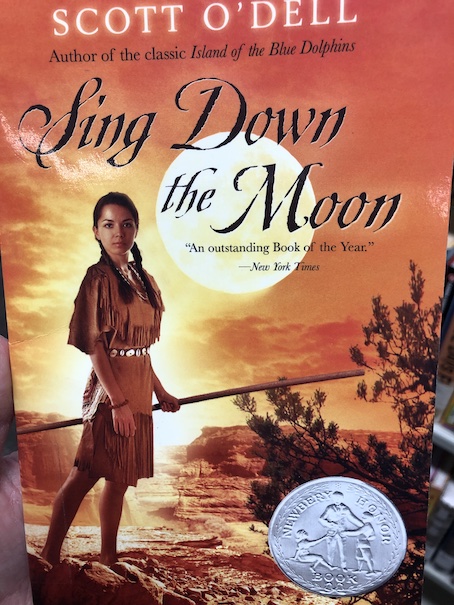
Sing Down the Moon cover

Sing Down the Moon by Scott O’Dell, 1970.

The story begins with a young Navajo girl, Bright Morning, admiring the beginning of spring, but she is caught in a storm and hurries home without the sheep she was supposed to be tending. When the girl’s mother realizes that she abandoned the sheep, she takes the girl back to the sheep, and they watch them all night. The sheep are very important to the family, and the girl’s mother refuses to allow her to take the sheep out by herself again for the rest of that spring.

When Bright Morning finally proves that she can be responsible and not leave the sheep to tend themselves, she is allowed to take them out again. Bright Morning likes to talk to the other girls, Running Bird and White Deer, as they watch all of their sheep together. The girls like to talk about their futures, who they will marry and what kind of children they have. They like to tease each other. Bright Morning’s friends know that she is likely to marry a young man called Tall Boy. The rumor is that Tall Boy’s parents want him to marry her because her mother owns so many fine sheep. Bright Morning knows that her friends tease because they are curious about Tall Boy and want her to talk about him, but she refuses. The girls know that he is supposed to be riding out with the warriors soon, and they tease that maybe he will bring back some other girl from the Ute tribe, but Bright Morning ignores them.
After the warriors have left for their raid on the Utes, the girls see some white men on horses approaching the village. The girls recognize them as oldiers and are worried that their village could be vulnerable to attack without the warriors. Later, the girls encounter more white men, but these men are not dressed as soldiers. They stop to talk to Bright Morning and Running Bird, asking them for directions, but the girls realize that they are slavers. They kidnap both girls and ride away with them!

They take the girls to a town of Spanish people and separate them from each other. They sell Bright Morning to a woman who uses her as a servant. The woman has other Native American girls as slaves, including a younger girl called Rosita. Rosita doesn’t mind her captivity or her life as a servant much. She came from a tribe that was very poor, and since she was brought to this woman’s household to work for her, she has had better food and clothing than she did at home. Rosita tells Bright Morning that the family they work for isn’t bad, and Bright Morning is allowed to keep her dog, who followed her when she was abducted. However, Bright Morning can’t stand her captivity. The woman who owns the house gives her new clothes, but Bright Morning doesn’t care. All she wants to do is find a way to go home.
Bright Morning is reunited with Running Bird when another captive girl comes up with a plan for the three of them to escape. They manage to steal horses and ride away from the town. Along the way, they meet up with Tall Boy and one of his friends, and the boys help fight off the Spaniards who are pursuing the girls. Unfortunately, Tall Boy is badly injured in the fight. He loses the use of one of his arms, and the other Navajos know that he can no longer be a warrior. Bright Morning still cares about Tall Boy, but her mother and sister tell her that she should no longer consider marrying him.
However, the Navajos’ troubles are just beginning. They haven’t heard the last of the soldiers. The American soldiers return and drive the Navajos off their land. They destroy all of their homes and eventually round them up and start them on a long march with little food, where many of them die. The Navajos fear that all of them will die. How will Bright Morning and her family survive, and will they ever see their homeland again?

The book is a Newbery Honor book. It’s available to borrow and read for free online through Internet Archive (multiple copies).

My Reaction

I remember reading this book when I was about 13 years old, in middle school! It takes place in my home state, the northern part, where the Navajo reservation is now, in the Four Corners region. I’ve been to Canyon de Chelly (“Chelly” is pronounced like “shay”, like in French) before, although I hadn’t been there at the time when I first read this book. Since I read this book as a kid, I’ve been to places and seen things that helped me understand the setting of the story better. As an adult, I appreciate the historical aspects of the story even more because I know more about the background. The book doesn’t give a date for the story until the postscript at the very end of the book, but the death march described in the story is Long Walk of 1863 to 1865.

The second half of the book is very depressing because there are horrible conditions and many deaths, including the deaths of children. I wasn’t sure that I really wanted to revisit this book at first because I remembered that it was depressing, but the book is well-written. The narrator describes events in an exciting, compelling way.

I had forgotten many details of the story, but there were some things that jumped out at me as an adult that I hadn’t noticed the first time. The postscript at the end of the story explains how life and Navajo culture changed after this traumatic event. If you see photographs of Navajo in “traditional” costumes now, they often include velveteen clothing, but that’s actually a relatively new tradition. The velveteen was adopted from white people during their captivity because they didn’t have access to wool to make their older style of traditional clothing. When Bright Morning was held captive in the Spanish town, she was given velveteen clothing there.

Another odd topic that is touched on only very briefly but that I know more about from other sources concerns the subject of flour. The book mentions that the Navajo were unused to eating wheat flour until it was their only form of rations during the Long Walk. Until then, their staple grain was corn, and when they started eating wheat flour, it made them feel sick. Their bodies just weren’t used to it. The book doesn’t explicitly explain this, but I know from other sources that the Long Walk and those flour rations were the origins of Navajo fry bread. Fry bread was not part of Navajo diet until that point. I grew up eating it on special occasions as a treat because it is greasy but good with powdered sugar, and it’s often served at carnivals and fairs here. However, as an adult, I came to realize that its origins as a food come from a very dark source. It was starvation food. It can keep you alive if there’s nothing else, but it’s not going to keep you healthy if you eat nothing else. It’s greasy and fatty, and it has little nutritional quality. Even now, I don’t have as much tolerance for it as I did when I was a kid. I can’t stomach it well these days if it’s too greasy or I eat too much.

That’s actually not a bad metaphor for the events described in this book. They’re heavy, and the more of it you understand and absorb, the sicker you feel. I absorb much more now than when I was a kid and only half understood the full significance of the events, and it makes me feel much worse than I did the first time.

So, do I recommend this book for kids? Actually, yes. I’m not a fan of depressing books with a lot of death, and I struggled through some depressing books when I was in school. If you had asked my 13-year-old self whether books with this much death and suffering were worth it, she might have had trouble answering that question, but time and further understanding have changed the way my adult self feels. There are some depressing topics that are worth the struggle to absorb them, but if I were the one teaching the lessons, I think I would do it a little differently than my teachers did for me back then.

I think this book is still a good introduction to topics that can be difficult to discuss. It’s worth reading once to understand the historical background of these events and what they really meant to the people who experienced them directly. It’s painful to read the bad parts, but it’s the kind of pain that leads to something better: real understanding. I recommend the book for kids in their early teens because I think that’s the best level for understanding it and accepting the bad parts. I think it should also be accompanied by nonfiction history lessons about the time period and events and discussion about their feelings about the story and historical events. I remember being told some of the history the first time I read this book, but I think that maybe there should have been more discussion about feelings.

I think it’s important to discuss feelings because they’re the hardest part of this book and they’re also the reason why it’s difficult to study some of the darker parts of history. I had a hard time with this when I was younger, and I still do in some respects, but I think understanding what causes those feelings is key to handling them. Reading books like this while discussing tools to handle difficult feelings could help students to better handle their emotions in other areas of life as well.

One of the first points that I think is important to understand and which my teachers didn’t really explain to me is that it’s natural to feel bad when you hear about bad things happening to other people, even when the bad things happened generations before you were born or even when those individual characters are fictional. (Bright Morning and her friends and family are fictional characters even though the events around them are historical. Real Navajos did experience what they experienced.) Empathy is a natural human emotion, and it’s an important tool for living with other people. Humans are social creatures. We live as part of larger groups, and we need at least some empathy to understand other people’s emotions and circumstances, how our actions affect them, and how to treat other people as we ourselves would truly like to be treated. The ability to experience empathy is a sign that you are mentally and emotionally healthy. It’s really only worrying when someone can’t feel it.

One of the most disturbing feelings about this story comes from realizing that the soldiers who are inflicting all of this death and pain either don’t feel empathy for the people they are harming or have actively chosen to ignore it to further their own purposes. That’s not a sign of being mentally or emotionally healthy or behaving in a moral way. When the readers feel repulsed by the soldiers and what they’re doing, it’s because they recognize that these people are a serious danger to others, and they are not functioning in a normal way. Your brain is warning you of a threat. It’s a past threat rather than an immediate one, but if you find the soldiers and their actions upsetting, it’s a sign that your brain has accurately assessed the risk associated with these people and the harm they do. You have accurately connected the suffering of other people for whom you feel empathy with the people who are the direct cause. I’m not saying that the soldiers were necessarily psychopaths, but lack of empathy and remorse and calculated manipulation are all symptoms of psychopathy and should raise alarms for anyone confronted with those signs. So, feeling bad about this situation and the people causing it is a sign that you yourself are mentally and emotionally healthy and have correctly recognized the seriousness of the situation and the harm being done to other people. What I’m saying is that, even when you’re feeling bad, it’s for good reasons, and that deserves recognition.

When I was young, I felt angry and frustrated by stories where people were doing terrible things to others. I still do because that’s part of empathy, but I also came to realize that part of my frustration when it came to historical situations came from my inability to change the situation. When harm has been done, it’s impossible to undo it. What was done was done. I can’t help the people who died, and I can’t even punish the wrong-doers because they’re dead now, too. It’s frustrating to find yourself confronted by a situation where nothing can change. But, I think it’s important to realize that change has happened and is currently happening. History is being written all the time, not even just through writing but through the ways that people live their lives every day. Even when a particular event is over, events and people keep moving. Bad events can cast long shadows, causing harm long after the initial event. That’s part of what makes them so bad. However, as time moves on, new people enter the scene, and new things happen, including things that people in the past would never have foreseen. It eventually reaches a point where the things that continue to happen rely on what we, the living, continue to do or allow to be done. History takes the long view, and I think people need to be reminded of that.

Do you suppose that the people in this story who act as villains thought of themselves like that? Further point, how much does it matter how they thought of themselves? Maybe they thought of themselves as winners at the time because they were getting their way and the people they were hurting were unable to stop them from hurting and killing them, but is that really “winning”? Lazy historians frequently brush things off by saying that “history is written by the victors“, but if that were really true, would we even be hearing or reading stories like this? Would we ever hear about slaves or care about the victims of war and atrocity? Would we ever consider the perspectives of people who died at all? Or does it change your mind about what “winning” really is and who’s really a “winner”? Maybe, in life and history, there aren’t any “winners” because neither of those was ever really a contest to begin with. (Or, as some put it, life is a collection of contests that people can simultaneously be both winning and losing. Personally, I think life is just for living, not for winning against someone else who is also trying to just live and probably couldn’t care less about you “winning” or not.) Apparent victories aren’t always real accomplishments, and people who see that reality are the ones who write the most accurate histories. Individual human lives only last so long, so any apparent “win” by an individual or group is never more than temporary. Our sense of what history includes and what people in the past were really like changes as we increase our knowledge of it and reconsider the context, not unlike the way my 40-year-old self has a deeper understanding of this book than my 13-year-old self did.

Remember that, at the beginning of this particular story, the Navajo warriors were going to raid the Utes. We never really find out in the book why they were going to do this, but does it matter anymore when the Navajos themselves get raided and subjected to something that might be even worse than what they were originally planning to do to their enemies? The story drops this subplot when the march begins. Life is like that, constantly moving, ever changing. History goes on and on. Sometimes, a young warrior who was praised for his prowess gets shot in the arm and can’t pull a bow anymore. Sometimes, a 40-year-old woman from the 21st century looks back on 19th century soldiers who may have thought of themselves as heroes and wants to tell them, to their faces, that they couldn’t be more wrong about that. If they’re not evil psychopaths, they’re doing a dang good job of pretending, and I never once thought of them as being “heroes” in my entire life. That’s life for you. Each of the people who have read this book or ever will read it are among the new people entering the story and its sequels, and we all have the ability to decide what role we want to play in the on-going story of history.

What happens after the book ends, is important, too. If I were teaching this, I would follow up this particular chapter of Native American and Navajo history by talking about some of the developments that continued to happen in their history, including some of the better moments, like the development of the written form of the Navajo language (for much of it’s history, Navajo was only a written language – that’s why the soldiers in the story couldn’t leave a written message in Navajo) and how code talkers used the Navajo language during WWII. The people who realized that these things were possible and something worth working toward were creative individuals. Rather than seeking to destroy something or repress it, they found creative ways to make use of what was there and put people’s talents to good use, helping others. The worst moments of history have been when people without empathy use others or seek to destroy them for personal gain, but the triumphant moments are when people take what they have and find a way to make it better. Noting these positive moments doesn’t make the bad parts of history any better than they actually were, but what we want is more of these positive moments of creativity and development and the type of people who are willing to work to make them happen.

It helps to balance out the explanations of what went wrong and people who did wrong with examples of what was better. Some teachers stress how we teach the bad moments so people learn from the past and don’t repeat it, and that’s true. However, I think we also need to add on what has worked and what we want people to do instead. A “don’t do this” needs to be followed up by “do this instead” to be an effective instruction. As a society, we don’t want more destroyers and takers. We want innovators and makers. We want creative people who find new uses for resources, including human resources and talents, and who are dedicated to truly helping others and human society as a whole instead of merely helping themselves to what others have that they want. This book demonstrates the dark side of humanity, but as I said, history is still being written every day with new players.

On the lighter side of this story, I enjoyed the descriptions of the coming-of-age ceremony for young women that Bright Morning has and the marriage ceremony later. During her time in captivity in the Spanish town, Bright Morning also attends Easter celebrations. She doesn’t understand Christianity and has never heard of Jesus before, and she doesn’t understand what the holiday is about or what’s going on. Rosita tries to explain to her who Jesus is in terms of Navajo religion. I found the explanation fascinating, but Bright Morning is still confused.

Native Americans

Native Americans by Jay Miller, 1993.

This book is part of the New True Books series, a series of nonfiction picture books on a variety of topics. This particular book gives an overview of the history and culture of Native Americans.

The book starts with some basic definitions and broad explanations of certain aspects of Native American culture, beginning with the explanation of why Native Americans are sometimes called “Indians.” The book notes that each tribe of Native Americans also has a name for itself. Each tribe has had its own culture, which it thought was better than other tribes’ cultures, but throughout history, tribes have interacted and traded with each other. One factor that made Native American cultures different from each other was whether tribes relied mainly on farming or hunting and gathering for food.

The book refers to hunter-gatherers as “caretakers”, a term that I can’t recall seeing before for hunter-gatherers. The reason why they use the term “caretakers” is they say that hunter-gatherers took care of their environments and only took the plants and animals they needed for survival, not wasting anything.

There are sections of the book that discuss some general aspects of Native American culture, like types of homes and tribal leaders. Of course, as the book notes, many cultural aspects varied, depending on the tribe, the environment where they lived, and whether they were mainly farmers or “caretakers.”

The book also has sections about the Native America tribes of various regions of North America, like the Northeast, the Southeast, the Southwest, the Northwest Coast, and the Plains.

The book ends with a brief section called Changes, which explains how Native American cultures were impacted by the arrival of Europeans in North America.

The book is available to borrow and read for free online through Internet Archive.

Blackbeard’s Ghost

Blackbeard’s Ghost by Ben Stahl, 1965, 1976.

This is the novel that the live action Disney film Blackbeard’s Ghost from 1968 was based on. My copy is a later edition designed as a tie-in with the Disney movie, based on the cover, but it contains the text of the original story.

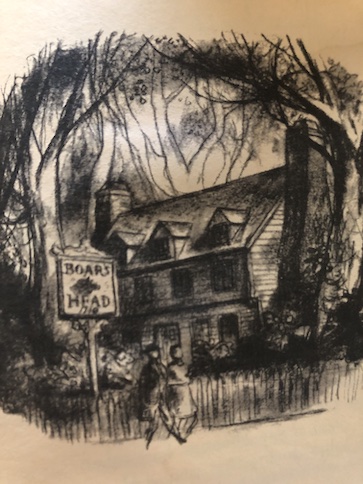
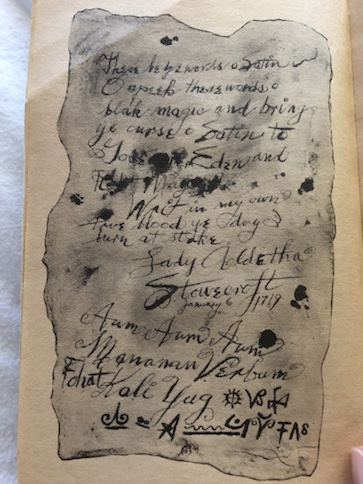
The story begins with a prologue that explains how Blackbeard the pirate evaded execution for piracy by offering to collect tolls from ships on behalf of the colonial governor, Governor Eden, in the town of Godolphin. However, instead of collecting tolls from the ships, he decided to use his position for his own benefit. Knowing that he would eventually need a source of stability on land instead of spending the rest of his life at sea, he looted wood from various ships and used it to build a tavern for himself called the Boar’s Head. He hired a woman rumored to be a witch, Aldetha, to tend the tavern for him. In the end, though, Blackbeard was killed by someone who wanted to collect the bounty on him for piracy. After his death, the poor woman who tended his tavern was burned at the stake for witchcraft.

(Note: The witch burning is historical inaccuracy because no witchcraft executions in North America involved burning, at least not in English-controlled parts of the American colonies. Accused witches in North America were typically hanged. None of this story is meant to be historically accurate, but I always feel compelled to point that out in stories that make that mistake. The town of Godolphin and the Boar’s Head Tavern are fictional. In real life, Blackbeard did receive a pardon from the real Governor Eden in Bath, North Carolina, and he was eventually killed in 1718 in a battle with Lieutenant Robert Maynard and his crew, as he did in this story. However, in the book, the tavern is now owned by a descendant of Maynard’s, and in real life, Maynard didn’t have any children.)

Most of the story takes place in the 20th century, when two 14-year-old boys, J.D. and Hank, talk about how the old Boar’s Head Tavern is about to be torn down because the former owner sold it, and there’s going to be a gas station built on the land instead. They think it’s a shame because they’ve heard ghost stories about the place and think the old tavern is fascinating. The boys go to watch the workmen tearing down the old tavern, but the workmen haven’t made any progress so far. Although they’d love to loot some of the expensive woods from the old tavern, they just can’t seem to dismantle the building. They’ve been able to dismantle some of the newer additions to the building, but somehow, they can’t seem to touch the original structure. The site has been plagued with mysterious accidents. Their equipment fails, heads fall off the ends of their hammers, and workmen keep getting injured in small accidents, not enough to seriously hurt anyone but enough to keep them away from their work for days at a time.

When J.D. and Hank see the workmen leaving the building in frustration soon after arriving, they decide to go inside and look around to satisfy their curiosity and see if there’s anything of value that they can salvage before the tavern is demolished. They don’t find much of value, but they do find their way into Blackbeard’s secret dungeon under the tavern. There, they find a piece of old parchment with a satanic curse written by Aldetha. (So, apparently, people were actually right about her being a witch. Plot twist!) Inspired by this creepy message from the past, the boys realize that they can make money from other kids by capitalizing on the ghost stories about the old tavern and holding seances to contact the spirits. They don’t really believe that seances are real, but they figure that, if they can get enough ghost-story fans to come to their seances, they can make a profit from this enterprise.

Of course, the boys’ seance awakens the ghost of Blackbeard. Blackbeard is invisible to everyone except for the boys, but he’s a solid ghost, who can manipulate physical objects. The boys quickly realize that Blackbeard can be a dangerous ghost, and he’s not at all happy when he finds out that a descendant of the man who killed him wants to have his tavern torn down.

The book is available to borrow and read for free online through Internet Archive. The Disney movie is available to buy or rent through YouTube or Amazon Prime. There is also a sequel to this book called The Secret of Red Skull, which involves spies and is also available online through Internet Archive.

My Reaction and Spoilers

There is some humor in this book because only the boys are able to see and hear Blackbeard, but by the end of the story, adults become aware of Blackbeard’s ghost, too. The boys’ history teacher is helpful in finding a way to appease the ghost by helping him to negotiate to buy back his tavern using his hidden treasure. When it becomes obvious both to Maynard and the company he tried to sell the tavern to that it’s haunted, they’re willing to accept pirate gold in exchange. The company also sees that it can use the building for public relations purposes by sponsoring a pirate museum in the old tavern. It’s good news for the teacher, too, because he gets to be the director of the museum. There, he can show off his collection of pirate memorabilia and indulge his love of pirate history. The tavern continues to be haunted by the ghosts of Blackbeard and his witch friend, leaving the story open for the sequel.

As expected of Disney films, the Disney movie version of the story is quite different from the book. In the movie, the person who can see the ghost is a college track coach who is staying in the old inn, which is still being operated by elderly descendants of Blackbeard’s old crew. There is a track meet in the movie that never appeared in the book, and at the end of the movie, Blackbeard disappears, having been freed from his haunting by performing a good deed.

I prefer the concept of the boys being the ones who accidentally summoned Blackbeard’s ghost, but the boys got on my nerves at first. In the early part of the book, they bickered a lot and didn’t seem to like each other enough to be best friends, although they seemed to be friendlier with each other later, when they were both trying to figure out what to do about Blackbeard. I think the teacher character was my favorite. He takes the matter of the ghost in stride, coming up with a practical solution that helps everyone.

Castles

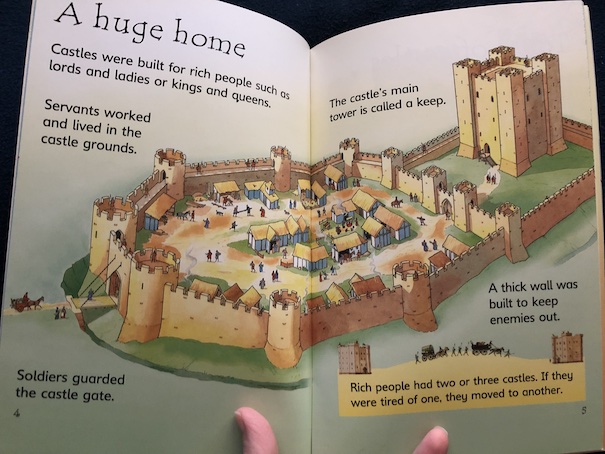
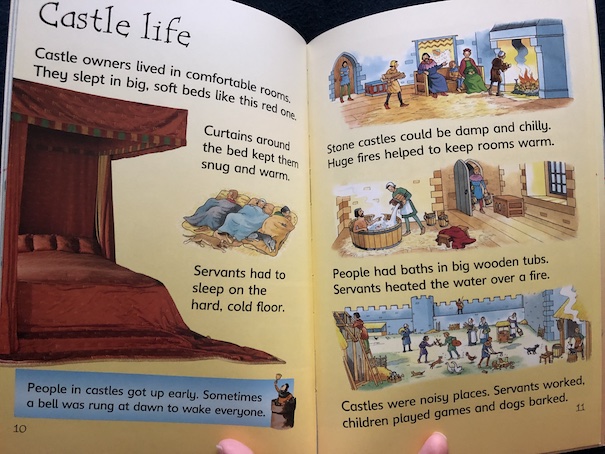
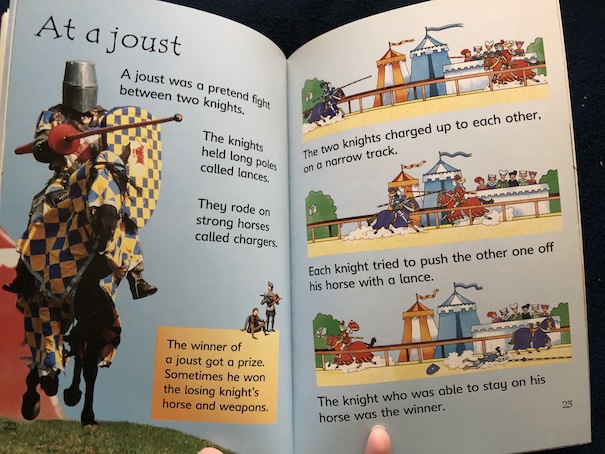
Castles by Stephanie Turnbull, illustrated by Colin King, 2003.

This nonfiction picture book for kids is part of the Usborne Beginners series, originally published in Britain. There are other books about castles, knights, and life in the Middle Ages from Usborne, but this book in particular, like others in its series, is a simplified version meant for beginning readers. The book is recommended for ages 4 and up.

The book explains different types of castles and the parts of a castle. It also offers details about daily life for people who lived in castles, including hunting, food and feasts, and things they would do for fun.

There are also pages about knights, the armor they wore, jousts, and attacking and defending a castle.

The book ends by explaining why castles from the Middle Ages are in ruins today.

In the back of the book, there is a glossary of terms and a link to the Usborne site’s page of quicklinks, which still works and has links to child-friendly informational sites on various topics, organized first by topic and then by related book. Both the book and the website offer Internet safety tips for kids and parents.

The book is available to borrow and read for free online through Internet Archive (multiple copies).

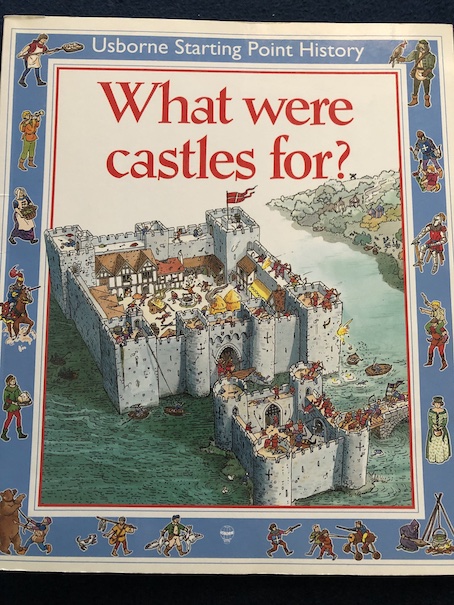
What Were Castles For?

What Were Castles For? by Phil Roxbee Cox, illustrated by Sue Stitt and Annabel Spenceley, 1994.

This nonfiction picture book for kids is part of the Usborne Starting Point History series, originally published in Britain.

I love books about daily life in the past, and this book explains the lives of people who lived in castles during the Middle Ages by answering questions about what castles were for and what people in castles did. Each page of the book is organized around sections answering specific questions.

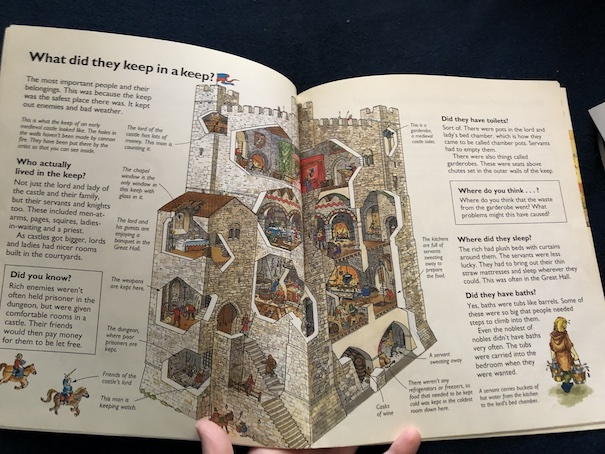
First, the book describes the basic purpose of castles and different types of castles that have existed and how they were built. The, it shows different parts of a castle and what people did in different parts. One of my favorite parts is where they show what is in a castle’s keep, which is where the lord of the castle and his family lived. The book uses cutaway pictures to show what is inside buildings, and the detailed pictures show the different activities of the people.

Among the activities of the nobles who lived in castles, the book explains how they would hunt and hold feasts and jousts.

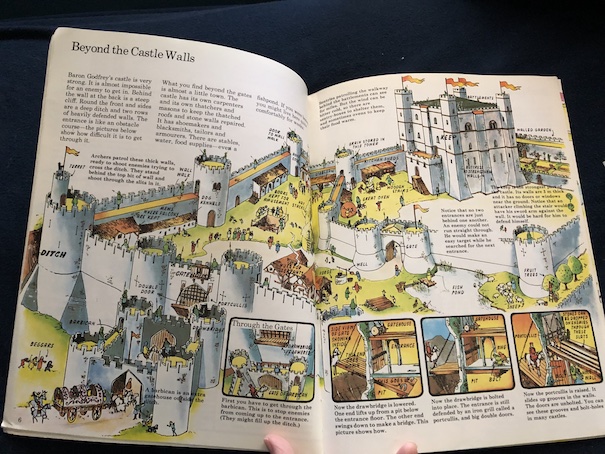
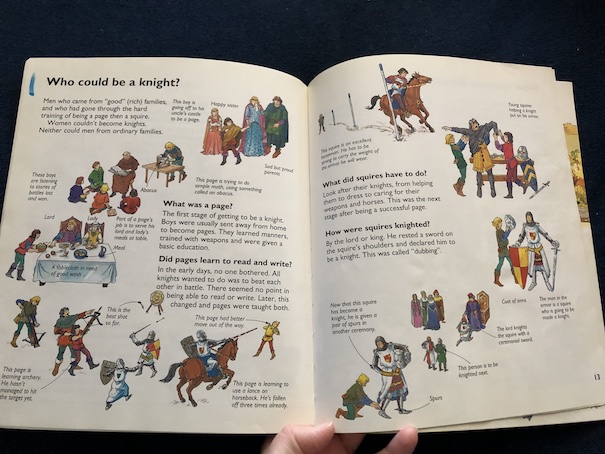
Knights and warfare were central to the purpose of a castle, which was to provide a defensible fortress for the noble families who lived in them and their supporters. The book explains how boys from noble families were raised and educated to be knights. There are also pages showing weapons and the siege of a castle.

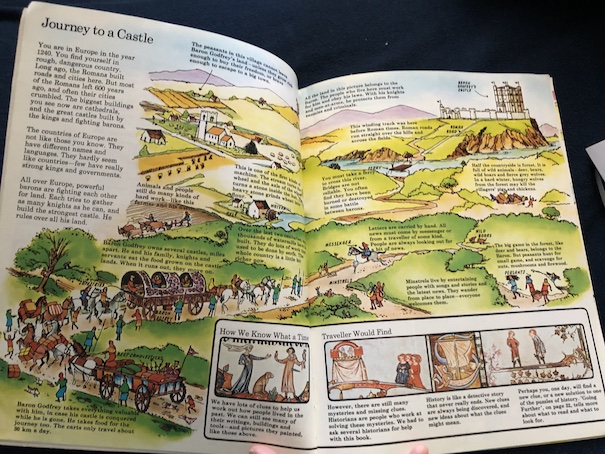
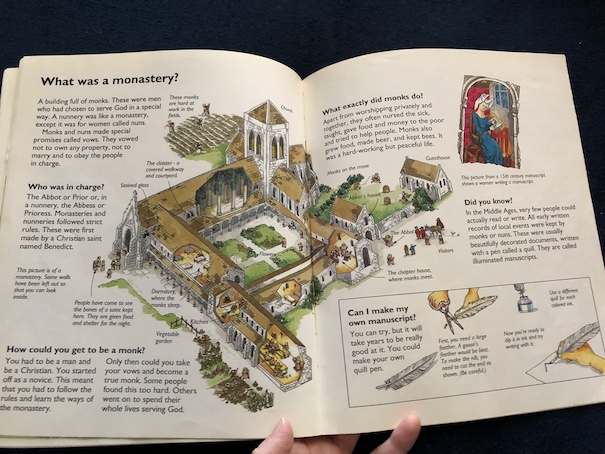
One of the things I liked about this book is that, while it is mainly about castles and the people who lived in them, it also shows how people lived outside of castles in small villages, towns, and monasteries. While castles are iconic of the Middle Ages, seeing how people lived in these other places gives a more expanded view of life in Medieval times.

The pictures really make the book! Every picture from the cutaway castle views to the scenes of villages and towns or jousts and hunts, show many people and small details. There are little descriptions labeling the people and details, most giving extra historical information, but some just for fun so readers can notice humorous details, like the monk being chased by bees at the monastery, the chicken escaping along the castle wall, the sister who is happy that her brother is going off to learn to be a knight, and the page who is learning archery but hasn’t made the target yet (his last failed shot falls short of the target, but it’s labeled as the best he’s done so far).

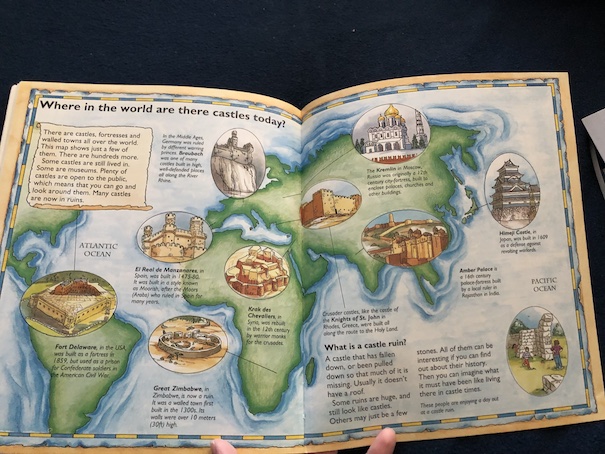
In the back of the book, there is a section with the legend of Richard the Lionheart and his minstrel and a map marked with famous castles around the world.

The book is available to borrow and read for free online through Internet Archive (multiple copies, including one in French).

Knights & Castles

The Usborne Time Traveller Book of Knights and Castles by Judy Hindley, illustrated by Toni Goffe, 1976, 1993.

This nonfiction picture book for kids is part of the Usborne Time Traveller Books series, originally published in Britain.

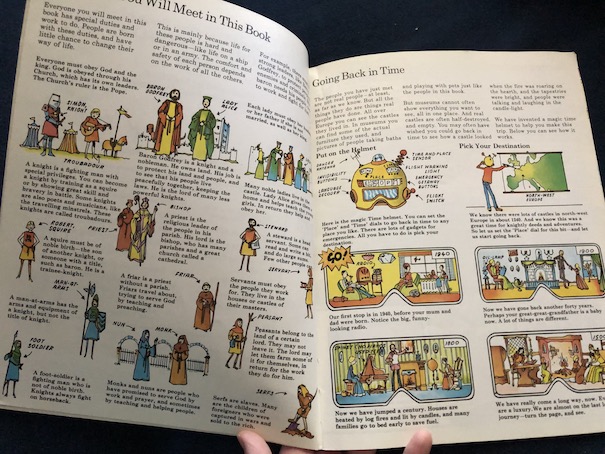
The contents are framed as a time back in time to the Middle Ages, specifically 1240 AD, to see how people would have lived in Medieval times and what castles were like when people actually lived in them. Readers follow a specific set of Medieval characters as they go about their lives.

Our trip back in time begins with a road journey to a castle. Readers see how people in the Middle Ages traveled. The journey page also explains how the Romans built the roads Medieval people used centuries earlier, which is a good historical segue because the period that we call the “Middle Ages” begins with the fall of the Roman Empire and the withdrawal of Roman forces from the furthest parts of its empire. On some pages of the book, there are extra panels at the bottom of the page with additional information, and the first set explains how we know what people would find if they were able to travel back in time to the Middle Ages, explaining how historians have gleaned information from Medieval writings and pictures and from studying physical objects, like buildings and tools.

When readers arrive at the castle, the book explains different parts of the castle and how they were used for defense.

I particular like the cutaway pictures of the interior of the keep because I enjoy the details of people’s living quarters and daily life in the past. There is a page that shows the morning routine of the castle and how people would get dressed for the day. There are also pages about hunts, feasts, a visit to a building site, and a trip to town.

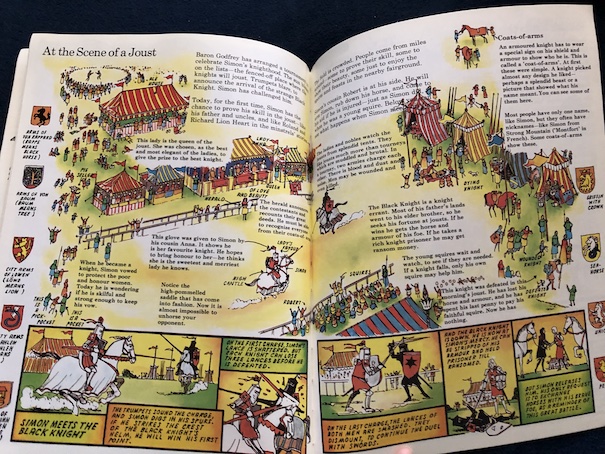
There are a couple pages about knights and how a boy would train to be a knight. There are also pages about jousts, the Crusades, and attacking and defending a castle.

The pictures are cartoon-like, but they are busy and full of details for readers to study, accompanied by notes that offer more information and historical background.

At the end of the book, there is a map showing locations of famous European castles.

The book is available to borrow and read for free online through Internet Archive (multiple copies).

Catherine Called Birdy

Catherine, Called Birdy by Karen Cushman, 1994.

Catherine is a 14-year-old girl living in Medieval England in 1290. The entire book is written in the form of diary entries, but after the first few extremely short and unenthusiastic entries, Catherine reveals that she is not writing these entries of her own free will. Keeping a diary was her brother Edward’s idea. She explains that Edward, who is studying to be a monk, thinks that keeping a diary will help Catherine become “less childish and more learned.” At first, Catherine declares that she won’t continue writing and that Edward can write the diary himself if he wants it so badly, but she changes her mind when her mother releases her from the even more boring chore of spinning so that she can have more time to write. Although she can’t think of much of interest to write about her daily life at first, she would rather continue to try writing than spin.

From there, Catherine describes her life and family in detail. The diary continues for a full year, from September 1290 to September 1291. Catherine lives with her parents, but she isn’t fond of her father, who often hits her. Her father is a country knight, but not a particularly wealthy one. They have some servants but not enough that Catherine doesn’t need to help with household chores. She would much rather be out, running around the fields and playing than doing chores and sewing with the other ladies of the household. Catherine’s mother has suffered several miscarriages since her birth, and she still mourns for the children she has lost. Catherine is her youngest child, and she is the only one who still lives with her. Catherine has three older brothers, and none of them live at home anymore. Two of her brothers are away in the king’s service, and Edward is at his abbey. Catherine’s first diary entries are mostly about chores, avoiding chores, and pulling some admittedly childish pranks and stunts.

However, her diary entries soon note that a major change seems to be starting. She notices that her father is suddenly taking an unusual amount of interest in her. Usually, he pays little attention to her, except to give her a slap or smack, but suddenly, he starts asking her probing questions about herself and her health habits. It’s strange behavior for him, but Catherine soon realizes the reason why. Her father is planning to marry her off, or sell her off, as Catherine thinks of it. Catherine’s assessment is pretty accurate because the man is wealthy and has promised her father a handsome sum if Catherine marries him. Catherine’s father’s main interest in her and her future marriage is how it can benefit him.

Catherine doesn’t consider herself a great beauty, a very accomplished young lady, or a real prize, so she can’t imagine why this man might want her and even be willing to pay for the privilege. It turns out that her prospective suitor is a wool merchant whose ambition is to become mayor. Catherine’s family is nobility, although not very high-ranking or important nobility, but having a wife of noble blood would be to the merchant’s political advantage.

Catherine has already decided that she doesn’t want him. When Catherine learns that her prospective suitor will be coming to see her, she decides that she will act stupid and unappealing so he will give up the idea of marrying her. However, even though she scares away the first suitor, she is at the age when noble girls start to consider marriage, and there are soon other suitors. Catherine doesn’t want any of them! She doesn’t even want to be a noble young lady at all. The story of Catherine’s attempts to get rid of her unwanted suitors and to figure out what she really wants out of life are lively and humorous and sometimes touching.

The book is available to borrow and read for free through Internet Archive (multiple copies).

My Reaction

I enjoyed the details of everyday life that Catherine describes. She finds the typical chores that young ladies of her social class do boring, and she often dreams that she could do something more exciting or outdoors, whether it’s traveling on a Crusade or even just ploughing a field. Still, she describes her activities in detail, including the ingredients that she uses to make different types of medicines. One of the duties of a Medieval housewife was to tend to the health of members of the household, so like other Medieval young ladies, Catherine has been learning how to make various home remedies, with varying results.

Modern day anti-Semitism has roots in Medieval times, and this book also addresses that when Catherine’s mother allows a party of traveling Jews to stay the night. At this point in history, the king is ordering Jews to leave England because he thinks they are evil. These travelers are poor refugees on their way to live in Flanders (a region in modern Belgium). Catherine notes that her mother is not afraid of Jewish people, even though other members of their household are. Catherine herself is curious about them. She has heard stories that Jewish people secretly have horns and tails, like the devil, and she excitedly spies on them to see if it’s true. She is actually disappointed to find out that it’s not true and that these poor people are just poor people in ragged clothes. One of the women allows Catherine to listen while she tells stories to entertain the children in the group, and Catherine finds the stories charming. It occurs to her that there are different types of stories in the world, ones that are true and ones that aren’t, and that the stories people have told her about wicked Jewish people aren’t true. She even starts to think that it would be exciting if she were to join the Jewish group and go abroad with them to seek her fortune.

She does temporarily disguise herself as a boy to go with them, but when she explains to dissatisfaction with her life to the woman in the group, the woman discourages her from running away. The woman says to her that, in the end, nobody is going to ask her why she wasn’t like one of the boys or men but why she didn’t spend her life simply being Catherine. In one of her stories the night before, the woman had emphasized knowing who you are and where you are and what you are to orient yourself in the world. Although Catherine doesn’t fully understand it at first, the key to finding her happiness isn’t about running away from the things she doesn’t like in her life, whether it’s chores that she finds boring or a suitor she doesn’t like, but how to make choices that give her life a purpose that suits her and that lead her to better options.

Catherine daydreams about more exciting options in life, but none of them are really right for her because there are things that she doesn’t know about the realities of these other positions. She loves the beautiful illuminated manuscripts that monks like her brother make, and she wonders if she could disguise herself as a boy and become a monk so she can spend her days making beautiful paintings. Her brother laughs at the idea because he says that her figure is too feminine for her to be a boy, and there is no point in her becoming a nun because nuns spend most of their time sewing, one of the chores that Catherine doesn’t like. When she asks her Uncle George about being a Crusader, he tells her that war is more like hell than the heavenly adventure she is imagining. Although Catherine thinks than men’s work and war sound exciting, her brother and uncle realize that Catherine knows little of the reality behind them, and she would not be happy with the reality if she knew. Early in the book, she also laments about never having been allowed to see a public hanging, but when she learns more about them, she realizes that she doesn’t like them. This book reminds me a little of the picture book Hester the Jester, where another Medieval girl tries different professions before deciding that she’d rather be herself.

None of this is to say that there are only separate roles for men and women in life and that Catherine, as a young woman, would be incapable of doing anything other than typical women’s work. It’s really more that, while there are relatively limited possible occupations for a girl of Catherine’s time and social level, it’s the woman who makes the occupation rather than the occupation that makes the woman. Catherine can still be happy in her position as a young noblewoman of her time if she can learn to shape her position in life to suit her, learning and adjusting her life as she goes. That’s the best way for a girl in Catherine’s position to become her own woman.

An older noblewoman, who correctly guesses Catherine’s nickname of Birdy, talks to her about the lives of noblewomen. Although she is of a much higher rank than Catherine, she tells Catherine that her position also comes with duties and obligations, not the freedom and adventure that Catherine imagines. However, the older woman says that, just because she doesn’t spend all her time flapping her wings, doesn’t mean that she can’t fly, meaning that although she can’t control everything about her life and obligations, she is not powerless. She tells Catherine that she picks her battles and that Catherine should consider what she says and do the same. Catherine doesn’t understand her full meaning at first, but the older woman means that, rather than chafing over the position in life that she was born to and the things she can’t change, Catherine can focus on the parts that she can control and change. When Catherine gains a greater understanding of who she is and how she can remain herself in whatever circumstances she finds herself in life, she is ready to move forward in her life.

For a girl of Catherine’s social class, marriage is expected, unless she becomes a nun, which Catherine has already rejected as an option. Catherine doesn’t like the idea of marriage because she thinks that she knows what a marriage is like, based on her parents’ marriage, but Catherine’s mother tells her that a marriage is what you make it. Catherine’s father is a brutish man who drinks too much, but he treats his wife very differently from the way he treats everyone else, which is why she still loves him. Catherine observes that people can have layers and that sometimes, people are different when they’re in the company of different people. Even her brother Robert, who is frequently odious, surprises her with a great kindness when she needs it. It helps Catherine to realize that marriage might not be so bad if it can be with a person who is kind and agreeable in the ways that matter to her.

A major part of Catherine’s problem is that her choice of who to marry largely depends on what her father arranges, and her father is an uncaring, brutish man who sees Catherine more as an asset to be used than a person whose own future needs to be nurtured. Although Catherine doesn’t like the men her father would pick to be her suitor, mostly because they would benefit him more than Catherine, circumstances eventually allow Catherine to marry a man who would suit her instead. Like Catherine, her new intended husband is known to be a man who values learning and was criticized by his brutish father about it, so the two of them may understand each other and share similar ideals in life. Being a married woman who is married to a man who suits her, rather than trapping Catherine in an unwanted position in life, will allow her to run her own household in her own fashion and give her a way to escape from her father and his abusive and self-serving treatment.

I particularly liked some of interesting the Medieval superstitions that Catherine believes. When her mother gives birth to her little sister at the end of the book, Catherine unties all of the knots in the house, which I’ve heard of before as a superstition to help ease births.

Because of some of the content of the book, like the description of the difficult birth of Catherine’s sister, I think this story would be best for tweens and teens.

Crispin and the Cross of Lead

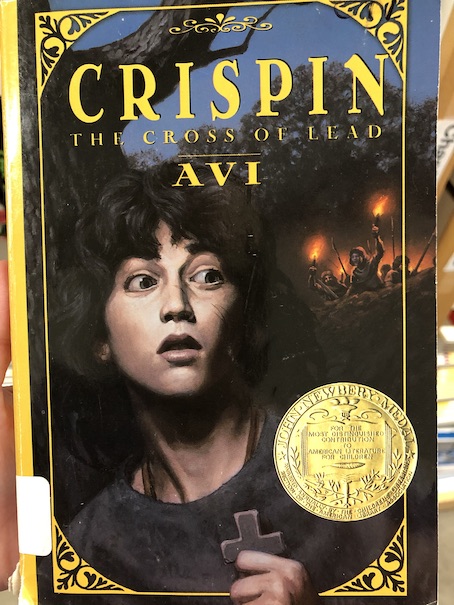
Crispin: The Cross of Lead by Avi, 2002.

The story begins in 1377 in England. It begins with the death of the boy’s mother, Asta. The boy is only known as “Asta’s son” at this point. Nobody has ever called him anything else for as long as he can remember. Even his mother only called him “Son.” He is 13 years old and has no knowledge of who his father was, although his mother told him that he died of the Plague before he was born. As a fatherless child, he was often taunted by others in their little village, and he noticed that no one really seemed to like his mother, although he never really understood why. The only real friend they’ve had is the village priest. With his mother gone and John Aycliffe, the steward of the manor of Lord Furnival that controls the area where they live, demanding his only ox as the death tax for his mother, the boy fears starvation.

As a bleak future lies before the boy, something happens which makes his situation even more dire. He witnesses a secret meeting between John Aycliffe and a mysterious stranger. The boy doesn’t understand the significance of the meeting, but Aycliffe catches him watching and tries to kill him. The boy escapes, but it soon becomes clear that he can’t go home again. Aycliffe has people hunting for him, and he overhears a couple of them talking, saying that the steward has accuse him of stealing from him. No one actually likes Aycliffe and they don’t really believe that the boy is a thief, but they have no choice but to follow the steward’s orders because he’s a relative of Lord Furnival’s wife, and that’s how he gained his position.

Not knowing why Aycliffe has framed him for theft and not having anywhere else to go, the boy turns to the village priest for help. He discusses the meeting he witnessed between Aycliffe and the mysterious stranger, and the priest reveals that Lord Furnival, who has been away, fighting, has returned home but is now dying. The stranger, Sir Richard du Brey, brought the news of Lord Furnival’s impending death, but the boy knows that Aycliffe and du Brey seemed concerned about another matter, something they said posed a threat to them.

The priest tells the boy that Aycliffe means to have him killed and that his only choice is to run away. The boy doesn’t see how he can do that or where he’s supposed to go because he has lived all of his life as a serf, bound to the land. The priest tells him that he needs to go to a big town and stay there for a year and a day to gain his freedom from serfdom (this was a true historical way for people to escape serfdom in the Middle Ages). The priest also tells the boy that his real name is Crispin, but his mother didn’t want anyone else to know, for reasons that he doesn’t explain. He asks Crispin if his mother ever told him anything about his father, but the boy just says that all he knows is that his father is dead. Crispin asks the priest if there’s something that he’s not telling him about his mother, but the priest doesn’t explain. Instead, he tells Crispin that the most important thing is for him to get away. He tells Crispin to hide in the woods while he gathers some things to help him on his journey, and he promises to tell him more about his father when they see each other again. He says that it would be safer for Crispin to know more right before he leaves. (You just know that when someone has something important to say but would prefer to say it later, that person is probably doomed.)

When Crispin waits for the priest to come for him later, a boy from the village shows up instead, saying that the priest sent him. The boy, Cerdic, guides him to Goodwife Peregrine’s house, and she advises him to go to the south because the steward’s men are searching the road to the north. She gives him some food and a cross made of lead in a leather pouch. Before Crispin leaves the village, however, Cerdic says that maybe he should head north after all because the steward might have been lying about searching the north, just to make Crispin think that he should go south. Cerdic says that the priest told him that the best way for Crispin to go would be west because that’s what everyone would least expect. It would be the last thing anyone would expect because the Lord Furnival’s manor house lies in that direction. However, Crispin soon discovers that he has been led into a trap and that the steward is waiting for him. He manages to escape, but he discovers that the priest has been murdered, preventing him from telling him whatever he knew.

Crispin wanders by himself until he finds an empty village where everyone was apparently killed by the Plague. However, there is one other person in the village, a traveling entertainer. The entertainer gives Crispin some food, but he also forces him to tell him his story. Realizing that the boy is a runaway, he forces Crispin to become his servant on the principle that a runaway serf can be taken by anyone. Crispin doesn’t want him for a master, but he has no choice because, if he refuses, the entertainer could easily turn him over to the steward at his former manor, where he would be killed.

The entertainer explains that his name is Orson Hrothgar, but his nickname is Bear because he is a large man. He shows Crispin his juggling and explains that’s how he makes his living. He asks Crispin what he can do, but all Crispin knows is the farming he did as a serf. Bear says that there is no way he could make a living on those skills in any city he went to and he’s going to have to acquire some new ones. Bear is a strange master, giving orders like a tyrant but at the same time claiming to hate tyranny and keeping Crispin firmly in his service while refusing to be called “sir” because he thinks that it makes Crispin sound too servile. As Bear and Crispin get to know each other, it starts becoming obvious that Bear is actually trying to help Crispin when he’s hard on him and even forcing him to serve him is actually in Crispin’s favor because Crispin doesn’t know how to survive by himself in the wider world and hesitates to make decisions for himself without guidance or orders from someone. The threat against Crispin’s life is real, and he’s gong to need help and guidance to survive.

Bear teaches Crispin how to sing and juggle so he can perform with him, but he also teaches the boy how to have some respect for himself and how to take charge of his own life. He can tell that Crispin has been badly neglected in his early life, taught only to obey orders and not ask questions. Because, for a long time, Crispin didn’t even know he own name, he thinks of himself as basically a nobody who doesn’t have a place in the world and isn’t worth anything to anyone. Bear takes Crispin in hand and shows him that his life and his own self are what he decides to make of them.

Bear’s own history is a strange story, and he tells Crispin how his father originally enrolled him in a Benedictine abbey at a young age to be a monk. While he was there, he learned to read and actually became a scholar, but before he took his final vows, he happened to meet a group of mummers, and he was charmed by the life of a traveling entertainer. He abandoned the abbey and traveled with the mummers for a time. He has also been a soldier, and during his time as a soldier, he met Lord Furnival. Crispin asks him what Lord Furnival is like because, even though he has always served on his land, he’s never actually met him. Bear describes Lord Furnival as a cruel man who used other men for his own gain and killed them when he had no use for them.

When they arrive at a new town, Bear assumes that Crispin will be safe to perform in public, having left his enemies behind because few people would pursue a poor boy of no important family or position over the theft that he was accused of doing back in his village. However, Crispin is alarmed to see Aycliffe as they enter the town. Bear realizes that there must be more to Crispin and his situation than even he knows. The murder of the priest back in the village is a shocking crime and must have been intended to silence him from telling whatever he knew. If Aycliffe poses a threat to Crispin, it seems that Crispin must also somehow pose a threat to him, a threat that he thinks must be eliminated. Discovering the reason for targeting Crispin also means unraveling the secrets of Crispin’s past and parentage, and along the way, Crispin also comes to a new vision of the future that he may build for himself.

There is a section in the back of the book which explains the history of this time period and some of the wider events that are a part of this story. The copy I read also had the text of an interview with the author.

This book is a Newbery Medal winner. It is available to borrow and read for free online through Internet Archive (multiple copies). There is also a sequel to this book called Crispin at the Edge of the World.

My Reaction and Spoilers

I read this book partly because I liked Midnight Magic by the same author, and I was pleased to see another mystery story by Avi set in Medieval times. However, the two books have a very different tone from each other. Midnight Magic featured palace intrigue and possible murder, but it was a spooky mystery adventure. Although there were dark themes, it had a sense of whimsy and fun adventure to it, playing with superstitions and a kind of spooky prank, even though it had high stakes. Crispin begins immediately with a mystery orphan who has people who are actively trying to kill him for reasons he doesn’t understand and who is forced to flee for his life. It’s much darker and more serious in tone, and there are parts where dead bodies are actually described in detail. This is definitely not a book for young kids!

The mystery in the story centers around the boy’s true identity and parentage. I thought it was obvious even from the beginning that the boy’s father would turn out to be someone important, whose identity might become known through the deaths of his mother and Lord Furnival and who might pose a threat to the villains in the story through whatever position and inheritance he might have.

It isn’t that much of a surprise that Lord Furnival is Crispin’s father. When he was alive (he dies during the story), he used women for his purposes as well as men. Crispin is not the only child he had by women other than his wife, who apparently, was unable to bear children. The story doesn’t explain who Crispin’s other half-siblings might be or where they are, but the other characters quickly realize that the reason why Lady Furnival and her kinsman, Aycliffe, want Crispin dead is that he might make a claim on his estate, or worse yet, other people might use Crispin to undermine their power. This is a dangerous time, and many people are competing for power and influence. Crispin’s mother was also no ordinary peasant girl. She has kin who are still alive and may be in a position to use Crispin and whatever inheritance or title he could claim to solidify their own positions. Even Crispin’s grandfather, if he became aware of the boy’s existence, might look at Crispin less as a beloved but previously unknown grandson, but more as an unexpected windfall that he could control and use to his advantage. Bear is really the only person who cares about Crispin’s welfare for his own sake, not for what he might be able to gain or achieve through him.

The plot is further complicated because it turns out that Bear is no ordinary entertainer. He turns out to be involved with a real historical character, John Ball, the priest who helped lead the Peasants’ Revolt of 1381. The pieces of philosophy that Bear discusses with Crispin throughout the story are not just academic, and for all of Bear’s apparent lightness as an entertainer, he is actually a deeply serious man who is participating in a clandestine organization that plans to put his principles into action in the form of a rebellion. In his travels, Bear acts as a kind of spy, carrying information to different leaders of his group. There are indications in the story of social unrest and the coming violence. Sadly, in real life, most of the leaders of this revolt were caught and put to death, including John Ball. This endeavor isn’t going to work out well for Bear’s associates and maybe not even for Bear himself, and that probably figures into the sequel to this book.

I particularly liked this book for the inclusion of many small historical details. Throughout the story, Bear and Crispin discuss aspects of Medieval law, social structure, and religion in England, and there are also some details about daily life and the Plague. The only Christian religion in the book is Catholic because the story takes place prior to the Reformation, so all of the religious talk in the book is from that perspective, although Bear and Crispin debate with each other about the role of God in determining a person’s position in life and human decisions (like when a person should wait to act on divine guidance vs making decisions for themselves) and the use of religious objects (like whether Crispin’s lead cross serves a purpose in prayer or if prayer should simply be private and mental, with no outside sign), which leaves room for readers to consider what they believe and their own views of the situation.

A small detail that I liked was Bear’s explanation of what the different colors of the robes of different types of monks mean. The different orders of monks and priests – Dominican (white robes), Franciscan (brown), and Benedictine (black) – still exist in modern times and still have a somewhat different focus from each other in their activities. As a Catholic, I know that Dominicans are usually (but not always) the priests who celebrate public masses in local churches (Bear describes them saying, “They preach well” because that’s a major focus of what that order of clergy does), and Jesuits (who don’t exist yet at the time of this story) are typically (but not exclusively) the ones who teach in Catholic schools (which I’ve never attended – I came up exclusively through public schools) and universities (Loyola Marymount University is an example). These are the two groups I’ve seen the most in my life in the modern southwestern US, but they are not the only orders of Catholic clergy. For example, the book didn’t mention the Cistercians, who also existed at the time of this story and are basically more strict, austere versions of the Benedictines. I like this particular detail because it shows how there is depth to every subject. A non-Catholic might not know that these different orders of clergy exist, and it matters because each of these groups does have a different focus in their views, methods, and lifestyles while still falling within the sphere of being Catholic. In Medieval England, because each of these groups would have performed somewhat different functions in society because of their different focus and people of the time would have been aware of the differences between them. If you’re a fan of Dungeons and Dragons, the concept of different subclasses of clerics have real-life parallels, not just in historical polytheistic religions but even in modern monotheistic religions.

It was common for Medieval monastic orders to support themselves through agriculture (when society was largely based on agriculture, abbeys kept their own lands and animals for support), but monks, priests, and nuns could also fulfill a variety of professions and services in society, some as charity and others as paid roles to support themselves and their orders. Aside from their basic religious functions, they could act as scribes, copying, writing, and illustrating religious and historical books and manuscripts on commission (essentially, the book publishers of their day, before printing presses were available). When Bear was young, his father enrolled him in a Benedictine abbey. He explains that he learned to read in different languages there, so this was probably the work they were preparing him to do if he had continued with his training there, rather than the public preaching he would have been taught to do if he had joined the Dominican order. It was one of the functions that Benedictines were known for, and it would have been a good order for someone to join if they wanted to lead an intellectual or academic life in the Middle Ages. Bear gets much of his philosophical attitude and reflection from his early Benedictine education, although he values the independent form of free thought that he developed through his years of travel to the more strict form of traditional scholarship the abbey would provide. Religious orders that emphasized reading, writing, and learning could also provide tutors to wealthy families to teach their children these skills and clerks (derived from the word “clergyman” or “cleric”), who would keep important financial, legal, and political records for influential people in society. Abbeys and monasteries might also provide lodging for travelers in places where there were no inns, hospitals for the sick and injured, and various forms of charity for those who needed it (the social services of their time). Although joining one of these orders involved strict rules and vows of chastity and poverty (any wealth they acquired was supposed to be used to support the group and their functions rather than mere personal gain), there were opportunities for intellectual as well as spiritual development and a chance to lead a more varied life than other parts of society might provide at the time.

In their travels, Bear and Crispin see many different types of people who would all have been part of Medieval English society. Not all of their jobs and positions are described in detail, but if someone was using this book with students working on a Medieval lesson unit, they could make notes about all of the different types of people Bear and Crispin meet and look up the details of their roles in society to get a more detailed picture of the world these characters are moving through.

Adam of the Road

Adam of the Road by Elizabeth Janet Gray Vining, illustrated by Robert Lawson, 1942.

The story takes place in England in 1294. It’s summer, and eleven-year-old Adam Quartermayne is waiting for his father, Roger the minstrel, to come see him at the dormitory where he’s been living while he’s going to school at the Abbey of St. Alban. Roger Quartermayne has been in France, attending a minstrels’ school, where he has been learning new songs and stories. More than anything, Adam wants to go on the road with his father, traveling from town to town, playing their musical instruments.

Roger is a higher class of minstrel than most, truly skilled in his art, welcome even in noble manor houses and castles, and well-paid for his performances. Roger plays a viol, while Adam can play the harp. Adam practices his playing while at school and tells stories to the other students. Although his teachers would prefer that he spent his story-telling time talking about the saints, they allow him to entertain the other boys as long as his stories are tasteful and not rude or mocking. Adam’s father has impressed on him that a minstrel’s job is not to tell his own feelings but to choose entertainment that suits the mood of his audience, whether it’s happy or sad. (In other words, they know how to read a room, and a good minstrel can make the audience feel like he’s saying what’s on the minds of the listeners.)

Adam’s closest companions at school are his best friend, Perkin, and his dog, Nick. Since Nick isn’t allowed in the dormitory, Adam pays for him to board with a woman in town. He and Perkin go to visit Nick when they can. Adam has taught Nick to do entertaining tricks, as befits a minstrel’s dog.

When Adam’s father comes, he tells Adam that he has taken a position with Sir Edmund de Lisle and is now traveling with his party. Roger invites Adam to join him on their journey to London, and Adam eager accepts. His only regret at leaving the school is that Perkin cannot come with them, but Perkin says that they’ll see each other again. Perkin’s father is a ploughman (this video, from Crow’s Eye Productions, explains a little about the life of a ploughman and how they dressed), and he says that, if they pass through the village where he lives, they can stop and visit his parents and the parson who sent him to the abbey school.

The open road is like home to minstrels like Roger and Adam. They spend their journey entertaining Sir Edmund’s party with stories. Adam develops a crush on Sir Edmund’s pretty niece, Margery, although her brother, Hugh, is an annoying snob. Adam’s first efforts to join his father in playing music are awkward and embarrassing, but Roger says he will improve. Adam is also lonely without Perkin to talk to. There are other boys at Sir Edmund’s manor house, but they all ignore him. They become friendlier when Adam takes the advice of a friendly squire to lend them his horse for their jousting practice when Hugh’s horse is lame. At first, Hugh thinks that a minstrel like Adam wouldn’t know anything about martial arts, but Adam demonstrates that he has also had some training, causing Hugh to give him more respect. From then on, he is able to join the other boys in their games.

At the wedding of Sir Edmund’s daughter, Emilie, Adam has the chance to see many other minstrels and entertainers of various kinds. Although both Adam and his father are richly rewarded for their performance, Roger gambles away his share of the money playing dice with the other minstrels. He tells Adam to keep his own money close to him and not to hand it over to him, even if he asks for it. Roger recognizes that he has a gambling problem and can’t be trusted with money. Worse still, he gambled away their horse, too. It’s upsetting to Adam because they had never had a horse before, and he was fond of it. He also knows that Hugh was fond of that horse. Roger is embarrassed about what he has done, and Hugh worries that Jankin, the man who won the horse, will ride him to death because he doesn’t know how to take care of horses.

Although they are still in the employ of Sir Edmund, he will not be needing them for a while, now that the wedding of his daughter is over. Roger and Adam go on the road again, although they are supposed to return to Sir Edmund’s manor after traveling their route. In London, they meet up with Jankin again, and he tries to get Roger to gamble with him again for ownership of Adam’s dog, but Roger refuses, saying he doesn’t want to play anymore and the dog belongs to his son. However, when they happen to be staying at the same inn later, Jankin steals Adam’s dog!

Roger and Adam hurry after Jankin to get Nick back, asking people they meet on the road which way he went with their dog. They almost catch up to him at a ferry, but he gets on the boat and it leaves before they can reach it. Not wanting to wait for the ferry to return and desperate to reach his dog, Nick jumps in the water and tries to swim after the ferry, but he is still unable to catch up. When he climbs out of the river, he is alone and too tired to continue the pursuit anymore. He is separated from his father, but he still has his harp, thanks to a kind woman who helped him. What is he going to do? Will he ever find his dog or father again?

The book is a Newbery Medal winner. It is available to borrow and read for free online through Internet Archive (multiple copies).

My Reaction and Spoilers

The story offers a ground-level view of Medieval society. Through his travels, Adam mixes with children and adults from various levels of society. Adam begins at a monastery school, taught by monks. Then, he joins his father, working for a noble family and living at their manor, where Adam becomes friends with noble boys training to be knights. They meet other minstrels, and when they travel on the road, they also meet traveling pilgrims, stay at inns and speak to the innkeepers. When Adam is on his own, he briefly stays with a ferryman and his wife, travels with a merchant, is robbed by highwaymen and has to get help from local law enforcement, gets information from a shepherd, attends a large fair with people of all kinds, and toward the end of the book, spends time with Perkin and his family, helping his father with ploughing. Along the way, Adam learns many things about people and different members of society, including how girls are treated differently from boys, even in noble families and what common people think about the king and parliament and how they make laws.

During the course of the story, Adam and his father also discuss some of the philosophy behind their own profession. It begins with Adam’s reflection on what his father said about choosing his selections of songs and stories to appeal to his audience because his job is to please others, not merely himself. However, when Adam briefly joins up with some poorer minstrels, he comes to understand that it’s not just a matter of giving people what they want. A better minstrel not only gives people material they like but which appeals to the better sides of their personalities, elevating them to their highest versions of themselves, instead of just catering to everyone’s lower tastes. Understanding other people and their lives and tastes are critical to the job of being an entertainer. Adam also learns a little about the use of humor and how it can benefit both himself and others when used well. At one point, when Adam is recovering from an incident that was embarrassing to him, he makes a joke about it that amuses a new friend, and when his new friend laughs, Adam realizes that he feels better about the embarrassing incident. His use of humor softens his feelings of embarrassment and also provides a useful tool for entertaining and bonding with someone else. The story compares it to an oyster turning an irritant into a pearl that is both less irritating to the oyster and something beautiful for someone else. Although Adam goes through genuinely terrible circumstances through his travels, the experience shapes his views of life and the type of minstrel he wants to be.

I was genuinely worried about the animals in the story because I find it stressful to read about animal cruelty. Fortunately, both the horse and dog survive their experiences with Jankin, and Adam is reunited with his father and Nick.

I enjoyed the pieces of real Medieval songs that appear throughout the story, like Sumer is I-cumen In (You can hear the song in this YouTube video. This one explains what the Old English words mean. It’s about the beauties of nature and lively animals at the beginning of summer, apparently with a confusing line about farting billy goats.) and an old version of London Bridge is Falling Down, which also includes an explanation of the story behind the the song.

As another piece of trivia, Jankin is actually a Medieval nickname for John. In Medieval times, it was common to get new nicknames for certain common names by changing just one letter or sound in the name and/or adding “-kin” to the end of a name as a diminutive, like we might add a “-y” for Johnny. In fact, the name Jack that is used as a nickname for John comes from this earlier nickname – John to Jan to Jankin to Jackin to Jack. We get other nicknames that don’t completely resemble the original name from this same method of creating new nicknames, like the nickname Peggy for Margaret – Margaret to Maggie to Meggy to Peggy.

Something Upstairs

Something Upstairs cover

Something Upstairs by Avi, 1988.

This story begins with a famous quote:

Those who cannot remember the past are condemned to relive it.

Santayana

It’s an appropriate quote for the story, which is about memory and a repeated wrong that has led to a seemingly endless cycle of violence. The story is framed as having been told to the author by the boy who actually had this frightening adventure.

Kenny Huldorf is unhappy when his parents decide to move the family from California to Rhode Island. Kenny was happy in California, the weather was much better there, and the streets and buildings in Rhode Island all seem small and old. The house they move into is called the Daniel Stillwell House, and it was built in 1789. Right from the beginning, the house gives Kenny a strange feeling, like there’s something or someone there when there shouldn’t be anyone or anything.

Kenny starts to feel better when his parents give him the big, renovated room with the private bathroom in the attic of the house. He likes that room, but there are two smaller rooms off the attic that haven’t been renovated, and they give Kenny a strange feeling. His parents think they were probably old servants’ quarters. One of them has a stain on the floor that makes Kenny think of death, and even more frightening, Kenny gets an odd sense that, somehow, it’s a death he may be responsible for. For a time, Kenny tries to tell himself that it’s nothing but an old stain and occupies himself with unpacking and getting settled. Since school hasn’t started yet, Kenny gets bored and does some exploring of the area. He starts wondering about the history of the town and the house.

Then, one night, Kenny hears a strange sound from the room with the stain. When he goes to investigate, he sees a pair of ghostly, glowing hands reaching up out of the stain on the floor. The hands pull the rest of the ghostly person out of the floor, and Kenny can see that it’s the figure of a boy. When the boy tries to reach out to him, Kenny reacts defensively, and the ghost boy seems frightened and vanishes. The next day, Kenny asks his parents if they believe in ghosts. His father says he doesn’t but that Providence is a very old town and a lot of things have happened there over the years. His mother later says that she doesn’t really believe in ghosts either, but she believes that places have memories. Kenny’s parents conclusions seem to be that Kenny is sensing the general history of the town, but Kenny feels that it’s something more specific than that, that the ghost he saw is a specific person from a specific incident in the history of the house.

The family was given a scrapbook with a list of former owners of their historic home, so Kenny decides to do some research about the past owners and see if he can learn more about where the ghost came from and who it is. When he arrives at the local Historical Library, Kenny is surprised to find out that someone there is expecting him. He is directed to the office of an historian named Pardon Willinghast. Willinghast tells Kenny that he keeps track of the owners of historic homes, which is how he and others at the library recognized his last name, and he expected that someone from the Huldorf family might come to ask about the house. Kenny gives him the list of past owners and asks what Willinghast can tell him about them. Willinghast looks at the list of names and says that there probably won’t be much about them in the library but that he’ll do some research and see what he can find. Kenny also gets the idea to have the local pharmacy test a sample of wood from the stained floor to find out what the stain is.

The next time Kenny sees the ghost, he tries to talk to the ghost boy and ask him who he is. The ghost has trouble talking but manages to communicate one word: “slave.” The pharmacy tells Kenny that the stain on the wood is human blood. They can tell that the stain is more than 100 years old, which is why they haven’t reported it to the police, like they’d have to with a recent blood stain. When Kenny talks to Willinghast again, he wants to know about people who lived in his house over 100 years ago who might have owned slaves, which limits the scope of his investigation to the first three families who owned the house. Willinghast is oddly vague in his reply, and when the subject of abolitionists comes up, he makes vague references to “agitators” and people who want to “rush history.” When Kenny tries to ask him about a murder that may have occurred in the house, Willinghast becomes agitated himself and tries to discourage Kenny from inquiring further. He says that if a slave was murdered, it probably wouldn’t even have been reported in a newspaper because it wouldn’t have been considered important.

However, now that Kenny understands that a young slave was murdered in his house and is still haunting it, he can’t leave the situation alone. He continues trying to communicate with the ghost boy, and the ghost gradually finds it easier to talk to him. He says that his name is Caleb and indicates that he is tied to the stain on the floor. He can’t seem to move very far from it. He says that he’s a memory of what happened there. He is aware that he was murdered, but he doesn’t know who did it because he was killed in his sleep. He senses that he was killed by someone who wanted to keep him a slave because he and other black people were trying to free themselves from slavery. Kenny asks Caleb if there’s anything he can do to help him, and Caleb asks him to find his murderer. Kenny asks how he can do that when the murder happened so long ago.

Then, the attic changes, and Kenny finds himself back in the past, in Caleb’s time. Kenny looks out the window and sees a strange man in a black cape watching the house. As he explores the town, he witnesses a public argument about slavery and someone asks him to deliver a note. The next morning, Kenny is back in his own bed, in his own time. When Kenny talks to the ghost again, he describes what he saw in the past, and Caleb recognizes these events and people as being part of the circumstances that led to his death. He has trouble believing that Kenny really cares about what happened to him so long ago. He says that white people have broken their promises to him before, but Kenny insists that he does care and that he wants to not only solve his murder but prevent it so Caleb can finally be free from haunting that room.

However, that’s going to be even more difficult than Kenny thinks. On his next trip into the past, he discovers who their true enemy is: Pardon Willinghast. Willinghast isn’t just an historian. Almost like Caleb, Willinghast is memory, a piece of the past that keeps coming back to haunt the people who live in Caleb’s old house and who have tried to help Caleb before. Willinghast has figured out that if someone from the future comes to the past and they lose something they’ve carried with them or if they get hurt or change themselves in some way, they can get stuck in the past, seeming like ghosts to the people there. (Or, so he says.) He has used this knowledge before against other people who have tried to help Caleb, blackmailing them into helping him instead. Now, he has the lucky key chain that Kenny always carries with him. Until Kenny gets this key chain back, he’s stuck in the past, and Willinghast won’t return it until Kenny does what he wants. In fact, he implies that Kenny is already doing what he wants, leaving Kenny to wonder if he’s accidentally leading Caleb into a trap while trying to help him escape from one.

Kenny set out to help Caleb, but he’s in danger of becoming a part of the same cycle of murder that has been repeated over and over for almost 200 years. As Kenny tries to help Caleb, he knows he’s being manipulated by Willinghast into playing a role in a very old story, but since he doesn’t have a copy of the script, he struggles to figure out what has to change to break the cycle. Can he find a way to break cycle and escape without either himself or Caleb losing their lives?

Th book is available to borrow and read for free online through Internet Archive (multiple copies).

My Reaction and Spoilers

This is a book that I remembered from when I was a kid, but strangely, I’m sure that I never heard the end of it back then. I’m having trouble remembering exactly why I never heard the end. I think it might have been one that a teacher was reading aloud, and maybe I was absent the day she finished it. Either that, or I started reading it myself and chickened out before the end because I was spooked.

This book poses a kind of “gun-to-your-head” type of decision, forcing both Kenny and the readers to consider what they would do if they were forced to make a choice between two horrible options. In this case, Kenny is put into the position of being pressured into committing a murder or being trapped forever in the past. Willinghast committed the original murder, and he tells Kenny that the only way he’ll return his keychain to him and let him go home is if he shoots Caleb himself this time. Willinghast is confident that he can force Kenny to do what he wants because he’s done the same to others before him. Other past owners of the house have tried to help Caleb before, but Willinghast has manipulated each of them into betraying Caleb and shooting him instead. These are the betrayals that Caleb referred to earlier. Willinghast claims that each of these people has lost their memory of what they’ve done when they return to their own time, so Kenny won’t have to worry about feeling guilty about killing Caleb. But, if Kenny gives in, he knows that Caleb will remain a ghost, and someday, someone else will also be in Kenny’s position, another pawn in Willinghast’s sick game of endlessly repeated murder. As long as Willinghast gets his way, not only is Caleb going to be his perpetual murder victim, but every person who tries to help will continue to be victimized and forced to participate in his bloody crime.

There is also a deeper theme to this story. Violence begets violence, and hate begins hate. Murder, revenge, hatred, and yes, also slavery and racism, are part of violent cycles that draw other people into them long after the original deed was done. People are haunted by the past in many ways … especially those who feel like they’ve got something to prove about it. It’s a theme that’s been very much on people’s minds in the early 21st century, and there are many, like Kenny, who are unwilling to be pulled into going along with violence, murder, racism, and everything that goes with it just to save some past people’s public images or some modern people’s egos.

Willinghast has correctly realized that the reason why he’s able to come back is because he’s a part of Caleb’s memory as his original murderer. Every time Caleb’s ghost tries to solve his murder and change the past, Willinghast gets reawakened to interfere. In his role posing as the historian, he rewrites the accounts of Caleb’s death in the archives to trick the people trying to help him. He’s not about truth but manipulation, much like the pseudo-historians who resurface to tell “their truth” when certain controversial topics come up. He has a vested interest in lying to cover up his own shameful deed and to force others into helping him get things his way. Willinghast does not care either about accurate history or about the welfare of future generations; he only uses them to cover up his own misdeeds. He’s used other people to repeat his dirty work before, and he’ll do it again, blaming Caleb each time for bringing it on himself by trying to survive instead of just accepting his own murder and staying dead … unless things are different this time around. The violence ends when someone finally says no and refuses to play along. So, what Kenny is really looking for, in this situation where he seems to be given a choice between two horrible options, is a third option that allows both him and Caleb to escape.

Because the story is framed as one being told by Kenny to the author later, readers know from the beginning that Kenny finds another solution to the problem that doesn’t include murdering Caleb or being trapped in the past as a ghost. The suspense comes from the readers wondering how he’s going to do that. Kenny’s solution isn’t entirely peaceful (spoiler) because he ends up shooting Willinghast, but that could be seen as an act of self-defense, not only saving himself but also Caleb and all of Willinghast’s future victims. It seems like eliminating Willinghast was the only way to end the cycle of murder because it wasn’t really Caleb’s attempts to save himself or bring his murderer to justice but Willinghast’s attempts to cover up his crime that kept the cycle going. Willinghast blames Caleb for trying to avoid being murdered, but the truth is that it’s his original act of murder that created this situation from the beginning and his continual cover-up and recruitment of unwilling abettors that has kept the cycle going. Readers can debate whether there was another way to solve the problem, but once Willinghast is gone, the cycle is broken.

Some might also point out that the reason why Willinghast targeted Caleb in the first place was that Caleb shot one of Willinghast’s associates first, but the reason why Caleb did that was that Willinghast’s associates were violently targeting a black neighborhood, and Caleb was trying to hold them off. Once again, violence begets violence until someone decides not to participate. In the end, Kenny commits a violent act, but the cycle ends because he gets the one person who was at the center of all of the other violence from the beginning. Kenny also remembers everything that happened when he returns to his own time, which brings up a point that I’ve already mentioned but I’d like to explain in more detail: Willinghast is a liar.

The only reason why Kenny knows, or thinks he knows, that Willinghast has power over him and can prevent him from returning to his own time as long as he holds one of his belongings is because Willinghast says so. Nobody else in the story says that, and frankly, Willinghast is a known liar. He was never a real historian. He’s only another ghost from the past masquerading as one to trick people into doing his bidding. He fakes historical records to manipulate people. He is an admitted murderer. He said that Kenny wouldn’t remember what happened in the past when he returns to his own time, so he wouldn’t have to feel guilty about shooting someone, but Kenny remembers everything. This didn’t occur to me when I first encountered this story as a kid, but looking at it now, I can’t help but think, why the heck should Kenny believe anything that Willinghast says about how the time travel works?

At the point in the story where Willinghast tells Kenny that he’s trapped in the past as long as he has his key chain, Kenny already been to the past once and returned from it without either Willinghast’s help or interference. Kenny did not get to the past by Willinghast’s power, but through Caleb’s memories. Willinghast was counting on Kenny to be frightened and confused so that he would rely on his word for what’s going to happen to him in the past and feel like he had something real to lose for not going along with his plans, but even as I read the story, I doubted him. I think what he said about Kenny needing his key chain to return home might have just been another of Willinghast’s lies. I don’t recall seeing anything in the story that proved that Willinghast was right, and it seems that none of his other victim/accomplices put his lies to the test to find out. There is no one else trapped in the past as a ghost because we never see any such people in the story. So, if that hasn’t actually happened to anyone before, how would Willinghast or anyone else know that such a thing was even a possibility?

The fact that Kenny remembers shooting Willinghast also suggests that everything Willinghast said may have been a lie. He claimed that none of the other time travelers retained their memories, so Kenny wouldn’t remember if he shot Caleb. If Kenny wouldn’t remember shooting Caleb, how would he be able to remember shooting Willinghast? Unless Willinghast needs to be alive after Caleb’s death to rewrite people’s memories, it sounds like the idea that Kenny wouldn’t remember what happened in the past was a lie. We never see or hear from the other people Willinghast manipulated, so we don’t know for sure that they had no memories or guilt over what happened. That could be another subject for debate among readers, but from what I saw in the story, I’m thinking that Willinghast should be considered a liar on everything he said. I think the real trap wasn’t that Willinghast was holding Kenny in the past so much as Willinghast was making Kenny believe that he was. Although he tried to make Kenny believe that he only had two choices, Kenny himself found a third one. Perhaps there were other possible choices, but we know that there was at least one more option than Willinghast led Kenny to believe he had.

Because there are violent themes in this story, it isn’t for very young kids, but it does combine some historical details with excitement for kids who enjoy scary stories. There is also some use of the n-word on the part of the villains in the story, so be warned. The story is thought-provoking on the subjects of history and personal choices.

In the end, after Kenny has finished telling his story to the author, he says that he knows that Caleb survived the room where he was murdered before and no longer haunts it. Caleb ran away after Willinghast was dead, but Kenny doesn’t know where he went after that or what happened to him. He finds himself worrying that the violence caught up with him again somewhere else and that maybe he’s just haunting a different house now because the memory of all that was done to him will never end. This is the final question the story leaves readers. Is that how it really is? Is there an end to the wrong, or are Caleb and others like him still ghosts who haunt us all?

This story reminds me somewhat of a YouTube video made by Kaz Rowe in 2022 about the history of ghost hunting. While talking about the history of belief in ghosts and our society’s fascination with ghosts and ghost stories, Kaz Rowe points out that many of our historical American ghost stories focus on moments when our society failed and innocent or vulnerable people suffered. The ghosts that haunt our society often represent unresolved situations – unpunished crimes, unacknowledged injustices, perpetuated wrongs, and tragedies that can’t be undone. There is a feeling that there was more that our society could have done and should have done to prevent needless death and suffering, and that’s probably true. Perhaps some of these problems were the result of people who thought (or convinced others) that they only had one option or just one choice between two bad options – black-and-white thinking, if you will – so they made terrible choices, never considering or choosing to acknowledge that there might be other ways. One of the difficult parts of studying history is considering the choices not made and the things people of the past left undone. It does create an unsettling a sense of the unresolved, that the past is still with us and haunting us today. What Kaz Rowe was talking about is that part of the interest in communicating with ghosts is that sense of the unresolved. There were people in the past who needed help and didn’t get it, people whose voices weren’t heard when they needed someone to listen, and people who suffered when no one seemed to care. When people reach out to ghosts, they seem to be saying that, even if no one heard them or cared about them in their time, someone does care now and wants to hear what they have to say. We don’t have the ability to go back and change the past, like the character in the story, but there may be the hope that caring and listening can, in some way, offer peace to the ghosts of the past because someone finally understands what they went through and how they felt.

Do I think Caleb and others are still haunting us? Yes, after a fashion, I think so. There is the haunting feeling of a past that can’t be changed or entirely made right. Caleb isn’t haunting Kenny’s house anymore, but he is haunting Kenny’s mind because of the shared trauma of what they went through and Kenny’s lingering fears about Caleb’s life after the events.

In that sense, I would say that maybe the ghost hunters have it right. Maybe the best thing to do with the ghosts of the past is not to be afraid of them but to pay attention to them and see them and their situations for exactly what they were. The haunting in the back of our minds comes from our inability or unwillingness to see what we can sense is there and is begging to be seen. That feeling comes from the human impulse to investigate and understand. It’s the unknowables and uncertainties in life that are the most frightening. When you know, even when you know the worst, you stop worrying so much about it. There are no more unanswered questions and things that just don’t add up, the questioning little voices in your head fall quiet, and the ghosts have nothing more to say because they’ve been heard and seen.