Hanukkah at Valley Forge

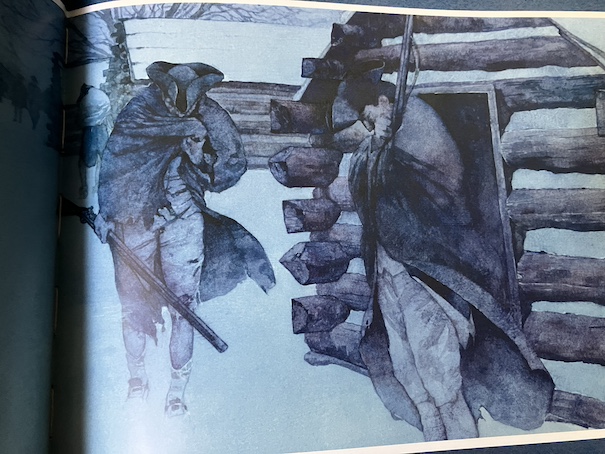
It’s a cruel winter at Valley Forge, during the American Revolution, and George Washington is worried about the welfare and morale of his soldiers.

As Washington walks through the camp, he sees a young soldier lighting a candle and reciting something softly to himself.

Curious about what he’s doing, Washington stops to talk to him, casually remarking on how cold the night is. The young soldier says that he saw colder nights when he was young in Poland, and he is lighting candles for Hanukkah. Washington asks him what that means, and the soldier explains the meaning of the holiday.

The soldier recounts the story of how Israel was conquered by the Ancient Greeks, who forced Jewish people to worship Greek gods and tried to replace Jewish customs with Greek ones. Washington also says that he understands what it’s like to feel like you’re under the thumb of a king who lives far away and the desire for liberty. The Jewish soldier says his family left Poland for similar reasons, because they were not being allowed to practice their beliefs there.

Returning to the story of the ancient Israelites, the soldier explains that a priest named Mattathias refused the Greeks’ orders to bow to idols, and he fought back against the Greeks. Mattathias and his five sons, who were called the Maccabees, led a rebellion against the Greeks. They were a small group, and the odds were against them, but they were determined to continue the fight against their oppressors. Washington says that he understands the feeling because his army is in a similar position.

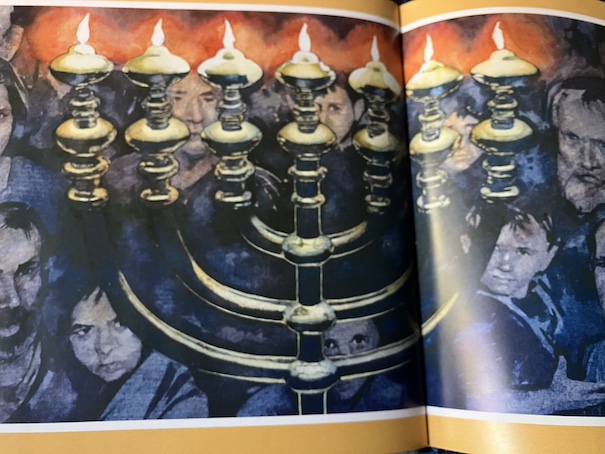
Continuing the story, the soldier recounts how Mattathias’s son, Judah, inspired their troops by reminding them that God was on their side, leading them to victory. When they finally managed to overthrow their Greek rulers, they took back their Temple and lit the Temple menorah. The menorah was supposed to be kept lit constantly, and they were worried because there was very little oil left. They only had enough to keep it burning for one day, and they weren’t sure when they could get more oil. However, they lit the menorah anyway, trusting that God would somehow provide them with more soon. It took them eight days to find more oil for the menorah, but to their surprise, the menorah continued to stay lit all the time they were searching, lasting eight times longer than they thought it would with the amount of oil they had. Hanukkah became the commemoration of this miracle.

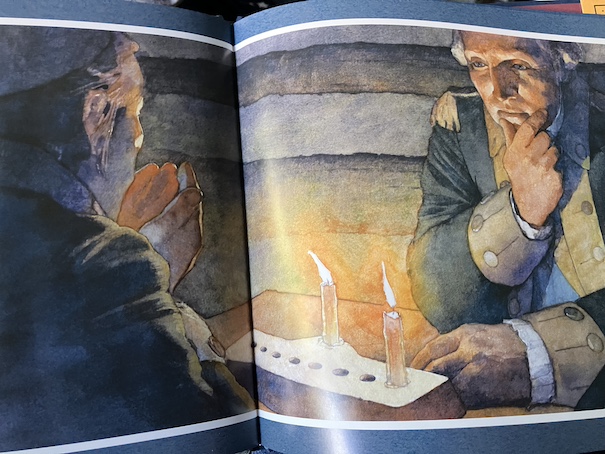
George Washington contemplates the story that the soldier told him, and he finds it inspiring. It reminds him that, even though their current situation in Valley Forge may seem bleak, there have been others before them who have also faced steep odds in their struggles and who still managed to succeed. He begins to think that, if they persevere, they may also be gifted with a miracle of their own.

There is an author’s note at the end of the book that explains the inspiration behind the story. As the characters in the story do, the author draws parallels between the American Revolutionary War and the historical battle that began the tradition of Hanukkah. The author learned that George Washington may have learn about Hanukkah during the Revolutionary War, although there are no entries in his diary to confirm it, so he used excerpts from George Washington’s other writings to explain his sentiments. The author also offers commentary on bullies and the importance of standing up to oppressors, both in the context of war and in daily life.

This book won the Sydney Taylor award from the Association of Jewish Libraries.

I love books that include little-known or lesser-known events. Whether this one happened or happened in the way the author tells it is difficult to verify, and it seems likely that it’s more of a folk tale than an historical account. George Washington was a real, historical person, but so many legends have grown up around his life that it’s sometimes difficult to tell whether certain stories about him actually happened. As the author says, Washington’s own diary doesn’t offer any verification about this particular incident. Other reviewers of this book, including J. L. Bell, who specializes in Revolutionary War history in the Boston area, have attempted to trace the origins of this particular story about Washington learning about Hanukkah during the Revolutionary War. In his blog, J. L. Bell explains the known sources for this story, which vary in their description of exactly when the encounter between Washington and the Jewish soldier took place and what the soldier’s name was. The soldiers who have been credited with having this encounter with George Washington were real people, but there’s nothing that definitively proves that the discussion about Hanukkah actually happened with any of them. The story is probably more folklore than history, and Bell believes that it started to circulate during the 20th century, when there were more immigrants arriving from Poland with stories and experiences like the one the Polish soldier in the story tells about not being allowed to practice their religion openly. Even so, the parallels the story draws between the ancient rebellion of the Maccabees and the American Revolution are fascinating.

There are certain feelings that are universal among humans, and the author’s point that nobody likes being oppressed by a bully, whether that bully is another person or a government or an army, is true. No matter what you’re up against in life, perseverance in the face of hardship is important, and miracles can come to those who continue to stand up for themselves and what they believe in. It is also true that people who come from different sets of circumstances can help to inspire each other by sharing common feelings about their struggles.

The Gift of the Christmas Cookie

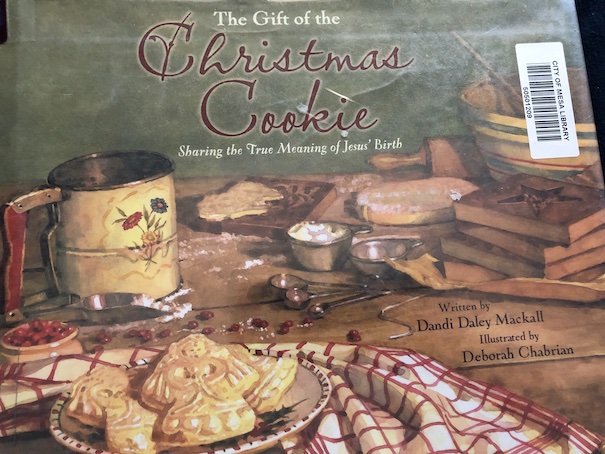
The Gift of the Christmas Cookie by Dandi Daley Mackall, illustrated by Deborah Chabrian, 2008.

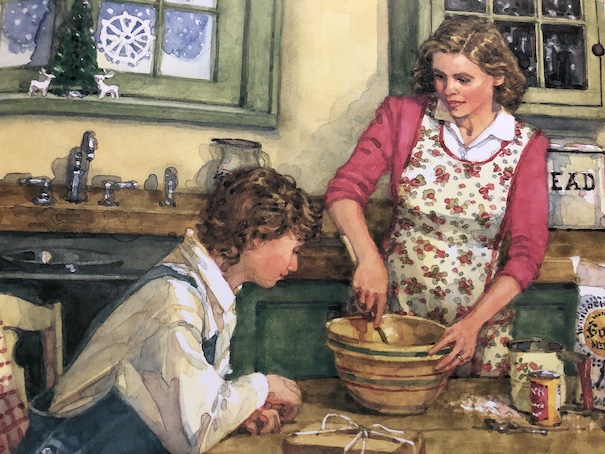
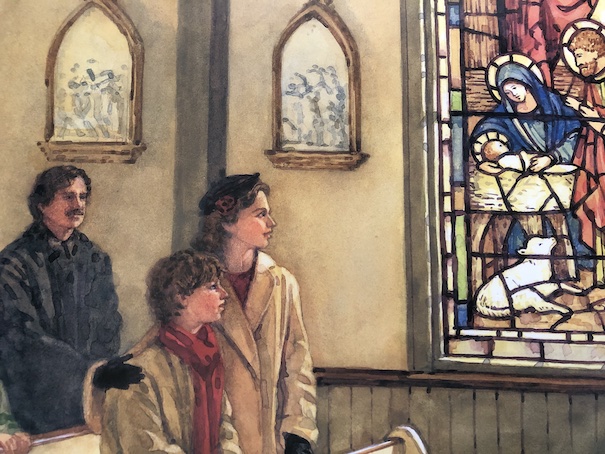
This is a sweet Christmas story that discusses the meaning of Christmas along with the history of Christmas cookies.

The story doesn’t provide a year, but it seems to be implied that it takes place during the Great Depression because Jack’s father is described as hopping a freight train to find work and send money home. Since then, Jack and his mother have lived alone, saving every penny that Jack’s father sends to them.

Then, before Christmas, Jack arrives home to find his mother making cookies. Jack is thrilled at the idea of having a rare treat, but his mother says that the cookies are for the needy at church. It’s disappointing because Jack has been feeling rather needy himself.

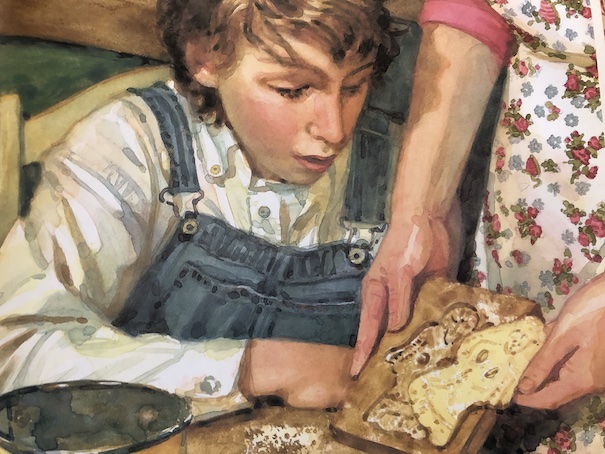
Then, his mother shows him the wooden cookie board molds that they will use. They are big with elaborate carvings of Christmas symbols. Making the cookies is labor-intensive, and Jack wonders why they’re working so hard to make such elaborate cookies that people will just eat anyway.

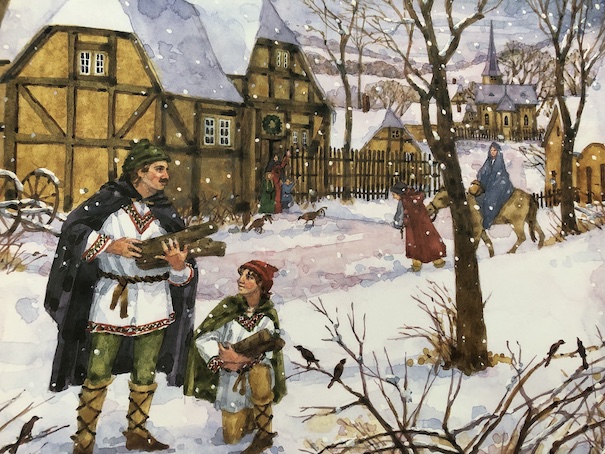
Jack’s mother tells him a story that takes place in the “Old Country” of their ancestors during the Middle Ages. (It’s in Germany, although Germany didn’t exist as the single country it is today back then.) Times were very hard, and people couldn’t afford much, but one family wanted to do something special for their neighbors for Christmas. The father of the family was a woodcarver, so he considered carving Nativity figures, but his wife said that many people were hungry, so it would be better to bake something they could eat. The woodcarver made wooden molds in the shapes of figures associated with Jesus’s birth, and his wife made the sweet dough to put in them, and they made cookies to share with their neighbors.

Jack’s mother saves one cookie from their batch in the shape of an angel for Jack so he can have a treat, but when a hungry man comes beginning for something to eat, Jack considers his own father, who might be traveling and hungry.

Jack is inspired to share his special Christmas cookie with someone who might need it more than he does and to pass on the story that goes with it.

My Reaction

I like stories that include some history, and I enjoyed this story about the origins of Christmas cookies and a lesson in generosity, giving to someone else as he hopes other people will be generous with his father. The invention of Christmas cookies can’t be traced back to any particular family, like the story in the book tells it, and Christmas cookies might have actually originated in Medieval monasteries because the monks would have had greater access to the sugar and spices needed than most people. However, the general concept of Christmas cookies made with molds is accurate. There is a brief note in the back of the book about the cookie boards or springerle molds that come from the Schwabian region of Germany, Switzerland, and Austria and how these molded cookies have had religious shapes since the Middle Ages. The book also notes that some cookie molds take the form of specially-carved rolling pins rather than the flat boards shown in the book, and this was the type of cookie mold that my grandmother used to use. When she made molded cookies, they were anise-flavored, which is traditional and tastes like licorice, although I prefer to make ginger cookies with my cookie mold rolling pin. The book includes a simple recipe for cookies that you can use with cookie molds or cookie cutters, and it uses the traditional anise flavoring.

A Pioneer Thanksgiving

A Pioneer Thanksgiving by Barbara Greenwood, illustrated by Heather Collins, 1999.

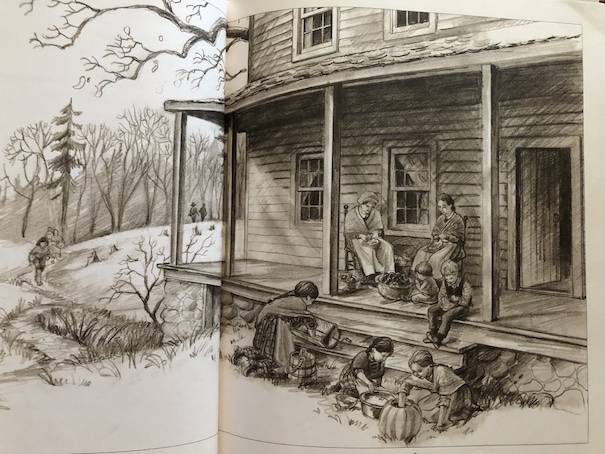
This book is part story, part history, and part craft and activity book. It tells the story of a particular pioneer family’s Thanksgiving celebration in 1841 to explain the sort of Thanksgiving celebrations that pioneer families would have at the time, and there are related activities and recipes to accompany the story.

Everyone in the Robertson family helps with preparing the food for the Thanksgiving feast, including the family’s neighbors, who will be joining them. The story is episodic, focusing on different family members and their adventures and activities through the Thanksgiving preparations.

As they begin their preparations, they are worried about Granny, who is unwell. Mrs. Robertson is afraid that she might die because she doesn’t seem to be improving. As Sarah reads to her, Granny expresses a wish to taste her mother’s cranberry sauce one more time.

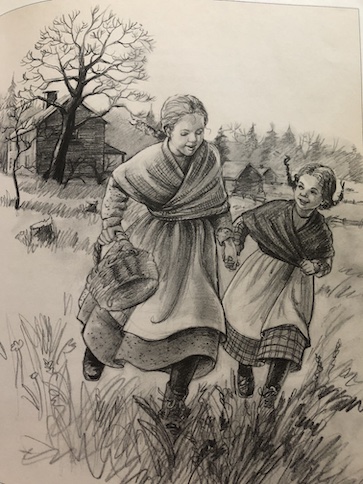
Sarah decides to go out and gather some cranberries for the sauce herself, but her little sister, Lizzie, tags along with her. The cranberry bog isn’t safe. Lizzie falls in and nearly drowns. Sarah manages to save her, but she’s very upset at almost losing Lizzie. However, her brother George finds Sarah’s basket of cranberries and brings it back to the house. The first activity in the book is a recipe for cranberry sauce.

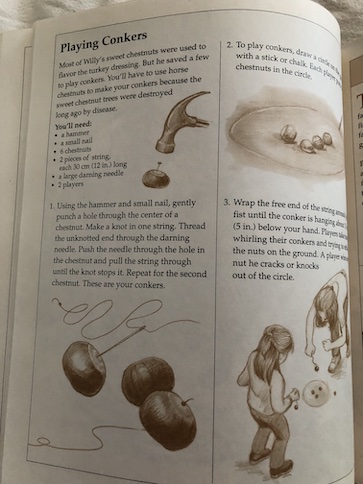
Willie, one of the boys in the family, almost gets lost while looking for chestnuts for his mother’s chestnut stuffing, and he plays a game of Conkers with a Native American (First Peoples) friend, whose family trades foods with the Robertson family. Part of the story explains about Ojibwa and Iroquois thanksgiving ceremonies, and there are instructions in the book for playing Conkers with chestnuts and a Native American game with peach stones.

The younger children go into the woods to gather nuts, and there are instructions for weaving a nutting basket. Meg, the oldest girl in the family, makes bread with interesting designs, and there’s a recipe for bread. Sarah makes a Corn Dolly, and Granny explains the superstition of making a Corn Dolly and then plowing the Corn Dolly back into the soil at the beginning of the next planting season to ensure a good harvest.

Mr. Burkholder, their neighbor, tells them a story about when his family had newly arrived in North America and they had little food. Then, there is a section about weather and now to make a weather vane. Finally, everyone gathers at the table to say grace and enjoy the feast!

In the back of the book, there is a section about the history of Thanksgiving as a holiday in North America, both in the US and Canada. This book is actually set in Canada, and it explains that the date of Canandian Thanksgiving celebrations wasn’t initially fixed. Sometimes, they could be in October and sometimes in November. Canadian Thanksgiving was finally established as the second Monday in October in 1957.

I couldn’t find a copy of this book online, but I did find a copy on Internet Archive of a related book by the same author about the same pioneer family in Canada.

My Reaction

Although the book doesn’t say exactly where this family is other than North America, the other book about the family establishes that they are in Canada, and the references to Native Americans as “First Peoples” confirms it. When I first started reading the book, I thought that the pioneer family was somewhere in the United States or its territories. The lifestyle that the Canadian pioneers lived seems very similar to the way pioneers in the United States lived around that time, so I think the recounting of this family’s holiday would still be of interest to fans of the Little House on the Prairie series and similar books.

Hearing about Canadian Thanksgiving was interesting, and I liked the inclusion of information about the Thanksgiving traditions of the First Peoples and immigrants to Canada. The family in the story was originally from Scotland, and the grandmother in the story talks about how Thanksgiving celebrations remind her of the Harvest Home celebrations back in Scotland.

The book has a good selection of different types of activities for readers to try, from recipes to games to crafts. It seems like there is something here that could appeal to many people with different interests. Each of the activities appears next to a part of the story that references it, so readers can feel like they’re taking part in the activities along with the people in the story. I also really love the realistic art style in the illustrations!

A Native American Feast

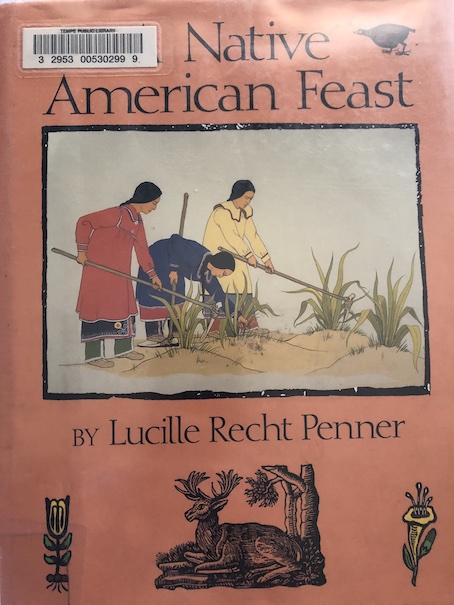
This nonfiction children’s book explains the traditional foods of different Native American tribes and how they were prepared. (Throughout the book, they are referred to both as “Native Americans” and “Indians”, but mostly, the book uses the term “Native Americans.” The focus is on Native American tribes in the area that is now the United States, but the book includes information about various tribes across the United States.)

It starts with an Introduction that explains how European settlers came to North America and how the first settlers almost starved to death because they weren’t prepared for the conditions they found and didn’t understand the plants and foods of the Americas. In those early years of the colonies, the colonists relied heavily on help from nearby Native American tribes in learning techniques for hunting and growing food in North America. These colonists had to adopt some of the Native American foods and techniques of getting food in order to survive. Not only did European colonists adopt some foods used by Native Americans, but Native Americans also adopted foods that were introduced to them from Europeans, including some plants and grains, like apples and wheat, and some domesticated animals, like sheep. The focus of this book is on Native Americans and their cooking and eating habits, both pre-colonization and post-colonization. For more information about what the colonists were cooking and eating, see The Colonial Cookbook.

The book explains how we know what we know about Native American foods and cooking. Some information was recorded by early European colonists in America and European scientists who were interested in plants of the Americas, and archaeology provides information in the form of animal bones, clamshells, and pollen from plants that Native Americans cultivated, going back hundreds and even thousands of years. Native American eating habits shifted throughout their history, although they shifted very abruptly with the European colonization of North America.

The book is available to borrow and read for free online through Internet Archive.

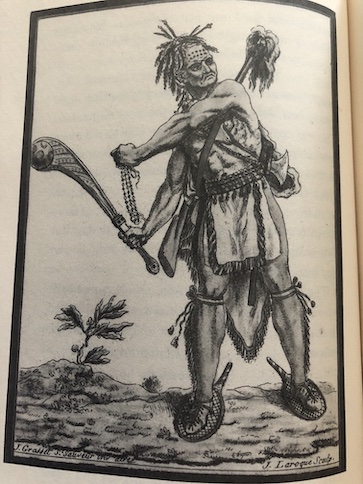
Every chapter, including the Introduction, contains recipes that readers can make at home. Some of them are easier than others. Some recipes include pieces of Native American folklore about them or the foods in the recipes. Many of the illustrations are 19th century drawings.

Rather than organizing the book based on tribe or geographic region, the chapters of the book are based around particular types of food or cooking and eating concepts:

This section introduces how historians know about the history of food among Native American tribes and how their diets changed after the arrival of Europeans.

Recipes in this section are:

  • Hickory Nut Soup
  • Green Succotash
  • Pueblo Peach Crisp

This section includes information about the earliest known hunting and cooking habits of Native Americans. It includes a description of the “land bridge” theory of how the ancestors of Native Americans arrived in the Americas from Asia. As of the early 21st century, we still don’t have a definitive answer for precisely how ancient people first arrived in the Americas, more recent theories include the possibility of these ancient people being seafaring rather than finding a land crossing, although the land crossing theory is also still possible.

Then, it explains about the arrival of the European colonists. It doesn’t sugar coat that the arrival of the colonists and their westward expansion led to the extinction and endangerment of native animal species because these newcomers hunted them without restraint. The introduction of unfamiliar diseases, like measles and smallpox, to the Native Americans took many lives, sometimes even killing whole tribes. These drastic changes greatly impacted the lives and lifestyles of Native Americans, although some traditional habits survived, including the preparation of traditional types of foods.

There are no recipes in this chapter.

This chapter explains about hunting and gathering and the development of agriculture among ancient Native American tribes. The “mystery” is about the development of corn as we know it. It was never really a wild plant. The evidence suggests that ancient Native Americans deliberately created it by cross-pollinating different wild grass plants, but it isn’t really known which ones. Most of this chapter explains how widespread corn was as a food and the uses and folklore that different tribes had for it.

Recipes in this section are:

  • Roasted Corn on the Cob
  • Blue Pinole – a blue cornmeal-based drink with sugar and cinnamon, from the Southwest
  • Thumbprint Bread (Kolatquvil)
  • Hopi Blue Marbles – boiled balls of blue cornmeal dough, a traditional breakfast food
  • Wagmiza Wasna – a mixture of cornmeal and dried berries

This section is about foods that Native Americans introduced to the rest of the world, like pumpkins, peanuts, chili peppers, sunflower seeds, maple sugar, and different varieties of beans, including kidney beans and lima beans.

Recipes in this section are:

  • Cherokee Bean Balls
  • Apache Pumpkin with Sunflower Seeds
  • Popped Wild Rice
  • Zuni Green Chili Stew

This chapter is about Native American hunting techniques and the animals they hunted.

Recipes in this section are:

  • Broiled Buffalo Steaks
  • Venison and Hominy Stew

This chapter is about Native Americans who lived in areas where food was scarce and ways of foraging for food during times of famine. It also explains special feast days.

Recipes in this section are:

  • Mouse Cache Soup – made with beef broth and seeds: sunflower seeds, sesame seeds, buckwheat groats, and millet
  • Iroquois Strawberry Drink
  • Mushrooms Cooked in Oil

This chapter explains the seasonings that Native Americans added to food and cooking techniques that added nutrients.

Recipes in this section are:

  • Fried Squash Blossoms
  • Pemmican Cakes – the origins of beef jerky
  • Maple Sugar Drink
  • Wild Grape Dumplings
  • Inuit Ice Cream – a berry dessert originally made with seal oil but made with egg whites here
  • Wojapi – a Sioux fruit pudding

This chapter is about how plants and animals were processed to make them ready for cooking, such as how corn and acorns were ground into flour and how animals were butchered. When they had to boil water, they often used vessels that would have been damaged if they were put directly over fire, so they would heat stones and put them into the water instead.

Recipes in this section are:

  • Broiled Salmon Steaks with Juniper Berries
  • Broiled Rabbit with Corn Dumplings
  • Baked Beans with Maple Sugar

Native Americans didn’t have cooking pots and pans made out of metal or glass until after the European colonists arrived. Before that, their cooking vessels were made of wood, stone, pottery, or tightly-woven baskets. This chapter explains the different types of cooking vessels they had, including the shells of pumpkins and gourds.

Recipes in this section are:

  • Pumpkin Shell Soup

This short chapter is about eating manners, superstitions, and taboos among different tribes. There are no recipes.

This section explains how Native Americans would give thanks to their Creator or Great Spirit or Nature or to animals and plants themselves for the foods that helped keep them alive. There are no recipes in this chapter.

A One-Room School

Historic Communities

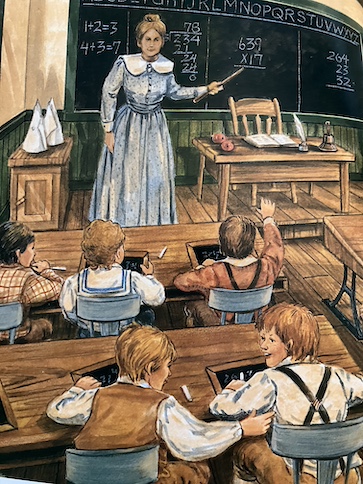
The book begins by saying that there was a time when not all communities had schools at all. In areas where the population was low, children had lessons at home or from a neighbor, if they had lessons at all. Towns and villages needed enough children living there to support even a small school. (The book doesn’t describe exactly when or where they’re talking about, but it’s implied that this is the United States or the American frontier.) When there were enough settlers in an area for a school, they might make a small log cabin for the school. As populations grew and there were more students, they would build better schools.

Requirements for teachers were different back then than they were today. Most teachers were men because married women were not allowed to be teachers. Only single women could teach. Teachers were also often required to handle rough students as well as teach them, and all ages and grades of students would study together in one-room schools. The teacher would manage the different grade levels by having them dividing them into groups based on their levels and having the different groups take turns reading aloud to her while other students did quiet work, like practicing writing. The teacher would set some students quiet tasks to do while focusing on a different group, and then, they would switch. Teachers were also responsible for the cleaning and maintenance of their school, but they typically assigned students chores to help with that. Local families would provide room and board for the teacher of their community, and they would also contribute toward the teacher’s salary.

Lessons were basic and focused mostly on the “three Rs” – reading, writing, and arithmetic. (Those three subjects contain the letter ‘R’ near the beginning, even if they don’t all start with that letter.) There was often little time to teach anything else, and these were the subjects that were most important to people with the most common jobs, such as farmer, craftsperson, or storekeeper. In schools that taught a wider range of subjects, students would also learn history (mainly focused on the United States), world geography, and grammar.

Small schools often had few books or supplies. Because paper was often in short supply, children would memorize lessons and verbally recite them back to the teacher and would practice writing on slates (small blackboards). When students were able to buy paper, they bought a blank notebook they called a copybook. The paper in the copybook wasn’t lined, so if they wanted lined paper, they had to draw the lines themselves, using a ruler.

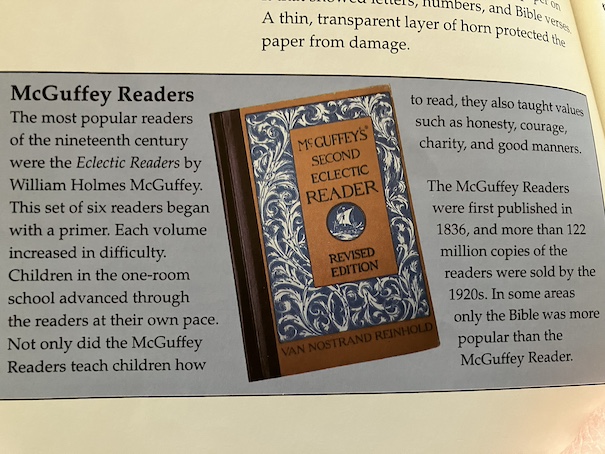
A small school might also only have two books for the students to study: a primer for beginning readers (which showed the alphabet, numbers, and some basic spelling words and poems) and a copy of the Bible. The most popular series of books for building reading skills in the 19th century was McGuffey’s Eclectic Readers. The series started with a primer and continued with six readers, each one at a higher reading level than the last one to build more advanced reading skills. In the small, one-room schools, students would work through these books at their own pace. (Since all ages and grade levels were together in one room, there was little concern about each student moving to the next grade at the exact same time as their peers since they were all still going to be in the same room with the same teacher anyway. As long as a student was continuing to come to school and make progress, it didn’t really matter how fast or slow the progress was.)

The book describes the daily routines of students at small, one-room schools, including how they would get to school each day and what they would do at lunchtime and recess. Most children simply walked to school, although they often had to walk long distances to get there. Sometimes, they might ride a horse to school or get a ride from an adult in a wagon or sleigh, if it was winter. Children brought their lunches from home, but some schools also maintained a school garden. Most of the children from these small schools would grow up to be farmers, so gardening was a valuable skill for them to practice, and the students would also eat what they grew in the school’s garden. During the winter, they could make a soup with vegetables they grew on the stove in the schoolhouse (which also kept the schoolhouse warm) that everyone would eat for lunch. The schoolhouse stove could also be used to heat up foods that the children brought from home. Besides their lunch break, the students would also have two short recess breaks during the day. During recess, they could walk around outside, talk to their friends, play games, or play with toys they brought from home, like marbles. Toys were often homemade or easily improvised, such as using string to play Cat’s Cradle.

Sometimes, students would play pranks on their teacher or fellow students, such as hiding bugs and spiders to scare someone, pouring water on their seat if they got up, or covering the schoolhouse chimney to fill the school with smoke and smoke everyone out of the school. The last prank was dangerous.

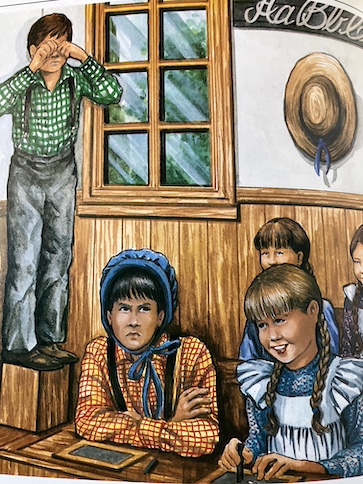
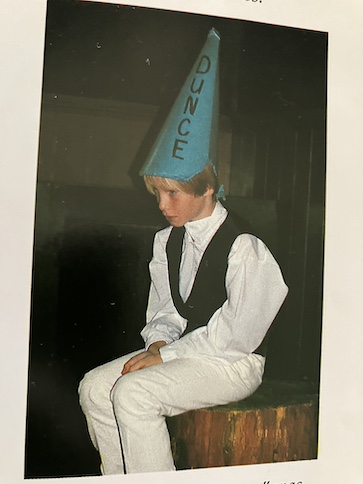
Punishments for pranks and misdeeds, such as being late or falling asleep in class, were at the teacher’s discretion. They could take whatever form the teacher thought was appropriate for the situation, and they could be as harsh and strict as the teacher thought was necessary. Sometimes, they could be a form of poetic justice, designed to fit the crime. We aren’t told why one misbehaving boy was told to put on a girl’s bonnet and sit with the girls in class, although it might have been a fitting punishment if his misdeed was teasing the girls. (That was just a guess of mine, that the teacher might have decided that, if he wanted to tease girls, he should try sitting in their place for awhile.) Some punishments were meant to teach lessons and reinforce the idea that children should not repeat certain behaviors, such as having the children repeatedly write lines, sentences that spelled out what they were supposed to do or not do. (For example, a student who was late to school could be assigned to write, “I will not be late to school” or “I will be on time to school from now on” a certain number of times.) Other punishments were purely for humiliation, like having a student wear a cap that labeled them as a “dunce”, in the hopes that the embarrassment would keep them from misbehaving again. (This could also be the goal of making a boy wear a bonnet and sit with the girls.) Punishments could even include physical punishments. Teachers were allowed to whip their students, if they though it was necessary, and some teachers even punished children who were physically fighting by making them take turns whipping or hitting each other with a stick. The book doesn’t explain the motive for doing this, but I think that they were probably emphasizing the idea that people who fight get hurt and that getting hurt is unpleasant to discourage them from fighting more in the future. I also suspect that the point of making them take turns hitting each other was to make it equal, so it wasn’t just one person beating up on the other, but that’s just a guess. When the students got home, and their parents found out about what they had done at school that day, they might even get a second punishment, on top of whatever punishment the teacher assigned them!

Sometimes, schools had special events for holidays or academic events that involved members of the wider community. For example, schools sometimes had spelling bees, including some where adult members of the community would watch or participate. Schools often had Christmas pageants, where children would sing songs or recite poems they had memorized or perform a play written by the students themselves. At the end of the school year, students would have oral exams in front of their parents and other community members, followed by a picnic with games.

The book ends with a section of games and activity suggestions designed to show modern kids what it might be like to be a student in an old-fashioned one-room school and compare their own schools to old-fashioned schools.

The book is available to borrow and read for free online through Internet Archive.

Books in the Historical Communities series focus mostly on the 1800s in the United States, but they don’t always mention exactly what time period they are describing. It’s often more implied than stated, and that’s true of this book, too. The book mentions the 19th century once or twice, but it doesn’t mention any specific date or date range.

The pictures in the book are a combination of drawings and photographs of real people in historical costumes, reenacting scenes at schoolhouses and the lives of the students. I liked the combination of real people and drawings to illustrate different concepts about life and education in old-fashioned, one-room schools.

There are some concepts of education in a one-room school that fit with the educational concepts of the modern Montessori system, such as having students of different levels being taught together and having students progress at their own rate in different subjects. In a way, I think that the Montessori system hearkins back to this one-room school style of education, and that’s examined in more detail in the classic children’s book Understood Betsy, which is by Dorothy Canfield Fisher, who was an early advocate of the Montessori method of education in the United States.

The Ghost of the Gracie Mansion

Mysteries in Time

The Ghost of the Gracie Mansion by Susan Kohl, illustrated by Ned Butterfield, 1999.

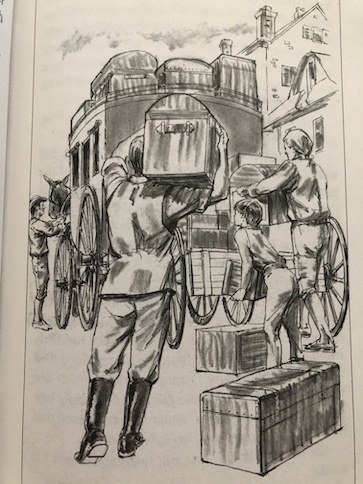
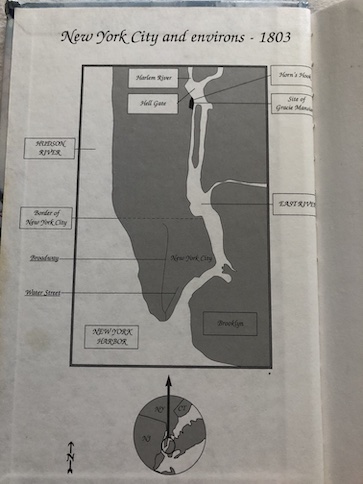
The year is 1803, and the Gracie family has decided to temporarily leave New York City because of the Yellow Fever Epidemic. William Gracie, the eldest son of the family, is disappointed because he has started working for his father’s shipping business, and he was looking forward to being promoted to clerk this spring. He wants to follow in his father’s footsteps, and he’s serious about wanting to learn the business. The trip that they’re taking to their new country home at Horn’s Hook, north of the city, seems to delay his plans because it’s so far away from everything, from his father’s business and from the Tontine Coffee House, where businessmen and other important people meet to discuss the issues of the day. However, William can’t help but admit that the situation in New York is serious. People are dying of Yellow Fever every day, including children, and his parents just want the family to be safe.

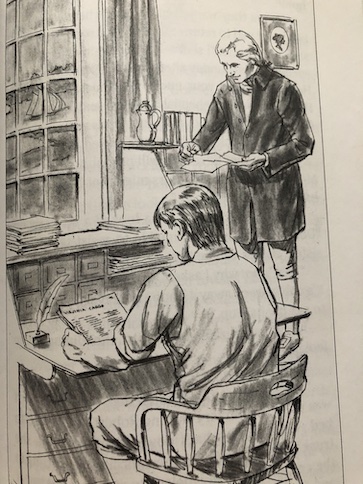
William begins to feel a little better when his father tells him that he’s arranged for them to work together from the family’s country mansion. His father says that captains of the ships he owns will stop at Horn’s Hook on their way to New York Harbor to report to him, and William will help him to prepare the cargo lists and timetables for the ships. Their temporary exile from New York hasn’t put a stop to their business or William’s education in that business; they’re just going to be doing things a little differently until the crisis is over.

While the family is traveling to their new country house, Mr. Gracie tells them about the history of the place. There used to be another house on that land, but it was destroyed during the American Revolution (an event still in relatively recent memory at the time this story takes place) as the British and the Patriots struggled to control it because that location is a strategic spot on the Harlem River. Mr. Gracie says that their new house is built over the basement of the old house, and that’s important because he’s aware that the former owners had a secret tunnel that led out of their basement in case they needed to use it as an escape route during the war. He told the builders to look out for it while they were building the new house, but if any of them ever figured out where it is, they never admitted it. The Gracie children are excited about the idea of their new house having a secret tunnel, and they’re eager to find it!

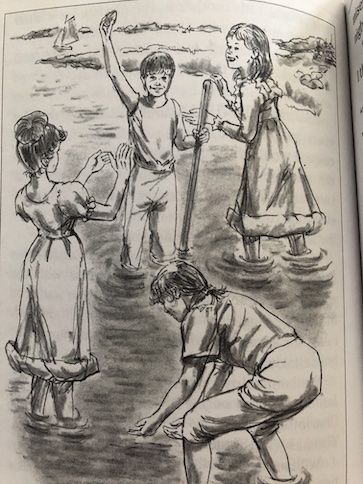
The new Gracie house is beautiful, really more of a mansion than just a house. However, there is something strange going on there. Soon after they arrive, William’s younger sister Sarah sees someone in the house dressed all in white. Sarah thinks that she saw the ghost of the person who owned the house that used to be on their property. The others don’t believe her because Sarah has a vivid imagination and is always making up stories, but Sarah insists that she saw someone.

When things start disappearing from the house, the rest of the family begins to believe that there may be some unknown person in their house. Sarah still thinks it’s a ghost, but William thinks maybe someone has found the secret passageway into the house. Who is this mysterious intruder?

The book is available to borrow and read for free online through Internet Archive.

My Reaction

I always like historical novels, particularly historical mysteries, and I really enjoyed this one. The mystery is meant for children in elementary school, and it isn’t too difficult, but it’s fun to see the Gracie children searching for the secret passage and trying to learn who is sneaking around the family’s country mansion. I also enjoyed that the story offers history lessons on multiple levels. The immediate situation for the characters is the yellow fever epidemic of 1803, but the story also touches on the American Revolution. The solution to the mystery is also related to Revolutionary War history. The Gracies, headed by father Archibald Gracie, were a real family who made their money in shipping, although the events in the story are fictional. There is a section in the back of the book that explains more about the family’s history. They associated with prominent people in New York in the early 19th century, and Alexander Hamilton makes an appearance in the story when he visits the Gracie Mansion. The Gracie Mansion is a real place. When it was first built, it was in the countryside outside the limits of New York City, but since then, the city has grown around it. It is now used as the home of the mayors of New York City.

Although this book was published before the coronavirus pandemic of the early 2020s, I also appreciated the part of the book at the beginning, where William is concerned that the current epidemic has changed his plans and impacted his ability to learn his father’s business. However, his father explains to him that they are still in business, and he has made arrangements for them to continue working in a different way during their time away from the city. People who lived through the quarantines and lockdowns of the covid pandemic will understand how it impacted the way people worked or continued their education and how people had to find ways to work around the problem. I appreciated that this story shows how people have had to deal with public health crises before in history and how they have always had to find creative solutions to deal with problems of this nature.

In this particular situation, the Gracies are a wealthy and privileged family, so their options for escaping from the crisis and working from outside the city are greater than other people of their time. Not everyone had a countryside mansion where they could go to escape the disease, and not everyone had employees who could report to them wherever they were. What Mr. Gracie and his son are doing during the course of the story is the early 19th century equivalent of “working remotely”, pre-Internet, and they accomplish it through people coming to report to them and taking goods and information into the city on their behalf. Even though the Gracie family can stay outside the city, they are still sending their ships into the city’s harbor because the cargo the ships carry is necessary there. There are people in the city who are waiting for the supplies the ships are carrying. The crews of the ships are what people in the 2020s came to call “essential workers” – the people whose type of work was necessary, no matter the circumstances, and who could not perform their duties from a remote location. The same is true for all the other people who must remain in the city because their jobs require them to work with or on behalf of the people who are still there.

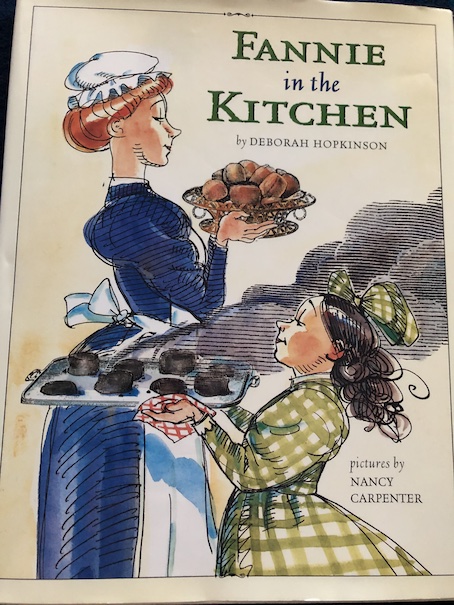
Fannie in the Kitchen

Fannie in the Kitchen by Deborah Hopkinson, 2001.

This is the story of Fannie Farmer and her famous and popular cookbook! When I first heard of the Fannie Farmer Cookbook (originally The Boston Cooking-School Cook Book (1896)), I wasn’t sure whether Fannie Farmer was a real person or if that was just a pseudonym or a marketing name for the cookbook, but Fannie Farmer was a real person in the late 19th century, and that was her real name. The story in this picture book is based on her real life, although details may be fictionalized, and the pictures give the story humorous twists.

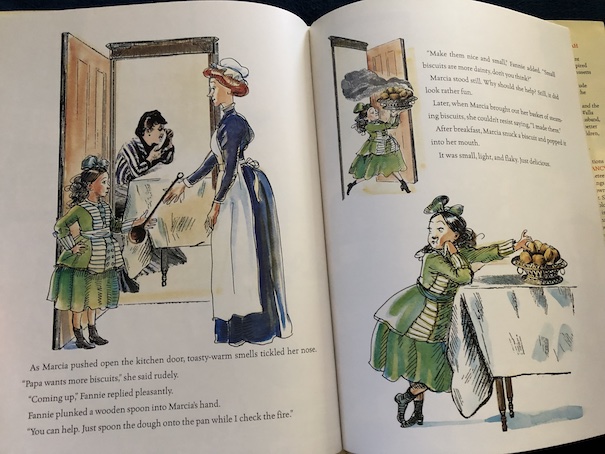
In the beginning of the story, a little girl named Marcia Shaw prides herself on how many things she can do around the house and how much help she can give to her mother. However, she’s still a little girl, and there are some things she doesn’t know how to do well. In particular, Marcia doesn’t know how to cook. Now that her mother is expecting another baby, Marcia’s mother decides that she needs to hire some extra household help, especially with the cooking.

Marcia is a little offended that her mother considers her inadequate to help by herself, but when the new help arrives, a young woman named Fannie Farmer, Marcia has to admit that she’s a good cook. Even better for Marcia, Fannie doesn’t consider her cooking techniques trade secrets. She enjoys letting Marcia help in the kitchen and teaching her cooking tips.

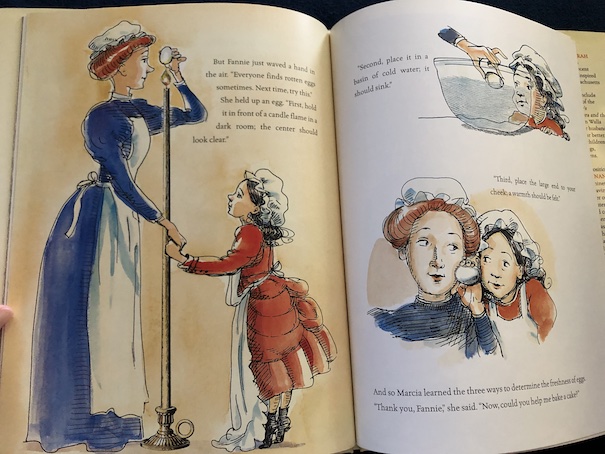
Under Fannie’s tutelage, Marcia’s cooking skills improve. Fannie teaches her many important pieces of information about cooking, like how to measure ingredients and how to tell when ingredients are fresh or if they’ve gone bad.

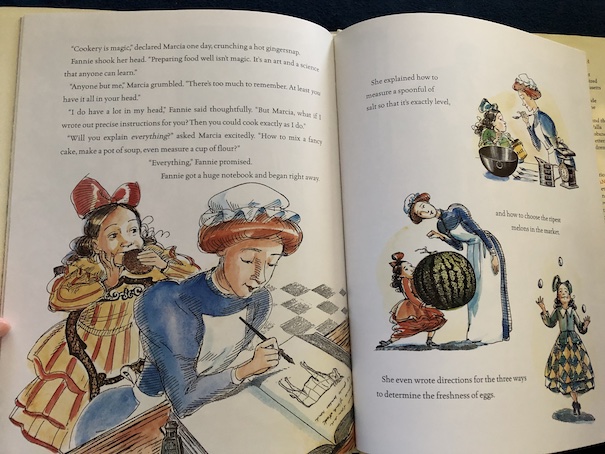
Marcia enjoys learning to cook with Fannie, but she thinks that she’ll never be as good as Fannie because there’s just too much to remember. She doubts that she’ll ever be able to memorize it all. Marcia is amazed that Fannie can keep all of that cooking information in her head. To help Marcia, Fannie decides to write out a notebook with recipes and cooking instructions, including all of the specific measurements for ingredients and detailed information about cooking techniques to make the recipes come out just right.

This is what makes Fannie Farmer and her cookbook so unique for their time period. If you’ve ever seen a very old recipe book or even just old family recipes written down, they often don’t have all of the amounts of ingredients written down, or the amounts are written in very vague terms. Old recipes also offer little to no cooking techniques, like how to tell when it’s time to turn a griddle cake over or how to tell if a cake is done baking. The assumption was that girls (usually girls for this time period) would learn to cook by watching their mothers and by learning from their examples. However, that assumes that their mothers knew all of these cooking tips themselves, that the mothers remembered to tell their daughters what they knew and explained it well enough for them to understand (some people don’t have much of a talent for teaching, even when it’s a subject they know themselves), and that the daughters understood or remembered everything their mothers said. Otherwise, the vague directions in cookbooks and family recipes were of little help, and new cooks had to learn through experimentation or trial and error. Fannie’s approach to cooking, as explained in the story, is an art and a science that anybody can learn if someone explains it well enough, so she puts her focus on recording all of the necessary details of her recipes.

Fannie’s recipe book, started for Marcia, turns out to be very popular with both the Shaw family and their friends and neighbors. As word spreads about it, people start coming by to borrow recipes or get cooking advice. Fannie realizes that there is a lot of demand for better teaching of cooking techniques, and she really enjoys teaching cooking, so she decides to accept a job at the Boston Cooking School.

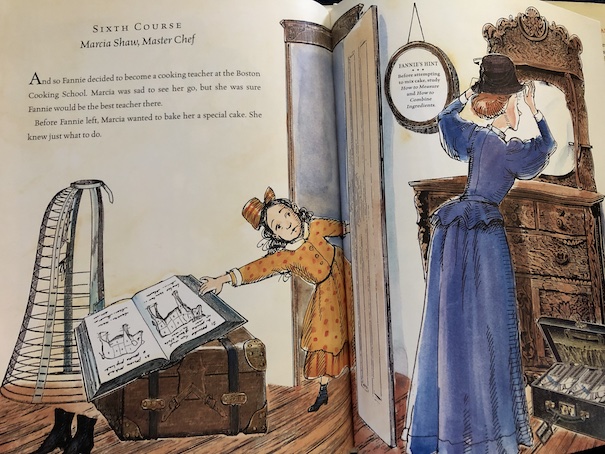
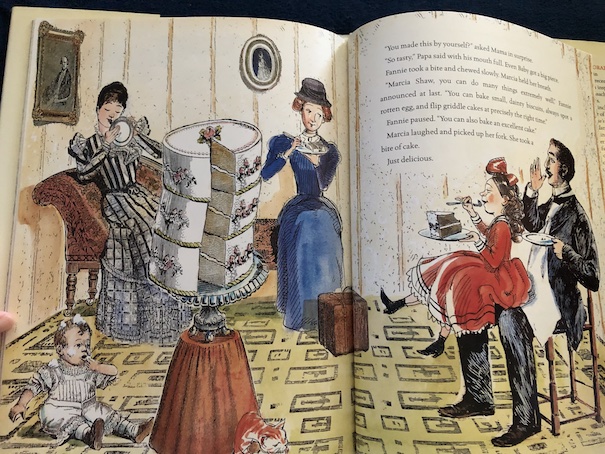
Before Fannie leaves the Shaws, Marcia borrows the cooking notebook and makes a special cake for Fannie to show her what she’s learned. The cake comes out just right because Marcia has followed Fannie’s directions.

There are hints from the Fannie Farmer cookbook throughout the book, and there is a section in the back of the book with historical information about Fannie Farmer. It also includes a sample recipe for Griddle Cakes.

The book is available to borrow and read for free online through Internet Archive (multiple copies). New and used copies are also available on Amazon. You can also buy the original Fannie Farmer Cookbook through Amazon or read it online through Internet Archive (multiple copies).

My Reaction

One of the things I liked about this book is the illustrations. There are eccentric details in the pictures that add humor to the story, like how Marcia stacks a bunch of chairs on top of each other while making candles, so she can make them extra long, and one of her extra long candles appears later, when Fannie shows her how to tell if an egg is fresh by holding it up to a light. For some reason, Marcia’s mother also has a weird habit of licking her dishes when she’s eating one of the yummy recipes, and there is one picture where it looks like she’s lost control of the baby carriage, and it’s rolling away with the baby. I’m sure these aren’t historical details and were just thrown in to be funny.

I think it’s also important to point out that the real-life Fannie Farmer lived an unconventional life for someone of her time period. She was plagued with health problems from a fairly young age. At some points in her life, she was unable to walk, possibly because of a stroke, and when she walked, she had a limp. She never married, but she built a fulfilling career around her talent for cooking. and achieved lasting fame because she wanted to share her knowledge with others. She is credited with establishing exact and level measurements in cooking in the United States, and she was also a strong believer in quality food and proper nutrition, especially for people with health problems.

Invincible Louisa

Invincible Louisa by Cornelia Meigs, 1933.

This is the story of Louisa May Alcott, the famous 19th century author who wrote Little Women and other books for children.

The book begins with Louisa May Alcott’s birth on November 29, 1832 in Pennsylvania and explains about her parents’ backgrounds. When Louisa’s mother, Abba (short for Abigail), had first become engaged to her father, Amos Bronson Alcott, people advised her not to go through with the marriage because Bronson didn’t seem like a very practical man and nobody really expected that he would amount to much. However, Abba genuinely loved him and understood him. They shared similar ideals, including Abolitionism and the practice of service and charity to others, although they didn’t agree about everything. Bronson was a scholarly man who worked as a teacher, although he struggled to get an education himself when he was young because he was born to a family of poor farmers. As a young man, he had worked as a traveling salesman and had seen much of life across the country. He was good at talking to people and was very good at speaking to children, which led him to eventually settle down to teaching.

The Alcott family was happy where Bronson Alcott was teaching in Germantown, but the death of his school’s patron was a heavy blow. Without his patron’s backing, the school didn’t last, so the Alcott family left Germantown and moved to Boston. Little Louisa enjoyed the busy city of Boston, but the book also describes a harrowing situation in which she almost drowned after falling into Frog Pond. This incident was a traumatic memory for Louisa, but it wasn’t just the trauma that left a mark on her. The person who rescued her from drowning was a black boy. (The book uses the word “Negro.”) Louisa never knew the boy’s name, but her gratitude toward her rescuer influenced her feelings toward black people for the better at a time when the country was heading toward Civil War over the issue of slavery.

The Alcott family had ties to some important people. Her father was friends with Ralph Waldo Emerson and Elizabeth Peabody, who was instrumental in the development of kindergarten education in the United States, worked at his school in Boston. Her mother’s elderly aunt, known as the formidable Aunt Hancock, had been the wife of the famous John Hancock. However, in spite of connections, Bronson met with opposition to his teaching when parents of the students learned that he was an Abolitionist. A friend of his, William Lloyd Garrison, was almost lynched by an angry mob for airing his views about ending slavery. When Bronson admitted a black boy as a student to his school, it was the last straw, and many parents withdrew their children. Louisa later remembered discovering that her parents helped to hide runaway slaves when she was young, but it isn’t clear at which of their homes they were doing this.

After his school in Boston closed, he moved the family to Concord. He didn’t have the heart to open another school, so he supported this family through farming. They were poor and lived very simply, but they enjoyed living in the countryside. However, her father did maintain some scholarly contacts and was involved with the Transcendentalist movement. In 1843, the family moved yet again to join a community of Transcendentalists, experimenting with a more isolated lifestyle. (A footnote in the book, added decades after the original writing, compares it to the communes of the 1960s and 1970s.) However, the community was not a success. When one of the leaders of the community suggested that Bronson give up his wife and daughters to live in the style of Shakers, Bronson discussed the situation with his family, and they all came to the conclusion that this community was asking too much. Giving up on his experimental lifestyle was difficult for Bronson, but Abba’s brother understood the situation and helped the family move to a new home. Eventually, the family resettled in Concord.

Compared to her sisters, Louisa was a boisterous and temperamental child. She loved running wild in the countryside, and her curiosity and impulsiveness sometimes got her into scrapes. She wasn’t as good at housework as her older sister, Anna. However, she was always imaginative. When the family returned to Concord, Louisa was able to have a room to herself for the first time, and she used her new privacy for writing stories. She created plays for her and her sisters to perform.

As she grew up, Louisa became increasingly aware of her family’s poverty and her father’s lack of understanding for the ways of the world. Her mother was frequently worn out from trying to make do and take care of the four girls in the family. She began making plans early that she would find a way to provide for her parents and her sisters when she got older.

At Concord, her family continued their friendships with Thoreau and Emerson, and Ralph Waldo Emerson allowed Louisa to read books from his library, She developed a kind of hero-worship of him as a teenager. The Alcott girls also attended a regular school for the first time. Louisa often felt awkward because she was taller than the other girls at school, but she was also very athletic. She frequently wished that she had been born a boy instead of a girl.

At age 16, Louisa began her professional life, giving lessons to Emerson’s children. She was a good teacher, although as an active person, she found quiet study and teaching for extended periods difficult. Her mind often wandered to ideas for romantic stories, and she wrote a collection of little stories for Ellen Emerson. However, the family was badly in need of money, and they had to leave Concord and return to Boston, where they would live with her mother’s brother.

In Boston, Louisa continued teaching and found work as a governess. She also picked up other odd jobs to help support her family. One of them, a job as a live-in companion for an invalid, turned out especially badly because the job had been misrepresented and turned out to be hard labor. She was paid very little for it, too. It was during this time that her father discovered the little stories that Louisa had written for Ellen Emerson. He took one of them to a publisher he knew, and the story was published. Encouraged, Louisa and her father had the rest of the stories published in a collection called Flower Fables, Louisa’s very first book.

This did not bring her instant success as a writer, though. The family’s lives were filled with ups and downs, and they moved house multiple times. Louisa left her family to pursue an independent living for a time, although she made very little money, taking teaching jobs, sewing, and anything she could find. It was during this time that Louisa’s two younger sisters became ill with scarlet fever while the family was engaging in their usual charity work. Elizabeth had it particularly badly, and her health was never good after that. Louisa rejoined the family when they once again returned to Concord, where Elizabeth passed away. Elizabeth’s death was reflected in Louisa’s semi-autobiographical Little Women with the death of Jo’s sister Beth.

The Alcotts had been such a tight-knit family that separations of the sisters were bitterly painful, but every family experiences change over time. After Elizabeth’s death, Anna became engaged to marry John Pratt. It upset Louisa because it felt like she was losing another sister. Louisa once again set out to try to make her own living, but for a long time, it seemed like nothing would go right for her. It was difficult for her to find work, and opportunities seemed to disappear when she was about to take them. At one point, she was in such despair that she even considered suicide. Fortunately, after hearing an uplifting sermon about girls who were in her position, she renewed her determination to succeed, and she received a job offer from someone she had worked for before. Meanwhile, her father was finally starting to have some success with his educational lectures, and he even became superintendent of schools in Concord.

During all of these trials and tribulations for Louisa and the Alcott family, the country was headed toward Civil War. The Alcotts were still Abolitionists, and Louisa’s father had even been involved in a riot in Boston where a mob of citizens had tried to rescue a runaway slave who was about to be returned to the slave owner. After the war started, Louisa felt the urge to do something to help the side of the Union, so she volunteered as a nurse. Conditions were rough at the hospital where she worked, and she was put to work immediately with no training. She had some talent for nursing and a good bedside manner, having nursed Elizabeth through her final illness, but nothing could have prepared her for dealing with the war wounded. It was difficult and often heart-wrenching work, and it took a toll on her own health. After only about a month of working there, she caught typhoid, and her father was summoned to come and take her home.

Louisa eventually recovered from her illness. She felt like a failure for not being able to complete the full term she had originally promised to the hospital, but her nursing experiences helped further her writing career. The letters that she had written to her family about the people she met and her experiences at the hospital were so interesting that they had them published as “Hospital Sketches”, and they were extremely popular. So many people had friends or family who had gone away to war that they were anxious to know as much as they could about what was happening to them and others like them. The success of the “Hospital Sketches” led publishers to ask Louisa for further writings.

When Louisa recovered further, she felt restless, so she accepted a position as a nurse/companion to a friend’s daughter, who was unwell but wanted to go on a trip to Europe. Traveling as a nurse/companion didn’t give Louisa all of the freedom she would have liked to see and do everything she wanted, but she did get to see many things in Europe. She was able to visit the home of the German philosopher Goethe, and she attended a public reading by Charles Dickens. During their travels, she also met the young man who would be the inspiration for Laurie in Little Women.

She started writing Little Women after she returned home from Europe, at the suggestion of her publisher, who thought that she should write books for girls. When her publisher read it, he wasn’t sure that it would be successful at first because its tone was different from the popular children’s books for girls at the time. He tested it out by giving copies to his niece and some other girls who were about the same age, and they all loved it, so he went ahead and published it. It was so successful that it provided Louisa and her parents with financial stability for the first time, and readers wanted more! Much of the story was based on Louisa’s own life with her sisters and on people they knew, but she changed some parts for the sake of the story. Since the real Louisa never married, she made up a fictional husband for her story counterpart, Jo. In the story, Jo marries a German professor, and in the sequel, she and her husband start a school for boys based on Louisa’s father’s theories about the ideal school. Many of her father’s theories about education were very progressive for the time, and since he never got the chance to try all of them, Jo and her husband did in the story.

Even though she never fully recovered her health after having typhoid, she continued to write books for children, and she visited schools to speak to children. The book explains how these other books were also inspired by aspects of Louisa’s life. She and her youngest sister, May, took another trip to Europe together. May always had a talent for art, and Louisa funded her further travels and studies in Europe. May eventually married, but sadly, she died not long after the birth of her only child, a daughter named after Louisa. In accordance with her wishes, May’s infant daughter was brought to Louisa to raise, and Louisa treated her like her own daughter, calling her Lulu as a nickname. The book ends with Louisa’s death, mentioning that she made one of Anna’s sons her heir to perpetuate her copyrights. In the back of the book, there is a chronology of events from Louisa May Alcott’s life.

The book is a Newbery Medal winner. It is available to borrow and read for free online through Internet Archive (multiple copies).

My Reaction

I bought my copy of this book at a Scholastic Book Fair back in the 1990s, but I didn’t notice until I was an adult that the book was originally published in the early 1930s. I think part of the reason why the author was interested in doing a biography of Louisa May Alcott at that particular time was that it was around the 100th anniversary of her birth. I appreciated how later reprintings of this book also tried to keep it up-to-date and relevant for modern readers, including the addition of the footnote in the book about communes of the 1960s and 1970s.

Something that shows how 19th century society was different from modern society is the qualifications required for certain types of jobs. In the past, there were relatively few professional and educations qualifications required for teachers and nurses. In the 21st century, both teachers and nurses are required to have college degrees and relevant certifications to apply for their jobs. Nobody in the 21st century gets those jobs without having the requisite professional credentials (with the exception of homeschooling families, where the teachers are the parents). It would be useless to apply for such careers without having all of the education and certification required. In the 19th century, it was sometimes more important to just find someone willing to do the job, whether they had any particular qualifications to do it or not. Where the need was sufficiently great, like in the hospitals tending to the war wounded, they would take almost anyone who showed up and was willing to take the job with the hardships and blood involved. (There is one episode where Louisa witnesses an applicant being turned down because, while this person wanted to help the war effort, they didn’t have the stomach or stamina for the demands of the job. Next to that, medical knowledge was less important.) I explained dame schools when I reviewed Going to School in 1776, and the concept still applied in the mid-19th century. Dame schools were informal schools set up by people, often women, who were simply willing to take on the job of teaching local children. They got the jobs chiefly because they were the people who were willing to do them in the area. The quality of education these informal teachers could provide varied drastically, depending on the individual teacher. Some of them were actually well-read individuals with a gift for teaching (this is what Louisa and her father were like, in spite of their relative lack of formal education), while others provided little more than day care while the children’s parents worked. In the section of this book that explains Bronson Alcott’s history, there is some discussion of how education levels and quality varied across the country in the mid-1800s.

Parts of this book and the lives of the Alcott family also offer a different perspective on what it means to be successful in life. Through most of their lives, the family has little money, and Louisa and her father often struggle to find jobs and get recognition for their work. Louisa May Alcott is famous now, but early in her life, she felt like a failure. She struggled to find and keep jobs and had health problems that interfered with her ability to find and keep work. In the end, it wasn’t having money that made her famous but her talent and perseverance. There were times when she wanted to give up, and she even felt suicidal at one point, but she kept going in spite of everything. Even her father eventually managed to carve out a career for himself that suited his real talents. Their early problems didn’t mean that they were worthless or incapable. Their talents were just unusual, and they needed time to find their proper niche in life, the right circumstances to demonstrate what they could do, and the right people to recognize and appreciate their abilities.

The Story of Ruby Bridges

The Story of Ruby Bridges by Robert Coles, illustrated by George Ford, 1995.

This is a beautifully illustrated picture book about Ruby Bridges, one of the first black children to attend a school that was formerly all-white during the desegregation of schools that took place during the Civil Rights Movement. The story is told in the form of the memories of Ruby and other people, looking back on their experiences, rather than as a first-person account.

When the book begins, it introduces Ruby as the child of a poor family who moved to the city after her father lost his job picking crops when farmers began using mechanical pickers instead. After her family moved to New Orleans in 1957, her father worked as a janitor, and her mother became a cleaner at a bank.

The book explains briefly that schools were segregated at the time, and that black children were not given an education that was equal to what was offered in white schools. Because the book is for children, it doesn’t go deep into detail about the Civil Rights Movement and desegregation or exactly how Ruby Bridges’s family became involved. (Ruby was selected as one of the children because she passed a test for academic aptitude, showing that she could keep up with a class of white children, who had better early education.) It simply says that, in 1960, a judge decided that four young black girls would be sent to schools that had been for just white children and that six-year-old Ruby Bridges was one of them.

It was a harrowing experience for young Ruby. There were protesters outside the school, yelling angrily and threatening the little girl. For her safety, she had to be escorted by armed federal marshals.

Parents in the area refused to send their children to school so they wouldn’t be in the same classroom with a black child, so Ruby Bridges was literally in a class all by herself. Her teacher, Miss Hurley taught Ruby in an otherwise empty classroom. Miss Hurley was surprised at how Ruby was able to keep a good attitude in spite of the angry protestors and the lack of other children.

One day, Miss Hurley was looking out the window as Ruby approached the school, and she thought she saw Ruby saying something to the angry crowd before coming inside. When Miss Hurley asked Ruby what she said to them, Ruby said that she was talking to them; she was praying for them. Miss Hurley hadn’t realized it before, but Ruby had a ritual of praying for the people who were angry and hated her every day before school. This was just the first time that Miss Hurley had seen her doing it.

Ruby also said the same prayer after school. This prayer was part of what helped her get through those difficult days of hostility and loneliness.

The book ends by explaining that the parents soon began to send their children to school again and let them join Ruby’s class because they realized that life had to continue and that keeping their children from their education was hurting them. The angry protestors gradually gave up. Ruby continued going to school and eventually graduated from high school. She later married a building contractor and had four sons of her own. She founded the Ruby Bridges Educational Foundation to help parents become more involved with their children’s education and to promote equality in education.

The book is available to borrow and read for free online through Internet Archive (multiple copies).

My Reaction

I’ve heard the story before of Ruby Bridges praying for the people threatening her and protesting against her. This particular rendition is very good, although there is one thing that confuses me. According to this book, her teacher’s name is Miss Hurley, but I understood her name was Barbara Henry. I thought perhaps Hurley was her maiden name and that she later got married, but I haven’t been able to find anything to confirm that. I haven’t found anything to explain where the name Hurley came from at all. I’m not the only reviewer who questions the name confusion.

Ruby Bridges wrote books herself about her experiences, at different reading levels, and they’re also available on Internet Archive.

Little House in the Big Woods

Little House on the Prairie Series

Little House in the Big Woods by Laura Ingalls Wilder, 1932.

The story begins “60 years ago”, in a little house in the woods in Wisconsin, where a little girl named Laura lives with her parents and her two sisters, Mary and Carrie. Mary is older than Laura, and Carrie is younger. Their father hunts for meat for the family in the woods, and although Laura worries about the wolves in the woods, she and her family are safe in their little house.

Much of the family’s time is occupied with getting and preserving food. Food preservation is important because not every hunting trip is successful, and they need to make sure that they make the best use of every animal they get, as well as dairy products and produce. Laura and Carrie like to play among the food being stored in the attic. One of their favorite chores is helping their mother mold butter into shape with their butter mold, and often, the highlight of their day is getting something special to eat.

The story begins in winter, and Christmas is coming. The girls help their mother to prepare some special foods and treats, like apple pie and vinegar pie. They make candy by pouring a molasses syrup over snow to freeze it. The girls’ aunt, uncle, and cousins come to visit, staying overnight. The children have fun playing in the snow, making what they call “pictures” by throwing themselves down in the snow and seeing what type of shapes they can make with their bodies. The family has a feast, during which the children are not allowed to talk because “children should be seen and not heard”, but they don’t really mind because the food is really good, and they can have as much as they like. The children believe in Santa, and they are happy with the simple presents they receive: a pair of red mittens and a peppermint stick each.
Laura also receives a very special present: her first real rag doll. Her older sister already has a rag doll, but up to this point, Laura didn’t. Her only doll was made from a corn cob. Children of their time don’t get many presents, and the youngest children don’t get any at all or only have improvised toys. The other children aren’t angry or jealous because Laura has received this extra present because she is younger than they are. Only the babies in the family are younger than Laura, and the older chidren know that Laura didn’t already have a doll, like they do. Laura isn’t being favored; it’s just that she is now old enough to get this kind of present.

Although the family is safe when they’re in their log cabin, there is a genuine risk of attack from wild animals when they’re outside. Members of the family talk about close encounters they or other people had with panthers or bears. Laura’s Pa has a humorous encounter with a tree stump that he mistakes for a bear in the snow, while Ma actually slaps a bear because she mistook it for the family cow.

As the seasons change, the family activities change. They help relatives make maple syrup, and they have a dance. The girls have their first trip to town with their parents. Pa gathers honey, and Ma makes straw hats. Pa helps a relative with his harvest, and a cousin who plays mean tricks instead of helping gets his comeuppance.

I couldn’t find a copy of this book to read online, probably because of the racial language in the story, but there are shorter books on Internet Archive based on individual incidents in this story, like the winter and Christmas scenes. I thought those were the best parts of the story anyway. I would recommend those shorter books and picture books over the original for young children.

My Reaction

Things I Liked and Didn’t Like

It’s been a long time since I first read this book, and honestly, I didn’t like it as much as I did the first time. I remembered kind of liking it when I was a teen. I can’t remember exactly how old I was the first time I read it, I might have been a young teen or tween, but I know I didn’t read Little House on the Prairie books as a young child. My mother wasn’t really into the series herself, so she didn’t read them to me or recommend them much. (She preferred Nancy Drew, and really, so did I.) I know I lost interest in the series after reading only one or two more books because it seemed like that poor family was always getting sick everywhere they moved, and I found that depressing. This book series is one of the reasons why I don’t believe that exercise and organic food by themselves keep a person from being sick. This family had both, and it never helped them. During the course of the series, they catch everything from malaria to scarlet fever or meningoencephalitis, whichever it was that eventually made Mary go blind. It’s like all of the diseases my characters died from in the Oregon Trail computer game but in book form. Come to think of it, people on the Oregon Trail were also exercising and eating organic, and I’ve seen the real tombstones of pioneer children. I believe in sanitation and vaccinations.

As an adult, I found much of the first half this particular book boring or frustrating. That’s surprising because I usually like books with details about life in the past, and many of the details in this particular book echo stories passed down in my own family. (I also had ancestors with strict traditions about not working on Sundays, and they also ate cold meals on Sundays because they had to do all the Sunday cooking the day before.) I found some of the early parts of this story grating. The main reason is that this book is not actually a single story. There is no real, over-arching plot. It’s basically a collection of episodic reminiscences and family stories. I found some of them interesting, but not the early parts.

The book isn’t bad because the writing quality is pretty good, but in the first part of the book, there are long descriptions of hunting and food. I hated the descriptions of how they processed animals they hunted and butchered. I’m sure they’re true-to-life, but I’m the squeamish type. The parts where they talk about foods they like are better. They have kind of a cozy feel, with homemade meals and goodies that have kind of a nostalgic feel. However, I’m not that much of a foodie, and I’m not into “food porn” or long detailed descriptions of things other people are eating. There are limits to how much of that I can take before I start wanting more plot to happen. I think food descriptions are good when used to add color and atmosphere to a story, but it’s too much when they start turning into the story itself. Ideally, a good food description in the book will make me think of a story I liked the next time I eat that particular food. When it’s too overwhelming, there isn’t much of a story to be transported to. Part of the reason why Laura dwells on the subject of food is that this family has to struggle and work hard to get it. It’s not always guaranteed, and when there is something extra, there’s reason for celebration. They are poor, and treats are rare. I think that part of the reason why this book was so popular during the 1930s, when it was first published, was that many other children were growing up in a similar situation during the Great Depression.

When there is more action in the first part story, it’s typically that someone has a close encounter with a dangerous wild animal, like a panther or a bear. Most of this isn’t something that little Laura witnesses directly, but people will tell her stories about family members who had this happen to them. It happens repeatedly throughout the book. One really exciting encounter with a wild animal who wants to eat someone makes for a good adventure story, but when it happens repeatedly, the novelty goes out of it. It starts to become more like, “Oh, another animal attack incident story. Everybody’s got one.” Ma slapping the bear was something special, though. After the other descriptions of animal attacks, Pa’s mistaking a stump for a bear and Ma actually slapping a real bear felt like the punchline of a joke.

People in Laura’s family carry guns with them whenever they go out both for hunting purposes and because they are living in a real wilderness full of dangerous animals, and there is always a real possibility that they might have to defend themselves from a bear, panther, or wolf. They also eat bear when they can get one, and Laura likes the way it tastes. One of the chores that the kids find fun is when they help their father make his own bullets using molten lead in a bullet mold. I actually know someone who does this in modern times. Some modern gun hobbyists do, but I’m not into guns myself, so I didn’t find that as interesting as other types of home crafts. As the book continued and the seasons changed, there was more variety in activities for the family, and I started getting more interested.

The books in this series are semi-autobiographical, based on the real life and childhood of the author, Laura Ingalls Wilder. Laura Ingalls Wilder is actually the Laura from the book. That’s partly why the book isn’t structured liked a story so much as a collection of reminiscences, because this is just about what she remembers from her early life and family. I appreciated some of the small details of daily life, like the log cabin where the family lives, the butter mold with the strawberry shape, the trundle bed where the girls sleep, the lanterns they use for lighting, the family’s Sunday traditions, how the ladies prepared for their dance, and how they made maple syrup and straw hats. The parts of the story that I didn’t like so well were the parts where she goes on about the parts of life in the past that interest me the least. I don’t like hunting, I have no interest in guns, I don’t like hearing about butchering animals, and I’m not the kind of person who gets excited about animal attacks. (I never liked watching them on National Geographic, and I refuse to watch Shark Week or anything like it.) The parts I liked better were about using items that people just don’t use anymore and often don’t even have in their homes and the things the family did for fun and entertainment or celebrating holidays.

One of best scenes in the book, which is probably many people’s favorite, is the Christmas episode. It’s charming how Laura and her family make candy by pouring molasses syrup over snow. People can still do this today if they want to try an old-fashioned treat. It’s also heart-warming that they spend Christmas with visiting relatives, playing outside in the snow and enjoying a few simple presents, mostly handmade. They take great pleasure in simple activities and small presents because much of the rest of their lives were about chores and basic survival, and special treats and presents of any kind were rare. I thought about this book during the covid pandemic, when many people couldn’t safely visit with family or friends for Christmas. This is just one household of people, with just a few relatives visiting for a day, enjoying a few simple pleasures and homemade food and fun. It can be possible to enjoy very simple, homemade activities if you take the time to fully appreciate them and really throw yourself into making the most of them. The Christmas scene was the one that really stayed with me from my first reading when I was young, and it was the main reason why I wanted to read it again. I forgot most of the rest of the book.

Racial Language Issues

One thing that many people find distasteful about the Little House on the Prairie books these days is that books in the series have inappropriate racial language. This sort of thing went completely over my head when I was a kid because I didn’t know what some of these words meant, but it really jumps out at me now. At one point in the story, Laura’s father plays his fiddle and sings a folk song called Uncle Ned (that link is to a page from Missouri State University with words and music), which is about a black man who dies and uses the word “darkey” repeatedly. To be completely honest, I listened to the entire recording of this song, and I have no idea why anybody would like it. It’s not the only song Pa sings in the story about someone dying, and I can’t figure out why he thinks any songs like that are fun. They just sound depressing to me. But, Uncle Ned stands out from the other songs because of the racial slur.

I want to stress that it definitely is a slur. “Darkey” was not a polite term even during the time the story was set. People said it, but it was rude and insulting slang, not a word for polite conversation. Black people did have feelings about racial terms, and there were terms that were preferred and polite and terms that were considered demeaning and insulted and were known to be deliberately condescending. This particular term belongs to the second category. Black people weren’t always able to openly express their real feelings about the rude terms because of threatened violence for anything they might say, but their inability to speak openly about the issue doesn’t change the reality of the issue. There were 19th century white people who were well aware of what terms were polite and which were impolite, and they made active efforts to teach children to speak politely, such as the editors of this 19th century children’s magazine and Rev. Jacob Abbott, author of the Stories of Rainbow and Lucky (1859-1860), among other children’s books. Both of those sources are older than Laura Ingalls Wilder, pre-Civil War. Abbott made it a point to include a conversation between a grandfather and grandson in one of his Rainbow and Lucky stories to teach children the polite way to address black people of their time (“black” was one of the less preferred terms until the Civil Rights era, when people wanted to distance themselves from older racial terms and their accompanying emotional baggage, but the advice to care about others’ feelings and what they want to be called still holds true):

“I don’t know who they are, grandfather,” said he, after gazing at Handie and Rainbow a moment intently. “One of them is a black fellow.”
“Call him a colored fellow, Jerry,” said the old man. “They all like to be called colored people, and not black people. Every man a right to be called by whatever name he likes best himself.”
“But this is a boy,” replied Jerry.
“The same rule holds good in respect to boys,” added the old man. “Never call a boy by any name you think he don’t like; it only makes ill blood.”

True politeness requires consideration for others’ feelings, not denial of them, which would be the exact opposite of politeness by literal definition. Politeness is about avoiding what would offend others and emphasizing behaviors others find pleasant, not about doing only what pleases oneself or choosing to take personal offense at the idea of considering another’s feelings.

So, what’s the deal with Pa Ingalls? If other white adults of this era cared and tried to teach their children to care, why doesn’t he? Some people might point out that he’s just singing a song and that he didn’t write the song, which is true. In this particular instance, he’s effectively quoting someone else. That being said, this is just the first instance of questionable racial terms and attitudes in this series, and some of the later ones are worse. After thinking it over, I think what it comes down to is that the Ingalls family has little need to consider how people of other races feel specifically because of the way they live. Most of the time, there are simply no “others” in their lives to consider.

Nobody thinks anything of this type of language in the story or comments on it because, remember, this family lives in a log cabin in the woods with no close neighbors. They rarely go to town, and when they visit with other people, it’s usually other relatives, like the children’s aunt and uncle or grandparents. What I’m saying is that, when you live alone much of the time or surrounded only by people like you, especially close relatives, you don’t have to put much energy or thought into how to live with other people. The Ingalls family doesn’t have to think about any of this, so they just don’t think about any of this. But, when it comes right down to it, that’s certainly not the kind of life I’ve lived or the kind of life modern 21st century children live.

Since my first encounter with this book, I grew up in a city, in multicultural society full of people to interact with every day, and I got a higher education with a heavy focus on cultural issues. Some of the words in this book went over my head the first time, but I grew up. This book did not grow with me, and the racial language is one of the parts that not only doesn’t hold up but feels worse when you’re older and know better. This is not a book that has greater depth and provides more insight when you go back and read it as an adult with more life experience, as some children’s books do. Instead, it brings out some uncomfortable realizations about characters you liked before and the lives they live.

I’ve read that some newer printings of these books have changed the problematic parts, which is actually very common with older classic children’s books that are still in print. The same thing was done to old Stratemeyer Syndicate books like the Bobbsey Twins, Mary Poppins books, and various books by Enid Blyton. I was surprised when I found out what some of the original editions of those books were like. However, I haven’t seen a new copy of any of the Little House on the Prairie books to know how much has changed. There are parts of this series that I remembered from reading them the first time, mostly the Christmas scenes, but I’m just not really into this series. There are others I like better. Overall, I really prefer the Grandma’s Attic series to the Little House on the Prairie series because it also has details of daily life in the past, but I feel like it has more variety and warm humor to the stories in those books, and there are no inappropriate racial terms. My own grandmother grew up on a farm in Indiana, and she specifically recommended the Grandma’s Attic series to me, saying that it reminded her of her youth. She never mentioned or recommended Little House on the Prairie books, so I suppose she wasn’t as into those, either.