The Olympians

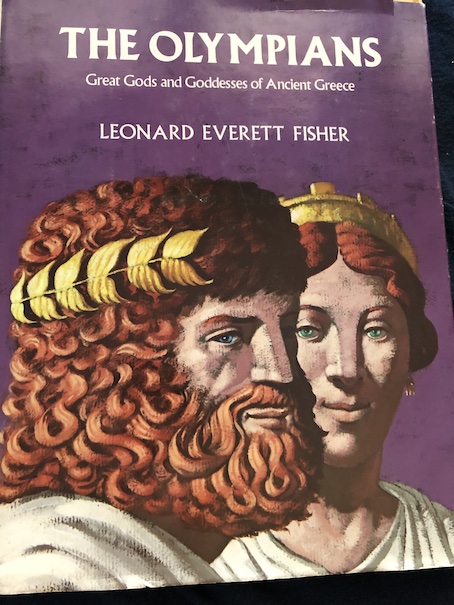
The Olympians by Leonard Everett Fisher, 1984.

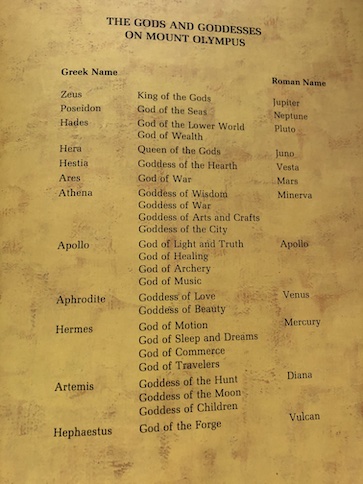
This picture book was my very first introduction to mythology when I was a kid! The book presents profiles of twelve Greek/Roman gods and goddesses. The Ancient Greeks and Romans worshiped the same gods and goddesses, but they used different names for them. At the beginning of the book, there is a list of gods and goddesses that gives both their Greek and Roman names. However, the rest of the book mainly uses the Greek names because the emphasis is on Greece. The gods and goddesses were called the Olympians because their legends state that they lived on Mount Olympus in Greece. It’s useful to know the Roman names, though, because the planets in our solar system were given the Roman names of gods.

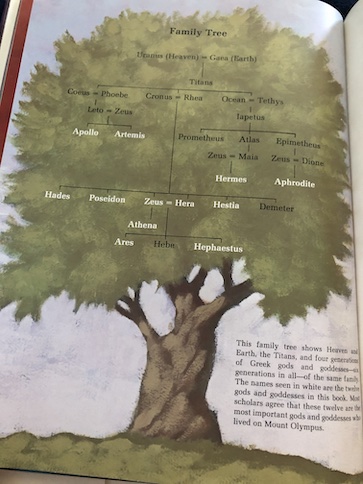
The back of the book has a family tree because all of the gods and goddesses were canonically related to each other. As a kid, I just accepted that. I don’t remember questioning it. The names of the gods and goddesses in the book are written in white.

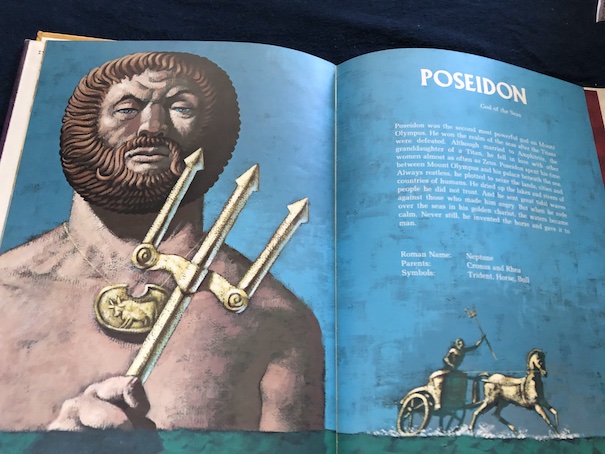
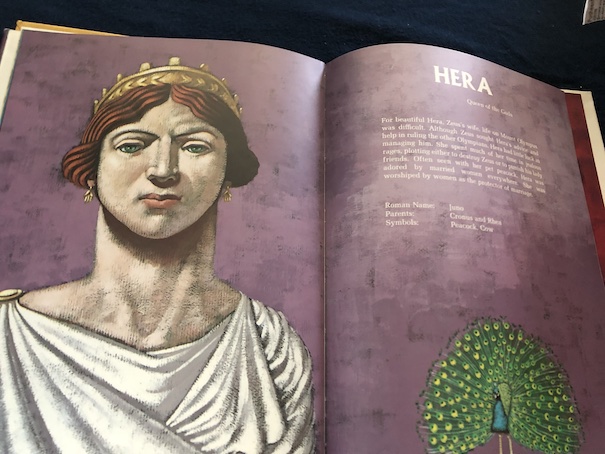
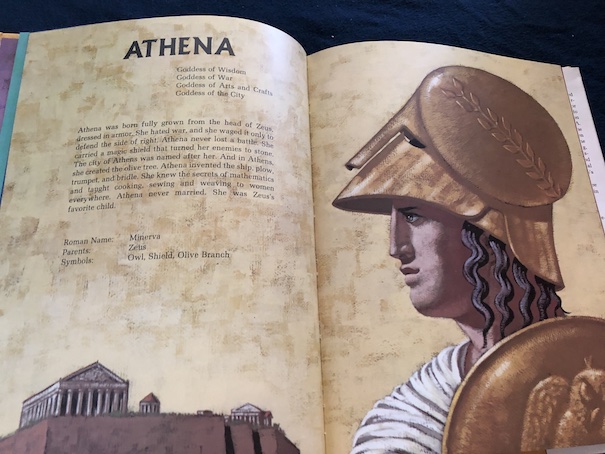
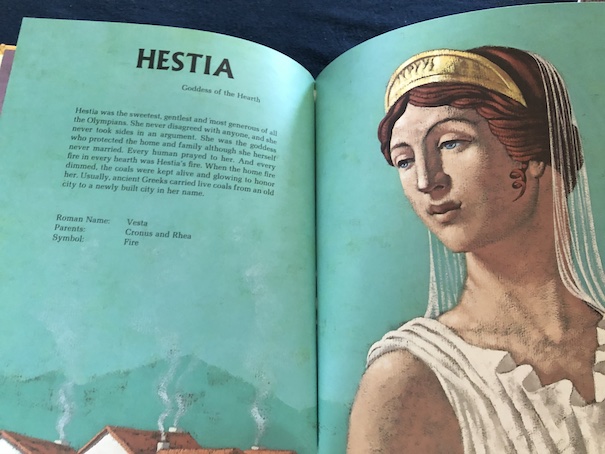
Each god and goddess in the book has a page of information and a full-page, full-color picture. Their profiles explain their personalities, their roles among the gods, and symbols that are commonly associated with them.

The pictures in the book are colorful. Although the faces of the gods and goddesses have a somewhat chiseled appearance, I like them.

When I was a kid, I think I had a fascination for Artemis and Apollo because they were twins, and I found twins fascinating. Because I was a girl, I generally liked the female goddesses better than the male ones. I think I sometimes tried to imagine which one I would be if I could pick one. I think, for a time, I liked Athena because she was the goddess of wisdom and was represented by owls, and I also happen to like owls.

As I was rereading the book this time, I became more interested in the page about the goddess Hestia. As the goddess of the hearth and home, she might not seem as exciting and well-known as the others, but I like her picture, and her profile has some interesting facts. It mentions that Ancient Greeks would carry live coals from an old city to a new one that had been recently built in her honor.

The book is available to borrow and read for free online through Internet Archive (multiple copies).

How Did They Live? Greece

How Did They Live? Greece edited by Raymond Fawcett, 1951, 1953.

This is a non-fiction book, part of a series about life in the past, but it’s told in the form of a story where the readers are visiting a man living in ancient Athens named Simonides. The story is told from the point of view of “we” as “we” visit Simonides, and he shows us around Athens.

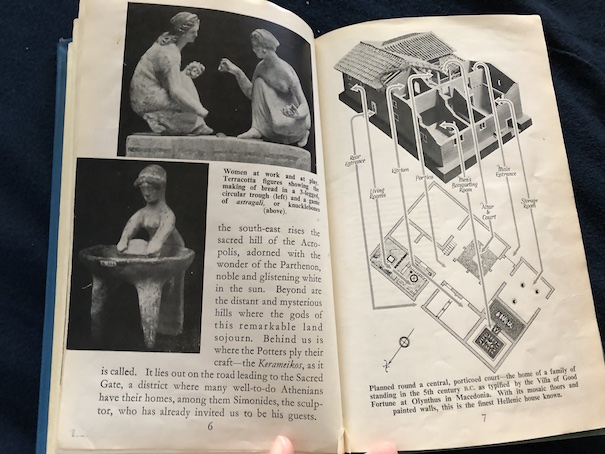
At the beginning of the story, Simonides meets us at the Temple of Hephaestus. The book provides a map and a description of the city so we know our way around. Simonides is a sculptor, and he lives in a nice house in an area of the city with well-to-do people. The book provides a map of the interior of Simonides’s home. His house is bigger and nicer than those of poorer people, and he also owns slaves. (The women playing a game on this page are playing Knucklebones, a precursor to modern Jacks but played with animal bones.)

Athens, like other cities in Greece at this time, is actually a city-state, an independent state with its own government, separate from other Greek city-states. Simonides explains that he served in Athens’s army when he was younger. Now, as a sculptor, he works with an artist producing public art in Athens. During a war with Sparta, many homes and buildings were badly damaged, so they’ve been rebuilding what was ruined and creating new public monuments.

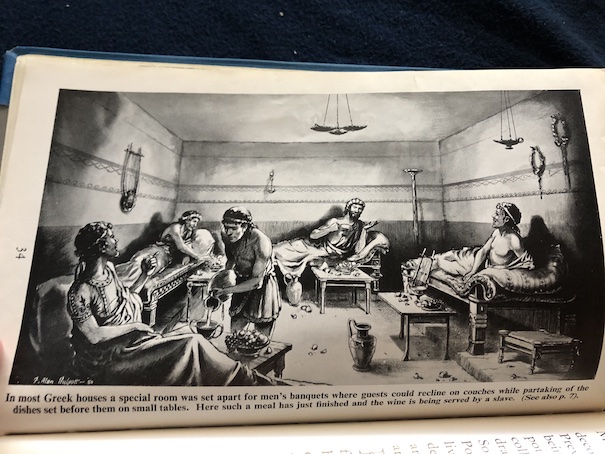
Simonides takes his guests into a special dining room, where we can relax. Guests are only allowed into areas of the men’s quarters of the house. The women’s quarters are strictly private, and we are told that the women in Athens spend most of their time at home, tending to household tasks. Usually, they only go out for special occasions, like festivals or plays. The Athenian women do not have the rights to property and having a say in public life that the men do. However, women from wealthy families lead comfortable lives and authority with in their houses. The book puts it, “Besides running the household she has her little vanities and the universal feminine interest in dress and adornment to help her and, in spite of her seclusion, she contrives to keep herself pretty well informed about what is going on in the city.” The part about the “little vanities” seemed a little insulting to me because I personally don’t like vain and shallow women who can’t think outside of the clothes closet, and I know plenty of women who aren’t in clothes and fashion. It seems like one of those cases where interest in these things might not really be “universal” but it’s something that women do because there just isn’t that much else for them to do. If they had more options of other activities, some of them might have found other things to do. The book goes on to describe various styles of women’s dress, hair, and makeup.

As the guests, we are invited to spend the night at Simonides’s house, and the next day, slaves bring us water to wash in and a breakfast of pieces of bread in wine. Then, we visit the agora (marketplace) with Simonides. There are people hanging around, socializing with friends, and the book describes the tunics and mantles they wear. After Simonides makes his purchases, he has his slaves carry them home. As we wander through the public meeting places, Simonides explains about the local philosophical groups that meet there, like the Stoics. We even meet Socrates as a young man.

After the shopping and visiting the public meeting places, we return to Simonides’s house for the midday meal of fish, vegetables, fruit, and bread. After the meal, Simonides’s wife, Hestia, explains more about the lives of women and children in Athens. As explained before, women have fewer rights than men, and female children do not receive as much education and training as boys do. Children younger than seven are all raised in the women’s quarters of the house. They play with toys like rattles, dolls, balls, spinning tops. Girls like to play on swings and see-saws and learn to dance, while boys play with kites, hoops, and hobby-horses. They all listen to stories like Aesop’s Fables to learn moral lessons. At the age of eight, boys begin to go to school, and at the age of eighteen, they join the army. Meanwhile, girls are taught to handle domestic tasks.

After that, we make a visit to the Acropolis to see the Parthenon, which is the Temple of Athena. The carved figures in the pediments of the building tell stories from the life of Athena. That evening, Simonides invites some friends to the house for a dinner party in his banquet room, where people eat while reclining on couches.

The next day, we learn about pottery and how it is made. The book describes the types of pictures and designs painted on pottery and says that the style with red figures painted on a black background is a newer style. Before, black figures were painted on a red background.

Toward the end of the book, we attend the Panathenaic Festival, which is meant to honor Athena. The festival includes athletic competitions and music and literature contests. There is a procession of important public officials and animals to be sacrificed to Athena. We (the guests) ask Simonides to explain more about the religion and gods of Ancient Greece, and he does. Religion is an important part of public life in Athens, but the book includes a suggestion that Simonides might not actually believe in the gods and goddesses of Ancient Greece: “We do not ask Simonides if he himself believes in these gods. But we have an idea that, like many other Grees, he may not do so, for he suggests that a knowledge of the gods has been handed down from the poets of old and the sculptors have clothed the ancient myths in beautiful forms.” That’s not much of an explanation, although I suppose it’s reasonable that people would believe in the religion of Ancient Greece to varying degrees, and there would have been at least some disbelievers. That’s found in pretty much every religion. There are also people around the world in modern times who engage in religious traditions less out of personal belief than out of civic or cultural participation (like this description of Shinto in modern Japan), which is the implication about the people in this story.

The book ends with a visit to Olympia to see the ancient Olympic Games.

My Reaction

I love books that explain daily life in different time periods, and I thought this one was pretty well done. It covers a few days in the life of Ancient Athens and also does a good job of explaining the wider society of Athens. Most of the perspective is on a fairly wealthy family and their slaves. I found parts about the descriptions of the lives of women and slaves distasteful, but the descriptions and attitudes of the people seem pretty accurate for the time and place. My feelings were more about not liking the lifestyle and circumstances than about disagreeing with the author. There are more details about the raising and schooling of children and about food and clothing than I’ve included in this description.

I particularly liked the maps of the city and the interior of the house. I also liked the way they included Greek words and explained their meanings, like kerameikos (pottery, note the resemblance to the word “ceramics“). Even though I took a philosophy class in college and learned about the Stoics, I didn’t remember the professor explaining that the origin of the word “Stoics” was the stoa, the public gathering place like a covered porch where they would meet.

I was confused for a moment when the book explained that Simonides doesn’t bow when he meets people “as we would do.” As an American, I wondered, “Who’s ‘we’?” Americans aren’t in the habit of bowing to random people we meet on the street, either. I checked, and the book was printed in England. British spellings in the book (“honour” vs. “honor”) also confirm that this is a British book. I didn’t think that people in England in the 1950s bowed to people either, except maybe during important events with royalty and nobility. The most I would ordinarily expect would be a nod or bow of the head to acknowledge other people, and people in the US do that, too.

Secret of the Samurai Sword

Secret of the Samurai Sword by Phyllis A. Whitney, 1958.

Before I explain the plot of this book, I’d like to point out some of the aspects of the book that make it interesting. The story takes place in Japan following World War II. The book wasn’t just written in the 1950s but set during that time (no exact year given, but the characters refer to the war as being “more than ten years ago”, putting it contemporary to the time when the book was written and published), and the war and its aftermath are important to the plot of the story. Although the main characters are American tourists, readers also get to hear the thoughts and feelings of people living in Japan after the war. The author, Phyllis A. Whitney actually born in Japan in 1903 because her father worked for an export business in Yokohama, and she spent much of her early life living in and traveling through Asia. Her parents gave her the middle name of Ayame, which means “Iris” in Japanese, although she had no Japanese ancestry. Her parents were originally from the United States, but the family did not return to the United States until Phyllis was 15 years old, following her father’s death in 1918. That means that Phyllis Whitney was very familiar with what Japan was like before both of the World Wars as well as after. She lived a very long life, passing away at age 104 in 2008, and she saw many major world events and changes through her life. I was interested in hearing how she viewed the effect of the World Wars, especially WWII, on Japan and its culture in this book. In the back of this book, there is a section where the author explains some of the background of her life and this story and her inspiration for writing it.

Celia and Stephen Bronson are American teenagers who are spending the summer in Japan with their grandmother, who is a travel writer, not long after the end of World War II. Celia and Stephen are really just getting to know their grandmother, whom they have not seen since they were very young (they don’t explain much about why, except that she travels a great deal) and don’t really remember, and she is getting to know them. Stephen’s passion in life is photography, and Celia likes to draw, although she doesn’t consider herself to be very good. Stephen is the older sibling, and he’s lively and outgoing, often doing the talking for Celia as well as himself because she’s quieter and less confident. Celia often hesitates to voice her opinions in Stephen’s presence because he jumps on her for things she says and shuts her down when she speaks. (Yeah, I’ve been there before, kiddo.) Stephen is often brash and insensitive, bluntly referring to his sister as “beautiful but dumb” right to her face and in public when she accidentally leaves one of their bags with some of his camera equipment behind at the hotel where they were staying in Tokyo. Celia is embarrassed at her mistake because she knows that sometimes her mind wanders and she doesn’t focus properly. Celia is a daydreamer. She feels bad that she does silly things sometimes, but she had hoped that this trip to Japan might help her and Stephen to be closer, more like they used to be when they were younger, before Stephen started getting so impatient and disapproving with her. However, Stephen’s about to get a little disapproval of his own. (And more from me later.) Stephen gets a rebuke from his grandmother for using the word “Japs” in the conversation because they are guests in Japan, and she won’t have him using “discourteous terms” for the people there. The kids’ grandmother says she’ll just write a note to the hotel, telling them where to forward the forgotten bag, and it’s not a big deal.

The kids and their grandmother, whom they call Gran, are not staying in Tokyo but renting a house in Kyoto. Gran knows her way around because she has been to Japan before, multiple times, and she can speak a little Japanese. Everything is new to Celia and Stephen, even the train trip to Kyoto, where their grandmother introduces them to the bento boxed lunches they can buy at the train station, which come beautifully wrapped with included chopsticks, and little clay teapots with green tea. (I love stories that include little pieces of cultural information like this. When they finish with their lunch boxes and pots of tea, they wrap them up and put them under the train seats to be collected by staff later.)

While they’re having lunch on the train, the kids’ grandmother tells them a little about the house she’s rented. It’s a very old house, and a Japanese family used to live there, but after WWII, the Occupation Army used it for a time and updated some parts of the house, so it’s an odd mixture of Japanese and Western style now. (Gran says that the house now includes a “real bathroom.” Here, I think what she’s really talking about are the toilets, not the baths. Americans don’t make a distinction between rooms for baths and rooms for toilets because our houses usually have both in the same room. In Japan, like in Britain, that’s not always the case. What I’m not sure about is whether she’s saying that the house didn’t originally have indoor plumbing because it was really old or if she’s just saying that the army changed the traditional squat toilets for western style ones. Either way, I think she’s trying to say that they can expect western style toilets, similar to what they have at home.) She also tells her grandchildren that the house is supposed to be haunted by a ghost in the garden. She thinks the prospect of a ghost sounds exciting and will make a nice addition to the book she’s writing. However, Stephen says that he doesn’t believe in ghosts. Celia hesitates to voice much of an opinion because she doesn’t want Stephen to jump all over her verbally again. Gran tells Stephen that people in Japan look at things like ghosts and spirits differently from people in the United States hints that he should keep more of an open mind.

The three of them discuss the bombings of Japan during WWII, and Gran explains that Kyoto wasn’t bombed, like Tokyo and Yokohama were. It’s a very historic city because it used to be the capital of Japan, and Gran is happy that the historic shrines and temples of the city survived the war. Celia admires the beautiful countryside and thinks about drawing it later. Although she said earlier that she would be happier if someone else saw the ghost instead of her, Celia thinks that an elegant Japanese lady ghost pining for a lost love in her garden would make a very romantic image. However, the ghost isn’t an elegant lady. It’s the ghost of a samurai, pierced with arrows, and he’s looking for his lost sword.

When they finally reach Kyoto, Celia is surprised by how modern it looks and how many people are wearing American style clothes instead of kimonos. Finding the house is a bit tricky because the houses don’t always have house numbers and not all of the streets have names. (This is true, although there is a system behind the lack of names and irregular numbering.) People stare at the Bronsons because they’re blond and stand out from everyone else as foreigners. At the house, they meet the maid, Tani, and the cook, Setsuko. Gran explains to the kids how they need to change their shoes when they enter the house and how the bedding in the bedrooms is folded and put away during the day. (Again, I really like the little pieces of information about daily life and culture.) Celia admires the garden of the house, but she notices a strange lump of concrete that seems oddly out of place. It turns out to be a bomb shelter, left over from the war. The door to the shelter is locked, so for much of the book, the characters are unable to look inside.

Then, Celia spots a Japanese girl from a nearby house watching her. She tries to say hello, but an elderly man discourages the girl from talking to Celia. However, a boy named Hiro stops by because he’s been studying English in school and would like to practice by talking to them. Hiro isn’t bad, but his pronunciation is off, partly because of the r/l sound that’s practically cliche in fiction. (The r/l confusion in Asians who speak English is based in reality, not just fiction. Many Asian languages, including Japanese have a sound that’s about halfway between ‘r’ and ‘l’, which causes confusion to English speakers, who are accustomed to those sounds being completely separate from each other. This is one of those books that spells things people say how they’re pronounced in order to convey accent, which I tend to find annoying. The way Hiro’s speech is conveyed seems to be pretty accurate for a beginning speaker of English who is accustomed to Japanese, including his mispronunciation of “baseball” as “beso-boru.” I’m not really fond of books that over-emphasize accents in writing because there are a lot of really corny jokes in old movies based on the r/l sound confusion, and they tend to overdo it and try to carry the jokes too far, but I’ll go easier on this particular book because it’s important to the story that Hiro is learning English pronunciation. I also appreciate that there are some Japanese words and phrases and their translations in the book, which is educational.) Stephen, always the rude one, picks on Hiro’s pronunciation while he’s visiting, and when he leaves, he calls him an “oddball.” Gran disapproves of Stephen’s attitude and tells him that Hiro might teach him “a few things.” Stephen does become friends with Hiro and some of Hiro’s friends, and Celia admires Stephen’s ability to make friends easily, but it occurs to me that might not be entirely due to Stephen’s friend-making abilities because his new friends also need the ability to tolerate him. (Mean people can be sociable and attract others because they’re self-confident, but rudeness is also trying, especially when you’re around it for long periods. Also, I’m pretty sure that Hiro doesn’t know what Stephen said about him behind his back.)

Celia tries to ask Tani about the ghost in the garden, but all Tani will tell her is that only her cat sees the ghost. Later that night, Celia wakes up and hears the sound of someone wearing wooden clogs walking around outside and music being played on a stringed instrument. Celia is too comfortable and too tired to get up, so she doesn’t see the ghost that night, but she believes that’s what she heard.

When Celia and Stephen are allowed to do some exploring on their own, Celia meets the Japanese girl she saw before and learns that she’s actually American, too. Sumiko Sato’s parents were born in Japan, but she was born in San Francisco and only arrived in Japan the month before to stay with her grandfather. Sumiko doesn’t think of herself as being Japanese, although she speaks the language. Her grandfather, Gentaro Sato, is a famous artist, but he is also an old-fashioned man who doesn’t like Americans, partly because of the destruction from the war. Sumiko is Hiro’s cousin, and Sumiko is a little angry that her grandfather allowed Hiro to go talk to the Americans the other day to practice his English but wouldn’t allow her to go when she’s really an American who speaks fluent English. She says that it’s part of her grandfather’s old-fashioned attitudes and because Hiro is a boy. Apparently, boys are allowed more freedom than girls in Japan. Since she and her mother came to Japan after her father died, Gentaro has been trying to teach his granddaughter to be a proper Japanese girl, but Sumiko is used to living as an American and hates it that her grandfather wants to mold her into being something else. She also says that the other girls in the area don’t accept her because they know that she’s an American who doesn’t fit in. Sumiko doesn’t even care for her grandfather’s traditional style of art, which only has nature themes and no people. She likes the pictures Celia draws with people in them. She wishes that they’d stayed in San Francisco because she really wants to go to the university in Berkeley, where Celia and her brother live, but her mother missed Japan, and Sumiko is only 14, the same age as Celia, too young to stay in the US by herself. Celia sympathizes with how Sumiko seems caught between two cultures, but she’s grateful that Sumiko is there because she could really use a friend this summer. Really, both of them could use a friend who speaks their language, in more ways than one. Celia asks Sumiko if she knows anything about the ghost that’s supposed to haunt their house. Sumiko says that her grandfather has seen it, but she refuses to believe in it until she sees it herself.

Celia’s first knowledge of the lore of the samurai who is supposed to haunt their garden comes when she and her grandmother are looking at prints of Gentaro Sato’s work in a shop. The shop owner also has a painting by Gentaro Sato that he did in his youth, when he did paint pictures of humans. The picture is of an ancestor of the Sato family, a samurai who died bravely in battle. It’s a frightening image but a powerful one. Later, when they see Sumiko at a shopping center with her younger cousins, and they ask her about the samurai painting. Sumiko says that people in her family talk about the painting, but she’s never actually seen it herself because her grandfather gave it away years ago, although the family wishes that he hadn’t. Gentaro said that he just couldn’t bear to have it in the house anymore. After the war ended badly for Japan and his eldest son (Hiro’s father, not Sumiko’s) died, Gentaro was greatly depressed. It turns out that Hiro’s father didn’t just die but committed suicide along with his commanding officer at the end of the war because they felt like the defeat of Japan was a personal dishonor for them as soldiers. At least, Hiro’s father’s captain felt that way, and Hiro’s father killed himself out of loyalty to him. (Japanese soldiers in real were known to have killed themselves in various ways at the end of the war. Some committed suicide as individuals and some in large groups, and some in last-ditch battles. Even civilians killed themselves and even family members for fear of how they might be treated by an occupying American army. The war’s deaths didn’t end with the war itself.) That means that Hiro’s father’s death was a direct result of the defeat of Japan. The Sato family said that, after that, Gentaro sat and stared at the samurai painting for days until, one day, he couldn’t stand to see it anymore. Now, he doesn’t even like talking about it. During an English language practice session with the Bronson family, Hiro further explains that, while Gentaro hadn’t wanted Japan to enter the war in the first place, he was even more shocked when Japan lost because he always thought that the gods favored Japan and wouldn’t allow the country to be defeated. The defeat shook his confidence in everything he thought he knew and believed in.

Even though it’s been more than ten years since the war ended, the memory of the losses and destruction of the war is still strong, and Gentaro still struggles with his feelings about it. He gave up drawing and painting people and samurai for his nature drawings because he wanted to get as far from the themes of war as possible. All of this ties directly with the house the Bronsons have rented because the Sato family originally owned the house. They were forced to sell it to the Occupation Army because they badly needed money after the war, and they moved to a smaller house nearby, just another loss from the war for Gentaro to mourn. When Celia and Sumiko take doll-making lessons together, their teacher, Mrs. Nomura, who has known the Sato family for a long time, tells them things that even Sumiko hasn’t heard from her family. Apparently, before Hiro’s father killed himself, he hid the sword that his samurai ancestors kept for generations because he didn’t want the occupation forces to find it. (It was a valid concern. Although Sumiko points out that American soldiers wouldn’t take the sword to use against Japan as her grandfather initially feared because most Americans, even soldiers, don’t know how to fight with swords, some US soldiers were known to take weapons and other objects they found as “souvenirs” or war booty.) Gentaro originally told his son to destroy the sword to keep it out of enemy hands, but no one knows whether he did or not. However, metal swords are very difficult to destroy, so people think he might have just hidden it somewhere.

The ghost that haunts the house and garden is the samurai from Gentaro’s painting, even including the arrows piercing his body. Celia does eventually see him, even noting that he doesn’t have his sword with him, like he did in the painting. Strangely, Gentaro actually seems happy whenever he sees the ghost. He thinks the ghost is trying to tell him something, although he worries because he can’t figure out what the ghost wants and thinks that he might not be able to provide it. Why does the ghost appear in the garden at night? Or, perhaps a better question, why would someone want to make it seem like a ghostly samurai is haunting the garden? Is someone really trying to send a message to Gentaro? And, what did Hiro’s father really do with the sword years ago?

My Reaction

The Mystery

I’ve read other books by this same author, so I know that she wrote mysteries, not ghost stories. I knew from the beginning that the ghost wasn’t really a ghost. I was pretty sure, for about half the book that I knew who the “ghost” was going to be because there was one really obvious place for the “ghost” to get his costume, but I wasn’t completely sure, and I also couldn’t figure out the motive. The missing sword is at the center of the mystery, but I wasn’t sure why someone would play ghost to find it. I mean, the ghost act does allow someone to enter the garden without permission without being recognized, but when Celia and Stephen see the ghost, the ghost doesn’t really seem to be actively searching for anything. The “ghost” seemed to be meant to be seen by other people, but I couldn’t figure out why or what that was supposed to accomplish.

As it turns out, I was only partially right with my first theory. I was right about where the costume came from, but not who was wearing it. I had rejected one of the characters as a possibility because this person was accounted for during one of the ghost sightings, but this person had a little help to establish an alibi. The ghost stunt wasn’t meant to upset Gentaro but to help him to let go of the past by staging a conclusion to a family tragedy in order to help Gentaro to regard the situation as resolved. The “ghost” had a final act to the drama in mind when Celia’s investigation interfered, but it all turns out for the best because Celia realizes where the missing sword must be. In the end, they don’t tell Gentaro the whole truth because the “ghost” deception would upset him, but when they return the sword to him, he is able to believe that the spirit of the samurai is now at rest. The sword was not destroyed, but Hiro’s father did manage to break the blade in half in order to render it unusable to anyone who might find it. Gentaro regards the broken blade as a fitting metaphor for the end of the war and, hopefully, the beginning of a more peaceful future.

The mystery is good, and the nighttime sightings of the ghost are fun and creepy, but much of the emphasis in this story is on the characters, their relationships with each other, and the history and culture of Japan.

Japanese Culture

I’m not an expert on Japanese culture, although I know a little about Japanese history. The author of this book actually lived in Japan during her youth, and she later returned to visit, so this is a subject near and dear to her heart. The book is full of explanations of daily life and culture in Japan, more than I even mentioned above. The characters visit some famous landmarks and collect stamps in their stamp books to mark places they’ve been. I also enjoyed the scene where Celia watches Gentaro as he pays his respects to a local shrine. The rituals Gentaro observes at the shrine resemble the ones described in this video for the benefit of tourists visiting Japan. The kids also visit a Japanese movie studio with their friends because Hiro and Sumiko’s uncle is an actor, and Hiro gets a part as an extra in a movie. The book ends around the time of some Japanese festivals that honor the dead, which is fitting.

The books seems pretty accurate on history and culture, but I can’t vouch for everything the author says, both because I haven’t lived in Japan myself and because the book takes place more than 60 years ago, so some things may have changed since then. Sumiko makes some comments about Japanese family life and family dynamics during the course of the story, and I don’t know if all of them still apply or if some of them even really applied to families other than Sumiko’s. There’s probably at least some basis for what she says about how girls are treated differently from boys and how discipline of young children works, but I’m just not sure to what extent Sumiko’s experiences reflect real life because family dynamics can be personal among families. There may be some general trends in these areas, but actual results may vary or change with time.

If you’d like to see some street scenes of Tokyo during the 1910s, when the author lived in Japan as a girl, for an idea of how Japan looked to her at the time, I recommend this video (colorized and with ambient sound added because it was originally silent). There are also videos that show Japan in the 1950s (with added music) and part of a documentary about family life in Japan during the early 1960s (which discusses how Japanese culture and clothing became more Westernized after the war) to give you an idea of what the author might have seen on her return visit to Japan and how Japan might have looked to the characters in the book. Again, these are just brief glimpses, and actual results may vary in real life, but I did like that the 1960s documentary shows what a Japanese house of the era looks like because that’s important to this story. It also shows scenes from a children’s art class, which is also appropriate to the story. This video from 1962 shows scenes in Kyoto and Nara which include a print shop and a temple, which are also places the characters in the story visit. For a look at modern 21st century life in Japan, I recommend the YouTube channels Life Where I’m From and japan-guide.com, which are in English and designed to be educational for visitors to Japan. In particular, the Life Where I’m From channel includes this video, which shows and explains old townhouses in Kyoto, which can help you further understand the types of homes in the story.

The War

Since the book takes place during the 1950s, the focus is on the end of World War II and what happened immediately after. If you want to know more about how the war started (a lot of it had to do with resources as well as the state of international affairs following WWI), how Japan entered the war, what led up to the attack on Pearl Harbor, and how the US became involved, I can suggest the videos I’ve linked in this sentence for some brief explanations with historical footage. I particularly like the ending to the CrashCourse video that briefly explains WWII, where the host talks about the aftermath of the war and the development of nuclear weapons, explaining that, “the opportunity of studying history is the opportunity to experience empathy. Now, of course, we’re never going to know what it’s like to be someone else, to have your life saved or taken by decisions made by the Allied command. Studying history and making genuine attempts at empathy helps us to grapple with the complexity of the world, not as we wish it were, but as we find it.” I think this fictional mystery story captures some of that sentiment. What happened at the end of the war wasn’t happy. It was good that the war was over, but Japan was in a bad state, and its people were in a bad situation. The characters in this story have to acknowledge that and come to terms with it, and empathy is one of the tools they use to do it.

It helps to remember that the original audience for this book was American children about the age of the child characters in the story, who were probably too young to remember the war themselves and were dependent on their elders to tell them what happened. The book was meant to explain some of the Japanese perspective and encourage empathy. The author notes in the back of the book that she consulted with some Japanese friends about the aspects of Japanese culture included in the book. It’s worth pointing out that Americans and Japanese have different memories of the war because, while both countries experienced trauma from it, the parts that caused each country the worst trauma were different. For Americans of the time, the beginning of the war and Pearl Harbor were the most traumatic parts, and for the Japanese, the end of the war, the atomic bombs, and the suffering that came immediately after the end of the war were the most traumatic. All of those events were part of the war, and they were all bad, but some parts were worse for some people than others, and that influenced how they all felt afterward. It’s worth keeping that in mind because it explains how different characters in the story feel and how they approach the subject and also what the author is trying to point out to the American children reading the book.

Because this book was intended for a young audience, probably kids in their tweens (pre-teens) or early teens, it doesn’t go into gory detail about all of the horrors of war, but there’s enough here to give a realistic impression of genuine suffering. For example, we know that Hiro’s father committed suicide with his commanding officer after the war, but the book doesn’t explain the method he used to do that. It’s left to the imagination. (Hiro’s father didn’t use his family’s sword for that or it would have been found with his body, but that’s all we really know.) Readers are invited to empathize with the characters about what they’ve endured as well as what they’re continuing to go through. Celia empathizes with Gentaro when she learns what he and his family suffered because of the war, although she still thinks that it’s a little unreasonable for him to still hate all Americans because he now has a granddaughter who counts as an American by birth and upbringing and Celia’s family wants to be friends. Celia follows her grandmother’s attitude that the war ended more than ten years ago, and it’s time to move on and build a new future. Of course, that’s easier to say when you’re not the one whose life was shattered and completely changed by the war. Gentaro has had some time to work through some of his feelings about what’s happened, but the damage done to his family is serious and lasting, and the truth is that nothing will ever be the same for them again. The characters have to acknowledge and accept some of the grim realities of the past before they can move on.

I was surprised that the book never mentioned Japanese internment camps in the US during WWII because I would have expected that to have an effect on Sumiko and her attitudes about being an American, but I suppose we’re meant to assume that her family wasn’t among those sent to the camps. Of course, this is more than ten years after the war, and since Sumiko is fourteen, she was probably very young during the war and wouldn’t have much of a memory of that time.

I’ve talked somewhat about how Sato’s family was affected by the war and their thoughts about it, but there’s much more detail about that in the book. The book doesn’t shy away from talking about the atomic bombs dropped on Japan. The characters in the story don’t visit Hiroshima in the book, but at one point, the subject comes up when Celia and Hiro have an honest talk about what the missing sword means to the Sato family. Hiro describes the museum and monument at Hiroshima to explain how his family feels about the nature of war. The sword is no longer a symbol of war to them but his family’s connection to the past and their ancestors. Gentaro wants it back because he thinks the ghost is his samurai ancestor, searching for the sword because it’s lost, and he gets upset because he can’t return the sword to this spirit. (That’s not what’s happening, but that’s what Gentaro thinks at first.) Celia is moved to tears at what Hiro tells her about Hiroshima and how both Americans and Japanese go there to mourn and pay their respects and there is “no resentment left against those who had dropped the bomb.” (I’m not sure that there is “no resentment” at all because people like Gentaro are still struggling with their feelings, and that’s completely understandable, but the story is focusing on how people were coming to terms with what happened in a form of sad acceptance.) Hiro quotes the words on the monument, “Sleep undisturbed, for we shall not repeat this error,”, adding “Japan makes error. America makes error. But these words do not mean to apologize for wrong. By ‘we’ monument means mankind. It is man who must never make error again.” It’s a broad statement against war itself, and this is the sort of sentiment the author is encouraging the readers to have, reflecting on what war does to people, even just ordinary families, letting them feel for others, and consider what they really want for the future.

The bright side is that, although there were dark times in the recent past and everything has changed for the Sato family, not every change has to be a bad one. With the help of the young people in the story, Gentaro begins to see that there is new life and hope for the future. Even though they don’t speak the same language and have to communicate through a translator, Gentaro bonds with Celia over their shared love of art and the beauty of nature. Celia is quiet, shy, and observant, very unlike the loud and rough Americans Gentaro has seen before (including her brother). Gentaro begins to realize that not all Americans are alike, and some can be kindred spirits. Similarly, not all Japanese girls are really alike, and Sumiko is just a different kind of Japanese girl. Gentaro realizes that he has to take people as he finds them, even his own complex and seemingly incongruous granddaughter. Sumiko has some soul-searching of her own to do before she and her grandfather finally have a heart-to-heart talk, but their interactions with the American family put their relationship into a new light. Gentaro’s life isn’t what he once thought it would be, but this is the life he has now, and not all of it is bad. Sumiko isn’t the granddaughter he would have expected, but she’s also one he has, and she’s not bad, either. Gentaro also realizes that Celia has some good qualities that she could use to be a good influence on his granddaughter, especially her ability to see the beauty in things around her and communicate it to other people. Celia is very perceptive, and Gentaro recognizes it. Although Sumiko has been resisting traditional Japanese culture because it’s unfamiliar and uncomfortable to her and she thinks that even the people in her own family don’t like her, she begins to appreciate the beauty of traditional Japanese arts through Celia’s appreciation for them. Celia also helps her to see a different side of her family. Because Celia can bond with Gentaro over their shared love of art, Sumiko realizes that she also values her grandfather and admires his art and begins to bond with him by learning how to show her interest and appreciation. When Gentaro draws a picture for Celia, Sumiko tells her that he’s never drawn a picture for her, so Celia tells Sumiko to ask her grandfather for a picture so he’ll know that she wants one and will value what he gives her. Gentaro’s appreciation for Celia also helps her to resolve some problems in her own life.

The story works on a small scale, focusing on one American family and their interactions with a Japanese family and seeing how they can help each other and find some common ground. However, you might be wondering what was going on in the bigger picture at this time. As the author explains in the section in the back where she talks about her own travels in Japan, there were American tourists going to Japan and seeing and doing things very much like what the characters in the book do. Americans could safely visit Japan in the 1950s and receive hospitality, although the war was still in everyone’s mind, and there were lingering feelings about it. The fact that, when the book takes place, more than ten years have passed since the end of the war helps. The children in the story were either very young when it was still happening or weren’t born at all, so they don’t remember the war themselves the way their parents and grandparents do. Also, there are two other factors that are worth addressing here although they aren’t fully addressed in the book.

The first is that, in the face of the devastation of the war and the hardships that came after, many people developed a kind of stoicism, a sense that that situation simply “couldn’t be helped” because it was all just a part of the nature of war and that the best thing to do was to try to go on with life as best they could afterward, rebuilding their cities and their lives. They didn’t like what happened (to put it mildly), but they accepted circumstances for what they were. There was still plenty to justifiably complain about, but the focus shifted to doing something about building the future, which is empowering. This mindset also helped people in Japan to shift the blame for the results of the war away from the soldiers who engaged in it and onto the concept of war itself, a sentiment that is reflected in the story. As Hiro puts it when he’s describing the monument at Hiroshima to Celia, “But no more enemy. Only war is enemy. Enemy of all people.”

The second factor is that the US learned something from the end of WWI. Part of the reason why WWII happened was that Germany was left in a bad state with a crippled economy after the end of WWI and a lot of resentment for those who had left it in that condition, those who blamed Germany for the entire war. As WWII came to an end, the US didn’t want to leave Japan in a similar condition, setting up further suffering and resentment that might erupt in revenge later, and they also hoped to shift the cultural focus of Japan away from some of the imperialistic and nationalistic feelings that helped fuel Japan’s involvement in the war. (Gentaro and his son’s despair at Japan’s loss of the war was partly based on what they had always believed about their government and leadership and what victory and loss would mean, and that’s an example of the sort of thinking that the US wanted to discourage during the rebuilding process, to redirect attention from the war and defeat mindsets. In real life, there were more complicated and controversial factors, of course, relating to political and economic structures, but this is the sort of reference to mindsets that enters this particular story. They’re pointing out that the defeat of Japan in the war doesn’t really mean what Gentaro and his son originally thought it meant for Japan’s future and even the future of the Sato family.) So the US government made it their business to contribute to the rebuilding of Japan, starting almost immediately after the end of the war. Being an occupied country after a war is never a great thing, and there was an admitted element of self-interest in the efforts the US made (fighting Japan once was a horrible nightmare, so they were ready to do things that would make that less likely to occur a second time, plus Japan also proved helpful in providing bases for US troops as the Korean War started) and perhaps a lingering sense of guilt over the use of atomic weapons, but the ability and willingness to take some responsibility and back it up with both work and money is worth something.

The book takes a rather optimistic view of the US occupation of Japan after the war, probably more than it really deserves. For example, Gran and Stephen both discount the possibility that US soldiers would take anything that didn’t belong to them as souvenirs, but they were known to do that in real life. They don’t even touch on some of the darker the subjects, like rape and prostitution, because this is a book for kids, but those were realities as well. In real life, post-war recovery was a long, hard effort with a lot of problems and mistrust along the way, but as time went on, the efforts helped because the people involved were willing to continue putting in the work even though it was difficult, people didn’t do everything right, and things weren’t always working well. So, the US did cause immense destruction to Japan but the fact that they stayed to become rebuilders after the war probably made a big difference in the long term relationship between the two countries. The US couldn’t bring back the dead, but in the end, they did do something to help the living. By the time the American Occupation ended in 1952, just seven years after the end of the war, Japan was on a much better footing, economically sound enough to begin operating independently again, albeit with some continuing military restrictions.

Tourists to Japan helped bring in additional sources of business and revenue, and when tourists were genuinely interested in the history and culture of Japan, as the characters in the story are, they made pleasant visitors. Probably, these positive interactions helped smooth over some of the bad and bitter feelings from the war and dissolve some prejudices on both sides. Real life is complex and messy, but the book emphasizes these types of positive interactions and the feelings of understanding they can produce. The author showed her young readers that not all Japanese are scary soldiers, like the ones who attacked Pearl Harbor; some are artists who create beautiful things and love nature, like Gentaro, and some are kids, like Sumiko and Hiro, who are much like the kids who originally read this book and can be friends. Also, if Americans can go to places like Hiroshima and face the past, showing real feelings like sorrow and remorse, and they can also appreciate the good parts of Japanese culture with respect and genuine interest, maybe they’re not so bad and scary, either. This is the way the author wants her readers to behave and to look at other people.

Gradually, the US and Japan developed a sense of mutual respect, which improved over time. It can’t be said that it’s a completely perfect relationship because nothing on Earth ever is completely perfect, but it’s a very good relationship in modern times, especially considering what it started from. (Actually, way before WWII and the atomic bombs, the first interactions that the US had with Japan in the 19th century were also pretty rocky, such as when Matthew Perry sailed there in 1853 and told isolationist Japan that they had better open up for trade or he would open fire. That’s one way to make a first impression.) The improvement came largely because the people involved cared enough to work for the improvement. The way things happened wasn’t always good, and sometimes, it was about as bad as it could get, but people took what they had and made it better, and that’s what makes a relationship worth something.

Theme of Respect

Speaking of relationships that are based on mutual respect (and even more about those that aren’t), I found the character of Stephen in the story really annoying, and if you’ve read other reviews of mine where I complain about characters like him, you can probably guess why. He is rude and inconsiderate and occasionally downright nasty. One of Stephen’s functions in the story is to be an example of ways not to behave, and that means that readers have to watch him do things that are annoying and cringe-inducing. The other way he functions is to provide a reason for Celia to want to prove her intelligence in spite of his criticism that she’s “dumb.” He’s kind of a negative force, moving the situation forward, not because he does much to help it, but because Celia wants to prove that she’s not as dumb as he thinks she is and earn his respect. I understand the points the author wants to make with Stephen, but putting up with him along the way isn’t fun. What I have to say about Stephen largely about the issue of respect, which is a theme that runs through the book.

To begin with, although Stephen is outgoing, and that helps him to make friends with some of the Japanese boys, including Hiro, but Stephen really isn’t a very respectful visitor in Japan. He starts off the trip using the word “Japs” freely on the train until his grandmother stops him. He laughs at Hiro and calls him an “oddball” behind his back for the way he speaks when Hiro knows more English than Stephen does Japanese. When they visit a temple, Stephen openly laughs at one of the worshipers because he thinks something the man does looks silly. Stephen is the kind of American tourist who gives other tourists a bad name, embarrassing us all. Perhaps I might feel differently if he was ten or twelve or younger, but he’s fifteen years old. That’s one year away from driving and three years away from college and registering for the draft, even back then. The older someone is, the worse it is when they act that way, like they don’t have a clue. When you’re in high school, you’re old enough not to behave like a little kid who doesn’t know that he’s supposed to sit still and not to use potty words in church. When they first start talking about going to the temple, Stephen gives Celia a funny look like he’s thinking, “that if he took her along she’d do something foolish so that he’d be sorry she was there,” but Stephen is the one who does offensive things. He’s worse than Celia’s occasional accidental clumsiness because he’s mean. I partly blame his parents and grandmother for that. He’s got this entitlement attitude, like everyone else has to think of him first and like he can do anything he wants while he jumps all over his sister for every little thing, and I think it’s because his parents issue corrections to Celia that they just don’t with him, no matter what he does. He thinks that he’s great and can do no wrong.

Stephen’s grandmother does correct him sometimes. When he laughs at the man at the temple, she says, “Don’t forget that the things we do seem every bit as funny to the Japanese, but they are at least polite enough not to laugh in our faces.” That’s a large part of Stephen’s problem – his sneering contempt for other people that he thinks is funny and his complete inability to figure out how others feel even when they actively tell him. Basically, Stephen is an arrogant brat. He doesn’t know how to have genuine respect for others and appreciate things they do, or at least, he’s quick to show disrespect because he thinks it’s cool and funny. His behavior forces other people to exercise more self control because he won’t control himself. Worse, while the grandmother has an honest talk with both Celia and Sumiko about their problems, she seems to have a “boys will be boys” attitude about Stephen and doesn’t tell him much. From what Celia says, it sounds like her parents are the same way. Yeah, I’m sure that boys are boys, but that’s only to the point where they’re legally men. While we’re at it, adults are adults, and I’d like to see a bit more adulting going on here from the people who are supposed to raising Stephen. Gran lets the kids roam around town and famous sites by themselves, and I wouldn’t feel comfortable doing that if I didn’t have confidence that they could be trusted to behave themselves unsupervised. If I were in charge of these kids, and I knew that I had a boy like Stephen, I’d prime him for certain situations, telling him ahead of time, in no uncertain terms, what I expect and what’s going to happen if he doesn’t follow through, but if Gran ever has a serious talk with Stephen beyond a mild rebuke a couple of times, we don’t see it. No preemptive talks or warnings like the kind I would have gotten as a kid. I also wish the grandmother had had an honest talk with Stephen about the way he treats his sister.

Celia’s feelings about her brother are a major part of her character and the conflicts she feels in the story. When she was little, she admired her older brother because it seemed like he knew so much and could do everything so well, and she felt like she wasn’t as good. She still admires him, but having respect for Stephen hasn’t caused Stephen to have any respect for her in return. This is the source of the problems between them. As the story continues, Celia still wants his respect, but she gets more and more fed up with her brother’s attitude and disrespect for her, picking at every little thing she does or likes or thinks or says and insisting on calling her “beautiful but dumb,” even when things that happen aren’t her fault and she apologizes anyway to placate him. Her self-esteem is a little low because of the way he picks at her and repeatedly calls her dumb, but at the same she realizes that she isn’t really dumb and that there are things that she actually understands certain things better than he does. He belittles painting as a skill to his sister, knowing that it’s something she likes to do, because photographs are more accurate at capturing what a subject really looks like, not appreciating the talent that it takes to make a painting and convey a feeling through it. Stephen doesn’t have a clue about anyone’s feelings. When Celia gets fed up with him for his rudeness to her when a picture she was trying to take for him is messed up because she was accidentally startled by a car horn, he can’t understand why Celia is irritated with his rudeness because, as far as he’s concerned, he’s the only one who’s entitled to have feelings. “Why should you be mad? You’re the one who spoiled the picture for me.” Yeah, and you’re the one who spoiled the day for her because you’re rude, self-centered, and inconsiderate, Stephen, and you’ve been that way for this whole trip. Maybe look in the mirror once in awhile and listen to yourself talk.

Gran sees Stephen’s arrogance, negativity, and disrespect. At one point, she suggests that the children take a class in something and learn a skill in Japan that they wouldn’t be able to learn at home. Stephen becomes interested in learning judo, and Gran suggests that Celia learn to make a doll after they admire some in a shop. When she sees Stephen shaking his head over the doll-making, Gran tells him, “Never mind. We’ll be polite and not tell you what we girls think of judo.” It’s a reminder that Stephen doesn’t have to like everything, but he should be polite enough to allow others to like what they like and not ruin things for them just to make himself feel bigger and better. Gran characterizes Stephen more as being thoughtless and teasing than intentionally mean toward his sister, but I don’t think that’s quite accurate. Calling someone “dumb” repeatedly, even when you can tell it’s making them mad, isn’t affectionate teasing; that’s just a direct insult. I’m not fond of any kind of teasing in general, but thoughtless but affectionate teasing would be more like someone joking around and giving someone a cutesy but embarrassing nickname, like calling a short person “munchkin” or something. When you’re just nitpicking someone to death and calling them dumb, you’re just nitpicking them to death and calling them dumb. It’s much more straightforward. Actually, I’m personally creeped out by the “beautiful but dumb” comments Stephen keeps making. Referencing his sister’s attractiveness while simultaneously telling her that she isn’t worth anything is a really weird thing for a brother to do. It’s not only really harmful to her self esteem, because Celia semi-believes what Stephen keeps telling her (and Gran openly acknowledges that), but it’s also pretty gross when you begin to think about what he’s really saying, implying that she’s a girl who’s “only good for one thing” and doesn’t need to be respected. I doubt that Stephen really means it that way, but I think he’s such a dang arrogant idiot that he hasn’t got a clue what he really means about anything. He has contempt for other people, so I have contempt for him.

Gran sees all of this as a phase that Stephen will get over someday. She says that he’s not thinking about Celia’s feelings because he’s too busy thinking about other things right now, but deep down, he really realizes that she’s a good sister. I don’t see it that way. I don’t think people just magically grow out of anything and that they need to have things spelled out for them because most people aren’t good at guessing why something they’re doing is bothering someone. I wish that Gran had told Celia that she can turn down things that Stephen asks her to do if he’s not appreciative of her efforts. Trying to help him is a thankless chore that exposes her to ridicule, and I don’t think anyone should be obligated to put up with that. Tell him, “If you want something done right, do it yourself!” Then, stand back and watch Stephen take some responsibility for himself. When someone’s taking you for granted, one of the best ways to stop it is to say “no” to them once in a while, and that’s a life skill that can help Celia in other ways as well. Respect is a taught skill, and Stephen’s not being taught. His grandmother speaks up when he says something culturally offensive but never tries to put a stop to his disrespectful treatment of his sister, even when he does it right in front of his grandmother. Gran is completely and totally aware of the situation, and she does nothing because Stephen is a boy and he’s at that “teasing” age, and that really bothers me. At the end of the story, when Stephen finally tells Celia that she’s smart for figuring out the mystery and Celia is surprised that he gave her any credit for what she did, Gran just says, “What a funny one you are. Don’t you know that he has always thought you were plenty smart? But he’d feel foolish showing it. Boys are like that.” Why no, Celia didn’t realize that Stephen had anything nice to say because he usually doesn’t, and if it’s so embarrassing for him to say that Celia is “smart”, he could just say nothing at all or at least cut out the creepy “beautiful but dumb” stuff. Celia isn’t “funny”; Stephen is weird and inappropriate. That’s not okay, Gran. It’s not okay at all, and I have a song for you. Someone should point out to Stephen how he sounds to other people and enforce some behavior standards. Gran also needs to have a second think or three because I don’t like the lessons she’s teaching Celia. I don’t care if Stephen is happy about getting some discipline or not because, when you’re responsible for a child, you have to do what’s best and teach them what they need to know. You can’t always be the boys’ best friend, and Gran also has a responsibility to Celia and needs to make sure that she knows how to speak up for the respect she deserves and not let someone put her down and push her around. We all teach other people how to treat us, and Stephen needs fewer allowances and more very direct lessons about respect of the sort that Gran gives to Sumiko.

I thought it was interesting that each of the grandparents in the story helps the other’s granddaughter. Gentaro helps Celia by pointing out her strengths – her eye for detail as an artist and perceptiveness of feelings, which she uses in solving the mystery and improving her self-esteem. Gran helps Sumiko by pointing out that some of her problems are rooted in her own behavior. Sumiko explains that she really envies Celia because she’s blonde and pretty and nobody would ever question whether she was a “real” American or not. Sumiko is under a terrible pressure because she is caught between cultures. Stephen refers to her as “neither fish nor fowl“, indicating a person who doesn’t seem to belong anywhere or in any particular category, and Gran tells him that’s not right – Sumiko is both American and Japanese at once, equally part of two groups at the same time, and that’s more difficult. Sumiko says that people might chuckle a little when Celia and the other Americans make a mistake, but it’s a tolerant kind of amusement because they’re obvious foreigners who aren’t expected to know better. It’s different with Sumiko because of her Japanese ancestry and family. She looks Japanese, so people expect her to already know all of the cultural rules in Japan, but she doesn’t because she didn’t live there until recently, and there are things no one has told her yet. People get impatient with Sumiko and expect her to know things that no one has explained to her, like teachers who test on material that wasn’t covered in class. (I told you that preemptive warnings are a good idea. They clear up a lot of misunderstandings.) People can be condescending when Sumiko doesn’t know the answers and does the wrong thing. This attitude isn’t endearing Sumiko to life and people in Japan. From her perspective, it’s like she’s expected to constantly please people who are both impossible to please and who don’t seem to appreciate her efforts or care about her feelings. Sumiko wants to give up trying and just go back to America. It’s a situation that somewhat mirrors Celia’s situation with Stephen, trying to please someone who apparently won’t be pleased, but while the brother and sister issues are based in Stephen’s thoughtlessness and disrespect and Celia’s lack of self-confidence, Sumiko feels more like her troubles are an inherent problem with who she is because of who her family is and where she was born and raised. Gran understands the awkwardness and tells Sumiko that there’s nothing wrong with who she is, but there is something wrong with her behavior – the same thing that I wish she had said to Stephen.

Gran points out to Sumiko that her own attitude is part of the problem. She hasn’t really been trying to bond with her Japanese relatives, and she actually shows them some of the condescension that she says they show her. When Sumiko begins ridiculing her grandfather for being superstitious during the Bon Festival (which seems somewhat like Dia de Los Muertos, where people pay respects to the dead and families believe that deceased loved ones return for a visit), talking to his dead sons as if they had really returned, Gran points out that Americans actually have a similar belief that those who love us never really leave us. Gran herself still speaks to her deceased husband about things that are happening in her life and sometimes feels like he answers her because she knew him so well that she can imagine what he would say to her. What Gentaro is doing isn’t really so different, and Gran can understand that because she is in a similar phase of her life as a grandparent and has similar feelings. Sumiko feels like she can’t talk to or connect with her family because they don’t understand her. Only her father seemed to, and he’s gone. However, Gran tells her that she can still talk to her father, and if she’s honest with herself, she can probably imagine what he would tell her in return.

Gran also tells Sumiko that she has known other Japanese people who were born in the United States (“nisei” as they call them), and being born in American doesn’t mean that she can’t also be Japanese. The difference between her and the other nisei that Gran has known is that Sumiko is fighting against the very things that would lead to her acceptance. From the beginning, Sumiko has thought that everyone is judging her harshly because of where she was born and how American she is, and she says that everyone thinks that she’s really stuck up, but Gran points out to her that it’s partly because she behaves that way. Sumiko was so sure that everyone would reject her that she’s been trying hard to reject every piece of Japanese culture and family heritage that her family has been trying to share with her. She ridicules things they tell her as silly or “superstitious.” When she goes to buy some flowers and accidentally buys the type that people put on graves because she doesn’t know better, her family has her start to take flower arranging lessons so she can learn something about it, but she hates the hates the lessons. Sumiko won’t accept anything from her family, yet she complains that they won’t accept her. Gran says that she has the ability to change that by changing her attitude. If she wants other people to drop their prejudices, she’s going to have to drop some of hers, too. Gran also references the Civil Rights Movement, which had started by the time this story takes place, and how American society is trying to rid itself of some past prejudices, so learning some tolerance and acceptance is a very American thing for Sumiko to do. Sumiko admits that she never thought of the situation like that. Sumiko takes Gran’s advice to heart, and she has a talk with her grandfather about how she really feels. Sumiko is surprised that he listens to her when she talks to him, but Gentaro really does love his granddaughter and cares about how she feels. The two of them come to an understanding, and Sumiko decides that she can do some things to try to meet her grandfather halfway. Although she still prefers Western-style clothes, Sumiko decides that she can wear kimonos now and then to please her grandfather and try to learn what he has to teach her about her family and culture. It’s about respect, and when Sumiko and her grandfather show that they respect each other and each other’s feelings, their relationship improves. So, why is it that Stephen is so special that he can’t be told that because he’s a boy being a boy?
Da Vinci

Da Vinci by Mike Venezia, 1989.

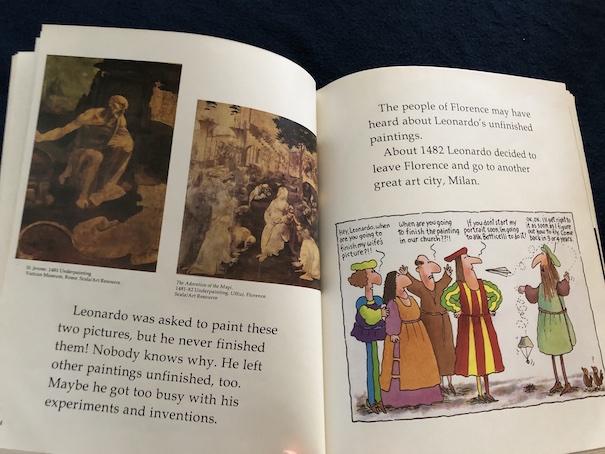
This book is part of a series of biographies of famous people from history. I’ve been familiar with the part of this series about famous artists since around the time the first ones were published. I was in elementary school school at the time, and we had the books because my mother used to teach the Art Masterpiece program at the school. She would come to class and talk about famous artists and show their paintings, and there would be an art project for the kids to do based on the style or subject matter of the artists. So, when I was young, we had books from this series (among other art books) around the house that she used for the art classes and a lot of arts and crafts materials (a tradition which exists to this day). At the moment, this is the only book from the series that I have because the book about Leonardo da Vinci was my favorite.

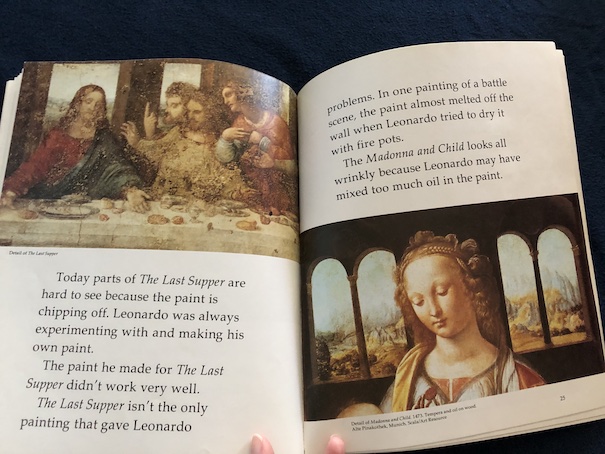
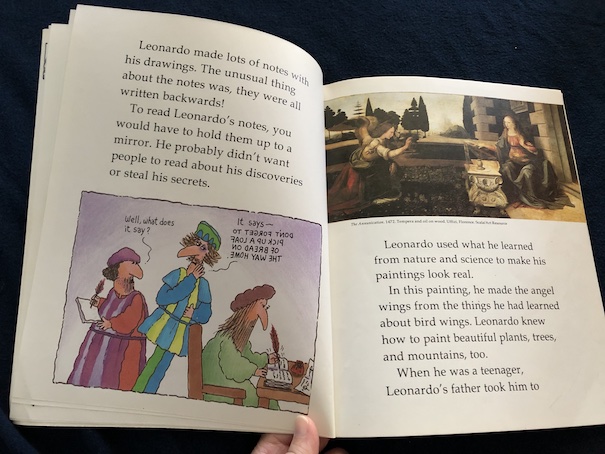
Leonardo da Vinci was one of the most famous artists of the Italian Renaissance, particularly known for his paintings The Last Supper and the Mona Lisa, but he was more than just a painter. The book is full of interesting facts about his life as well as his work. Aside from showing photographs of da Vinci’s work, the book also has humorous cartoons about da Vinci’s life, which is one of the things that makes this series of books fun.

Leonardo began showing an interest and talent for drawing while he was still a child. Throughout his life, he also developed and practiced many other skills, including architecture and mathematics, music, and sculpture. He was a scientist and inventor, experimenting in many different areas, from the mixing of different types of paints to weapons design. Along the way, he found creative ways to combine his various interests. He used his drawing skills to develop his scientific ideas, and he used his knowledge of science to make his art appear more realistic.

You might wonder how one person could find so much time to do so much, but part of the answer is that he didn’t finish everything he did. He is known to have left some of his work unfinished, possibly because he got distracted by other, more interesting projects and pursuits or because he just couldn’t finish them to his satisfaction. Not all of his designs for inventions really came to anything, and not all of his experiments worked out, either. Some of his paintings are now deteriorating because the experimental paints that he mixed didn’t quite work out.

However, Leonardo da Vinci was a perfectionist, and the paintings that he did complete show excellent techniques and a high degree of realism that have been an inspiration to later artists for centuries.

One final thing I’d like to add is that this book is part of the reason I thought The Da Vinci Code by Dan Brown was a dumb book. As I said, I grew up with art lessons. I read and loved this book about Leonardo da Vinci when I was a kid, and it has some very basic information about the life and work of Leonardo da Vinci that anybody who was seriously interested in him really should know. One of the cringiest parts of The Da Vinci Code for me was the part where our heroes are stupidly trying to figure out a message that is simply written backward. As this picture book about Leonard da Vinci points out, it’s common knowledge these days that da Vinci wrote notes using mirror writing. Some people, like the book suggests, think that he did that to make his notes harder for other people to read, although there’s also a theory that he did it because he was left-handed and that he decided that it was easier for a left-handed person to write that way. Left-handed people often complain about getting ink on their hands when they write left-to-right, but they don’t have that problem if they write right-to-left, so this might have been his attempt to get around the problem of ink-stained hands. Either way, if the people in The Da Vinci Code were such experts, they should have know this about da Vinci, and it should have been one of the first things they should have checked for. That’s not the only problem in The Da Vinci Code, but it’s one of the ones that rankled me the most because of how long I’ve known about this. (Also, The Da Vinci Code totally ripped off the albino assassin from Foul Play with Chevy Chase and Goldie Hawn, but that’s another issue.)

The book is available to borrow and read for free online through Internet Archive.

Famous French Painters

Famous French Painters by Roland J. McKinney, 1960.

This book is part of a series of Famous Biographies for Young People. Reading older non-fiction books can be problematic because non-fiction books are often updated with new information. In this particular book, there are people who are described as being still alive because they were at the time of the book’s publication, but they are not alive anymore. However, older non-fiction books sometimes interest me both because they are an indication of what people knew and studied at the time of publication and they sometimes cover odd topics that don’t commonly appear in new books. So far, this is the only book I own from this particular series, but the other biographies in the series

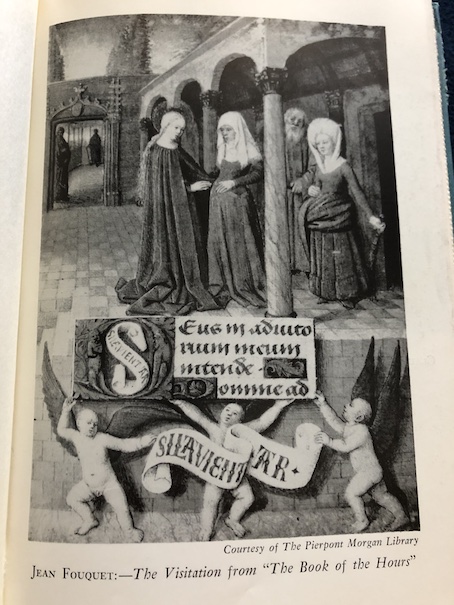
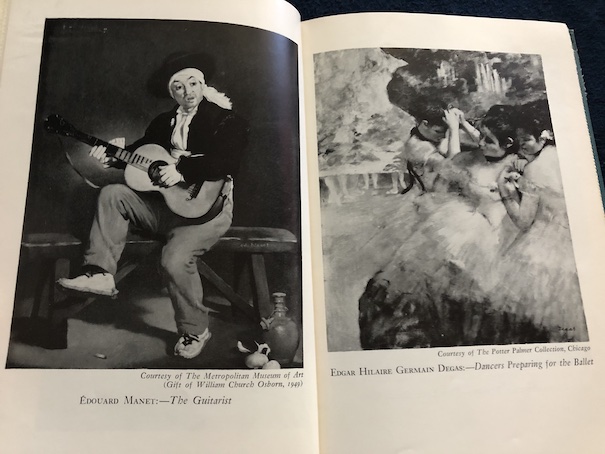
It begins with a section of black-and-white prints of famous French paintings and an introduction to the history of French painting in general. The introduction begins with a discussion of illuminated manuscripts in the 15th century and the artistic and architectural endeavors promoted by King Francis I in the 16th century. Francis I was particularly fascinated by Italian art, and he hired artists of the Italian Renaissance, including Leonardo da Vinci, to work at his court. Francis I helped to fuel an increasing interest in the arts in France called the French Renaissance. Although the French Renaissance was initially heavily influenced by the Italian Renaissance, French artists continued to develop their own styles. Popular subjects in French art were portraits, realistic landscapes, scenes from Classical mythology, and religious themes. The introduction ends with artists who painted during the late 18th century and early 19th century, explaining how their departure from neoclassical styles led to the development of new art styles.

After the introduction, there is a series of short biographies of famous French artists, beginning in the early 19th century and leading into the early 20th century. One of the first things that struck me about the list of artists included in the book is that, when their birth and death dates are included, none of the artists were born later than the 1880s, and the last two in the book have no death dates listed. Since the book was published in 1960, those last two artists were still alive at the time of publication, although they have died since then.

The artists included in the book are:

Eugene Delacroix (1798-1863) – He was a leader in the Romantic style of painting and one of the first French artists to use watercolor paints, which the French learned from English artists.

J. B. (Jean Baptiste) Camille Corot (1796-1875) – Originally, he trained in business, but he didn’t think he was suited to business and decided that his future was in art. He was particularly known for his landscapes, which were his specialty. He was also known as a charitable benefactor.

Edouard Manet (1832-1883) – Manet’s parents originally wanted him to become a lawyer, but it soon became apparent that he did not have the interest or temperament for a law career. When he first began his art studies, he quarreled with his teacher over the teacher’s strict insistence on realism in art because Manet preferred a more creative form of expression. He eventually developed a more simplified realistic style that did not focus on small details, a style that contributed to the development of impressionism.

Edgar Hilaire Germain Degas (1834-1917) – His specialty was portraits, and following the lessons that his teacher impressed on him, he emphasizes the importance of lines and drawing in his work. Much of his work was in oil paint, but he switched to pastels because he found that it was easier to work with and less of a strain on his eyes. Some of his best known works were of ballet dancers.

Paul Cezanne (1839-1906) – He initially doubted his own artistic talents, but a fellow painter, Pissarro, advised him to stop trying to imitate others and put his focus on studying nature. Cezanne’s association with Pissarro helped him to develop his own style.

Pierre Auguste Renoir (1841-1919) – Early in his life, Renoir was known for his singing ability, but his parents insisted that he learn a trade. He started learning how to decorate china, but this was the era when factories began using machines to decorate china. For a time, Renoir decorated fans and window shades, but his focus on improving his drawing abilities led him to a career in art. He became a friend of Monet, and the two would discuss art techniques with each other, although they had different styles.

Vincent van Gogh (1853-1890) – He was originally from the Netherlands but lived in France. He was a contemporary of Gauguin, and the two were even friends. Unfortunately, van Gogh was plagued by mental illness, leading to the fit where he cut off part of his ear after an argument sparked by ridicule from Gauguin. Eventually, he committed suicide. He was not a famous artist during his lifetime, partly due to his mental illness and early death, but his work became famous after his death.

Paul Gauguin (1848-1903) – Although he was originally from France, Gauguin is known for his travels to islands in the South Pacific, where he eventually died. Much of his work was inspired by his travels in the South Pacific.

Henri Matisse (1869-1954) – He was a leading figure in a group of artists known as the fauves, which mean “wild beasts.” They painted in an unorthodox way that included few details and ignored perspective.

Pablo Picasso (1881- ) – Picasso was originally from Spain, but he lived in France for most of his adult life. He began studying art at a young age and is known for his work in surrealism and cubism. He was alive at the time this book was written, but he died in 1973.

(Odd fact not included in the book – Picasso was actually born one day before the shootout at the OK Corral in Tombstone, AZ. It doesn’t mean anything and isn’t important, but I noticed the date and just thought I’d tell you.)

Georges Braque (1882- ) – Braque was a contemporary of Picasso, and the two artists were instrumental in the development of cubism, although they each did their own work. The collaboration between the two artists was interrupted by the outbreak of WWI. Braque was alive at the time this book was written, but he passed away in 1963. On the subject of limitations in art, he once said, “Progress in art does not lie in extending its limits, but in knowing them better.”

Something that struck me was how much artists who were contemporaries of each other worked together, met to discuss and analyze each other’s art, and were actual friends. I prefer collaboration to competition, and I like that many of these artists seemed to appreciate and learn from each other’s skills and techniques.

I was also surprised at the number of artists whose parents initially wanted them to become lawyers, like Manet, Degas, Cezanne, and Matisse.

The book is available to borrow and read for free online through Internet Archive.

Bells

Bells by Elizabeth Starr Hill, illustrated by Shelly Sacks, 1970.

I love books about oddball topics, so a children’s picture book about the history of bells was irresistibly intriguing.

The book begins with the origins of bells in the Bronze Age. People had made rattles of various kinds before the Bronze Age, but after they learned to make bronze, an alloy of copper and tin, they discovered that they could make metal rattles with a much prettier sound. These metal rattles/early bells were made in the “crotal” design, which is the same shape as today’s jingle bells or sleigh bells. Other shapes of bells, like gongs and the classic bell shape may have been inspired when people realized that pleasant sounds could be made by banging bronze utensils against bronze dishes and bowls.

Bells have been used for thousands of years and have served many purposes. The oldest bell that has been found (at the time the book was written) was over 3000 years old and came from the area near Babylon. King Solomon of Israel used to have bells to frighten away birds from the roof of his temple. The Spartans were able to infiltrate a walled town in Macedonia because the sentry wore a bell on his uniform that helped them to keep track of where he was, but in other instances, nets with bells attached to them were used to warn of the presence of enemies. Bells have also been frequently used in religious services.

Sometimes, people wear bells to call attention to themselves. The classic jester’s cap with crotal bells (jingle bells) attached to it is meant to be attention-getting.

Bells can be made of many different materials, from different types of metal bells to glass bells to clay bells. There are even wooden ones, although they make more of a clunking sound than a ringing. People used to make bells by hammering pieces of metal into shape, but then they developed ways to cast bells in molds, which is how bells are made today.

There are many superstitions that have been attached both to the making of bells and their use. The book describes the Bilbie family, who famously made bells in Medieval England. The Bilbies were superstitious and consulted astrologers to determine the best times to make their bells. They also always rang bells for the first time on full moons. Various people have believed that ringing bells frightens away demons and witches.

The parts about superstitions and legends are my favorites. In particular, there is a legend in England about a town that was completely buried during an earthquake. The people in the town always rang their church bells at Christmas, and the legend is that if you go to a particular spot and put your ear against the ground, you’ll still hear them ringing the bells. However, the book says that there’s actually a scientific explanation behind the phenomenon. People who have put their ears to the ground at that spot have heard bells ringing, but they’re actually the bells from a nearby town, not one underground. The ground actually conducts sound very well, even better than sound waves moving through the air, so a person standing upright might not hear the bells ringing from another town, but someone who put their ear to the ground could hear the conducted sound vibrations. It’s not unlike the phenomena experienced by people who put their ears to the rails on railroad tracks to listen for the train. There are also stories of people having heard the approach of herds of animals, like buffalo, coming toward them in this way. The book doesn’t mention it, but “keep an ear to the ground” is actually an expression for watching and listening for signs of things that are going to happen because people noticed that vibrations in the ground could be indications of something coming toward them.

The book also describes some famous bells, like the Liberty Bell, Big Ben (Big Ben is actually the name of the bell in the clock tower, not the clock tower itself, although people informally think of the clock tower as Big Ben) and Tsar Kolokol, the largest bell in the world.

There are also a few nursery rhymes that mention bells (although the book doesn’t give any background information about the rhymes) and some information about change-ringing and carillons.

The book annoyed me a little in the way it kind of jumps around, telling some history, then some legends, then some more history, and then more legends. It’s a very easy read, and the information is interesting, but it’s a big disjointed. It sometimes feels more like a list of facts and short stories than one cohesive story. It might help if there were headings or chapter divisions in the book to organize the information, but there aren’t.

The book is available to borrow and read for free online through Internet Archive.

Brother Eagle, Sister Sky

Brother Eagle, Sister Sky: A Message from Chief Seattle with paintings by Susan Jeffers, 1991.

This is a picture book, but not one for very young children because of the serious subject matter. It’s a profound book with beautiful pictures, but before presenting it to children, adults should be sure that the children are old enough to understand the background of the book.

The book begins with some information about its background. It describes the variety of “Indian” (Native American) tribes that have lived in the Americas for thousands of years and how, after white settlers arrived from Europe, they were killed and pushed off their ancestral lands by the new arrivals. It’s historically true, but also dark subject matter, which is why it’s important for the children reading the book to be old enough to understand it. Most of the book is the text of a speech made by Chief Seattle (who lived c. 1786 to 1866) to the Commission of Indian Affairs for the Territory and other government employees when the US government wanted to buy land from his tribe. The historical details concerning this speech from the mid-1850s are complicated, and accounts of it might not be completely accurate, and there is a note in the back of the book that addresses that. I consider the spirit of this speech something worth preserving, so I won’t get too hung up on that right now. I just mention it for the sake of people interested in going deeper into the history.

Susan Jeffers particularly wants readers to consider the environmental message of the speech and how relevant the message is today for a society that has endangered itself by placing a higher priority on the acquisition of land, resources, and wealth than on preserving the land and environment that makes life itself possible. This book was written in the early 1990s, and having been a child at that time myself, I know that these themes were increasingly becoming topics in schools and in children’s entertainment during that time. I’d like to point out that I, and others who are younger than me, have heard similar messages about environmental concerns from an early age. This has given us different priorities from earlier generations who did not, although it’s also worth pointing out that many of us came to care more about the environment as children because of the influence of adults who already did.

Chief Seattle questioned the concept of buying land because of the absurdity of buying aspects of nature, like the sky or rain. Land and nature had sacred spiritual meaning for Chief Seattle’s people.

Chief Seattle’s speech was full of poetic imagery, as he explained how his people felt like they were part of the land and it was part of them. He said that they looked on animals like they were brothers.

The land also connected them to their ancestors and the memories of their people.

Chief Seattle questioned what would happen in the future, when the land was filled with people and all of the animals either killed or tamed, painting a bleak picture of a land deprived of life.

The speech ended with the thought that people didn’t “weave the web of life, we are merely a strand in it.” Chief Seattle called on the people wanting to buy the land to love it, care for it, and preserve it because “Whatever we do to the web, we do to ourselves.”

The environmental themes of the message are poignant for modern times because people have become increasingly aware of the consequences of environment pollution and careless use of natural resources.

The book is available to borrow and read for free online through Internet Archive (multiple copies, including English and Hindi).

The Key to the Indian

The Key to the Indian by Lynne Reid Banks, 1998.

This is the final book in the Indian in the Cupboard series. At the end of the previous book, Omri’s father learned the secret of Omri’s special cupboard and key, that it brings small plastic figures to life.

At the beginning of this book, Omri’s father suddenly announces to his family that he wants to take them on a camping trip. It seems like an impulsive decision because this isn’t something that the family usually does, and Omri figures that it must have something to do with the secret that the father and son now share concerning their small friends from the past.

After Omri’s father discovered his secret, the two of them had a serious talk, and Omri explained to him all about his past adventures and the very real consequences that they’ve had, both in the present and in the past. They need to consider carefully what they’re going to do because Little Bear has asked them for help with some trouble that his tribe in the past is having with the British. Knowing the history of the interactions between Europeans and Native Americans, both Omri and his father know that something serious is about to happen to Little Bear and his people, but how can they help? Omri explains to his father that they have the ability to go back into the past themselves, but in order to do that, they need to find something big enough to hold both of them, and someone else would have to turn the key for them to send them and bring them back.

Omri’s father later admits to him privately that he thought up the camping trip as a way for the two of them to disappear for a couple of days without anyone asking questions. Although he proposed the camping trip, he plans to arrange for him and Omri to have a private trip by themselves, discouraging the others from going along. Omri’s father also thinks that he’s figured out what they can use to send themselves back in time – the family car. It’s big enough to hold both of them, it locks with a key, and there’s even an LB in the license plate number, which they take as a hopeful sign. But then, Omri realizes that there’s a problem with that scheme. Even though the car locks with a key, it’s not the kind of lock that an old-fashioned skeleton key could open. They need a key with a different shape, something flatter. They decide that they need the help of Jessica Charlotte, who made the last key. Fortunately, Omri has a way to talk to her because he has the plastic figure of Jessica Charlotte.

When Omri brings Jessica Charlotte back, he finds that she has attempted to drown herself in a river (an event hinted at in the last book) because of her guilt at accidentally causing her sister’s husband’s death. Omri brings back a WWII Matron who has helped them before to treat Jessica Charlotte. When Jessica Charlotte recovers, she thinks at first that she must have died and that Omri is part of her afterlife. Omri assures her that it’s not the case, that she’s still alive. She is still lamenting over having caused Matt’s death and ruined her sister and niece’s lives, but Omri explains to her that he’s Lottie’s grandson. Jessica Charlotte feels better, hearing that Lottie grew up, married, and had children, so her life wasn’t completely ruined. Omri can’t bring himself to explain how Lottie was killed in a bombing during WWII, but he asks for her help to create a new key. Aunt Jessie, as she asks to be called, agrees to help Omri, and he and his father give her their car key to duplicate.

However, when Aunt Jessie returns with the key, they realize that they’ve miscalculated. When a person comes from the past with anything they make or bring with them, it’s always small, like the miniature people themselves. Aunt Jessie’s key is a duplicate of the key they gave her, but it’s small, too small to use in the car. Omri and his father aren’t sure how to get around this problem, so they decide to go on the camping trip with Omri’s brother Gillon, just camping like normal, while they think it over.

It turns out that something magic happened to the car key while it was in the past with Aunt Jessie. When Omri’s father turns the key in the car, Omri suddenly finds himself in the past, but not the past he was hoping to visit. Because they brought some things that belonged to his Great-Grandfather Matt with them on the camping trip, Omri suddenly finds himself in India, during the time that Matt was living there. Omri is inside a puppet in a marketplace, and his great-grandfather buys him. Also, to Omri’s shock, Gillon is also inside a puppet that his grandfather has.

Their mother eventually rescues them by opening the car and turning the key. She was alarmed because it seemed like her husband and sons all passed out in the car. Omri and his father don’t have a real explanation for her, not wanting to explain that the car key is now magic. (She decides that there must have been an exhaust leak, and they were all overcome by fumes.) Gillon was knocked unconscious when his puppet was dropped on its head, and his mother takes him to the hospital, using her spare car key. (When Gillon recovers, he thinks it was just a weird dream he had because of the car fumes.) Meanwhile, Omri and his father talk about the situation, and Omri’s father reveals that, while the boys were taken to India, he ended up in Little Bear’s time because he was carrying some wampum belonging to Little Bear.

So, know they know that it’s possible for them to use their car key to go back in time, but if they try it a second time, who will turn the key for them to bring them back at the appropriate time? The only other person who can come with them on their “camping trip” who knows their secret and can be trusted to help them is Omri’s friend, Patrick. However, Patrick isn’t happy that he’s only there to help Omri and his father go back in time and that he won’t be going himself. He does agree to help them, but unfortunately, he has plans of his own while Omri and his father are occupied elsewhere.

The book is available to borrow and read for free online through Internet Archive (multiple copies).

My Reaction:

Although Omri’s father wonders at first whether it’s a good idea to try to help Little Bear because of the risk of changing the past and affecting the future, Omri has learned that it’s not quite as simple as that. During his previous adventures, he has felt an irresistible pull to use the cupboard and the key, even when he wasn’t always sure it was a good idea, and there are indications that Omri’s interactions with people in other time periods seem fated to happen. He did save Jessica Charlotte’s life when she tried to drown herself, and other things Omri has done seem to fit with wider events.

When Omri and his father are figuring out how to help Little Bear with his problems with the British in his time, they do some research about Little Bear’s time and talk about the ways that 18th century British people treated Native Americans. Knowing what Little Bear is likely to face, they feel like they have a responsibility to help him as best they can. When Little Bear explains in more detail what his people have been suffering at the hands of the British and other settlers, Omri feels guilty, knowing that he’s also British, while at the same time knowing that he was not responsible for things that happened before he was born. This is something that people still struggle with today, hearing about difficult periods of history and knowing that their ancestors (or at least other members of their society, if not literally their direct ancestors) played a role in making life difficult for others, setting up situations where real people suffered or were killed. The best Omri can do is to help Little Bear make the best possible decisions to ensure the survival of his people. Of course, being able to help with that much is part of the time traveling fantasy of this story. Real people can’t actually go back in time and intervene to influence others and change the course of history.

The books in this series aren’t for young children, and as the series progresses, they get more serious in subject matter. There is discussion of suicide, not just with Jessica Charlotte’s attempt to drown herself but when Little Bear explains that his first wife killed herself after being raped by white men. There is violence in the story when the Native American village is attacked and people are shot. Overall, the story is pretty straight-forward in the way in confronts the dark sides of history. Omri and his father advise Little Bear to take his clan to a place where they know that they will be relatively safe and among other Iroquois, but they know and admit to Little Bear that even that won’t solve all of their problems and that there will be other hardships in the future. It’s an imperfect solution to a massive problem, but Omri senses that it is best choice that they could make and that Little Bear and his family will live the safest possible life because of the decision they made, and their descendants will survive.

Omri and his father struggle with knowing that things are going to be hard for Little Bear’s people no matter what choices they make. There is no magical solution to everyone’s problems in the story, and the book doesn’t offer a firm moral or solution to Omri’s guilty feelings when he sees firsthand how badly Native Americans were treated (a form of “white guilt“, although the book doesn’t use that term). Overall, I would say that the book confronts the dark parts of history and human guilt on a very individual level. Omri and his father can’t solve the large issues completely because they can’t control them. They can’t control the past, and they can’t control other people, not even the people who come through the cupboard as miniature ones, like living toys. Everyone is an individual with their own choices to make, and every choice, even the wrong ones, changes the course of history.

After Omri saves Jessica Charlotte’s life, she realizes that what she thought was a dream before she stole her sister’s earrings was real, that she saw and spoke to Omri, and that he could have warned her about what would happen if she went through with her theft, how Matt would have died and how everyone’s lives would be changed for the worse. However, Omri did choose not to warn her because not everything was changed for the worse. After Lottie’s father died and her family lost their money, Lottie still grew up, fell in love, got married, and had a daughter. It’s true that she did die young in World War II, while her daughter was still an infant, and changing the theft of the earrings might have changed that in some way, but not without changing other things. Omri has discovered that changing things about the past, even seemingly small things, can change larger parts of history, and his psychic gift seems to guide him toward making only choices that help the flow of history instead of working against it. If he had prevented the theft of the earrings, his great-grandfather might have lived longer and so might Lottie, but if that happened, would Lottie have ever met the man she eventually married and had Omri’s mother? Omri’s father wouldn’t be happy without his wife and sons, and if Omri never existed, would some of the other things he did that impacted history have happened? Also, if Lottie hadn’t died in the bombing during WWII, would someone else have been where she happened to be and died in her place? The bomb that killed her would have fallen anyway because that was part of someone else’s choices, a person who never enters this story and whose decisions can’t be controlled. Time and history and the ripple effects caused by individual choices are complex. Omri has his psychic gift to guide him, and even his father, who admits that he never used to believe anything he couldn’t see for himself, comes to trust it.

People without this sort of magical gift have only themselves to rely on to make the best choices they can to make the world as good as possible, even in the face of others’ bad decisions. I think that a large part of the choices that Omri makes in the story and dealing with “white guilt” in real life come down to the combination of frustration and the acceptance of choices made by other people who can’t be controlled. Modern people might hate what happened in the past and feel badly if people related to them were part of it, but we don’t have the option to change things that have already happened. There comes a point where you have to accept the knowledge that you can’t control others, no matter how much you might want to make better choices on their behalf. The only person you can control is yourself.

I’m a white person, descended from colonial settlers in America, and I don’t actually see “white guilt” as a negative thing. I see it as a human thing. If you can feel real emotion at someone else’s plight, a wish that bad things didn’t really happen, or a feeling that what happened shouldn’t have happened and an honest desire to change even the unchangeable past for the better, it means that you’re a real, thinking, feeling human being with a sense of right and wrong, and there’s nothing bad about that at all. Feelings are just tools, to give us hints of what we need to do or how we need to behave in our lives. Feelings aren’t always completely accurate, but sometimes, they give us hints of things that need to be fixed or clues that whatever we did before didn’t really work, that we made the wrong choice or did the wrong thing. I think what upsets and confuses other white people about “white guilt” is the conflict between loving ancestors and wanting to be proud of them and admitting that some of them had a real dark side and did some pretty awful things. Some people have trouble dealing with that, thinking that it’s impossible to feel two things at once, loving someone and being angry with them for things that they’ve done, but it really is possible. Two things can be true at once, and you can have mixed feelings about many things.

Feelings are complex, as complex as people are, and I think it’s as possible for a person to both like and hate another person for the things they’ve done as it is to both like a sweater for the way it looks but not want to wear it because it’s itchy and uncomfortable. I think that’s about the best advice that I can actually offer to other white people trying to make sense of that feeling. Sure, that sweater looks pretty impressive. It has a nice color and a cheerful pattern, and you might think it would look impressive on you if you wore it, but honestly, it’s better if you just leave it on the mannequin. It’s overpriced, out of style, and won’t look at all impressive when it makes you constantly want to scratch all of the places where it itches. Let it go.

“God, grant me the serenity to accept the things I cannot change,
courage to change the things I can,
and wisdom to know the difference.”

The Serenity Prayer

The frustrating thing about feelings about the past and about other people’s lives is that we can’t fix those particular things. In real life, we can’t go back in time, and we can’t even “fix” other people in our own time because that’s something they have to do themselves, if they’re going to do it. You can suggest things to other people, but there’s always a point where they have to make the decisions themselves. But, the good news is that, if you can’t control other people, nobody can completely control you! The way I see it, the most useful thing about this “white guilt” is remembering that this is something we don’t want. Maybe there’s something charming about the rosy, nostalgic view of the past, but honestly, you wouldn’t be happy living there, and if you actually had to live with your ancestors, you’d probably discover that you wouldn’t see eye-to-eye on a lot of things and maybe wouldn’t even get along at all. So, why would you want to try to carry their old baggage with you into your life and spend your life and your precious time constantly trying to explain or excuse their bad choices? You’ve got your own to life.

Give credit where credit is due for both the good and the bad things, and let our ancestors’ records speak for themselves. You won’t accomplish anything for twisting your feelings into knots for trying to protect the feelings of the dead and justify their actions. They don’t even feel anything anymore. They are dead. Let them rest. We don’t want to add to bad things that have been done in the past and to keep having things in our lives to feel guilty about, and that’s okay because there are new choices to be made every single day. Put your focus there. You have a present to live and a future to plan. Knowing about the past is interesting and informative, but the past isn’t where we really live. Admire it like a nice sweater on a mannequin, take note of the price tag, and move on. We don’t have to make the same old choices that have made people, including ourselves, unhappy just because that’s the way things have been before or because we feel like we have something to prove about our ancestors. They had their chance to make the choices in their time, for good or bad (and frequently, some of each, but you can’t help that), and now, it’s our turn to make the choices because this is our time.

Speaking of bad decisions, Patrick almost gets Boone and Ruby killed because of his recklessness when he brings them back while Omri and his father were with Little Bear, which he did just because he was bored and felt left out of their magical adventure, which wasn’t really pleasant and fun for them anyway. Boone and Ruby both make it clear how they feel about that, and Omri also makes it clear that this is the end of the magic for him and Patrick. Boone and Little Bear have their own lives to live, and Omri’s gift tells him that it’s time to let them get on with living their lives without interference. Omri still has the cupboard and the key, but he no longer feels the pull he felt before to use them because he has played his part in history and in the lives of his little friends, and there is nothing more he needs to do. He doesn’t feel the need to lock these things away as he did before because he already knows that he will never feel the urge to use them again. When something’s over and the moment has passed, you just know.

Before the end of the story, Omri’s mother admits to him that she knows all about the little figures and that the cupboard brought them to life, although she never actually saw any of them herself. She has also inherited the family gift and is aware of what the cupboard does, even though she has not used it herself. All along, she’s been pretending that she didn’t know what was going on, although she really did. She’s a little sorry that she didn’t see the little people herself, but she knew that not interfering was the right thing to do. She thinks that letting the magic go and not using the cupboard again are the right decisions, and she doesn’t want Omri or his father to tell Omri’s bothers about the magic because, if they do, it will never end, and it’s really time for it to all end. This really is the final book in the series.

The Mystery of the Cupboard

The Mystery of the Cupboard by Lynne Reid Banks, 1993.

This is the fourth book in the Indian in the Cupboard series. It’s also the longest book in the series and the one that reveals the most about the history of the magical key and cupboard and how their secrets tie into the secrets in Omri’s own family. It was my favorite book in the series when I was a kid!

Omri’s parents have surprised him by telling him that they’re planning on moving to a new house again. Omri wasn’t exactly happy with their last move, and his room and other parts of their new house were damaged after his last adventure with time travel, when his friend Patrick brought back a tornado with him. However, now that the house has been repaired and he’s settled in, Omri doesn’t like the idea of having to pack up and leave and get used to a new place again. His parents want to move to the country, but it’s not even the area where Patrick now lives. Instead, they’re planning to move to a house that his mother has just inherited.

The house Omri’s mother has inherited belonged to an older cousin of hers she never actually knew. He didn’t leave his house specifically to her; it’s just that he died and left no will, and Omri’s mother happens to be the nearest living relative his lawyers could find. When they finally see the house and find out how much land is attached to it, it turns out to be much better than Omri expected.

There are just two things that concern Omri. The first is the package that he asked his father to store at a bank for him – the magical cupboard and key. Although Omri asked his father to put them in a bank deposit box to keep them safe and prevent himself from being tempted to use them again because it’s too dangerous, he doesn’t like the idea of them being too far away from where he’s living. His father promises to have them transferred to a bank near their new home. The second thing that worries him is that his cat mysteriously disappears soon after they move into the new house. (The cat is okay, she just sneaked away to have kittens.) His parents say that she’s just roaming her new territory and might be a little angry for being moved from her old home and that she’ll come back to Omri once she’s settled in, he still worries about her.

One night, he think he hears his cat crying and goes looking for her. He doesn’t see her, but he stumbles on something that was hidden in some old thatch that fell of the roof of the house. It turns out to be a metal box and a notebook belonging to someone named Jessica Charlotte Driscoll, written in 1950. Omri doesn’t know who she is, but the notebook is a story of her life, in which she describes incredible things happening to her which her family doesn’t believe. Omri wonders if she could be a relative of his, and the name Charlotte reminds him of his grandmother, Lottie. He never knew his grandmother and his mother doesn’t even remember her mother because she died in a bombing during WWII, when she was very young. The woman who wrote the notebook couldn’t have actually been his grandmother because she would have been dead for several years by 1950, but perhaps it was a family name.

Omri questions his mother about the cousin who owned the house and her family’s history. Jessica Charlotte turns out to be the sister of Omri’s great-grandmother, his mother’s great-aunt. Great Aunt Jessica Charlotte was the younger sister of his mother’s grandmother. After her mother was killed in the war, Omri’s mother was raised by her grandmother. Omri’s mother had asked her about her younger sister when she was a girl, but her grandmother didn’t like to talk about her. Apparently, Jessica Charlotte had been an actress with a somewhat scandalous past. However, the cousin who used to own this house was Jessica Charlotte’s son, Frederick. Frederick never married, and although Omri’s mother thought that Jessica Charlotte had lived abroad somewhere, it’s possible that she lived at this house for a time.

Much of the story is told through entries in Jessica Charlotte’s notebook. When Omri begins to read the notebook, written toward the end of Jessica Charlotte’s life, he learns, to his shock, that Jessica Charlotte was the original owner of the magic cupboard and that she had her own Little People who visited her from other times and were her friends. After Omri reads that, he questions Gillon, the brother who gave him the cupboard, and he admits that he didn’t really find it in an alley, like he said. He actually found it in the basement of their old house with a bunch of other junk. He just didn’t have the money to buy Omri a birthday present at the time, and Omri had kind of a fascination for secret drawers and boxes, so Gillon thought that he might have some fun with the old cupboard, and he made up the story about mysteriously finding it to make it more interesting. (I suspect that the author was just retconning this part to make it agree with the idea that the cupboard was passed down through Omri’s family, but I like the way this comes out, so I’m okay with that.)

The notebook further explains that Jessica Charlotte had been envious of her older sister because she was prettier, luckier, and often seemed favored by everyone. However, in mocking the young men who came to court her older sister, Jessica Charlotte discovered that she had a talent for mimicry, which led her to become an actress, although her family thought that it was a disreputable profession and disapproved. Jessica Charlotte also discovered that she was psychic and sometimes had visions of the future. She eventually left home and became an actress. Her sister, Maria, still visited her secretly sometimes, against their parents’ wishes.

After awhile, Jessica Charlotte became pregnant with Frederick, which was when she first came to the old house where Omri’s family now lives. She didn’t have any money and couldn’t work while pregnant, and because she was unmarried, she would have been considered shameful if people knew. At that time, the house was a farmhouse belonging to a relative of Frederick’s father. By that point, Jessica Charlotte realized that her boyfriend wasn’t a good person and wasn’t going to be a good father to their son, but he did arrange for this relative of his to help her through her pregnancy. Frederick was born in the house, and because he was illegitimate and sensed his mother’s complicated feelings about him and the circumstances of his birth, he and his mother were never as close as they really should have been.

Meanwhile, Maria got married and had a daughter, Lottie, who was Omri’s grandmother, the one who was killed in the war. Jessica Charlotte says that she did something that wronged Maria and Lottie, and Omri stops reading the diary for a time, but he decides that he really has to continue and know the full story.

Over the years, Jessica Charlotte lived a hard life, supporting Frederick through a mixture of acting and other odd jobs, including fortune telling because of her psychic abilities (although she never used her gift to see into the future for herself or anyone close to her because she was afraid she might see something bad happen to them and be unable to stop it). Meanwhile, Maria was living a very comfortable life with her husband and daughter. Even after their parents died, Maria still had Jessica Charlotte visit secretly because of her tainted reputation, and she never wanted to meet Frederick or talk about him because his birth was the cause of her sister’s scandal. Still, Jessica Charlotte continued to see her sister and became fond of Lottie.

However, Maria was basically a pampered snob who didn’t understand her sister’s life and hardships and also had a streak of self-centeredness. One day, when Lottie was a young child, Maria said that when Lottie was older, she didn’t want her to see so much of her aunt, implying that Jessica Charlotte would be a bad influence on her. Jessica Charlotte was deeply offended by that, but she was also fearful about losing the last family members who were still speaking to her. She had lost so many of her other relationships that she still felt the need to be close to Maria and Lottie as much as she could and visit their pampered and comfortable little world, enjoying occasional tastes of their happier and more comfortable lives.

Yet, Jessica Charlotte’s jealousy for Maria’s pampered life and anger at her callousness continued to eat at her. One day, when Maria was showing her all of her nice jewelry, Jessica Charlotte got the urge to steal a beautiful pair of earrings. First, Maria was being, at the very least, thoughtless and callous for showing off all of her nice jewelry to her much poorer sister, who could never have things like that herself. Maria not only had no concept about what her sister’s life was like outside of her occasional visits, but she purposely never asked her about how she was doing, how her son was doing, or even where they were living, how they were getting by, if they needed anything, or if she could help them in any way. She didn’t know because she didn’t want to know any of these things, and the fact that she didn’t want to know any of that indicates that she knew enough to understand that their circumstances weren’t pleasant. To show off all of her pretty things like that just seems like rubbing it in. Second, Jessica Charlotte had been in need for so long that she saw all of the pretty jewels as symbols of Maria’s comfortable life, something she hungered for herself. The pair of earrings weren’t something that Jessica Charlotte wanted just for the sake of having them but because of what they represented to her, the life that she couldn’t share in and which she knew that Maria would soon shut her out of when she declared that her visits with her young niece would have to stop soon.

Jessica Charlotte planned out the theft in advance, making a duplicate key for her sister’s jewelry box and thinking that her sister would just assume that she’d mislaid that one pair of earrings somewhere. Unfortunately, when Maria noticed that the earrings were gone, she thought Lottie had done something with them, and when she kept insisting that Lottie tell her where they were, Lottie got upset and ran out of the house into the street. Matt, Maria’s husband and Lottie’s father, chased after her and was hit by a cab and killed. Jessica Charlotte felt terrible when she heard the news because she hadn’t meant for anyone to get hurt, but there was nothing she could do to take it all back.

Omri knows how Maria and Lottie’s lives went after that point because of what his mother told him about their family history. After Matt died, Maria and Lottie didn’t have very much money to live on, just a little pension, and then their house was burgled, and many of Maria’s nice things were stolen, including the rest of her jewelry, so she couldn’t sell them for extra money. Maria had to move to smaller, cheaper lodgings and get a job for the first time in her life in order to support herself and her daughter, living a life closer to what her sister had been doing. When Lottie was grown and married, she and her husband helped to support her mother, but after they were killed in WWII, Maria took in Lottie’s daughter (Omri’s mother) and had to keep working in order to raise her. Although they were now living in more equal circumstances, the two sisters did not become close again because of Jessica Charlotte’s guilt about what she’d done. Jessica Charlotte ended up buying the old house in the country where her son had been born and told her sister that she was going to live abroad, never telling her exactly where. She had not expected to see Maria again anyway since Maria was planning to cut her out of her daughter’s life before Jessica Charlotte stole the earrings, and after Matt died, Jessica Charlotte couldn’t bring herself to face Maria. Jessica Charlotte lived in the country house until her death in 1950.

When Jessica Charlotte became too weak to write any longer, shortly before her death, she had Frederick finish the story in the notebook. Aside from the difficult feelings between Frederick and his mother because of the circumstances of his birth and the rough and poor childhood he endured, Frederick also says that the two of them don’t really get along because they are very different types of people. When he was grown, Frederick went into business as a metal smith, eventually owning his own factory that made toy soldiers and other metal toys. During WWII, the government had him convert his toy factory to manufacture munitions. He wasn’t happy about it, but it did make him fairly well-off. After the war, Frederick had hoped to go back to making metal toys, but plastic was coming into vogue as the material of choice for toys, and Frederick couldn’t stand the stuff. He thought that the newer plastic toys were cheap and shoddy compared to his detailed works of art in metal. (It was kind of true.) There were basically two choices before Frederick: convert to making the cheap plastic toys he hated or switch to making different types of metal products. He switched to making metal boxes and cabinets.

Frederick never really believed in his mother’s supposed psychic powers, but when he was upset about plastic ruining his metal toy business, he admits that he let his mother talk him into participating in a silly ritual. He was so angry and upset that his emotions were ruining his health, so his mother told him to build something to put his feelings into and shut them away. Frederick built Omri’s magical metal cupboard. When he was finished making it, his mother had him visualize cleansing himself of all of his anger and hatred of plastic and shutting that feeling away in the cupboard. To his surprise, his mother shut and locked the cupboard with a different key from the one that he’d made to put in the cupboard’s lock (her key to her sister’s jewelry box). He thought that this ritual was kind of crazy at first, but he did feel better after he did it. He felt weak for a time, but then he recovered. He still didn’t like plastic, but not to the point where it harmed his health anymore.

Jessica Charlotte had said her son had also inherited her psychic “gift”, even though he didn’t believe in it. Apparently, his strong feelings about plastic produced a kind of magic spell or curse that affected the key and the cupboard and created the effect of bringing plastic toys to life. Jessica Charlotte discovered this herself because her son had given her a set of plastic figures in order to demonstrate to her how these little figures were inferior to his metal ones. Jessica Charlotte put them in the cupboard and brought them to life, and these little friends of hers brought her some happiness in her final days. Frederick thought that her mother was imagining that she was talking to fairies or something and never found out about his mother’s little friends or the magic of the cupboard.

When Jessica Charlotte realized that she was dying, she used the cupboard to send her little friends back to their own time periods, except for one little maid named Jenny, who refused to go back because she’d had a terrible life in her own time. Instead of making her go back, Jessica Charlotte confided in one of the workmen fixing the thatch on her roof and gave Jenny to him. This man, Tom, was lonely because his wife left him for someone else, so Jenny was good company for him for many years, until one day, she simply turned back to plastic suddenly. When Omri finds Tom as an old man and introduces himself as Jessica Charlotte’s distant nephew, Tom explains all of this to him, saying that all he can think of is that Jenny’s physical body must have died in her own time after having been in an apparent coma for years. He buried her little plastic figure respectfully. Tom is also the one who sent the cupboard and key to Maria after Jessica Charlotte died along with a note dictated to him by Jessica Charlotte, hinting at the nature of the cupboard and key and tacitly admitting to the theft of the earrings, so Maria knew the truth of the theft before her own death.

Omri comes to realize that the metal box that Jessica Charlotte left behind, and which was sealed with wax, must contain her collection of little figures. When his friend, Patrick, comes to visit him at his new house, Omri explains the whole situation to him, and Patrick suggests that Omri’s magic key will probably open this metal box, too. Of course, he also points out that if Omri opens the box with that special key, it will bring the figures inside to life, just as it has with the cupboard and Omri’s old trunk. Omri sees Jessica Charlotte’s old figurines as a way of finishing her story and feels compelled to bring them back to life one last time, although he knows that bringing figures to life always comes with complications, and he will have no way of knowing who or what the figures are until the box is open.

When Omri gets the chance to talk to Jessica Charlotte’s little friends, he not only learns more about his great-great-aunt’s past and the history of the cupboard but also sees an opportunity to change the past of his mother and great-grandmother by preventing the robbery that made them poor. But, if he meddles in the past, what will that mean for his future?

The book is available to borrow and read for free online through Internet Archive (multiple copies).

My Reaction:

This is my favorite book in the Indian in the Cupboard series. I suspect that the author of the series didn’t originally have an explanation for why the cupboard and key were magic, but that’s just a guess on my part. The explanation behind the magic in this book makes sense, and those parts that didn’t quite mesh with the earlier books (like Omri’s brother’s original explanation of finding the cupboard in an alley) were briefly explained. Sometimes, when book or movie series try to explain something magical or a mysterious secret they’ve left hanging, it turns into a let-down because the explanation feels rushed or implausible or fits clumsily into the earlier parts of the story, but this one was pretty smooth, intriguing, and also opened up some new story possibilities.

In previous books, Omri and Patrick both did impulsive things with the cupboard that put their small friends, themselves, and other people in danger, but in this book, both of the boys seem to have matured. Although Patrick thinks of Jessica Charlotte as a bad person and a thief for stealing her sister’s earrings, Omri tries to explain to him that she was a much more complex and conflicted person than that. Yes, Jessica Charlotte was a thief, but her motives were beyond mere greed, and it wasn’t long before she regretted what she’d done and the lasting hurt that she’d caused her family. In considering Jessica Charlotte’s theft and the theft that the burglar who was one of Jessica Charlotte’s little friends later committed against Maria, partly out of personal greed and partly as retribution against Maria on Jessica Charlotte’s behalf, Omri and his mother both come to terms with their family’s history. Patrick, who in previous books had been the more impulsive one when he and Omri interacted with the little people from the past, acts as a restraining influence in this book when Omri is tempted to change his family’s past for the better by preventing the thefts that left his great-grandmother without money. Patrick is the one who makes it clear to Omri that, just as Jessica Charlotte’s theft of a single pair of earrings radically changed the lives of her sister and niece, if Omri tries to stop those events from happening, he might change his family’s past so much that he might accidentally prevent himself or even his own mother from being born in the first place. After Omri tells the thief to give back the jewel box he stole, Omri worries that he’s gone too far, but it turns out that one request was actually fated to happen, just as it turns out that Jessica Charlotte later realized that she had met Omri briefly in what she thought was a dream when he brought her plastic figure to life. Not all of Omri’s “meddling” with the past was really meddling but was actually part of what was fated to happen and has already had an effect on the past even before he knew it.

At the end of this book, something that Omri has alternately dreaded and wanted to happen: his father discovers the secret of the cupboard and meets Omri’s small friends. In books, there is usually this assumption that if parents ever find out about their children’s magical adventures, they will end because the parents will put a stop to them or somehow, the magic will be ruined. However, in this case, the magic is not ruined, and there is one more book in this series where both Omri and his father take part in the magic.

Phoebe the Spy

Phoebe the Spy by Judith Berry Griffin, illustrated by Margot Tomes, 1977.

Phoebe Fraunces is a thirteen-year-old girl living in New York in 1776. The Fraunces family is black, but unlike most black people in the American colonies at the time, they have never been slaves. (There were some free black families who had never been slaves during this period of history, but they were uncommon.) Phoebe’s father, Samuel Fraunces owns a tavern called The Queen’s Head. It’s a popular place for people to meet, and Samuel Fraunces allows some prominent Patriots to meet there in secret and discuss their plans. Being party to such meetings could come with consequences as the colonies are on the brink of war.

One day, in April 1776, Samuel confides in his daughter that he has overheard something disturbing. He believes that George Washington’s life is in danger, that there are soldiers who are willing to kill their general for money. Samuel is worried about what he heard, but he isn’t sure what the plot against George Washington actually is and has no proof of what he heard. He’s afraid that if he tells Washington about what he heard too soon, without proof, the conspirators will just wait for a safer time to strike, so he asks Phoebe to help him uncover the truth. Samuel knows that George Washington will be coming to New York soon, and he has asked Samuel to help him find a housekeeper for the house where he will be staying. Samuel wants Phoebe to take the housekeeper position and to keep her eyes open for signs of danger.

Phoebe doesn’t know if she can do what her father wants her to do. She isn’t sure what she’s supposed to be watching for, and she doesn’t know how she could stop the plot if there is one. Her father tells her that she should look out for a man who is part of George Washington’s bodyguard and whose name starts with the letter ‘T’. This is all that Samuel was able to tell about the conspirator from the conversation that he overheard. He tells Phoebe to be careful, not to trust anyone, and to meet with him regularly in the market to tell him what she has learned. The two of them also discuss how odd it is that a man like George Washington, who owns slaves, would be at the center of a fight for freedom. Phoebe hopes that he will free his slaves after the war is over, although her father doubts that will happen. Still, the Fraunces family supports the cause of the Patriots, and Phoebe agrees to help her father find the conspirators and save George Washington’s life.

Phoebe is young to be a housekeeper, but she is accepted into Washington’s household. There, she meets Mary the cook and her son Pompey. Pompey also performs chores for the family, like carrying firewood. The work isn’t too hard for Phoebe because much of it is what she is accustomed to doing for her family’s tavern, like making beds, cleaning the silver, and making sure that meals are served on time. George Washington doesn’t say much when he’s around Phoebe, but she carefully observes the people around him. Every day, she goes to the market to buy food and see her father.

At first, Phoebe has nothing to report to her father. Everyone around George Washington seems to be nice or at least behaving normally, and nobody’s last name begins with the letter ‘T’. Mr. Green, a member of George Washington’s bodyguard, seems a bit unfriendly, but a younger man, Mr. Hickey, seems rather nice and sometimes gives Phoebe little presents.

However, there is a traitor among the household, and although it pains Phoebe when she learns who it is, she must do her duty and protect the life of the person she has promised to protect.

Some of the pictures in the book are black-and-white drawings, and some are in muted colors.

The original title of this book was Phoebe and the General. It is available to borrow and read for free online through Internet Archive.

Historical Background

The story is based on the real Fraunces family of New York. Samuel Fraunces really did own a tavern called the Queen’s Head and allowed Patriots to meet there. A note in the back of the book explains that after the war ended, he was given a reward by Congress, and he changed the name of the Queen’s Head to Fraunces Tavern. Fraunces Tavern still exists today, and it is still a restaurant, although part of it has been converted into a museum.

The racial identity of Samuel Fraunces has been in dispute for some time. No one is completely sure what he actually looked like. There is a portrait of a white man that has been reputed to be Samuel Fraunces, but the true identity of that portrait is in dispute. Samuel Fraunces is known to have had the nickname of “Black Sam”, but different sources describe the family differently. All that is known of Samuel Fraunces’s background is that he was born around 1722 and was originally from the West Indies. It’s possible that the Fraunces family may have been mixed race because some sources refer to Samuel Fraunces as “mulatto” (an old term for someone born to a white parent and a black parent, not considered a polite term now), which might explain the other, differing accounts of the family’s race.

The story of Phoebe Fraunces saving George Washington’s life is legend, but the facts regarding that incident are also in dispute. The legend might be based on a misunderstanding, and Samuel Frances’s real daughter, Elizabeth, does not seem to have been old enough at the time to have taken part in this adventure. The story has had a tendency to appear and reappear around patriotic milestones in the United States, first around the centennial in 1876 and then around the bicentennial in 1976, when this book was written.