The Legend of the Indian Paintbrush

This story is a retelling of a Native American legend.

In the distant past, there was a boy called Little Gopher who never seemed able to keep up with the other boys with the skills they would need to be warriors. His parents worried about his future, but he had other talents. He had a skill for making things, and the shaman of the tribe told him that his destiny would be different from the others.

One day, Little Gopher had a vision of a grandfather and a young maiden, who came to him, holding an animal skin, a brush made of animal hairs, and paints. These figures told him that these would be the tools he would use to accomplish great things for his people. He would spend his life painting the warrior’s deeds and the shaman’s visions so people would remember them. The maiden told him to find a white buckskin and paint a picture with the colors of the setting sun.

From then on, Little Gopher gathered animal skins and painted them with the scenes of great hunts, warrior’s deeds, and visions from dreams. When he found a pure white buckskin, he tried to paint it with the colors of the setting sun, but they never looked right. He kept trying and studying the sunset to figure out how to make the right colors.

One night, he heard a voice telling him to take the buckskin with him to watch the sunset and that he would find what he needed on the ground there. He did as the voice told him, and he found brushes with paint stuck into the ground. He used the brushes, and they were just the right colors. The next day, everyone saw plants growing with beautiful colors, like the colors of a sunset, where the brushes had taken root.

I remember this book from when I was a kid, and I always kind of paired it in my mind with The Legend of the Bluebonnet by the same author, Tomie DePaola because both of them are retellings of Native American folktales about the origins of particular flowers. In the back of the book, there’s an Author’s Note about the story. A friend of Tomie DePaola had recommended to him that he write this story about the state flower of Wyoming, the Indian Paintbrush, because he had already written about the state flower of Texas in The Legend of the Bluebonnet. The folk tale about the origins of the Indian Paintbrush came from a book about stories and legends about Texas Wildflowers, which was given to Tomie DePaola by another friend. Although the Indian Paintbrush is the state flower of Wyoming, it also grows in Texas.

When I was a kid, I was often too impatient or absorbed with the main story to read Author’s Notes, Forewords, Afterwords, or any explanations outside of the main story, but as an adult, I find that they really do add to the story by adding context. I appreciated this story even more after understanding its connection to the other story, The Legend of the Bluebonnet, and how the author learned this story before making his own retelling.

When Clay Sings

This children’s picture book is a salute to the ancient makers of Native American pottery, dedicated to these makers and the museums that preserve their work. It’s written as free form poetry with images of the American Southwest and designs from Native American pottery.

The story sets the scene on a desert hillside, where pieces of ancient pottery are buried. Sometimes, Indian (Native American) children dig up pieces of old pottery, and their parents remind them to be respectful of what they find because they are pieces of the past and of lives that went before. Sometimes, they’re lucky enough to find pieces that fit together or even a bowl that isn’t broken.

They reflect on the time and skill that went into making the pottery and how strong the pottery would have to be to last well beyond the lives of the people who made it. They think about the people who painted the beautiful designs on the pots and what their lives were like. Could their own children have requested favorite pictures painted on their bowls?

Some designs show animals or bugs or hunters, but others show bizarre creatures that might be monsters or spirits. Others show a medicine man trying to cure a child, ceremonies, dancers in masks and costumes, or the traditional flute player. People can reflect on the lives of those long-ago people and how they compare to the lives of people today.

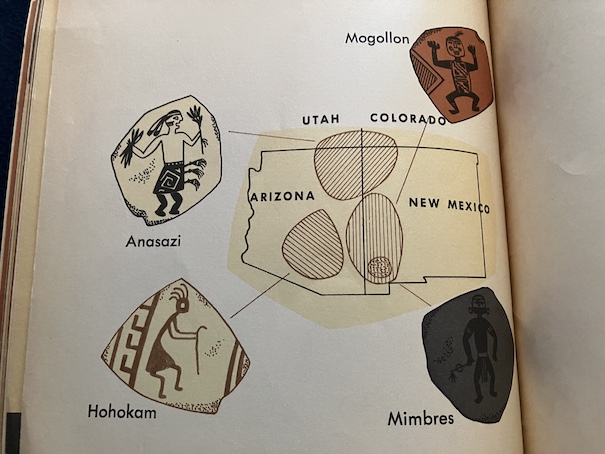
There is a map in the back of the book which shows the areas of the American Southwest (Arizona, New Mexico, Utah, and Colorado) where the pottery designs the book uses originated from and the tribes that used them.

This is a Caldecott Honor Book. It is available to borrow and read for free online through Internet Archive (multiple copies).

I grew up in Arizona, and I remember our school librarian reading books by Byrd Baylor to us in elementary school during the late 1980s or early 1990s. She wanted to introduce us to this author because she wrote about the area of the United States where we lived. In fact, this book about pottery was fitting because, when they were building our school in the 1970s, they found some ancient pottery. They used to have it on display in the school library. Even to this day, it’s common for people creating buildings in this area to have the site surveyed by archaeologists. Finds are fairly common, and the usual procedure is to thoroughly document everything that gets uncovered before burying it again in the same location and constructing the building over it. One of the reason why they usually rebury finds is that, in this dry, desert climate, putting them back into the ground will actually preserve them very well. It’s possible that later generations will find them again (especially with the location documented) when the building is gone or no longer necessary, but they may have better instruments or techniques for analyzing them.

I’m a little divided on how much I like this book, though. On the one hand, I like books about folklore and traditional crafts, and this book focuses on a geographical area that’s very familiar to me. On the other hand, the free verse poetry that reflects on the feelings of people about the pottery doesn’t appeal to me quite as much as books which show the process of making it, like The Little Indian Pottery Maker. I like to see the process and learn more of the known background legends of some of the designs than just try to imagine what things might have been going through the minds of the designers. Toward the end of the book, they show the legendary humpbacked flute player, but they don’t tell you that this figure is called Kokopelli and that there are legends about him. It’s a nice book, but I just felt like there was potential to include more background information.

This book uses the word “Indian” for “Native American” or “America Indian”, which is common in older children’s books.

The Mystery of the Eagle Feather

Three Cousins Detective Club

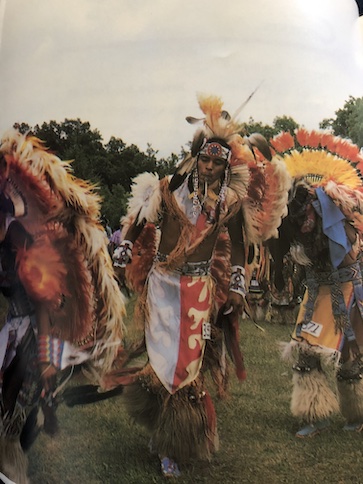
Timothy is excited because he has a chance to meet his pen pal, Anthony Two Trees, for the first time. Anthony is a Native American, and he will be dancing at a powwow. Timothy’s cousins get to come along on the trip, too.

Soon after they arrive, though, they learn that someone has been taking pieces of the dancers’ costumes, like fans or headdresses made of eagle feathers. Who could be taking the costume pieces and why?

The costume pieces and the eagle feathers they contain are very expensive, and the kids realize that the thief might be thinking of selling them. It is illegal to deal in eagle feathers because eagles are an endangered species. Even the Native American dancers have to write to the government in order to get eagle feathers for their costumes from eagles that died in zoos. Therefore, the costumes are expensive and require a lot of effort to put together, and losing them is a real blow. The rarity and cost of the feathers might prove to be a temptation to a thief.

The theme of the story is self-control.

The book is available to borrow and read for free online through Internet Archive.

I wasn’t sure if I was going to like this story. I understand the fascination kids have with Native Americans and their costumes and dances. I felt like that when I was a kid, too, but there’s also an element of cringe to it. The cringiness comes from kids (and even adults) who get wrapped up in the fascination of the appearance of other people’s traditions and treat them more like playing dress-up than traditions with deeper, underlying meaning and significance or depicting Native Americans as being stereotypes from old movies and books rather than real, living people.

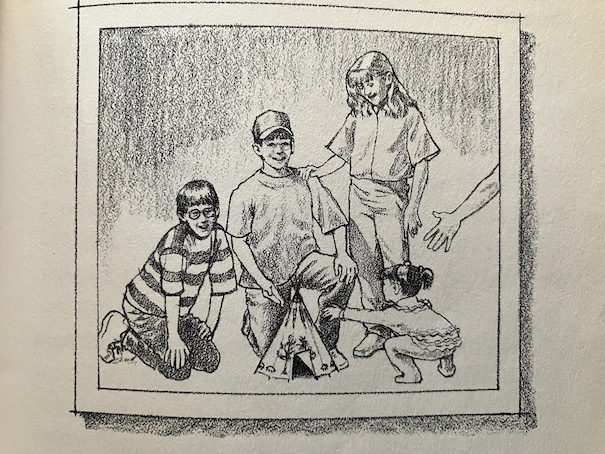
Fortunately, I was pleased at how this story shows that Timothy’s friend, Anthony, is a regular boy who shares his interest in baseball. They emphasize that Native Americans don’t live in tepees any more, and they don’t treat the Native American characters like stereotypes. I enjoyed some of the facts the story provided about Native American dances and costumes, like the regulations regarding the use of eagle feathers.

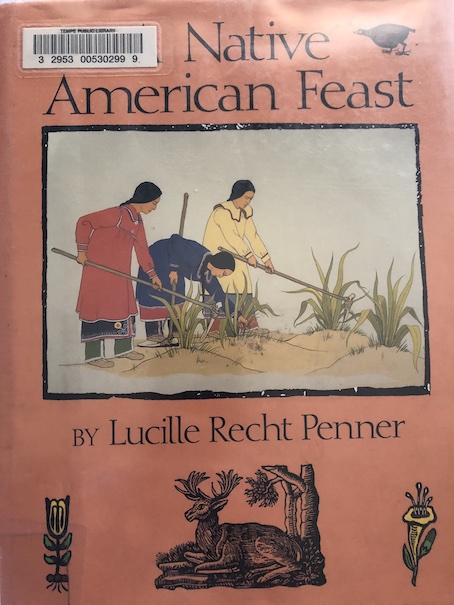
A Native American Feast

This nonfiction children’s book explains the traditional foods of different Native American tribes and how they were prepared. (Throughout the book, they are referred to both as “Native Americans” and “Indians”, but mostly, the book uses the term “Native Americans.” The focus is on Native American tribes in the area that is now the United States, but the book includes information about various tribes across the United States.)

It starts with an Introduction that explains how European settlers came to North America and how the first settlers almost starved to death because they weren’t prepared for the conditions they found and didn’t understand the plants and foods of the Americas. In those early years of the colonies, the colonists relied heavily on help from nearby Native American tribes in learning techniques for hunting and growing food in North America. These colonists had to adopt some of the Native American foods and techniques of getting food in order to survive. Not only did European colonists adopt some foods used by Native Americans, but Native Americans also adopted foods that were introduced to them from Europeans, including some plants and grains, like apples and wheat, and some domesticated animals, like sheep. The focus of this book is on Native Americans and their cooking and eating habits, both pre-colonization and post-colonization. For more information about what the colonists were cooking and eating, see The Colonial Cookbook.

The book explains how we know what we know about Native American foods and cooking. Some information was recorded by early European colonists in America and European scientists who were interested in plants of the Americas, and archaeology provides information in the form of animal bones, clamshells, and pollen from plants that Native Americans cultivated, going back hundreds and even thousands of years. Native American eating habits shifted throughout their history, although they shifted very abruptly with the European colonization of North America.

The book is available to borrow and read for free online through Internet Archive.

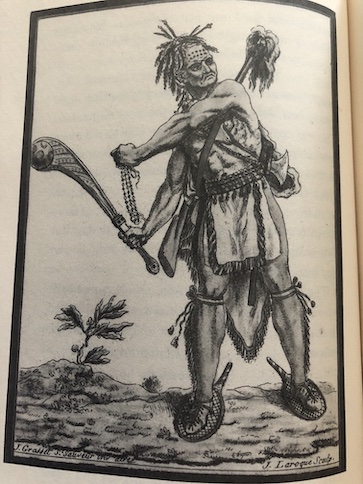
Every chapter, including the Introduction, contains recipes that readers can make at home. Some of them are easier than others. Some recipes include pieces of Native American folklore about them or the foods in the recipes. Many of the illustrations are 19th century drawings.

Rather than organizing the book based on tribe or geographic region, the chapters of the book are based around particular types of food or cooking and eating concepts:

This section introduces how historians know about the history of food among Native American tribes and how their diets changed after the arrival of Europeans.

Recipes in this section are:

  • Hickory Nut Soup
  • Green Succotash
  • Pueblo Peach Crisp

This section includes information about the earliest known hunting and cooking habits of Native Americans. It includes a description of the “land bridge” theory of how the ancestors of Native Americans arrived in the Americas from Asia. As of the early 21st century, we still don’t have a definitive answer for precisely how ancient people first arrived in the Americas, more recent theories include the possibility of these ancient people being seafaring rather than finding a land crossing, although the land crossing theory is also still possible.

Then, it explains about the arrival of the European colonists. It doesn’t sugar coat that the arrival of the colonists and their westward expansion led to the extinction and endangerment of native animal species because these newcomers hunted them without restraint. The introduction of unfamiliar diseases, like measles and smallpox, to the Native Americans took many lives, sometimes even killing whole tribes. These drastic changes greatly impacted the lives and lifestyles of Native Americans, although some traditional habits survived, including the preparation of traditional types of foods.

There are no recipes in this chapter.

This chapter explains about hunting and gathering and the development of agriculture among ancient Native American tribes. The “mystery” is about the development of corn as we know it. It was never really a wild plant. The evidence suggests that ancient Native Americans deliberately created it by cross-pollinating different wild grass plants, but it isn’t really known which ones. Most of this chapter explains how widespread corn was as a food and the uses and folklore that different tribes had for it.

Recipes in this section are:

  • Roasted Corn on the Cob
  • Blue Pinole – a blue cornmeal-based drink with sugar and cinnamon, from the Southwest
  • Thumbprint Bread (Kolatquvil)
  • Hopi Blue Marbles – boiled balls of blue cornmeal dough, a traditional breakfast food
  • Wagmiza Wasna – a mixture of cornmeal and dried berries

This section is about foods that Native Americans introduced to the rest of the world, like pumpkins, peanuts, chili peppers, sunflower seeds, maple sugar, and different varieties of beans, including kidney beans and lima beans.

Recipes in this section are:

  • Cherokee Bean Balls
  • Apache Pumpkin with Sunflower Seeds
  • Popped Wild Rice
  • Zuni Green Chili Stew

This chapter is about Native American hunting techniques and the animals they hunted.

Recipes in this section are:

  • Broiled Buffalo Steaks
  • Venison and Hominy Stew

This chapter is about Native Americans who lived in areas where food was scarce and ways of foraging for food during times of famine. It also explains special feast days.

Recipes in this section are:

  • Mouse Cache Soup – made with beef broth and seeds: sunflower seeds, sesame seeds, buckwheat groats, and millet
  • Iroquois Strawberry Drink
  • Mushrooms Cooked in Oil

This chapter explains the seasonings that Native Americans added to food and cooking techniques that added nutrients.

Recipes in this section are:

  • Fried Squash Blossoms
  • Pemmican Cakes – the origins of beef jerky
  • Maple Sugar Drink
  • Wild Grape Dumplings
  • Inuit Ice Cream – a berry dessert originally made with seal oil but made with egg whites here
  • Wojapi – a Sioux fruit pudding

This chapter is about how plants and animals were processed to make them ready for cooking, such as how corn and acorns were ground into flour and how animals were butchered. When they had to boil water, they often used vessels that would have been damaged if they were put directly over fire, so they would heat stones and put them into the water instead.

Recipes in this section are:

  • Broiled Salmon Steaks with Juniper Berries
  • Broiled Rabbit with Corn Dumplings
  • Baked Beans with Maple Sugar

Native Americans didn’t have cooking pots and pans made out of metal or glass until after the European colonists arrived. Before that, their cooking vessels were made of wood, stone, pottery, or tightly-woven baskets. This chapter explains the different types of cooking vessels they had, including the shells of pumpkins and gourds.

Recipes in this section are:

  • Pumpkin Shell Soup

This short chapter is about eating manners, superstitions, and taboos among different tribes. There are no recipes.

This section explains how Native Americans would give thanks to their Creator or Great Spirit or Nature or to animals and plants themselves for the foods that helped keep them alive. There are no recipes in this chapter.

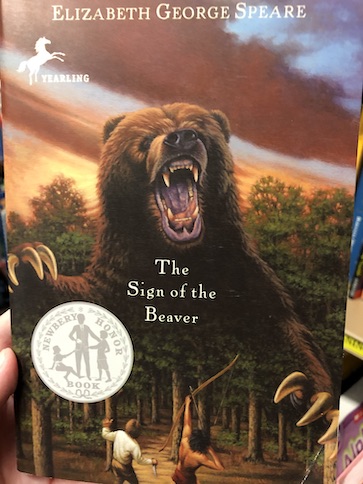
Sign of the Beaver

Sign of the Beaver by Elizabeth George Speare, 1983.

The story begins in the late 1760s with twelve-year-old Matt’s father leaving him alone in the log cabin that he and his father built for their family in the Maine territory. The rest of their family is still in Massachusetts, and Matt’s father is going to get them and bring them to their new home. Their family will be the very first to settle in what will soon be a new township. However, for now, Matt is alone at their cabin, surrounded by miles of wilderness, while he waits for his father to return and the rest of his family to arrive. Matt will be looking after the cabin and the field of corn that he and his father planted, but he finds the silence and solitude unnerving.

Before he left, Matt’s father left his watch and rifle with Matt. After his father leaves, Matt tries the rifle. He doesn’t hit anything, and he decides that it will take getting used to. He learns to hunt with it, and Matt finds that he is very busy with hunting, fishing, and chores, which helps pass the time. Every day, he makes a notch on a stick to mark the days that pass.

Gradually, Matt becomes aware that someone is watching him. Someone seems to be hiding and following him. Since there are no other white families living for miles around, he can only assume that it must be an “Indian” (Native American). They know that there have been some in the area, although they haven’t really met any yet. Matt finds the prospect a little worrying because he isn’t sure what to expect from them, but his father always told him that, if he met an Indian, he should just be polite and respectful. Matt is nervous that whoever is watching him is also hiding from him, though.

One day, Matt hears someone wearing heavy boots tramping in the woods, and Matt thinks that maybe his father has returned early for some reason. However, it turns out to be a stranger in a blue army uniform. Although Matt has missed having company, he finds himself reluctant to talk much to this stranger, and he doesn’t want the man to know that he is there completely alone. Still, the stranger is hungry, so Matt agrees to let him share a meal with him. The stranger, who calls himself Ben, stays the night with Matt, uninvited. Matt can’t bring himself to turn away someone who needs hospitality in the wilderness, and Ben tells him stories of his past adventures. Matt still has misgivings about Ben, and he’s sure his stories are tall tales. When Ben mentions leaving a town because there was trouble there, Matt thinks maybe Ben ran away because he’s a criminal. Matt plans to stay awake that night to keep an eye on Ben, but he eventually falls asleep. When he wakes up, Ben is gone, and so is his father’s rifle. Ben is a thief! Matt realizes that he was right to be suspicious of Ben and is angry that he let him get away with stealing the rifle.

Without that rifle, Matt can’t hunt. He can still feed himself through fishing, but he loses more of his supplies when he forgets to properly bar the door while he’s out fishing, and a bear eats most of the food in the cabin. Reduced to eating only fish, Matt gives in to temptation and tries to get some honey from some bees he finds in a nearby tree. It’s a bad idea, but this decision changes everything for Matt.

Matt is badly stung by the bees, and when he tries to escape them in the water, he nearly drowns. Fortunately, Matt is saved from drowning by the Indians who have been watching him. It turns out to be a grandfather and his grandson. The grandfather, Saknis, takes Matt back to his cabin, brings him food, and treats his wounds. When he realizes that Matt hurt his ankle and lost his boot in the water, he gives Matt a crutch to use for walking and a new pair of moccasins to wear.

Matt is both grateful for this much-needed help but also very self-conscious about it. He can tell that the grandson, Attean, doesn’t like him and thinks that he’s a fool for getting hurt like this, which is embarrassing. Matt also thinks that he should repay them for what they’ve given him, but he doesn’t have much to offer. The only thing he can think of to give them is the only book he owns, a copy of Robinson Crusoe. Matt is embarrassed when he realizes that the Saknis can’t read, and he thinks maybe he will be offended at this type of gift, but the older man realizes that Matt’s knowledge of reading is a gift that they badly need.

In broken English, the old man explains that his people have made treaties with white people before, but because they can’t read English, they never really know what’s written in the treaties. When white people break the treaties or tell them that they’re no longer allowed in certain areas of land, there isn’t much they can do, since they don’t even know for certain what was in the original agreements. He realizes that his people can’t afford to be ignorant. There are more white people moving into their territory all the time, and his people will have to know how to deal with them. Therefore, Saknis proposes a kind of treaty with Matt: they will continue to bring Matt food if Matt teaches Attean to read.

Attean immediately protests this plan. He really doesn’t like Matt, or any white people in general, and he doesn’t want these reading lessons. However, his grandfather is firm that this is something he needs to do. Matt also isn’t sure about this plan. He does owe them for their help, but he’s never taught anybody to read before. His own early lessons didn’t go particularly well, although he likes reading Robinson Crusoe now. Also, Matt thinks of Attean as being a “savage” and a “heathen” who doesn’t even really want to learn, so he’s not confident that the reading lessons are going to go well. Still, Matt does owe them for saving him and could use their continued help while he recovers from his injuries, so all he can do is try.

When Attean gets frustrated during the first reading lesson and storms out of Matt’s cabin, Matt thinks that the lessons are already over. Yet, Attean does return for more lessons. Gradually, Matt thinks of ways to make the lessons more interesting to Attean, reading the most exciting parts of Robinson Crusoe out loud to Attean to get him interested in reading the story himself and finding out what will happen to the main character. It isn’t easy to get Attean interested in learning because Attean is initially determined not to be interested or impressed by anything Matt has to say.

When Matt becomes curious about some of the things Attean and his tribe do, like how Attean hunts rabbits without a gun, Attean opens up a little and shows Matt some of the things he knows. Matt begins to admire some of the unique skills Attean shows him and learns to use them for himself. Matt is aware that his first efforts must look clumsy and childish to Attean as he tries to learn skills that Attean has known for years, but it puts the boys on a more equal footing with each other. Each of them has something to learn from the other, and it’s all right for each of them to look a little awkward to the other while learning. Matt gets embarrassed sometimes when he does something clumsy in front of Attean, but he learns that he must also persevere. Attean teaches him some good, practical skills for making things without using some of the manufactured goods that he and his father brought with them from Massachusetts. When Matt loses his only fish hook, Attean shows him how to make a new one. Attean teaches Matt to be self-reliant and to use new methods to accomplish his goals.

During the part where Matt reads the part of Robinson Crusoe where Robinson Crusoe rescues the man he calls Friday, and Friday, out of gratitude, becomes his slave, Attean protests that would never happen in real life. Attean says that he would rather die than become a slave. Matt is surprised because he never really thought that much about how someone like Friday would feel in real life. Matt learns to look at the story as Attean would, reading the best pieces to him, the ones that emphasize the friendship between the two characters rather than servitude.

Gradually, Matt and Attean become friends. Matt doesn’t think he’s very good at teaching Attean to read, but Attean does slowly learn. Although Attean resists learning to read because he’s trying to prove that he doesn’t need this skill that he associates only with white people, his spoken English becomes better as he and Matt talk. Attean admits that he tells parts of Robinson Crusoe to his people, and they enjoy hearing them, so Matt moves on to stories from his father’s Bible. Attean finds the Bible stories interesting and compares them to stories that his people already tell. (It is interesting, for example, how many civilizations around the world tell stories about great floods.) The boys are fascinated by the common themes in their stories.

The boys also enjoy doing things together, and Matt feels less lonely when Attean comes to visit. Matt doesn’t always like Attean because he has a disdainful attitude toward him, but they learn to trust each other, and they find interesting things to do together. Matt comes to realize that his irritation at Attean’s attitude is because it’s so difficult to earn Attean’s respect, and he really wants Attean’s respect. Although Matt doesn’t like Attean’s attitude toward white people, he does agree with Attean about some things, and he has to admit that he cares about what Attean thinks. Matt does get some respect from Attean later when the boys have a hair-raising encounter with a bear. Attean is the one who actually kills it, but Matt proves his usefulness during the struggle. Matt also comes to understand Attean’s resentment against white people when Attean eventually tells him that he’s an orphan and that his parents were killed by white people. That’s why he lives with his grandparents.

As time goes by, Matt becomes increasingly worried about whether or not his family will ever arrive. He worries that maybe something happened to his father and that the rest of the family won’t know where the cabin is and won’t be able to find him. When it passes the time when his family should have arrived, Matt fears that maybe they will never come at all. What if he is left alone? He has survived so far, with some help from Attean and his people, but can he live alone forever? Or could there be a place for him among Attean’s people?

Saknis has also been thinking about this, and he has noticed that Matt’s family has not yet come. He knows that it would be dangerous for the boy to remain alone in the cabin when winter comes. As the seasons change, the Native Americans are preparing to move to their winter hunting grounds. Saknis invites Matt to come with them, and Matt has to decide whether to accept the offer or stay and wait for his family.

This book is a Newbery Honor Book. It’s available to borrow and read for free online through Internet Archive (multiple copies).

My Reaction and Spoilers

This story reminds me a little of The Courage of Sarah Noble, where an 18th century white child who is afraid of Native Americans comes to learn more about them by living with them and interacting with them. I actually read The Sign of the Beaver when I was a child, and I only read The Courage of Sarah Noble as an adult. I’m not sure now if I prefer one of these books over the other. For a long time, I forgot the title of The Sign of the Beaver, although I did like this book the first time I read it. I remembered the concept of the boy living alone while he waited for the rest of the family to join him. One part that stuck in my mind the most was the part near the end of the story where Matt makes a cradle because he knows that his mother was expecting a baby when he last saw her and thinks that it would be nice to have a cradle ready for his new younger sibling, but when his family arrives, he is told that the baby died. That tragic image just stayed with me for years.

Some of the prejudiced language in the story, like “savage” and “heathen” and some anti-Catholic talk from Ben early on, is a little uncomfortable, but this is one of those stories about changing attitudes and overcoming prejudice. The main character has to show some fearful and/or prejudiced thoughts toward Native American initially for readers to appreciate how far he comes and how much his thinking changes after he makes friends with them and learns more about them.

Ben, of course, is a villain character, so his prejudiced talk is a reflection of that. He’s selfish and a thief, so his views of other people are based on what puts him in the best light or justifies things that he’s done. When he talks about the people of the last town he was in being against him and making trouble so he had to leave, both the readers and Matt realize that Ben was the one who started the trouble. Ben blames other people for problems he creates himself. The stories he tells Matt about his earlier, supposedly brave adventures are based around the French and Indian War, which is where the Catholics enter the discussion.

Several times during the story, Attean uses the word “squaw” to refer to women. I didn’t think too much about that sort of thing when I was a child because I assumed that both the author and characters in books that used that term knew what it meant and were using it correctly. Since then, I’ve heard that it actually has a rather vulgar meaning, although I’ve also heard conflicting information that it’s not always vulgar. The contradictory accounts make it a little confusing, but according to the best explanations I’ve read, the contradictions about the meaning of this word have to do with similar-sounding words in different Native American languages. Not all Native American tribes have the same traditional language, and some have words that sound like “squaw” and refer to females in a general way, while others have words with a similar sound that refer to female anatomy in a more vulgar way. For that reason, something that might seem innocuous to one native speaker might sound crude to another, and non-native speakers of any of the languages involved may not fully understand all the connotations of the word. In the end, I’m not sure how much of this the author of this book understood, but my conclusion is that it’s best not to use certain words unless you’re sure of their meaning, not only to you but to your audience. I only use the word here to make it clear which word appears in the book. Other than that, I don’t think this word is a necessary one, at least not for me. I understand what Attean is referring to in the context of the story, and I think that’s what really matters in this particular case. Whether that’s the right word for Attean’s tribe to use at this point in history would be more a matter for a linguist. I’m willing to accept it in the book as long as readers understand the context of the situation and are content to leave the word in the book and not use it themselves outside the context of the story.

When Attean talks about women in the story, it’s typically to point out certain types of work that he considers women’s work instead of men’s work. Matt is a little offended sometimes when Attean tells him that some chore he’s doing is for women instead of men. Matt’s family doesn’t have the same standards for dividing up chores as Attean’s tribe does, and the fact is that Matt is living alone at the moment. There are no women in Matt’s cabin, only Matt. Any chore that needs to be done right now is Matt’s to do because there simply is no one else to do any of it for him. I think when Attean tells him that he’s doing women’s work, he’s trying to needle Matt because, otherwise, he comes off as sounding a little dense. Sure, Attean. We’ll just have the women who aren’t here do this stuff that needs doing right now. During the course of the story, Matt comes to appreciate how the Native Americans live differently because it makes sense for the place where they live and their circumstances, but this is one instance where Attean could be a little more understanding about Matt’s circumstances.

One thing that I had completely forgotten about in this story was the part where Matt thinks about how Attean smells bad. Earlier, when I did a post about Mystery of the Pirate’s Ghost by Elizabeth Honness, I was irritated at the author for having one of the characters imagining smelly Native Americans because I had never heard of that as a stereotype before (I thought at the time), and I didn’t know where that idea came from. A site reader suggested that the trope came from the Little House on the Prairie series because there is talk like that in those books, but The Sign of the Beaver actually offers an immediate explanation as soon as Matt thinks about the cause of the smell. Matt realizes that Attean has smeared a kind of smelly grease on his body that is meant to repel mosquitoes. Matt has heard of people doing this before, and he understands that there is a useful purpose behind it, but he just hates the smell so much that he thinks he’d rather just put up with the mosquitoes. That explanation really helps to put everything into context. When there’s no explanation about things like this in stories, it makes it sound like Native Americans are just smelly because they’re “savages” who don’t bathe or something, but when you hear the explanation, it’s just that the smell is an inconvenient side effect from something that has a real, practical purpose. It might be unappealing to Matt, but there is a point to it. So, on the one hand, I feel a little bad about getting down on Elizabeth Honness for throwing that idea into her story without an apparent basis, but still irritated because, if she knew that was the explanation, she could have said something about it instead of just throwing that out there, like everyone reading the story would already know. I have similar feelings about some of the things Laura Ingalls Wilder put in her books, too. Context is important, and some authors are better at providing it than others. I also think that context is something that books from the late 20th century and early 21st century often provide better than books from earlier decades, although there are some exceptions.

At the end of the story, we don’t know for sure whether Matt and Attean will meet again. When Matt’s family arrives, they tell him that other white families will be arriving soon. Matt knows that the tribe he befriended will likely lose their hunting grounds to the town that will be built there. Matt is concerned for their future, but he is glad to be reunited with his family and still considers Attean his friend.

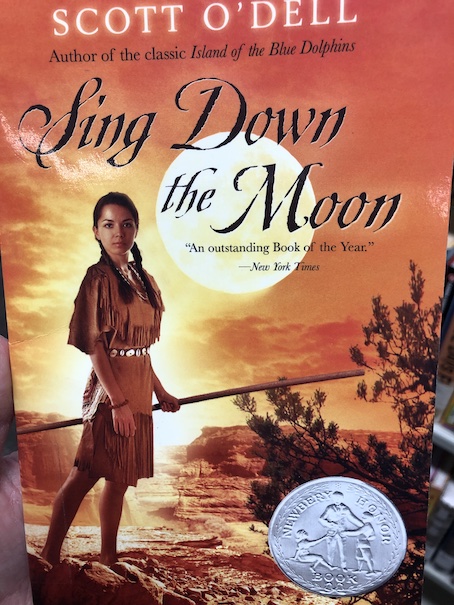
Sing Down the Moon

Sing Down the Moon cover

Sing Down the Moon by Scott O’Dell, 1970.

The story begins with a young Navajo girl, Bright Morning, admiring the beginning of spring, but she is caught in a storm and hurries home without the sheep she was supposed to be tending. When the girl’s mother realizes that she abandoned the sheep, she takes the girl back to the sheep, and they watch them all night. The sheep are very important to the family, and the girl’s mother refuses to allow her to take the sheep out by herself again for the rest of that spring.

When Bright Morning finally proves that she can be responsible and not leave the sheep to tend themselves, she is allowed to take them out again. Bright Morning likes to talk to the other girls, Running Bird and White Deer, as they watch all of their sheep together. The girls like to talk about their futures, who they will marry and what kind of children they have. They like to tease each other. Bright Morning’s friends know that she is likely to marry a young man called Tall Boy. The rumor is that Tall Boy’s parents want him to marry her because her mother owns so many fine sheep. Bright Morning knows that her friends tease because they are curious about Tall Boy and want her to talk about him, but she refuses. The girls know that he is supposed to be riding out with the warriors soon, and they tease that maybe he will bring back some other girl from the Ute tribe, but Bright Morning ignores them.

After the warriors have left for their raid on the Utes, the girls see some white men on horses approaching the village. The girls recognize them as oldiers and are worried that their village could be vulnerable to attack without the warriors. Later, the girls encounter more white men, but these men are not dressed as soldiers. They stop to talk to Bright Morning and Running Bird, asking them for directions, but the girls realize that they are slavers. They kidnap both girls and ride away with them!

They take the girls to a town of Spanish people and separate them from each other. They sell Bright Morning to a woman who uses her as a servant. The woman has other Native American girls as slaves, including a younger girl called Rosita. Rosita doesn’t mind her captivity or her life as a servant much. She came from a tribe that was very poor, and since she was brought to this woman’s household to work for her, she has had better food and clothing than she did at home. Rosita tells Bright Morning that the family they work for isn’t bad, and Bright Morning is allowed to keep her dog, who followed her when she was abducted. However, Bright Morning can’t stand her captivity. The woman who owns the house gives her new clothes, but Bright Morning doesn’t care. All she wants to do is find a way to go home.

Bright Morning is reunited with Running Bird when another captive girl comes up with a plan for the three of them to escape. They manage to steal horses and ride away from the town. Along the way, they meet up with Tall Boy and one of his friends, and the boys help fight off the Spaniards who are pursuing the girls. Unfortunately, Tall Boy is badly injured in the fight. He loses the use of one of his arms, and the other Navajos know that he can no longer be a warrior. Bright Morning still cares about Tall Boy, but her mother and sister tell her that she should no longer consider marrying him.

However, the Navajos’ troubles are just beginning. They haven’t heard the last of the soldiers. The American soldiers return and drive the Navajos off their land. They destroy all of their homes and eventually round them up and start them on a long march with little food, where many of them die. The Navajos fear that all of them will die. How will Bright Morning and her family survive, and will they ever see their homeland again?

The book is a Newbery Honor book. It’s available to borrow and read for free online through Internet Archive (multiple copies).

My Reaction

I remember reading this book when I was about 13 years old, in middle school! It takes place in my home state, the northern part, where the Navajo reservation is now, in the Four Corners region. I’ve been to Canyon de Chelly (“Chelly” is pronounced like “shay”, like in French) before, although I hadn’t been there at the time when I first read this book. Since I read this book as a kid, I’ve been to places and seen things that helped me understand the setting of the story better. As an adult, I appreciate the historical aspects of the story even more because I know more about the background. The book doesn’t give a date for the story until the postscript at the very end of the book, but the death march described in the story is Long Walk of 1863 to 1865.

The second half of the book is very depressing because there are horrible conditions and many deaths, including the deaths of children. I wasn’t sure that I really wanted to revisit this book at first because I remembered that it was depressing, but the book is well-written. The narrator describes events in an exciting, compelling way.

I had forgotten many details of the story, but there were some things that jumped out at me as an adult that I hadn’t noticed the first time. The postscript at the end of the story explains how life and Navajo culture changed after this traumatic event. If you see photographs of Navajo in “traditional” costumes now, they often include velveteen clothing, but that’s actually a relatively new tradition. The velveteen was adopted from white people during their captivity because they didn’t have access to wool to make their older style of traditional clothing. When Bright Morning was held captive in the Spanish town, she was given velveteen clothing there.

Another odd topic that is touched on only very briefly but that I know more about from other sources concerns the subject of flour. The book mentions that the Navajo were unused to eating wheat flour until it was their only form of rations during the Long Walk. Until then, their staple grain was corn, and when they started eating wheat flour, it made them feel sick. Their bodies just weren’t used to it. The book doesn’t explicitly explain this, but I know from other sources that the Long Walk and those flour rations were the origins of Navajo fry bread. Fry bread was not part of Navajo diet until that point. I grew up eating it on special occasions as a treat because it is greasy but good with powdered sugar, and it’s often served at carnivals and fairs here. However, as an adult, I came to realize that its origins as a food come from a very dark source. It was starvation food. It can keep you alive if there’s nothing else, but it’s not going to keep you healthy if you eat nothing else. It’s greasy and fatty, and it has little nutritional quality. Even now, I don’t have as much tolerance for it as I did when I was a kid. I can’t stomach it well these days if it’s too greasy or I eat too much.

That’s actually not a bad metaphor for the events described in this book. They’re heavy, and the more of it you understand and absorb, the sicker you feel. I absorb much more now than when I was a kid and only half understood the full significance of the events, and it makes me feel much worse than I did the first time.

So, do I recommend this book for kids? Actually, yes. I’m not a fan of depressing books with a lot of death, and I struggled through some depressing books when I was in school. If you had asked my 13-year-old self whether books with this much death and suffering were worth it, she might have had trouble answering that question, but time and further understanding have changed the way my adult self feels. There are some depressing topics that are worth the struggle to absorb them, but if I were the one teaching the lessons, I think I would do it a little differently than my teachers did for me back then.

I think this book is still a good introduction to topics that can be difficult to discuss. It’s worth reading once to understand the historical background of these events and what they really meant to the people who experienced them directly. It’s painful to read the bad parts, but it’s the kind of pain that leads to something better: real understanding. I recommend the book for kids in their early teens because I think that’s the best level for understanding it and accepting the bad parts. I think it should also be accompanied by nonfiction history lessons about the time period and events and discussion about their feelings about the story and historical events. I remember being told some of the history the first time I read this book, but I think that maybe there should have been more discussion about feelings.

I think it’s important to discuss feelings because they’re the hardest part of this book and they’re also the reason why it’s difficult to study some of the darker parts of history. I had a hard time with this when I was younger, and I still do in some respects, but I think understanding what causes those feelings is key to handling them. Reading books like this while discussing tools to handle difficult feelings could help students to better handle their emotions in other areas of life as well.

One of the first points that I think is important to understand and which my teachers didn’t really explain to me is that it’s natural to feel bad when you hear about bad things happening to other people, even when the bad things happened generations before you were born or even when those individual characters are fictional. (Bright Morning and her friends and family are fictional characters even though the events around them are historical. Real Navajos did experience what they experienced.) Empathy is a natural human emotion, and it’s an important tool for living with other people. Humans are social creatures. We live as part of larger groups, and we need at least some empathy to understand other people’s emotions and circumstances, how our actions affect them, and how to treat other people as we ourselves would truly like to be treated. The ability to experience empathy is a sign that you are mentally and emotionally healthy. It’s really only worrying when someone can’t feel it.

One of the most disturbing feelings about this story comes from realizing that the soldiers who are inflicting all of this death and pain either don’t feel empathy for the people they are harming or have actively chosen to ignore it to further their own purposes. That’s not a sign of being mentally or emotionally healthy or behaving in a moral way. When the readers feel repulsed by the soldiers and what they’re doing, it’s because they recognize that these people are a serious danger to others, and they are not functioning in a normal way. Your brain is warning you of a threat. It’s a past threat rather than an immediate one, but if you find the soldiers and their actions upsetting, it’s a sign that your brain has accurately assessed the risk associated with these people and the harm they do. You have accurately connected the suffering of other people for whom you feel empathy with the people who are the direct cause. I’m not saying that the soldiers were necessarily psychopaths, but lack of empathy and remorse and calculated manipulation are all symptoms of psychopathy and should raise alarms for anyone confronted with those signs. So, feeling bad about this situation and the people causing it is a sign that you yourself are mentally and emotionally healthy and have correctly recognized the seriousness of the situation and the harm being done to other people. What I’m saying is that, even when you’re feeling bad, it’s for good reasons, and that deserves recognition.

When I was young, I felt angry and frustrated by stories where people were doing terrible things to others. I still do because that’s part of empathy, but I also came to realize that part of my frustration when it came to historical situations came from my inability to change the situation. When harm has been done, it’s impossible to undo it. What was done was done. I can’t help the people who died, and I can’t even punish the wrong-doers because they’re dead now, too. It’s frustrating to find yourself confronted by a situation where nothing can change. But, I think it’s important to realize that change has happened and is currently happening. History is being written all the time, not even just through writing but through the ways that people live their lives every day. Even when a particular event is over, events and people keep moving. Bad events can cast long shadows, causing harm long after the initial event. That’s part of what makes them so bad. However, as time moves on, new people enter the scene, and new things happen, including things that people in the past would never have foreseen. It eventually reaches a point where the things that continue to happen rely on what we, the living, continue to do or allow to be done. History takes the long view, and I think people need to be reminded of that.

Do you suppose that the people in this story who act as villains thought of themselves like that? Further point, how much does it matter how they thought of themselves? Maybe they thought of themselves as winners at the time because they were getting their way and the people they were hurting were unable to stop them from hurting and killing them, but is that really “winning”? Lazy historians frequently brush things off by saying that “history is written by the victors“, but if that were really true, would we even be hearing or reading stories like this? Would we ever hear about slaves or care about the victims of war and atrocity? Would we ever consider the perspectives of people who died at all? Or does it change your mind about what “winning” really is and who’s really a “winner”? Maybe, in life and history, there aren’t any “winners” because neither of those was ever really a contest to begin with. (Or, as some put it, life is a collection of contests that people can simultaneously be both winning and losing. Personally, I think life is just for living, not for winning against someone else who is also trying to just live and probably couldn’t care less about you “winning” or not.) Apparent victories aren’t always real accomplishments, and people who see that reality are the ones who write the most accurate histories. Individual human lives only last so long, so any apparent “win” by an individual or group is never more than temporary. Our sense of what history includes and what people in the past were really like changes as we increase our knowledge of it and reconsider the context, not unlike the way my 40-year-old self has a deeper understanding of this book than my 13-year-old self did.

Remember that, at the beginning of this particular story, the Navajo warriors were going to raid the Utes. We never really find out in the book why they were going to do this, but does it matter anymore when the Navajos themselves get raided and subjected to something that might be even worse than what they were originally planning to do to their enemies? The story drops this subplot when the march begins. Life is like that, constantly moving, ever changing. History goes on and on. Sometimes, a young warrior who was praised for his prowess gets shot in the arm and can’t pull a bow anymore. Sometimes, a 40-year-old woman from the 21st century looks back on 19th century soldiers who may have thought of themselves as heroes and wants to tell them, to their faces, that they couldn’t be more wrong about that. If they’re not evil psychopaths, they’re doing a dang good job of pretending, and I never once thought of them as being “heroes” in my entire life. That’s life for you. Each of the people who have read this book or ever will read it are among the new people entering the story and its sequels, and we all have the ability to decide what role we want to play in the on-going story of history.

What happens after the book ends, is important, too. If I were teaching this, I would follow up this particular chapter of Native American and Navajo history by talking about some of the developments that continued to happen in their history, including some of the better moments, like the development of the written form of the Navajo language (for much of it’s history, Navajo was only a written language – that’s why the soldiers in the story couldn’t leave a written message in Navajo) and how code talkers used the Navajo language during WWII. The people who realized that these things were possible and something worth working toward were creative individuals. Rather than seeking to destroy something or repress it, they found creative ways to make use of what was there and put people’s talents to good use, helping others. The worst moments of history have been when people without empathy use others or seek to destroy them for personal gain, but the triumphant moments are when people take what they have and find a way to make it better. Noting these positive moments doesn’t make the bad parts of history any better than they actually were, but what we want is more of these positive moments of creativity and development and the type of people who are willing to work to make them happen.

It helps to balance out the explanations of what went wrong and people who did wrong with examples of what was better. Some teachers stress how we teach the bad moments so people learn from the past and don’t repeat it, and that’s true. However, I think we also need to add on what has worked and what we want people to do instead. A “don’t do this” needs to be followed up by “do this instead” to be an effective instruction. As a society, we don’t want more destroyers and takers. We want innovators and makers. We want creative people who find new uses for resources, including human resources and talents, and who are dedicated to truly helping others and human society as a whole instead of merely helping themselves to what others have that they want. This book demonstrates the dark side of humanity, but as I said, history is still being written every day with new players.

On the lighter side of this story, I enjoyed the descriptions of the coming-of-age ceremony for young women that Bright Morning has and the marriage ceremony later. During her time in captivity in the Spanish town, Bright Morning also attends Easter celebrations. She doesn’t understand Christianity and has never heard of Jesus before, and she doesn’t understand what the holiday is about or what’s going on. Rosita tries to explain to her who Jesus is in terms of Navajo religion. I found the explanation fascinating, but Bright Morning is still confused.

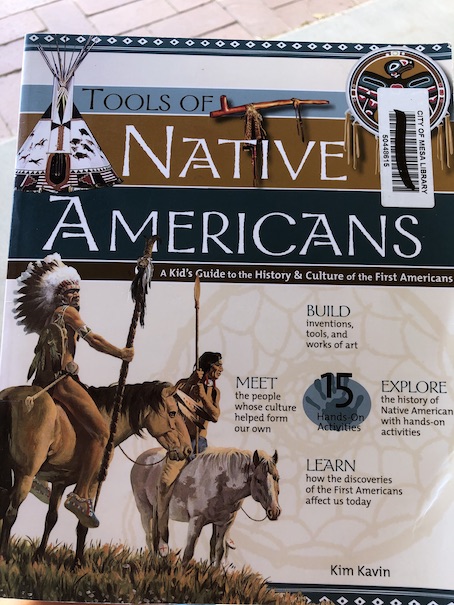
Tools of Native Americans

Tools of Native Americans by Kim Kavin, 2006.

This nonfiction book is part of a series recommended for kids ages 9 to 12. It provides insights into the daily lives of Native Americans of the past by explaining their tools and inventions. I was intrigued by the idea immediately because I love books that give insights into history through the lives of ordinary people.

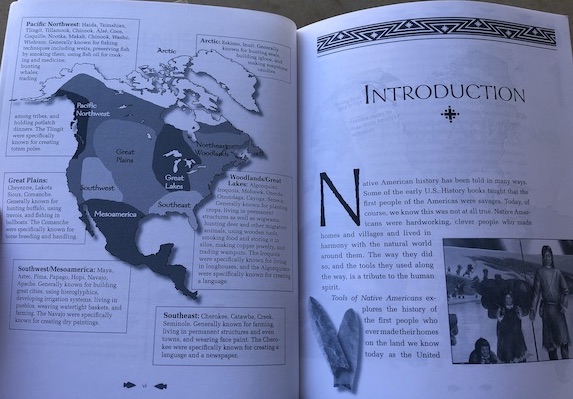
The book is divided into time periods and geographic areas of North America. At the beginning of the book, there is a timeline of important events in the history of North America and Native American culture, beginning c. 20,000 to 8000 BCE, when the ancestors of Native Americans are believed to have migrated to the continent and ending in 2006, the year the book was published. There is also a map showing major geographic regions of North America and the Native American tribes that live there. The chapters of the book are mostly grouped by region, except for the first two, which are about the First Americans and Archaic and Formative Periods.

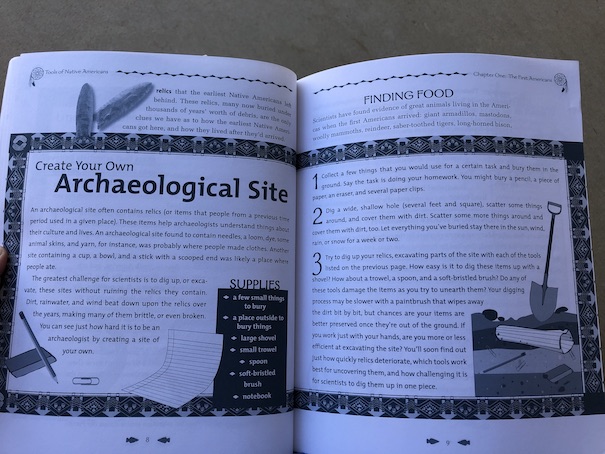
The first chapter, called The First Americans, discusses theories about how the ancestors of Native Americans first arrived on the continent from Asia. The exact circumstances of their arrival are unknown, but there are some possible migration paths that they could have taken. The chapter discusses the Ice Age that existed when this migration took place, how people found food, and Clovis culture, one of the earliest known civilizations in the Americas. One of the activities from this section is about archaeology, which is what we use to learn more about ancient civilizations that did not leave written records, and how to create an archaeological site of your own.

The next chapter is about the Archaic and Formative Periods, which were characterized by climate change as the Ice Age came to an end and many plants and animals that had thrived in the colder climate died off. The changes in the environment cause Native American groups to make changes in their own lifestyles. Rather than relying on herds of large animals for food, they began cultivating crops. They made pottery and developed new cooking techniques. They still hunted, using a device called an atlatl to throw their spears further and with more power. Civilizations like the Maya flourished.

After the second chapter, the other chapters discuss tribes by region:

The Northeast Woodland and Great Lakes Tribes – The Algonquian and Iroquois

This chapter discusses Native American tribes from the East Coast to the Midwest, around the Great Lakes, who primarily lived in woodland areas. The Iroquois and the Algonquian were both collections confederated tribes. There is information about the Algonquian language, which contributed some words to English, including moccasin, succotash, hominy, hickory, and moose. There is also an activity about creating Algonquian style pictographs and petroglyphs.

The Southeast Tribes – The Cherokee, Catawba, Creeks, and Seminoles

The tribes in this chapter lived in and around the Appalachian Mountains. It explains about Sequoyah, who developed a system of writing for the Cherokee language.

The Great Plains Tribes – The Cheyenne, Lakota Sioux, and Comanche

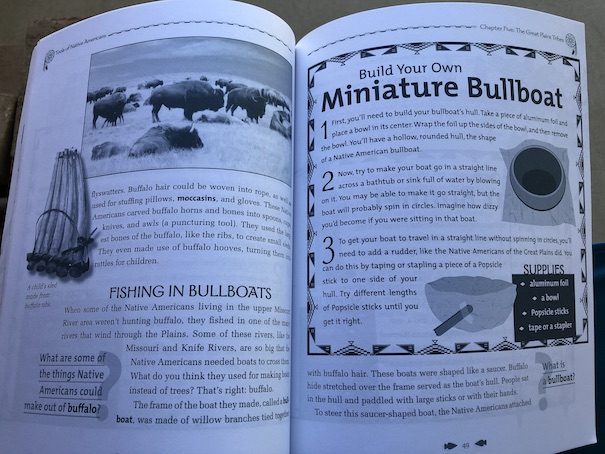
The tribes of the Great Plains were migratory, following herds of buffalo, which were a primary source of food. Because they moved often, everything they owned, from the tepees where they lived to the tools and other objects they used, had to be easily portable. The Comanche were particularly known for being expert horsemen. This chapter also discusses the Lewis and Clark Expedition and Sacagawea, who was part of the Shoshone tribe from the Rocky Mountains. She had been abducted when she was young, and when she joined the Expedition, she was able to guide Lewis and Clark and their men back to the territory she had known when she was a child and to the Pacific Ocean. Activities for this chapter include making a rattle of the kind children used as toys, making a miniature bullboat, and making a war bonnet (using pieces of poster board instead of feathers).

The Southwest and Mesoamerican Tribes – The Hohokam, Mogollon, Anasazi, Maya, Aztec, Hopi, Apache, and Navajo

I know this area because this is where I grew up. Much of it is desert, and the book is correct that there can be sharp differences in temperature between day and night. In modern Southwestern cities, buildings and pavement can hold in heat even at night, but there isn’t much to hold in heat in the open countryside, not even much humidity in the air to hold heat once the sun goes down. There is an abundance of clay in the soil in this region which local tribes used to make pottery and adobe homes.

Among the civilizations discussed in this section are the Hohokam, whose name means “Vanished Ones” (I’ve seen different versions of the translation of that name, but they’re all words to that effect – that they are gone, vanished, disappeared, etc.) because, for unknown reasons, they seem to have suddenly abandoned the area where they had previously lived and farmed for generations. They don’t seem to have died off, at least not all of them. It’s believed that they were the ancestors of the Pima and Tohono O’odham tribes, and the book discusses that a little further on in the chapter. There is a Pima story about a fierce rainstorm and a massive flood that killed many people, but The Hohokam were the ones who built the original irrigation canals for watering their crops. Later, when settlers came from the Eastern United States, they found these abandoned canals, dug them out, and started using them again. The canals are still in use today, and one of the activities in this chapter of the book is about irrigation.

This section of the book also covers the Maya and the Aztecs, who lived in what is now Mexico and Guatemala. There is an activity about creating hieroglyphs, like the kind that the Maya once used.

In the part that describes the Navajo, there are activities for sand painting and Navajo-style jewelry.

The Pacific Northwest Tribes – The Nootkas, Makahs, and Tlingits

Much of this chapter discusses hunting and fishing and the preservation of food. Because food-related work mostly took place during a single season due to the severity of the winters, there were periods of time when the members of the Pacific Northwest Tribes had time for social and artistic pursuits. The book explains the meaning of totem poles, and there is an activity for readers to create their own.

The Arctic Tribes – The Inuit

The lives of the Inuit were shaped by learning to live in a very cold environment. The book explains how they built igloos out of packed snow and ice, but really, igloos were temporary shelters. The houses they lived in long term where made of sod and were partially built underground for insulation. There are activities for building a snow cave called a quinzy (this requires that you live in a place with snow) and for playing a game called Nugluktaq.

The last chapter in the book is called New Immigrants, Manifest Destiny, and the Trail of Tears. It’s about how European settlers arrived in the Americas, the westward expansion of the United States, and the confinement of Native American tribes to reservations.

The book ends with an Appendix with further information about Native American Sites and Museums State by State. There is also a glossary, index, and bibliography.

Indian Sign Language

Indian Sign Language by William Tomkins, 1969.

This is the third book I’ve reviewed on the topic of Indian Sign Language, and the reason why I wanted to include this one is that it was part of the list of recommended reading in one of the others, a book that was written much later. I can see why it was recommended. I found the readability of this book to be lower than the later book, but there is information found in this book that isn’t found in the later book.

The introductory notes at the beginning of the book explain a little about the author’s background. He grew up near the Sioux Indian Reservation in the Dakota Territory during the late 1800s, which was where he was first introduced to this form of sign language. He was not Native American himself, but he was later ceremonially adopted into the Sioux tribe. He became a lecturer about American Indian issues, and he discovered that people were very interested in his sign language demonstrations. He wanted to create this book so there would be a readily-available text explaining how the language works. He credits this form of sign language as being “probably the first American language. It is the first an only American universal language. It may be the first universal language produced by any people.” I’m not completely sure that’s true, but the author does have great respect for the beauty and utility of the sign language and the role that it played in Native American history.

The later book had the vocabulary of the sign language organized by topic, but this book (like an earlier one) had it organized in alphabetical sections, like a dictionary. The hand signs are shown in drawings on one side of the page, with lines and arrows to indicate movement where necessary, and written descriptions of the hand signs on the other.

The range of vocabulary is much more broad in this book than in the newer book, and it includes descriptions of more complex words and concepts that can be conveyed by combining some of the signs for simpler words. For example, the word “generous” can be indicated by making the signs for “heart” and “big”, and there is a list of synonyms for words. The book also demonstrates how to form sentences using the vocabulary words.

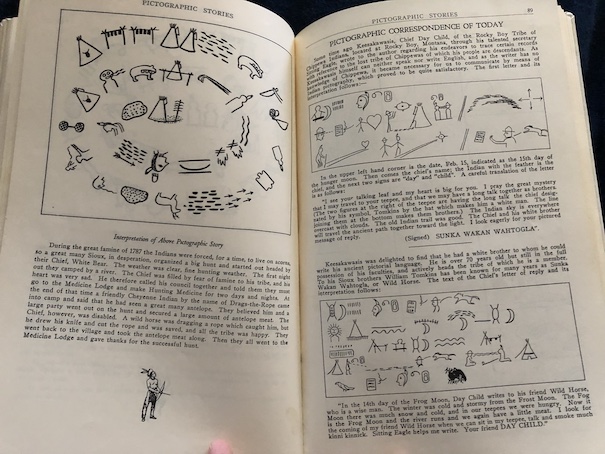
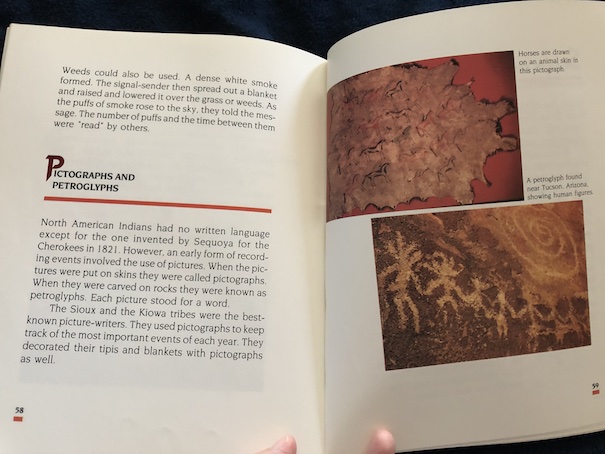
There are a couple of sections in the back of this book that provide additional information about other forms of communication, pictographs and smoke signals, which is interesting because the later book that I mentioned also made references to these other forms of communication but didn’t really offer details about how they work. This book is very detailed on the subject of pictographs, showing what different ideographs mean and explaining how to tell entire stories with them. It even explains the correlations between sign language and pictography. The book ends with some historical information about this form of sign language and suggestions for a unit about Indian sign language for a boy scout troop meeting, which include a somewhat cheesy play where the boy scouts pretend to be American Indians and use words like “How” and “paleface” with each other. The book seems very good and thorough on the technical explanations of the language, but I suspect it could be a little better on the subject of cultural representation.

The book is available to borrow and read for free online through Internet Archive (multiple copies).

How Sign Talk in Pictures

How; Sign Talk in Pictures by Iron Eyes Cody, 1952.

I like nonfiction books on esoteric topics! This one has kind of a kitschy feel to it. It’s partly the “How” in the title, like the way Native Americans talk in old movies, but it was written around the time those old black-and-white westerns were made, and this sort of movie theme is actually a major issue with both the book and the author. We found this book as a library discard, and part of the interest for me is that another book by the same author (available through Internet Archive) was used as recommending reading in a later book on the same subject.

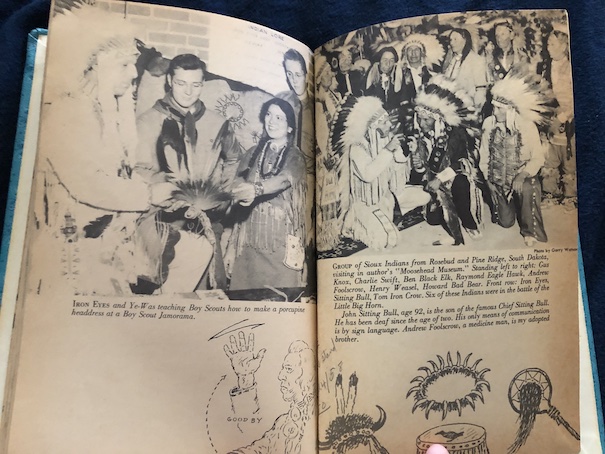
The author and his wife appear frequently in pictures in the book, demonstrating different signals in Indian sign language. Part of the book near the beginning explains about the author’s life, and what it says actually isn’t true, but the real story of the life of “Iron Eyes Cody” is pretty interesting. The main reason for the deception is that Iron Eyes Cody was an actor known for playing Native Americans in films, beginning in the 1920s. To support his film persona, he claimed to be of Native American descent, but the truth is that both of his parents were Italian. His birth name was Espera Oscar de Corti. In the book, he says that he was born on his family’s ranch in Texas, but he was actually born in Louisiana, and his parents owned a grocery store. The family did live in Texas for awhile. After his father died, he and his brothers moved to California to pursue acting careers, changing their last name to Cody. As part of his film persona, he was known to wear his Native American costumes on a daily basis, as if he were living a Native American lifestyle. Many people really believed he was Native American, but this costume quality is part of what gives the book that kitschy vibe. If you think that you’ve never seen or heard of Iron Eyes Cody before, it’s actually very likely that you have because one of his acting roles was that of the “Crying Indian” in the “Keep America Beautiful” anti-pollution PSAs of the 1970s. Yep! He’s that guy, and that’s the man who wrote this book.

So, you can disregard many of the details of Cody’s brief autobiography (there’s a fanciful story there about how he got the name “Iron Eyes”, but Chief Iron Eyes was actually the name of the character he played in the 1948 movie The Paleface with Bob Hope), but what is real is that he was married to an archaeologist of Native American descent, Bertha Parker (referred to as Yeawas in the book and also appearing in pictures to demonstrate the sign language), and they had two adopted children, also of Native American descent (one of which appears in pictures in the book). Outside of his acting work, Cody supported many charitable causes that helped Native Americans and promoted the study of Native American culture. He had a collection of Native American costumes and art that he called the Moosehead Museum, and he offered lessons in Native American arts and crafts, songs and dances, and lore out of his home. (The book doesn’t really offer details about how that worked, but my guess would be that his wife, the archaeologist, provided much of the instruction or at least educated Cody about these subjects before he taught others.) Cody also worked with the Boy Scouts, helping with Scout-O-Ramas and acting as an adviser about Indian (Native American) lore. He also sometimes helped the Girl Scouts. The book is dedicated to “the youth of America, especially the Boy Scouts of America.” If you would like to know a little more about Cody, I recommend this YouTube video and this one.

On the one hand, a person who is deceptive or misleading about their identity and credentials is worrisome and probably rightly considered unreliable. However, as near as I can tell (not being an expert on this topic myself), the information presented here seems reasonably accurate, and I think that’s probably due to research, consulting with experts, and the influence of the author’s wife, who did have credentials as an archaeologist and ethnologist and had connections to other scholars through her museum work. One of the beginning sections of the book is called “A Brief History of Sign Language by Bertha Parker Cody” with an accompanying list of works consulted (texts spanning 1880 to 1926, the 19th century ones apparently written by army officers because their ranks are given, if you’re curious – Bertha’s a woman after my own heart because she also added a note to her citation about a book with a particularly good bibliography section, and I’m a great believer in notes).

So, now that you know who’s talking here, let’s discuss what they have to say about Indian Sign Language, the main topic of this book.

In a foreword to the book, F. W. Hodge, director of the Southwest Museum in Los Angeles, where Bertha Parker used to work, discusses the concept of sign language and non-verbal cues used in communication by people all over the world. People in different countries, speaking different languages, might recognize a nod of the head as meaning “yes” or a finger placed against the lips as a gesture to be quiet, but sign languages convey much more than these simple ideas, allowing people to hold entire conversations. The Indian Sign Language presented in this book was used by many different tribes, ranging from Canada all the way south to Mexico. If members of different tribes encountered each other, they could use this language to communicate, no matter which language they spoke verbally. When people of European descent learned this sign language, they also gained the same ability to communicate with a wide range of Native Americans, without even needing to speak a single word aloud. Hodge said that this was an uncommon skill for people of European descent, although he does mention one of the army officers referenced by Bertha Parker Cody in her essay.

In her essay, Bertha Parker Cody also explains the concept of sign language, referring to it as a kind of “universal language.” She explains how people have used hand signs and gestures to convey ideas and concepts throughout history. She says that the reason why this type of universal language based on gestures was necessary because, in the territory now known as North America, there were once more than 500 different spoken languages among Native Americans. Even groups who were living no more than 10 miles away from each other might be speaking completely different languages, but they would need to be able to interact with each other and communicate. It is unknown exactly who invented this particular system of sign language (although there are some possible theories), but it was particularly developed by the Plains Indians because they were nomadic buffalo hunters, often encountering other tribes as they followed the herds. As an added benefit, because the language is completely silent, hunters could use it without startling their prey, and warriors could use it with each other before a surprise attack on an enemy. Chiefs of tribes would even use sign language to convey important messages because it would guarantee that people would pay attention and focus on the hand signs to interpret what they were saying. She explains that there are signs that the language changed over time and variations existed among different tribes, there was enough commonality that members of different tribes could communicate with each other effectively. She concludes by saying that their hope was that this book would help to keep knowledge of this sign language alive among young people at a time when it was falling out of use and living knowledge.

The actual vocabulary of the sign language is presented in sections organized alphabetically, with drawings and photographs of Cody and his wife performing each of the hand signs.

The book ends with a section about hand signs for numbers and counting and a section presenting examples for forming complete sentences using the hand signs presented in the book.

The final part of the book contains an Acknowledgement from Cody to all of the people who helped with the research and writing of the book, including the photographer and the artist who did the drawn pictures.

My Reaction

I’ve already given some of my thoughts and reactions in the review above, but there is one more thought that I had about this book. I completely understand why this book was library discard. It is an older book, and there are newer ones that cover the same topic as well or better. The author is an actor who is not as culturally relevant as he once was, and although it wasn’t known at the time of his popularity, he was deceptive about his life and past. In some ways, though, reading and researching this book and its background was educational. The education I would say that I got from this book wasn’t just about sign language but also about perceptions vs. reality, the roles people play, the personas created by the movie industry, and also the expectations of the public and the credentials we require or are willing to accept from those with a message to spread.

That last part is the most complicated part, but the resources that I consulted to get the details of Cody’s life pointed out that he did genuinely encourage interest in Native American culture and support causes important to Native Americans, which begs the question of whether he would have been accepted in that role of spreading interest and providing support if it had been known at the time that he was not actually a Native American himself. The truth is that he was something of a fake and a poser. He wasn’t really what he pretended to be, and in a sense, he was acting in a permanent role, even outside movies. He was given roles as a Native American in films because his physical appearance made it credible that he could have been one, and as far as movies are concerned, that’s really all that matters. Average people believed he really was a Native American because he was a good actor and convincing, and they didn’t know enough about real Native Americans to spot the parts about his dress and act that didn’t quite ring true. However, I think that Cody’s interest in Native American culture was genuine, probably the most genuine part of his performance, and he appears to have taken a genuine pride in it. A person lying about their background is deceptive and makes other things that they do suspect, but I’m still left with some questions. If he had been honest about his family’s background, would his interest in Native American culture been accepted or would people have sneered and said that he should have stuck to speaking only about the culture his family came from? Is it possible for someone to adopt a new culture not based on family or upbringing but pure personal interest and choice, and if so, could it ever be as deep or authentic as the culture one is born into and brought up in? Or, will it only ever just be an act or a deception, something that might only fool those who don’t know how to see the reality? What is the difference, or is there one? Could the person doing it even get so deep into the act that they themselves don’t know the difference anymore?

North American Indian Sign Language

North American Indian Sign Language by Karen Liptak, 1990, 1995.

This book is going to be one of three I’m planning to cover on the same topic because this book includes a list of recommended reading about North American Indian Sign Language, and I happen to have two other sources from that list in my collection. The other books I have are much older, and I’d like to compare them to this newer book and explain why the newer one does things differently.

To begin with, older books about this topic frequently just use the term “Indian” or “American Indian” to refer to Native Americans. This particular book defines its terms right at the beginning. The author says, “North American Indians are currently called both American Indians and Native Americans. I have chosen the term American Indians to reflect the preference voiced in a recent informal survey at an intertribal powwow in Reno, Nevada, and to help readers find the book more easily. The signs presented in this book are based on the sign language used by the American Indians of the Great Plains.” I appreciate it when authors explain their thinking clearly.

The introductory section of the book explains the purpose and history of using sign language for intertribal communications. It starts with an example of a fictional encounter between two members of different tribes who are strangers to each other. At first, they’re not sure who the other one is and if they’re someone who can be trusted, but when they begin using sign language to signal to each other who they are and what their intentions are, they realize that they’re from tribes who are friendly with each other and that it’s safe to continue communicating.

This particular form of sign language was particularly popular among Native Americans of the Great Plains, including the Cheyenne, Sioux, Kiowa, and Blackfoot tribes to allow communication between tribes that did not share a common spoken language and also within tribes in situations that demanded silent communication, such as during hunting and warfare or when communicating with people who could not hear well. American Indian sign language isn’t commonly used in modern times because there are others more commonly used, but it still appears sometimes at powwows or in Native American ceremonial festivals. This book is meant to present the sign language for fun and education.

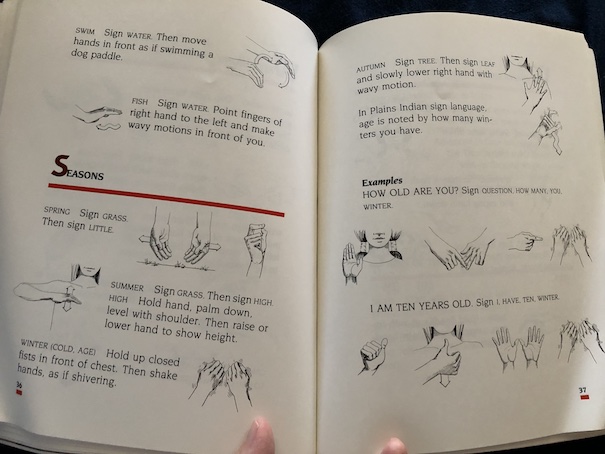
It begins by explaining basic hand and finger positions and introducing some basic vocabulary, demonstrating signals for simple words, like “I”, “You”, “Yes”, and “No.” All of the hand signs are shown in drawings with arrows to indicate movement where necessary. It also introduces how to signal that you are asking a question.

The rest of the vocabulary is presented in themed sections, introducing words for family members, counting, seasons of the year, weather, time, food, clothing, feelings. This is different from the older books about American Indian sign language, which had vocabulary words organized alphabetically, like a dictionary. I prefer the approach of the themed sections because they demonstrate related words together and provide information for forming sentences as needed, like how to indicate that a concept is past tense. Later sections build on earlier sections, like when the section about seasons draws on the earlier concepts of counting and how to ask questions to demonstrate how to ask how old someone is or how to tell someone your age.

There are also sections at the back of the book discussing other methods of communication used by Native Americans, including smoke signals, pictographs, and petroglyphs.

The book is part of a series by the same author about various aspects of Native American culture. It’s available to borrow and read for free online through Internet Archive.