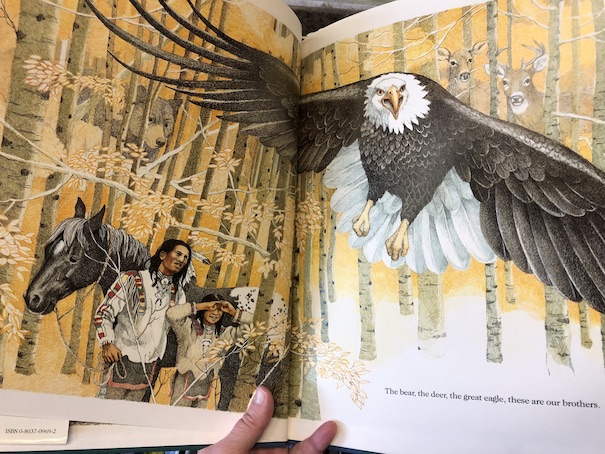
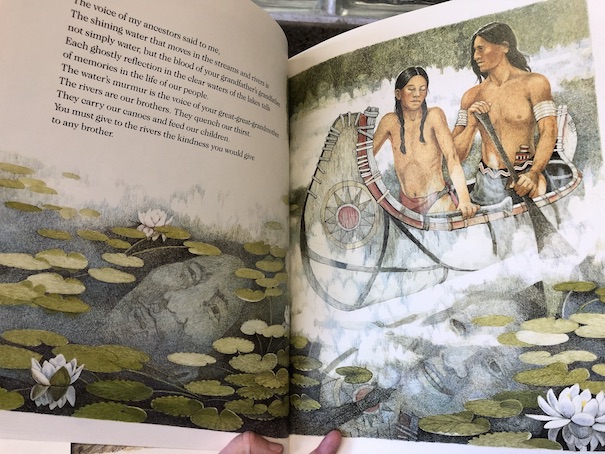
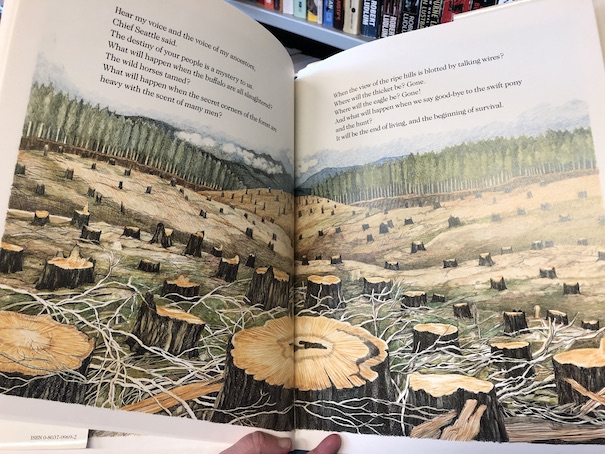
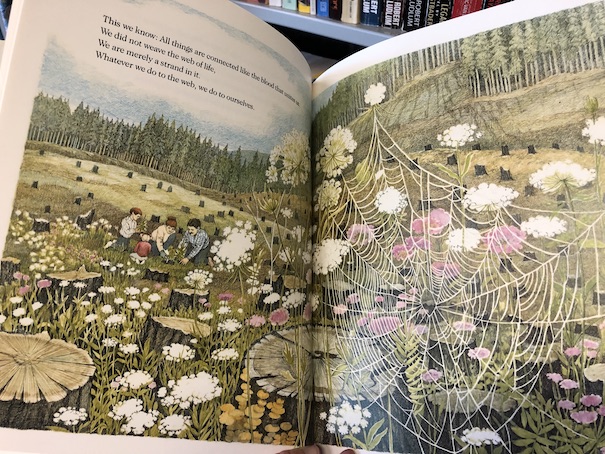
Brother Eagle, Sister Sky: A Message from Chief Seattle with paintings by Susan Jeffers, 1991.
This is a picture book, but not one for very young children because of the serious subject matter. It’s a profound book with beautiful pictures, but before presenting it to children, adults should be sure that the children are old enough to understand the background of the book.
The book begins with some information about its background. It describes the variety of “Indian” (Native American) tribes that have lived in the Americas for thousands of years and how, after white settlers arrived from Europe, they were killed and pushed off their ancestral lands by the new arrivals. It’s historically true, but also dark subject matter, which is why it’s important for the children reading the book to be old enough to understand it. Most of the book is the text of a speech made by Chief Seattle (who lived c. 1786 to 1866) to the Commission of Indian Affairs for the Territory and other government employees when the US government wanted to buy land from his tribe. The historical details concerning this speech from the mid-1850s are complicated, and accounts of it might not be completely accurate, and there is a note in the back of the book that addresses that. I consider the spirit of this speech something worth preserving, so I won’t get too hung up on that right now. I just mention it for the sake of people interested in going deeper into the history.
Susan Jeffers particularly wants readers to consider the environmental message of the speech and how relevant the message is today for a society that has endangered itself by placing a higher priority on the acquisition of land, resources, and wealth than on preserving the land and environment that makes life itself possible. This book was written in the early 1990s, and having been a child at that time myself, I know that these themes were increasingly becoming topics in schools and in children’s entertainment during that time. I’d like to point out that I, and others who are younger than me, have heard similar messages about environmental concerns from an early age. This has given us different priorities from earlier generations who did not, although it’s also worth pointing out that many of us came to care more about the environment as children because of the influence of adults who already did.
Chief Seattle questioned the concept of buying land because of the absurdity of buying aspects of nature, like the sky or rain. Land and nature had sacred spiritual meaning for Chief Seattle’s people.
Chief Seattle’s speech was full of poetic imagery, as he explained how his people felt like they were part of the land and it was part of them. He said that they looked on animals like they were brothers.
The land also connected them to their ancestors and the memories of their people.
Chief Seattle questioned what would happen in the future, when the land was filled with people and all of the animals either killed or tamed, painting a bleak picture of a land deprived of life.
The speech ended with the thought that people didn’t “weave the web of life, we are merely a strand in it.” Chief Seattle called on the people wanting to buy the land to love it, care for it, and preserve it because “Whatever we do to the web, we do to ourselves.”
The environmental themes of the message are poignant for modern times because people have become increasingly aware of the consequences of environment pollution and careless use of natural resources.
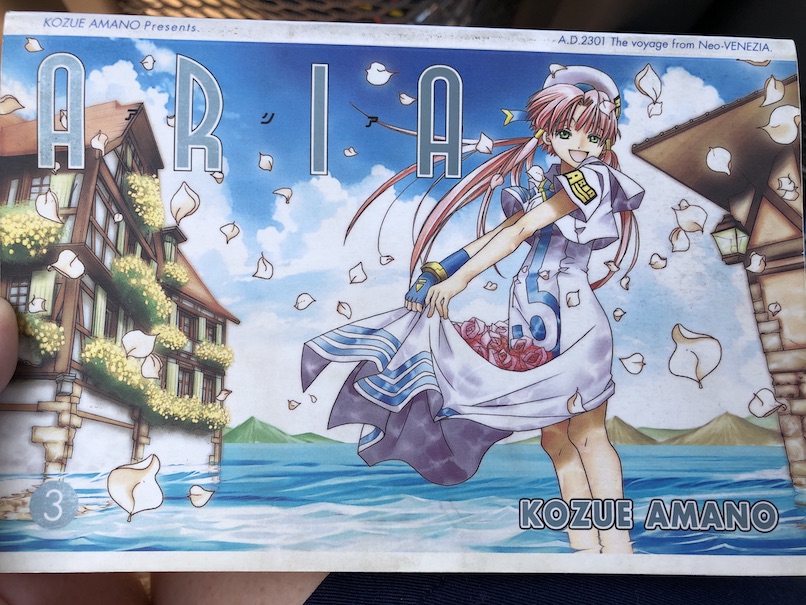
Aria Volume 3 by Kozue Amano, 2003, English Translation 2004.
This is the third volume of the second part of a fascinating manga series that combines sci-fi, fantasy, and slice of life. The series takes place about 300 years in the future, when Mars has been terraformed and renamed Aqua (because of all the water on its surface). The human colonies on Aqua are designed to resemble old-fashioned cities on Earth (called Manhome here). The people of Aqua prefer a much slower pace of life than people on Manhome, and aspects of life on Aqua more closely resemble Earth’s past.
The series is divided into two parts. The first two books are the Aqua volumes and introduce Akari Mizunashi, the main character, a young girl who came to Aqua to learn to become a gondolier in the city of Neo Venezia (which resembles Venice). Female gondoliers, called Undines, give tours of the city, giving Akari plenty of time to admire the beauty of her new home and meet interesting people. The two Aqua books are the prequel to the main series, Aria. Aqua covers Akari’s arrival on the planet, her introduction to life on Aqua, and the beginning of her training. The main Aria series show Akari’s continuing training, her progression to becoming a full Undine, her evolving relationships with her friends, and as always, her delight in learning more about her new home and admiring its beauty.
The series has received some criticism for being slow and lacking danger and adventure, but that is not really the point of the series. The main purpose is to show people how to appreciate the small pleasures of life. The sci-fi and fantasy elements (the spaceships, advanced environmental controls, intelligent Martian cats, and even the occasional appearances of the legendary Cait Sith) are mainly background to the stories about the magic of friendship and simple pleasures. Each volume contains a few short stories about Akari and her friends and the little adventures they have on a daily basis and the life lessons they learn. It’s a great series for relaxing when you’re stressed out.
The stories included in this volume are:
First Gale of Spring
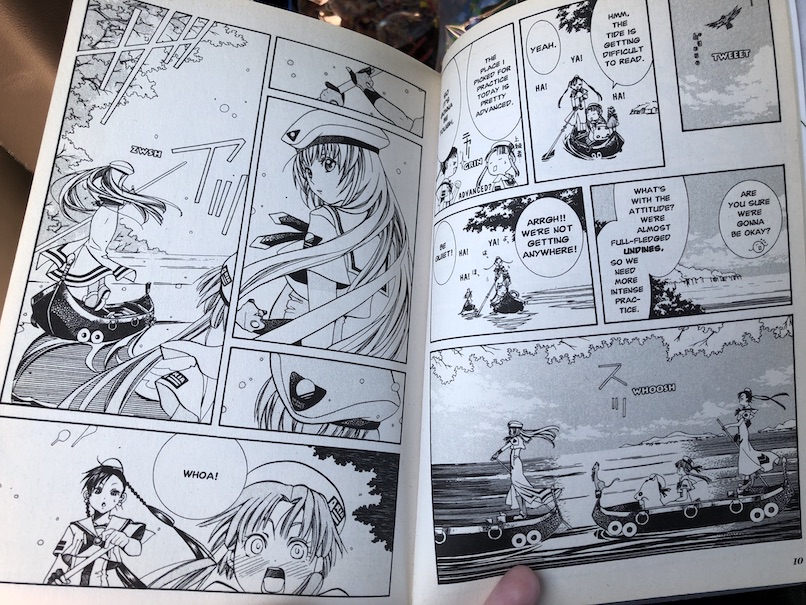
It’s been a full year (full Martian year, which is equal to two Earth years) since Akari moved to Aqua and began her Undine training, and she’s happy that it’s spring again! While Akari and Aika are practicing their rowing one day, they meet another trainee Undine, Alice.
Alice is a young prodigy, only 14. Even though she is rather young and still in school, she’s really good at handling a gondola. However, Aika takes an instant dislike to her, partly because she belongs to Orange Company, a rival of Aika’s gondola company, Himeya. Akari tries to be friendly to Alice and tries to invite her to join them for lunch, but Alice is rude and unfriendly to them.
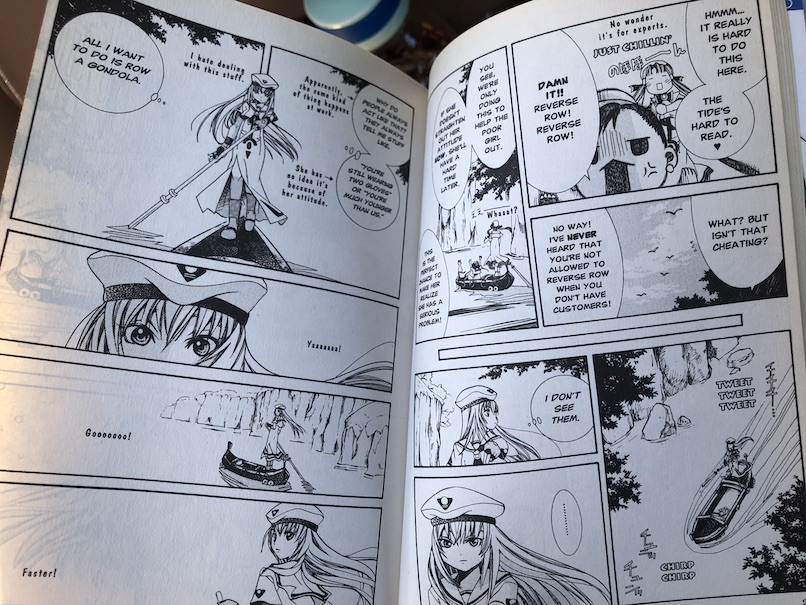
Aika thinks that Alice has an uppity attitude and is disrespectful to them even though they’re higher level trainees than she is. (There is some mild swearing in this part of the story. Most of the Aria series doesn’t have any swearing at all.) To prove her point and put Alice in her place, Aika decides to challenge Alice to a race.
Part of the reason why Alice is so prickly and unfriendly is that she thinks that people look down on her for being young and because they’re jealous of her skills , but she doesn’t realize how her abrasive attitude affects the people around her and their perceptions of her.
Aika has Akari row their gondola in the race, partly so she can use her secret ability to row a gondola backwards really fast, but Akari has her own ideas of how the race will end. Akari is still thinking of the beauty of spring, and even though she makes sure that her gondola will come in second by stopping to pick flowers (the fact that they had time to pick an entire boatload of flowers indicates just how much of a lead they had), she uses them to remind the other girls
Alice actually appeared in one of the prequel books to the Aria series, Aqua Volume 2, as the friend who went with Akari to visit Aika when Aika had a cold. It was the only Aqua story she was in, and this story in the third volume of the Aria series is the true introduction to her character.
Under the Cherry Blossoms in Full Bloom
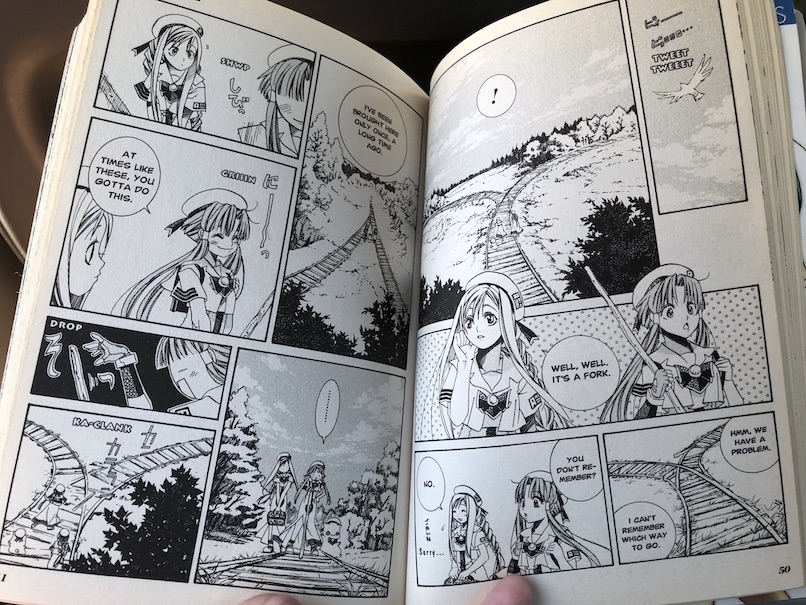
Alicia and Akari decide to go on a picnic to enjoy the beauty of nature in spring. Alicia has a special place in mind for a picnic, but the two of them get lost on the way. Although Alicia remembers that getting to her special spot involves following some old train tracks, when they split off in different directions, she can’t remember which way to go.
Akari picks a random direction. It turns out that the direction she picks doesn’t take them to Alicia’s special place, but they find something else interesting: an abandoned train car underneath a cherry tree in full bloom.
The girls explore the train car and find that part of the roof is missing. They lie in the train car and enjoy the cherry blossoms raining down on them. Akari apologizes to Alicia for not finding her special place, but Alicia says that’s fine because this place is nice, too. She says that sometimes, you have to get a little lost to find something new.
Town Treasure
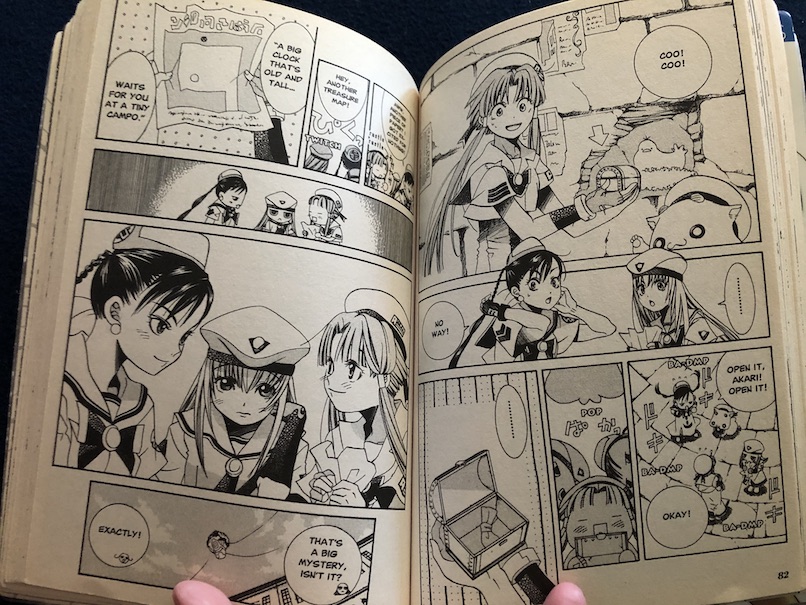
Akari, Aika, and Alice find a message in an old gondola that they borrow from the gondola repairman while Aria Company’s gondolas are being service. The message is in a small box in a hidden compartment of the gondola, and it turns out to be the first clue in a treasure hunt with a special surprise at the end.
Curious to find the treasure, the girls follow the clues through Neo Venezia, and their search leads them to take a second look at places they pass by all the time with little notice and takes them to lesser-known parts of the city that even Aika and Alice, who were born there, haven’t seen.
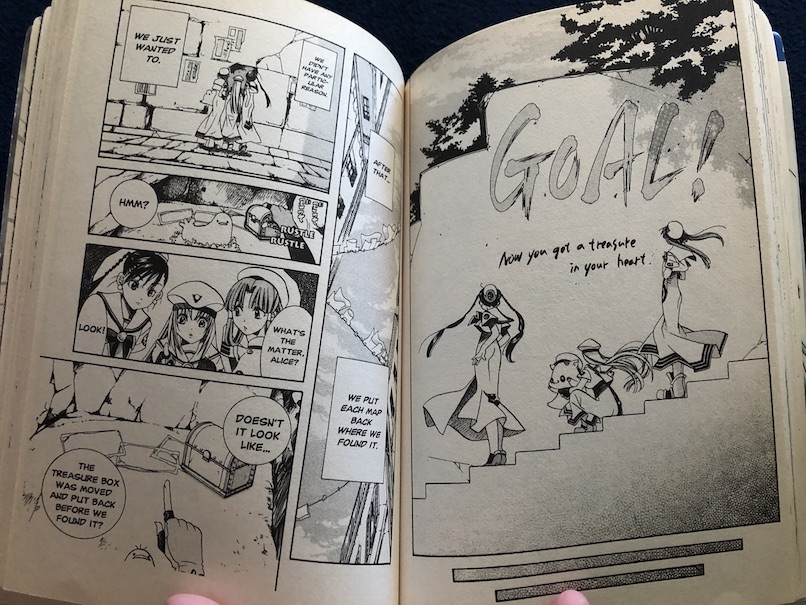
The treasure hunt finally ends on an often over-looked stairway that actually provides an excellent view of Neo Venezia, and the treasure they find there is the one that made Akari enjoy the treasure hunt from the very beginning.
The girls decide to put all the clues back where they found them, and to their surprise, they notice that there are marks that indicate that many other people have done the same.
Three Water Fairies
Akari and Aika are training under two of the Three Water Fairies, the best-known Undines on Aqua. However, Aika’s mentor, Akira, is much more strict than Alicia. One day, Aika gets fed up with Akira’s strictness and decides to run away and train under Alicia.
When Akira shows up to reclaim her wayward trainee, Akari learns more about Alicia, Akira, and especially about Aika. Akira was seen briefly in Aqua Volume 2, when Aika snuck out of her room to go buy some pudding, and she was the person Aika was trying to avoid because she was the one making her rest from her cold. However, Akira wasn’t actually introduced until this book, like Alice. This story reveals that Alicia and Akira were friends as trainees, like Akari and Aika, and have had a bit of a rivalry, being considered among the three best Undines, but they haven’t seen each other much in recent years.
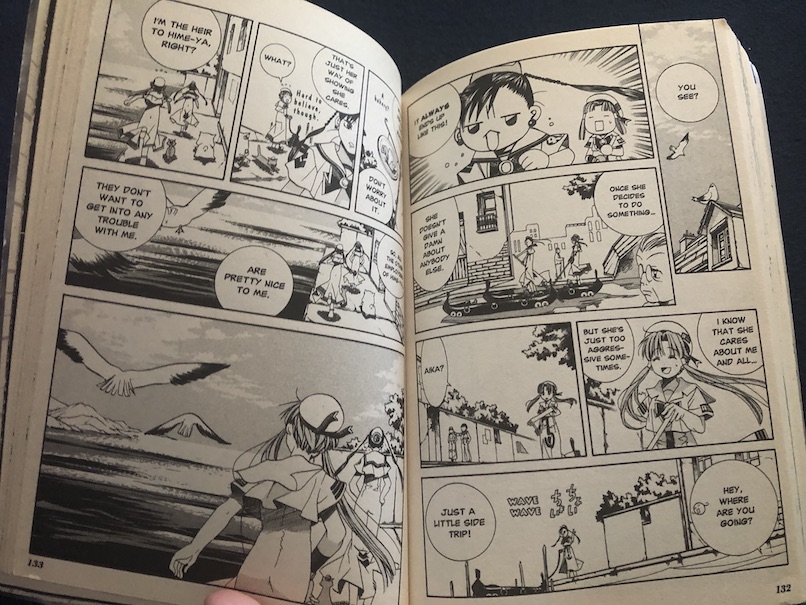
Aika had reveals that the reason why she admires Alicia so much is that Alicia was nice to her when she was a child. One day, when she was upset about something, Alicia found her and gave her a ride in her gondola and cheered her up by trying different hairstyles with her hair. This experience is what made Aika want so badly to become an Undine herself. However, Aika could not train under Alicia at Aria Company because her parents actually own Himeya Company, something that Aika has never told Akari before. Aika’s family expects her to work her way up through the ranks as an Undine and eventually take over Himeya Company.
To settle the matter of Aika’s future training, Akira proposes a contest, a race between Aika and Akari, to determine whether Aika will become Alicia’s student or return to Himeya Company with Akira. As Alicia guesses, the “race” between their trainees gives Aika an opportunity to return to Himeya without sacrificing her dignity. It also gives both Akira and Aika an opportunity to consider how they really feel about each other and how much they appreciate each other.
While Akira and Alicia talk about Aika and how she’s both similar to and different from her mentor, Akari and Aika aren’t really having a race. Instead, they talk about how Aika feels about Akira.
Aika says that her position as the future heir of Himeya Company doesn’t matter much to her because she just wants to be an Undine, like Alicia, but she admits that people at Himeya treat her differently from the other trainees because they know who she is. They are extra nice to her and try to avoid getting on her bad side because they want to be friends with the boss’s daughter, who will be their future boss someday. Aika admits that, strict as Akira is, she’s also the one who’s the most honest with her, correcting her when she needs it and not worrying about making her angry. Aika realizes that she needs that honesty in her life and that Akira’s training is helping her. At Aika’s insistance, the girls end their “race” and go buy some walnut pastries for Akira, which Aika offers to her as an apology before returning to Himeya with her. Akari realizes the the bond between Aika and Akira is stronger than either of them wants to admit, and she hopes that, someday, she’ll have a bond that strong with Alicia.
This story is important for explaining more of the backstory of the characters and how they relate to each other. There is a running theme in these stories of having characters whose names begin with the letter ‘A’. In most cases, I don’t mind because the names are usually different enough that it doesn’t matter, but Akira and Akari are rather close.
Festa del Boccolo
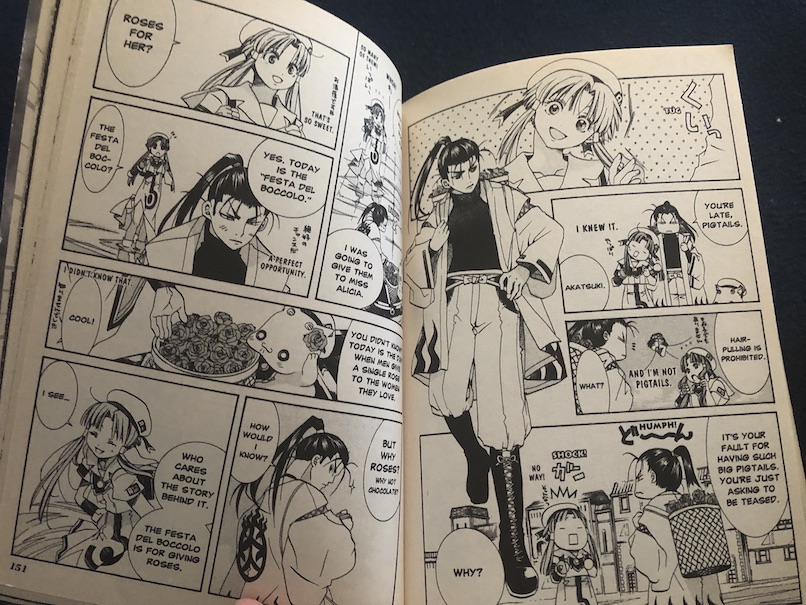
Festa del Boccolo is the time when men give red roses to the women they love. Akatsuki has had a crush on Alicia for a long time, and he enlists Akari’s help to give her a boatful of roses to impress her. He needs her help because the town is flooded during high tide again, as it is every year during late spring.
Unfortunately, his elaborate gesture doesn’t go as planned because Alicia has already received many other roses from other people, and she assumes that Akatsuki has bought all of his roses for Akari.
Akatsuki accidentally spills the roses in the water, while trying to get Alicia’s attention. He thinks that he’s completely screwed everything up, but Akari points out that his gesture wasn’t futile because, like the roses floating on the water, his love for Alicia spreads out around him and touches everyone, and one day, Alicia is bound to notice. Akatsuki gives Akari a single rose to thank her for her help, and the two of them enjoy a walk together through the flooded city.
#27 The Camp-Out Mystery by Gertrude Chandler Warner, 1992.
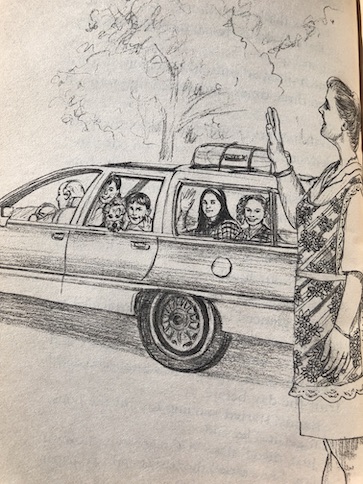
The Alden family has decided to go on a camping trip to a campground at a state park. From the moment that they arrive, though, strange things seem to be happening. When they stop for supplies, a woman Mr. Alden knows, Doris, seems oddly evasive when he tries to ask her about her sister, Hildy, and she makes the odd comment that she hopes nothing will spoil their trip. As they pull into the state park, they discover that the arrow on the sign pointing to the rangers’ station has been reversed to point the wrong way. Mr. Alden shrugs the incident off as a prank, but it’s only the beginning of the strange happenings.
The Aldens get to their camp site and notice that the place is a mess. Either the previous campers were pretty messy, or they left in a hurry. The Aldens clean up the site and set up their tents. (The description of how they set up camp is actually somewhat educational because they talk about things to look for when choosing a campsite, how they have to check the ground for rocks and tree roots before setting up their tents and why they should avoid places where it looks like rain water might pool and why it can be dangerous to set up a tent under a tree if there is a lightning storm.) Later that night, Violet is woken by the sound of music. At first, she thinks that it must be some nearby campers, but it sounds too loud and too close. When she and Jessie get up to investigate, the sound stops.
Later, the kids see strange lights in the woods, and things
disappear or are moved around at their campsite. When Mr. Alden realizes that someone has been
sneaking into their camp and taking things, he suggests that they might want to
leave the park, but the kids say that they’d rather stay because they’re still
enjoying themselves. Then, Mr. Alden injures
his ankle when he’s startled by another blast of loud music and part of the path
he’s on gives way because the dirt was loosened by rain. The children are prepared to leave when their
grandfather is injured, but to their surprise, Mr. Alden says that he’d rather
stay, too.
Who is doing all of these things and why? Is it the unfriendly Hildy, who lives alone
in a cabin and wants everyone to leave her alone? Or maybe her seemingly-helpful neighbor,
Andy, for reasons of his own? Could
Doris be responsible? What about the
Changs, a family camping nearby who seemed disappointed that they didn’t have
the campground to themselves?
There are some environmental themes and lessons in the story. The Aldens frequently pick up litter that other campers and hikers leave behind. There is also an explanation that the reason why part of the path Mr. Alden was on collapsed due to erosion because there are no trees along that section of path; tree roots help secure the soil so that it doesn’t wash away. After the mystery is solved, Mr. Alden decides to donate some trees to the park, and the kids talk about adding more trash cans and a recycling center to help solve the litter problem.
The book is available to borrow and read for free online through Internet Archive.
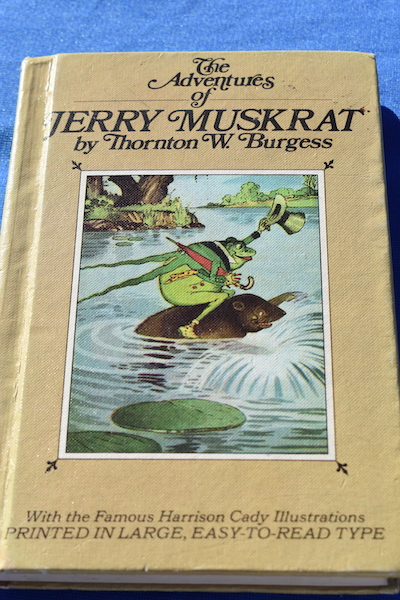
The Adventures of Jerry Muskrat by Thornton W. Burgess, 1914.
This book is part of a series of stories about the adventures of different animals.
Jerry Muskrat lives with his family and friends in the Smiling Pool and Laughing Brook, near the farm owned by Farmer Brown. Jerry’s mother warns him to look out for the traps that Farmer Brown’s son likes to set, but he’s sure that he can take care of himself . . . until he has a very narrow escape!
Jerry’s mother calls a meeting of the other animals to discuss the threat of traps after Jerry’s close call. They decide to ask Great-Grandfather Frog for his advice. He tells them that they must find all of the traps and use a stone or stick to trigger them. Then, when the traps have been sprung, they will bury them. The animals have some close calls while springing the traps, but they manage to set them off successfully.
However, they soon have a new problem: it seems like the water in the Smiling Pool is getting lower each day. When the animals investigate, they discover that someone has dammed the Laughing Brook that feeds the Smiling Pool! If they don’t do something about it, they might all have to go live on the Big River, and they don’t want to leave their home.
It turns out that the dam was made by Paddy the Beaver, Jerry Muskrat’s “big cousin from the North.” Jerry tries to make a hole in the dam so that the water will flow, but Paddy blocks it again, telling them not to mess with his dam. Jerry has to explain to Paddy why the residents of the Smiling Pool need the water. Once Paddy understands, he lets the water flow again.
The animals in the story refer to the place where they live in terms of their pool and brook and the nearby farm. You don’t really know exactly where they live, but there is one animal who has a Southern accent, “Ol’ Mistah Buzzard.” Ol’ Mistah Buzzard talks like the characters in Disney’s Song of the South, regularly dropping phrases like, “Where are yo’alls going?”, “Fo’ the lan’s sake! Fo’ the lan’s sake!”, and referring to other animals as “Brer Mink” and “Brer Turtle.” The book was written before the movie Song of the South was created in 1946, but long after the book that the movie was based on, Uncle Remus by Joel Chandler Harris from 1881. I suspect that the author of this book was inspired by the animal stories in Uncle Remus and that the Buzzard’s dialect is a salute to that. Unfortunately, that kind of dialect is really annoying for modern readers and may make it a difficult thing to read aloud to children. Mercifully, none of the other characters in the book do this. The parade of animals who hurry to find what has stopped the water in the brook is also a take-off from The Tortoise and the Hare story because the turtle, who was left behind by the others in their rush does become the first to find the source of the problem when the others stop to rest.
This book is over 100 years old and in the public domain now. There are multiple places to read this book for free online, but the one that I recommend the most is Lit2Go from the University of South Florida because it offers audio readings of the chapters in the book as well as the text. The book is also available online through Project Gutenberg.
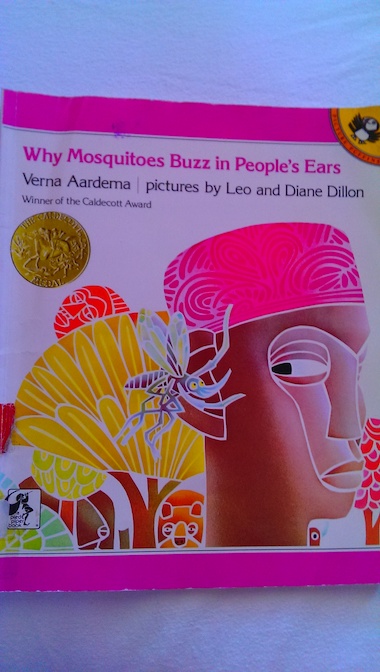
Why Mosquitoes Buzz in People’s Ears retold by Verna Aardema, pictures by Leo and Diane Dillon, 1975.
The story comes from a West African folktale, and all the characters are animals.
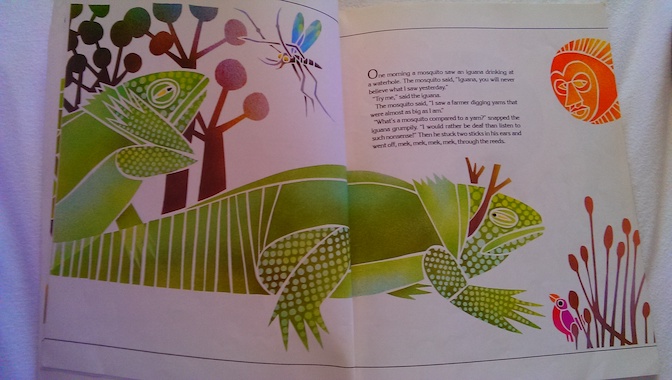
In the beginning, a grumpy iguana gets tired of hearing a mosquito telling tall tales. He sticks a couple of sticks in his ears so that he won’t have to listen anymore, and this decision leads to a series of unfortunate events that leads to the accidental death of a baby owl.
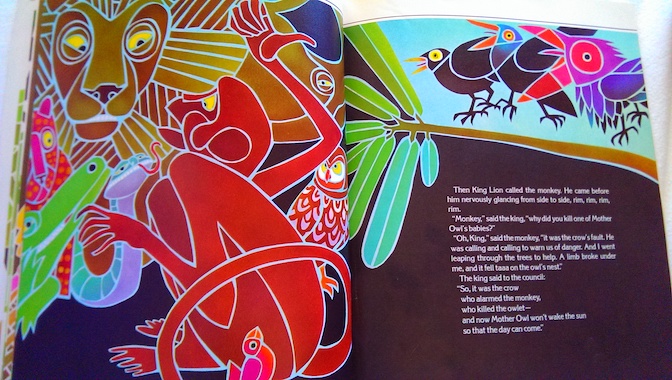
It starts with a snake trying to talk to the iguana, who does not hear him. The snake, thinking that perhaps the iguana is angry with him, goes to hide from him in a rabbit hole, startling the rabbit out. The chain reaction of events continues, with different animals startling each other, until a frightened monkey crashes through a tree branch, which breaks, killing the baby owl.
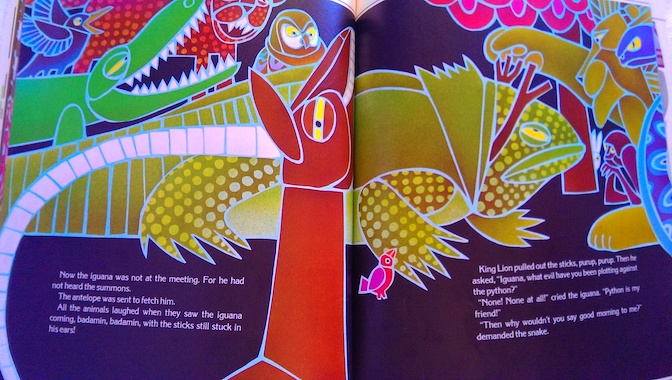
The Mother Owl is so distraught at the death of her baby that she doesn’t wake the sun so that dawn can come, as she usually does. When the other animals realize that dawn isn’t coming, King Lion calls a meeting to determine the reason why. Together, they trace the events backward to the iguana. The iguana is not at the meeting because he still has sticks in his ears and hasn’t heard a thing about it.
When the other animals track down the iguana and take the sticks out of his ears, they demand to know why he wouldn’t talk to the snake. When he tells them that he had sticks in his ears because he couldn’t stand listening to the mosquito’s stories anymore, the mosquito ends up taking the blame for everything. The Mother Owl is satisfied with the explanation and hoots to wake up the sun, although the mosquito escapes punishment by hiding. So, ever since, the mosquito whispers in people’s ears to find out if everyone is still angry.
The art style in the book is a little unusual. When I looked at the pictures the first time, I thought of them as looking stenciled. However, there is a note in the beginning of the book, near the copyright information, that says that the pictures are a combination of watercolors and india ink. The artists used an airbrush and pastels, and they created the “cut-out effect” with frisket masks and pieces cut out of vellum.
This book is a Caldecott Award winner. It is currently available online through Internet Archive.

















 Jestress's Forgotten Books and Stories