Mirette on the High Wire

Mirette

Mirette on the High Wire by Emily Arnold McCully, 1992.

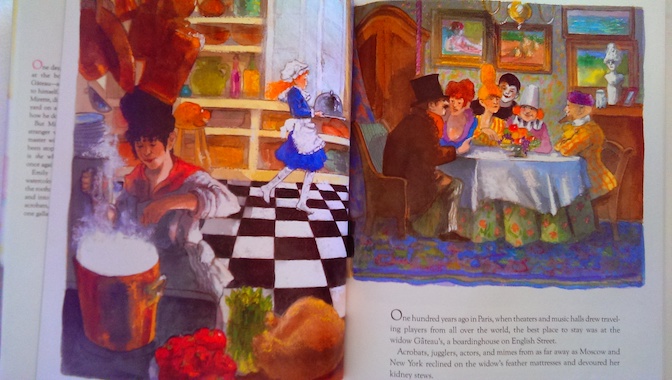
About 100 years ago (the book says, so it’s around the 1890s), a young girl named Mirette and her widowed mother run a boardinghouse in Paris. Most of the people who live there are actors and performers of various kinds.

MiretteBoardinghouse

One day, a strange, quiet man named Bellini comes to stay at the boardinghouse. Most of the time, Bellini prefers to keep to himself, but then Mirette catches him walking on the rope they are using for clothesline in the courtyard of the house. It turns out that Bellini is a tightrope walker. Mirette begs him to teach her how to do it, but he refuses.

MIretteRequest

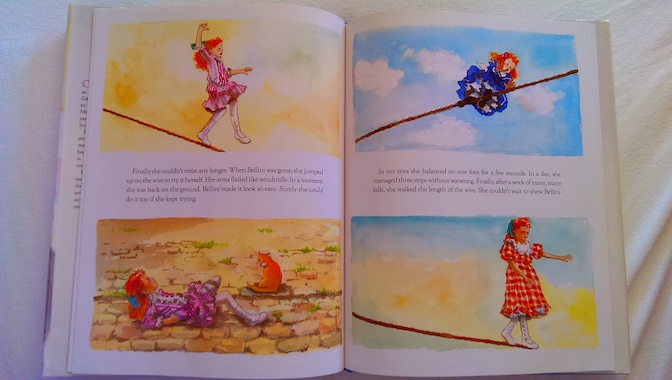
Not to be daunted, Mirette begins experimenting with tightrope walking herself. After repeated falls, Mirette eventually learns to balance on the rope. When she shows Bellini that she can walk the length of the rope, he is impressed with her perseverance and teaches her more things to develop her skills. However, he becomes very upset when she boasts that she will never fall again.

MirettePractice

Mirette learns that Bellini was a world-famous tightrope walker until a friend of his was killed in a fall, and he lost his nerve. She talks to Bellini about it, and he says that he doesn’t know how to get over being afraid. Seeing Mirette’s disappointment and worry, however, gives Bellini the courage to try once again.

MiretteBellini

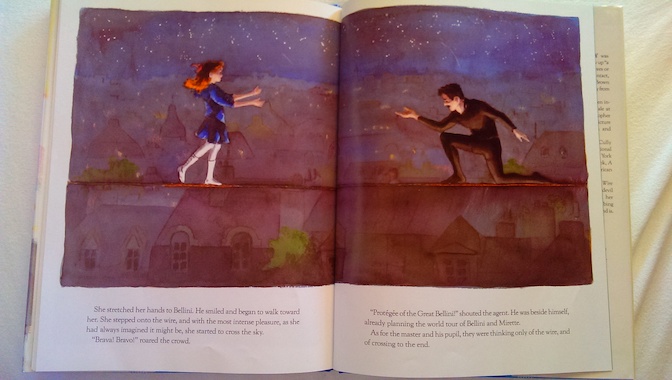
After talking with a performing agent staying at the boardinghouse, Bellini arranges a performance where he will walk a tightrope over a Paris street. When Mirette sees him hesitating at the beginning of the performance, she joins him on the wire, bolstering his courage and realizing her own dreams of becoming a real tightrope walker.

MiretteBelliniTightrope

There are other books in a series about Mirette and Bellini, where they perform tightrope acts and have adventures around the world, but I think that the first book is really the best.  The pictures are beautiful, done in an impressionistic style.

This book is a Caldecott Award winner.  It is currently available online through Internet Archive.

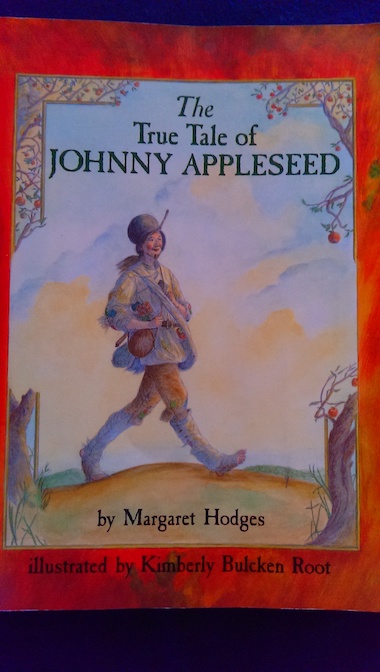
The True Tale of Johnny Appleseed

JohnnyAppleseed

The True Tale of Johnny Appleseed by Margaret Hodges, 1997.

This American folktale was based on the life of a real person, John Chapman.

Johnny Appleseed was born as Johnny Chapman in 1774. His family lived in Massachusetts. There were plenty of apple trees there, and Johnny loved them. When he was grown, he started traveling west with the idea of spreading apple trees.

He carried very little with him, and some people said that he wore the pot that he used to cook his meals on his head as he walked. Everywhere he went, he planted apple seeds.

His reputation spread, and although people thought that traveling around just to plant apple seeds sounded crazy, they sometimes let him stay with them on his travels. Even Native Americans seemed to like him because he was friendly and helpful and interested in learning their languages. His legacy continued long after his death with trees that were enjoyed by generations of families across the Midwest.

There is a section in the back of the book that explains more about the history behind Johnny Appleseed’s story, including the end of the Revolutionary War and the beginning of westward migration in America. One of the things they mention is the effect that the War of 1812 had on relations between pioneers and Native Americans. Because pioneers were already pushing into the territory of Native Americans in the area that later became Ohio, the tribes there sided with the British in the war, hoping to push out the invading pioneers. After the war was over, though, the pioneers continued to come west, and when they did, they retaliated against the tribes that had been on the side of the British. The pioneers could be brutal, and part of the reason that Native Americans liked Johnny Appleseed was that he was different. He wasn’t trying to hurt anyone or take land for himself; he just wanted to plant trees. After he planted trees, he would build fences around them to keep animals from eating them while they were growing.

John Chapman’s life was unconventional.  He never married, and he acted as a Christian missionary in his travels as well as a planter.  Although he could be regarded as something of an oddball in the itinerant way he lived his life, he became a legend.

The book is currently available online through Internet Archive.

Paul Bunyan and Babe the Blue Ox

PaulBunyan

Paul Bunyan and Babe the Blue Ox by Jan Gleiter and Kathleen Thompson, 1985.

This story is based on an American folktale that was used to promote the logging industry. The book doesn’t explain the background to the story, but in a very literal sense, it is a “tall tale.”  The book is part of a series about legendary figures from history and myth.

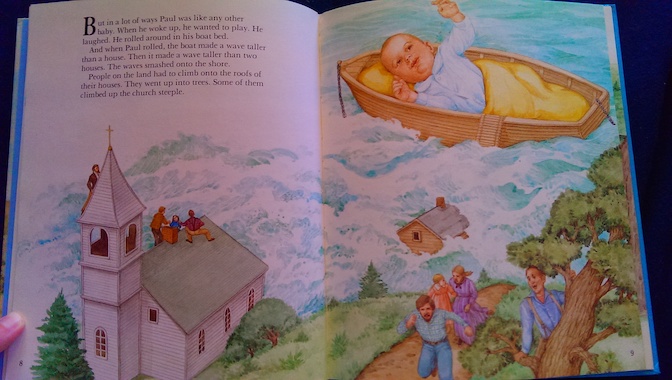
Paul Bunyan is a giant of a man, and he was a giant since he was a baby, even though his parents were both of normal human size (no explanation given). Because he was never small enough to fit in his parents’ house, they made a large boat for him to sleep in as a cradle, rocking him to sleep on a river. Needless to say, having a giant baby complicates everything and can pose a real risk to everyone. His parents had to teach him early about what he could and couldn’t do so that he would avoid hurting people.

PaulBunyanBaby

However, Paul discovered early that he was skilled with an ax, and because of his great size and strength, he realizes that he is good at cutting down trees. Because this was the frontier days in America, good loggers were in demand because trees were plentiful and wood was needed to build houses and railroads. (Paul Bunyan would not be such a hero for cutting down whole forests today.)

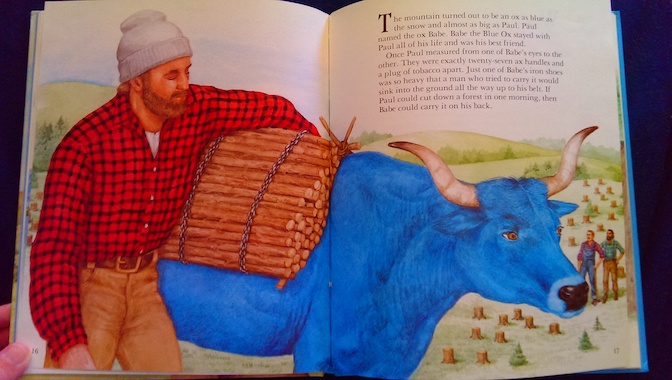
However, a giant of a man can also be lonely when there’s no one around his own size. Paul finds a companion in a giant blue ox. (Yep, that’s part of the traditional story.) He found the ox partly buried in a blizzard. After he dug it out, he named it Babe, and the two of them became lifelong friends.

PaulBunyanBabe

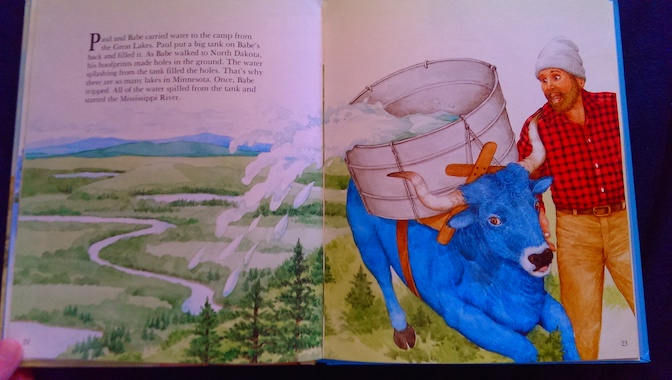
Part of the story is that the Mississippi River and all the lakes in Minnesota were caused by Babe accidentally spilling water that he was carrying on his back. Paul also supposedly dug the Grand Canyon by accident by dragging his ax behind him when he walked to California.

PaulBunyanBabeSpill

Paul also meets a man named Hals Halvorsen who is almost his size. After trees get cut down, Paul and Hals pound the stumps into the ground with their fists to finish clearing the land. Then, they try planting some corn to see how good the land is for farming, but the corn stalk grows up so high that Hals nearly starves to death while climbing it to try to find the top of it.

PaulBunyanHals

The part of the story I liked the best as a kid was when they made gigantic pancakes for Paul Bunyan and Babe, greasing their giant griddle by basically skating across its surface with grease strapped to their feet.

PaulBunyanPancakes

I can’t say that this was one of my favorite folktales as a kid, and my feelings as an adult about deforestation don’t make me feel good about it now. Still, it is an interesting piece of Americana and a little nostalgic.  As a side note, Paul Bunyan was used as a mascot for a pancake restaurant in an episode of Disney’s Phineas and Ferb (which has also been done in real life).  In that episode, Norm, a giant robot, accidentally gets the head of the Babe statue outside the restaurant stuck on his head, causing Phineas and Ferb to think that they are being chased by a Minotaur.  Now that I think about it, this joke’s use of Paul Bunyan and Babe the Blue Ox makes me smile more than the original version of the story.

The book is currently available online through Internet Archive.

Pocahontas

Pocahontas

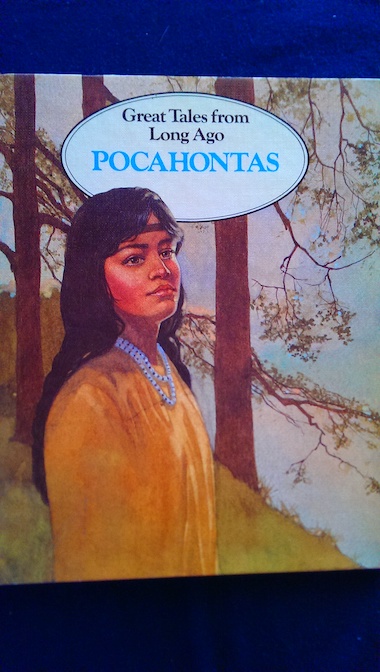
Pocahontas by Jan Gleiter and Kathleen Thompson, 1985.

The story about the life of the young Native American woman known as Pocahontas (“Pocahontas” was really a nickname, which the book mentions, although it doesn’t say that her original name was Matoaka) has been told many times in many forms, but this particular book is somewhat sentimental for me because it was the first one I ever read about her when I was a kid. It’s part of a series about famous and legendary figures in history and myth. Pocahontas was a real, historical person, but aspects of her life have taken on the characteristics of legend (as well as providing material for a Disney movie, although the Disney movie takes liberties with the real life of Matoaka/Pocahontas and the movie was not based on this particular rendition of her story).

When this particular book begins, Pocahontas is a grown, married woman going by the name of Lady Rebecca Rolfe. While living in England, she reflects back on her life and youth, remembering when she first met Europeans.

PocahontasEngland

When she was ten years old, she heard her father, Powhatan (who was the chief of their tribe) and other men talking about the white men. Although Pocahontas hears that the white people had betrayed her people’s trust and even killed some of them, she is curious to get a look at them.

PocahontasSettlerChildren

She ends up meeting with a group of boys from Jamestown and playing with them. She begins making friends with people in Jamestown and visiting them from time to time. A man named John Smith becomes curious about the girl and her people and gets Pocahontas to teach him some of her language.  (The book is more accurate than the Disney version here, showing that there is a significant age difference between Pocahontas and John Smith, with Pocahontas being a child at their first meeting.)

PocahontasJohnSmith

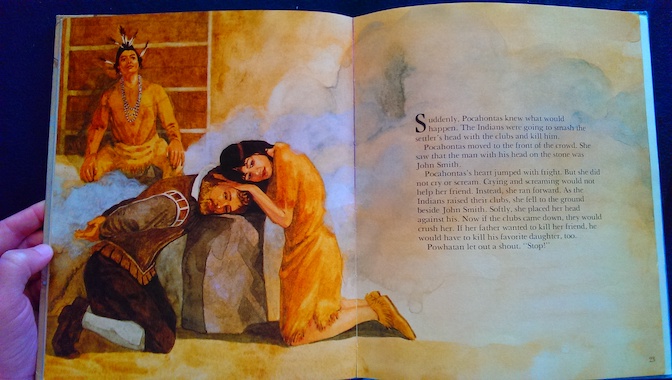
Then, one day, there is a feast in Pocahontas’s village, and some of the men of the tribe bring a white man who was caught trespassing in their territory. Pocahontas recognizes the white man as John Smith and, upon realizing that he is about to be executed, intervenes to save his life. (This is one of the most famous parts of the story of Pocahontas’s life, although the exact circumstances surrounding the real-life incident are a little confusing and may have actually been part of a more complex ritual that John Smith didn’t fully understand at the time, not an actual attempt at execution, if the event actually happened at all. This book offers a simplified version of the incident, supposing that John Smith’s life was in real danger, as he described it in his account of what happened.)

PocahontasExecutionAttempt

In the end, the settlers at Jamestown kidnap Pocahontas in the hope that Powhatan would end hostilities with them, using her as a bargaining chip.  (The book says that her father wasn’t too worried because he knew that the settlers were her friends and would treat her well, but I find this part of the book pretty worrying myself, reading it as an adult.  I’m pretty sure that is not how a parent would react to a missing child in real life.  I guess that the book is trying to keep the tone light for children, but it just sounds weird.) Pocahontas remains among the settlers, living according to their lifestyle and taking the name Rebecca. Eventually, she meets a man named John Rolfe and marries him. The two of them have a son together. With her new family, she travels to England and tries to help the people there to understand her people.  (The book says this in a very optimistic way, calling her visit a “success”, although in real life, this visit was largely a propaganda move on the part of the Virginia Company of London. On the other hand, she was, evidently, very well-received in England, if something of a social curiosity.)

PocahontasWedding

The story in the book ends here, with her still in England, thinking back on her life and her reasons for being there. Part of me wishes that it had explained a little more about Pocahontas’s earlier life and some other facts behind her story. Sadly, part of the reason why they might have been reluctant to tell the rest of the story to children was that the real Pocahontas didn’t live very long after the point where the story ends.  As she was preparing to return to Virginia from England, she became very ill and died.  Her exact age at the time of her death is unknown, but she was probably about 21 years old.  Her son, Thomas Rolfe, was very young at the time she died, but they do still have living descendants today.

Overall, I’d say that this is one of those stories that becomes more interesting when you’re older and realize the full depth of it.  This picture book is a very simplified version of the story, meant for kids, but when I was young, it did inspire me to learn more about Pocahontas.  There any many missing details of Matoaka/Pocahontas/Rebecca Rolfe’s life because of the limited records of it, but what is known is fascinating.  It’s sad because she died so young, but that the story of her life lived on in so many imaginations after her death is profound.  Different people, both when she was alive and after her death, tried to use her for their own purposes, but her legend still continues, out-living them all.  I’ve never seen the Disney Pocahontas movies, and I don’t really want to.  I already know how the story ends.

The book is currently available online through Internet Archive.

The Mystery of the Midnight Visitor

MorganMidnightVisitor

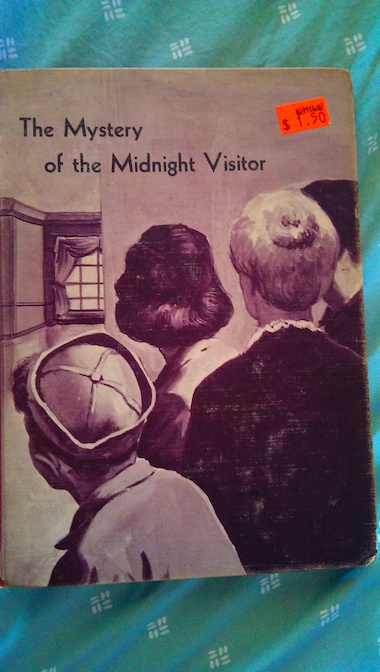
The Mystery of the Midnight Visitor by John and Nancy Rambeau, 1962.

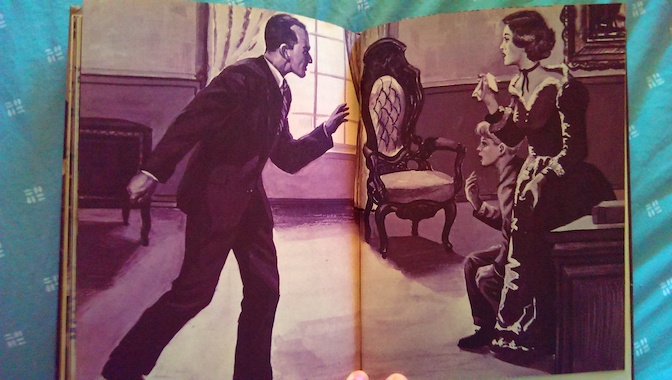
One day, Gabby is going fishing on the beach at Morgan’s Landing. Miss Wellington, a family friend, owns the property along with the old mansion known locally as Morgan Castle. She has given permission to Gabby to fish there, but Gabby is surprised to meet a stranger on the beach as well. This stranger is an old man who says that his name is Admiral Lavendar. When Gabby tells him that he’s on private property, the old man moves on. Then, Gabby spots smoke coming from Morgan Castle!

When Gabby goes to investigate, he finds that someone has shut Miss Wellington in a closet and that there is a fire in the bedroom that had once belonged to Mrs. Morgan, the former lady of the house. He gets Miss Wellington out of the closet, and they call the fire department. The firemen put out the fire and tell Miss Wellington that it was apparently caused by a dropped candle.


Morgan Castle was once owned by the wealthy Morgan family that gave Morgan Bay its name. However, the house has become shabby over the years. Miss Wellington inherited the house after Mrs. Morgan died because there were no other Morgans left. However, she doesn’t actually live in Morgan Castle because she has a house of her own. People have been saying that perhaps the house should be torn down because of its poor condition. Miss Wellington doesn’t have much money and says that she would find it difficult to manage the upkeep of the house.

Gabby and his brother Bill and sister Vinny don’t want to see the old beautiful old mansion destroyed, and there is still the mystery of who dropped the candle and why to consider. A small silver box that Gabby found on the beach turns out to be a jewelry box that once belonged to Mrs. Morgan. Mrs. Morgan wasn’t particularly interested in jewelry, but she did own one particularly fine emerald necklace that was never found after her death. Perhaps the person who dropped the candle was looking for it!

To give Morgan Castle a new purpose and prevent it from being torn down, the kids convince Miss Wellington to let them turn it into a Historical, Boat, and Tennis Club, dedicate to celebrating local history and providing entertainment for local people.

At first, the mysterious Admiral Lavendar looks like a likely suspect for the person sneaking around Morgan Castle, but he turns out to be very helpful to the children and their plans. There is another stranger in town who has the knowledge to seek out Mrs. Morgan’s lost necklace.

MorganMidnightVisitorThief

This book is part of a series that were once used as classroom readers.

The Haunting of Cabin 13

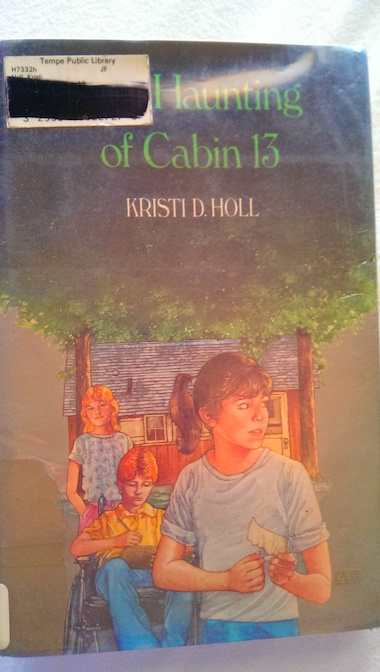
Cabin13The Haunting of Cabin 13 by Kristi D. Holl, 1987.

Thirteen-year-old Laurie is looking forward to her family’s vacation. They’ve rented a cabin for a week, Cabin 13, by the lake at Backbone State Park (It’s a real state park in Iowa. Link repaired 10-19-22.), and her friend Jenny is staying there with them. Laurie’s mother isn’t looking forward to the trip. She hates dirt and bugs and doesn’t like the cabin when they arrive. As everyone starts unpacking, Laurie looks around the cabin and finds a note that warns them to leave because the cabin is haunted. Supposedly, it was written by the ghost herself. The note is signed “Eleanor.” Laurie’s mother thinks that they should leave right away, but Laurie and the rest of the family persuade her that it’s just a joke. At first, Laurie’s sure that’s all it is.

Then, the park ranger tells the family that the other families who have tried to stay in that cabin this summer also found similar notes. It might be just a prank, but it might not. He also tells them that a girl named Eleanor, the same age as Laurie and Jenny, drowned there the summer before, and strange things have been seen there since, like lights around the lake. Laurie’s brother, Ricky, thinks it sounds cool that they’re staying in a haunted cabin by a haunted lake. Like others, Laurie thinks that the notes are the product of a prankster, but what would be the point behind it?

The girls meet a pair of brothers who are staying nearby, Kevin and Matt. When they tell them about the note, Matt is eager to investigate. Jenny enjoys flirting with boys, and she’s mostly interested in flirting with good-looking, athletic Kevin. Matt is in a wheelchair, so Jenny doesn’t pay much attention to him. She just makes an awkward comment about cripples being able to contribute to society that makes everyone feel uncomfortable. Although Laurie knows that Jenny’s comment was inappropriately personal and callous, Laurie also underrates Matt’s ability to help with their note mystery at first, and she’s shy about talking to him because she’s often shy around boys. However, needing someone to confide her thoughts in when Jenny isn’t interested, Laurie talks to Matt about her theories about the mysterious notes. Matt turns out to be easy to talk to, helping Laurie get over her nervousness about talking to boys.

At first, Laurie tells Matt that she thinks that the prankster is trying to drive people away from Cabin 13 because something important is hidden there. However, as she starts asking questions about Eleanor, she learns that the notes haven’t just been directed at Cabin 13. Staff at the park have also received notes from “Eleanor.” Laurie also sees a figure in black sneaking around the park, who she is sure is not a ghost.

It isn’t long before Laurie receives more notes from “Eleanor,” hinting that she might be in danger, and she and Jenny see the mysterious lights that people have been talking about. Then, when the children are out in a canoe together, it develops a leak and sinks. Matt panics because his legs are paralyzed, and he can’t swim, but Laurie saves him with the help of some people in another boat.

Was that accident just an accident, or could it have something to do with Eleanor’s “accident” last year? There are plenty of suspects who might have reasons for playing ghost and stirring up trouble at the lake. Matt’s father blames the park ranger for the accident that paralyzed Matt. At a previous visit to the lake, Matt was crossing a road with his father and brother and was struck by a speeding car. Matt father says it wouldn’t have happened if the roads had been policed properly. Laurie realizes that he might have a motive for revenge. Then again, some people have been coming to the lake, drawn by the ghost stories and hoping to see the mysterious lights. Could the ghost be a publicity stunt to drum up business?

The book is available to borrow and read for free online through Internet Archive.

My Reaction and Spoilers

When Laurie discovers that Eleanor’s half sister has come to the lake to investigate Eleanor’s death herself, she thinks that she has the mystery solved, but she’s only half right. It’s true that Eleanor’s sister has been responsible for some of the things happening at the lake, but not all of them.  She explains to the kids that Eleanor loved mystery stories and was always playing detective games, but she thinks that perhaps the game got too real for Eleanor the summer that she died.  There is something sinister going on at the lake, something that Eleanor also realized before her death, and there is more to Eleanor’s death than most people know.

At the end of the book, Matt gets a chance to be a hero and stop the bad guy from escaping, using his wheelchair to his advantage because a person on wheels can sometimes move faster than a person on foot.  Even before that, Laurie had gained an appreciation for Matt and his sensible thinking, realizing that a person who is impaired in one way can still have great abilities in other areas of life.  She also comes to think of Matt as being brave for coming back to the site of the accident that made him a paraplegic.  Matt says that he had to come in order to prove to himself that there was nothing inherently bad about the  place and to stop the nightmares he was having about his accident.  Matt and Eleanor’s sister both make Laurie realize that everyone has something difficult or frightening that they have to deal with in their lives; it’s just that some people’s problems are more obvious than others.  Everyone can see what Matt’s dealing with at first glance because he’s in a wheelchair, but no one knew about the pain and fear that Eleanor’s sister was carrying around with her until she admitted it.

I consider this story a pseudo-ghost story because the obvious parts of the haunting were caused by living people, for reasons of their own.  However, Laurie seems to feel that Eleanor’s spirit was there with them, waiting to see the mystery of her death solved.  It’s left open to interpretation, but if Eleanor was there, it was only seen in the odd feelings that Laurie had from time to time, not in any more obvious or physical way.

Something that confused me a little in the book is that, at one point, Jenny tells someone that Laurie already has a reputation for being an amateur detective, having discovered that Jenny herself had been kidnapped when the authorities thought that she had run away from home. Jenny gives full details of the time when she was kidnapped, including who kidnapped her and why and how Laurie figured out where she was. When I read that section of the story, I thought at first that the author was talking about a previous book that she had written with these two characters, but I had trouble figuring out which it was, if any.

Interesting fact: some of the children in the story are named after the author’s own children.

Color War

Camp Sunnyside Friends

ColorWar#3 Color War! by Marilyn Kaye, 1989.

Usually, the girls of Cabin 6 at Camp Sunnyside have fun during the camp’s annual competition.  Every year, the girls at camp are divided up into two teams, red and blue, and they compete against each other in a series of contests.  Ms. Winkle, the camp director, cautions the girls at the beginning of the Color War not to let themselves be carried away by the competition, to remember that they’re all still friends and members of the same camp, and to keep the contests friendly.  Usually, that isn’t a problem for the girls of Cabin 6.  They each have their favorite activities, and every year, they’re always on the same team, working together against other cabins.  However, this year is different.

When the girls of Cabin Six are split up and put on different teams, the competition between them threatens to ruin their friendship.  Some of the girls of Cabin 6 are more competitive than others, especially Katie, who likes to be a leader and hates to lose at anything.  Trina, on the other hand, values loyalty and friendship more than competition.  She looks on the other girls in her cabin as being almost family because they’ve spent so much time together and considers Katie to be her best friend at camp.  There is an unexpected clash between the two girls when Katie turns out to be the captain of the blue team, and Trina ends up on the red team.

Both Trina and Katie are disappointed about the team assignments.  Trina had helped to campaign for Katie during the elections that were held for the team captains, before the teams were even assigned, and Katie had told her that she wanted her to be her assistant.  But, teams are assigned randomly after the entire camp elects two captains to lead them, and none of the girls had any say in it when Trina and Erin were both placed on the red team, under the leadership of Maura, a snobby older girl who is even more competitive than Katie and not above stooping to some mean tricks to get ahead.  Switching teams is against the rules, so there’s nothing to be done about it.

Trina feels badly that she can’t be on Katie’s team and still thinks of her as her friend.  But, she notices that, from the moment when the teams are assigned (the girls each have a dot of a different color paint on their foreheads when they wake up one morning, indicating what their team will be), Katie starts behaving awkwardly around Trina, treating her almost as a suspicious stranger, or worse, an enemy.  When Katie tries to play on Trina’s sympathies, getting her to let her have an edge at certain contests or even bow out so Katie’s team can win, Trina is willing to go along with it at first because she likes Katie and wants to see her win, if it’s important to her.  But, gradually, Katie’s pushy competitiveness begins to wear on Trina, especially when she sees her taking advantage of her and other friends without regard for their feelings.  When someone tries to deliberately sabotage an activity that Trina is taking part in, it seems like Katie is willing to stoop to some dirty tricks and even cheating against her “best friend” in order to win, and it doubly hurts.

With Katie expecting Trina to give her advantages and inside information on demand and then shutting her out immediately afterward and acting suspicious of her, even accusing her of doing some of the things Katie herself is doing, Trina is fed up!  Katie’s seeming sabotage is the last straw, and Trina decides from that point on, she’s going to treat the Color War as the serious competition Katie acts like it is.  The girls’ unfriendly attitudes toward what are supposed to be fun games turns the Color War into a real war with friend against friend.  When people as well as friendships seem to be getting hurt, the girls have to decide what’s really important to them and what the cost of winning is going to be.

The book is currently available online through Internet Archive.

My Reaction and Spoilers

Although I liked this book when I was a kid, it frustrates and even angers me now.  I have a long-standing contempt for one-upmanship in all of its forms, and I lose respect for anyone I see using one-upmanship tactics.  (I didn’t write this, but I agree with it, especially the part that says, “You really do not need to be the winner every single time.” Seriously.)  As a character, Katie is my least favorite of the girls because of her overly-competitive attitude and lack of consideration for others.  It’s all the more aggravating because, as much as Katie likes to be the leader and the other characters follow her, she isn’t actually good at leading.  She’s mainly good at being bossy and manipulative.  As soon as Katie gets put into a leadership role in a competitive atmosphere, her usual standards of behavior go straight out the window, and she uses even close friends as mere tools to her glorious victory.  Note that she isn’t focusing on leading her troops to victory.  The victory is all about her and the trophy she wnats, regardless of what it does to people around her, and that’s why she’s not good at leading.  In this story, she’s mainly just selfish.  Some people can enjoy some harmless competition without losing their scruples, but sadly, Katie is not one of them.  Now that I’m an adult with more experience with this personality type, I have less patience for it than I ever did.

It’s true that Katie isn’t as bad as Maura, who we learn later actually did some of the worst things that Katie and Trina suspect each other of doing.  Neither Katie nor Trina actually sabotaged each other’s activities.  Maura did that both to give her team an edge and also to stir up Trina’s anger against Katie.  Maura saw that Trina wasn’t a competitive person and was willing to let Katie win just for the sake of friendship, and she realized that the only way to get Trina to even try to win would be to make her fighting mad.

Maura’s lying and acts of sabotage were worse than what Katie did because it was direct cheating, but Katie’s tactics were also a kind of cheating.  Katie persuades Trina to let her have the better horse for the riding contest, even though Trina was supposed to ride that horse, and she tries to convince her to fake an injury so that she can bow out of a gymnastics contest, which she knows Trina loves, just because she knows that Trina is likely to win that activity.

Supposedly, Katie’s a nice person most of the time, but you wouldn’t know it to see her in this contest.  Almost from the word go, Katie turns into a rabid little win-monster, ready to shove even her closest friends under a bus to win . . . at summer camp games.  At one point, she tries to make Sarah compete in a pie-eating contest because she knows Sarah is normally a big eater, but Sarah gets upset because she’s been dieting, and it was just starting to pay off, and she doesn’t want to ruin what she’s done just for the sake of some dumb contest.  When Trina sees how upset Sarah is, she tells her to be honest with Katie about how she feels, and Katie flies off the handle irrationally, as if she had never heard of Sarah’s diet before (she had, a lot, because Sarah had been talking a lot about how hard it was to fight temptation) and accuses Trina of trying to make her lose.  Katie can’t stand the idea of not winning, in case you couldn’t tell, and she doesn’t care about what her friends stand to lose in the pursuit of her personal victory or what the lasting consequences might be after the contest ends.

You might be wondering why winning is so important to Katie.  What’s really at stake for her in this summer camp contest?  I was wondering this a lot, all through the book.  It turns out that winning is important because the alternative, not winning, will make Katie feel like a loser, and people might think she was lame.  And . . . nothing.  That’s it.  Whoopty doo.  Katie fears getting jeered as the loser at the end of the contest, which is silly because no one does jeer the loser at the end, and most of the younger girls they talk to while campaigning for Katie to be one of the team captains in the beginning were kind of unenthusiastic about the games, not because they feared losing, but because they figured that the older girls wouldn’t let them try any of the more fun stuff, saving all the best parts for themselves.  In other words, very few people beyond Katie and Maura were at all concerned about who won or lost, they just wanted to take part.  Mostly, it seems that what Katie is really afraid of is coming up against an opponent, or even other teammates, who are just like her.  Katie is the manipulator who uses her friends; her friends are not trying to manipulate her or make her lose.  Katie is the rude one who jeers at losers.  Ultimately, she’s afraid of what she does to other people coming back on her.

Part of the reason Katie was hoping that Trina would be her assistant on her team was because Katie remembered that the year before some of the girls had ganged up on their team’s captain over a part of the competition that had gone badly.  Trina remembers that Katie had been the main instigator of the rebellion.  Katie’s scared of getting a taste of what she dished out to someone else before.  She fears getting jeered because that’s what she does to others when they lose.  She fears teammates getting down on her for not winning because she does that herself, to them.  And as the reader, we’re supposed to like her and hope she wins against awful Maura?  I have pity for her former team captain, getting stuck with this bratty little girl who ruins fun and makes people miserable because she can’t win at everything.  It must have been like babysitting, unpaid, while she’s supposed to be on vacation.  Have I mentioned how much I hate one-upmanship?

It’s funny, but by the end of the book, I had more contempt for Katie than I did for Maura.  It’s not that I liked Maura at all.  Maura’s tactics were definitely worse.  If I were in charge of the kids, she would be punished worse for what she did.  My anger at Katie is because of her sense of entitlement and because she’s still considered one of the “good guys” at the end, and I don’t think she deserves either.  She saw nothing wrong with manipulating her friends and forcing them to do what she wanted for her own personal glory, even when some of what she asked them to do would have been actually harmful to some of them, like interfering with Sarah’s diet. She plays on their feelings of friendship but with no feelings of friendship returned.  If she feels real friendship for them, it all evaporates the moment the possibility of being a “winner” is on the horizon.  Even if it’s just a dinky summer camp contest.  Worst of all, Katie routinely does things to others that she fears and resents having done to her. She does them more frequently to others than anyone does them to her, and often, she’s the first to do them, so she can’t even say that it was retaliation.  Part of Maura’s justification for her bad behavior is that Katie would do the same things she’s doing.  While Katie might not stoop quite as low as Maura does, the sad part is, Maura’s not that far off in her assessment of Katie.  Even though Trina doesn’t like Maura and sees her behavior as worse than Katie’s, she admits that Maura is pretty good at reading people and understanding their motivations.

In the end, Katie does acknowledge to Trina that the situation was really all of her fault and that she intentionally tried to make Trina feel bad about being on the opposite team because she genuine feared that Trina would win against her.  I don’t have any sympathy for Katie at all, and her apology falls flat for me.  Trina genuinely cared about about Katie.  She let her win when she didn’t have to and was actually happy when she did well.  All the time, Katie just cared about Katie and winning and that was about it.  Even after her apology to Trina, Katie says that she still wants to win.  Dang it, girl, don’t you have any other priorities in your life or any other dimensions to your character?  I would have found Katie more interesting as a character if she liked winning but had exceptions where the price of winning was just too high.  I wish she had limits.

The one part of the book that makes me feel better is when Trina is taking part in the gymnastics competition, and she realizes that if she made a mistake on a very difficult part, she could hand victory to Katie and no one would know that it was intentional.  At that moment, Trina realizes that she can’t do that because it wouldn’t be honest.  She says to herself, “You don’t have to prove your friendship this way . . .  If Katie expects you to, then she’s not a true friend.  And if you intentionally give this away, you’re not being a friend either – you’re trying to buy a friend. And that’s not what it’s all about.”  Bravo, Trina, for growing a backbone and some self-respect!  Katie also shows that she’s happy when Trina does well, and that’s something, a kind of progress for her, learning to care about someone else and be happy when they succeed at something that isn’t also a personal win for her . . . but dang it, that silly, shallow, win-monster still annoys me.  I didn’t really want Maura to win, but I have to admit that I wasn’t entirely happy that Katie’s team won, either.  I didn’t feel like either one of them really deserved it.

Since I disliked both Maura and Katie, I suppose it’s a given that I was going to be disappointed no matter which of them won.  But, I keep thinking of ways that the story could have ended which would have been better.  What if . . . no one won?  Suppose it was a tie?  Trina would have been happy since she doesn’t like to see people lose and doesn’t really care who wins.  In a tie, no one wins, but no one loses, either.  Also, it might bring it home to both of the team captains that the real goal of the contest, which they both somewhat failed, was to make the contest fun for their teammates.  Instead, people on both teams repeatedly remark that the contest is so much nastier this year with both Maura and Katie in charge and everyone feels awkward about it.  Nobody really enjoyed this contest except maybe Katie, because she won the trophy she was hungering for.  Then, when Katie has her pretty trophy at the end, she doesn’t even acknowledge her teammates’ hard work or how they helped her to win.  Many people would be thanking their teammates and talking about this trophy belongs to everyone because everyone won it together, but not Katie.  She was just happy that she had her trophy.  It’s her trophy, hers.  Whee.

I understand that we’re supposed to learn from both Katie and Maura what not to do in competitions, but watching them do what they do is painful and frustrating, a slow train wreck on Katie’s way to victory, and I hated seeing her friends just letting her obsessive meanness slide in the beginning.  In the end, the only person I felt was a real winner was Trina.  She never cared that much about winning the contest because her self-esteem doesn’t depend on it.  Trina is a valuable person and a true friend whether she wins a contest or not.  She knows what’s really important to her, and nothing important changes if she wins a game or not.  I think the world needs more people like Trina, who aren’t in it for the winning but are willing to work cooperatively with others to make good things happen for everyone.  By contrast, Katie needs to win because she is . . . just a winner.  At summer camp.  She’s got a trophy now.  Winner, winner, chicken dinner.

In spite of the fact that a large part of this review is me venting about the frustration, I actually did like this series when I was a kid.  This is the only book in it that I’ve been able to get my hands on recently, and it happens to be the one I find most frustrating.

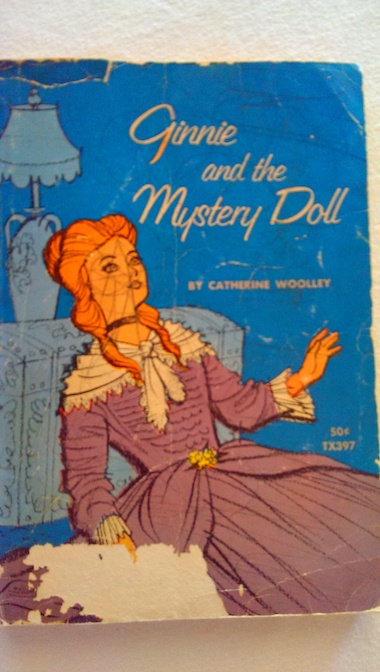
Ginnie and the Mystery Doll

GinnieMysteryDoll

Ginnie and the Mystery Doll by Catherine Woolley, 1960.

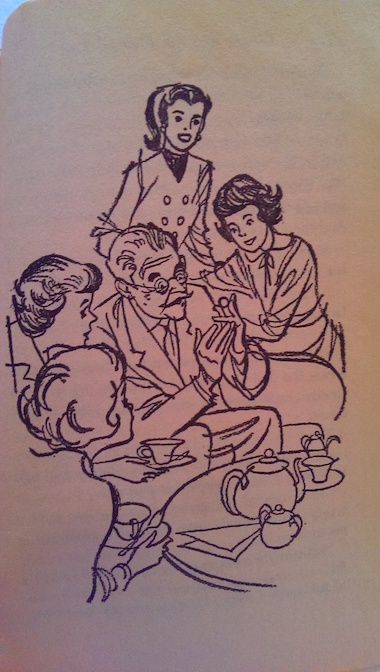
Ginnie and Geneva’s families have rented a house on Cape Cod for the summer, so they’ll be sharing their vacation at the beach. Their next door neighbor at Cape Cod is Miss Wade, a nice older lady. Miss Wade’s house is very old-fashioned, and when the girls make friends with her, she shows it to them, allowing them to see some of the neat old things in her attic on a rainy day. The girls have fun trying on the old clothes in the attic, and then they find an old diary belonging to Miss Wade’s mother when she was a girl. In the diary, the girl talks about the special doll that her uncle gave her, which has a “precious jewel.”

GinnieMysteryDollDiaryAtticThe girls ask Miss Wade about the doll, and she says that she knows the one they mean, but she no longer has it. Her mother’s uncle was the captain of a ship and used to bring her presents from around the world. The doll, called Lady Vanderbilt, was very fancy, and Miss Wade describers her costume to the girls. However, she says that the doll disappeared after she rented her house out to a family one summer while she was traveling. She never found out what happened to the doll, but she assumed that the children of the family probably found her and either took her or broke her. Miss Wade said that she didn’t think that the doll was worth making a fuss about, so she never asked the family about it. The girls note that Miss Wade doesn’t seem to know anything about a precious jewel in the doll, but they decide not to say anything about it since Miss Wade doesn’t have the doll anymore.

The girls decide to concentrate on enjoying their summer vacation, picking beach plums and digging clams with Miss Wade on the beach. Then, when they go to see a local auction, they spot a doll that looks exactly like the Lady Vanderbilt that Miss Wade described! The girls try to bid on the doll at the auction, but someone else buys her instead, and that lady leaves the auction before the girls can talk to her.

GinnieMysteryDollJewelThe girls tell Miss Wade and their mothers about the doll, but when they try to ask the people in charge of the auction where the doll came from and who bought her, they learn that the woman who was in charge of organizing the toys has already left on vacation. The only clue that the girls have is that the woman who bought the doll left the auction in a red Jaguar.

The girls make it their mission to track down the doll and its buyer, asking questions all over town about who might own a red Jaguar. Then, at an art exhibit at the Historical Society, they make a surprising discovery: a painting of the very doll that they’re looking for!

But, just when they figure out who has the doll and where she is, she disappears again when the red Jaguar is stolen with Lady Vanderbilt inside! Was it just an accident that the doll was stolen along with the car, or does someone else know that Lady Vanderbilt might be hiding a valuable secret?

The book is currently available online through Internet Archive.

Katy Comes Next

KatyComesNext

Katy Comes Next by Laura Bannon, 1959.

Ruth is little girl whose parents own a doll hospital. She has always been proud and fascinated by how her parents can make old or damaged dolls beautiful again.

KatyComesNextDollShop

However, Ruth’s own beloved doll, Katy, is in need of repair herself. As her parents rush around repairing dolls for their customers, they keep assuring her that Katy’s turn will come next.

KatyComesNextRuthsFather

After being put off repeatedly, Ruth starts to think that poor Katy will never get the attention that she needs.

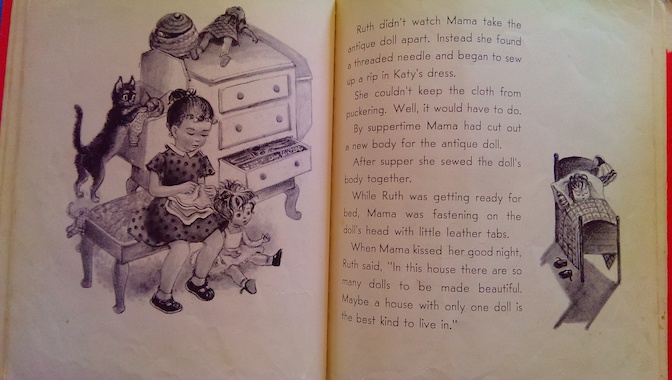
KatyComesNextRuthMending

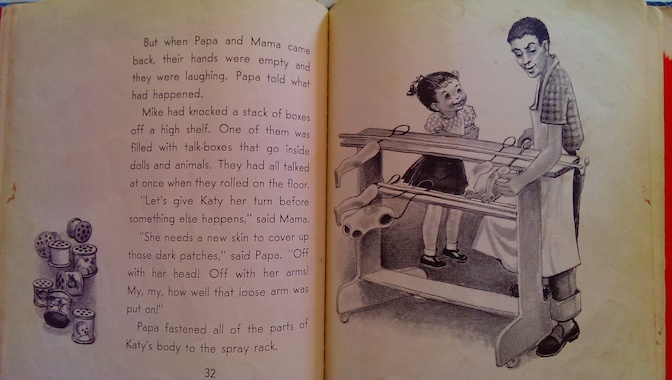
When Ruth’s parents realize how discouraged she is, they decide to take a day off for Katy to come first.

KatyComesNextFatherPaintSpray

This was one of absolute favorites when I was little!  The pictures alternate between black and white and color and show the process that Ruth’s parents go through to repair Katy, repaint her body and features, and give her new hair and eyes.

KatyComesNextWigs
KatyComesNextClothesTrunk

Ruth also gets to pick out an entirely new wardrobe for Katy. I was always fascinated with the description of how Ruth’s parents fixed the doll, and I enjoyed imagining the doll clothes that I would have selected from the ones they showed in the pictures.  Making the choices is half the fun!

KatyComesNextDresses
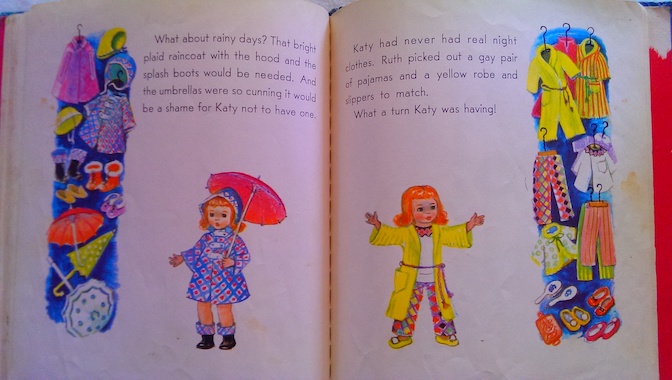
KatyComesNextPajamas

When Katy is finally finished, she looks beautiful, and Ruth is happy!  This is one of the many out of print children’s books that I wish would come back into print!

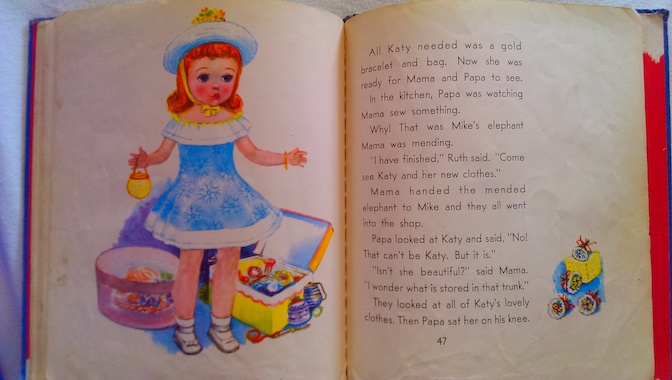
KatyComesNextPartyDress

Hitty, Her First Hundred Years

Hitty

Hitty, Her First Hundred Years by Rachel Field, 1929.

Sometimes, I debate about how much detail I should use when describing the plots of books, but since this is such an old book and a more recently released version has altered the events in Hitty’s life significantly, I’ve decided to cover it in detail.  I do not have the updated version and haven’t read it, so what I describe below is the older version.  The book is episodic in nature, following the life and travels of a small doll named Hitty.  This book is a Newbery Award winner and is currently available online through Internet Archive (multiple copies).

These are the memoirs and adventures of a hundred-year-old wooden doll, which she writes as she lives in antique shop. She doesn’t recall exactly when she was made, but she knows that it was about a century earlier and that she was carved by a peddler in Maine for a little girl named Phoebe Preble.

HittyMemoirsThe peddler did some odd jobs for the Preble family on their farm that winter, while the weather was too bad for him to travel. They named the doll Mehitabel (a Biblical name from the Old Testament), and Phoebe nicknamed her Hitty. At her mother’s insistence, Phoebe made clothes for Hitty and embroidered Hitty’s name on the doll’s petticoat. Phoebe’s mother says that as long as she has her name on her clothes, she’ll always know what it is, whatever happens to her. Phoebe doesn’t see what could happen to Hitty because she wants to keep her forever, but Hitty is destined to live an adventurous life.

Phoebe misplaces Hitty more than once during their time together. The first time, she accidentally leaves her at church (when she wasn’t even supposed to bring her there in the first place). Then, Phoebe takes Hitty out to play one day, but she and her brother are frightened when they see some American Indians. (Phoebe lives in the early 1800s.) When they run away from the Indians, Phoebe accidentally leaves Hitty behind. Then, Hitty is picked up by a curious crow and carried to the tree next to the Preble house. She hangs from a tree branch for awhile before they realize that she is there and rescue her.

HittyShipwreckedThen, Phoebe’s father, who is the captain of a whaling ship, convinces his family to join him on a voyage. Life aboard ship turns out to be both exciting and perilous. One day, the ship catches fire, and the Preble family and all the crew abandon it. Hitty, once again, is unfortunately left behind. Although Hitty sees Phoebe gesture back at the ship and knows that Phoebe wants to return for her, it is too late for that.

However, luck is with Hitty, and instead of being burned, she is washed overboard as the ship goes down. Miraculously, she is washed ashore and found once again by the Preble family, who are now castaways on an island. They hope for rescue but fear the “natives” on the island. (Yep. “Savages”, “natives”, etc. These are sadly a common feature in vintage children’s literature. See Edward Eager’s Magic by the Lake for a funnier spoof version. The scene in this book is the sort of generic “savage natives” or “native savages” scenes he was making fun of, except that nobody tries any silly ooga-booga talk to communicate with them, and they don’t turn out to be cannibals. But, it does occur to me that if this book had been written in modern times, people would have insisted that the author give the proper name for the civilization on this island instead of just calling them “natives” and thoroughly research their actual habits and customs and present them in an informative, realistic way for the education of children reading this book, while writers and parents during this period didn’t seem to care about any of that.  Keep this in mind the next time someone tells you that younger generations are lazier and not as well-educated.)

One day, the natives come to have a look at the castaways, and their leader catches sight of Hitty and demands (through gestures) that she be handed over to him. Phoebe doesn’t want to give up her doll, but her father tells her that she has to. It turns out that the natives think that Hitty might be an idol that gives the castaways power, which is why they want it for themselves. Hitty is taken back to the natives’ village, and they use her as an idol themselves, making a little shrine to house her.

Hitty probably would have remained there if she had not been stolen from the temple by some curious monkeys and once again found by members of the Prebles’ party, who return the doll to Phoebe. Fortunately, the family sees a passing ship and manages to get rescued before the natives can come after Hitty again.

However, Hitty’s adventures are still not over. The ship that rescues them is going to India, and unfortunately, this is where Hitty and Phoebe are permanently separated when Phoebe loses her in a bazaar. Instead of being found by Phoebe or her family again, Hitty is found by a snake charmer, who uses her in his act, positioned near the snake. Even though Hitty is made of wood and not vulnerable to snake bites, she still finds the experience frightening.

From this point on (we’re about halfway through the story), Hitty changes hands repeatedly, gaining and losing owners every few years or so. Most of her new owners give Hitty a change of clothes, but they always keep her petticoat with her name still embroidered on it so, as Mrs. Preble once said, Hitty and her new owners always know her name.

An American missionary couple spot Hitty with the snake charmer and realize that her design looks like dolls in America. They have no idea how she got to India, but they buy her from the snake charmer and give her to their daughter, Thankful. Hitty lives with Thankful for a couple of years, and she enjoys her time with her, even though she really misses Phoebe.
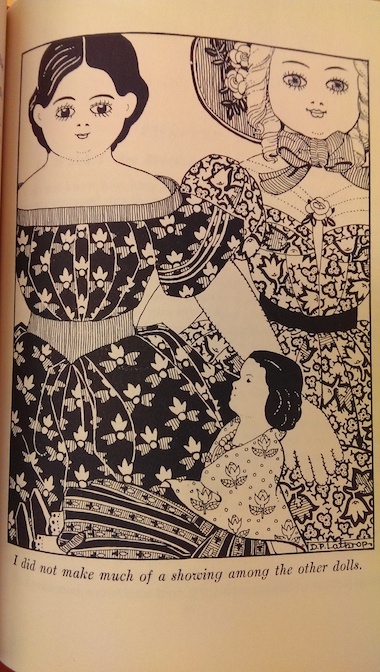
HittyOtherDollsThen, Thankful gets sick, and her parents decide that it might be time to send her home to the United States to stay with her grandparents. Thankful takes Hitty with her when she goes home to Philadelphia. Because Thankful’s early life was spent entirely in India, she has been unaccustomed to spending time with American girls her age, and she doesn’t know how to behave around the American children she meets when she first arrives in Philadelphia.  When the some of these (still 19th century) American girls first meet Thankful and Hitty, they think that Thankful is strange and make fun of her for her unusual habits and the way she dresses, telling her that her doll is ugly, too. Hitty has to admit that she isn’t as fancy as the other girls’ dolls. Thankful is so embarrassed by what the other girls say that she decides to hide Hitty in a sofa. After that, the sofa is taken up to an attic for storage, so Hitty remains hidden for a number of years.

HittyQuakerDuring her time in the attic, Hitty resents Thankful for abandoning her, in spite of all the charitable talk of her missionary parents. However, when Thankful is grown, Hitty is finally found by one of Thankful’s younger cousins, Clarissa Pryce, who really appreciates her. She doesn’t know how Hitty came to be in the attic, but thanks to the name still embroidered on Hitty’s petticoat, knows what to call her. Clarissa is a quiet, conscientious girl in a family of Quakers. She dresses Hitty as a Quaker girl, and Hitty lives with her for many happy years, learning to write as Clarissa goes through her schooling.

By now, the time of the Civil War is approaching, and Clarissa’s family are abolitionists. Hitty doesn’t really understand what the war was about, but she remembers being with Clarissa and watching soldiers march off to war. (This is where the updated version of the book differs greatly.  In the older version, Hitty doesn’t witness the war directly, but in the newer one, she does when she is sent to Charleston.)

Eventually, Clarissa gets older and is sent away to boarding school. Hitty is put into storage for awhile and then sent to the Pryces’ relatives in New York, along with some other things. However, Hitty’s package is misdirected and ends up being delivered to the wealthy Van Rensselaer family by accident. There, she is found by Milly Pinch, a seamstress doing some sewing for the Van Rensselaer family. Miss Pinch makes some stylish new clothes for Hitty, although she still lets her keep the petticoat with her name on it.

The Van Rensselaers’ young daughter, Isabella, sneaks into Miss Pinch’s room one day and finds Hitty, and a debate ensues about who really owns her. Mr. Van Rensselaer, on hearing where Miss Pinch found Hitty, says that rightfully, Hitty belongs to their family but that the clothes she is wearing are obviously Miss Pinch’s because she made them. Miss Pinch is gratified that he is being fair about it, but because Isabella really wants both the doll and clothes together, the family purchases them from Miss Pinch and gives her an excellent employment recommendation for her sewing.

Isabella is rather spoiled and has several dolls already, but she genuinely likes Hitty and takes care of her. Unlike Thankful, she even speaks up for Hitty when others say disparaging things about her plainness. While living with Isabella, Hitty even gets the chance to meet Charles Dickens. However, Hitty is stolen from Isabella by a gang of mean boys.

One of the boys in the youth gang takes the doll home with him and gives her to his younger cousin, Katie. The family is poor, but Katie loves her and gives her plenty of attention. When Katie gets sick and goes to live in the country for awhile, Hitty is accidentally lost in some hay and spends a long time in the barn, living with the mice.

When she is finally found, a pair of traveling artists are staying at the farm, and one of them keeps her to use as an artist’s model. He uses her to amuse children when he paints their portraits and even adds her into still life paintings. Hitty worries about how her painted features have faded, but the artist thinks that she’s much easier to paint than newer china dolls because the light doesn’t glare off of her. She stays with him for many years while he travels around the country, but he eventually leaves her with a pair of spinster ladies, Miss Hortense and Miss Annette, in New Orleans when he rents a room from them.

HittyBrideWhile living with these ladies, Hitty learns that Miss Annette’s fiancé died young, fighting for the Confederacy in the Civil War, and she still feels bitterly toward the North because of it. From her time with Clarissa, Hitty knows that many people in the North could say the same about the South, but of course, she can’t actually say so out loud. The ladies make new clothes for Hitty, dressing her as a bride, with her clothes made from an heirloom handkerchief, and put her on display at the Cotton Exposition (aka the 1884 World’s Fair). From there, Hitty is stolen by a little girl named Sally, whose father is the captain of a riverboat that carries cotton up and down the Mississippi River.

Hitty learns that Sally is a lonely child who travels with her father frequently because her mother is an invalid and cannot always take care of her. Sally knows that it was wrong for her to steal Hitty, but she so badly needs a companion that she is even willing to risk jail if it means that she can keep Hitty. However, after attending a revival meeting where there are warnings against the evils of theft and getting caught in a sudden thunderstorm, Sally panics, thinking that God may be about to strike her down for her sins, and throws Hitty into the river. (I found this scene a little disturbing because, when Sally fears that God will smite her with lightning for stealing, she not only makes a desperate apology but asks if anyone has to be struck, couldn’t it be one of the newly-baptized kids, who are sinless and would know that they were going to heaven? The fearful apology is understandable, but it’s a little disturbing to hear this little girl try to throw someone else under the bus like that.)

From the river, Hitty is rescued by a couple of black boys (the book says “Negro” because it was written in the 1920s) who are fishing. One of them gives Hitty to his sister, “Car’line.” (Her name is probably really Caroline, but Hitty just says the name as she hears it, and the boys have a Southern accent. This is one of those books where they try to give the impression of accents with odd spellings like, “How you come by dat doll?” It’s not the worst example I’ve seen of this, but I have to admit that I’ve never really liked the use of odd spellings like that.) Car’line’s family is the poorest one that Hitty has ever lived with, with a fairly sizable family living in a small cabin. However, Hitty likes the way Car’line treats her and how close her family is, and she loves the music that they sometimes play and the old spirituals that they sing.

At Christmas, Car’line’s family goes to a big party at a house that was apparently once an old plantation. The wealthier owners of the house give presents to the poor children of the area, like Car’line. While they are at the party, one of the women at the house, Miss Hope, recognizes Hitty from a newspaper report that a doll in heirloom clothing had disappeared from the Exposition in New Orleans. Car’line is upset when Miss Hope tells her that the doll really belongs to someone else and should be returned, but Miss Hope understands Car’line’s feelings toward Hitty and soothes her by giving her the doll she had played with as a child, a fancy French doll named Mignonette, as a replacement for Hitty.

As the end of the book draws closer, Hitty changes hands more often than before, and she doesn’t describe her time with new owners in as much detail, partly because her new owners tend to be adults and mostly display her, not play with her. Miss Hope attempts to return Hitty to the ladies in New Orleans, but since the heirloom handkerchief clothes are ruined, they decide that she should really be returned to the artist who had her before. When they try to mail Hitty to his address in New York, it turns out that he has moved without leaving an accurate forwarding address. Hitty spends some time as a package in the postal service, ending up in the dead letter office, where she is sold off, along with other undeliverable packages, to people who are willing to take a chance that there might be something interesting or valuable in them. She doesn’t spend much time with the man who bought her because her package is accidentally left behind at a tobacconist’s shop, where she is accidentally delivered to a house with an order of pipes. The lady of the house has been wanting to try a craft project for turning a doll into a pincushion, so she adds padding to Hitty and puts some pins in her (terrifying but not actually painful for Hitty). From there, Hitty is sold at a craft sale, where she is bought as a present for someone’s great aunt. The great aunt doesn’t think much of the pincushion, but her friend collects dolls and recognizes that Hitty is a collectable. For awhile, Hitty lives happily with the friend as part of her collection, until she is lost out of a car on her very first automobile ride. Then, she lays alone in the countryside, fearful that this is going to be the end for her, until she is found and rescued by some picnickers.
HittyCollectableIt is at this point that Hitty learns something astonishing: not only is she now about a hundred years old, but she has actually managed to make it back to her home state of Maine. To her further astonishment, she even returns to the Preble house where she originally lived, which is now the summer home of an elderly woman. Hitty knows that it’s far too late for her to have any hope of seeing Phoebe Preble again, and she never learns what exactly happened to Phoebe in her later life (which I thought was kind of a shame, bu it fits with the story of a doll, drifting from one owner to the next, unable to control her destiny or ask any questions of the people around her). The elderly lady collects antiques, and Hitty becomes a part of her collection, although the lady has no idea that this is Hitty’s original home.

Eventually, the elderly lady dies (it’s implied, but not stated – one summer, she simply never comes back), and her collection is auctioned off. Hitty is again surprised when she discovers that people view her as a valuable antique now. An Old Gentleman buys her at the auction, and when he takes her with him to New York, he comments that he supposes that it’s probably the first time she’s been outside of Maine and that her travels are about to begin. Hitty is amused.

At the end of the story, it is revealed that the Old Gentleman has purchased her for Miss Hunter’s antique shop, which is where she is now writing her memoirs. Miss Hunter and the Old Gentleman are delighted by Hitty and consider her a “museum piece.” Even though they could sell her, they don’t seem anxious to do so. She has become their shop’s mascot, and many people who visit the shop like to say hello to Hitty. Still, Hitty knows from her experiences that change is a part of life, and she is looking forward to seeing more changes in the world around her and the new adventures she may have with future owners!

My Reaction

In some ways, I was surprised by how much I enjoyed this story.  The length may seem a little daunting at first (262 pages about the adventures of a doll!), but the reading time is faster than you think, partly because of the episodic nature of Hitty’s life.  Books that are episodic can sometimes be a drag because, no sooner are the characters out of one situation, they plunge straight into another.  If it isn’t done right, it can leave the reader feeling like it’s all getting tiresome and repetitive and wondering where it’s all heading.  It’s a little different with Hitty, partly because the writing quality is good and partly because her owners and their lives are so varied.  I didn’t think much of the whole “natives” episode (because I never like “savage native” scenes in anything), but her other owners are a eclectic range of people, young and old, who have different interests and uses for Hitty.  Hitty ends up in some worrying situations, but you can feel reassured that she is going to be all right in the end because you know from the beginning that these are her memoirs that she is writing during the course of the story.

Hitty is unable to move around much on her own, which is part of the reason why she moves from place to place because of accidents or intentionally being carried or shipped by people.  However, she does seem to have the ability to move by herself in some small ways, such as writing her memoirs and when she tries to imitate Isabella’s dancing lessons, only to discover that she can’t quite do it because a doll’s legs aren’t jointed in the same way that human ones are.

Apart from the “savage native” scene, I don’t think the book was too bad, racially speaking.  I can’t recall any really objectionable terms being used.  Black people, when they appear, are called either “black” or “Negro”, and nothing insulting is said about them.  They are not treated cruelly in the course of the story.  Hitty enjoys her time as Car’line’s doll and doesn’t think badly of her or hold her in lesser esteem than other owners because she was poor.  The people in India aren’t described too badly, either, although Hitty thinks that the snake charmer was weird, and she seems to think well of the Indian nurse who took care of Thankful.  Thankful’s parents never discover that the Indian nurse gave her additional herbal remedies when she was ill, but Hitty appreciates the nurse’s devotion to the girl, doing everything she could to help her.  Hitty even says that she doesn’t know which medicines helped Thankful the most or if it was really the combination of all of them that saved her from her illness.

Some of Hitty’s owners are obviously nicer than others, with Thankful being arguably among the worst of them.  Even though Thankful’s upbringing is very religious, she and her new American friends are apparently rather shallow and thoughtless.  Even though her new “friends” in Philadelphia aren’t even nice to her, Thankful still worries about how she looks to them and is ready to chuck her beloved doll to please them.  Even spoiled little Isabella takes better care of Hitty and is more loyal to her, standing up to mean people as best she can instead of trying to appease them.

Mostly, Hitty prefers to be owned by young girls because she likes it when they play with her and carry her around, but she does enjoy being with adults who pay attention to her and treat her as a personality instead of as a mere object.  I was glad that none of the children Hitty lives with dies young, which could have been a risk in real life but would have been tragic.  Even with the elderly owner who presumably died, which was probably why her collection was being auctioned, Hitty never sees her die and doesn’t explicitly know that she is dead.  Whether Hitty will ever be owned as a child again now that she is considered an antique is unknown, but the author leaves the end of the story open, so just about anything could happen in Hitty’s future.

In a way, though, Hitty’s fate is already known.  Great Cranberry Island is the part of Maine where Hitty is supposed to have come from, and the Preble house is based on a real house. The story was based on a real doll that the author found in an antique store.  This doll is now at the Stockbridge Library Museum in Stockbridge, Massachusetts. There is also a cafe that is named after Hitty. There are fan sites dedicated to Hitty, some of which have tips for creating a doll very much like her.