 Mystery on Nine-Mile Marsh by Mary C. Jane, 1967.
Lucille Pierce has been feeling lonely because her other friends joined a club with some other girls that meets over the weekend, and Lucille hasn’t been invited to join. The only people who are available to hang out with now are her brother Brent and his friend Kevin, and they don’t always want a girl hanging out with them.
When Brent and Kevin have an argument because Kevin laughed at Brent’s horrible spelling during a spelling bee (Brent is horrible at spelling because he never stops to think about what he’s doing, and he gets into fights fast because he also has a quick temper), Kevin invites Lucille to join him as he goes out to have a look at the old house on Moody Island before the new owners take over. The old farmhouse stands on an island in the marsh. Sometimes, people hear odd sounds coming from the house, and some people believe that it’s haunted by the ghost of John Moody, who was lost at sea years ago. Old Mrs. Moody, John’s widow, was a hermit in her final years, and now, the only living member of the Moody family is Clyde Moody, John’s nephew. Everyone had expected that Clyde would inherit the old Moody house, but instead, Mrs. Moody left it to a man named Arnold Lindsay, an apparent stranger. Miss Rand, who owns the diner not far from the Moody house thinks that Mrs. Moody should have left it to Clyde. Clyde has had problems with alcohol and hasn’t been able to hold any job for very long, and Miss Rand thinks that having the house to care for might have been good for him, providing him with some stability. No one even has a clue who Arnold Lindsay is.
 Lucille and Brent take a bike ride out to the island, but a noise in the barn frightens them away. It isn’t that they really think there’s a ghost, but they’re concerned that someone may be trespassing on the property. They decide to keep an eye on the house to see if they can see anyone sneaking around, but they don’t.
A short time later, Lucille, Brent, and Kevin meet Arnold Lindsay, who turns out to be a nice man. Like the children, he becomes concerned about the condition of Pedro, the donkey that the Turner family owns and leaves neglected in one of their fields. To give the donkey a better life, Mr. Lindsay buys Pedro, telling the kids that they can come out to the Moody house and visit him.
Mr. Lindsay doesn’t have any idea why Mrs. Moody left him the house, either. He’s a writer, but not a famous one. He just writes newspaper columns. All he or the children can think of is that Mrs. Moody must have been a fan of his columns. She didn’t get out, but she did read newspapers.
 Mr. Linsday has also heard strange noises around the Moody house, and he asks the children what they know about it. They tell him the ghost stories about the Moody place, but they say that they don’t really believe that there’s a ghost. Mr. Lindsay is fascinated by the stories. He says that his impression was that the noises he heard came from the cellar, but he didn’t see anything when he investigated. He invites the children to help him investigate further sometime.
Meanwhile, Lucille tries to make friends with a new girl at school, Barbara Rosen. At first, Barbara doesn’t want to be friends because she thinks that Lucille is part of the Saturday Club with the other stuck-up girls, but she becomes friendlier when Lucille tells her that she’s not with them. Barbara had worried that the snobby girls didn’t like her because they thought something was wrong with her, but she really likes Lucille and thought for sure that she would have been asked to join the club, too, having been involved in a lot of other activities at school. Both girls find it reassuring that the fact that they weren’t asked to join the club doesn’t mean that that there’s anything wrong with them, but maybe with the girls running the club and their priorities in choosing friends. Having each other for friends makes them both feel less lonely, so they can stop worrying about the club and its members so much.
 Barbara’s father owns a clothing store in town, and she says that some of his customers have been saying bad things about Mr. Lindsay. Some of them have even said that he might be a spy. Lucille thinks that’s ridiculous and that they’re only saying things because they wanted to buy the property or see it go to Clyde. Lucille has to admit that she doesn’t know much about Mr. Lindsay, so she can’t swear that the rumors aren’t true, but she still thinks that he’s probably just a nice guy, and she wants to see him keep the house so that Pedro will have a safe place to live.
With Clyde Moody and others sneaking around the property, seeming to look for something, and Clyde’s new accusations that Mrs. Moody was never legally married to his uncle and therefore had no right to will the property to anyone, Lucille, her brother, and their friends try to help prove that Mrs. Moody was really Mrs. Moody and that the house does rightfully belong to Mr. Lindsay.
Part of the theme of this story is about loyalty. Lucille feels hurt that the girls she had previously thought were her friends abandoned her to join the Saturday Club. She thinks that people who are real friends should stand by each other, no matter what other friends come into their lives. However, looking back on her friendship with these other girls, she comes to realize that she was mostly friends with them because they were the girls who lived nearby, and neither of them really had other options. In the end, they didn’t really have much in common, and she realizes that she doesn’t think very highly of them, so she is as free to move on and make new friends as they are.
Similarly, that is how some of the people in town feel about Clyde Moody. It isn’t so much that they like him as he’s always been there. He’s familiar to them, and it would have made sense for Mrs. Moody to will the Moody house to him. It doesn’t make sense to them that she would leave her house to someone she’s never met, so they get upset about it and assume that there must be something wrong with the situation or with Mr. Lindsay himself. However, nothing is wrong with Mr. Lindsay, and Clyde isn’t really worth their loyalty. He’s a known troublemaker who associates with other troublemakers, like the Turners. Mr. Lindsay really is a better person.
In part of the story, the children catch Miss Rand sneaking around the property. At first, they think that she was there to help Clyde or get Mr. Lindsay in trouble, but she tells Mr. Lindsay that she was actually there for very different reasons. There was something on the property that she wanted to protect. She wasn’t sure that she could trust Mr. Lindsay, and she knew that she couldn’t trust Clyde, so she was taking it on herself to look after it.








 Mystery Back of the Mountain by Mary C. Jane, 1960.
 When they get to Maine, they meet Uncle James’s lawyer, Mr. Palmer, to collect the key to the house. Mr. Palmer tells them that the house has a few items in it that could be considered valuable antiques, including a portrait of the woman that Uncle James had wanted to marry, Drusilla Randall. The children’s father asks Mr. Palmer more about Drusilla Randall, and he says that all he knows is that she had an argument with Uncle James and then disappeared. He thinks that she just left town, although he says that there are rumors that Uncle James may have murdered her. Mr. Palmer thinks that the rumors are ridiculous and doesn’t take them seriously, but Stevie and Anne are disturbed at the idea that their relative may have been a murderer, or that people thought he was. Mr. Palmer also mentions that Drusilla’s sister, Marion, has decided to return to her family’s old house for the summer as well, so she’ll be living close to their farm.
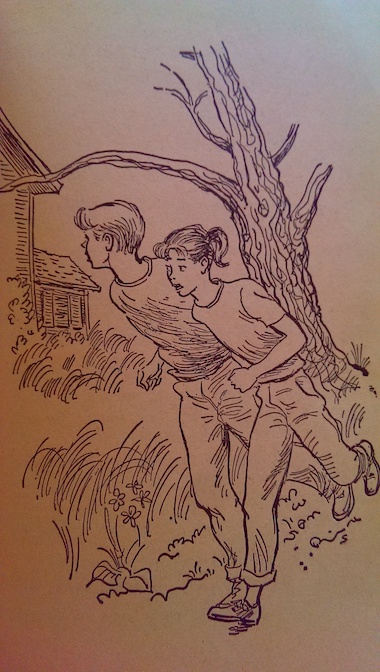 The house is certainly an isolated place, and their closest neighbors, the Hodges have an old grudge against Uncle James. The unethical business deal that Uncle James did years ago involved buying some of the Hodges’s family’s best land. Bert Hodges, who was young at the time, says that the deal ruined his father’s life, and it’s making his miserable, too, because he really needs that land to make his farm profitable. Anne hears this from Bert’s young niece, Oleva, an orphan who has come to live with her aunt and uncle. Although Uncle Bert is strict with her and somewhat bitter about the past and the family’s circumstances, Oleva likes her aunt and uncle and wishes they would adopt her, giving her the stable home she’s longed for since her parents died and she began being traded around among her relatives. However, Bert doesn’t have much faith in other people, and even though he likes his young niece, is afraid to commit to adopting her.
 Anne feels badly that Uncle James’s land deal seems to have ruined people’s lives. Oleva also tells her something disturbing about Drusilla, the girl that Uncle James loved. They were supposed to be married when Drusilla turned twenty, but she disappeared before that happened, and most people think that she drowned in the natural pool on Uncle James’s property. It’s deeper than it appears at first, and some things belonging to her were found nearby, so everyone thinks that she probably drowned and that her body is still somewhere at the bottom of the pool. Whether her death was an accident, suicide, or murder is still unknown.
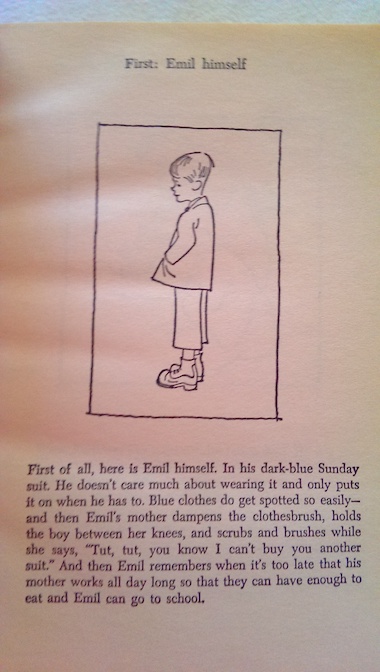 This book was originally written in German. It was written in Germany during the
  At the beginning of this story, it explains that Emil Tischbein’s father died when he was very young and that his mother works hard as a hairdresser to support the two of them. When she can, she saves a little money for Emil’s grandmother as well. When the story begins, Emil is preparing for a train trip to Berlin to visit his relatives. Emil will be traveling by himself and will meet his relatives near the station when he arrives. His mother gives him some money to take to his grandmother and warns him to be careful. Emil pins the money inside his pocket for security.
 Determined to get the money for his grandmother back, Emil searches for Herr Grundeis and spots him getting off the train. It’s too soon for Emil’s stop, but he follows Grundeis off the train anyway, tracking him to a café.
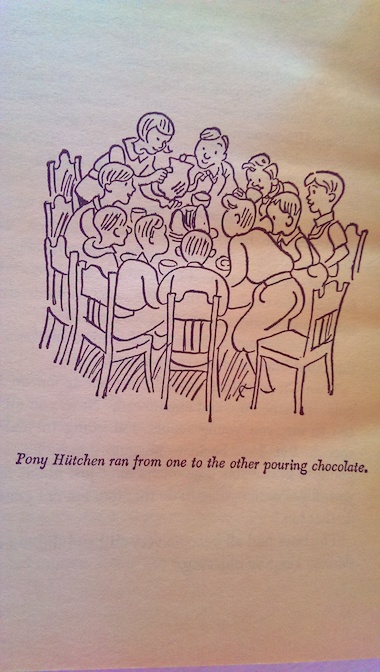 Gustav recruits a bunch of other boys from the neighborhood, and they continue tailing Grundeis through the city to his hotel. The boys call another friend at home, who keeps track of their progress and gives them reports about what others have said. Emil gets one of the other boys to tell his relatives that he has been delayed on important business, causing his cousin, Pony Hutchen, to come and tell him that everyone is worried and that he’s going to be in big trouble with his relatives if he doesn’t show up soon. However, they still have the problem of deciding how to confront Grundeis and get him to return the money. In this case, the detectives don’t need to solve the mystery of who the thief is. The real problem is how to prove it.
 There was a note in the beginning of my copy of the book that says that many of the character names in the book are actually jokes on the part of the author. It’s not as obvious in English because the forms of the names sound reasonable for German names, but anyone who knows German would spot that they aren’t real names. For example, Emil’s last name is Tischbein, which means “table-leg,” and the thief’s alias, Grundeis, means “ground-ice.”
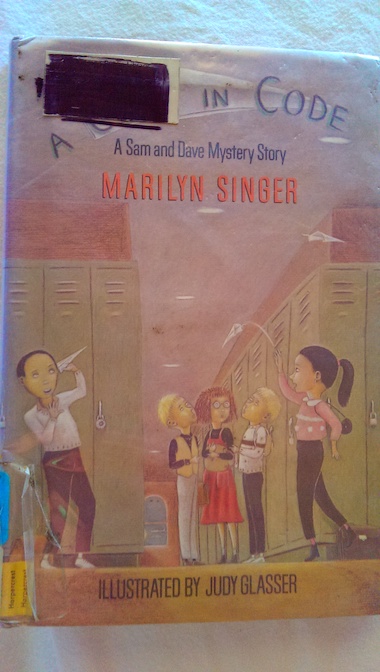 A Clue in Code by Marilyn Singer, 1985.
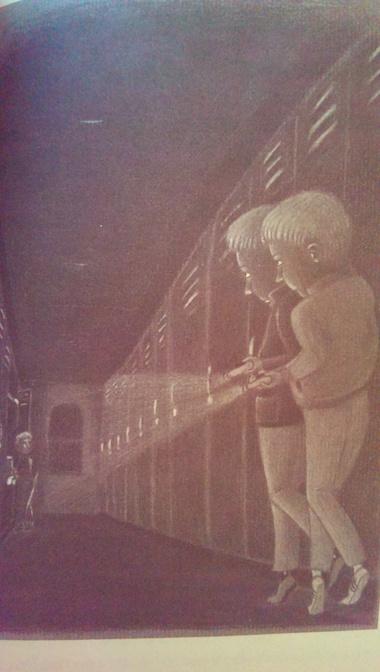 Sam and Dave decide to begin their investigation with Willie. His father is the school’s custodian, and Willie has been using a copy of his father’s key to the school to sneak around after hours. To the twins’ surprise, when they confront Willie, not only does Willie deny stealing the money, but it turns out that he’s actually been scared and upset himself. After being caught stealing the last time, his parents have been especially strict with him, sending him to bed early, limiting his time with friends, and not allowing him to watch tv or read comic books. In fact, his father tried to get rid of his entire collection of comic books by throwing them in the trash, but Willie rescued them and has been hiding them in the school, sneaking away to read them when he can. However, someone has discovered them and stolen them. Willie wants his comic books back, but he can’t report them stolen because his father thinks that they’re already gone. Worse still, his parents will be even harder on him if he ends up taking the blame for stealing the class’s trip money.
 In spite of Willie’s reputation, which he deserves, Sam and Dave think that he’s telling the truth about the thefts. Then, they happen to find a strange message that appears to be written in code after some of their classmates were throwing paper airplanes. With the help of Rita, a friend who is very good with codes, they decode the message and uncover a valuable clue that explains why the comic books were taken and leads them to the thief’s identity.
 Jestress's Forgotten Books and Stories
