The Wheel on the School

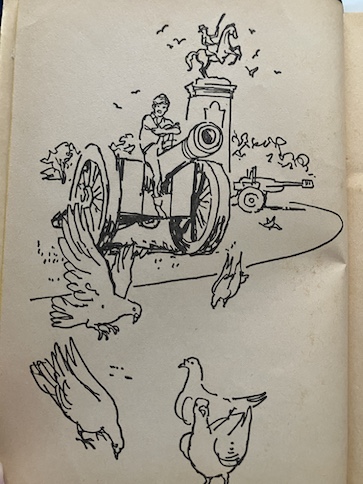
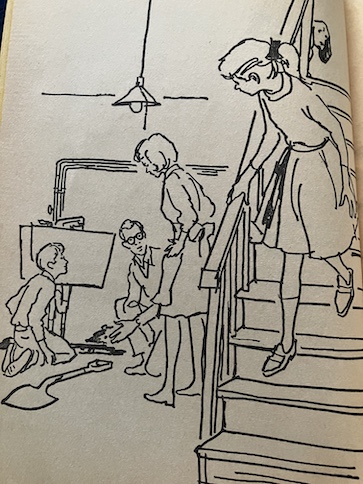
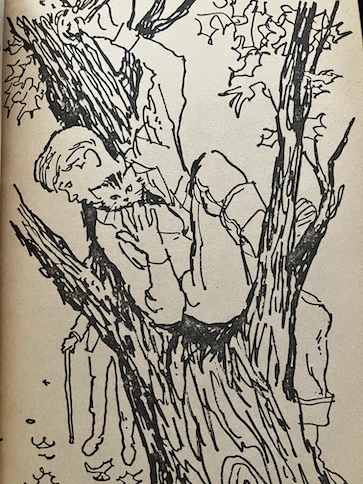
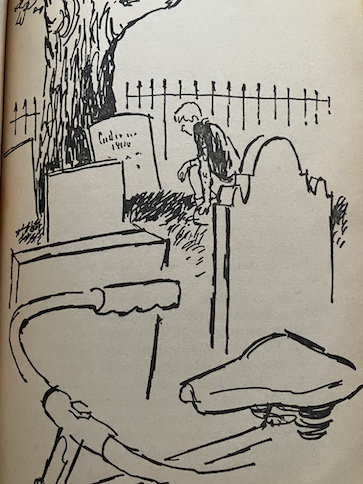
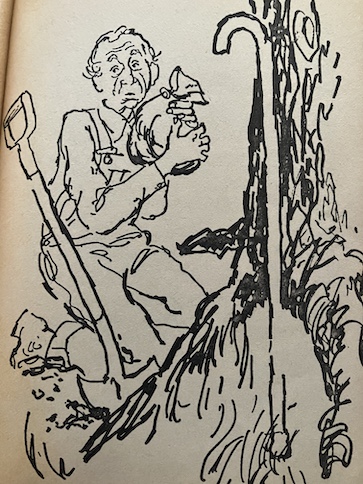
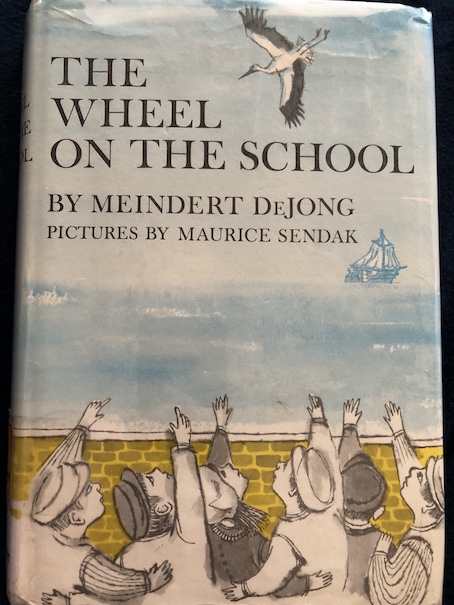
The Wheel on the School by Meindert DeJong, pictures by Maurice Sendak, 1954.

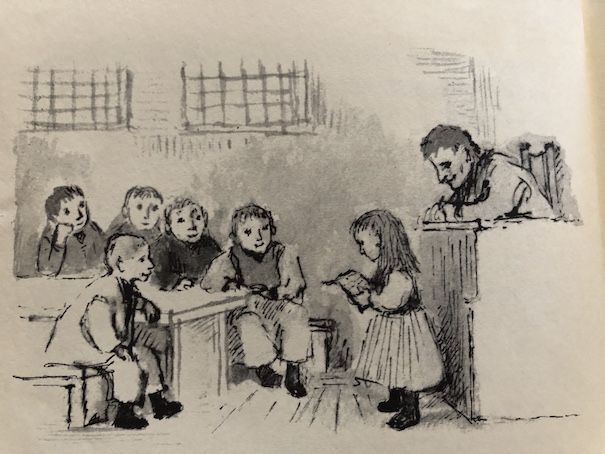
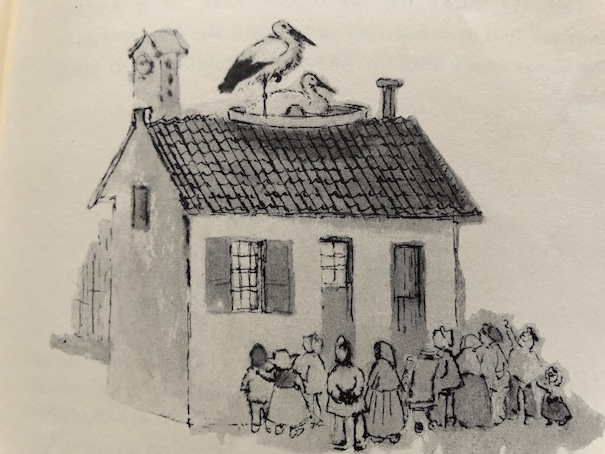
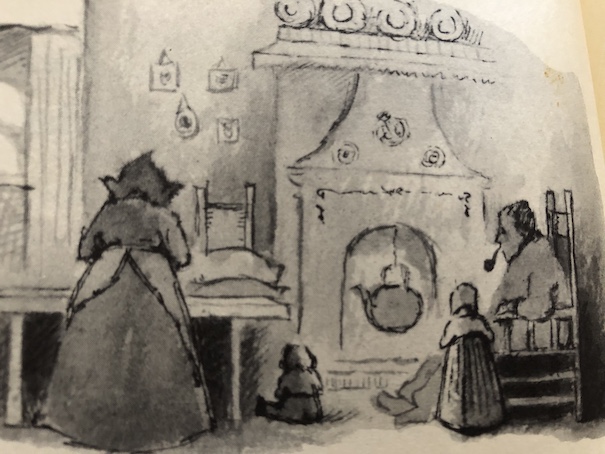
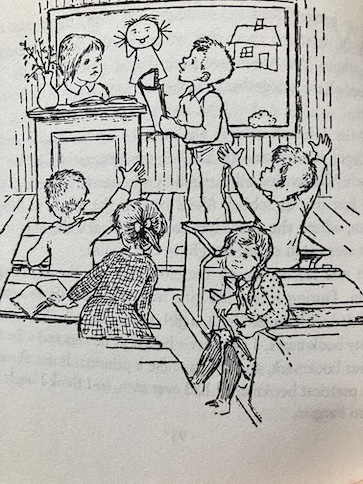
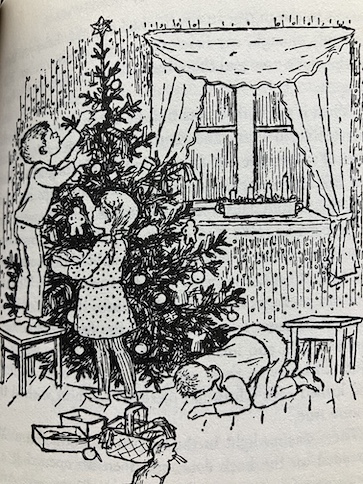
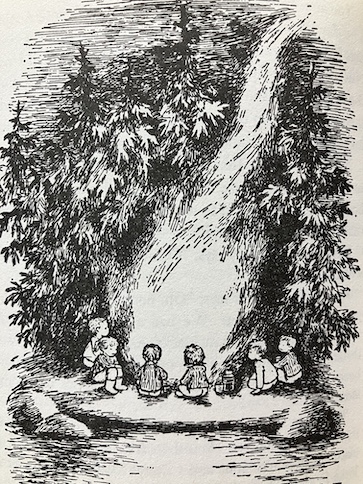
The story takes place in a small fishing village in Holland called Shora. Because the town is small, the local school is also very small, with only six children in the village old enough to attend. Five of them are boys: Jella, Eelka, Auka, and Pier and Dirk (a set of twins). The sixth student is Lina, the only girl. Lina is the one who gets the other students thinking about storks because she writes a story/essay about them. It wasn’t a school assignment. Lina just wrote it because she thinks that storks are interesting. It’s supposed to be good luck if a stork nests on your roof. Lina also notes that, while storks nest in other towns around them, like the one where her aunt lives, they never nest in Shora, for some reason. This starts a class discussion about storks, and the students generally agree that they know very little about storks because storks don’t live in their little village. The teacher says that, even when people don’t know much about a subject, they can still wonder about it, and he challenges the students to wonder about storks and why they don’t nest in their village. He is sure that, if the students wonder about it and think about it, they will learn the reason why the storks don’t come to their village. In fact, he lets the students out of school early so they can spend some time thinking about it. He mysteriously says that their wondering may cause things to happen.

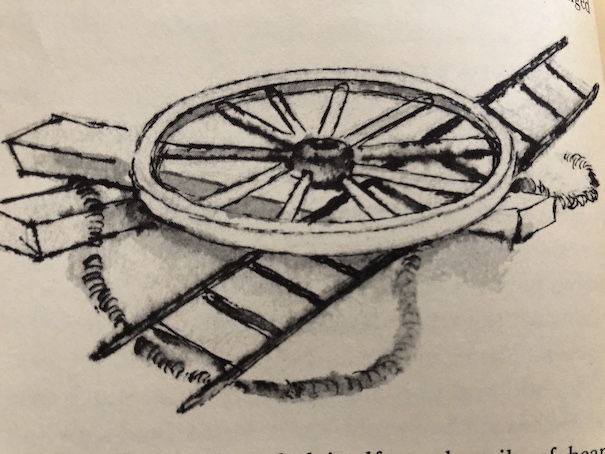
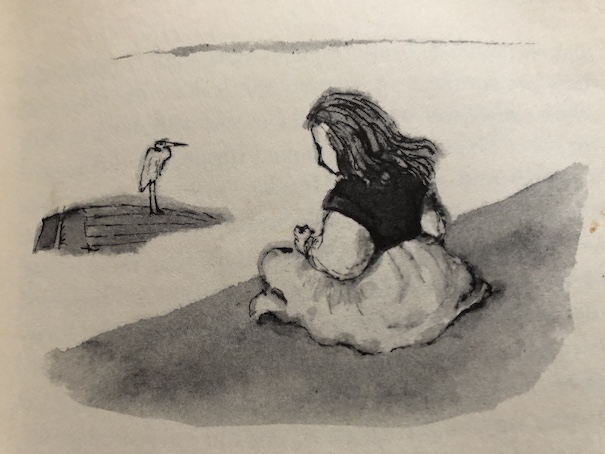
The children are thrilled at being let out of school early, but they feel bound now to wonder about storks and why storks don’t nest in their village. They’re not sure exactly how to begin thinking about this subject or how to figure out the answer, but they take a good look around their village. They find themselves looking at familiar places like they’ve never seen them before, but after a while, some of them become restless. Eventually, the boys all run off to play, leaving Lina to wonder by herself, to her annoyance. However, while wondering by herself, Lina notices something important: that all of the roofs in town are steep and that the school has the steepest roof of all. She realizes that the steep roofs are the reason why the storks can’t nest in Shora. When she realizes that, she also realizes that she knows what to do about it. Her aunt has a wagon wheel on top of her roof, and the storks nest there. Lina realizes that, if they put a wagon wheel on top of the roof of the school, the storks would have a place to nest.

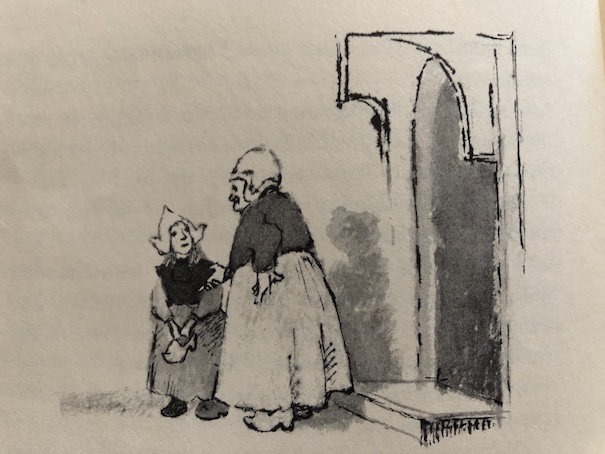
Lina is thrilled that she’s managed to figure out the answer all by herself, but since all the boys ran off, she has nobody to tell about it. Then, an elderly lady who everyone in the village calls Grandmother Sibble sees Lina and asks her what she’s doing. Lina is a little shy about talking to Grandmother Sibble, but she finds herself talking to Grandmother Sibble about the storks and what she’s realized. Grandmother Sibble says that what Lina has realized is true, but she also points out that houses in other towns have trees around them, too. That’s important because Shora doesn’t have trees. Grandmother Sibble says that, if Lina wants to really understand what storks want and need, she has to imagine what it’s like to be stork and consider how a stork would think. Lina likes that idea and starts thinking about what storks would want.
Grandmother Sibble says that, when she was Lina’s age, she was the only girl in Shora, just like Lina is now. Back then, they used to have trees in Shora, and they also had storks there. What changed Shora was that there was a terrible storm that destroyed the trees. Grandmother Sibble says that the storks haven’t returned to Shora since. Lina is surprised about Grandmother Sibble’s story, but it helps explain more about why their village is the way it is. Grandmother Sibble says it’s important to consider the whole picture of the village and everything that’s there and look at it from a stork’s point of view. Grandmother Sibble says that she’s missed the storks ever since they stopped coming to Shora, so she will think about it with Lina and consider what to do. Lina is pleased that Grandmother Sibble is as interested in the storks as she is, and she also realizes that this project has changed the way she looks at Grandmother Sibble. She now sees Grandmother Sibble, not as an unapproachable old lady but as a friend, as someone who used to be a girl very much like herself and who understands how she thinks and what she cares about.

The next day, the teacher asks the students who spent time wondering about storks and what they learned from it. Lina is irritated that the boys say that they thought about storks, too, when they all ran off to play, but the boys tell her and the teacher that they did do some thinking. Jella says that he asked his mother about storks, and his mother says that there were never storks in Shora and that there’s nothing they can do about it. Lina contradicts him, telling the class what Grandmother Sybil said. Jella is forced to admit that his mother was wrong. She probably didn’t know storks had ever been in Shora because she isn’t as old as Grandmother Sibble and wouldn’t remember when they were there. Eelka says that he also thought about trees, partly because he got wet when he was playing with the other boys and wished that there was a tree to hang his clothes on. It made him think that maybe the storks wish there were trees, too. The teacher asks them if that’s their firm conclusion that the lack of trees is the main reason why storks don’t come to Shora, but Lina says that she still thinks that the lack of wheels on the roofs is important because storks nest on the roofs, not in the trees. She thinks that, when the trees in the town died, everyone just assumed that the storks were gone for good and stopped trying to put wheels on their roofs like they used to and like people in other towns do.
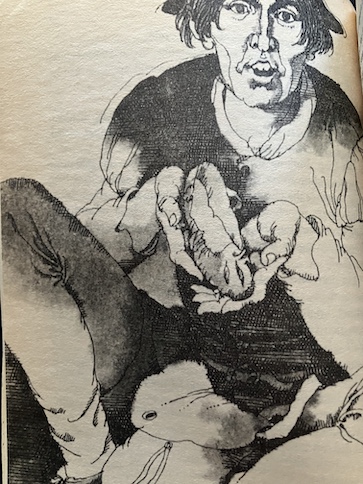
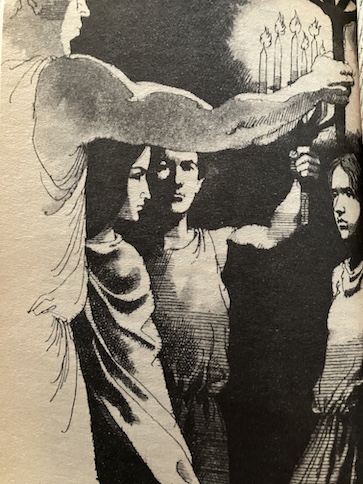
As the students argue and debate about the importance of trees and wheels on the roofs, the teacher asks them what they can do to test their theories. The students realize that growing trees would take a long time, and some of them think it might be impossible because their village has too much wind and salt in the air and soil from the sea, which is why the trees they used to have died. Someone points out that one person in town has a cherry tree, but it’s small, and he won’t let anybody near it. He has a fence around it to keep people and animals away, and he scares away birds who try to take the cherries. The teacher says that the cherry tree is evidence that at least some trees can survive in Shora, if they are cared for and protected. He also tells the children that making changes and making dreams come true does take time and work, so they can’t expect results from the theories they test immediately. Still, by trying different approaches, he believes that they will learn more and that they can get storks to nest in Shora again. If they can get even one pair of storks to build a nest in Shora, they will know that they’re on the right track.

Since the idea of putting a wagon wheel on a roof is one that they can do more quickly than growing new trees, they decide to start by testing that theory. The nesting season for storks has already started, so they want to get started right away, or they’ll miss the season. Their teacher agrees to give the students time away from school to work on the project, as long as they’re willing to make up the study time later, and they agree. The teacher helps them to coordinate their search for a wagon wheel they can use. The children are sometimes distracted or tempted to go play instead of working on their project, but they quickly realize that, if they don’t focus on their task, they’ll miss their opportunity.

In the children’s quest to find a wagon wheel they can use, they learn a little more about some of the people in their little community and come to a new understanding and appreciation of them. When a big storm comes, the children worry that all of the storks will be killed and that their efforts have been for nothing, but reassurance and help comes from an unexpected source.

The book is available to borrow and read for free online through Internet Archive (multiple copies).

My Reaction

The author of the book, Meindert DeJong, was born in the Netherlands, and the tradition of putting wheels on roofs for nesting storks is real. If you Google it now, it’s difficult to find a mention of it that isn’t also about this book. I have found some pictures of stork nests on wheels (including some in Alsace, where they apparently have a similar practice) and some up on special poles. It’s a fascinating tradition that, admittedly, I wouldn’t have known about or thought to look up if the book hadn’t described it. There is also another children’s book, Wheel on the Chimney by Margaret Wise Brown, that also describes this type of nest for storks.

What I really enjoyed about this book was how the teacher encouraged the students to work through the issue of why there were no storks in their town in their heads, collect observations, brainstorm different possible explanations, and test their theories. Basically, he was teaching them a simple version of the scientific method, although he never calls it that. When Lina raises the question of why there are no storks in Shora when other towns around them have storks, the teacher encourages the students to put their minds to the question, collect some observations about their town, conduct research (like asking the adults what they know about storks in their town), develop a working hypothesis (the storks need a place to nest), and conduct an experiment to test their theory (provide storks with a place to nest and see if they can get a pair of storks to build a nest there).

The teacher provides some guidance as the children go through these steps, but then, he allows the children to approach the project by themselves, only stepping in when they run into problems. In some cases, the children do run into serious problems, even putting themselves in physical danger, which shows the dangers of not drawing some limits ahead of time or providing more direct supervision, but the children do manage to work out their problems, and fortunately, nobody is seriously hurt. By the end of the book, the children have also drawn many other adults in the community into their project, often in ways that help the adults as well and bring the community closer together. In the process, the children also learn a few things about themselves and their own abilities. In some ways, it reminded me of the Christmas story Starlight in Tourrone, where a community comes together to re-create an old ritual that people in a small village have otherwise abandoned.

I appreciated how the children develop some better understanding for the adults in their community by bringing them into the project or approaching them for help, and parts of the story actively encourage the children to be empathetic and look at different situations from someone else’s point of view.

  • Grandmother Sibble, the first adult Lina talks to, tells Lina that, to think what would attract a stork, she has to think about the village from a stork’s perspective and consider what a stork would want and need. Lina is fascinated at the idea of thinking like a bird would, but she also comes to think a little like Grandmother Sibble when Grandmother Sibble recounts her memories of how the village used to be when she was a little girl and the great storm that destroyed their trees. Lina comes to realizes that Grandmother Sibble wasn’t much different from herself when she was a girl and that the two of them understand each other better than she thought.
  • Jella angers a nearby farmer by taking a wagon wheel without his permission, and the teacher helps to soothe the farmer’s feelings by getting him to remember something he did as a boy Jella’s age, so he can understand why Jella did what he did. It’s a bit eye-opening for Jella as well, to see that adults around him were once very much like himself. The teacher also persuades Jella to give the farmer some help to make up for the inconvenience he caused the farmer, and Jella and the farmer bond over a shared love of archery.
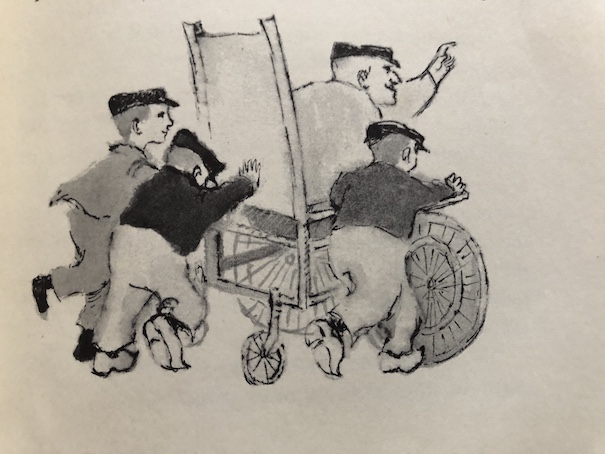
  • Later in the story, when the children consider approaching Legless Janus, an intimidating man in a wheelchair who has lost both of his legs and who has a reputation for having a nasty temper, Pier pauses to consider what it must be like to be Janus, how hard it would be to be confined to a wheelchair, and how that might make a person angry and temperamental. When Pier and his twin try to sneak into Janus’s garden to see if has any wagon wheels, there’s a confrontation between them and Janus, and Pier reveals to Janus some of the thoughts he had. Janus is surprised at how the children see him and the stories that they tell about him. He tells them the truth about how he lost his legs and reveals a shared interest in the children’s project that turns them from mutual antagonists into friends.

Besides the children in the story learning to think about situations from other people’s perspectives and getting to know other people better, the children also learn a few things about themselves that give them some different perspectives on their own futures. Lina often feels a little left out of things because she’s the only girl among the children old enough to go to school in their village. The boys don’t always include her with things they do because they say that girls don’t like to get their clothes wet and messy and that they cry or giggle too much. Even Lina at times wishes that, like a boy, she had less of an impulse to cry at times, and modern readers may roll their eyes at some of the story’s old-fashioned attitudes about boys and girls. With the exceptions of Lina and Grandmother Sibble, women in the story often play subordinate roles in the story, and the story refers to a male stork as being his mate’s “lord and master.” However, there are also parts of the story that prove some of those assumptions wrong. Lina does some daring things in her pursuit of the wagon wheel, and isn’t afraid to get wet or dirty while doing it. The women urge their husbands to help the children in their efforts, even in bad weather, and their support proves important and is appreciated, even when they’re not the ones leading the project. There are also times when the boys get a bit emotional or on the verge of tears, showing that the boys also have emotions, even when they try to fight them or hide them. The roles of boys and girls and men and women in the story aren’t what we typical want or expect in 21st century America, but I liked it that all of the characters are shown as being capable and that their contributions are appreciated.

Grandmother Sibble also helps Lina to see herself and her future from a new perspective. She reveals that, like Lina, Sibble was also the only girl in the village at her age. As the eldest girl of her generation in the village, Grandmother Sibble eventually became the eldest woman in the village, the “grandmother” of everyone, and eventually, Lina herself will someday be Grandmother Lina, the eldest woman in the village, telling stories about what used to be and how things have changed to younger generations. Lina isn’t just a girl but a kind of future village wise woman in the making, actively bringing about some of the changes that will later become part of village lore.

Some of the boys learn a few things about themselves, too. Eelka is a big boy who is often slow and clumsy, which is why some of the other boys, like Jella, are reluctant to let him join in games. Part of his difficulty is that he doesn’t always think things through all the way before he does them, which is how he gets into trouble in the story. Another issue is that, as the youngest of all of his brothers, he’s used to the idea that other people can do things that he can’t do. When Eelka rescues Jella from a dangerous situation, partly brought about by Eelka’s impulsiveness and the need he feels to try to tackle big jobs by himself to prove himself and partly caused by Jella’s own impulsiveness, Eelka comes to fully appreciate that he’s a lot stronger than even he knew. When he and Jella talk about it, Eelka says that his family is in the habit of thinking of him as the “baby” of the family who doesn’t know anything and can’t do things, but the truth is that people grow. Eelka isn’t a baby anymore, and he has developed strengths he didn’t know he had until he is forced to use them. He just needs to learn how to use them wisely.

The village’s shared participation in the project and the quest for a wagon wheel also brings out sides of the adults that some of them haven’t shown for years, giving them new confidence in themselves as well as greater appreciation from the village children. 93-year-old Douwa shows Lina that elderly people are sharper and can do more than she thinks they can and gets the opportunity to relive one of the most heroic escapades of his own youth. Legless Janus enjoys the most exciting adventure he’s had in years and shows that, even though he is now disabled, he has nerves of steel and an ability to take charge in an emergency. He also knows carpentry, so he creates the mount for the wheel on the school and later, he begins making new wheels for other roofs, finding a new trade to practice. He is also the one who reassures the children that reports of storks killed by the storm are exaggerated or made up because he has spent years watching birds and knows their behavior. He says that the storm probably scattered them over land, but they have instincts that would have prevented most of them from being over water when the storm was coming and that they will come resume their journey as the weather clears.

A few other concepts in the story are consideration for the environment, problem-solving, and time management. All through the story, the children are confronted with problems of various kinds, and they have to figure out how to solve them, using their own wits and whatever they have to work with. They also learn the importance of time management because they know that they don’t have long before the storks’ nesting season will be over, so they must use their time wisely, putting aside playing or other distractions to accomplish their mission. I was particularly interested in Grandmother Sibble’s description of how Lina needs to look at the whole picture of the village, what it has, and how it has changed over the years in considering why storks no longer nest there. Essentially, what’s she’s describing is the ecosystem of the village, how all of the different elements work together to either make it a hospital place for the storks or an inhospitable one. The wheel on the roof is one of the factors, but the trees (or lack of them) are also a factor, and the windy and salty conditions are further factors in the growth of trees and how friendly the environment is too wildlife. The story doesn’t use the term “ecosystem”, but that’s what this interplay of different environmental factors is. Changes to one part of the ecosystem will bring about other changes, just as the terrible storm that happened when Grandmother Sibble was young radically changed the character of the village.

There are a couple of things that readers might want to be aware of. First, there is some corporal punishment of children in the story. Janus spanks Jella badly when he tries to steal cherries from his tree, and the farmer hurts Jella’s ear when he takes his wagon wheel without permission. In 21st century America, we don’t generally encourage physical punishment, although Jella does get over these incidents and doesn’t hold it against either of them in the end. Admittedly, Jella was doing something he shouldn’t have been doing both times, and they don’t abuse him beyond the immediate incident either time. Each of them also admits after the fact that each of them might have gone a little too far in their punishment, and both Janus and the farmer do Jella favors, helping him with the wheel on the school project and teaching him how to make arrows for his bow, so the negative experiences are balanced with positive ones. Sometimes, adults in the story also use harsh insults to rebuke children, like “idiot” and “lunkhead”, which we also don’t encourage.

The presence of Janus in the story also leads both the children and readers to consider the feelings of people with disabilities and how people with disabilities would like to be treated. The children are afraid of Janus at first because he has a temper and can be pretty fierce in defending his cherry tree, but they later learn that he actually does care more about the children than his defense of his property makes them think. What Janus really wants the most is to feel useful and to show that he is still smart, strong, and capable, in spite of his disability. Later in the story, when the other men in the village get tired of Janus barking orders at them while they’re putting the wheel on the school, and one of them calls Janus a “slave-driver”, saying that he just needs a whip. Janus retorts that he doesn’t need a whip when he has a sharp tongue. He’s only slightly embarrassed at being called a “slave-driver.” It would be a very negative thing to say about someone in the 21st century US, but in some ways, it actually makes Janus feel a little better that the other men see him as being tough and not someone to be coddled or treated too carefully because of his disability. They even feel comfortable enough to joke with him about it. There is a moment when he’s a little unsure how to take a man’s comment that maybe the “shark” that got his legs should have taken his tongue instead, but when Janus sees that the man isn’t serious about it, he responds in the same bantering way, bragging that his tongue was too intimidating for the “shark”. (His legs weren’t really lost to a shark. That’s a kind of joke/village rumor.) Janus is also thrilled when one of the men makes a thoughtless comment that, if Janus isn’t satisfied with the way they’re working, he should come up on the roof and do it himself. It was a thoughtless thing for the man to say, and there’s an awkward moment when everyone remembers that Janus can’t climb up on the roof without legs. However, Janus tells the children that he’s actually pleased because the way the man made that comment shows that, for a moment, he completely forgot that Janus has no legs. Janus thinks that’s a good sign because it means that people are no longer thinking of him only in terms of his disability. He doesn’t want his disability to define him.

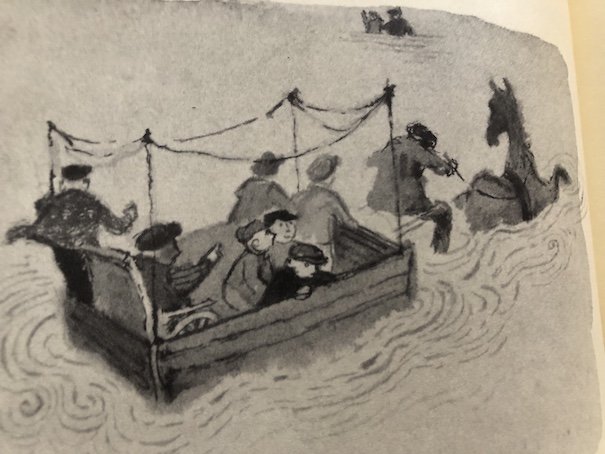
Toward the end of the story, the children do find some drowned storks, showing that an article the children saw in the newspaper about storks being killed in the storm wasn’t all “fake news” as Janus made it sound. At least some storks were killed in the storm. The adults in the story aren’t always right about everything. However, Janus is correct that the storks weren’t all killed. He helps the children to stage a daring rescue of a couple of exhausted storks off a sandbar before the tide comes in, saving them from drowning.

Overall, I though it was a very positive story that provides many things for young readers to think about. Sadly, as of this writing (March 2026), it is out of print. Used copies are still available, although some are a bit expensive, and libraries still have it. There is also an unofficial reading of the story on YouTube.

The Children of Noisy Village

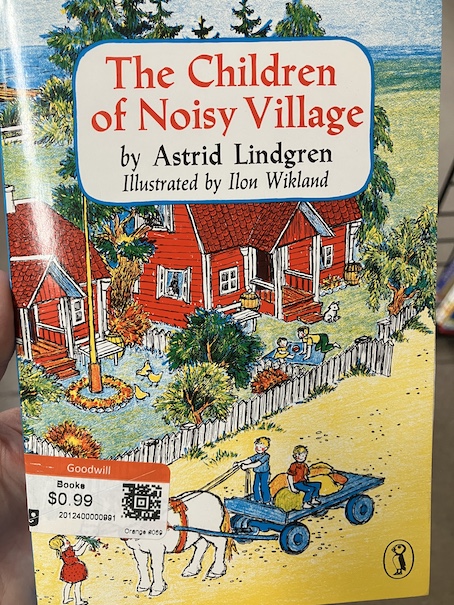
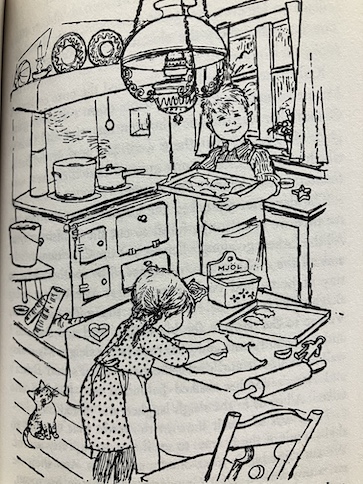
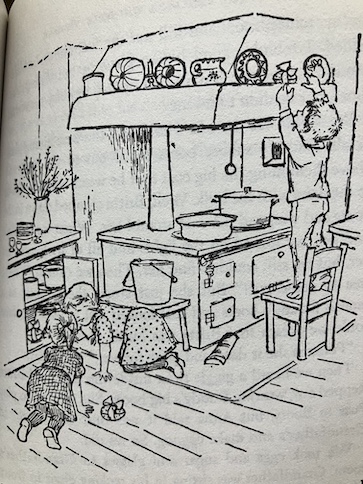
The story is told from the point-of-view of nine-year-old Lisa, a Swedish girl who has two older brothers, Karl and Bill. She and her family live on a farm that people call Middle Farm because it’s between two other farms, North Farm and South Farm. The three farms together are called “Noisy Village” because there are so many children around. The children who live on South Farm are Ulaf and his little sister Kirsten, who is only a year-and-a-half old, and North Farm has two girls, Britta and Anna, who are Lisa’s friends. Ulaf is friends with Karl and Bill. Sometimes, Lisa tries to play with her brothers, but they often tell her that she’s too little, and she sometimes thinks of the boys as a nuisance. Ulaf will sometimes play with girls, although Karl and Bill sometimes tease him about it, but there are also a limited number of children in the area to play with, so being willing to play with whoever is around is a good thing. Through the story, Lisa tells little stories and talks about the things that all of the children of Noisy Village do together.

When Lisa was younger, she used to share a room with her brothers before getting a room of her own. At night, Karl used to tell ghost stories, while Bill likes to talk about adventures. Lisa tells a story about how her brothers scared her one night with a ghost story and how they rigged up a trick to make it look like their room was haunted. Although Lisa sometimes misses the stories that her brothers used to tell her at night, she’s also relieved that she has a space of her own so she doesn’t have to put up with their pranks or them bossing her around all the time. Bill and Karl like their room because their window is close to Ulaf’s window, and the boys like to use the tree between their houses to go back and forth between the two rooms. The room that Lisa has now used to belong to her grandmother, before her grandmother moved in with an aunt. Lisa’s family remade the room for her as a present for her seventh birthday. Lisa’s room faces North Farm and Britta and Anna’s room, so the girls can send each other notes or signal to each other through their windows.

Some of the children at Noisy Village have pets, and Lisa explains how Ulaf got his dog, Skip, from the mean shoemaker, who was mistreating him. Britta and Anna don’t have any pets, but their grandfather lives with them, and the other children at Noisy Village like to visit him. Britta and Anna’s grandfather tells the children stories. One of his stories is about how he ran away from home as a boy. Inspired by the story, Lisa and Anna decide that they should have their own adventure, running away from home temporarily. However, they think that they have to run away during the night, and they both miss their opportunity because they fall asleep.

The children like to play games of pretend on their way home from school, which makes their mothers wonder what they’re doing and sometimes get them into trouble. Anna and Lisa accidentally get on people’s nerves one time, when they try too hard to follow their teacher’s advice about doing things to make people happy. They often end up doing the wrong things because they don’t know what other people really want or what people say they want doesn’t seem like enough. They finally succeed in making someone happy when they share some of their things with a girl from school who is sick.

The children’s adventures continue through the year. The people of Noisy Village have a charming, old-fashioned Christmas. At a Christmas party at a relative’s house, they play old-fashioned party games and tell stories. Lisa also describes a Swedish tradition of finding an almond in porridge, which is supposed to be a sign of marriage in the coming year. The children are allowed to stay up late on New Year’s Eve. The boys scare the girls with some firecrackers, and Britta and Anna’s grandfather teaches the children the tradition of pouring melted lead into water to see what shapes it will form to predict what will happen in the new year. On Easter, the children paint eggs and make egg nog.

Eventually, school lets out for summer vacation. The children go swimming and catch crayfish during the summer. When they go fishing for crayfish, they camp out in the forest, near the lake, with Lisa’s father and the other men. The children make little huts to camp in. The boys try to scare the girls with stories about goblins. The children appreciate their idyllic lives in Noisy Village!

My Reaction

This book is a series of pleasant, gentle, slice-of-life stories about the children who live on a collection of small farms outside of a Swedish town, probably some time in the mid-20th century. Because there is little mention of any form of technology in countryside, it could set almost be any time in history from the 19th century to the time when it was written in the 1940s. The one thing that identified it as the 20th century for me is when they mentioned “turning on lights” in the house rather than lighting lamps. Even into the mid-20th century, not all farm houses had electricity, but it seems that these do. Other than that, these children seem to be living an idyllic, “unplugged” life in the countryside that people who are into cottagecore would aspire to! I think it would be a nice book to read children at bedtime because it’s very gentle.

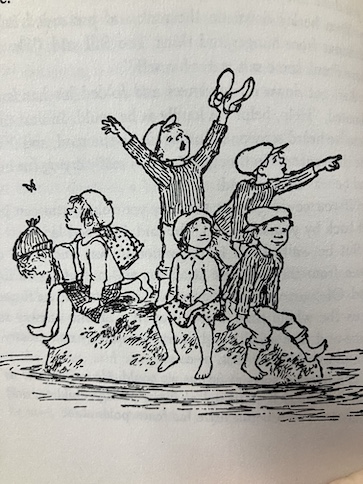
I enjoyed reading about the games that the children play with each other and with their families. The children like playing games of pretend that seem to be inspired by books they’ve read. The girls play at being princesses, while the boys play at being Indians, probably American Indians (Native Americans) because one of young Bill’s ambitions is to be an Indian Chief when he grows up. We don’t really encourage playing at being “Indians” today in 21st century America because that can devolve into caricatures of someone else’s racial group (cowboys are still fair game because that’s a profession, not an ethnicity), but that sort of thing was pretty common in the mid-20th century, even outside of the United States. I’ve read British books from around the same time period that also refer to children playing at being American Indians, so it was something that seems to have captured children’s imaginations, even internationally. The children also pretend that they’re marooned or shipwrecked on a rock at one point, something else that often appears in children’s literature and is based on older books.

I particularly enjoyed some of the descriptions of Swedish holiday traditions through the year. Some of them are very similar to traditions in the United States and Britain around this time and even earlier, like in the 19th century. They have a charming Christmas with friends and family and a party with old-fashioned parlor games. I’ve heard of the tradition of finding an almond in porridge or pudding before, but I think that’s more common in Scandinavian countries than in the United States. In Britain, there are traditions associated with finding things (like a coin or a bean) in porridge or pudding, but it’s not really common in the US. Another thing that stood out to me was that Lisa said they made egg nog at Easter. In the US, people typically have egg nog at Christmas, but when I thought about it, it does make sense for Easter because of the association with eggs.

One other thing that stood out to me in the book was the little huts that the children make when they’re camping out by the lake. It reminded me of the huts that children in The Secret Summer (Baked Beans for Breakfast) made.

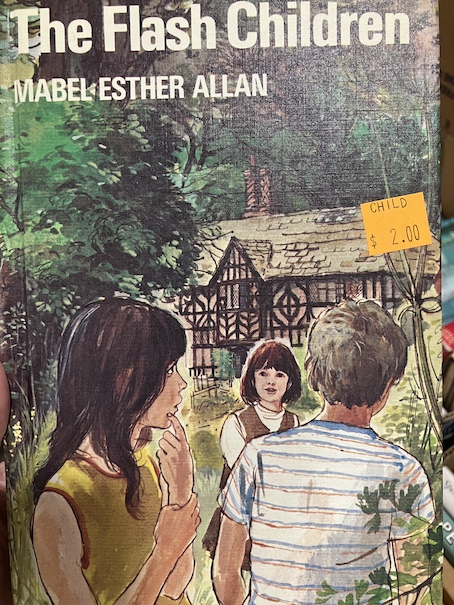
The Flash Children

The Briggs family moves to a new house in July, and the three Briggs children are upset about leaving their old home and friends. Their father tries to reassure them that they’ll make new friends in their new home, but ten-year-old Dilys isn’t so sure. She knows that her mother is also not happy about the move, but it can’t be helped. Her father used to be a cowman on an estate in their old town, but the estate has been sold to be turned into an army training camp, so he has to go somewhere else for a new job.

Their new home will be a cottage near a “flash”, which is a kind of salt lake. Flash Cottage, as their new house is called, turns out to be an ugly modern brick house, not at all like the charming old cottage where they used to live. Their old cottage had a beautiful garden, but this little house doesn’t have much at all. Most of the views from the house are also ugly. The embankment behind the house, where the train tracks are, makes parts of the house dark and blocks the view, and there’s a chemical plant a couple of miles away. There isn’t much else in the area to see. The bright spots of their new home are the lake and the train tracks that run near the house. The fast-moving trains make Dilys a little nervous and they also make the house kind of loud, but eleven-year-old Arthur finds them fascinating. Arthur takes a yellow bedroom at the back of the house, where he can see the trains. Dilys shares a blue bedroom with their little sister, Megan, with a view of the chemical plant in the distance. All three of the children find the house strange and ugly and wonder how they’re ever going to feel at home there.

Dilys doesn’t think she’ll ever like the new house, although she thinks it might be nice if they could go rowing on the lake. Their mother worries about the children falling in the flash because they have to travel across an unfenced causeway when coming to or leaving the house. The children will have to catch a school bus to go to the local school, and Arthur wonders what the other children in the area are like. The children hope to find some friends because, if they don’t, they don’t really know what they’ll do with themselves. There doesn’t seem to be much in the area to do for fun.

The Briggs children meet a boy and girl about their age on their first day at the new house, but the meeting doesn’t go well at first. Arthur stops the other boy and girl from throwing rocks at some ducks. Dilys warns him about making enemies of people because they need some friends in their new home, but Arthur can’t stand to see people being cruel to animals. The other boy and girl already know who the Briggs children are because they were told they would be coming, but Arthur surprises them with a Welsh phrase. The Briggs children’s mother is Welsh, and they grew up near Wales. The boy, whose name is Dan Brown, thinks at first that Arthur was speaking French, but his sister, Edith, recognizes the phrase as Welsh because someone told her that the family was part Welsh. Dan and Edith argue about it, and Arthur asks them if they often argue with each other. The Brown kids admit that they do because there just isn’t that much else to do in the area. Boredom is also the reason why they tease animals, and because they tease animals, they’ve been banned from Colonel Melling’s farm, where Mr. Briggs will now be working with the cows. Sometimes, when they have money, they can take a bus to town to find other things to do, but they don’t always have the money to do that.

Mr. Briggs tells the children that the Brown children are the nearest children in the area. Their mother is dead, and they have an aunt looking after them. Their father also works at Colonel Melling’s farm. The Briggs children aren’t sure that they like the Brown children or want to be friends with them, but they might be their best or only option for friends at all. Their father persuades them to give the Brown children a chance, but Dilys wonders if, before long, they’ll all be so bored that they’ll start throwing rocks at ducks, too.

School isn’t too bad once it starts. Dilys meets another girl she likes, but unfortunately, the other girl lives too far away to see easily when they’re not in school. Some other kids at school tease another new boy named Brian because he’s partially blind. Dan and Edith turn out to be among the worst bullies, and Arthur and Dilys get so angry with them that they get into a fight. Dilys tells Edith that she’s ashamed of how she acts, she thinks it’s disgusting, and she wishes Edith would turn deaf so she can see what it’s like to live with a disability. The other kids back down rather than fight Arthur, and surprisingly, Edith is actually a little embarrassed when she sees how angry and disgusted Dilys is with her. It seems like the behavior of the local kids is as rough and ugly as the area where they live, but Dilys finds herself interested in Brian because he seems to be a different type of person.

Mrs. Briggs is as homesick as the kids for where they used to live, but she starts to make friends with Miss Brown, the aunt looking after Dan and Edith. Mrs. Briggs says that Miss Brown is a nice lady, but she doesn’t entirely know how to cope with the children, and Dan and Edith often misbehave and make trouble. She’s only been living with her brother and the children since their mother died last year.

One day, Dilys and Arthur go exploring, and they find an unexpected green area down a road that makes them feel more like home. They get caught in a sudden storm, so they take shelter under a railway bridge, where they meet Dan and Edith, also taking shelter. They start talking more about the area and places to explore, and Dan and Edith say that they can’t go down by Mr. Lowe’s farm anymore. Arthur asks them why, and they admit that they stole some plums from him and left his gate open, so the livestock got out. Arthur and Dilys can see why Mr. Lowe would be angry, but Dan and Edith defensively add that they didn’t leave the gate open on purpose. They just forgot to close it because Edith got stung by a wasp and was upset, but Mr. Lowe won’t believe them. They say it’s a pity because the area is much more interesting over there. There’s an old manor house, a stream, and a ruined mill over that way.

Things change for the children when Dilys, Arthur, and Megan befriend an artist who lives in a cottage nearby, John Zachary Laurie, and he’s a friend of Colonel Melling. He takes them out rowing on the flash and talks to them about how they like their new home. The Briggs children confide in him how unhappy they’ve been since they moved to the area because everything is so ugly, but the artist points out that it’s not really an ugly place. He says he finds it fascinating to paint because it has certain “dramatic effects.” When he shows them his pictures, they’re very different from the kind of pictures that the children are accustomed to seeing. Rather than conventional flowers and pretty landscapes, they are filled with angles and a lot of grays and browns, but with unexpected dashes of color. They’re unmistakably pictures of the area, but not in a way the children usually see it. The landscape in the paintings is familiar but strange, ugly but also oddly enchanting. John Laurie even gives them one of his paintings, the one he did of their new house, Flash Cottage. He says he knows the children hate the house now, but he thinks it has interesting angles, and if they learn how to look at things a little deeper, they’ll see more than they do now.

Although Dilys isn’t quite sure that she understands it, she begins to feel what the artist is talking about. Things that are strange start to feel familiar, and even in the ugliness of the landscape and the picture of their house, she begins to feel a sense of fascination and attraction. It’s not exactly pretty, but it is compelling.

When school lets out for the summer, the Briggs children once again find themselves bored and lonely. The few other children they like don’t live close to them, like Dan and Edith, and the Briggs children still think Dan and Edith are pains and troublemakers. Looking for something to do, Arthur, Dilys, and Megan decide to explore the old manor house that Dan and Edith mentioned.

It turns out to be a beautiful place, although it’s old and deserted. To their surprise, they discover that the property actually belongs to Brian’s family, the Pelverdens. They live in a little cottage behind the old manor house. Brian has a little sister, Mellie (short for Melinda), who would be a good friend for Megan, but Brian seems less than pleased that Arthur and Dilys have discovered where he lives. Brian’s father explains that they haven’t been living here long. The manor house has been in the family for generations, but it’s fallen into ruin because they haven’t had the money to maintain it for a long time. They only recently inherited the place themselves when Brian’s grandfather died. The Pelverdens don’t expect to ever live in the manor house themselves, but their hope is that, if they get it sufficiently repaired, they might have it registered and preserved as a historic building and get a grant to maintain it. The Briggs children eagerly volunteer their services to help with the project over the summer. They have nothing else to do, and they still miss the garden from their old cottage, so helping to replant the manor garden would be fun for them. The Pelverdens’ cottage and the crumbling old manor house are more beautiful to them than anything else they’ve seen since they moved, and they feel more like home.

Mellie is immediately happy to have found a friend in Megan, but Arthur and Dilys find it harder to make friends with Brian. Brian has known all of his life that he’s different from other kids because of his vision problems, and he’s used to people treating him differently or making fun of him. He tries very hard to be as “normal” as he can and prove to everyone that he can do things other kids can do. Because he feels like he has something to prove to everyone, he’s often less friendly than he could be, but Dilys is determined to earn his trust.

However, Dan and Edith are still problems. The Briggs children fight them off one day when they catch them teasing the Briggs’s cat. Edith is offended that the other kids keep telling them everything they do is wrong. Then, another day, they show up at the old manor house and break a window by throwing rocks. When the Briggs children and Mr. Pelverden confront Dan and Edith about what they’ve done, Dilys come up with a plan that might solve the Dan and Edith problem and prevent them from making further trouble.

The book is available to borrow and read for free online through Internet Archive. There is a sequel to this book called The Flash Children in Winter, which is about the children experiencing their new home in autumn and the lead up to their first Christmas there.

I thought this book was interesting because it has aspects of a cottagecore style story, but there are parts of it that contrast with the typical cottagecore aesthetic. The main characters in the story, the Briggs children, have come from an environment that would be like a cottagecore dream: an actual old cottage with a beautiful garden attached to an old manor house, where they were allowed to help out. Then, they have to move to a far more plain and conventional house in an ugly area with a view of a chemical plant. It’s understandable that they would feel badly about the move. Moving and starting over again would be difficult for anybody, but most people would find their new environment downright depressing, especially after hearing what their old home was like.

When they find out that Brian’s family lives in a cottage and is renovating their old manor house to turn it into a historic site, the story goes back to the charming sort of environment the children come from. However, it’s not just about the children finding a way back to the kind of environment that has the beauty and charm they crave but also learning to see what makes different types of environments fascinating, even enchanting. The Flash Cottage isn’t a real cottage, and it’s not as pretty as their old home, but after talking to the artist and looking at things from an artist’s viewpoint, taking into account the features of a place that make it unique, Dilys comes to see how a shift in perspective can make many different environments more attractive, in their own way.

Learning to get along with Dan and Edith also involves finding a different perspective and a different way of dealing with them. It’s not just about seeing the good side of Dan and Edith as they are. Frankly, the two of them are pain-in-the-butts. Dilys realizes that their problem is that they are thoughtless. They don’t think about other people, how the things they do affect anyone else or make them feel. Their thoughts begin and end with themselves. They’re bored and feel unwanted at home since their mother’s death, so they cause trouble because they just can’t seem to think anything else to do. Personally, I don’t think either Dan or Edith is very intelligent or imaginative because intelligence could be used to reason out why people react to them the way they do and a little imagination would help them put themselves in other people’s position or help them think of different things to do or ways to approach other people. However, Dan and Edith don’t do any of those things on their own. It never even seems to occur to them that they could. They only get upset when other people are unhappy with them and seem totally unable to understand why.

Even though Dan and Edith don’t seem either very bright or very considerate, it does occur to Dilys that they could learn to be helpful if someone actually set them tasks to do to keep them busy. At her persuasion, Mr. Pelverden and the other children allow Dan and Edith to join their efforts to clean up the manor. Dan and Edith are actually eager to accept the opportunity to help out with the others because they are incredibly bored and seriously need something to do and people to be with. When the others are dubious about whether they’ll actually do any helping or if they even know how to help, they try to prove that they can do things that are useful for a change. It also proves educational for Dan and Edith because, in helping to clean up the manor, they’re also forced to face damage they have caused themselves and begin to realize how things they’ve been doing have caused trouble and made extra work for other people. They’re not used to seeing themselves as other people see them or dealing with the consequences of their actions, and it’s an eye-opening experience for them. Later, they all have to face off against a motorcycle gang that comes to vandalize the manor, and Dan and Edith have come to see where their loyalties really lie and what menaces people can be when they act like they used to.

The story ends happily for the children and for the manor, which is going to be preserved. The Briggs children feel more at home in their new home, Dan and Edith have greatly reformed, and Brian has learned to be more open with people about his disability, so other people come to understand him better and treat him more kindly. Some of the people who made fun of him before admit that they didn’t understand just how bad his vision was, so they didn’t know why he seemed to struggle so much. Dilys still tells off those kids for not having figured it out, but at the same time, she is the one who tells Brian that he has to make things clear to people and not try to pretend that his condition doesn’t exist or that he doesn’t need some help when he actually does.

The author, Mabel Esther Allan is also a very interesting person. During her life, she wrote more than 100 books for children, under different pen names. She struggled with vision problems of her own when she was young, which was part of the inspiration for Brian in the story. During WWII, she worked was part of the British Women’s Land Army, and she also worked as a teacher.

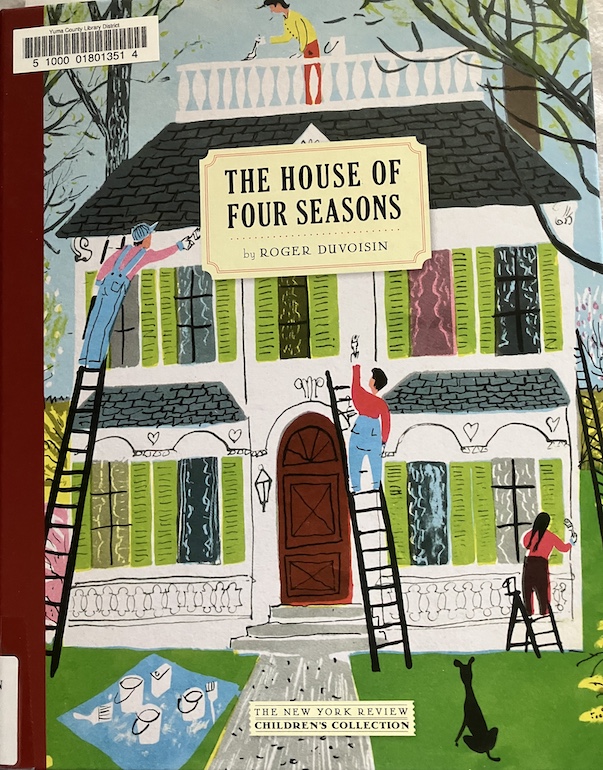
The House of Four Seasons

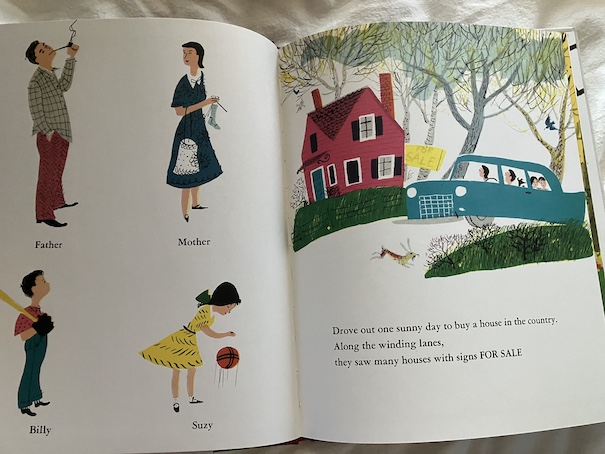
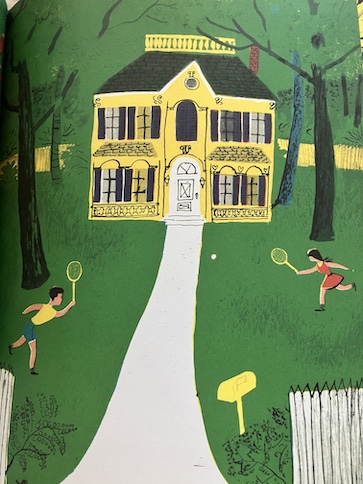
A family is searching for a house to buy in the countryside. They find one they love, but it needs some fixing up. Along with the repairs, the house needs a new coat of paint.

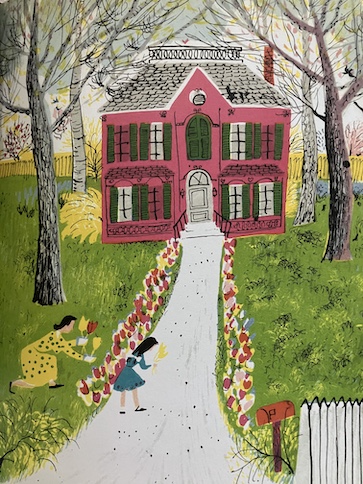
Different family members have different ideas about the best color to paint the house. Little Suzy likes the idea of painting it red with green shutters because she thinks that would look wonderful in the spring. Billy likes the idea of making it yellow with purple shutters, which would be great in summer. Their mother like the idea of a brown house with blue shutters because she thinks that would look great in autumn. Father suggests a green house with orange shutters because he thinks that would be colorful in the winter, when it snows.

They talk over the different possible color combinations, and Billy suggests that each of them could have their colors on a different side of the house. He says that they could call it the House of Four Seasons. However, when they go to the hardware store, they learn that the store only stocks three colors of paint – red, yellow, and blue.

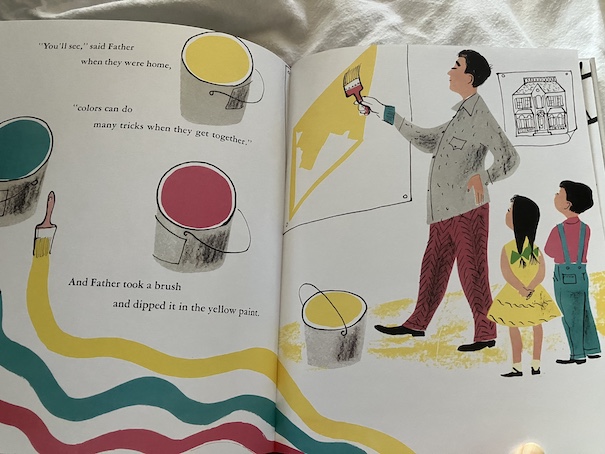
At first, the children in the family think they can’t have their House of Four Seasons with only three colors, but their father buys some of each color and shows them how the colors combine to make different colors. By mixing two colors together, they can also make orange, green, and purple. If they mix all three together, they can get brown.

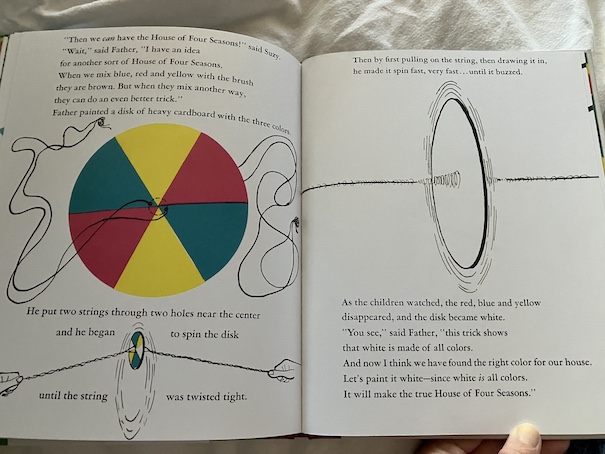
That covers all of the colors they originally thought of using, but there’s one more thing that Father points out. Although mixing all three colors of paint gives them brown, white is also the sum of all colors. That gives them a color they can all agree on!

I liked how the book demonstrated color combinations and how mixing primary colors make secondary colors. It is true that, when you mix all the primary colors of paint, you typically do get a brown color. Technically, according to an art class I once took, you’re supposed to get black by mixing all colors, but it usually doesn’t work out that way because the colors aren’t entirely true hues.

I’ve thought before that it’s interesting how, when it comes to paint, black is supposed to be the sum of all colors and white is often considered blank, the absence of color, but the opposite is true when it comes to light. These two ways of mixing colors are called “additive” and “subtractive” – mixing colors of light is additive and mixing physical colors, like paint, is subtractive. That’s really what the father in the story demonstrates, how different colors blend to form white visually with light, although he doesn’t really explain the additive vs subtractive color systems concept. If you’ve ever done web design, you’ve used the additive color mixing method with hexadecimal colors. Black in hexadecimal is #000000, the complete absence of all colors, while white is #FFFFFF, the full amount of all colors.

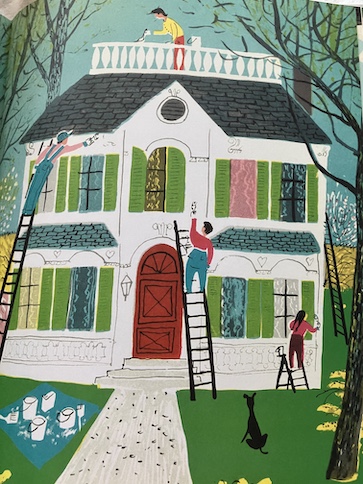
As fascinating as that is, though, I have to admit that I wasn’t entirely satisfied with the choice to paint the house white. Part of it is that it won’t stand out in the snow when it’s white, and part of it is that they just paint the shutters green without any discussion about it, but mostly, it’s because … the hardware store doesn’t sell white paint. They clearly stated that the hardware store only has three colors of paint – red, yellow, and blue – no white. They also can’t combine those colors to make white because they already demonstrated that combining those three colors makes brown. Combining colors to make white works with light but not paint.

It’s still a fun story that has some educational quality, but yeah, I realized that the proposed plan to use white paint actually wouldn’t work. Unless, of course, they just go to a different hardware store, one that has a wider paint selection.

The pictures really make this story stand out as being from the 1950s. The father is smoking a pipe, which is uncommon these days and almost never depicted in 21st century children’s books. Even in the late 20th century, when I was young, people were cracking down on depictions of tobacco use in children’s books and movies to discourage children from normalizing tobacco and using it themselves. The overall art style of the book is typical of the mid-20th century, but it has a full range of colors, in keeping with the theme of the book. Some other mid-20th century books were printed with limited color range.

I liked seeing the house depicted with the different color combinations that members of the family imagined, and I enjoyed how they associated the color combinations with different seasons of the year. Some of their color combinations are very unusual, like yellow and purple together on the house. Few people would choose such a combination in real life, although yellow and purple are complementary colors on the color wheel. So are red and green, the color combination that the daughter of the family would have chosen. I thought that it was interesting that the color combinations the family considered were all either complementary colors or leaned in that direction, although they never mentioned it in the book or explained what complementary colors are. Complementary colors are directly opposite each other, and they can be used to create contrast and visual appeal.

One of the things I like about seeing the different color combinations is that it invites children to consider what color combinations they would choose themselves. It reminded me a little of Katy Comes Next, where readers get to see the wigs, doll eyes, and doll clothes that Ruth chooses among for her doll, Katy, and imagine which ones they would choose. I think kids like to see different possibilities and consider their choices and favorites.

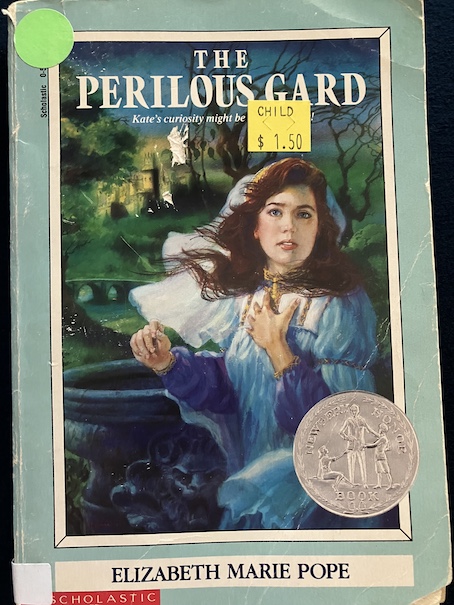
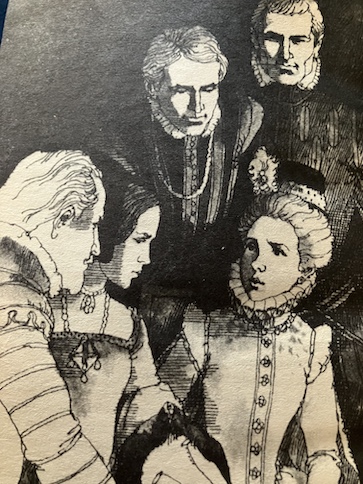
The Perilous Gard

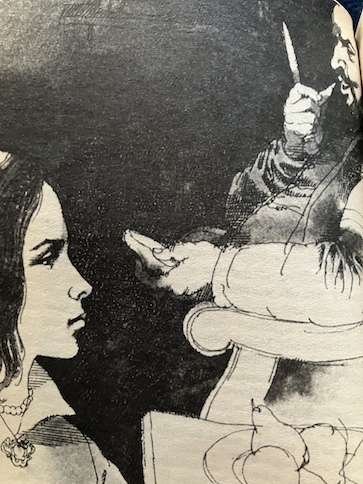
Kate Sutton and her sister, Alicia, live in the household of Princess Elizabeth in the year 1558. Alicia hates the Hatfield palace because it’s dreary and poorly maintained, apparently on purpose because Queen Mary Tudor resents Princess Elizabeth and wants her and her household to be uncomfortable. Kate and Alicia are maids in the household, and Alicia decides to write a complaining letter to Queen Mary about the condition of the house. Alicia thinks of herself at trying to help Princess Elizabeth by explaining how bad the conditions there are, but her letter gets heated and insulting toward the queen. Alicia is accustomed to getting away with things and with people not being angry with her because she’s pretty. However, Kate has to be the one with a brain, and she sees immediately that Alicia’s letter is bound to cause trouble.

When Princess Elizabeth receives a reply to Alicia’s letter, she summons the sisters to see her. Queen Mary is very direct in her letter about what she thinks of Alicia Sutton’s letter, but she ultimately blames Kate for it because Alicia is a favorite of hers and Kate reminds her too much of her father, who she never liked. She believes that Alicia is only a sweet innocent and that Kate is a corrupting influence, which is unfair. Queen Mary has decided to separate the sisters, taking Alicia into her own household and sending Kate to Sir Geoffrey Heron at his house, Elvenwood Hall, in Darbyshire. The queen wants Kate to stay at Elvenwood Hall and out of her sight or hearing from now on. Kate has no idea where Elvenwood Hall is, other than in Darbyshire, and she doesn’t know Sir Geoffrey Hall. Although Alicia is initially pleased that the queen doesn’t blame her, she becomes remorseful when she realizes that Kate is taking the blame for the letter, when she knew nothing about it. She offers to write to the queen again and confess everything, taking full responsibility for the letter, but Princess Elizabeth, Roger, and Kate herself all tell her not to. The queen’s mind is made up, and another of Alicia’s letters might make it worse.

Princess Elizabeth asks her tutor, Roger, if she knows anything about Sir Geoffrey Heron, and he says that he’s heard of him. The house, Elvenwood Hall, has another name, Perilous Gard. The word “gard” indicates that the place was once a castle, but Roger knows that the house has been rebuilt with old parts cleared away. The other part of the name “perilous”, indicates that there is a superstitious element to the place, like places rumored to be inhabited by fairy folk or associated with pagan religion. One of his old pupils told him some stories about the place, but Roger would rather not repeat them. The accounts that Roger has heard of Sir Geoffrey say that he is an honorable man, so he thinks that Kate will be safe in his household.

Other than that, Kate has little idea of what to expect from Elvenwood Hall. She doesn’t think that Alicia’s dire fears that Kate will be thrown into a dungeon are true. The queen wants her out of her sight, and that’s why she’s sending her to a relatively remote area where she won’t have to deal with her and putting her under the supervision of a supporter of hers, who is supposed to keep her out of trouble. Kate isn’t actually under arrest.

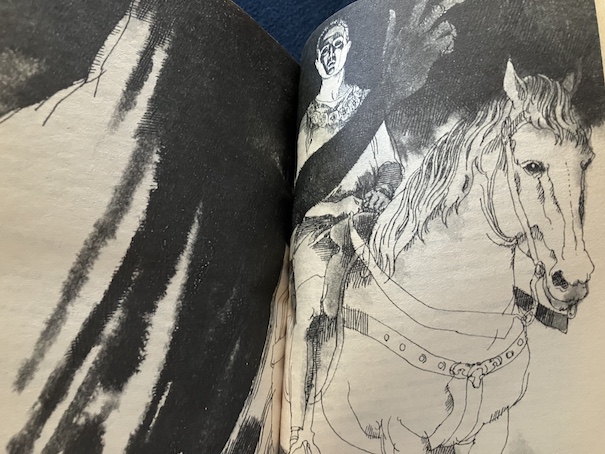
The journey to Elvenwood Hall is rough. On the way, the traveling party meets an old harper, Randal, who Sir Geoffrey says is a little addled since he suffered from a serious illness. When they tell the harper that Kate is coming to stay at Elvenwood, Randal asks if she might be lost like the last girl. Sir Geoffrey seems upset about what Randal says and hurries Randal away to get some food. Then, Kate hears a laugh and sees a strange woman looking at them from the hill. Then, her horse acts up, and when Kate looks again, the woman is gone.

When Kate sees Elvenwood Hall, it doesn’t seem to be very old due to the recent rebuilding, and its interior is luxurious, compared to the house where Princess Elizabeth is living. It is surrounded by ancient stone walls and battlements, and the older parts of the house are more castle-like and crumbling. Sir Geoffrey is still in the process of renovating the castle and turning it into a luxurious manor. The elderly Dorothy, former nurse to Sir Geoffrey’s wife, is the manor’s housekeeper, and Master John is the estate’s steward. Master John seems cold and unfriendly, but he is in charge whenever Sir Geoffrey is away.

Much to Kate’s dismay, Sir Geoffrey will be leaving Kate under Master John’s supervision while he makes a trip to Norfolk. Kate gets the impression that Sir Geoffrey doesn’t like being at Elvenwood, in spite of its renovations, but under the queen’s orders, Kate is required to stay at Elvenwood and not to travel away from it. Sir Geoffrey also tells her that the queen will not allow her to write to anyone or communicate with anyone outside of Elvenwood without Sir Geoffrey’s permission, of in his absence, Master John’s permission. Sir Geoffrey says that he will not be back at Elvenwood until All Saints’ Day, so Kate will be under Master John’s authority for months.

Elvenwood used to belong to Sir Geoffrey’s wife’s family, the Wardens, and old Dorothy doesn’t like Sir Geoffrey or any of the Heron family. Dorothy says that Sir Geoffrey’s brother, Christopher Heron, was responsible for the death of Sir Geoffrey’s daughter, that he had admitted it, and that Sir Geoffrey never punished him for it. Sir Geoffrey knows that Dorothy has been gossiping with Kate, but he is not upset with Kate for it. He also doesn’t offer any further explanations about what Dorothy said before he leaves on his trip to Norfolk.

Elvenwood Hall is pretty comfortable and nobody there mistreats Kate, but she is often lonely because the place is isolated. The farthest Kate is allowed to go from Elvenwood Hall is to the nearby village, but there isn’t much there. When Kate visits the village, people stare at her and act like they’re afraid of her. Even the village priest makes the sign of the cross at her, as if he thinks that she is something evil. Mostly, Kate has Dorothy as her companion.

Then, one day, she notices a pair of visitors, and Dorothy says that they are pilgrims, coming to visit the holy well on the grounds. Kate knows that some people believe that holy wells have the power to heal or make people more beautiful. Dorothy says that the holy well in the cave here will take away sorrow and pain, if a visitor offers a gift in exchange. The gift is for “those who rule over the well”, who Dorothy says were in this land long before saints and Christianity, but she hesitates to say more about it. She says that Kate can ask Master John, if she wants to know.

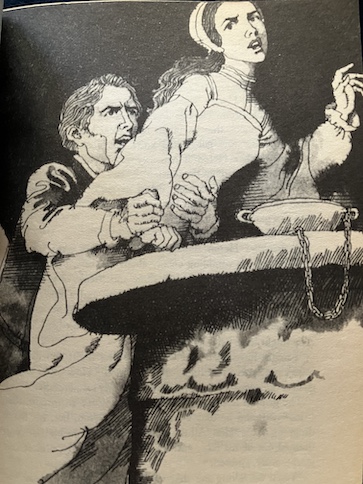
When Kate decides to take a look at the well herself, Christopher Heron finds her, grabs her, and hauls her away from it. Kate is startled, and he explains that he thought that she would fall in and be lost in the chasm under the rocks there. Kate thinks that’s silly because the well has a wall around it, but Christopher explains that’s what happened to Sir Geoffrey’s daughter, Cecily. At least, that’s what Christopher thinks happens to her.

He explains that Cecily was a little girl and that her mother was dead when he and his brother came to live at Elvenwood. One day, Sir Geoffrey left on one of his trips, and Christopher was responsible for Cecily. Cecily liked playing a kind of hide-and-seek game, but that day, Christopher found her antics irritating. He left her with Master John and went for walk to visit the well. However, he spotted Cecily following him, so he made a mock wish at the well that Cecily, being a spoiled child, would be in the care of someone else. And, that was the last time he saw Cecily. He supposes that she must have fallen when he wasn’t looking, although he didn’t actually see her fall, and they never found her body. They only found one of her shoes on the path. Christopher feels horribly guilty about losing Cecily, and he knows how her loss has hurt his brother, who has been the only person who loved and cared of him since his mother died giving birth to him. For him to lose Cecily when Geoffrey trusted him to take care of her was terrible, and he knows that his brother has not looked at him in the same way since. As a penance, Christopher has been living in the old leper’s hut on the estate whenever his brother is not in residence.

It’s sad, but Kate thinks that Christopher has been spending too much time feeling sorry for himself. She thinks it would be more sensible if he made a confession to the local priest to clear his conscience rather than brooding over what he could have done or should have done. Christopher says that it’s none of her business what he does, and he will give himself whatever penance he thinks is fitting. Kate thinks that Christopher is indulging in pride and self-pity over what was merely an accident.

When Kate helps to rescue a local boy from a flooded river, his grateful mother talks to her about the guardians of the well, insisting that it’s really the fairy folk. She says that they live in a cave under the hill, that the strange woman Kate saw on the hill is their queen, and that they sometimes steal away children to be their slaves … or worse. She and others in the village think that’s what really happened to little Cecily and that the people at the castle know it, too. She thinks they’re purposely letting Christopher blame himself so that Sir Geoffrey won’t learn that his daughter is really alive and a captive of the fairies.

It does seem to Kate that everyone but the Herons genuinely believes in the fairies and that’s what Dorothy was talking about when she was talking about the guardians of the well being older than the saints. She reflects that Roger believed that the stories about fairies are just references to pagan gods and religious practices, and she starts to wonder if the people of Elvenwood, or the Perilous Gard, are secretly practicing pagan rituals with their traditions about the well. If the fairies are only superstition and the remnants of old religion, though, who was the mysterious woman who was watching Kate’s arrival? Could that have actually been a real fairy queen?

Kate tries to discuss it with Christopher, but he’s convinced that he knows what must have happened to Cecily. Then, they have an encounter with Randal, who tells them that the fairies have stolen away his wits. He knows he’s a bit addled and missing some memories, but he insists that the fairies did it to him because they couldn’t use a musician as one of their sacrifices, so they sacrificed his wits instead. Then, he claims that he has seen a little golden-haired girl dancing with the fairies and that she gave him her slipper to show to someone. To their astonishment, Randal produces a little girl’s slipper that matches the one Cecily lost on the path the day she disappeared! This slipper is much more worn than the other one, indicating that the girl who wore it continued to wear it after she disappeared.

Realizing that Cecily is still alive, Christopher wants to make a thorough search of the chasm beneath the well, but Kate urges caution. Whatever is going on at the well and whatever happened to Cecily, she’s sure that the people at the castle know about it, like the woman from the village said. If they don’t want to find and rescue Cecily themselves, it’s because they have something to hide. Sir Geoffrey’s wife seemed eager to leave this place, where Kate is now trapped by the queen’s orders, after her marriage, and Sir Geoffrey only returned here after she was dead, apparently unaware of the dark things that have happened here and still may be happening. Whatever is going on, the people of Perilous Gard are involved, and Kate and Christopher cannot expect any help from anyone in the castle.

People leave coins and gold as gifts to the well when they ask it for something, and Christopher wonders if that could be the secret source of money for the estate that has funded all the luxurious renovations. Master John could be secretly taking all of the offerings the pilgrims leave. On the other hand, the name of the family that once owned this estate was “Warden”, a name that indicates the caretaker for something. Were they once the caretakers of the well, of a remaining cult of pagans that still practices the old religion and its rituals … or perhaps of actual fairies? What was Sir Geoffrey’s wife afraid of in her old family home, and where is little Cecily now? Was she taken as a hostage to ensure that Sir Geoffrey wouldn’t interfere with whatever the people at the castle are doing … or as a potential sacrifice to fairies or pagan gods? They reflect that the story of Tam Lin, about a lover who rescued her beloved from the fairies, was set on All Hallow’s Eve (Halloween). Cecily’s father plans to return on All Saint’s Day, the day after All Hallow’s Eve (November 1). Kate and Christopher need to get word to Sir Geoffrey or rescue Cecily themselves before it’s too late!

This is a Newbery Honor Book. It is available to borrow and read for free online through Internet Archive (multiple copies).

This book was fascinating and suspenseful! From the beginning, I wasn’t really sure whether or not this was a fantasy story. It turns out that it’s what I call pseudo-fantasy. It has all the trapping of fantasy, and there are points when it seems like something supernatural might be happening. However, it seems that, in the end, the “fairies” are humans practicing pagan rituals and who have convinced themselves that they are somehow different from the other humans who live above ground, out of the caves. There may be things that indicate that they might be more than that, but overall, Kate believes from the very beginning, that they are merely humans with strange and dangerous practices. As she puts it, “There were never any heathen gods, only heathen people who believed in them.”

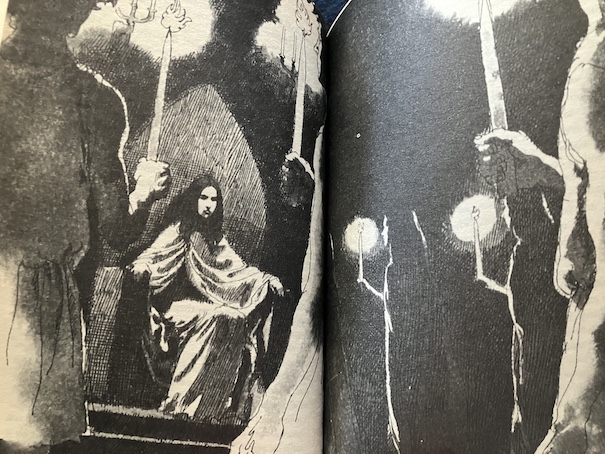
In their attempts to free Cecily, Christopher and Kate become the captives of the “fairies”, and Christopher is in danger of being used as one of their sacrifices. During their captivity, Kate gets to see some of their practices, and she realizes that they control people through things they give them to drink that affect their minds, and she learns what she needs to know about their rituals and beliefs to thwart their plans. In real life, there are a lot of gaps in our knowledge of pre-Christian religion in Britain because the practitioners didn’t leave written records. Mostly, what know about them is based on archaeology and accounts left by the Romans, which may not be entirely accurate. In the story, the “fairies'” beliefs are based around the idea of sacrifices, energy from humans and the earth, pieces of folklore, and probably the use of some kind of psychedelics. The most interesting and revealing part of their beliefs comes when Kate discusses the need for sacrifice with the fairy queen, and the two of them face off with their respective religious beliefs. During their discussion, they compare their beliefs on the subject of God/gods, power, and the purpose of sacrifice.

The fairy queen says that sacrifice is necessary to take the power from a human life and put it into the land and people through to keep them alive. In spite of her group’s isolation and life in the caves, she seems to understand some of the basics of Christianity, and she says that Kate should understand the notion of sacrifice because Christianity is built around one particular sacrifice. The fairy queen compares Christ’s sacrifice to the sacrifices that her cult holds – one person must give their life for the sake of the others as a way of transferring their life energy. Kate is a Christian, and she knows this description of Christ’s sacrifice isn’t completely accurate, but she tries to convince the queen that Christ’s sacrifice makes other sacrifices unnecessary. She says, since Christ gave Himself for the sake of humanity, He has guaranteed humanity’s safety so no others need to pay the price He paid. The queen argues that Christ’s sacrifice happened a long time ago, that His life energy has passed, and their cult holds a sacrifice on All Hallow’s Eve every seven years to renew the energy. Kate argues that Christ was special as the son of God, the only God that truly exists, and that His energy never dies, that it has transferred to living humans. She uses the story of Christopher’s namesake, St. Christopher, as an example of Christ’s power extending to humans. Unfortunately, the queen takes that to mean that Christopher holds some of Christ’s power in him, so sacrificing Christopher would not only give them the power of his life force but the power of Christ as well. Kate realizes that she can’t persuade the fairy queen or make her understand because the queen will just take everything she says and try to fit it into her views and what she has already decided needs to be done.

The philosophical and theological discussion between the two of them was fascinating, but the only way Kate can disrupt the sacrifice and save Christopher is to use the power of stories these people already believe. Kate never cared much for folk tales and ballads before, but she knows that the queen believes in the legend of Tam Lin and that the method the heroine from that story is the only one that can save a sacrifice like Christopher. When Kate finds out that the queen completely believes in that story, she realizes that she has to use the heroine’s solution from the story to rescue Christopher.

This is a point where the actual ritual differs from the magic in the story of Tam Lin. In the story of Tam Lin, he is physically changed into various forms that are frightening or difficult to hold onto, but his lover has to keep hold of him for him to be released from the magic. In this story, Christopher is not actually transformed into anything. It’s more psychological. The fairies believe that people who are going to be sacrificed need to give themselves to the sacrifice willingly, so they use psychological manipulation to convince Christopher that he has nothing to live for, playing on his feelings of guilt for not protecting his niece better and other traumatic pieces of his past, like his mother dying while giving birth to him and his father resenting him because of it. To hold on to him, like the heroine in the story, Kate has to speak up and convince him that the fairies are lying to him and that he does have things to live for. She needs to hold on to his mind and get him to assert his own will to survive while the fairies try to convince him that the only purpose he has left is to offer himself for sacrifice. “Holding on” in this case means holding on to one’s sense of self and one’s purpose, even in the face of doubts, insecurities, personal trauma, and the toxic influence or manipulation of other people.

In her arguments with Christopher to get him to see that his life is worth living, Kate also confronts her own inner demons and insecurities – that everyone prefers her pretty sister, that she was blamed for things her sister did, etc. Their experiences with the fairies and confronting their personal demons are traumatic for Christopher and Kate, but they grow through them and come away with a better sense of self and greater self-assurance. Kate’s growth shows in the end both because she other women realize that she no longer fits into her clothes and will need new ones and in her maturity with dealing with her old insecurities when she sees her sister again.

There is a point when, because Alicia is thoughtless in the way she talks and has a habit of giving people the wrong impression about things, Kate thinks that Christopher has fallen in love with Alicia as the prettier sister and that he is going to marry her. This is crushing for Kate because Alicia is often favored by people and because she has fallen in love with Christopher through their shared experiences. The fairy queen makes a last appearance in which she offers to give Kate something to make Christopher fall in love with her, but Kate rejects it. While it would hurt for Christopher to reject her in favor of Alicia, and it would add to past hurts she’s had about Alicia being the favored girl, Kate has grown emotionally through the story. She is above the manipulations of the fairies, and whatever she encounters in her life that might cause her hurt, she has the emotional strength to handle it and do the right thing in spite of it. Her rejection of using dirty tricks is rewarded when Christopher proposes to Kate. Her doubts of his love were only because Alicia is thoughtless in the way she says things to people and because of Kate’s remaining insecurities. Kate is happy that she can accept Christopher’s honest love for what it is without attributing it to any manipulation. They’ve been through the worst together, they’ve seen each other’s insecurities, and they love each other all the more for it.

It isn’t just Christopher and Kate who grow through their experiences. Sir Geoffrey realizes that his own bad decisions and blindness to what was going on contributed to the danger his daughter was in. He had no idea what his steward was involved in and what was going on around the castle. He also realizes that little Cecily needs the attention of someone who can devote herself more to the little girl without distraction and a life in a more settled place with greater access to broader society, so he sends Cecily to her aunt’s house in London. Sir Geoffrey’s acceptance of his own failings absolves Christopher of the last of his guilt over Cecily’s disappearance/abduction.

I also appreciated that characters in the story didn’t hate each other even when they had suffered hut because of them. Sir Geoffrey didn’t stop loving his brother when he thought that Christopher had failed to protect Cecily. He found the loss of his daughter difficult to take, and his brother’s role in that was hard on his feelings for his brother. However, Sir Geoffrey never sought to banish or punish Christopher for it, and when he finds out that Christopher is in trouble, he races to the rescue! In the end, Kate also cares about Alicia. Even when she was punished for the letter that Alicia wrote and thought that she might lose Christopher to her, she didn’t let spite and resentment take over. I appreciate the characters’ growth, and I also liked the way they dealt with their emotions when they were hurt and things were difficult. They still care for their family members because, deep down, they still love them and want to do right by them, even when it isn’t easy.

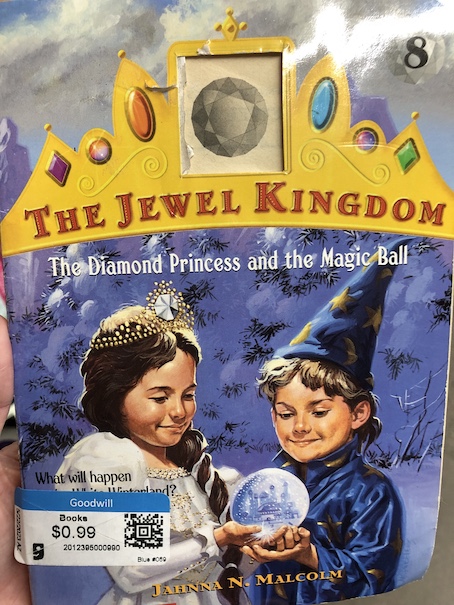
The Diamond Princess and the Magic Ball

The Jewel Kingdom

Demetra is the Diamond Princess, and she lives in the White Winterland. She and each of her sisters has a different castle and region to rule over in their parents’ kingdom, but they still spend time together. After a visit with her parents, Queen Jemma and King Regal, at the Jewel Palace, Demetra finds herself worrying about how she measures up to her sisters. It seems like each of them has done something special for the people in their region, but Demetra can’t think of anything special she’s done. She talks about it with her friend, Finley the fox, but she can’t think of anything really special to do.

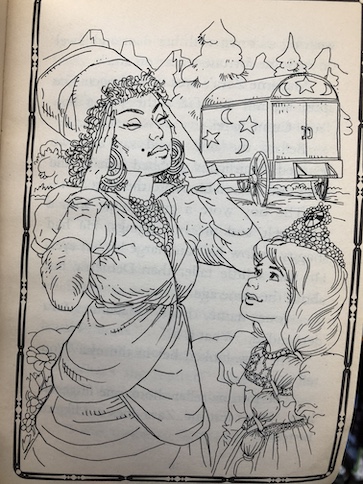
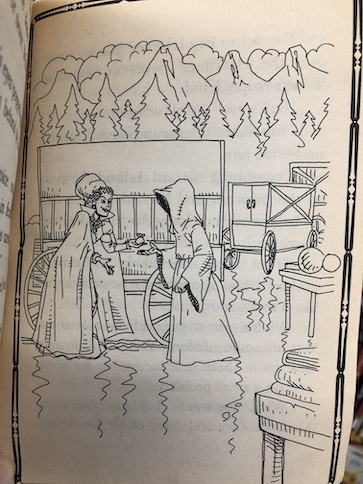
On the way home, they see a wagon with performers giving a show. Princess Demetra wants to stop and watch the show, but Finley warns her that it could be dangerous because they’re near the Mysterious Forest, which is a dangerous region. Demetra insists on stopping anyway, and she meets a fortune teller called Madame Zara. Madame Zara says that she can see that Demetra is a princess, and a boy from the audience says that’s not much for a fortune teller to see because Demetra is obviously wearing her crown.

Madame Zara says that she knows who the boy is, too. His name is Wink, and Madame Zara says that he’s a failed student wizard, rejected by the Wizard Gallivant. Demetra also knows Gallivant because he appointed her as the Diamond Princess. Madame Zara could have figured out Wink’s identity because his wizard robe is peeking out from his pack and has his name on it, but the part that’s harder to figure out is how she knew that the frog hidden in Wink’s shirt is actually his dog. Wink accidentally turned his dog into a frog.

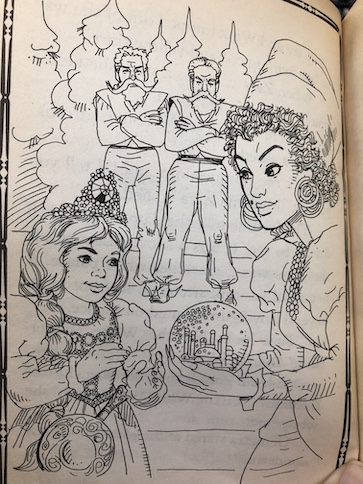
Demetra decides that’s good enough proof that Madame Zara knows things other people don’t, so she asks her to tell her fortune. Madame Zara shows her a beautiful snow globe that looks like it has a scene of the White Winterland inside. Demetra can even hear the voices of people she knows inside it. Madame Zara says that the magic ball tells the future and asks Demetra if she would like to have it. Demetra says she would, although Wink tries to warn her not to trust Madame Zara. However, Demetra lets Madame Zara take a lock of her hair in trade for the magic ball.

As Demetra continues on her way home, she begins to see that the snow that always covers the White Winterland is melting! Something is terribly wrong, and it may have something to do with the magic ball!

The book is available to borrow and read for free online through Internet Archive.

I never actually read any of the Jewel Kingdom books when I was young, but I remember them being sold in stores along with little jeweled charms. It doesn’t take too long to get into the lore and backstory of the series, even though I’ve read the few books I’ve read out of order.

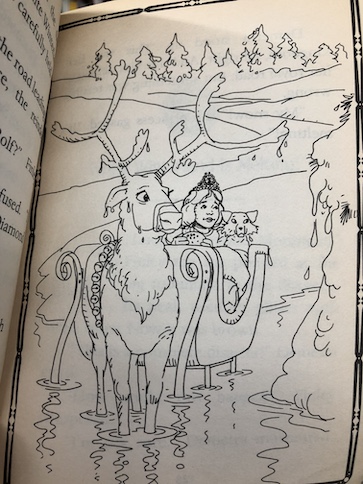
There are recurring villains in this series, especially Lord Bleak and his minions, called Darklings. When the Darklings appears in this story, the book explains who they are and about Lord Bleak’s backstory. Lord Bleak was an evil tyrant who used to rule the Jewel Kingdom, until he was vanquished by Queen Jemma and King Regal. Since then, he’s been trying a series of evil schemes to regain control. The Darklings used to be beautiful, but they were corrupted by evil, and now they’re hideous creatures in dark robes.

Because this story is meant for young children, Demetra makes the mistake of entering into a suspicious trade with a shady character, apparently not having had the “stranger danger” warnings and not heeding her friends’ concerns. Of course, it turns out that the lock of hair she traded for the magic ball was important because it gives the person who holds it power over her and her kingdom. To save her kingdom, she has to get her lock of hair back.

I enjoyed the story, though. It has a colorful setting, and I liked their trip to the Bizarre Bazaar.

Princess Megan

The Magic Attic Club

Meg and her friends are planning to perform a short play of Peter Pan at a local nursing home. Her friends chose her to be their director, and Megan is really looking forward to it. Then, her mother does something that threatens to derail the project.

Megan’s mother is a lawyer, and she frequently has to work late. The problem is that, this time, she’s going to have to work on Saturday, interviewing witnesses for a trial. However, that Saturday, Megan’s mother was supposed to be at the high school, receiving donations for a food drive. She asks Megan to take care of the food donations, but the problem is that the play Megan and her friends are supposed to perform is also on Saturday. Helping with the food drive would make it difficult for Megan to get to the play on time. Megan’s mother is tired and in no mood to listen to Megan’s objections that it wouldn’t be fair to derail her project with her friends. Her mother just wants Megan to take care of her obligations for her.

While Megan is fuming about the unfairness of the situation and worrying about what to do, she decides to visit their neighbor, Ellie Goodwin. Megan and her friends have a standing invitation to visit and explore her attic, which has the ability to send them to other places and times when they put on different costumes and look at themselves in the mirror.

This time, Megan tries on a purple princess dress, and she finds herself in a Medieval village in France, near a castle. She meets a peasant girl named Michelle. Michelle tells her that there’s been trouble over the matter of the unicorn and the feast.

When Megan asks what she means, Michelle explains that Lord Claude and Lady Helene are hosting a feast and joust at their castle and that the king (who is supposedly Megan’s father in this world) has been invited as an important guest. At the end of the feast, they want to give the king a unicorn’s horn as a gift, but the problem with that is that they have to kill the unicorn to do that. Alternatively, it is possible to befriend a unicorn and get filings from its horn that also have magical powers, but Lord Claude and Lady Helene want to give the king the whole horn. Michelle confesses to Megan that her mother, who works in the castle’s kitchen secretly released the unicorn that they’d captured for the purpose. If they knew she was the one who did it, she would be in serious trouble.

Megan wants to help Michelle and her mother, and as someone who supposedly has the rank of princess, she should have some authority. However, she’s not entirely sure what kind of influence she can have because she knows that she’s not a “real” princess. Everyone thinks that she’s the king’s daughter, but Megan knows that she’s not. Can Megan find another way to save the unicorn’s life and Jacqueline from punishment, without revealing herself as an imposter princess?

The book is available to borrow and read for free online through Internet Archive.

Some children’s books that involve time travel have real, historical information for educational value, but this one, and others in the series, are pure fantasy. Megan doesn’t visit real Medieval France. This is a fairy tale version of the Middle Ages with a unicorn and an invisibility cloak. There are a few accurate details for the Middle Ages, like the practice of using straw or other plants on the floors and the fact that intricate tapestries took years of work to complete. However, the focus is definitely on fantasy.

The invisibility cloak is critical to Megan’s plan to save the unicorn and make the king realize the value and beauty of the unicorn before someone can kill it on his behalf. When the king sees the unicorn for himself and reads the note that Megan wrote for him, he accepts the living unicorn and its presence as his gift instead of the horn. The problem with the unicorn is resolved pretty quickly, and so is Megan’s situation with her mother.

At first, I was expecting that the situation that Megan encountered in the fantasy world would have more of a direct parallel to Megan’s situation in her regular life, but it doesn’t really. It mostly serves as its own adventure, although it does highlight that Megan is creative when it comes to problem-solving and can be relied on in difficult circumstances. What Megan really needs to do is to explain to her mother why it would be difficult for her to take over her mother’s project without compromising her own. When Megan finally explains, it turns out that her mother didn’t know about her project with her friends. Handling both of their projects requires some careful scheduling and a little help from a friend, but they manage to work it out.

I really like the pictures in the Magic Attic Club books because they remind me of the ones in the American Girls books. They have a similar quality.

Amelia Bedelia Bakes Off

Amelia Bedelia Bakes Off cover

Mr. Rogers has been watching a tv show called What’s Cooking? with Chef Du Jour, and there’s going to be a Bake-Off contest in town! Because Amelia Bedelia is so good at baking, Mr. and Mrs. Rogers think she should try to enter the contest.

Amelia Bedelia Bakes Off contest announced on the tv show

She is a good baker, but Amelia Bedelia has already agreed to spend the day taking care of the bakery called Grace’s Cookie Jar with her Cousin Alcolu while Grace is out of town. Even though Amelia Bedelia is good at baking, it turns out that she isn’t any better at following someone else’s baking and recipe instructions than she is at following any other to do list written by someone else.

Amelia Bedelia Bakes Off - Amelia meets her cousin at the bakery

When Amelia Bedelia meets Cousin Alcolu at the bakery, they read the notes that Grace left for them. The first note tells them to “start every recipe from scratch”, so of course, they have to scratch each other’s backs before they begin cooking. From there, Amelia Bedelia thinks that cutting a recipe for chocolate chip cookies in half means that they have to literally cut the recipe paper in half. Then, for good measure, Amelia Bedelia thinks they should cut all the chocolate chips in half, too.

Amelia Bedelia Bakes Off - Amelia literally cuts a recipe in half

When Grace’s instructions ask them to bake “twelve pound cakes”, she assumes that she wants a cake that weighs 12 pounds instead of baking 12 small pound cakes. Fortunately, because that seems like such a big task, Cousin Alcolu suggests that they bake twelve one-pound cakes and just stack them, which is closer to what they’re actually supposed to do.

Amelia Bedelia Bakes Off - Amelia and her cousin stack pound cakes

Amelia Bedelia and Cousin Alcolu get creative with decorating the cheesecakes because Amelia Bedelia doesn’t want to top them with cherries, like Grace asked. She just doesn’t think that cherries and cheese go together. Instead, they decorate them on the theme of cheese. Even though they don’t go about their baking in quite the way they’re supposed to, the things they make are still good.

Amelia Bedelia Bakes Off - Amelia and her cousin decorate cheesecakes

At the end of the day, Amelia Bedelia is tired, but she bakes one last cake for the Bake-Off. Since she’s so tired, she uses that a creative theme for her “sheet” cake! The book includes the recipe for Amelia Bedelia’s Sheet Cake.

The book is available to borrow and read for free online through Internet Archive.

Amelia Bedelia Bakes Off - Amelia decorates a cake to look like a bed

Amelia Bedelia books are supposed to be ridiculous, playing off of expressions and words with multiple meanings. They aren’t really supposed to make sense so much as poke fun at Amelia Bedelia’s literal interpretations or confusion over instructions that other people give her.

I found this one a little out of character for Amelia Bedelia because one of her signature traits is that she’s good at baking. In other books, her baking skills often save her job or diffuse people’s anger at other instructions that she’s misinterpreted. Of all the things that Amelia Bedelia might understand, you would think she would know how to read a recipe. Although, admittedly, this isn’t the first time that she’s misunderstood something that someone else asked her to bake because she once cut up a calendar when she was asked to bake a “date cake”, apparently not understanding that dates are fruit. Now that I think about it, Amelia Bedelia also seems to bake her best dishes from memory, not usually consulting a recipe. Above all, though, there are a lot of baking and cooking expressions that would be fun to see Amelia Bedelia misinterpret (like when Amelia Bedelia pinches Cousin Alcolu when a recipe calls for a pinch of salt), and that’s what’s really the point of the story.

I did enjoy that, even though Amelia Bedelia and her cousin misinterpret Grace’s instructions, the things they make still taste good, and most of them are more or less what they’re supposed to be, like the cookies and the pound cakes.

Amelia Bedelia and the Baby

A friend of Mrs. Rogers, Mrs. Lane, asks Amelia Bedelia to babysit her baby. Amelia Bedelia says she doesn’t know anything about babies, but Mrs. Rogers says that Amelia Bedelia is good with children and points out that babies are also children. When she puts it that way, Amelia Bedelia agrees to babysit. Fortunately, she doesn’t have the idea that babysitting involves sitting on the baby, but being Amelia Bedelia, she finds plenty of ways to misinterpret the list of instructions that Mrs. Lane gives her for taking care of the baby.

When the baby starts to cry, Amelia Bedelia consults the list and sees that she’s supposed to give the baby a bottle. She worries that a baby might break a bottle, though. She tries giving the baby a box and a can instead, but of course, that doesn’t work. Fortunately, Mrs. Carter stops by to drop off some strawberries and helps to fix the baby a bottle.

Amelia Bedelia successfully manages to give the baby a bath but thinks that the instruction to use baby powder means that she should use it on herself and that putting on the baby’s bib means that she should wear it herself. Similarly, Amelia Bedelia thinks that the instruction for naptime mean that she should take a nap herself, and she refuses to do it because she hates naps. Instead, she decides to make strawberry tarts while the baby takes a nap in her play pen.

Amelia Bedelia has some misinterpretations about what the baby is supposed to eat, and when Mr. and Mrs. Lane arrive home, the baby is a mess. Mrs. Lane is upset, realizing that Amelia Bedelia doesn’t understand anything about babies and baby food, but her husband gives her one of Amelia Bedelia’s amazing strawberry tarts. That, and realizing that the baby likes Amelia Bedelia makes Mrs. Lane change her mind.

The book is available to borrow and read for free online through Internet Archive (multiple copies).

Amelia Bedelia books aren’t supposed to be taken seriously. They’re just funny stories about the ways Amelia Bedelia misinterprets instructions people give her. She gets things wrong because she doesn’t understand certain expressions and words with multiple meanings.

In real life, putting someone like Amelia Bedelia in charge of a baby would be a complete disaster, and it could even be dangerous to the baby. Although things work out with the food Amelia Bedelia gives the baby, a real baby could choke on food they’re not old enough to handle. I couldn’t really blame Mrs. Lane for being upset when she realizes that she put someone who didn’t know what they were doing in charge of her small child. No real parents would be willing to let the matter go or invite her to come back in those circumstances just because they liked her strawberry tarts. However, because this is just meant to be a humorous story, everything works out okay in the end.

I did think it was kind of funny, in hindsight, that they never made any jokes about a babysitter sitting on the baby, which would be the kind of literal interpretation that Amelia Bedelia does. They probably couldn’t make that joke because, if Amelia Bedelia made any comment about that, nobody, not even Mr. and Mrs. Rogers, would dare leave Amelia Bedelia in charge of an infant. They also probably wouldn’t want kids to think that might be a funny thing to do. They also never made any jokes about “changing” the baby or having Amelia Bedelia wonder in what way she was supposed to be changed. That’s probably all for the best.

Amelia Bedelia Goes Camping

Mr. and Mrs. Rogers are going camping, and they take along their maid/housekeeper, Amelia Bedelia. Amelia Bedelia has never been camping before, and she brings along her unique habit of taking things too literally or misinterpreting instructions as Mr. and Mrs. Rogers explain to her what she needs to do while camping.

When Mr. Rogers tries to teach her how to catch a fish, he doesn’t tell her right away that they need to use fishing poles, so Amelia Bedelia just jumps right into the stream and grabs a fish right out of the water. It’s actually kind of an amazing accomplishment, but Mr. Rogers is stunned when Amelia Bedelia lets the fish go, not realizing that they were supposed to keep what they catch. She thought the activity was only about catching.

When Amelia Bedelia is sent to “pitch the tent”, she meets some boys, who say that they’ve heard of Amelia Bedelia. Even knowing that she’s pitching the tent wrong, by simply throwing it and letting it come down wherever it lands, the boys happily participate. When they suggest to Amelia Bedelia that maybe they should move the tent or throw it again when it lands in the bushes, Amelia Bedelia says that isn’t necessary because the tent is conveniently out of the way there.

Amelia Bedelia also gets confused about starting a fire with pine cones because Mr. Rogers didn’t say to use a match, and she thinks “rowing a boat” means to put all the boats in a row. She also doesn’t understand that tent stakes aren’t the same as meat steaks and thinks that sleeping bags are bags that are asleep. The only order that I know that Amelia Bedelia refuses to obey is Mr. Rogers’s order to “go jump in the lake”, and that’s only because she is out of dry clothes! Fortunately, where Amelia shines is preparing a picnic feast for Mr. Rogers’s birthday!

The book is available to borrow and read for free online through Internet Archive.

The Amelia Bedelia books all poke fun at words with multiple meanings and the literal ways that Amelia Bedelia misinterprets various expressions. As with some of the other Amelia Bedelia books, though, the whole premise of the book is based on Amelia Bedelia not only getting confused about the proper meanings of words but also having no knowledge of the subject at hand. Amelia Bedelia doesn’t know what tent stakes are or what pitching a tent involves because she’s never been camping before. In spite of that, even knowing that Amelia Bedelia has no experience in camping and how she usually interprets instructions she doesn’t fully understand, Mr. Rogers assigns her tasks which he should know that she has no idea how to do. Not only does Amelia Bedelia never learn to check her understanding of what other people mean, Mr. and Mrs. Rogers never really learn that they have to teach Amelia Bedelia what she needs to know to do a task and check to make sure that she understands.

As with other books in this series, though, Amelia Bedelia’s cooking skills save the day and her job with Mr. and Mrs. Rogers! Maybe Amelia Bedelia should have just gotten a job in a bakery or something, but then again, she also messes up cooking instructions whenever she tries to do what someone else told her rather than just doing things the way she’s accustomed to doing them.