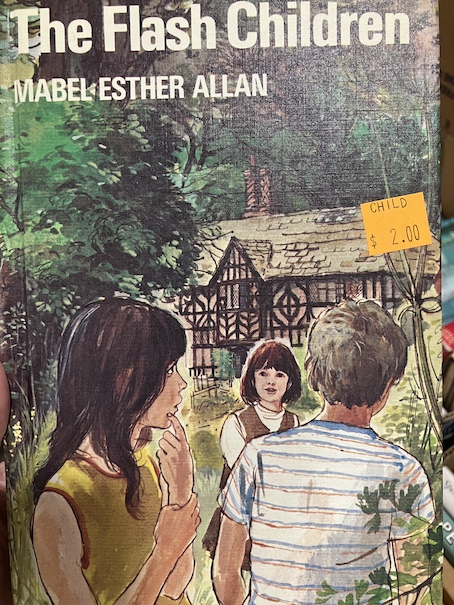
The Flash Children by Mabel Esther Allan, 1975.
The Briggs family moves to a new house in July, and the three Briggs children are upset about leaving their old home and friends. Their father tries to reassure them that they’ll make new friends in their new home, but ten-year-old Dilys isn’t so sure. She knows that her mother is also not happy about the move, but it can’t be helped. Her father used to be a cowman on an estate in their old town, but the estate has been sold to be turned into an army training camp, so he has to go somewhere else for a new job.
Their new home will be a cottage near a “flash”, which is a kind of salt lake. Flash Cottage, as their new house is called, turns out to be an ugly modern brick house, not at all like the charming old cottage where they used to live. Their old cottage had a beautiful garden, but this little house doesn’t have much at all. Most of the views from the house are also ugly. The embankment behind the house, where the train tracks are, makes parts of the house dark and blocks the view, and there’s a chemical plant a couple of miles away. There isn’t much else in the area to see. The bright spots of their new home are the lake and the train tracks that run near the house. The fast-moving trains make Dilys a little nervous and they also make the house kind of loud, but eleven-year-old Arthur finds them fascinating. Arthur takes a yellow bedroom at the back of the house, where he can see the trains. Dilys shares a blue bedroom with their little sister, Megan, with a view of the chemical plant in the distance. All three of the children find the house strange and ugly and wonder how they’re ever going to feel at home there.
Dilys doesn’t think she’ll ever like the new house, although she thinks it might be nice if they could go rowing on the lake. Their mother worries about the children falling in the flash because they have to travel across an unfenced causeway when coming to or leaving the house. The children will have to catch a school bus to go to the local school, and Arthur wonders what the other children in the area are like. The children hope to find some friends because, if they don’t, they don’t really know what they’ll do with themselves. There doesn’t seem to be much in the area to do for fun.
The Briggs children meet a boy and girl about their age on their first day at the new house, but the meeting doesn’t go well at first. Arthur stops the other boy and girl from throwing rocks at some ducks. Dilys warns him about making enemies of people because they need some friends in their new home, but Arthur can’t stand to see people being cruel to animals. The other boy and girl already know who the Briggs children are because they were told they would be coming, but Arthur surprises them with a Welsh phrase. The Briggs children’s mother is Welsh, and they grew up near Wales. The boy, whose name is Dan Brown, thinks at first that Arthur was speaking French, but his sister, Edith, recognizes the phrase as Welsh because someone told her that the family was part Welsh. Dan and Edith argue about it, and Arthur asks them if they often argue with each other. The Brown kids admit that they do because there just isn’t that much else to do in the area. Boredom is also the reason why they tease animals, and because they tease animals, they’ve been banned from Colonel Melling’s farm, where Mr. Briggs will now be working with the cows. Sometimes, when they have money, they can take a bus to town to find other things to do, but they don’t always have the money to do that.
Mr. Briggs tells the children that the Brown children are the nearest children in the area. Their mother is dead, and they have an aunt looking after them. Their father also works at Colonel Melling’s farm. The Briggs children aren’t sure that they like the Brown children or want to be friends with them, but they might be their best or only option for friends at all. Their father persuades them to give the Brown children a chance, but Dilys wonders if, before long, they’ll all be so bored that they’ll start throwing rocks at ducks, too.
School isn’t too bad once it starts. Dilys meets another girl she likes, but unfortunately, the other girl lives too far away to see easily when they’re not in school. Some other kids at school tease another new boy named Brian because he’s partially blind. Dan and Edith turn out to be among the worst bullies, and Arthur and Dilys get so angry with them that they get into a fight. Dilys tells Edith that she’s ashamed of how she acts, she thinks it’s disgusting, and she wishes Edith would turn deaf so she can see what it’s like to live with a disability. The other kids back down rather than fight Arthur, and surprisingly, Edith is actually a little embarrassed when she sees how angry and disgusted Dilys is with her. It seems like the behavior of the local kids is as rough and ugly as the area where they live, but Dilys finds herself interested in Brian because he seems to be a different type of person.
Mrs. Briggs is as homesick as the kids for where they used to live, but she starts to make friends with Miss Brown, the aunt looking after Dan and Edith. Mrs. Briggs says that Miss Brown is a nice lady, but she doesn’t entirely know how to cope with the children, and Dan and Edith often misbehave and make trouble. She’s only been living with her brother and the children since their mother died last year.
One day, Dilys and Arthur go exploring, and they find an unexpected green area down a road that makes them feel more like home. They get caught in a sudden storm, so they take shelter under a railway bridge, where they meet Dan and Edith, also taking shelter. They start talking more about the area and places to explore, and Dan and Edith say that they can’t go down by Mr. Lowe’s farm anymore. Arthur asks them why, and they admit that they stole some plums from him and left his gate open, so the livestock got out. Arthur and Dilys can see why Mr. Lowe would be angry, but Dan and Edith defensively add that they didn’t leave the gate open on purpose. They just forgot to close it because Edith got stung by a wasp and was upset, but Mr. Lowe won’t believe them. They say it’s a pity because the area is much more interesting over there. There’s an old manor house, a stream, and a ruined mill over that way.
Things change for the children when Dilys, Arthur, and Megan befriend an artist who lives in a cottage nearby, John Zachary Laurie, and he’s a friend of Colonel Melling. He takes them out rowing on the flash and talks to them about how they like their new home. The Briggs children confide in him how unhappy they’ve been since they moved to the area because everything is so ugly, but the artist points out that it’s not really an ugly place. He says he finds it fascinating to paint because it has certain “dramatic effects.” When he shows them his pictures, they’re very different from the kind of pictures that the children are accustomed to seeing. Rather than conventional flowers and pretty landscapes, they are filled with angles and a lot of grays and browns, but with unexpected dashes of color. They’re unmistakably pictures of the area, but not in a way the children usually see it. The landscape in the paintings is familiar but strange, ugly but also oddly enchanting. John Laurie even gives them one of his paintings, the one he did of their new house, Flash Cottage. He says he knows the children hate the house now, but he thinks it has interesting angles, and if they learn how to look at things a little deeper, they’ll see more than they do now.
Although Dilys isn’t quite sure that she understands it, she begins to feel what the artist is talking about. Things that are strange start to feel familiar, and even in the ugliness of the landscape and the picture of their house, she begins to feel a sense of fascination and attraction. It’s not exactly pretty, but it is compelling.
When school lets out for the summer, the Briggs children once again find themselves bored and lonely. The few other children they like don’t live close to them, like Dan and Edith, and the Briggs children still think Dan and Edith are pains and troublemakers. Looking for something to do, Arthur, Dilys, and Megan decide to explore the old manor house that Dan and Edith mentioned.
It turns out to be a beautiful place, although it’s old and deserted. To their surprise, they discover that the property actually belongs to Brian’s family, the Pelverdens. They live in a little cottage behind the old manor house. Brian has a little sister, Mellie (short for Melinda), who would be a good friend for Megan, but Brian seems less than pleased that Arthur and Dilys have discovered where he lives. Brian’s father explains that they haven’t been living here long. The manor house has been in the family for generations, but it’s fallen into ruin because they haven’t had the money to maintain it for a long time. They only recently inherited the place themselves when Brian’s grandfather died. The Pelverdens don’t expect to ever live in the manor house themselves, but their hope is that, if they get it sufficiently repaired, they might have it registered and preserved as a historic building and get a grant to maintain it. The Briggs children eagerly volunteer their services to help with the project over the summer. They have nothing else to do, and they still miss the garden from their old cottage, so helping to replant the manor garden would be fun for them. The Pelverdens’ cottage and the crumbling old manor house are more beautiful to them than anything else they’ve seen since they moved, and they feel more like home.
Mellie is immediately happy to have found a friend in Megan, but Arthur and Dilys find it harder to make friends with Brian. Brian has known all of his life that he’s different from other kids because of his vision problems, and he’s used to people treating him differently or making fun of him. He tries very hard to be as “normal” as he can and prove to everyone that he can do things other kids can do. Because he feels like he has something to prove to everyone, he’s often less friendly than he could be, but Dilys is determined to earn his trust.
However, Dan and Edith are still problems. The Briggs children fight them off one day when they catch them teasing the Briggs’s cat. Edith is offended that the other kids keep telling them everything they do is wrong. Then, another day, they show up at the old manor house and break a window by throwing rocks. When the Briggs children and Mr. Pelverden confront Dan and Edith about what they’ve done, Dilys come up with a plan that might solve the Dan and Edith problem and prevent them from making further trouble.
The book is available to borrow and read for free online through Internet Archive. There is a sequel to this book called The Flash Children in Winter, which is about the children experiencing their new home in autumn and the lead up to their first Christmas there.
My Reaction and Some Spoilers
I thought this book was interesting because it has aspects of a cottagecore style story, but there are parts of it that contrast with the typical cottagecore aesthetic. The main characters in the story, the Briggs children, have come from an environment that would be like a cottagecore dream: an actual old cottage with a beautiful garden attached to an old manor house, where they were allowed to help out. Then, they have to move to a far more plain and conventional house in an ugly area with a view of a chemical plant. It’s understandable that they would feel badly about the move. Moving and starting over again would be difficult for anybody, but most people would find their new environment downright depressing, especially after hearing what their old home was like.
When they find out that Brian’s family lives in a cottage and is renovating their old manor house to turn it into a historic site, the story goes back to the charming sort of environment the children come from. However, it’s not just about the children finding a way back to the kind of environment that has the beauty and charm they crave but also learning to see what makes different types of environments fascinating, even enchanting. The Flash Cottage isn’t a real cottage, and it’s not as pretty as their old home, but after talking to the artist and looking at things from an artist’s viewpoint, taking into account the features of a place that make it unique, Dilys comes to see how a shift in perspective can make many different environments more attractive, in their own way.
Learning to get along with Dan and Edith also involves finding a different perspective and a different way of dealing with them. It’s not just about seeing the good side of Dan and Edith as they are. Frankly, the two of them are pain-in-the-butts. Dilys realizes that their problem is that they are thoughtless. They don’t think about other people, how the things they do affect anyone else or make them feel. Their thoughts begin and end with themselves. They’re bored and feel unwanted at home since their mother’s death, so they cause trouble because they just can’t seem to think anything else to do. Personally, I don’t think either Dan or Edith is very intelligent or imaginative because intelligence could be used to reason out why people react to them the way they do and a little imagination would help them put themselves in other people’s position or help them think of different things to do or ways to approach other people. However, Dan and Edith don’t do any of those things on their own. It never even seems to occur to them that they could. They only get upset when other people are unhappy with them and seem totally unable to understand why.
Even though Dan and Edith don’t seem either very bright or very considerate, it does occur to Dilys that they could learn to be helpful if someone actually set them tasks to do to keep them busy. At her persuasion, Mr. Pelverden and the other children allow Dan and Edith to join their efforts to clean up the manor. Dan and Edith are actually eager to accept the opportunity to help out with the others because they are incredibly bored and seriously need something to do and people to be with. When the others are dubious about whether they’ll actually do any helping or if they even know how to help, they try to prove that they can do things that are useful for a change. It also proves educational for Dan and Edith because, in helping to clean up the manor, they’re also forced to face damage they have caused themselves and begin to realize how things they’ve been doing have caused trouble and made extra work for other people. They’re not used to seeing themselves as other people see them or dealing with the consequences of their actions, and it’s an eye-opening experience for them. Later, they all have to face off against a motorcycle gang that comes to vandalize the manor, and Dan and Edith have come to see where their loyalties really lie and what menaces people can be when they act like they used to.
The story ends happily for the children and for the manor, which is going to be preserved. The Briggs children feel more at home in their new home, Dan and Edith have greatly reformed, and Brian has learned to be more open with people about his disability, so other people come to understand him better and treat him more kindly. Some of the people who made fun of him before admit that they didn’t understand just how bad his vision was, so they didn’t know why he seemed to struggle so much. Dilys still tells off those kids for not having figured it out, but at the same time, she is the one who tells Brian that he has to make things clear to people and not try to pretend that his condition doesn’t exist or that he doesn’t need some help when he actually does.
The author, Mabel Esther Allan is also a very interesting person. During her life, she wrote more than 100 books for children, under different pen names. She struggled with vision problems of her own when she was young, which was part of the inspiration for Brian in the story. During WWII, she worked was part of the British Women’s Land Army, and she also worked as a teacher.

