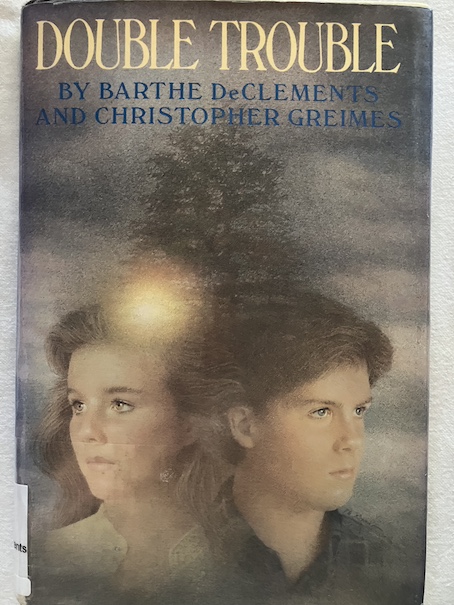
Double Trouble by Barthe DeClements and Christopher Greimes, 1987.
Faith and Phillip are twins and the only members of their immediate family who are alive. Their parents and their older sister were killed in a car accident. Faith was taken in by their aunt, but their aunt didn’t think that she could manage to care for two children, so Phillip was sent to a foster home. The story is written in the form of letters to each other (this is called epistolary style) after their separation.
Separating is cruel, especially when they’re orphans, but there is something about Faith and Phillip that other people don’t know. They have psychic powers, and they have the ability to communicate their feelings to each other with their minds. They have to communicate specific information to each other in writing because their psychic abilities only communicate their general mood and circumstances, but their psychic link to each other makes them feel less alone when they’re apart. Apart from dealing with their grief over the loss of their parents and the changes to their lives, each of them is also in a troubling situation.
In her first letter to Phillip, Faith tells him about a disturbing encounter with a teacher at her new school. Faith was selling candy with another classmate, Sue Ellen, to support the school band. Sue Ellen gets the idea of going by Mr. Gessert’s apartment. Mr. Gessert is their social studies teacher and is considered one of the cool teachers in school. Faith can tell that Sue Ellen has a bit of a crush on him. He buys one of their candy bars, and Sue Ellen asks to use his bathroom. When Sue Ellen seems to be taking awhile, the teacher goes to see if everything is okay, and he catches Sue Ellen snooping around. He gets especially angry when Faith is about to touch his cane near the door. He grabs both girls by the arm and throws them out of the apartment. Although snooping in someone’s private rooms is rude, the girls are startled by how angry Mr. Gessert is. Faith asks Sue Ellen what she saw in his apartment, and Sue Ellen says that she didn’t see anything. She had just started to open the door to a room when he found her. The next day, Sue Ellen brags to other kids at school about having been in the teacher’s apartment, but Faith is still concerned about how angry Mr. Gessert was.
When Phillip replies, he says that he can understand why the teacher would be annoyed at someone snooping through his stuff, and he tells Faith about his new foster parents, the Wangsleys, Howard and Cynthia. He’s now living in Seattle, about 50 miles from where Faith is living. Phillip also got picked on at school by a bully, but a girl named Roxanne spoke up for him. He thinks Roxanne is pretty, and he describes her aura as being indigo. (The twins also have the ability to see people’s auras and use them to learn things about other people.) His new foster parents don’t take his vegetarianism seriously, trying to convince him to eat meat. They say that God put animals on Earth for people to eat and that he has to eat like they do. Their house is shabby, and Howard keeps Cynthia on a tight budget. That surprises Phillip because he thinks Howard must be making decent money at the shipyards. He wonders how Howard spends his money, if it’s not on his wife or home. He knows that Howard and Cynthia belong to some kind of religious group and that, whenever they return from one of their meetings, they act strangely, and their auras are weird. He’s still grieving their parents and sister, and with all the stresses of his new home, the only time he feels better is when he’s using astral projection, to get away from it all.
The twins learned their psychic skills from their sister Madalyn and Madalyn’s friend, Roger, who is an archaeologist. Faith doesn’t quite have Phillip’s ability with astral projection, but she can sometimes get visions of other people and what they’re doing. She uses this ability to try to learn more about Mr. Gessert, and she sees that his cane is actually a gun. She watches him loading it. Why would a teacher have a cane with a hidden gun?
Faith is still angry that her aunt didn’t take Phillip, too. She also hesitates to ask her aunt for things she needs because she doesn’t want to seem like a charity case. She has a part-time job taking care of her neighbors’ dogs while the neighbor is on vacation, and she uses the money to buy a pair of second-hand boots. When Aunt Linda finds out that Faith bought second-hand shoes, she says that Faith should have told her that she needed shoes because she doesn’t want people thinking that she isn’t taking care of her niece. Still, after she cleans them up, they don’t look bad, and she gets compliments on them at school.
The next time she sees Mr. Gessert in class, he seems normal at first. He gives the class a lesson on the Donner Party of pioneers, who were trapped by a snowstorm and resorted to cannibalism to stay alive. (This is actually described in gruesome detail in the book. Some kids like a good gross-out, but I never did.) After Mr. Gessert describes all the gory details in class, one of Faith’s other classmates comments that Mr. Gessert seems crazy. Faith knows that he was telling them the truth about what happened, but she finds it disturbing how much he seemed to enjoy recounting all the grossest parts, and other classmates agree. Phillip is concerned about Faith’s description of the teacher, so he uses astral projection to spy on him, and he agrees that Mr. Gessert gives off weird vibes.
Both Faith and Phillip connect with other kids at their schools who have an interest in psychic abilities. Faith meets a boy named Jake, who is intrigued because his father has been reading a book about remote viewing, which is what Faith does. As Phillip becomes friends with Roxanne, who is interested in the topic of astral projection. When Phillip confides in her about his astral projection abilities, she asks him to teach her how to do it.
One day, when Phillip and Roxanne are at the library, they see Mr. Gessert there. Mr. Gessert has an interest in Spanish treasure, and there is a special exhibit at the library with some very valuable pieces. Soon after that, the Spanish treasure is stolen from the library. It doesn’t take a psychic to see that Mr. Gessert, who has already been established as creepy and suspicious, might have a motive to steal it, but he’s not the only suspect. Working separately, with the help of their friends, Phillip and Faith use their special mental abilities to get to the bottom of Mr. Gessert’s secrets.
The book is available to borrow and read for free online through Internet Archive.
My Reaction and Spoilers
Themes and Spoilers
There are a lot of metaphysical themes to this story with the kids exploring their psychic abilities. It is revealed that their old family friend, Roger, is a kind of archaeologist/treasure hunter, but he is regarded as unorthodox by his colleagues because he uses his psychic abilities to guide his discoveries. Roger is the one who taught the twins and their older sister how to use their abilities.
In the story, the people who are open to developing their psychic/spiritual/metaphysical sides are the heroes, and they thrive when they connect to other, like-minded people and share what they know with each other, helping each other to develop. However, there are unhealthy forms of spiritual development in the story. Phillip is unnerved about the Wangsleys and their religious group from the beginning because the Wangsleys always act strangely after one of their meetings. Initially, I was concerned that this group might be doing drugs or something like that, but that’s not the case. It’s a little vague exactly what group the Wangsleys are part of, but it seems to be a very conservative Christian group with a cult-like devotion to their leader, and the the Wangsleys have an unhealthy relationship with it.
I don’t think it’s an unhealthy group for being Christian, but it seems like devotion to this particular group encourages overly harsh discipline and emotional manipulation and that Howard and Cynthia’s relationship with each other is troubled because of disagreements about their level of devotion to the group’s standards. I sometimes think that people who don’t have a religion imagine that all Christian groups are like that, but I’ve been to various Christian churches throughout my life, and most are not like this. There are some extreme groups like this, but this is definitely an extreme group. It seems to be an isolated group that isn’t part of a larger denomination. It seems to have just one charismatic leader. I think it’s implied, although not directly stated, that the reason why Howard isn’t spending more money on keeping up his house is that he’s contributing a large portion of his income to this religious group. I’m a little suspicious about the money issue and the long periods that the group’s leader seems to spend in Hawaii, ostensibly on religious business. While it isn’t stated explicitly, and I could be wrong, I think there are some implications about the Hawaii trips and the money of this group that make them seem suspicious.
Besides the metaphysical elements, there are themes of children adjusting to loss and trauma and major life changes with the deaths of the twins’ parents and their adjustments to their new homes. Initially, Faith doesn’t have a very good relationship with her aunt. She’s angry that her aunt didn’t accept her twin brother and sent him into the foster system, and she finds her aunt’s manners cold. She doesn’t trust her aunt enough to ask for the things she needs, even basic clothing, and her aunt gets upset about that. Things improve between them when they learn to communicate more openly with each other. Aunt Linda does care about Faith, but she’s also dealing with her own feelings and uncertainties about raising her niece. She has never married or had children, and while she does want Faith living with her, becoming a single parent is a major adjustment for her.
The Wangsleys are completely unsuitable as guardians for Phillip. They don’t accept his vegetarianism and complain about having to make special things for him. They keep trying to convert him, both to eating meat and to their religious group. I feel like their religious affiliation should have been disclosed from the beginning and that there should have been some discussion between them, Phillip, and Phillip’s caseworker about the differences between their lifestyle and the lifestyle that Phillip is accustomed to living, so they could all reach an understanding about what living together would mean for them before he actually went to life in their house. Phillip does describe some meetings with the Wangsleys and his caseworker during his time with the Wangsleys, where the caseworker tries to mediate circumstances between them and offer suggestions, such as ways they can deal with Phillip’s vegetarianism. Cynthia does make some efforts to accommodate Phillip’s eating habits, but they’re kind of half-hearted, and the Wangsleys absolutely cannot accept that Phillip doesn’t want to join their religious group. They heavily pressure him to convert, and when they discover Phillip’s astral projection activities, they’re convinced that he’s having visions given to him by the devil and demons. They tell Phillip’s caseworker that they want to adopt him, but Phillip finally speaks out about what life with them is really like. In the end, Roger decides that he will take Phillip, and the Wangsleys are forced to relinquish him to his caseworker.
From now on, Phillip will be living with a family friend who understands him and shares his lifestyle, and there are even hints of a possible romance between Roger and Aunt Linda. The hints of romance with Roger and Aunt Linda feel awkward, partly because the kids know that Aunt Linda is about 10 years older than Roger, a significant although not insurmountable age gap. Mostly, it just feels awkward to me because it seemed like there had been a romance relationship between Roger and the twins’ deceased elder sister. Switching attention from the niece to the aunt, even if the niece is now dead, just feels odd. Although, it’s not definite that their relationship will really be romantic. It might just end up being friendly.
The authors, Barthe DeClements and Christopher Greimes, are a mother and son team, and the inspiration for this story came from their own shared interests in psychic phenomena and “nontraditional methods of expanding awareness.”
My Psychic Experiment Story
I remember reading this book when I was a kid, and I was fascinated with the idea of communicating psychically with other people or being able to do astral projection. I don’t really believe in all of the metaphysical ideas that the book presents, but I think most children go through a phase where they’re interested in things like ESP and try to test themselves to see if they can do it. I actually had an English teacher in middle school who tested the whole class for ESP after we read some science fiction or fantasy story, just for fun. I can’t remember which story that was now, although I don’t think it was this one. I think it might have been a story about a typewriter that predicts the future, although I can’t remember the name of that one. I didn’t do very well on most of the tests, although there was one in particular where I did pretty well. After thinking it over for about 30 years, I’ve decided that it wasn’t because I had any significant psychic ability. The one test I did well involved predicting another person’s actions, and I think anybody could do that fairly well if you know something about the other person’s personality. The teacher did say that people do this activity much better if they do it with close friends, implying that friends have a special connection to each other, but I think it’s more the case that friends understand each other’s thinking better.
I can’t remember whether I read this particular book before or after I was tested for ESP, but I think it was after. I still had an interest in the subject, and I remember, one night, I tried my own experiment in astral projection. When I did it, I had a vision of space aliens. It was probably because I was dozing off in bed at night, and I was going through a sci-fi phase at the time, but I got spooked. You see, the punchline to this story is that I grew up in Arizona, and the night of my experiment happened to be the night of the Phoenix Lights. I was so creeped out the next day, when people were talking about UFOs that I stopped the astral projection experiments. Although I’m sure that it was all a coincidence, just a dream brought on by my own fascination with science fiction and space aliens, I decided that, while I was curious about how such things worked, I didn’t really want them to work for me. I might have been a cowardly child with a habit of spooking herself, but I was also a cowardly child who decided that there was no point in continuing to do things that she knew would spook her. I had my fun with that phase, and then it was time to move on to my next obsession.



 Jestress's Forgotten Books and Stories