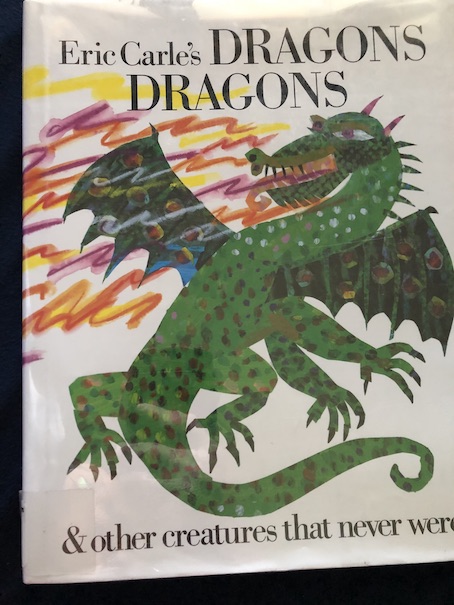
Dragons, Dragons, and Other Creatures that Never Were

Dragons, Dragons, and Other Creatures that Never Were by Eric Carle, 1991.

This is a collection of poems and quotations about various mythical creatures from around the world. The poems and quotes come from various sources. Some are by famous authors and some are nursery rhymes and pieces of folklore. The quote about the leviathan is from The Book of Job.

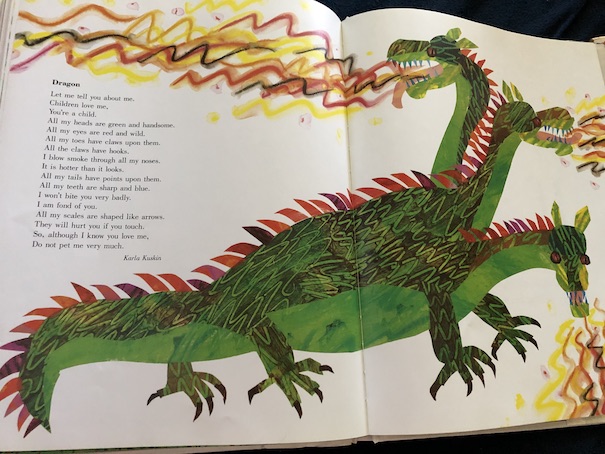
The illustrations are what really make the book interesting. They are bright and colorful, and the middle section of the book folds out to reveal a particularly long picture of a Chinese dragon.

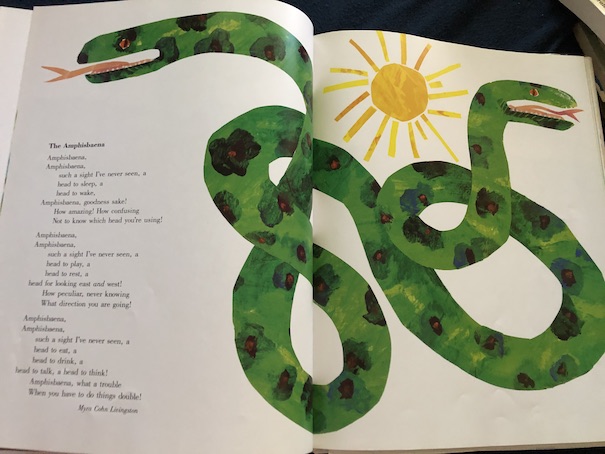
Although there are common mythological creatures, like dragons, unicorns, yetis, the phoenix, there are also less common ones that some children may not have even heard of, like the giant bird called the roc, the two-headed amphisbaena, the kappa, and the bunyip.

Most of the descriptions of the creatures are in the poems themselves and in the accompanying pictures, but there is a glossary in the back that explains more about what each creature is and where it is from.

The book is available to borrow and read online for free through Internet Archive (multiple copies).

In the Night Kitchen

In the Night Kitchen by Maurice Sendak, 1970.

This is a very surreal children’s picture book about a strange dream that a boy has one night.

One night, a boy name Mickey is trying to sleep when he hears a strange thumping sound. He yells for the person making it to be quiet, and he suddenly finds himself falling out of bed.

He continues falling through the floors of his house and loses his pajamas. (Mickey is naked for most of the book, and at times, you can see his private parts in the pictures. The rest of the time, he is covered in batter. This is a very strange book.)

Mickey falls into a bowl of batter in the Night Kitchen, and the cooks mix him into the batter and try to bake him into a cake. However, Mickey climbs out of the oven and into some bread dough, which he shapes into an airplane.

The cooks cry out for milk for the cake they want to bake, so Mickey grabs their measuring cup and flies off in his bread dough airplane to find some.

He dives into a giant bottle of milk, losing the batter that was covering him. Mickey gets a cup of milk and pours it into the batter. The cooks are happy and bake their cake.

Then, Mickey slides down the side of the bottle and ends up in his own bed and in his pajamas again.

Apparently, the whole thing was a dream, but it’s a very odd dream. I didn’t like Mickey being naked in the pictures because I don’t see any particular reason why he should be. This would still be an odd, surreal dream even if he was wearing his pajamas through the whole adventure. It’s not terrible, but I did find that part a little unsettling and unnecessary. The rhymes in the text of the story were cute. I think it would sound nice read aloud.

The book is available to borrow for free online through Internet Archive (multiple copies).

The 13th Clue

The 13th Clue by Ann Jonas, 1988.

This picture book is almost entirely pictures. The pictures present clues to a treasure hunt and reveal the true story of the book.

The book begins with a diary entry. At first, we don’t know who is writing it, but this person writes about what a bad day it’s been. We know that the person must be a kid because they mention school, and I guessed that it was the person’s birthday because people sang to them at school. But, she thinks that others have forgotten her birthday. The diary entry breaks off when the person notices a light going on in the house when, supposedly, no one else is home.

From this point on, until the very end of the book, the text is presented in the form of clues for our birthday kid (who turns out to be a girl, as shown in shadows and a reflection in water in later illustrations) to follow that lead to the place where her friends are waiting to give her a surprise party. Readers can figure out the clues along with the girl, some of which are easier and more direct than others.

I love puzzle books, and I thought that it was interesting how we don’t even know who the main character of the book is, only finding that out as the book continues. I liked the challenge of figuring out the clues as the book went along, although none of them were particularly difficult. They aren’t written in any kind of code, just kind of hidden in plain sight, most of them using objects that are part of the rest of the scene. Some of the letters of words are jumbled and have to be unscrambled. I’m sure it would seem harder to children.

This is a pretty easy book, but not one that would be suitable to read to children who can’t read themselves. There are no solutions provided to the puzzles, but that’s okay because, first of all, they aren’t very hard, and second, there are no opportunities for the reader to make choices based on the puzzles, so there is nothing for the reader to get wrong. The end of the story is obvious. Most of the fun is just studying the pictures to see the cute ways her friends decided to hide their “secret” messages. The hardest message to spot is the one written in the hillside.

The book is available to borrow for free online through Internet Archive.
Phoebe the Spy

Phoebe the Spy by Judith Berry Griffin, illustrated by Margot Tomes, 1977.

Phoebe Fraunces is a thirteen-year-old girl living in New York in 1776. The Fraunces family is black, but unlike most black people in the American colonies at the time, they have never been slaves. (There were some free black families who had never been slaves during this period of history, but they were uncommon.) Phoebe’s father, Samuel Fraunces owns a tavern called The Queen’s Head. It’s a popular place for people to meet, and Samuel Fraunces allows some prominent Patriots to meet there in secret and discuss their plans. Being party to such meetings could come with consequences as the colonies are on the brink of war.

One day, in April 1776, Samuel confides in his daughter that he has overheard something disturbing. He believes that George Washington’s life is in danger, that there are soldiers who are willing to kill their general for money. Samuel is worried about what he heard, but he isn’t sure what the plot against George Washington actually is and has no proof of what he heard. He’s afraid that if he tells Washington about what he heard too soon, without proof, the conspirators will just wait for a safer time to strike, so he asks Phoebe to help him uncover the truth. Samuel knows that George Washington will be coming to New York soon, and he has asked Samuel to help him find a housekeeper for the house where he will be staying. Samuel wants Phoebe to take the housekeeper position and to keep her eyes open for signs of danger.

Phoebe doesn’t know if she can do what her father wants her to do. She isn’t sure what she’s supposed to be watching for, and she doesn’t know how she could stop the plot if there is one. Her father tells her that she should look out for a man who is part of George Washington’s bodyguard and whose name starts with the letter ‘T’. This is all that Samuel was able to tell about the conspirator from the conversation that he overheard. He tells Phoebe to be careful, not to trust anyone, and to meet with him regularly in the market to tell him what she has learned. The two of them also discuss how odd it is that a man like George Washington, who owns slaves, would be at the center of a fight for freedom. Phoebe hopes that he will free his slaves after the war is over, although her father doubts that will happen. Still, the Fraunces family supports the cause of the Patriots, and Phoebe agrees to help her father find the conspirators and save George Washington’s life.

Phoebe is young to be a housekeeper, but she is accepted into Washington’s household. There, she meets Mary the cook and her son Pompey. Pompey also performs chores for the family, like carrying firewood. The work isn’t too hard for Phoebe because much of it is what she is accustomed to doing for her family’s tavern, like making beds, cleaning the silver, and making sure that meals are served on time. George Washington doesn’t say much when he’s around Phoebe, but she carefully observes the people around him. Every day, she goes to the market to buy food and see her father.

At first, Phoebe has nothing to report to her father. Everyone around George Washington seems to be nice or at least behaving normally, and nobody’s last name begins with the letter ‘T’. Mr. Green, a member of George Washington’s bodyguard, seems a bit unfriendly, but a younger man, Mr. Hickey, seems rather nice and sometimes gives Phoebe little presents.

However, there is a traitor among the household, and although it pains Phoebe when she learns who it is, she must do her duty and protect the life of the person she has promised to protect.

Some of the pictures in the book are black-and-white drawings, and some are in muted colors.

The original title of this book was Phoebe and the General. It is available to borrow and read for free online through Internet Archive.
Historical Background

The story is based on the real Fraunces family of New York. Samuel Fraunces really did own a tavern called the Queen’s Head and allowed Patriots to meet there. A note in the back of the book explains that after the war ended, he was given a reward by Congress, and he changed the name of the Queen’s Head to Fraunces Tavern. Fraunces Tavern still exists today, and it is still a restaurant, although part of it has been converted into a museum.

The racial identity of Samuel Fraunces has been in dispute for some time. No one is completely sure what he actually looked like. There is a portrait of a white man that has been reputed to be Samuel Fraunces, but the true identity of that portrait is in dispute. Samuel Fraunces is known to have had the nickname of “Black Sam”, but different sources describe the family differently. All that is known of Samuel Fraunces’s background is that he was born around 1722 and was originally from the West Indies. It’s possible that the Fraunces family may have been mixed race because some sources refer to Samuel Fraunces as “mulatto” (an old term for someone born to a white parent and a black parent, not considered a polite term now), which might explain the other, differing accounts of the family’s race.

The story of Phoebe Fraunces saving George Washington’s life is legend, but the facts regarding that incident are also in dispute. The legend might be based on a misunderstanding, and Samuel Frances’s real daughter, Elizabeth, does not seem to have been old enough at the time to have taken part in this adventure. The story has had a tendency to appear and reappear around patriotic milestones in the United States, first around the centennial in 1876 and then around the bicentennial in 1976, when this book was written.

Cathedral

Cathedral by David Macaulay, 1973.

This is the story of the construction of a Medieval cathedral. The story takes place in a fictional town in France, Chutreaux, but it is based on the construction of real Medieval cathedrals.

In 1252, the people of Chutreaux decide to build a new cathedral because their old cathedral was badly damaged by a lightning strike and other towns in their part of France are building grand cathedrals. The people know that it takes decades to construct a grand cathedral, perhaps even more than 100 years. The people making the decision to build the cathedral know that they will never see the end of the construction themselves, but they believe that this is an important undertaking, both for the welfare of their community in the future and for the glory of God.

The church leader in Chutreaux is the bishop, but a group of clergymen have been given control of money for the cathedral project. They have chosen to hire a Flemish architect, William of Planz, to create the design for their cathedral and hire the craftsmen who will actually build the cathedral.

Building a cathedral is a massive undertaking that requires many different types of craftsmen and laborers. The book explains that the craftsmen building the cathedral will include a quarryman, a stone cutter, a mason, a sculptor, a mortar maker, a blacksmith, a carpenter, a glass maker, and a roofer. All of these craftsmen are masters of their crafts, with apprentices, assistants, and many general, unskilled laborers doing much of the heavy work.

The building of the cathedral begins with the clearing of the site, marking the basic layout of the building, and building workshops where the craftsmen will be doing their work. The book shows the tools that the various types of craftsmen use. They also need to gather the materials that they will use. There is a quarry where they will cut the limestone blocks they will use to construct the cathedral, and the wood for the roof is brought from Scandinavia by boat.

From there, the cathedral is built in stages, beginning with the foundation and then the walls. The book explains each step of the construction and how it was managed, giving the dates when each phase is completed. It also explains the purpose of various architectural features, such as the flying buttresses that support the walls. There is also a glossary in the back of the book that defines various architectural terms.

Because this is an extremely long-term project, over the course of the book, William of Planz and various craftsmen age and one person dies in a work-related accident, and they are replaced by younger people. The construction is finally finished 86 years after it was started.

I recommended this book to people after the burning of Notre Dame in Paris last year because this cathedral is similar to Notre Dame and can give people an idea of what went into its construction. I think that the time invested in the cathedral construction is one of the key points of the story. The ability to delay gratification in the pursuit of larger goals is an important life skill, but the people who began the cathedral project showed this ability to an even higher degree than most. The book carefully notes that the people of this town understand that they will never see the final product of their contribution of money and labor because the project will take decades to complete, but they still begin the undertaking because they believe that it is the right thing to do for their community, for future generations, and for God. Their ultimate reward is not in immediately profiting from this project but in their legacy, laying the foundations (literally) for the future. In the end, it is their grandchildren who become the ones to complete the project and enjoy the beauty of the finished cathedral, and they consider it more than worth the wait.

The book was also made into a documentary film. The film follows the basic course of the book but with more focus on the lives of the characters, giving them more personality than the book does and inserting more drama into the construction of the cathedral. The story of the town and townspeople alternates with explanations about the history and architecture of cathedrals. The fictional cathedral serves as an example not only of the process of constructing a Medieval cathedral, but the difficulties and dangers it might involve.

The book is available to borrow and read for free online through Internet Archive (multiple copies).

William’s Doll

William’s Doll by Charlotte Zolotow, pictures by William Pene du Bois, 1972.

A boy named William wants a doll to play with, like the one the girl next door has.  Other boys make fun of him and think he’s a little strange, calling him a “sissy,” but he likes the idea of having a doll to love that he could treat like it was a real baby.

William’s father buys him toys that boys usually like, like a basketball and a train set.  William likes the train set and gets pretty good at basketball, but he still wants a doll of his own.

When his grandmother comes to visit, William tells her about wanting a doll, and she decides that it’s a good idea and gives him one.  William’s father worries about it, but the grandmother reassures him that there’s nothing to worry about.  William’s desire for a doll is a fatherly instinct, not because he’s a “sissy.”  William likes having something small to love and care for, like a father would for a real baby, and it’s a good thing for a boy to learn the gentleness and responsibility that he would need to know as a future father.

The book is available to borrow and read for free online through Internet Archive.

Further Thoughts and My Opinion

The book has two messages.  First, not everyone feels bound by gender when it comes to the things that they like, and there’s no reason to feel like they should.  Sometimes, people feel pressure to like what their friends like or what society think that they should like and to deny that they like certain things because they’re worried that people will think that they’re weird or uncool, which can be an uncomfortable position to be in.  Speaking as a childless adult who likes, collects, and reviews children’s books, I know how that is.  If it was going to stop me, I wouldn’t have maintained this blog for almost four years, and I wouldn’t have more than 600 books reviewed here, not to mention what’s hanging around my room right now. I’m not even halfway though my personal collection yet.

When you think about it, it does seem kind of unfair that even people who support a little girl’s right to play with traditional boys’ toys, like toy cars, can sometimes get uneasy about the idea of a boy playing with a doll.  People weren’t always so understanding when girls wanted to do “boy” things, like play sports, and there are times when they could be a little more understanding about boys who sometimes want to do “girl” things, too.  Some people might consider cooking to be more of a girl’s hobby than a boy’s hobby, but some of the most famous chefs in the world are men, and what woman wouldn’t be impressed by a boyfriend who can cook a romantic dinner?  People might think that sewing is a girl’s hobby, too, but many professional tailors and leather workers are men as well, and there are some guys who make their own costumes for historical reenactments.  To some people, poetry might sound girly and too sentimental for a boy, but try telling that to Shakespeare, Robert Louis Stevenson (who wrote, among other things, poems for children), Percy Shelley (“Look on my works, ye Mighty, and despair!”), and all of the other famous men who have been authors and poets.  Sometimes, people just aren’t looking at the big picture.  I think that, partly thanks to books like this, people have been loosening up a little on some of the “shoulds” in life – what they think people “should” do or “should” like.

No one in the story says anything about sexual orientation, although that may be part of the father’s worry and possibly the root of the “sissy” accusations. In the story, William is too young to be concerned about sexual relationships, and his wish for a doll has nothing to do with who he might want to date or marry in the future.  He has very specific reasons for wanting a doll, which he explains, and they have nothing to do with sex or romance. I’m not going to speculate about William’s potential orientation because it’s outside of the range of this story, and actually, I think that the story is stronger if his orientation is completely unrelated to his wish for a doll. If the other boys and William’s father think that the doll automatically points to homosexuality, they may be overstepping.  Part of the grandmother’s point is that emotions like love and caring go beyond the idea of sex, and gentleness and nurturing qualities are good things to encourage.  Also, William’s efforts to stand up for what he wants, even knowing that others don’t agree with him, could be seen as a first step to becoming his own man.  Who’s really more of a “sissy,” the guy who lets his friends lead him around by the nose and tell him what to think because he’s scared of being called a “sissy,” or the guy who will stand up and defend his baby, taking care of it no matter what?

The grandmother’s explanation leads to what I think is the second message, that having gentle, loving, and nurturing qualities doesn’t make a boy less of a boy or, by extension, a man less of a man.  These are human emotions, and all humans have some desire for these feelings.  These are the feelings that real relationships are built on: closeness, gentleness, and nurturing. These are qualities that women look for in husbands.  These are also qualities that make a man a good father, which is ultimately what William wants to be when he grows up.  Children have male parents as well as female parents, and it’s fine for William to want to be a good parent someday.

We don’t know, at the end of the story, how long William’s interest in the doll will last.  Children sometimes go through phases where they’re really interested in something, and a few months later (maybe sooner, depending on the kid’s attention span), they put it aside when something new comes along.  William is trying out a concept in his life, which is a large part of growing up, and once he’s tried it out, he may either build on it or move on to other things.  Given William’s interests and character, I think he will probably remember the feelings he’s had and the lessons he’s learned even after he puts the doll aside.  When he’s a little older, perhaps he’ll earn some extra money by babysitting younger kids in the neighborhood.  Maybe he’ll combine his varied interests and end up coaching a kids’ basketball class at the local community center.  He might end up being a teacher as well as a father, since he likes the idea of nurturing young children.

People who grew up in the 1970s may remember the story of William’s Doll from the cartoon and song on Free to Be… You and Me.  There was also a short live action film of the story. In the live action film, it was a grandfather who bought William a doll, and the grandfather reminds the father that he also had a doll for awhile when he was small, reminding him that children grow and change, and this phase in William’s life is just part of his path of growing up. The short film was later parodied on Rifftrax.

Blueberries for Sal

Blueberries for Sal by Robert McCloskey, 1948.

Sal is a little girl whose mother takes her to pick blueberries one day. The mother wants to can the blueberries for winter.

Sal gives in to temptation and eats the blueberries as she picks them.

Meanwhile, a mother bear and her baby come to eat blueberries.

Both Sal and the Little Bear lose sight of their mothers, and when they go looking for them, Sal accidentally finds the mother bear, and the little bear accidentally finds Sal’s mother.

Eventually, the mother bear realizes that Sal is following her when she hears the blueberries plunking into Sal’s pail. Sal’s mother realizes that a small bear is following her when he eats blueberries out of her pail.

Fortunately, nothing bad happens. The mothers just look around for their respective children and figure out where they are by the sounds they make. Then, the mother bear leaves with her baby, and Sal and her mother take their blueberries home.

At first, I was worried about Sal being with the mother bear and how Sal’s mother would react to the mother bear when she saw it, but the two mothers never meet in the story, and the children are fine.

The book is a Caldecott Honor Book. It is available to borrow for free online through Internet Archive (multiple copies).

Harold and the Purple Crayon

Harold and the Purple Crayon by Crockett Johnson, 1955.

Harold loves drawing things with his purple crayon. In fact, everything in the story is a creation of Harold’s, drawn with his purple crayon.

First, Harold decides that he wants to go for a walk in the moonlight. He draws a moon and a path that he can follow.

Along the way, he decides to draw a forest with an apple tree. However, he makes the mistake of drawing a dragon to guard the tree, and it frightens him.

Harold’s hand shakes, and he accidentally draws water and falls in. Fortunately, he also draws a boat and sails to a beach where he can have a picnic lunch.

After a series of adventures, Harold decides that he wants to go home, but he has trouble finding his home. He looks for his bedroom window, and then realizes that his window should look out on the moon, which is still in the sky.

After drawing his window and bed, Harold goes to sleep.

The story is rather surreal. We never see Harold’s real home or any other people who are not drawn by Harold. All we see in the story is Harold and the things he draws with his purple crayon. This is a story about the power of imagination, and at the end, we can only imagine Harold’s real life because we never see him return to it.

The book is available to borrow for free online through Internet Archive (multiple copies).

Where the Wild Things Are

Where the Wild Things Are by Maurice Sendak, 1963.

One evening, Max puts on his wolf costume and starts causing trouble all over the house. His mother calls him a “wild thing” and sends him to bed early without supper.

As Max mopes in his room, a forest grows around him, and Max climbs into a boat and sails away.

Max eventually arrives at “the place where the wild things are.” There are all kinds of wild beasts and monsters there, and they make Max their king because he’s the wildest of them all.

After they all go parading about and swinging from trees, Max sends all the wild things to bed and is lonely because he wants to be with someone who loves him.

So, Max sails home again to have his supper, which is waiting for him, still hot.

Max’s magical journey is in his own head. Angry and hurt at being told off for his behavior, he imagined himself far away from where he was being punished, in a place where he could act any way he wanted and tell other people what to do. But, that wasn’t satisfying because what he really wants is to be loved and cared for. Wild monsters don’t get the kind of nurturing that small human boys get from their mothers, so there are benefits to being a civilized human. This is a classic children’s book about the power of a child’s imagination and how love and human feeling wins out over anger.

The book is a Caldecott Medal Winner. It’s available online through Internet Archive.
Detective McGruff Sniffs Out a Thief

Detective McGruff Sniffs Out a Thief by Megan Durand, illustrated by John Sullivan, 1983.

Sniffy books, or scratch-and-sniff books, were popular during my early childhood in the 1980s, and they are still being made today. Scratch-and-sniff books are picture books with special patches that release a scent when they’re scratched. Kids like interactive books, so it can be fun for them to scratch a flower or some food in a picture and then smell it. I know from my old books that these scented patches eventually wear out, although I’m amazed that some of them still have a scent more than 30 years after the books were originally made. I had expected that the ones that my brother and I liked and scratched the most would be the ones that would eventually wear out the fasted, but it also depends on the strength of the original scent. The milder, more subtle scents are often more difficult to smell decades later. Scratching a little harder can sometimes help. This picture book is a mystery story, and I thought that it was clever, using the sniffy patches as part of the mystery story.
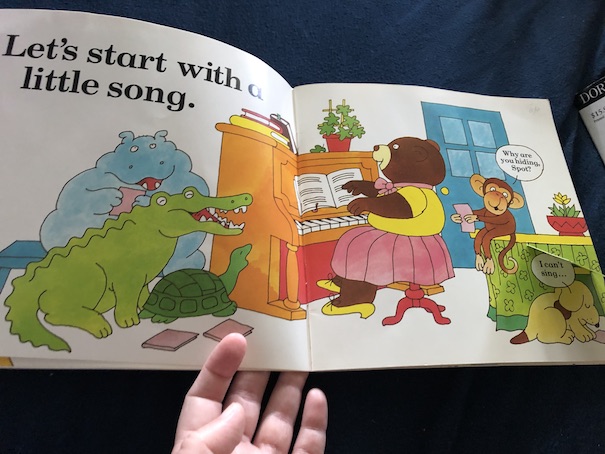
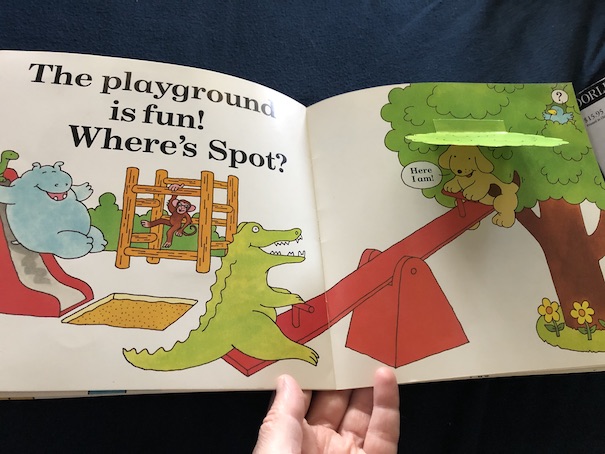
Mrs. Tabby loves shopping, but she often forgets to pay attention to her purchases while she’s looking at other things. One day, someone steals her shopping bag while she’s trying on hats at a sale. It’s terrible because the bag contained the chocolate cake for her son’s birthday.

Fortunately, Detective McGruff is nearby when Mrs. Tabby realizes that her bag is missing. Unfortunately, finding it isn’t going to be easy because many people are carrying blue shopping bags that look like hers. Mrs. Tabby isn’t sure what to do, but McGruff decides to use his nose to sniff out the correct bag.

McGruff approaches various shoppers and gives their bags a sniff. All of the bags look alike, but readers can scratch and sniff the special patches on each bag and try to guess what they contain before McGruff reveals the truth.

After sniffing several bags, McGruff eventually locates the one that smells like chocolate and finds the cake. But, curing Mrs. Taffy of being forgetful is another matter.

Detective McGruff, or McGruff the Crime Dog, was created in the early 1980s as a mascot for anti-crime messages from U.S. police and law enforcement agencies through the National Crime Prevention Council, including anti-drug messages and information related to the issue of child abduction. Sometimes, police use McGruff costumes when visiting schoolchildren to talk to them about crime.