Peter Rabbit's Sniffy Adventure

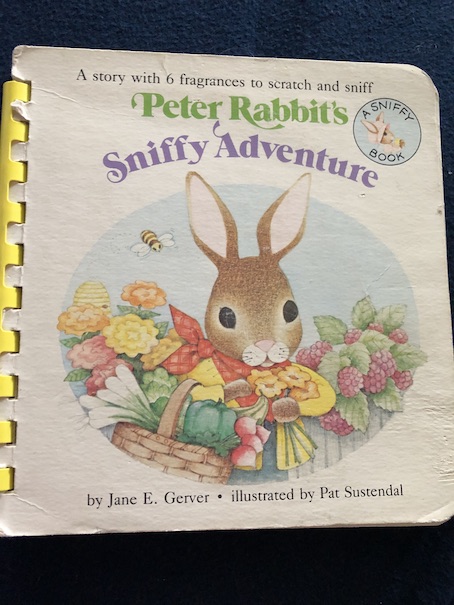
Peter Rabbit’s Sniffy Adventure by Jane E. Gerver, illustrated by Pat Sutendal, 1984.

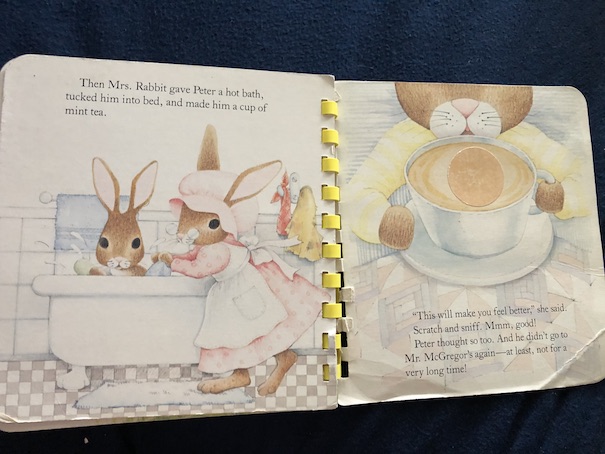
Sniffy books, or scratch-and-sniff books, were popular during my early childhood in the 1980s, and they are still being made today. Scratch-and-sniff books are picture books with special patches that release a scent when they’re scratched. Kids like interactive books, so it can be fun for them to scratch a flower or some food in a picture and then smell it. I know from my old books that these scented patches eventually wear out, although I’m amazed that some of them still have a scent more than 30 years after the books were originally made. I had expected that the ones that my brother and I liked and scratched the most would be the ones that would eventually wear out the fasted, but it also depends on the strength of the original scent. The milder, more subtle scents are often more difficult to smell decades later. Scratching a little harder can sometimes help. If you look carefully at the pictures of our old book, you can see where the round scent patches are on the illustrations.

This book is based on The Tale of Peter Rabbit by Beatrix Potter. It’s meant as a continuation of Peter Rabbit’s adventures.

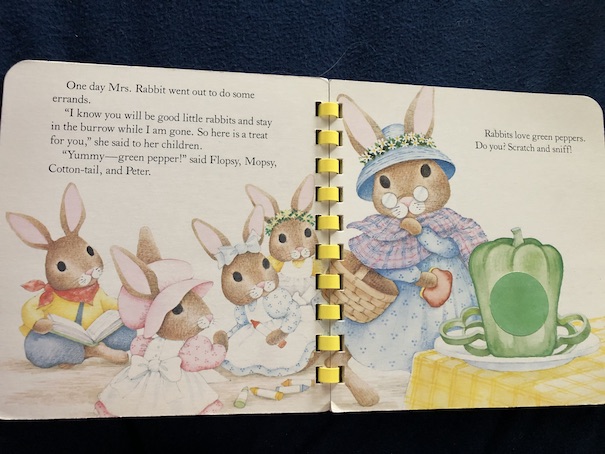
Peter Rabbit lives with his mother and three sisters. One day, Mrs. Rabbit leaves her children alone while she goes to run some errands, giving them a green pepper to eat while she’s gone.

Then, Peter’s cousin, Benjamin comes by and asks Peter to come with him and visit Mr. McGregor’s garden. Peter is reluctant to go because of the trouble that he got into the last time, but Benjamin finally persuades him to come.

In Mr. McGregor’s garden, the bunnies eat raspberries, get into a sawdust pile, and stop to pick some flowers. Peter’s clothes become more dirty, stained, and torn through their adventures.

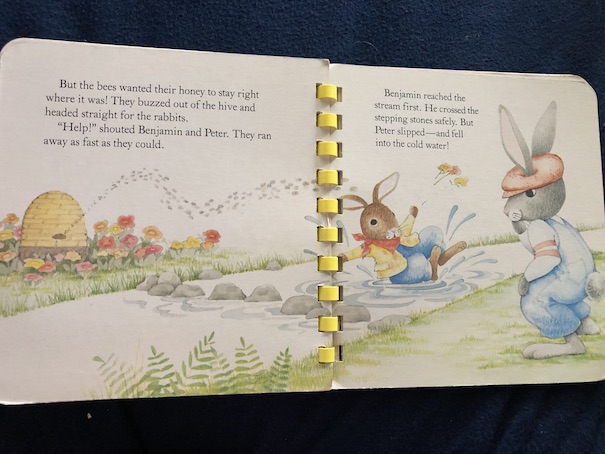
Then, Benjamin spots a beehive and suggests that they get some honeycomb to take home. They end up angering the bees, and Peter falls in a stream as they run away.

When he returns home, Peter is a mess, and he apologizes to his mother for going to Mr. McGregor’s, promising not to do it again. His mother gives him a bath and puts him to bed with a cup of mint tea.

Egg in the Hole Book

Egg in the Hole Book by Richard Scarry, 1967.

This is a board book with a very special feature: a hole that goes all the way through the pages to the back of the book. There is something yellow, soft, and fuzzy in the hole, and it becomes obvious as you read the book what it is.

Henny lays an egg in the barn’s hayloft, but she loses it when it rolls through a hole. The anxious chicken immediately chases after it.

Down below, Billy Goat tells her that the egg fell on the ice cream that he was going to eat for dessert and then rolled out the window.

From there, Henny follows the egg’s path along a rain gutter, out a down spout, through a fence, into a hollow log, and eventually, into a hole in the ground.

When Henny fears that her egg is lost in the hole, a mouse comes out to tell her that the egg broke, but it has hatched into Henny’s new baby chick! (The yellow, soft, fuzzy thing.)

My brother and I used to like this book when we were little kids. I think of it as a kind of Easter story because of the bunny painting Easter Eggs, although the book isn’t really about Easter. Baby chicks are also often associated with Easter. It’s cute how the egg’s path is marked by little dots as it rolls across the barnyard, and the gimmick with the holes in the pages is clever.

The book is available to borrow and read for free online through Internet Archive (multiple copies). Of course, you can’t quite enjoy the effect of the hole feature with the electronic copies.

The Sleepy Puppy

The Sleepy Puppy by Mary Jo Chamberlin, illustrated by Florence Sarah Winship, 1961.

Johnny’s father brings a new basset hound puppy home to his son. Johnny is excited about his new dog, but the puppy is sound asleep. Johnny’s father tells him that puppies are like small children, that they need sleep and love, and when they grow bigger, they’ll be more active. Johnny has to be patient and let his puppy grow.

The puppy falls asleep in his dinner and on the grass outside when Johnny takes him out to play. The puppy seems to be able to sleep through anything, and Johnny wonders if the dog will ever be able to do more than sleep.

On the Fourth of July, Johnny tries to get his dog to pull a little cart in the pet parade, but Johnny ends up having to pull the cart with his dog on it instead.

Then, one day, Johnny’s puppy wakes Johnny because he wants to play. Suddenly, Johnny’s dog is full of energy, and Johnny can play with him!

The book is available to borrow and read for free online through Internet Archive.

My Reaction

I loved this book when I was a little kid, and I think it has a good lesson for young children about caring for pets. Animals, especially young ones, do require patience and time to grow, just like human children do. Johnny is bound to also learn that they also require some training once they get active, but there’s time for that, and that’s been the subject of other children’s books.

Jessica the Blue Streak

Jessica the Blue Streak by Sucie Stevenson, 1989.

Jessica is a six-month-old puppy who has just arrived at her new home. The lady the family bought the dog from warned them to keep Jessica in her crate at night to keep her out of trouble, but the family is confident that they know about dogs.

They already have two dogs, Chelsea and Wolf, and they’re hoping that all three dogs will be friends. Chelsea doesn’t mind Jessica, but Wolf bites the new puppy.

On her first day with the family, Jessica runs wildly through the house, peeing on the floor and grabbing random things to run around with and chew on. She makes messes and eats the cat’s food. Soon, she’s even getting on Chelsea’s nerves.

That night, when they put Jessica in her crate, Jessica howls and cries. What can the family do with this wild puppy?

The story is based on a real dog, Jessica, who was owned by the author’s family, who are all characters in the story. I know from my own experience with my adopted rescue dog that it’s normal for a dog to cry at night in a new home. Puppies are little babies, and like small human children, they need comforting when they’re scared in a new place.

Clifford Goes to Hollywood

Clifford

Clifford Goes to Hollywood by Norman Bridwell, 1980.

Clifford the big, red dog gets an offer to be in a movie. He passes a screen test where he has to act out different emotions, and he gets the part in the movie, so he has to go to Hollywood to accept the role, while Emily Elizabeth and her parents stay behind.

In Hollywood, Clifford is given a big, fancy doghouse and all sorts of fancy collars to wear.

However, Clifford quickly gets overwhelmed by all of the fans who mob him.

He misses Emily Elizabeth, so he runs back home to be with her.

The idea of someone going to Hollywood and missing friends back home is kind of cliche. Actually, I think the best part of the book was the screen test, where Clifford has to show different emotions. There are many books that demonstrate different types of emotions to kids, and I thought that was a nice addition to this book. The part where they show all the fancy collars that Clifford has to choose from was nice, too, because kids like to make choices, and this page is an opportunity for kids to decide which of the collars they like best.

The book is available to borrow for free online through Internet Archive.

Clifford's Family

Clifford

Clifford’s Family by Norman Bridwell, 1984.

Emily Elizabeth and her enormous dog, Clifford, were both born in a big city, although they live in a smaller town now. They decide to go back to the city and visit Clifford’s mother, who is still there.

Clifford’s brothers and sisters all live with different people now, so they decide to visit them, too. Clifford’s sister, Claudia, has become a seeing-eye dog.

His brother, Nero, is now a fire rescue dog.

Clifford’s other sister, Bonnie, lives on a farm and herds sheep.

Clifford’s father doesn’t live with his mother. He lives in a house in another town with a lot of children, and he loves playing with them.

Clifford wishes that his family could live together, but he understands that every member of his family has other people who also need them.

I thought that this book did a good job of pointing out some of the jobs that dogs do, like seeing-eye dog, rescue dog, and herding dog. Clifford and his parents are all companions animals, like most pet dogs, but his siblings all have specific jobs to do for their owners.

The book is available to borrow for free online through Internet Archive.

Clifford's Tricks

Clifford

Clifford’s Tricks by Norman Bridwell, 1969.

A new girl moves next door to Emily Elizabeth. The new girl, Martha, also has a dog, although her dog, Bruno, is a normal-sized dog, unlike Emily Elizabeth’s dog, Clifford.

Martha is competitive and brags that her dog is probably smarter than Clifford. Martha and Emily Elizabeth compare the tricks that their dogs can do, although Clifford’s tricks are different from those of normal dogs. His tricks tend to go wrong or cause problems because of his large size. For example, Bruno can retrieve a newspaper for Martha, but when Clifford tries to do the same thing, he comes back with the whole news stand.

Martha tries to show off Bruno’s bravery by getting him to walk the railing of a bridge, but Bruno doesn’t want to do it because it’s too dangerous. When Martha tries to show Bruno how easy it is, she falls off the bridge into the river. Bruno jumps in to save her and also gets into trouble.

Fortunately, Clifford is big enough to save them both.

Martha is grateful that Clifford saved her and her dog, but each girl still loves her own dog the best.

The book is available to borrow for free online through Internet Archive. The edition that I have is the older edition of the book with pictures that are mostly black-and-white, except for Clifford, who is red. However, there is also a newer edition with full color pictures.

Clifford the Big Red Dog

Clifford

Clifford the Big Red Dog by Norman Bridwell, 1963.

Emily Elizabeth introduces readers to her big, red dog, Clifford. Clifford isn’t just big; he’s humongous.

Like other kids, Emily Elizabeth likes to play with her dog, but playing even the usual games of fetch have unpredictable results because of Clifford’s size. When they play hide-and-seek, there aren’t many places where Clifford can hide, and even then, he’s not too difficult to find.

He also requires a lot of food and special accommodations because of his size. His baths aren’t like those of normal-sized dogs.

Clifford’s doggy bag habits, like chasing cars, can be even more unpredictable. Other dogs might chase cars, but Clifford has a real chance of actually catching them.

However, there are good sides to having a big dog. For one thing, bullies never bother Emily Emily Elizabeth.

Emily Elizabeth loves Clifford and wouldn’t trade him for any other dog.

The book is available to borrow for free online through Internet Archive. The edition that I have is the older edition of the book, but there is also a newer edition with full color pictures.

I Can Fly

I Can Fly by Ruth Krauss, 1950.

This is a cute Little Golden Book about a little girl playing.

As she plays, she compares herself to various animals. When she’s on her swing, she feels like she’s flying like a bird, and when she swims, she feels like a fish.

The story is told in rhyme, and in the back of the book, there is actually music so you can sing the rhyme as a song.

There are different printings of this book, some with different illustrations. The different versions also have different words, and it looks like the newer one includes both a boy and a girl and doesn’t have the music for the song. One of the newer versions is available to borrow for free online through Internet Archive.

Will It Be Okay?

Will It Be Okay? by Crescent Dragonwagon, 1977, 2022.

I like to tie my book reviews into current events when I can, and I first wrote this review around the beginning of the coronavirus pandemic. It just seemed like the right time for this one. It’s a picture book, and, when I first wrote the review, my local libraries were closed because of the pandemic, so I couldn’t go find a copy to get pictures. However, the book is available to read online through Internet Archive, which is where I first encountered it.

The version on Internet Archive is the older printing of the book, with its original pictures. Since then, the book has been reprinted with a set of new pictures. The pictures that appear here are from the new version. The older version of the book showed a blonde girl with a blonde mother, and the new version has a mother and daughter with black hair. Between the two, I prefer the newer illustrations, but readers can decide for themselves. I was surprised, but some of the text of the story was also changed between the versions of the book.

A young girl keep asking her mother about various types of problems that she might encounter, everything from storms to bee stings to forgetting her lines in the school play, and asking her what she would do if each of these things happen.

The mother gives her calm, reassuring answers. Some of them are based on common sense, like if their cabbages don’t come up, they’ll go get some tomato plants and plant tomatoes, and then their cabbages will likely come up anyway.

All of the answers have a poetic quality and answer the girl’s emotions, not taking all of the situations exactly literally, but capturing the feeling that the girl would need to have to get through life’s fears and uncertainties. When the girl asks what if no one likes her dancing, her mother describes how she can dance alone until she meets a new friend, who will dance with her and then come to her house to draw pictures and drink cocoa. I take this to mean what if people don’t like the girl instead of just her dancing, and her mother’s response to mean that she just needs to keep living her life, and she will meet people who will like her.

The last question that the girl poses to her mother is “But what if you die?” This is probably the fear that the girl has more than any of the other fears that she’s mentioned, but the mother still has a calm reply.

The mother tells her daughter that if she dies, her love will stay with her and she’ll have so much that she’ll have to give love away to other people. Her daughter will make new friends and dance with them and she’ll even come to love things like bees and thunderstorms and the other things that have frightened her. The girl will love other people in her life, and they’ll love her, too. Everything will be okay.

My Reaction

Life has many uncertainties, and bad things can happen, but there are other things that can make life better so that, in the end, we will be okay, in spite of the bad and scary things that come along. It’s not easy to believe that in the middle of scary situations, when you don’t know how it’s all going to work out, but I appreciate the sentiment. It’s always possible for things to improve. Bad things might happen, but we can handle them. It’s important to believe that we can handle situations and approach them with confidence.

The hardest, scariest thing to accept is when people die. Death is permanent. When someone has died or is facing death, it’s hard to believe that it could ever be okay because you can’t undo death. The mother in the story doesn’t try to deny that she could die at some point, but what she says is that her daughter will go on with her life and that she will always have her love. It’s what she leaves behind and what her daughter will continue to do after she is gone that will make things okay. The mother doesn’t want her daughter to focus on the sad and scary parts but to look forward with hope and confidence. As long as we can continue to move forward and love one another, things will be okay.

The last picture in the original version of the book is of the mother and daughter in the bathtub together, but they’re largely concealed by bubbles in the bath. Personally, I prefer the newer version of the book, which has the mother and daughter dancing in the leaves together under the trees.

Some of the situations in the book were changed between the old version and the new version of the book. In the old version of the book, the girl worries about what to do if she meets a big dog or if snakes come in the middle of the night, and neither of those were included in the new version of the book. Some answers in the old book are as improbable as the problems that the girl poses, like suggesting that the girl play a flute to charm snakes if snakes come. Both versions of the book have the scene where the girl worries that someone might hate her and her mother says that a frog will tell her that she’s lovable.