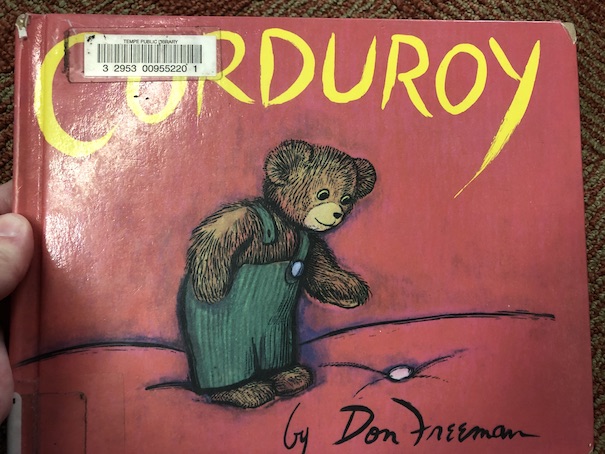
Corduroy is a small teddy bear who lives in a department store, waiting for someone to buy him and take him home. However, he is missing one of the buttons on his overalls, and it makes people reluctant to buy him.
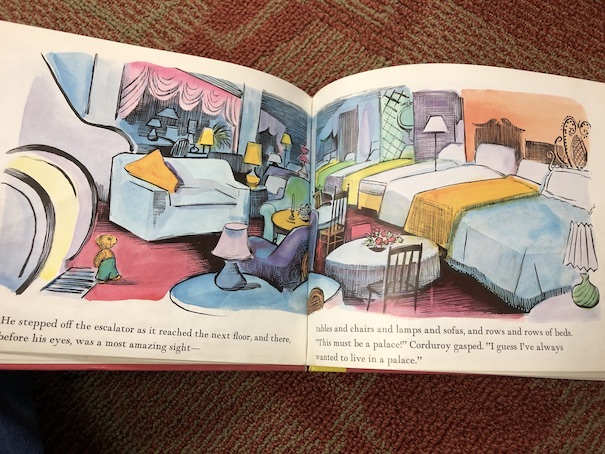
One night, after the store is closed, Corduroy sneaks out of the toy department to go looking for his lost button. After a trip up the escalator, he finds himself in the furniture department. To Corduroy, it’s like climbing a mountain and finding himself in a palace.
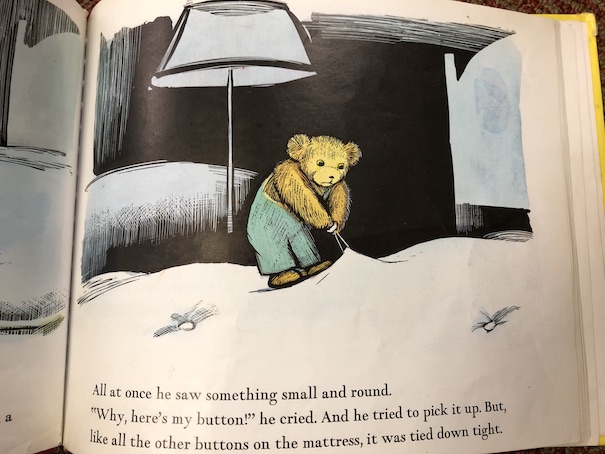
When he spots a button on a mattress, he thinks it might be his and pulls it off. By accident, he knocks over a lamp, which attracts the attention of a night watchman, who spots him and returns him to the toy department.
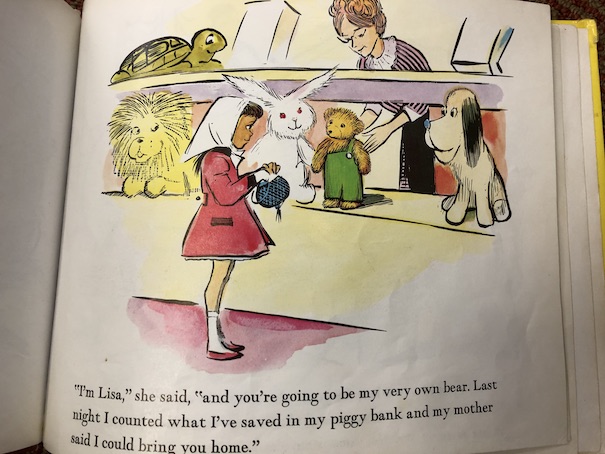
The little girl who wanted Corduroy before, Lisa, returns to the store and buys him. Lisa takes Corduroy home and sews a new button on Corduroy’s overalls. Corduroy is happy because he’s always wanted a home and a friend, and now he has both.
At first, this book was a stand-alone story, but later, the author wrote a sequel called A Pocket for Corduroy. Later, other authors continued the series.
The book is available to borrow for free online through Internet Archive.
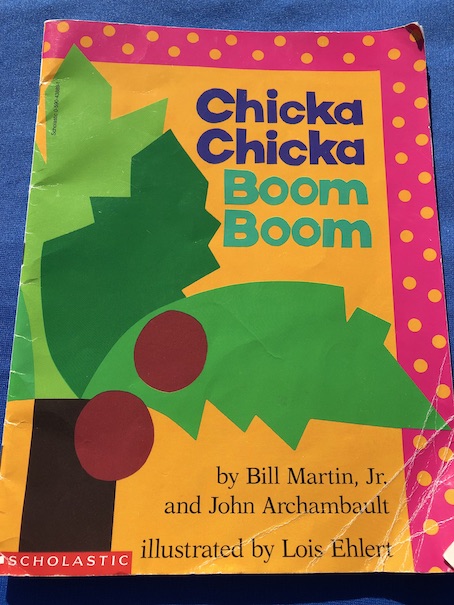
Chicka Chicka Boom Boom by Bill Martin, Jr. and John Archambault, illustrated by Lois Ehlert, 1989.
This is an alphabet book for young children, but it’s not like most alphabet books. Most alphabet books try to tie letters of the alphabet to words that young children know, to emphasize the sounds that the letters make, like in A, My Name is Alice or the letter-themed tongue twisters in Animalia.
In Chicka Chicka Boom Boom, the letters of the alphabet decide to climb to the top of a coconut tree. (Why not?) They go up the tree in alphabetical order.
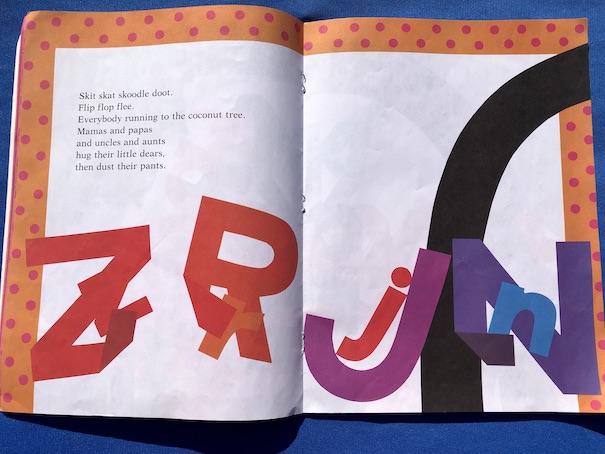
But, by the time they reach the end of the alphabet, there are too many letters in the tree, and they all fall out.
The uppercase versions of the letters are the adults of the story, like parents and aunts and uncles, and they comfort the lowercase letters who fell out of the tree.
At the end of the book, the letter ‘a’ tries to convince the others to climb the tree again.
As I said, this book struck me as unusual for an alphabet book because it doesn’t try to tie any of the letters to associated words. Mostly, it just emphasizes the order of the letters, first in the order that they go up the tree, and then in the order that they recover from falling out.
The story is told in rhyme, and the “Chicka Chicka Boom Boom” part is just sounds that fill out the story/rhyme, like it’s part of a song. At the end of the book, there’s a page with all of the letters of the alphabet, both upper and lowercase.
The book is currently available online through Internet Archive.
This retelling of the classic fairy tale is a Caldecott Medal winner. The illustrations are beautiful! A note in the beginning of the book explains a little more about the author’s sources for the story as well as his view about it. Instead of focusing on an evil witch who holds a young girl captive, he presents “a mother figure who powerfully resists her child’s inevitable growth.”
A
couple who have wished for children for a long time are excited to realize that
they are finally going to have one!
However, the wife finds herself with an irresistible craving for the
Rapunzel (an herb) that grows in the nearby garden of a sorceress. She is so desperate to have some that she is
able to persuade her husband to steal some for her. But, even having some causes her craving to
grow.
When the husband returns to the garden to get more Rapunzel, the sorceress catches him. He explains the situation, saying that his wife’s craving is so intense that he fears she will die if she doesn’t get some Rapunzel. The sorceress agrees that the wife can have the Rapunzel she needs, but in exchange, she demands the child when it is born. Not knowing what else to do, the husband reluctantly agrees. When the wife gives birth to a baby girl, the sorceress comes, names the baby “Rapunzel”, and takes her away from her parents.
The sorceress cares for the girl and raises her. When the beautiful young girl turns twelve, the sorceress takes her to live in a tower in the forest. The tower is magical, looking narrow on the outside, but containing many beautiful and comfortable rooms. The only way in or out is through the window at the very top. The witch has Rapunzel let down her extremely long, beautiful hair so that she can climb up.
Rapunzel lives alone in the tower for years, until a prince happens to ride by and hears her singing. The prince is enchanted by the singing and asks questions about the tower at the nearest houses, learning about the sorceress and the young woman in the tower.
One
day, he sees the sorceress visiting Rapunzel and sees how she gets into the
tower. So, later, he calls to Rapunzel
himself, asking her to let down her hair.
Rapunzel is surprised and frightened at first, when she sees that her
new visitor isn’t the sorceress, but he speaks nicely to her, and they become
friendly. The prince proposes marriage,
and Rapunzel accepts. After that, he
visits her every night, without the sorceress’s knowledge.
However,
Rapunzel eventually gets pregnant, and when her clothes no longer fit her, the
sorceress realizes it. She calls
Rapunzel a “wicked child” and says that she has betrayed her. She cuts off Rapunzel’s long hair and exiles
her into the wilderness, alone.
The sorceress uses Rapunzel’s long hair to trick the prince into climbing into the tower. When he comes, she tells him that Rapunzel is gone, and he will never see her again. The prince falls from the tower, injuring his eyes. Blinded, the prince wanders alone for a year, lamenting for his lost wife.
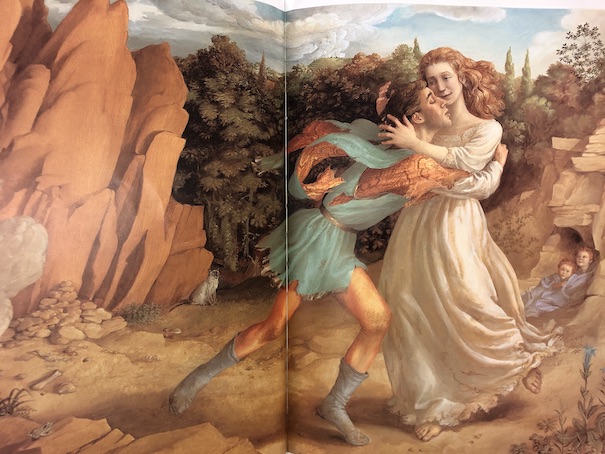
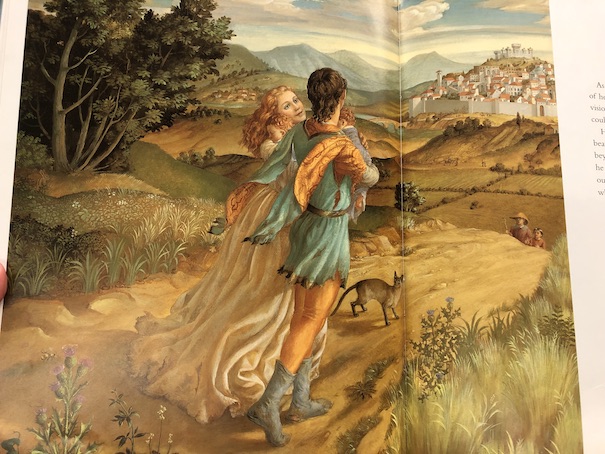
Eventually, he finds Rapunzel in the wilderness, recognizing her singing. She has given birth to twins. Rapunzel’s tears heal the prince’s eyes, and he is able to see again. Realizing that they are near to his kingdom, he takes Rapunzel and the twins home.
The book is available to borrow for free online through Internet Archive.
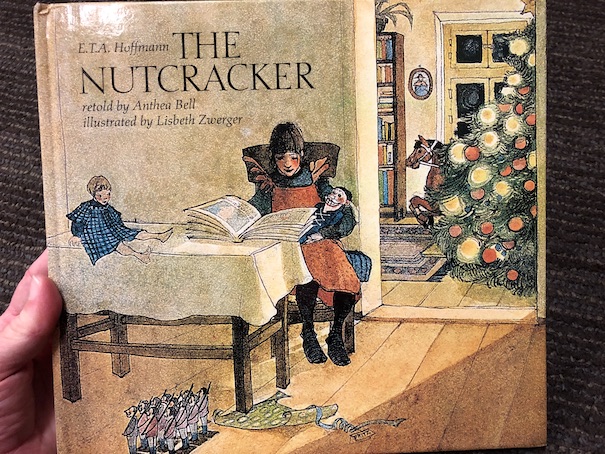
The Nutcracker by E.T.A. Hoffmann, retold by Anthea Bell, 1816, 1987.
The reason for the two dates of this book is that the original Nutcracker story was written by a German writer, E.T.A. Hoffmann, in 1816, as the novella The Nutcracker and the Mouse King. Some places, including the back of this book note different publishing dates for the original story because it was published more than once during the 1810s, as part of different story collections. This article gives more details about the original version of the story and different publications. Since then, it has been retold many times and in many different forms, including the famous ballet based on the story. In ballets and plays, the name of the heroine is often Clara, but in this picture book, as in the original story, the heroine’s name is Marie.
In the beginning of the book, which is set in the 19th century, Marie and her brother Fritz, are opening their Christmas presents on Christmas Eve. (The book explains that opening presents on Christmas Eve is a German tradition. A friend in Germany also explained that to me once because, in Germany, presents are supposedly brought by the Christ Child, not by Santa Claus. Since then, I’ve read that explanation may vary, depending on whether the household is Catholic or Protestant.) The children receive many wonderful presents, including a toy castle from their godfather, Mr. Drosselmeier. Marie’s favorite present is a nutcracker that looks like an odd little man. When Fritz is too rough with the nutcracker and breaks it, Marie takes care of it.
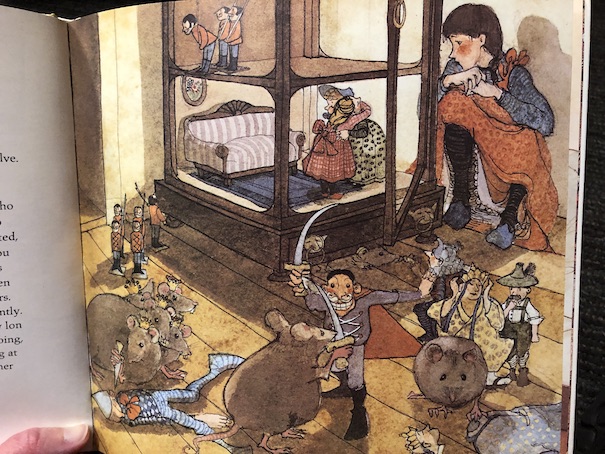
Marie stays up late, and when she finally puts the nutcracker away at midnight, she is astonished to see an army of mice coming out of the floorboards. The leader of the mouse army is the Mouse King, who has seven heads. The Nutcracker leads an army of toys against the mouse army. The mouse army appears to be winning, so, to save the Nutcracker, Marie takes off her shoe and throws it at the mice. Then, her arm hurts, and she apparently faints.
When Marie wakes up, she is in her own bed, and her mother tells her that she apparently put her arm through the glass door of the toy cabinet, cutting herself badly. When Marie tries to tell her mother about the battle between the toys and the mice, her mother and the doctor think that she’s ill and confine her to her bed for a few days. Mr. Drosselmeier repairs the Nutcracker and returns it to Marie, telling her the reason why nutcrackers look so strange and ugly, calling it The Tale of the Hard Nut.
Year ago, there was a royal banquet given by the King and Queen who were the parents of Princess Pirlipat. A mouse who claimed to be the queen of Mousolia demanded some food from the banquet as the Queen was preparing it. The King was angry that the mouse took some of the food and wanted revenge. The King asked his Court Watchmaker, who was also named Drosselmeier, to build some mousetraps to catch the mouse queen’s seven sons. When the sons were caught, the mouse queen vowed that she’d take her revenge on Princess Pirlipat. Princess Pirlipat was a pretty baby, but the mouse queen turned her ugly. The King took out his anger on the Court Watchmaker, ordering him to find a way to change Princess Pirlipat back to normal and threatening to behead him if he failed. After consulting the Court Astronomer, the Court Watchmaker learned that the key to breaking the spell on the princess was a special nut, which had to be cracked by being bitten by a man who filled certain special requirements, which all happened to be met by the son of the Watchmaker’s dollmaker cousin. The King had promised that the person who could break the spell could marry his daughter, but the mouse queen interrupted the last part of the ritual, causing the young cousin to turn ugly himself. When pretty Princess Pirlipat saw her rescuer turn ugly, she didn’t want to marry him anymore. The Court Astronomer said that the only way to break the spell on the young man was for him to defeat the new Mouse King – the mouse queen’s youngest son – and for him to find a woman who would love him regardless of his appearance.
Marie knows that the story is true because she has seen the Mouse King herself. She loves the Nutcracker and wants to help him. The Nutcracker returns to visit Marie during the night and makes repeated demands of her for her candy and toys. Marie knows that, no matter what she gives him, the Mouse King will keep returning to demand something else. The Nutcracker tells her that he needs a sword to fight the Mouse King. They borrow one from a toy soldier, and the Nutcracker successfully defeats the Mouse King, giving Marie his seven golden crowns.
As a reward for helping him, the Nutcracker takes Marie to the land where he is from, leading her there through a magic staircase in an old wardrobe. The Nutcracker’s land is beautiful, filled with candy and sweets and gold and silver fruit. (The Christmas Wood that they pass through reminds me of the woods in the wardrobe in The Lion, the Witch, and the Wardrobe.) The Prince Nutcracker’s home is Marzipan Castle in Candy City, where his beautiful princess sisters live. They welcome Marie and the Nutcracker home.
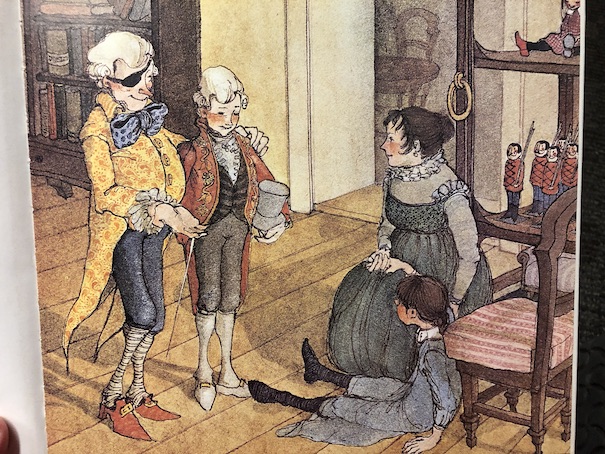
Then, suddenly, Marie wakes up, as if it were all a dream. However, Marie knows that it wasn’t a dream because she still has the Mouse King’s crowns. Marie tells the Nutcracker that she loves him. There is a sudden bang, and Marie faints. When she wakes up, she is told that Mr. Drosselmeier’s nephew has come to visit them. The nephew is the Nutcracker, restored to human form and now a handsome young man, thanks to Marie’s love. Marie later marries the nephew, and the two of them rule magical Kingdom of Sweets.
There is a section in the back of the book that explains a little more about E.T.A. Hoffmann and the original version of the Nutcracker story.
This book is available to borrow for free online through Internet Archive.
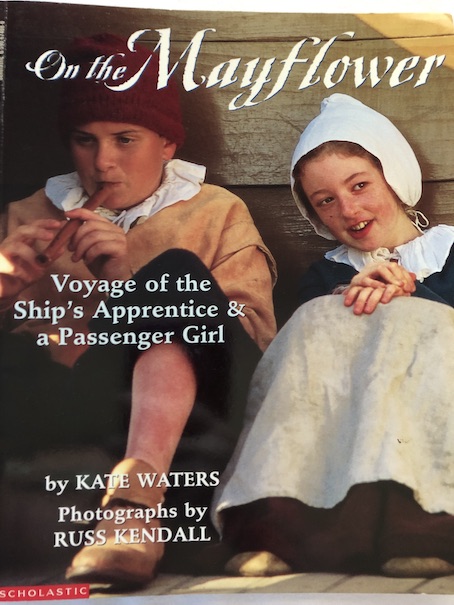
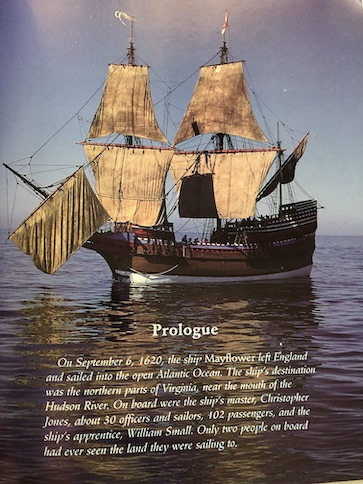
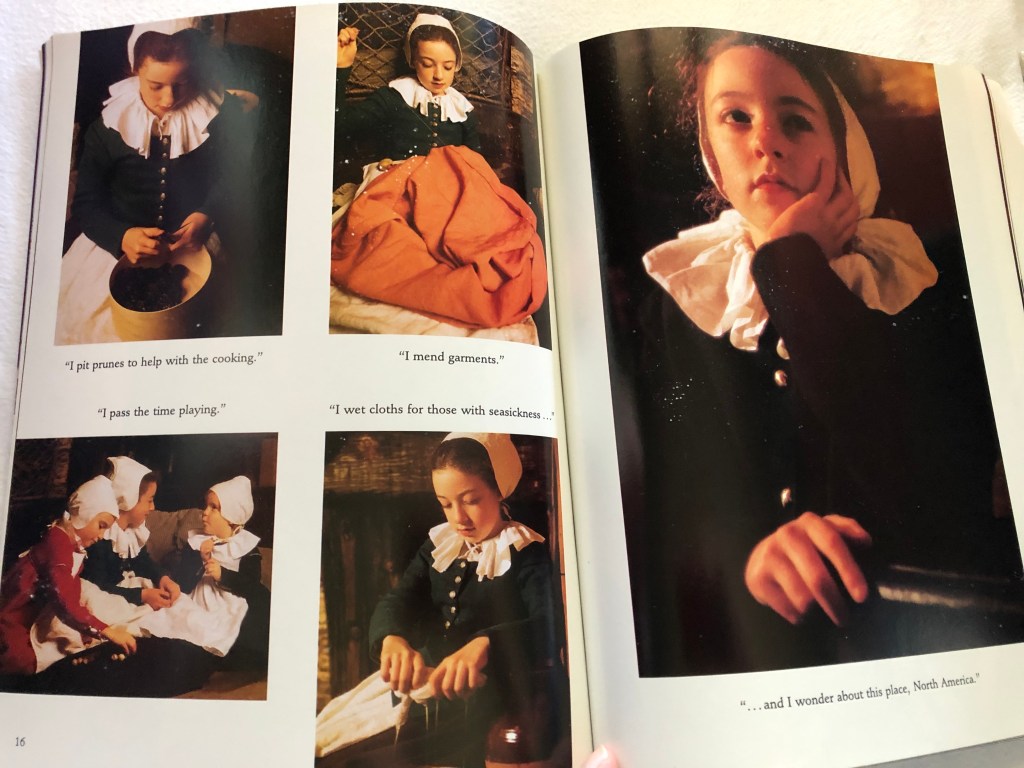
This book is part of a series by same author about children growing up in Colonial America. Each of the books is the series has photographs of historical reenactors portraying real people from Colonial history. This book focuses on two children who are traveling on the Mayflower in 1620, heading to what would become the Plymouth colony. One of the children is a girl who is a passenger on the ship, and the other is a boy who is part of the crew, a ship’s apprentice. In the section of historical information in the back of the book, the author explains that the girl was based on a real girl who was a passenger on the Mayflower, although the boy was not based on a specific apprentice; he is just meant to show what a ship’s apprentice would have been like at that time and to help explain the duties of the various crew members as he assists them.
The ship’s apprentice is called William Small. He is specifically apprenticed to the ship’s master, Christopher Jones (historical character). As an apprentice, he is learning basic navigation skills and assists the regular crew members with various tasks, including serving food.
The girl is named Ellen Moore. She and the other passengers are traveling in cramped quarters, and people are often seasick or trying to find ways to keep themselves occupied during the long journey. Ellen is traveling with younger siblings, and she plays with them in between performing routine chores, like sewing and preparing food.
During the voyage, there is a terrible storm, and the passengers are all confined below deck without light because lanterns and candles would pose too much risk of fire while the ship is rocked during the storm. William has to help the ship’s carpenter to repair leaks. Before the storm is fully over, Mrs. Hopkins, one of the passengers, gives birth to a baby she names Oceanus (historical person, the real Oceanus made it through the voyage although he sadly died young, possibly about age six, but the date of his death is uncertain).
The book ends with their arrival in the Americas. Because the storm blew them off course, the Mayflower did not arrive at its intended destination in Virginia but further north at Cape Cod in what is now Massachusetts. Because winter was setting in, the passengers decided not to risk further travel and established their colony there, 65 days after their ship first left England.
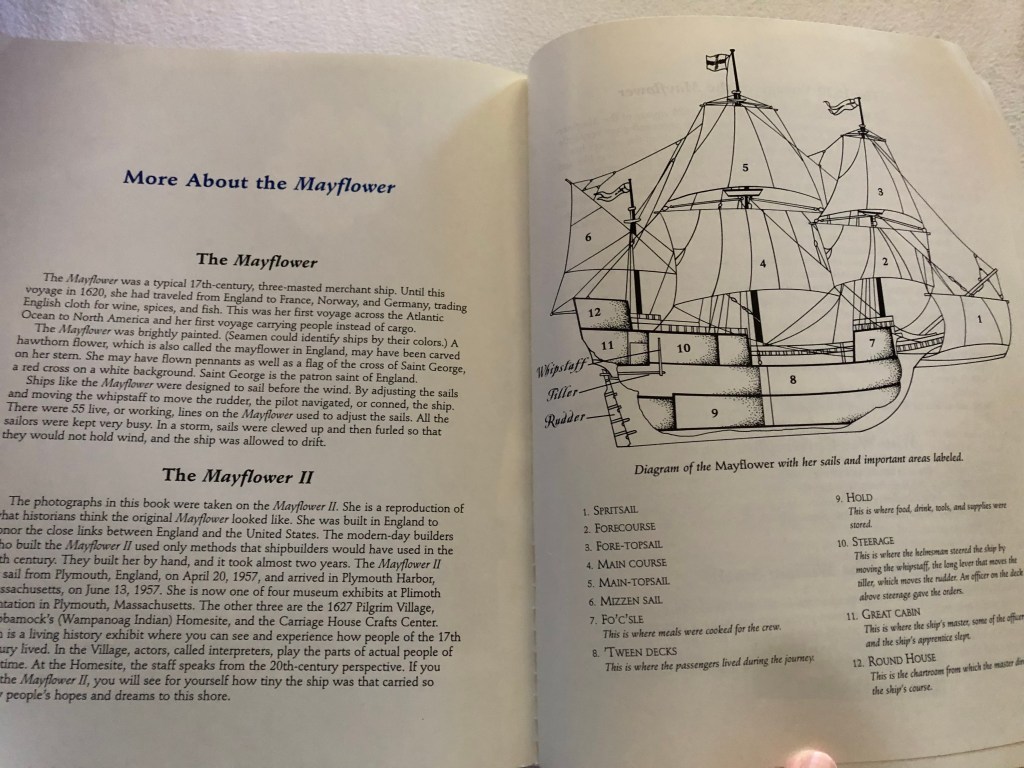
In the back of the book, the section with historical information explains more about both the characters in the story and the reenactors. The historical Ellen Moore and her siblings were traveling to the colony without their parents, under the guardianship of the other families, acting as young servants in their employment. The book mentions that the Moore children were without their parents because of a family tragedy but is not specific about what it was. I looked it up, and the story is both sad and bizarre. I can see why the author didn’t want to explain it in a children’s book. Apparently, the children’s parents had an arranged marriage and were not happy being married to each other. The children’s mother had a long love affair with another man, and also apparently, all of the children were the biological children of her lover. The mother’s husband began to notice that the children physically resembled his wife’s lover. The couple bitterly divorced, and after the husband was granted custody of the children (which, apparently, weren’t his anyway), he decided to send them away to the Americas with the departing pilgrims, paying for them to be taken on the voyage, never seeing them again. Sadly, Ellen probably did not survive the first winter at the Plymouth colony because she disappears from the historical record during that time. Out of the four Moore children traveling on the Mayflower, only one survived to adulthood, Ellen’s young brother Richard. Richard married twice in his life and had seven children of his own. He became a sailor and ship’s captain and eventually died an elderly man in Salem, Massachusetts, during the 1690s, not long after the Salem witch trials. None of this information about Richard is mentioned in the book, but I thought it was interesting background information. In the book, there is also additional information about the ship, The Mayflower, and the reproduction ship used in the pictures, The Mayflower II.
The book is available to borrow for free online through Internet Archive.
Ten Little Rabbits by Virginia Grossman and Sylvia Long, 1991.
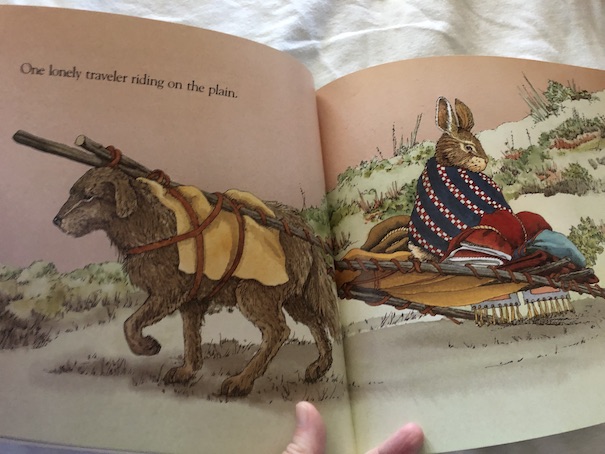
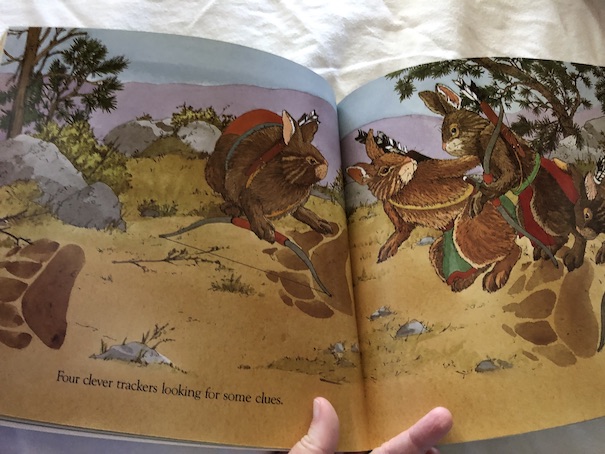
This picture book is loosely based on the Ten Little Indians counting rhyme, but with a twist. Instead of “Ten Little Indians,” it’s ten little rabbits. The rabbits in the pictures are dressed in traditional costumes from different Native American tribes. Also, unlike in some versions of the Ten Little Indians rhyme, none of the characters are eliminated during the course of the rhyme. The rhyme simply counts upward from one to ten.
The pictures are beautiful and detailed, and they do a good job of showing the rabbits in the poses of humans.
The book intentionally shows the rabbits acting out aspects of traditional Native American culture. Very young children might not fully appreciate what the book is trying to depict, but there is a special section in the back that explains which tribes the rabbits are supposed to belong to and what they are doing in the pictures.
The book is available to borrow and read for free online through Internet Archive.
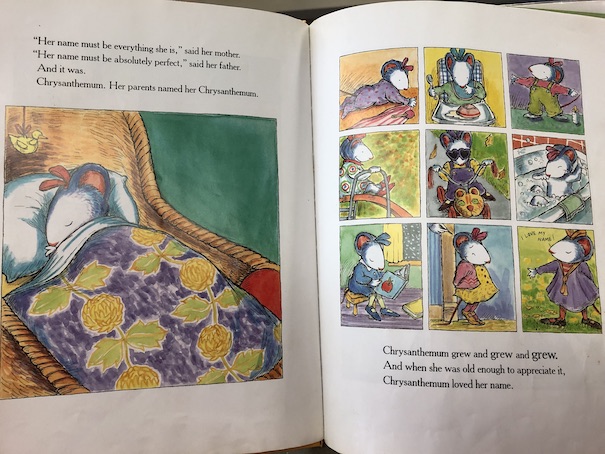
When little Chrysanthemum was born, her parents chose Chrysanthemum as her name because it just seemed perfect, as perfect as their little girl. As Chrysanthemum grew up, she loved her name, and she thought that it was perfect, too.
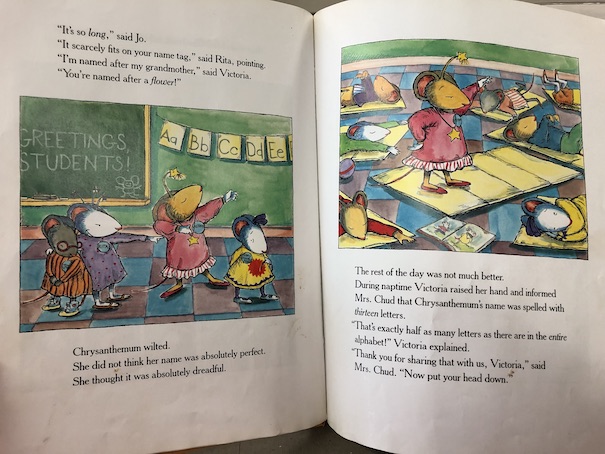
However, when Chrysanthemum starts school, the other kids point out how unusual her name is. Most of them have much shorter names. Chrysanthemum’s name is so long that it doesn’t really fit on her name tag. One girl, Victoria, is particularly mean about Chrysanthemum’s name, making fun of her whenever she can and encouraging other children to make fun of her.
For the first time in her life, Chrysanthemum starts hating her name. She wishes that she had a much shorter name, like Jane. Her parents comfort her and tell her that the other kids are probably just jealous, but their repeated teasing really bothers her.
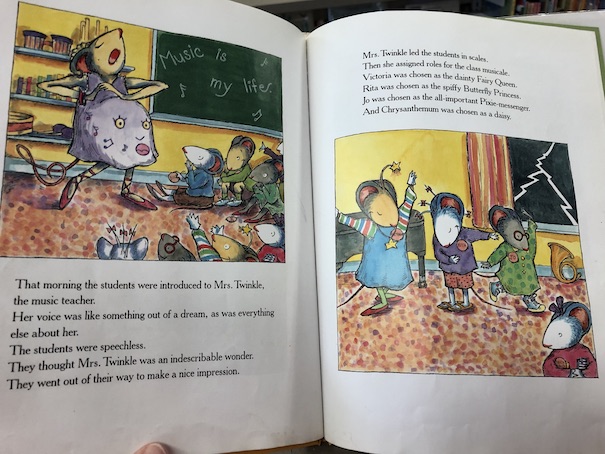
Then, the children have music lessons at school with Mrs. Twinkle. Mrs. Twinkle is a fun teacher, and the kids are excited about her class. She gives the children roles to play in a class musicale, and Chrysanthemum is cast as a daisy. When the other kids laugh about her playing a different type of flower, Mrs. Twinkle asks them what’s so funny.
The other kids explain about Chrysanthemum’s name and that they think it’s funny because it’s so long and weird. That’s when Mrs. Twinkle tells them that her first name is Delphinium – another long, unusual flower name! She says that she really likes the name Chrysanthemum, and since she’s expecting a baby, she might name the baby Chrysanthemum if it turns out to be a girl. Suddenly, the other girls in class envy Chrysanthemum and wish they had flower names, too!
In the short epilogue at the back of the book, the baby does turn out to be a girl, and Mrs. Twinkle names her Chrysanthemum. Chrysanthemum also gets a laugh at Victoria’s expense when the class puts on their musicale, and Victoria completely forgets her lines.
It’s a nice book, and I appreciate some of the messages now even more than when I first read it when I was a kid. Now that I’m an adult, I know that Chrysanthemum’s name isn’t the real reason why Victoria picks on Chrysanthemum. Victoria is mean basically because Victoria is a mean person. Kids who want to bully others make the decision to bully first and then pick something to bully about second. From what I’ve seen, they’re usually out to make fun of someone or make someone mad just to do it, and they don’t really care how or why. Chrysanthemum’s unusual name was just a convenient thing for Victoria to single out and use for her bullying. If she hadn’t had that name, Victoria would have picked on her (or maybe some other, more convenient target) for something else. Maybe it would have been someone’s clothes. Maybe it would have been the way someone walks or the way someone talks or their hair or their eyes or the fact that they have fingernails or breathe air or take up physical space … you get the idea. Victoria is the way she is because that’s what she is and what she wants to be, and she doesn’t see any need to change until the end of the story. (Even then, she may be back to bully again over something different because she hasn’t yet learned not to bully in general, just not over that particular thing.)
My point is that the way Victoria is has nothing to do with Chrysanthemum and her name. I’ve heard parents who are considering names for their children working hard to pick names that can’t be used for teasing, and sometimes, it can help. However, at the same time, bullies are basically going to bully because that’s who they are and what they do, and most importantly, it’s what they want to do. They’ll find something to bully about anyway because they’re always intentionally looking for something to bully about.
For a time, because of Victoria’s meanness and bullying, Chrysanthemum’s enjoyment of her name is ruined. She even feels like Victoria is destroying her sense of identity. At one point, she has a nightmare that she is actually a Chrysanthemum flower and that Victoria plucks her petals, picking at her and picking at her and picking at her until there’s nothing left. That’s the kind of effect that bullies have on people, which is why I have such contempt for them. They ruin things, even really fun and cool things like a colorful name, and make people unhappy just by being the kind of people they are. (If you’ve read my other reviews of books with bullies, you’ve already heard that I have very strong feelings about this subject and absolutely no patience or sympathy for bullies.)
But, fortunately, the book takes a very positive tone and points out that Chrysanthemum’s name is not really ruined by Victoria’s meanness. Chrysanthemum’s music teacher also has a really unusual flower name, and naming her baby Chrysanthemum as well gives Chrysanthemum new status among the kids at school, to the point where some of them, including Victoria, wish that they also had flower names of the kind that might inspire someone to name their baby after them. Mrs. Twinkle is a fun and different kind of teacher, and her fun and different name fits her personality. Although it hasn’t occurred to the other kids yet, the world would be a pretty drab place without colorful and unusual people. The Victorias and Janes of the world may have very proper names and are reassuringly ordinary, but the Delphiniums and Chrysanthemums are the ones who bring color and excitement to life. So, although I wouldn’t deliberately give a child a name that might leave them open to teasing, I don’t see a need to go overboard and reject some of the fun names that are just a bit unusual. Different is good, and it should be appreciated for what it is, not for what a bully may or may not be able to say about it when they’re trying to be mean. (They’ll find something else to bully and complain about two seconds later anyway, so why bother considering them for longer than that?)
Lilly’s Purple Plastic Purse by Kevin Henkes, 1996.
Lilly loves going to school, and she especially loves her teacher, Mr. Slinger. Everyone in class thinks that he’s great, and he inspires a lot of them, including Lilly, to want to be teachers themselves.
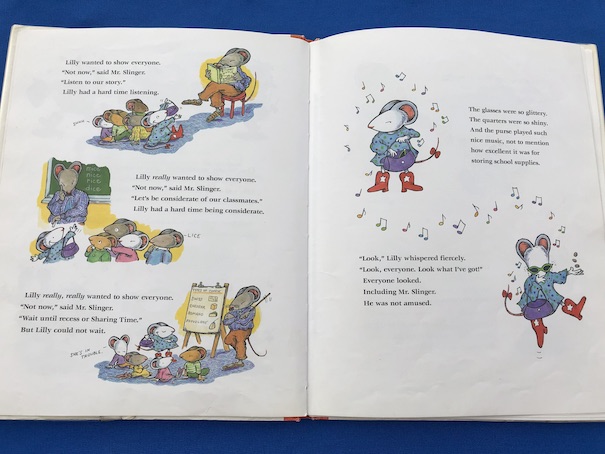
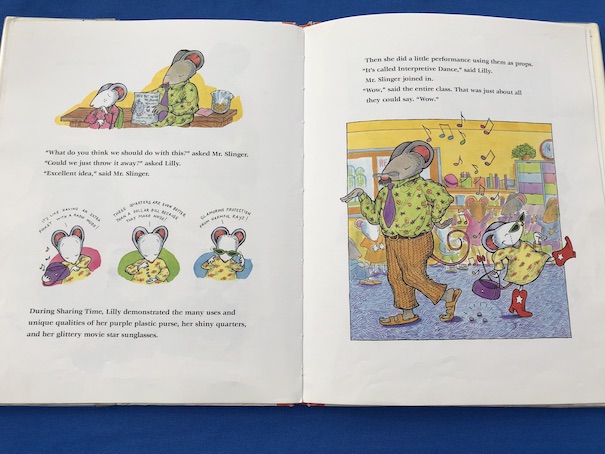
One day, after a special shopping trip with her grandmother, Lilly gains a some special new treasures: movie star sunglasses, some quarters, and a purple plastic purse that plays a tune when she opens it. Eager to show off her new things to her friends, Lilly brings them to school. However, she just can’t wait until recess or Sharing Time to show everyone. She keeps trying to draw attention to these things while the teacher is talking and opening the purse so it keeps playing its tune.
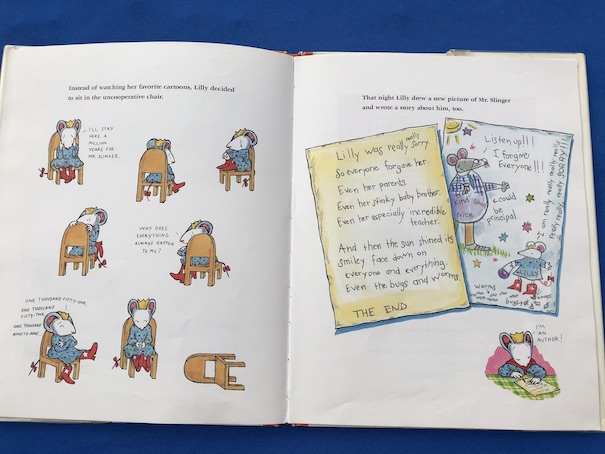
Finally, after repeated warnings, Mr. Slinger is forced to confiscate Lilly’s purse with its other treasures. Lilly is hurt and feels betrayed by her favorite teacher. Sad and angry at having her treasures taken from her, she draws a mean picture of her teacher as a purse thief, leaving the picture where she knows he will find it.
However, Mr. Slinger isn’t as mean as Lilly thinks that he is when he takes her purse. After he gives the purse back to her, she discovers a nice note from him inside, telling her that tomorrow will be a better day, and there’s even a little bag of snacks. Now, Lilly feels guilty about her mean picture. It’s too late to get it back, and she worries that her teacher will never forgive her.
The story is really good at showing how Lilly’s emotions change through the course of the day and how her sadness and anger grow more urgent the more she thinks and worries about them. It’s a good story to use when talking about feelings with young children (through the course of the story, Lilly is happy, excited, sad, betrayed, angry, guilty, worried, and embarrassed – some of these are stated explicitly and some are more implied) and how to deal with emotions. Adults can talk to children how one kind of emotion can lead to another (like how Lilly’s sadness turns to anger at her teacher for making her feel sad by confiscating her purse) and how some ways of dealing with emotions are better than others. It is both creative and appropriate that Lilly used her drawing ability to both insult her teacher and, later, apologize to him.
Fortunately, both Lilly’s parents and her teacher are very understanding. Her parents reassure her that her teacher will forgive her. Lilly draws a new, nicer picture of her teacher to go with her apology to him, and her parents give her some snacks to give to him as well. He does forgive her, and she finally gets to show everyone her amazing purple plastic purse at Sharing Time (being careful not to disturb anyone with them at other times.
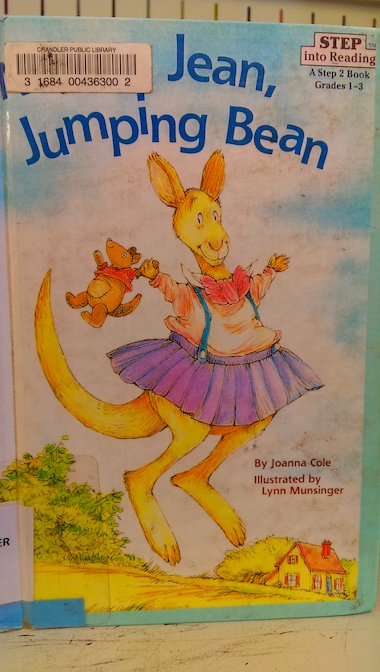
Norma Jean, a kangaroo, loves to jump! She goes hopping and jumping everywhere, all the time.
It’s pretty normal for a young kangaroo, but it sometimes causes problems. She keeps wanting to jump when her teacher wants her to sit still and and listen. Sometimes, accidents happen because she’s jumping around.
Without meaning to, she sometimes plays too rough with her friends because she has so much energy. One day, when her friends stop wanting to play with her after a series of disasters, Norma Jean decides that the only thing to do is to give up jumping. It makes her sad, but she doesn’t want to be thought of as a rough, clumsy klutz, who can’t sit still – a jumping bean.
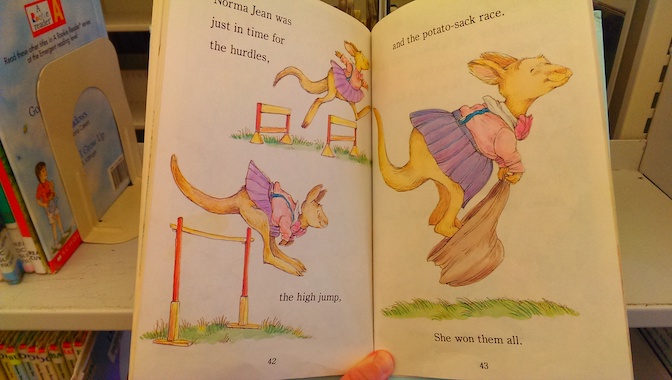
But, with the school’s field day coming up, Norma Jean realizes that jumping is okay, at certain times and certain places.






















 Jestress's Forgotten Books and Stories