Mrs. Armitage on Wheels

ArmitageWheels

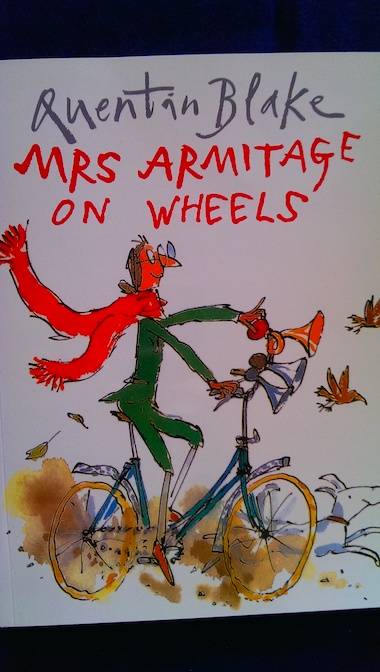
Mrs. Armitage on Wheels by Quentin Blake, 1987.

Mrs. Armitage loves to ride her bicycle with her dog, Breakspear, running alongside.  However, she sometimes runs into difficulties that require some minor repairs to her bike, and she can’t resist the urge to tinker further.

The more she thinks about it, the more ideas for improvements she has.  Each idea starts with the words, “What this bike needs . . .”

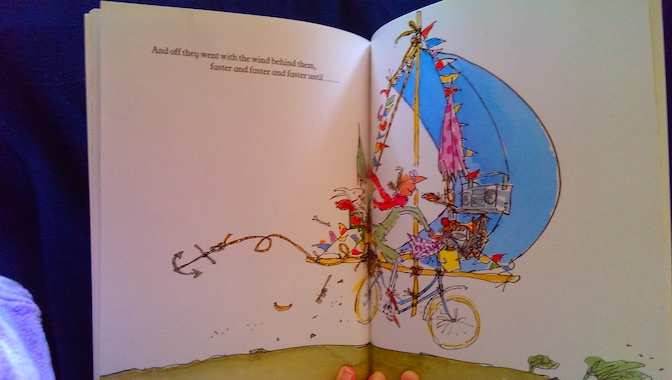
But, Mrs. Armitage goes well beyond what the bike really needs.  Beyond adding a seat for her dog and room for her lunch, she gradually turns her bicycle into a crazy, unwieldy contraption.

ArmitageWheelsSail

Was adding the sail and anchor where she went too far, or did she reach that point long before?  Even after she trades what’s left of her bike for some skates, one has the feeling that her tinkering is far from over.

The book is available to borrow and read for free online through Internet Archive.

ArmitageWheelsSkates

Roxaboxen

Roxaboxen

Roxaboxen by Alice McLerran, illustrated by Barbara Cooney, 1991.

This story is based on reminiscences from the author’s family about the games they and their friends played when they were children in Yuma, Arizona. The section in the back about the author and illustrator explains a little about it. The author was born in 1933. Her Aunt Frances (one of the children named in the story) was 80 years old when the creators of the book were writing the story and drawing the pictures, so she was born around 1910. That means that the children in the story probably made up their imaginary town and played in it in during the late 1910s and into the early 1920s. The clothes that the children wear in the pictures appear to be from around that time as well (some of the girls have dresses with dropped waists, and some of the children wear sailor-style outfits).

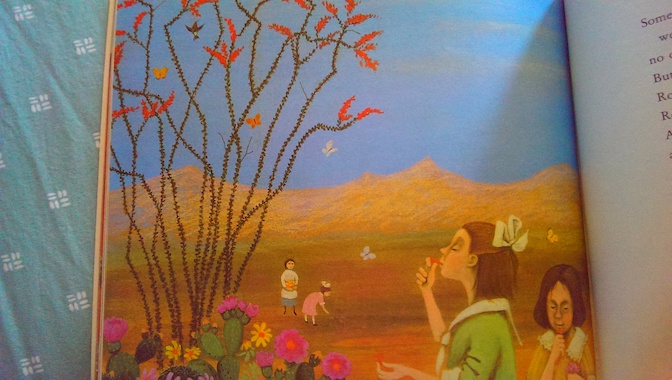
One of the great things about this book is the power of imagination. Readers are not only taken back in time to someone’s remembered childhood, but to the place that the children invented: a town that both isn’t there but yet always is because of the imaginations of the children who once played there.  The pictures in this book are beautiful!

RoxaboxenDesertBeginning

A group of neighborhood friends living in a small town in Arizona play games on the edge of the desert. They make a town of their own from stones and old boxes and other things they find, naming it Roxaboxen. Marian, one of the oldest children, names the town and becomes its mayor.

RoxaboxenMayor

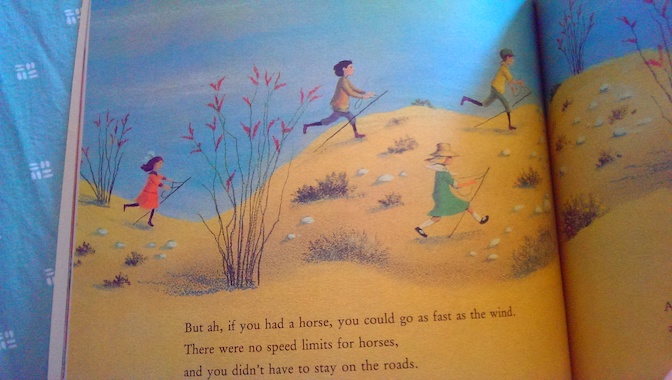
Using stones, the children outline the streets, houses, and shops of their town. They sell things to each other, using little black stones for money, and decorate their “houses” with old bottles and bits of broken glass in different colors. Using other things they find, the kids pretend that they have cars and horses. There are rules against speeding in their “cars”, so they also appoint a policeman and create a “jail.” Sometimes, they have “wars”, boys against girls.

RoxaboxenHorses

Time passes, but the children continue to play in Roxaboxen year after year, adding to the town and its lore. Even years later, when they’ve grown up and have moved to other places, Roxaboxen still lives in their minds. In a way, they said that their imaginary town always existed, just waiting for those with the imagination to see it, and through the story and illustrations in the book, it now draws in those who read about it but have never seen it themselves.

RoxaboxenOcotillo

Another great thing about the book is the sense of freedom that the children have. Many modern children wouldn’t be able to go out on the edges of their town and build something for themselves in the same way that the children in the story did. Although, in the freedom of their own minds and their own backyards, maybe some kids are building their own Roxaboxens as we speak.

The book is available to borrow and read for free online through Internet Archive (multiple copies, including one in Spanish and a video reading).

RoxaboxenFrances

Mailing May

MailingMay

Mailing May by Michael O. Tunnell, 1997.

Four-year-old Charlotte May lives in a small town in Idaho in 1914. May, as her family calls her, wants to visit her grandmother in another town, but travel during this time is difficult and expensive. With a lack of roads that are easy to travel, the only comfortable way to get to May’s grandmother’s town is by train. Unfortunately, May’s family can’t afford to buy a train ticket for her.

MailingMayParents

May wants so badly to go see her grandmother that she even asks at the local general store if the owner can hire her, but he doesn’t have any work that a little girl could do.  Then, May’s mother’s cousin helps the family to find a more affordable alternative. If May can’t travel as a passenger, is it possible for her to travel as . . . mail?

MailingMayPostOffice

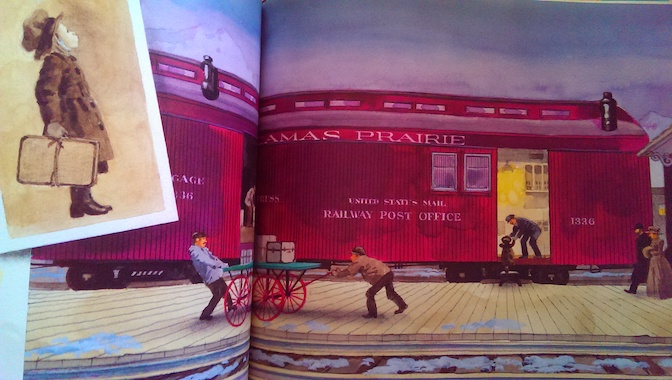
It turns out that the rate for mailing a live package the size of May is much cheaper than the fee for a passenger ticket.  Because May’s mother’s cousin works in the mail car on the train, he could take responsibility for her during the trip.  So, with a label on her clothes, declaring her to be “baby chicks” and the proper postage stuck to her jacket, May undertakes the journey to her unsuspecting grandmother’s house.

MailingMayTrain
MailingMayMailCar

This story was based on a real incident. In fact, May wasn’t the only child to be sent through the mail when their parents couldn’t afford to send them as passengers. I also like the book for its glimpse at travel and mail services over 100 years ago.

The book is available to borrow and read for free online through Internet Archive.

MailingMayGrandmother

The Mysteries of Harris Burdick

HarrisBurdick

The Mysteries of Harris Burdick by Chris Van Allsburg, 1984.

Harris Burdick isn’t exactly a mystery story, not even really a story exactly, but it is mysterious.  Most of the book is pictures, and that’s kind of the point.  The premise of the book is that a mysterious stranger known only as Harris Burdick approached a publisher about some stories that he had written and illustrated.  As examples of his work, he gave the publisher a collection of illustrations he had done for each of his stories with accompanying captions.  The publisher loved the illustrations, but Harris Burdick didn’t keep his appointment to bring in the complete stories the next day.  When the publisher tried to contact him about the stories, he was never able to find Harris Burdick and never heard from him again.  However, the publisher continued to be intrigued by the pictures and wondered what the stories were like, so his children and their friends wrote their own stories about them.  The pictures are therefore presented as a collection, and readers are invited to imagine the stories that they are part of.

HarrisBurdickAnotherPlace

I remember one of my teachers using this book as part of a writing exercise, having us each choose a picture and write the accompanying story as we imagined it.  Over the years, I’ve changed my mind about which picture is my favorite.

HarrisBurdickLibrary

I thought for awhile that “The House on Maple Street” could have inspired the author himself in writing Zathura, the sequel to his other book, Jumanji, although there is apparently no direct link between the two.

HarrisBurdickHouse

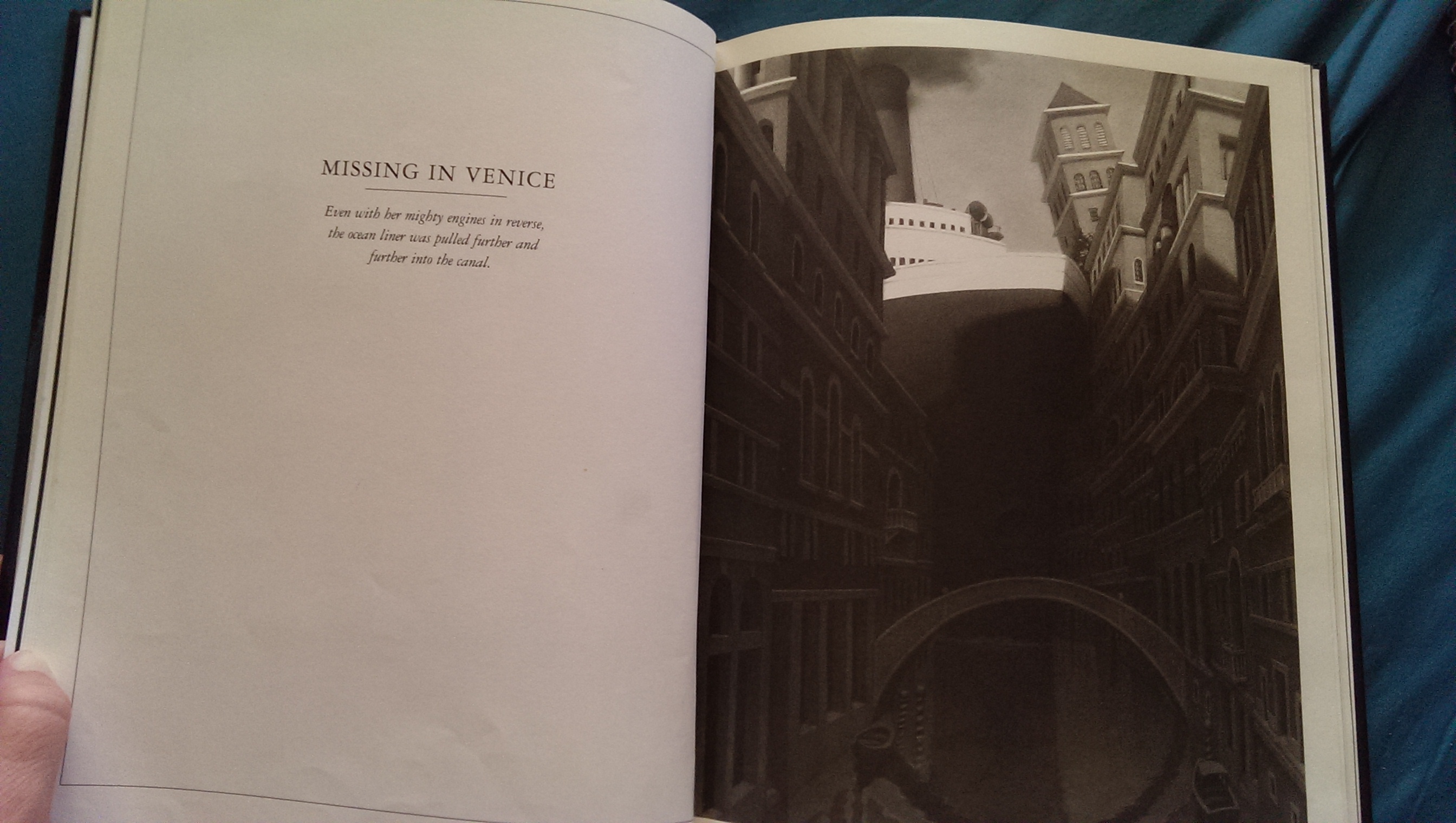
The book is currently available online through Internet Archive.  There is also a collection of stories called The Chronicles of Harris Burdick in which well-known authors present their own versions of each of the stories.

HarrisBurdickVenice

Zathura

Zathura

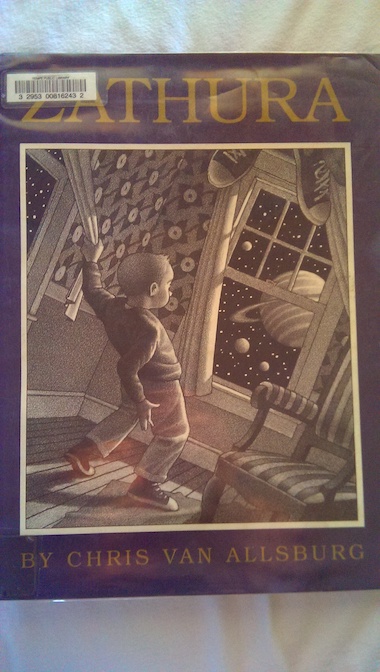
Zathura by Chris Van Allsburg, 2002.

This book begins where Jumanji ends. It’s not completely a sequel because it has a different set of children and a new game, but it’s connected because the two children from Jumanji left the board game in the park again after they finished it, and they saw two boys that they know pick it up and take it home.

ZathuraBrothersWrestling

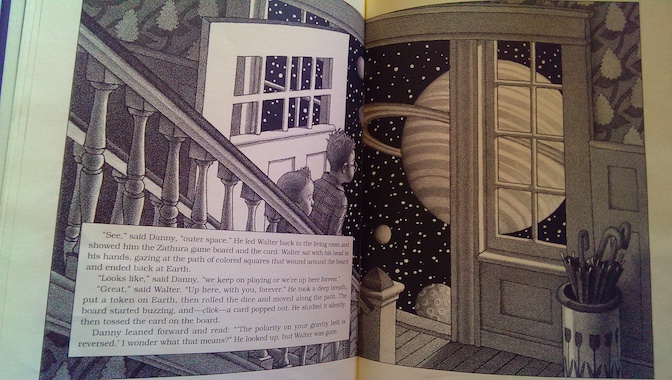
However, the two boys, Danny and Walter, don’t end up playing the same jungle board game, Jumanji, that was in the previous book. They find a second board game in the Jumanji box called Zathura and decide to try it instead. Zathura is a space-themed game where players travel a path from Earth to the planet Zathura. Like in Jumanji, elements from the board game come to life as the boys play, and someone must reach the end in order to end the game.

ZathuraStartingGame

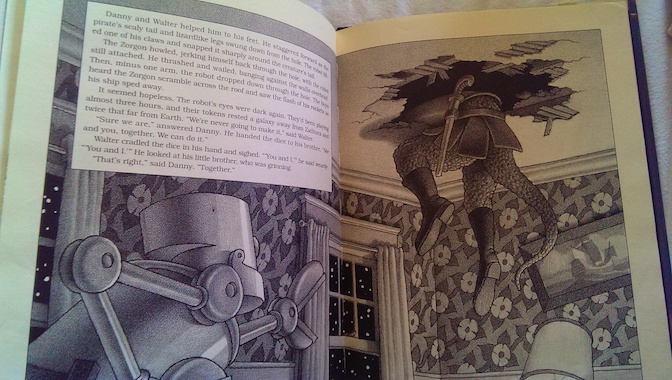
Danny and Walter, a pair of brothers, fight a lot. Walter hates doing things with Danny. However, when Danny starts playing the game, sending their house into outer space, Walter must join in and play with his brother in order to bring the game to an end so they can go home. The two of them learn teamwork as they help each other face the dangers of the game while trying to reach Zathura.

ZathuraOuterSpace

There is a movie version of this book, but there are major differences between the original book and the movie. The conflicts between the two boys are similar in the book and the movie, but the movie added a subplot about the boys’ parents being divorced (they weren’t in the original book), an older sister for the boys (it was just the two of them originally), and a kind of alternate reality where the older boy was trapped in the game by himself for years because he wished his brother away before finishing the game until his alternate self realized that he cared about his brother and wanted to cooperate with him.  In the original book, nobody was trapped in the game.

ZathuraAlienRobot

Chris Van Allsburg illustrations are always good, although I have to admit that I preferred the illustrations in Jumanji to the ones in Zathura.  It just seems to me that the pictures in Jumanji were more detailed and realistic.

The book is currently available online through Internet Archive.

ZathuraGoingHome

Jumanji

Jumanji

Jumanji by Chris Van Allsburg, 1981.

Judy and Peter, a brother and sister, are left home alone while their parents go to an opera. In spite of their parents’ warning not to make a mess because they’ll be bringing guests by later, the kids scatter all of their toys around while playing. Then, the kids go to the park to play for awhile, and they find a board game labeled Jumanji with a note that the game is free to anyone who wants to play it. Judy and Peter decide to give the game a try and take it home.

JumanjiPark

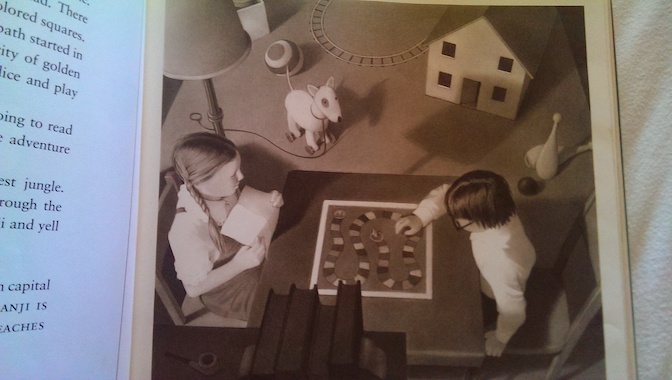
Jumanji turns out to be a kind of race game. Players are supposed to make their way down a path through a jungle, facing all kinds of dangers, until someone reaches the golden city of Jumanji. The instructions warn them that once a game has begun, it will not be over until one of the players reaches Jumanji.

JumanjiGameStart

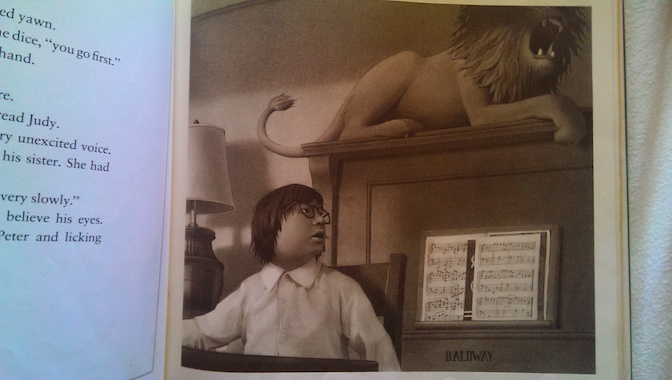
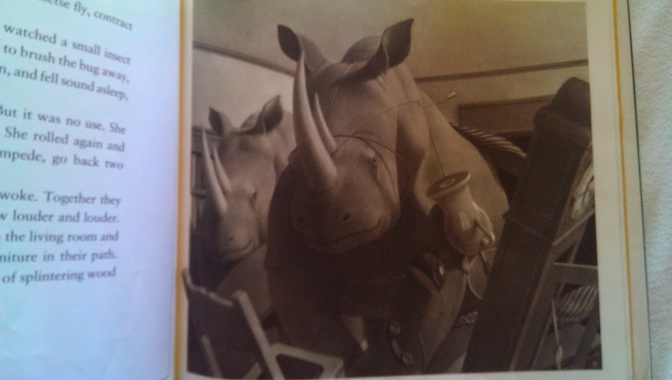
At first, Peter thinks that the game is boring and easy, but it soon becomes apparent that things that happen in the board game are starting to happen in real life when a live lion suddenly appears after an encounter with one on the game board.  Peter is scared and wants to stop playing, but Judy reminds him that they can’t stop because the game won’t end until one of them reaches the end of the path on the game board. Until the game ends, they’re stuck with the lion and anything else that happens to appear because of the game. They have no choice but to keep playing, facing each danger as wild animals rampage through their house.

JumanjiLion

Chris Van Allsburg books always have amazing illustrations, and the pictures in this book are especially good!  At the end of the book, the children see two other children find the game, which leads to the sequel, Zathura.

JumanjiRhino

There is a movie version of this book, but the movie differs greatly from the original story. In the movie, the two kids were friends, not brother and sister, and the boy ends up trapped in the game for a period of years until, finally, a new set of kids starts playing and helps the original players to finish their game.  When their game ends, the original children are returned to their own time, and no one but them knows that they were ever gone.  Things turn out better for the future children as well because the older players make things better for everyone in their own time.  There were no players stuck in the game in the original book, and everything takes place during a single day.

The book is currently available online through Internet Archive.

JumanjiParents

Hester the Jester

HesterJester

Hester the Jester by Ben Shecter, 1977.

This cute picture book takes place in a Medieval kingdom.  Little Hester’s father is the court jester.  Then, Hester decides that she wants to be a jester, too.  At first, Hester’s parents tell her that she can’t because she’s a girl.  (If you’re thinking that you know where this story is headed, wait.)

One day, the king is so sad that Hester’s father can’t cheer him up, no matter what he does.  When Hester starts putting on her jester act for her father and makes him happy, he decides to go ahead and have her perform for the king.  Hester does cheer the king up, but that isn’t the end of the story.

Hester tells the king that she has discovered that she doesn’t like being a jester after all because it makes her feel too silly.  So, the king, now in a much better mood, asks her what she would like to do instead.

This starts a sequence where the king allows Hester to try out various roles and see if she likes them.  She tells him that she wants to be a knight because knights are important, but she ends up not liking that when she learns that knights have to go into battle.  Then, Hester decides that being a king is even more important, so the king decides to let her try it.  But, Hester isn’t good at giving other people wise advice, as the king does.

HesterJesterKnight

In the end, when Hester’s mother is sad and doesn’t know what to do now that her daughter has become a king, Hester decides that what she most wants to do is to go home and be her little girl again.

In a way, this book seems like two little stories in one.  First, there’s Hester proving that she can be a jester even though she’s a girl, and then, there’s Hester trying to decide what she really wants to be the most, now that the king is letting her try anything she wants.  What she decides that she wants most is to be herself and go home.

So, is this little book anti-feminist, saying that girls are better off just forgetting about the other stuff they might want and staying girls?  I don’t think so.  Basically, this is just a silly little story about a little girl, one too young to have a profession of any kind, who is allowed to see the realities behind some of the things she’s been wanting to try.  Some parts, she likes, and some she doesn’t.  But, she’s too young and inexperienced for all of them (and some, she will never want to try again because she’s learned that they’re not what she really wants after all), so she’s just going to be what she is: a little girl with plenty of time to grow up, who needs her mother and whose mother needs her.  All throughout the book, Hester speaks her mind about what she wants and is honest about the things she doesn’t like, admitting when she changes her mind.  As for what might happen when Hester grows up and finds something else she might want to do . . . who knows?  By then, she may be willing to try new things again.  But, she knows what she wants for now and has a little better idea of some things that she won’t want in the future.
The book is currently available online through Internet Archive.
The Surprise Doll

SurpriseDoll

The Surprise Doll by Morrell Gipson, 1949.

Mary is a little girl who lives by the sea. Her father is the captain of a ship, and he travels to different countries all over the world. Sometimes, he brings presents for Mary from his voyages. So far, he has brought six dolls for her:

SurpriseDollTeresaSusan – from England, with rosy cheeks

Sonya – from Russia, with a cute turn-up nose

Teresa – from Italy, with brown eyes

Lang Po – from China, with raised eyebrows

Katrinka – from Holland, with blonde hair

Marie – from France, with a smile that brightens her whole face

Mary loves her dolls, but she realizes that if she had a seventh doll, she would have a doll for each day of the week. She asks her father if he will bring her another, but he says that she already has enough dolls.

When her father refuses her request, Mary pays a visit to the local dollmaker. She takes along her six dolls and explains to the dollmaker why she wants one more. After studying Mary and her dolls, the dollmaker agrees to make one for her as long as she’s willing to leave her other dolls with him for a week. At the end of the week, Mary returns to collect her new doll and receives a surprise!

SurpriseDollDollmaker

The “surprise” isn’t much of a surprise to the readers because the “surprise doll” is shown on the cover of the book, but it’s a cute story about how people around the world have many things in common. What the dollmaker notices about Mary and her dolls is that Mary shares certain qualities with each doll, the ones listed in the dolls’ descriptions above. So, he makes a doll for Mary that looks just like her by using her other dolls and their shared features as models. Her new doll, Mary Jane, is an American doll, but she has features in common with Mary’s other dolls from around the world, just like children in America can share qualities with children in other places. It’s a soft message about diversity and finding common ground.

SurpriseDollSeventhDoll

The Biggest, Most Beautiful Christmas Tree

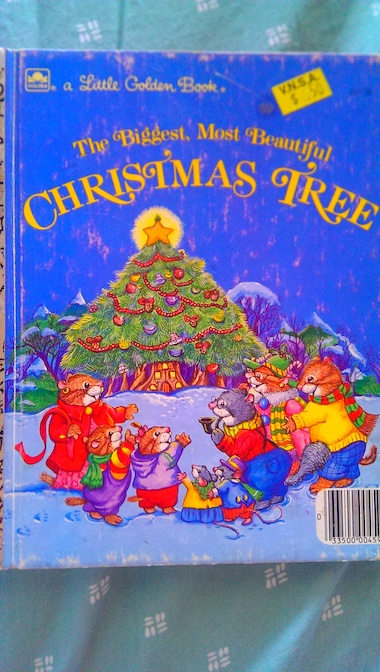
BiggestChristmasTree

The Biggest, Most Beautiful Christmas Tree by Amye Rosenberg, 1985.

This is a Little Golden Book.

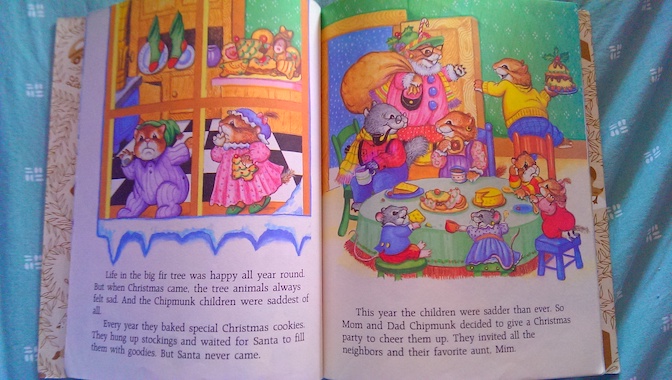
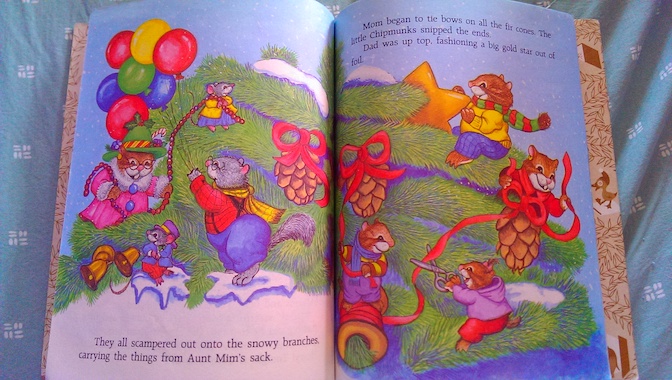
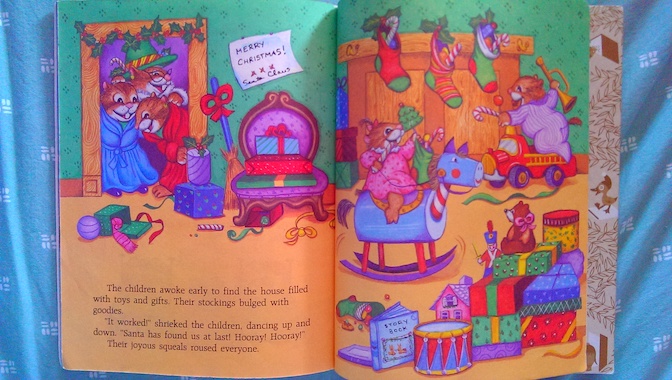
Every year at Christmas, the Chipmunk children, Nina and Nutley, are disappointed because Santa doesn’t visit their home in a large fir tree in the forest.  They always hang up their stockings and put out cookies, but for some reason, Santa never comes.

BiggestChristmasTreeDisappointment

However, this year, their Aunt Mim has figured out the reason why Santa passes them by and what to do about it.  Aunt Mim has realized that Santa can’t find their tree because it looks like every other tree in the forest.  What they have to do is to decorate their tree so that Santa can find it among all the others.

Aunt Mim brings lots of things they can use as decoration, and all of the other animals who live in the tree help with the decorating.  They tie bows on the pine cones, hang strings of berries, and paint balloons to look like large Christmas tree ornaments.

BiggestChristmasTreeDecoration1
BiggestChristmasTreeDecoration2

Sure enough, once Santa knows how to find the Chipmunk children, they get the kind of Christmas they’ve been waiting for!

BiggestChristmasTreePresents

This is just a cute picture book that I liked when I was young.  It is available to borrow and read for free online through Internet Archive.
The Legend of the Bluebonnet

LegendBluebonnet

The Legend of the Bluebonnet by Tomie dePaola, 1983.

This is a story about the Comanche People in what is now Texas, based on an old folktale.

There has been a severe drought and famine in the land for a long time, and many people have died.  The survivors pray to the spirits for help in ending the drought, and they receive a sign that it will not end until someone among the Comanches makes a sacrifice of the thing that is most dear to them.

LegendBluebonnetShaman

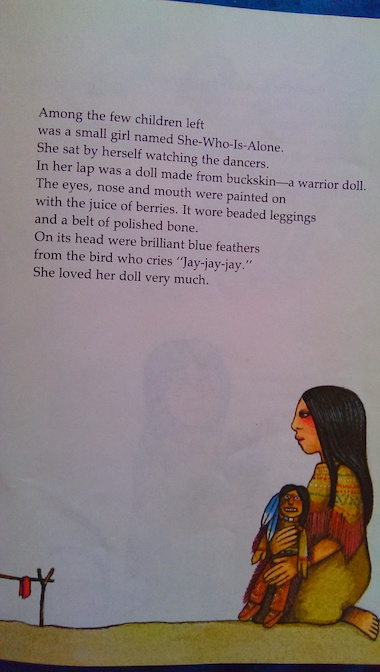
The people debate about who is supposed to make the sacrifice and what object the spirits could want, but one young girl thinks that the spirits are talking about her and her doll.  The girl is called She-Who-Is-Alone because she is the last of her family.  Her parents and grandparents are dead, victims of the famine.  The only thing she has left to remind her of them is her doll, a warrior with blue feathers in its hair, that her parents made for her before they died.

Desperate to end the drought and famine and to save her people, the girl makes the difficult decision to sacrifice her doll by burning it.  Her sacrifice is rewarded not only by the end of the drought but by the sudden appearance of a field of flowers as blue as the feathers in her doll’s hair.  The girl receives a new name from her people, acknowledging her sacrifice on their behalf.

LegendBluebonnetFlowers

A section in the back of the book explains a little about the Bluebonnet flower, which is the state flower of Texas, and the origins of the story in the book, which is based on a folktale.  This is also a little information about the Comanche People.

The book is currently available online through Internet Archive (multiple copies).