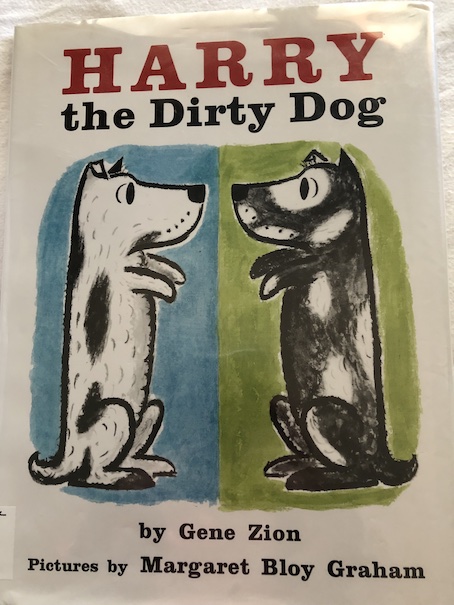
Harry the Dirty Dog by Gene Zion, pictures by Margaret Bloy Graham, 1956.
Harry, like other dogs, hates baths! One day, when he finds out that his family is about to give him a bath, he decides to steal the scrub brush! He buries the scrubbing brush in the yard and runs off into the city to have some fun and get good and dirty!
Normally, Harry is a white dog with black spots, but after a day playing with other dogs and running through construction areas in town, he’s so dirty that he looks like a black dog with white spots.
Eventually, he gets tired and hungry and misses his family, so he goes home. However, he has trouble getting his family to recognize him because he’s so dirty. Even when he does his usual tricks for them, they still don’t think he looks like their Harry.
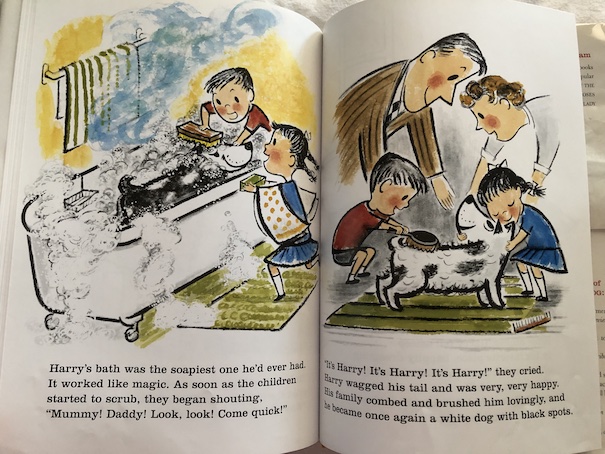
At first, Harry fears that he’s lost his family because they don’t know who he is. Then, he realizes that what he really needs is the scrub brush and a good bath! He digs up the scrub brush again and manages to persuade his family to give him a bath.
Once he’s clean, his family recognizes him. Harry sees the benefits of getting a bath, but he still doesn’t really like them, and he still enjoys the thought of getting nice and dirty again.
The book is available to borrow and read for free online through Internet Archive (multiple copies).
My Reaction
Dogs in real life often don’t like baths, and this whimsical picture book is about a dog discovering the benefits of a bath. When I was a little kid and I first saw this book, I was really worried that Harry would lose his family because they didn’t recognize him, but really, the family would have to be pretty dense for thinking that this dog, which looks like the same breed/mix as theirs and acts like theirs and does all the tricks their dog does but is just covered in dirt, must be a completely different dog. The story is just meant to be humorous, and it’s questionable in the end whether any lessons are learned. Yes, Harry now sees that getting a bath and being clean help his family to recognize him, but he still dreams about getting dirty, and he’s hiding the scrub brush under his bed. My dog also hates baths and fears the groomer, but I have assured her that I would still know her anywhere!
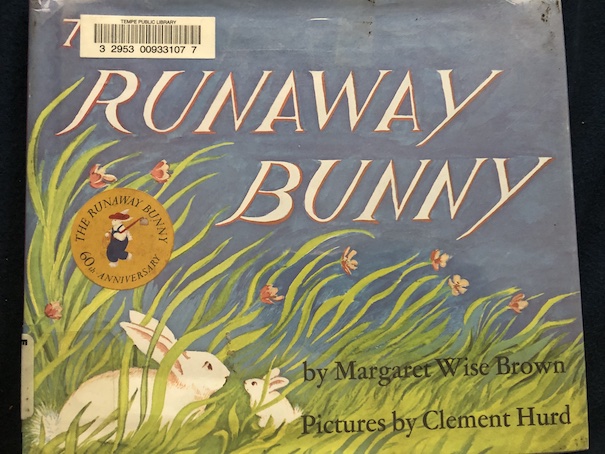
The Runaway Bunny by Margaret Wise Brown, pictures by Clement Hurd, 1942.
A little bunny tells his mother that he’s thinking about running away, but his mother assures him that, no matter where he goes or what he does, she would always come after him because he’s her little bunny, and she loves him.
The pictures where the little bunny talks about all of his ideas for running away and evading his mother and where his mother explains what she would do to follow him are in black-and-white.
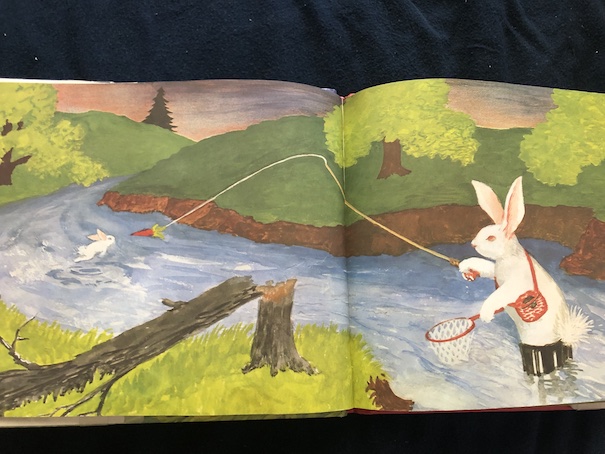
However, there are large, full color pictures after each of these sections showing what would happen as the mother follows her little bunny.
The little bunny’s plans for running away become increasingly imaginative and outlandish, from going up a mountain and joining the circus to transforming himself into a fish, a bird, or a sailboat.
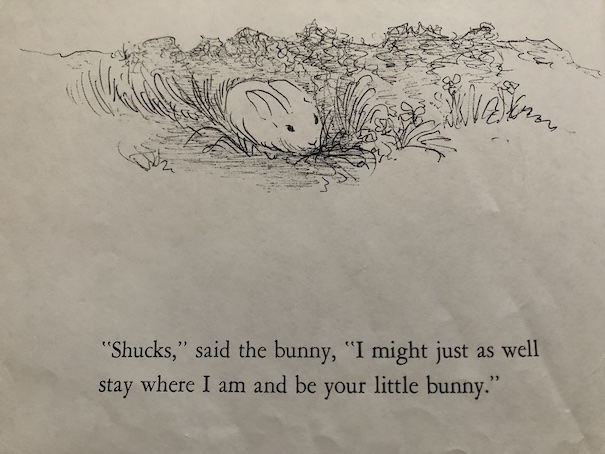
No matter what the little bunny thinks of for running away and changing himself into something else, his mother assures him that she would find a way to come after him and be there for him. In the end, the little bunny decides that he might as well stay with his mother, just as they are.
The book is available to borrow and read for free online through Internet Archive (multiple copies).
My Reaction
This is a very well-known and much-loved book about parental love and the lengths that parents will go for their children. The mother bunny is determined to be there for her child, even when the child wants to run away. We don’t know why the little bunny was talking about running away from his mother, and without that, it seems just like the little bunny was just trying to provoke his mother to find out how much his mother loves him. When she tells him all the things she would do to reach him if he ran away, he seems reassured and content to remain her little bunny.
This book was originally published during WWII and is a calm and reassuring story that probably comforted many children living through unsettling times. It has never been out of print since its original publication.
The author and illustrator of this book also later wrote and illustrated Goodnight Moon. The scene where the little bunny imagines himself as a boy in a house and his mother says that she would still be his mother reminds me of the illustrations in that book, and I wonder if the mother and child rabbits in that book came from this one.
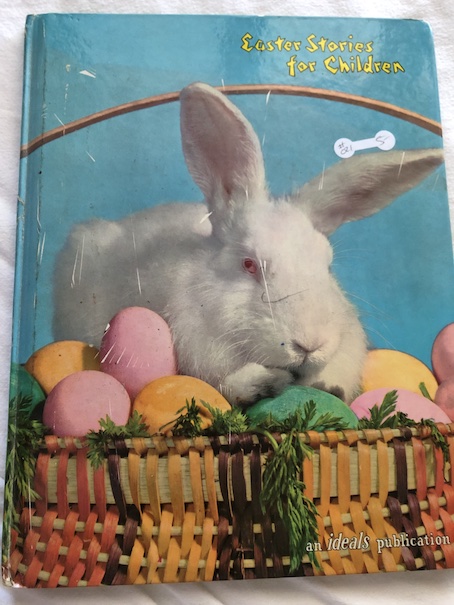
Easter Stories for Children edited by Van B. Hooper, 1962.
This book was published by Ideals, and if I remember right, is part of a series of holiday/seasonal books for children. (I don’t have a list of other books in the series, though.) It has short stories and poems about Easter. Largely, they’re not very religious in tone, tending to focus on fairies and the Easter bunny. I actually found all the references to fairies confusing because I never heard anybody talk about fairies being associated with Easter when I was a kid. On the religious side, there is one poem about prayer and a story about how the dogwood plant represents the crucifixion. There is also some information about how Easter is celebrated around the world.
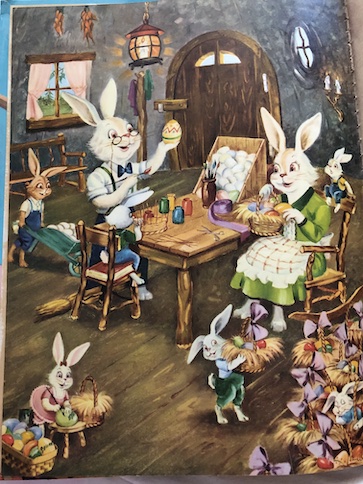
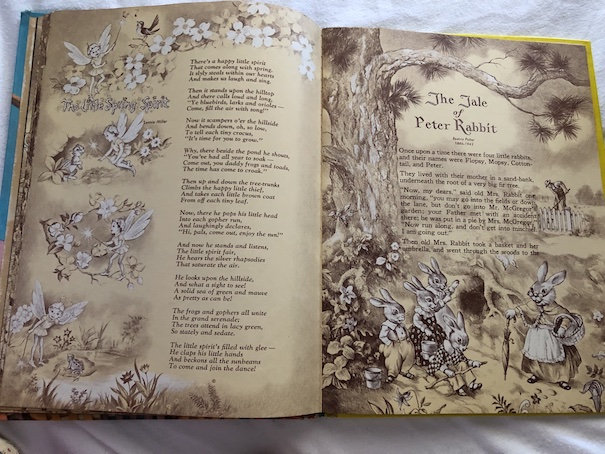
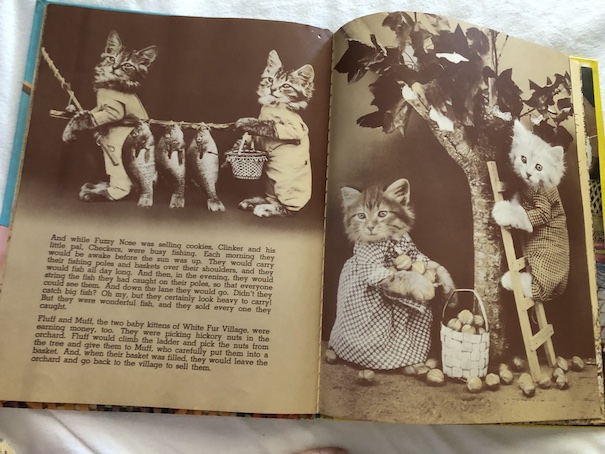
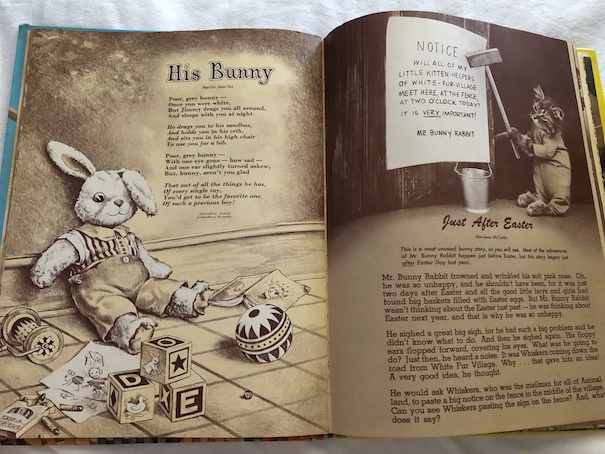
The pictures are in sepia tones. Mostly, they’re drawings, but there are also some photographs of cute bunnies and kittens wearing human clothes. The only full color pictures are on the inside of the front and back covers, and they’re scenes of rabbits painting Easter eggs. All in all, it’s a very cute book for Easter.
Stories:
How the Forest Fairies Get Ready for Spring – “Written especially for you by SPARKIE” – All of the forest fairies have special tasks for getting ready for spring.
The Tale of Peter Rabbit by Beatrix Potter (1886-1943) – A classic children’s story about a bunny who disobeys his mother.
Just After Easter by Maryjane McCarthy – Mr. Bunny Rabbit is worried about next Easter because the farmer is having trouble affording grain to feed his chickens. If he can’t keep the chickens, where will they get their Easter eggs? This is the story that has pictures of bunnies and kittens in costumes with props. The kittens try various ways to raise money for the chickens.
The Legend of the Dogwood – author unknown – The legend is that the cross of Jesus’s Crucifixion was made from dogwood, but the plant felt badly about it, so Jesus made the plant too small to be used for such a purpose again and gave it a cross-shaped flower.
Easter in Many Lands – About Easter customs in different countries, and the origins of the word “Easter” and how symbols like bunnies and eggs came to be associated with Easter. This is my favorite section in the book!
The Story of the Colored Easter Egg by “Maryjane” – A fairytale about a kind queen and the origins of Easter eggs.
Poems:
The Magic Pool by Dorothy Weiner – Bunnies color eggs in a magical pond fed by a rainbow.
Easter Bunny’s Secret by Mrs. Roy L. Peifer – The Easter bunny collects drops of paint that Jack Frost uses to paint leaves in autumn and saves them for Easter eggs, but when the paint gets spilled, he needs to get colors from other sources.
The Little Spring Spirit by Leonie Miller – The spirit of spring calls to plants and animals with the change of the season.
If Easter Eggs Would Hatch by Douglas Malloch – What would come out of an Easter egg? Brightly-colored chickens or maybe a little silver bunny?
In Cottontail Town by Marguerite Gode – A famly in Cottontail Town takes in an elderly rabbit and nurses him back to health. He starts a school there to teach the other rabbits how to paint Easter eggs.
The Gray Bunny’s Night – “As told by The big black Bumblebee” – A little gray bunny wants to be brightly colored for Easter, and his wish is granted by the queen of the fairies.
Hippety-Hop to the Barbershop by Claribel Ream – The Easter Bunny is going to the barbershop to deliver eggs and candy for the barber’s children.
Helping One Another by Mrs. Roy L. Peifer – The Little Red Hen helps the Easter Bunny to fill his basket for Easter.
His Bunny by Marilyn Jean Fais – About a little boy’s stuffed bunny. It can be hard on a toy to be a child’s favorite, worn and dragged everywhere, but it’s worth it!
Prayer by Ethel Romig Fuller – If we can hear songs from radio waves that travel through the air, God can also hear prayers.
Seed Thoughts by W. M. Walker – Good and kind thoughts produce good deeds, like plants sprouting from seeds, but selfish thoughts are like weeds that get in the way. Be careful what seed thoughts you grow in the garden of your mind!
Jack in the Pulpit by Mrs. Jessie S. Manifold – Spring plants and animals celebrate the Sabbath Day.
And He Hippety-Hopped Away by Rowena Bastin Bennett – The Easter Bunny delivers eggs and candy to children before sunrise.
Sniffy books or scratch-and-sniff books were a new development during the 1970s, and they remained popular through the mid-1980s, along with scratch-and-sniff stickers. This particular book features characters from Richard Scarry‘s Busytown series, especially Lowly Worm. The first part of the book has Lowly and his friend Huckle Cat looking at a sniffy book and teaching readers how to use the scratch-and-sniff parts of the picture.
The rest of the book takes readers through the four seasons: spring, summer, fall, and winter. In each season, there are different objects and foods associated with the season for readers to scratch and sniff. In the spring, the characters smell violets and bananas that they eat at the circus.
During the summer, there are lemons for making lemonade and chocolate ice cream sticks that they eat at the beach.
During the fall, there are apples and pumpkin pie at Thanksgiving.
The winter parts focus on Christmas, with pine-scented Christmas trees and gingerbread pigs.
My Reaction
Sniffy books and stickers were common features of my early childhood in the 1980s. I think they still exist, although I don’t know if they’re as popular in the 21st century as they were back when they were relatively new developments. This particular sniffy book was a favorite of mine and my brother when we were little kids.
One of the interesting things about finding some of these older sniffy books decades later is seeing which of the scratch-and-sniff patches have held up over the years. They do wear out over the time, especially the ones that have been scratched more than others, meaning that favorite scent patches will wear out faster. Milder scents are also harder to detect years later than the ones that were always strong. In our old copy of this book, I can’t smell the lemon, chocolate ice cream, pumpkin pie, or gingerbread any more, but the violet, banana, apple, and pine are still fine. I think those scents were always the strongest.
A small caterpillar hatches out of an egg and is very hungry. Each day, the caterpillar goes out looking for food, finding different things to eat.
Part of the book is a counting story, as the caterpillar eats different numbers of different types of fruit in different numbers. The format of this part of the book is really interesting because each of those pages isn’t a whole page but sections of pages that are different sizes, showing how the amount that the caterpillar eats increases each day.
Also, there are real holes in the pages to show where the caterpillar ate through different types of food. Kids like books with interesting physical features that encourage them to interact with the book as a toy as well as a story. I think that’s part of what has caused this book to have lasting appeal.
The book does also have a story to it about the growth and development of the caterpillar along with the counting part. At the end of the part that counts the number of pieces of fruit the caterpillar eats, the caterpillar eats a bunch of random junk foods and gives himself a stomachache. Eating a green leaf makes him feel better. By this point, the caterpillar is a fat caterpillar who is no longer hungry. At the end of the book, the caterpillar makes a cocoon and turns into a butterfly.
This is a cute picture book that is fun to show to very young children. The counting element is good both for teaching young children and for the children who have already learned to count because they can predict what the caterpillar is going to do next. The unusual format of those pages with the holes also makes the book distinctive.
On the 50th anniversary of the book in 2019, the BBC produced an article about the book’s history and its appeal to generations of young readers.
The book is available to borrow for free online through Internet Archive.
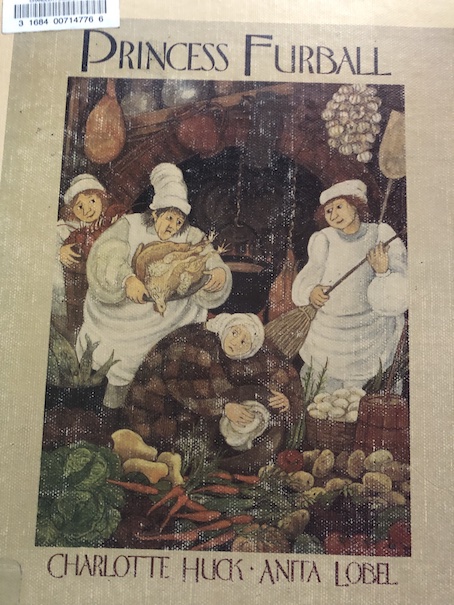
Princess Furball retold by Charlotte Huck, illustrated by Anita Lobel, 1989.
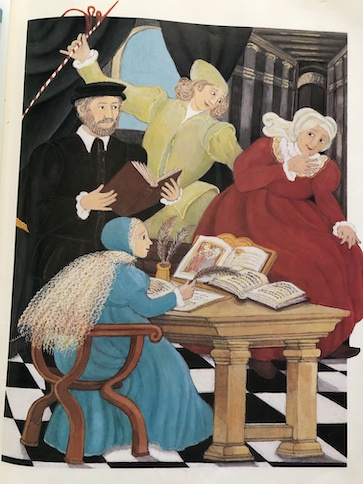
There was a princess whose mother died when she was only a baby and whose father never paid much attention to her. In spite of this misfortune, she had a happy childhood because her nurse loved her and let her play with other children. She arranged lessons appropriate to a princess with skilled tutors and let the princess learn how to cook in the royal kitchen.
However, when the princess was grown, the old nurse died, and the princess was very lonely. Her father only cared about the money he could get from the princess’s marriage, and to the princess’s horror, he arranged a marriage to an ogre who promised him fifty wagons of silver in exchange for the princess.
Unable to face the prospect of such a horrible marriage, the princess requests a special gift from her father for her wedding. She asks for three dresses: one golden like the sun, one silver like the moon, and one as sparkling as a the stars. She also asks for a special fur coat made of a thousand different types of fur. At first, the princess doesn’t think the king will be able to meet her demands, but to shock, he sets his people to accomplishing the task and presents her with everything she asked for.
Deciding that there is no other option but to run away, she takes the three dresses with her along with three small golden treasures that belonged to her mother: a ring, a thimble, and a tiny spinning wheel. She also takes along her favorite soup seasonings, which she got from the castle’s cook. Then, she puts on the bulky fur coat and flees into the woods.
In the woods, she is found by the hunting party of a neighboring king. At first, they mistake her for some kind of strange animal. When they find out that she’s a person, they take her back to their castle and put her to work in the kitchen. There, they make her do all the messy cleaning jobs. Nobody knows her real name, so everyone just calls her Furball after her strange, bulky coat made of a thousand patches of fur.
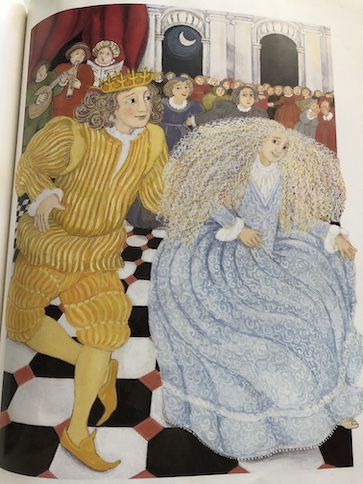
The princess always wears the fur coat as a disguise, but one day, she finds out that the young king of this kingdom is having a ball. She slips away from her kitchen duties and dresses in her dress like the sun. When she is unrecognizable as the kitchen servant, she is able to meet and dance with the king. Being herself is essentially a disguise!
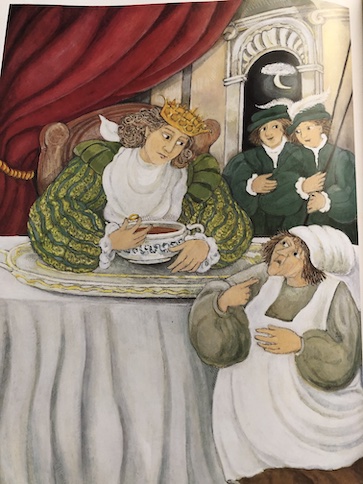
When she slips away from the king and returns to the kitchen, the cook has her make soup for the king, and she uses her special blend of seasonings. When no one is looking, she she also puts her golden ring into the king’s bowl. When the king finds the ring, he asks the cook about it. The cook admits that Furball made the soup, so the king questions her about the ring, but she doesn’t explain.
At the king’s next ball, the princess repeats the same performance, this time wearing the dress like the moon. This time, she slips the golden thimble into the king’s soup when she returns to the kitchen. Again, she doesn’t explain when the king questions her about the thimble.
As in many fairy tales, it’s the third time that’s the charm. When the princess shows up to a ball dressed her her dress like the stars and doesn’t have time to completely change when she gets back to the kitchen that all is revealed, and there’s a happy ending!
The book is available to borrow and read for free online through Internet Archive (multiple copies).
My Reaction
I remember reading this book when I was a kid in elementary school! I think I read it when I was about 7 years old, when the book was pretty new. I always liked fairy tales. There is a brief explanation at the beginning of the book that the story is a Cinderella variant. This version is very similar to the English folktale Catskin and to the tale of Many Furs or Thousand Furs by the Brothers Grimm.
Like so many little girls, I was fascinated as a kid with the concept of the dresses that resemble the sun, the moon, and the stars. The fur coat made of many animals is a little alarming to me now, but it makes a good disguise in the story. I love the illustrations that show the princess in all of her different dresses and the Furball disguise!
The story doesn’t explain why the princess put her treasures into the soup, but my guess was that she wanted an excuse to see the king again and a way to keep him intrigued about her identity and her relationship to the mysterious princess who keeps showing up to his balls. It’s only after the king decides that he really loves the mysterious princess that it’s safe to reveal her identity.
Cinderella translated and illustrated by Marcia Brown, 1954.
This is a retelling of the classic Cinderella story, translated from the French Perrault version by Marcia Brown, the author and illustrator of many other classic fairy tales and folktales for children.
As in the classic story, Cinderella is a girl with a cruel stepmother and a pair of spoiled stepsisters, who force her to do all of the work of the house and make her wear rags. Her father never stands up for her because he is too attached to his second wife to oppose her.
When it is announced that the king’s son is holding a ball and that the stepsisters are invited, they hurry to get ready, and they make Cinderella help them. Of course, nobody thinks that Cinderella should go to the ball, and the stepsisters laugh and tease her about it.
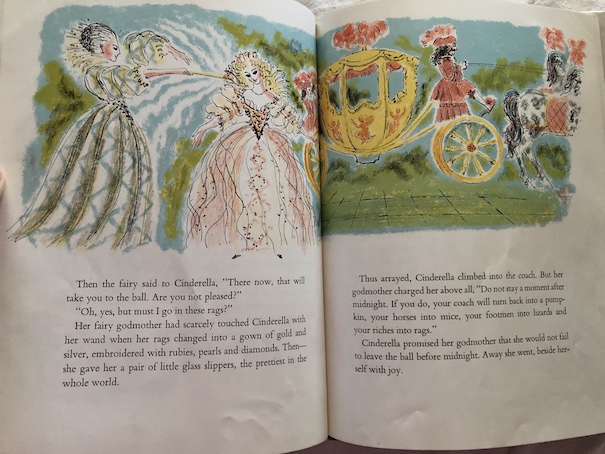
When they head off to the ball, Cinderella watches them go and cries. Then, her fairy godmother appears and tells her that she is going to help her. The fairy godmother turns a pumpkin into a fine coach, mice into horses, and a rat into a coachman. She gives Cinderella a beautiful dress to wear and a lovely pair of glass slippers. However, she warns Cinderella not to stay at the ball past midnight, when her magic spells will end, and everything will become what it was before.
At the ball, Cinderella charms the prince and has a wonderful time. She is even nice to her stepsisters when she encounters them. They don’t recognize her in her new finery. Everyone keeps wondering who the girl who appears to be a beautiful princess could be. Shortly before midnight, she leaves the ball abruptly and returns home before her stepsisters do. She tells her godmother everything that happened and that the prince invited her to a ball to be held on the next night.
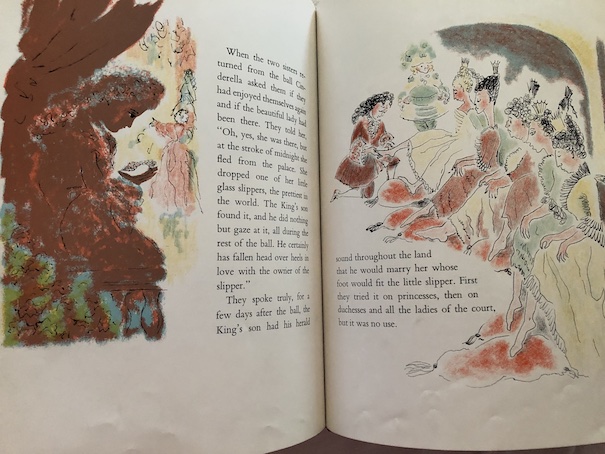
The next ball is also wonderful, but Cinderella loses track of the time and runs away suddenly when the clock begins to strike midnight. In her haste to get away, she accidentally leaves one of her glass slippers behind. The prince finds it and decides to use it to find this beautiful, mysterious girl he has already come to love.
Many young ladies try on the shoe, including Cinderella’s stepsisters, hoping that it will fit them. However, it will only fit Cinderella, and only Cinderella has the other slipper in the pair.
This is a Caldecott Medal Book. It’s available to borrow and read for free online through Internet Archive.
My Reaction
The story follows the classic Perrault version of the Cinderella story. There are many variations of this fairy tale, but this one is often the best-known. In some versions of the story, Cinderella’s father is also dead, which is why she is left at the mercy of her stepmother and stepsisters, but in this one, he is still alive and is just unconcerned about Cinderella’s treatment. He is never shown in any of the pictures and plays no role in the story.
I enjoyed the illustrations in this book. They’re an unusual style. Objects and people in the pictures are only party defined by pen lines. Many of their edges are more softly defined by color.
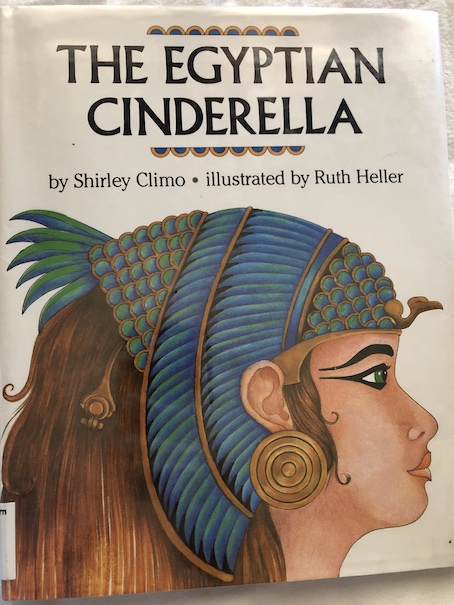
The Egyptian Cinderella by Shirley Climo, illustrated by Ruth Heller, 1989.
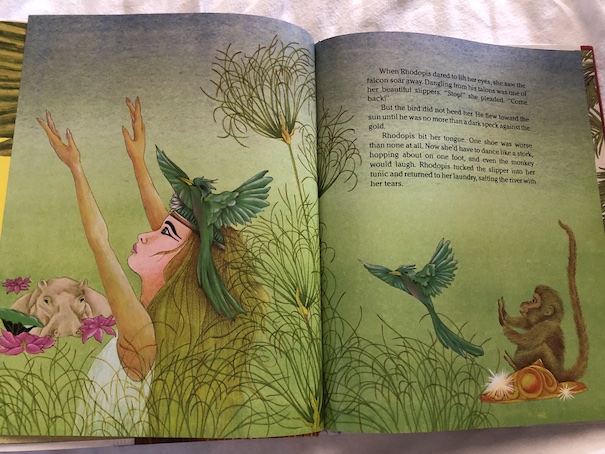
Rhodopis is a slave girl in Egypt. When she was young, she was abducted from her home in Greece by pirates, who sold her into slavery. Her blonde hair and green eyes make her look very different from the Egyptian servants, and none of them like her.
Most of Rhodopis’s friends are animals, and in the little free time she has, she likes to dance. The elderly man who owns her sees her dancing and has a special pair of rose-red gold shoes made for her so she can wear them while she dances. However, the Egyptian servants are all jealous of her for getting this special gift.
One day, the servants all leave her behind when they go to a special court held by the Pharaoh. While they are gone, a falcon snatches one of Rhodopis’s slippers and flies away. The falcon flies to the court and drops the slipper in the Pharaoh’s lap. The Pharaoh takes this as a sign from Horus that the girl who owns that shoe is destined to be his wife and immediately begins searching for her.
When he finds Rhodopis, the servant girls protest that she is not Egyptian and is only a slave, but the Pharaoh compares her green eyes to the color of the Nile, her light hair to papyrus, and her pink skin to a lotus flower. In his eyes, there could not be any other girl who could represent Egypt, and her slave status doesn’t matter.
The book is available to borrow and read for free online through Internet Archive (multiple copies).
My Reaction
I remember loving this book when I was a kid! I always liked fairy tales and folktales, and I think this was one that was introduced to me by our school librarian, probably around the time it first came out in 1989. For a long time, I was unaware that the same author also wrote other books based on variations of the Cinderella story: The Korean Cinderella, The Persian Cinderella, and The Irish Cinderlad. One of the fascinating things about the story of Cinderella is that variations of the story about a girl (usually, it’s a girl, although there are some variations with a boy) who is abused by her stepmother and stepsisters but who triumphs in the end when she marries a king or a prince, who identifies her as the girl he loves by a lost shoe, have appeared in cultures around the world. The classic one that most of us know is the French version by Perrault, but there are other versions of the story that are older.
There is an author’s note in the back of the book that explains that this Egyptian version of the Cinderella story is one of the oldest known Cinderella stories. The Roman historian Strabo recorded the story in the first century BC. The story is legend, but according to the author, Rhodopis was a real slave girl who married the Pharaoh Amasis in the sixth century BC (although accounts of her vary, and it can be difficult to separate history from legend).
The Prince Who Knew His Fate by Lise Manniche, 1981.
This picture book is a retelling of an Ancient Egyptian story (sometimes called The Tale of the Doomed Prince) about a prince and a prediction regarding his death with an unknown ending. The only known original version of the story is incomplete. For this book, the author has given the story an ending.
An Egyptian king wishes for a child, but when his son is born, the seven Hathor goddesses offer a prophecy for the prince’s fate. They say that, “He is destined to be killed by a crocodile or a snake or a dog.”
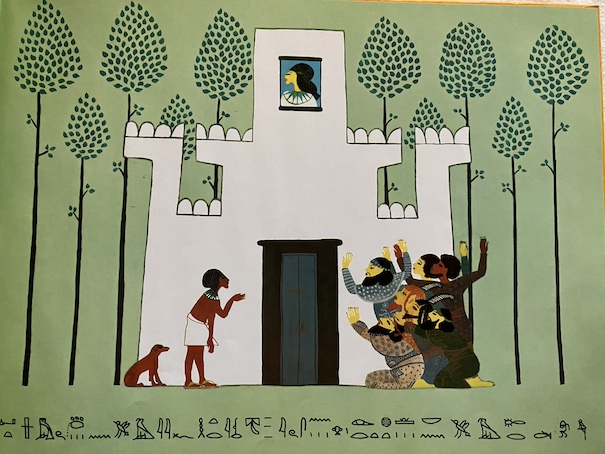
The king is distressed by this prediction for his son’s fate, and he decides to protect him from it as best he can. He has a special house built for the prince, where he grows up, attended by servants and given all sorts of good things to keep him happy. The king wants his son to stay in this house, where he will be safe.
However, as the prince gets older, he becomes more interested in the outside world. One day, he sees a man passing the house with a dog, and the prince wants a dog of his own. The king relents and allows his son to have a dog, in spite of the prophecy.
The prince further demands that his father allow him to leave the house and travel. After all, he says, if his fate is already determined, it won’t matter if his father tries to protect him from it. He says that, if he must die eventually, he might as well live his life to the fullest while he can. The king allows his son to have a chariot and to hunt and travel the Nile. Everywhere the prince goes, he brings his dog with him.
Eventually, he comes to the country of the Chief of Naharin, who only has one daughter. The chief keeps his daughter in a special house with a single window, high off the ground. He says that he will allow his daughter to marry the man who can jump up to that window. The prince manages to make the jump, and he marries the chief’s daughter.
After they are married, the prince explains to his wife the prophecy about his fate. His wife wants to kill the prince’s dog, but he refuses to allow it because he’s had the dog since it was a puppy. His wife begins to watch over him, to try to prevent him from being killed. She manages to kill the snake that comes for the prince, and the prince manages to make a deal with the crocodile, but can he truly escape his fate?
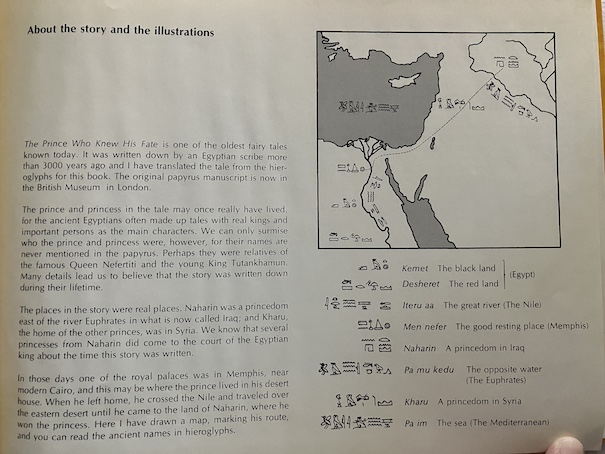
There is a section at the back of the book that explains more about the original story, which was written over 3000 years ago and is “one of the oldest fairy tales known today.” There is also some information about Ancient Egypt and the carvings that were the inspiration for the illustrations in the story.
My Reaction
I always enjoy folklore, and this story is fascinating because the original ending is unknown. The author of this book, Dr. Lise Manniche, who was a Danish Egyptologist, translated the story from the original hieroglyphics and added an ending to the story. I thought that the ending fit well enough, and I was pleased that it was a happy ending, even though it holds to the idea that the fate must be fulfilled. I also enjoyed the illustrations, based on Ancient Egyptian carvings from around the time that the story was created, and the addition of the hieroglyphs of the original story along the bottom of the pages.
I first heard about the folktale in this book in a mystery book for adults called The Snake, the Crocodile, and the Dog by Elizabeth Peters. It is part of the Amelia Peabody mystery series, about a Victorian era woman who is married to an archaeologist. Elizabeth Peters is a pen name for Barbara Mertz, who was an Egyptologist herself. Because this folktale featured prominently in that mystery novel, I was thrilled to find this version of it!
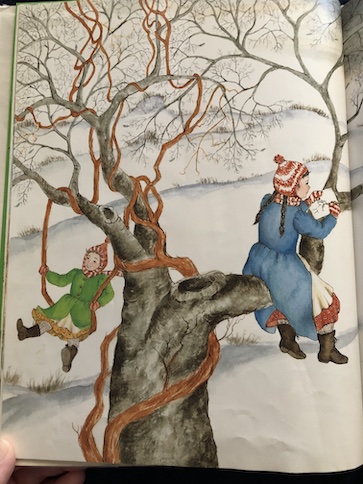
A farm family in 1881 lives in their barn because they haven’t built a separate house yet. Outside the barn, there is an old apple tree that the family loves.
They like to pick the apples from the tree, and use them for cider and applesauce. The two girls in the family like to climb the tree. Josie, the younger girl, likes to swing on the vines that hang from the tree’s branches. Katrina, the older girl, likes to draw in the tree with her paper resting against a crooked branch. She thinks of that special limb as her “studio.”
Then, a terrible winter storm ruins the apple tree before Christmas. The whole family is sad at the loss of the tree, but Katrina is particularly devastated at the loss of her studio. Will she even be able to draw again if she can’t craw in her special place?
The family uses most of the ruined tree as firewood, and they use apples they’ve saved from the tree as decorations on their Christmas tree. However, because of the loss of the apple tree, it doesn’t really feel like Christmas to Katrina. Then, their father shows them that he has saved their favorite parts of the tree and turned them into special Christmas presents.
The book is available to borrow and read for free online through Internet Archive.
My Reaction
I thought this was a charming Christmas story! When I first saw the title, I guessed that the family would use an apple tree as a Christmas tree, but that’s not it at all. It’s just about the family feeling sad about the loss of their apple tree and how the remains of the tree made it a memorable Christmas. Because the father of the family saved their favorite parts of the tree when he was cutting up the rest for firewood, they will still be able to enjoy the things they loved about the tree, particularly Katrina, who receives a special drawing table made out her favorite branch of the tree.
The author dedicated the book to her own father because he made a special drawing board for her. On the inside dust jacket of the book, the explains that the inspiration for the apple tree and vine swing came from her own childhood in rural Michigan.
I love the artwork in this book! The pictures are realistic and detailed, and they have an old-fashioned charm that fits well with the modern Cottagecore aesthetic. I love the family’s home in the barn, with the girls sleeping in the loft and being wrapped in colorful patchwork quilts! The first book that I read by this author was The Day Jimmy’s Boa Ate the Wash, but she wasn’t the illustrator for that book. I didn’t know the she did illustrations, but seeing the illustrations in this book makes me want to see more by her!























 Jestress's Forgotten Books and Stories