Island Boy

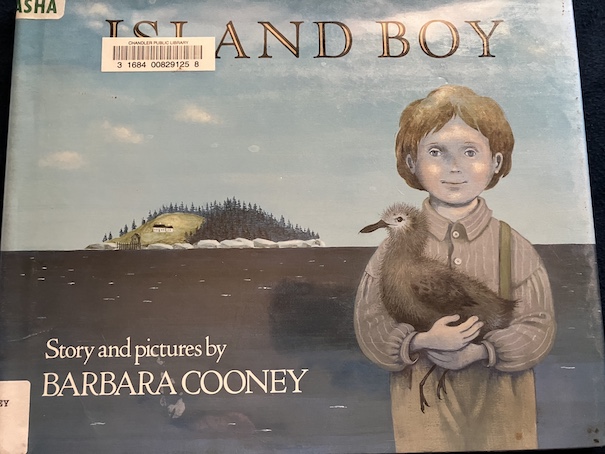
When the Tibbetts family first moves to the island, they build their house and give the island its name, Tibbetts Island. As time passes, there are eventually twelve children in the Tibbetts family, and the youngest of them is little Matthais.
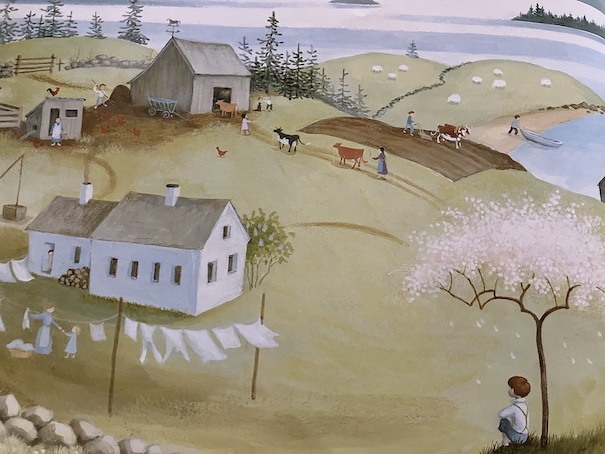
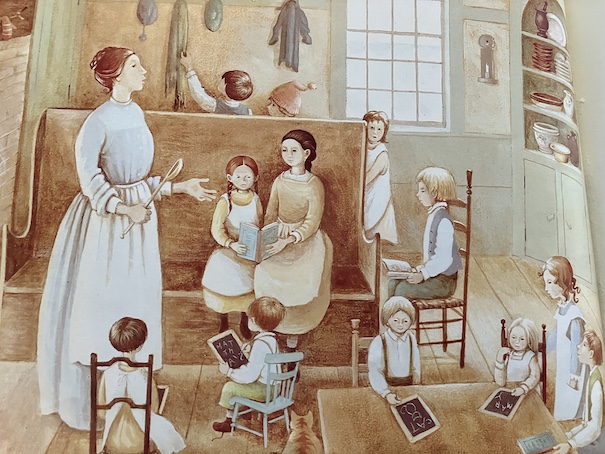
The boys in the family help on their family’s farm and go hunting and fishing. At first, Matthais’s older brothers think he’s too little to help. As he grows up, though, he learns how to be more helpful, and he joins the other children in their lessons in reading and writing.
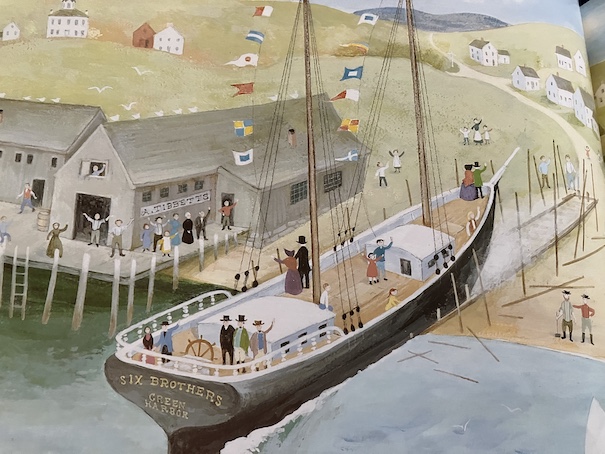
As time passes, the Tibbetts children grow up and leave the island to get married or get jobs working in their uncle’s shipyard. Eventually, Matthais becomes a cabin boy on one of his uncle’s ships. After years of experience, Matthais become the captain of the ship. He visits many places as a sailor, but he finds himself wanting to return home.
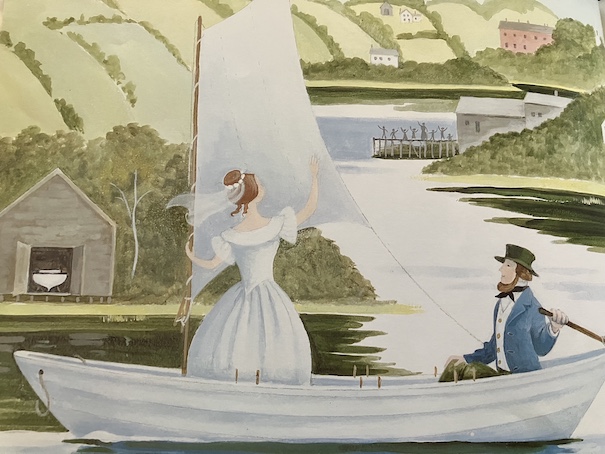
When Matthais marries a young schoolteacher named Hannah, they move into his family’s old home on the island and restart the farm because his aging parents have moved to the mainland. Together, they have three daughters.
Over time, Matthais’s daughters grow up, and he and Hannah grow old. His daughters marry and move away, and Hannah dies. Around this time, new people begin moving to the area, building vacation homes and bringing pleasure boats. Unlike the Tibbetts family, they’re there to enjoy the countryside for fun and not for farming. They’re called “rusticators” because they enjoy the rustic lifestyle. One of Matthais’s daughters points out that he could sell the family’s island to these people, but he can’t bring himself to do it because it’s the family’s old home.
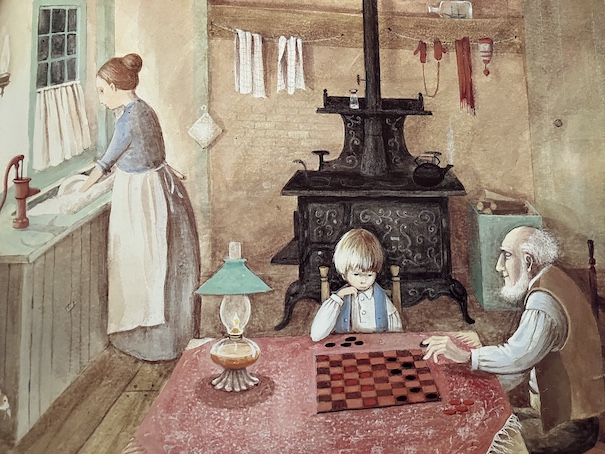
Following the death of her husband, one of Matthais’s daughters moves back to the island with her small son, also named Matthais. The elderly Matthais helps to raise his young grandson and teach him about life on the island. The elderly Matthais eventually dies in a boating accident in rough weather, and many people come to pay their respects and reflect on his long life, but the younger Matthais’s life is still beginning.

The book is available to borrow and read for free online through Internet Archive.

I love the charming, old-fashioned pictures in this book, and it’s a sweet story about a man’s long life and the passing of one generation to the next. As characters comment at the end of the story, Matthais has lived a long and full life. He’s experienced the cozy family life on the island and the beauties of nature, and he’s also traveled and had adventures at sea. He’s raised a family of his own, and he’s set up a home for his daughter and her young son. The end of the story indicates that the cycle of life will continue in this family as the younger Matthais thinks about becoming a sailor like his grandfather and then returning to the island himself.

There’s a sense of stability to the island and its cycles of life and generations. Even when things are changing in the world around them, the nature of the island remains pretty constant, and it’s always a place for members of the family to come home.
Hattie and the Wild Waves

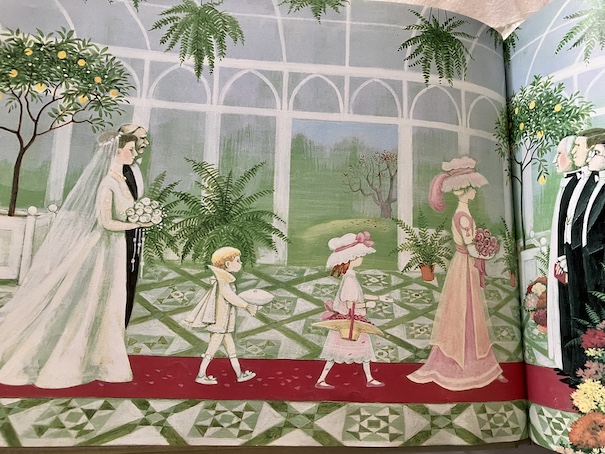
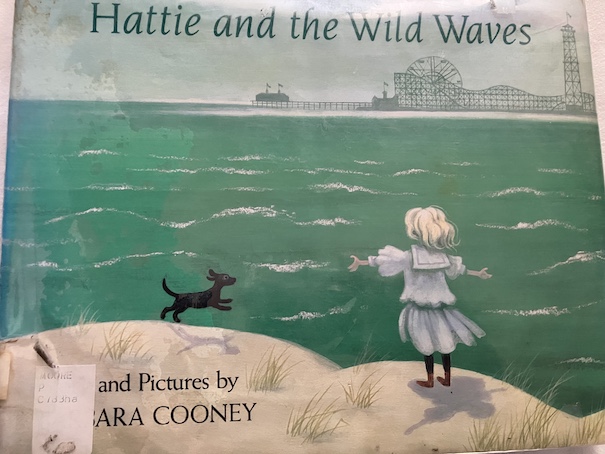
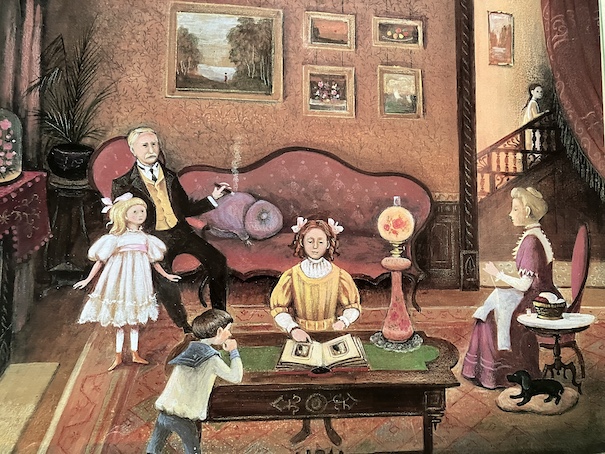
Young Hattie grows up as part of a wealthy family in a red brick house with beautiful woodwork because her father is in the woodwork business. She comes from a family of German immigrants living in New York around the turn of the last century. When she and her siblings start talking about what they want to do when they’re grown up, Hattie says that she wants to be a painter. At first, the others think she means painting houses, but what she actually means is that she wants to be an artist.

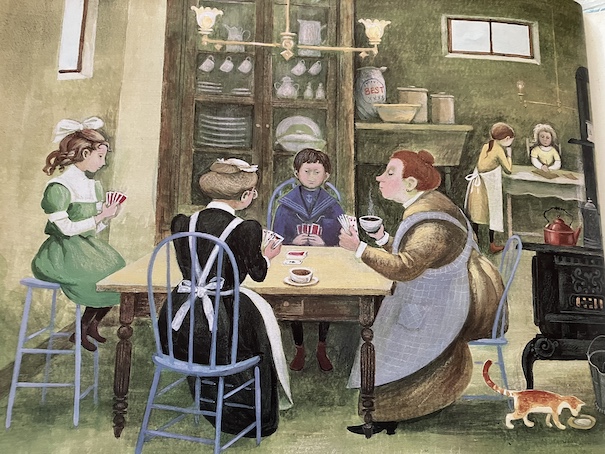
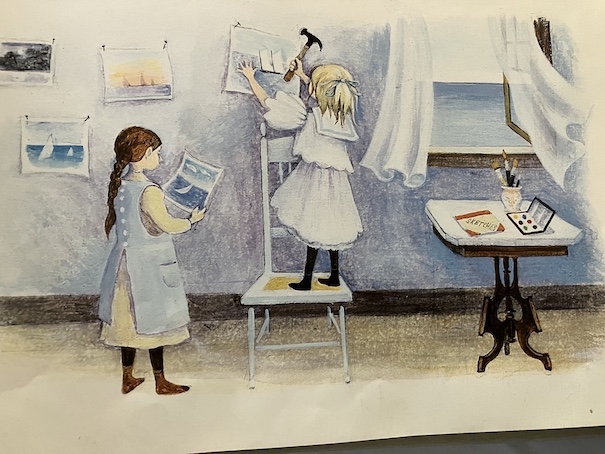
While Hattie’s siblings make life hard for the series of nursemaids who come to look after them (and are ultimately fired for reacting to their teasing) and play cards with the cook and maid, Hattie likes to spend her time drawing. The cook’s daughter admires her drawings. Hattie never minds it when she’s confined to bed with a cold because it just gives her more time to draw.

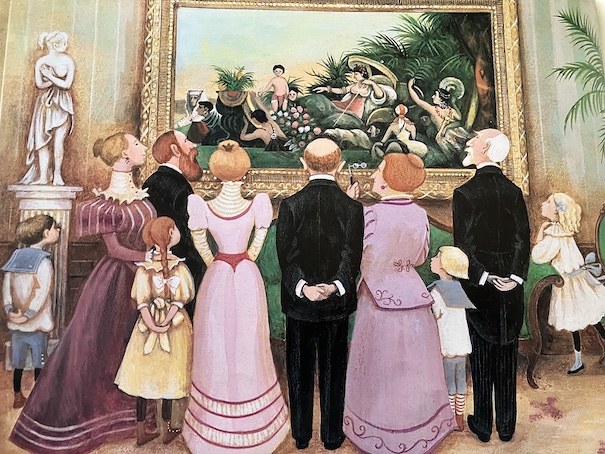
When Hattie’s relative come to visit, they always have a big dinner, and they admire a painting that Hattie’s grandfather painted years ago called Cleopatra’s Barge. However, Hattie’s father prefers a drawing that Hattie made of a barge because he thinks it looks more seaworthy. Hattie knows that the people on her mother’s side of the family tend to be musicians and artists. Hattie’s mother is one of the musical members of the family. She teaches Hattie and her sister how to play the piano and how to sew, but Hattie never does either of these very well.

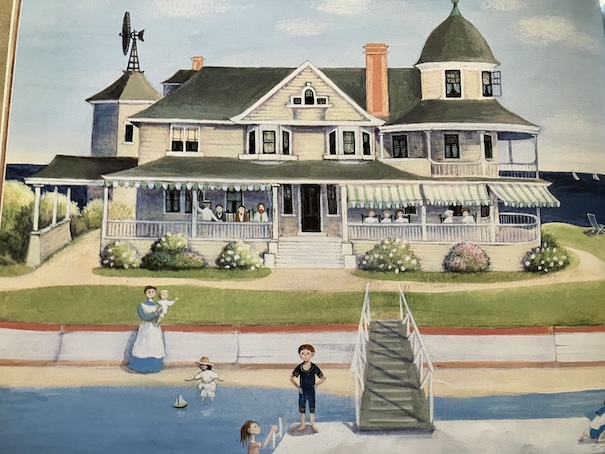
The family spends their summers at a summer house at Far Rockaway with their relatives. The adults like to gather on the veranda and talk, the women sewing and knitting. Sometimes, they go sailing in their boat. Hattie absorbs the details of everything she sees at the seaside and paints pictures.

Hattie loves their summer house, but then, her father sells it and buys a bigger summer house on Long Island. Hattie’s brother and sister think it sounds exciting because it will be like a castle, but Hattie thinks she will miss the wild waves of Far Rockaway.

Their new summer house is incredible. The children ride horses there and have tennis parties. Hattie’s sister is now old enough to have suitors. While everyone is busy with her sister’s suitors and later, her sister’s wedding plans, Hattie takes walks by herself and finds new things to paint.

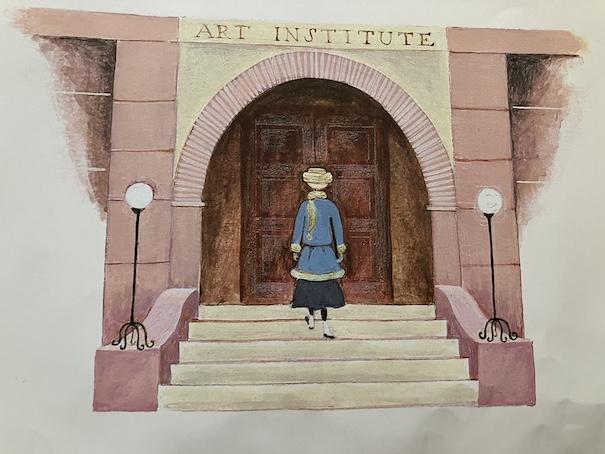
Hattie’s life continues to change, but she stays true to her dreams, joining the Art Institute to become the painter she’s always wanted to be. Her mother thinks that she will be like her grandfather, but Hattie knows that she will be her own artist.

The book is available to borrow and read for free online through Internet Archive.

Some aspects of the story are similar to Miss Rumphius, another book by Barbara Cooney about a young girl growing up around the turn of the century who has very definite ambitions early in life. Miss Rumphius’s life ambitions aren’t quite the same as Hattie’s, but they each know what they want to do with their lives from an early age and find their own way of adding beauty to the world.

This is a very calm and relaxing story about a girl with a strong ambition early in life to be an artist. She comes from a wealthy family, so she grows up in charming homes and summer houses, surrounded by beauty and with a family that includes other artists, so her family isn’t opposed to her ambition. There are changes that come in the girl’s life as she and her siblings grow up, but nothing tragic or traumatic happens to her. This is a book where readers can enjoy the beautiful atmosphere and artwork.

The author based the story on her own mother, Mae Evelyn Bossert, although the girl in the story is called by a different name. The hotel where the family lives at the end of the story is the Hotel Bossert, which Barbara Cooney’s grandfather built and which was the place where she was born. There are German words and phrases sprinkled throughout the story because this is an immigrant family, and they speak at least some German to each other. Readers can generally tell by context what the characters are saying.

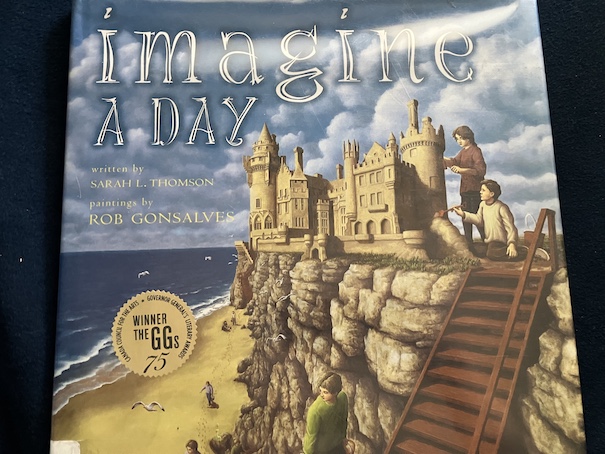
Imagine a Day

This book celebrates the power of imagination and invites readers to use their imaginations, envisioning things that are impossible but amazing!

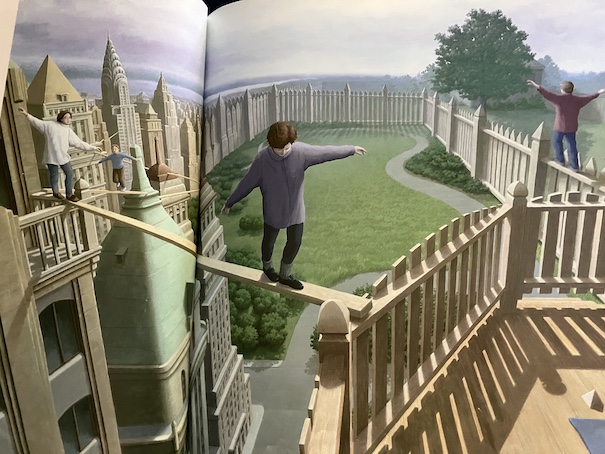
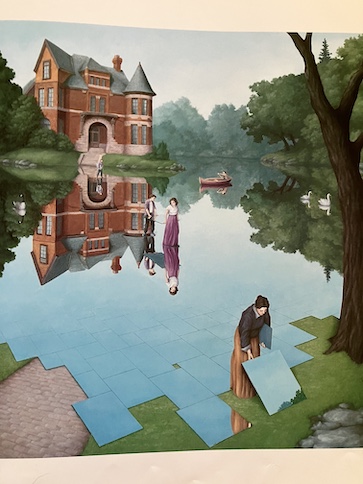
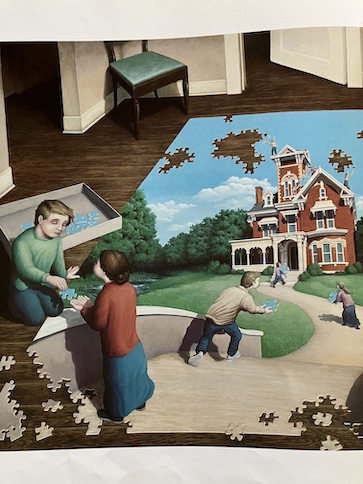
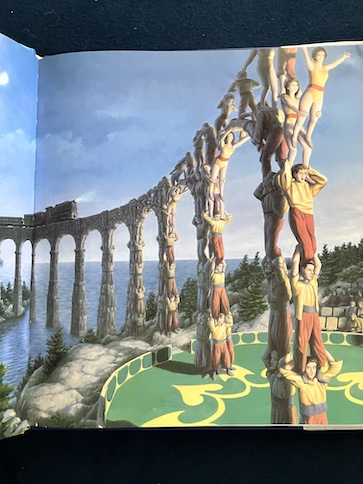
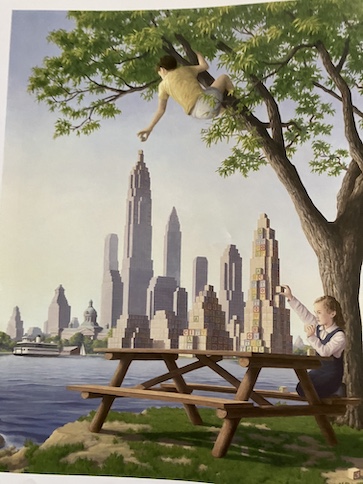
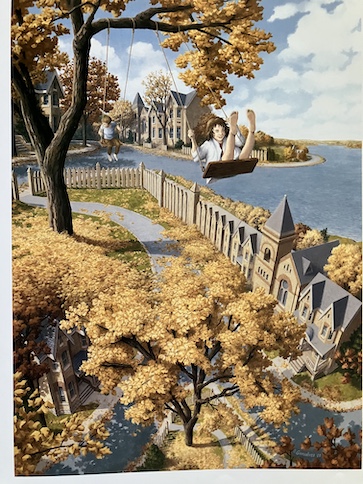
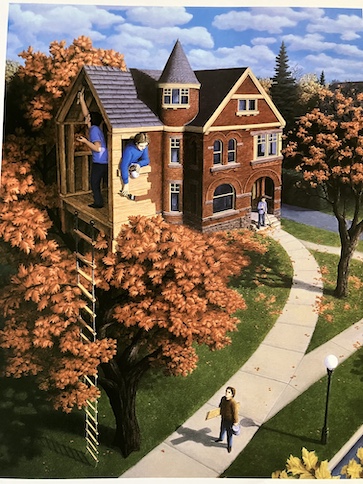
There isn’t exactly a story to the book. Each page poses something for readers to imagine with an accompanying picture where the shifts from the real world to the imaginary or impossible one are shown.

Each of the illustrations is surreal, with perspective changes from the real to the unreal.

The book invites readers to imagine powerful and amazing things, like “when grace and daring are all we need to build a bridge”, “when you forget how to fall”, “when we build a moat not to keep strangers out, but to welcome them in”, “when everything you build touches the sky”, “when you build the world around you piece by piece”, or “when the edge of the map is only the beginning of what we can explore.” All of this amazing things are things that could happen on a wonderful day! Just imagine a day like that!

The best part of the book is the end when we “Imagine a day … when a book swings open on silent hinges, and a play you’ve never seen before welcomes you home. Imagine … today.” Books are a key that unlocks a person’s imagination!
The pictures are amazing, and they really make the book! The pictures use perspective to shift the characters and their actions from the ordinary world to the extraordinary! Fence posts or toy blocks gradually morph into buildings. Streets become rivers, and rivers become trees. People on swings or bikes start off on the ground and end up above the trees! I’ve shown a number of pictures from this book to show you what they’re like, but there are many more to enjoy!

The pictures are fascinating to look at, and each of them seems like it could represent the beginning of a story. In that way, the book reminds me a little of The Mysteries of Harris Burdick. The things the book invites readers to imagine are positive, inspiring, and uplifting, and I think this book would be good to use for a story-writing prompts. Even adults can find this enchanting book inspirational for their creative powers!

Rules of Summer

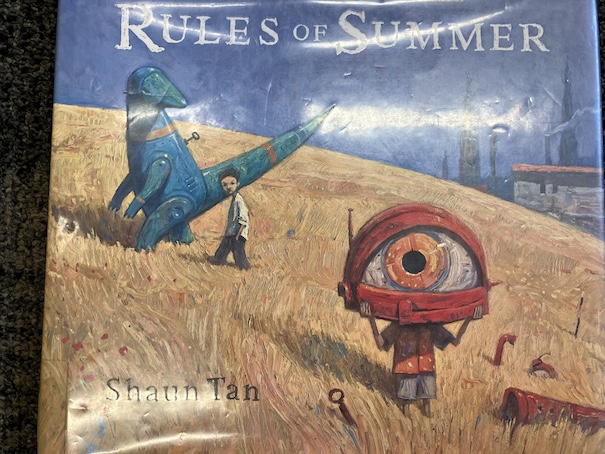
The book starts with the phrase, “This is what I learned last summer:” On every page, there’s a different “rule of summer”, something that the kid and his brother learned from their summer adventures.

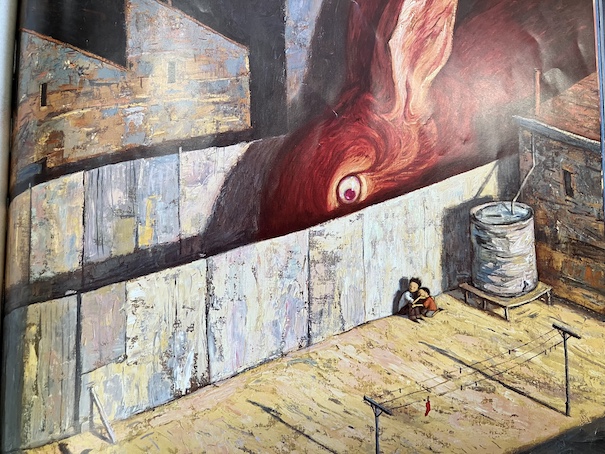
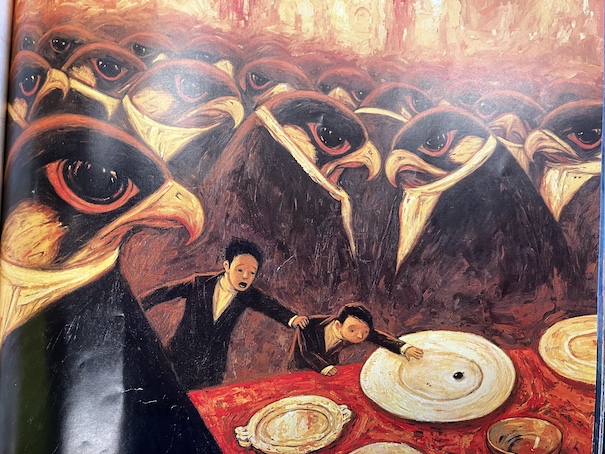
However, they’re not having the ordinary kind of summer adventures. He apparently learned not to leave a red sock on the clothesline when a giant red rabbit appeared, and he learned not to drop his jar when he and his brother were catching falling stars.

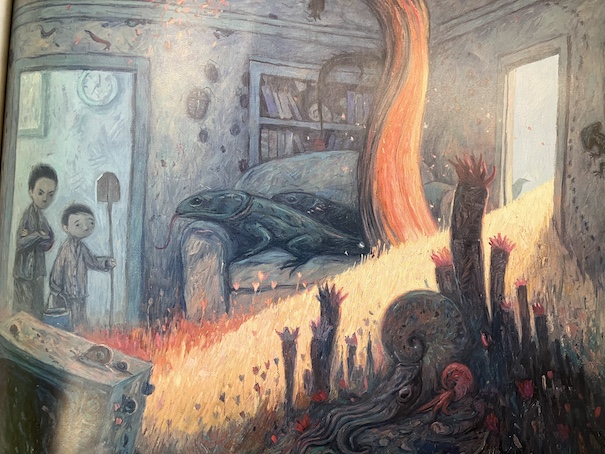
The pictures show all kinds of strange things happening, like a giant lizard and weird plants spilling into the living room, which apparently taught the boy not to leave the back door open overnight and a tornado that came after the boy stepped on a snail.

At the end of the book, the two boys sit in front of their tv with pictures of all the strange creatures they’ve seen pinned to the wall. Are they pictures from the boys’ imagination or memories of a fantastic summer?

The book is available to borrow and read for free online through Internet Archive.

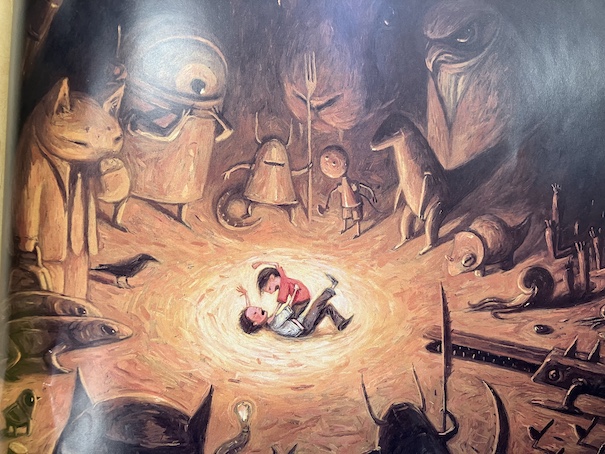
The book is set in a gritty, urban environment where some surreal things happen. Either that, or the surreal adventures all take place in the boys’ imaginations. They could be turning regular adventures in the city where they live into sci-fi, dystopian epics. There is no backstory to anything in the book, so it’s all up to the readers’ imaginations whether anything in the book actually happened or not.

Their world may be post-apocalyptic (at least in their imaginations), peopled by all kinds of strange creatures and robots. There are no other humans in the book other than the boys. I don’t really like gritty or dystopian style books or art, but this book appealed to me because it leaves so much up to the imagination, including whether or not the boys just imagined everything. To me, the last picture, where the boys are just sitting in front of their tv with pictures they’ve drawn all over the walls suggest that they imagined their fantastic summer adventures, but that’s never clarified. In fact, there are a couple of additional pictures after the story ends that suggest maybe it wasn’t all imagination, but you can make up your own mind.

The Curious Garden

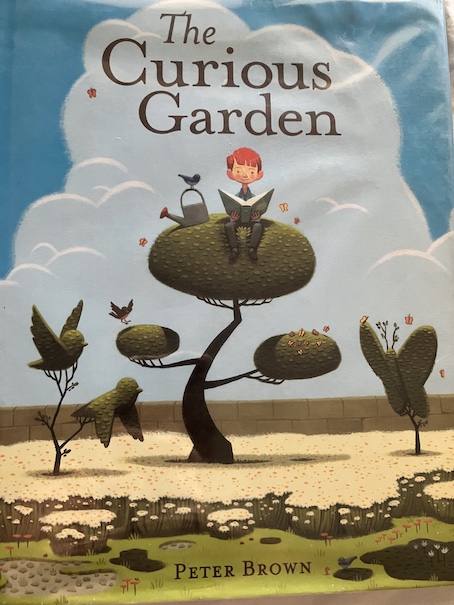
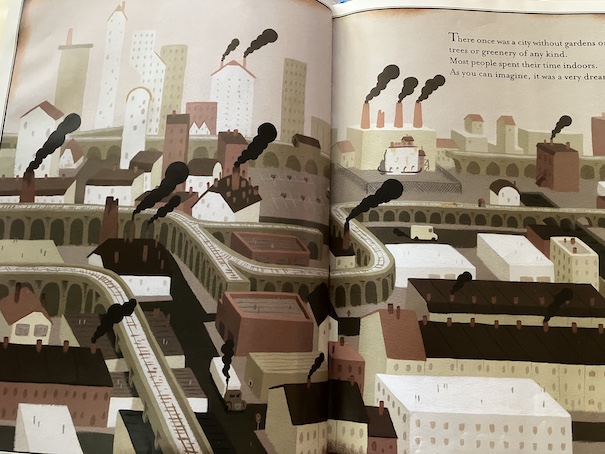
A boy named Liam lives in a dreary city where there aren’t any gardens or green spaces. Most people in the city spend most of their time inside. However, Liam likes to explore outside.

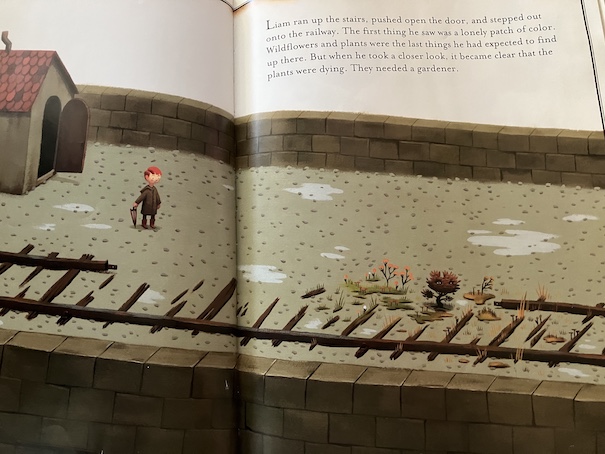
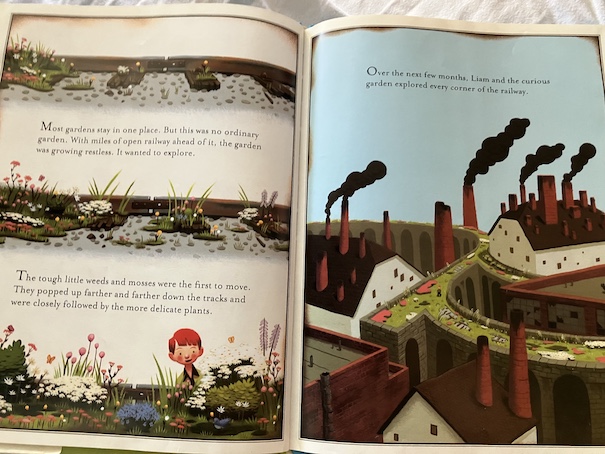
One day, while exploring some disused train tracks, he finds a few plants struggling to survive. Liam doesn’t know much about plants, but he decides to help them by giving them water. Gradually, he begins to learn more about what will help the plants, and they begin to grow and spread into a small garden.

As Liam helps the plants, they begin to spread all along the old railroad tracks. During the winter, the plants are covered in snow, and many of them are killed or have suffered badly from the cold. However, because Liam spent the winter studying about plants and gathering some gardening tools, he is able to restart the garden.

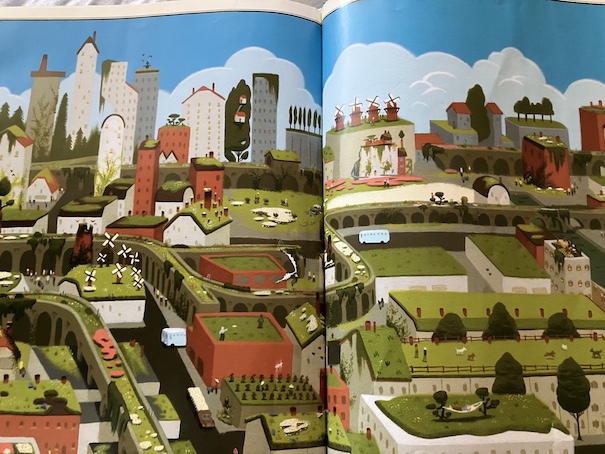
As the garden spreads through the city, other people begin to notice, and they start joining Liam in tending the garden. Greenery begins taking over places and things that are disuses and abandoned, and people encourage the plants to grow where they can enjoy them. Because of their efforts, the city is transformed!

There is an author’s note in the back of the book about the inspiration for the story. There was an elevated train in Manhattan that was shut down in 1980, and plants took over the abandoned tracks. The author, Peter Brown, considered what it would be like if the phenomenon took over an entire city.

The pictures in the book are great, and some pages are full pictures with no text, just showing how the garden grows and spreads through abandoned places in the city. I love how this story was inspired by the way plants take over abandoned places in real life. Plants can grow in some unlikely places, when nothing interferes with them, and in the story, the boy discovers that they can spread further with a little help.

By the end of the story, his entire city is completely transformed into a greener, more eco-friendly place. It’s not just that there are more plants and green spaces in his city, but the factories that we see in early scenes are no longer putting out all that smoke by the end, and we see windmills in the pictures as alternative forms of energy production. We aren’t told exactly why some things are changed about this city, but it seems like the increasing presence of the green spaces has caused people to change aspects of their lives and businesses to accommodate and preserve them. It’s an idyllic solution that doesn’t show a lot of the conflict that occurs in real life, when some people are ready for a change and others just don’t want to change. Still, I like this mage of a hopeful future because it comes as an antidote to the dystopian quality that we see in many forms of modern entertainment.

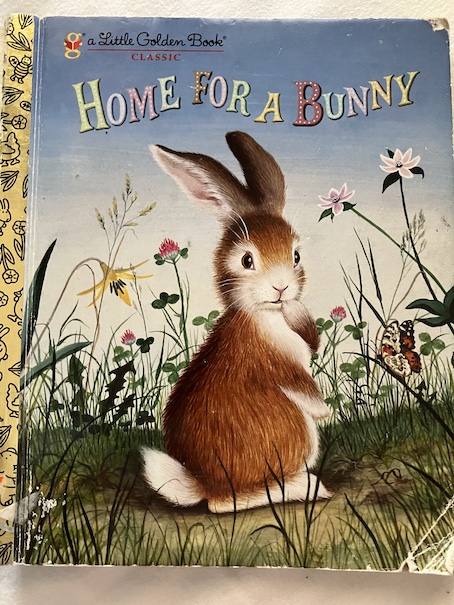
Home for a Bunny

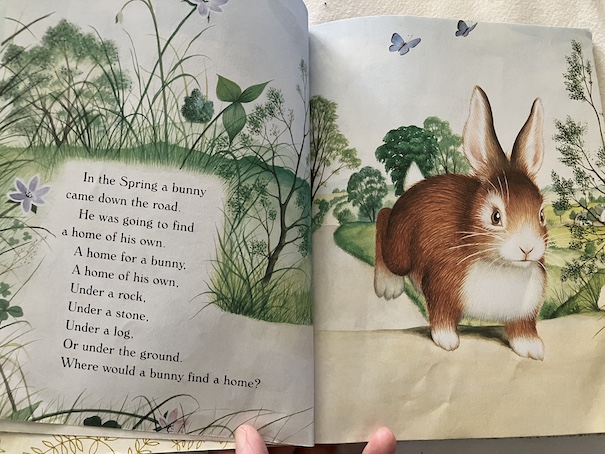
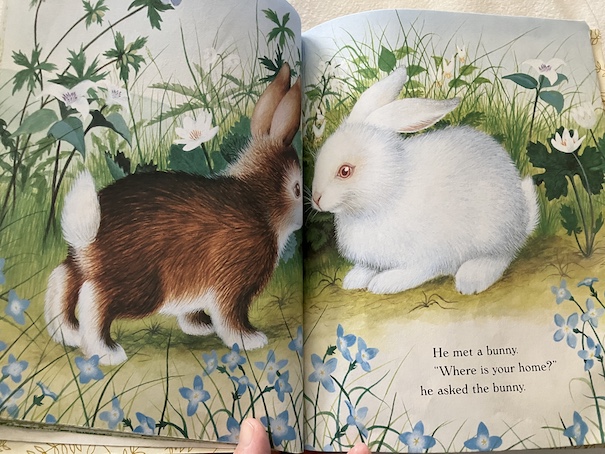
It’s springtime, and a little bunny is searching for a new place to call home.
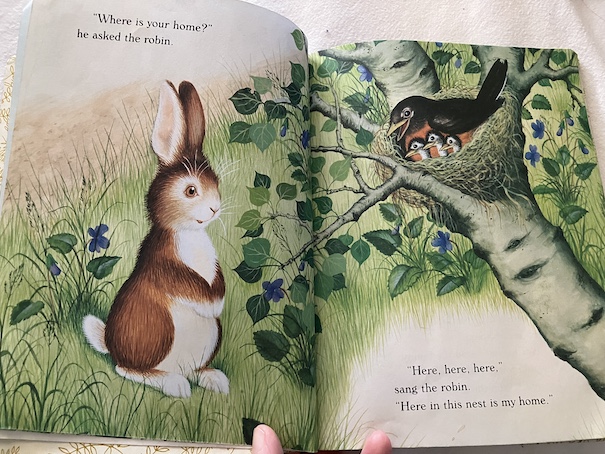
As he looks for a place that might suit him, he asks the other animals about their homes. However, most of the homes of other animals wouldn’t work for him. The bunny knows he couldn’t live in a nest like the birds or in a bog like a frog.

There is a point when the bunny thinks another animal’s home might suit him, when he talks to a groundhog who lives in a log, but the groundhog is not willing to have him as a housemate.

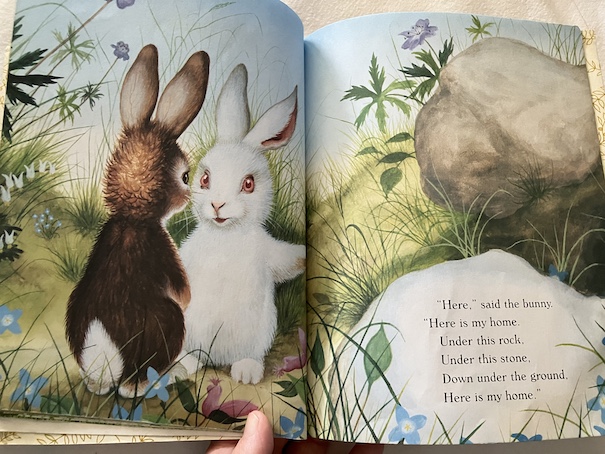
The bunny finally finds his home when he meets another bunny, who invites him to stay!

The book is available to borrow and read for free online through Internet Archive (multiple copies).

This vintage Little Golden Book is a calm and sweet story about a little bunny finding a home that’s just right for him. I liked how the bunny looks at other animals’ homes to figure out if any of them would be right for him because it shows young children how each animal’s home has conditions that are right for that animal but wouldn’t be right for a different type of animal. The bunny realizes that a nest in tree wouldn’t work for him because, unlike birds, he can’t fly and would fall out of the nest. Similarly, he can’t live in a bog with a frog because he’s not amphibious and would drown. (The book doesn’t use the term amphibian or amphibious, but I think kids would get the idea that some animals are better able to live in and around water than others.)

The story also includes the idea is that what makes a home is also who shares that home. The bunny thinks that the place where the groundhog lives could work for him, but he’s not a groundhog and the groundhog doesn’t want to share his home with the bunny. The place where the bunny eventually finds is rabbit hole he can share with another bunny, who is happy to have him as a companion. It’s a calm story with a happy ending because there is a home for everyone and someone for everyone.
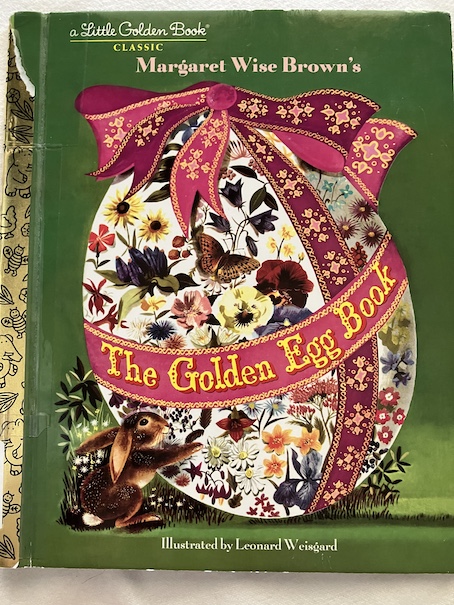
The Golden Egg Book

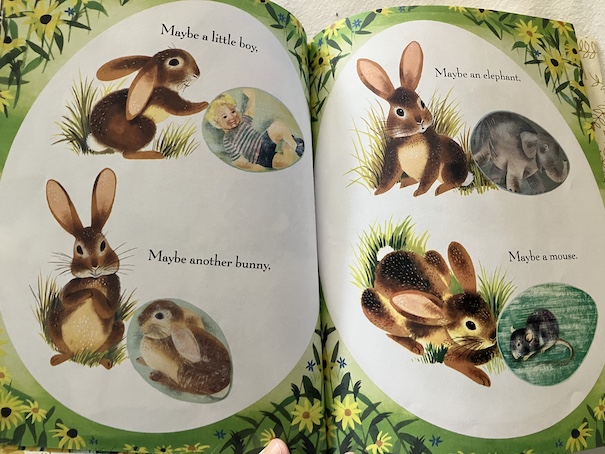
One day, a little bunny finds a blue egg. He knows there’s something inside the egg because he can hear it moving, but he doesn’t know what kind of egg it is. He imagines all the different creatures that could be inside the egg.

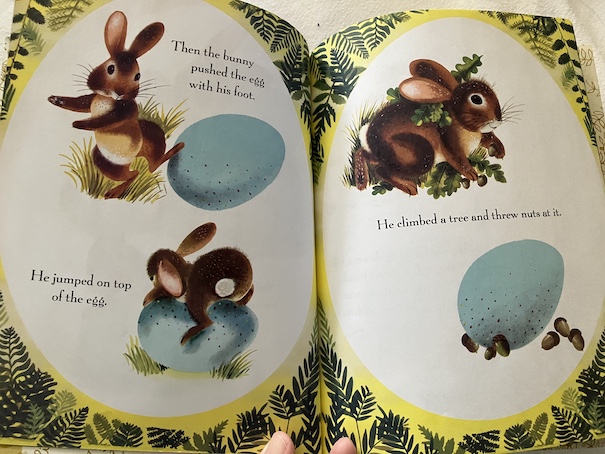
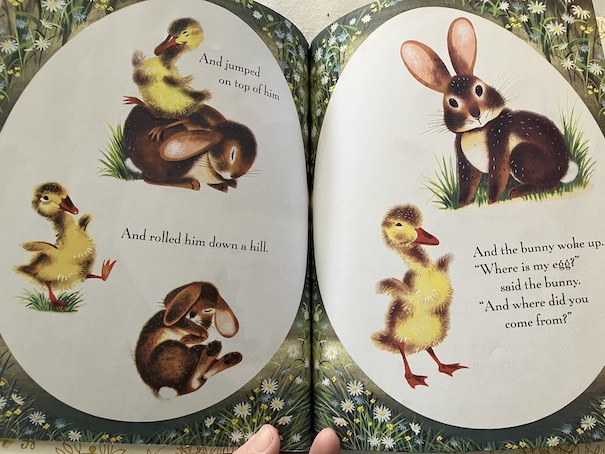
He tries to figure out how to get the egg open. He shakes it, kicks it, jumps on it, rolls it down a hill, and throws nuts and small rocks at it. Nothing he does causes the egg to open.

Eventually, the bunny falls asleep next to the egg, and while he’s asleep, the egg hatches! The animal that hatches out becomes the bunny’s best friend!

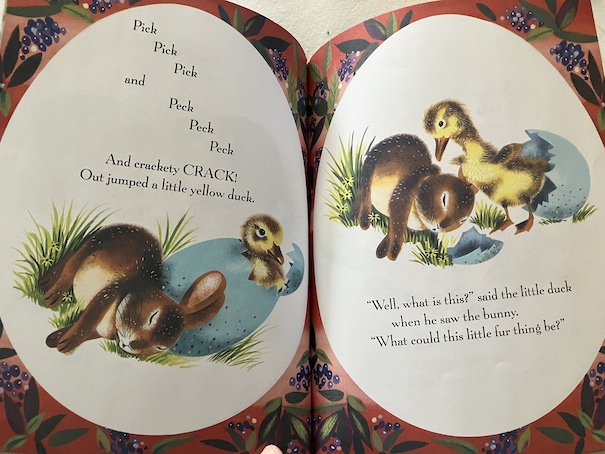
This is a vintage Little Golden Book, originally printed in the 1940s, about two young animals trying to figure each other out. The bunny apparently knows that some things hatch from eggs, but he’s not sure exactly how that happens or what sort of things might come from an egg. Even little kids will know that the things that the little bunny thinks might come from an egg are silly, like a little boy or an elephant, but that’s part of the fun of it.

There’s some repetition in the story, which young children enjoy, because when the duckling hatches out of the egg and finds the bunny asleep, he tries some of the steps that the bunny tried on his egg to get the bunny to wake up, like pushing the bunny with his foot, jumping on him, or rolling him down the hill.

Fortunately, neither animal hurts the other in their attempts to hatch the egg or wake up the bunny, and the two become friends. It’s just a cute little picture book that might be fun for springtime or Easter!

The Little House

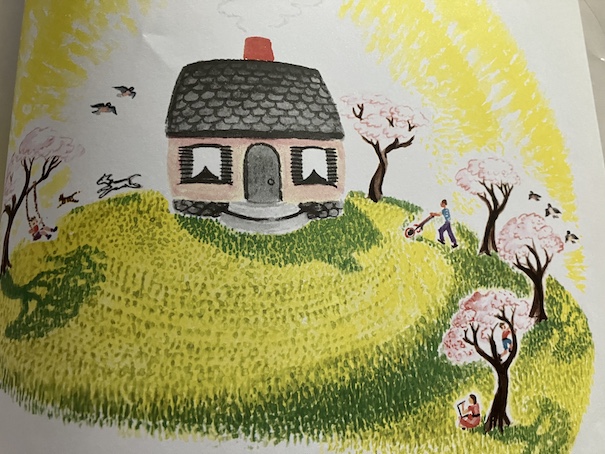
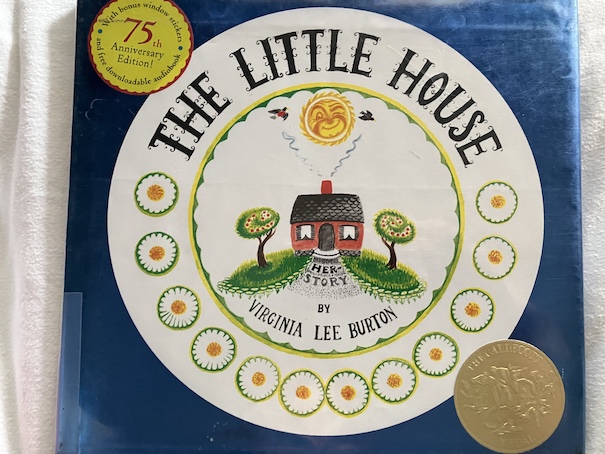
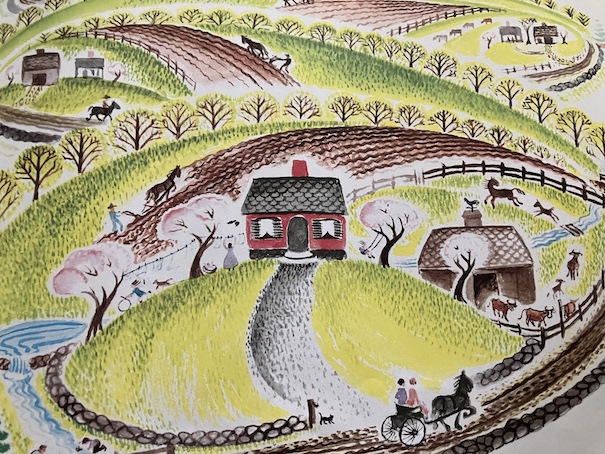
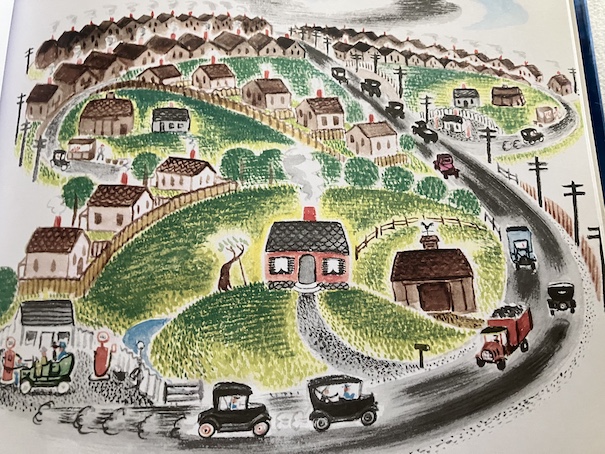
A family builds a strong little house in the countryside, dreaming of their descendants living in her. The little house is happy in the countryside, watching the changing seasons as the years come and go.

Over time, things begin to change, though. Other farms are built around the little house, but then, a big road is built, and the little farms gradually give way to suburbs.

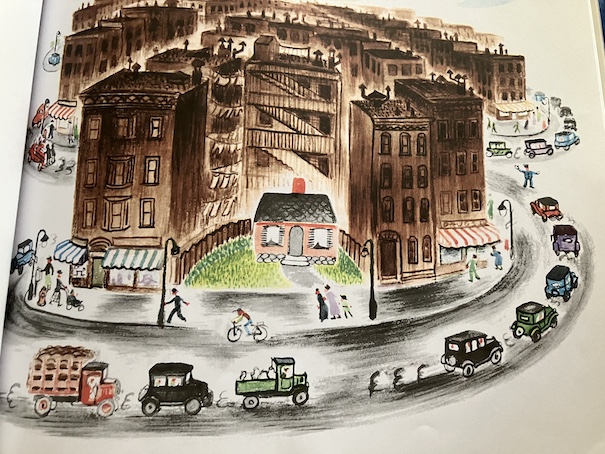
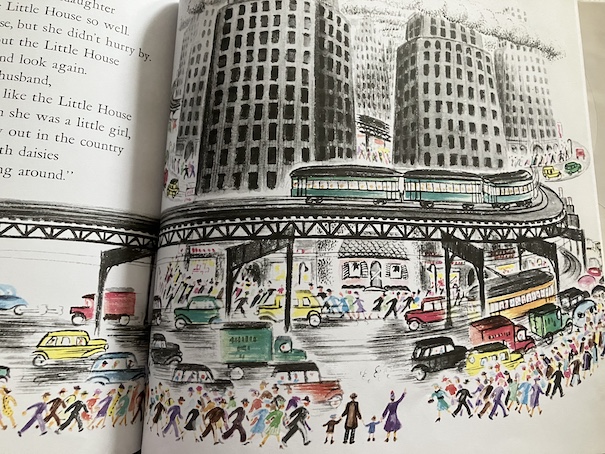
Eventually, the houses around the little house turn into bigger houses and apartment buildings. As time goes on, the little house is no longer in the countryside or even the edge of the city, but it’s actually engulfed by the city itself.

The city becomes more and more crowded with taller and taller apartment buildings, more roads and trains, and crowds of peoples. The little house stands empty and becomes run-down. She can hardly see the sky and can’t feel the changing of the seasons the way she used to because there isn’t much nature around her to sense changing.

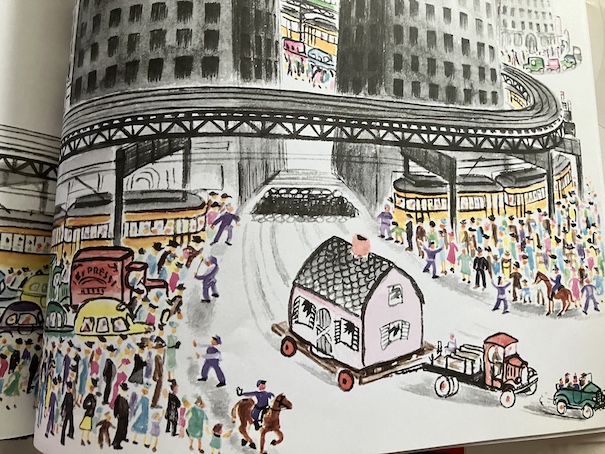
Fortunately, the little house is rescued from this terrible situation. One day, the great-great-granddaughter of the man who built the house spots the little house in the city and recognizes it as the one her family owned. When she and her husband look into it, they verify that this is her family’s old house, and they decide that they want to move it to the countryside, like when her family lived there.

Because the little house was built so strongly, they’re able to move it intact to the countryside. The little house is happy to once again live in the countryside with the family who always loved her!

The book is available to borrow and read for free online through Internet Archive.

This vintage picture book is about the nature of change. Growing cities do expand into the countryside around them, so a house that was once outside of the city is gradually touched by and then engulfed by the nearby city as it expands. Readers get the feelings of the house as the world around her changes. At first, she’s a little intrigued by the city and isn’t sure if she likes it or not, but as the city becomes overcrowded, the house is neglected, and she can no longer sense the seasons, she decides that she doesn’t like it. When things change for the house again, she is relieved.

I remember this story from when I was a kid, and I remember feeling sad when the poor house was run-down and neglected in the city, surrounded by the towering apartment buildings. However, the book has a good ending. Houses can be moved, and the family that once owned this house remembers it and rescues it from the city, moving it to the countryside, where they all feel more at home. Things change, but sometimes, they change for the better. The house can’t move itself when it isn’t happy, but the family gives it the help and attention it needs.
When I reread this book as an adult, it suddenly occurred to me that this book was originally published during WWII, when the world was changing in some very scary ways. I think a book like this might have been reassuring to children of that time. Life is full of changes, but sometimes, things can change for the better again.
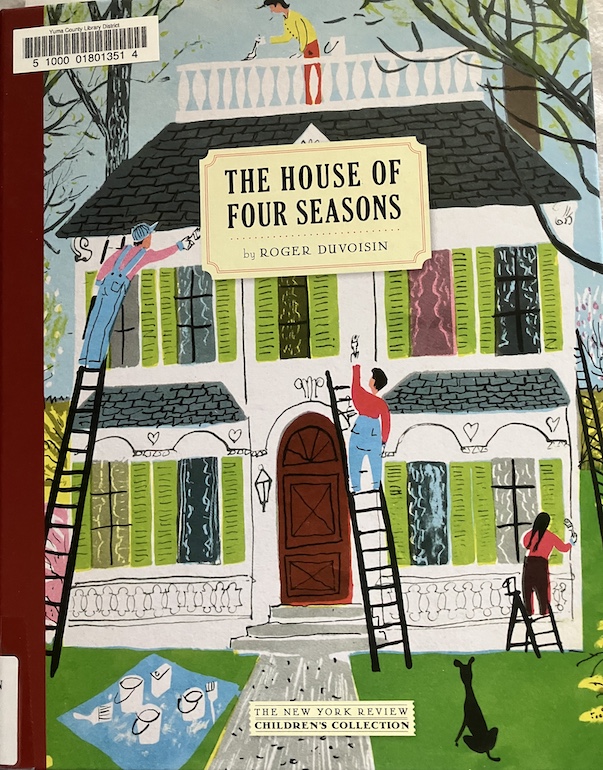
The House of Four Seasons

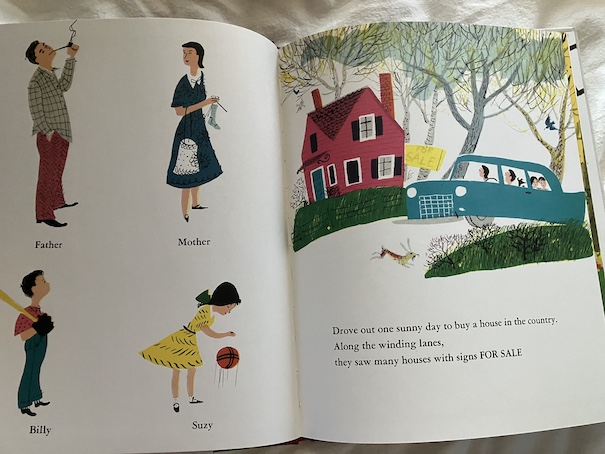
A family is searching for a house to buy in the countryside. They find one they love, but it needs some fixing up. Along with the repairs, the house needs a new coat of paint.

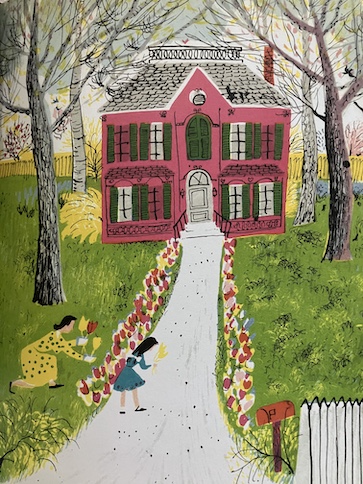
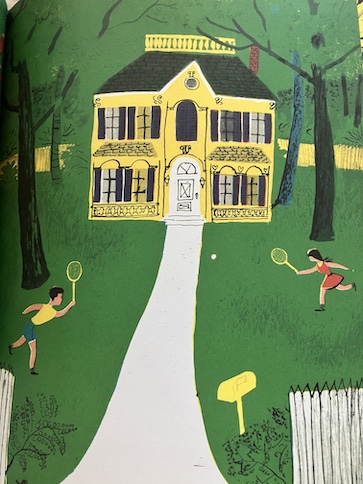
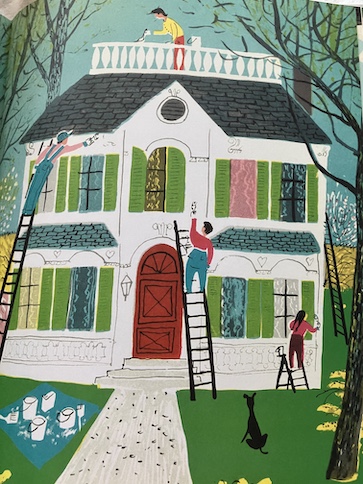
Different family members have different ideas about the best color to paint the house. Little Suzy likes the idea of painting it red with green shutters because she thinks that would look wonderful in the spring. Billy likes the idea of making it yellow with purple shutters, which would be great in summer. Their mother like the idea of a brown house with blue shutters because she thinks that would look great in autumn. Father suggests a green house with orange shutters because he thinks that would be colorful in the winter, when it snows.

They talk over the different possible color combinations, and Billy suggests that each of them could have their colors on a different side of the house. He says that they could call it the House of Four Seasons. However, when they go to the hardware store, they learn that the store only stocks three colors of paint – red, yellow, and blue.

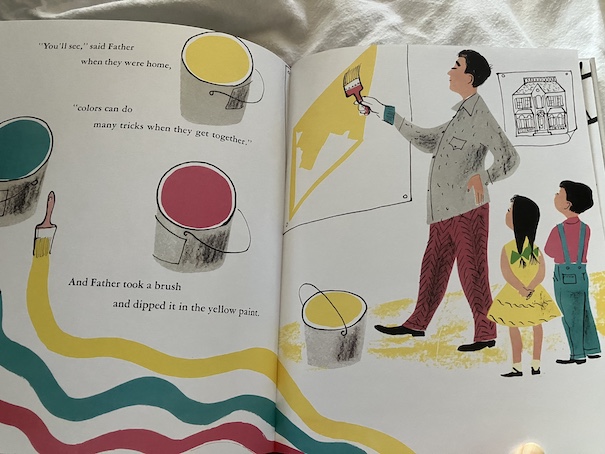
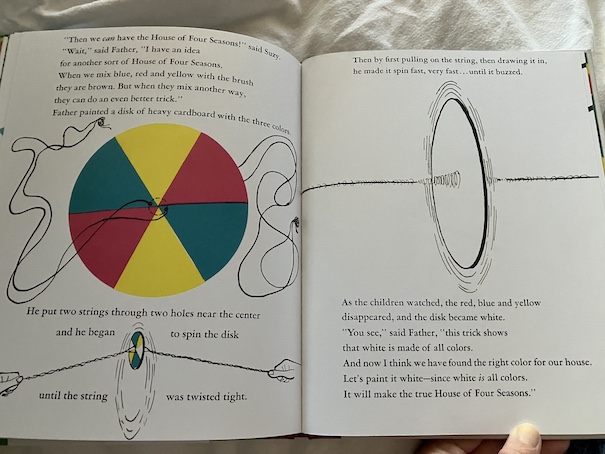
At first, the children in the family think they can’t have their House of Four Seasons with only three colors, but their father buys some of each color and shows them how the colors combine to make different colors. By mixing two colors together, they can also make orange, green, and purple. If they mix all three together, they can get brown.

That covers all of the colors they originally thought of using, but there’s one more thing that Father points out. Although mixing all three colors of paint gives them brown, white is also the sum of all colors. That gives them a color they can all agree on!

I liked how the book demonstrated color combinations and how mixing primary colors make secondary colors. It is true that, when you mix all the primary colors of paint, you typically do get a brown color. Technically, according to an art class I once took, you’re supposed to get black by mixing all colors, but it usually doesn’t work out that way because the colors aren’t entirely true hues.

I’ve thought before that it’s interesting how, when it comes to paint, black is supposed to be the sum of all colors and white is often considered blank, the absence of color, but the opposite is true when it comes to light. These two ways of mixing colors are called “additive” and “subtractive” – mixing colors of light is additive and mixing physical colors, like paint, is subtractive. That’s really what the father in the story demonstrates, how different colors blend to form white visually with light, although he doesn’t really explain the additive vs subtractive color systems concept. If you’ve ever done web design, you’ve used the additive color mixing method with hexadecimal colors. Black in hexadecimal is #000000, the complete absence of all colors, while white is #FFFFFF, the full amount of all colors.

As fascinating as that is, though, I have to admit that I wasn’t entirely satisfied with the choice to paint the house white. Part of it is that it won’t stand out in the snow when it’s white, and part of it is that they just paint the shutters green without any discussion about it, but mostly, it’s because … the hardware store doesn’t sell white paint. They clearly stated that the hardware store only has three colors of paint – red, yellow, and blue – no white. They also can’t combine those colors to make white because they already demonstrated that combining those three colors makes brown. Combining colors to make white works with light but not paint.

It’s still a fun story that has some educational quality, but yeah, I realized that the proposed plan to use white paint actually wouldn’t work. Unless, of course, they just go to a different hardware store, one that has a wider paint selection.

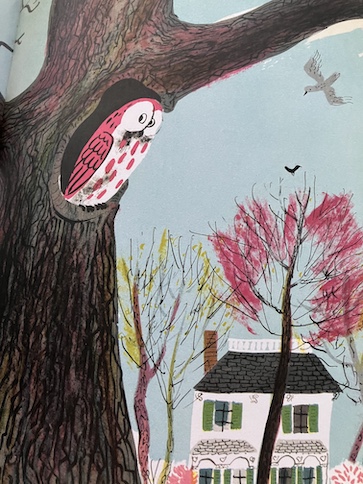
The pictures really make this story stand out as being from the 1950s. The father is smoking a pipe, which is uncommon these days and almost never depicted in 21st century children’s books. Even in the late 20th century, when I was young, people were cracking down on depictions of tobacco use in children’s books and movies to discourage children from normalizing tobacco and using it themselves. The overall art style of the book is typical of the mid-20th century, but it has a full range of colors, in keeping with the theme of the book. Some other mid-20th century books were printed with limited color range.

I liked seeing the house depicted with the different color combinations that members of the family imagined, and I enjoyed how they associated the color combinations with different seasons of the year. Some of their color combinations are very unusual, like yellow and purple together on the house. Few people would choose such a combination in real life, although yellow and purple are complementary colors on the color wheel. So are red and green, the color combination that the daughter of the family would have chosen. I thought that it was interesting that the color combinations the family considered were all either complementary colors or leaned in that direction, although they never mentioned it in the book or explained what complementary colors are. Complementary colors are directly opposite each other, and they can be used to create contrast and visual appeal.

One of the things I like about seeing the different color combinations is that it invites children to consider what color combinations they would choose themselves. It reminded me a little of Katy Comes Next, where readers get to see the wigs, doll eyes, and doll clothes that Ruth chooses among for her doll, Katy, and imagine which ones they would choose. I think kids like to see different possibilities and consider their choices and favorites.

Basket Moon

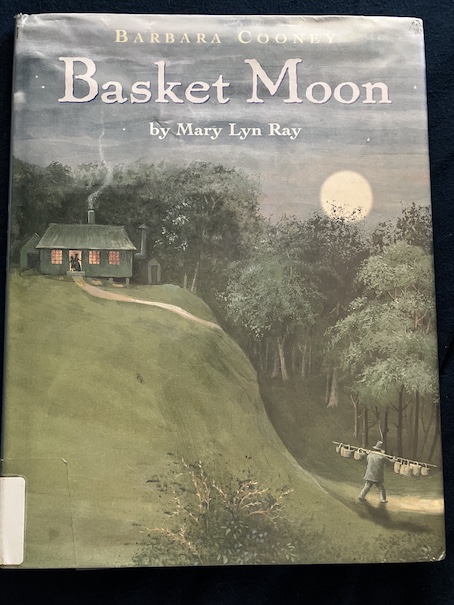
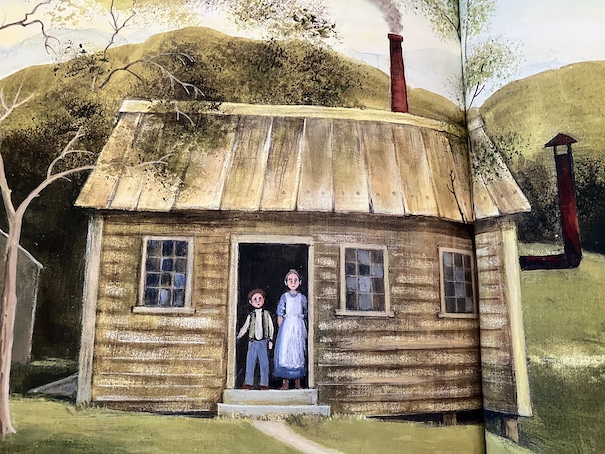
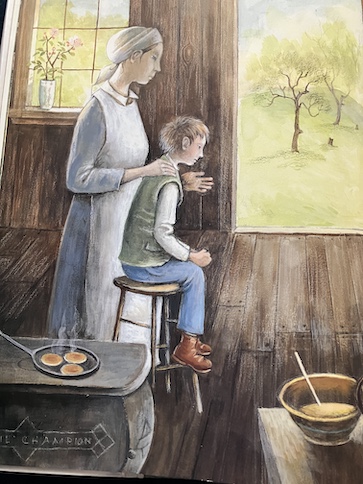
An eight-year-old boy lives in the countryside with his parents, and his father makes baskets to sell in the town of Hudson in New York. The boy has never been to town before, and he wants to go, but his father always says he’s too young.

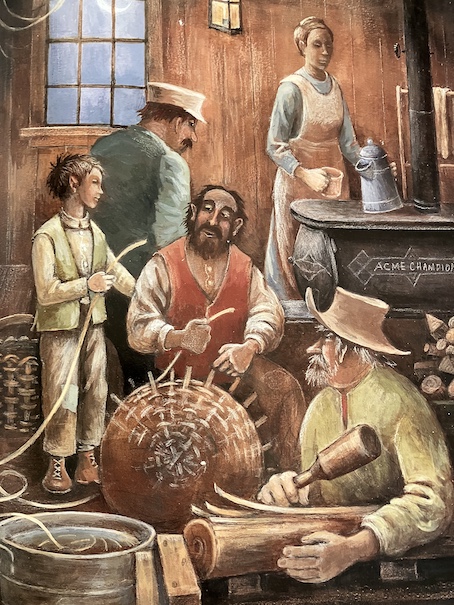
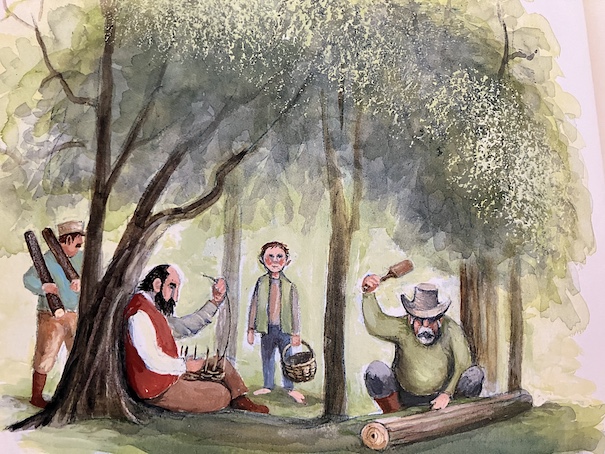
His father has taught him which trees are best for wood to make baskets, and he watches his father and the other men who live in the area gathering it. He’s also watched his father weaving baskets, and he starts to weave baskets of his own. When he turns nine years old, his father decides that he’s old enough to go to town with him to sell the baskets.

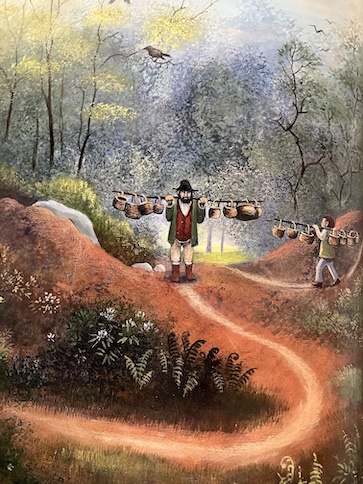
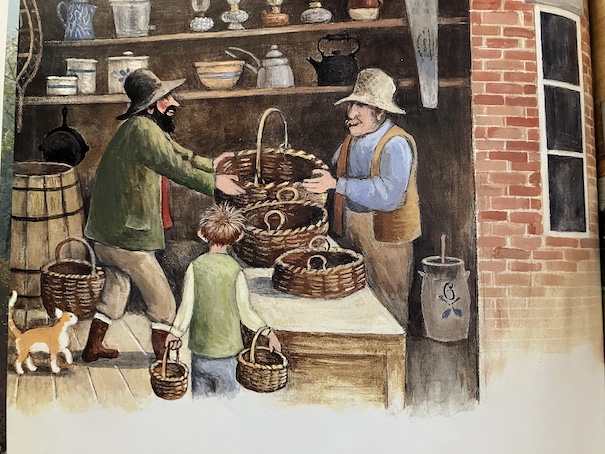
They sell their baskets to a hardware store, and they buy some supplies their family needs. The boy marvels at all the new sights around him. However, as he and his father are heading home, a man teases them about being hillbillies who only know how to make baskets. The boy’s father ignores them, but the boy is bothered by what the man said.

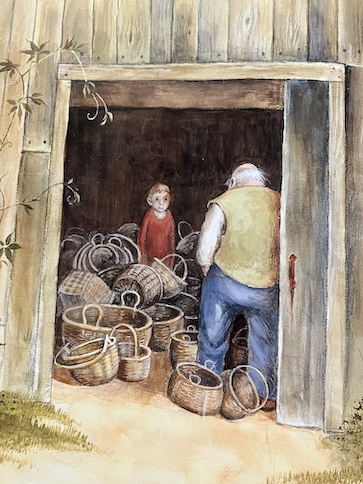
For a time, the boy no longer wants to make baskets, thinking that it’s something that only hillbillies do, like the man in town said. However, when the boy kicks over stacks of his father’s baskets in anger, they don’t break when they fall, and he sees that his father makes strong, high quality baskets. His mother and one of the other men who works with the boy’s father talk to him about how they learned the art of basket making from the trees and the wind. The trees and the wind never seemed to talk to the boy before, but when he really listens, he begins to understand what the men mean.

The book is available to borrow and read for free online through Internet Archive.

I like books about traditional crafts and lesser-known pieces of history. In the back of this book, there’s an author’s note about the history of making baskets among the country people around Hudson, New York. Sometimes, these country people came into town to sell their baskets, but the townspeople were also somewhat leery of them. The wooded countryside around the town was spooky to the townspeople, and there were a lot of stories about frightening things that lurked there. The author points out that this is the area where the stories of Rip Van Winkle and The Legend of Sleepy Hollow were set. The time period of the story is indefinite although it looks like it might be set around the late 1800s or early 1900s. The author’s note says that the art of making baskets in the area started dying out in the mid-20th century because people were using different types of containers, such as paper bags, plastic containers, and cardboard boxes. However, the traditional baskets were made very study, and surviving examples of this functional folk art still exist in collections and museums.

One of the themes of book is being in touch with nature, which is what the adults in the story really mean when they talk about hearing the wind and the trees speak to them. In the end, the boy thinks he literally hears the wind calling to him, but I think it’s supposed to be a metaphor for him getting in touch with nature and with his craft. His family and the others around them are country-dwelling people, and some of the townspeople look down on them for living out in the countryside, away from the society, amenities, and business of the town, but the country-dwelling adults are comfortable with themselves and with their lives. They realize that they know things about nature and about their craft that the townspeople don’t know.

It did occur to me that the townspeople probably wouldn’t know how to make their own baskets if they had to do it themselves. We don’t think that much about baskets today, although we still use them sometimes, frequently as a form of decoration. In those days, though, the baskets were functional home necessities for carrying and storing food and other items. The townspeople in the story buy their baskets from these makers in the countryside because they are the ones who have necessary skills and knowledge to make strong, high-quality baskets that the people in the town need, whether or not the townspeople truly appreciate the work and skill that went into them. Part of what the author’s note points out is that the baskets were of such high quality that some of them have long out-lived their original makers and users. Things of quality last.