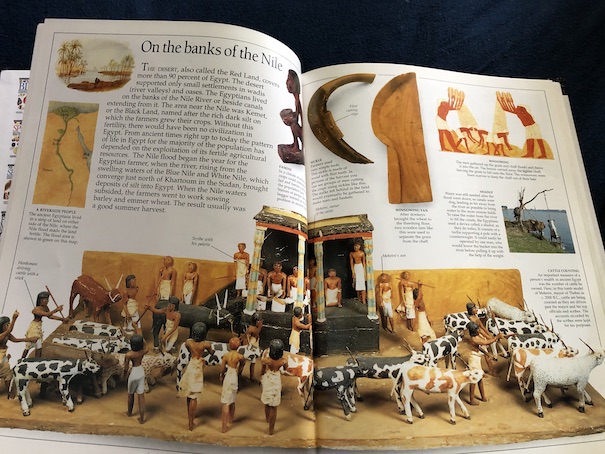
I love the way this book, like others in the Eyewitness series, shows photographs of artifacts so readers can not only read about how people lived but see the objects that they used. Each photograph in the book has a caption to explain what it is.
The book begins with an explanation about the origins of Ancient Egyptian civilization thousands of years ago, before there were pharaohs. Then, it explains about the geography of Egypt and the Nile and how the Nile floods and fertile lands along the river made Egyptian civilization possible.
The book then explains the concept of the Egyptian king as a “pharaoh.” The title of “pharaoh” comes from an Ancient Egyptian word meaning “great house”, referring to the palace where the king lived, so the king was the one who lived in the “great house.” However, the pharaoh was more than just the an important man living in a palace; he was also regarded as being a god. Most Egyptian rulers were male, although queens also sometimes ruled and were also regarded as divine. The book shows pictures of statues depicting pharaohs and explains a little more about some of the most famous pharaohs and queens. Then, it goes on to discuss life in the royal court.
Of course, no book about Ancient Egypt is complete without a discussion of mummies and tombs. Much of what we know about Ancient Egypt comes from what the Ancient Egyptians left in their tombs because Ancient Egyptians believed in life after death. They developed methods of preserving their bodies after death, and they stocked their tombs with things that they wanted to have with them in the next life. The book explains the embalming process, what pyramids and royal tombs were like, who the Egyptian gods and goddesses were, and what Egyptians believed about the journey to the afterlife.
I liked how the book not only explains different types of gods and goddesses in Ancient Egypt but also the roles of priests and temples in Egyptian society, types of religious rituals, and the role of religion and magical rituals in Ancient Egyptian medicine.
As the book covers a wide variety of different topics in Egyptian society, including scribes and writing, weaponry, and trading. I particularly like the parts focusing on daily life, like what Egyptian homes were like and some of the tools and details of different trades, like carpentry. The book has details about foods Ancient Egyptians ate, what music and dancing were like, and types of clothing and jewelry they had.
One of my favorite sections in the book is about toys and games in Ancient Egypt. We don’t know all of the details of games that were played in Ancient Egypt, but we do know that they had board games because they were found in tombs. Children’s toys were whimsical and included moving parts. Some of the games children played are similar to ones that children play today, like versions of leapfrog and tug-of-war and spinning tops.
The book is available to borrow and read for free online through Internet Archive (multiple copies, including some in different languages)
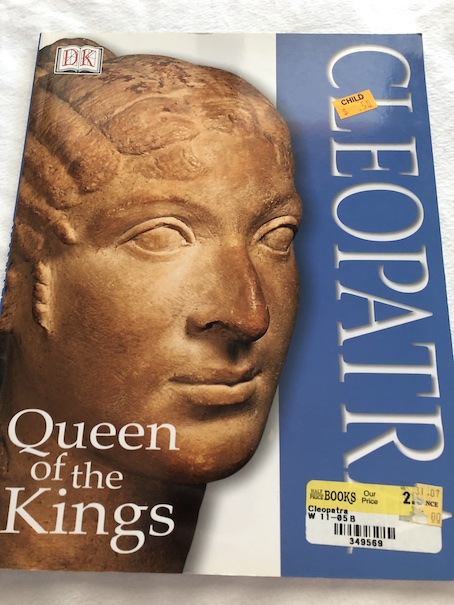
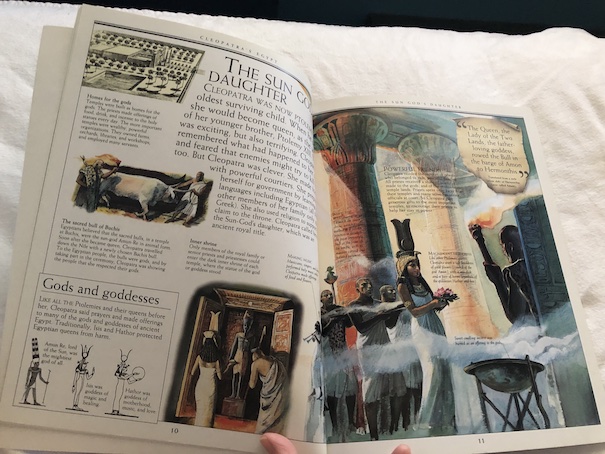
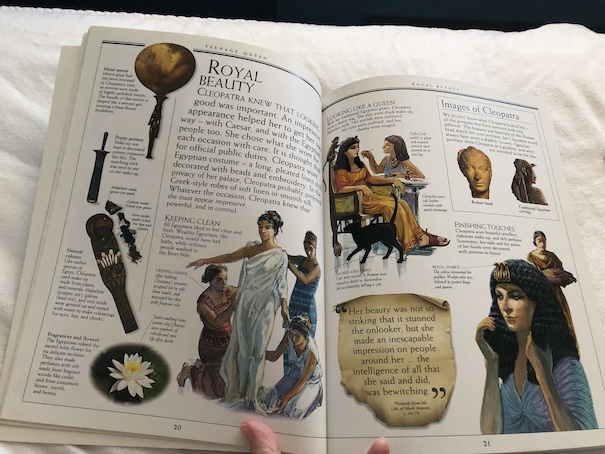
Cleopatra: Queen of the Kings by Fiona MacDonald, illustrated by Chris Molan, 1998, 2003.
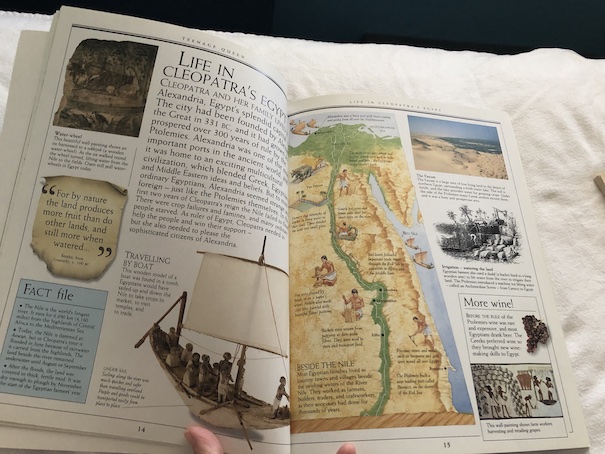
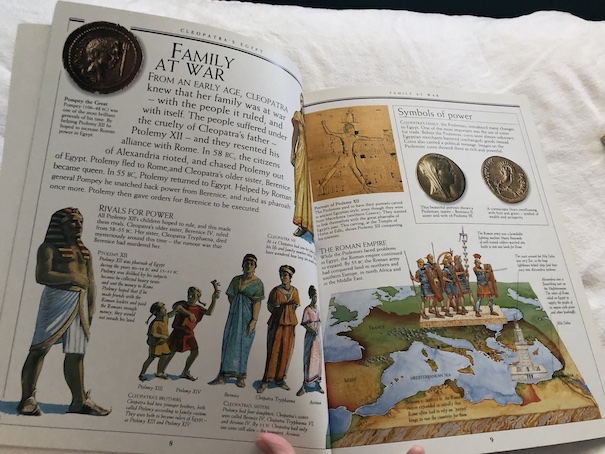
I always like books from DK Publishing because they have great illustrations, and they do a good job of helping to explain nonfiction topics, including different periods of history. However, one thing that’s important to realize is that you really have to read all of the small text that accompanies even the small pictures in order to get the full story. If you don’t, you may miss important details. Although this is a picture book, the detailed nature of the information and some of the dark subject matter make it inappropriate for young children.
This particular book is about the life of Cleopatra, the famous Egyptian queen. The queen we know as simply Cleopatra was actually Cleopatra VII. She was part of a dynasty of Egyptian rulers who were originally from Macedonia, a region of Greece. This dynasty was known as the Ptolemaic Dynasty because all of the kings in the dynasty were named Ptolemy, including Cleopatra’s father, Ptolemy XII. There were certain names that were repeated in every generation of the family and even within generations, like Ptolemy (Cleopatra’s two brothers both had this name), Cleopatra (Cleopatra also had a sister who was also named Cleopatra), and Arsinoe (Cleopatra’s younger sister). The book doesn’t fully explain why they came from Macedonia, but one of Cleopatra’s ancestors, Ptolemy I, was a Macedonian nobleman and a friend of Alexander the Great. Ptolemy I went with Alexander the Great on his military campaigns. Through his service to Alexander the Great, Ptolemy I was made the Greek governor of Egypt, ruling from the city Alexandria, which had been established by Alexander the Great. Alexandria was an important port city as well as the seat of the royal family. It was a gathering place of traders, scholars, and people from different cultures in Egypt, although average Egyptian citizens viewed it more as city of foreigners, just as the royal family itself was also foreign. That’s an abbreviated explanation of the family’s history, but it helps to understand that, while the family ruled Egypt for generations, they remained culturally Greek. The book mentions that most of the members of Cleopatra’s family only spoke Greek and that Cleopatra departed from the norm by learning to speak Egyptian.
Cleopatra was born into tumultuous times in the history of Egypt and her family. Her father was known as a cruel ruler who taxes his people heavily and sent large amounts of money to Rome, attempting to befriend Roman leaders and bribe them not to invade Egypt. In 58 BC, Alexandrian citizens had enough of Ptolemy XII and the way he catered to Rome, and they revolted, forcing Ptolemy XII to flee the city for Rome. Cleopatra was only fourteen years old at the time. Members of the family were left behind in Alexandria when Ptolemy XII fled, and Cleopatra’s oldest sister, Berenice claimed the throne in her father’s absence. The Ptolemies were always focused on maintaining their power, even in the face of competition or opposition from family members, and they were not afraid to fight or even kill each other to maintain control. Berenice may have murdered another of her sisters during her time as queen because she died under mysterious circumstances. However, when Ptolemy XII returned to Egypt a few years later, he had Berenice executed as a rival for the throne. By then, Cleopatra was the oldest surviving child of the family, with only her youngest sister and her brothers still alive.
A few years later, Ptolemy XII died, and Cleopatra acted quickly and prudently to secure both her life and her power. Her younger brother, Ptolemy XIII, had a claim to the throne, but he was still only twelve years old, and Cleopatra was eighteen. Asserting her authority over her child brother, Cleopatra took the throne as the oldest remaining offspring of Ptolemy XII and married her brother in order to turn her brother from a rival for power into a further source of her own authority. She could then rule on her brother’s behalf as his wife as well as his older sister. (Other Egyptian rulers had married close relatives for reasons like that. Tutankhamen was similarly the result of an incestuous royal relationship.) As queen, Cleopatra called herself the Sun God’s Daughter, an old royal title that tied her image to rulers of the past and the gods of Ancient Egypt.
From the beginning, being queen was a difficult task for Cleopatra. There were famines in Egypt during the beginning of her reign, and Cleopatra had to manage a response that would satisfy the citizens that she was doing her job as ruler. Family rivalries were also an ever-present danger. Cleopatra knew that she had enemies in her court, including people who favored her brother over her. As her brother got older, he became dissatisfied with the way his sister was ruling without sharing power and authority with him. For a time, Ptolemy XIII forced Cleopatra to flee Egypt and go to Syria. Cleopatra took her sister Arsinoe with her, both to protect her from their brother and to prevent her from trying to seize power herself. (In the Ptolemy dynasty, either could be a possibility. When family members weren’t in danger from each other, they could be a danger to each other.)
In the meantime, Julius Caesar came to Egypt to collect a debt that he claimed that Cleopatra’s father had owed him. He arrived during the power struggle between Cleopatra and Ptolemy XIII, and he decided that it would be for the best to try to mediate peace treaty with the two of them. He wanted to meet with both Cleopatra and Ptolemy XIII together, but Cleopatra knew that there was a risk that she might be killed if she showed up for a meeting. Yet, she did want to meet with Caesar because she recognized that he could be an important friend and source of protection for her. She ended up visiting Caesar in secret. According to legend, she had herself delivered to Caesar’s room in a rolled-up carpet. Caesar was charmed by Cleopatra and became her ally. When the news of their alliance spread, it tipped the balance of power in the royal family. Caesar learned that Ptolemy XIII’s adviser was plotting against him and had him executed. Ptolemy XIII fled with Arsinoe to join the Egyptian army and was later killed and found dead in Alexandria’s harbor. Getting rid of her brother/husband and his advisers secured Cleopatra’s position. She had one remaining brother, Ptolemy XIV, who was only eleven years old at the time, so she married him, too, further solidifying her power. As her ally (and possible lover), Caesar provided her with guards for her safety.
Cleopatra had a son named Caesarion, who was rumored to be Caesar’s son as well. However, Romans feared that Julius Caesar would proclaim Caesarion as his heir. They didn’t want him as the future ruler of Rome, citizens were appalled at the way Arsinoe was paraded through the streets as a war prize, and people generally began to fear that Caesar was becoming too powerful. In 44 BC, Caesar was assassinated by a group of senators. Cleopatra was in Rome when Caesar was killed, and she fled back to Egypt with her son. Around this time, Ptolemy XIV disappeared, and he may have been murdered by Cleopatra. With a son to inherit her throne, Cleopatra no longer needed Ptolemy XIV. However, her Roman protector was now gone, and Cleopatra still had enemies at court. Cleopatra’s remaining sibling, Arsinoe, sided with Caesar’s enemies and plotted against her sister and Caesarion.
Nobody knows exactly what Cleopatra looked like (statues and carvings of her don’t always look alike, and they may have been idealized images of her), but she took care of her appearance as part of her image as queen. Apparently, Cleopatra was more striking than beautiful, and what struck people about her the most was her intelligence and personality. Her charm was one of her most important tools in winning allies, and she used it again to win over a new ally to replace Caesar. She found a new ally in Marcus Antonius (also known as Mark Antony), one of the candidates to replace Caesar in Rome.
Mark Antony needed the control of Egypt and its resources and the support of Cleopatra for his own political purposes. To win his support for her purposes, Cleopatra began a romantic relationship with Mark Antony that eventually became a major part of the legends around Cleopatra. Although Mark Antony already had a wife in Rome, he became devoted to Cleopatra and fathered a set of twins with her and, later, a third child.
When Caesar’s nephew, Octavian, learned that Antony had divorced his wife and was conspiring against him, he declared war on Egypt to take down both Antony and Cleopatra. Cleopatra and Antony’s forces were defeated at the Battle of Actium although the two of the escaped. Feeling that the end was probably near, Cleopatra had stoneworkers hurry to complete her tomb. She began experimenting with poisons, and she and Antony swore to each other that they would die together. When Antony’s soldiers turned against him and refused to fight, Antony was disgraced and forced to flee. He ended up taking his own life by stabbing himself. Cleopatra had retreated into her own mausoleum, planning to die, but Octavian allowed her to remain there as a prisoner while she arranged Antony’s funeral. The exact cause of Cleopatra’s death has never been confirmed, but according to legend, she arranged her own death by the bite of an asp and sent a note to Octavian, asking that she be buried with Antony.
It’s a tragic end to a story that was full of treachery and family rivalries from the very beginning. Octavian refused to allow any of Cleopatra’s children to assume the throne of Egypt, ending the reign of pharaohs forever. Rome took control of Egypt, and Cleopatra’s children were sent to be raised by Antony’s first wife in Rome, Octavia (who was also Octavian’s younger sister). Caesarion tried to flee to Syria, but he was caught and executed by Octavian’s orders. No one knows what happened to Cleopatra’s other two sons because they disappear from historical records after this point, so they may have died young (or were murdered, given how things went in the powerful circles in which they lived). However, Cleopatra’s daughter survived, grew up, and eventually married the King of Mauretania, a region in North Africa. The book mentions that she had a son that she also named Ptolemy, but it doesn’t mention that this Ptolemy was the last king of Mauretania and was assassinated by Caligula. Caligula and Ptolemy were distant relatives of each other because Ptolemy of Mauretania was a grandson of Antony, and Caligula was descended from both Antony and Octavian. In many ways, it seems like this family’s greatest misfortunes were themselves and each other. Fortunately, the death of death of Ptolemy of Mauretania didn’t end the family line. It’s unknown whether or not Cleopatra has living descendants today, but Ptolemy of Mauretania did have a sister (the details of her life are unknown) and a daughter named Drusilla, who apparently grew up, married, and continued the family line. Further down the family tree, relationships and offspring become harder to trace.
Something I particularly liked about this book was the separation between the legends of Cleopatra and the her known history. As with other ancient historical figures, the history and legends go hand-in-hand, and it can become difficult to separate the two. The book is pretty open about which parts of her life are known, what can’t be firmly established, and which parts of her story come to us from legend and may or may not be reality. The final section in the book discusses the known facts and fiction about Cleopatra and possible confusions between her and other Cleopatras in her family (which may be another reason why not all of the images of Cleopatra look alike). It also explains the information about Cleopatra in Plutarch‘s biography of Mark Antony and how his stories inspired Shakespeare’s play and modern movies about Cleopatra.
The book is available to borrow and read for free online through Internet Archive.
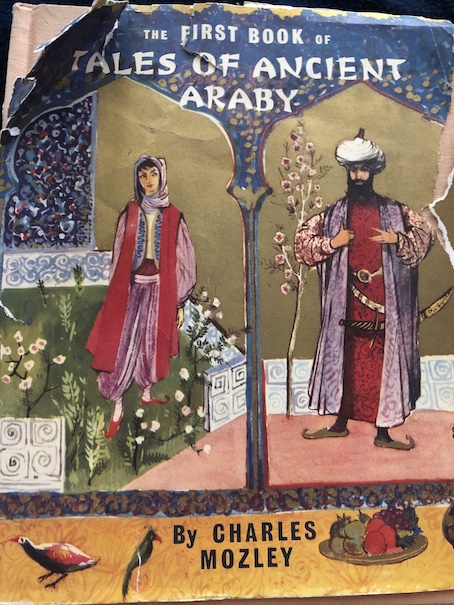
The First Book of Tales of Ancient Araby by Charles Mozley, 1960.
I’ve had this book for years, and one of the questions that I’ve had about this book is why is it Ancient “Araby”? Why “Araby” instead of “Arabia”? According to Wikipedia, “Araby” is an archaic name for Arabia, which explains it, I guess. This book was published in 1960, and I don’t think people were using “Araby” back then, but the book is trying to sound ancient.
The stories in the book are based on those from the collection of folktales called One Thousand and One Nights, in which Scheherazade tells stories to the murderous king who is her husband, but they’re simplified for children. The introductory section to this book says that . The book doesn’t explain, but the original stories in the book were rather racy.
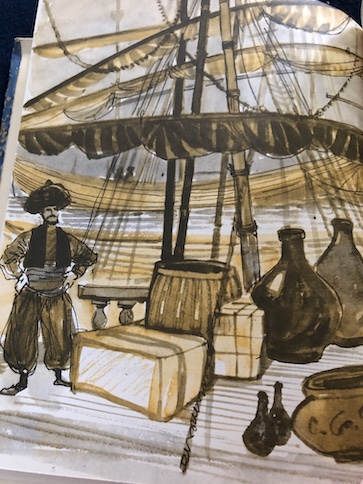
The book has pictures for each story, but some are in black-and-white, some are monochromatic with a color other than black, and some are in full color.
The book is available to borrow and read for free online through Internet Archive.
The book contains the following stories:
Scheherazade – When the sultan’s wife betrays him, he not only has her executed but loses his mind with hatred for all women because he believes that they are all untrustworthy. He begins a murderous series of weddings, where he has his wives all executed the day after the wedding, so they can never betray him. (It’s dark stuff, but this story wasn’t originally intended for children). All of the unmarried women in the kingdom are terrified that they’ll be next, and the sultan’s vizier is beside himself because he doesn’t know how to stop the sultan and has an obligation to obey the sultan’s commands to bring him new brides. Then, his eldest daughter, Scheherazade, requests that her father send her to the sultan as his next wife. At first, the vizier doesn’t want to send her because it’s certain death to marry the sultan, but Scheherazade tells him that she has a plan to put an end to the weddings and executions. Every night, she starts to tell a story but leaves it unfinished, so the sultan keeps putting off her execution to hear the end of the story. This continues for 1,001 nights, until the sultan realizes that he’s actually happy with Scheherazade and no longer has any desire to execute her or any other woman. The rest of the stories in the book are among the ones that Scheherazade told the sultan. (The Scheherazade story is a frame story, a story that contains other, internal stories or creates the basis for the other stories.)
Aladdin and the Wonderful Lamp – A poor boy and his widowed mother are approached one day by a man claiming to be the brother of the widow’s dead husband, the boy’s uncle. At first, he is very nice to them, bringing them to live with him and providing them with everything they need. However, one day, he stakes the boy, Aladdin, to retrieve a strange old lamp from a series of treasure caves, giving him a ring to protect himself. Before the boy returns to the man, he comes to the realization that the man isn’t really his uncle but an evil magician who is just using him to get the lamp. The boy and his mother discover that there is a genie living in the lamp who will do their bidding and provide them with all they need. They use the lamp not only to provide for themselves but to make it possible for Aladdin to marry a princess. The evil magician almost ruins everything when he tricks the princess into giving him the lamp, but Aladdin and the princess get it back through some trickery of their own.
Ali Baba and the Forty Thieves – Ali Baba marries a kind but poor woman and makes his living as a woodcutter, while his brother, Kassim, marries a disagreeable woman from a wealthy family and becomes an wealthy merchant. One day, while cutting wood in the forest, Ali Baba sees a large group of horsemen. They are robbers, and they have a secret hideout nearby. Ali Baba hides and watches how they open the entrance to their secret cave with the magic words “Open, Sesame!” After the thieves stash their loot and leave, Ali Baba realizes that he can use their secret words to enter the cave himself and see what they left. He helps himself to some of the stolen loot. He and his wife decide to stash the second-hand loot and spend it a little at a time, ensuring their family’s security. However, Kassim’s wife finds out about their loot and tells Kassim, and Kassim damands that Ali Baba tell him where he acquired so much money. When Ali Baba explains about the thieves and the treasure cave, Kassim wants to go there and loot the place himself, but Ali Baba thinks it’s too dangerous to go back again because the thieves will be angry and will probably kill them if they get caught. When Kassim goes anyway and is caught and killed, Ali Baba must arrange a deception to prevent the thieves from learning who Kassim was and everyone else from learning how Kassim met his death so the thieves won’t take revenge on the rest of the family with the help of a clever slave girl, Morgiana.
The Fisherman and the Genie – A fisherman pulls a strange bottle from the sea that contains a genie, but to the fisherman’s shock, the genie threatens to kill him when he frees him from the bottle. The fisherman asks why he would do such a thing when the fisherman did him a favor, and the genie explains that he was imprisoned in the bottle by King Solomon for sins against Heaven. At first, the genie thought that he would reward whoever freed him, but as his imprisonment grew into hundred and hundreds of years with no rescue, he became increasingly enraged and decided to kill whoever released him. However, the genie decides to grant the fisherman one wish before death. The fisherman asks him to prove that he can actually fit into the bottle and imprisons the genie there again. He refuses to let him out again until the genie swears he won’t kill him. The genie promises the fisherman anything he wants, but the fisherman is a modest man and only asks that he always be successful as a fisherman. He gets his wish, and he uses the money he acquires from his success to build a better life for his family.
Sinbad the Sailor – When Sinbad’s father dies, he leaves Sinbad a considerable amount of money, but Sinbad quickly squanders most of his inheritance. When he realizes his foolishness, Sinbad uses what he has left to set himself up as a merchant sailor. However, this decision takes him on a series of wild adventures, from being nearly drowned to befriending a king to a hair-raising encounter with a roc (a giant bird that’s big enough to carry a grown man).
The Twice-blessed Arab – This is a legend about the origins of horses and camels.
The Story of Little Mukra – Little Mukra is a dwarf, and his father, fearing that the rest of the world will laugh at him and treat him cruelly for his size, hides him for his early life. When Little Mukra is sixteen years old, his father dies and the rest of his relatives declare that they don’t want him, so Little Mukra decides to go out and seek his fortune. One day, while Little Mukra is hungry, he hears an old woman calling for someone to come to eat. It turns out that she’s talking to her cats, but he persuades her to let him eat with the cats because he’s starving. The woman hires him as a servant to take care of her cats. It gives Little Mukra a place to live, but the problem is that the woman blames him for damage that the cats cause while the lady isn’t looking. The clever cats are always perfectly behaved when she’s watching but not when they’re alone with Little Mukra. Little Mukra escapes this situation with the help of the lady’s dogs, who are not so pampered as her cats and reveal to Little Mukra a paid of magical slippers that can make him run fast, securing him a position as the king’s special courier.
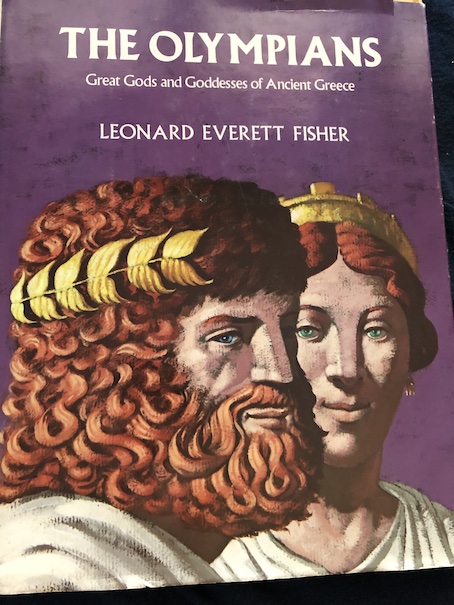
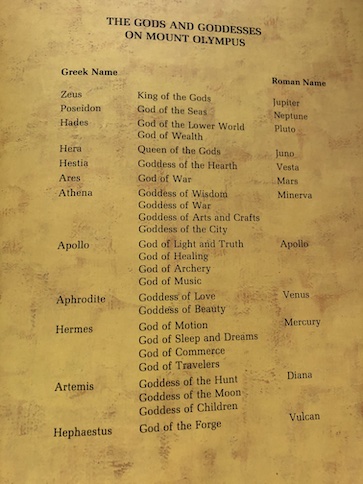
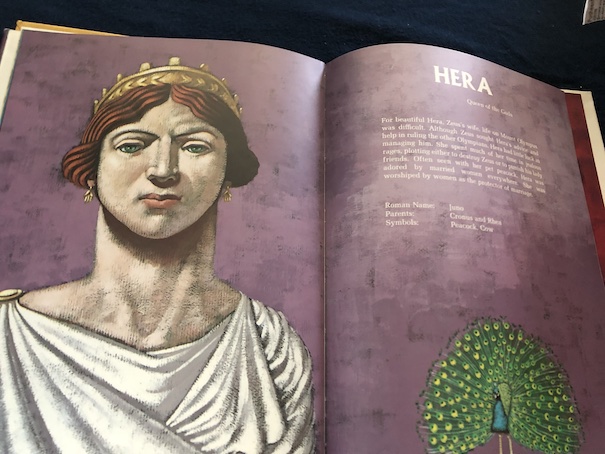
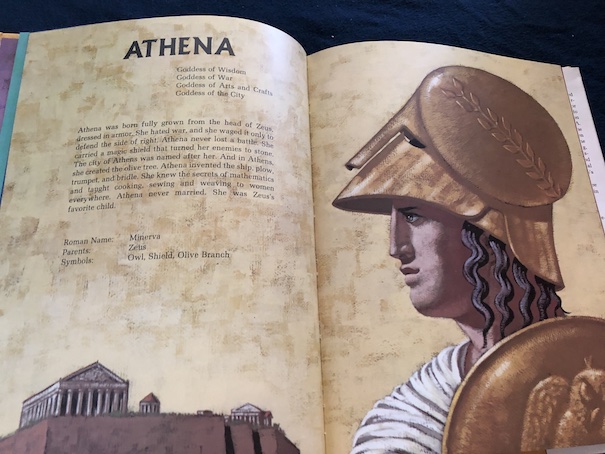
This picture book was my very first introduction to mythology when I was a kid! The book presents profiles of twelve Greek/Roman gods and goddesses. The Ancient Greeks and Romans worshiped the same gods and goddesses, but they used different names for them. At the beginning of the book, there is a list of gods and goddesses that gives both their Greek and Roman names. However, the rest of the book mainly uses the Greek names because the emphasis is on Greece. The gods and goddesses were called the Olympians because their legends state that they lived on Mount Olympus in Greece. It’s useful to know the Roman names, though, because the planets in our solar system were given the Roman names of gods.
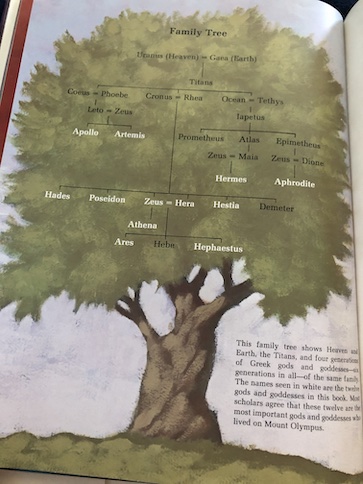
The back of the book has a family tree because all of the gods and goddesses were canonically related to each other. As a kid, I just accepted that. I don’t remember questioning it. The names of the gods and goddesses in the book are written in white.
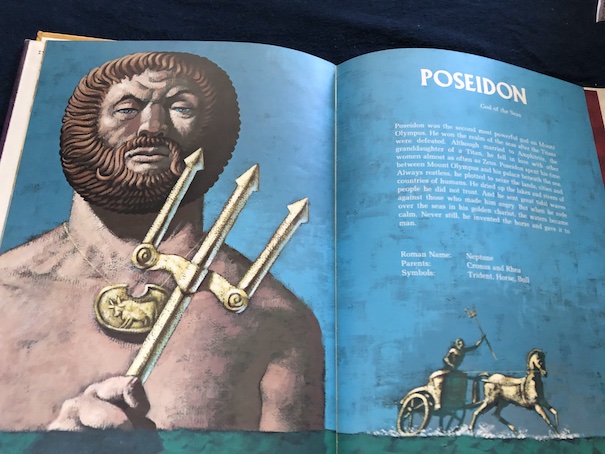
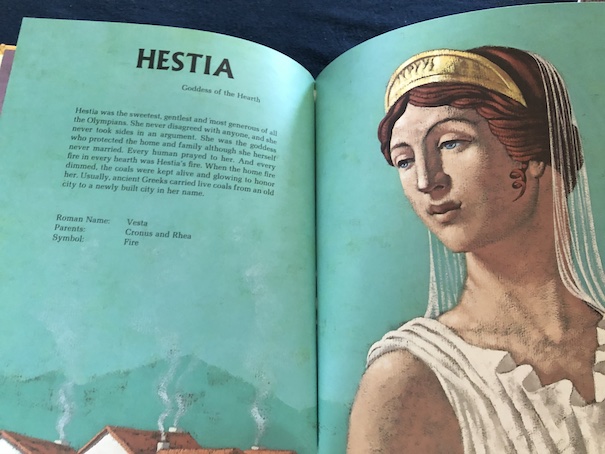
Each god and goddess in the book has a page of information and a full-page, full-color picture. Their profiles explain their personalities, their roles among the gods, and symbols that are commonly associated with them.
The pictures in the book are colorful. Although the faces of the gods and goddesses have a somewhat chiseled appearance, I like them.
When I was a kid, I think I had a fascination for Artemis and Apollo because they were twins, and I found twins fascinating. Because I was a girl, I generally liked the female goddesses better than the male ones. I think I sometimes tried to imagine which one I would be if I could pick one. I think, for a time, I liked Athena because she was the goddess of wisdom and was represented by owls, and I also happen to like owls.
As I was rereading the book this time, I became more interested in the page about the goddess Hestia. As the goddess of the hearth and home, she might not seem as exciting and well-known as the others, but I like her picture, and her profile has some interesting facts. It mentions that Ancient Greeks would carry live coals from an old city to a new one that had been recently built in her honor.
The book is available to borrow and read for free online through Internet Archive (multiple copies).
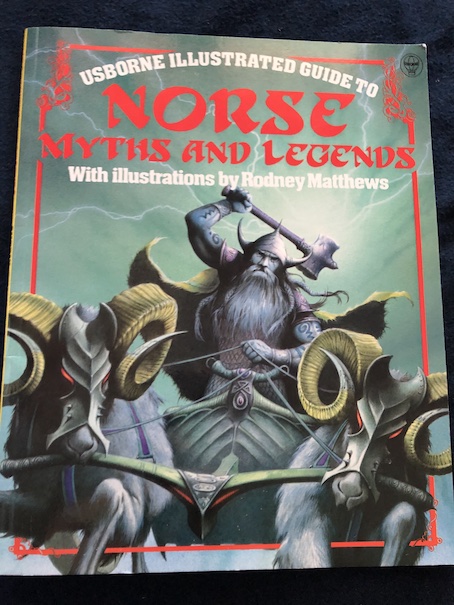
Usborne Illustrated Guide to Norse Myths and Legends by Cheryl Evans and Anne Millard, illustrated by Rodney Matthews, 1986.
I like this book because, before it begins telling the myths and legends, it first gives an introduction to the history, territory, and religion of the Norsemen. By “Norsemen“, the book means not only people living in Norway but Scandinavians and people of Scandinavian descent speaking related languages and living in various areas across Europe. The Norsemen include, but are not limited to, the Vikings, who were specifically seafaring traders, mercenaries, and pirates/looters as opposed to farmers and fishermen.
There is still much about the history of the ancient Norsemen that we don’t know because, for much of their history, they did not have their own system of writing and relied on oral stories for passing down historical and cultural knowledge. The Norse myths were originally oral stories before they were written down. The introduction also explains that there is one myth in the book, the story of Sigurd and the Nibelungs, that was originally a German legend but was later adopted by Scandinavians.
Norse mythology is somewhat unusual because, while Norsemen were polytheistic, like other ancient groups, and their gods and goddesses had human emotions and relationships, like the gods and goddesses in Greek and Roman mythology, Norse gods were not immortal. Norse gods could be killed, like human beings, which meant that any risks they took had genuinely serious stakes for them. In fact, the legends predict that, at a future, world-ending event known as Ragnarok, most of the gods will be killed.
Although this particular book doesn’t mention it, the qualities of Norse gods being able to perform incredible deeds while still being mortal makes them rather like our modern concept of a superhero. Thor and Loki were both made into comic book characters by the time this book was written, and characters and events in Norse mythology have helped to form the 21st century Marvel Cinematic Universe.
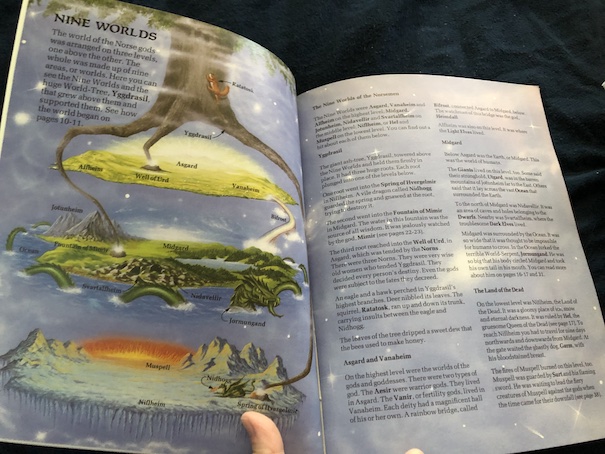
In Norse mythology, the gods and goddesses lived in a multilevel universe made up of nine lands or “worlds.” The highest level of their universe contained Asgard (home of the warrior gods), Vanaheim (home of the fertility gods), and Alfheim (home of the light elves). The middle level contained Midgard (our world, where humans live, connected to Asgard by a rainbow bridge), Jotunheim (home of the giants), Nidavellir (home of the dwarves), and Svartalfheim (home of the dark elves). The lowest level held Niflheim (land of the dead, dark and icy, ruled by a fearsome queen named Hel) and Muspell (where the creatures who will attack the gods at Ragnarok live). All three levels of this universe were kept in place by the roots of a giant ash tree called Yggdrasil.
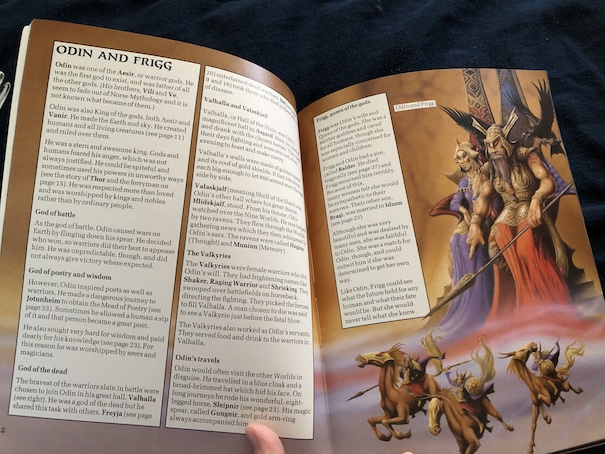
The book has pages dedicated to specific gods and goddess, explaining their histories and roles in Norse mythology. Odin, for example, was the king of the gods, who created the world and humans and was the father of the other gods. His wife’s name was Frigg, and she was a mother goddess figure. Thor was the thunder god and the god of law and order. Unlike other gods, he mostly relied on his strength instead of magic or tricks, but he did have magic weapons, including his hammer, Mjollnir, which would always strike its intended target and return to Thor after. Freyja was one of the fertility gods, and she was the goddess of love and beauty. She later also became a goddess of death and was responsible for starting wars among humans. Loki technically wasn’t a god because his parents were fire-giants, not gods, but he was a close friend and sworn brother to Odin, so he was able to live in Asgard, too. Loki is known for being a trickster figure.
After the book profiles some of the gods and goddesses and other notable figures in Norse mythology, it tells some of the myths and legends associated with theses figures. One story that particularly interests me is “The Curse of the Ring” because this story and other aspects of Norse mythology provided some of the inspiration for Tolkien’s Lord of the Rings. Before it inspired Tolkien, this same story was also made into an opera by Wagner.
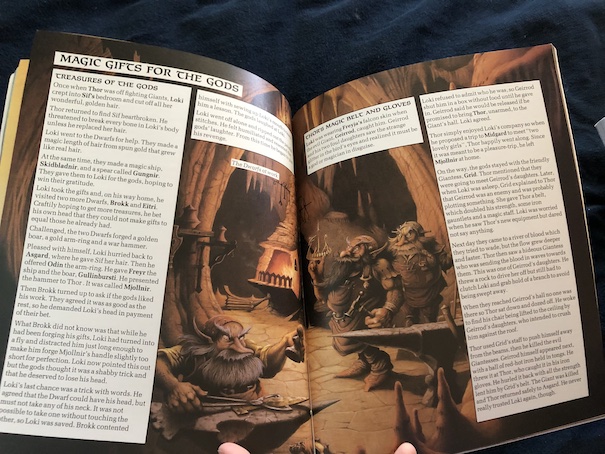
In “The Curse of the Ring”, Odin, Loki, and Honir kill an otter who turns out to be the son of a magician who sometimes turns one of his sons into an otter to go fishing for the family. (Maybe not the safest choice of fishing methods.) The gods offer to compensate the magician with enough gold to fill the otter skin. Loki goes to get the gold from a dwarf named Andvari, who has a famous hoard. Andvari has no choice but to give Loki the gold he wants, but Loki notices that Andvari also has a gold ring on his finger, and Loki demands that Andvari give him the ring, too. Angry at having his ring stolen, Andvari curses the ring so that it will bring misery and destruction to anyone who wears it. When Loki brings the promised gold to the magician, the magician also sees the ring and wants it. Loki warns him about the curse on the ring, but the magician insists that he wants it anyway.
The curse on the ring comes true when one of the magician’s other sons, Fafnir, kills his father for his gold. Fafnir takes all of the gold instead of giving his other brother, Regin, a share of the inheritance and turns himself into a dragon so he can protect his hoard of gold from anyone who tries to take it. Regin raises their nephew, Sigurd, to kill Fafnir and avenge his grandfather. However, the curse of the ring and the gold doesn’t end there. Regin tries to kill Sigurd so he won’t have to share the gold with him, and Sigurd has to kill him in self defense. After Sigurd rescues a Valkyrie named Brynhild, and they fall in love, they both fall victim to treachery from Queen Grimhild of the Nibelungs. Wanting Sigurd’s gold, she gives him a love potion that makes him fall in love with her daughter, forgetting about Brynhild. Queen Grimhild’s son also wants to marry Brynhild. Abandoned by her lover, Brynhild marries him, but driven mad with by Sigurd’s abandonment of her, Brynhild arranges for Sigurd to be murdered and then kills herself, setting off a continuing chain of murder and revenge after her own death that destroys the royal family of the Nibelungs.
The book ends with a “Who’s Who” section with information about various characters and creatures in the Norse myths.
The book is available to borrow and read for free online through Internet Archive.
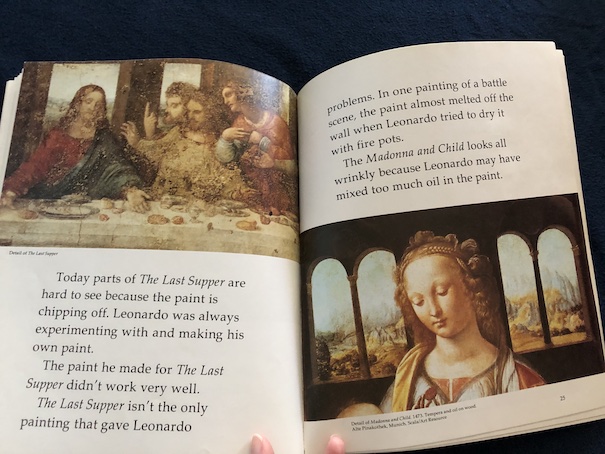
This book is part of a series of biographies of famous people from history. I’ve been familiar with the part of this series about famous artists since around the time the first ones were published. I was in elementary school school at the time, and we had the books because my mother used to teach the Art Masterpiece program at the school. She would come to class and talk about famous artists and show their paintings, and there would be an art project for the kids to do based on the style or subject matter of the artists. So, when I was young, we had books from this series (among other art books) around the house that she used for the art classes and a lot of arts and crafts materials (a tradition which exists to this day). At the moment, this is the only book from the series that I have because the book about Leonardo da Vinci was my favorite.
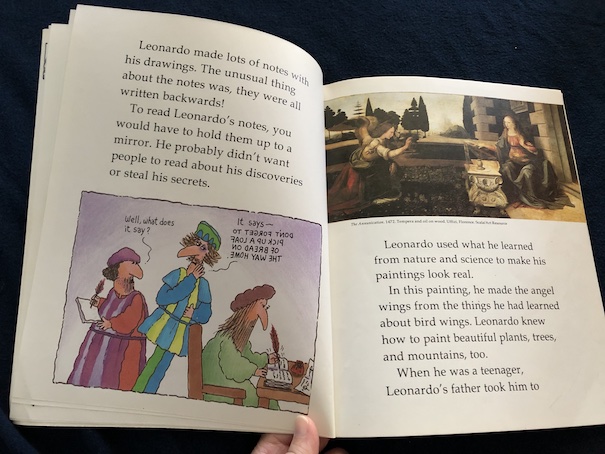
Leonardo da Vinci was one of the most famous artists of the Italian Renaissance, particularly known for his paintings The Last Supper and the Mona Lisa, but he was more than just a painter. The book is full of interesting facts about his life as well as his work. Aside from showing photographs of da Vinci’s work, the book also has humorous cartoons about da Vinci’s life, which is one of the things that makes this series of books fun.
Leonardo began showing an interest and talent for drawing while he was still a child. Throughout his life, he also developed and practiced many other skills, including architecture and mathematics, music, and sculpture. He was a scientist and inventor, experimenting in many different areas, from the mixing of different types of paints to weapons design. Along the way, he found creative ways to combine his various interests. He used his drawing skills to develop his scientific ideas, and he used his knowledge of science to make his art appear more realistic.
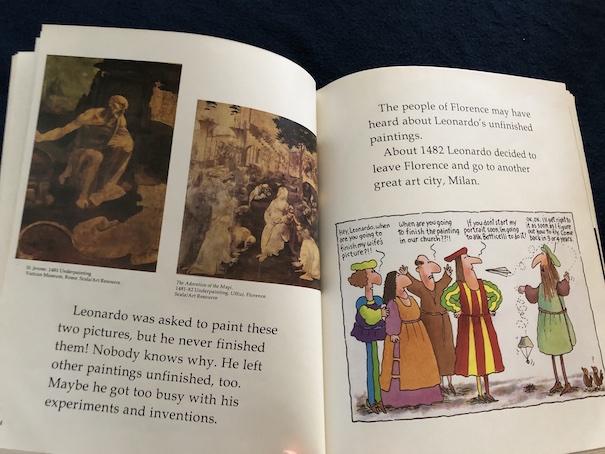
You might wonder how one person could find so much time to do so much, but part of the answer is that he didn’t finish everything he did. He is known to have left some of his work unfinished, possibly because he got distracted by other, more interesting projects and pursuits or because he just couldn’t finish them to his satisfaction. Not all of his designs for inventions really came to anything, and not all of his experiments worked out, either. Some of his paintings are now deteriorating because the experimental paints that he mixed didn’t quite work out.
However, Leonardo da Vinci was a perfectionist, and the paintings that he did complete show excellent techniques and a high degree of realism that have been an inspiration to later artists for centuries.
One final thing I’d like to add is that this book is part of the reason I thought The Da Vinci Code by Dan Brown was a dumb book. As I said, I grew up with art lessons. I read and loved this book about Leonardo da Vinci when I was a kid, and it has some very basic information about the life and work of Leonardo da Vinci that anybody who was seriously interested in him really should know. One of the cringiest parts of The Da Vinci Code for me was the part where our heroes are stupidly trying to figure out a message that is simply written backward. As this picture book about Leonard da Vinci points out, it’s common knowledge these days that da Vinci wrote notes using mirror writing. Some people, like the book suggests, think that he did that to make his notes harder for other people to read, although there’s also a theory that he did it because he was left-handed and that he decided that it was easier for a left-handed person to write that way. Left-handed people often complain about getting ink on their hands when they write left-to-right, but they don’t have that problem if they write right-to-left, so this might have been his attempt to get around the problem of ink-stained hands. Either way, if the people in The Da Vinci Code were such experts, they should have know this about da Vinci, and it should have been one of the first things they should have checked for. That’s not the only problem in The Da Vinci Code, but it’s one of the ones that rankled me the most because of how long I’ve known about this. (Also, The Da Vinci Code totally ripped off the albino assassin from Foul Play with Chevy Chase and Goldie Hawn, but that’s another issue.)
The book is available to borrow and read for free online through Internet Archive.
The First Book of Paintings by Lamont Moore, 1960.
This book is meant to be a beginner’s introduction to understanding and appreciating paintings. I thought it was interesting how, in the book’s introduction, it points out that the word “art” is based on the Latin word for “skill.” Art work is skilled work, and it explains how other types of skills are referred to as “arts.” Artists are people who are skilled at making things, but they also have an ability to see things more clearly than most people, form strong mental images, and convey those mental images and their feelings about them through their art.
The book is divided into sections that focus on different elements of paintings and artistic principles, explaining their role in art and providing examples of their use. The elements of paintings are line, shape, space, light, and color. The artistic principles covered in the book are pattern, balance, rhythm, contrast, and unity. Some of these sections also include suggested activities for readers to try that demonstrate these concepts.
Line – The lines of a painting define shapes in the painting. They also convey the idea of movement and direct the eyes of the viewer to important points of interest. This section shows a cave drawing a rhinoceros and suggests that readers trace it onto another piece of paper but change some of the lines to see the difference it makes.
Shape – Shapes are defined by lines. Shapes are flat, but their placement can create the illusion of depth and distance. The book suggests studying shape in drawing by drawing a friend’s silhouette.
Space – Shapes occupy and fill space. The placement of shapes within space create balance and suggest depth.
Light – Light is used to create the illusion of three-dimensional shapes because physical objects have sides that reflect light and cast shadow. It can also be used to give viewers a sense of substance because metal objects in paintings should look particularly reflective. Lighting can also convey mood in a painting. Part of this section explains how impressionists use light to give paintings more of an appearance of depth when viewed at a distance.
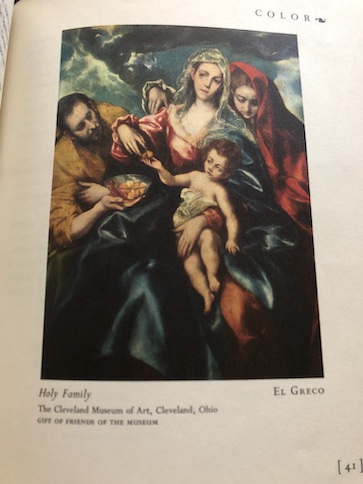
Color – The colors help to convey the mood of the painting. Certain colors also look better in combination with each other.
Pattern – Patterns are repeated features, like repeated shapes, lines, colors, and/or repeated light and dark spaces. Patterns can be used turn a few simple elements into part of a larger concept.
Balance – The concept of balance means that elements of a painting should balance each other, like placements of shapes and objects, points of interest, and areas of dark and light colors. If elements are out of balance, it can unsettle the viewers and give them the impression that something is wrong and needs to be fixed.
Rhythm – Rhythm in a painting suggests movement and energy, like the subjects of a painting are alive and moving.
Contrast – Contrast in a painting creates visual interest. If the elements of a painting are too much alike, they can look dull. The contrast could be in the placement and grouping of elements in the picture (such as some objects in the picture being grouped while others are isolated) or contrast between light and dark elements, making some of them stand out from others.
Unity – Unity refers to how well all of the elements of a painting combine to form a whole. All of the previously listed aspects of a painting need to work together effectively to convey the subject of the painting and the mood and message of the artist.
One of the things I like about this book is that is uses a wide selection of paintings from different countries and time periods as its examples, from cave paintings and paintings on Grecian pottery to Renaissance portraits and modern art.
At first, when I was reading the book, I was annoyed that almost all of the pictures of paintings in the book are black-and-white. Then, I discovered that the pictures in the chapter about the use of color in paintings are full color. That is the only place in the book (aside from the cover) where there are color images. I think the reason why they did that is to draw attention to the colors in that chapter while emphasizing other aspects of painting in the other chapters, but I think I would still prefer more color images throughout the book.
The book is available to borrow and read for free online through Internet Archive.
The FunCraft Book of Print & Paint by Heather Amery and Anne Civardi, 1976.
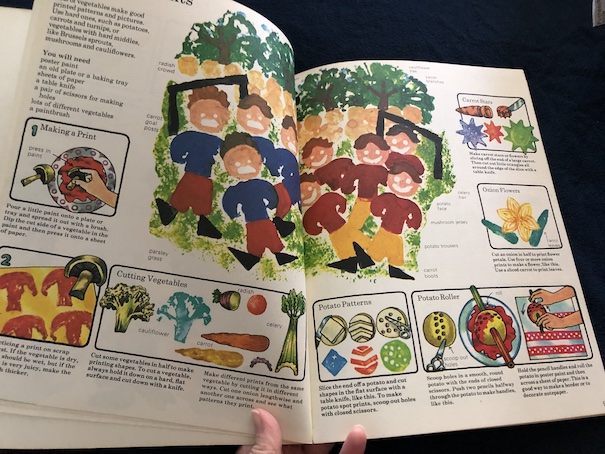
This is the American edition of a British book, and it’s part of a series of craft and activity books. When I was a kid, I was really into crafts, but I didn’t do even half of the crafts in the craft books we had. This particular book is interesting because I first thought that it was going to be about painting pictures, and it is, but it’s specifically about making “prints” with paint. Basically, the crafts involve using various objects, from leaves and veggies to your own hands and fingers as stamps to make pictures and designs.
I remember once taking part in an activity at our local library that involved making pictures with stamps make from cut potatoes, like the book shows in the section about vegetable prints. Our potato stamps weren’t as elaborate as the ones shown here, and it’s interesting that they thought of using other veggies to get some different shapes as well.
The range of objects and techniques that the book uses in making prints is also interesting. It points out that you can make some interesting patterns by painting on a page and folding it over or using string coated in paint to make swirls. There are tips for making using tools like stencils and rollers to make designs.
The book also includes some painting techniques, like how to mix colors, and some tips for how to enhance pictures you’ve made, like painting over parts of a picture with glue and then shaking on some powdered colors. It gives suggestions for different powdered colors, like colored sand, salt, or sugar or using powdered spices or cocoa from your kitchen (more expensive, but it will give your artwork a scent).
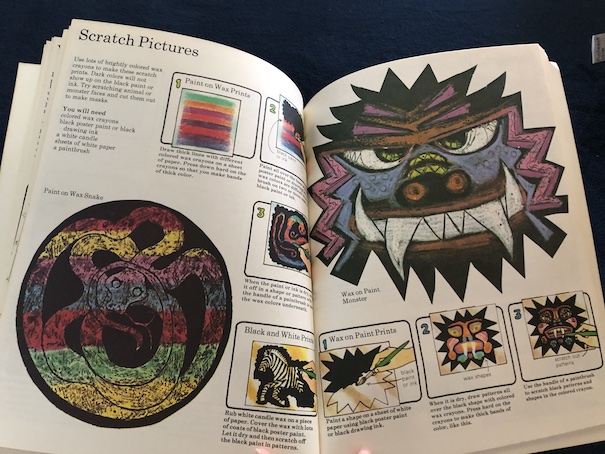
One of my favorite suggestions was a technique that I did like a lot when I was a kid, making scratch pictures with a simple form of sgraffito. You can buy kits and specially prepared paper for doing this today, which didn’t exist when I was a kid (at least, not anywhere where I could buy it). Instead, I had to do it the old-fashioned way, using the technique in this book – drawing a rainbow of colors on paper, covering of it with black, and then scratching the black off to make rainbow pictures and patterns.
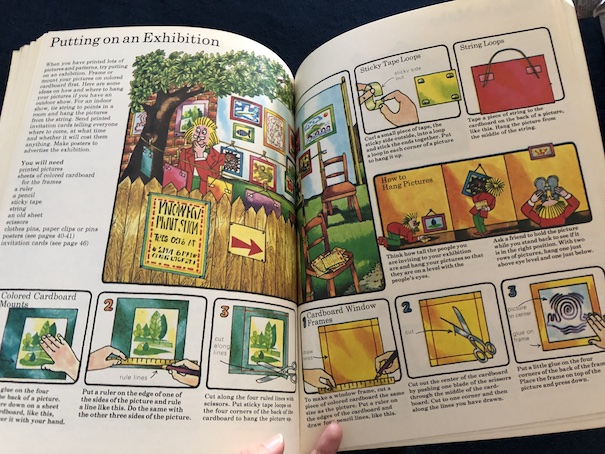
There are too many tips and techniques for me to cover everything in detail. The last few pages cover uses of the techniques for specific projects, how to make prints on cloth, and how to have an exhibition of the pictures you’ve made.
The book is available to borrow and read for free online through Internet Archive.
Bird Wise by Pamela M. Hickman, illustrations by Judie Shore, 1988.
This is a beginning guide to birds and bird watching for kids. I thought that the guide was very helpful with nice, detailed illustrations. The book explains the appearance, biology, and lives of birds and offers activities to help readers understand and interact with birds.
The first section in the book is about the appearance and body parts of birds. It explains how different birds have differently-shaped beaks and feet and different types of feathers and how the differences help each type of bird eat the foods they like and live in the places where they live. One of the activities for this section is about how to start a feather collection. The book also explains that different birds have different styles of flying.
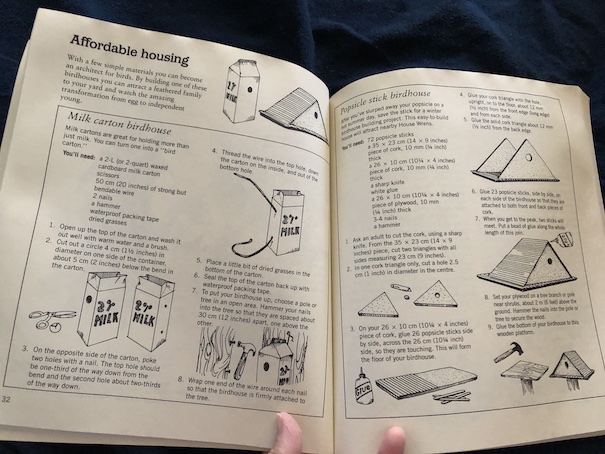
The section about how birds live explain about different types of bird nests and how they migrate and raise their young. The book explains different methods for making bird feeders and bird houses.
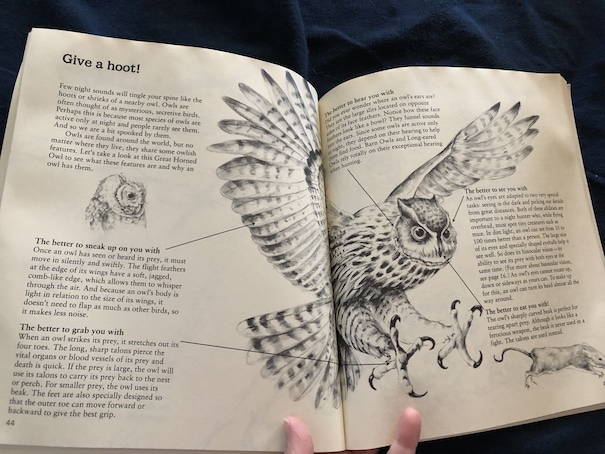
The book profiles certain specific types of birds, including owls (there is an activity about dissecting owl pellets, which I had to do when I was in elementary school), gulls, hummingbirds, and woodpeckers.
In the section about bird watching, the book offers tips for what to look for to identify a bird’s type. It also explains how to make bird blinds to avoid being seen and how to recognize types of bird songs.
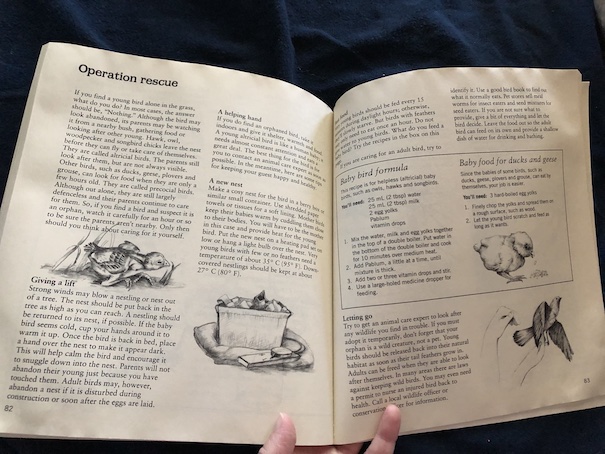
The book also contains other helpful information, like how to care for injured birds and how to plant a garden that will attract birds. It also includes a board game that emphasizes some of the lessons about birds in the book.
Overall, I was pleased with the range of information in the book. It was interesting and well-presented.
The book is available to borrow and read for free online through Internet Archive.
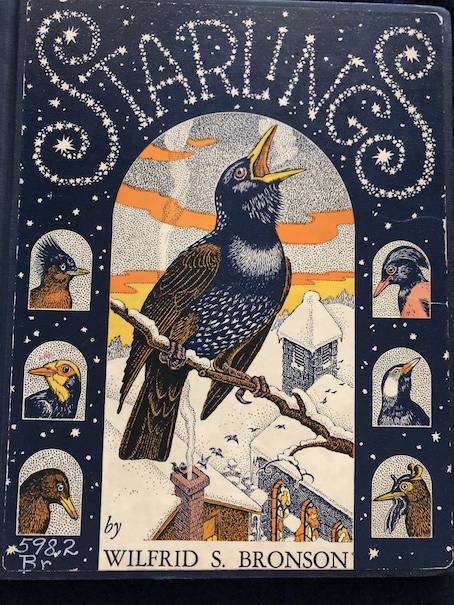
The title of the book tells you what it’s about; this is a children’s picture book about starlings. That sounds pretty straight-forward and even a little dull, but there is more to learn about starlings than I imagined, and the author of this book has an imaginative way of explaining information. I love books that cover odd topics in detail, and I enjoyed the whimsical quality of this book. The pictures are detailed black-and-white drawings, some with captions like comics. Most of them explain the anatomy of the birds or their habits, but they have some unique ways of expressing educational information.
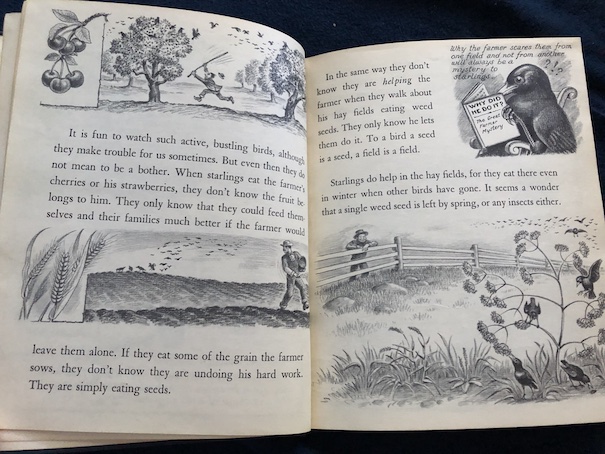
The book begins by describing the singing of starlings and then explains how farmers view starlings. Starlings can be a pest to farmers when they eat their fruit or the seeds the farmers are trying to plant, but they can also be helpful when they eat weed seeds and prevent weeds from coming up in the farmers’ fields. Of course, the birds don’t know when they’re helping or hindering because, as far as they’re concerned, they’re just there to eat any food that happens to be available at the moment. I like the little picture of the bird reading a mystery book, trying to figure out why farmers don’t mind when they eat some seeds and try to scare them away from others. That’s an example of the whimsy I was talking about.
The book continues describing what starlings eat and places where they like to roost, and it explains how they affect people living in cities (mainly, messing up their cars). There were times when people in cities considered them such a nuisance that they would shoot them, and some poor people hunted them for food. Actually, the entire reason why we have starlings in the US is that people over-hunted other types of birds (there is a disturbing picture of hunters with piles of dead birds at one point in the book), and birds are an important part of the ecosystem. Even though they can annoy farmers when they eat seeds and fruit, they also eat bugs that are pests to crops.
I was really struck by the passage that explained how starlings were first brought to the United States and why they were brought here:
“Some people think that starlings have no right to food or nesting-places because they are not ‘American birds.’ Yet all the starlings you see were born in America. So were their parents and grandparents and great-great-grandparents and all their relatives clear back to 1890. In that year their ancestors were caught in Europe and brought in cages to America. So many American birds had been killed at that time by our own ancestors that our crops were growing wormier and wormier each year, while insect pests grew worse and worse. So starlings were imported to help us fight the insects. They were freed in Central Park in New York City and left to look out for themselves.”
This explanation uses simplified language for children, and it also oddly evokes imagery of human beings. We don’t normally refer to animals as “foreigners” because animals don’t speak different human languages or have allegiances to foreign governments like people from other countries do. When we talk about new species that have been introduced to an environment where they did not originally belong and quickly spread out and multiple, we usually call them “invasive species.” In that case, the ecological concern is that the new invasive species will disrupt the balance of the natural environment and crowd out native species, but the author is trying to point out that the situation with the starlings was different. The starlings were introduced to the environment in the US on purpose, not by accident, and it was done specifically because they were meant to a solution to a problem. The environment had already been disrupted by humans who had moved into areas where they had not lived previously and where they killed too many of the native species themselves without regard to what that would do to the natural environment and their own farming. The introduction of the starlings was meant to restore a balance that had been lost. However, the people who had originally caused the problem didn’t see it that way, seeing the starlings as pests because they were “foreign.” While birds in general may occasionally be a nuisance because they don’t understand human priorities, they still perform useful functions for human beings as they go about their lives, just being the birds they are – eating annoying weed seeds and bugs and scavenging food from what humans throw out.
“People who think that starlings should be starvelings because they are ‘foreigners’ should remember that these American-born birds save much of what they themselves throw away and are still helping us to fight insects as they did in 1890.”
I understand what the author is trying to explain about balance in the ecological system, but I was struck by the human imagery that the passage evokes: “Foreigners” who came to New York City, not unlike immigrants fresh off the boat from Ellis Island during the 19th century, set free to make their way in a strange environment among people who often regarded them as worthless pests, disliking them while still using the useful services they provided. The comparison still fascinates me. At first, I wasn’t sure that the author meant to make that broader comparison here. I thought he probably used that language just to simply the ecological concepts for children’s understanding, but the author does make another comparison a little further on:
“So let’s be fair. If American-born starlings are foreigners, then so are all people in America except the Indians (Native Americans). So are many kinds of birds, animals, and plants. Our ancestors brought them here from other countries. But if all these creatures, and ourselves, are American now, then so are the starlings. Yes indeed!”
So get off your high horse, starling-haters.
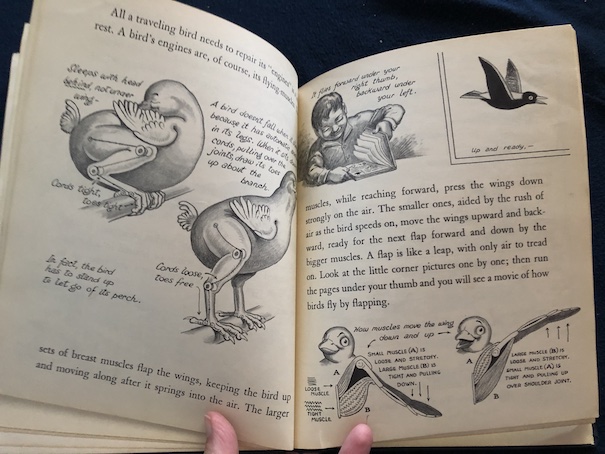
At several points in the book, the author compares birds to airplanes, explaining their muscles and flying mechanisms like machinery. I liked the page where the author compares different planes and helicopters to types of birds (cruisers being like gliding eagles and albatrosses, fast-turning speed planes like starlings and swallows, and hovering helicopters like humming birds). The parts that describe how birds cling to branches as they sleep and how their wings move look accurate and helpful. The part about how a bird creates eggs is hilarious. The text about the formation of the egg inside the bird isn’t bad. It completely skips over the subject of the fertilization of eggs (understandably), and the picture show the bird as a kind of egg-making factory with little men assembling the parts of the egg in stages instead of showing a bird’s reproductive anatomy.
In the upper right corners of this section of the book, there are little squares with a flying bird because part of the book is meant to be uses as a flip book to see a bird flying. The page shown above with the boy flipping through the book shows how to use the flip book portion.
There is a section of the book that explains how baby birds develop in the egg and eventually hatch.
There is also a section in the book that shows how adult starlings will prepare a nest for their eggs and how they raise their babies.
As I was reading the book, I wondered who the author, Wilfred S. Bronson, was. Bronson was an artist specializing in natural history, and he wrote and illustrated other books for children about animals and natural history. In the years before he wrote this particular book, he served in the US Army during World War I and painted murals for the Works Progress Administration (WPA) during the Great Depression. He also participated in expeditions to gather specimens and create illustrations of wildlife for botanical gardens and museums.
I haven’t found a copy of this particular book to read online, but it was republished in 2008 and is still available from Amazon.































 Jestress's Forgotten Books and Stories