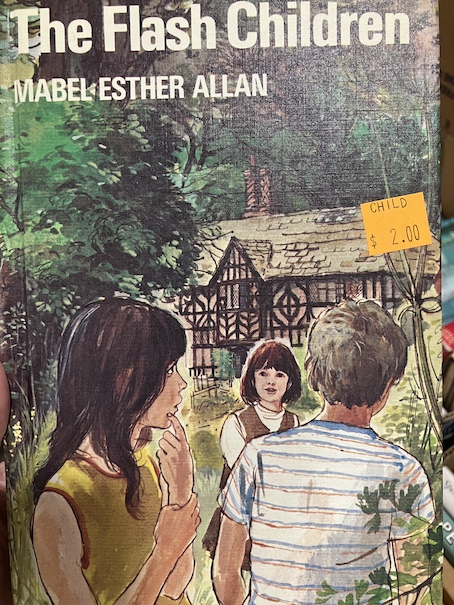
The Flash Children

The Briggs family moves to a new house in July, and the three Briggs children are upset about leaving their old home and friends. Their father tries to reassure them that they’ll make new friends in their new home, but ten-year-old Dilys isn’t so sure. She knows that her mother is also not happy about the move, but it can’t be helped. Her father used to be a cowman on an estate in their old town, but the estate has been sold to be turned into an army training camp, so he has to go somewhere else for a new job.

Their new home will be a cottage near a “flash”, which is a kind of salt lake. Flash Cottage, as their new house is called, turns out to be an ugly modern brick house, not at all like the charming old cottage where they used to live. Their old cottage had a beautiful garden, but this little house doesn’t have much at all. Most of the views from the house are also ugly. The embankment behind the house, where the train tracks are, makes parts of the house dark and blocks the view, and there’s a chemical plant a couple of miles away. There isn’t much else in the area to see. The bright spots of their new home are the lake and the train tracks that run near the house. The fast-moving trains make Dilys a little nervous and they also make the house kind of loud, but eleven-year-old Arthur finds them fascinating. Arthur takes a yellow bedroom at the back of the house, where he can see the trains. Dilys shares a blue bedroom with their little sister, Megan, with a view of the chemical plant in the distance. All three of the children find the house strange and ugly and wonder how they’re ever going to feel at home there.

Dilys doesn’t think she’ll ever like the new house, although she thinks it might be nice if they could go rowing on the lake. Their mother worries about the children falling in the flash because they have to travel across an unfenced causeway when coming to or leaving the house. The children will have to catch a school bus to go to the local school, and Arthur wonders what the other children in the area are like. The children hope to find some friends because, if they don’t, they don’t really know what they’ll do with themselves. There doesn’t seem to be much in the area to do for fun.

The Briggs children meet a boy and girl about their age on their first day at the new house, but the meeting doesn’t go well at first. Arthur stops the other boy and girl from throwing rocks at some ducks. Dilys warns him about making enemies of people because they need some friends in their new home, but Arthur can’t stand to see people being cruel to animals. The other boy and girl already know who the Briggs children are because they were told they would be coming, but Arthur surprises them with a Welsh phrase. The Briggs children’s mother is Welsh, and they grew up near Wales. The boy, whose name is Dan Brown, thinks at first that Arthur was speaking French, but his sister, Edith, recognizes the phrase as Welsh because someone told her that the family was part Welsh. Dan and Edith argue about it, and Arthur asks them if they often argue with each other. The Brown kids admit that they do because there just isn’t that much else to do in the area. Boredom is also the reason why they tease animals, and because they tease animals, they’ve been banned from Colonel Melling’s farm, where Mr. Briggs will now be working with the cows. Sometimes, when they have money, they can take a bus to town to find other things to do, but they don’t always have the money to do that.

Mr. Briggs tells the children that the Brown children are the nearest children in the area. Their mother is dead, and they have an aunt looking after them. Their father also works at Colonel Melling’s farm. The Briggs children aren’t sure that they like the Brown children or want to be friends with them, but they might be their best or only option for friends at all. Their father persuades them to give the Brown children a chance, but Dilys wonders if, before long, they’ll all be so bored that they’ll start throwing rocks at ducks, too.

School isn’t too bad once it starts. Dilys meets another girl she likes, but unfortunately, the other girl lives too far away to see easily when they’re not in school. Some other kids at school tease another new boy named Brian because he’s partially blind. Dan and Edith turn out to be among the worst bullies, and Arthur and Dilys get so angry with them that they get into a fight. Dilys tells Edith that she’s ashamed of how she acts, she thinks it’s disgusting, and she wishes Edith would turn deaf so she can see what it’s like to live with a disability. The other kids back down rather than fight Arthur, and surprisingly, Edith is actually a little embarrassed when she sees how angry and disgusted Dilys is with her. It seems like the behavior of the local kids is as rough and ugly as the area where they live, but Dilys finds herself interested in Brian because he seems to be a different type of person.

Mrs. Briggs is as homesick as the kids for where they used to live, but she starts to make friends with Miss Brown, the aunt looking after Dan and Edith. Mrs. Briggs says that Miss Brown is a nice lady, but she doesn’t entirely know how to cope with the children, and Dan and Edith often misbehave and make trouble. She’s only been living with her brother and the children since their mother died last year.

One day, Dilys and Arthur go exploring, and they find an unexpected green area down a road that makes them feel more like home. They get caught in a sudden storm, so they take shelter under a railway bridge, where they meet Dan and Edith, also taking shelter. They start talking more about the area and places to explore, and Dan and Edith say that they can’t go down by Mr. Lowe’s farm anymore. Arthur asks them why, and they admit that they stole some plums from him and left his gate open, so the livestock got out. Arthur and Dilys can see why Mr. Lowe would be angry, but Dan and Edith defensively add that they didn’t leave the gate open on purpose. They just forgot to close it because Edith got stung by a wasp and was upset, but Mr. Lowe won’t believe them. They say it’s a pity because the area is much more interesting over there. There’s an old manor house, a stream, and a ruined mill over that way.

Things change for the children when Dilys, Arthur, and Megan befriend an artist who lives in a cottage nearby, John Zachary Laurie, and he’s a friend of Colonel Melling. He takes them out rowing on the flash and talks to them about how they like their new home. The Briggs children confide in him how unhappy they’ve been since they moved to the area because everything is so ugly, but the artist points out that it’s not really an ugly place. He says he finds it fascinating to paint because it has certain “dramatic effects.” When he shows them his pictures, they’re very different from the kind of pictures that the children are accustomed to seeing. Rather than conventional flowers and pretty landscapes, they are filled with angles and a lot of grays and browns, but with unexpected dashes of color. They’re unmistakably pictures of the area, but not in a way the children usually see it. The landscape in the paintings is familiar but strange, ugly but also oddly enchanting. John Laurie even gives them one of his paintings, the one he did of their new house, Flash Cottage. He says he knows the children hate the house now, but he thinks it has interesting angles, and if they learn how to look at things a little deeper, they’ll see more than they do now.

Although Dilys isn’t quite sure that she understands it, she begins to feel what the artist is talking about. Things that are strange start to feel familiar, and even in the ugliness of the landscape and the picture of their house, she begins to feel a sense of fascination and attraction. It’s not exactly pretty, but it is compelling.

When school lets out for the summer, the Briggs children once again find themselves bored and lonely. The few other children they like don’t live close to them, like Dan and Edith, and the Briggs children still think Dan and Edith are pains and troublemakers. Looking for something to do, Arthur, Dilys, and Megan decide to explore the old manor house that Dan and Edith mentioned.

It turns out to be a beautiful place, although it’s old and deserted. To their surprise, they discover that the property actually belongs to Brian’s family, the Pelverdens. They live in a little cottage behind the old manor house. Brian has a little sister, Mellie (short for Melinda), who would be a good friend for Megan, but Brian seems less than pleased that Arthur and Dilys have discovered where he lives. Brian’s father explains that they haven’t been living here long. The manor house has been in the family for generations, but it’s fallen into ruin because they haven’t had the money to maintain it for a long time. They only recently inherited the place themselves when Brian’s grandfather died. The Pelverdens don’t expect to ever live in the manor house themselves, but their hope is that, if they get it sufficiently repaired, they might have it registered and preserved as a historic building and get a grant to maintain it. The Briggs children eagerly volunteer their services to help with the project over the summer. They have nothing else to do, and they still miss the garden from their old cottage, so helping to replant the manor garden would be fun for them. The Pelverdens’ cottage and the crumbling old manor house are more beautiful to them than anything else they’ve seen since they moved, and they feel more like home.

Mellie is immediately happy to have found a friend in Megan, but Arthur and Dilys find it harder to make friends with Brian. Brian has known all of his life that he’s different from other kids because of his vision problems, and he’s used to people treating him differently or making fun of him. He tries very hard to be as “normal” as he can and prove to everyone that he can do things other kids can do. Because he feels like he has something to prove to everyone, he’s often less friendly than he could be, but Dilys is determined to earn his trust.

However, Dan and Edith are still problems. The Briggs children fight them off one day when they catch them teasing the Briggs’s cat. Edith is offended that the other kids keep telling them everything they do is wrong. Then, another day, they show up at the old manor house and break a window by throwing rocks. When the Briggs children and Mr. Pelverden confront Dan and Edith about what they’ve done, Dilys come up with a plan that might solve the Dan and Edith problem and prevent them from making further trouble.

The book is available to borrow and read for free online through Internet Archive. There is a sequel to this book called The Flash Children in Winter, which is about the children experiencing their new home in autumn and the lead up to their first Christmas there.

I thought this book was interesting because it has aspects of a cottagecore style story, but there are parts of it that contrast with the typical cottagecore aesthetic. The main characters in the story, the Briggs children, have come from an environment that would be like a cottagecore dream: an actual old cottage with a beautiful garden attached to an old manor house, where they were allowed to help out. Then, they have to move to a far more plain and conventional house in an ugly area with a view of a chemical plant. It’s understandable that they would feel badly about the move. Moving and starting over again would be difficult for anybody, but most people would find their new environment downright depressing, especially after hearing what their old home was like.

When they find out that Brian’s family lives in a cottage and is renovating their old manor house to turn it into a historic site, the story goes back to the charming sort of environment the children come from. However, it’s not just about the children finding a way back to the kind of environment that has the beauty and charm they crave but also learning to see what makes different types of environments fascinating, even enchanting. The Flash Cottage isn’t a real cottage, and it’s not as pretty as their old home, but after talking to the artist and looking at things from an artist’s viewpoint, taking into account the features of a place that make it unique, Dilys comes to see how a shift in perspective can make many different environments more attractive, in their own way.

Learning to get along with Dan and Edith also involves finding a different perspective and a different way of dealing with them. It’s not just about seeing the good side of Dan and Edith as they are. Frankly, the two of them are pain-in-the-butts. Dilys realizes that their problem is that they are thoughtless. They don’t think about other people, how the things they do affect anyone else or make them feel. Their thoughts begin and end with themselves. They’re bored and feel unwanted at home since their mother’s death, so they cause trouble because they just can’t seem to think anything else to do. Personally, I don’t think either Dan or Edith is very intelligent or imaginative because intelligence could be used to reason out why people react to them the way they do and a little imagination would help them put themselves in other people’s position or help them think of different things to do or ways to approach other people. However, Dan and Edith don’t do any of those things on their own. It never even seems to occur to them that they could. They only get upset when other people are unhappy with them and seem totally unable to understand why.

Even though Dan and Edith don’t seem either very bright or very considerate, it does occur to Dilys that they could learn to be helpful if someone actually set them tasks to do to keep them busy. At her persuasion, Mr. Pelverden and the other children allow Dan and Edith to join their efforts to clean up the manor. Dan and Edith are actually eager to accept the opportunity to help out with the others because they are incredibly bored and seriously need something to do and people to be with. When the others are dubious about whether they’ll actually do any helping or if they even know how to help, they try to prove that they can do things that are useful for a change. It also proves educational for Dan and Edith because, in helping to clean up the manor, they’re also forced to face damage they have caused themselves and begin to realize how things they’ve been doing have caused trouble and made extra work for other people. They’re not used to seeing themselves as other people see them or dealing with the consequences of their actions, and it’s an eye-opening experience for them. Later, they all have to face off against a motorcycle gang that comes to vandalize the manor, and Dan and Edith have come to see where their loyalties really lie and what menaces people can be when they act like they used to.

The story ends happily for the children and for the manor, which is going to be preserved. The Briggs children feel more at home in their new home, Dan and Edith have greatly reformed, and Brian has learned to be more open with people about his disability, so other people come to understand him better and treat him more kindly. Some of the people who made fun of him before admit that they didn’t understand just how bad his vision was, so they didn’t know why he seemed to struggle so much. Dilys still tells off those kids for not having figured it out, but at the same time, she is the one who tells Brian that he has to make things clear to people and not try to pretend that his condition doesn’t exist or that he doesn’t need some help when he actually does.

The author, Mabel Esther Allan is also a very interesting person. During her life, she wrote more than 100 books for children, under different pen names. She struggled with vision problems of her own when she was young, which was part of the inspiration for Brian in the story. During WWII, she worked was part of the British Women’s Land Army, and she also worked as a teacher.

Blackbeard’s Ghost

Blackbeard’s Ghost by Ben Stahl, 1965, 1976.

This is the novel that the live action Disney film Blackbeard’s Ghost from 1968 was based on. My copy is a later edition designed as a tie-in with the Disney movie, based on the cover, but it contains the text of the original story.

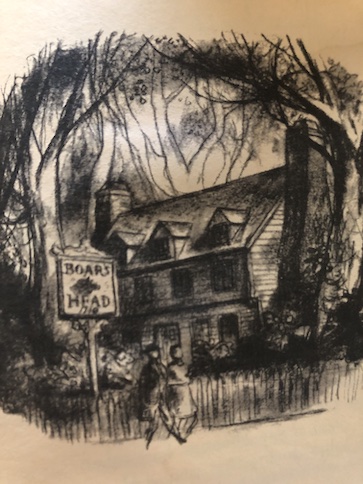
The story begins with a prologue that explains how Blackbeard the pirate evaded execution for piracy by offering to collect tolls from ships on behalf of the colonial governor, Governor Eden, in the town of Godolphin. However, instead of collecting tolls from the ships, he decided to use his position for his own benefit. Knowing that he would eventually need a source of stability on land instead of spending the rest of his life at sea, he looted wood from various ships and used it to build a tavern for himself called the Boar’s Head. He hired a woman rumored to be a witch, Aldetha, to tend the tavern for him. In the end, though, Blackbeard was killed by someone who wanted to collect the bounty on him for piracy. After his death, the poor woman who tended his tavern was burned at the stake for witchcraft.

(Note: The witch burning is historical inaccuracy because no witchcraft executions in North America involved burning, at least not in English-controlled parts of the American colonies. Accused witches in North America were typically hanged. None of this story is meant to be historically accurate, but I always feel compelled to point that out in stories that make that mistake. The town of Godolphin and the Boar’s Head Tavern are fictional. In real life, Blackbeard did receive a pardon from the real Governor Eden in Bath, North Carolina, and he was eventually killed in 1718 in a battle with Lieutenant Robert Maynard and his crew, as he did in this story. However, in the book, the tavern is now owned by a descendant of Maynard’s, and in real life, Maynard didn’t have any children.)

Most of the story takes place in the 20th century, when two 14-year-old boys, J.D. and Hank, talk about how the old Boar’s Head Tavern is about to be torn down because the former owner sold it, and there’s going to be a gas station built on the land instead. They think it’s a shame because they’ve heard ghost stories about the place and think the old tavern is fascinating. The boys go to watch the workmen tearing down the old tavern, but the workmen haven’t made any progress so far. Although they’d love to loot some of the expensive woods from the old tavern, they just can’t seem to dismantle the building. They’ve been able to dismantle some of the newer additions to the building, but somehow, they can’t seem to touch the original structure. The site has been plagued with mysterious accidents. Their equipment fails, heads fall off the ends of their hammers, and workmen keep getting injured in small accidents, not enough to seriously hurt anyone but enough to keep them away from their work for days at a time.

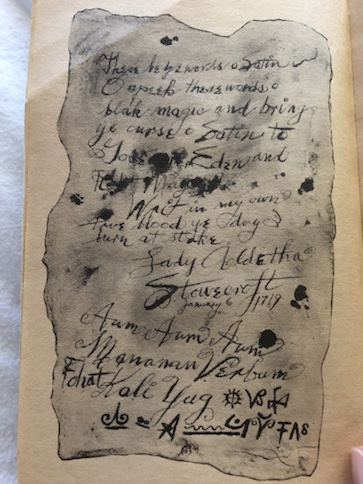
When J.D. and Hank see the workmen leaving the building in frustration soon after arriving, they decide to go inside and look around to satisfy their curiosity and see if there’s anything of value that they can salvage before the tavern is demolished. They don’t find much of value, but they do find their way into Blackbeard’s secret dungeon under the tavern. There, they find a piece of old parchment with a satanic curse written by Aldetha. (So, apparently, people were actually right about her being a witch. Plot twist!) Inspired by this creepy message from the past, the boys realize that they can make money from other kids by capitalizing on the ghost stories about the old tavern and holding seances to contact the spirits. They don’t really believe that seances are real, but they figure that, if they can get enough ghost-story fans to come to their seances, they can make a profit from this enterprise.

Of course, the boys’ seance awakens the ghost of Blackbeard. Blackbeard is invisible to everyone except for the boys, but he’s a solid ghost, who can manipulate physical objects. The boys quickly realize that Blackbeard can be a dangerous ghost, and he’s not at all happy when he finds out that a descendant of the man who killed him wants to have his tavern torn down.

The book is available to borrow and read for free online through Internet Archive. The Disney movie is available to buy or rent through YouTube or Amazon Prime. There is also a sequel to this book called The Secret of Red Skull, which involves spies and is also available online through Internet Archive.

My Reaction and Spoilers

There is some humor in this book because only the boys are able to see and hear Blackbeard, but by the end of the story, adults become aware of Blackbeard’s ghost, too. The boys’ history teacher is helpful in finding a way to appease the ghost by helping him to negotiate to buy back his tavern using his hidden treasure. When it becomes obvious both to Maynard and the company he tried to sell the tavern to that it’s haunted, they’re willing to accept pirate gold in exchange. The company also sees that it can use the building for public relations purposes by sponsoring a pirate museum in the old tavern. It’s good news for the teacher, too, because he gets to be the director of the museum. There, he can show off his collection of pirate memorabilia and indulge his love of pirate history. The tavern continues to be haunted by the ghosts of Blackbeard and his witch friend, leaving the story open for the sequel.

As expected of Disney films, the Disney movie version of the story is quite different from the book. In the movie, the person who can see the ghost is a college track coach who is staying in the old inn, which is still being operated by elderly descendants of Blackbeard’s old crew. There is a track meet in the movie that never appeared in the book, and at the end of the movie, Blackbeard disappears, having been freed from his haunting by performing a good deed.

I prefer the concept of the boys being the ones who accidentally summoned Blackbeard’s ghost, but the boys got on my nerves at first. In the early part of the book, they bickered a lot and didn’t seem to like each other enough to be best friends, although they seemed to be friendlier with each other later, when they were both trying to figure out what to do about Blackbeard. I think the teacher character was my favorite. He takes the matter of the ghost in stride, coming up with a practical solution that helps everyone.

Who Knew There’d Be Ghosts?

Who Knew There’d Be Ghosts? By Bill Britain, 1985.

Tommy Donahue and his friends, Wendy “Books” Scofield (the smartest kid in their class as well as being pretty tough) and Harry “the Blimp” Troy (known for being the tallest and biggest kid in their class), prefer playing around the abandoned Parnell house instead of at the park because they like to play games of pretend, based on adventure stories that Tommy has read.  It’s hard to play games of pretend in such a public place as the park because other people either laugh or think that they’re just getting in the way.  Almost nobody goes near the old Parnell house because people think that it’s haunted.  They’re right; it is haunted.

Some people in their town have been trying to arrange for the Parnell house to be turned into a museum because the Parnells were the founding family of their town, but the movement hasn’t been able to raise the money needed to renovate the place.  Now, Tommy’s father, a lawyer, has been recruited to arrange for the house to be purchased by a private citizen who says that he wants to renovate the house and use it as his own residence.  However, Tommy and his friends overhear the buyer, Avery Katkus, and a confederate talking as they look over the house.  Mr. Katkus isn’t interested in the house at all; he wants something valuable that is hidden inside.  When they hear the two men plotting to sneak into the house at night to do some searching for this mysterious something, the kids decide that they will come back at night and watch for them to find out what they’re looking for.  The kids don’t want anything bad to happen to the house because they’ll lose their private playground.

Tommy is the first to go and check out the Parnell house at night, and that’s when he meets the ghosts, Horace and Essie Parnell.  At first, Horace tries to scare Tommy away, but when Tommy explains that he only came to keep watch, Horace asks him what he means by that.  Tommy explains to him about Mr. Katkus, and Horace says that he could use Tommy’s help.  Years ago, Horace’s father made a dying wish that all members of their family should be buried in the family cemetery on the property of the house.  Most of the members of the family are buried there, but Horace, who was killed during the Revolutionary War, and Essie, who accidentally fell overboard from a riverboat and was permanently lost in the Mississippi River, were only two Parnells who were not buried on the property, so their spirits are now bound to the house.  Naturally, Horace and Essie are concerned with the future of the house.

Tommy tries to tell his friends about the ghosts, but they don’t believe him until they see the ghosts for themselves.  When the three kids return to the house the next night, Horace saves them from being attacked by Mr. Katkus’s hired confederate.  Now convinced of the ghosts’ existence, Harry and Books are eager to help save the house, and the key in doing so is discovering what kind of hidden treasure the house holds.

The book is available to borrow for free online through Internet Archive.

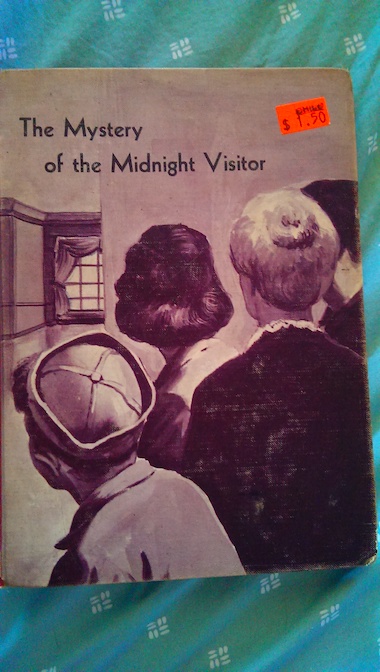
The Mystery of the Midnight Visitor

MorganMidnightVisitor

The Mystery of the Midnight Visitor by John and Nancy Rambeau, 1962.

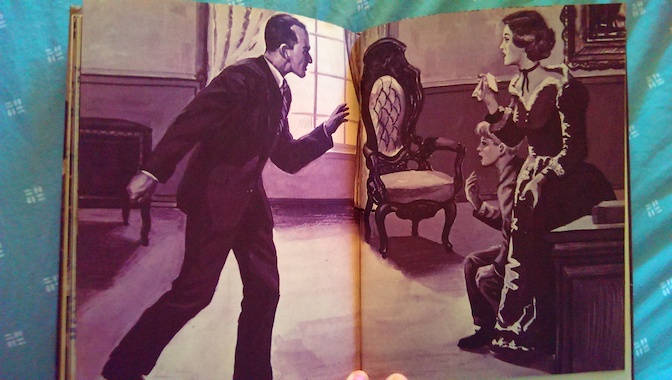
One day, Gabby is going fishing on the beach at Morgan’s Landing. Miss Wellington, a family friend, owns the property along with the old mansion known locally as Morgan Castle. She has given permission to Gabby to fish there, but Gabby is surprised to meet a stranger on the beach as well. This stranger is an old man who says that his name is Admiral Lavendar. When Gabby tells him that he’s on private property, the old man moves on. Then, Gabby spots smoke coming from Morgan Castle!

When Gabby goes to investigate, he finds that someone has shut Miss Wellington in a closet and that there is a fire in the bedroom that had once belonged to Mrs. Morgan, the former lady of the house. He gets Miss Wellington out of the closet, and they call the fire department. The firemen put out the fire and tell Miss Wellington that it was apparently caused by a dropped candle.


Morgan Castle was once owned by the wealthy Morgan family that gave Morgan Bay its name. However, the house has become shabby over the years. Miss Wellington inherited the house after Mrs. Morgan died because there were no other Morgans left. However, she doesn’t actually live in Morgan Castle because she has a house of her own. People have been saying that perhaps the house should be torn down because of its poor condition. Miss Wellington doesn’t have much money and says that she would find it difficult to manage the upkeep of the house.

Gabby and his brother Bill and sister Vinny don’t want to see the old beautiful old mansion destroyed, and there is still the mystery of who dropped the candle and why to consider. A small silver box that Gabby found on the beach turns out to be a jewelry box that once belonged to Mrs. Morgan. Mrs. Morgan wasn’t particularly interested in jewelry, but she did own one particularly fine emerald necklace that was never found after her death. Perhaps the person who dropped the candle was looking for it!

To give Morgan Castle a new purpose and prevent it from being torn down, the kids convince Miss Wellington to let them turn it into a Historical, Boat, and Tennis Club, dedicate to celebrating local history and providing entertainment for local people.

At first, the mysterious Admiral Lavendar looks like a likely suspect for the person sneaking around Morgan Castle, but he turns out to be very helpful to the children and their plans. There is another stranger in town who has the knowledge to seek out Mrs. Morgan’s lost necklace.

MorganMidnightVisitorThief

This book is part of a series that were once used as classroom readers.

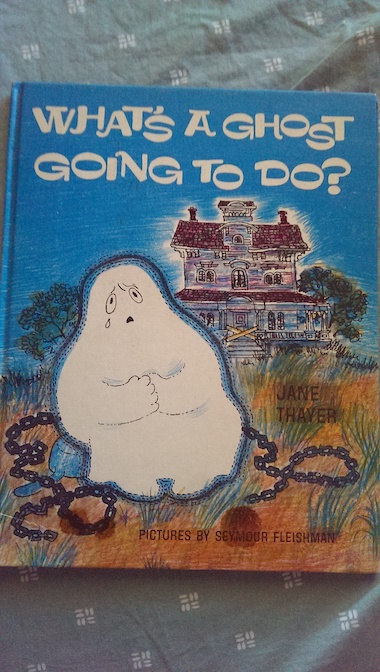
What’s a Ghost Going to Do?

WhatGhostDo

What’s a Ghost Going to Do? by Jane Thayer, 1966.

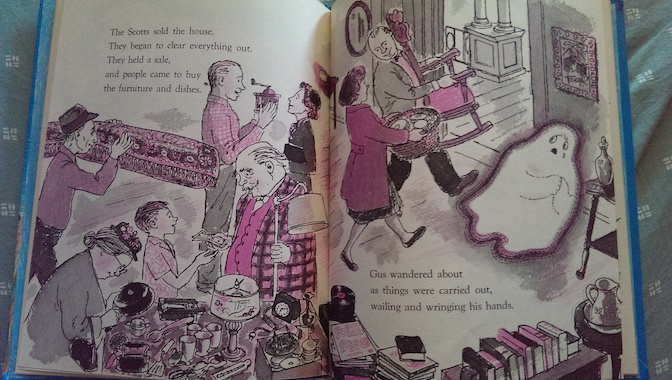
Gus is a friendly ghost who lives a quiet life alone in his old house, which is run-down and shabby, with winter visits from his mouse friend.  However, Gus discovers one day that the property is being sold.  The government wants the land to turn into a park, and if that happens, Gus’s house will be torn down!  If they decide to tear the house down, where will he go?

WhatGhostDoSale

For a time, Gus tries living with another ghost in another old house nearby, but that arrangement doesn’t work because the other ghost doesn’t like Gus rattling chains.  Then, Gus tries living in a hole with his mouse friend, but it’s really too small for him.  The only place that seems right for Gus is his old house, which is in danger of being destroyed!

WhatGhostDoHints

In desperation, Gus whispers in the ears of the man in charge of preparing the park for the government, Mr. McGovern, trying to get him to notice the virtues of his house.  Fortunately, Mr. McGovern accepts Gus’s vision of the house as a beautiful piece of the past and finds a way to restore it to its former glory so that Gus can keep his home and others can appreciate it, too.

WhatGhostDoRepairs

Gus’s house becomes a museum in the park, and Mr. McGovern also officially acknowledges Gus as the resident ghost.

The book is available to borrow and read for free online through Internet Archive. It’s part of a series.

WhatGhostDoMuseum

My Reaction

I’ve had this book since I was a little kid. I always felt sorry for poor Gus throughout the book, but the story has a nice ending, with Gus and Mr. McGovern finding a creative way to restore the house and put it to good use, filling it with antique furniture for both Gus and the public to enjoy. I haven’t read any of the others in the series yet because this is the only one I’ve ever had.

Tornado Jones

TornadoJonesTornado Jones by Trella Lamson Dick, 1953.
This book was recommended by a reader of this blog.  I haven’t been able to find a copy of it myself, but the reader thoughtfully supplied a picture of the cover.

The reader says:

“I lived in North Platte Nebraska from about February of 1953 till about April of 1955. During that time a book was written by Trella Lamson Dick entitled “Tornado Jones”. Everyone in my school in North Platte read that book many many times. We all loved it. Trella Lamson Dick was born, lived and died in small town of Orleans, Nebraska, Just East and a bit South of North Platte Nebraska. I have two copies of the book one for each of my grandsons. It may be something you might look into investing in I know there are copies available.

It is about a boy whose parents had died and he lived with his Aunt on a farm. In his adventures he discovered people who were digging dirt out in a gully and a pit in the middle of prairie land and he could not figure out why. It turns out that the book is a work of fiction but it is based on fact about the determination that the ‘Jeffrey Reservoir’ East of North Platte could actually be built and would function.”

The orphan boy, Tornado Jones, also has a mystery surrounding his name.  He doesn’t like to talk about it with other people, but when he makes a friend (the first one he’s ever had), Paul, he finally confides that the only clue he has to his real name is a glass bell.  The secrecy surrounding his name has made him uneasy for his entire life.  Tornado also believes that there is gold buried in the canyon nearby, and when he sees people digging there, he is sure that’s what they’re looking for.  Paul is fascinated at the secrets Tornado confides in him, and he and Tornado team up to uncover both the secret of the gold and Tornado’s name.  At the same time, Tornado’s family is worried about the beginning of the reservoir and dam, the construction of which threatens to flood the family’s home.  Can they save their home or will they have to give it up in the name of progress?

This book won the Charles W. Follett Award and is actually the first in a series about Tornado Jones.  There are two others.

Help! I’m a Prisoner in the Library!

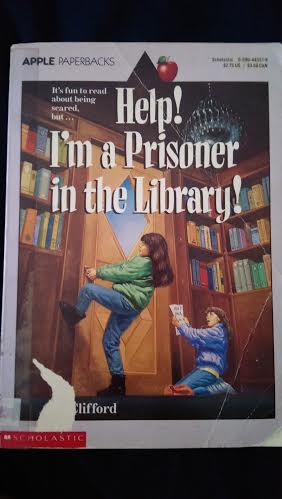
Help! I’m a Prisoner in the Library! by Eth Clifford, 1979.

Harry Onetree is taking his two daughters, Mary Rose and Jo-Beth, to stay with their aunt on a snowy evening because their mother is about to have a baby and will soon be in the hospital. But, Harry has a habit of being careless and doing things at the last minute. In spite of practical Mary Rose’s warning that they’re running low on gas, Harry doesn’t stop to get any until they finally run out, and he has to hike through the snow back to the last gas station they passed.

Before their father gets back, Jo-Beth, the younger sister, declares that she has to go to the bathroom. Long-suffering Mary Rose finds one for her in a nearby library just before closing time. But, it’s not an ordinary library. It’s actually an old mansion which has been converted into a branch library for children. It has some fantastic displays, including an old wooden wagon called a “kid hack” which was once used to carry children to school, like a school bus. Unfortunately, the girls get distracted by this strange library.  The girls forget about the library closing, and the librarian, not knowing that they’re there, locks them in for the night.

Meanwhile, the blizzard outside is getting worse, and their father has returned to the car and realized that they’re missing. The girls try to call the police, but they refuse to listen, thinking it’s a prank. Melodramatic Jo-Beth thinks that they’re doomed to starve to death in the library, trapped by the blizzard. Then, the girls hear a mysterious “thump” from upstairs. It turns out that they’re not alone in the library . . .

This is the first book in the Mary Rose and Jo-Beth Mysteries.  It is available to borrow and read for free online through Internet Archive.

My Reaction

The Mary Rose and Jo-Beth books are fun with the way Jo-Beth delights in imagining doom and gloom while Mary Rose tries to work out a practical solution to their problems. The books in this series are also frequently about something other than the immediate mystery that the girls face. In this case, the girls learn about the history of the old house, how it became a branch library, and how old buildings, even though they are beautiful and have a history to them, may face destruction if people don’t care enough about them or find a way to put them to some useful purpose.