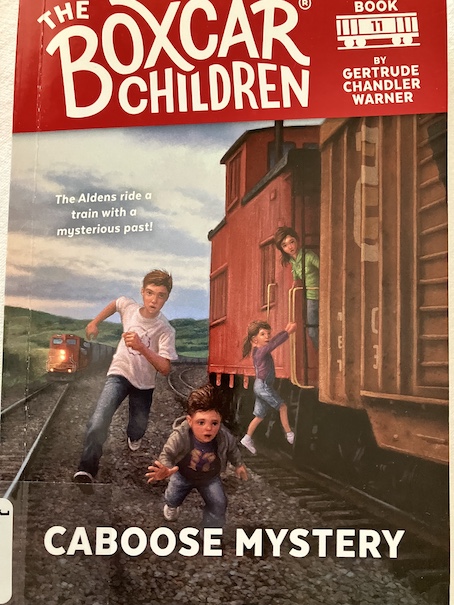
In the Garden with Dr. Carver

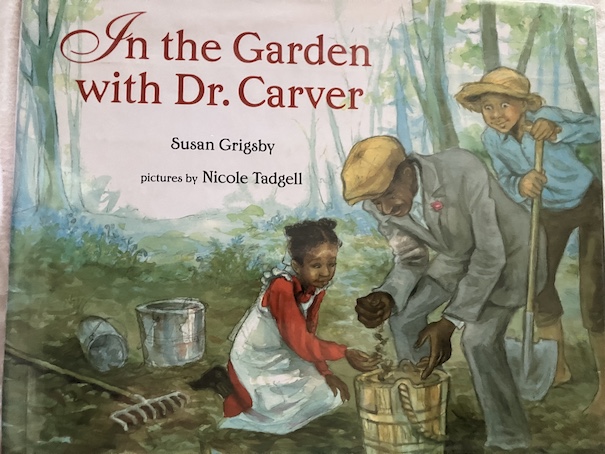
This picture book is about George Washington Carver, as told by a young girl named Sally.

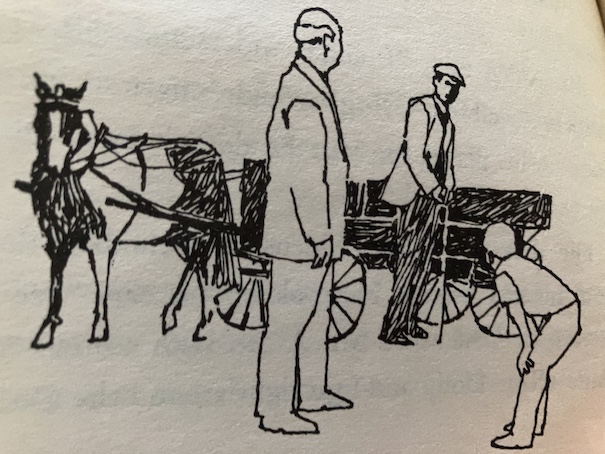
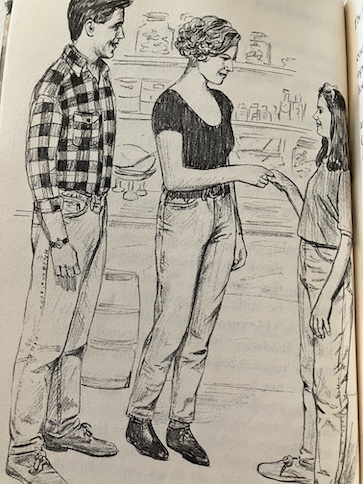
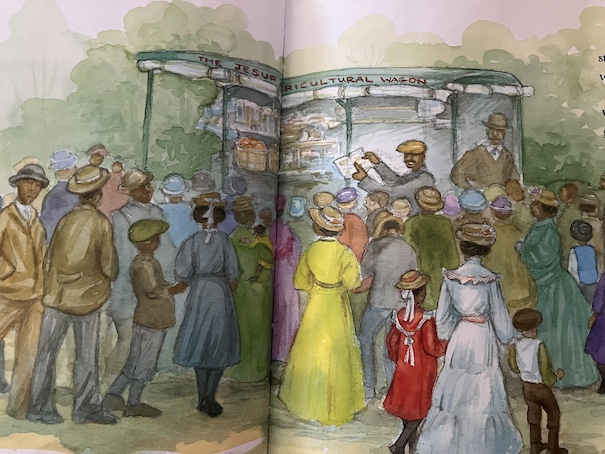
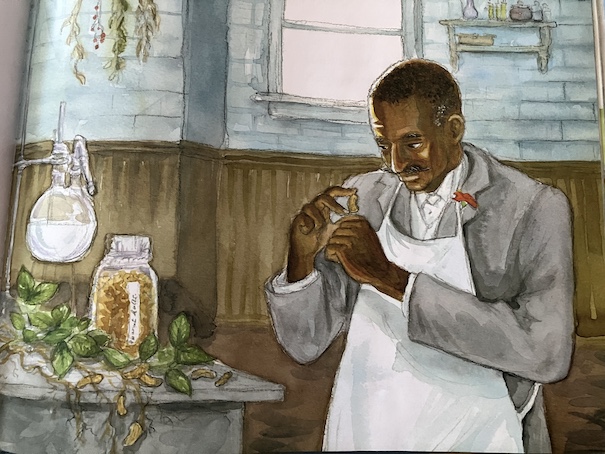
The first time Sally sees him is when he’s traveling with his wagon, pulled by a mule. Sally knows that Dr. Carver is a famous plant scientist from Tuskagee and that he uses his wagon as a kind of mobile school. It contains seeds, plants, and gardening tools, and people come to Dr. Carver for advice about growing plants. The nutrients in the soil of this area have been depleted by growing cotton, and Dr. Carver has been advising them about how to restore the soil. He also advises them about new ways to use common crops.

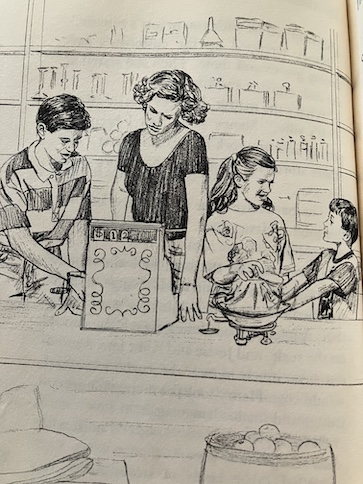
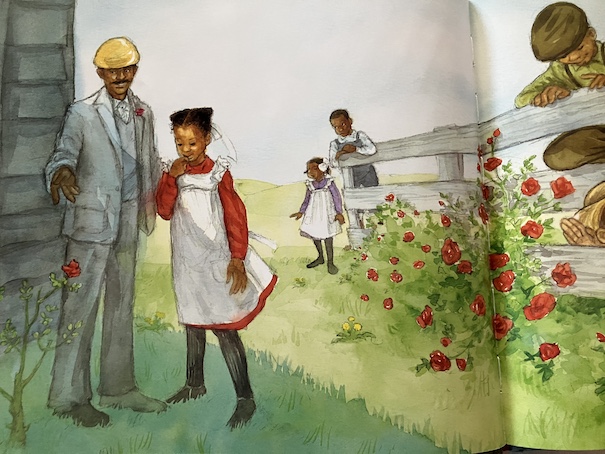
Dr. Carver visits Sally’s school to help the children with their garden. He teaches them how to use observation to notice the conditions that benefits plants and figure out how to help plants that aren’t doing well. When a boy is about to kill a spider, Dr. Carver stops him, pointing out that the spider helps their garden by eating bugs that are pests for the plants. He teaches the children that everything is part of an ecosystem (although he doesn’t use that word) and that they need to observe and understand the roles each plant and creature has in the ecosystem before deciding to eliminate or change anything. The reason why they remove weeds like dandelions is that their presence doesn’t help the other plants, and they take resources the other plants need. Although, he also shows them that dandelions are edible, so they are not wasted.

Dr. Carver teaches the children about restoring the nutrients in depleted soil using fertilizer and compost made from decaying plant matter and organic materials that most people simply throw away. Dr. Carver teaches them not to waste anything, helping them to make a scarecrow and markers for their plants from scraps of wood and other things people have thrown away.

Eventually, Dr. Carver has to return to Tuskagee, but the lessons he teaches the children stay with them.

There is a section at the back of the book that explains that Sally and her school are fictional, but George Washington Carver was a real person and the story is based around his life and writings. He was born as a slave in Missouri about a year before the abolition of slavery, so he grew up as a free person. He began learning about agriculture and botany from an early age, and as he grew older, he sought out schools that would help him further his knowledge and share it with others. He taught at Iowa State College before Booker T. Washington (see More Than Anything Else for a picture book about his youth) recruited him to be the head of Tuskagee‘s Department of Agriculture in 1896. He also believed in bringing education to people who couldn’t come to a college to learn by sending out bulletins about farming techniques and booklets for teachers in lower grades to use in their classrooms. His mobile school in a wagon was another form of outreach that has been imitated in other places.

I enjoy books about historical figures, and I found this story about George Washington Carver gentle and fascinating. There are some parts that I think I appreciate more as an adult than I would have as a child, making this a book that I think would appeal to readers across different ages and something that parents and teachers would enjoy sharing with children.

Although Sally wasn’t a real person, the lessons she and her classmates receive from George Washington Carver help to illustrate Carver’s real-life work and the lessons that he shared with people of his own time. I appreciated the level of detail the story provided about how people can use observational skills to diagnose and fix possible issues with ailing plants, the importance of understanding that plants exist as part of an ecosystem and that gardeners and farmers need to understand how all parts of the ecosystem interact, and how nutrients can be restored to depleted soil. I can’t remember whether I had heard before about how cotton farming depleted soil nutrients, but I appreciated how that explanation helped explain a real problem facing farmers of Carver’s time and how Carver was helping them to solve it.

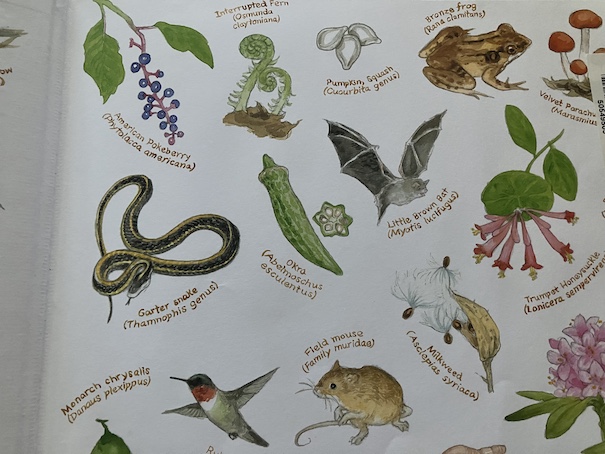
I think this book would appeal to fans of cottagecore as well as people interested in American history. The illustrations are beautiful, and even the inner covers are lovely, with small, labeled pictures of plants and creatures. As the book explains, George Washington Carver himself used drawings of plants and creatures in his work, and in the story, he teaches the children to make their own drawings to help themselves study details of the natural world.

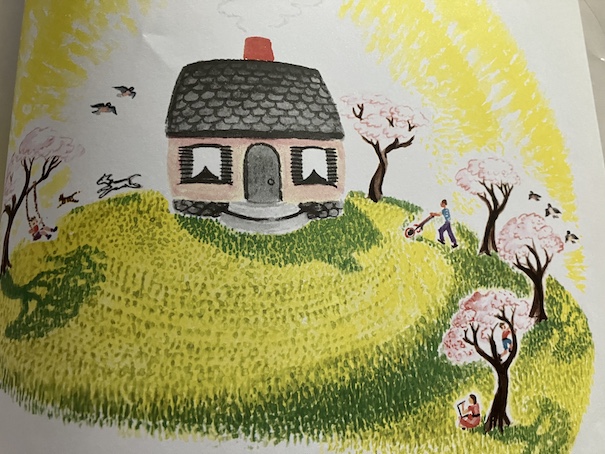
The Little House

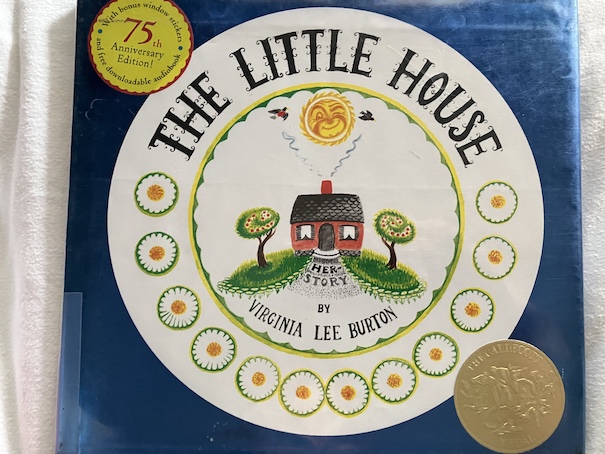
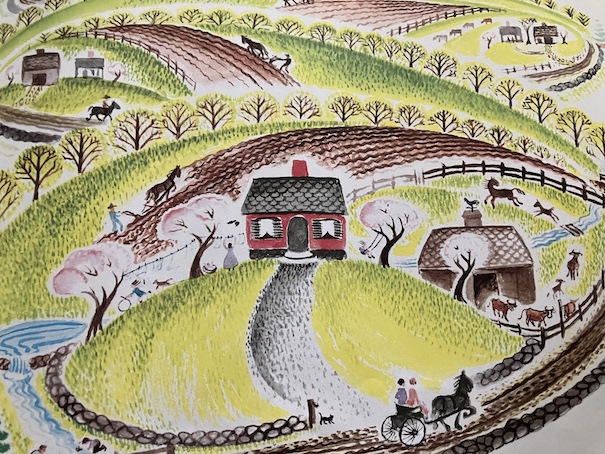
A family builds a strong little house in the countryside, dreaming of their descendants living in her. The little house is happy in the countryside, watching the changing seasons as the years come and go.

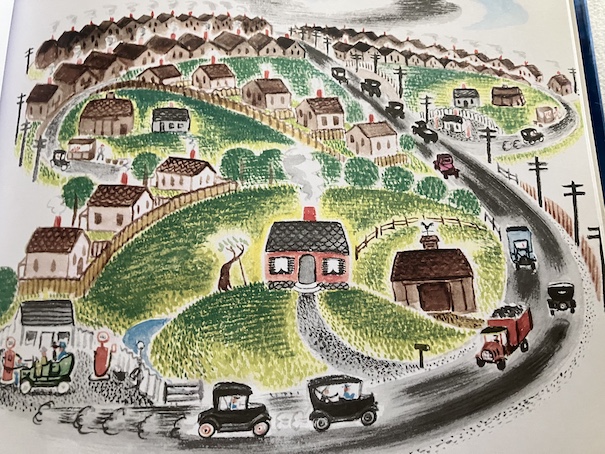
Over time, things begin to change, though. Other farms are built around the little house, but then, a big road is built, and the little farms gradually give way to suburbs.

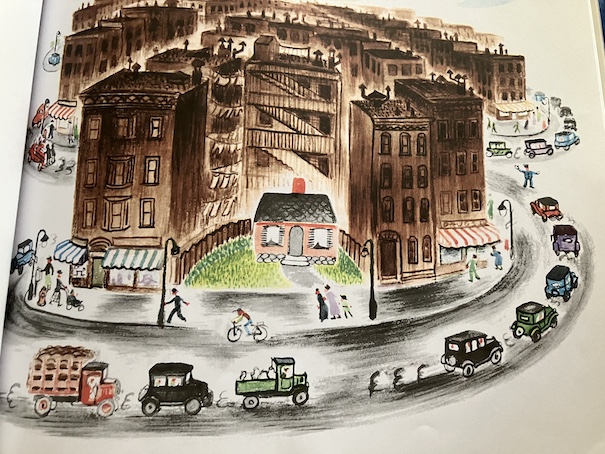
Eventually, the houses around the little house turn into bigger houses and apartment buildings. As time goes on, the little house is no longer in the countryside or even the edge of the city, but it’s actually engulfed by the city itself.

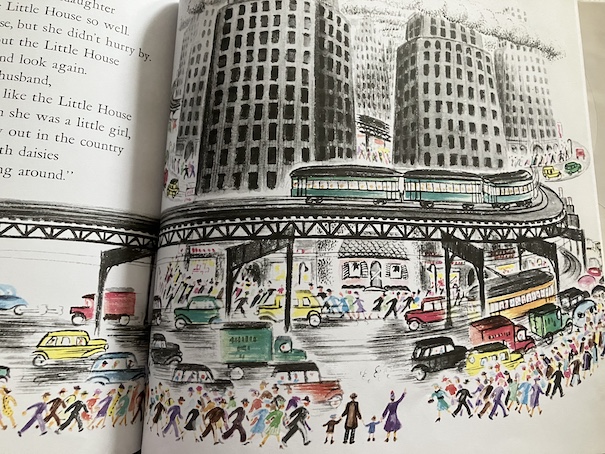
The city becomes more and more crowded with taller and taller apartment buildings, more roads and trains, and crowds of peoples. The little house stands empty and becomes run-down. She can hardly see the sky and can’t feel the changing of the seasons the way she used to because there isn’t much nature around her to sense changing.

Fortunately, the little house is rescued from this terrible situation. One day, the great-great-granddaughter of the man who built the house spots the little house in the city and recognizes it as the one her family owned. When she and her husband look into it, they verify that this is her family’s old house, and they decide that they want to move it to the countryside, like when her family lived there.

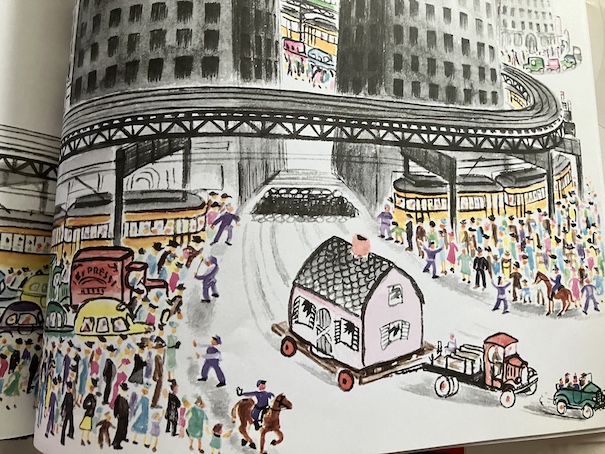
Because the little house was built so strongly, they’re able to move it intact to the countryside. The little house is happy to once again live in the countryside with the family who always loved her!

The book is available to borrow and read for free online through Internet Archive.

This vintage picture book is about the nature of change. Growing cities do expand into the countryside around them, so a house that was once outside of the city is gradually touched by and then engulfed by the nearby city as it expands. Readers get the feelings of the house as the world around her changes. At first, she’s a little intrigued by the city and isn’t sure if she likes it or not, but as the city becomes overcrowded, the house is neglected, and she can no longer sense the seasons, she decides that she doesn’t like it. When things change for the house again, she is relieved.

I remember this story from when I was a kid, and I remember feeling sad when the poor house was run-down and neglected in the city, surrounded by the towering apartment buildings. However, the book has a good ending. Houses can be moved, and the family that once owned this house remembers it and rescues it from the city, moving it to the countryside, where they all feel more at home. Things change, but sometimes, they change for the better. The house can’t move itself when it isn’t happy, but the family gives it the help and attention it needs.

When I reread this book as an adult, it suddenly occurred to me that this book was originally published during WWII, when the world was changing in some very scary ways. I think a book like this might have been reassuring to children of that time. Life is full of changes, but sometimes, things can change for the better again.

What To Do About Alice?

Theodore Roosevelt had done many things in his life, from herding cattle to hunting grizzly bears, but one thing he could never seem to do was manage his daughter, Alice. From early childhood, Alice was a lively girl, always having things she wanted to do and places to go. She called it, “eating up the world.”

Alice’s mother died when she was a baby, only two days after she was born. The loss was very difficult for her father, and people felt sorry for Alice. However, since Alice had no memories of her mother, she didn’t feel the loss so much, and she didn’t want people to pity her. Eventually, her father remarried, and Alice had half-siblings. Because of her father’s political career, the family traveled between New York and Washington, DC. Alice enjoyed this lifestyle and the experiences she had in different places where they lived.

For the most part, Alice’s childhood busy and full of fascinating experiences, but she did have problems as well. She went through a period where she had to wear braces on her legs because they weren’t growing properly. (The book doesn’t explain why she had this condition, partly because the exact cause is unknown. The common belief was that she might have had a mild form of polio, but that isn’t definite.) The braces worked, and eventually, she no longer had to wear them. Her father encouraged her to engage in physical activities and learn to ride a bicycle because he didn’t want her previous condition to make her overly cautious.

It turned out that there was little need to worry about that. Alice was a wild child! She would run off to explore the cities where she lived, and she once joined an all-boys club, sneaking them in disguised as girls! Concerned that Alice was getting too wild and becoming a bit of a “tomboy” (a girl who acts like a boy and likes things boys like – I don’t think this term is used as much anymore because the modern view is more that people shouldn’t allow themselves to confine their interests based on gender stereotypes).

Theodore Roosevelt considered sending Alice to boarding school to give her some discipline and teach her more ladylike habits, but the idea upset Alice so much that he eventually decided to let her continue her education at home. Alice used the books in her father’s library to study seriously. She read books by famous authors and studied subjects like Greek, geology, and astronomy, discussing them with her father.

When Alice was seventeen years old, Theodore Roosevelt was elected President of the United States. Alice and her half-siblings thrilled people with their wild behavior and exotic pets. (The book mentions Alice’s pet snake, Emily Spinach.) However, Alice also developed a serious interest in politics. She became a goodwill ambassador and took part in public projects, like the Buffalo Exposition. Her antics often became the subject of newspaper reports and society gossip. It earned her some criticism, but because she was such a personable young woman, she was also a social success. She gained the nickname of “Princess Alice.”

Eventually, Alice married a congressman named Nicholas Longworth. She continued to act as an advisor to her father and take part in diplomatic events. The entire time, she was known as an irrepressible personality!

I enjoyed the book for its fun look at a colorful character from American history, although it was on the cartoonish side. In multiple pictures, she is shown holding a giant spoon. It confused me a little at first, and then, I realized that it was a reference to her saying about “eating up the world.”

The Roosevelts were a colorful family in general. Teddy Roosevelt encouraged his children (and nieces and nephews, as explained in the book about Alice’s cousin, Eleanor) to be brave and daring, and Alice and her half-siblings were known for their wild stunts and the small zoo of bizarre animals that members of the family kept as pets. The book shows Alice and her half-siblings sliding down the stairs in the White House on serving trays, something that they did in real life, although it doesn’t explain in the text that’s what they were doing.

Alice was both a scandalous figure and an admired person in her time, and I thought the book did a good job showing that. She was an eccentric person who often trampled on social conventions, but she was also a highly social person and pleasant to be around, so she tended to shine in social and diplomatic situations.

Her life wasn’t always as happy and cheerful as the story shows. She had tensions with both her father and stepmother while she was growing up, and her marriage wasn’t especially happy. There were times when she opposed her husband politically, and she is also known to have had affairs with other men. Her daughter was probably the result of one of these affairs. Of course, these darker subjects aren’t exactly suitable for a children’s picture book. The book gives enough of an indication of tensions within her family by showing her father’s reactions to her various antics and the way she threw fits to convince her father not to send her to a traditional school. Overall, the book is a fun introduction to the life of a fascinating but complex person.

More Than Anything Else

Young Booker lives with his family in a little cabin, and every morning, before the sun is up, he goes to work with his father and brother. They work at the saltworks, shoveling salt into barrels, and it’s hard, tiring work.

There is something on young Booker’s mind, though. More than anything else, he wants to learn how to read. One evening, he sees a black man reading aloud from a newspaper to a group of listeners, and he wishes that he could read like that himself. It inspires him that the man is black, like himself, showing that reading isn’t just something for white people.

Booker tells his mother how badly he wants to learn to read. His mother can’t read herself, but somehow, she manages to find a book for him to study. Booker tries to figure out how to read by studying the letters in the book, but he just can’t figure out it by himself.

Then, Booker thinks of someone who could help him: the man who was reading the newspaper. Before Booker can learn to read, he needs some help from someone who already knows.

The boy in the story is a young Booker T. Washington. The book doesn’t refer to him by his full name in the story because it’s told from his perspective and because, when he was young, he was never referred to by a surname and was only known as Booker. We only get his first name, but the book summary makes it clear that it is Booker T. Washington, the famous African American educator, who lived from 1856 to 1915 and was the first principal of the Tuskegee Normal School, which later became Tuskegee University. He was born into slavery, but he was freed as a child during the Civil War.

I’m not sure whether the description of how he learned to read from this story actually happened in real life. From what I’ve read, he learned to read at a school managed by the Freedmen’s Bureau. Another account that I read said that he wanted to learn to read after seeing white children going to school and that his mother got him a book that taught him basic reading and writing. I don’t know whether he was ever inspired by seeing a black man reading a newspaper, but I couldn’t find anything about it. Because I’ve read some differing accounts, I think that either Booker’s exact inspiration for learning to read is unknown or that there were multiple influences in his early education, with different people putting emphasis on different aspects.

I liked the story, although it doesn’t explain more about Booker T. Washington’s life. I think it would have been more educational if it explained to readers what he did when he grew up, showing how he became a teacher and influenced others’ lives and education. It’s a little disappointing that kids can read the story as it is without really understanding who Booker T. Washington was and what he did. A section of historical information in the back of the book would have helped add context to the story. The story in the book simply ends at the point where Booker learns to write his own name, but I think that showing how this simple accomplishment in basic reading and writing started him on a path to greater accomplishments.

A My Name is Alice

I remember this book from when I was a kid! I always liked the pictures in the book, which are by Steven Kellogg, who also did the pictures for The Day Jimmy’s Boa Ate the Wash.

This book isn’t a story. It’s based on a talking game that’s often played on car rides called A My Name is Alice or Alphabet Chant. Like many casual folk games or childhood playground/car games, it goes by different names and has variable rules. In the back of the book, the author, Jane Bayer, says that she learned the game on a playground when she was a child in the 1950s. When she played it, they would bounce a ball while playing. This book was a favorite of mine when I was little because it was the first place I learned about this game.

This game is an alphabet game where players have to follow the alphabet, giving the names of people, objects, and places all according to which letter of the alphabet they were currently on, using the following format: “(Letter) my name is (female name) and my husband’s name is (male name). We come from (place name), and we sell (object name).” (Because the rules vary, some people who have played this game with a slightly different format, possibly using the male name first.) First, you give all A names and words in this format, then you do the same for the letter B, then C, and so on to the end of the alphabet. (Or until you reach your destination, get stuck, get bored, etc.)

The fun of the game is that you can be as silly as you want with the names, places, and things to sell. The challenge is that it’s harder to think of names, places, and objects for certain letters than it is for others. Many kids playing this name will use the most common words they can think of first, took keep the game going quickly. However, the author deliberately goes for silly and unusual, which makes the book and the pictures fun and interesting.
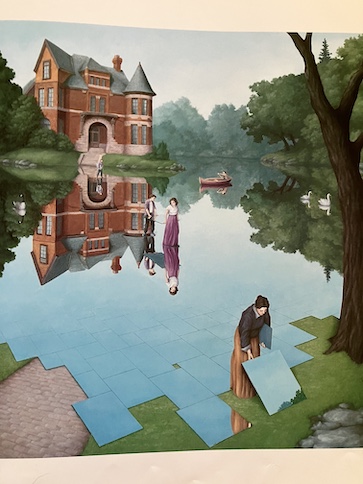
She also adds the element that all of the “people” she’s talking about are animals, and the types of animals they are also fits the alphabet theme. It can be difficult to think of animals for certain letters of the alphabet, but again, she goes for the unusual ones. The husband/wife pairs being named aren’t always the same animal, either. When they match, it’s usually because it was too difficult to come up with two different animal names for particular letters. The types of animals are given under each picture.

X is always the most difficult letter in an alphabet game because there aren’t many words or names that start with X. However, I liked the way the author dealt with it, just using aliens!

The book is available to borrow and read for free online through Internet Archive.

An Ellis Island Christmas

A six-year-old girl, Krysia Petrowski, knows that her family is preparing to leave Poland for the United States. Her father went ahead to America to establish a home for the rest of the family, and she knows that she, her mother, and her brothers will soon follow him. She doesn’t want to leave her home and her best friend, but her mother explains that life will be better in America because there is more food and there are no soldiers in the streets.

When the family begins packing to leave for America, they cannot bring everything with them because they have a long walk to get to the ship that will take them to America, and they can only bring what they can carry with them. The girl can only bring one of her two dolls with her, and she is sad at having to leave one behind.

When they board the ship, the conditions are cramped and cold. The food isn’t good, either. The voyage is rough and stormy, and many people are seasick. The one bright point is that Krysia meets another girl she knows from school, Zanya, so she knows that she won’t be going to America alone and friendless. Krysia and Zanya play together on the ship when the weather is better.

Finally, they reach Ellis Island on the day before Christmas. Everyone lines up, and the family has to show their papers to the immigration officials. Doctors look at them to make sure they are healthy enough to go ashore and into the city. Fortunately, they pass the health tests, although Krysia sees another woman who is told that she will have to go into the hospital or back to Poland because she is ill. The family converts their money to American money and buys some food. A man has to explain to them how to eat a banana because they’ve never seen one before.

Because it’s Christmas Eve, there is a big Christmas tree, covered with lights and toys. There is also a man dressed like Santa Claus, although Krysia thinks of him by the Polish name, Saint Mikolaj. They don’t receive any new presents, but Krysia’s mother does have a surprise for her. The best part is when Krysia’s father comes for them and takes them to their new home.

The book ends with a section explaining the history behind the story.

The book is available to borrow and read for free online through Internet Archive (multiple copies).

The focus of this story is all on the feelings and experiences of the immigrant family, especially little Krysia. Krysia’s impressions of the journey and the arrival at Ellis Island are all a child’s impressions, and she often needs explanations of what’s happening and what’s going to happen next, which is helpful to child readers.

The historical context for the story is provided in the section of historical information at the end and in some hints during the course of the story. The section of historical information in the back of the book discusses the peak years of US immigration, from 1892 to 1924. They don’t say exactly what year this story takes place, but it mentions 48 stars on the American flag. That means that this is the early 20th century, after Arizona and New Mexico were admitted as states in 1912. During that time, 70% of US immigrants came through the immigration center on Ellis Island, just off the coast of New York City. Of those who arrived at Ellis Island, about a third stayed in New York, and the others spread out across the US. The family in the story seems to be going to stay in New York, but because the focus of the story is mainly on the journey, there are still few details provided about this family’s background and circumstances. The section of historical information also explains a little more about the traveling conditions of immigrants around that time and what typically happened at Ellis Island, so readers can understand how the experiences of the characters in the story fit into the experiences of other, real-life immigrants. (For more details, I recommend reading If Your Name Was Changed at Ellis Island and Immigrant Kids, nonfiction books which echo many of the details included in this book.)

There is some discussion in the section of historical information about the reasons why immigrants left their homes, and we told in the beginning of the story that there are shortages of food in Poland and soldiers everywhere, but there is more that I’d like to say about this. Because I like to add context to historical stories, I’d like to talk what was happening in early 20th century Poland and what’s behind the circumstances the characters describe. During the 19th century, parts of Poland were under the control of three different European empires: Russia, Prussia (a German state), and the Austro-Hungarian Empire (while later dissolved into Austria and Hungary). The oppressive control of these imperial powers accounts for the soldiers the family describes on the streets. There were Poles who resisted the control of these forces and wanted to reunify their country, so the soldiers were to keep the population under control and put down resistance. Around the turn of the 20th century, Polish territories were also suffering from unemployment and land shortages, which explains the food shortages the family experiences. Because of these conditions, there was massive immigration from Poland to the United States during the late 19th century and early 20th century. The Petrowski family in the story would have been on the tail end of this wave of immigration because circumstances changed for Poland after World War I (1914 to 1918), when Poland became an independent country again. Some Polish immigrants to the United States intended to stay only for a relatively short time, hoping to save up money and return to their homeland with the money to purchase land or improve their family’s circumstances, but many of these people remained in the United States anyway.

Because the main character, Krysia, is only six years old, she likely wouldn’t understand the full background of her family’s circumstances and the political causes of the hardships in her country, but I like to explain these things for the benefit of readers. I think it’s also interesting that this story is a Christmas story. We are never told what the religion of the characters is, although it seems that they are Christian because they care that it’s Christmas. Many people from Poland were Catholic, so it’s possible that this family was Catholic, too, but it’s never clarified.

If you read the short biographies of the author and illustrator of the story, the author reveals that the inspiration for the story was the story of her own family’s journey from Poland. The illustrator says that he went on a tour of Ellis Island to prepare for producing the illustrations, and he tried to capture the “awe and anticipation” of the immigrants and the high vaulted ceilings and views of the New York skyline through the windows. I’ve also been to Ellis Island, and the illustrations in the book brought back memories of my trip there. I thought that the illustrator did a good job of capturing how big, impressive, and bewildering the Ellis Island compound would be to a young child.

The Legend of the Indian Paintbrush

This story is a retelling of a Native American legend.

In the distant past, there was a boy called Little Gopher who never seemed able to keep up with the other boys with the skills they would need to be warriors. His parents worried about his future, but he had other talents. He had a skill for making things, and the shaman of the tribe told him that his destiny would be different from the others.

One day, Little Gopher had a vision of a grandfather and a young maiden, who came to him, holding an animal skin, a brush made of animal hairs, and paints. These figures told him that these would be the tools he would use to accomplish great things for his people. He would spend his life painting the warrior’s deeds and the shaman’s visions so people would remember them. The maiden told him to find a white buckskin and paint a picture with the colors of the setting sun.

From then on, Little Gopher gathered animal skins and painted them with the scenes of great hunts, warrior’s deeds, and visions from dreams. When he found a pure white buckskin, he tried to paint it with the colors of the setting sun, but they never looked right. He kept trying and studying the sunset to figure out how to make the right colors.

One night, he heard a voice telling him to take the buckskin with him to watch the sunset and that he would find what he needed on the ground there. He did as the voice told him, and he found brushes with paint stuck into the ground. He used the brushes, and they were just the right colors. The next day, everyone saw plants growing with beautiful colors, like the colors of a sunset, where the brushes had taken root.

I remember this book from when I was a kid, and I always kind of paired it in my mind with The Legend of the Bluebonnet by the same author, Tomie DePaola because both of them are retellings of Native American folktales about the origins of particular flowers. In the back of the book, there’s an Author’s Note about the story. A friend of Tomie DePaola had recommended to him that he write this story about the state flower of Wyoming, the Indian Paintbrush, because he had already written about the state flower of Texas in The Legend of the Bluebonnet. The folk tale about the origins of the Indian Paintbrush came from a book about stories and legends about Texas Wildflowers, which was given to Tomie DePaola by another friend. Although the Indian Paintbrush is the state flower of Wyoming, it also grows in Texas.

When I was a kid, I was often too impatient or absorbed with the main story to read Author’s Notes, Forewords, Afterwords, or any explanations outside of the main story, but as an adult, I find that they really do add to the story by adding context. I appreciated this story even more after understanding its connection to the other story, The Legend of the Bluebonnet, and how the author learned this story before making his own retelling.

The Mysterious Horseman

This book is part of a loose series of books by Kate Waters, showing child reenactors at living history museums, having adventures in the roles of the characters they play. While most of the books are set in Colonial times at Plymouth and Colonial Williamsburg, the setting for this story is the Connor Prairie living history museum in Indiana, which shows life in a small town in the 19th century.

The story centers around a boy named Andrew McClure. He is the only one of his siblings left still living with their parents. His older sister is now married, and his baby brother died of an illness during the last year. His family is still grieving for his little brother. Andrew’s best friend is a boy named Thomas Curtis, who lives nearby, and Andrew works part time at a local inn to earn some money.

One day, while Andrew is doing some sweeping at the inn, he overhears some men talking in the taproom. He doesn’t hear their entire conversation, but he hears them talking about a mysterious rider without a head who chased a schoolmaster. Andrew is startled, and he wonders if that has something to do with the new schoolmaster who is supposed to arrive in town.

When Andrew is done with his work, he goes to the schoolhouse, and he finds his friend Thomas and Thomas’s sister, helping the new schoolmaster to clean the schoolhouse and prepare it for lessons to start. Andrew wants to talk to Thomas about what he overheard at the inn, but the schoolmaster only wants to talk to the boys about lessons.

Later, Andrew does have a chance to talk to Thomas, and both of the boys are spooked by the idea of a headless rider. They even think that they hear the rider on the road! The frightened boys go see Thomas’s father, the blacksmith, and tell him about the rider. Fortunately, the blacksmith knows what the men were talking about, and he can settle the boys’ fears.

The book is available to borrow and read for free online through Internet Archive.

I didn’t know about this book until I was looking up Kate Waters’s books for my younger cousins. I was surprised because Kate Waters’s living history museum books are mostly set on the East Coast or focus on the Colonial era. This 19th century book set in Indiana somewhat departs from the theme and has a different feel from the other Kate Waters books, but I enjoyed it. I’ve been to Connor Prairie because I have relatives in the area, and I enjoyed my visit. It’s been years since I’ve been there, so I didn’t immediately recognize the setting. When I read the explanation in the back of the book, I was fascinated to realize that I had visited that location before.
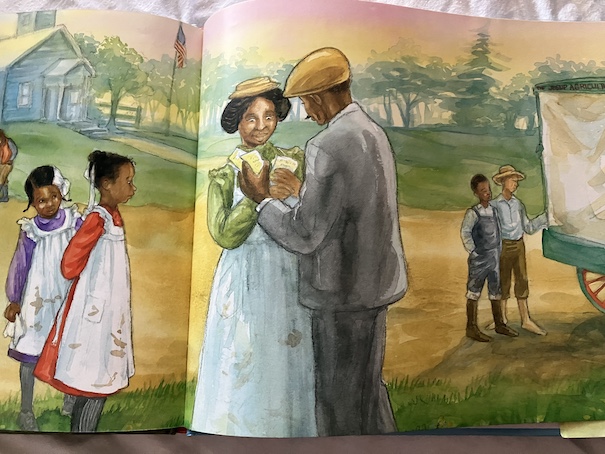
Andrew has a fascination for life on the frontier because he often watches people pass through his town on their way further west, and he daydreams about going west himself. His family is also still coming to terms with the death of his little brother, so the subject of death is still on Andrew’s mind. The deaths of children due to illness were sadly common in the 19th century and on the frontier, and the mourning in Andrew’s family adds to the melancholy and spooky atmosphere of the story.

Most adults and older children will probably recognize what the men at the inn where actually talking about when they were discussing the headless rider who chased the schoolmaster. When the boys talk to Thomas’s father, he immediately recognizes the story as the plot of The Legend of Sleepy Hollow by Washington Irving, originally published in 1820, about 16 years before the story in this book is suppose to take place. The men at the inn were just discussing the plot of the story, not something that they saw on the road themselves.

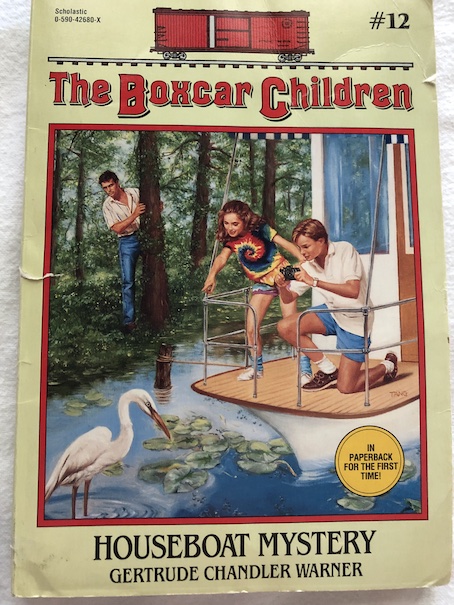
The Secret of the Haunted Mirror

The Three Investigators

TIHauntedMirror

Mrs. Darnley has collected mirrors for years, and she has some pretty impressive ones in her collection. Her strangest mirror by far is the goblin mirror that her friend in another country, the Republic of Ruffino sent to her. There is a legend surrounding the mirror that says it was once owned by magician who used it to communicate with goblins under the earth. Supposedly, the magician went inside the mirror himself and now haunts it.

A man called Sr. Santora has been pestering Mrs. Darnley to sell the mirror to him, claiming he’s a descendant of the magician who created it. He insists that the legends about the mirror are true and that terrible things have happened to previous owners of the mirror. Mrs. Darnley didn’t believe these stories at first, but now, she and her grandchildren have seen this ghost in the mirror and heard unearthly laughter in the night. That isn’t the only strange phenomenon they’ve experienced. Someone tries to steal the mirror from Mrs. Darnley’s house, and Mrs. Darnley, not knowing what to do, asks the Three Investigators to find out what the mirror’s secret really is.

The Three Investigators are pretty sure from the beginning that someone is faking the ghost, although they don’t know exactly how. At first, they think that Sr. Santora hired the man who tried to steal the mirror, but when they follow the attempted thief, Pete sees him attack Sr. Santora!

Jupiter spends a stormy night at Mrs. Darnley’s house and has an encounter with the “ghost” that reveals how the haunting was accomplished and reveals connections to another magician who once owned Mrs. Darnley’s house and to the president of the Republic of Ruffino. It seems that the mirror contains secrets that aren’t entirely magical. There are two competing forces trying possess these secrets.

When Mrs. Darnley’s grandson is kidnapped, the kidnapper demands that she turn over the mirror in an abandoned warehouse. The Three Investigators must hurry to find the kidnapped grandson, discover which side in this power struggle is responsible for the kidnapping, and what the real secret of the mirror is before it’s too late!

The book is available to borrow and read for free online through Internet Archive (multiple copies).

The part I enjoyed the most about this mystery was the creepy legend and haunting of the mirror. One of the features of the Three Investigators books that I like is that they have some spooky mysteries in the pseudo-ghost story fashion of Scooby-Doo, and some of their supposed ghosts and supernatural creatures are much more original than in other series. The idea of a haunted goblin mirror and Jupiter’s encounter with it on a spooky, stormy night are delicious to a Scooby-Doo style mystery fan!

There are echoes of the first Three Investigators book in this one because there are secrets to Mrs. Darnley’s house that she doesn’t fully understand, and the haunting is based on magic tricks. There is some political intrigue to the story, too. The Republic of Ruffino isn’t a real place, so readers find out about its circumstances along with the Three Investigators. There is also a secret room and a clever hiding place for something in the solution to the mystery.

The Mystery of the Laughing Shadow

The Three Investigators

The mystery begins when Bob and Pete are bicycling by the old Sandow estate and they hear a call for help. Although it’s dark they can’t see who yelled for help, they can tell that the person threw something small that lands near them. They pick it up and discover that it is a small gold amulet. Then, Bob and Pete have to hide when a dark, shadowy figure comes looking for the amulet. The figure appears humpbacked and has a weird laugh that Bob and Pete have trouble describing.
They tell Jupiter what happened, and he joins them in searching for the person who called for help and figuring out the significance of the amulet. Someone steals the amulet from Jupiter, although Jupiter manages to save a message that was hidden inside the amulet. Then, they consult an expert in Native American languages and antiquities and learn that the amulet may be part of the Chumash treasure hoard, a treasure stolen from the Spanish settlers of the area many years ago by Chumash Indians (Native Americans) who once lived in the area. People have searched for the treasure for many years, but no one has found it. However, the message that was hidden inside the amulet is written in a language that belongs to the Yaquali Indians of Mexico (this is a fictional group, not the Yaqui), a remote tribe mostly living in isolation but known for their climbing skills. The expert is puzzled because he can’t figure out what the connection can be between the Chumash and the Yaqualis. The two group don’t live in the same area, their languages aren’t related, and the Yaqualis had nothing to do with the lost Chumash treasure hoard.
Jupiter says that their next move should be to investigate the Sandow estate. At first, they plan to make an excuse that they’re researching the Sandow estate for a school project, but to their surprise, Ted Sandow, grandnephew of Sarah Sandow, who owns the Sandow estate, shows up at Jupiter’s uncle salvage yard. Ted is just a few years older than the Three Investigators, and he explains that he came from England to visit his Great-Aunt Sarah after his father died. He says that his aunt wants to clean out a bunch of old things that have been in storage on the estate and that someone recommended the salvage yard to him. He invites the boys to the estate so he can show them some antiques that Jupiter’s uncle might want to buy. It seems like quite a coincidence that Ted Sandow would just come looking for them and give them an invitation to the Sandow estate just when they were planning to investigate the place, but the boys can’t pass up the invitation.

At the Sandow estate, the boys are amazed at the antiques that Sarah Sandow is offering to sell, and they’re sure that Jupiter’s uncle will be interested. They spend some time chatting with Ted, Great-Aunt Sarah, and Mr. Harris, a friend of the Sandows who has started a Vegetarian League with the help of Sarah Sandow. Sarah tells the boys that the reason she wants to clean out some of the clutter around the estate is that they recently had a burglary. They all explain to the boys that a small gold statue (the amulet) was stolen from the estate by an unknown boy. It was one of a pair that used to belong to Sarah’s brother, who was Ted’s grandfather. The boys explain that they are investigators and that they would be happy to help them recover the little statue, without telling them that they had it in their possession at one point or about the message they found with it. The Sandows hire boys to find it, promising them a reward if they’re successful, but some things about their offer don’t ring true.

For one thing, Ted Sandow asks the boys about the meaning of the question marks on their business card before he even looks at the card, indicating that he already knew about their investigation business and that he sought them out for that purpose rather than just to sell things to the salvage yard. It’s also strange that he stresses that they will reward the boys for the return of the amulet with “no questions asked” about how they found it. What are the Sandows hiding, and what is the meaning of the message that was with the amulet? Do they know the location of the Chumash hoard, or do they have it themselves? Who was the mysterious shadow with the weird laugh? Lives may hang in the balance as the boys struggle to learn the identity of the laughing shadow.

The book is available to borrow and read for free online through Internet Archive.

I like books that reference history, but this book bothers me a little because of the introduction of the Yaquali. The Chumash are real, but the Yaquali are a fictional group, and it just feels strange to have the book start with a real group of Native Americans and then incorporate a fictional group. It also makes the story feel a little contrived that the villain needs the Yaquali for their excellent climbing skills to reach the treasure when it doesn’t seem like the Yaquali had anything to do with placing the treasure where it’s hidden.

The explanation behind the laughing shadow also feels a little contrived. There’s a logical explanation but at the same time, it depends on the villain having a pet that makes a sound that sounds like a laugh, and this pet’s origins point to the villain’s origins.

The part of the story that I thought was most interesting was that, while the Three Investigators are suspicious of the Sandows, it’s implied that the suspicious is mutual. The Sandows offer the Three Investigators the job of finding the amulet with “no questions asked” about how they found it, and there is an implication that they suspect that the boys stole it. The implication that the “no questions asked” is actually an invitation to the boys to return what they took with a promised reward and no repercussions. However, at the same time as the boys accept the job from the Sandows, they have their own suspicions about what the Sandows are doing and what the meaning of the message in the amulet is. They see the investigation job as a way to learn more about what’s going on. The interesting part is that, while each of them has some reason to suspect each other, the real culprit in this situation isn’t either of them.

Although the boys suspect Ted at first, the real villain is Harris.  Years ago, Sarah Sandow’s brother, Ted’s grandfather, learned that the Chumash hoard was located on their property, but for reasons that no one seems to know, he killed the only person who could tell him where it was and had to leave the country.  Ted was born in England, and he has been visiting his Great-Aunt Sarah.  He met Mr. Harris on the way here, and Harris introduced himself to Sarah on the pretext of getting a donation to help set up a society for vegetarians in the area.  He had already figured out where the hoard was located on her property, and he had convinced some young Yaqualis from Mexico to come to the United States to help him get it. 

The treasure is hidden in a cave which can only be reached by experienced climbers, and the Yaqualis are known for their climbing skills.  One of the Yaqualis realized that what Harris wanted them to do was illegal and that he was planning to do away with them when it was all over.  He managed to get word to his family, and he put the message in the amulet in the hopes that someone would find it later and help him and the others. 

Jupiter figures out that Harris is the villain when he realizes that the mysterious laugh isn’t human; it was caused by a kookaburra, a pet of Harris’s from Australia.  His shadow only looked humpbacked because the bird was sitting on him at the time.  Jupiter gets the police to check with the Australian authorities, and they learn about Harris’s criminal past.  By then Harris has taken Bob and Pete hostage, and they must stage a daring rescue to save them.  For a while, Bob and the young Yaqualis are trapped in the cave with the treasure, but a couple of other Yaqualis who have been searching for them help to rescue them.  At the end of the book, the ownership of the treasure still has to be determined, but many museums are hoping to acquire pieces for their collections.