The Mysterious Horseman

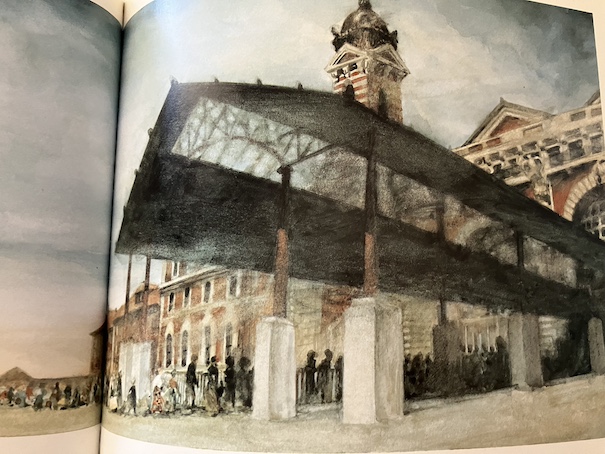
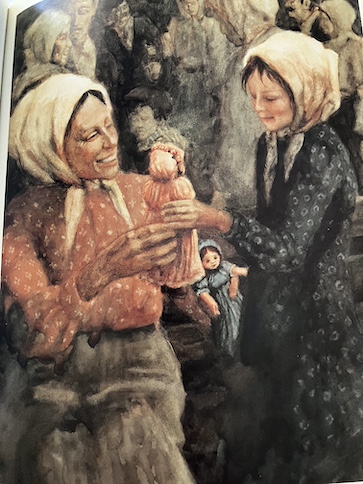
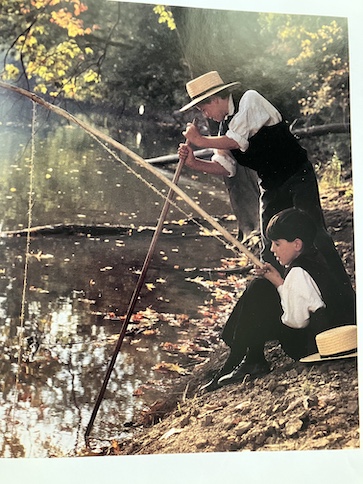
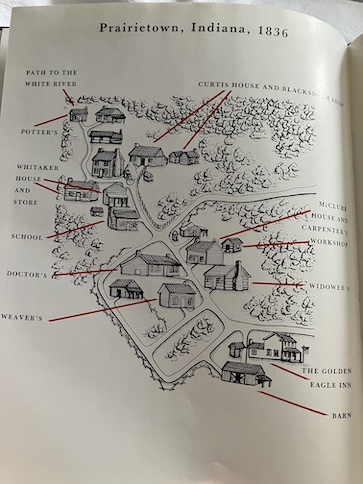
This book is part of a loose series of books by Kate Waters, showing child reenactors at living history museums, having adventures in the roles of the characters they play. While most of the books are set in Colonial times at Plymouth and Colonial Williamsburg, the setting for this story is the Connor Prairie living history museum in Indiana, which shows life in a small town in the 19th century.

The story centers around a boy named Andrew McClure. He is the only one of his siblings left still living with their parents. His older sister is now married, and his baby brother died of an illness during the last year. His family is still grieving for his little brother. Andrew’s best friend is a boy named Thomas Curtis, who lives nearby, and Andrew works part time at a local inn to earn some money.

One day, while Andrew is doing some sweeping at the inn, he overhears some men talking in the taproom. He doesn’t hear their entire conversation, but he hears them talking about a mysterious rider without a head who chased a schoolmaster. Andrew is startled, and he wonders if that has something to do with the new schoolmaster who is supposed to arrive in town.

When Andrew is done with his work, he goes to the schoolhouse, and he finds his friend Thomas and Thomas’s sister, helping the new schoolmaster to clean the schoolhouse and prepare it for lessons to start. Andrew wants to talk to Thomas about what he overheard at the inn, but the schoolmaster only wants to talk to the boys about lessons.

Later, Andrew does have a chance to talk to Thomas, and both of the boys are spooked by the idea of a headless rider. They even think that they hear the rider on the road! The frightened boys go see Thomas’s father, the blacksmith, and tell him about the rider. Fortunately, the blacksmith knows what the men were talking about, and he can settle the boys’ fears.

The book is available to borrow and read for free online through Internet Archive.

I didn’t know about this book until I was looking up Kate Waters’s books for my younger cousins. I was surprised because Kate Waters’s living history museum books are mostly set on the East Coast or focus on the Colonial era. This 19th century book set in Indiana somewhat departs from the theme and has a different feel from the other Kate Waters books, but I enjoyed it. I’ve been to Connor Prairie because I have relatives in the area, and I enjoyed my visit. It’s been years since I’ve been there, so I didn’t immediately recognize the setting. When I read the explanation in the back of the book, I was fascinated to realize that I had visited that location before.

Andrew has a fascination for life on the frontier because he often watches people pass through his town on their way further west, and he daydreams about going west himself. His family is also still coming to terms with the death of his little brother, so the subject of death is still on Andrew’s mind. The deaths of children due to illness were sadly common in the 19th century and on the frontier, and the mourning in Andrew’s family adds to the melancholy and spooky atmosphere of the story.

Most adults and older children will probably recognize what the men at the inn where actually talking about when they were discussing the headless rider who chased the schoolmaster. When the boys talk to Thomas’s father, he immediately recognizes the story as the plot of The Legend of Sleepy Hollow by Washington Irving, originally published in 1820, about 16 years before the story in this book is suppose to take place. The men at the inn were just discussing the plot of the story, not something that they saw on the road themselves.

The Secret of the Haunted Mirror

The Three Investigators

TIHauntedMirror

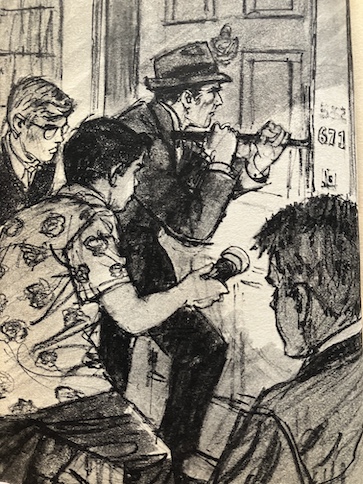
Mrs. Darnley has collected mirrors for years, and she has some pretty impressive ones in her collection. Her strangest mirror by far is the goblin mirror that her friend in another country, the Republic of Ruffino sent to her. There is a legend surrounding the mirror that says it was once owned by magician who used it to communicate with goblins under the earth. Supposedly, the magician went inside the mirror himself and now haunts it.

A man called Sr. Santora has been pestering Mrs. Darnley to sell the mirror to him, claiming he’s a descendant of the magician who created it. He insists that the legends about the mirror are true and that terrible things have happened to previous owners of the mirror. Mrs. Darnley didn’t believe these stories at first, but now, she and her grandchildren have seen this ghost in the mirror and heard unearthly laughter in the night. That isn’t the only strange phenomenon they’ve experienced. Someone tries to steal the mirror from Mrs. Darnley’s house, and Mrs. Darnley, not knowing what to do, asks the Three Investigators to find out what the mirror’s secret really is.

The Three Investigators are pretty sure from the beginning that someone is faking the ghost, although they don’t know exactly how. At first, they think that Sr. Santora hired the man who tried to steal the mirror, but when they follow the attempted thief, Pete sees him attack Sr. Santora!

Jupiter spends a stormy night at Mrs. Darnley’s house and has an encounter with the “ghost” that reveals how the haunting was accomplished and reveals connections to another magician who once owned Mrs. Darnley’s house and to the president of the Republic of Ruffino. It seems that the mirror contains secrets that aren’t entirely magical. There are two competing forces trying possess these secrets.

When Mrs. Darnley’s grandson is kidnapped, the kidnapper demands that she turn over the mirror in an abandoned warehouse. The Three Investigators must hurry to find the kidnapped grandson, discover which side in this power struggle is responsible for the kidnapping, and what the real secret of the mirror is before it’s too late!

The book is available to borrow and read for free online through Internet Archive (multiple copies).

The part I enjoyed the most about this mystery was the creepy legend and haunting of the mirror. One of the features of the Three Investigators books that I like is that they have some spooky mysteries in the pseudo-ghost story fashion of Scooby-Doo, and some of their supposed ghosts and supernatural creatures are much more original than in other series. The idea of a haunted goblin mirror and Jupiter’s encounter with it on a spooky, stormy night are delicious to a Scooby-Doo style mystery fan!

There are echoes of the first Three Investigators book in this one because there are secrets to Mrs. Darnley’s house that she doesn’t fully understand, and the haunting is based on magic tricks. There is some political intrigue to the story, too. The Republic of Ruffino isn’t a real place, so readers find out about its circumstances along with the Three Investigators. There is also a secret room and a clever hiding place for something in the solution to the mystery.

The Mystery of the Laughing Shadow

The Three Investigators

The mystery begins when Bob and Pete are bicycling by the old Sandow estate and they hear a call for help. Although it’s dark they can’t see who yelled for help, they can tell that the person threw something small that lands near them. They pick it up and discover that it is a small gold amulet. Then, Bob and Pete have to hide when a dark, shadowy figure comes looking for the amulet. The figure appears humpbacked and has a weird laugh that Bob and Pete have trouble describing.

They tell Jupiter what happened, and he joins them in searching for the person who called for help and figuring out the significance of the amulet. Someone steals the amulet from Jupiter, although Jupiter manages to save a message that was hidden inside the amulet. Then, they consult an expert in Native American languages and antiquities and learn that the amulet may be part of the Chumash treasure hoard, a treasure stolen from the Spanish settlers of the area many years ago by Chumash Indians (Native Americans) who once lived in the area. People have searched for the treasure for many years, but no one has found it. However, the message that was hidden inside the amulet is written in a language that belongs to the Yaquali Indians of Mexico (this is a fictional group, not the Yaqui), a remote tribe mostly living in isolation but known for their climbing skills. The expert is puzzled because he can’t figure out what the connection can be between the Chumash and the Yaqualis. The two group don’t live in the same area, their languages aren’t related, and the Yaqualis had nothing to do with the lost Chumash treasure hoard.

Jupiter says that their next move should be to investigate the Sandow estate. At first, they plan to make an excuse that they’re researching the Sandow estate for a school project, but to their surprise, Ted Sandow, grandnephew of Sarah Sandow, who owns the Sandow estate, shows up at Jupiter’s uncle salvage yard. Ted is just a few years older than the Three Investigators, and he explains that he came from England to visit his Great-Aunt Sarah after his father died. He says that his aunt wants to clean out a bunch of old things that have been in storage on the estate and that someone recommended the salvage yard to him. He invites the boys to the estate so he can show them some antiques that Jupiter’s uncle might want to buy. It seems like quite a coincidence that Ted Sandow would just come looking for them and give them an invitation to the Sandow estate just when they were planning to investigate the place, but the boys can’t pass up the invitation.

At the Sandow estate, the boys are amazed at the antiques that Sarah Sandow is offering to sell, and they’re sure that Jupiter’s uncle will be interested. They spend some time chatting with Ted, Great-Aunt Sarah, and Mr. Harris, a friend of the Sandows who has started a Vegetarian League with the help of Sarah Sandow. Sarah tells the boys that the reason she wants to clean out some of the clutter around the estate is that they recently had a burglary. They all explain to the boys that a small gold statue (the amulet) was stolen from the estate by an unknown boy. It was one of a pair that used to belong to Sarah’s brother, who was Ted’s grandfather. The boys explain that they are investigators and that they would be happy to help them recover the little statue, without telling them that they had it in their possession at one point or about the message they found with it. The Sandows hire boys to find it, promising them a reward if they’re successful, but some things about their offer don’t ring true.

For one thing, Ted Sandow asks the boys about the meaning of the question marks on their business card before he even looks at the card, indicating that he already knew about their investigation business and that he sought them out for that purpose rather than just to sell things to the salvage yard. It’s also strange that he stresses that they will reward the boys for the return of the amulet with “no questions asked” about how they found it. What are the Sandows hiding, and what is the meaning of the message that was with the amulet? Do they know the location of the Chumash hoard, or do they have it themselves? Who was the mysterious shadow with the weird laugh? Lives may hang in the balance as the boys struggle to learn the identity of the laughing shadow.

The book is available to borrow and read for free online through Internet Archive.

I like books that reference history, but this book bothers me a little because of the introduction of the Yaquali. The Chumash are real, but the Yaquali are a fictional group, and it just feels strange to have the book start with a real group of Native Americans and then incorporate a fictional group. It also makes the story feel a little contrived that the villain needs the Yaquali for their excellent climbing skills to reach the treasure when it doesn’t seem like the Yaquali had anything to do with placing the treasure where it’s hidden.

The explanation behind the laughing shadow also feels a little contrived. There’s a logical explanation but at the same time, it depends on the villain having a pet that makes a sound that sounds like a laugh, and this pet’s origins point to the villain’s origins.

The part of the story that I thought was most interesting was that, while the Three Investigators are suspicious of the Sandows, it’s implied that the suspicious is mutual. The Sandows offer the Three Investigators the job of finding the amulet with “no questions asked” about how they found it, and there is an implication that they suspect that the boys stole it. The implication that the “no questions asked” is actually an invitation to the boys to return what they took with a promised reward and no repercussions. However, at the same time as the boys accept the job from the Sandows, they have their own suspicions about what the Sandows are doing and what the meaning of the message in the amulet is. They see the investigation job as a way to learn more about what’s going on. The interesting part is that, while each of them has some reason to suspect each other, the real culprit in this situation isn’t either of them.

Although the boys suspect Ted at first, the real villain is Harris.  Years ago, Sarah Sandow’s brother, Ted’s grandfather, learned that the Chumash hoard was located on their property, but for reasons that no one seems to know, he killed the only person who could tell him where it was and had to leave the country.  Ted was born in England, and he has been visiting his Great-Aunt Sarah.  He met Mr. Harris on the way here, and Harris introduced himself to Sarah on the pretext of getting a donation to help set up a society for vegetarians in the area.  He had already figured out where the hoard was located on her property, and he had convinced some young Yaqualis from Mexico to come to the United States to help him get it. 

The treasure is hidden in a cave which can only be reached by experienced climbers, and the Yaqualis are known for their climbing skills.  One of the Yaqualis realized that what Harris wanted them to do was illegal and that he was planning to do away with them when it was all over.  He managed to get word to his family, and he put the message in the amulet in the hopes that someone would find it later and help him and the others. 

Jupiter figures out that Harris is the villain when he realizes that the mysterious laugh isn’t human; it was caused by a kookaburra, a pet of Harris’s from Australia.  His shadow only looked humpbacked because the bird was sitting on him at the time.  Jupiter gets the police to check with the Australian authorities, and they learn about Harris’s criminal past.  By then Harris has taken Bob and Pete hostage, and they must stage a daring rescue to save them.  For a while, Bob and the young Yaqualis are trapped in the cave with the treasure, but a couple of other Yaqualis who have been searching for them help to rescue them.  At the end of the book, the ownership of the treasure still has to be determined, but many museums are hoping to acquire pieces for their collections.

The Mystery of the Talking Skull

The Three Investigators

Jupiter reads in the newspaper about a public auction of luggage abandoned at hotels. He is curious about the auction and persuades Bob and Pete to come with him. On a whim, Jupiter bids on an old trunk at the auction and gets it for a dollar. Even the auctioneers don’t know what’s in the trunk because it’s locked. However, shortly after Jupiter buys the trunk, others show up offering to buy it from him.

It turns out that the trunk used to belong to a magician called the Great Gulliver, who disappeared about a year earlier. His signature trick was a talking skull called Socrates, which is still inside the trunk. The Three Investigators study the skull because Jupiter is curious to see how the trick works, but he can’t find anything about the skull that would explain how the trick was done. However, when the skull begins to speak to the boys, it suggests an even more puzzling mystery.

In the middle of the night, the skull tells Jupiter to go to a certain address and use the skull’s name, Socrates, as the password. When Jupiter goes there, he meets a gypsy fortune teller called Zelda, who tells him that Gulliver isn’t dead but he’s no longer among the living. She also tells him that there are people who want money, but the money they want is hidden. Zelda says that maybe Jupiter can help, and she tells him to protect the trunk and listen to anything else the skull might say.

When the Three Investigators look through the trunk again, they find a letter hidden inside, under the lining. The letter is from a man Gulliver once knew in prison, Spike Neely. The man was dying, and he wanted to tell Gulliver where he hid some money he stole years before. Because he knew the authorities would read any letter he sent, he could only hint at the location. The letter was short, and it doesn’t seem to say much, but The Three Investigators are sure that there’s a clue to where Spike hid the money somewhere in the letter.

However, The Three Investigators find themselves questioning how much they want to investigate this particular mystery. Jupiter was followed by a strange car on the way home from Zelda’s, probably the men Zelda spoke of who are looking for the money. Then, Jupiter’s Aunt Mathilda gets spooked by the skull when it says “boo” to her, and she tells Jupiter to get rid of it. The boys decide to sell the trunk to Maximilian, a magician who was interested in buying it for the sake of the talking skull and other tricks inside. When Maximilian takes the trunk, they think that’s going to be the end of the matter for them, but the next day, Police Chief Reynolds comes to see them because Maximilian was in a car accident. He says that another car forced him off the road and a couple of men stole the trunk!

Chief Reynolds tries to see Zelda, since she seemed to know something about the hidden money, but when he goes to the address where Jupiter met her, Zelda and the other gypsies are gone. Then, somebody mails the trunk back to Jupiter! When the boys open the trunk again, Socrates the skull says, “Hurry! Find–the clue.” It looks like they’re on a hunt for stolen money whether they like it or not!

The book is available to borrow and read for free online through Internet Archive (multiple copies).

The idea of a mysterious talking skull that used to belong to a vanished magician is exciting by itself, and I remember liking this story the first time I read it. As an adult, the parts about the gypsies seem a little cringey, the stereotypical stuff of vintage children’s books. A mysterious fortune teller is compelling and reminds me of similar type characters that appeared in the original Scooby-Doo cartoons, but The Three Investigators aren’t really big on accuracy when it comes to cultural representations. That sort of thing never occurred to me as a kid. All I cared about was an interesting story, and this book does have that. It’s just that, when you’re an adult and you know more about the world, you can tell when a character or culture is really just a cardboard cutout with no depth to it, more of a stock element pulled out of an old bag of tricks, and it hits you differently.

The talking skull element was cool, and I loved the idea of buying a mystery trunk cheaply and finding an amazing mystery in side. It’s the sort of thing I would have loved to do or envision doing as a kid, although in real life, the contents of the trunk would probably have turned out to be far less exciting, like a bunch of rusty hardware or somebody’s collection of water-damaged magazines. It’s that sense that, when you open it, there could be anything inside that’s compelling, and the best books have that sense of anticipation, too.

The solution to this mystery involves the Three Investigators examining the letter to figure out where Spike hid the clue to finding his loot. There is one part of his letter that seems to hint at something personal, a person who doesn’t really seem to exist, but that’s only half of the clue. The other part lies in the stamps he used and also in Spike’s distinctive trait of having trouble pronouncing words with the letter ‘L’ in them. It’s the sort of multi-layered clue that might appear in a Sherlock Holmes story. From there, the Three Investigators have to track down the house that Spike’s sister owned, where he was apprehended after the robbery, which proves more difficult than they anticipated because all of the houses from that neighborhood have been moved to a new location and were given new numbers. There were parts of the treasure hunt that were exciting and others that seemed to drag a little, but there are definitely some violent characters looking for the money, too.

Someone is obviously using the Three Investigators to try to find the money on their behalf, urging them on by using the talking skull, and that adds layers to the mystery. Who is trying to use them to solve the mystery, or is it more than one person or group of people? When people approach them with information or ask for their help, who can they trust? By the end of the story, we do learn where Gulliver is (if you haven’t guess it already) and the full story behind Spike hiding the money and what led to Gulliver’s disappearance.

The Scandalous Sisterhood of Prickwillow Place

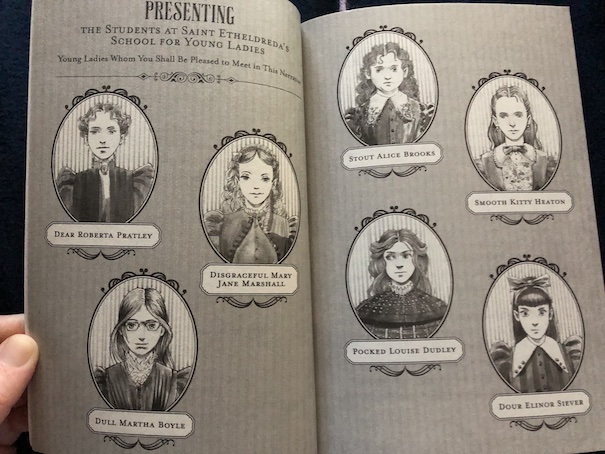
The story is set in England in 1890. There are seven girls at the proper Victorian boarding school known as Saint Ethelreda’s School for Young Ladies on Prickwillow Road in Ely. As the beginning sections of the book explain when they introduce the girls and members of their families and acquaintances, they were all sent to Saint Ethelreda’s because their families want them to become proper Victorian young ladies, ready to make suitable and socially-acceptably marriages. Some of the girls have defects in their characters or personal interests that are considered entirely unsuitable, and their families are hoping that the school’s discipline and propriety will cure them.

“Dear” Roberta Pratley – Her mother died while she was still young, and her father remarried. It was her stepmother’s idea to send her to boarding school, thinking her too soft, clumsy, awkward, and overindulged by her late mother. Her stepmother hopes that boarding school will strengthen her and turn her into a more graceful young lady. Roberta is known for being gentle and kind. She’s good at sewing.

“Disgraceful” Mary Jane Marshall – She was sent to boarding school by her mother, who has noticed that Mary Jane, while still rather young, is very pretty and precociously flirtatious, with a tendency to attract disreputable and penniless young men. Worse still, Mary Jane enjoys the company of these disreputable young men and regularly slips away from her mother to see them on the sly. Fearful that Mary Jane’s recklessness with young men will lead her into a disastrous marriage too early in life, her mother enrolled her in an all-female boarding school to keep her away from boys and, hopefully, give her a chance to mature and improve herself. So far, it’s not working. The only non-disreputable young man who interests her is the young local police constable.

“Dull” Martha Boyle – Martha has four brothers at home who make her life miserable with their pranks and teasing. Boarding school gives her an escape from them. She isn’t considered very bright, but she has a talent for music. She has a crush on a nearby farmer’s son.

“Stout” Alice Brooks – Poor Alice has a tendency to put on weight and is often compared unfavorably to her cousin Isabelle, who seems to be able to eat anything she wants without putting on an ounce. Alice doesn’t really hate Isabelle for this, but she’s tired of her grandmother’s criticism over it. She has a crush on a young law clerk.

“Smooth” Kitty Heaton – Kitty’s mother died when she was only four years old, and Kitty has no other siblings, which is a disappointment to her father, who hoped for a son to take over his business enterprises one day. Kitty’s father largely ignores her, and he has not yet noticed that Kitty is developing some shrewd business skills herself.

“Pocked” Louise Dudley – Louise’s face is scarred because she contracted smallpox at a young age. She survived this potentially-deadly illness because her devoted uncle, a talented doctor, nursed her through it. Ever since, she has revered her uncle and looks up to him as a mentor. Her uncle enjoys sharing his scientific and medical knowledge with her, he encourages her studies, and he thinks that she has the potential to a be doctor herself. Unfortunately, Louise’s parents don’t think that this is a proper profession for a young lady, so they sent her to boarding school to learn the kind of skills young ladies need to know to be wives and mothers. However, Louise has not given up her scientific interests.

“Dour” Elinor Siever – Elinor has a macabre side to her personality. Actually, her macabre side is most of her personality. When she was younger, she started sneaking out at night to explore, and she watched with fascination as the old grave digger in her town exhumed bodies to rob them or sell them for medical experiments. When the old grave digger spotted her watching him, she gave him a fright, and when her parents found out what she’d been doing, they packed her off to boarding school to put an end to this morbid interest and encourage her to be a sweeter, more cheerful, and more normal girl. None of that is working, but her morbid interests are about to come in handy when death comes to the little school.

One evening, while the headmistress of the girls’ school is dining with her visiting brother, both the headmistress and her brother are poisoned. The girls are saved because they were not eating the same food. Realizing that the headmistress and her brother are dead and quickly concluding that they were murdered, the girls debate about what to do. They consider calling a doctor, but it’s obviously too late for that. They could get the police, but before they do, the girls stop to consider what this will mean for themselves.

They have no idea who poisoned the headmistress and her brother. The girls prepared the food they were eating, so the poisoner could have even been one of them, or at least, they could be potential suspects. At the very least, the death of the headmistress means the end of the school, and the girls will all be sent home to their families. The truth is that the girls don’t want to go home. Each of them has some sort of tension at home or a reason why they were sent away, and they’ve all become like sisters to each other. More than anything, they want to be able to stay together and have some freedom from their tensions at home.

With their headmistress gone and no adults around to tell them what to do, what not to do, or how to be, the girls realize that they have unprecedented freedom to do as they like and be themselves, but that’s not going to last if they’re suspected of murder. Kitty is the first to suggest that they not tell anyone that the headmistress and her brother are dead, but she’s also the first to realize that, if they don’t find out who killed them, there will be a scandal, and each of the girls will be under suspicion for the rest of their lives. While Kitty relishes the idea of taking charge of the other girls and having them organize their own lessons and self-study from now on, according to the subjects that interest each of them the most, they also need to investigate and solve the murders. There is little hope for any of their future prospects if they have to go through life as murder suspects.

Their first problem arises when some friends of the headmistress and her brother show up unexpectedly as part of a surprise party for the brother’s birthday. Acting quickly, the girls hide the bodies and convince the guests that the brother has gone to India suddenly to tend to a sick relative and their headmistress has gone to bed because she was feeling unwell. However, one of the girls accidentally injures the ankle of the choir teacher, who has to spend the night at the school, causing them further complications. Desperately, the girls try to cover up the fact that their headmistress is dead and buy themselves time to investigate.

Although none of the girls is what their families consider a proper Victorian young lady, they each have skills that are useful to their deception and investigation. Kitty is good at organizing and managing people, and Mary Jane knows how to charm them. Elinor isn’t afraid of handling the dead, and Louise has scientific knowledge. Alice is the right size to pose for their headmistress in her clothes, and she has some acting ability.

Can the girls find the real murderer before someone figures out that two murders have taken place and blame the girls for them? What will the girls do if it turns out that the murderer is one of them? And, if it’s not one of them, what’s to stop the murderer from trying to kill again if he believes the girls’ ruse that their headmistress is still alive?

The book is available to borrow and read for free online through Internet Archive (multiple copies).

This is a humorous mystery with delightful characters! Although none of the girls is quite what their families or society wishes they were, readers will see that some of their supposed defects are actually strengths and skills. The humor in the story is dark, and the girls are unsentimental about the deaths of their annoying headmistress and her odious brother. They explain the reasons for their lack of sentimentality through their explanations of the victims’ characters. Neither of them was ever very nice to the girls, and they both had dark sides to their personalities.

Because some of the girls have morbid tendencies or possibly scandalous sides to their personalities that they need to cover up, it is plausible from the beginning that one of them could have had a reason to kill the headmistress, leaving readers more in suspense about the identity of the murderer. Although the girls love each other like sisters, there are moments when even they question whether they can really trust each other. However, the introduction of the headmistress’s friends and associates add other possible suspects to consider.

The first half of the book is largely about the girls getting themselves organized and covering up the deaths of the headmistress and her brother. They get more into solving the murders about halfway through the book, although they begin developing suspicions before that. I was pretty sure from the beginning that none of the girls did it, although the book does a good job of making it plausible that they could have. However, the girls soon learn that there were sides to their headmistress and her brother that they didn’t know about.

Early on, I had a theory that there could be more than one murderer involved. The headmistress and her brother didn’t seem to have exactly the same symptoms when they died, so I thought that it was possible that they were poisoned by different people coincidentally at the same meal. That’s not quite the right answer, although the parts of the story that made me think so are actual clues to what really happened. There are multiple villains in the story, some working together and some not. Some of what I suspected turned out to be true, but not all of it, and I didn’t figure out the whole situation before the characters explained it.

During the course of their adventures, the girls remain friends, and they also come to realize some things about themselves. Some of the girls develop budding romantic interests. Whether or not those fully develop, we don’t know, but it appears that there’s someone out there for everyone. Even Elinor finds someone to bond with over her morbid fascination for death. Some of the girls also come to realize talents they didn’t fully consider before and begin developing ambitions for their future. Kitty comes to reckon with her father’s lack of interest and emotional connection with her, and she also comes to realize that she shares some traits with him, even some of the less desirable ones. She realizes that she doesn’t want to be like her father, cold and commanding. While she felt little for her old headmistress, she was primarily motivated by her warm feelings for her best friends and fellow students, whom she regards as sisters. Because of her father’s detachment, she desperately guards the only warm connections she has in her life. Fortunately, the book has a happy ending. Circumstances allow the girls to continue with their education together in a way that supports all of their interests and under the guidance of someone who truly cares for them and understands them.
Madeline in London

This book is part of the Madeline series about a little girl at a small boarding school in Paris. The son of a Spanish Ambassador, Pepito, lives next door to the girls. He’s a menace to them at first, but the girls make friends with him. However, in this book, Pepito moves to London because his father has been relocated for his job.

When Pepito and his parents go to London, Pepito is unhappy there because he’s lonely for Madeline and the other girls from the boarding school. With Pepito growing thin and depressed from his unhappiness, Pepito’s father arranges for the girls from the boarding school to visit for Pepito’s birthday to cheer him up.

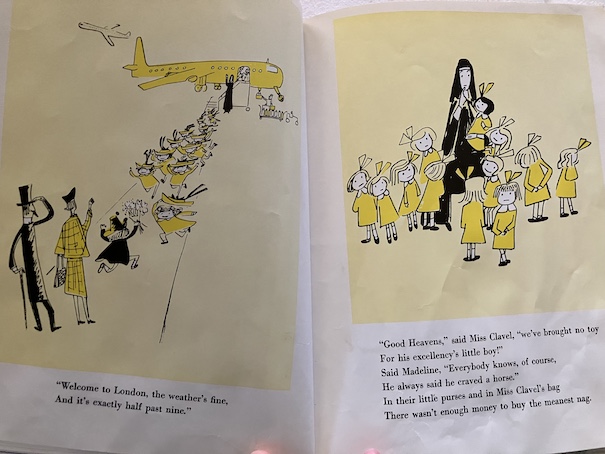
When Miss Clavel and the girls arrive in London, there’s a happy reunion, but then, they remember that they didn’t bring Pepito a present for his birthday. Madeline remembers that Pepito has always wanted a horse, and they find an old, retired army horse who is still healthy and gentle.

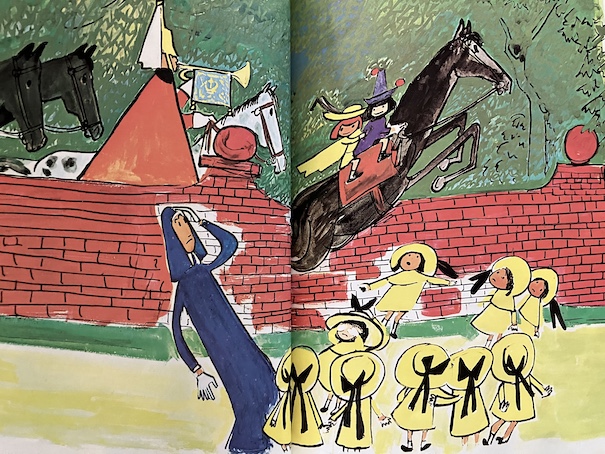
However, when they give the horse to Pepito, they quickly discover that there are complications to owning a horse as a pet. The horse hears a trumpet, and reacting to his army training, he runs off with Pepito and Madeline on his back to join a parade.

Then, they forget to feed him, so he eats everything in the garden, making himself sick. It seems like the embassy in London is no place for a horse, but Madeline and her friends may have room for one at their school!

The book is available to borrow and read for free online through Internet Archive (multiple copies).

Giving someone a horse for a present without checking with their parents or making sure that they have what they need to take care of a horse isn’t something that people realistically do, but the Madeline books rarely worry about the practicalities of a situation. It’s all fun and adventure!

I was seriously worried about the horse after they forget to feed him and he helps himself to random plants in the garden, especially when they find him with his feet up in the air. Fortunately, everything works out okay, which is characteristic of Madeline books, too. How the trustees of Madeline’s school will react when they find out that the girls now have a pet horse, since they raised a fuss earlier about the girls having a dog, is anyone’s guess, but the story doesn’t worry about that, either.

Like other books in this series, the pictures in the book alternate between limited color images, mostly in black and yellow, and full color images.

Madeline and the Bad Hat

Madeline is a little girl at a small boarding school in Paris. The Spanish ambassador moves into the house next door, and the girls at the boarding school get to know his son. However, his son, Pepito, is a wild boy who Madeline starts calling the “Bad Hat.” He teases the girls, scares them by playing ghost, and worst of all, is cruel to animals.

However, Pepito is actually lonely, and he wants the girls’ attention. He tries to win them over by being polite and doing things to impress them. Unfortunately, his idea of what impresses people can be horrific, like building a guillotine for the chickens the cook will prepare and playing practical jokes.

One day, he goes way too far and tries to release a cat into a pack of dogs! The cat tries to evade the dogs by getting on top of Pepito’s head, so the girls and Miss Clavel have to rescue both the cat and Pepito himself from the dogs!

Because Pepito has now gotten hurt himself by one of his pranks, he swears to Madeline that he’s learned his lesson, and he won’t do anything to hurt another animal. He even decides to become a vegetarian!

The book is available to borrow and read for free online through Internet Archive (multiple copies).

I didn’t remember much about this book from when I was a kid. I vaguely remembered that Pepito was a troublemaker who played pranks and teased the girls, but I didn’t remember that he was cruel to animals. Actually, I was kind of horrified by the guillotine for distressed chickens and the cat that he attempted to feed to the dogs.

Pepito only learns his lesson when he gets hurt himself and discovers what it’s like to be on the receiving end of pain. I didn’t mind him showing off a bit or playing pranks like dressing up like a ghost. The cruelty to animals part, though, I found distressing, even as an adult. I don’t think I’d read this book again because of that.

Madeline

“In an old house in Paris
that was covered with vines
lived twelve little girls
in two straight lines.”

The Madeline stories are considered children’s classics today, and these words, which are the opening lines in other books in the Madeline series, introduce Madeline’s school. Madeline is a little girl who lives in a small boarding school in Paris, tended by Miss Clavel.

Madeline is the smallest girl at the boarding school. She’s a brave girl, who isn’t scared of either mice or lions at the zoo, and she sometimes does daring stunts that frighten Miss Clavel.

One night, Miss Clavel wakes up because Madeline is crying. She calls the doctor, who examines Madeline and rushes her to the hospital because she needs to have her appendix removed.

After the operation, Madeline has to stay in the hospital for a while. Miss Clavel brings the other girls from the school to visit her, and they are impressed by all the candy and presents that Madeline has received from her family. Even more impressive, Madeline now has a scar that she shows to the other girls.

After the other girls return home and go to bed, Miss Clavel wakes up to find them all crying. Madeline has made having her appendix out look like so much fun, they all want to do it!

I wouldn’t say that I was a particular fan of Madeline as a kid, but I did read at least some of the books in the series. As an adult, I had forgotten that they were told entirely in rhyme, even though I still sometimes get those opening lines stuck in my head.

I remember thinking as a kid that I wouldn’t want to have my appendix out! Even if you get presents and an impressive scar, having an operation always sounded awful to me. It didn’t occur to me until I was older, but the Madeline cartoons and movie tended to portray Madeline as an orphan, but she isn’t. She’s just a student at a small boarding school. This book is one of the stories that mentions her family, with her papa sending her a dollhouse as one of the presents she receives while she’s in the hospital.

I also didn’t realize, until I was researching this series for the blog, just how old the first Madeline book was. It was originally published in 1939, on the eve of WWII. I don’t think the books ever have anything in them to tie the stories to any particular events, and they seem almost timeless, although I suppose that the girls’ school uniforms are a little old-fashioned. This timeless, idealized portrayal of Paris was popular with the book’s original audience of Americans during WWII.

I was curious about the author, Ludwig Bemelmans. He was born in Austria and grew up in Austria and Germany during the late 19th century and early 20th century. As a young man, he was apprenticed to his uncle, who owned a hotel, but Bemelmans was difficult to manage and got into trouble while working there. He later told a story about shooting and wounding a headwaiter who whipped him, although that might have been just a tall tale. Eventually, however, his uncle decided that he couldn’t deal with him, so he told him he would either have to go to reform school or go to the United States, where his father was living after having left him and his mother years before. He moved to the United States and lived there during WWI. He spent some time working in a series of hotels and restaurants. He eventually joined the US Army in 1917, although they wouldn’t send him to Europe because the US was at war with Germany, and he was German. He became a US citizen in 1918, and he developed an interest in art. He worked as a cartoonist before writing and illustrating children’s books. He wrote the first seven of the Madeline books, and the last one was published after his death. Since then, his grandson, John Bemelmans Marciano has written other Madeline books.

Thank You, Mr. Falker

When little Trisha turns five years old, her grandfather introduces to her to reading in the same way he has done for other children in the family, with a taste of honey on a book, to remind her that knowledge is sweet. Trisha already loves books because her mother reads to her every night, and other members of the family also read to her. She’s looking forward to learning to read herself.

However, when she starts going to school, she finds that she has trouble learning to read. She likes drawing, and other kids at school admire her drawings, but for some reason, she struggles at deciphering the letters that other kids seem to learn so easily. When she looks at writing on a page, everything looks like wiggling shapes, and she has trouble figuring out what sounds they’re supposed to make. Other children move forward with their reading lessons, but Trisha struggles and starts to feel dumb.

Trisha asks her grandmother if she thinks she’s different from the other kids, and her grandmother says that everyone is different and that’s “the miracle of life.” Trisha asks if she thinks she’s smart, and her grandmother says she is. That makes her feel a little better, but why can’t she read like the other kids?

Trisha continues to struggle in school, even after the family moves from Michigan to California. She is in third grade at that point, and other children insult her and tease her when she struggles, and Trisha feels dumber than ever. She spends more time drawing and daydreaming, and she starts hating school, sometimes pretending that she’s sick so she won’t have to go.

Things only start to improve for her in fifth grade, when she gets a new teacher, Mr. Falker. Mr. Falker doesn’t cater to the teacher’s pets like other teachers do, and he notices Trisha’s artistic talent and praises her for it. He also stops the other kids from teasing Trisha in class when she struggles, although one boy, Eric, continues to bully Trisha terribly and get other kids to gang up on her when the teacher isn’t looking until Mr. Falker finally catches him.
Mr. Falker works with Trisha to improve her reading and reassures her that she is not stupid. He realizes that the reason she has struggled with reading is that Trisha doesn’t see letters the way other kids do, and he points out that she’s actually been clever in the way she’s managed to hide just how much she’s been struggling all this time.

Mr. Falker introduces Trisha to Miss Plessy, a reading teacher, and the two of them work with her to develop techniques that improve her reading skills. Gradually, Trisha begins to make real progress, and she begins to feel the sweetness of knowledge that her grandfather talked about.

The book is available to borrow and read for free online through Internet Archive.

The end of the book explains that the story is autobiographical. Patricia Polacco was the Trisha in the story, and she did have trouble learning to read until the read Mr. Falker realized how she was struggling and helped her. At the end of the story, the author says that she met Mr. Falker again years later and thanked him, telling him that she can become a children’s author.

There is a difference between real life and the story, though. In the book, Trisha is in the fifth grade when she gets help with her reading, but in real life, Patricia Polacco was apparently 14 years old and in junior high school. The book doesn’t say exactly what the cause of Trisha’s learning difficulties is, but she is apparently dyslexic, based on the description and because Patricia Polacco was dyslexic in real life.

I enjoyed seeing this part of the author’s childhood, although I found the part with the school bullies stressful. I do think it was important to include that part, though, because that can be part of the experience of children who struggle in school. Although Eric is an obvious bully in the story, the other kids also make Trisha miserable with their teasing and insults. It occurred to me that they may not all think of themselves as bullies, but at the same time, a person doesn’t have to think of themselves a bully in order to be one. Bullying is a behavior, and it exists independently of self-identity. Part of me wondered, if the girl and the teacher in the story are both real, were the bullies also real, and if so, did any of them ever read this story and recognize themselves? Maybe some did, and maybe they didn’t. Maybe not all of them would even care, if they had.

Regardless, I do think stories like this can be useful as a preemptive measure against bullying by showing kids how their behavior can affect other people and what may be going on in the life of a person they’re teasing or bullying. While I’m sure that everyone thinks of themselves as being the heroes of their own story, I think people sometimes need a reminder that, at the very same time, they are also supporting characters in everyone else’s story, for good or bad. In a way, we’re all self-casting in every story we’re in by the ways we choose to act as we go through life’s story in general.

The bully antagonists aren’t really the main focus of the story, though. They act as further obstacles to the problem that Trisha is trying to solve, but ultimately, the story is really one of gratitude toward the teacher. Part of what the teacher does for Trisha is to shut down the bullies so Trisha can focus on what she needs to learn and he can focus on helping her. Even more importantly, Mr. Falker helps Trisha to see that she is smart and capable. It takes a little more work for her to make progress than others because she has a condition to overcome, but with a little help, she can do it. It really opens up a whole new world for her, and she finally gets to taste that sweetness that comes with knowledge.

I’ve heard of the tradition of giving children a taste of honey before they begin their lessons. When I was a student, I thought I remembered a teacher mentioning this tradition to us as a Greek tradition. It might be, although when I tried to look it up, I couldn’t find anything about Greece. I found references to it as a Jewish tradition, which would make sense for Patricia Polacco’s family.

Patricia Polacco’s real-life grandmother also appears in the story, the same grandmother who appears in another of Polacco’s books, Thunder Cake. Her grandfather wasn’t present in that story, but he is in this one. Both of the grandparents are mentioned as dying before the story ends.

The Haunted Clock Tower Mystery

Boxcar Children

Grandfather Alden is attending a reunion at his old college, Goldwin University, and he brings his grandchildren with him so he can show them where he went to school. The children are fascinated with the beautiful campus, especially with its clock tower. Their grandfather and Ezra Stewart, who works at the college and is responsible for maintaining the clock tower and playing its carillon bells. Ezra demonstrates to the Aldens how the carillon bells work, and he also shows them the smaller training keyboard, where he has trained his assistants. Ezra plays concerts for the campus on the carillon bells, but he gets irritated with his new assistant, Andrea Barton, because she never puts his music back where it belongs.

The Aldens run into Grandfather Alden’s old college roommate, Joel Dixon, who is also there for the reunion. Joel brought his son Don with him because Don has business in the area, and he’s been interested in the college since he started reading a book about it. At dinner, they also meet Grandfather Alden’s old history professor, Julia Meyer, who says that she’s working on a special project, but is mysterious about it.

That night, Benny sees a light in the clock tower. Ezra insists that nobody goes into the clock tower at night, and Benny wonders if it could be a ghost! Then, someone sabotages the carillon. Was it the mysterious night visitor, and if so, who could it be and why?

When the children look at the book Don has been reading, they learn that there may be a secret hidden treasure on the campus that dates from the Civil War. Is their mysterious “ghost”, looking for it, too? Is Don the one searching for the treasure, or is could it be the history professor or maybe Ezra’s new assistant?

The book is available to borrow and read for free online through Internet Archive.

I always like treasure hunt stories, and I enjoyed seeing the Aldens figuring out the clues to find the hidden treasure! They know that someone else is looking for the treasure, too, and I thought at least one person was a really obvious suspect. What I like about this book, though, it’s that it’s one of those stories where each of the potential suspects has something to hide. There isn’t just one person who’s been sneaking around the clock tower at night. Different people have been there for different reasons, not all of which have anything to do with the treasure. Part of the mystery involves figuring out who is doing what in the clock tower and why.

The addition of the carillon to the story is a fascinating and unique feature. I’ve seen carillon bells before, but I enjoyed hearing Ezra describe how they use the training keyboard for practice. I think, for most kids in the target audience for this book, this story be their first introduction to the idea of a carillon.