Magic Elizabeth

MagicElizabeth

Magic Elizabeth by Norma Kassirer, 1966.

Young Sally’s parents are away on a business trip, so she’s been staying with Mrs. Chipley, but now Mrs. Chipley has a family emergency to tend to. Mrs. Chipley’s daughter is ill, and Mrs. Chipley needs to go and help her with her children. While Mrs. Chipley is gone, there is only one other person for Sally to stay with: her Aunt Sarah, an elderly woman who Sally doesn’t really know. Aunt Sarah moved to California when Sally was just a baby, and the only reason why she has returned is that she has decided to sell her old house.

MagicElizabethArrival

Sally is a rather shy girl. She’s uneasy around Aunt Sarah, who is obviously unaccustomed to spending time with children, and Aunt Sarah’s creepy cat, Shadow. The house is old, chilly, and filled with strange things. However, Sally is enchanted with the bedroom that Aunt Sarah gives her and the portrait of a girl and her doll that hangs on the wall. The girl looks very much like Sally herself, and Aunt Sarah tells her that the girl was also called Sally and lived in that bedroom as a child, many years ago.

MagicElizabethKitchen

Fascinated by this earlier Sally and her beautiful doll, modern Sally decides to try to find the doll. Although her aunt tells her that she shouldn’t go poking around in the attic, Sally can’t help herself. She finds a trunk with Sally’s name on it full of girls’ clothes, just the right size for modern Sally to wear. There is a doll in the trunk also, but it’s not the same doll as the one in the portrait. When Sally reads the diary in the old trunk she learns the reason why. The doll in the picture, Elizabeth, was lost many years ago, when the earlier Sally was still young. As modern Sally plays dress up with the earlier Sally’s old clothes and studies herself in the mirror, she finds herself taken back in time, seeing the house through earlier Sally’s eyes. In the past, it was a busy and happy household with parents, an elderly aunt, earlier Sally, Sally’s little brother, and Sally’s pet cats.

A short time later, Aunt Sarah wakes modern Sally on the floor of the attic, and they assume that it was all a dream, but this look into the past changes Sally’s feelings about the house and her aunt’s cat, who suddenly seems friendlier and reminds her of the mother cat she saw in the past. Aunt Sarah also seems a little less stern as they discuss earlier Sally and her lost doll. Aunt Sarah says that no one ever saw the doll again after it disappeared on Christmas Eve all those years ago.  Earlier Sally had put the doll on top of the Christmas tree, like an angel, and after the family finished singing Christmas carols, the doll was gone.  They could never figure out what happened to her.  Modern Sally thinks that sounds very sad and wants to investigate the mystery of the missing doll, although Aunt Sarah isn’t very enthusiastic. She says that if the doll could be found, it would have been found long ago, and the earlier Sally has long since grown up and no longer needs it. Although, oddly, Aunt Sarah remarks that the earlier Sally had always thought that Elizabeth was “a little bit magic.”

Modern Sally continues to look for the doll anyway and also continues having moments when she sees the past as the earlier Sally did many years ago, especially when she looks into the mirror in the attic. One day, she invites a neighbor girl named Emily over, and while the two of them are looking around the attic, Emily finds Elizabeth’s old doll bonnet. The girls are excited because they now know for certain that Elizabeth is still in the house, waiting to be found. The girls are running out of time to find her. If Aunt Sarah agrees to sell the house, it will be torn down to build apartments. But, Sally falls ill with the flu, and it isn’t until Shadow gives her an important clue that Sally realizes where Elizabeth must be.

This book is currently out of print, but it’s one that I’d dearly love to see in print once more!  It is available to borrow and read for free online through Internet Archive.

My Reaction and Spoilers

Adults reading this story will probably realize before the children do (spoiler) that Aunt Sarah herself was the earlier Sally, the one who lost her favorite doll many years ago. “Sally” is a nickname for Sarah, like “Molly” can be for Mary and “Peggy” can be for Margaret, although any of those names can also be used by itself.  (In the Middle Ages, it was common for popular names to get different variations of nicknames by changing one sound in the original name and then changing one more sound in the first nickname to get another one, and sometimes even moving on to change one more sound to get yet another nickname that was very changed from the first. Those nicknames that look significantly different from their original names are a holdover from that practice, having lasted even into modern times.  John/Jack works on the same principle.  Fun fact!)  When Aunt Sarah grew up, she stopped using her childhood nickname, but the name was passed on to modern Sally.

At first, modern Sally sees her stern aunt as being witch-like, all dressed in black and fussy, but gradually, the memories of the past, her new relationship with young Sally, and the finding of her slightly-magical doll soften her. There are hints of Aunt Sarah’s youth in the attic, although Sally at first dismisses thoughts that some of the lovely things there could have belonged to her cranky old aunt because she has trouble thinking of her aunt as once having been young, pretty, and sweet. However, part of the theme of the story is that everyone was young once. Aunt Sarah is is bent and achy from arthritis, giving her the witch-like appearance and making her short-tempered at times. She also hasn’t been around children much for years, and part of her fussiness comes from forgetting what it was like to be young herself. Modern Sally, with her resemblance to her elderly aunt, and Elizabeth the doll both work their magic on her, reminding her what it was like to be a young girl and helping to revive a more youthful spirit in her.

I was happy that (further spoiler) Aunt Sarah decides not to sell the house after all, not just because she and Sally will get to spend more time together, but because old houses like that are rare these days. I like the idea that the old family heirlooms in the house will now be preserved, like the sleigh out in the old barn and the melodeon, a type of small organ.  I liked the way the book described the melodeon making musical sounds as people walk past it because of the way the floor boards move.  I also loved the description of the gas plant that Sally sees in earlier Sally’s memories.  If you’d like to see what a gas plant looks like when it’s lit, have a look at this video on YouTube.MagicElizabethMelodeon

Amelia Bedelia’s Family Album

ABFamilyAlbum

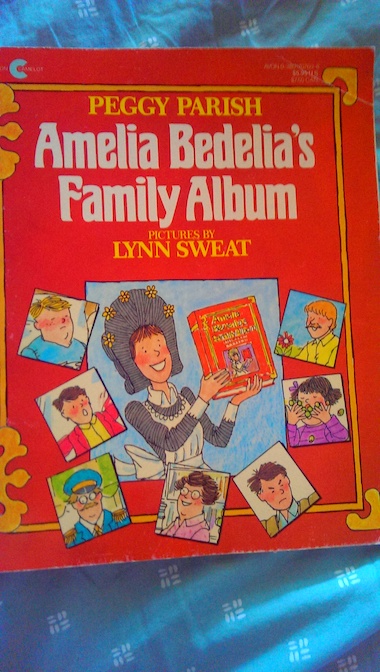
Amelia Bedelia’s Family Album by Peggy Parish, 1988.

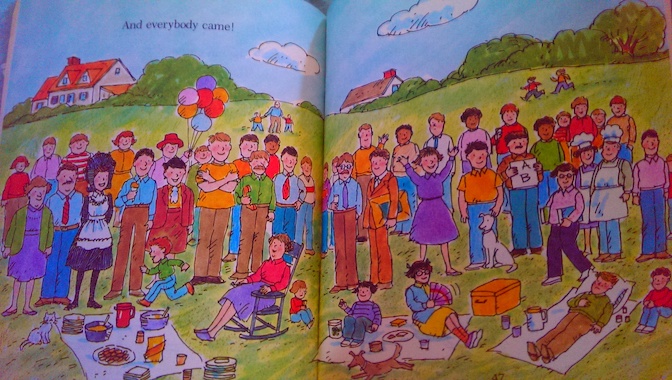
Mr. and Mrs. Rogers realize that they’ve never met the rest of Amelia Bedelia’s family, so they tell her that they’d like to give a party for her and family. Amelia Bedelia is happy about the party and shows Mr. and Mrs. Rogers some pictures of her relatives.

It turns out that her tendency to be extremely literal is a family trait. Her father is a telephone operator who operates on telephones and her mother is a “loafer” who makes loaves of bread. One of her uncles is a “big-game hunter” and has a checkers set that takes up an entire room, and another “takes pictures” in the sense that he is basically an art thief.

With each relative introduced, readers can pause for a moment to consider what each of Amelia’s relatives do, in a very literal sense, based on Amelia’s description, before turning the page to confirm it.  (I kind of identify with the “bookkeeper” because my room looks kind of like that, for similar reasons.)

In this picture book, Amelia Bedelia isn’t doing any chores or getting confused about instructions, like in other books, but all the occupation-related puns have the same feel as Amelia’s routine misunderstandings about the multiple meanings of words from the rest of the series.

The book is currently available online through Internet Archive.

ABAlbumReunion.jpg

Meg Mackintosh and The Case of the Missing Babe Ruth Baseball

Meg Mackintosh Mysteries

MMBaseball

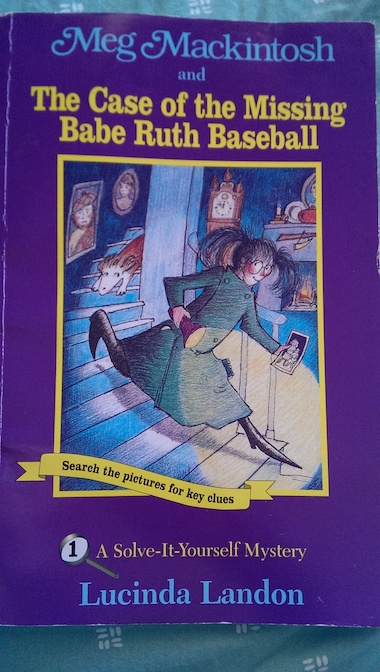
Meg Mackintosh and The Case of the Missing Babe Ruth Baseball by Lucinda Landon, 1986.

MMBaseballAlbumThis is the first book in the Meg Mackintosh series, and it was the first mystery story that I ever read, when I was about seven years old.  It started a life-long love of mysteries!

Meg’s grandfather shows Meg and her friend Liddy some old family photographs and tells them about the time when his cousin Alice took his prize possession: a baseball autographed by Babe Ruth.  Alice was a bossy girl who always liked to tease him, and so she created a kind of treasure hunt, challenging him to solve it in order to get the baseball back.  Unfortunately, he could never figure out the clues and still doesn’t know what happened to the baseball.

Meg’s brother, Peter, has a Detective Club, but he refuses to allow Meg to join, saying that she needs to prove that she can solve a mystery.  Seeing this as her chance, Meg decides that she’s going to solve this old puzzle and find the Babe Ruth baseball!  However, she also has competition from Peter, who thinks that he’s the better detective and tries to send Meg off in the wrong direction.

The book is currently available online through Internet Archive.

My Reaction

All of the books in the Meg Mackintosh series allow readers to try to solve the mysteries along with Meg, stopping periodically to ask them if they’ve noticed a clue that Meg has noticed or if they know what the significance of a clue is.  There are pictures to help, and readers are invited to stop and study the details before moving on. I think this is a good way to introduce children to puzzle-solving and help them develop critical thinking skills and an ability to notice details. I would recommend adults reading these books, or at least the first one or two along with children, so they can discuss the stories and clues with them, helping them spot clues as they begin to get used to the format of the books.

This is an excellent series for introducing children to the mystery genre for the first time! When I was young and just learning what mysteries were, I was fascinated to discover that I already had all of the knowledge I needed to solve this mystery along with Meg because all of the clues to Alice’s treasure hunt had to do with nursery rhymes. If you can recognize the rhymes in the book, you’re well on your way to solving the mystery!

Alissa, Princess of Arcadia

AlissaAlissa, Princess of Arcadia by Jillian Ross, 1997.

Alissa, the only child of King Edmund of Arcadia, feels like her life has taken a turn for the worse since she turned ten years old.  Before, she lived a basically care-free life, but now, her family has become more serious about her education and training as the future Queen of Arcadia.  Her great-aunts are mainly in charge of her education now, and they find Alissa to be ill-mannered, impatient, and stubborn.  In some ways, she is.  Alissa is bored with her lessons in the standard school subjects and hates her “deportment” lessons, where she learns etiquette suited to the royal court.  More than anything, she wants adventure and excitement.

To Alissa’s surprise, she meets a strange old man one evening while walking in the garden who promises her the adventure that she’s looking for.  At first, Alissa doesn’t know what to think about this strange old man, Balin, who seems to know everything about her, even what she’s been thinking.  He sets Alissa a “quest”, to solve a riddle to determine where to find him.  After pondering it for awhile, Alissa realizes that the riddle says that Balin lives in the oldest tower of the castle, where no one ever goes anymore.

AlissaBalinIt turns out that Balin is a wizard.  He’s lived in the tower for centuries and hardly ever leaves, so most people have forgotten that he’s there.  He offers Alissa lessons in magic and the kind of quests that she’s been craving.  He once taught Alissa’s father similar lessons, although he thinks that King Edmund has also forgotten that he exists.  Alissa eager accepts the offer of magic lessons.

At first, the only other person who knows about Alissa’s lessons with Balin is Lia, a servant of one of Alissa’s great-aunts.  Lia had been about to run away from her position as servant because she didn’t think that she was very good at her job, but Alissa caught her the night when she was going to find Balin in his tower.  The two of them became friends, and Alissa makes Lia her lady-in-waiting. Alissa enjoys having someone her age to share her secrets and adventures.  Her great-aunts disapprove of her choice of lady-in-waiting, but Alissa’s father appreciates Lia because she sees the better side of Alissa, her bravery and kindness, and somewhat helps Alissa’s impatience because Lia is a more patient, cautious person.

AlissaKingWhen Alissa first begins her lessons with Balin, she thinks that studying magic is turning out to be as boring as her other lessons.  Balin makes her do little chores, like dusting things in his tower, and he has her read books and memorize words.  Alissa is impatient to get on with the exciting magic, but Balin impresses on her that she needs to start out slowly and to recognize that magic is not the solution to all things.

Meanwhile, Alissa’s father is preparing to hold a banquet to celebrate a new alliance with a neighboring kingdom.  Now that Alissa is old enough to participate in such banquets, she learns that she must not only attend the banquet but be the dinner partner of the invited king, who she has heard is a stern man who is a stickler for proper manners.  Alissa is terrified that she will make a mistake during the banquet, anger the king, and ruin everything.

Her fears grow worse when Balin tells her that he has seen impending disaster in his crystal ball and a threat to the alliance.  Alissa begs him to tell her more, but he says that something is preventing his magic from seeing more.  All he has to offer Alissa are a few vague hints which take the form of another riddle.

Balin believes that Alissa is the only one who can solve the riddle, stop the danger, and save the alliance, but Alissa doubts herself.  She’s still afraid that she isn’t up to the task and will ruin everything, and she wishes that Balin would give her some magic spell to prevent her from doing anything wrong.  However, the best weapons Alissa has are the ones she already possesses: her wits, her desire to work hard for what she wants to achieve, and the new patience that she is just starting to learn.

One of the things that I liked about the story was that the visiting king, for all of his sternness and demanding nature with others, is surprisingly understanding with Alissa.  Some adults still remember what it was like to be young and awkward and impatient to grow up.

This book does not have extra information or activities in the back, as other books in the Stardust Classics series do.  It is currently available online through Internet Archive.

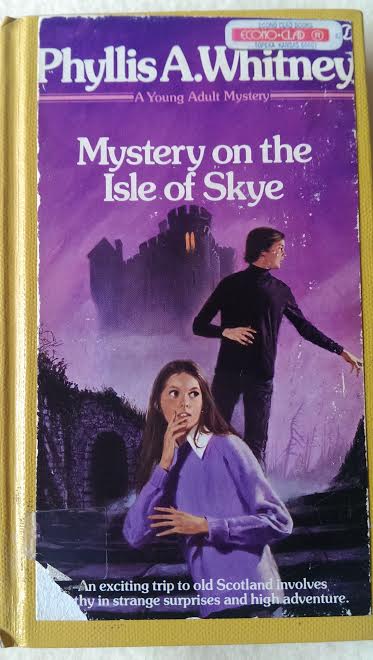
Mystery on the Isle of Skye

mysteryisleskyeMystery on the Isle of Skye by Phyllis Whitney, 1960.

Cathy MacLeod has lived with her grandmother for years, ever since her parents died when she was very young.  Now, her grandmother is very ill and will probably have to live in a nursing home.  Cathy needs to find a new place to live, and her relatives are debating about who is going to take her.  So far, the only relative who has offered her a home is Aunt Bertha.  Cathy isn’t enthusiastic because Aunt Bertha only has a tiny apartment where she lives alone, and she’s only offering Cathy a home out of duty, not real affection.  Aunt Bertha hasn’t spent much time around children and doesn’t really understand them.

But, there is one other prospect.  Cathy’s other relatives, the Corbins, are taking a trip to the Isle of Skye, where Cathy’s grandmother came from originally, and her grandmother has arranged for Cathy to go with them while Aunt Bertha is on a business trip.  Uncle Jerry (Cathy’s mother’s brother) and Aunt Lila Corbin have two boys of their own, Don (who is about Cathy’s age) and Humphry, who goes by the nickname of Punch.  Cathy is happy about the chance to go with them to visit the island that her grandmother has told her so much about.

At first, Cathy feels a little awkward around the Corbins because she doesn’t really know them, and they don’t know her.  Aunt Lila is warm and welcoming to Cathy, but Uncle Jerry is a tease.  Don is a tease as well and very impatient with the whole idea of the trip.  He doesn’t care about the history or legends of Skye as much as Cathy does.  His only real interest is in photography.  Young Punch is friendlier, sharing the excitement of the trip with Cathy.

Before they left on the trip, Cathy’s grandmother gave her a mysterious box to take with her.  Cathy doesn’t quite understand it at first, but the box contains several smaller packages with instructions to open them at different times during the trip.  Some of the instructions are vague and force her to rely on other people to tell her when to open them and what to do with the contents.  The packages are part present, part “spell.”  Thanks to them, Cathy makes new friends in Skye and goes on an adventure that she will never forget.

My Reaction

There is no real magic in this story, no real magic spells, and there actually isn’t much mystery either, except for the mystery Cathy initially feels about what’s in the packages and what their real purpose is.  Cathy’s grandmother has a love of legend and mystery, and these special gifts are meant to serve special purposes: to acquaint Cathy more with her past on the Isle of Skye and share some special memories, to heal Cathy’s sadness, to help draw her closer to her other relatives, and perhaps, to help her find her way to a brighter future than the one she currently thinks is waiting for her back home.

The packages help Cathy to bond with her aunt, uncle, and cousins.  They’re meant to be a shared activity.  She has to open certain packages with certain relatives, and they have to take her to certain places to do certain things with the contents.  These shared experiences help draw them closer to each other.

Although this story doesn’t follow the traditional mystery format and it can’t even be called fantasy or pseudo-fantasy, it’s enchanting because of the subtle hints of mystery and fantasy surrounding Cathy’s surprise packages.  Readers get to wonder alongside Cathy what’s in them and where they’re going to lead her.  It’s a little slower and more subtle than most modern children’s books, but I find it refreshing and magical for those reasons.

Pirate Island Adventure

pirateislandPirate Island Adventure by Peggy Parish, 1975.

The Roberts kids must solve another family treasure hunt! This time, they are staying with their grandparents at the family’s vacation home on Pirate Island. It has been many years since the family has been able to go there during the summer. For years, they rented the house out to a couple who lived there most of the time, and the grandparents could only go there when the couple left to visit relatives at Christmas. Now, the house is vacant again, and the grandparents have decided to take the Liza, Bill, and Jed there for the summer.

The last time that their grandfather spent the summer there as a child, his older brother decided to take something from every member of the family and make a treasure hunt just like the old family treasure hunt that the kids solved in Key to the Treasure. Just like that treasure hunt, other circumstances arose that kept the treasure hunt from being solved, so no one ever got back what grandfather’s brother hid. The only clue they have to the treasure now is a picture that grandfather’s brother drew. Since the children were able to solve the last treasure hunt, their grandfather is hopeful that they will be able to solve this one, too.

Unlike other treasure hunts that the Roberts kids solve, this treasure hunt does not involve codes and word games.  The clues are given in the form of drawings, most of which (unfortunately) are not shown to the readers.  The readers wouldn’t have a chance to solve the puzzles anyway because the objects in the drawings are things which the children’s grandfather has to recognize, places where he and his brother went as kids.  This book also introduces Hermit Dan, who appears in another book.

This book is part of the Liza, Bill, and Jed Mysteries series.

Ghosts in the Gallery

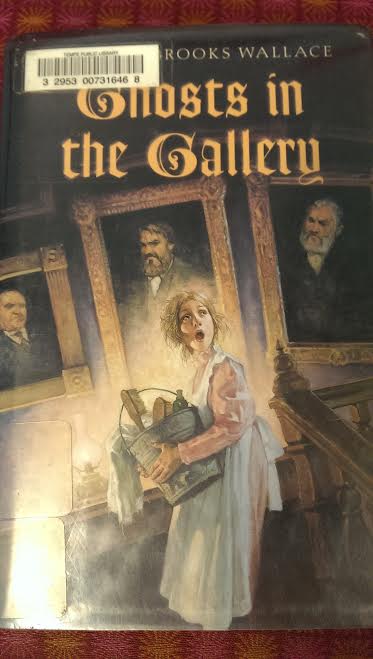
ghostsgalleryGhosts in the Gallery by Barbara Brooks Wallace, 2000.

Eleven-year-old Jenny was raised in China by her mother and stepfather, who ran a dance studio. She has no memory of her real father, who died when she was a baby. When her stepfather dies and her mother becomes deathly ill, her mother writes a letter to her real father’s father, a grandfather that Jenny never even knew existed before. In the letter, her mother explains that she is dying and that she will be sending Jenny to live with her grandfather. Then, Jenny starts the long journey from China to the East coast of the United States alone.

Leaving her dying mother to head to a strange country to live with her previously unknown relations is frightening enough, but there is still worse to come. When Jenny arrives at her wealthy grandfather’s home, no one is expecting her or knows who she is. Her uncle, Winston Graymark, insists that her mother’s letter never arrived. Worse still, he believes that Jenny is an imposter, and that her mother merely made up the story about his long-lost brother being her father.

At first, he angrily threatens to send Jenny back to China, but Madame Dupray, a servant who cares for Jenny’s ill grandfather, suggests that she be taken on as a household servant. Jenny is given a dreary little room in the cellar and embarks on the drudgery of household chores. Could the Graymarks really be her relatives? If so, what happened to the letter that Jenny’s mother sent? Something sinister is happening in Graymark House, and Jenny will have to face suspicious servants and attempted murder before she finds the truth.

The “ghosts” in the title are the portraits of Jenny’s ancestors, which hang in the gallery. They appear grim and frightening at first, but when Jenny begins to recognize them as her relatives, they no longer frighten her.  Like many of Wallace’s books, this book contains sinister characters with hidden motives, but ends happily.  The story takes place at some point during the Victorian era.

The Mystery in Old Quebec

mysteryoldquebecThe Mystery in Old Quebec by Mary C. Jane, 1955.
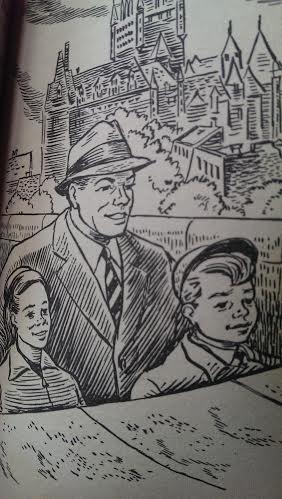
Mark and Kerry, a brother and sister, are visiting Quebec with their father, who is on a business trip. Their father allows them to explore the city on their own during the day while he works (something that would be unlikely to happen in modern times). The kids enjoy sight-seeing and learning French words and phrases.  They even make a new friend in the city, but they are troubled by events at the quaint little inn where they are staying.

On their first day there, Kerry’s coat mysteriously disappears and reappears with some strange messages in the pocket.  A boy wants them to take a message to someone in the city.  At night, Kerry hears someone crying in the next room. Is the boy being held prisoner at the inn? If so, why? Kerry and Mark are determined to help in any way they can, but time is running out.

The book is currently available online through Internet Archive.

My Reaction and Spoilers

mysteryoldquebecpicThe solution to the mystery involves family quarrels, custody issues, and racial tensions. In spite of that, this is actually a very gentle story.  In the end, the kids are dependent on the people the mysterious message was intended for to help a troubled, lonely child.  It turns out that the boy is an orphan, and some of his relatives are white, and some are First Nations (Native American). There is a fight for the boy’s custody, but the boy knows where he really wants to be.

The author describes the atmosphere of Quebec in some detail. The famous landmarks probably haven’t changed much, although I don’t know if all the descriptions are accurate anymore. I also thought it was interesting how the author includes some French phrases and their pronunciations and translations as the kids learn to communicate with French-speaking people in the city.