Hanukkah at Valley Forge by Stephen Krensky, illustrated by Greg Harlin, 2006.
It’s a cruel winter at Valley Forge, during the American Revolution, and George Washington is worried about the welfare and morale of his soldiers.
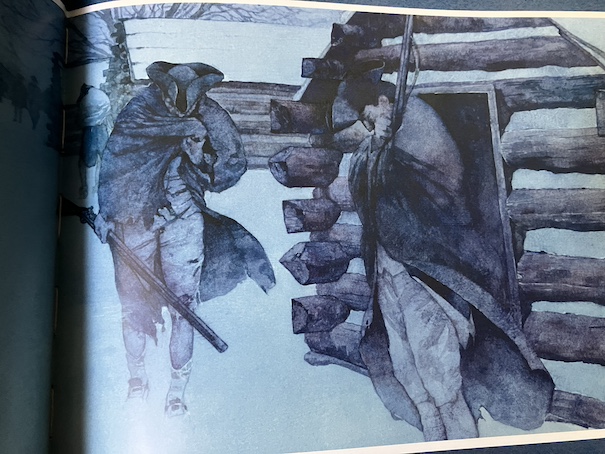
As Washington walks through the camp, he sees a young soldier lighting a candle and reciting something softly to himself.
Curious about what he’s doing, Washington stops to talk to him, casually remarking on how cold the night is. The young soldier says that he saw colder nights when he was young in Poland, and he is lighting candles for Hanukkah. Washington asks him what that means, and the soldier explains the meaning of the holiday.
The soldier recounts the story of how Israel was conquered by the Ancient Greeks, who forced Jewish people to worship Greek gods and tried to replace Jewish customs with Greek ones. Washington also says that he understands what it’s like to feel like you’re under the thumb of a king who lives far away and the desire for liberty. The Jewish soldier says his family left Poland for similar reasons, because they were not being allowed to practice their beliefs there.
Returning to the story of the ancient Israelites, the soldier explains that a priest named Mattathias refused the Greeks’ orders to bow to idols, and he fought back against the Greeks. Mattathias and his five sons, who were called the Maccabees, led a rebellion against the Greeks. They were a small group, and the odds were against them, but they were determined to continue the fight against their oppressors. Washington says that he understands the feeling because his army is in a similar position.
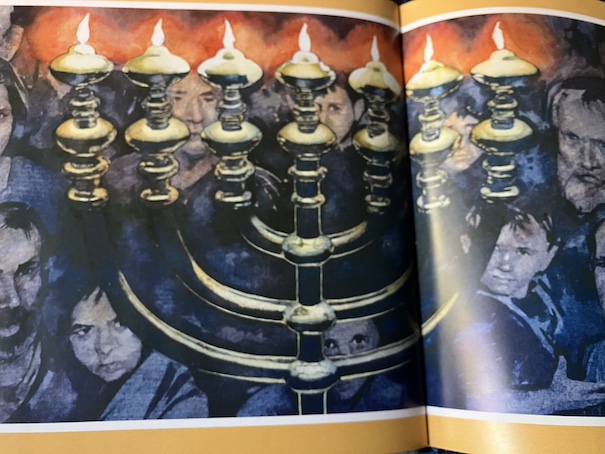
Continuing the story, the soldier recounts how Mattathias’s son, Judah, inspired their troops by reminding them that God was on their side, leading them to victory. When they finally managed to overthrow their Greek rulers, they took back their Temple and lit the Temple menorah. The menorah was supposed to be kept lit constantly, and they were worried because there was very little oil left. They only had enough to keep it burning for one day, and they weren’t sure when they could get more oil. However, they lit the menorah anyway, trusting that God would somehow provide them with more soon. It took them eight days to find more oil for the menorah, but to their surprise, the menorah continued to stay lit all the time they were searching, lasting eight times longer than they thought it would with the amount of oil they had. Hanukkah became the commemoration of this miracle.
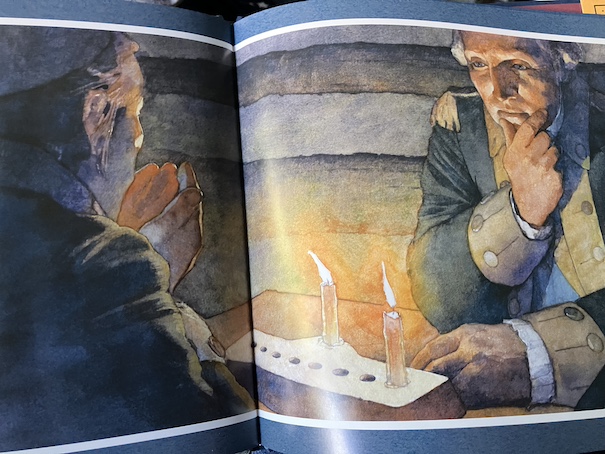
George Washington contemplates the story that the soldier told him, and he finds it inspiring. It reminds him that, even though their current situation in Valley Forge may seem bleak, there have been others before them who have also faced steep odds in their struggles and who still managed to succeed. He begins to think that, if they persevere, they may also be gifted with a miracle of their own.
There is an author’s note at the end of the book that explains the inspiration behind the story. As the characters in the story do, the author draws parallels between the American Revolutionary War and the historical battle that began the tradition of Hanukkah. The author learned that George Washington may have learn about Hanukkah during the Revolutionary War, although there are no entries in his diary to confirm it, so he used excerpts from George Washington’s other writings to explain his sentiments. The author also offers commentary on bullies and the importance of standing up to oppressors, both in the context of war and in daily life.
This book won the Sydney Taylor award from the Association of Jewish Libraries.
My Reaction
I love books that include little-known or lesser-known events. Whether this one happened or happened in the way the author tells it is difficult to verify, and it seems likely that it’s more of a folk tale than an historical account. George Washington was a real, historical person, but so many legends have grown up around his life that it’s sometimes difficult to tell whether certain stories about him actually happened. As the author says, Washington’s own diary doesn’t offer any verification about this particular incident. Other reviewers of this book, including J. L. Bell, who specializes in Revolutionary War history in the Boston area, have attempted to trace the origins of this particular story about Washington learning about Hanukkah during the Revolutionary War. In his blog, J. L. Bell explains the known sources for this story, which vary in their description of exactly when the encounter between Washington and the Jewish soldier took place and what the soldier’s name was. The soldiers who have been credited with having this encounter with George Washington were real people, but there’s nothing that definitively proves that the discussion about Hanukkah actually happened with any of them. The story is probably more folklore than history, and Bell believes that it started to circulate during the 20th century, when there were more immigrants arriving from Poland with stories and experiences like the one the Polish soldier in the story tells about not being allowed to practice their religion openly. Even so, the parallels the story draws between the ancient rebellion of the Maccabees and the American Revolution are fascinating.
There are certain feelings that are universal among humans, and the author’s point that nobody likes being oppressed by a bully, whether that bully is another person or a government or an army, is true. No matter what you’re up against in life, perseverance in the face of hardship is important, and miracles can come to those who continue to stand up for themselves and what they believe in. It is also true that people who come from different sets of circumstances can help to inspire each other by sharing common feelings about their struggles.
Lady Margaret’s Ghost by Elizabeth McDavid Jones, 2009.
This book is one of the mystery stories published to accompany the American Girl series of historical books. The main character of this book, Felicity Merriman, lives in Colonial era Williamsburg, Virginia, around the beginning of the American Revolution.
Felicity’s mother is going on a trip to visit a relative, along with Felicity’s younger siblings. As the oldest girl in the family, Felicity will be in charge of the household while her mother is gone and her father and his apprentice, Ben, are working in the store her father owns. It’s a big responsibility and an honor that Felicity’s mother considers her capable of managing the household, but because Felicity is still young and some household tasks involve heavy work that is difficult for her to do alone, her mother has hired a temporary cook, Mrs. Hewitt, to help her. Because Felicity is known as a daydreamer who doesn’t always pay attention to what she should be doing, her mother reminds her to focus on the task at hand while she’s minding the house, although she has faith in Felicity and is sure that she will do a good job.
Soon after her mother leaves, a crate arrives at the house for Felicity’s father, along with a letter. The letter explains that a cousin of Felicity’s father has died and that the crate contains some family heirlooms that his cousin left to him. These heirlooms once belonged to a common ancestor of theirs, Sir Edward Merriman, a wealthy nobleman and the first member of their family to live in the colonies, more than 100 years earlier. Felicity’s father didn’t know his cousin well because they never lived very close, and his cousin was much older, but he does know the history of the heirlooms. The heirlooms include a lady’s silver vanity set and a silver cup and rattle for baby. The story is that Sir Edward’s wife, Lady Margaret, owned the vanity set, and the rattle and cup were for their infant son. Unfortunately, the baby was stillborn, and Lady Margaret died shortly after the birth. After her death, her husband and the household servants believed that she still haunted the house. The haunting may have been part of the reason why Sir Edward decided to leave his home in England and go to America, but even though he later remarried and had other children, he could never bring himself to part from the things that belonged to his first wife and child. Even before Felicity’s father tells her about the ghost story, Felicity gets a strange feeling from the vanity set, and she wonders if the objects could be haunted.
However, Felicity soon has to turn her attention to household issues. Mrs. Hewitt, the temporary cook arrives, and she is a brusque and unpleasant woman. She is rude and condescending to Felicity when they are working in the kitchen together. Because Mrs. Hewitt is so rude, Felicity is nervous and makes mistakes, making her look like more of a fool to Mrs. Hewitt. They can’t easily replace her because cooks are in demand right now because this is Publick Times in Williamsburg, and there are many visitors to the city. Everyone is busy tending to them. Mrs. Hewitt was the best they could find available. Felicity’s father does speak to her about her rudeness to Felicity. After that, Mrs. Hewitt is sullen and resentful, and she is even more pleased whenever she sees Felicity doing something wrong.
There is also an exciting event taking place. Felicity has entered her horse, Penny, in a horse race at the fair in town! Ben, her father’s apprentice, will ride her. The day of the race, Penny seems to be doing well, but then, she suddenly develops a problem during the race. When Felicity and Ben check her out to see what was wrong, they discover that someone put burrs under Penny’s saddle! Worse still, the wounds caused by the burrs become infected. Felicity is very upset and worried about Penny, and she wonders who would have hurt her horse. There were a couple of men looking at her before the race. There was also a boy named Dawson and a girl called Anne.
Dawson turns out to be a runaway, but he also has some knowledge of horses. Although Felicity is a little suspicious of him at first, Dawson helps to heal Penny’s wounds. He also says that he saw Anne gathering burrs, but it was probably on behalf of someone else.
When Felicity realizes that her treasured coral necklace, which her mother also wore as a girl, has disappeared, Felicity questions whether she carelessly lost it or if someone has stolen it. Felicity has been doubting herself and her ability to manage the household because of all the mistakes she has made since her mother left, and the clasp of the necklace was a little loose. This could just be another disastrous mistake, but it is suspicious that Anne seemed so friendly to her at the race and then ran away from her later. Anne also literally bumped into Felicity at the race. Could she have taken the necklace? Dawson seems to think so, but then again, can Felicity really trust everything he says?
Felicity still gets an odd feeling from Lady Margaret’s heirlooms, and she thinks that she sees something white moving around at night. At first, she thinks that it could be Lady Margaret’s ghost, but then, strange things begin happening around the house. Things disappear, and Felicity worries that maybe she carelessly mislaid them. Then, her necklace unexpectedly turns up, and Lady Margaret’s vanity set vanishes! Are these strange things part of the haunting of Lady Margaret or the work of a thief? If it’s a human thief, is it the work of the runaway Dawson, mysterious Anne, unpleasant Mrs. Hewitt, or the mysterious person who arranged for Penny to be hurt?
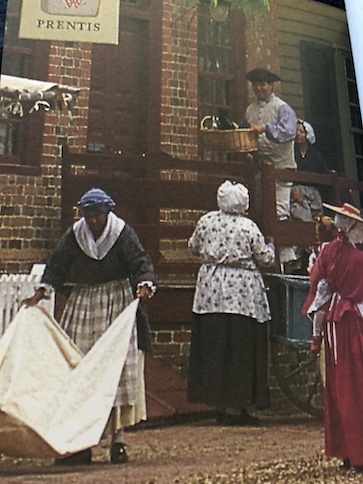
The book ends with a section of historical information about Colonial era Williamsburg. The story is set during Publick Times, which was when court was in session in Williamsburg. People would gather in Williamsburg during Publick Times to see the trials in court and attend a public fair in Market Square. The fair offered various kinds of entertainment, games, and races, like the horse race in the story.
My Reaction
The story leaves it a little ambiguous at the end about whether Lady Margaret’s ghost exists, but if she does, she is not harmful and has nothing to do with the thefts in the story or what happened to Penny at the horse race. As the section of historical information explains, there are many new visitors in Williamsburg during Publick Times. This was a good setting for the story because there are many strangers to the city with unknown pasts and motives, and crowds at the fair might harbor thieves.
Part of the story and part of the section of historical information in the back focuses on the subject of orphans. Both Dawson and Anne are orphans, and neither of them is really being cared for. Dawson admits that he used to steal to support himself after his father died, but he is seriously looking for work. Anne technically has a guardian, but her guardian is abusive and uses her as a servant rather than taking care of her.
When the thefts occur and mysterious things start happening around the Merriman house, both Dawson and Anne look like the best suspects, but there are also possible adult suspects. Even after Felicity realizes Anne’s situation, she isn’t entirely sure which of the men at the fair that day is Anne’s guardian. Mrs. Hewitt also looks suspicious because she is so unpleasant and seems to be trying to make trouble for Felicity. I though the book did a good job of supplying an array of suspects to consider. The solution to the mystery was one of the possibilities I thought was most likely, but there were enough other possibilities to make the story interesting.
The Ghost of the Gracie Mansion by Susan Kohl, illustrated by Ned Butterfield, 1999.
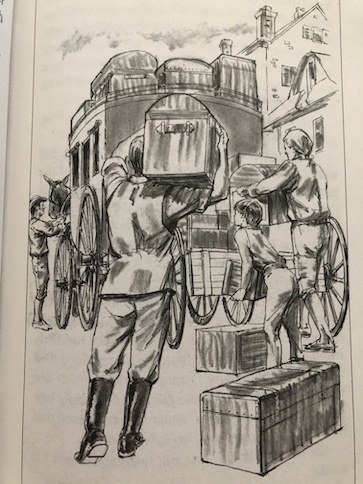
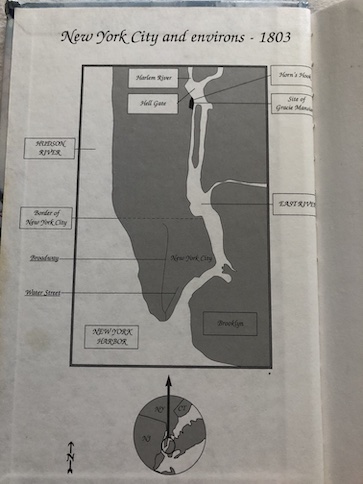
The year is 1803, and the Gracie family has decided to temporarily leave New York City because of the Yellow Fever Epidemic. William Gracie, the eldest son of the family, is disappointed because he has started working for his father’s shipping business, and he was looking forward to being promoted to clerk this spring. He wants to follow in his father’s footsteps, and he’s serious about wanting to learn the business. The trip that they’re taking to their new country home at Horn’s Hook, north of the city, seems to delay his plans because it’s so far away from everything, from his father’s business and from the Tontine Coffee House, where businessmen and other important people meet to discuss the issues of the day. However, William can’t help but admit that the situation in New York is serious. People are dying of Yellow Fever every day, including children, and his parents just want the family to be safe.
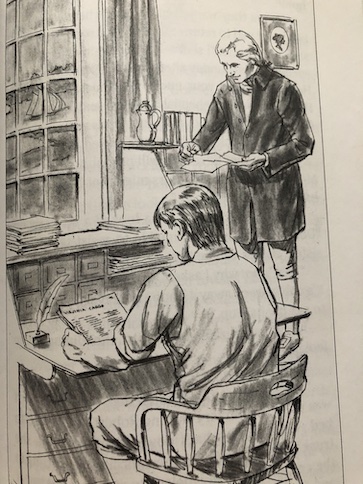
William begins to feel a little better when his father tells him that he’s arranged for them to work together from the family’s country mansion. His father says that captains of the ships he owns will stop at Horn’s Hook on their way to New York Harbor to report to him, and William will help him to prepare the cargo lists and timetables for the ships. Their temporary exile from New York hasn’t put a stop to their business or William’s education in that business; they’re just going to be doing things a little differently until the crisis is over.
While the family is traveling to their new country house, Mr. Gracie tells them about the history of the place. There used to be another house on that land, but it was destroyed during the American Revolution (an event still in relatively recent memory at the time this story takes place) as the British and the Patriots struggled to control it because that location is a strategic spot on the Harlem River. Mr. Gracie says that their new house is built over the basement of the old house, and that’s important because he’s aware that the former owners had a secret tunnel that led out of their basement in case they needed to use it as an escape route during the war. He told the builders to look out for it while they were building the new house, but if any of them ever figured out where it is, they never admitted it. The Gracie children are excited about the idea of their new house having a secret tunnel, and they’re eager to find it!
The new Gracie house is beautiful, really more of a mansion than just a house. However, there is something strange going on there. Soon after they arrive, William’s younger sister Sarah sees someone in the house dressed all in white. Sarah thinks that she saw the ghost of the person who owned the house that used to be on their property. The others don’t believe her because Sarah has a vivid imagination and is always making up stories, but Sarah insists that she saw someone.
When things start disappearing from the house, the rest of the family begins to believe that there may be some unknown person in their house. Sarah still thinks it’s a ghost, but William thinks maybe someone has found the secret passageway into the house. Who is this mysterious intruder?
The book is available to borrow and read for free online through Internet Archive.
My Reaction
I always like historical novels, particularly historical mysteries, and I really enjoyed this one. The mystery is meant for children in elementary school, and it isn’t too difficult, but it’s fun to see the Gracie children searching for the secret passage and trying to learn who is sneaking around the family’s country mansion. I also enjoyed that the story offers history lessons on multiple levels. The immediate situation for the characters is the yellow fever epidemic of 1803, but the story also touches on the American Revolution. The solution to the mystery is also related to Revolutionary War history. The Gracies, headed by father Archibald Gracie, were a real family who made their money in shipping, although the events in the story are fictional. There is a section in the back of the book that explains more about the family’s history. They associated with prominent people in New York in the early 19th century, and Alexander Hamilton makes an appearance in the story when he visits the Gracie Mansion. The Gracie Mansion is a real place. When it was first built, it was in the countryside outside the limits of New York City, but since then, the city has grown around it. It is now used as the home of the mayors of New York City.
Although this book was published before the coronavirus pandemic of the early 2020s, I also appreciated the part of the book at the beginning, where William is concerned that the current epidemic has changed his plans and impacted his ability to learn his father’s business. However, his father explains to him that they are still in business, and he has made arrangements for them to continue working in a different way during their time away from the city. People who lived through the quarantines and lockdowns of the covid pandemic will understand how it impacted the way people worked or continued their education and how people had to find ways to work around the problem. I appreciated that this story shows how people have had to deal with public health crises before in history and how they have always had to find creative solutions to deal with problems of this nature.
In this particular situation, the Gracies are a wealthy and privileged family, so their options for escaping from the crisis and working from outside the city are greater than other people of their time. Not everyone had a countryside mansion where they could go to escape the disease, and not everyone had employees who could report to them wherever they were. What Mr. Gracie and his son are doing during the course of the story is the early 19th century equivalent of “working remotely”, pre-Internet, and they accomplish it through people coming to report to them and taking goods and information into the city on their behalf. Even though the Gracie family can stay outside the city, they are still sending their ships into the city’s harbor because the cargo the ships carry is necessary there. There are people in the city who are waiting for the supplies the ships are carrying. The crews of the ships are what people in the 2020s came to call “essential workers” – the people whose type of work was necessary, no matter the circumstances, and who could not perform their duties from a remote location. The same is true for all the other people who must remain in the city because their jobs require them to work with or on behalf of the people who are still there.
Revolutionary War on Wednesday by Mary Pope Osborne, 2000.
The story begins with a prologue that explains things that have happened in the series up to this point, saying that Jack and Annie are currently undertaking a series of missions to four special types of writing for the library at Camelot. These missions cover books #21-24 in the series, and in this book, Jack and Annie need to find a piece of writing that represents “something to send.” To find this piece of writing, they’re off to the time of the American Revolutionary War!
When they arrive, it’s winter, and they find a camp of soldiers nearby. At first, they’re not sure which side the soldiers are on, so they sneak up to the camp to get a look at them. The soldiers catch them spying on the camp, but it’s okay because they’re Patriots, not British Redcoats. The soldiers tell the children that they had better go home, thinking that they’re just ordinary children from their time.
After Jack reads a little further in their book about the Revolutionary War, he realizes that this is December 25, 1776, and that they are about to witness the famous crossing of the Delaware River in Pennsylvania. This was a mission carried out in secret by George Washington and his men. The children listen while George Washington delivers an inspirational speech to the soldiers (“These are the times that try men’s souls.”), but a captain tells them that they had better leave because they don’t want children getting in the way of the mission. However, he asks them to do one favor before they leave. He asks them to take a letter to his family back in Frog Creek. He says that it’s a farewell letter, and they should only deliver it if they hear that the mission has failed and many soldiers were lost. Jack accepts the letter, realizing that this letter represents “something to send.”
Since the children know from their book that the mission will be successful, they can safely keep the letter. Jack thinks that their mission is over, but Annie has other thoughts. She climbs into one of the soldiers’ boats because she wants to spend more time with George Washington. George Washington tries to send the children back, but when the snow gets worse and he considers canceling the mission, the children have to persuade him to continue.
At first, the soldiers think that the children might be enemy spies because they seem to know too much about their mission, and one of them saw Jack writing something down earlier. However, Jack convinces them otherwise when he shows that he copied George Washington’s inspirational speech. He reminds George Washington about what he told his men about perseverance. Jack’s words inspire George Washington to take his own advice.
There is a section in the back of the book with more information about the Revolutionary War and places and people mentioned in the story.
The book is available to borrow and read for free online through Internet Archive.
My Reaction
I didn’t often read prologues to books when I was a kid, and I remember skipping over sections that explained the story background and past events in series that I followed regularly, but in this case, I was glad that the prologue explained the children’s mission. I’ve read books in this series out of order, although I don’t really recommend doing that. The books in the Magic Tree House series are very linear, and there are story arcs that extend over multiple books. If you skip around too much, it can spoil some surprises or disrupt the thread of the story.
I liked how this book introduced children both to the historical event of Washington crossing the Delaware and to the famous speech that he made. The lesson about perseverance was good.
I remember reading this book in elementary school. It’s about Benjamin Franklin’s friendship with a talking mouse (fictional, of course), and how his mouse friend helped inspire him in his work.
The book begins with the author saying that this manuscript, supposedly written by Amos the mouse, was found in a small compartment in a room in an old house that was being renovated. The little compartment was furnished with miniature pieces of Colonial style furniture. The author goes on to say further that the manuscript has been authenticated as being early American and that the National Museum of Natural History has confirmed that the handwriting of the manuscript was done by a mouse. (I’d love to see comparisons of different animals’ handwriting and hear their explanation of how the handwriting of a mouse differs from the handwriting of other members of the rodent family, but trust us, kids, this is all very scientific.) The author says that this account of Benjamin Franklin’s life differs from the stories told by later scholars, but he trusts the descriptions of this mouse who was so close to Benjamin Franklin. (Yeah, sure, why not?)
In the “manuscript”, Amos says that he’s writing not long after the death of his friend, Benjamin Franklin, and some people have attempted to write about the life of Benjamin Franklin, but Amos isn’t satisfied with their accounts of his life and wants to write the truth himself. (Benjamin Franklin also wrote a famous autobiography, but they don’t mention that. I know that this is a story about a talking, writing mouse, but I’m just saying.) Amos says that, much as he liked Ben Franklin, Franklin was kind of stupid at times and that, as Franklin’s secret adviser, he was actually the source of many of Franklin’s greatest ideas.
Amos says that he was born into a large family of poor church mice. Then, during the winter of 1745, food grew scarce, and as the oldest of his siblings, Amos decided to set out to seek his fortune and maybe a way to help provide for the rest of his family. It’s a cold night, and lured by the smell of cheese, Amos finds his way into the house where Ben Franklin lives. He finds Franklin sitting and sneezing in a chilly room near a small fireplace. Ben is trying to write, but because of the sneezing, he’s not making much progress. Amos, cold and tired, climbs up on Ben and curls up in his fur cap and goes to sleep.
When Amos wakes up in the morning, the fur cap is hanging on the bedpost, and the room is still cold. Amos talks to Ben, recommending that he put more wood on the fire. Ben doesn’t question why a mouse is talking to him and just retorts, “Waste not, want not.” Amos points out that there will be plenty of waste and extra expenses if the cold makes him sick. Ben agrees with that and decides to use more wood on the fire. Then, Amos points out to him that the fireplace would be more effective at heating if it was in the middle of the room, explaining how his family used to gather around a hot chestnut to warm themselves. Ben is intrigued by the idea, and they discuss how a fireplace could be located in the middle of the room and how to handle the smoke from the fire. Ben excited sets to work building the stove according to Amos’s suggestions. His first attempt is a bit crude, but the stove works much better at heating the room than the fireplace did, and Ben is pleased. He shares some bread and cheese with Amos, and the two of them become friends.
Ben begins writing about the design of the stove as if he had created it all by himself, but Amos points out that Ben had acknowledged his contribution. Amos doesn’t care about getting fame or public credit for his contribution, but he needs food and has a large family to help provide for, so he and Ben work out an agreement: in exchange for Amos’s companionship and help, Ben agrees to leave regular supplies of food at the church for Amos’s family and to provide Amos and any descendants he may have food and a home in his fur cap. Ben sews some special compartments in the fur cap so that Amos has secure places to sleep and store a little food. There’s also a little compartment near Ben’s ear where Amos can quietly whisper suggestions to Ben.
Life with Ben isn’t easy. Amos hates it when Ben goes swimming and leaves his cap on the ground. One day, a dog steals the cap (along with Amos), and Ben has to chase the dog in order to get the cap and Amos back. Ben promises not to take the cap off his head ever again.
Amos also doesn’t like Poor Richard’s Almanack and doesn’t consider the facts or maxims it offers to be worth much. Ben points out that people do use his paper and its predictions of sunrise, sunset, and high and low tide, and the money the paper makes helps support them both. It also seems weird to Amos that Ben attributes everything to do “Poor Richard” when there is no such person. Amos starts substituting his own name for “Poor Richard” in the paper, and he also changes some of the predictions of times for the tides. It turns out that this is one area where Ben knows better than Amos because Amos predicts the wrong time for high tide and some ships are stranded. Confronted by the angry men from the ships, Ben points out that the paper with the wrong time says “Amos” instead of “Poor Richard”, so it can’t be his work. The angry people realize that Ben is right, and Amos realizes that he shouldn’t interfere with the paper.
Amos also hates it when Ben starts to experiment with electricity and Ben shocks him. He tells Ben to leave him out of his electrical experiments. However, Ben continues his experiments with a group of other interested people, disappointed that Amos doesn’t seem to understand what he’s trying to accomplish. Amos finally reads Ben’s writings about electricity and his experiment, and when a boy Ben got to assist him at one of his meetings uses Ben’s electrical device to shock the governor, Amos urgently whispers to Ben to stop the boy. Ben doesn’t consider the experiment to be a failure because it very effectively demonstrated how electricity affects human beings, although some people, including the governor, start avoiding Ben after the experience.
Then, Ben starts wondering if lightning and electricity are the same thing. Amos says he doesn’t care because both to those things should be avoided, whether they’re the same or not, and Ben says that he has “no vision.” Ben’s first experiment with lightning rods is frightening, even terrifying Ben to the point where he modestly refuses to take credit for the invention. In spite of that scare, Ben continues to wonder about the nature of lightning. He starts taking Amos with him while he flies kites for fun, and he rigs up a little car on the kite string for Amos so Amos can ride on the kite and come down when he wants to. Ben suggests that Amos that he could get a better view of lightning and describe it to him if he stays on the kite during a storm, and Amos refuses to consider it, but one day, Ben tricks him into doing it anyway. Amos is angry at Ben for making him suffer through the storm while he took shelter in a shed and refuses to discuss what he experienced with him. Burned with electrical shocks from the storm, Amos returns to his family at the church, where they dress his wounds, and he rests.
Ben comes to see Amos about their earlier agreement. Amos tells him that the electrical experiments were never part of the agreement and he will never return to him while he is doing these things. Ben agrees to stop all of the electrical experiments, and he and Amos write a new agreement with each other.
At this time, troubles are arising between England and the Colonies, and Ben is concerned. He tells Amos that he needs his skills for gathering information and asks him to accompany him to England to present the Colonies’ case before the King and Parliament. Amos initially agrees to go, but he backs out of the voyage when he sees that Ben has attached lightning rods to the ship. Pointing out to Ben that the lightning rods are a violation of their agreement, he returns to the church and lets Ben go to England alone.
While Ben is gone, Amos hears the people of Philadelphia talking about current events, like the stamp taxes, and how they feel about them. Amos finds himself siding with the colonists and wanting to do something to help, and he realizes that Ben is his best chance for helping to accomplish something. When Ben returns from England, Amos rejoins him, and he goes with Ben to the committee meetings he attends, including the one for writing the Declaration of Independence. Amos helps Ben by gathering information from other people. Amos meets another mouse named Red, who comes to Philadelphia with Thomas Jefferson and starts preaching revolution to the mice in town. Amos borrows some of the pieces of writing from Red’s Manifesto and tells them to Ben, who in turn, tells them to other members of his committee so they get included in the Declaration of Independence.
Then, George Washington says that the Colonies could really use some help and support from another country. Amos persuades Ben to suggest France. George Washington accepts the suggestion, and Amos accompanies Ben to France to ask for help from the French government. Ben enjoys the attention he gets from the ladies in France, frequently dining with his admirers. Amos is afraid of the ladies’ pet dogs and cats, though, so he persuades Ben to put most of his attention on a woman who doesn’t have cats. It turns out that this lady also has a mouse who lives with her named Sophia. Sophia is actually married, but her husband has been exiled to the United States, and her children are being held in the palace of Versailles. Amos wants to help Sophia, but he’s not sure how until after the Revolutionary War ends and Red arrives in France with Thomas Jefferson. Amos explains the situation to Red, and Red is more than eager to help assemble a force to stand up to the oppressive aristocratic French mice.
The mouse battle that follows terrifies the human French court, but the mice successfully rescue Sophia’s children. Ben suddenly finds himself a social outcast for bringing mice to the royal court, so he’s ready to return home, bringing Sophia and her children with them. Ben is welcomed home as a hero by the humans. Sophia is reunited with her husband, and Amos remains a friend of the family. Three of Sophia’s oldest children marry Amos’s three youngest siblings, tying their families together.
The story ends with the mice giving Ben a nice, new hat for his birthday. Ben keeps the old one just as a house for Amos to live in, but Amos is mostly retired, his time occupied by teaching his young nieces and nephews.
The book is available to borrow and read for free online through Internet Archive (multiple copies). There is also a Disney film based on the book that is also on Internet Archive (about 21 minutes long).
My Reaction
I remembered liking this story when I was a kid, but I’m not as fond of it now. I don’t like books with intentionally stupid characters, and in this case, the intentionally stupid character is a real, historical person, which doesn’t seem fair. I know it’s supposed to seem humorous, but it just doesn’t seem to hold up after all these years.
I also hated the part where Ben intentionally kept the poor mouse up in a kite for half an hour during a terrifying storm. It’s just so cruel, even though it’s supposed to humorous. What can I say? I have a soft spot for cute, fuzzy animals, and I just don’t like to think of any little animal suffering, even if it’s in blatantly ridiculous circumstances.
I had forgotten about the Disney cartoon, although I think I remember seeing that when I was a kid, too.
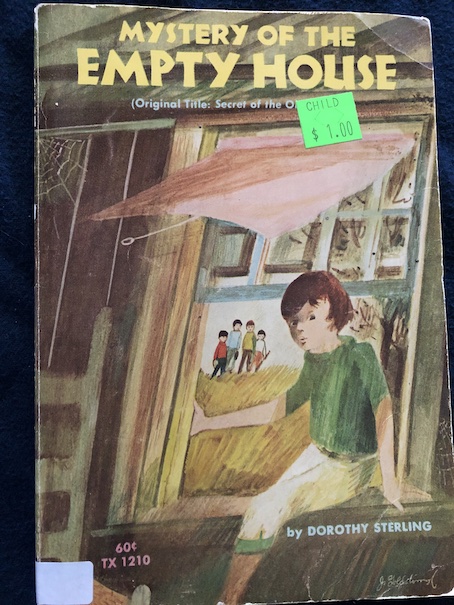
Mystery of the Empty House by Dorothy Sterling, 1960.
Patricia Harrison’s family has recently moved from their apartment in New York to a house in Haven. Her father used to live in Haven when he was a boy. His mother still lives in town, and he still knows some of the other people who live there. Patricia, called Pat, is still unpacking her belongings when a boy from across the street, Jim Gray, calls to invite her to play ball with him and some of his friends in the field behind her house because his mother used to know his father when they were kids. Pat isn’t very used to playing with boys because she went to an all-girls school when she was in New York, but she agrees to go play ball with the boys.
When she goes to meet the boys, some of the other boys, the Paine brothers, don’t want her to play with them. When Jim said they were meeting “Pat”, they assumed that “Pat” was another boy. Jim says he doesn’t care if Pat is a girl or not because they could really use another player. Pat thinks they’re rude, and since they don’t seem to want her, she starts to leave, but Jim stops her and persuades her to stay. Even though Pat is usually good at baseball at school, she finds herself making clumsy mistakes when she plays with the boys, probably because she feels uncomfortable with them. Finally, she hits a home run, which is great, but there’s a problem. She accidentally hit the ball into the window of an old, abandoned house nearby that looks haunted.
The boys are mad because it’s the only baseball they have. Pat says they could just go get the ball, but the boys say they can’t. When she asks them if they’re scared, they say that’s not the problem; they’ve just promised that they won’t go near the old house. Pat says that, since she didn’t promise, she can just go get the ball, but Jim stops her from going into the house. He tells her that they can just buy a new ball. When Pat asks him why he doesn’t want her to go in, Jim says that it’s a secret having to do with the Paines. Pat says that she’s sick of the Paines and insists on going into the old house.
The old house is dark and spooky. When she climbs in through the window, Pat is startled when she runs into another person inside. At first, she can’t see the other person too clearly because it’s dark, but when she asks the girl who she is, the girl tells her that she’s Patricia Harrison. Pat is shocked and tells her that she can’t be Patricia Harrison because that’s her name. The girl finally laughs and admits that her real name is Barbara Thomas. Barbara lives next door to Pat’s grandmother and decided to stop by and meet her. When she saw Pat playing with the boys, she decided to go explore the old house instead.
Barbara is the one who explains the history of the house and the Paines’ attitude to Pat. The Paine family used to live in the old house. It’s the oldest house in town, dating back to the Colonial era. Nat Paine, the oldest of the Paine boys, was always proud of his family’s old home and used to brag about how George Washington and Lafayette visited the house during the Revolutionary War. It was even occupied by British soldiers at one time. Unfortunately, the father of the Paine boys was killed during the Korean War several years earlier (dating this story to the late 1950s or 1960, the year it was published). Since then, the family has fallen on hard times, and they’ve been unable to pay the taxes on the house. Now, because of the unpaid taxes, the town council is threatening to sell the old house to pay the unpaid taxes. The Paines have been forced to move out of the house and into a much smaller place, and Nat is very upset about it. Plus, he’s been going through this phase where he’s decided that he hates girls because he’s just getting into middle school, where all the boys either start developing crushes or decide that they hate girls. His younger brothers are being pests because they’re following his lead.
Barbara says that her father felt bad about what happened to the family and tried to convince other people in town to help the Paines pay the taxes on the old place. They could have helped, but they’ve made it plain that they just don’t want to. As Barbara’s father put it, “people in Haven are a bunch of rock-ribbed, rugged individualists who wouldn’t help their own grandmas.” (I have strong feelings about that, and I’ll explain them in the reaction section.) Barbara reveals right away that the secret Jim is keeping for the Paine brothers is that Nat made his brothers take a vow with him that they wouldn’t enter that house again “until it was rightfully theirs.” Barbara says that Nat’s sense of pride talking, and “You know how boys are.” She thinks Nat’s being overly dramatic, although she sympathizes with the family’s plight. When Pat suggests that maybe they shouldn’t be in the house, either, Barbara says that she comes there all the time to explore. Barbara thinks the old house is fascinating and that there might be a secret passage somewhere. She invites Pat to help her look for it sometime.
At dinner that night, Pat finds out that her parents already know about the death of the boys’ father and the trouble that the family is having over their old house. Pat’s mother says that the old house is a good example of the saltbox style of house that was popular in Colonial New England. (I remember my old high school history teacher explaining how the slope of the roof was meant to help snow slide off during the winter, but the uneven slope also allows more living space to be added onto an existing house.) However, Pat’s mother says that there probably aren’t any secret passages in the house because houses from that time were built pretty simply and didn’t even have closets or bathrooms. She doesn’t think that there’s any place in the old house to conceal a secret passage.
Now that Pat knows the issues with the Paine family, she begins to feel better about them, and they start being nicer to her. As Pat begins settling in, she becomes better friends with Barbara and is happy that she has another girl as a friend. They ride their bikes downtown together, and Barbara sleeps over at Pat’s house. As the girls are getting ready for bed, Pat looks out the window and sees a light in the old Paine house when no one is supposed to be there. Barbara says that whoever’s in the house is probably looking for the secret passage and the treasure. When Pat asks what she means by “treasure”, Barbara says that there’s a rumor that there’s treasure hidden in the house from Revolutionary times. The family used to be rich, but after the American Revolution, when the children of the family returned to the house after their parents were killed, the family fortune had vanished. People think that the ancestors of the Paines hid their fortune somewhere during the war and that it’s still waiting to be found. (I already had some misgivings about the people of Haven and their intentions in kicking the Paines out of their house, and now, suddenly, my suspicions are even worse.)
Barbara says that they can’t just let this mystery sneak steal what should rightfully belong to the Paines and ruin the only chance they have left of regaining their house. The girls sneak over to the house to spy on the intruder, and they end up frightening him away. The girls tell the boys about what they witnessed the next day, and they persuade the Paine brothers to come into the house with them in spite of their “vow” to look around and see what the intruder was searching for. As they inspect the kitchen fireplace, where the man was searching, and look at the flashlight he dropped, the man shows up again. It turns out that he’s a college student doing research on the Paine family.
Back in Revolutionary times, the family that lived in the house was the Woodruff family. (A Paine ancestor married into the Woodruff family, changing the family name, but the Woodruffs are also ancestors of the current Paines. It’s the same family.) The college student, Robert Popham, found some old papers that indicate that the head of the Woodruff family, the first Nathaniel Woodruff, was a Tory. Nat, who was named for this ancestor (full name Nathaniel Woodruff Paine IV), angrily denies it, saying that his family was known to associate with George Washington and Lafayette, hosting them at their house. Robert explains more about the papers he found, but he also says that the last letter Nathaniel Woodruff wrote to his wife before he was killed indicates that he feared for his life and left something hidden in an old post box to pass on to his young son. However, as Nat points out, the date on this final letter was shortly after Nathaniel Woodruff’s wife was murdered by unknown assailants. (She was found scalped, so people blamed her death on American Indians, but it’s also possible that she was killed by someone else who just wanted to make it look that way to cover up the real reason for her murder.) Nathaniel Woodruff didn’t know his wife was already dead, and since she never got the letter and he was also killed soon after, the box is probably still hidden somewhere. Robert thinks that what Nathaniel hid was proof that he was actually a spy for the Patriots and that he feared for his life because he suspected that the British knew he was a spy. He says that he wants to find this hidden box and the information it holds because it would make a fantastic historical research paper.
The kids are completely on board with the search for the hidden box, both because the Paines want to preserve the reputation of their ancestors and because there may be valuables hidden in the box that will help the Paines pay their taxes and keep their home. However, they only have until August 15, the date that the town council has set for selling the Paine house. They only have until the end of summer to figure it out!
To begin with, I didn’t like the people of Haven right from Barbara’s description of them as “rugged individuals who wouldn’t help their own grandmas.” It is pretty cold to turn out a war widow who is working as an underpaid nurse in the community and her children after their father was killed serving his country. I completely agreed with Barbara’s father’s assessment of the townspeople’s levels of generosity from the first. I suppose at least some of the townspeople of Haven probably thought they were actually being kind, giving Mrs. Paine several years after her husband’s death to come up with the mounting tax money, while doing nothing to help her and not actually paying her enough to manage and letting her family sink deeper into the hole until there was no way for them to escape, but in realistic terms, that’s not really kind at all.
We don’t actually hear the townspeople express their own feelings because the children don’t talk to the adults about their search and discoveries until they’re sure of what they found. When Barbara explained how her father felt about the townspeople’s unwillingness to help the Paines, I was also a little suspicious of their motives, and when Barbara mentioned that there’s been a popular rumor about hidden treasure in the Paine household for years and everyone has heard of it, I got really suspicious. Basically, I started looking for thieves among the townspeople. I immediately suspected that the “rugged individuals”, or at least some influential ones in the community, wanted to steal some historical treasure from a veteran’s widow and orphans because people who would would kick the widow and orphans out of their home might as well be out to steal their legacy, too.
If that was part of their plan, they weren’t very good at it, and they never even show up in the story. Perhaps I’m judging them a bit harshly, although in a way, I’m a little disappointed because that kind of Machiavellian plot would have made the story much more exciting. From the way the story goes, the townspeople might just not believe that there’s any treasure to be found because that rumor has been going around for so long and nothing has come of it. Still, I was suspicious of them for a good part of the book because it looked like the author was setting them up to be suspicious.
I was also annoyed by the townspeople because I found them ineffectual and uncreative in their approach to a community problem. They miss opportunities, and worse, they deny opportunities to others because they’re apparently stuck in their “rugged individual” mindset and won’t even entertain ideas that might help themselves as well as others when people like Barbara Thomas’s father suggest them. I often think that high-and-mighty rugged individualistic attitude cuts out so many genuinely fun, creative, and amazing possibilities that can make a community rich in character as well as money. It’s maddening to a person who thrives on creativity and likes to consider possibilities.
When I started getting really irritated at the townspeople, I guessed that, before the end of the story, they would do something to redeem themselves that would simultaneously leave me unsatisfied. I figured that the point where the townspeople finally come together would probably result in something that I thought they should have been working on from the beginning, and then, they’d act like it was such an amazing idea that they’d never thought of before and I’d be really irritated with them all over again because I thought of something like it very early in the story. Actually, that’s not how the story goes, and it’s still irritating to me.
So, what would I want them to do in this situation? Basically, the community wants its tax money, and the family wants to keep their house with a living wage that can support them. Fine. So, I asked myself, why not make this historic house, which is known to be the oldest house in town, into a community project which would actually contribute to the common good of the community (I don’t think “common good” is a dirty word, although I’m aware that some “rugged individualists” think so) and provide the Paine family with an additional source of income? If the town council invested in fixing up the house, which is also known to contain some very interesting Colonial antiques as well as fascinating architectural details and a unique history, the house could be turned into either a museum or a period bed-and-breakfast to encourage local tourism. (Sleep where George Washington and Lafayette slept!) Since it does have original furnishings and actual bedrooms, it probably wouldn’t take a lot to make the conversion for either of those projects.
The town and its business owners would benefit from the tourism, giving them an actual monetary return on their investment, and the Paine family could stay on with the house as its caretakers, receiving additional wages from visitors. People couldn’t say that the Paines simply received a handout because they would be doing valuable community work to support the town’s image and industry. It would satisfy Nat Paine’s family pride because he could talk to tour groups on the weekends and during the summer about his family’s great legacy to the history of his town. The whole community could even expand on the idea to further attract visitors, setting up a sort of local living history center, where people can learn Colonial crafts and recipes (something like what the Townsends demo on their YouTube channel), and schools from neighboring towns and cities could book field trips. Local business owners could support it with a themed restaurant and shops selling Colonial-era replicas and memorabilia and books about the time period. The town could hold special celebrations a few times a year to draw in more visitors, like a big Fourth of July parade or a Colonial Christmas celebration (although I known not all of the American colonies actually celebrated Christmas) or a re-creation of old harvest parties (more historically accurate) with plays by the local theater group (if they don’t have one, they could form one) or dramatic readings from Washington Irving at the local library or a themed fair with people selling local artisan crafts. They wouldn’t have to do all of this at once, but they could start with the matter of the house and build up from there. It’s an idea that has the potential for future expansion. This story is even set pre-Bicentenniel, so imagine what the town could do if they already had everything up and running by July 4th, 1776! Doesn’t anybody plan ahead? That’s creative use of resources. That’s community action. That’s job creation. Even if it’s not as big as Plimoth Plantation (now called Plimoth Patuxet to better incorporate the Native Americans) or Colonial Williamsburg (which both already existed by the time this story was written and could have provided inspiration), it’s still a money-making industry that is inherently built into the town’s very nature and won’t disappear tomorrow because some outside business decides to move or close a job-providing factory or something. Even if they didn’t get national or international attention, they would probably still be a destination for people from around their state and neighboring ones, and there’s potential for continued development. The project just need to be supported and promoted by the community.
Unfortunately, that’s not what they do. My griping aside, I guess if the solution was really that simple and the townspeople were more thoughtful and pro-active, we would lose the source of tension and the obstacle that our heroes have to overcome. The August 15th deadline is what pressures the kids to hurry up and find the treasure, so as irritating as it is to me, I have to put up with it.
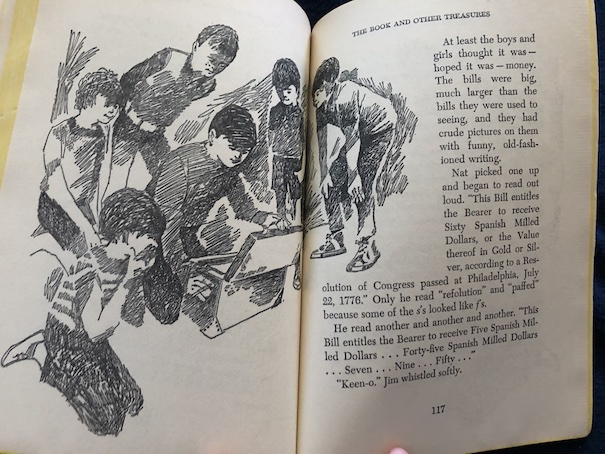
The treasure hunt part is a lot of fun, and I liked the children’s logical, methodical approach to their search. When the children eventually find the hidden box, the story isn’t over. There are coded messages in the box that they have to decode to learn the full truth about Nathaniel Woodruff. Part of the story explains how they figure out how to decode the substitution code and the book code that compose parts of the message. The story they learn about Nathaniel Woodruff is better than anything the Paines had originally thought.
So, did they save the old house and do anything cool, like start a unique museum? Yes, and no. Although they don’t find any jewels, gold, or traditional sort of treasure, the letters that they find in the box are worth quite a bit. They sell them to a wealthy local business owner, and he donates them to a local university library. (So, you know, the wealthy business owner who never makes an actual appearance in this story and who wouldn’t have helped a war widow and her orphans for their sake can buy their family legacy and present it as his magnanimous gift to the university. I can’t say that he’s terrible for doing this because it does help, but I still think my idea was better.) The Paine family has enough money to keep their house and fix it up. It’s a pretty good ending, but I still prefer my vision. The story points out that it’s not a matter of everyone living happily ever after because they’re all their imperfect selves and still have some problems, but one lesson that they all learned from this experience is how to create their own book code to use for passing notes in class. It’s not profound, but codes are fun.
Phoebe the Spy by Judith Berry Griffin, illustrated by Margot Tomes, 1977.
Phoebe Fraunces is a thirteen-year-old girl living in New York in 1776. The Fraunces family is black, but unlike most black people in the American colonies at the time, they have never been slaves. (There were some free black families who had never been slaves during this period of history, but they were uncommon.) Phoebe’s father, Samuel Fraunces owns a tavern called The Queen’s Head. It’s a popular place for people to meet, and Samuel Fraunces allows some prominent Patriots to meet there in secret and discuss their plans. Being party to such meetings could come with consequences as the colonies are on the brink of war.
One day, in April 1776, Samuel confides in his daughter that he has overheard something disturbing. He believes that George Washington’s life is in danger, that there are soldiers who are willing to kill their general for money. Samuel is worried about what he heard, but he isn’t sure what the plot against George Washington actually is and has no proof of what he heard. He’s afraid that if he tells Washington about what he heard too soon, without proof, the conspirators will just wait for a safer time to strike, so he asks Phoebe to help him uncover the truth. Samuel knows that George Washington will be coming to New York soon, and he has asked Samuel to help him find a housekeeper for the house where he will be staying. Samuel wants Phoebe to take the housekeeper position and to keep her eyes open for signs of danger.
Phoebe doesn’t know if she can do what her father wants her to do. She isn’t sure what she’s supposed to be watching for, and she doesn’t know how she could stop the plot if there is one. Her father tells her that she should look out for a man who is part of George Washington’s bodyguard and whose name starts with the letter ‘T’. This is all that Samuel was able to tell about the conspirator from the conversation that he overheard. He tells Phoebe to be careful, not to trust anyone, and to meet with him regularly in the market to tell him what she has learned. The two of them also discuss how odd it is that a man like George Washington, who owns slaves, would be at the center of a fight for freedom. Phoebe hopes that he will free his slaves after the war is over, although her father doubts that will happen. Still, the Fraunces family supports the cause of the Patriots, and Phoebe agrees to help her father find the conspirators and save George Washington’s life.
Phoebe is young to be a housekeeper, but she is accepted into Washington’s household. There, she meets Mary the cook and her son Pompey. Pompey also performs chores for the family, like carrying firewood. The work isn’t too hard for Phoebe because much of it is what she is accustomed to doing for her family’s tavern, like making beds, cleaning the silver, and making sure that meals are served on time. George Washington doesn’t say much when he’s around Phoebe, but she carefully observes the people around him. Every day, she goes to the market to buy food and see her father.
At first, Phoebe has nothing to report to her father. Everyone around George Washington seems to be nice or at least behaving normally, and nobody’s last name begins with the letter ‘T’. Mr. Green, a member of George Washington’s bodyguard, seems a bit unfriendly, but a younger man, Mr. Hickey, seems rather nice and sometimes gives Phoebe little presents.
However, there is a traitor among the household, and although it pains Phoebe when she learns who it is, she must do her duty and protect the life of the person she has promised to protect.
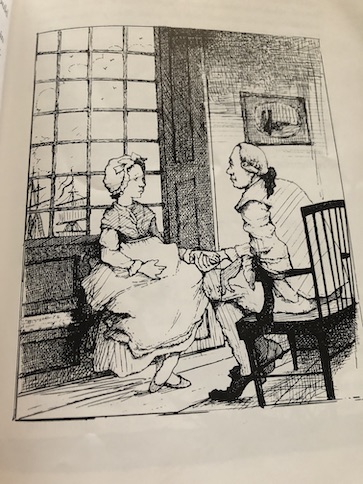
Some of the pictures in the book are black-and-white drawings, and some are in muted colors.
The original title of this book was Phoebe and the General. It is available to borrow and read for free online through Internet Archive.
Historical Background
The story is based on the real Fraunces family of New York. Samuel Fraunces really did own a tavern called the Queen’s Head and allowed Patriots to meet there. A note in the back of the book explains that after the war ended, he was given a reward by Congress, and he changed the name of the Queen’s Head to Fraunces Tavern. Fraunces Tavern still exists today, and it is still a restaurant, although part of it has been converted into a museum.
The racial identity of Samuel Fraunces has been in dispute for some time. No one is completely sure what he actually looked like. There is a portrait of a white man that has been reputed to be Samuel Fraunces, but the true identity of that portrait is in dispute. Samuel Fraunces is known to have had the nickname of “Black Sam”, but different sources describe the family differently. All that is known of Samuel Fraunces’s background is that he was born around 1722 and was originally from the West Indies. It’s possible that the Fraunces family may have been mixed race because some sources refer to Samuel Fraunces as “mulatto” (an old term for someone born to a white parent and a black parent, not considered a polite term now), which might explain the other, differing accounts of the family’s race.
The story of Phoebe Fraunces saving George Washington’s life is legend, but the facts regarding that incident are also in dispute. The legend might be based on a misunderstanding, and Samuel Frances’s real daughter, Elizabeth, does not seem to have been old enough at the time to have taken part in this adventure. The story has had a tendency to appear and reappear around patriotic milestones in the United States, first around the centennial in 1876 and then around the bicentennial in 1976, when this book was written.
Ten-year-old Ann Hamilton hasn’t been very happy since her family decided to move West. Her family lives in 18th century Pennsylvania, and moving West means homesteading in an area where there are few other families, none of which have girls Ann’s age. Her father and brothers love the adventure of starting over in a new place on the western frontier (what is considered the frontier for their era), but Ann is lonely, surrounded by boys, and missing their old home. When her father built their cabin, he purposely placed it so that the door faces to the west because he says that’s where their future lies. Ann’s brothers, Daniel and David, also make up a rule that no one can complain about the west (partly because Ann had already been doing a lot of complaining), saying that anyone who does so will get a bucket of water poured over their head, and they make a game out of trying to catch each other complaining about something. So, there is nothing Ann can do but suffer in silence and write in her diary, a present from her cousin Margaret when the family left Gettysburg.
There’s
a boy close to her age who lives nearby, Andy McPhale, but Ann doesn’t think
much of him. He makes jokes about her
being “eddicated” because she can read and write. Sometimes, he seems like he wants to play
with her, but she’s a girl, and he doesn’t want to play girl games.
Andy McPhale also worries about his mother. His father believes in hunting and trapping more than planting. Rather than grow some of their food, Andy’s father goes off for days at a time on hunting expeditions, leaving his family with very little while he’s gone. Ann’s family thinks that this is a sign of poor planning for the future and don’t think highly of Andy’s father for it.
Later, they
meet a young man named Arthur Scott who has just arrived in the area and is
looking for land to settle on. When Mr.
Scott first arrives, he meets Ann on the road. Ann has allowed the hearth fire to go out, and
she is on her way to her aunt and uncle’s house to borrow some from them
because she doesn’t know how to start a fire by herself. Understanding her problem, Mr. Scott gives
Ann a ride home on his horse and helps her to restart the fire, promising not
to tell her parents. They invite him to
stay for lunch, and he talks about his time at Valley Forge with Washington’s
soldiers when he was only 13 years old.
He was too young to fight, but he volunteered to drive an ammunition wagon. Ann thinks of George Washington as a hero,
and she finds it thrilling that Mr. Scott served with him.
Arthur Scott becomes a friend of the Hamilton family, and Andy McPhale seems jealous of him and the attention that Ann pays to him. Then, Andy tells her that his family has decided to go back to town for the winter. In the spring, they will return to the area and try farming, persuaded by their experiences working with the Hamiltons. To Ann’s surprise, Andy offers for Ann to come with them. She could visit Gettysburg and stay with her cousin Margaret again. Ann has been lonely, being the only girl in the area, and it’s a tempting offer. However, Ann feels like she must stay for her family’s sake and so she won’t feel like a deserter. When a storm destroys a good part of her family’s crop, she feels terrible and wonders if it’s all really worth it.
In the end, there is a great surprise coming for Ann: she gets to meet her hero, George Washington, when he comes to see some land that he has purchased nearby.
I first read this book when I was a kid in elementary school. As the cover of the book says, the author won the Laura Ingalls Wilder Medal, which honors authors and illustrators for children who have made long-term contributions to children’s literature. Laura Ingalls Wilder was the author of the semi-autobiographical Little House on the Prairie books, but because those books contain uncomfortable racial language and situations, her name were removed from the award in 2018. The award still exists, but it’s now called the Children’s Literature Legacy Award, which is more descriptive of its purpose.
I liked this book as a kid, although I had forgotten many of the details before I reread it as an adult, and I’m not sure if I fully understood the history behind the story when I was a kid. I think stories actually become more interesting when you know the background, so I’d like to discuss the history a little.
The story is based on the real life of Ann Hamilton, the great-great-grandmother of the author of this book, who did get to meet George Washington in 1784. The author is essentially retelling an old family story. The real Ann Hamilton married Arthur Scott when she grew up. The place where they lived, called Hamilton Hill in the story, is now called Ginger Hill. In fact, it seems that a member of the Hamilton family caused the name change, although that story isn’t really one for children.
One of the parts of the story that I always remembered from when I read it in school as a kid was the part where Ann talks about “mother’s fried wonders”, basically describing a fried donut. People in the 18th century did make various types of fried pastries, varying in style and name depending on where they lived. For an example of early American donuts, see this video by Townsends about 18th century doughnuts, where they make doughnuts and talk about the history and evolution of American “dough nuts” (they talk about the name and how it seems to come from the original shape – nut-shaped pieces of dough).
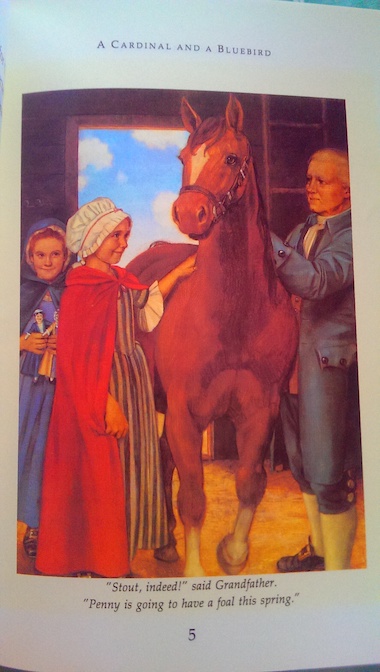
Everything is changing for Felicity. To begin with, her horse, Penny, is expecting a foal. Penny has been happy and healthy since she came to live with the Merrimans, but Felicity worries about what will happen when Jiggy Nye, her abusive former owner, gets out of prison. He has been in jail for not paying his debts. Felicity learns that he was once a respected member of the community and an expert with animals, but he became an alcoholic after his wife’s death. However, Felicity can’t bring herself to feel sorry for Nye after the way he’s behaved, even when she learns that he is sick. Felicity’s friend, Elizabeth, convinces her that they should send him some medicine and other supplies in prison, partly to have pity on him and partly so that he will feel grateful to Felicity when he gets out and not make trouble for her.
Unfortunately, Elizabeth’s father also soon ends up in prison. Tensions between Patriots and Loyalists are high. The former governor has fled Williamsburg, and Patriots are arresting Loyalists. That Mr. Cole is a Loyalist has been well-known for some time. Felicity fears for Elizabeth and wonders what will happen to their friendship.
Then, Felicity’s grandfather also becomes ill. He soon dies of his illness, devastating her family, but before his death, he takes steps to make things better for Elizabeth’s family, Jiggy Nye, and his own family, especially Felicity. In return for Felicity’s charitable gift and her grandfather’s honorable payment for the horse, Jiggy Nye also helps Felicity and Penny when they need him the most, redeeming himself in everyone’s eyes.
With the war everyone has dreaded finally becoming reality, there are still more changes yet to come. Elizabeth’s father must leave Williamsburg, Felicity’s father decides how he will support the war effort, and Felicity begins to play more of a role in the running of her father’s shop, as she had wished to do before.
In the midst of Felicity’s grief over her grandfather’s death and worries about the coming changes in all of their lives, her mother has some poignant thoughts about the nature of death and change. While Felicity wishes that it were summer again, back when her grandfather was alive and they were all happy, her mother says that not all changes are bad ones. As she points out to Felicity, even though it might be tempting for her to wish that she were a child again herself, when both of her parents were still alive, to go back to that time would mean giving up her life with her husband and her children. She loves her children and enjoys seeing them grow up and change. The ability to witness those happy changes is worth dealing with the less happy changes in life as well. Death, like change, is just another part of life, and Felicity’s mother points out that love still connects us to those we’ve lost. Like everyone else, the only way Felicity can move in her life is forward, and that’s a good thing. Felicity still has growing up to do and happier changes yet to come.
In the back of the book, there is a section of historical information about the Revolutionary War.
The book is currently available online through Internet Archive.
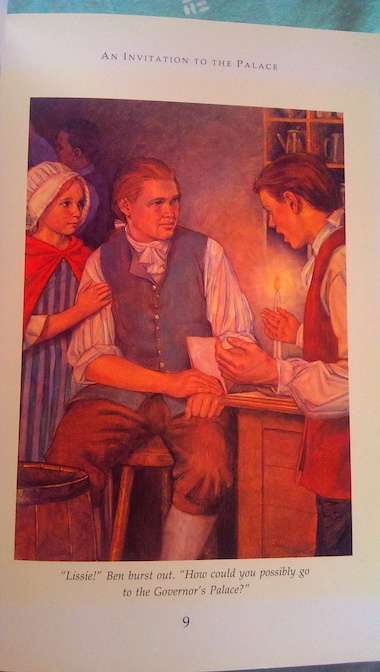
Christmas is coming, and Felicity is excited. She and Miss Manderly’s other students, Elizabeth Cole and her older sister, Annabelle, have all been invited to the Christmas party at the Governor’s palace! Miss Manderly is a friend of the dancing master who has been giving the governor’s children dancing lessons, so she was able to get invitations for her students. There will be a special dance lesson for all the children who come. With food, music, and dancing at the party, Felicity and Elizabeth are looking forward to dressing up like grown-up ladies going to a ball.
However, Ben, her father’s apprentice is against the idea of Felicity going because the Governor sides with the King and the Loyalists against the Patriots. He can’t understand why Felicity would want to attend a party with people who have treated the colonists so badly and have even boycotted her father’s store because he refuses to sell the taxed tea. However, Felicity’s father understands that the invitation was meant kindly and that it would be a special event for Felicity, so he tells her that she can go if she likes. Christmas should be a time for peace and enjoyment.
At Miss Manderly’s the girls start having dancing lessons, and Felicity wishes for a new gown, like the one on the elegant doll at the milliner’s shop. Since Felicity is usually not very interested in clothes, her mother decides to grant her wish.
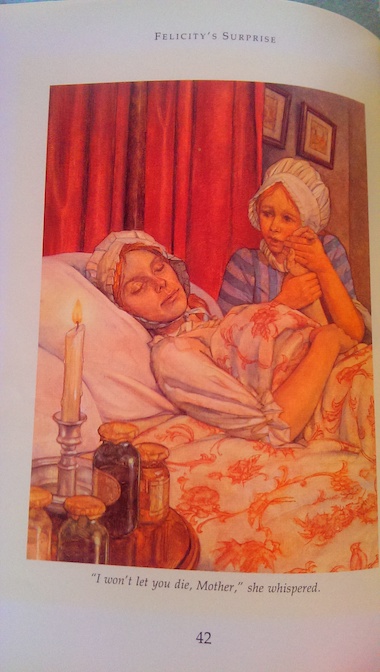
When Felicity’s mother falls ill, not only do Felicity’s Christmas dreams seem dashed, but she worries about whether her mother will recover from her illness. Everything that Felicity was concerned about before, the dress, the dancing, the party, all suddenly seems unimportant and silly in the face of something more serious. However, miracles come to those who work for them, and Felicity receives some unexpected help from friends.
There is a section in the back with historical information about how Christmas was celebrated in Colonial America.
The book is currently available online through Internet Archive.















 This is part of the
  Unfortunately, Elizabeth’s father also soon ends up in prison. Tensions between Patriots and Loyalists are high. The former governor has fled Williamsburg, and Patriots are arresting Loyalists. That Mr. Cole is a Loyalist has been well-known for some time. Felicity fears for Elizabeth and wonders what will happen to their friendship.
 With the war everyone has dreaded finally becoming reality, there are still more changes yet to come. Elizabeth’s father must leave Williamsburg, Felicity’s father decides how he will support the war effort, and Felicity begins to play more of a role in the running of her father’s shop, as she had wished to do before.
 This is part of the
  At Miss Manderly’s the girls start having dancing lessons, and Felicity wishes for a new gown, like the one on the elegant doll at the milliner’s shop. Since Felicity is usually not very interested in clothes, her mother decides to grant her wish.

 Jestress's Forgotten Books and Stories