Going to School in 1876

Earlier, I covered Going to School in 1776 by the same author. The earlier book was written around the US Bicentennial, when many authors were revisiting patriotic themes. This follow-up book is set a century later than the first, the time of the US Centennial. The author’s earlier book, Going to School in 1776, explains what Colonial American schools were like, and this book explains what schools were like after the US had existed for 100 years, how they had changed in the 100 years since the Colonial era, and what society needed and wanted education to become.

The book starts off with some information about America in 1876. Ulysses S. Grant was President, there were 37 states in the United States, the country was recovering from the Civil War, and there was a huge exhibition in Philadelphia to celebrate the Centennial. The Centennial Exhibition included exhibits by American industries, showing off new inventions, such as steam engines and sewing machines, and there were exhibits contributed by other countries. Now that railroads and telephones were linking different parts of the country, the general outlook was one of optimism and a fascination with progress.

However, American society was still largely rural. Since newspapers only had limited ranges of circulation, there was no mass media that could reach everyone, the spread of information wasn’t entirely reliable, and news often depended on word of mouth. Education also varied widely throughout the country. The concept of public schools, with taxes paying for anyone who wanted to attend, was controversial. The book says that some people resented the idea of “paying for the schooling of rich and poor alike,” although it doesn’t go into detail about arguments surrounding the issue. Although, in the 21st century, there are public schools across the nation, and the idea of public education for children from elementary school to high school is pretty common, there are still people who quarrel with the concept, with assertions like “Why do I have to pay for people who could be paying for themselves?” and “I paid for myself and my children, so why should I have to pay for anyone else?” I think that studying the types of schools that the US had in the past partially answers these questions.

The beginning chapter of this book references the earlier book and types of Colonial schools, like blab schools and dame schools, which no longer existed by 1876. By 1876, it was more common for children to be educated in formal schools and trained teachers, although the quality of schools varied by region, and not all children attended. There were schoolhouses even in rural areas, but not all schools were well-equipped, and some wouldn’t accept all students. Many states were passing laws about educational requirements, but children were still heavily used in labor in mines and mills. To explain the nature of education in the late 19th century, the book explains that it will examine the daily lives of children in that period to show what their living circumstances and schooling were like.

(Note: After a fashion, something like dame schools reemerged during the Coronavirus Pandemic of the early 2020s, when public schools were closed or converted to online forms. During that time, many people turned to homeschooling in various styles, and there were some homeschooling groups with parents sharing teaching and supervising responsibilities for their children and a small group of other children in their homes, which is sort of what the earlier dame schools were like. However, this book was written written long before that happened, and the 21st century version was more an aberration, a departure from the norm for the time period, by people reacting to unusual circumstances.)

From that point onward, each chapter of the book focuses on a different aspect of children’s lives and education in 1876. To illustrate each of these concepts, rather than just stating the dry facts or statistics about 19th century children, the author tells short stories about individual children as examples. Below, I’ve explained what chapters and sections of the book are like and what information they cover, although I changed some of the heading names of the sections to highlight the educational topics covered rather than the stories about children that were given as examples. The titles of some of these sections in the book, which describe the stories rather than the information, wouldn’t make sense without retelling the story, but this book is available to read online for those who would like to explore this topic further and read the stories for themselves.

The book is available to borrow and read for free online through Internet Archive.

To give readers an idea about the varying circumstances of 19th century children, the author describes the daily lives of six children, who each live in a different part of the US or in a US territory. Each of these descriptions are told in the form of a short story. The author makes the point that the level of education children of this era receive is based not just on geographical location but also social class, and there were major gaps between the education of poor children and wealthy children. The stories he tells about different children around the country illustrate the point. I was pleased that he not only described the lives of children of various social classes and regions, but he also included a Native American girl in this chapter. The Native American girl example is one of the better and more hopeful examples of Native American education for the period, not one of the traumatic ones of the Native American boarding schools of the 1800s.

(Black people are covered in other chapters as the next-largest racial group next to white people at this time and because the Civil War drastically changed their educational prospects, but I have more to say about this later and in my reaction section at the end. Where race/ethnicity is not stated, assume that the people described are white because that’s the majority race/ethnicity and the assumed general default for this time and location. Asian people or Hispanic people are not mentioned at all in this book.)

Farm Child in Massachusetts

Jim Porter is a ten-year-old boy in a village in Massachusetts. His daily routine involves chores on his family’s farm and attending the local schoolhouse. There were laws in Massachusetts mandating that children attend school from the ages of 8 to 14 for at least 12 weeks a year (that’s about 3 months a year), but these laws were rarely enforced. If a child hated school or couldn’t get along with a teacher, the child might simply quit going to school, and very likely, nobody would do anything about it. Children who stayed in school did so either because they wanted to continue going or because their own parents insisted that they continue going because few other people would care if they did or not. Children’s parents would pay tuition fees to the local school committee, just a few cents a day for each day the child attended school (although even a penny went much farther in the 19th century).

Child Coal Miner

Ten-year-old Patrick Doherty lives in Pennsylvania and works in a coal mine. He works every day, except Sunday, and he is only paid a few cents a day for his work. There are some laws about child labor in his time, but not many, and even those that exist have many loopholes. Many parents of this time are poor and need their children to work and earn more money for the family. For them, it’s a necessity, not a preference. Employers liked child labor because they didn’t have to pay kids much. Some people even said they though it was better for children to work and called laws limiting child labor “soft” and “silly.” The book doesn’t shy away from describing Patrick’s harsh and unsafe working conditions, describing children’s “raw and bleeding” little hands and bodies covered in coal dust, the bad and dusty air in the mines, and cave-ins. The only school in Patrick’s town is the local Sunday school, which teaches a little reading and religious education. The town was built by the coal company. The coal company owns all the businesses and buildings in town, and the coal company says that the children don’t need a school because they’ll learn everything they need to know by working in the mines.

Farm Child in Iowa

Jim Wright is a twelve-year old boy in Iowa. His family used to live in Maryland, but his father moved the family west. They live in a cabin near a lake and grow wheat, oats, and barley on their farm. Jim works on his family’s farm, and he and his sister attend the local schoolhouse for a few weeks each winter, between the planting and harvesting seasons. Iowa has had tax-supported public schools since it became a state in 1846, so individual students do not need to pay when they attend. However, there are no laws requiring children to go to school, and families still prioritize the work that children do at home and on the farm. Jim’s father thinks that a few weeks of school a year are all his children need.

Immigrant Child in New York City

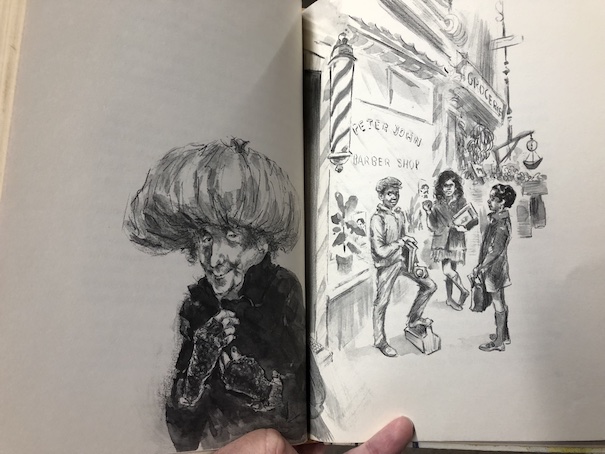
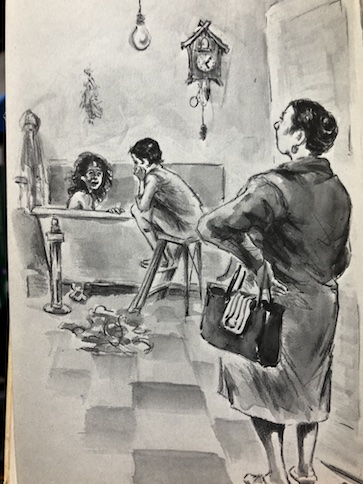
Eight-year-old Tony Wasic is from an immigrant family, and his family lives in a crowded tenement building in New York City. Tenements are a cheap form of apartment where many poor people and immigrants live, and they often have many people crowded into very few rooms, with poor conditions and few amenities. An entire building of people might have only one outdoor toilet and only one water tap outside the building, so they would have to haul buckets of water inside for cooking or baths in wooden tubs. Because of the crowded conditions and poor sanitation, they were often breeding grounds for disease, and they were also often fire risks. Tenement slums could be found in major cities, like New York City and Chicago. New York City established a public education system in 1867, so in spite of their poverty, Tony and his brothers can go to school without paying fees to attend. After school, he sells newspapers to help raise money for his family. His ambition in life is to own a grocery store.

Native American Child in Oklahoma

Anna Crowfoot is a 12-year-old Native American girl. She is part of the Cherokee tribe, and she lives in the part of Oklahoma known as Indian Territory. She knows that her people were forcibly moved from their ancestral lands into this territory by government troops during the 1830s. Not many people during this time are concerned about educating Native American children (the book uses the term “Indian” instead of Native American), at least not in any formal way, but the ones who do offer formal schools for Native Americans see education as a way to “civilize” them, Christianize them, and change their lifestyles from the “savage ways” of Native Americans to that of mainstream, predominantly white/European based US culture (the quotes around the words in this sentence also appeared around those words in the book – those ideas are ones expressed by people of the time and do not come from the author, and the author wants readers to know). In short, the people running schools for Native Americans have no interest in Native American culture and would rather see them give up their culture. Whatever the Native American children learn about their tribe’s culture and history comes from their families at home.

Anna attends a girls-only school, where the girls are taught skills that farm wives would find useful, such as how to cook, how to sew, and how to make medicines from herbs. (Herbal medicines are popularly thought to be more Native American than a white person’s thing, but in the days when most people lived on farms or in rural areas and weren’t very near doctors, everybody had to know how to make a few basic remedies for common ailments. White people did have a tradition of herbal medicines from Europe, but one of the issues with that was that white people were more familiar with plants from Europe than plants native to the Americas. The book doesn’t explain this, but European colonists brought some of the plants that they commonly relied on from Europe, and apart from that, they had to learn how Native Americans used the local plants.) The Native American boys learn how to be farmers at their school. (Exactly how this kind of education differed from their traditional Native American lifestyles depends somewhat on the tribe, but basically, one of the goals was to make Native American society into permanent agrarian settlements, specifically on land nobody else really wanted, rather than nomadic or semi-nomadic, which had been the previous way of life for some of them. They also learned to grow different types of plants than the ones that their society would have traditionally cultivated, more in line with the European-based crops favored by white people.)

Anna is described as enjoying her school and lessons in “some of the white man’s ways” (I added those quotes, just quoting from the book), but she also values the ways of her tribe. (This is one of the more benign descriptions I’ve heard of what “Indian schools” could be like. Real life stories could be much worse, and that’s part of the reason why Native Americans would try to avoid sending their children, if they could.) Her ambition in life is to become a teacher herself and to start a school for Cherokee children that will also teach Cherokee traditions.

Middle Class or Upper Class in Indiana

Nancy Feather is the most fortunate of the children described in this chapter. She is an eleven-year-old girl whose father owns a hardware store in Indiana. They are a “middle-class” family. There are other people who are more wealthy than they are, but the Feathers have a very comfortable lifestyle, with money for some luxury items, including some that modern middle class families would be unable to afford. The Feather family employs a cook and a gardener and even has a summer house at a lake. Mr. Feather is a respected businessman in his community, and like others of their social class, the family is concerned with maintaining a good social image. The Feathers make sure that their children are always clean and neatly dressed in public. The children also learn etiquette, so they make a good impression on people they meet. They value education and culture, and they can afford the best education their community can offer and lessons that are not solely focused on employment skills. Nancy attends Miss Dwight’s Academy, which emphasizes that they teach music, art, classical literature, and French.

This chapter has short little stories about a different set of children from the ones described in the previous chapter. This set of stories focuses on what children wore in 1876. Social class and money are factors in the clothes they wore, but the author also brings in other issues, such as health theories and cultural habits. This chapter seems to further elaborate on the range of lifestyles and daily life activities of children and also helps readers to picture the people they’re reading about.

Boys in Wool Suits

Nine-year-old Fred Hart gets a new suit to wear to the Centennial parade on the Fourth of July in his town. Fred doesn’t want to wear the suit because it’s really too heavy for the summer weather, but his mother insists that he wear it because she doesn’t want him to “catch a chill.” The book explains that there were no vaccines to prevent disease at this time, so parents and doctors recommended other precautions, including wearing heavy clothing year-round to avoid “chills.” (This comes from the misconception that colds are caused by literally being cold instead of by viruses.) Dr. Gustav Jaeger, a German doctor, spread a popular theory that wool was the healthiest clothing, telling everyone that plant fibers like linen and cotton wouldn’t adequately block air from touching or moving across the skin. He also believed that clothes should fit tightly to be less breathable. Not everyone agreed with his advice or followed it, but it was a popular theory that governed the way some people dressed.

Poor Children in Flour Sack Clothes

On the other hand, Anna Jenkins is a poor child in a mill town, and her dress is made from an old flour sack because her family can’t afford anything better. They have to improvise clothing from whatever they can find or have available. She dreams of one day owning a pretty silk dress.

Sailor Suits

Ten-year-old William Smith wears a nice sailor suit to church. He wears a wooden whistle around his neck as an accessory, but his mother tells him that he shouldn’t be blowing it on Sunday.

Fancy Dresses and Accessories for Little Girls

Lucy Preston wears a pink dress decorated with rosettes and a blue ribbon sash with a bonnet and white gloves when she visits her grandmother. Her grandmother believes that proper young ladies should wear pretty and fashionable clothes and “behave in a proper manner.” Lucy’s outfit isn’t particularly comfortable, but her grandmother also believes that sacrifice is necessary for the sake of style. This section of the book notes that children’s fashions of the era are based on adult fashions rather than being designed specifically for children.

Different Outfits for Different Purposes of Young Ladies

Twelve-year-old Mary Trent gets her first corset and a dress with a bustle, fashionable touches that mark her as becoming a young lady rather than a mere girl. She writes a letter to a younger cousin about it. She is excited about her new clothes, although she admits that they are difficult to wear. She finds it harder to breathe in the corset, and she admits that her new button boots are difficult to put on, but she thinks that it’s important to wear the right kind of clothes, and she’s looking forward to wearing them when she visits her aunt.

Her father is irritated with her for being too obsessed with clothes, but Mary says that he doesn’t understand because he is a man. Men of their time wear suits for every occasion. A couple of suits for work and church are about all they need. On the other hand, fashionable women are expected to have different outfits for different purposes, including walking dresses, riding dresses, morning dresses (simpler, more informal garments to wear first thing in the morning for breakfast and other activities at home, before dressing to go out for the day – unlike other dresses of the era, they were more loose and could be worn without a corset – sort of like the 19th century version of feminine lounge wear, although the term “morning dress” later came to indicate a more formal type of outfit in the 20th century), and church dresses. Basically, each of these styles of dresses have features that make it easier to do certain activities, rather than the women having a single outfit that was comfortable and easy to wear for a variety of activities. (See the YouTube video Why Did Victorian Women Change Their Clothing 5 times a Day? for more detailed explanations and examples of different types of Victorian era women’s outfits.) With more variety in styles and additional requirements for different types of outfits, women have more decisions to make in the clothes they choose, so there’s more for them to consider.

Unlike the previous two chapters, this chapter focuses on school systems, school districts, and individual schools rather than describing individual students who attend them. It isn’t clear whether the schools the book describes are/were real schools or if, like the children described earlier, they are intended as just general examples of types of schools and school conditions that existed in 1876. I tried looking them up, and I couldn’t find information about them, so they might be fictionalized examples, but they do work as examples to illustrate school types.

One-Room Country Schoolhouse

The Wexbury District School is a one-room schoolhouse one mile outside of town. The book explains that it was common in the 19th century for public schools to be called “district schools” because they served students in a particular area or district. The local school committee (sometimes called school directors or school board, depending on the area) governs the school, pays the teacher, and maintains the school building, using money collected from taxes. However, they don’t pay the teacher much, and the teacher is also responsible for cleaning the school. Public schools of this type could vary in size and the number of teachers, depending on the needs of the local district, but Wexbury District School is just a small, one-room schoolhouse, so it only has one teacher for all the students, regardless of age or grade level. There just aren’t enough students to separate them out into different rooms with different teachers. The Wexbury District School is a kind of dingy gray little building with a couple of outhouses behind it, and truancy is high because the area has weak laws about school attendance. Most days, less than half of the students in this district attend school. Part of that is due to the poor condition of the school. The book quotes an unnamed Connecticut official’s observation that schools are often less comfortable than prisons. One thing the Wexbury District School has that is considered a new innovation is a blackboard. The book says that blackboards were a new development for 19th century schools, and not everyone thought that they would be a lasting trend.

Small Local School Districts/District Schools

The book explains that school districts in southern and western states are named for the town or the area they serve, and some of them have really colorful names. The example of this is Fly Hollow School in West Virginia. Fly Hollow is a very rural area, and most people live on scattered farms, although many of the local families are related to each other. However, the schoolhouse in 1876 is new because West Virginia only established its public school system in 1872. It’s a one-room schoolhouse with one teacher and ten students, most of whom are the teacher’s younger cousins or nephews. The teacher decides when students are ready to pass to the next grade, and the teacher at this school refuses to pass students until they’re really ready, even though they are relatives of hers. Her standards are strict, and she holds to them.

Pioneer Sod Buildings

By contrast, the Logan County public school in Nebraska, is run out of the teacher’s house, which is only a small sod building. Sod houses, made of bricks of sod, are common for pioneers in Nebraska because wood is rare on the prairies. They only have dirt floors, and the conditions are rough and uncomfortable. However, charmingly, plants will grow in the sod bricks, so flowers will grow out of them and bloom in the spring. This particular school and teacher has only six students, and they are supported with state funds.

Small Private Schools

The Millville Academy is a private school for boys. When the schoolmaster opens the school, he advertises the opening in the newspaper, describing what subjects will be taught at the school and what the school fees are. The schoolmaster will be running the school out of his own home, and he will teach science and classical learning. As part of the school’s services, the students will also be provided with a midday meal. Private schools like this were often found in larger towns, and their students were from upper class families. Along with the academic subjects, they would teach etiquette and proper behavior. The midday meal this school provides is also a lesson in how to behave at a dinner table. The schoolmaster uses some harsh punishments on his students, including locking them in a closet. (Abusive by modern standards.) His lessons are rigorous because he wants to prepare the students to go on to college. The schoolmaster’s credentials for teaching are that he is a graduate of Yale.

Upper-Class Academies and Seminaries

While upper class boys’ schools were called “academies”, schools for upper class girls were called “seminaries.” The headmistress of a female seminary was often an educated woman who was either the wife or daughter of a minister. Sometimes, they came from Europe to teach because upper class American families wanted their daughters to learn another language, such as French. Typical subjects at a female seminary might include spelling, writing, music, drawing, sewing, and embroidery.

Segregated Schools in the South

My summary of this part is going to be longer because I think this requires more explanation. Prior to the Civil War, there was no education for black people in the southern states because black people were slaves. (The book doesn’t explain this, but there were actually laws forbidding teaching black people to read. Occasionally, some sympathetic white person would do so anyway in defiance of the laws, or black people themselves would find a way to learn and teach others, but they were rare exceptions.) After the Civil War, the southern states developed a public education system that provided for the education of both black children and white children, but it was a dual system with separate schools for children of different races. Even with separation between the black and white people, the subject of educating black people at all was controversial in the south, with some people calling it a waste of money.

(Think of it this way: If some people generally didn’t like the relatively new idea of public education because it meant paying for other people’s children to attend school through their tax money, imagine how those people might react when they find out that this is going to include paying not just for the children of friends and neighbors they like or might potentially do business with to go to school but also a group of people they specifically hate and resent. I’m not saying that this is well-reasoned, ethically right, or a healthy mindset, just that this is the sort of thing that might be going through people’s minds at the time. The book doesn’t explicitly explain this, although it does indicate that this is how some people of the time feel without going into specifics. Educating people in general might not objectively be a “waste of money”, but what I’d like to point out is that these people are not being objective but very personal about it. They, personally, don’t want to spend their money, and they especially don’t want to spend it on people they personally don’t like or even want to associate with in their daily lives. We’re about to see what they and their children do in response because the book does explain that.)

The example the book describes of a school for black children in the South is Goose Creek School in South Carolina. It’s a small school with only two rooms, and there is only one teacher. The teacher is from the American Missionary Society, an abolitionist organization founded prior to the Civil War which had an interest in providing education for black people after slavery was abolished. The children at Goose Creek School learn basic subjects, such as reading and writing, mathematics, hygiene, and farm skills. A black boy named Jason attends this school, and he gets teasing and physical abuse from white children and even some other black children because of it. They accuse him of being “uppity” and thinking that he’s “somebody special” for going to school. However, he still wants to go to school, and his mother and teacher encourage him to continue his education because this is an opportunity that people like him never had before.

Because this book only focuses on conditions during one year, 1876, it doesn’t explain the futures of any of the children or schools described so far. However, readers with some historical background will know that this segregated system of education continues into the mid-20th century, until the Civil Rights Movement and school desegregation. Having seen footage of people reacting to school desegregation in the mid-20th century, the behavior of opponents to education for black people described in this 19th century is very similar.

A question readers might ask at this point is, was school segregation limited to only the South? Because of the history of slavery in the South and its previous laws against education for slaves, the idea of 19th century southerners being opposed to their children being educated alongside black people or even black people being educated at all makes logical sense just as a progression of events and in keeping with the long-term attitudes of the people involved in the public decision-making. What I’m saying is that educational segregation is not great but not surprising, given the context. People might expect that attitude in former slave states, and their official dual school systems and Jim Crow segregation laws made the South the focus of desegregation, the area of the country always most associated with the idea of segregation. It certainly isn’t an undeserved reputation.

However, others might point out that even northern states had some slavery, and they still had their share of racism, and that’s also a fair observation. So far, in this book, there has been no mention of racism with relation to any schools or school systems outside of the South, so readers might wonder what was happening in Northern schools with relation to race during the 19th century. I have things to say about that in my reaction section below because I think this is a good topic to cover that’s missing from this book.

Public School in a Large City

At this point in history, large cities already have established school systems, and public education is just accepted as a normal part of life. Because there are many schools in a large city, they are often given numbers instead of names, such as “P.S. 84.” The “P.S.” stands for “public school.” Class sizes are large, about 50 to 60 students in a class. One of the challenges they face is helping students from immigrant families, who are still learning English and adjusting to life in a new country. School superintendents are often political appointments, so there are some accusations that the schools are too political.

Church Schools

Some of the very first schools in the United States were church schools, and there have been church schools here ever since. They were very common during the 19th century. Religious groups of all types had schools of their own, and they taught religious classes alongside more basic subjects, such as reading, writing, arithmetic, geography, and history. Although church schools were familiar features of American education, some people criticized them for being too insular, preventing children from mixing with the broader population, keeping them from being exposed to people with different religions, and confining them to their own ethnic groups.

Kindergarten

There weren’t many kindergartens in the US in 1876. The very first public kindergarten in the US was founded in 1873 in St. Louis. Kindergartens were the concept of a German educator named Friedrich Froebel and were meant to help young children become prepared for regular school. At kindergartens, children would learn to play with other children and become adjusted to the concept of leaving their mothers and attending school. Some people at the time criticized the concept of kindergarten because they thought that it was silly and that young children weren’t developed enough to begin learning much.

Teacher Examinations

Job requirements for teachers in the 19th century were far less strict than in the 21st century. Not all teachers even had a high school education, and when they did, high school was often the highest level of education they had. They were typically graduates of whatever local school system they hoped to teach in. To gain teaching status, they had to pass whatever examination was established by the local school superintendent to establish that potential teachers had sufficient knowledge of the subjects they planned to teach.

Normal Schools

In 1834, American Charles Brooks had an interesting conversation about education with a German man while they were traveling together by ship. The German man described how, in Germany, teachers were given specialized training in order to become teachers. Brooks thought the concept was fascinating, and when he returned to the United States, he promoted the idea of specialized teaching colleges called “normal schools,” which would not only give potential teachers mastery of the subjects they would teach but also instruct them on the theories of education and teaching techniques. By 1876, normal schools were becoming common features of American education, and trained teachers became in demand for teaching jobs. (The book doesn’t mention this, but some state universities, including the one I attended, originally started as normal schools before gradually expanding as larger colleges, and eventually, universities.)

Godey’s Lady’s Book

Godey’s Lady’s Book was a popular magazine for American women in the 19th century, and it influenced American life by influencing American women and mothers. (I’ve mentioned it before as one of the magazines that promoted the concept of Halloween as a children’s holiday, around the same time as this book is set, with ideas for mothers to help set up children’s parties, offering suggestions for decorations, costumes, and games. This book doesn’t mention Halloween, but I like to tie into earlier subjects I’ve covered.) Godey’s Lady’s Book promoted the idea that there should be more female teachers in American schools. There were relatively few respectable professions for women during the 19th century, and teaching was one of the more genteel professions, making it an attractive job for unmarried women. The magazine pointed out that, since married women of the time were expected to give up whatever job they had to care for a household and raise children of her own, they wouldn’t need as large a salary as a man would, if he had a family to support. Because women would work for a cheaper salary and had a nurturing, motherly image, teaching gradually came to be thought of as primarily a women’s profession in the United States, although some people questioned whether female teachers had the same academic rigor of male teachers.

Teaching and Marriage

While teaching was becoming a popular profession for women, it was only for unmarried women. Few school systems would hire married teachers because they assumed married women wouldn’t have much time to teach with their own households and families to manage. Unmarried teachers often lived with their parents or other family members or boarded with other families who lived near their schools. There were opportunities for professional teachers to continue studying educational techniques and to form groups with fellow teachers to share information.

A Day in a Country School

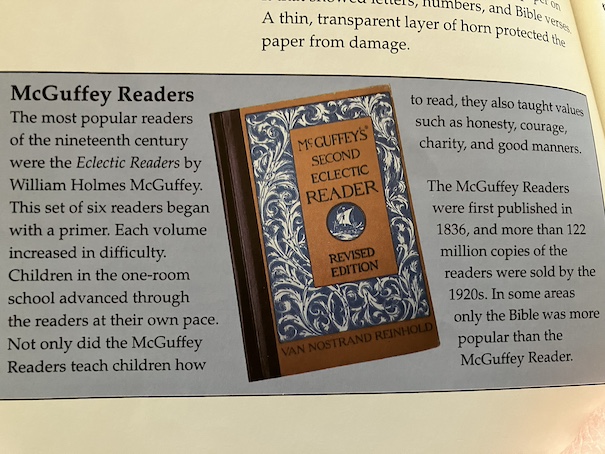
This chapter covers what students often studied in American schools, and it starts with a section about a typical day in a country school. All of the students would typically walk to school, no matter what the weather was like, and many of them had to walk long distances. (This aspect of historical education in the US is what started the old joke about elderly people claiming that they had to “walk to school in the snow, uphill … both ways!”) Classrooms might have an American flag, but the students wouldn’t say the Pledge of Allegiance because it hadn’t been established yet, and they didn’t sing the national anthem because no song had been chosen as the national anthem yet in 1876. Instead, students would start the day with a reading lesson from McGuffey’s Ecletic Readers, a popular set of books with reading lessons and selections of stories and poems. McGuffey’s Eclectic Readers also helped to transmit important pieces of American history and culture in their readings.

The students would then study arithmetic, take a recess break, and then have a writing lesson. When it was time for lunch, the students would eat in the classroom. They would bring their own food or sometimes eat soup the teacher would make on the classroom stove. Then, they would study history and geography, and they might have a spelling bee.

Copybooks

Although many schools use slates for writing practice, students would write their best and most important pieces in copybooks.

Lessons in Discipline

As an example of a kind of inspirational lesson a teacher might use to correct a student’s discipline problems, the book tells the story of a student who is caught in a lie by his teacher. The teacher assigns him to read the story about George Washington and the cherry tree from A History of the Life of General George Washington by Mason Weems. The book notes that many of the incidents of George Washington’s life were fictitious, the book was very popular in the 19th century and used in many classrooms. Weems’s book was the origin of many popular myths about George Washington’s life, and although this book doesn’t mention it, even though Weem’s book was popular, it did receive criticism even during the 19th century for its inaccuracies and fantasies.

Arithmetic

In 1876, it was common for schools to teach students to do mental arithmetic instead of having them write everything down. Mathematics lessons covered the basic operations of addition, subtraction, multiplication, and division, plus fractions, decimals, and units of measurement.

Report Cards

Report cards on students’ learning progress and behavior at school were very common and often required of teachers. Teachers might require parents to sign a child’s report card to prove they had seen it, and parents might punish children who misbehaved at school and didn’t do their schoolwork.

School Rules

Large schools might post a list of school rules in the hallway along with the punishments for breaking them. The book presents an example of what might happen to students who misbehave.

Immigrants in School

The book offers an example of what school was like for young immigrants. Schools helped immigrants to learn American history and heritage as well as English, helping them to assimilate to American culture.

School Discipline

The book has an account of how harsh and intimidating school punishments could be. It also describes how some misbehaving children escaped punishment by stirring up other students and watching as they got punished while they put on an innocent act. Sometimes, teachers seemed to take an almost sadistic pleasure in dealing out punishment.

Recess and Games

The book tells an anecdote about some boys who were so busy playing sports at recess that they came back to class very late. Their teacher banned the boys from going to recess for the next five days.

New Teacher

The book describes some boys talking about how they aren’t afraid of their new teacher, but 19th century teachers were tough, strict, and not afraid of administering even physical punishments. The next small section describes the punishment given to a pair of misbehaving boys.

Advice from a Magazine

A girl reads advice on the discipline of children from a magazine. It was becoming more common to allow children some degree of freedom, but obedience to parents was still expected.

Conditions of Poor Children

Life was hard for poor children, and they often faced cruelty and neglect, including harsh physical punishments from employers. Because conditions were getting so bad, citizens in New York formed the Society for the Prevention of Cruelty to Children.

Reform Schools

Children who actually committed crimes or were completely uncontrollable might be sent to reform schools, which were also called industrial schools. There were reform schools for girls as well as boys. The children would live at the school, and parents typically paid for the children to be there. Aside from school subjects, children in reform schools also had to perform long hours of work.

Orphans

“Orphans” not only included children whose parents were dead but also children whose parents were simply unable to care for them, perhaps because they were sick, in jail, had no money, or were divorced but neither parent was able to look after the children. Orphanages would care for children until they were old enough to work, and then, they were often hired out as domestic servants.

Circuses

Traveling circuses were a major source of exciting entertainment, and their arrival in town was often like a holiday.

Children’s Books

Popular books for children in 1876 included the Rollo books by Jacob Abbott and Hans Brinker or the Silver Skates by Mary Mapes Dodge. Children also enjoyed books that we might think of as adult classics now, like The Last of the Mohicans by James Fenimore Cooper. There were also magazines for children, such as St. Nicholas Magazine. Sometimes, children would also read sensationalist adventure stories in “dime novels,” although parents might consider this form of literature “trashy.” Parents and relatives might give children books or magazine subscriptions they approved of as presents for birthdays and Christmas.

Baseball

Baseball evolved from several older games involving balls and bats. By 1876, there were organized, professional teams and a national league.

Football and Lawn Games

Football wasn’t as popular in America as baseball in the 19th century. However, there were a few college teams that played against each other. Popular lawn games in the 19th century were croquet and lawn tennis.

Swimming

It was popular for children to swim in local ponds. Boys would often swim naked in ponds, although swimsuits were required for public beaches.

Playing in the City

Children living in big cities could play in parks, in vacant lots, or just out in the street. Girls often liked to play hopscotch, and boys would play tag. Poor children didn’t have much time to play because they often had to work. However, parks offered green spaces where children could explore among the trees, watch birds and squirrels, or play with toy sail boats on a lake.

I included some of my opinions and some additional historical information within the review itself, but there are a few more points I’d like to make. I looked up this book because I found the first one, Going to School in 1776, fascinating, and I wanted to see what this book would say about changing education in the US from the 18th century to the 19th century. What I appreciated about both books was that they connected the types of schools children attended and the types of education they received to the actual, daily lives of children at the time and the types of lives that they were likely to lead as adults. No matter the era, I think that the type of education a child receives reflects both the realities of their current life and the kind of life that adults caring for them think that they are likely to lead in the future. In the context of 19th century children’s lives, their levels of education and the attitudes of their families toward education make sense.

However, we know that not only did schools not stay the same between the 18th and 19th centuries, the conditions of education in the 20th and 21st centuries are different yet from either of those. Even my own childhood school experiences from the late 20th century aren’t quite like what kids have been experiencing in the early 21st century, and that’s just a difference of about 30 years. Part of that is due to changing technologies since my childhood, but also, it’s about changing expectations about the lives that children will eventually lead. Not only are there almost no jobs in 21st century America that will hire anybody who doesn’t have at least a high school education, there are relatively few jobs that pay a living wage that don’t require either a college education or some form of professional training or certification beyond high school. The schools children attend in the 21st century have that in mind.

One of the controversies about modern education is the way that schools address topics like racial issues. Some schools definitely handle topics like this more effectively than others, but ignoring the issues is not an option for 21st century schools because modern people mix more with people of different cultures and racial backgrounds. Kids have to grow up understanding more about other people’s backgrounds and how to interact with other people than, say, a kid who lived on a 19th century farm and spent most of his time with his own family and occasionally people from nearby farms or the nearest small town. If you rarely see other people in general and almost never interact with anyone whose background is different from yours, then learning to understand other groups of people and how to speak to and about them politely would not be a high priority. (I talked about this when I was reviewing Little House in the Big Woods.) However, that is not even remotely the type of life people in the 21st century have, unless they’re deliberately trying to isolate themselves. Anybody who is reading this review, no matter who they are or where they are, has Internet access and, by extension, the ability to speak to people from all over the world. People of the 19th century were pretty excited by the concept of communicating with people over distances by telephone, but the idea of communicating with large numbers of people around the world would have been incredible to them. The school systems of the 19th century would never be able to prepare students for the kinds of lives people live in the 21st century, which is why we have the school systems we have today instead of the ones we used to have.

In the section about segregated schools in the southern states, I pointed out that the book doesn’t address whether or not schools were segregated in the northern states or anywhere else in the country. I’m going to discuss that here and also point out some of the reasons why segregation and discrimination in the South stood out more than other places.

There was also segregation in northern states, but just as schools and school systems varied, racial laws and conditions also varied by location. In the United States, schools have always been regionally governed, and there can be considerable variation on the way schools are run from region to region, depending on who lives there and what their priorities are. There were both official laws segregating races in various public settings in northern states and unofficial customs and economic factors that effectively created segregated circumstances that weren’t covered by laws. Because I think this is an important and complicated issue that the book doesn’t cover, I want to give a brief run-down of these factors.

As some people have observed, historians tend to focus more on the unofficial factors of racial segregation when it comes to the northern states instead of discussing the formal laws, and I think that’s partly because the southern states had a much more visible system of segregation. Given the South’s history of institutionalized slavery and their official “separate but equal” school systems prior to the Civil Rights Movement, everyone has watched the South’s racial issues much more closely since the Civil War than they have other parts of the country. The South’s stance on segregation was a very visible and deliberately enforced part of public policy during the late 19th and early 20th centuries. Of course, none of that means that the North didn’t have its problems and its own bad behavior and segregation laws. It was more that what it looked like in the northern states was different from what it looked like in the South because of the South’s position in the Civil War and because racial demographics were different in the northern states, compared to the southern states.

Prior to the Civil War, even in northern areas where black people were allowed to attend schools, there was an official policy of segregation. Soon after the end of the Civil War, official legislation “outlawed school segregation in all northern states except Indiana.” However, just as formal school attendance laws were often ignored or rarely enforced when they didn’t suit the people involved, laws forbidding school segregation in the North were also ignored whenever it suited the white people involved. Schools were always managed at the local level, and if the local white people didn’t want black people attending their school, they would find ways to stop them, whether officially or unofficially. Black people had little legal recourse in places where they were outnumbered, wider public opinion was against them, and they couldn’t find or afford lawyers to help them argue their case.

Another factor to consider is that racism tended to be stronger in areas with higher populations of black people, and this applied to both the North and the South. The South had much higher numbers of black people than any area of the North during the 1870s, the focus period of this book, and within the northern states, some areas had higher populations of black people than others. In fact, some areas of the North had few or none. That makes a major difference in the priorities and concerns of the people who were living in these areas.

The 1870 United States Census is telling because it was the first U.S. census to gather detailed information about black people. You can read the full census online, and when you start examining the aggregate population information with race and study the numbers of total population, population of white people, and population of “colored” people, you realize that black people, while still a minority in 1870, were a very large minority in southern states. They were definitely a minority politically and socially, but in some areas of the South, their numbers actually rivaled those of white people. For example, black people made up 46% of the aggregate population in Georgia, and in Mississippi, they were actually the majority at 53% of the aggregate population. In South Carolina, black people were 58% of the aggregate population. By contrast, black people made up only about 1.8% of the aggregate population of Connecticut, 0.26% of the aggregate population of Maine, about 1.2% of the aggregate population of New York, and about 2.5% of the aggregate population of Ohio. The racial demographics were radically different between the different regions of the country, and that changed the ways the racial groups interacted and how the laws in different regions were made. Where there were more black people, there seemed to be more concern about white and black people mixing in public facilities and more rules to prevent it. It also changed how visible the treatment of people of different races could be. One of the lessons I take from this is that making laws that oppress a particular part of the population becomes much more obvious if the part of the population being targeted is about 40% or more of the total population than if it’s only about 2% or less. I think this is a major factor in how visible Southern segregation was and how Northern segregation was easier to overlook.

Because the South had a higher population of black people, they could justify having an official “dual system” of segregated schools. The northern states could not do this in the same way as the South, officially and on a large scale, regardless of whether or not anybody there wanted to, both because most northern states during the 1870s had official laws against segregated schools (whether or not they were being enforced) and also because many areas didn’t have large enough numbers of black people in general to populate a second school system. In rural areas especially, they barely had enough students to justify having even one school, with one room and one teacher. Many of the schools that we’ve seen described for this time period are rural schools and schools in small towns. Many of these small public schools were one-room schoolhouses, serving very small populations of students. Simply because of their overall low populations, not all small towns or rural areas in the northern states would even have black residents, and when that was the case, the issue of where to educate black people didn’t apply to them, and they likely didn’t have to give the matter much thought.

In cases where there were black families in a small town or rural area, there was just no other school or likely not even a second room at the local school to be used to segregate anybody. It was more a question of attending vs. not attending school. Most likely, under those conditions, any segregation would have been more unofficial, established and enforced directly by the attitudes and behavior of local people. Any black people in the area who didn’t feel welcome at the small local school or were actively discouraged from attending simply wouldn’t attend school at all, and because many areas either didn’t have attendance laws or rarely enforced the ones they had, probably no one would say or do anything about it. Their education and training for later life would come largely by engaging in manual labor of some kind and whatever else they could pick up along the way. (This is exactly the situation described for the titular black character in Stories of Rainbow and Lucky in the first installment of the series, written in 1859, on the eve of the Civil War. The white author was aware that things like this were happening in his time period.) The idea of non-attendance sounds bad and like it would set black people far behind white people in their area, and that’s true. However, even white kids during this time often skipped school or only attended sporadically if they were from farming families that needed them to help with farm chores or if they had to work to help support their families. The white kids would still have an advantage from the little schooling they had, but they were still likely to be farmers or doing manual labor, like their parents, rather than prioritizing education or looking to move up much in society or branch out into different types of work.

In larger towns and cities, there was more school choice because the populations there could support both public schools and fee-based private schools for those with the money to pay. Some former slave families went to the bigger cities in the north to find new opportunities and to escape the downsides of the environment they came from. In the larger cities, black people technically could attend public schools by law, although not necessarily without social pressure to not attend public schools with white children, and probably very little or nothing would happen if they didn’t attend because white families didn’t make them welcome or discouraged them from coming because, even in areas with school attendance laws, the laws were only weakly enforced and had loopholes. Where there was a sufficiently large enough population of black people, there was also more opportunity for the local authorities to find ways to segregate them in their neighborhoods. There were even cases where local school systems created some schools specifically for black students, which was illegal under the laws forbidding segregation in education, but could be managed if there was a sufficient number of black people in a particular area to make it seem justified to build a specific school, just for them. As long as they were living in concentrated areas, separate from white people, the segregation could be portrayed as simply providing a school for their particular area but which was meant to make sure that black children wouldn’t join the public schools white children attended. There was also the option for white people who had enough money to send their children to more exclusive private schools that black people would be unlikely to afford. In those instances, neighborhoods segregated by both race and economic status and the unequal ability to pay for a more exclusive form of education could separate well-to-do white families from poorer black counterparts, a form of economic segregation that is still a matter of concern in the 21st century.

There was also the issue that many black people didn’t entirely trust white schools because, having experienced exclusion and abuse, they thought that black children would be better nurtured by black teachers. Why fight too hard to be included in a school system that didn’t want them anyway and where the people there couldn’t be trusted and might just take advantage of them? In those cases, their solution was to form their own private schools or form private schools in conjunction with more sympathetic white organizations who shared common views and goals. If white people could sometimes start private schools out of their own homes or associated with their own churches (as explained in other chapters of this book), black people could do the same. (See Addy Learns a Lesson for a fictional example of a school for black children in Philadelphia during the Civil War.) The downside of this type of solution was that, in the 1870s, so soon after the end of the Civil War, slavery, and the laws that prevented many black people from being formally educated, there were relatively fewer qualified black teachers. Because the families of the students were also poor and struggling, these schools didn’t have much money. There were advantages to forming schools with the help of larger church organizations that also included white people or at least getting support from a larger church to form an all-black school. During the 1870s, state governments also created local colleges to teach people who had been freed from slavery, so the foundations were being laid during this period for more black people to become educational leaders for future generations. Conditions would still be rough and equal for a long time after this, but this period is important for laying the foundations of what was to come.

What I’ve described is just to give you a rough idea of the circumstances of racial segregation in schools and school systems in the 1870s and up to the Civil Right Movement, both in northern and southern states. It’s a complicated issue with a lot of variables. There is quite a lot more to be said about this, and because schools were always governed at the local level, there were considerable variations and options from place to place during every time period. It would be difficult to thoroughly describe every one of them in detail. However, I wanted to explain at least some of the broad strokes and varying conditions and attitudes to the issue to offer a broader view of what this book explains and what it doesn’t about race and education.

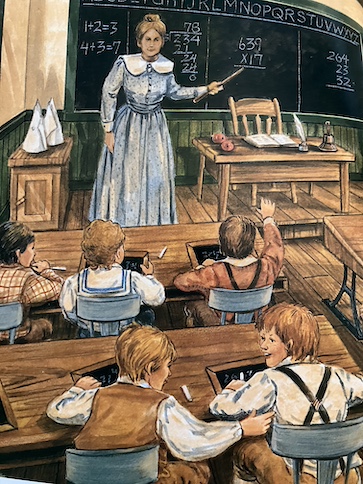
A One-Room School

Historic Communities

The book begins by saying that there was a time when not all communities had schools at all. In areas where the population was low, children had lessons at home or from a neighbor, if they had lessons at all. Towns and villages needed enough children living there to support even a small school. (The book doesn’t describe exactly when or where they’re talking about, but it’s implied that this is the United States or the American frontier.) When there were enough settlers in an area for a school, they might make a small log cabin for the school. As populations grew and there were more students, they would build better schools.

Requirements for teachers were different back then than they were today. Most teachers were men because married women were not allowed to be teachers. Only single women could teach. Teachers were also often required to handle rough students as well as teach them, and all ages and grades of students would study together in one-room schools. The teacher would manage the different grade levels by having them dividing them into groups based on their levels and having the different groups take turns reading aloud to her while other students did quiet work, like practicing writing. The teacher would set some students quiet tasks to do while focusing on a different group, and then, they would switch. Teachers were also responsible for the cleaning and maintenance of their school, but they typically assigned students chores to help with that. Local families would provide room and board for the teacher of their community, and they would also contribute toward the teacher’s salary.

Lessons were basic and focused mostly on the “three Rs” – reading, writing, and arithmetic. (Those three subjects contain the letter ‘R’ near the beginning, even if they don’t all start with that letter.) There was often little time to teach anything else, and these were the subjects that were most important to people with the most common jobs, such as farmer, craftsperson, or storekeeper. In schools that taught a wider range of subjects, students would also learn history (mainly focused on the United States), world geography, and grammar.

Small schools often had few books or supplies. Because paper was often in short supply, children would memorize lessons and verbally recite them back to the teacher and would practice writing on slates (small blackboards). When students were able to buy paper, they bought a blank notebook they called a copybook. The paper in the copybook wasn’t lined, so if they wanted lined paper, they had to draw the lines themselves, using a ruler.

A small school might also only have two books for the students to study: a primer for beginning readers (which showed the alphabet, numbers, and some basic spelling words and poems) and a copy of the Bible. The most popular series of books for building reading skills in the 19th century was McGuffey’s Eclectic Readers. The series started with a primer and continued with six readers, each one at a higher reading level than the last one to build more advanced reading skills. In the small, one-room schools, students would work through these books at their own pace. (Since all ages and grade levels were together in one room, there was little concern about each student moving to the next grade at the exact same time as their peers since they were all still going to be in the same room with the same teacher anyway. As long as a student was continuing to come to school and make progress, it didn’t really matter how fast or slow the progress was.)

The book describes the daily routines of students at small, one-room schools, including how they would get to school each day and what they would do at lunchtime and recess. Most children simply walked to school, although they often had to walk long distances to get there. Sometimes, they might ride a horse to school or get a ride from an adult in a wagon or sleigh, if it was winter. Children brought their lunches from home, but some schools also maintained a school garden. Most of the children from these small schools would grow up to be farmers, so gardening was a valuable skill for them to practice, and the students would also eat what they grew in the school’s garden. During the winter, they could make a soup with vegetables they grew on the stove in the schoolhouse (which also kept the schoolhouse warm) that everyone would eat for lunch. The schoolhouse stove could also be used to heat up foods that the children brought from home. Besides their lunch break, the students would also have two short recess breaks during the day. During recess, they could walk around outside, talk to their friends, play games, or play with toys they brought from home, like marbles. Toys were often homemade or easily improvised, such as using string to play Cat’s Cradle.

Sometimes, students would play pranks on their teacher or fellow students, such as hiding bugs and spiders to scare someone, pouring water on their seat if they got up, or covering the schoolhouse chimney to fill the school with smoke and smoke everyone out of the school. The last prank was dangerous.

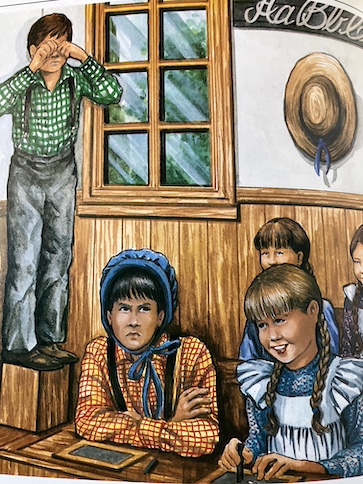
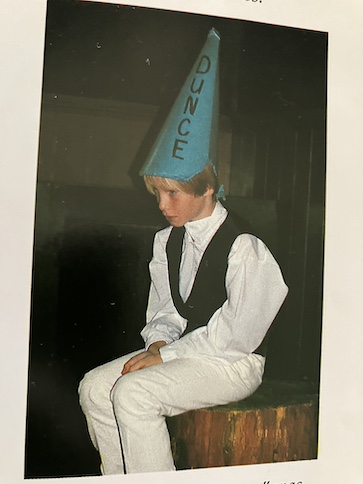
Punishments for pranks and misdeeds, such as being late or falling asleep in class, were at the teacher’s discretion. They could take whatever form the teacher thought was appropriate for the situation, and they could be as harsh and strict as the teacher thought was necessary. Sometimes, they could be a form of poetic justice, designed to fit the crime. We aren’t told why one misbehaving boy was told to put on a girl’s bonnet and sit with the girls in class, although it might have been a fitting punishment if his misdeed was teasing the girls. (That was just a guess of mine, that the teacher might have decided that, if he wanted to tease girls, he should try sitting in their place for awhile.) Some punishments were meant to teach lessons and reinforce the idea that children should not repeat certain behaviors, such as having the children repeatedly write lines, sentences that spelled out what they were supposed to do or not do. (For example, a student who was late to school could be assigned to write, “I will not be late to school” or “I will be on time to school from now on” a certain number of times.) Other punishments were purely for humiliation, like having a student wear a cap that labeled them as a “dunce”, in the hopes that the embarrassment would keep them from misbehaving again. (This could also be the goal of making a boy wear a bonnet and sit with the girls.) Punishments could even include physical punishments. Teachers were allowed to whip their students, if they though it was necessary, and some teachers even punished children who were physically fighting by making them take turns whipping or hitting each other with a stick. The book doesn’t explain the motive for doing this, but I think that they were probably emphasizing the idea that people who fight get hurt and that getting hurt is unpleasant to discourage them from fighting more in the future. I also suspect that the point of making them take turns hitting each other was to make it equal, so it wasn’t just one person beating up on the other, but that’s just a guess. When the students got home, and their parents found out about what they had done at school that day, they might even get a second punishment, on top of whatever punishment the teacher assigned them!

Sometimes, schools had special events for holidays or academic events that involved members of the wider community. For example, schools sometimes had spelling bees, including some where adult members of the community would watch or participate. Schools often had Christmas pageants, where children would sing songs or recite poems they had memorized or perform a play written by the students themselves. At the end of the school year, students would have oral exams in front of their parents and other community members, followed by a picnic with games.

The book ends with a section of games and activity suggestions designed to show modern kids what it might be like to be a student in an old-fashioned one-room school and compare their own schools to old-fashioned schools.

The book is available to borrow and read for free online through Internet Archive.

Books in the Historical Communities series focus mostly on the 1800s in the United States, but they don’t always mention exactly what time period they are describing. It’s often more implied than stated, and that’s true of this book, too. The book mentions the 19th century once or twice, but it doesn’t mention any specific date or date range.

The pictures in the book are a combination of drawings and photographs of real people in historical costumes, reenacting scenes at schoolhouses and the lives of the students. I liked the combination of real people and drawings to illustrate different concepts about life and education in old-fashioned, one-room schools.

There are some concepts of education in a one-room school that fit with the educational concepts of the modern Montessori system, such as having students of different levels being taught together and having students progress at their own rate in different subjects. In a way, I think that the Montessori system hearkins back to this one-room school style of education, and that’s examined in more detail in the classic children’s book Understood Betsy, which is by Dorothy Canfield Fisher, who was an early advocate of the Montessori method of education in the United States.

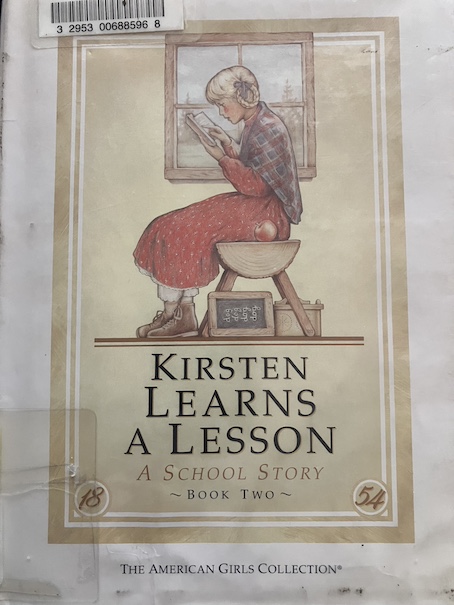
Kirsten Learns a Lesson

Kirsten, An American Girl

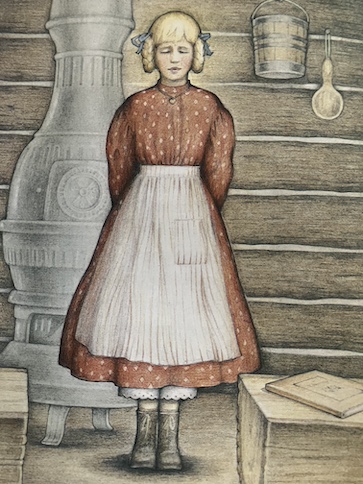
It’s November, 1854, and now that nine-year-old Kirsten’s family has settled in their new home in Minnesota and the harvest season is over, it’s time for the children to go to school. Kirsten and her brothers, Lars and Peter, will go to the small local school with their cousins, Lisbeth and Anna. Powderkeg School is a one-room schoolhouse in a little log cabin. Lisbeth and Anna’s stories about what Powderkeg School is like worry Kirsten. They talk about how strict their teacher, Mr. Coogan, is. Sometimes, the boys in class get rowdy and fight, and Mr. Coogan uses physical punishment on them. However, the girls tell Kirsten that she probably won’t have any problems with Mr. Coogan because he likes children who are well-behaved, and Kirsten is well-behaved. Still, Kirsten is nervous about what her new school will be like.

When they get to school, they learn that Mr. Coogan was injured in a fall from his horse, so they will have a replacement teacher, Miss Winston, who has only recently arrived from Maine. When one of the mean boys in class says he hops the horse also stepped on Mr. Coogan, Miss Winston tells him that nobody talks out of turn in her class and, although they live in the country, “we are not savages like the Indians.” (This is a 19th century attitude toward Native Americans, but this concept is challenged later in the story.)

Miss Winston has each of the children in class introduce themselves so she can get to know everyone. When it’s Kirsten’s turn to say her name, she forgets to address her teacher as ma’am, like the other students. Miss Winston insists that she say “ma’am”, and when she sees Kirsten struggling with the language, she asks Kirsten if she speaks English. Kirsten says that she speaks a little, and her cousins explain that her family just came from Sweden and that they speak Swedish at home. Miss Winston says that “practice makes perfect”, so Kirsten will practice her English in school. For now, she will have the easiest lessons and share seven-year-old Anna’s schoolbook.

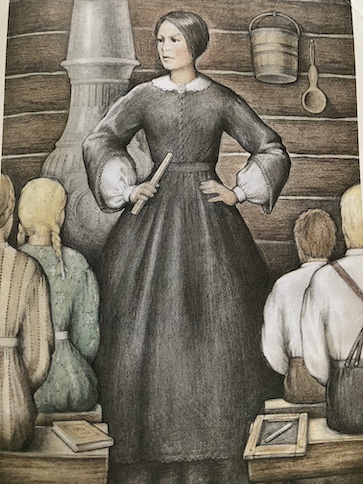
When the mean boy, Amos, laughs at Kirsten, Miss Winston glares at him and strikes the school’s iron stove with her ruler, startling the students. Miss Winston says that her father was a ship’s captain, so she knows how to be in charge of her students, like he was in charge of his crew. Then, she deconstructs the sentence “Miss Winston hit the stove”, pointing out which words are the subject, verb, and direct object of the sentence. Then she warns the class to “Be careful that the direct object of hit isn’t the student.” The implication is that Miss Winston is just as willing to use physical punishment against her students as Mr. Coogan was.

When Amos introduces himself to Miss Winston, we learn that he is nineteen years old, the same age as the new teacher, but the new teacher says that, in spite of being the same age, she’s still the teacher, and he’s the student. In spite of being more a young man than a boy in age, Amos has only just finished the third reader, and Miss Winston says her role is to help him read and do math like a man would, embarrassing Amos. (He can’t use his age to put himself on an equal footing with the new teacher because they are not intellectual equals. She’s the same age, but she has graduated from her own school and become a teacher, and he’s still struggling along with low level math and reading.)

Anna helps Kirsten with her lessons, and Miss Winston praises her for helping to teach Kirsten, but she doesn’t praise Kirsten for doing a good job. At the end of the school day, Kirsten and her cousins talk about the new teacher. Anna thinks that Miss Winston seems nice, but Kirsten thinks that Miss Winston doesn’t like her and that she seems very strict. She asks if that was what Mr. Coogan was like, and Lisbeth says he was worse. The best part of the day for Kirsten was lunchtime, when the children were allowed some play time. When she ran around and played tag with the other children, it didn’t matter if she didn’t speak much English.

When the girls play school with their dolls, Anna imitates Miss Winston and her comment about “savages.” Kirsten asks the other girls what that word means. They say it means “wild.” Kirsten asks them if the Indians (Native Americans) are really like that, and they say that some people say they’re kind and will help people if they need food but others day that they’re “cruel and bloodthirsty.” They’ve seen an Indian man before. He came to their house when their mother was roasting meat, and he left when their mother gave him some. They thought he looked pretty “savage” because his face was painted, and he had eagle feathers in his hair. The girls say that Native Americans also wear knives and live in tents. As a farmer, their father is concerned about the Native Americans. He knows that, if the farmers take too much of their usual hunting grounds for farming, it will drive away the animals, and the Native Americans will be starving and angry. While he is happy that he has been able to secure some farmland for his family (I explained a little about the famine conditions and lack of farmland in Sweden around this time that caused people like the Larsons to leave their country when I covered Meet Kirsten), he is aware that the Native Americans also need land for their survival.

At school, Miss Winston announces that each student will memorize a poem and recite it for the class. When they recite their poems, she wants them to say them with feeling and show the emotions their poem is trying to convey. Kirsten worries about this assignment because she’s still learning English. It’s hard enough for her to learn to read anything in English and understand the meaning of the words. She doesn’t know how she can also learn to memorize an entire poem and say it in front of everyone. Miss Winston gives Kirsten a short poem to learn, but having even a short one doesn’t seem to help Kirsten.

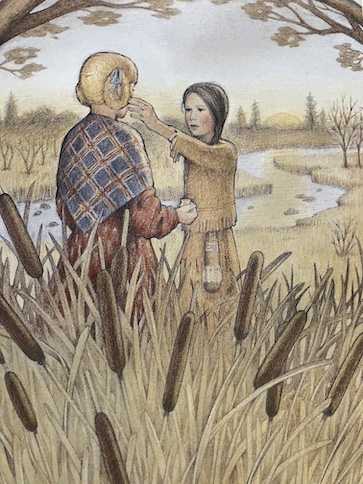
Meanwhile, Kirsten has her first encounter with a Native American when she spots an Indian (Native American) girl watching her while she’s getting water from the stream. The girl runs away, but Kirsten finds a blue bead that she dropped. Kirsten takes it and leaves her a little pretend cake that she and her cousins made for their dolls. Later, she finds that the cake is missing and that there’s a green duck feather in its place. She and the Indian girl trade little objects in this way, gradually becoming friends.

Kirsten’s secret friendship with the Native American girl becomes a comfort to her when school is stressful. Frontier teachers often board with families who live near the school, and when Miss Winston comes to stay at Kirsten’s aunt and uncle’s house, Kirsten feels like school is following her home. What’s worse is that Kirsten’s family will be joining them for dinner, and they will practice English during the meal. Kirsten knows that the meals, instead of being comfortable family time, will now be like lessons, and they will struggle to say things they would want to say because her family still hardly knows English. Worse yet, Miss Winston is cross with Kirsten because she can’t seem to memorize even her short poem.

Sneaking away to visit the Native American girl, who is called Singing Bird, gives Kirsten an escape from her struggles with English. Somehow, Kirsten and Singing Bird manage to communicate well enough with each other, even though neither of them speaks each other’s language. Then, Singing Bird takes Kirsten to see her village. To her surprise, Kirsten realizes that she has been gradually teaching Singing Bird English words without realizing it. However, Singing Bird’s people are going to be moving on soon. Kirsten’s uncle is correct that farming is driving away the animals the Native Americans depend on for food, and they’re suffering for it. Singing Bird invites Kirsten to come with her tribe when they leave, and it’s tempting to think of living an exciting life, traveling with Singing Bird and not going to school. But, is that what Kirsten really wants?

The book ends with a section of historical information about frontier schools in the mid-1800s.

The book is available to borrow and read for free online through Internet Archive (multiple copies).

Along with the first book in the series, this is the book that I remember the best of the Kirsten books. I think I either didn’t read the others or didn’t finish them because there are some sad things in the Kirsten stories that I didn’t like. In the first book, Meet Kirsten, another child Kirsten befriends on the journey to Minnesota dies of cholera. It’s historically accurate that some children died of disease on the journey west, but it was still hard to take. I also talked about how the reason why families like Kirsten’s wanted to come to America was that Sweden was experiencing famine around this time. The first book didn’t say much about that, but in this book, Kirsten remembers experiencing hunger in Sweden when her father’s crops failed and how her little brother cried from hunger.

Kirsten understands the plight of the Native Americans when they have to move to a new area when their food supplies run low. However, when Singing Bird invites Kirsten to come with them, she realizes that would mean leaving the rest of her family, and she can’t do that. While it’s tempting to go with her friend and escape the problems in her life, Kirsten can’t do that without also giving up the good things in her life and trading the problems in her life for a different set of problems. Although there are appealing aspects to their lives, the Native Americans also have their own struggles. To use an old adage, the grass isn’t always greener on the other side of the fence. People say it in different ways, but just because someone else’s situation is different doesn’t always mean that it’s better.

In this book, we also see what it’s like for Kirsten’s family as they begin learning English, so they can communicate with other people in their new country, and the children begin going to school. The little frontier school is different from other schools they’ve experienced before, and the teachers are strict. They have to be strict because some of the students are rough and fight with each other physically, and they have to make it clear that they’re not going to put up with that. This is a real-life aspect of schools from this time period. Fortunately, we never see the teacher actually using physical punishment against anybody. She just threatens to do it so her students will think twice about misbehaving.

When Miss Winston comes to board with Kirsten’s relatives, Kirsten thinks that everything is going to be worse, that she’s constantly going to be bombarded with lessons and the problems she’s been having at school. However, it turns into an opportunity for Kirsten and Miss Winston to get to know each other better. At first, Miss Winston can’t understand why Kirsten is having such a difficult time remembering her poem, even though it’s pretty short and easy. It’s partly because she’s still having difficulties with her English, but also, the content of the poem has no relation to anything currently happening in Kirsten’s life. It doesn’t interest her, and her mind is preoccupied with all the changes happening in her life, making it difficult for her to focus on the poem and remember it. When Miss Winston shows Kirsten a model of her father’s ship, it brings back memories of the ship Kirsten’s family traveled on when they came from Sweden. Miss Winston realizes that Kirsten has strong memories of the ship, so she gives her a different poem to memorize, one about a ship. Kirsten finds this poem easier to remember because it connects to memories she already has.

Although Miss Winston can be tough, she genuinely does care about Kirsten and looks for ways to help her learn. It just takes time to figure out the best way to help her, and Kirsten also needs time to adjust to her new language and new home. Once Kirsten sees that it’s possible for her to learn and for her new home to begin feeling like home, she begins to feel better about her new life in Minnesota.

I enjoyed the realistic aspects of the story and the references to historical events and real life conditions on the frontier. I think I liked this story better as an adult because I understood more about the historical background than I did when I was a kid. Parts of this series are still sad. Kirsten remembers people being sick and dying on the journey to America, and although she doesn’t go into detail about it, her family did suffer genuine hardship in Sweden.

Magdalena

Magdalena is switching classes at school. She’s happy about it because she found her old class too chaotic. She thinks she will be happier in her new class. Her friend in her current class at school, a boy named Saul, tells her that she must be an IGC, an Intellectually Gifted Child, in order to get transferred to that class because that class only takes gifted children. However, she is told that she will also have to wait a little for them to give her a desk in the room. When months go by without her being told that there is a spot ready for her and she can make the switch, Saul thinks that they were probably lying to her about her being able to switch classes.

Finally, in January, she is able to switch to the new class, but right away, she runs into trouble with the class bullies. A boy named Andy and his friend start calling her “Miss Two-Ropes” because of her long braids, and the name sticks. Magdalena wishes that she didn’t have to wear her hair in braids, but her grandmother, Nani, insists on it. She loves Nani, who is from Puerto Rico and has looked after her for last two years, ever since her mother died when she was nine years old, but Nani has some old-fashioned ideas about how girls ought to be raised.

Magdalena’s father is a sailor, and he spends much of his time away at sea, so Magdalena and her grandmother are alone most of the time. Nani speaks Spanish to Magdalena at home because she thinks that’s proper for a Puerto Rican family like theirs, although Magdalena speaks English at school. She thinks that her grandmother probably knows more English than she pretends. Nani also keeps a portrait of Great-Grandfather Mendez, which she brought from Puerto Rico. Although he has been dead for years, the portrait always feels like a living person to Magdalena.

After some further teasing from the boys in her class, Magdalena decides to tell her grandmother that she doesn’t like her braids. Nani says that not unusual, that many children don’t like their braids, but they get over it. Magdalena doesn’t think she’s going to just get over it. Like a lot of kids, she would rather just look like everyone else so she won’t get teased, but Nani doesn’t approve of the short hairstyles that are popular among American girls at Magdalena’s school. She says that Magdalena’s braids are a mark of pride and a caring grandmother who brushes and braids her hair. She thinks the American girls wear their hair short because their mothers can’t be bothered to spend time on caring for long hair, and they don’t have grandmothers to nurture them. When Magdalena tells her that the boys at school are calling her names because of her braids, her grandmother decides that she should talk to the teacher about it. Magdalena thinks that having her grandmother talk to the teacher might be more embarrassing than having the boys call her names, so she persuades her grandmother to forget about it for now and let her handle it.

Then, Magdalena is called to the principal’s office at school. At first, Magdalena is upset because it sounds like she’s in trouble, and she can’t understand what she could have done to cause that. She is calmed a little when a black boy in the office, who is also waiting to talk to the principal, is nice to her. It turns out that Magdalena isn’t really in trouble. Instead, the principal wants to talk to her about one of her classmates, a girl named Daisy Gonzales, who is also transferring into her new class.

Madgalena is surprised because Daisy hasn’t struck her as a gifted child. Most of the other students call her “Spook” because she tends to lurk around the school and suddenly jump out at people to scare them, and she is known to frequently skip classes. The principal says that Daisy might be gifted, but it’s difficult to tell. The teachers think that she’s at least bright, but she’s an “under-achiever.” The principal explains that means that Daisy could do better at school than she does, but for some reason, she doesn’t seem motivated to do better. That’s why they’ve decided to transfer her to the class with the gifted students. They think that she isn’t being challenged enough in the class where she is. The teachers are also concerned that Daisy has no friends at school. They’ve noticed that the other girls at school seem to be afraid of Daisy, although they don’t seem to understand about Daisy’s “Spook” act. They do know that Daisy has behavioral problems and an unhappy home life. The reason why the principal is telling Magdalena about this is that she wants Magdalena to try to be Daisy’s friend when she transfers into her new class. The reason why she selected Magdalena to be Daisy’s new friend is because Daisy’s family is also Puerto Rican, like Magdalena’s family, so she thinks that the girls might understand each other better than their other classmates. The principal thinks that Daisy might settle down at school if she had a friend to help her feel more comfortable there. Magdalena isn’t comfortable with the idea of trying to be Spook’s friend because she also finds Daisy spooky, but the principal persuades her to try but not to let on that the principal asked her to do this.

Magdalena has no idea how to approach Daisy/Spook to be friends, since she’s not the easiest person to approach about anything. Then, Sue Ellen, the most popular girl in class tells Magdalena that she wants to be friends with her. She says that she’s been feeling empathy for her since the first day that she came to class and the boys started teasing her, and she felt it again when she got called to see the principal. She asks her what the principal wanted, and Magdalena explains that she asked her to do something, but it’s something really hard, and she isn’t supposed to talk about it. Sue Ellen offers to help her with whatever the principal’s task is. Magdalena thinks maybe making friends with Spook won’t be so bad if Sue Ellen helps, so she takes Sue Ellen into her confidence. Sue Ellen agrees with Magdalena that making friends with Spook would be hard because she’s so weird and spooky. Both girls admit that they’re a little afraid of her, but Sue Ellen agrees to try to be basically nice to Spook along with Magdalena and see what happens. Sue Ellen says that the principal ought to have more empathy for the students and see just how hard it would be to get along with someone like Spook.

Their first attempts at making friends with Spook are clumsy. Sue Ellen tries offering her advice, pointing out that she wore the wrong thing to the school assembly, but criticism and advice aren’t the best ice-breakers. Then, to Magdalena’s surprise, Spook approaches her in the school library, when she is trying to find a specific book for her grandmother. The school library doesn’t have the book she wants, but Spook says that she knows where to find it. However, she will only help Magdalena if she plays hooky and goes with her right now. Magdalena hesitates because she doesn’t really want to skip class and get in trouble, but Spook says that Magdalena will have to come with her because she’s “emotionally disturbed” and might do crazy things if she doesn’t get her way. Magdalena points out that school will end in only 20 minutes, and she asks Spook to wait for her. Spook makes her promise that she won’t change her mind and let her down in that time.

When Magdalena waits for Spook, she doesn’t show up at first, but Spook jumps out at her just when she’s giving up waiting. Spook says that she just wanted to see if Magdalena was serious about wanting to come with her. The place where Spook knows they can find the book turns out to be the Brooklyn Public Library. Along the way, Magdalena begins to learn more about Spook. The reason why she wasn’t dressed right this morning was that the sweater she was wearing was the only thing she had to wear that was clean. She skipped out during the school assembly to go home and see if her mother was back from the laundromat so she could put on something else. Also, Spook isn’t completely friendless. She is friends with a strange woman named Miss Lilley, who wears an unusual, large hat. When Daisy tells Miss Lilley that she got put into the class at school with the smart kids, Miss Lilley congratulates her and tells her that she knew she was smart. Daisy admits that she’s been trying not to let her teachers know that she’s smart because she knows that they will expect more of her and insist that she do all her homework. People don’t expect so much of kids who aren’t bright. There is method to Daisy’s madness. All of her weird and spooky acts are tools that she uses to get her, get out of things that she doesn’t want to do, cover up for problems that she has, and keep people she doesn’t like or doesn’t think would understand her at a distance.

Daisy introduces Magdalena as one of the smart kids from her class, but Miss Lilley thinks that Magdalena’s manners aren’t very polite because she keeps staring. Magdalena has trouble getting over the large hat, which looks like a large pumpkin. Miss Lilley begins evaluating Magdalena’s appearance, and Magdalena comments about how she hates her braids, but her grandmother makes her wear them. Miss Lilley says that she understands that her grandmother likes the quaintness of the braids, but she knows how to deal with that. She also knows where to find a good barber. The black boy who was nice to Magdalena earlier, Samson Shivers, makes money after school by shining shoes outside the library, and when Miss Lilley asks him if he would be willing to lend them money for the haircut, he joins the others at the barber shop. Miss Lilley takes the kids to the barber shop, and Magdalena gets a haircut. Magdalena feels wonderfully free after he haircut, although she saves the braids as a souvenir and worries about what her grandmother will say when she gets home.

Nani is very upset when she sees Magdalena’s short hair and worries that Magdalena is rejecting her care for her and her Puerto Rican heritage. Magdalena says that’s not the case and explains about going to the library and meeting Miss Lilley. Magdalena’s grandmother thinks that she’s bewitched and says that she knows how to deal with that. She uses herbs on Magdalena to break the bewitchment.

Getting the haircut changes things for Magdalena. The boys stop teasing her, which is a relief. However, Sue Ellen is annoyed that Magdalena didn’t tell her that she was going to get her hair cut. Magdalena explains that it was a sudden decision and a possible bewitchment by Miss Lilley. Sue Ellen thinks that Spook is probably the one who bewitched Magdalena because she’s so spooky and that maybe Magdalena would rather be best friends with her. Magdalena says that’s not the case and that she doesn’t see why she can’t be friends with both girls. Sue Ellen still expects that Spook is going to do something to ruin the class, but Magdalena notices that Spook is becoming less spooky in their class. She stops skipping classes, does more of her homework, and cuts out some of her previous spooky behavior.

Samson, often called Sam, is a practical boy, and when Magdalena tells him how her grandmother thinks Miss Lilley is a witch and bewitched her, he says that she can’t be a witch. Sam sees her often because he shines shoes by the library, and he realizes that Miss Lilley is actually just a poor, old woman. She goes to the library all the time because she can’t afford proper heating for her apartment. She often has little to eat, and she partly survives off of candy that he gives her. Like Spook, she seems spooky because she looks odd and behaves oddly, but there are explanations for what she does that show that she’s actually unfortunate.

Magdalena’s grandmother meets Spook for the first time when Spook hangs out with Magdalena at her apartment after school. Nani isn’t home at the time, but the girls talk to each other about their lives and families. Magdalena gets to know more about Spook, and Spook admires the place where Magdalena lives. Spook’s family lives in a much poorer apartment, and it’s crowded with Spook’s younger siblings. Spook admires the nice bathtub that Magdalena and her grandmother have and says that she wishes they had one at her apartment. Part of the reason why she looks so strange is that she doesn’t get the opportunity to take baths often. Magdalena tells her that if she wants a bath, she can go ahead and take one. Nani arrives home before Spook is finished with her bath, but Nani stops her when she tries to get out and get her clothes. Nani can see how badly Spook needs some care, so she insists that she finish the bath, clean the tub, and let her shampoo her hair. When she’s done, Nani has Magdalena loan her some clean clothes, and the girls are amazed at the transformation.

After the bath incident, Spook avoids Magdalena for a while, and she can’t understand why, but it’s about Spook realizing what’s been lacking in her life and envying what Magdalena has: someone who really cares for her. She was so emotional when she looked at herself in the mirror that she spit at the image and then was embarrassed that she had done that. Nani surprisingly understands Spook’s behavior. She can see that Spook lacks impulse control and the ability to understand and manage her feelings. Nani comments that she’s angry with Spook’s mother because she can tell that the girl has been badly neglected. Having been a mother and grandmother herself, she knows exactly how to deal with this.

Meanwhile, Sam is correct about Miss Lilley. Miss Lilley is poor and not in very good health, but she also knows what Magdalena and Spook/Daisy need. She is eager to help the girls, but she also needs some help and attention herself. When Miss Lilley decides that it’s time to have a word with Nani about the needs of modern girls and her fears about her granddaughter becoming too American, a number of things get better.

The book is available to borrow and read for free online through Internet Archive.

The heart of this story is understanding and empathy. By the time it’s over, many of the characters come to a better understanding of each other and maybe themselves. Although Spook’s transformation is the most dramatic, the other characters are also changed after their experiences in the story.

Magdalena’s changes come with her admission to her grandmother that she really doesn’t like her braids and then with her decision to have her hair cut against her grandmothers wishes. She knew that her grandmother wouldn’t like it when she said that she didn’t want braids because her grandmother is a traditionalist, and she knew that Nani wouldn’t react well to the haircut. At first, it was easier for Magdalena to buy into the idea that Miss Lilley was a witch who bewitched her into doing it, but that’s not really the truth. It wasn’t even that Magdalena was getting her hair cut just because of the teasing. When Magdalena and Spook are talking about whether or not they truly understand the reasons why they do things, Magdalena acknowledges that she has reasons for the things she does, and the truth is that she got the haircut because she herself really hated wearing braids. If she had really loved her braids, she could have kept them in spite of the teasing, and she could have turned down the offer of a haircut, but she really wanted to change her hairstyle, and she just took advantage of the opportunity to do it.

Nani understands from the first time she meets Spook that she has not had nearly the level of care and attention that she has needed in life. Spook doesn’t even really understand all of the motivations she has for the things she does. Her behavior is odd partly because she acts on impulse, not fully thinking about the consequences or the affect her behavior has on others. She initially doesn’t have much self-awareness because she has not had caring adults in her life to teach her how to behave, how to understand her feelings, and how to control herself. Because she hasn’t really had any friends before, she hasn’t really had anyone to talk to about these things and help give her some perspective. When Spook and Magdalena talk about why she spit on the mirror, Spook says at first that she isn’t sure why she did it. As they continue to talk about reasons for doing things, though, Spook admits that she did it because, while she was stunned at how nice she looked, she quickly became upset because she didn’t think that nice look could last.

Nani is the nurturing type of person, and she quickly sees that Spook is in dire need of some nurturing and guidance. She also recognizes that Spook doesn’t have much confidence in herself. She is bright, but she has grown used to hiding it. She also thinks, because she doesn’t really understand her feelings or behavior, that is can never really control herself. She thinks that she will always be a “stinker” who does things that she shouldn’t and acts weird. Nani has a frank talk with her and tells her that she can be herself without being a “stinker”, and the first step is believing that she can. Even if she’s not in the habit of understanding and controlling herself, she can learn. People have different sides to their personalities and different ways of expressing themselves, and Spook can learn how to show the best sides of herself in the best possible ways.

Magdalena appreciates that Nani is understanding and helping Spook, but she also has a frank talk with her grandmother about why she doesn’t understand her own granddaughter as well. When Magdalena tries to tell her what she wants or doesn’t want, Nani contradicts her or ignores her feelings. Nani is understanding with Spook because she can tell that Spook is a disadvantaged child, but she doesn’t see her granddaughter the same way, so she doesn’t try to understand why Magdalena sometimes does things she doesn’t like. Nani admits that she wanted her granddaughter to be “perfect”, but maybe she doesn’t really know what “perfect” actually is. She wants the traditional ways for her granddaughter because she really thinks that’s what’s best, but even grandmother doesn’t always know what’s best.

Miss Lilley is concerned about the girls and offers them attention and support. When she goes to see Nani and open her eyes to her grandmother’s needs and the ways of modern girls, she collapses because of her bad health. Fortunately, Nani is a nurturing person, and she nurtures Miss Lilley, making sure that she gets the treatment she needs and even looking after her when she gets out of the hospital. Miss Lilley’s health improves, and the two of them become friends. Although they are both older ladies, they each admit that they have things to learn in their lives, and they can learn from each other. Nani helps her to make changes to her living arrangements so she will be healthier and more comfortable, and Miss Lilley helps her understand what modern American life has to offer for girls like Magdalena.

Samson is always a very understanding character because he is genuinely interested in people, and he meets many different types of people through his shoe-shining business. Although Sue Ellen is the first person who brings up the topic of empathy, she is really the one who understands it the least. I think her relatively narrow view of empathy is because of her relatively narrow life experiences. She feels some empathy for Magdalena because she sees Magdalena experiencing something she understands, but she doesn’t seem to know what to do when she encounters something she doesn’t understand. Admittedly, Spook’s spooky act is off-putting, partly by design and partly because Spook has issues she herself doesn’t know how to handle. However, because Sue Ellen only wants to stick to the familiar and understandable, she doesn’t notice when Spook begins to change and doesn’t see how some support from her could influence her for the better. Sue Ellen’s attempts at friendliness and helpfulness often involve offering some kind of criticism, like pointing out that Spook isn’t dressed right. Magdalena can tell that Sue Ellen is trying to be helpful, but she’s also kind of snippy and smug in the way she does it, and that gets on Magdalena’s nerves, too. Sue Ellen kind of fades out of the story toward the end, so we don’t know if she continues being friendly with Magdalena or not or if she ever recognizes Spook’s transformation.

There is also a subplot that I haven’t mentioned about the literary magazine that the girls’ class starts. Their teacher has some thought-provoking descriptions about what good writing is and does, and the girls’ choices of what to write about are based on their experiences and the changes in their lives.

The book doesn’t shy away from the harsh realities of life. Magdalena’s mother is dead, and her father is away most of the time, so she is being raised by her grandmother. Her father never even makes an appearance in the story. Miss Lilley is a poor and lonely old woman who needs help and friends. It is acknowledged that Spook is a neglected child, and she even tells Magdalena that her favorite brother died at age three because he was asthmatic, and they were living in bad conditions. We don’t know exactly how her family came to be living in such bad conditions, but Spook says that, if she wrote a story about her family, the teacher would think she had a filthy mind.

Since the story is about understanding other people, one could consider whether we might view Spook’s neglectful mother more sympathetically if we knew her past and what led her to the situation they’re now in, but we do not see Spook’s mother at any point in the story. I think it’s also important to note that understanding does not equal approval. You can know a person’s history and reasons for doing things and still not agree with them. Maybe Spook’s mother is another unfortunate soul who needs some help, but if she is, she doesn’t seem to be looking for that help. Her vulnerable children are suffering for it, and one has died. Empathy doesn’t mean saying that things are okay when they really aren’t, and this mother’s neglect of her children is not okay.

Down a Dark Hall

Down a Dark Hall cover

Fourteen-year-old Kathryn Gordy, called Kit, is going to boarding school for the first time. She doesn’t really want to attend the Blackwood School for Girls, but her widowed mother has remarried, and she and Kit’s new stepfather, Dan, will be going on an extended honeymoon in Europe. Kit tried to persuade her mother to take her with them on the trip to Europe, but Dan is firm that she can’t come on their honeymoon trip. The Blackwood School has a good reputation, and graduation from the school would guarantee Kit entrance to a good college. At first, Kit thought it might not be so bad if her best friend, Tracy, could attend the school, too, but although Tracy applied to Blackwood, she wasn’t accepted there. Kit hates the idea of going there alone. Worse still, when her mother and Dan take her to the school, it’s an imposing, castle-like mansion that gives Kit the creeps. Her mother and Dan think it looks impressive, but just the sight of the building gives Kit a terrible sense of evil. Even though she doesn’t want to stay, her mother and Dan insist.

Because her mother and Dan have to leave on their trip, Kit has arrived at the school a day early, before classes will start. Madame Duret, the headmistress of the school, welcomes them and explains a little about the school’s history. The school is fairly new. Before it was a school, the mansion was the private home of a man called Brewer, who died about ten years ago. Because few people would want a house that size outside of town, the building was vacant for some time before the Blackwood School moved in, and there are some ghost stories and urban legends about it in the area. Kit’s mother and Dan laugh it off.

Madame Duret gives them a tour of the school and mentions her art collection. She says that she enjoys collecting lesser-known works by famous artists. The dorm rooms are incredibly luxurious. Each student will have a room to herself with a private bath and a canopied bed with velvet draperies. Art is important to Madame Duret, and she says that she wants the surroundings to inspire her students. When it comes time for Kit’s mother to say goodbye to her, her mother asks her if she thinks she could be happy at the school. If Kit really feels like there’s something wrong with the place, her mother is willing to delay her trip and make other arrangements. Shrugging off her earlier misgivings, Kit tells her mother that she will be fine, and her mother and Dan leave.

The school still bothers Kit, but she feels like she has to try to do well there for her mother’s sake. She knows that things have been hard for her since her father died several years before. Although nobody believes her, Kit remembers seeing her father’s ghost in her room the night he died in a car accident while he was on a business trip. Her mother has managed since then, but she wasn’t really happy until she met Dan, and Kit appreciates that her mother needs adult companionship. Still, Kit senses that this school is very strange, and there are things wrong it it. She can’t figure out why her friend, Tracy, was rejected by the school. The canopied bed is luxurious but kind of creepy because it reminds her of a scary story. Then, she notices that the bedroom doors have locks on the outside of the doors but not the inside.

At dinner that evening, Kit meets Professor Farley, who is a teacher at the school, and Madame Duret’s son, Jules. Professor Farley teaches math and science, and Jules, who has only recently gotten his degree, will teach music, giving the students piano lesssons. Madame Duret herself teaches languages and literature, and apart from these three, there are no other teachers at the school. Professor Farley says that he is the one who convinced Madame Duret to open a school in the United States, having seen her success at her school in England. A young cook named Natalie also works at the school, but strangely, Natalie says that Madame Duret doesn’t want her to speak to the students much.

When the other students begin arriving, Kit realizes that there aren’t going to be many students at this school, either. In fact, there are only three other students besides Kit: Sandy, Lynda, and Ruth. All of the girls also seem to be somewhat removed from their families. Sandy is an orphan who lives with her grandparents, who don’t drive, so they didn’t even drop her off at the school. Lynda and Ruth have both been to boarding schools before, and they were dropped off by a chauffeur. They say that Blackwood isn’t like their old school. Kit still wonders why Tracy wasn’t accepted to the school when there are so few students. Kit realizes that she herself isn’t a top student, and the other three students at this school are quite different from each other. However, Professor Farley says that there are other qualifications besides grades, and all of the girls at this school have the qualities they were looking for. Madame Duret refuses to discuss test results at all.

Kit does her best to settle into the school. Everyone acts nice to each other, and the classes are like having private tutors because there are so few students. However, Kit is still nervous and having strange dreams. She never remembers what she’s been dreaming about, but she dreads these strange dreams, so she has trouble getting to sleep. The only way she can get to sleep is to exhaust herself by reading and writing letters late at night until she is exhausted.

One night, while Kit is writing a letter to Tracy late at night, she hears a scream that is choked off suddenly. Although Kit is afraid, she feels like she has to investigate and find out if there is someone in trouble. She thinks the scream came from Sandy’s room. When Kit tries to check on Sandy, Sandy doesn’t answer, and she has trouble getting into Sandy’s room. Kit feels like there is someone in Sandy’s room, and the room is weirdly cold. When Kit finally gets the light on, Sandy is a little disoriented. She doesn’t remember screaming, but she remembers a strange dream about a young woman in old-fashioned clothing, who was watching her. Sandy tells Kit that she’s had strange dreams like this before, although not about this particular woman. When her parents were killed in a plane accident, Sandy sensed the accident when it happened, and she saw her parents in a dream, not unlike the apparent dream that Kit had about her father when he died. The next day, Kit talks to Lynda and Ruth and learns that they have also been having strange dreams that they have trouble remembering.

These dreams seem to be the one thing that all four of the Blackwood girls have in common, and all of them find them disturbing. When Kit has morning piano lessons, she feels strangely tired and her fingers are sore, as if she’s been playing the piano for hours already. Kit tries to talk to Jules about the strange things that have been happening and her own sense of unease. He tries to give her reasonable explanations, but from the way he speaks, Kit has the uneasy feeling like he knows something that he’s not telling. Jules tells Kit that he’s had some strange dreams himself, but he thinks it’s just the atmosphere of the strange old house. Kit asks him if he’s still having the dreams, and he says he is, but he also likes the house and thinks that it’s just a matter of getting used to the place.

Strange things continue to happen at the school. Lynda wakes up from a nap and suddenly draws an incredibly realistic portrait of Kit when she’s never even taken art classes or done any drawing before. Then, someone steals the portrait out of Kit’s room. Letters and post cards from Kit’s mother and Tracy reveal that they haven’t received any of the letters that she’s been writing to them. Sandy tells Kit that she has a sense that Blackwood School is evil, just like Kit felt when she first arrived.

Ruth is the one who realizes that all of the girls have ESP. Sandy and Kit both experienced ESP when they saw visions of their dead parents. Ruth admits that her excellent grades are only partly due to her naturally high IQ. She can also sense the contents of books without reading them and read the minds of people giving her tests, so she can give them exactly the answers they’re looking for. Lynda isn’t as bright as the other girls, but Ruth has been friends with her for a long time and has discovered that Lynda has memories of herself in a past life, when she lived in Victorian England. Ruth realizes that the girls’ psychic abilities are the reason why the four of them, and only the four of them, were chosen to be students at Blackwood School. The school has a dark purpose beyond providing an education, and these four isolated girls are there to fulfill that purpose.

The book is available to borrow and read for free online through Internet Archive. It was also made into a movie in 2018.

I read this book because it was mentioned as a book a character was reading in another children’s book, The Shimmering Ghost of Riversend, and because it occurred to me that it would fit the Dark Academia genre that’s been popular in the last few years. The reason why this book was mentioned in the other story is that both books involve ghosts who have the ability to act through other people and help them to do things that the living people couldn’t do by themselves. I have a tolerance limit on scary stories, but I felt like I had to read this one because it was mentioned in the other book, and I was curious about it. I’m not sure that I want to see the movie because trailers of the movie make it look even darker than the book, but the book didn’t go beyond my tolerance limits.

In Down a Dark Hall, Madame Duret has psychic abilities of her own and is using girls with psychic abilities to channel the spirits of famous dead people so they can complete works that they were unable to complete in life. Lynda draws and paints pictures that she shouldn’t be able to produce because she has no natural talent for art or training in it. She also begins signing her pictures with the initials TC because she is actually channeling the spirit and abilities of Thomas Cole. Sandy begins writing sonnets without having any prior interest and ability in poetry before because she is channeling Emily Bronte. Ruth finds herself making mathematical notes that are really too advanced for her and barely within her understanding. She’s not sure who she’s been channeling because the scientific and mathematical principles she’s been receiving have little personality attached to them. The reason why Kit’s fingers are always sore and she’s so tired every morning is that she’s been channeling Schubert and other musicians, playing piano music at night. There is one night when multiple musicians fight to control her and get their music out.

The girls are not channeling these spirits through any will or conscious effort of their own. Each of these episodes occurs either while the girls are asleep or just after they wake up from having been asleep. Madame Duret isn’t just facilitating this possession for the sake of art, literature, and scholarship, but also out of greed. She is known for having an impressive collection of works of little-known works of art from famous artists, but what no one else knows is that those works were not produced within the artists’ lifetimes. She has performed this same trick of using the psychic abilities of students to channel the spirits of dead artists to produce new works before, and she artificially ages these works so no one knows that they are new instead of previously-undiscovered works.

Being possessed by the spirits of the dead is disturbing enough, but the girls of Blackwood School also come to realize that the psychic bonds between them and these famous spirits are getting stronger over time. If they don’t find a way to escape Blackwood School soon, they will become permanent. Records in Madame Duret’s office reveal that some of her previous students died from their experiences, and others lost their minds and ended up in mental institutions. No one could stand this type of channeling over the long term and keep their sanity intact, and the spirits themselves don’t seem to have much or any concern for the well-being of the girls channeling them. They seem to have so many ideas that they want to get out that they push the girls harder and harder to produce them. Some of the spirits are gentler and more personable than others, but some regard the girls simply as tools to be used. They can even get violent when the girls resist them or when different spirits interrupt each other’s work. This is a very creepy book, and the girls have some close calls, but fortunately, it has a good ending. I like atmospheric books, but I don’t like books that are overly dark, and I was relieved that all the girls survived. I would have found it hard to take if children died during the course of the story.

Although I knew before reading the book that the story involved ghosts and possession, I initially thought that the isolation each girl has from family and friends was part of the reason why these particular girls were chosen for the school. Before I found out that each girl has psychic abilities, I noticed that none of them are in a position where they are very closely watched by their relatives. Kit’s mother and stepfather are going to be traveling through Europe, so they won’t be trying to visit the school anytime soon, and it would make sense if they didn’t hear from Kit for a while. Sandy is an orphan whose grandparents can’t travel easily, so they won’t be coming to check on her every weekend. Lynda’s mother is an actress who now lives in Italy, so again, there is a separation by great physical distance. Ruth’s parents are busy professionals with doctorates. None of the girls is likely to have any visitors while she’s at school or anybody who would be overly concerned about not hearing from them for a while. At first, I thought that could have been part of the reason why Tracy was rejected as a student, because she has both parents living, and those parents would be in more of a position to check on her and more likely to go to the school themselves if they didn’t hear from her. However, it turns out that her rejection is really because she isn’t psychic, like Kit. The chosen students’ relative isolation from family is just icing on the cake to their psychic abilities and plays into the plot as a reason why nobody outside the school realizes all the weird things that are going on.

I thought that the build-up of the sinister atmosphere at the school was great! Kit has a blatant sense of evil when she first arrives, which feels at first like we’re just being told that the place is evil, but there are also a lot of little details that support it. First, the place is overly luxurious for a boarding school, especially one with so few students to support it. Kit is quick to spot that the girls’ doors can only lock from the outside, which is chilling, although Jules says that’s just to keep people from going into their rooms when they’re not there themselves. However, someone does enter Kit’s locked room to take the portrait of her that Lynda drew, indicating that the girls’ rooms are not safe from anyone and that it’s possible for them to be locked in and unable to get out.

There are also hints from the beginning of the book that Madame Duret and Professor Farley are sinister. Blackwood is actually Madame Duret’s third school that we know about. She had one in France, one in England, and now, one in the US. For some reason, she tends to move countries, which seems odd for someone building a reputation as an elite educator. Boarding schools often have an air of tradition, and their reputations rest on long-term success, which is built over time. Moving around is actually a warning sign, at least to me, that Madame Duret doesn’t want to stay places long enough for people to figure out what she’s really been doing at her schools. Even Jules admits that he doesn’t know things about his mother because he has spent most of his life at other boarding schools himself, not at her schools, so the two of them have mostly been living apart. However, he does know about the possessions of the girls because he has the recordings of the music Kit plays at night. It’s just that he doesn’t fully realize the harm being done to the girls until the end of the book or the harm his mother has already done to previous students.

The old mansion the school is in has a sinister history. The former owner, Mr. Brewer, lost his wife and children, including a baby, in a fire at the house, mostly due to smoke inhalation because the fire didn’t damage the building too badly. After that, he lived as a recluse, and he would act like his family was still alive, buying things for them in town. He could have just lost his mind from grief, but there are indications that his family still haunted the house as ghosts. Locals started telling ghost stories about the place after a plumber heard a baby crying in the house.

Recent reprintings of this book have been updated to include the concepts of laptops, cell phones, and emails, which were not in use when the book was first written. The explanation for why the girls can’t use their laptops to email anybody or get outside help is that there is no Wi-Fi or Internet access at the school. They can write reports on their laptops, but they can’t do much else. Their cell phones don’t get signals, so they can’t call or text anyone.

The version of the book that I used for the cover image is one of the new, revised books with modern technology, and it also has an interview with the author, Lois Duncan, in the back, in which she talks about the inspiration behind the story, her own beliefs about ghosts and psychic abilities, and how she was impacted by the murder of her own daughter, which she earlier documented in a book called Who Killed My Daughter?, in which she consulted psychics for insight into her daughter’s death because the police seemed unable to make progress in the case. Her daughter’s murder happened in 1989, years after Down a Dark Hall was written. Lois Duncan wrote many suspense books for children and young adults, but after her daughter’s death, she gave up writing suspense because it was too upsetting for her to write about girls in danger. She started writing picture books instead. Duncan had already passed away by the time one of the suspects in the case confessed more than 30 years after the murder.

Gone Away

I haven’t found a copy with its dust jacket intact.

Gone Away by Ruth Tomalin, 1979.

Time flies?
Ah no.
Time stays.
We go.

Sundial motto from the beginning of Gone Away

Francie is an only child living on a farm called Goneaway Farm in Sussex in the 1930s. It’s a very old farm, and there’s a story about it that, hundreds of years before, another family once lived there, another couple with only one child. One day, this family went to a fair in another town, Alchester, and for reasons nobody understands, they never returned to this farm. The farm stood empty for a long time before it had a new owner. Because this old family went away with no explanation, the farm came to be called Goneaway. In spite of this strange story and the age of the farm, Francie has never felt that the farm was haunted or that there was anything sinister about it. Then, Francie finds herself staying in a real haunted house.

There are no illustrations in the book. It starts with this quote.

Because the farm where Francie lives with her parents is far away from local schools, Francie studies her lessons at home with her parents’ help, but she often gets distracted by the animals on the farm and doesn’t focus on her lessons. Francie’s great-aunts, Aunt Berta and Aunt Fanny, live in Scotland, but when they come to visit the farm, they see how Francie isn’t getting her schoolwork done. The aunts are also concerned at how isolated Francie’s life is. There are no other children living nearby to be friends with Francie, and they think that her life must be lonely. They talk to Francie’s parents about sending her to boarding school, but they say that they can’t afford it. They can’t even afford a car, which is why they can’t drive Francie to school in town. The aunts remind Francie’s mother that she used to board in a private house with a nice family so she could attend school when she was young. Boarding with a family wouldn’t cost as much as a fancy boarding school, and she could come home on weekends. Still, Francie’s parents are reluctant to send her away because they think she’s too young, and they’re not ready to part with her.

When the aunts leave after their visit and her parents don’t bring up the subject of school again for a while, Francie is relieved. She loves her life on the farm, and she doesn’t want to leave. Yet, she also finds herself oddly disappointed, too. She’s read stories about children at schools, and their adventures do sound exciting. She thinks it would be ideal if she could go to school during the day and come home afterward, like other children do, but that just won’t work with her family’s circumstances. Her parents’ attempts to find friends for her just aren’t working, either. Her parents start inviting other farm families to visit on Sundays, but Francie doesn’t get along with their children. The reasons why she doesn’t get along with them are largely because the other children don’t behave well, but these incidents convince Francie’s parents that maybe the aunts were right and that Francie could benefit from going to school and meeting a wider range of other children.

Her parents write to the high school in Alchester and inquire about registering Francie. They arrange for Francie to take entrance exams, but Francie has mixed feelings about it. On the one hand, the idea of boarding and going to school, with the knowledge that she will come home on the weekends, seems exciting, but on the other hand, she worries that the children at the school won’t be any more friendly than the children of the nearby farm families. Her mixed feelings continue through the day when she and her mother visit the school. At first, Francie thinks that maybe she’ll flunk the entrance exams on purpose so she won’t have to leave her farm. Then, after the initial tour of the school, Francie thinks that going there may be exciting after all, so maybe she’ll try to pass the exams. The exams are difficult, and she expects she’ll fail them after all because she really can’t do the work. Her parents tell her not to worry because, if she fails this year, she can always study more and try again next year. However, it turns out that she did pass. The arithmetic portion of the exam really was too difficult for her because the person giving her the exam accidentally gave her a higher level test instead of the basic entrance exam, but Francie did an excellent job on the writing portion of the test.

Since Francie will be attending the school in Alchester after all, she and her mother begin shopping for her school uniforms and other supplies. Francie is still worried about the prospect of boarding with strangers in town, and her mother isn’t sure how to find a house or family willing to take her. A boarding prospect turns up because Francie is too small and skinny for even the smallest available size of the school uniform, and she and her mother have to visit a professional tailor. The tailor, Mrs. Majendie, also has a few rooms that she rents out to boarders. Francie isn’t sure that she’ll like boarding with Mrs. Majendie at first because she and her house seem a bit grand, her dog seems oddly bored and unresponsive to Francie’s friendliness, and her other boarder is the headmistress of another school in town, the Chantry School. However, the available room is beautiful, with a four-poster bed and tapestries, and the room has a view of the nearby churchyard, where the children from the Chantry School are playing among tombstones in the old graveyard. Mrs. Majendie says that the Chantry School was once a chapel, and her own house was once an old inn. She also says that a new housekeeper will be moving in soon with her daughter, who will attend the Chantry School. It all seems like a fairy tale kind of place to Francie, and she is reassured that there will be another girl living in the house with her, so she tells her mother that she would like to board there.

When she actually starts school, it goes pretty well. The classes aren’t too hard, the subjects are interesting, and she gets along well with the other girls. There is an older girl called Trixie who likes to play pranks on the younger students, and some of the girls tease Francie about her height, but the older girl who is assigned to look after her, Verity, tells Francie not to take any notice of those girls. At first, Francie is able to use her bicycle to get from school to the train station, so she is able to go home every night, but then, as the days grow shorter, and it gets dark sooner, she can’t do that anymore, so she starts to board in town with Mrs. Majendie.

Her boarding experience turns out to be different from what she first thought, though. It turns out that the new housekeeper isn’t very friendly, and her daughter decided to stay with her grandmother instead of coming to town with her mother, so the house is lonelier than Francie had expected. The atmosphere is also different in the winter than in the summer, when Francie first saw her room. The room seems colder, darker, and a little more sinister in the winter, and in the evening, there aren’t any children playing in the churchyard outside. At night, she hears strange sounds, like a tapping and a wailing. When Trixie learns that the place where Francie is boarding is Falcon House, she implies that there’s something really wrong with the place, but Francie assumes it’s just another of Trixie’s tricks. Then, when other students try to get Trixie to shut up and remind her that they all promised not to talk about it in front of Francie, Francie realizes that there really is something weird about the house. She tries to get Verity to explain it to her, but Verity refuses, which just makes Francie angry and more scared. Now, she knows there is a real secret about the house, but she doesn’t know exactly what it is.

A strange man comes to visit Falcon House, and Francie sees that his card says he is Dr. D. Bone Fane from the Circle for Psychical Research. Francie doesn’t know what it means, so she asks some of the other girls at school if they know. One of them, Bryony, says that she’s met this man before. He’s a ghost-hunter from the United States, investigating supposedly haunted places. Bryony’s father teaches in the Abbey choir school, and this man has been pestering him about stories of a haunting there, although Bryony’s father thinks it’s all boring nonsense. From this information, Francie realizes that Dr. D. Bone Fane is interested in Falcon House because he thinks it’s haunted. She confronts Verity about it, and Verity admits that there are stories of hauntings at Falcon house. Nobody’s ever actually seen the ghost that haunts the house, only heard things, and the only people who have heard the ghost are children. According to the stories, Mrs. Majendie’s own children were the last children to be haunted by the ghost, and they were so scared of the house that they begged their mother to send them to boarding school so they could get away from it. Francie is the first child to live in the house since the Majendie children grew up. Francie realizes that this is why the housekeeper didn’t bring her own daughter to the house and why she seems uneasy about Francie’s presence in the house. Mrs. Majendie even gave her nightlights as a gift because she was expecting Francie to be frightened. The headmistress at Francie’s school told everyone not to talk about the ghost stories, not because she believes in them, but because she was afraid that Francie would believe them and get scared. Everyone but Francie has known about the ghost stories from the beginning, and they’ve all been waiting to see what she will experience in the house, if anything.

The more Francie thinks about it, the more she realizes that she sensed the presence of the ghost on her first visit to the house. Besides the noises she’s been hearing at night, the dog in the house reacted to something at the top of the stairs, as if an invisible hand was petting him. When Francie returns to Falcon House after visiting Verity, it’s a stormy night, and she’s terrified about what might be waiting for her at the top of the stairs. However, when she gets there, and she realizes that it’s just her, the dog, and the ghost, she suddenly realizes that the ghost isn’t a menacing presence. The dog likes it, and it seems a little teasing, but it doesn’t mean Francie any harm. Strangely, its presence begins to feel reassuring to Francie because she’s no longer alone in the house, the only child among adults. The ghost is a child, too. In fact, it’s the ghost of the child from Goneaway, the one who disappeared hundreds of years ago, along with its parents.

The more that Francie investigates, the more she comes to realize that the ghost needs her help. Helping the ghost means learning the truth about the family who once lived on the farm that Francie calls home.

This book was originally published in the UK. The book is available to borrow and read for free online through Internet Archive. There is a sequel to this book called Another Day.

My Reaction and Spoilers

This book fits well with the Dark Academia aesthetic, and it could also be considered Dark Cottagecore because of the farm and countryside themes. When Francie is on the farm, she describes the animals and plants in the countryside. Francie’s school isn’t a boarding school, but she does have to board in a spooky place to go there. There are many literary references throughout the story, and there’s a note in the beginning of the book about the poetry references. Francie reads The Story of the Amulet by E. Nesbit for fun, and her class at school reads Treasure Island. She uses stories she’s read to help her understand what is happening around her. When she makes friends with a girl named Geraldine at school, Geraldine also uses story references to explain what she thinks is happening with the ghost.

When Francie first begins to interact with the ghost, she is only able to sense its presence but not really see it. As the ghost begins to interact with her, it gradually begins becoming more visible. At first, Francie can’t even tell whether the ghost is a boy or a girl, only that it’s a child about her size. She wonders why the stories she’s heard about this child and its parents never mention whether the child is a boy or a girl or what its name and age were. She thinks it’s sad that so many little piece of history get lost.

What she eventually realizes is that the child and its parents were probably plague victims because they disappeared around the time that the plague came through this area in the Middle Ages. She thinks that they probably caught the plague when they came to town for the fair and were buried in one of the unmarked mass graves she’s heard about, and that’s why they were never able to return home. When she talks it over with Geraldine, Geraldine realizes that the children who have been able to see the ghost were all suffering from homesickness when they first arrived at Falcon House. The ghost is awakened by feelings of homesickness in other children because that’s what the ghost has been feeling the entire time. What it wants is to go home to the farm, and Francie has to find a way to help bring it home with her. There is a twist in the ghost story later that leaves Francie wondering how much of what she’s perceived about the ghost is her imagination and another girl, the housekeeper’s daughter, sneaking around the house. However, there really is a ghost, and Francie does figure out how how to help it. It comes home for Christmas with Francie.

During the story, Francie struggles with the difficulties of being away from home and going to school for the first time, and she also starts to consider what it’s going to mean for her future. She still thinks of herself as living at Goneaway Farm, but then, the wife of a farm hand refers to her as becoming a “visitor.” Francie feels uneasy about that because she knows that the woman’s son also went away for school and decided that he would rather do something other than farming, so he now lives somewhere else. Francie still thinks of the farm as her home, and it upsets her to think of the farm without her or her life without the farm in her future. But, is that really what she wants? Before her great-aunts raised the issues of school and friends, Francie was content with her life and didn’t realize that either of those things was something she was missing or might want. Now that she’s going to school in town, meeting new friends, and experiencing some independence to explore the town on her own, what else might she discover that she wants and never knew she could experience before? Will the new things she learns and wants to experience mean giving up her old life, which she still loves? These are all questions that people have as they’re growing up and pursuing an education.

Nobody really knows where life will lead them when they’re just starting out, and that can be scary, but at the same time, growing up does mean change. The changes that Francie experiences are ones that she would have experienced anyway, eventually. Her mother understands some of how Francie feels because she also boarded as a child so she could go to school, but at the same time, Francie realizes that her mother doesn’t understand everything that she’s going through because she isn’t there with her every day. Her mother doesn’t fully know what her classes or teachers are like or what the other people she meets and lives with at Falcon House are like. For the first time in Francie’s life, she and her mother are starting to live different lives, and there are some things that Francie must experience and make decisions about on her own.

The practice of children from rural areas boarding at a private house to attend a day school in town is a real part of history, both in the UK and in the US. I covered that earlier when I reviewed Sixteen and Away From Home, a book set in the 19th century Midwestern US, and The Secret School, when a teenage girl named Ida wants to go to high school in the 1920s. Anne Shirley did the same in Anne of Green Gables, which is set in 19th century Canada. This is what children from rural areas in different countries have had to do if they wanted more schooling than they could get in their area.

There is a scene in the story with some gyspies. The book calls them both “gypsies” and “travellers.” One of them tells Francie’s fortune, which gives her hints about what to do. There is also a scene where girls from Francie’s school put on a performance, and there is a dancing dragon and a student who is dressed as a “Chinese boy” for part of it. The “Chinese boy” costume is only mentioned briefly and not described in detail. It’s the sort of thing that is discouraged now in school, people dressing up as people from other races.

The Secret Language

The Secret Language by Ursula Nordstrom, 1960.

“Sooner or later everyone has to go away from home for the first time. Sometimes it happens when a person is young. Sometimes it happens when a person is old. But sooner or later it does happen to everyone. It happened to Victoria North when she was eight.”

Victoria North is attending boarding school for the first time at the Coburn Home School. Victoria is only eight years old, and this is her first time being away from home at all, so she is very nervous and shy. When she arrives at the school, she is met by an older girl named Ann, who shows her where her room is in the dormitory. Ann shares a room with Victoria and is supposed to show her around and tell her the rules, but she doesn’t really explain much. Victoria still feels lost and has trouble even finding the table where she is supposed to sit at dinner.

At dinner, one of the other girls, Martha Sherman, starts uses funny words, and she tells the other girls that they are part of a secret language that she made up. However, she refuses to tell anybody what they mean. Martha is moody and rude to the other girls at dinner, so the housemother sends her to her room before the meal is over.

Overcome with homesickness, Victoria cries at dinner and during the songs they have to sing afterward. No one has any patience with poor Victoria. Ann tells her that she’s being a crybaby. Other girls laugh at her when they see that she’s been crying. Victoria doesn’t know how she’ll be able to handle boarding school if every day is going to be like this!

The other girls in the dormitory say that Miss Mossman, the housemother, is strict. She blows her whistle at them and makes them line up for inspection every morning. Miss Blanchard, another teacher, is nicer, and she tries to reassure Victoria that things will get better when she gets to know the other students and makes some friends. However, nobody seems to want to be friends with Victoria. Nobody except Martha.

Martha is the only girl who seems interested in talking to Victoria. Martha doesn’t like Coburn Home School, either. More than anything, Martha wants to live at home and just go to an ordinary day school instead of being boarder. Victoria knows just how Martha feels! The other girls are surprised at how well Martha seems to get along with Victoria because Martha doesn’t usually want to be friendly with anyone.

The two of them start to talk about their homes and families. Martha’s father is an importer. She keeps saying that her parents are going to let her come home from boarding school and just go to day school, but it quickly becomes apparent that it isn’t likely. Victoria only has her mother, who works and sometimes needs to travel for work. She doesn’t even remember much about her father. Martha likes math, a subject which Victoria finds hard, but Martha says that she doesn’t reading, which is Victoria’s favorite subject. The two complement each other well.

Although Martha misses home, like Victoria does, and doesn’t really want to be a boarder, she is more experienced about boarding school life, and she helps Victoria to adjust to the school. Martha starts teaching Victoria about pieces of boarding school lore, like school rhymes and the traditions made up and passed down by students, and she also begins teaching her the secret language that she made up. There are only three words in Martha’s secret language, but Martha explains to Victoria what they mean, and the girls decide that they’ll make up more together. Martha becomes Victoria’s best friend all through the rest of her first year at boarding school.

Being friends with Martha makes boarding school feel better to Victoria. Martha still constantly talks about hating boarding school and how she definitely won’t come back next year, although Victoria realizes that’s just a wish of hers. Victoria also comes to realize that many other kids at the boarding school feel the same way. Even the ones who like the school admit that they’d really rather be at home with their parents. They daydream about just going to school during the day and coming straight home afterward, where they can just relax at home and eat what they want and not have to answer to whistles or line up for inspections. When Ann’s family decides to bring her home, Martha and Victoria ask Miss Mossman if they can share a room, and she agrees as long as the girls behave themselves.

Victoria is fascinated at the things that Martha knows about life at boarding school. Martha teaches her about “pie beds.” (I always heard it called “short-sheeting” when I was a kid, although I was never good at making beds the normal way in the first place, so I never fully grasped how to pull off the trick, and I didn’t go to summer camp or boarding school, where people typically did this anyway.) The girls argue about what costumes to wear to the school’s Halloween party, but the school’s handy man helps them make ice cream cone costumes that win a prize for the most original costume. The costumes are uncomfortable to wear, but Victoria is pleased and thinks that Martha should get the credit because the costume concept was her idea. Martha says that, next year, they’ll start planning their costumes earlier and come up with an even better idea. That’s the moment when Victoria realizes that Martha is no longer talking about how she’s definitely not coming back next year.

After the girls come back from Christmas vacation, Victoria is homesick again, but it turns out that their old, strict housemother has left to take care of her father, who is ill. Instead, they get a new housemother, Miss Denton, who is much nicer. She doesn’t blow whistles at the girls to wake them up. Victoria likes Miss Denton right away, and even the other girls in the house start calling her “Mother Carrie” as Miss Denton requests, even though the name strikes them all as silly at first. Martha finds Miss Denton to be overly sweet (“ick-en-spick” in the secret language), although she admits that she’s better than Miss Mossman.

Martha also finds herself liking Miss Blanchard, who teaches math. Miss Blanchard was nice to Victoria in the beginning, but Victoria can’t bring herself to like her much because she has so much trouble in math. Victoria has a fanciful imagination and likes to imagine that certain numbers are boys and others are girls, and Martha finds it frustrating because the idea doesn’t make sense to her, and Victoria doesn’t even follow an exact pattern, like odds vs. evens in her designation. Meanwhile, Victoria is confused by the math tricks that Miss Blanchard teaches Martha. Martha thinks they’re fun, but Victoria isn’t as good at math and has trouble following them.
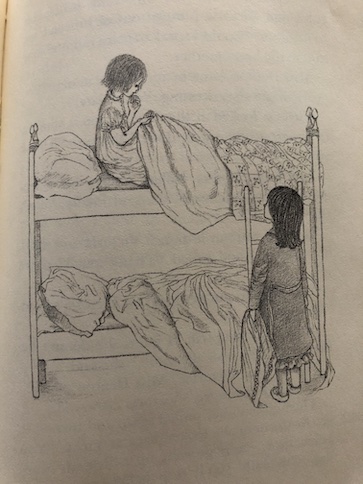
The two girls find themselves arguing sometimes because of their different preferences, but they remain friends. It’s more that, now that they’re getting comfortable with each other and their school, more of their individual personalities are coming out. Victoria is also surprised to realize that, while she still frequently misses her mother, she no longer agrees with her mother about certain things. When her mother comes to visit the school, she worries about Victoria sleeping in the top bunk of their bunk bed, but Victoria herself loves it and has to assure her mother that she likes the top bunk. One thing that boarding school has done for Victoria is to give her a sense of independence and room to develop her own identity and preferences. She no longer has to get her mother’s permission for everything she does, as long as her housemother approves.

Victoria and Martha are both imaginative, and they begin enjoy their shared adventures at school. They try to hold a midnight feast in their room and search for hidden passages or secret compartments in the dormitory because Martha has heard or read that these things happen in boarding schools. Neither of those adventures goes as planned, but Miss Denton allows the girls to build a little play hut of their own with help from the school’s handy man. Miss Denton also gives the girls a little lockbox to keep some of their treasures in, and they hide it so they can have a buried treasure.

As the year comes to an end, Victoria knows that she’ll be coming back to boarding school next year, and the prospect doesn’t seem so bad as it did before. Martha isn’t sure whether she will or not, talking sometimes about what they’ll do next year but still hoping to live at home with her parents. But, if Martha doesn’t come back to school, it just wouldn’t be the same for Victoria!

The book is available to borrow and read for free online through Internet Archive.

My Reaction and Spoilers

One of the things I found interesting about this book is that it is set in the US. The iconic boarding school stories for children tend to be British stories, but the Coburn Home School is in New York state. The girls’ parents live in New York City.

Most of the story focuses on the girls’ relationship with each other and their growing sense of self-identity and confidence at their boarding school. They talk about classes they take and how they each feel about the other’s favorite subject, but they aren’t shown in classes themselves. The school is also a co-ed school, with both boys and girls, but the boys don’t enter into the story much because most of the action takes place around the girls’ dorm. The boys live in a different dorm. There is only one instance where a boy is shown talking to Victoria, with a hint that he might have a crush on Victoria, another new development in Victoria’s life at school. The little developments in the girls’ lives and attitudes through the school year and each little experience and adventure they have are the main focus of the story. These are the things that are helping the girls understand and develop their identities, self-confidence, and sense of independence.

Toward the end of the book, Miss Denton encourages the girls to think about all of the things they’ve learned this year, and not just the ones they’ve learned in class. The girls don’t fully understand and appreciate that Miss Denton is talking about personal growth and development, but they do consider things they’ve learned, like how to make beds, that midnight feasts aren’t as fun as they sound, and how Victoria learned not to be homesick. These are some of the little things that are part of their school experience and that are slowly making them more grown up and independent than they used to be.

Although Martha is a little older than Victoria and sometimes chides her for being babyish about some things (like putting a lose tooth under her pillow) or still homesick, the truth is that Martha has been just as homesick the entire time. Martha doesn’t appear to be as upset about boarding school as Victoria because she is not a new student in this book, like Victoria. She already went through her first year at boarding school before Victoria got there, so she no longer openly cries about being away from home. Still, the reason why she keeps talking about going home and living with her parents all the time is that she misses them. While the girls’ adventures during the school year and Victoria’s realizations about how boarding school gives her the opportunity to do things and be with people she wouldn’t at home make her feel better about coming back next year, Martha still feels uncertain about it. Martha has also come to love being friends with Victoria and even loves Miss Denton, but her feelings of homesickness leave her feeling torn about what she really wants.

There are hints that Martha will probably return to boarding school anyway, but Miss Denton reassures Victoria that she will be fine at boarding school even if Martha decides not to come next fall, reminding Victoria that she is now one of the “old girls” instead of a scared new one, like she used to be. Victoria also starts to feel that way herself. Martha will probably be back the next year to be with Victoria, Miss Denton, and Miss Blanchard, but readers can be reassured that, even if she doesn’t return, Victoria will be all right with her new sense of identity and independence. This first year at boarding school with Martha may be the beginning of a lifelong friendship or just one step to Victoria finding herself and building other friendships. Maybe it’s both. Victoria’s future life will be fine in general as she continues growing up and finding her way, learning to manage her life one step at a time.

There is a modern 21st century documentary about young children going to boarding school for the first time at 8 years old, What’s Life Like in a Private British Boarding School? | Leaving Home at 8 Years Old, on YouTube. The school in that documentary is British, but I was struck by the common feelings in the documentary and the book, even though they take place decades apart in different countries. There are just some parts of the human experience that last through the generations. The documentary also shows the parents’ side of the boarding school experience, the reasons why they choose to send their children to boarding school, and how they cope with their feelings about sending their children away and being separated from them.

Boarding school isn’t always easy for parents in terms of emotions, and there are hints of that in The Secret Language. We never see Martha’s parents in the book, so we don’t know what’s going on with them, but Victoria’s mother fusses over Victoria when she gets the chance, and she talks about how great it would be if she could arrange things so that Victoria can be home with her all the time again, too. If Victoria’s mother wasn’t a working single mother who has to travel for work, she probably wouldn’t have sent her away to boarding school at all. Miss Denton is very in tune with people’s feelings, and I think that she’s aware of all the complexities in the lives of the girls and their parents. She does her best to look after the girls emotionally, and that’s part of her urging the girls to consider other people’s feelings, to be thoughtful about each other, and to think about the ways they’ve been changing inside as well as outside. I think that the universal nature of the girls’ and adults’ feelings in the book are a sign of the author’s emotional awareness, understanding of how different types of people feel.

Ursula Nordstrom, the author of the book, was actually a famous children’s book editor. She is credited with helping to transform mid-20th century children’s literature to have more of a focus on children’s feelings, experiences, and imagination instead of being morality tales, focused on what adults want children to know or understand. The Secret Language was the only children’s book that she wrote herself. This YouTube video explains about her life and career.

Go Jump in the Pool!

This is the second book in the Bruno and Boots series (also called the MacDonald Hall series), which is about a pair of boys at a Canadian boarding school for boys and their humorous adventures and pranks. 

Once again, Bruno and Boots are faced with a problem when Boots’s parents consider sending him to a different school.  MacDonald Hall, unlike its athletic rival York Academy, doesn’t have its own swimming pool. MacDonald Hall is superior to York Academy in academics, but they often lose to them at swim meets because the MacDonald Hall team can only train at the local YMCA once week.  Boots’s father is an athlete who once competed in the Olympics, and athletics are very important to him.  Because of York’s superior athletic facilities, he’s considering sending Boots there instead. Bruno and Boots ask their headmaster why the school doesn’t have a pool, and he says that they want to build one but haven’t been able to raise the necessary money. Of course, Bruno, the idea man, immediately starts getting ideas.

Boots loves MacDonald Hall and doesn’t want to leave his friends, especially his best friend and roommate, Bruno. Although Bruno’s schemes often cause chaos, they do produce results in the end, so he is able to convince his friends to go along with them.  While Boots writes letters home, talking about how great MacDonald Hall is and how much he loves it there, hoping to sway his parents’ minds, Bruno begins scheming for a way to raise the money so that MacDonald Hall can build a new pool.

First, Bruno gets the other students at the school to hold a rummage sale, selling things of their own and even some furnishings from their dorm rooms. The girls from Miss Scrimmage’s school across the road also join in their efforts, including donating some items that they liberated from their headmistress’s rooms. Mr. Sturgeon, the headmaster of MacDonald Hall is upset when he finds that the boys are holding a large public sale without his permission, and there are some complications because of the items that the girls stole from Miss Scrimmage, including the shotgun that she keeps for protection. While almost everyone would be relieved by someone else buying that gun and removing it from Miss Scrimmage’s dangerous hands, the purchaser turns out to be a robber, who uses the gun in a holdup. Chaos ensues when the police come to arrest Miss Scrimmage because the gun had her name and address engraved on it. However, Mr. Sturgeon manages to get the situation under control by explaining about the sale and giving Miss Scrimmage an alibi for the crime, and he is persuaded not to punish the boys by his wife, who is sympathetic to the boys, and a member of the school’s board of directors, who is impressed by the boys’ initiative and school spirit. However, Mr. Sturgeon tells the boys not to hold any more sales and that he needs to know about any future fundraising efforts.

Their next fundraising project is a talent show with students from both MacDonald Hall and Miss Scrimmage’s. It doesn’t go too badly, although there are complications. Mrs. Sturgeon’s attempts to take pictures of the performers startle the performers with bright flashes that cause a few accidents. Elmer’s bird calls accidentally attract an owl that flies away with Miss Scrimmage’s hat. Then, several of Miss Scrimmage’s girls modify their dancing costumes to make them skimpier, scandalizing Miss Scrimmage. In spite of the incidents of minor chaos, Mr. Sturgeon appreciates that the boys have managed to raise more money, and they’ve also managed to get some of the more shy students, including Elmer, to participate in school activities.

Mr. Sturgeon does put a stop to some of Bruno’s more inappropriate ideas. He refuses to let them hold a casino-themed fundraising event or bet on a race horse because he can’t condone gambling, and he won’t let them enter a fellow student in an eating contest out of concern for the student’s health. However, Bruno convinces his fellow students to enter any contest they can find with a cash prize. Unfortunately, some of the contests also have non-cash prizes, which is how they end up with a massive amount of jelly beans and a refrigerator. When Bruno asks Mr. Sturgeon for permission for them to hold a funny photo contest at the school, he agrees on the condition that the photos be tasteful enough for a school environment. Of course, the students’ attempts to deliberately produce humorous pictures also lead to some antics and bizarre pranks.

After that, the boys hold a kind of carnival that they call “Individual Effort Day” because each student gets to do their own kind of fundraising effort, making and selling things or producing some form of entertainment. While everyone, including the girls at Miss Scrimmage’s school, who are also participating, tries to come up with an original idea, some of the students try spying on each other and stealing ideas. Mr. Sturgeon particularly enjoys the game that Bruno and Boots are holding, where people pay to throw wet sponges at them. He accurately hits both of them and also hits Miss Scrimmage when she passes by. Cathy and Diane’s haunted house scares Miss Scrimmage, and Mr. Sturgeon gets hooked on an elaborate pinball game built by Elmer.

When Mr. Sturgeon points out that the boys have mostly been getting money from the students and parents of MacDonald Hall and Miss Scrimmage’s, Bruno takes his attempts to get money from the public too far by setting up a toll stop on the road that runs by the school. It’s illegal to get money under false pretenses, so Mr. Sturgeon calls a halt to all the fundraising efforts. However, he changes his mind when he finds out that some of the boys’ parents, including Boots’s parents, have been considering sending their boys to York Academy because of the pool issue. Realizing that the boys have been trying to save the school and continue going to school with their friends, Mr. Sturgeon lifts their punishment, although he still gives them a warning that if they do anything illegal again, it will jeopardize the rest of their lives.

The boys still have the problem that they are thousands of dollars short of their goal, even after Cathy wins a large cash prize in a recipe contest. There is still one student at the school who hasn’t contributed to all the fundraising efforts, though: Boots’s old roommate from the previous book in the series, the wealthy but stuffy and fussy hypochondriac, George. George has resisted getting involved in all the weird activities happening on campus because he considers them all “vulgar”, but when they finally explain to him that the point of it all is to raise funds for the school, he approves. If there’s one thing George knows how to do well, it’s manage money. George convinces them that they don’t need to raise more money from other people if they know how to put their money to work for them in the stock market. The other boys are a bit dubious about letting George invest their money, but George knows what he’s doing. Meanwhile, Boots’s parents have been taking all the letters he’s been writing them about how great MacDonald Hall is and how happy he is there to heart. In the end, they just want their son to be happy.

The book is available to borrow and read for free online through Internet Archive (multiple copies). It’s also one of the MacDonald Hall books that was made into a movie. You can sometimes see the trailer for the movie or clips of it on YouTube.

I always liked the Bruno and Boots series when I was a kid. The pranks aren’t quite as funny to me as when I was a kid, but I like it that the boys’ antics always have a purpose. I don’t like stories where people play pranks just to be mean, but the boys’ escapades in this series are always in support of their school and their friends.

There are also aren’t really any villains in the series, and there are no villainous characters in the story. Even when people are in opposition to the boys, they aren’t really evil. There is the rival school, which is snobby and rude to the boys, but other than giving the boys a motive for fundraising for the pool project, they don’t play much of a role in the story. The headmaster of MacDonald Hall is a good man who really cares for the boys, and even when he punishes them, he has their welfare at heart. The boys, especially Bruno, have a tendency to go too far with their schemes, and they do need someone to restrain them at times. George wasn’t a very likeable character in the previous the book, and even here, he’s kind of fussy and not too fond of Bruno and Boots. However, he also cares about the school, and this time, he has just the talents that they need. The other boys at the school also appreciate what George does for them, and they hail him as a hero.

I also appreciated that, in the end, Boots’s parents acknowledge that it’s more important for him to be happy with his school and his friends than for him to seriously train for the Olympics. Boots’s letters are overly enthusiastic about the things he’s been learning in class, and I’m sure his parents know that he’s not really that excited about his math lessons, but they can read between the lines and realize that the purpose of his letters is to indirectly ask them not to make him switch schools. Even if MacDonald Hall wasn’t able to get a swimming pool of their own, I think his parents would have agreed to let him stay there if he insisted that he just wouldn’t be happy anywhere else.

The Mystery of the Blue Ring

Polka Dot Private Eye

The Mystery of the Blue Ring by Patricia Reilly Giff, 1987.

When Dawn Bosco first joined Ms. Rooney’s class at Polk Street School, she stole Emily Arrow’s toy unicorn. Now, that incident has come back to haunt her. When the book begins, her theft of Emily’s unicorn was just weeks ago. Now, she and Emily are starting to be friends, although their friendship is a bit shaky.

At school, the teachers are talking about vegetables because it’s Good Vegetable Day. Everything is geared around vegetables all day, and the art teacher has the children make sculptures of vegetables out of clay. Dawn is bored because she’s been reading a mystery book, and she’d rather be finding mysteries and learning to be a detective than making silly vegetables out of clay.

Dawn gets irritated with Emily when she says that she’ll make a cucumber, which is what Dawn was going to make because it’s easy. The teacher won’t let Dawn make a cucumber because Emily already claimed that idea, so Dawn has to make a carrot instead. (Not that much different in shape, really, except one end is more narrow.) However, she still resents Emily for using the cucumber idea first.

As the girls push against each other by the sink, cleaning up from using the clay, Dawn spots a ring next to the sink. Later, Emily says that her ring is missing. It’s a special ring with a blue stone that she got for her birthday. Dawn is pleased that she’s found a mystery to solve. Remembering that she saw a ring next to the sink in the art room, Dawn proudly goes back to the art room to see if she can find the ring and return victorious. However, the ring isn’t there when she checks.

Then, suspicion turns to Dawn herself. After all, everyone knows that Dawn stole Emily’s unicorn before. Instead of being the hero detective, Dawn is turning into the main suspect in this crime. Now, she really needs to find the ring to clear her name!

Dawn’s grandmother, Noni, gave her a special detective kit for her birthday. Dawn uses it to turn into The Polka Dot Private Eye to hunt down Emily’s ring.

The book is available to borrow online through Internet Archive.

My Reaction

I liked the way the series returned to the subject of Dawn’s theft and used it to spark a spin-off mystery series. This is the first of the Polka Dot Private Eye books. In this series, Dawn becomes a more likeable character than she was when she first appeared in Fish Face, and she gets a little comeuppance for her earlier, unpunished theft of Emily’s toy unicorn in the form of her classmates’ suspicion of her. When I read this book for the first time when I was a kid, I hadn’t read the book where Dawn was first introduced, Fish Face, so I didn’t really understand the relationship between Dawn and Emily and how Dawn took Emily’s toy unicorn. We never really find out in either book exactly why Dawn took the unicorn, although in this book, she thinks of herself as having “borrowed” it instead of having stolen it.

Reading Fish Face isn’t necessary to understand the basic story in this book, but after having read it, I appreciate Dawn’s position in this book a little better. By now, everyone knows what Dawn did, and although Dawn thinks of “weeks ago” as a long time ago, it’s not really that long, and it’s still fresh in everyone’s mind. Dawn is still a relatively new kid in class, and one of the few things everyone knows about her is that she has a history of taking things that don’t belong to her. It is a logical conclusion that Dawn might have helped herself to another of Emily’s belongings when everyone knows that she’s done it before. As my grandfather used to say, it’s easier to keep a good reputation than to redeem a bad one, but Dawn works at it and learns that she likes being a detective and that she has a talent for figuring things out. After Dawn figures out where Emily’s ring is, the two of them become better friends. Solving the mystery also makes Dawn a class hero and begins to establish Dawn’s reputation as a person who likes to solve mysteries and crimes rather than commit them.

This book gets bonus points from me for mentioning jelly sandals. Jelly shoes were a regular part of my childhood in the 1980s and early 1990s, and I’ve seen some of them return again in the early 2000s, probably partly because people my age now have children, and they’re nostalgic for some of the things from their childhoods. Jelly shoes (or “jellies,” as we called them) are sandals and sandal-like shoes made from flexible plastic in different colors, some clear or with sparkles inside. They were cheap when I was a kid, and I used to get a new pair or two when the weather turned warm. Eventually, they wear out, and the plastic bits snap. I’d wear them around my backyard with my toes sticking out the front as they started breaking, and I started growing out of them. By the time they were too broken to use anymore, my toes were usually beyond the bottom of the shoes, and I was always kind of proud of that because it was a sign that I’d grown over the summer. It wasn’t much of a loss when the shoes wore out because they’d be too small for me at that point anyway, so we’d throw them away, and I’d wear more solid shoes when the weather turned cold. Jellies, flip-flops, and cheap canvas shoes were a major part of what I wore when I was young and growing out of shoes fairly quickly. They were all inexpensive, and while they didn’t last very long, they lasted about as long as they needed to before I needed the next size and weren’t much to lose when I was rough on them.

The Weird Science Mystery

The Bobbsey Twins

#20 The Weird Science Mystery by Laura Lee Hope (Stratemeyer Syndicate), 1990.

Before I begin, I’d like to acknowledge Sean Hagins, for supplying me with photos of this book! Usually, I take pictures of books myself, but I just couldn’t find a physical copy of this one. Sean is a big fan of the Bobbsey Twins, particularly the New Bobbsey Twins mysteries, and you can see some of his video reviews as well as videos about his photography work on his YouTube channel, SJHFoto. Thanks, Sean!

The Bobbsey Twins are all getting ready for their school’s science fair. Bert’s project is about dog behavior with the family’s dog as his subject. His twin, Nan, is also studying animal behavior, but with a chicken named Zelda. Because the science fair is open to both middle school and elementary school kids, the younger twins, Freddie and Flossie, can also enter. Freddie is entering with a large baking soda volcano.

When the kids arrive to drop off their projects, Nan and Bert notice another boy from their class, Martin Crane. Martin is a science whiz, but he isn’t very nice. He’s not really a bully, like Danny Rugg, but he makes fun of the Bobbseys’ science projects. They don’t know what Martin’s project is because he’s bringing it in boxes labeled “Top Secret”, but he swears that it’s going to win first prize.

When Freddie sees the other students’ projects, he starts to doubt that he has any chance of winning a prize himself. There’s a boy who has an impressive star chart display, and Danny Rugg has a display of spiders. There’s a girl named Ellen with an exhibit showing how pearls are made, including real pearls! Ellen says that her uncle is in the jewelry business and loaned her the pearls. Ellen’s younger sister, Melissa, says that Ellen’s project is unfair, although she doesn’t say why she thinks so. Melissa says that she didn’t do a project herself because she thinks the science fair is dumb.

Mr. Newman, Nan and Bert’s science teacher from an earlier book in the series, is one of the judges of the science fair. He’s going around the fair, taking pictures of the projects, but Martin refuses to unpack his project, saying that he will reveal it tomorrow. Then, Melissa screams that Danny’s poisonous spiders have escaped, and people start panicking and running! Mr. Newman says that Danny’s spiders are definitely not the poisonous kind, and he makes Danny apologize for telling people they were. The Bobbseys wonder if Danny could have let the spiders loose on purpose as one of his pranks. Then, suddenly, Ellen screams that her pearls are gone!

While the teachers are looking for the pearls and trying to encourage the thief to come forward, other accidents happen to other science fair projects. Freddie’s volcano suddenly erupts even though he didn’t set it up to do that yet. Someone cuts the leash on their dog, so he gets loose, and release’s Nan’s chicken from her cage. Ellen said that the pearls in her collection were valuable, so the teachers call the police. But, were the pearls stolen because they were valuable or because someone wants to sabotage the science fair? Was the theft of the pearls related to the sabotage of the other projects, or are these two separate acts? Also, what does Martin have in those boxes labeled “Top Secret”?

The book is available to borrow and read for free online through Internet Archive.

My Reaction

Sean and I were talking earlier about how later books in the New Bobbsey Twins series focused more on the younger set of twins, Freddie and Flossie, and seemed to involve lower stakes in the mysteries. I reviewed this book shortly after The Clue in the Classroom, so I could compare two science-based mysteries that took place at the kids’ school, one earlier in the series and one later.

The other science-based mystery in the series involved an invention and industrial espionage, while this one involves the school science fair. However, I thought the mystery was well-done. When the Bobbseys arrive at the science fair, the story establishes multiples suspects. Danny Rugg is a repeat suspect because he’s the school bully and general nemesis, and he could have set his spiders loose as a distraction while he took the pearls and set up other things to go wrong. Then again, Melissa seemed upset about her sister’s project, so she might have had a reason to sabotage it. Martin is being mysterious about his science fair project, but what if he doesn’t actually have one in those boxes of his? Maybe he couldn’t think of anything or ran out of time to do his project, so he’s sabotaging everyone else’s project to provide a reason for why his project will suddenly disappear or turn out not to work. I even had a theory that each of those people might have done something since multiple disasters happened at the same time or almost at the same time. From the beginning, there are multiple possibilities that seem about equally likely, which is good for making readers wonder, and the kids are active investigators in the story, investigating suspects individually, not just waiting for chance to give them the answers. Those are the ingredients for a good mystery.

Although the story takes place at a kids’ science fair, there are a couple of factors involved that add some excitement and higher stakes to the story. The value of the pearls has the adults worried about getting them back. (Personally, I wondered about just how valuable the pearls were. Since they didn’t seem to have any form of security to protect them, like a locked display case, and since Danny Rugg lied to everyone about his spiders being poisonous, it occurred to me that Ellen might have lied to everyone about the value of the pearls to make her project seem more exciting, although that is never clarified during the story.) I also appreciated the thief’s motive for stealing the pearls because it wasn’t just about the pearls’ value. It was one of the ideas that I can for a possible motive, but I’ll leave it a secret about which of my theories was right.