This is the third book I’ve reviewed on the topic of Indian Sign Language, and the reason why I wanted to include this one is that it was part of the list of recommended reading in one of the others, a book that was written much later. I can see why it was recommended. I found the readability of this book to be lower than the later book, but there is information found in this book that isn’t found in the later book.
The introductory notes at the beginning of the book explain a little about the author’s background. He grew up near the Sioux Indian Reservation in the Dakota Territory during the late 1800s, which was where he was first introduced to this form of sign language. He was not Native American himself, but he was later ceremonially adopted into the Sioux tribe. He became a lecturer about American Indian issues, and he discovered that people were very interested in his sign language demonstrations. He wanted to create this book so there would be a readily-available text explaining how the language works. He credits this form of sign language as being “probably the first American language. It is the first an only American universal language. It may be the first universal language produced by any people.” I’m not completely sure that’s true, but the author does have great respect for the beauty and utility of the sign language and the role that it played in Native American history.
The later book had the vocabulary of the sign language organized by topic, but this book (like an earlier one) had it organized in alphabetical sections, like a dictionary. The hand signs are shown in drawings on one side of the page, with lines and arrows to indicate movement where necessary, and written descriptions of the hand signs on the other.
The range of vocabulary is much more broad in this book than in the newer book, and it includes descriptions of more complex words and concepts that can be conveyed by combining some of the signs for simpler words. For example, the word “generous” can be indicated by making the signs for “heart” and “big”, and there is a list of synonyms for words. The book also demonstrates how to form sentences using the vocabulary words.
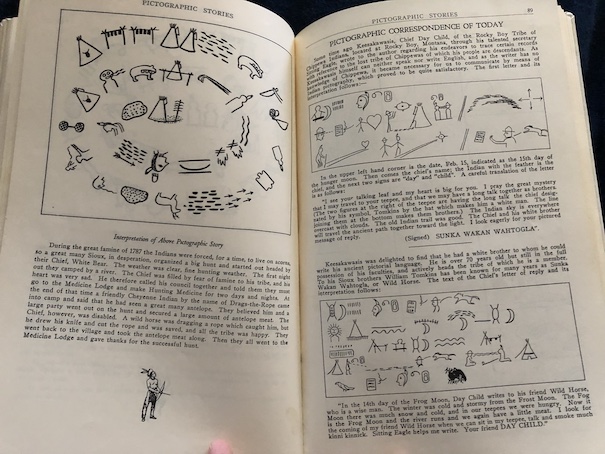
There are a couple of sections in the back of this book that provide additional information about other forms of communication, pictographs and smoke signals, which is interesting because the later book that I mentioned also made references to these other forms of communication but didn’t really offer details about how they work. This book is very detailed on the subject of pictographs, showing what different ideographs mean and explaining how to tell entire stories with them. It even explains the correlations between sign language and pictography. The book ends with some historical information about this form of sign language and suggestions for a unit about Indian sign language for a boy scout troop meeting, which include a somewhat cheesy play where the boy scouts pretend to be American Indians and use words like “How” and “paleface” with each other. The book seems very good and thorough on the technical explanations of the language, but I suspect it could be a little better on the subject of cultural representation.
The book is available to borrow and read for free online through Internet Archive (multiple copies).
How; Sign Talk in Pictures by Iron Eyes Cody, 1952.
I like nonfiction books on esoteric topics! This one has kind of a kitschy feel to it. It’s partly the “How” in the title, like the way Native Americans talk in old movies, but it was written around the time those old black-and-white westerns were made, and this sort of movie theme is actually a major issue with both the book and the author. We found this book as a library discard, and part of the interest for me is that another book by the same author (available through Internet Archive) was used as recommending reading in a later book on the same subject.
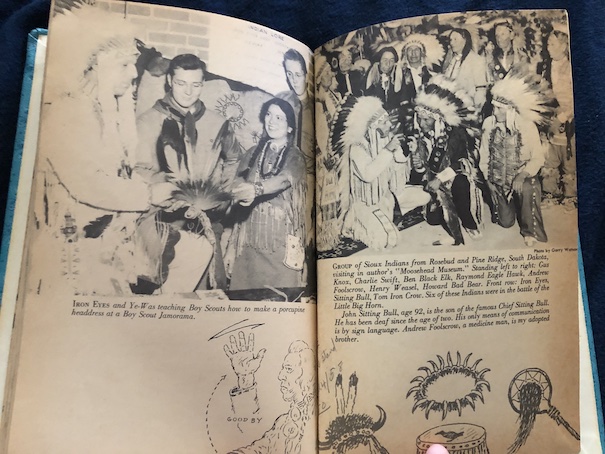
The author and his wife appear frequently in pictures in the book, demonstrating different signals in Indian sign language. Part of the book near the beginning explains about the author’s life, and what it says actually isn’t true, but the real story of the life of “Iron Eyes Cody” is pretty interesting. The main reason for the deception is that Iron Eyes Cody was an actor known for playing Native Americans in films, beginning in the 1920s. To support his film persona, he claimed to be of Native American descent, but the truth is that both of his parents were Italian. His birth name was Espera Oscar de Corti. In the book, he says that he was born on his family’s ranch in Texas, but he was actually born in Louisiana, and his parents owned a grocery store. The family did live in Texas for awhile. After his father died, he and his brothers moved to California to pursue acting careers, changing their last name to Cody. As part of his film persona, he was known to wear his Native American costumes on a daily basis, as if he were living a Native American lifestyle. Many people really believed he was Native American, but this costume quality is part of what gives the book that kitschy vibe. If you think that you’ve never seen or heard of Iron Eyes Cody before, it’s actually very likely that you have because one of his acting roles was that of the “Crying Indian” in the “Keep America Beautiful” anti-pollution PSAs of the 1970s. Yep! He’s that guy, and that’s the man who wrote this book.
So, you can disregard many of the details of Cody’s brief autobiography (there’s a fanciful story there about how he got the name “Iron Eyes”, but Chief Iron Eyes was actually the name of the character he played in the 1948 movie The Paleface with Bob Hope), but what is real is that he was married to an archaeologist of Native American descent, Bertha Parker (referred to as Yeawas in the book and also appearing in pictures to demonstrate the sign language), and they had two adopted children, also of Native American descent (one of which appears in pictures in the book). Outside of his acting work, Cody supported many charitable causes that helped Native Americans and promoted the study of Native American culture. He had a collection of Native American costumes and art that he called the Moosehead Museum, and he offered lessons in Native American arts and crafts, songs and dances, and lore out of his home. (The book doesn’t really offer details about how that worked, but my guess would be that his wife, the archaeologist, provided much of the instruction or at least educated Cody about these subjects before he taught others.) Cody also worked with the Boy Scouts, helping with Scout-O-Ramas and acting as an adviser about Indian (Native American) lore. He also sometimes helped the Girl Scouts. The book is dedicated to “the youth of America, especially the Boy Scouts of America.” If you would like to know a little more about Cody, I recommend this YouTube video and this one.
On the one hand, a person who is deceptive or misleading about their identity and credentials is worrisome and probably rightly considered unreliable. However, as near as I can tell (not being an expert on this topic myself), the information presented here seems reasonably accurate, and I think that’s probably due to research, consulting with experts, and the influence of the author’s wife, who did have credentials as an archaeologist and ethnologist and had connections to other scholars through her museum work. One of the beginning sections of the book is called “A Brief History of Sign Language by Bertha Parker Cody” with an accompanying list of works consulted (texts spanning 1880 to 1926, the 19th century ones apparently written by army officers because their ranks are given, if you’re curious – Bertha’s a woman after my own heart because she also added a note to her citation about a book with a particularly good bibliography section, and I’m a great believer in notes).
So, now that you know who’s talking here, let’s discuss what they have to say about Indian Sign Language, the main topic of this book.
In a foreword to the book, F. W. Hodge, director of the Southwest Museum in Los Angeles, where Bertha Parker used to work, discusses the concept of sign language and non-verbal cues used in communication by people all over the world. People in different countries, speaking different languages, might recognize a nod of the head as meaning “yes” or a finger placed against the lips as a gesture to be quiet, but sign languages convey much more than these simple ideas, allowing people to hold entire conversations. The Indian Sign Language presented in this book was used by many different tribes, ranging from Canada all the way south to Mexico. If members of different tribes encountered each other, they could use this language to communicate, no matter which language they spoke verbally. When people of European descent learned this sign language, they also gained the same ability to communicate with a wide range of Native Americans, without even needing to speak a single word aloud. Hodge said that this was an uncommon skill for people of European descent, although he does mention one of the army officers referenced by Bertha Parker Cody in her essay.
In her essay, Bertha Parker Cody also explains the concept of sign language, referring to it as a kind of “universal language.” She explains how people have used hand signs and gestures to convey ideas and concepts throughout history. She says that the reason why this type of universal language based on gestures was necessary because, in the territory now known as North America, there were once more than 500 different spoken languages among Native Americans. Even groups who were living no more than 10 miles away from each other might be speaking completely different languages, but they would need to be able to interact with each other and communicate. It is unknown exactly who invented this particular system of sign language (although there are some possible theories), but it was particularly developed by the Plains Indians because they were nomadic buffalo hunters, often encountering other tribes as they followed the herds. As an added benefit, because the language is completely silent, hunters could use it without startling their prey, and warriors could use it with each other before a surprise attack on an enemy. Chiefs of tribes would even use sign language to convey important messages because it would guarantee that people would pay attention and focus on the hand signs to interpret what they were saying. She explains that there are signs that the language changed over time and variations existed among different tribes, there was enough commonality that members of different tribes could communicate with each other effectively. She concludes by saying that their hope was that this book would help to keep knowledge of this sign language alive among young people at a time when it was falling out of use and living knowledge.
The actual vocabulary of the sign language is presented in sections organized alphabetically, with drawings and photographs of Cody and his wife performing each of the hand signs.
The book ends with a section about hand signs for numbers and counting and a section presenting examples for forming complete sentences using the hand signs presented in the book.
The final part of the book contains an Acknowledgement from Cody to all of the people who helped with the research and writing of the book, including the photographer and the artist who did the drawn pictures.
My Reaction
I’ve already given some of my thoughts and reactions in the review above, but there is one more thought that I had about this book. I completely understand why this book was library discard. It is an older book, and there are newer ones that cover the same topic as well or better. The author is an actor who is not as culturally relevant as he once was, and although it wasn’t known at the time of his popularity, he was deceptive about his life and past. In some ways, though, reading and researching this book and its background was educational. The education I would say that I got from this book wasn’t just about sign language but also about perceptions vs. reality, the roles people play, the personas created by the movie industry, and also the expectations of the public and the credentials we require or are willing to accept from those with a message to spread.
That last part is the most complicated part, but the resources that I consulted to get the details of Cody’s life pointed out that he did genuinely encourage interest in Native American culture and support causes important to Native Americans, which begs the question of whether he would have been accepted in that role of spreading interest and providing support if it had been known at the time that he was not actually a Native American himself. The truth is that he was something of a fake and a poser. He wasn’t really what he pretended to be, and in a sense, he was acting in a permanent role, even outside movies. He was given roles as a Native American in films because his physical appearance made it credible that he could have been one, and as far as movies are concerned, that’s really all that matters. Average people believed he really was a Native American because he was a good actor and convincing, and they didn’t know enough about real Native Americans to spot the parts about his dress and act that didn’t quite ring true. However, I think that Cody’s interest in Native American culture was genuine, probably the most genuine part of his performance, and he appears to have taken a genuine pride in it. A person lying about their background is deceptive and makes other things that they do suspect, but I’m still left with some questions. If he had been honest about his family’s background, would his interest in Native American culture been accepted or would people have sneered and said that he should have stuck to speaking only about the culture his family came from? Is it possible for someone to adopt a new culture not based on family or upbringing but pure personal interest and choice, and if so, could it ever be as deep or authentic as the culture one is born into and brought up in? Or, will it only ever just be an act or a deception, something that might only fool those who don’t know how to see the reality? What is the difference, or is there one? Could the person doing it even get so deep into the act that they themselves don’t know the difference anymore?
North American Indian Sign Language by Karen Liptak, 1990, 1995.
This book is going to be one of three I’m planning to cover on the same topic because this book includes a list of recommended reading about North American Indian Sign Language, and I happen to have two other sources from that list in my collection. The other books I have are much older, and I’d like to compare them to this newer book and explain why the newer one does things differently.
To begin with, older books about this topic frequently just use the term “Indian” or “American Indian” to refer to Native Americans. This particular book defines its terms right at the beginning. The author says, “North American Indians are currently called both American Indians and Native Americans. I have chosen the term American Indians to reflect the preference voiced in a recent informal survey at an intertribal powwow in Reno, Nevada, and to help readers find the book more easily. The signs presented in this book are based on the sign language used by the American Indians of the Great Plains.” I appreciate it when authors explain their thinking clearly.
The introductory section of the book explains the purpose and history of using sign language for intertribal communications. It starts with an example of a fictional encounter between two members of different tribes who are strangers to each other. At first, they’re not sure who the other one is and if they’re someone who can be trusted, but when they begin using sign language to signal to each other who they are and what their intentions are, they realize that they’re from tribes who are friendly with each other and that it’s safe to continue communicating.
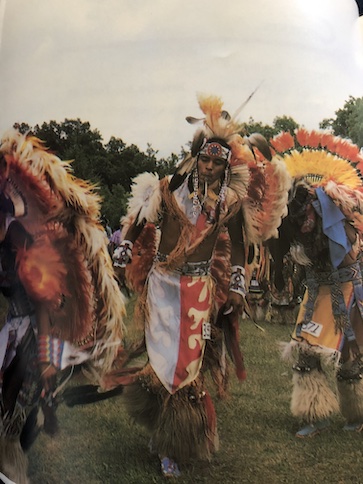
This particular form of sign language was particularly popular among Native Americans of the Great Plains, including the Cheyenne, Sioux, Kiowa, and Blackfoot tribes to allow communication between tribes that did not share a common spoken language and also within tribes in situations that demanded silent communication, such as during hunting and warfare or when communicating with people who could not hear well. American Indian sign language isn’t commonly used in modern times because there are others more commonly used, but it still appears sometimes at powwows or in Native American ceremonial festivals. This book is meant to present the sign language for fun and education.
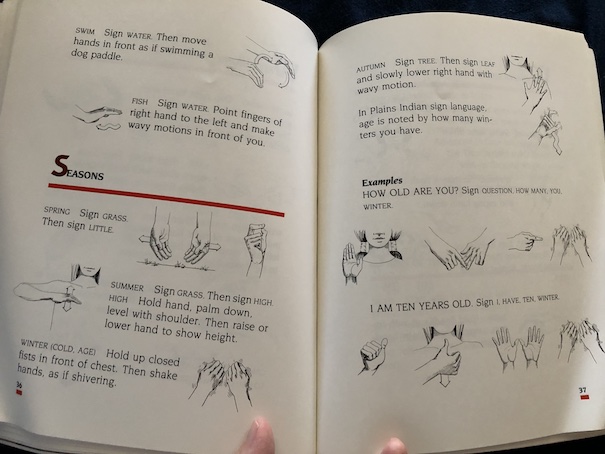
It begins by explaining basic hand and finger positions and introducing some basic vocabulary, demonstrating signals for simple words, like “I”, “You”, “Yes”, and “No.” All of the hand signs are shown in drawings with arrows to indicate movement where necessary. It also introduces how to signal that you are asking a question.
The rest of the vocabulary is presented in themed sections, introducing words for family members, counting, seasons of the year, weather, time, food, clothing, feelings. This is different from the older books about American Indian sign language, which had vocabulary words organized alphabetically, like a dictionary. I prefer the approach of the themed sections because they demonstrate related words together and provide information for forming sentences as needed, like how to indicate that a concept is past tense. Later sections build on earlier sections, like when the section about seasons draws on the earlier concepts of counting and how to ask questions to demonstrate how to ask how old someone is or how to tell someone your age.
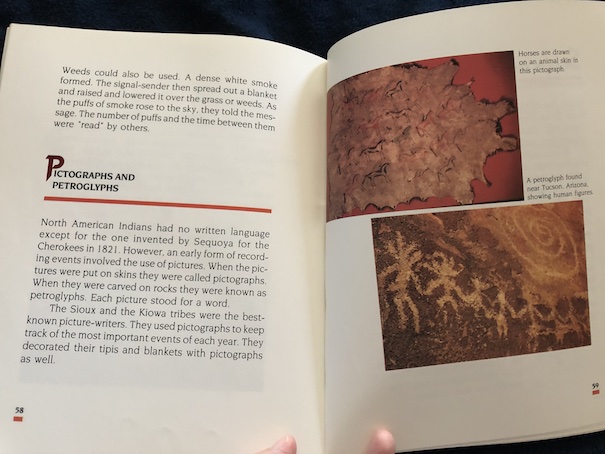
There are also sections at the back of the book discussing other methods of communication used by Native Americans, including smoke signals, pictographs, and petroglyphs.
The book is part of a series by the same author about various aspects of Native American culture. It’s available to borrow and read for free online through Internet Archive.








 Jestress's Forgotten Books and Stories