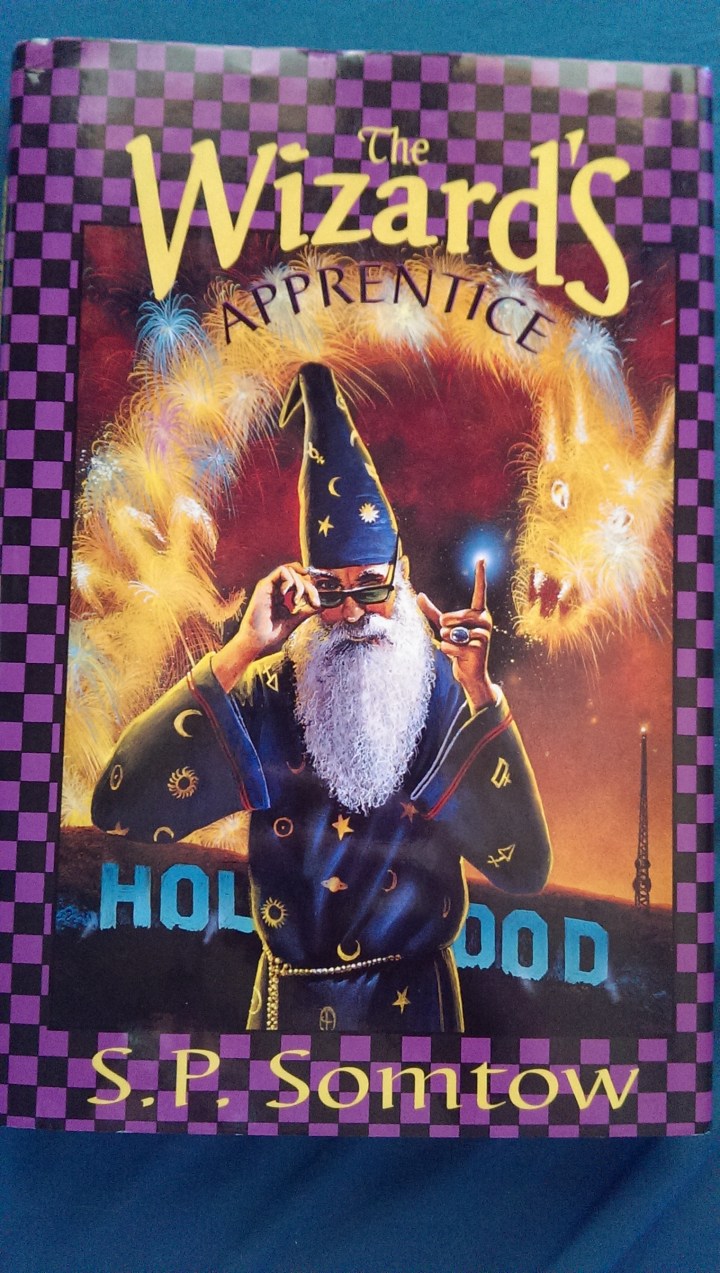
The Wizard’s Apprentice by S.P. Somtow, 1993.
 Sixteen-year-old Aaron Maguire thinks of himself as a typical teenager, even though his family is far from typical. His mother is a buyer for a fashion boutique, and his father does special effects for monster movies in Hollywood. They’re also officially “separated” and preparing for a divorce, even though they’re still living in the same house. So far, they’ve just kind of divided the house in two in order to have their own space. Aaron goes back and forth between the two halves of the same house as his parents share him. It’s a little weird (and, to Aaron, also a little depressing), but there’s weirder to come.
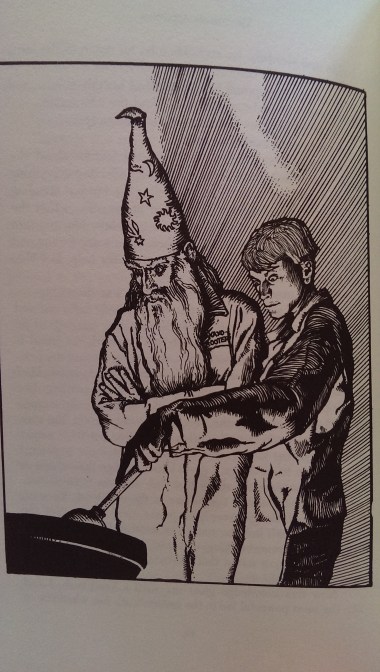
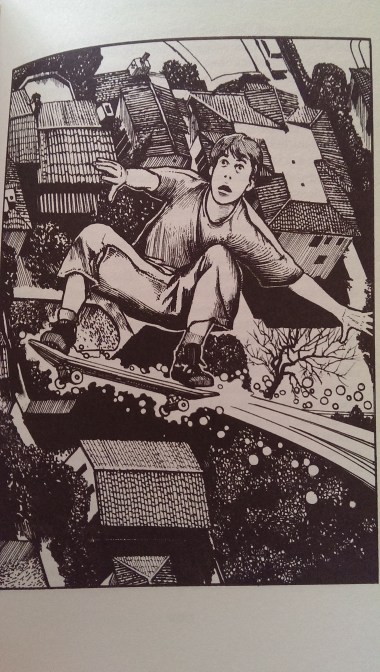
An old man approaches Aaron and tells him that he’s destined to be a wizard and that he will teach Aaron what he needs to know. At first, Aaron thinks this man is nuts and probably homeless, but what he says is true. The old man is the wizard Anaxagoras. Anaxagoras demonstrates to Aaron how the skateboarding maneuver he had just pulled off defies the laws of physics and tells Aaron things about his personal life that no one should know (how angry he is with his parents about their separation and about his crush on Penelope Karpovsky, a girl he knows from biology class). He also changes the dollar Aaron had offered him into a $100 bill and shows him that they can travel to magical lands and even through time. Although Aaron still has trouble believing what he sees (his father does special effects for a living, after all), he becomes Anaxagoras’s apprentice.
Partly because Aaron still has doubts and needs something physical to convince him of the wizard’s powers and trustworthiness, Anaxagoras gives him a mirror. It looks basically like an ordinary pocket mirror with a neon pink frame, but Anaxagoras invites him to ponder it and figure out what it does, telling him that what he does with it is important.
 However, when Aaron meets the divine Penelope for pizza and she asks to borrow a mirror to check her hair, Aaron lets her borrow Anaxagoras’s mirror. He instantly regrets it because the mirror suddenly changes in Penelope’s hands. Now, it has a tortoiseshell frame and is shaped like a heart. Penelope, who has low self-esteem in spite of her prettiness, is suddenly really happy when she looks in the mirror and refuses to give it back, insisting that she wants to borrow it for a few days. Because Aaron is in love with Penelope, he finally agrees to let her keep it for awhile.
When Aaron tries to tell Anaxagoras about Penelope borrowing the mirror, he doesn’t seem concerned. He just hurries Aaron on to his next lesson, which involves a plumbing problem. Anaxagoras’s lessons are pretty weird, although Aaron finds himself learning that there is more magic in the everyday world than he ever suspected.
Aaron later attempts his own feat of magical plumbing at the studio where his dad is working and encounters a creature of darkness. The mirror gets out of his hands, and he enchants a car in order to chase it down. Finally, a dare from some classmates causes him to unleash a dragon on the unsuspecting city, one that only Aaron can understand and defeat, once he realizes the true nature of his magical mirror.
Aaron has a distinctive voice as a California teenager, and his first experiments with magic lead him to some surprising discoveries about himself which help him to understand and reconcile his feelings about his parents’ divorce.
 Going to School in 1776 by John J. Loeper, 1973.
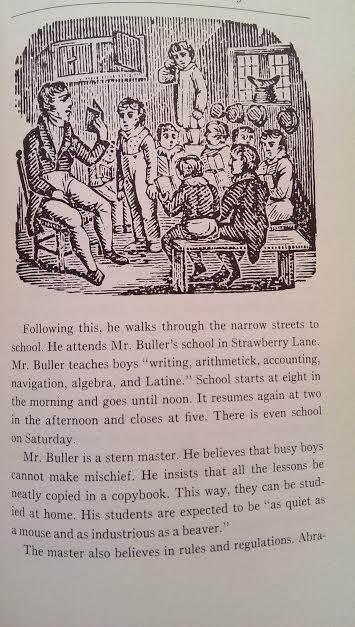 These explanations are told in story form, rather than simply explaining listing the ways children could live, learn, and go to school, trying to help readers see their lives through the eyes of the children themselves. The children’s lives are affected by the war around them. As the book says, many town schools in New England were closed during the war, so the students would attend “dame schools” instead. A dame school was a series of lessons taught in private homes by older women in the community. In other places, such as cities like Philadelphia, official schools were still open. Discipline was often strict, and school hours could be much longer than those in modern schools. Sometimes, children would argue with each other over their parents’ positions on the war.
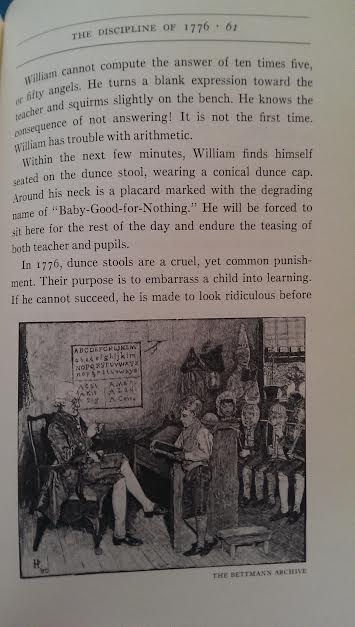 There were different standards for what girls and boys were expected to learn because their learning was guided by what they were each expected to do with their adult lives. A typical school might teach boys subjects like, “writing, arithmetick [sic], accounting, navigation, algebra, and Latine.” Generally, “reading, writing, arithmetic, and religion” were common elementary school subjects. Latin lessons and other advanced subjects were typically for boys who planned to become lawyers or clergymen. Girls were likely to receive little formal education beyond reading and writing, and black people were less likely to receive even that.
 #3 The Secret at the Polk Street School by Patricia Reilly Giff, 1987.


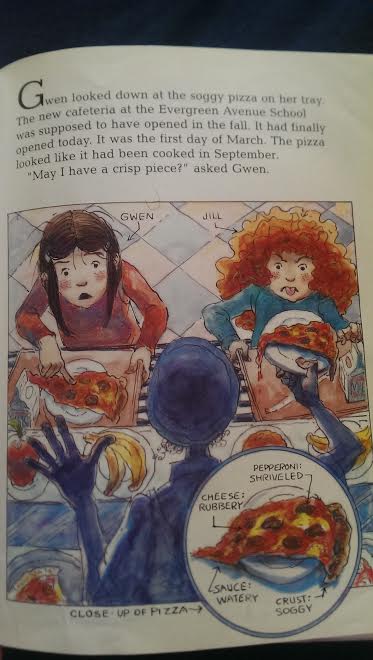 Ms. Lensky, the cafeteria lady at Gwen and Jill’s school, is just plain mean. All of the food that the cafeteria serves is yucky, even though the cafeteria is new. There will be a party to celebrate the opening of the new cafeteria, and even the kids’ parents and the mayor are invited. Gwen and Jill are happy because their class will get to help decorate the cake. However, Ms. Lensky, the M.C.L. (Mean Cafeteria Lady), doesn’t like the girls, and she blames them for a number of accidents that happen in the cafeteria.


 #4 Mandie and the Forbidden Attic by Lois Gladys Leppard, 1985.
 Mystery of the Roman Ransom by Henry Winterfeld, 1971.
 When they return to the slave dealer’s home, he is gone, and the place is boarded up. An elderly slave who was left behind said that all of the other slaves were sold, and then the dealer simply fled, abandoning him. He also says that there was someone else who had come to see the dealer, demanding that he hand over the slave called Udo (the one that the boys had already bought). This man was a former gladiator with only one eye, and he was very angry that Udo was gone. He swore that he would he would get Udo one way or another, dead or alive. He threatened the dealer, saying that he would return later and kill the dealer and all of his slaves if Udo was not among them then. The slave dealer, not knowing the names of the boys who had bought Udo or where he could be found and therefore unable to get Udo back, fled in fear of the former gladiator’s threats.
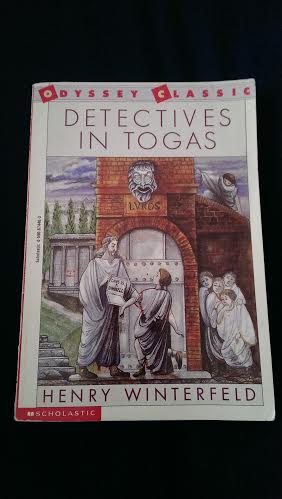 Detectives in Togas by Henry Winterfeld, 1956.
 The next day, when the other boys arrive at school, they discover that their teacher has been attacked and robbed during the night. Worse still, when they go to Rufus’s house to visit him, they learn that someone has written “Caius is a dumbbell” on the side of the Temple of Minerva, which has been dedicated to the emperor. Defacing a temple is a crime, and soon Rufus is arrested and sent to prison (being young and part of an important family does not guarantee him special treatment). Rufus swears that he was not the one who defaced the temple, but who else could have done it?
 #6 The Valentine Star by Patricia Reilly Giff, 1985.
 But then, Emily and “Beast” (Richard Best) make a serious mistake. It was hot inside at lunch, and they couldn’t resist the urge to run outside in the snow for just a couple of minutes without their coats. Then, they got locked out and had to get Beast’s sister to let them in a different door. They thought no one saw them, but a neighbor did and contacted the school. Now, Emily is afraid of what will happen if their teacher finds out that it was her and Beast. Will the school be angry enough to hold them both back a grade or maybe worse? Maybe Emily will be spending Valentine’s Day in the school office instead of at the party, watching Ms. Vincent enjoy her special valentine . . . especially if Sherri happens to know what they did.

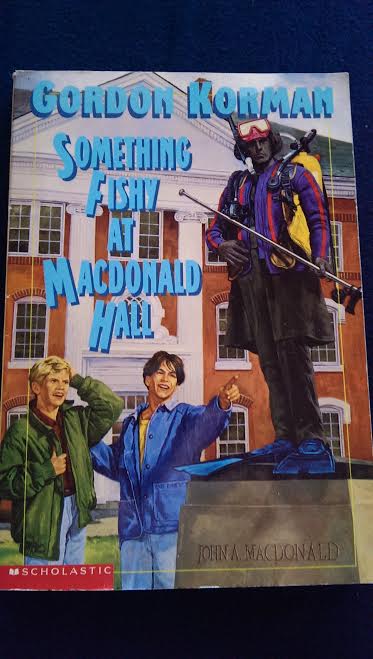 Something Fishy at MacDonald Hall by Gordon Korman, 1995.

