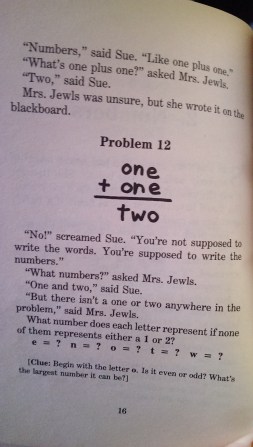
The Tap Dance Mystery

eeetapThe Tap Dance Mystery by Susan Pearson, 1990.

The kids in Ernie’s class are assigned to groups to plan different acts for the show that they will have when their parents visit the school on Parents’ Night. The Martians are assigned to different groups. R. T.’s group is going to do magic tricks. Michael’s group is going to pretend to be a music group from Jupiter and play different homemade instruments. Unfortunately, William and Ernie are in the same group as Marcie, a mean and bossy girl who always smells sticky and sweet, like Juicy Fruit gum.

Marcie convinces the others that their group should tap dance because she has been taking lessons and can teach the others. William and Ernie struggle to learn the steps and make homemade tap shoes by tacking washers onto the bottoms of their shoes. Jason, the fourth member of their group, really likes dancing and shows a lot of talent for learning the moves. Still, only Marcie really looks the part of a dancer in her fancy costume and beautiful tap shoes.

Several kids ask Marcie if they can try on her tap shoes, including Jason, but she refuses to let them. Every day, she hides her shoes in a different place in their classroom when she isn’t there to watch them. When the shoes disappear, Marcie is convinced that Jason took them, but he says he didn’t. Ernie believes him, but she has to hurry if she is going to find the shoes and clear his name before Parents’ Night.

The solution to this mystery is fairly simple, but the story also has some interesting insights into the reasons why Marcie acts the way she does and the effect that parents’ expectations can have on their children.

This is part of the Eagle-Eye Ernie series.  The book is available to borrow and read for free online through Internet Archive.

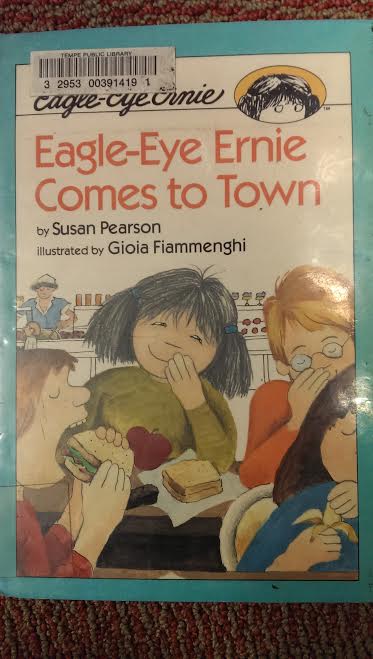
Eagle-Eye Ernie Comes to Town

eeetownEagle-Eye Ernie Comes to Town by Susan Pearson, 1990.

Ernestine Jones, better known as Ernie, is upset because her family has moved from Newport News, Virginia to White Bear Lake, Minnesota. She has no friends at school, and the other kids all think she’s strange and that she talks funny because of her southern accent.

Worse yet, someone has recently started stealing things from people’s lunches at school, and some of the kids think that Ernie might be the thief. Ernie has a knack for finding things, and her father says that she has an eagle eye. To save her reputation and any chance she might have of making friends, Ernie needs to use her eagle eye to find the thief so everyone will stop blaming her.

Ernie not only figures out who the real thief is but even helps the person find a solution to a bigger problem.

This is the first book in the Eagle-Eye Ernie series. The book is available to borrow and read for free online through Internet Archive.

My Reaction

The books are easy, beginning chapter books. The series starts with Ernie moving to her new town and making some new friends. These friends, William, Michael, and R.T. (Rachel) end up calling themselves the Martians because Michael is interested in outer space and likes calling everyone a Martian.

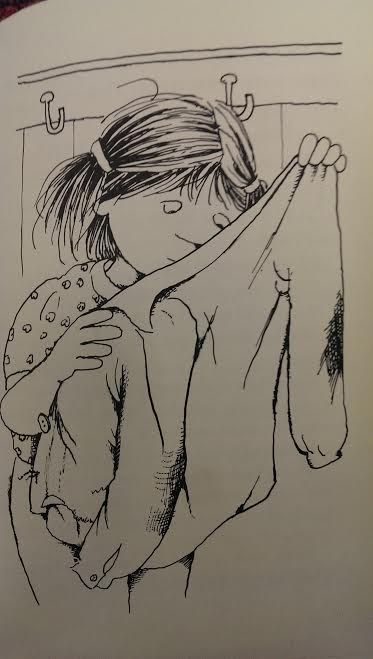
One of the cute parts of this book was when Ernie painted her saddle shoes to look like little bears in honor of “White Bear Lake.”  For a long time, this was the part of the story that I remembered best.

The 123 Zoo Mystery

eeezooThe 123 Zoo Mystery by Susan Pearson, 1991.

Ernie’s class at school, Room 123, has some fun class pets. They have a duck, a boa constrictor, a pair of hamsters, a toad, a rabbit, and a worm farm. Mrs. Lettuce, the pet rabbit, is going to have babies soon, and everyone is excited about it.

After a new girl, Hisako, joins the class, strange things begin happening. Someone lets all the pets out of their cages, and some toads appear in the classroom. Ernie wants to figure out what is going on because she’s worried that all the chaos will upset Mrs. Lettuce when she should be resting.

At first, suspicion falls on Hisako, who really likes animals, but Ernie soon realizes that there’s another explanation.  William is the one who finds the clue that Ernie needs to figure out the mystery.  Part of this story is about the lengths that someone would go to for the sake of a friend.

This book is part of the Eagle-Eye Ernie series.

eeezoopic1

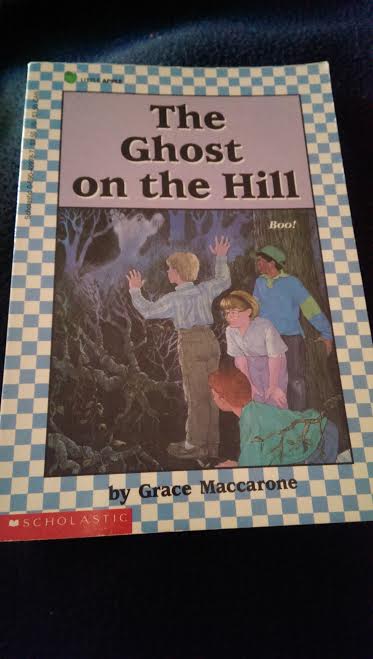
The Ghost on the Hill

ghosthillThe Ghost on the Hill by Grace Maccarone, 1990.

This is the last book in the Third Grade Ghosthunters series.

The kids take another field trip, this time to a state park. Native Americans used to live on that land, but most of the tribe died from disease many years ago. There are stories about spirits that live in the hills and the forest. Young boys from the tribe used to perform a ritual where they would dance with the Great Spirit in order to become men.

The third graders have been studying Native American history and customs to prepare for the field trip.  Norma wrote a report about Native American names, which tended to describe some significant characteristic of the person.  Their teacher tells the students that they should think of names for themselves which describe something significant about themselves.  Most of the kids think it sounds like a fun idea, but Joey doesn’t.  He’s just one kid in a family with a dozen other kids, and he’s never felt like there was anything particularly special about him.  That’s why he makes up tall tales about himself that all the other kids find weird and annoying.

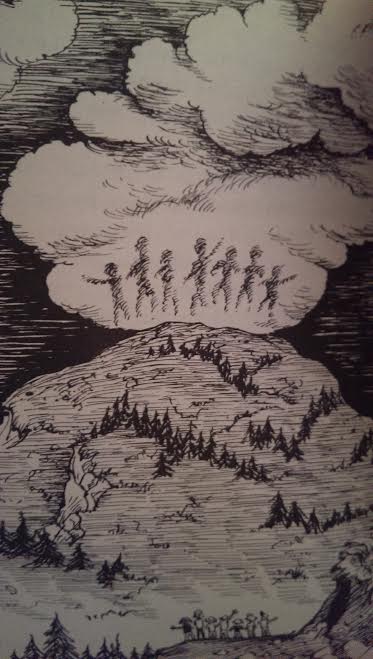
ghosthillpicWhen they reach the state park, Dennis Ten Foot Bridge, who is the last of his tribe, tells the students about his tribe, teaches them wilderness skills, and leads them in group activities.  One evening, Joey goes out to practice some rowing on the lake by himself, and he sees what looks like a large ghost at the top of a hill  However, everyone knows that Joey lies about a lot of things, so at first, no one believes him.  At least, no one except Adam.

Adam agrees to help Joey investigate the mysterious spirit. Eventually, all of the members of the ghosthunting group decide to go up on the hill together to see the ghost for themselves.  There, Joey finds the courage to face the spirit directly, and everyone sees the truth. Together, Joey and his friends end up repeating the ancient coming-of-age ritual that the tribe that used to live there would perform.

The solution to the mystery is a little strange, but the book is great for the characters alone. This final book in the Third Grade Ghosthunters series is a coming-of-age story. The other books in the series addressed personal issues and personality quirks in the characters as side-plots, such worrying about not being as smart others, worries about making and keeping friends, and the trouble with teasing. This one focuses on Joey and his sense of identity. He’s always felt that there is nothing special about him compared to his brothers and sisters. In this story, he develops his own character more and gains new confidence. In the process, he ends up becoming more comfortable with his role as a kid in a family with many children as well as appreciating his own uniqueness.  He also finds a name for himself that expresses his new sense of identity.

Return of the Third-Grade Ghosthunters

return3gghostThe Return of the Third-Grade Ghosthunters by Grace Maccarone, 1989.

This is part of the Third Grade Ghosthunters series.

The same kids who were assigned to figure out the mysterious happenings at their school are now going on a field trip to a farm with their class. They’ll be spending a couple of days on the farm, sleeping over.  Adam has been looking forward to the trip, and he brings his ghost hunting gear with him, just in case.  He hasn’t lost his taste for ghost stories since their last adventure.

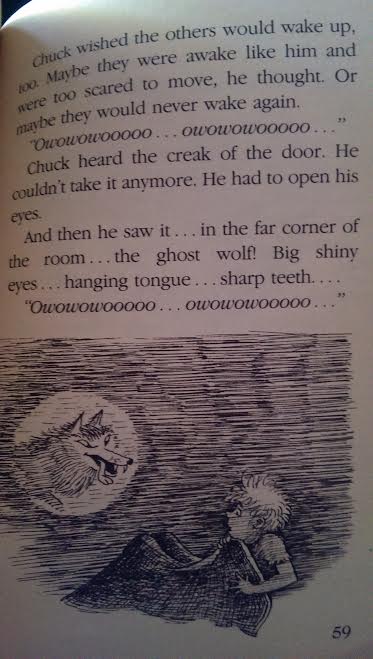
At first, things are pretty normal.  Then, during the night, the boys hear howling and see apparitions of a ghostly wolf in their bunk house. Could the farm be haunted?  Or is this some kind of mean joke?  Perhaps it’s the work of the class bully, Jeff? The ghost hunting committee assembles again to solve the mystery.

return3gghostpic2They try to use scientific methods to study the haunting.  They measure the placement of the furniture to see if anything moves while they’re out and sprinkle flour on the floor to get footprints.  But, even though they watch carefully and don’t see anyone enter the bunk house, when they go inside, everything is a mess, and the flour doesn’t appear disturbed.  Everyone else is about ready to admit that this one is a real ghost, but Adam has another theory.

The solution has an interesting twist to it. It’s a good mystery for kids beginning chapter books who like a little creepiness in their reading.

The book is currently available online through Internet Archive.

The Haunting of Grade Three

HauntingG3The Haunting of Grade Three by Grace Maccarone, 1984.

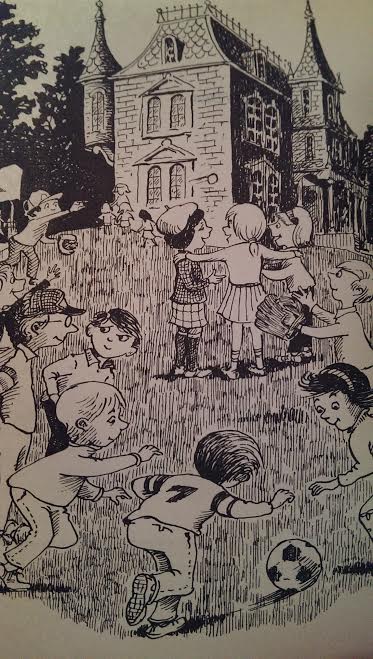
Elwood Elementary has become overcrowded, so the third-graders have been moved to an old mansion, Blackwell House, which has been empty for years. The house looks kind of spooky, and there are a lot of local ghost stories about it. Fortunately, Adam Johnson likes scary stories, so he thinks that it’s wonderful to go to school there.

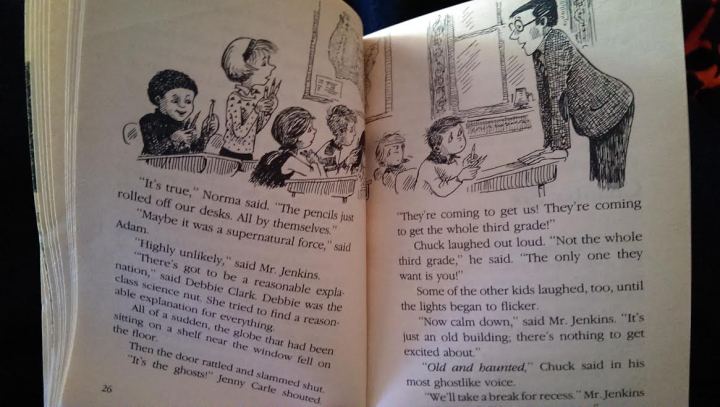
Soon after the students move into the house, strange things begin happening. Objects fall off desks and shelves, and door slam for no reason.  Some of the kids discover a grave marker on the property for a boy about their age who died during the Civil War.  The kids start getting nervous, and so does their teacher, Mr. Jenkins. Then, Mr. Jenkins decides to give the kids group assignments. Each committee gets to go to a different place in town and learn about it. Adam’s committee is assigned to study Blackwell House and decide if it’s really haunted. The kids think their assignment is pretty strange, but Adam is excited.  He wants to be a ghost hunter like on Ghostbusters!

HauntingGradeThreeMost of the group members are misfits in one way or another. Norma Hamburger is a shy girl, frequently teased about her last name. Debbie Clark is a talkative girl who’s really into science. Chuck Webber, Adam’s best friend, is the class clown, always telling stupid jokes (and one of the main people who teases Norma about her name). Danny Biddicker is strong and good at sports, but he worries that he’s not as smart as the others. Joey Baker feels overshadowed by his large family, so he tells tall tales to get attention. The other kids don’t understand and get annoyed with his lies. By working together, they not only learn the secret of Blackwell House, but they learn more about each other and become a real team and friends.

In the end, there is a reasonable explanation for the haunting of Blackwell House.  The kids take a methodical approach to the mystery, gathering their facts and ruling out various possibilities along the way.  Joey gets a chance to be a real hero, Danny proves to himself and everyone else that he’s smart and has good ideas, and Adam gets a new life ambition.

HauntingG3Pic

One other thing that I thought was interesting is that Adam, the main character in the story, is African American, but it’s never mentioned in the text of the story.  You only know because it’s shown in the pictures.  It’s just a little detail and not important to the story, but I thought it was interesting in a story that encourages kids to notice details.  I also liked it that Adam isn’t defined by race or appearance as so many characters in kids’ books are.  He stands by himself as an interesting character with his own ideas, courage, and leadership abilities.

This is the first book in the Third Grade Ghosthunters series.  It is currently available online through Internet Archive.

The D- Poems of Jeremy Bloom

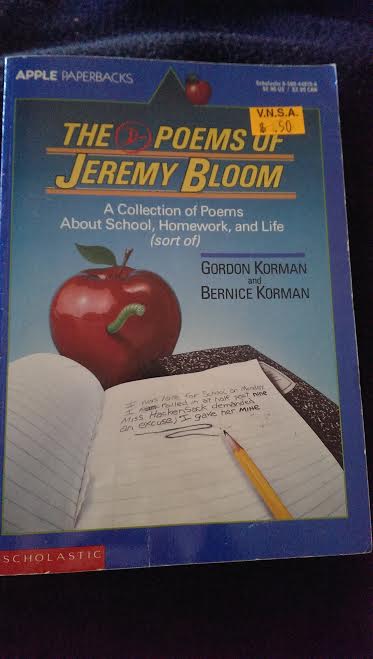
jeremybloomThe D- Poems of Jeremy Bloom by Gordon Korman and Bernice Korman, 1992.

This book is mostly a collection of funny poems, but there is an overarching story to them.  Jeremy Bloom, a typical middle school slacker, wanted to sign up for the easiest elective course he possibly could.  But, by accident, he overslept on the first day of school, and by the time he got there, sign-ups had already started and the easiest and most popular electives were full.  Desperately trying to find something easy and with as little work possible under the remaining electives, Jeremy decided to sign up for Pottery. (“It was no Snooze Patrol, but how hard could it be to make ashtrays?”)  Only, he made another mistake and accidentally signed up for Poetry, and once he was enrolled, there was no way out of it.  He was committed to spending a year writing poetry.

jeremybloompoemJeremy tries to make the best of things, but somehow (partly through his own fault and partly by accident), he continually manages to do things to annoy his poetry teacher, Ms. Terranova (or, as the kids call her, Ms. Pterodactyl, thanks to a mistake Jeremy made when he said her name on the first day of class).  Every single poem Jeremy writes during the year receives the same grade: D-.  The book is divided into different periods of Jeremy’s work, along with an explanation about what Jeremy did during each period to tick off his teacher.  At the end, the reader can be the judge: Are Jeremy’s D- grades because he’s a terrible poet or because his teacher is mad at Jeremy for everything else he does during the year?  (The answer is pretty obvious.)

My favorite poems are the longer ones like “Why I Was Late,” “The Wheeler-Dealer,” and “No Boring Parts Allowed.”  Just to give you an idea of what the poems are like (although they are written in a variety of styles), here’s another one of my favorites, “Honesty Is Not Always the Best Policy.”

The book is currently available online through Internet Archive.

Our Teacher Is Missing

TeacherMissingOur Teacher Is Missing by Mary Frances Shura, 1992.

Eliza is a quiet girl, and she likes to be that way.  Too many of her teachers try to make her be more “outgoing” or “lively.”  Mostly, Eliza wishes that they would just leave her alone.  That’s why she likes her new teacher, Miss Dixon.  Miss Dixon is quiet and soft-spoken, like Eliza.  Ben, the class bully, calls Miss Dixon “Mouse,” but in spite of that, Miss Dixon has no trouble controlling her class.

Then, one day, Miss Dixon doesn’t show up to class.  The kids wait around for her, goofing off, but Eliza is really worried.  She knows that it’s not like Miss Dixon to simply not show up.  Soon, other kids also start becoming concerned, and other faculty members realize that Miss Dixon is missing.  The principal arranges for a substitute teacher while they are looking for Miss Dixon, and the children continue wondering what could have happened to her. The students consider every possibility behind their teacher’s disappearance, from secret mafia connections and entry into the Witness Protection Program to alien abduction.

But, for Eliza, all these wild speculations, stupid jokes about their “Mouse” teacher being eaten by a cat, and the adults’ constant reassurances that they’re sure that there is a reasonable explanation and that no one should be “unduly concerned” are just not enough.  Whatever happened to Miss Dixon, Eliza is sure that she would have come to school or at least called if she could.  Eliza thinks that something terrible must have happened and that Miss Dixon needs help fast.  If the adults won’t do anything about Miss Dixon’s disappearance, then she will!

This book is currently available to borrow and read for free online through Internet Archive.

My Reaction and Spoilers:

I love this book because I identified with the main character from the time I first read it as a child. One of the themes of this book is about people’s perceptions of different personality types. Eliza’s teachers and even her parents underestimate her because of her quiet nature.  Eliza is an introvert, and she is under constant pressure from most adults to be more of an extrovert.  Eliza resents their attempts to reshape her into a more outgoing, forceful person, not recognizing that her real strengths are her intelligence, perceptiveness, and quiet determination to do the right thing.  Being a loud person isn’t the same as being a competent person, although some people have that perception.  However, the people around her come to understand her better in the end.  Eliza also finds some unexpected sympathy from friends who understand her impatience with the shallow immaturity of other kids and who also are content to not be completely understood by other people as long as they have the freedom to quietly be themselves.

Eliza succeeds in this mystery where the adults fail because she is perceptive and has insights into her teacher’s personality that other lack.  Although Eliza’s friends Robin, Stephen, and Chris are worried about getting into trouble by playing detective, when they see how determined Eliza is, they agree to help.  Soon, they realize that Eliza is right to be worried.  Miss Dixon intended to be home over the weekend, but something happened to keep her from coming home.  The more the children talk about what they really know about their teacher, the more they begin to put the clues together.  Finally, they realize where Miss Dixon was right before she vanished, but the situation is serious.  Miss Dixon is being held captive because she accidentally stumbled upon criminal activity.  When one of their classmates is also in danger, Eliza shows everyone that even a quiet person can have the bravery and determination to do what needs to be done.
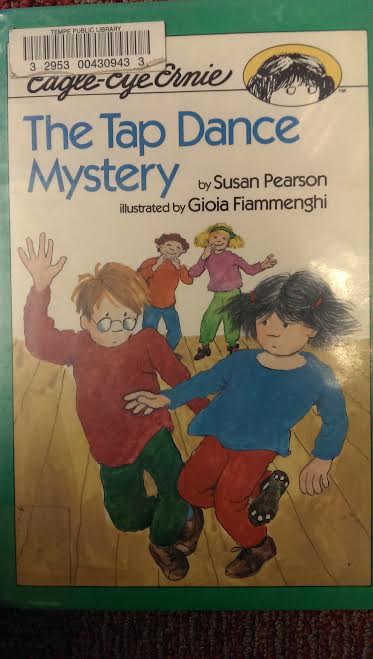
Sideways Arithmetic from Wayside School

SidewaysArithmetic

Sideways Arithmetic from Wayside School by Louis Sachar, 1989.

This is a companion book to the Wayside School Series.  Unlike the other books in the series, it doesn’t contain stories.  It talks about the things that kids at Wayside School study, partly from the point of view of Sue, a new student who is stunned to learn that kids at Wayside School do arithmetic with words, not numbers.

SidewaysArithmeticPicBasically, it’s a puzzle book.  In the Arithmetic section, the letters in the words stand for numbers.  The book gives an example to demonstrate how to figure out which numbers the letters stand for.  The problems get harder through the sections labeled Numbers, Pronouns, and Paragraphs.

From the Recess section on, there are logic puzzles.  In Recess, you have to use the information provided to figure out what games the children play at recess.  In Science, Geography, Etc. (that’s one chapter), you have to figure out who got the right answers to the tests from the information provided. You see the answers five of them got and know that only one of them got all the answers right and no two of them had the same score. When you look in the back to see if you solved the problem right, you get to see what the test was actually about, and that’s the funniest part.  The Lunch section combines logic puzzles with math.  The True or False section gives you true/false questions to answer based on a series of statements about which of them are true or false.  Finally, in the After School section, Joy and Sue give up and go home (as well they should).

I like the book because I like puzzles, and there are funny little stories around the problems and answers.  All of the puzzles are answerable (except for one or two where the correct answer is that they’re impossible, which is why Joy should definitely get up and go home, but you’ll figure that out way before she does).  If you like puzzles and the Wayside School series, you’d like this book.  If you don’t like puzzles, you can skip this and just stick to the regular books in the series (as regular as Wayside School gets).  If you like puzzles but don’t know about the Wayside School series, you could still find it interesting but you wouldn’t really appreciate the funny parts.  If you don’t like the Wayside School series or puzzles, you probably aren’t reading this right now, so don’t worry about it.

This book is currently available online through Internet Archive.

Wayside School Gets a Little Stranger

WaysideStrangerWayside School Gets a Little Stranger by Louis Sachar, 1995.
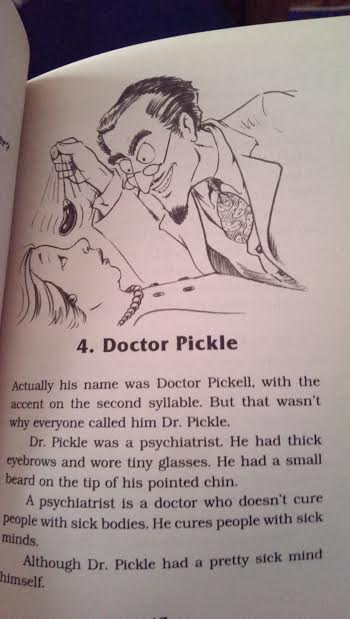
Just when you didn’t think it was possible . . .

Having finally managed to remove all of the cows from Wayside School (see the last story in the previous book in the Wayside School Series), Louis declares that Wayside School is ready for the students to return.  Everyone is glad because they were all sent to far more normal schools while Wayside was closed, and they hated it.  Nothing normal ever happens at Wayside, the school that was built sideways (and has a missing floor, where all the really strange stuff happens).

But, things are about to get stranger yet.  The school hires a new school counselor (they probably needed one) named Dr. Pickell (or Dr. Pickle, if you prefer).  He takes the job when he can’t practice psychiatry anymore because of his tendency to play practical jokes on people while they’re under hypnosis.  Can he finally cure Paul of his desire to pull Leslie’s pigtails?

WaysideStrangerPic1Meanwhile, the principal declares that “door” is a very bad word and that everyone should say “goozack” instead.  Mrs. Jewls tells the children to write poems about colors, but some colors rhyme better than others.  Kathy tries to convince everyone that Santa doesn’t exist.  Miss Zarves (who also doesn’t exist), laments about how difficult teaching really is.

Then, the children learn something really surprising: Mrs. Jewls is expecting a baby!  She has to take a break from teaching, and the children have a series of substitutes who are stranger than Mrs. Jewls.  Mr. Gorf turns out to be Mrs. Gorf’s son, and he wants revenge.  Mrs. Drazil turns out to be Louis’s old teacher, the one he was always afraid of, and she wants revenge.  Mrs. Nogard is an unhappy person who wants to make other people unhappy . . . until she realizes that isn’t what she really wants.  Wayside School may be strange, but it does have happy endings!

By the way, anyone notice what the substitutes’ names spell backward?

This book is currently available online through Internet Archive.