The Mystery of the Gulls

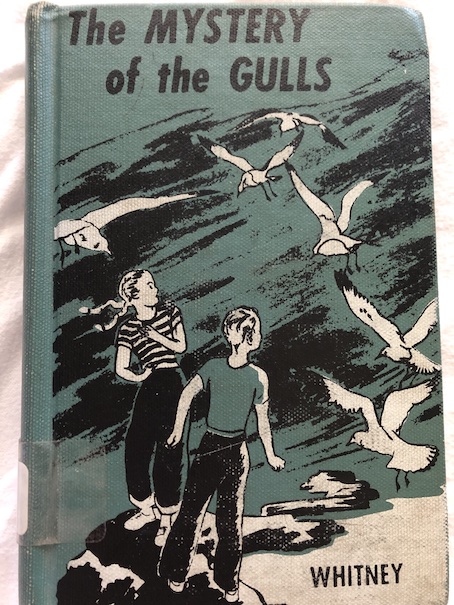
The Mystery of the Gulls by Phyllis Whitney, 1949.

Taffy Saunders and her mother are heading to Mackinac Island for the summer while Taffy’s father is in the hospital, recovering from a car accident. Taffy’s mother’s Aunt Martha has recently passed away, and she left the hotel she owned to Taffy’s mother. It’s a strange bequest because Aunt Martha hadn’t gotten along with her niece for years because she had disapproved of her marriage. There is also a condition on the inheritance. In order to retain ownership of the hotel, Taffy’s mother has to run it herself for a summer. Taffy thinks that it all sounds strange and mysterious, but her mother says that her aunt was an eccentric, and it was often difficult to understand why she did some of the things she did.

Taffy’s mother worries that something will go wrong over the summer that will prevent her from owning the hotel. It isn’t really that Taffy’s mother wants to be a hotel keeper, but since Taffy’s father’s accident, they’ve spent most of their money on medical bills. When he gets out of the hospital, he won’t be able to do his old job, which involved a lot of travel, so they’re going to have to settle down in a new city. Taffy is happy about living a more settled life than they used to live, but they’re going to need all the money they can get to buy a new home. Taffy’s mother is hoping to sell the hotel to pay their bills and buy a new home, but she can’t do that unless she can prove that she can manage the hotel first. Mrs. Saunders is hoping that her aunt’s long-time housekeeper, Mrs. Tuckerman, will help her make this summer a success, while Taffy is hoping that Mrs. Tuckerman’s daughter, Donna, will be a friend for her. Because their family has moved a lot, Taffy hasn’t had many opportunities to make and keep friends.

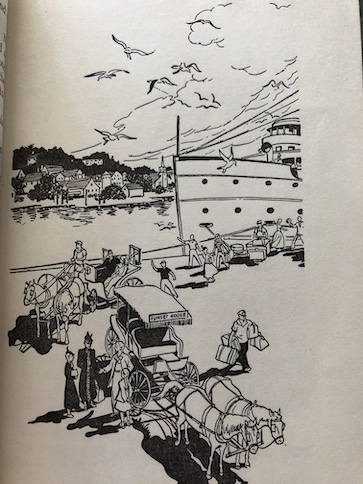
On the boat ride to Mackinac (which they point out is pronounced “Mackinaw” by locals), Taffy meets a boy about her age, David Marsh, who is going to Mackinac to visit his grandmother, and they talk about the sights to see on the island. There is an old fort on the island that is now a historic site for tourists, and David offers to show Taffy around. He tells her where his grandmother’s house is and says that she can come see him there, or he’ll come to the hotel, Sunset House, to see her.

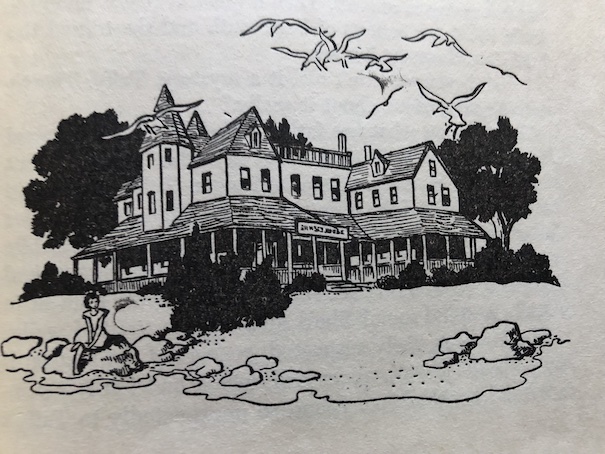
When Taffy sees Sunset House, she thinks it’s charming. The hotel is a large, old house with turrets, cupolas, and a widow’s walk. Mackinac Island in general seems charming. Cars are not allowed on the island, so people get around with horses, carriages, and bicycles. Taffy’s mother talks about wanting to “wake this place up”, but Taffy thinks that the calm, sleepy atmosphere is right for the house and doesn’t want to disturb it. Since Taffy has moved a great deal with her parents because of her dad’s job, she has lived in many hotels and apartments, and she finds the old-fashioned and comfortable furniture at Sunset House to be homey. Taffy thinks that the home-like atmosphere of Sunset House is a nice change and that she will like it there. The room she shares with her mother is beautiful, also filled with old-fashioned furniture and a charming alcove with a lovely view.

It seems like Aunt Martha’s usual guests prefer the place quiet, too. The first guests that they meet are the Twig sisters, a pair of elderly ladies who are at first concerned about a new child in the house. Until Taffy arrived, the only child at Sunset House was Donna, who is described as a quiet child. Aunt Martha only rented rooms to adults with no children. Taffy learns that Donna, who is about her age, is usually never even allowed to bring other children to visit her. Taffy feels sorry for Donna and hopes that she will want to be friends as much as she does.

Besides Mrs. Tuckerman, the housekeeper, there is also a cook named Celeste. When Taffy and her mother first arrive, they are told that Celeste hasn’t prepared lunch because she’s been seeing “omens.” Apparently, this is something that she does periodically, and Mrs. Tuckerman thinks that, this time, it’s just because she’s upset about Mrs. Saunders arriving. There are three other people who also work in the kitchen, but they all seem pretty useless without Celeste’s direction. Fortunately, Mrs. Saunders is a woman of action, so she immediately takes charge of making sandwiches for lunch. To speed things up, she even offers to let guests come to the kitchen to make their own sandwiches, any kind they want, if they wish to. Although Mrs. Tuckerman isn’t sure that will work, lunch turns out fine. However, Taffy has a strange encounter with Celeste in the garden.

In the garden, Celeste asks Taffy what word the gulls are saying. Taffy did have the feeling before that the gulls are saying a word, and it sounds like the word “help” to her. Celeste says that’s what she thought, and she says that’s a sign that a storm is coming. Her fear of the bad storm coming is why she feels like she can’t cook, and it bothers her that nobody else seems to understand, implying that there is impending doom. Taffy shows Celeste a map that David drew to his grandmother’s house, which she is having trouble understanding. Celeste explains to her how to get to the house, and she also mentions a shortcut, but she warns Taffy not to take the shortcut after dark because it goes through a “goblin wood.”

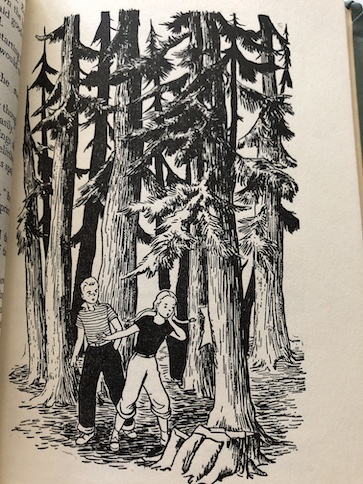
Taffy meets Donna for the first time at lunch. Donna is a shy girl, but she is glad that Taffy is there because she has spent much of her time alone since children are not usually allowed at Sunset House. Taffy asks Donna about Celeste and what she means about the “goblin wood.” Donna explains that Celeste and her family have lived on Mackinac for a long time because they are descended from fur traders (this is why Celeste has a French name, although the book doesn’t mention it directly) and Native Americans (the book uses the word “Indians”). Because of this heritage, Celeste has a lot of superstitions about the island and the spirits that supposedly inhabit it. Taffy doesn’t believe in spirits, but she can’t resist taking the shortcut to David’s grandmother’s house, just to see what it’s like. She has an odd encounter in the woods with a Native American boy (called an “Indian”) wearing overalls, who refuses to speak to her and seems hostile toward her.

When Taffy sees David, she tells him everything about Celeste and her encounter in the “goblin wood.” David says that he’s taken the shortcut through the woods many times without a problem, and he never had any reason to think that it might be haunted. Taffy is a little insulted at his comment that maybe girls get scared easier than boys, and David explains that the boy might not have been as unfriendly as she thought because her imagination might just have been fueled by Celeste’s stories, so she was primed for something scary or sinister to happen. They reconsider that theory when the two of them walk back through the “goblin wood” and find a note left on a tree, telling her that she’s not wanted on the island and that her presence makes the “manito” angry. David says that the “manito” is one of the Native American gods or spirits who supposedly inhabit the island. (This is a real concept in Native American lore, but I’ve seen it spelled “manitou.”) Whoever wrote the note was trying to scare Taffy, but why?

David is intrigued by what Taffy has told him about Celeste and her “omens” and the “goblin wood”, the note left for Taffy, and the unfriendly boy in the overalls (who Taffy sees again, talking to Donna, when she and David try out his grandfather’s binoculars), and he says he is willing to help her investigate further. The two of them work out a code, where Taffy can hang things of different colors in the window of her bedroom to send him messages.

The mystery deepens when Taffy’s mother tells her that there are two vacancies in the hotel after Taffy heard Mrs. Tuckerman turn away a man who wanted a room. There is also a locked room off of Aunt Martha’s old office that Donna says no one is supposed to enter. She says that they can’t even find the key, that no one has seen it since Aunt Martha died. When Taffy talks to her mother, she says that the locked room is a library and that the boy in overalls she’s been seeing is named Henry and that he does odd jobs for the hotel. Taffy tells her mother that it seems like people don’t want them on the island, including Henry, Celeste, and Mrs. Tuckerman. Even Donna has been acting strangely. Even though she said that she was glad Taffy was there, she’s been strangely unfriendly, and she’s been telling her mother that Taffy is the unfriendly one! Taffy thinks that’s really unfair, but her mother thinks that it’s just because everyone is adjusting to the changes since Aunt Martha died. Donna isn’t used to being with other children, and Celeste and Mrs. Tuckerman may be worried about their jobs since the ownership of the hotel depends on how well Mrs. Saunders manages it this summer and what she plans to do with it when she takes full ownership. Taffy and her mother don’t even know what will happen to the hotel if Mrs. Saunders can’t prove that she can manage it well enough. Aunt Martha’s will deliberately keeps the alternate heir secret until the end of the summer.

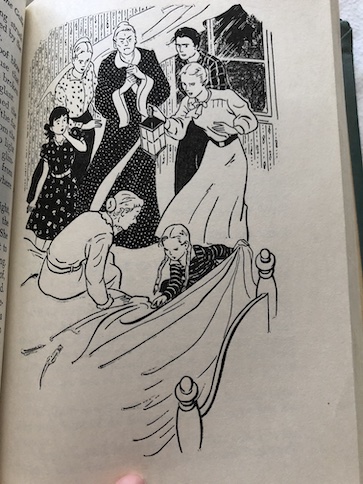
This is only the beginning of the mysteries and puzzles. Taffy learns that the man Mrs. Tuckerman turned away from the hotel was actually an old friend of Aunt Martha who has worked in hotels in Asia and says he would like to own a hotel of his own. The storm that Celeste predicted comes, and a baby seagull crashes into the window of the Twigs’ room. Celeste thinks that’s another bad omen and that Taffy and her mother should leave. Then, someone leaves a bat skeleton in Miss Twig’s bed. Donna says that Aunt Martha used to collect things like that and that maybe her spirit put the skeleton in the bed because she’s not happy. Of course, Taffy doesn’t believe that. Too many living humans seem unhappy that she and her mother are there. Donna admits that Aunt Martha was originally going to leave the hotel to her mother before the two of them had a quarrel, and Aunt Martha changed her will. Whether Mrs. Tuckerman might still be the alternate heir to the hotel is still unknown. Donna thinks the alternate heir might be some bird society because Aunt Martha was an amateur naturalist with a fondness for birds. Could there be another heir who is hoping to drive Taffy and her mother away so they can have the hotel? Could Donna and her mother still be hoping that the hotel will come to them? Could Celeste or Henry be trying to drive them away for their own purposes?

The book is available to borrow and read for free online through Internet Archive. Like other Phyllis Whitney books, this book is something of a collector’s item now, and copies are not cheap through Amazon.

My Reaction and Spoilers

I’ve been to Mackinac Island before, when I was in my teens, and I didn’t know about the pronunciation until I read this book. I had even forgotten about the horses and carriages since I’ve been there (which might seem odd, but I only spent one day there and I was obsessed with the fudge), but Mackinac Island is still car-free today. Reading this book revived some old memories for me, and it makes me want to go back and spend more time there! I didn’t stay overnight while I was there last time, but there are plenty of hotels there, including ones that resemble the one in the story, with turrets, cupolas, and widow’s walks.

Culture and Folklore

The book mentions that there are many Native Americans living on Mackinac Island, but it doesn’t mention a specific tribe. Even though some of the spooky and ominous things that happen in the story appear to have their roots in Native American folklore and superstition, I’m not completely sure how accurate the descriptions of the folklore aspects are. From what I’ve read, it seems that manitous (or manitos) really are a part of Native American folklore in that region, but there are a couple of aspects of it in the story that I haven’t been able to verify. As a slight spoiler, we eventually learn that Aunt Martha used to collect not only animal skeletons but dead birds, which she would turn into taxidermy. Celeste didn’t think that this was fully respectful to the spirits of the creatures, although she did seem to think that Aunt Martha had some kind of special connection to the spirits of birds because she was so good with them, living, injured, or dead. Because the author, Phyllis A. Whitney spent her youth in Asia because of her father’s job, she also has a habit of introducing Asian elements to most of the books she wrote at some point. In this one, although the main focus is on aspects of Native American folklore, there is also an Asia folklore story about a Chinese gong in the hotel, which seems to have a connection to birds or winged creatures, and that complicates the situation. The effect is that Taffy sometimes feels like she is dealing with forces that she doesn’t understand, which adds some suspense, although she is also sure that there’s a person behind it all because she doesn’t really believe in all the folkloric superstitions and physical objects are being used for the strange things that are happening.

One thing that I like about Phyllis A. Whitney’s juvenile mysteries is that they do frequently include history and folklore of different places and people around the world, and they do seem generally well-researched and presented with empathy. This book and other she wrote were published in the middle of the 20th century, around the same time that other books I’ve read were also published. Some mid-20th century books for kids lean into racial or cultural stereotypes, but Whitney’s book often subvert that or show characters rethinking some of their preconceived notions. The book does use the word “Indian” instead of Native American, which isn’t preferred, but apart from that, Taffy’s attitudes and ability to look at things from someone else’s point of view are good. Taffy is characterized as a very imaginative girl, and one of the ways she uses her imagination is to picture what other people think or how they would feel about different things. At one point, David says that Celeste is crazy for all of her superstitious talk, but Taffy defends her, saying that she’s not crazy. Taffy doesn’t believe in Celeste’s superstitions, but she recognizes that Celeste believes and acts the way she does because she has spent her whole life being steeped in stories of the history of spirits. These stories don’t make sense to Taffy and David, but Taffy recognizes that they make sense to Celeste. Celeste is wrong about the spirits being responsible for everything weird that’s happening, but being wrong about something isn’t the same as being crazy.

Later in the story, the kids form a club for exploring the island and giving hotel guests tours of some of the scenic spots. Taffy, David, and Donna ask Henry to be their “Indian guide” for the tours, and Henry sarcastically asks if they’re expecting him to wear feathers. The others quickly reassure him that they’re not asking him to be the guide because they want him to put on a kitschy show for the tourists or anything embarrassing like that. They just think he would make the best guide because he knows the island better than the rest of them and all the history and stories of the island. They want to call him an “Indian guide” to emphasize his Native American heritage and provide a credential for his knowledge for the sake of the tourists, but they say they would still want him to be part of the tours even without that, just because they want to be friends and include him. This explanation satisfies Henry, and he joins their tour club. For those who would like to learn more about the history of real Native American life on Mackinac, I recommend the Biddle House Native American Museum.

Time Period and Atmosphere

This book is set contemporary to when it was written, the in late 1940s. Readers will notice that Taffy periodically mentions whether or not women are wearing slacks instead of skirts, and that’s because that was a modern fashion trend in her time. Taffy’s mother is very much a modern woman, and she wears slacks from the beginning. However, Taffy can see that many women who stay at Sunset House (although not all) are older and more old-fashioned women, who wear skirts, like the Twig sisters. At first Taffy worries about whether her mother is dressing appropriately for her new job, managing the hotel, but it works out fine.

Taffy and her mother have different views on the hotel from the beginning. Taffy thinks that the old-fashioned hotel is charming and that the quiet atmosphere really suits the place. However, Taffy’s mother thinks that the place seems depressing and wants to “wake it up” a little. Taffy worries that her mother’s attempts to “wake it up” might ruin the quietness and quaintness that appeals to their customers. This is one of the reasons why people who work at Sunset House are concerned about what Taffy’s mother plans to do with the hotel. On the one hand, they didn’t always like the way Aunt Martha did things, but Taffy’s mother is a newcomer, who might not understand which parts of the hotel’s atmosphere should be preserved.

It’s true that people often visit places like this hotel specifically for their atmosphere, and the kind of people who choose to stay at Sunset House are looking for exactly that quiet and quaint atmosphere. When she was alive, Aunt Martha cultivated that time of atmosphere and a client base who likes that. With Aunt Martha’s death, Sunset House is at a transition point, where the new ownership will set the tone for its future. I think Taffy is right that the old-fashioned charm of the house should remain because even modern people like to visit quaint and charming places that are very different from the places where they live the rest of the time, but at the time time, Aunt Martha’s ways were unnecessarily strict, and there is some room for relaxing the atmosphere without ruining the quaintness. Allowing families with children wouldn’t be bad, and when Taffy’s mother learns that Donna’s passion in life is dancing (something that Aunt Martha disapproved of), she arranges for Donna to do an evening show for the guests, which Donna and the guests love. A little live music and dancing is a way of adding some life to the old house without ruining the charm because Donna’s ballet and tap dance are also charming and tasteful.

For some context between Taffy’s mother and her Aunt Martha, I’d like to point out that, because this book takes place in the late 1940s, Taffy’s mother’s youthful visits to her aunt’s Mackinac Island hotel took place before her marriage, which was probably in the mid-1930s, given Taffy’s age. That means that she was there as a kid during the 1920s or early 1930s. Culturally, the 1920s and 1930s, post-WWI, was the beginning of the modern era, with flappers pushing the boundaries of women’s dress and behavior, and women needing to take on greater roles in working and supporting their families during the Great Depression and WWII. Taffy’s mother would have been growing up, coming of age, and marrying and having a child of her own during all of these changes, and I think this helps explain her practical, modern outlook on life and personal habits. (Remember, she wears slacks. Other women don’t, especially the older and more traditional ones.) As a member of the previous generation, Aunt Martha would have been a product of the late 19th century and early 20th century, which I think helps explain the Victorian/Edwardian style of her home and her apparent attitude that children should be seen and not heard, an attitude which seems to be shared by the Twig sisters. Not all Victorian era adults felt this way, and many parents genuinely loved and indulged their children whenever they could, but it seems like Aunt Martha clung to the strict aspects of Victorian upbringing. In fact, her resistance to listening to the needs of the young people is a central part of the mystery. In fact, it is the reason for the mystery, and we learn that Aunt Martha’s behavior wasn’t solely a matter of her upbringing but her own mercurial personality and moods.

Aunt Martha (Spoilers)

Understanding Aunt Martha is key to understanding the entire mystery because she is literally the one who set everything up. Although she is dead before the story begins, we actually do get more explanations of her thinking in her own words than almost anyone else, except for Celeste, because she left behind journals that explain everything. I got angry with Aunt Martha when I realized that her manipulation of everyone was deliberate and planned. Aunt Martha wasn’t just strict; she was controlling and vindictive. She expected everyone to consult her about everything going on in their lives and to do everything she said, just based on her say-so. Whenever anybody resisted that control because their lives were their business and not hers, she would get angry, and that’s when she would withdraw affection and support and renege on promises she had made, seeking to punish them for their resistance. As Taffy later observes, Aunt Martha was not a nice person, and in her journals, she even said that she distrusted people who were too nice and too liked by other people because she never was herself. Her hotel was charming, but she wasn’t.

The terms of Aunt Martha’s will were not so much designed to benefit someone as to punish them all. She didn’t leave the hotel to Mrs. Tuckerman, as she had originally planned, to punish her for not following her orders on how to raise Donna, even though Mrs. Tuckerman had previously let her control things for both her and Donna. Leaving the hotel to her niece wasn’t meant as a nice gesture, either. She thought her niece was an idiot whose decision to marry a man she didn’t approve of was a sign of ingratitude for all that she had done for her (whatever that was – apart from letting her visit during summer, we don’t know of anything else she did), so she expected that she would fail at managing the hotel and would be publicly embarrassed by the failure. Aunt Martha purposely set up a situation where some people would have to ensure that others would lose in order to “win” something because she liked the thought of them fighting among each other and having problems because of her.

While understanding other people’s thinking is important, I also think that it’s important to recognize that understanding does not equal approval. We can understand that Celeste’s superstitions make sense to her without believing that everything has a supernatural cause, and we can also understand why and how Aunt Martha decided to use her will to get back at everyone for defying her in some way while recognizing that everything she did was toxic and done out of malice. What eventually stops it all is the revelation of Aunt Martha’s thinking and the understanding of the motives of the people doing all the strange things at the hotel. Taffy and one other person realize that, in spite of Aunt Martha’s manipulation, there is still a way for everything to work out well for everyone, with no “losers” in the situation. Once they figure that out, they are able to explain things to the others and get them to cooperate.

There is a theme in the story about good people who do bad things, but that applies more to the people Aunt Martha manipulated than Aunt Martha herself. Aunt Martha was good to birds and helped them heal when they were injured, but she wasn’t so kind to her fellow human beings. Some of the characters in the story think that they have no choice but to do what they’re doing because of the way Aunt Martha set things up, and it’s very hurtful to Taffy because she thought they liked her and she liked them, yet they were plotting against her and her mother the whole time. Taffy’s mother says that they did like them and feel badly about what they did, that they just felt trapped. I was bothered by some of the characters talking about how likeable these characters were because I don’t like people letting others off the hook for doing harmful things just because they can be pleasant and charming sometimes. There are serious abusers who too frequently get off the hook for those reasons. Heck, people let Aunt Martha get away with many of the things she did because she was nice to birds and could be charming and helpful sometimes, but her journals explain detail how little she thought of other people and how she schemed to manipulate and control them. Her last act was to do something she knew would hurt and embarrass the people close to her and cause them problems with each other.

Fortunately, even though the offenders are otherwise nice and likable, the book doesn’t let them off the hook for their behavior. I was gratified that Taffy’s mother and other characters say that people need to take responsibility for their choices, even if they’re “all mixed up inside”, and that doing things that harm others can’t be excused. Even the miscreants just saying that they understand now that they were wrong about what they were thinking and doing doesn’t get them completely off the hook. Instead, the characters make the offenders each pick a way to punish themselves and make amends for the trouble they’ve caused, to show everyone that they’re genuinely sorry and really mean to make things right. I like it because, as Taffy points out, their behavior makes her wonder about their entire relationship. How much of their previous likeability was just an act while they were scheming against them behind their backs, and what is their relationship going to be now? Can they still be friends, or is that all over because they were plotting harm the entire time? The punishments they give themselves are a gesture to show that they really do regret what they did and that they are going to follow through on that regret and change for the better. Nobody gets away with causing problems just because they put on an outward show and come across as likeable. In the end, they’re not trying to insist on everyone letting them go because that’s what they want, and they’re not acting as though they’re entitled to anything or deserving of being treated as special exceptions. It’s just them, taking responsibility for themselves and owning their feelings and motivations, as Aunt Martha never fully did outside of her journals. As Mrs. Saunders says, “like anyone who does wrong, they’ll have to take their punishment.” Their willingness to do that and to admit that they were wrong and make amends is what paves the way to repairing their relationships with the others.

I was disappointed, though, that we don’t really get to see the miscreants explain themselves. The Taffy’s mother and others talk to them without Taffy being present, saying that they want to handle the matter privately, even though Taffy is the main character and the one who was investigating the mystery all along. It’s sort of weird that the main character was shut out of the final discussion. Because she’s not there, readers don’t get to “see” exactly what happened or hear the miscreants’ explanations in their own words. Taffy’s mother just tells her about it afterward, and that feels like a cheat. “Show” is generally better than “tell.”

A Touch of Cottagecore

I think this mystery story about a summer spent in an enchanting place, with an old-fashioned hotel and an island with horse-drawn carriages, might appeal to fans of the Cottagecore aesthetic. The kids in the story have some independence in where they go and what they do. Taffy is allowed to spend some time exploring the island with David, seeing the sights and enjoying the beauty of the island. The garden around the hotel has pretty flowers, and Taffy starts learning some of their names. She never had the opportunity before to learn much about flowers because she’s been living in hotels and apartments. She thinks that, when her family finally has their own house, she also wants her own garden with flowers.

Some characters in books make up their own special words which are only used in their story, and the word for this book is “exasper-maddening”, which Taffy and her father use to describe her mother’s behavior at times. The mother is a woman of action, which can be good when someone needs to take charge of the situation. However, she is also impulsive and stubborn, given to doing things as soon as she gets the notion to do them and sweeping everyone else along with her, and she also has a tendency to focus on whatever seizes her attention in the moment instead of what’s concerning someone else.

Bells

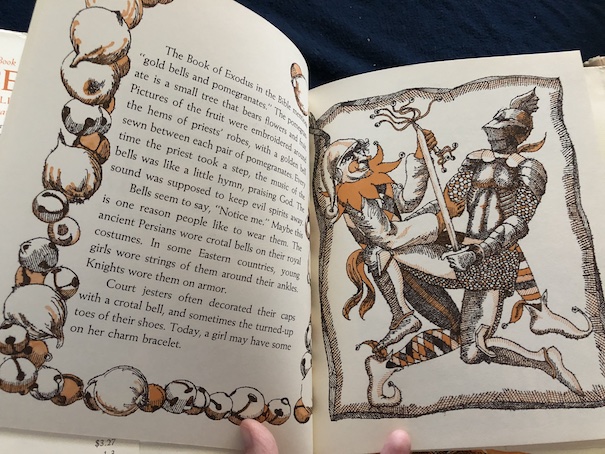
Bells by Elizabeth Starr Hill, illustrated by Shelly Sacks, 1970.

I love books about oddball topics, so a children’s picture book about the history of bells was irresistibly intriguing.

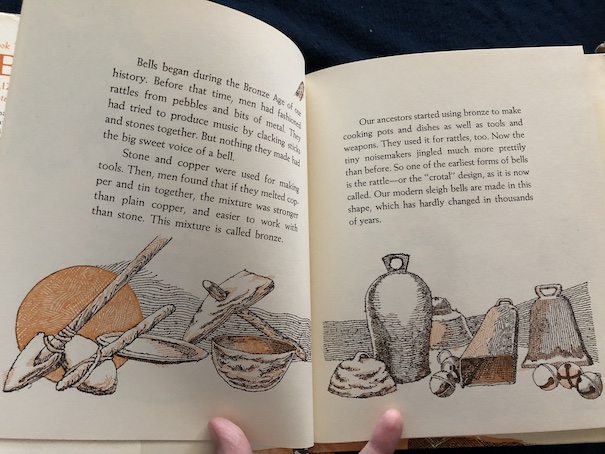
The book begins with the origins of bells in the Bronze Age. People had made rattles of various kinds before the Bronze Age, but after they learned to make bronze, an alloy of copper and tin, they discovered that they could make metal rattles with a much prettier sound. These metal rattles/early bells were made in the “crotal” design, which is the same shape as today’s jingle bells or sleigh bells. Other shapes of bells, like gongs and the classic bell shape may have been inspired when people realized that pleasant sounds could be made by banging bronze utensils against bronze dishes and bowls.

Bells have been used for thousands of years and have served many purposes. The oldest bell that has been found (at the time the book was written) was over 3000 years old and came from the area near Babylon. King Solomon of Israel used to have bells to frighten away birds from the roof of his temple. The Spartans were able to infiltrate a walled town in Macedonia because the sentry wore a bell on his uniform that helped them to keep track of where he was, but in other instances, nets with bells attached to them were used to warn of the presence of enemies. Bells have also been frequently used in religious services.

Sometimes, people wear bells to call attention to themselves. The classic jester’s cap with crotal bells (jingle bells) attached to it is meant to be attention-getting.

Bells can be made of many different materials, from different types of metal bells to glass bells to clay bells. There are even wooden ones, although they make more of a clunking sound than a ringing. People used to make bells by hammering pieces of metal into shape, but then they developed ways to cast bells in molds, which is how bells are made today.

There are many superstitions that have been attached both to the making of bells and their use. The book describes the Bilbie family, who famously made bells in Medieval England. The Bilbies were superstitious and consulted astrologers to determine the best times to make their bells. They also always rang bells for the first time on full moons. Various people have believed that ringing bells frightens away demons and witches.

The parts about superstitions and legends are my favorites. In particular, there is a legend in England about a town that was completely buried during an earthquake. The people in the town always rang their church bells at Christmas, and the legend is that if you go to a particular spot and put your ear against the ground, you’ll still hear them ringing the bells. However, the book says that there’s actually a scientific explanation behind the phenomenon. People who have put their ears to the ground at that spot have heard bells ringing, but they’re actually the bells from a nearby town, not one underground. The ground actually conducts sound very well, even better than sound waves moving through the air, so a person standing upright might not hear the bells ringing from another town, but someone who put their ear to the ground could hear the conducted sound vibrations. It’s not unlike the phenomena experienced by people who put their ears to the rails on railroad tracks to listen for the train. There are also stories of people having heard the approach of herds of animals, like buffalo, coming toward them in this way. The book doesn’t mention it, but “keep an ear to the ground” is actually an expression for watching and listening for signs of things that are going to happen because people noticed that vibrations in the ground could be indications of something coming toward them.

The book also describes some famous bells, like the Liberty Bell, Big Ben (Big Ben is actually the name of the bell in the clock tower, not the clock tower itself, although people informally think of the clock tower as Big Ben) and Tsar Kolokol, the largest bell in the world.

There are also a few nursery rhymes that mention bells (although the book doesn’t give any background information about the rhymes) and some information about change-ringing and carillons.

The book annoyed me a little in the way it kind of jumps around, telling some history, then some legends, then some more history, and then more legends. It’s a very easy read, and the information is interesting, but it’s a big disjointed. It sometimes feels more like a list of facts and short stories than one cohesive story. It might help if there were headings or chapter divisions in the book to organize the information, but there aren’t.

The book is available to borrow and read for free online through Internet Archive.

The Green Cameo Mystery

Kay Tracey

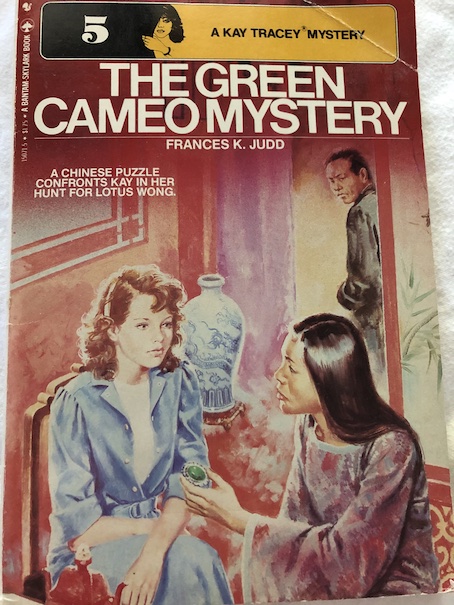
The Green Cameo Mystery by Frances K. Judd, 1952, 1980.

The story begins with Kay’s friends, Betty and Wendy, treating her to lunch, but when the girls try to pay the bill, the cashier says that their money is counterfeit. Betty and Wendy say that their mother gave them the cash, and she got those particular bills on a recent trip to San Francisco. The cashier tells them to contact the Secret Service and report the counterfeit money and tell them where it came from. (This book is old, but the Secret Service still investigates counterfeit money.)

As the girls leave the restaurant, they talk about the errands they want to run this afternoon. There is an auction Kay wants to attend because there’s a beautiful Chinese desk that she wants to get for her cousin, Bill, for his new office. However, she remembers that she needs to drop Bill’s shirt off at a laundry before they go to the auction. The laundry is a cliched Chinese laundry (connections are building in this story), but the man Kay usually sees there is absent today. The woman at the counter, Lily Wong, says that she’s the man’s sister and that her brother is unwell. Kay asks if he’s been to a doctor, and Mrs. Wong fearfully says that she doesn’t think that there’s anything a doctor could do against the green cameo. She explains that her husband got the green cameo in Shanghai, but it’s cursed, and it brings misfortune to her family every three years. While the girls are talking to the woman, she gets a phone call from someone who tells her that her daughter Lotus is now missing, having disappeared from the college she attends. (Yeah, Lotus. I don’t know if that’s a name that Chinese people actually use, but many of the Chinese names in this book struck me as being made up. I could be wrong because I’m not an expert on Chinese names, but they have that look.)

Mrs. Wong tells Kay that she tried to hire a medium named Cara Noma to break the curse of the green cameo, but she hasn’t been able to do it. Right away, Kay is sure that Cara Noma is a fraud. Kay volunteers to help find Lotus. A prime motive for her disappearance is Lotus’s impending arranged marriage to an older but wealthy businessman named Foochow. (I Googled that name, and apparently, it’s a romanized version of a place name, not a last name.) Kay’s first thought is that Lotus may have run away because she decided that she didn’t want to participate in this arranged marriage. Mrs. Wong also tells Kay that Cara Noma claims that her daughter has sold a jewel box with a green lotus cameo on the lid that Mr. Wong gave her as a betrothal gift.

The medium Cara Noma shows up while Kay is discussing the situation with Mrs. Wong and starts into her mystical act about how she’s going to break the curse. Kay impatiently tells her that it’s all nonsense and that she’s just taking poor Mrs. Wong’s money. Even Mrs. Wong agrees because, so far, Cara Noma hasn’t produced any results, and Kay is nice enough to offer to help her for free. Angrily, Cara Noma grabs both Kay and Mrs. Wong and uses some blood from a cut on Mrs. Wong’s finger to draw a red X on Kay’s forehead. She declares that she has transferred the curse of the green cameo to Kay and that Kay will soon see that the curse is real.

Kay still doesn’t think that the curse is real, and she and her friends head over to the auction where she wants to buy that desk for her cousin. Before the auction begins, Kay and her friends are looking over the items for sale when Kay discovers that the desk she wants to buy has a secret compartment in it. On impulse, she puts the envelope holding her money in the secret compartment to try it out. (This is so dumb, Kay. Don’t put all of your money in the secret compartment of a desk you don’t own!) Then, she gets distracted when she spots a jewelry box matching the one described by Mrs. Wong. Then, Kay’s nemesis from school, Chris Eaton, shows up and tells her not to waste her time bidding on the jewelry box because she wants and she has more money than Kay.

It turns out that Kay is unable to buy the desk she wanted to buy because the bidding is much higher than she can afford. Then, a man named Sidney Trexler shows up and protests the auction, saying that the desk belongs to him and he doesn’t want to sell it. It turns out that he’d been storing the desk there, but the desk was being sold because he hadn’t paid his storage fees. Mr. Trexler says that he has the money to pay his fees now and wants the desk back because he’s planning to get married and will need the furniture. The man who was going to buy the desk agrees to cancel his offer to buy so Mr. Trexler can have the desk back. When the jewelry box comes up for sale, both Kay and Chris Eaton are outbid by Mr. Trexler as well. Kay is disappointed because she was hoping to get the jewelry box for Mrs. Wong.

However, the mystery is only just beginning. When Kay gets home, she finds that the envelope she thought held her money isn’t really her envelope. She did remember to retrieve the envelope from the desk before it was sold (for a moment, I was afraid that she would forget), but by mistake, she grabbed a different envelope. Is this the first bad luck of the curse? Kay knows that she has to talk to either the auction house or Mr. Trexler to get her envelope and money back! Then, a taunting comment from Chris Eaton reveals that Mr. Trexler’s fiancee is actually Lotus Wong. Now, Kay really needs to find Mr. Trexler!

The book is available to borrow and read for free online through Internet Archive.

My Reaction and Spoilers

So, right from the beginning of this story we have the mystery of the counterfeit money, the mystery of the cameo curse, the mystery of the fake medium, the mystery of the disappearance of Lotus Wong, and the mystery of Mr. Trexler and his engagement and sudden money. The girls also come to wonder about Mr. Wong. He seems to have much more money than his brother-in-law who operates the laundry, and his wife seems afraid of him. What is Mr. Wong’s business, and why doesn’t he do more for his brother-in-law? Are any or all of these things connected? Actually, yes. At first, I wasn’t sure how they were going to circle back toward the counterfeit money from the beginning of the book, but it turns out that Cara Noma is in on the counterfeiting operation. For a time, it looks like Mr. Wong might be the head of the operation, but it turns out that he’s innocent. I thought that Lotus’s reasons for running away were poorly explained. Part of it is that she doesn’t want to marry Foochow, but there’s also a side plot about Cara Noma using hypnosis to control both Lotus and her mother. I think the implication is that she was doing it to milk Mrs. Wong of money while keeping Lotus hidden from her, but it seemed like an odd complication to me since Cara Noma was also involved in the counterfeiting ring.

I’m not sure that I’d call anything in the book “racist”, although I think there may be justification for saying that parts are “stereotypical” and probably a bit culturally shallow and “tone deaf.” My first impression was that the author and the characters in the story like Chinese culture for being exciting and exotic, but in that way where there’s no real depth to their knowledge it and it comes off as being a bit like caricatures of Chinese people you might see in old movies. I’ve seen some of the old Charlie Chan mystery movies, and the way the characters in the book talked kind of reminded me of them. The Chinese names seem pretty stereotypical and so does the way they speak in broken English. They don’t do the “Engrish” thing where the ‘l’s and ‘r’s are swapped, but the Chinese characters don’t speak proper English, and they throw in phrases and expressions that I think are meant to sound quaintly foreign. At one point, Mrs. Wong says to the girls, “When you see Lotus again, tell my lovely flower not study too hard. Much study make many wrinkles.” I’m not sure whether that was just a joke or if it was supposed to be some kind of pseudo-proverb, like Charlie Chan used to make. On the other hand, some of the speech patterns I thought might be old stereotypical tropes from movies might have more grounding in real life than I’ve credited them for having. Lily Wong also sometimes refers to herself in the third person, “Lily Wong not sure,” instead of “I am not sure.” I’ve met people in real life whose first language was Chinese, and none of them do this. I thought at first that this might be another trope carried over from old movies, but I looked it up, and apparently, actual Chinese speakers can do this sometimes. The technical name for it is illeism. So, while some of the speech patterns seem like old movie tropes, they might not be completely wrong for real life.

One part of the story that bothered me is the Chinese play that Kay’s school decides to perform. Kay and her friends are told that “a delegation of foreign visitors to the United States” (no nationality/nationalities specified at first) would be visiting schools in the area, including the high school that they attend. To entertain their foreign visitors, the school decides that they’re going to put on a short play, and of course, the drama teacher picks one with an “Oriental” theme called “The Pagoda Mystery.” (“Oriental” is the word they use, which is rather vague and considered somewhat outdated now. Some people consider it demeaning because it has old associations with stereotypes that people don’t want to perpetuate. The demeaning part seems to be more in the attitudes associated with its use than in the word itself. It is a technical geographic term that refers to the Eastern Hemisphere, but my thought is that referring to an entire hemisphere is rather vague. I don’t think the book meant it badly, but in modern times, it’s generally considered more polite and a sign of being well-educated to use the most specific word possible when describing geographic regions or groups of people. When people are overly vague, it makes it sound like they don’t know what they’re talking about or what the more specific word is. If this play is specifically about China, they could have just said that.) It’s rather coincidental that they’re doing a mystery play set in China right when Kay is working on a mystery involving people from China, but those types of coincidences happen often in Kay Tracey books. I wasn’t able to find any real information about this play, so I’m pretty sure sure that it was just made up by the author of the book so the school would have just the right kind of coincidental play to perform. Also, of course, Kay gets the lead role in the play when she tries out for it, that of a beautiful Chinese maiden. If there are any Asian students at this school, they aren’t mentioned, so I don’t think there are any. Charlie Chan was also not played by Asian actors, even though other characters in the series were, which is why they bother people now and there haven’t been any new ones made since 1981. The book says, “But because of her recent experiences at the Wong home, Kay spoke her lines with special feeling and proved her familiarity with Chinese customs and people. Therefore, the leading role was given to her.” I’m not convinced that her conversations with Mrs. Wong have really given her deep knowledge of China, but they did have tea together at her house, so maybe there’s an implication that she told her more about Chinese tea customs than the book described or something.

By another coincidence, it turns out that Mrs. Wong was in a production of the same exact play in China when she was young, and she played the part that Kay is going to play, so she coaches Kay in how to play the part. (What stroke of luck! See, Kay isn’t cursed!) Mrs. Wong assures Kay that when her face is made up to look Chinese, no one will know that she isn’t really Chinese because she’s such a good actress. I suppose that people in the 1950s, when this book was originally written, would be a little more accepting of non-Asians wearing makeup to play Asians (called “yellowface“) just because it was done more often back then, and people get comfortable with things they see often. It’s not particularly comfortable for modern people because our society is sufficiently diverse to have actual Asians playing Asian roles without the help of cheesy makeup, so this part of the story is eye-rolling, especially the way everyone fawns over Kay being so authentic-seeming. Also, much of what Mrs. Wong teaches Kay seems to involve making gestures with her hands and fluttering her eyelashes when she speaks, which the drama teacher praises as being very realistically Chinese. It’s hard to know exactly what that means without seeing exactly what Kay’s doing, and the description doesn’t say much. The fluttering eyelashes make me think that she’s acting flirty, but I don’t know if that’s suppose to be part of her role in the play or not because we’re never told the full story. Again, I could be wrong, but it Kay’s apparently authentic performance seems more like something from an old movie than real life.

I think that the drama coach choosing a play from China was meant to be some kind of salute to the foreign visitors (and a coincidence that helps further the plot of Kay’s mystery), but it seems like a kind of tone-deaf choice to me, not thinking about what people really want to see and experience when they visit a foreign country. If I were the person making the decisions, I don’t think that I would be comfortable with showing visiting foreign dignitaries a high school production of a play they would already know from their own youths in their country, entirely acted by people wearing makeup to look like them, probably with varying degrees of success. It just seems awkward and might give the impression that they were being made mocked rather than honored. People travel to see new and different things, not imitations of things they already have back home. That would be like someone from New York City going to New Orleans and spending their entire time there watching productions of Broadway plays instead of touring the French Quarter or the Garden District. If you’re just going to do something you could do back home, what did you even make the trip for? Traveling is about seeing things that make different places unique. So, if I were in charge of the high school play, I think I would have picked something that had nothing to do with China, something new and original that the visitors could describe to people back home as something you could only see if you go to America. It might be an American-written play or maybe something that the students put together themselves to show their individual personalities and interests, a view of the modern American teenager, like a collection of student-written short skits or a talent show. Musical performances would be good because people can still enjoy the sounds of the music even if they don’t know all of the words. It’s pretty likely that this school has a band or orchestra, and there may be some unofficial student bands that could play. Dancing, gymnastics, and juggling acts might be good, too, if there are people who know how to do those, because people understand what they are just by looking at them. They don’t require explanations like humor that involves puns and might go over the heads of people who aren’t completely fluent in a language. I like the idea of the entertainment being a sort of variety show with music and skits because that’s a traditional form of entertainment that was still popular in the 1950s, and it’s a good format when you have a large group of people because there are multiple leading parts and solos in different acts of the show, avoiding some of the inevitable arguments about who gets the best parts. They could even have displays of artwork or science projects from students who aren’t part of the performing entertainment. It would offer variety for the visitors and give everyone a chance to contribute something.

Of course, there’s a subplot to the story about Chris Eaton, Kay’s school nemesis, trying to steal her part in the play. Chris even goes so far as to drug Kay’s food so she’ll miss the performance. First of all, I’d never be as trusting as Kay, and I wouldn’t eat anything that someone who has a history of doing nasty things gave me. If Kay’s so sharp, she should have figured that Chris would do something nasty to her food. Second, drugging somebody isn’t a harmless prank. Chris apparently slipped Kay a strong sleeping pill, and Kay didn’t even finish everything Chris gave her. We don’t know whether Chris might have accidentally overdosed Kay if she’d eaten it all. People can die from drug overdoses. Chris also couldn’t know for sure whether or not Kay might have been taking some other medication at the time that would conflict with what she gave her. People can also die from mixing the wrong medications. For some reason, Kay and her friends don’t tell on Chris, and Chris isn’t punished. I understand that people don’t like to be thought of as tattletales, but I think that there are limits to what people should be willing to put up with, and being drugged should definitely something no one should tolerate. What she did was serious, and I don’t like it that they’re pretending like it isn’t.

Overall, I found myself often thinking of the old Charlie Chan movies while reading this book, comparing what I was reading to what I’ve seen in old movies. There are reasons why the Charlie Chan movies didn’t last, and I think this book is a decent example of some of those reasons. During their heyday, the Charlie Chan books and movies were welcomed as one of the first portrayals of an Asian hero in American culture who was kind, intelligent, and upheld justice. Even though Charlie Chan was a stereotypical character, he was a stereotype of all that was good, which was a welcome break from previous stereotypes of Asians as devious, evil characters, like the fictional villain Fu Manchu. Charlie Chan was one of the first fictional characters to encourage the American public to see Asian people in a friendly light and even as people to be admired. The Charlie Chan series encouraged a positive interest in Chinese people and culture, even though it was also somewhat shallow and stereotypical. As I said, the actors who portrayed Charlie Chan in movies were not Asian themselves. Hollywood back in the day couldn’t bring itself to put an Asian in the leading role. Culturally speaking, it’s probably best to look at that series as a stepping stone to better things. Once people have been introduced to a concept, we expect them to eventually gain more depth and understanding. Charlie Chan helped people to break away from old, toxic ideas and prejudices, but that doesn’t mean that people should stay at that level of cultural understanding and portrayals. People progress. They grow and learn, and so do societies and cultures.

What I’m saying is that nothing in this story related to China or Chinese culture is educational for children. They won’t learn anything from this book, and most of the books that I read as a child specifically included real facts about other countries and culture to be at least factually-correct or semi-educational. This book doesn’t even define the word “pagoda” for anyone who doesn’t already know it. There are no Chinese words in the story, and when Kay and her friends have tea with Mrs. Wong, they don’t say whether there are any special tea customs they observe. What the book tells you about Chinese people is very general – that they have some interesting antique furniture and art objects, they drink tea, they might be superstitious, not all of them speak good English, some are friendly and helpful while others are sinister criminals, and if you want to act like one on stage, hand gestures and fluttering eyes are pretty important (whatever that means). Some of that stuff is true, particularly the parts about tea, the fascinating antiques, and the fact that some can be good and some bad, like human beings in general. But, there’s not much concrete, factual knowledge here, and some parts might give kids the wrong impression. I had the feeling the whole time I was reading it that the person who wrote it was a fan of old movies and didn’t really know much about Chinese culture to tell anybody in a factual, educational way. The old Scooby-Doo cartoons were kind of like this when they talked about other countries and cultures, too, because many of them were written as kind of spoofs on movies that people would have known when they were first made. If you’re into old movies, you can recognize the references, but they weren’t meant to teach anything or include any real information. If you compare the older Scooby-Doo series to the more modern ones, you’ll notice that some of the modern ones make more of an effort to include some real, educational facts. Scooby-Doo isn’t an educational show, but I have noticed a slight shift in how they talk about other countries and cultures. That’s more the standard of children’s literature and entertainment I’m accustomed to – when someone says something about another country or culture, I expect it to be something factual that shows that the author did at least a little basic research and knows something about what they’re talking about. It’s grating to me sometimes that older, vintage children’s series don’t always do this. Some of them even shamelessly make things up about other countries and cultures just because they think it would make the story more exciting, assuming that the kids reading the books won’t notice or care. If this book sparked an interest and encouraged kids to learn more about China or Chinese culture, it’s not too bad, but by itself, it doesn’t demonstrate any helpful level of cultural knowledge and information.

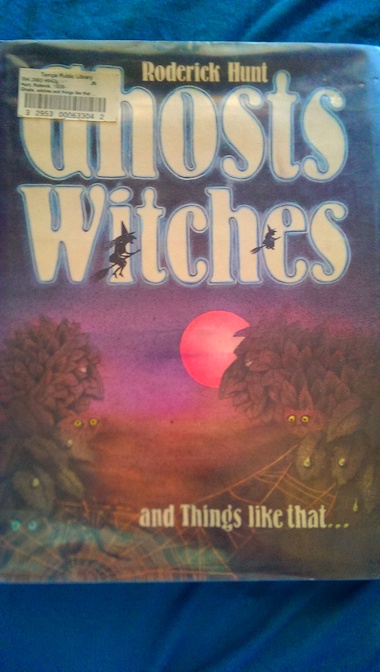
The Witches of Hopper Street

The Witches of Hopper Street by Linda Gondosch, 1986.

Kelly McCoy and her friend, Jennifer, are offended that another girl from school, Rae Jean, is having a Halloween party and didn’t invite them. Jennifer says that they could just throw their own party on Halloween, but Kelly says that’s no good because everyone else they know is going to Rae Jean’s. It isn’t so much that Kelly really likes Rae Jean; it’s more that she hates being excluded.

The girls talk about what they want to dress as for Halloween, and Kelly suggests that they be witches because she’s fascinated by the witches she saw in a play of MacBeth. Kelly also has a book called “Magic and Witchcraft”, and she says that they could study the book and become real witches. Jennifer doesn’t see the attraction of becoming a witch, but Kelly promises that they’ll only perform white magic, where you use magic to perform good deeds, instead of black magic, which involves cursing people. Although, she might make an exception for just a few little black magic spells against Rae Jean. Jennifer says that Kelly can’t be serious, but Kelly says that she is because it’s awful being the only ones in the sixth grade not invited to Rae Jean’s party. Jennifer points out that Adelaide also wasn’t invited. The girls know that Adelaide isn’t popular because she’s overly tall and awkward and much smarter than the other kids. Then, Kelly gets an idea – there were three witches in MacBeth, so maybe they should invite Adelaide to become a witch with them.

When the girls see Adelaide on her way to Rae Jean’s house to help her with her math homework, they stop her and suggest to her that she join them as witches. Kelly tells her that Rae Jean is dangerous and that dangerous things will happen at her party. Adelaide says that she’s not going to the party anyway. Then, Kelly pretends to tell the future with a deck of cards, predicting that there will be a mysterious death in 24 hours. Her prediction comes shockingly true when Rae Jean’s cat kills her pet parakeet.

Kelly knows that the parakeet’s death was partly her fault for taking him out of his cage when Rae Jean brought her cat around, showing off her prize-winning pet, but she also blames Rae Jean for bringing her cat to her house in the first place, and the reason why they took the bird out of his cage was that Rae Jean was goading them about how dumb the bird was. (I think that the kids’ mother shouldn’t even have let Rae Jean bring her cat into the house. The other kids said that they didn’t want to talk to her, but the mother insisted that they let her in because she’s a “nice” girl. That was an irresponsible thing for the mother to do, and she’s not a good example to her children. When you have a pet in the house, you have to make the pet’s safety a priority, especially over being polite to someone who is rude and insulting anyway. Rae Jean shouldn’t have been allowed to bring a predatory pet into their house, uninvited, simply because she wanted to and the mother didn’t have the guts to say no and enforce some house rules. Of course, this is one of those annoying incidents in books that’s used to move the plot forward. If the parents acted anything like mine, it wouldn’t have happened, and this would be a different story.) Adelaide is impressed that Kelly’s prediction came true, and she agrees to be a witch with Kelly and Jennifer.

Kelly walks the others through rituals for being a witch, like signing their names in a Black Book (really, it’s an old brown science notebook), preparing their broomsticks (they’re supposed to be rubbed with the fat of a newborn piglet and belladonna, but the best they can do is strips of bacon and dieffenbachia), and preparing magical rings to protect themselves from evil creatures (Kelly got hers at an estate sale so she’d have one that belonged to a dead person, but the others just got their rings from the quarter machines at the supermarket). The girls pledge to keep their “coven” secret, but then someone leaves a message for them that says, “Midnight is the witching hour. Then you shall be in my power.” All of the girls deny having written it. So, who did? Who else knows about their witchy activities?

Kelly still hasn’t given up her plans to use this witch business to ruin Rae Jeans’ party. She soon acquires a new pet, a skunk, from her brother Ben’s friend Buster, whose father is a veterinarian. She calls the skunk Cinnamon and declares that he is her familiar. To keep the boys quiet about their activities, they have to let Ben and Buster join the coven as warlocks. As an initiation, all of the witches and warlocks have to drink salt water and eat beef liver. Kelly’s mother is perplexed by some of the odd things that they do, but she doesn’t question them too much, and none of the adults ever discover that the kids sometimes sneak out at night to perform rituals. (I could never have gotten away with this sort of stuff as a kid because my mother was always the type to ask a lot of questions about everything and get specific answers.)

Kelly gets the idea of making a voodoo doll of Rae Jean, using an old sweater of hers that Rae Jean’s mother gave her because she helped to get a box of old clothes down from the attic for a sale and because Rae Jean told her that the sweater was scratchy. To get Rae Jean’s hair and nails, the witches open a “spa” business at Kelly’s house. They succeed in getting hair and nail clippings, but Rae Jean gets scared away when their “spa” treatment involves mud that they just dug up in the backyard and has a worm in it. After they make the doll, they decide it looks really awful and sticking toothpicks in it is creepy, so they take the toothpicks out and get rid of it. Instead, they decide to focus on giving Rae Jean the “evil eye” – basically staring at her to make her feel uncomfortable. (That one works whether you’re a witch or not.) When Rae Jean and some others in class get sick, some of the other kids start to believe rumors that the girls have spread about a “poison plague.”

Eventually, Halloween comes, and Kelly gets the idea for her, Jennifer, and Adelaide to use their witch act while passing out candy to the trick-or-treaters. They put the candy in their “cauldron” (an old camping pot), give themselves fantastical names, and perform chants while handing out candy. They have fun with that, but they still feel left out of the party, so they decide to try one last witchy trick on Rae Jean. They decide to brew up a love potion (just apricot juice with honey, and they even think it tastes good themselves), sneak into the party as fortune tellers, and slip the potion into the party punch. Rae Jean’s mother is amused by their fortune telling act and lets them into the party, although Rae Jean isn’t happy to see them.

When Kelly’s new pet skunk gets loose in the party, there is some momentary chaos before Kelly manages to explain that the skunk is deodorized and can’t spray. During their time at the party, the girls learn the true identity of their mystery message writer and have an honest talk with Rae Jean about their feelings and apologize for the witchy things they’ve been doing. Rae Jean also tells them the reason why she didn’t invite them and how left out she felt when she didn’t get invited to a big party that Kelly had soon after she moved to the neighborhood. Rae Jean comes to realize how much she has provoked the other girls into hating her with some of her behavior, and she apologizes bringing cat to Kelly’s house and killing her parakeet. However, Kelly is also forced to acknowledge that she’s also provoked Rae Jean with her quick temper and attempts at revenge. All of the girls owe each other some apologies, and they make up. Kelly and her friends promise to give up all the witch stuff.

However, before they cut it out entirely, they have one last thing to do. Adelaide read about an old superstition that explains how to see a real witch at midnight on Halloween night, and before Halloween is over, the whole “coven” decides that they have to try it. What they see is a bit startling, and although it has an apparently logical explanation, gives the kids an appropriately witchy scare. Could there possibly be a real witch in their neighborhood?

I didn’t like the parts of this story about dead animals. I hated the part where the parakeet was killed, and later, I felt sorry for a cat that died (of natural causes, and it was a sickly stray, not Rae Jean’s cat). I never like stories where animals die, especially through human cruelty or carelessness. Yet, I have to admit that I have a particular attachment to this book, which I remember reading when I was ten years old. Some of their rituals are a little gross, but as I a kid, I think I was attracted to the idea of having a secret, mysterious club and intrigued by the identity of the mysterious message-writer. At the end of the story, they think they know who wrote the note, but their last midnight ritual causes them to have second thoughts.

This book is available to borrow for free online through Internet Archive.

My Halloween Story About My History With This Book:

This particular book and I have a history. This book was important to me as a kid because it sparked something formative, but to tell you what that something was, I have a confession to make: When I was a kid, I wanted to be a witch. I was in high school before the first Harry Potter books appeared, so it wasn’t about that. No, my introduction to witches was The Wizard of Oz, my favorite movie when I was five years old. I liked Glinda, the Good Witch of the North. Dorothy was my favorite character, but I liked Glinda, too. Later, when I saw the movie of Bedknobs and Broomsticks, my interest in witches increased. I also read The Blue-Nosed Witch when I was young, and I was hooked. For a portion of my early childhood, my favorite Halloween costume was a traditional witch costume.

I didn’t want to curse people or be an evil witch, like the Wicked Witch of the West, in spite of my traditional witch costume with the pointy hat. No, I wanted to be a Good Witch and maybe ride a broom and bring suits of armor to life and maybe defeat Nazis in a way that is far less gross than melting them, like in Indiana Jones and the Raiders of the Lost Ark. I had discernment. I had standards. I also had a fear of heights after falling off the monkey bars when I was four, so that probably should have been a clue that broomstick-riding was out for me, but when you’ve got magic, I guess these things aren’t much of a problem. I can’t say that I was really ambitious about wanting magical powers because I didn’t really do anything to acquire them, it was just that I kind of liked the idea … except for that one time, and that’s what this little side story is leading up to.

When I was about ten years old, I read this book with a friend, and we were both enchanted with the idea of making up our own rituals and becoming “witches” and maybe trying some spells on Halloween, just to see if magic works. I only had sort of a vague notion of what kind of spells that we could do. I guess I was picturing something like Bedknobs and Broomsticks, where you recite a rhyme and something is supposed to happen, but I didn’t know any real spells, just movie stuff, and I was clever enough to realize that the stuff in movies probably wasn’t real. Naturally, being a bookish person, I decided that the best way to learn more was at the library. PSAs on tv always told you to “Read more about it“, whatever “it” was. (This was the early 1990s, and I didn’t have access to the Internet yet. That wasn’t even an option.) If anybody had some real spells books, especially ones placed at a convenient height on shelves that a not-very-tall ten-year-old could reach, it would be my local public library, right? I was actually surprised myself when I found one in the library catalog. I really didn’t think it was going to be that easy. That wasn’t the hard part. The hard part was when I actually picked up the book and opened it.

Now, I have to admit here that I didn’t read the whole book, and years later, I can’t remember the title or even what the cover looked like. I kind of wish I did because there are people I would like to show this book to just to prove that it actually exists. When I told my mother about it later, she thought that I dreamed the whole thing, but I swear I didn’t.

This book did have “spells” of various kinds. I picked one from the table of contents (I forget what, but something that sounded like something two ten-year-old girls might want to do on Halloween) and looked at the instructions. It was disgusting. It involved things like animal entrails, which I wouldn’t have known where to get and wouldn’t have wanted to touch even if someone handed me a free bag full. There were other things about animal parts on different pages that disgusted me, too. Under no circumstances was I going to kill cute animals just to do some dumb trick on Halloween, and I wouldn’t have wanted these animals parts even if someone else had done the dirty work of getting them. I wasn’t a vegetarian, but these were definitely not things I could just buy at the grocery store, or better yet, cooked and yummy with a side of fries and a plastic toy.

As I was staring at this book, I suddenly realized that I had no desire to do anything it described and that I was never going to do anything it said. Then, I had a worse thought: someone else must have thought this was a good idea, or they wouldn’t have written it down. Maybe I didn’t want to mess with animal entrails and body parts to gain magical powers, but someone else obviously would. What kind of person would do such a thing? Whatever kind it was, it wasn’t me, and I knew it. The image of the type of person I would have to be in order to do any of this, in order to take any of this seriously, disturbed and repulsed me more than just what was written in the book itself. I slammed the book shut, shoved it back on the shelf, and ran away. I never saw it again, although I did try to find it again once to show it to my mother so that I could prove that I wasn’t dreaming. It wasn’t even in the catalog anymore then.

My guess is that, whatever this book was, either someone stole it from the library (it is the sort of thing an aspiring evil witch might do) or lost or damaged it or some parent or librarian realized that this might not be the best book for children and had it removed from the shelves. Since then, I’ve wondered who put that in the kids’ section in the first place. I’m not fond of censorship, but I have to admit that this book was pretty dang gross and creepy. Was that spell book really serious, or did I miss some introductory part that would have explained that it was all part of some larger ghost story or something? What was the point of the book? I’ve often wondered. All I really remember now is that it was in the first row of children’s non-fiction books at the library, probably the 100 or 200 section of the Dewey Decimal System.

I’m actually glad I did look at it, though, because it made me realize a few things about myself. I realized that there were limits to the things that I was willing to do and that I had the power to say no when something was beyond my limits. My friend was disappointed and thought I was a bit of a wimp for chickening out on our witch experiment so soon and not even showing her the book, but I didn’t care that much. I was firm. I also came to realize that sometimes, it’s the things we don’t do or won’t do that define who we really are. In the end, it may not matter what that book actually was so much as that it left me with a stronger sense of who I was. I should have paid more attention to the part in the Bedknobs and Broomsticks movie where Miss Price said that she realized a long time ago that she could never really be a witch because nobody who felt the way she did about “Poisoned Dragon’s Liver” could be a real witch. I came to appreciate the sentiment.

This experience didn’t completely scare me away from stories with witches in them, as evidenced by the Halloween stories I cover here. I was born close to Halloween, and I like the holiday because I enjoy the imaginative costumes and playing pretend. (Not to mention chocolate. I also enjoy chocolate.) I enjoyed the Harry Potter books, too. But, I know where the dividing line is between pretend and real. It doesn’t trouble me now because I already put the book back on the shelf and said no when it was asking too much, and some decisions stick for life. I don’t worry too much about giving fantasy books to kids, either. Everyone has decisions to make in life about who and what they want to be, and I figure that the younger generations might as well learn where the dividing line between fantasy and reality lies early in life. A bit of a scare now and then might even help them to think more deeply about life’s consequences and make better choices.

If that spell book had been less scary and disgusting, like something that Wiccans use that involves pretty things like crystals and herbs instead of entrails, I actually might have tried a few spells as a child, probably raiding the spice drawer in the kitchen or dismantling my rock collection for spell ingredients. However, Jenny Nicholson did a YouTube video, demonstrating how that typically goes for the aspiring witch. I thought it was hilarious, especially after my childhood escapade. I doubt that I would have had quite the range of objects that Jenny describes, and my parents would have been mad at me if I tried to throw eggs at trees, but I probably would have achieved similar levels of results if my friend and I had actually gone through with our experiment that Halloween. As an adult, I mostly think that things like that are more psychological tricks than anything else, and I find descriptions of them amusing now.

Anyway, that’s my creepy experience with “real” magic. If anyone thinks that they know what that creepy spell book was, feel free to tell me. I don’t feel like I have anything to prove magic-wise, but I still have people I’d like to convince that I didn’t just imagine that the book exists.

Mystery of the Witches Bridge

Mystery of the Witches’ Bridge by Barbee Oliver Carleton, 1967.

Thirteen-year-old Dan Pride is an orphan. His father was an international correspondent, and during his early years, Dan lived in different European countries, as his parents traveled around to his father’s assignments. However, three years ago, his parents died in a plane crash. Since then, Dan has been living in a British boarding school. Now, he has returned to the United States to live with his father’s brother, Uncle Julian. Dan doesn’t know what to think about his new town because it’s very different from everything that he’s known before, but he likes the idea of belonging to a family once again because he has been lonely since his parents died.

The Pride family lives in a New England seacoast town. They were one of the founding families of the town in Puritan times, but Dan discovers that the local people aren’t particularly friendly with the Pride family. Billy Ben Corey, a man who works for his Uncle Julian, explains that the Pride family has been rather stand-offish with the townspeople, and there are also rumors and stories about witches that go back to Puritan times. Billy Ben says that most of the modern locals don’t really know all the details of the witch incidents, but the vague rumors that have circulated about the Pride family have caused the townspeople to treat them with suspicion.

This sounds like a somewhat sinister beginning to Dan’s life in York, Massachusetts as he comes to understand how much of life there is governed by the past relationships between the oldest families of the area. Billy Ben tells him that the Coreys have worked for the Prides for generations, but relations between the Prides and the Bishop family haven’t been good and that Dan should avoid them.

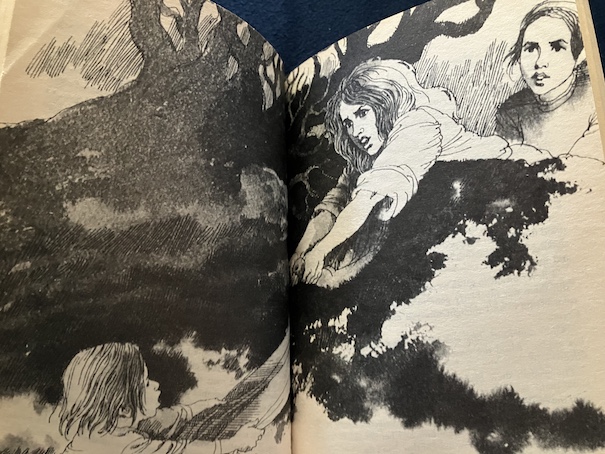
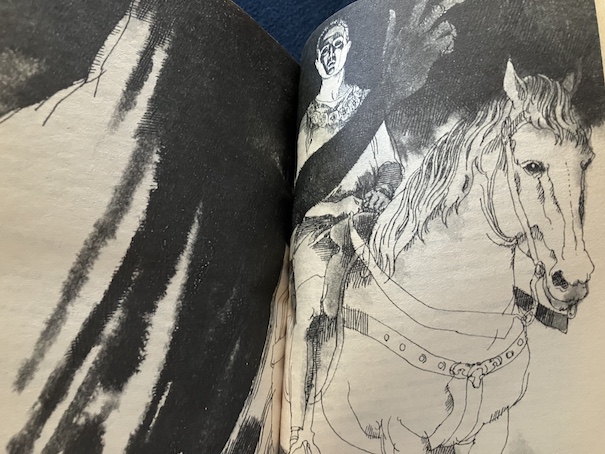
Dan presses Billy Ben for more information, and Billy Ben tells him the story of how one of his ancestors, Samuel Pride, was accused of witchcraft back in Puritan times. Some unfortunate happenings at the time, which were probably just the result of bad luck and bad weather, were blamed on him because he was kind of an odd, temperamental person. He was known for playing the fiddle extremely well, and people said that he used it to summon up the devil in the form of a black dog out of the marsh. The person who made the accusation and who led the group that came to arrest Samuel Pride was an ancestor of the Bishop family. Samuel came out to meet the group that came to apprehend them on the old stone bridge that leads to the island in the marsh where the Pride family has their house and farm, Pride’s Point. The story goes that when Samuel met the mob on the bridge, he placed a curse on them, that doom would come for them out of the night, out of the fog, and out of the marsh. Samuel and his wife were executed for witchcraft, and not only after, there was a terrible fog and a sickness that killed many people in town. People said that it was the result of Samuel’s curse. That’s why the Prides and the Bishops have a bad relationship even though they’re neighbors, why the townspeople are still a little suspicious of the Prides, why the Prides are somewhat standoffish of the townspeople (When you think about it, who really wants to be outgoing and friendly with people whose ancestors not only killed yours but who are not welcoming or friendly themselves because they have continually looked at you and your family with suspicion for generations, like you’re the weird ones? The townspeople basically created this situation and have been perpetuating it ever since, yet they act like the problem is with the Pride family instead of themselves. Gaslighting is a relatively new term from the 20th century, but the concept has been around forever, used even by people who don’t know what it is and that it’s what they’re really doing.), and why people in the area are afraid of the stone bridge that they call the Witches’ Bridge, the place where the curse was supposedly delivered. Even into modern times, people in the area see strange lights in the marsh and hear mysterious fiddle music or dog howls that they think might be Samuel’s ghost.

There is still more to come because the mysterious misfortunes of the Pride family have continued even into modern times. Dan is named for his grandfather, Daniel Pride, who died suddenly under very mysterious circumstances, something that still haunts his Uncle Julian. Young Dan learns the story from Mrs. Corey, a relative of Billy Ben’s, who is Uncle Julian’s housekeeper. Daniel Pride had been working to change the family’s image in the eyes of the local people, debunk all the old ghost and witch stories, and lay past quarrels to rest. To try to make peace with the Bishop family and restore the Pride family’s former fortunes, Daniel had been trying to arrange to buy the shipyards that the Bishop family owned, which had formerly been owned by the Pride family. The Bishop family initially agreed to the sale, and one foggy night, Daniel went to see the Bishops to finalize the sale. What happened after that is still a mystery. Daniel was found dead the next day near the old chapel with a look of terror on his face. It’s known that he had a heart condition, so he apparently had a heart attack, but from the marks on the ground, it also appears that he had been running before he collapsed, possibly deliberately frightened to death. Also, there were marks on the ground nearby where his briefcase fell, but the briefcase containing the sale papers was never found. The superstitious people in the area think that Daniel’s death was another symptom of the family’s curse, but it might also have been deliberate murder and theft. The Bishop family insist that they never finalized the sale of the shipyard with Daniel before his death, but Uncle Julian believes that the sale was finalized and that the Bishops are lying to take advantage of his father’s sudden death, just like their ancestors arranged the execution of Samuel for their own advantage. Uncle Julian remains suspicious and bitter about what has happened, just as the townspeople continue to look at the Prides suspiciously.

All of this makes York seem like it’s not the best place to raise a sensitive young orphan, and that’s basically what Uncle Julian says to Dan when Dan arrives at Pride’s Point. Uncle Julian seems elderly and physically frail, and Dan senses that he is a deeply troubled man. Uncle Julian tells Dan that the family and the old family home have a troubled history. That’s why Dan’s father decided to go away and live his life traveling to different places, and that’s why Uncle Julian delayed sending for Dan for so long after his parents’ deaths. Uncle Julian doesn’t seem to think that Pride’s Point is a very healthy place, and he hints at buried secrets. However, he does say that, now that Dan is there, there are going to have to be some changes.

Dan doesn’t think this sounds too hopeful, and he’s lonely and disappointed that he hasn’t found the happy family and home he was hoping for and that he doesn’t even seem particularly welcome there. He can’t even really enjoy playing his violin because of the connection people there seem to have between “fiddle” music, witchcraft, and his supposedly sinister ancestor. As Dan is looking around his new bedroom that night, he suddenly spots a mysterious flashing light from his window, outside in the marsh. It’s creepy because it not only supports all the ghost and witch stories that Dan has just heard but because he recognizes the patterns in the flashes of light as Morse Code … and the message being sent is his own name: D-A-N P-R-I-D-E.

Dan doesn’t believe that any supernatural force was using Morse Code to flash his name at night. It was obviously some human person, but who would do that and why? What is the truth about his grandfather’s death? Is Uncle Julian right that the Bishops caused Daniel Pride to die and then lied about the sale of the shipyard to cheat the Pride family? Or is someone else responsible?

The book is available to borrow and read for free online through Internet Archive.

My Reaction

I stand by my earlier statement that there is basically inter-generational gaslighting of the Pride family going on. It’s gone on for so long that the townspeople have trouble recognizing what they’re doing or stopping themselves from doing it, even though some of them seem to have the feeling that it isn’t right. At one point, some of the townspeople who come out to Pride’s Point to help fight a fire make jokes about the Pride curse. I could sense tension in them, and I think it was an attempt to lighten the mood, but under the circumstances, it wasn’t really appropriate for them to joke around, especially not about something that’s been a sensitive topic for the Prides, something that has literally caused members of their family to die and others to be persecuted for generations. Keep your audience in mind, and learn how to read a room, people of York!

Uncle Julian hates the stories and rumors that have circulated about his family since before he was born, but he doesn’t know what to do to stop it, and he sometimes wonders if it wouldn’t be better for the family to simply leave their old family home and start up again somewhere else. Mrs. Corey tells Dan that every single time anything bad happens in the area, people either look at the Prides suspiciously or find a way to blame them, even though they didn’t have anything to do with whatever it was. Dan can tell that Uncle Julian is so accustomed to having people blame him and his family for things and repeat scary stories about them that he halfway believes the stories in spite of himself, and he’s overly sensitive anytime it looks like the townspeople might be trying to blame the Prides for something yet again. That’s what makes this situation gaslighting, because the community’s constant untrue stories have warped even the Prides’ sense of reality and views of themselves. The community of York as a whole has created a situation that makes it difficult for the Prides to make friends with other people and get reality checks, and the most dangerous part of it is that among the few people that the Prides are in the habit of trusting is someone who turns out to be the person they should fear the most.

I couldn’t help but notice that there was someone in the story that Dan trusted too much in the beginning. It’s partly because Dan is young and in a situation where he is just getting to know the circumstances and people involved, but even when this person says things that are untrue, contradictory, or just plain mean, he doesn’t call him on it or seem to question within himself why this person is talking like that, at least not until about the middle of the book. Gaslighters will do this to a person, playing mind games, lying, alternately being friendly and praising their victim and then putting down their victim and/or trying to blacken their name to other people, discouraging them from getting close to people who care about them and might actually help them, acting like normal things that the victim does or feels are somehow weird or abnormal, trying to keep their victims in a constant state of confusion, unsure of what the reality of the situation really is. Although I found myself angry with the people of York in a general way for perpetuating something awful that their ancestors did for generations and for being apparently oblivious to what they’re doing in modern times, there is a definite villain in the story who is both deliberately and concretely evil.

There is a parallel drawn in the story between Uncle Julian’s big, black dog, Caliban, who is disfigured from an old injury and the Pride family themselves. Dan is afraid of the big dog, and Billy Ben tells him that it attacked him once, but Uncle Julian says that Caliban is just distrustful because he was badly abused and injured in his earlier life. People are like that, too. I understand that because I used to volunteer at an animal shelter, and that’s where I got my dog, Betty. (If you look at my About page, you’ll see a picture of Betty.)

I’ll never know Betty’s complete history because she was found wandering alone without a collar before she was brought to the shelter. However, I’m pretty good at reading between the lines, and I can read at least part of the story from her behavior. Betty is afraid of anyone, even me, walking behind her, and I’ve noticed since her shelter days that sometimes, her back end looks a little off-center when she runs. Her tail has an odd, permanent bend at the very tip that we didn’t discover until we had the hair on it trimmed. I think she’s been kicked hard from behind before, hard enough to leave permanent injury. She’s not as scared of things as she used to be after having lived with my family for a few years, but she used to be terrified of newspapers or anybody standing over her with anything in their hands, so I think she’s been hit with things before. Betty also gets scared when people laugh. She’s not as scared as she used to be because she’s gotten used to us laughing at something funny on tv, but there are times when she’s cringed and slunk away with her tail between her legs from people when they laugh and she can’t figure out why they’re laughing. Betty’s fear of laughter actually disturbs me because I think I know why it scares her. Based on her reaction, I’ve think that it’s likely that whoever hurt Betty before laughed when they did it. I think Betty has an association between laughter and pain, and that’s why she takes laughter as a bad sign, reacting fearfully to it when she thinks it might be directed at her. Laughing while inflicting pain is a sick thing to do, the product of a sick mind. There are stories in Betty’s reactions, and I’m disturbed by the mental picture I have of the person who had Betty before.

I have to admit that my own history has also both colored/given me insight into Betty’s behavior. If it isn’t obvious from comments in my previous reviews, I don’t see teasing as a positive thing. I’ve reacted to it in the past much like Betty does to sudden, unexplained laughter, which is why I understand the feeling behind it. Some people say that they like to tease their friends and people they like, but I just don’t like it, and I’ve learned to be more open and honest about how I never will like it. I do not have good feelings about people who tease others for fun, and I deeply resent being told that I have to like it because the people doing it are “just having fun.” It’s not a bonding activity, not with me, no matter who says it is. I absolutely refuse to “bond” with anyone who does it. Anyone telling me that I have to change myself to like people who tease is 100% guaranteed to get on my bad side. I have a bad history with teasing and bullying, I have a bad history with the people who do it, and I just don’t want to be around it. Teasing involves getting a laugh at someone else’s expense, benefiting from their discomfort, and getting a good feeling from making someone else feel bad. I don’t think any of that is right, and it doesn’t take much for it to get way out of hand, especially when people have the impulse press harder to get the reaction they want to their “jokes”, like the other person just didn’t get it, instead of cutting it out when their “jokes” just aren’t funny. It’s always awkward when it comes from people who don’t know the sore spots that they shouldn’t poke at and try to act like they’re special friends who should be cut some slack when the reality is that we don’t really know each other that well, we’re not really close friends, and no such special relationship actually exists between us. Real friends understand and demonstrate respect for each others’ feelings, and they don’t intentionally poke at a friend’s sore spots, like the people of York did to Uncle Julian with their jokes in this story.

What ties all of this together is that Betty’s reaction to laughter is like Uncle Julian’s reaction to the townspeople and their jokes and comments; it’s a conditioned response from long-term negative association. The townspeople are uneasy because Uncle Julian doesn’t laugh with them, but Uncle Julian doesn’t laugh with the townspeople because none of it was actually funny. By perpetuating these witch stories, even in the form of “jokes”, they’re constantly feeding the myths and ghost stories and making the situation worse, and they don’t seem to care about how he or his family feels or how it affects their lives. You can tell who respects you and who doesn’t by seeing who tries to treat you the way you want to be treated. The people of York were making jokes to soothe their own feelings, sharing in-jokes that they’ve had with each other at the Prides’ expense, and they got really uncomfortable when suddenly confronted with Uncle Julian’s, feelings that they helped to provoke and didn’t want to deal with.

Don’t worry about Betty. It’s sad that she’s been afraid of things and it’s kept her from being more outgoing and friendly, but we’re working through it. In non-pandemic times, I take her to places where I know she’s welcome, and she has acquired a fan club of people who like to see her and say hi whenever we visit. Anytime she seems uneasy because we’re laughing about something, I sit next to her, pet her, and praise her for being a Good Girl so she knows that nobody is trying to be mean to her and that we value her. When someone has been programmed through negative reinforcement, positive reinforcement is needed for balance. I’m trying to build more positive associations for her. It’s working, and she’s improving. She behaves very well and is very happy little dog when she’s treated well. Don’t worry about me, either. I’ve had some bad experiences, but I’m not the only one who’s had to deal with this stuff. There are lots of different kinds of people in the world, and I’ve learned some things about finding the kind of people I want to be around and making it clear how I want to be treated. I just gripe and vent now and then because I don’t like mean behavior or seeing others in these situations, and I’m all out of patience for it. I’ve learned what to do to help remedy such problems, but that doesn’t stop me from resenting the people who create problems that need to be solved.

The way both people and animals behave offers clues about what’s been happening with them. Sometimes, they offer warning signs of people to avoid, and sometimes, they are signs that the person or animal is in distress and needs some outside help and support. Caliban’s behavior in the story is more defensive than aggressive. That is, Caliban is reacting, not instigating … and if I saw what Dan saw in the story, I would know immediately to be very suspicious of the person Caliban hates the most because it explains where the source of harm in his life is. In a similar way, the Pride family is mostly reacting, not instigating. They have been harmed, both physically and psychologically, for an extended period of time, and while they seem to have the sense that’s the case, they’ve been too close to the problem for too long to see what the source of the greatest harm really is. But, about halfway through the book, Dan does learn to correctly read the people around him and comes to realize who is really his friend and how isn’t, based not on how others talk about them but by how they each actually treat him. When you pay attention and think about people’s actions in context, you can see who really has your best interests at heart and who doesn’t.

Dan spends much of the story, particularly at the beginning, feeling like he is unwanted, both in York and at Pride’s Point. At first, he thinks that his Uncle Julian doesn’t want him, but he gradually realizes that’s not it. There is someone else who doesn’t want Dan there, for reasons of their own. As I was reading, I noted times when this person said and did things that manipulated Dan’s feelings, even actively trying to make Dan feel bad while carefully seeming “honest” or “helpful” so Dan would continue to listen. I felt so much better when Dan finally realized the truth about this person. I have to say that I was really angry with Uncle Julian when I discovered that he was fully aware of who hurt his dog and that he still trusted this person. For me, the first hint of that would have caused me to permanently sever the relationship because it’s sick behavior and a sign of a disturbed mind, but I can only suppose that he felt unable to because he had been dependent on this person for too long, largely shunned by the wider community, who could have given him a reality check if they’d had a firmer grasp on reality themselves.

Dan, who had never heard of the Bishops before arriving in York, finds himself becoming angry and resentful of them, hating them for what they’ve done to his family for generations. His uncle even warns him not to get involved with the family, but that’s exactly what the real villain wants. When Dan makes friends with a boy named Pip Cole and his twin sister, Gilly, he confides his anger at the Bishops and how he blames them for this whole mess and for perpetuating it for generations, but Pip knows more about the situation than Dan suspects, and he has seen a different side of the problem. Pip tells Dan his family would have less problems if they would just forgive the Bishops, but Dan doesn’t believe it at first because, the way he sees it, the Bishops are the villains, who have actively profited from their villainy all along. I appreciate Dan’s situation. Pip doesn’t fully appreciate that, for Dan and his uncle, it’s not just about the past because they’re still actively suffering from the townspeople’s stories, rumors, and suspicions about them. It’s hard and maybe impossible to forgive something that’s ongoing from people who see no problem with the situation and aren’t particularly sorry. On the other hand, the resolution of this situation requires at least one of the parties involved to make the first move. Dan’s grandfather was trying, but his mysterious death prevented his mission from being completed. Even Uncle Julian reveals that he had been prepared to forgive the Bishops and marry their daughter, but some of the circumstances of his father’s death led him to believe that his fiance actually had a hand in it, and that apparent betrayal is what has left him such a haunted man all of these years.

The stories that Dan has heard about his family are not the complete story. Dan eventually comes to realize that the Prides and the Bishops each have only half of the real story, and because of their reluctance to associate with each other, the Bishops partly out of continued superstition and guilt, not knowing how to deal with the Prides’ anger, and the Prides, because they are both justifiably angry and accustomed to unfair treatment and being shunned by the community. However, it’s important that they do talk to each other because it’s the only way for each of them to get the complete picture of what’s really been happening and learn the real villain’s true motives.

The key to establishing the truth is in the missing briefcase, and both Dan and his enemy are searching for it. Dan needs to make peace with his family’s past, and he finds some help from a mysterious hermit called Lamie, who lives alone in the marsh. Lamie is another outcast of the York community. People avoid him because he has a reputation for being weird. People in this community in general may be “normal” in the sense that their behavior is fairly uniform, but uniformity by itself isn’t a virtue. When you’ve got an entire community doing something they shouldn’t, being the odd one out can be a good thing. Lamie helps Dan when he needs it, and Dan discovers that Lamie is actually a very kind and understanding person. Lamie’s solitary lifestyle is rather unorthodox, but he’s actually happy in his solitude because he knows who he is, he takes care of himself, he’s comfortable with himself, and he’s living the kind of life he likes, in touch with the natural world. When Dan talks to Lamie, he realizes that Lamie is comfortable with his own identity and at peace in his own mind in a way that his uncle isn’t. Even more importantly, Lamie sees things from a different perspective because he isn’t part of the groupthink of this community.

Lamie was friends with Dan’s grandfather, and he tells Dan about a hidden chamber built by the Prides’ ancestors, where Dan’s grandfather kept important family papers. However, Lamie tells Dan that he isn’t sure that he should look for it if his only motive is revenge. Dan does have a desire for revenge after all of the stories of injustice toward his family that he’s heard and what he’s suffered himself since he arrived in this area. Lamie helps to calm Dan’s desire for revenge by quoting from St. Francis of Assisi, emphasizing the importance of forgiveness instead of revenge. The part about truth speaks to Dan, and he comes to realize that what he really wants, more than revenge, is to know the truth about what happened to his grandfather. Lamie tells him that he saw some of what happened the night his grandfather died, from a distance. Because of the fog, he couldn’t see everything, but he knows that the Bishops were telling the truth that Dan’s grandfather didn’t make it to their place that night to complete their deal, defusing Dan’s anger at them for their supposed lies. Lamie’s memories also give him clues about the true identity of his grandfather’s attacker and the location of the secret hiding place. However, to find it and to evade his enemy, Dan will need the help of the very people his uncle has forbidden him to associate with.

I found the parts about the gaslighting of the Pride family and the poisonous duality of their true enemy frustrating and anger-inducing, but once Dan speaks to Lamie (really, my favorite charcter in the story) and begins to sort out who he can trust and who he can’t, I felt a lot better. The story is very atmospheric, with a grand old house and property, surrounded by a foggy marsh, and even when the characters know who their enemy really is, they are kind of trapped with him in a dangerous cat-and-mouse situation as they both race to find what they’re really looking for. By the end of the book, all of the old mysteries are wrapped up, including the source of the the mysterious “fiddler” music.

Murder at Midnight

Murder at Midnight by Avi, 2009.

This story is a prequel to Midnight Magic.

Fabrizio was an orphan living on the streets of the medieval city of Pergamontio before he was taken in as a servant by Mangus and his wife, Sophia. It was really Sophia’s idea that Mangus needed a personal servant. Mangus says that he is able to take care of himself, and he is impatient with Fabrizio because Fabrizio is ignorant and uneducated.

When Sophia goes to visit her sister, Fabrizio tries extra hard to please Mangus so that Mangus will continue to let him live in his house. Mangus is primarily a scholar, but he supplements his income by performing magic tricks at a local tavern. That evening, a black-robed figure appears at the magic show, warning of danger coming to Mangus. The next day, the magistrate, DeLaBina, accuses Mangus of spreading papers with treasonous messages about the king around the city. During this time, all writing is by hand, and no one can understand how these papers can all look so identical unless they were produced by magic.

At first, DeLaBina offers to let Mangus go if Mangus gets rid of the papers and reveals the identity of the traitor. When Mangus protests that he cannot do real magic and that he knows nothing about the papers, he is arrested. Shortly afterward, DeLaBina is murdered. Fabrizio’s only hope of saving his master, and himself, is to find the real traitor.

The book is available to borrow and read for free online through Internet Archive.

My Reaction and Spoilers

I didn’t like this book as well as I liked the original Midnight Magic.  Partly, the problem was that I feel like some of the events of this story should have changed people and events in the other book, and they don’t because this book, which is supposed to take place earlier than the other story, was actually written after the other story. It all just seems out of order, and I didn’t like the addition of Prince Cosimo to the royal family.  In this book, Prince Cosimo is the crown prince of Pergamontio, not Prince Lorenzo from the previous book.  Prince Cosimo did not appear in Midnight Magic (although his absence is explained by the end of this book) and was never even referred to in that book (which is the part that really bothers be me everyone in that book would have known all about him and what happened to him, and I feel like Fabrizio should have at least thought about him in passing, it’s just weird when characters suddenly exist in a series that you know didn’t exist before).

Basically, there is a plot (although not by the person who did the plotting in the other book) to overthrow the king, who is wildly superstitious. The printing press is a relatively new invention in this time period, and Pergamontio has never had one before, which is why no one can understand why the writing on the papers is so strangely uniform.  This is the other thing that bothers me about this book.  Pergamontio is supposed to be somewhat backward in comparison to other kingdoms, partly because the king is so superstitious, but it just seems like going a bit far for people to suspect that oddly-uniform writing would be a sign of witchcraft because people of that time would already be aware of the existence of signet rings and official seals which were used as stamps in wax to mark documents, like a kind of signature.  Like a printing press, those would also produce an identical image, time after time of use.  Basically, they’re all just complex forms of stamps.  Superstitious or not, I think that people of that time who were capable of reading probably would have been able to tell that a stamp of some kind was being used, even though they might not have seen one as complex as a printing press before.

In the story, a family has recently brought a printing press to the city, and printing the treasonous papers was the first job they were hired to do. Shortly afterward, Maria, the daughter of the family, was arrested while passing out the papers. Her parents are taken into custody by Count Scarazoni, who is a sinister character in his own right but is actually in opposition to the real traitor in this book.

Scarazoni was the figure in the black robe who tried to warn Mangus. Fabrizio is arrested when he tries to gather up more of the papers for Mangus so they can learn where they came from.  He is nearly executed for treason, but he is saved by Scarazoni because Scarazoni realizes that the real traitor wanted him dead because he feared that Fabrizio might know too much. At the prison, Fabrizio meets Maria and helps her to escape as well. Maria explains to him the true origins of the papers, and they find DeLaBina’s body.  This is the murder referenced in the title of the book, and they must solve it to uncover the identity of the real traitor!

As in the other book in this series, Fabrizio and Mangus use a magic trick at Mangus’s trial to shock the traitor into revealing himself.  Although, at the end of the story, the king still believes that Mangus is a real magician, Scarazoni points out that without Mangus’s “magic” the real traitor might not have been discovered. The king tells Mangus that he will let him go provided that he confine himself to his own home and no longer practice magic, setting events up for the beginning of the other story.

Aunt Morbelia and the Screaming Skulls

Todd Fearing is worried because his Great-Aunt Morbelia is coming to live with his family.  He has never met her before, but he has heard that she is rather strange, and he knows that his life will never be the same again.  Aunt Morbelia is very superstitious, and she sees bad omens everywhere.  When she first arrives at Todd’s house and sees that the family owns both a black dog and a black cat, she takes it as a sign that she should leave right away.  It takes a lot persuading to get her to stay on a trial basis.  By Joan Carris.

Having Aunt Morbelia at his house is sort of a mixed blessing.  On one hand, Aunt Morbelia likes baking good things for him to eat and helps him with his homework.  Todd is dyslexic and has extra assignments to help him improve his reading.  Aunt Morbelia used to be a teacher, and Todd really appreciates the help she gives him. On the other hand, Todd doesn’t like scary stories, and Aunt Morbelia’s talk of ghosts and bad omens gives him nightmares.  His friends like to hear her stories, particularly Rocky, a girl who typically doesn’t like feminine things.  Rocky, whose real name is RosaLynn, constantly pesters him about when Aunt Morbelia will tell more stories. 

Eventually, Todd gets tired of Rocky’s obsession with ghost stories and the way she encourages Aunt Morbelia to keep telling them, and he and his best friend, Jeff, decide to play a trick on her to cure her appetite for scary stuff.  However, their trick backfires, and in their attempt to make it up to everyone, especially Aunt Morbelia, they end up making things worse. 

Todd and Jeff succeed in scaring Rocky by dressing up as ghosts and showing up at her house in the middle of the night. They have so much fun with their trick that they decide to go to their friend Alan’s house to try it on him. Alan lives in the house right behind Todd’s, and that’s where they run into trouble. When they start their ghost act, they can’t get Alan to wake up and come to the window to see them. Jeff decides to throw a rock at Alan’s window to wake him up, but the rock breaks the window. To make matters worse, they startle Todd’s black cat, causing the cat to yowl. The boys run back to Jeff’s house, but Jeff’s father catches them. Todd has to go home and apologize to Aunt Morbelia, who was frightened very badly when the cat started howling.

The boys decide to take Aunt Morbelia on a tour of the historic places in town to make up for scaring her. Unfortunately, Jeff includes the funeral home that his father runs on the tour because it is in one of the oldest buildings in town. Although Todd tells her that she doesn’t have to go in if she doesn’t want to, Aunt Morbelia thinks that it would be rude to refuse. Unfortunately, Jeff’s father arrives with a dead body before their tour ends, and Aunt Morbelia faints when she sees it. Aunt Morbelia tells the boys that it isn’t their fault, but she says that she’s not sure she really belongs in their town. Even with all of Aunt Morbelia’s superstition craziness and spooky stories, Todd still doesn’t want her to leave.  Is there still something he can do to convince her to stay?

The book is currently available online through Internet Archive. There is also a sequel to this book, Beware the Ravens, Aunt Morbelia!

When I first read this book, I was expecting a spooky mystery, but it’s really more about a boy adjusting to a relative coming to live with his family and dealing with his dyslexia. Although Todd initially has some reservations about Aunt Morbelia living with him and his parents and her spooky stories scare him, Todd and Aunt Morbelia gradually come to understand each other better, and Todd genuinely wants her to stay. To help Aunt Morbelia change her mind about leaving, Todd has all the people who have met Aunt Morbelia since she arrived come by the house and tell her how much they all want her to stay.  After everyone has visited her, Todd himself tells her that he doesn’t want her to go.  They talk about the scary stories and how Todd feels about them, and Aunt Morbelia tells Todd that if he doesn’t want to hear a scary story, he can be honest with her and tell her so.  Now that the two of them understand each other better, Aunt Morbelia agrees to stay, and she accepts the invitation that one of Todd’s teachers makes to help tutor children at the learning center.

I didn’t like the part where the boys played the trick on Rocky and how awkward things were with her afterward. Jeff’s father says that part of that, with Rocky drifting away from her friendship with the boys, is because the kids are growing up. He says that, as they grow up, girls start changing before boys do and have different interests from boys and different ways of looking at things, including more tomboy girls, like Rocky. Toward the end of the story, Rocky does appear to need more friendships with other girls, and Todd decides that Jeff’s dad is probably right, that Rocky thinks and acts differently from his guy friends because she’s a girl, even if she’s usually not a particularly “girly” girl. Part of that may be true, but the boys’ trick was pretty mean. I think that the real issue is that real friends shouldn’t do that to each other, and Rocky might really be questioning what she’s looking for in a real friend. Although, to hear some of my male friends talk about their youths, boys (at least certain ones) might be more accepting and forgiving of that kind of rough humor from friends than girls would be, so perhaps boys vs. girls issues are partly at the heart of it.

I thought that the parts where Aunt Morbelia was helping Todd with his dyslexia were interesting. I don’t really have any experience with the condition myself, and I’m not quite sure what techniques teachers really use to help dyslexics. One of the tricks that Aunt Morbelia uses is to break down tasks into smaller pieces to make them more manageable. For example, Todd feels badly that he can’t keep the orders of months straight. When he tries to recite the months of the year in order, he mixes them up, which makes him feel bad because most kids his age should be able to do this easily. When I first read this, I wasn’t sure if this is a common issue among dyslexics, although I thought that I remembered reading something about dyslexics having trouble remembering the orders of certain things, like lists of instructions. I looked it up, and apparently, it is a common issue, along with memorizing things like days of the week. There are different techniques for handling it, some of which involve associating the things to be remembered with something else that sticks in the mind more easily, such as a rhyme or song. Aunt Morbelia does some association with Todd but she also breaks the months down into groups of three, representing the four seasons of the year, and giving him small bits of information to memorize. She calls the spring months, “the flower months” and the fall months “the leaf months” and so on. Todd finds that technique helpful, and Aunt Morbelia says that once Todd has mastered the seasons of the year, they will put the season of the year together so that he can recite the entire year. Todd also describes other ways that he is affected by his dyslexia and techniques that his teacher uses to help him.

Ghosts, Witches, and Things Like That

GhostsWitchesThings

Ghosts, Witches, and Things Like That by Roderick Hunt, 1984.

This is a collection of information about the history of Halloween and other things related to Halloween, like folklore, games, recipes, crafts, and poems.  There are sections about specific topics, starting with the section about Halloween itself (spelled Hallowe’en, this is a British book).  The section about Halloween talks about the origins of the holiday and has tips for holding a Halloween party, including how to make costumes and decorations, the rules for games to play (including some old traditional games), and recipes for various Halloween treats.

Other sections of the book focus on various monsters and mythical creatures associated with Halloween, such as witches, ghosts, fairies werewolves, and vampires.  There is a section of ghost stories and some fascinating historical information about spiritualists and how people have faked ghosts in the past, including the Pepper’s Ghost illusion that is still used in the haunted house in Disneyland.  The sections about witches, fairies, and monsters also include a mixture of history and folklore along with some jokes and poems about the various creatures.

GhostsWitchesHistory

This is a fun book to read around Halloween.  It’s a mixture of historical background, folklore, party-planning tips, games, and recipes.  I think that the information about traditional games is still my favorite part.

GhostsWitchesApples

Chimney Sweeps

ChimneySweeps

Chimney Sweeps by James Cross Giblin, 1982.

This book explains about the history and traditions of chimney sweeps. I love books that cover odd topics from history like this!

It starts by explaining the origins of chimneys in the Middle Ages. Before they were invented, people would have to have simple holes in the roofs of their houses to let out smoke from heating and cooking fires, or they would have had to rely on windows or doors to perform the function of venting smoke. Chimneys vent smoke more efficiently, but the more they are used, the more soot collects inside them, and they need to be cleaned out from time to time. If they aren’t cleaned, the build-up inside could either block air from getting to the fire in the fireplace, causing the fire to go out sooner, or it could pose a fire risk because the build-up inside the chimney is still flammable. Sometimes, home owners could clean their own chimneys, if they weren’t very tall, but the taller the chimney is, the more professionals are needed to clean it.

ChimneySweepsAdult

Modern chimney cleaners have vacuums that they can use to clean soot out of a chimney, but originally, people were basically relying on brushes. The book explains the evolution of the profession and variations in the profession between England, Germany, and the United States. Germany is significant to the profession because it was one of the first places where chimney sweep became a recognized profession and there were laws even in the 1400s that all chimneys had to be cleaned twice year. (Remember that chimneys that haven’t been cleaned can be a real fire risk, posing a danger not only to you but your neighbors, especially during a time when most buildings are made of wood and other highly flammable materials.) When chimney sweep became a recognized profession during the Middle Ages, members of the profession formed a guild (as was traditional for different professions in general during the Middle Ages) and established rules and standards for the profession. One of the responsibilities of a guild was to decide on the training and qualifications that the profession requires, and in the case of chimney sweeps, the only way to learn was by serving an apprenticeship. The apprentice would live with a master sweep for three years, learning the trade, and at the end of his training, he would have to prove that he could clean a difficult chimney all by himself with thoroughness and reasonable speed.

There are many traditions and superstitions that came to surround the profession of chimney sweep. One of them that you can still sometimes see even in modern times is the image of the chimney sweep in a top hat. The exact reasons for adopting a top hat and tailcoat as part of their uniform are uncertain, but it began back in the 1500s in Europe. The sweeps often got their top hats and tailcoats as secondhand clothing from undertakers (yes, really). Part of the reason for wearing them might have been as an effort to look professional, but the color black was also suitable for a person who was going to end up covered in soot. According to superstition, the top hat would help to protect the chimney sweep from falling when he was on the roof of a house. Chimney sweeps were often thought to be lucky because their jobs were dangerous, yet they survived.

ChimneySweepsChild

However, chimney sweeps’ lives and work were often hard. In 18th century England, their jobs became more difficult because chimneys were purposely being built in narrow, crooked zigzags. The idea behind the crooked chimneys was that they would keep more heat in, but that made them much harder to clean. Because brushes couldn’t make it around the bends of these chimneys and adults couldn’t get into the narrow flues, sweeps became reliant on young boys to climb up into them and clean them by hand. Although the law required boy apprentices to be no younger than eight years old, many sweeps used boys as young as four or five. Sometimes these boys were official apprentices with the permission of their parents (typically from poor families with many children) or even the sweep’s own children (sometimes, they used their daughters because girls were often smaller than boys). If they couldn’t get children any other way, sometimes sweeps would get children from orphanages or might even resort to kidnapping.  The author of this book includes a short story about what a day in the life of a child chimney sweep was like.

The plight of child chimney sweeps came to light during the early 19th century, when people were starting to become concerned about child labor of all kinds. At first, there was strong opposition to banning child chimney sweeps and using new cleaning devices because the adult chimney sweeps saw it as a threat to their livelihoods and home owners were worried that new methods would be more expensive for them (of the two, I think I’m more offended at the home owners’ attitudes because of the implication that they were more upset about a possible slight increase in expense than the risk to the lives of the children they knowingly endangered).  Many of the child chimney sweeps suffered severe and permanent health problems because they were forced to do this kind of work at an early age, while they were still growing, and because they inhaled and were covered with soot for such long periods.

In the back of the book, there is a poem by William Blake called “The Chimney Sweeper,” which was published in Songs of Innocence in 1789. Knowing the risks to young children, like the little boys in the poem, makes the poem seem pretty disturbing, which may actually be the author’s intention.  Eventually, after long years of struggles in which children were still exploited in chimney sweeping spite of regulations against it, in 1875, Parliament tightened regulations against child labor even further, forcing chimney sweeps to apply for licenses in order to practice their trade, listing each of their apprentices and their ages.

Chimney sweeping in American history was a little different from the way things were done in Europe. The American colonists sometimes tried some strange tactics for cleaning their chimneys. One of the oddest methods was to tie a rope to a goose’s feet and lower it down the chimney. The goose would become frightened and flap its wings, thus knocking the soot loose. When the job was done, the home owner would pull the goose out of the chimney and wash it off. Another tactic was to actually burn the excess soot out of the chimney, although there was a risk of simply setting the house on fire. Later, American cities had official chimney sweeps who were licensed and regulated. On Southern plantations, slaves were used as chimney sweeps, and some of them continued to work as chimney sweeps after they gained their freedom.

Later, when homes began to be heated by other sources than fireplaces, chimney sweeps were in less demand, although there was increased demand in the 1970s, during the energy crisis, because people started using their fireplaces more instead of relying on other heating methods that involved scarce or expensive fuel. Chimney sweeps can also perform other duties beyond simply cleaning chimneys, depending on where they live. For example, in Germany, sweeps perform inspections of factories and homes to make sure that they are using fuels efficiently, looking for sources of needless pollution, which can lead to fines for the owners of the buildings if the problems are not corrected. Some people might also become chimney sweeps as a seasonal part-time job, while they also have another career.

The book is available to borrow and read for free online through Internet Archive.

Midnight Magic

midnightmagicMidnight Magic by Avi, 1999.

The story takes place in Italy, toward the end of the Middle Ages.  Mangus, a formerly wealthy scholar and philosopher, is living under house arrest because the king believes that he has practiced black magic. Mangus was merely performing magic tricks to earn extra money, and in fact, does not believe in real magic.  However, the king is very superstitious and easily influenced by his scheming advisor, Count Scarazoni, who needed a scapegoat to distract everyone from his schemes.  Unfortunately, many people in the kingdom of Pergamontio believe that Mangus is a real magician with frightful powers.  Even Fabrizio, an orphan who is Mangus’s only remaining servant, believes that magic really exists.

When a messenger arrives, summoning Mangus to the castle to see the king, they are afraid that the king has reconsidered his decision to spare Mangus’s life. However, it turns out that the king is in need of Mangus’s help. He believes that his young daughter, Princess Teresina, is being tormented by a ghost, and he wants Mangus to use his magic to get rid of it.

Mangus again protests that he does not do real magic, but both the king and Count Scarazoni promise dire consequences if he fails to help them deal with the problem.  Mangus isn’t sure why Count Scarazoni has asked for his help because he knows that the count doesn’t really believe in magic, except perhaps as a way of appeasing the king.  The king promises that if Mangus can free the princess from the influence of the ghost, he will not only end Mangus’s house arrest but reward him with a generous pension.  Mangus has little choice but to agree to do his best, and the promise of the pension for his master convinces Fabrizio to do everything he can to make sure that Mangus succeeds, not only to save his master’s life but to restore his family’s fortunes.

But, what is the secret of the ghost?  Fabrizio believes in ghosts, even though Mangus doesn’t.  Princess Teresina insists that the ghost is real, appealing directly to Fabrizio to convince Mangus that it is. Adding to the mystery is the disappearance of the princess’s brother, Prince Lorenzo, and the murder of the princess’s tutor. Danger lurks in the castle, and conspiracies are around every corner. Could the troubled spirit really belong to the murdered prince?

The book is available to borrow and read for free online through Internet Archive.

My Reaction

I love historical books and spooky mysteries, and this is both! The Italian kingdom where the story takes place is fictional, but it takes its inspiration from real kingdoms of the later Middle Ages and early Renaissance, with Machiavellian intrigue, power struggles, and arranged marriages, even for children, that could influence the balance of power and successions. (There is talk of a potential arranged marriage in the story, but no child marriages actually take place.  If a child is old enough for ghost stories and murder mysteries and isn’t too frightened by them, there is really nothing more concerning than that to prevent them from reading this book.)

Princess Teresina is one of the most intriguing characters in the book.  Although young, she isn’t a shrinking violet or anyone’s fool, and she’s definitely not a tea party and ball gown kind of princess.  Like real life Medieval princesses, she is the product of a family who came to power by the sword and maintains it by the iron fist in the velvet glove and some clever political maneuvering, although some members of the family are more clever about it than others.  Princess Teresina well knows the family she was born into and what’s expected of her as royalty, and she knows to be careful about who she trusts and what the consequences of trusting the wrong people can be.  Although apparently terrified by the ghost, the princess has a kind of toughness and shrewd determination to do what she thinks is necessary.  She seems to be smarter and knows more than most people give her credit, and Fabrizio often wonders just how much she really knows.

One of the best things about the story is that, as soon as you think you know what’s going on, you learn that there is more to the story. There are conspiracies within conspiracies!

Hint: If you like pseudo-ghost stories, spooky stories of the Scooby-Doo variety, where there are logical explanations for the supernatural phenomena … you won’t be disappointed.