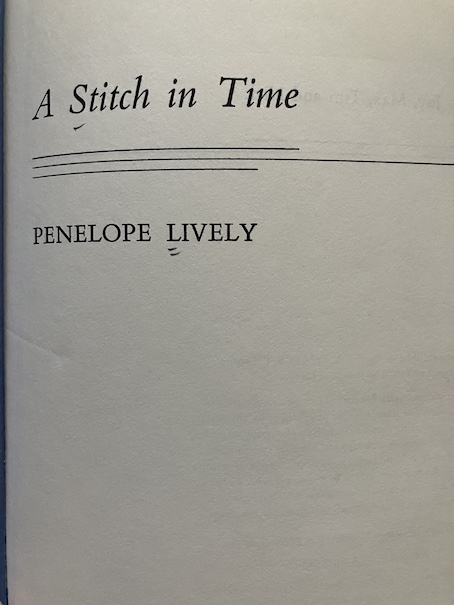
A Stitch in Time

A Stitch in Time by Penelope Lively, 1976.

It’s summer, and 11-year-old Maria Foster’s parents have rented a house near the sea for their summer holidays. Maria is an only child, quiet and given to daydreaming. Maria is shy and socially-awkward and her parents are often preoccupied with their business and thoughts. It often seems like their parents are socially-awkward and don’t know quite what to do or say to Maria as a child, which is why she doesn’t always know what to say to other people. Because she frequently doesn’t have anyone else to talk to and doesn’t always know what to say to other people, Maria often finds herself having imaginary conversations with objects or animals.

The seaside house where the Fosters are staying is an old one, built about 1820. It’s lovely and has a beautiful view. The interior has brown wall paneling. The furniture is old-fashioned, Victorian, and rather grand. When Maria chooses a bedroom for herself, she finds a collection of labeled fossils in a small chest of drawers, which she finds fascinating. The only modern touches are just a few bits and pieces left behind by the family that had rented the house before them and left the week before, like some half-eaten boxes of cereal. There’s also a tabby cat who appears to come with the house, and Maria begins to imagine conversations with it.

When they first arrive, Maria is sure that she hears the creaking of a swing and a dog barking, but when she goes looking for them, she can’t find them. When she begins exploring outside, she finds some small fossils in the rock, and her mother says that they’re ammonites and that the area is famous for them. She accidentally breaks one while trying to get it out, and she decides that it’s better to leave the others where they are. Exploring further, she finds some loose fossils and fossil fragments that she can collect more casually without hurting them. She begins making her own fossil collection, and she uses the old fossil collection and some books she finds in the house to begin labeling her own specimens. She begins to think that the fossil notes and sketches she finds were written by a girl around her age, and she tries to imagine what she was like.

When they meet the landlady who rented the house to them, Mrs. Shand, she says that she grew up in the house herself with several brothers and sisters. She says that the room that Maria chose for herself was once the old nursery. Mrs. Shand now lives in a small flat in the old guesthouse nearby, and she invites them to call on her if they have any questions about the house.

Maria observes a family with several children at a nearby hotel, and she even briefly speaks to a boy her age, but she doesn’t know how to ask them if she can play with them. Later, she and the boy, Martin, meet again and realize that they have a mutual interest in the natural world. Martin tells her the names of some plants and birds, and Maria impresses him with the name of a fossil she’s learned. Martin warns her about the cliffs nearby, which have a tendency to crumble after rain.

Mrs. Shand invites Maria to her house to get a book that she would like to loan her. Maria doesn’t really know what to say to Mrs. Shand, but Mrs. Shand tells her about the collection of stopped clocks she has. She says that they belonged to her grandfather, who was a scientist, and that they have been stopped as a gesture of respect to her grandfather since his death. Maria notices a stitched Victorian sampler on the wall, and Mrs. Shand says that she can look at it because the girl who made it was about her age. It has a the typical alphabet and an embroidered quotation about death, but it also has the image of a house with a tree and a swing, a little black dog, and some fossils. Maria realizes that it’s the house that she is now staying in and that it confirms that there was once a dog and a swing there, like she keeps hearing! An inscription says that the sampler was started by a ten-year-old girl named Harriet in 1865 and completed by her sister, Susan.

Maria begins to think about time and how the lives of people who had once lived in the house where her family is staying, like Harriet, have left traces behind, not unlike the fossils in the cliffs or Mrs. Shand’s stopped clocks, full of past times. Maria begins to wonder about Harriet and what happened to her. She lived over 100 years ago, so she would be dead by Maria’s time (the 1970s, contemporary to the writing), and Martin says that Harriet probably grew up, got married, and had children, like most girls. Yet, Maria finds herself thinking that maybe Harriet didn’t grow up and get married. When Mrs. Shand lets her and Martin look at her old photo albums, Maria notices that, after a certain age, Maria doesn’t seem to appear in family photographs. Mrs. Shand says that her own mother was Susan. The lack of Harriet in the photographs and the fact that Susan finished the sampler leads Maria to conclude that something tragic happened to Harriet.

Then, one day, Maria thinks she hears the dog again, barking frantically with the sounds of a landslide and shouting children. Nobody else can hear it, but Maria is sure that she’s hearing an echo of a past tragedy, and she becomes convinced that Harriet was killed in that past landslide. The existence of the metal swing that once hung in the tree is confirmed when she and Martin find it and restore it. When Maria swings on it, she feels like she’s gone back in time, almost like she was Harriet with her dog and sister Susan nearby.

The book is available to borrow and read for free online through Internet Archive (multiple copies).

My Reaction and Spoilers

I enjoyed the themes of time and what people leave behind. There are comparisons all through the story between clocks, fossils, and echoes of the past, and it all relates to the passage of time. More specifically, Maria starts seeing changes in herself, emotionally and mentally, as she matures.

Some of this story obviously takes place in Maria’s imagination. As a shy, socially-awkward introvert with parents who are also introverted, Maria tends to live in her own head much of the time. She often has imaginary conversations with objects and animals, and many of these are reflections of Maria’s concerns at the time. Through much of the story, Maria isn’t happy with herself as she is, realizing that she is socially-awkward and doesn’t know how to approach people and connect with them. When Maria imagines conversations with the tabby cat at the house, the cat tends to be critical of her. It’s a reflection of Maria’s own insecurity and self-criticism.

Maria’s parents love her, but they interact with her in a kind of off-handed way, which feeds her insecurity and social awkwardness. Maria knows that her parents love her, but she can tell that they don’t always know what to say to her or do with her, which makes it harder for Maria to learn how to interact with other people. Maria’s parents are both very introverted and try to avoid social occasions, if they can. However, Maria has realized that she needs to connect with other people and make friends. Through her experiences with Martin and his siblings, Maria becomes more outgoing and confident, and she finds it easier to interact with other people.

In some ways, Maria doesn’t entirely fit in with her parents because she’d like to be a little more outgoing than they are. Similarly, Martin sometimes doesn’t fit in with his family, either. Martin’s family is boisterous, and he is something of an intellectual. There are times when he likes doing quieter activities with Maria, talking about plants and fossils.

When Maria visits a local museum with Martin, and they look at the fossil exhibit, they talk about evolution vs. creationism. Maria decides that she doesn’t believe in the Noah’s Ark story about animals in the Bible, but at the same time, she thinks that studying animals through time makes it look like someone was experimenting with different designs of creatures and improving them with each generation. Martin says that’s nonsense and that it’s just evolution. Maria and Martin both seem to believe in evolution, but the difference between them is that Maria thinks that it seems like there’s a hand guiding it, and Martin credits just natural, scientific forces. In some ways, Maria and Martin are kindred spirits in their thinking, but Maria leaves a little more room in her personal understanding for feelings and the supernatural. Maria seems to be the only person in the story who is sensitive to the sounds and echoes of Harriet’s past.

At the end of the story, Maria decides that she’s going to give up imagining the conversations with the cat because she’s feeling a little more confident in herself through her friendship with Martin, her new understanding of the echoes of the past, and her realization that she herself is moving forward into her own future. She has a sense that she is leaving her past self behind, much like Harriet did. A part of Maria may always be young in this particular summer, but like Harriet, Maria herself is moving on.

What Really Happened to Harriet? (Spoilers)

As Martin guessed, Harriet did grow up and get married. She didn’t die young as Maria thought, based on the echoes of the past she’s been hearing, although she is correct that there was a landslide by the beach and that a tragedy occurred there. Before Maria’s family leaves at the end of the summer, Maria finally asks Mrs. Shand about Harriet and the landslide. Mrs. Shand explains that Harriet and her sister managed to escape the landslide, but their dog was killed. They were very upset about it and buried the dog near the old house. When Maria visits the grave, she discovers that this is the anniversary of the dog’s death.

Because I love dogs, I was still upset about the dog’s death, but Maria is at least reassured that Harriet herself survived. She asks Mrs. Shand why there aren’t any pictures of Harriet with the family after that summer, and she says that there are pictures of Harriet grown up, just not many because she wasn’t living at home anymore. The fall after her dog died, Harriet went away to boarding school. Her sister finished her sampler, both because Harriet was leaving for school and because Harriet never liked sewing. After Harriet graduated from her school, she got married and moved away. She did visit with her family after that, but because she was living somewhere else, she just wasn’t present for all the occasions when her family had their photographs taken.

So, because Maria guessed wrong about Harriet’s fate, readers might wonder if she just imagined everything she experienced related to Harriet’s memories and the landslide. However, the book indicates that Maria didn’t imagine it all. She drew the wrong conclusions about what was sensing, but she did sense things that she would have had no reason to know about, hearing the dog’s bark and the sounds of the swing before she had reason to know that either of them were ever there. When she’s on the swing and feels like she’s becoming Harriet in the past, she also manages to come up with the dog’s name before anybody tells her what it is. Because Maria is an introvert who often interacts with things in her environment more than she interacts with living people, it seems that she has a kind of sensitivity to her environment. At the end of the summer, though, when she senses that she’s changing as a person, she considers that, even if she were to return to this place again, she probably wouldn’t experience it in the same way. She’s moving on, mentally and emotionally, and that changes her perceptions of things.

Something Upstairs

Something Upstairs cover

Something Upstairs by Avi, 1988.

This story begins with a famous quote:

Those who cannot remember the past are condemned to relive it.

Santayana

It’s an appropriate quote for the story, which is about memory and a repeated wrong that has led to a seemingly endless cycle of violence. The story is framed as having been told to the author by the boy who actually had this frightening adventure.

Kenny Huldorf is unhappy when his parents decide to move the family from California to Rhode Island. Kenny was happy in California, the weather was much better there, and the streets and buildings in Rhode Island all seem small and old. The house they move into is called the Daniel Stillwell House, and it was built in 1789. Right from the beginning, the house gives Kenny a strange feeling, like there’s something or someone there when there shouldn’t be anyone or anything.

Kenny starts to feel better when his parents give him the big, renovated room with the private bathroom in the attic of the house. He likes that room, but there are two smaller rooms off the attic that haven’t been renovated, and they give Kenny a strange feeling. His parents think they were probably old servants’ quarters. One of them has a stain on the floor that makes Kenny think of death, and even more frightening, Kenny gets an odd sense that, somehow, it’s a death he may be responsible for. For a time, Kenny tries to tell himself that it’s nothing but an old stain and occupies himself with unpacking and getting settled. Since school hasn’t started yet, Kenny gets bored and does some exploring of the area. He starts wondering about the history of the town and the house.

Then, one night, Kenny hears a strange sound from the room with the stain. When he goes to investigate, he sees a pair of ghostly, glowing hands reaching up out of the stain on the floor. The hands pull the rest of the ghostly person out of the floor, and Kenny can see that it’s the figure of a boy. When the boy tries to reach out to him, Kenny reacts defensively, and the ghost boy seems frightened and vanishes. The next day, Kenny asks his parents if they believe in ghosts. His father says he doesn’t but that Providence is a very old town and a lot of things have happened there over the years. His mother later says that she doesn’t really believe in ghosts either, but she believes that places have memories. Kenny’s parents conclusions seem to be that Kenny is sensing the general history of the town, but Kenny feels that it’s something more specific than that, that the ghost he saw is a specific person from a specific incident in the history of the house.

The family was given a scrapbook with a list of former owners of their historic home, so Kenny decides to do some research about the past owners and see if he can learn more about where the ghost came from and who it is. When he arrives at the local Historical Library, Kenny is surprised to find out that someone there is expecting him. He is directed to the office of an historian named Pardon Willinghast. Willinghast tells Kenny that he keeps track of the owners of historic homes, which is how he and others at the library recognized his last name, and he expected that someone from the Huldorf family might come to ask about the house. Kenny gives him the list of past owners and asks what Willinghast can tell him about them. Willinghast looks at the list of names and says that there probably won’t be much about them in the library but that he’ll do some research and see what he can find. Kenny also gets the idea to have the local pharmacy test a sample of wood from the stained floor to find out what the stain is.

The next time Kenny sees the ghost, he tries to talk to the ghost boy and ask him who he is. The ghost has trouble talking but manages to communicate one word: “slave.” The pharmacy tells Kenny that the stain on the wood is human blood. They can tell that the stain is more than 100 years old, which is why they haven’t reported it to the police, like they’d have to with a recent blood stain. When Kenny talks to Willinghast again, he wants to know about people who lived in his house over 100 years ago who might have owned slaves, which limits the scope of his investigation to the first three families who owned the house. Willinghast is oddly vague in his reply, and when the subject of abolitionists comes up, he makes vague references to “agitators” and people who want to “rush history.” When Kenny tries to ask him about a murder that may have occurred in the house, Willinghast becomes agitated himself and tries to discourage Kenny from inquiring further. He says that if a slave was murdered, it probably wouldn’t even have been reported in a newspaper because it wouldn’t have been considered important.

However, now that Kenny understands that a young slave was murdered in his house and is still haunting it, he can’t leave the situation alone. He continues trying to communicate with the ghost boy, and the ghost gradually finds it easier to talk to him. He says that his name is Caleb and indicates that he is tied to the stain on the floor. He can’t seem to move very far from it. He says that he’s a memory of what happened there. He is aware that he was murdered, but he doesn’t know who did it because he was killed in his sleep. He senses that he was killed by someone who wanted to keep him a slave because he and other black people were trying to free themselves from slavery. Kenny asks Caleb if there’s anything he can do to help him, and Caleb asks him to find his murderer. Kenny asks how he can do that when the murder happened so long ago.

Then, the attic changes, and Kenny finds himself back in the past, in Caleb’s time. Kenny looks out the window and sees a strange man in a black cape watching the house. As he explores the town, he witnesses a public argument about slavery and someone asks him to deliver a note. The next morning, Kenny is back in his own bed, in his own time. When Kenny talks to the ghost again, he describes what he saw in the past, and Caleb recognizes these events and people as being part of the circumstances that led to his death. He has trouble believing that Kenny really cares about what happened to him so long ago. He says that white people have broken their promises to him before, but Kenny insists that he does care and that he wants to not only solve his murder but prevent it so Caleb can finally be free from haunting that room.

However, that’s going to be even more difficult than Kenny thinks. On his next trip into the past, he discovers who their true enemy is: Pardon Willinghast. Willinghast isn’t just an historian. Almost like Caleb, Willinghast is memory, a piece of the past that keeps coming back to haunt the people who live in Caleb’s old house and who have tried to help Caleb before. Willinghast has figured out that if someone from the future comes to the past and they lose something they’ve carried with them or if they get hurt or change themselves in some way, they can get stuck in the past, seeming like ghosts to the people there. (Or, so he says.) He has used this knowledge before against other people who have tried to help Caleb, blackmailing them into helping him instead. Now, he has the lucky key chain that Kenny always carries with him. Until Kenny gets this key chain back, he’s stuck in the past, and Willinghast won’t return it until Kenny does what he wants. In fact, he implies that Kenny is already doing what he wants, leaving Kenny to wonder if he’s accidentally leading Caleb into a trap while trying to help him escape from one.

Kenny set out to help Caleb, but he’s in danger of becoming a part of the same cycle of murder that has been repeated over and over for almost 200 years. As Kenny tries to help Caleb, he knows he’s being manipulated by Willinghast into playing a role in a very old story, but since he doesn’t have a copy of the script, he struggles to figure out what has to change to break the cycle. Can he find a way to break cycle and escape without either himself or Caleb losing their lives?

Th book is available to borrow and read for free online through Internet Archive (multiple copies).

My Reaction and Spoilers

This is a book that I remembered from when I was a kid, but strangely, I’m sure that I never heard the end of it back then. I’m having trouble remembering exactly why I never heard the end. I think it might have been one that a teacher was reading aloud, and maybe I was absent the day she finished it. Either that, or I started reading it myself and chickened out before the end because I was spooked.

This book poses a kind of “gun-to-your-head” type of decision, forcing both Kenny and the readers to consider what they would do if they were forced to make a choice between two horrible options. In this case, Kenny is put into the position of being pressured into committing a murder or being trapped forever in the past. Willinghast committed the original murder, and he tells Kenny that the only way he’ll return his keychain to him and let him go home is if he shoots Caleb himself this time. Willinghast is confident that he can force Kenny to do what he wants because he’s done the same to others before him. Other past owners of the house have tried to help Caleb before, but Willinghast has manipulated each of them into betraying Caleb and shooting him instead. These are the betrayals that Caleb referred to earlier. Willinghast claims that each of these people has lost their memory of what they’ve done when they return to their own time, so Kenny won’t have to worry about feeling guilty about killing Caleb. But, if Kenny gives in, he knows that Caleb will remain a ghost, and someday, someone else will also be in Kenny’s position, another pawn in Willinghast’s sick game of endlessly repeated murder. As long as Willinghast gets his way, not only is Caleb going to be his perpetual murder victim, but every person who tries to help will continue to be victimized and forced to participate in his bloody crime.

There is also a deeper theme to this story. Violence begets violence, and hate begins hate. Murder, revenge, hatred, and yes, also slavery and racism, are part of violent cycles that draw other people into them long after the original deed was done. People are haunted by the past in many ways … especially those who feel like they’ve got something to prove about it. It’s a theme that’s been very much on people’s minds in the early 21st century, and there are many, like Kenny, who are unwilling to be pulled into going along with violence, murder, racism, and everything that goes with it just to save some past people’s public images or some modern people’s egos.

Willinghast has correctly realized that the reason why he’s able to come back is because he’s a part of Caleb’s memory as his original murderer. Every time Caleb’s ghost tries to solve his murder and change the past, Willinghast gets reawakened to interfere. In his role posing as the historian, he rewrites the accounts of Caleb’s death in the archives to trick the people trying to help him. He’s not about truth but manipulation, much like the pseudo-historians who resurface to tell “their truth” when certain controversial topics come up. He has a vested interest in lying to cover up his own shameful deed and to force others into helping him get things his way. Willinghast does not care either about accurate history or about the welfare of future generations; he only uses them to cover up his own misdeeds. He’s used other people to repeat his dirty work before, and he’ll do it again, blaming Caleb each time for bringing it on himself by trying to survive instead of just accepting his own murder and staying dead … unless things are different this time around. The violence ends when someone finally says no and refuses to play along. So, what Kenny is really looking for, in this situation where he seems to be given a choice between two horrible options, is a third option that allows both him and Caleb to escape.

Because the story is framed as one being told by Kenny to the author later, readers know from the beginning that Kenny finds another solution to the problem that doesn’t include murdering Caleb or being trapped in the past as a ghost. The suspense comes from the readers wondering how he’s going to do that. Kenny’s solution isn’t entirely peaceful (spoiler) because he ends up shooting Willinghast, but that could be seen as an act of self-defense, not only saving himself but also Caleb and all of Willinghast’s future victims. It seems like eliminating Willinghast was the only way to end the cycle of murder because it wasn’t really Caleb’s attempts to save himself or bring his murderer to justice but Willinghast’s attempts to cover up his crime that kept the cycle going. Willinghast blames Caleb for trying to avoid being murdered, but the truth is that it’s his original act of murder that created this situation from the beginning and his continual cover-up and recruitment of unwilling abettors that has kept the cycle going. Readers can debate whether there was another way to solve the problem, but once Willinghast is gone, the cycle is broken.

Some might also point out that the reason why Willinghast targeted Caleb in the first place was that Caleb shot one of Willinghast’s associates first, but the reason why Caleb did that was that Willinghast’s associates were violently targeting a black neighborhood, and Caleb was trying to hold them off. Once again, violence begets violence until someone decides not to participate. In the end, Kenny commits a violent act, but the cycle ends because he gets the one person who was at the center of all of the other violence from the beginning. Kenny also remembers everything that happened when he returns to his own time, which brings up a point that I’ve already mentioned but I’d like to explain in more detail: Willinghast is a liar.

The only reason why Kenny knows, or thinks he knows, that Willinghast has power over him and can prevent him from returning to his own time as long as he holds one of his belongings is because Willinghast says so. Nobody else in the story says that, and frankly, Willinghast is a known liar. He was never a real historian. He’s only another ghost from the past masquerading as one to trick people into doing his bidding. He fakes historical records to manipulate people. He is an admitted murderer. He said that Kenny wouldn’t remember what happened in the past when he returns to his own time, so he wouldn’t have to feel guilty about shooting someone, but Kenny remembers everything. This didn’t occur to me when I first encountered this story as a kid, but looking at it now, I can’t help but think, why the heck should Kenny believe anything that Willinghast says about how the time travel works?

At the point in the story where Willinghast tells Kenny that he’s trapped in the past as long as he has his key chain, Kenny already been to the past once and returned from it without either Willinghast’s help or interference. Kenny did not get to the past by Willinghast’s power, but through Caleb’s memories. Willinghast was counting on Kenny to be frightened and confused so that he would rely on his word for what’s going to happen to him in the past and feel like he had something real to lose for not going along with his plans, but even as I read the story, I doubted him. I think what he said about Kenny needing his key chain to return home might have just been another of Willinghast’s lies. I don’t recall seeing anything in the story that proved that Willinghast was right, and it seems that none of his other victim/accomplices put his lies to the test to find out. There is no one else trapped in the past as a ghost because we never see any such people in the story. So, if that hasn’t actually happened to anyone before, how would Willinghast or anyone else know that such a thing was even a possibility?

The fact that Kenny remembers shooting Willinghast also suggests that everything Willinghast said may have been a lie. He claimed that none of the other time travelers retained their memories, so Kenny wouldn’t remember if he shot Caleb. If Kenny wouldn’t remember shooting Caleb, how would he be able to remember shooting Willinghast? Unless Willinghast needs to be alive after Caleb’s death to rewrite people’s memories, it sounds like the idea that Kenny wouldn’t remember what happened in the past was a lie. We never see or hear from the other people Willinghast manipulated, so we don’t know for sure that they had no memories or guilt over what happened. That could be another subject for debate among readers, but from what I saw in the story, I’m thinking that Willinghast should be considered a liar on everything he said. I think the real trap wasn’t that Willinghast was holding Kenny in the past so much as Willinghast was making Kenny believe that he was. Although he tried to make Kenny believe that he only had two choices, Kenny himself found a third one. Perhaps there were other possible choices, but we know that there was at least one more option than Willinghast led Kenny to believe he had.

Because there are violent themes in this story, it isn’t for very young kids, but it does combine some historical details with excitement for kids who enjoy scary stories. There is also some use of the n-word on the part of the villains in the story, so be warned. The story is thought-provoking on the subjects of history and personal choices.

In the end, after Kenny has finished telling his story to the author, he says that he knows that Caleb survived the room where he was murdered before and no longer haunts it. Caleb ran away after Willinghast was dead, but Kenny doesn’t know where he went after that or what happened to him. He finds himself worrying that the violence caught up with him again somewhere else and that maybe he’s just haunting a different house now because the memory of all that was done to him will never end. This is the final question the story leaves readers. Is that how it really is? Is there an end to the wrong, or are Caleb and others like him still ghosts who haunt us all?

This story reminds me somewhat of a YouTube video made by Kaz Rowe in 2022 about the history of ghost hunting. While talking about the history of belief in ghosts and our society’s fascination with ghosts and ghost stories, Kaz Rowe points out that many of our historical American ghost stories focus on moments when our society failed and innocent or vulnerable people suffered. The ghosts that haunt our society often represent unresolved situations – unpunished crimes, unacknowledged injustices, perpetuated wrongs, and tragedies that can’t be undone. There is a feeling that there was more that our society could have done and should have done to prevent needless death and suffering, and that’s probably true. Perhaps some of these problems were the result of people who thought (or convinced others) that they only had one option or just one choice between two bad options – black-and-white thinking, if you will – so they made terrible choices, never considering or choosing to acknowledge that there might be other ways. One of the difficult parts of studying history is considering the choices not made and the things people of the past left undone. It does create an unsettling a sense of the unresolved, that the past is still with us and haunting us today. What Kaz Rowe was talking about is that part of the interest in communicating with ghosts is that sense of the unresolved. There were people in the past who needed help and didn’t get it, people whose voices weren’t heard when they needed someone to listen, and people who suffered when no one seemed to care. When people reach out to ghosts, they seem to be saying that, even if no one heard them or cared about them in their time, someone does care now and wants to hear what they have to say. We don’t have the ability to go back and change the past, like the character in the story, but there may be the hope that caring and listening can, in some way, offer peace to the ghosts of the past because someone finally understands what they went through and how they felt.

Do I think Caleb and others are still haunting us? Yes, after a fashion, I think so. There is the haunting feeling of a past that can’t be changed or entirely made right. Caleb isn’t haunting Kenny’s house anymore, but he is haunting Kenny’s mind because of the shared trauma of what they went through and Kenny’s lingering fears about Caleb’s life after the events.

In that sense, I would say that maybe the ghost hunters have it right. Maybe the best thing to do with the ghosts of the past is not to be afraid of them but to pay attention to them and see them and their situations for exactly what they were. The haunting in the back of our minds comes from our inability or unwillingness to see what we can sense is there and is begging to be seen. That feeling comes from the human impulse to investigate and understand. It’s the unknowables and uncertainties in life that are the most frightening. When you know, even when you know the worst, you stop worrying so much about it. There are no more unanswered questions and things that just don’t add up, the questioning little voices in your head fall quiet, and the ghosts have nothing more to say because they’ve been heard and seen.