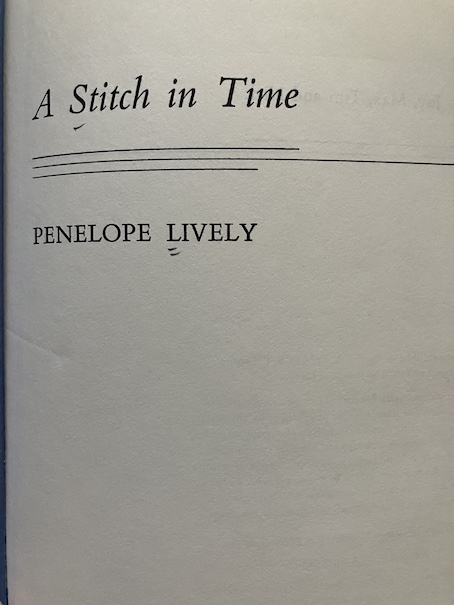
A Stitch in Time by Penelope Lively, 1976.
It’s summer, and 11-year-old Maria Foster’s parents have rented a house near the sea for their summer holidays. Maria is an only child, quiet and given to daydreaming. Maria is shy and socially-awkward and her parents are often preoccupied with their business and thoughts. It often seems like their parents are socially-awkward and don’t know quite what to do or say to Maria as a child, which is why she doesn’t always know what to say to other people. Because she frequently doesn’t have anyone else to talk to and doesn’t always know what to say to other people, Maria often finds herself having imaginary conversations with objects or animals.
The seaside house where the Fosters are staying is an old one, built about 1820. It’s lovely and has a beautiful view. The interior has brown wall paneling. The furniture is old-fashioned, Victorian, and rather grand. When Maria chooses a bedroom for herself, she finds a collection of labeled fossils in a small chest of drawers, which she finds fascinating. The only modern touches are just a few bits and pieces left behind by the family that had rented the house before them and left the week before, like some half-eaten boxes of cereal. There’s also a tabby cat who appears to come with the house, and Maria begins to imagine conversations with it.
When they first arrive, Maria is sure that she hears the creaking of a swing and a dog barking, but when she goes looking for them, she can’t find them. When she begins exploring outside, she finds some small fossils in the rock, and her mother says that they’re ammonites and that the area is famous for them. She accidentally breaks one while trying to get it out, and she decides that it’s better to leave the others where they are. Exploring further, she finds some loose fossils and fossil fragments that she can collect more casually without hurting them. She begins making her own fossil collection, and she uses the old fossil collection and some books she finds in the house to begin labeling her own specimens. She begins to think that the fossil notes and sketches she finds were written by a girl around her age, and she tries to imagine what she was like.
When they meet the landlady who rented the house to them, Mrs. Shand, she says that she grew up in the house herself with several brothers and sisters. She says that the room that Maria chose for herself was once the old nursery. Mrs. Shand now lives in a small flat in the old guesthouse nearby, and she invites them to call on her if they have any questions about the house.
Maria observes a family with several children at a nearby hotel, and she even briefly speaks to a boy her age, but she doesn’t know how to ask them if she can play with them. Later, she and the boy, Martin, meet again and realize that they have a mutual interest in the natural world. Martin tells her the names of some plants and birds, and Maria impresses him with the name of a fossil she’s learned. Martin warns her about the cliffs nearby, which have a tendency to crumble after rain.
Mrs. Shand invites Maria to her house to get a book that she would like to loan her. Maria doesn’t really know what to say to Mrs. Shand, but Mrs. Shand tells her about the collection of stopped clocks she has. She says that they belonged to her grandfather, who was a scientist, and that they have been stopped as a gesture of respect to her grandfather since his death. Maria notices a stitched Victorian sampler on the wall, and Mrs. Shand says that she can look at it because the girl who made it was about her age. It has a the typical alphabet and an embroidered quotation about death, but it also has the image of a house with a tree and a swing, a little black dog, and some fossils. Maria realizes that it’s the house that she is now staying in and that it confirms that there was once a dog and a swing there, like she keeps hearing! An inscription says that the sampler was started by a ten-year-old girl named Harriet in 1865 and completed by her sister, Susan.
Maria begins to think about time and how the lives of people who had once lived in the house where her family is staying, like Harriet, have left traces behind, not unlike the fossils in the cliffs or Mrs. Shand’s stopped clocks, full of past times. Maria begins to wonder about Harriet and what happened to her. She lived over 100 years ago, so she would be dead by Maria’s time (the 1970s, contemporary to the writing), and Martin says that Harriet probably grew up, got married, and had children, like most girls. Yet, Maria finds herself thinking that maybe Harriet didn’t grow up and get married. When Mrs. Shand lets her and Martin look at her old photo albums, Maria notices that, after a certain age, Maria doesn’t seem to appear in family photographs. Mrs. Shand says that her own mother was Susan. The lack of Harriet in the photographs and the fact that Susan finished the sampler leads Maria to conclude that something tragic happened to Harriet.
Then, one day, Maria thinks she hears the dog again, barking frantically with the sounds of a landslide and shouting children. Nobody else can hear it, but Maria is sure that she’s hearing an echo of a past tragedy, and she becomes convinced that Harriet was killed in that past landslide. The existence of the metal swing that once hung in the tree is confirmed when she and Martin find it and restore it. When Maria swings on it, she feels like she’s gone back in time, almost like she was Harriet with her dog and sister Susan nearby.
The book is available to borrow and read for free online through Internet Archive (multiple copies).
My Reaction and Spoilers
I enjoyed the themes of time and what people leave behind. There are comparisons all through the story between clocks, fossils, and echoes of the past, and it all relates to the passage of time. More specifically, Maria starts seeing changes in herself, emotionally and mentally, as she matures.
Some of this story obviously takes place in Maria’s imagination. As a shy, socially-awkward introvert with parents who are also introverted, Maria tends to live in her own head much of the time. She often has imaginary conversations with objects and animals, and many of these are reflections of Maria’s concerns at the time. Through much of the story, Maria isn’t happy with herself as she is, realizing that she is socially-awkward and doesn’t know how to approach people and connect with them. When Maria imagines conversations with the tabby cat at the house, the cat tends to be critical of her. It’s a reflection of Maria’s own insecurity and self-criticism.
Maria’s parents love her, but they interact with her in a kind of off-handed way, which feeds her insecurity and social awkwardness. Maria knows that her parents love her, but she can tell that they don’t always know what to say to her or do with her, which makes it harder for Maria to learn how to interact with other people. Maria’s parents are both very introverted and try to avoid social occasions, if they can. However, Maria has realized that she needs to connect with other people and make friends. Through her experiences with Martin and his siblings, Maria becomes more outgoing and confident, and she finds it easier to interact with other people.
In some ways, Maria doesn’t entirely fit in with her parents because she’d like to be a little more outgoing than they are. Similarly, Martin sometimes doesn’t fit in with his family, either. Martin’s family is boisterous, and he is something of an intellectual. There are times when he likes doing quieter activities with Maria, talking about plants and fossils.
When Maria visits a local museum with Martin, and they look at the fossil exhibit, they talk about evolution vs. creationism. Maria decides that she doesn’t believe in the Noah’s Ark story about animals in the Bible, but at the same time, she thinks that studying animals through time makes it look like someone was experimenting with different designs of creatures and improving them with each generation. Martin says that’s nonsense and that it’s just evolution. Maria and Martin both seem to believe in evolution, but the difference between them is that Maria thinks that it seems like there’s a hand guiding it, and Martin credits just natural, scientific forces. In some ways, Maria and Martin are kindred spirits in their thinking, but Maria leaves a little more room in her personal understanding for feelings and the supernatural. Maria seems to be the only person in the story who is sensitive to the sounds and echoes of Harriet’s past.
At the end of the story, Maria decides that she’s going to give up imagining the conversations with the cat because she’s feeling a little more confident in herself through her friendship with Martin, her new understanding of the echoes of the past, and her realization that she herself is moving forward into her own future. She has a sense that she is leaving her past self behind, much like Harriet did. A part of Maria may always be young in this particular summer, but like Harriet, Maria herself is moving on.
What Really Happened to Harriet? (Spoilers)
As Martin guessed, Harriet did grow up and get married. She didn’t die young as Maria thought, based on the echoes of the past she’s been hearing, although she is correct that there was a landslide by the beach and that a tragedy occurred there. Before Maria’s family leaves at the end of the summer, Maria finally asks Mrs. Shand about Harriet and the landslide. Mrs. Shand explains that Harriet and her sister managed to escape the landslide, but their dog was killed. They were very upset about it and buried the dog near the old house. When Maria visits the grave, she discovers that this is the anniversary of the dog’s death.
Because I love dogs, I was still upset about the dog’s death, but Maria is at least reassured that Harriet herself survived. She asks Mrs. Shand why there aren’t any pictures of Harriet with the family after that summer, and she says that there are pictures of Harriet grown up, just not many because she wasn’t living at home anymore. The fall after her dog died, Harriet went away to boarding school. Her sister finished her sampler, both because Harriet was leaving for school and because Harriet never liked sewing. After Harriet graduated from her school, she got married and moved away. She did visit with her family after that, but because she was living somewhere else, she just wasn’t present for all the occasions when her family had their photographs taken.
So, because Maria guessed wrong about Harriet’s fate, readers might wonder if she just imagined everything she experienced related to Harriet’s memories and the landslide. However, the book indicates that Maria didn’t imagine it all. She drew the wrong conclusions about what was sensing, but she did sense things that she would have had no reason to know about, hearing the dog’s bark and the sounds of the swing before she had reason to know that either of them were ever there. When she’s on the swing and feels like she’s becoming Harriet in the past, she also manages to come up with the dog’s name before anybody tells her what it is. Because Maria is an introvert who often interacts with things in her environment more than she interacts with living people, it seems that she has a kind of sensitivity to her environment. At the end of the summer, though, when she senses that she’s changing as a person, she considers that, even if she were to return to this place again, she probably wouldn’t experience it in the same way. She’s moving on, mentally and emotionally, and that changes her perceptions of things.
 Jestress's Forgotten Books and Stories