Hester Bidgood

Hester Bidgood, Investigatrix of Evill Deedes by E.W. Hildick, 1994.

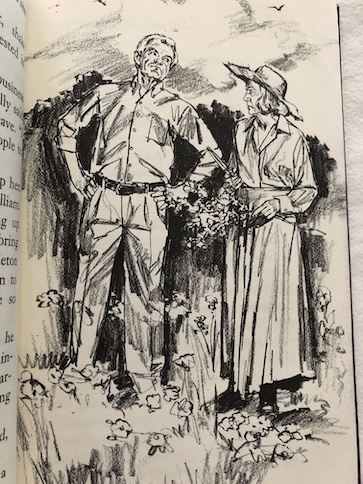
Hester Bidgood was a character in one of the McGurk fantasy mysteries, which involved time travel, and in this book, she investigates a mystery of her own in her own time, the late 1600s, Colonial America.

Goody Willson’s cat has been found, badly injured, with the shape of a cross burned into it. Some people are spreading the rumor that this is a sign that Goody Willson is a witch and that the injuries to the cat were a sign of God’s disapproval for Goody Willson’s “witchy ways.” Of course, Hester and her friend, Rob, don’t believe that. Old Mistress Brown worries that if the witch rumors go too far, everyone will soon be a potential witch suspect, like in Salem. Rob takes care of nursing the cat back to health, while he and Hester try to determine how the cat came to be injured in such a strange manner.

Rob knows what it’s like to be an outcast. Although he’s a white boy, he lived for a time among the Native Americans as a young captive and adopted many of their habits. He doesn’t know how to read, and Hester has been helping him. However, there are people in the community who don’t trust Rob because of his connections to the American Indians, and they call him derogatory names.

Hester and Rob consider that the mark on the cat could have been made by a branding iron. They go to the blacksmith and ask him if he has an x-shaped branding iron or if anyone has asked him to make one, but he says no. But, then Hester begins to consider that maybe the cross isn’t really a cross. A cross sign could also be made by putting two capital ‘T’s together at an angle.

Their investigations also take them to the old Morton homestead, where the entire Morton family was killed by American Indians some years before. Someone has been staying there in secret, and there are signs of blood, possibly from the injured cat. Gradually, Hester and Rob begin to put the pieces together, realizing who the person responsible must be and how this evil deed is actually connected to an earlier crime.

I didn’t really like this book because of the cruelty to animals. It wasn’t just what was done to the cat but also when Hester remembers Rob finding a dragonfly and considering taking off its wings. Hester stops him from doing it, but it’s still a disgusting thought. I thought that the villain was pretty obvious from the beginning, too, although I didn’t know the motive. When there’s a witch hunt, the person who is the most guilty is the first one to bring up the subject of witches.

The Mystery of the Cupboard

The Mystery of the Cupboard by Lynne Reid Banks, 1993.

This is the fourth book in the Indian in the Cupboard series. It’s also the longest book in the series and the one that reveals the most about the history of the magical key and cupboard and how their secrets tie into the secrets in Omri’s own family. It was my favorite book in the series when I was a kid!

Omri’s parents have surprised him by telling him that they’re planning on moving to a new house again. Omri wasn’t exactly happy with their last move, and his room and other parts of their new house were damaged after his last adventure with time travel, when his friend Patrick brought back a tornado with him. However, now that the house has been repaired and he’s settled in, Omri doesn’t like the idea of having to pack up and leave and get used to a new place again. His parents want to move to the country, but it’s not even the area where Patrick now lives. Instead, they’re planning to move to a house that his mother has just inherited.

The house Omri’s mother has inherited belonged to an older cousin of hers she never actually knew. He didn’t leave his house specifically to her; it’s just that he died and left no will, and Omri’s mother happens to be the nearest living relative his lawyers could find. When they finally see the house and find out how much land is attached to it, it turns out to be much better than Omri expected.

There are just two things that concern Omri. The first is the package that he asked his father to store at a bank for him – the magical cupboard and key. Although Omri asked his father to put them in a bank deposit box to keep them safe and prevent himself from being tempted to use them again because it’s too dangerous, he doesn’t like the idea of them being too far away from where he’s living. His father promises to have them transferred to a bank near their new home. The second thing that worries him is that his cat mysteriously disappears soon after they move into the new house. (The cat is okay, she just sneaked away to have kittens.) His parents say that she’s just roaming her new territory and might be a little angry for being moved from her old home and that she’ll come back to Omri once she’s settled in, he still worries about her.

One night, he think he hears his cat crying and goes looking for her. He doesn’t see her, but he stumbles on something that was hidden in some old thatch that fell of the roof of the house. It turns out to be a metal box and a notebook belonging to someone named Jessica Charlotte Driscoll, written in 1950. Omri doesn’t know who she is, but the notebook is a story of her life, in which she describes incredible things happening to her which her family doesn’t believe. Omri wonders if she could be a relative of his, and the name Charlotte reminds him of his grandmother, Lottie. He never knew his grandmother and his mother doesn’t even remember her mother because she died in a bombing during WWII, when she was very young. The woman who wrote the notebook couldn’t have actually been his grandmother because she would have been dead for several years by 1950, but perhaps it was a family name.

Omri questions his mother about the cousin who owned the house and her family’s history. Jessica Charlotte turns out to be the sister of Omri’s great-grandmother, his mother’s great-aunt. Great Aunt Jessica Charlotte was the younger sister of his mother’s grandmother. After her mother was killed in the war, Omri’s mother was raised by her grandmother. Omri’s mother had asked her about her younger sister when she was a girl, but her grandmother didn’t like to talk about her. Apparently, Jessica Charlotte had been an actress with a somewhat scandalous past. However, the cousin who used to own this house was Jessica Charlotte’s son, Frederick. Frederick never married, and although Omri’s mother thought that Jessica Charlotte had lived abroad somewhere, it’s possible that she lived at this house for a time.

Much of the story is told through entries in Jessica Charlotte’s notebook. When Omri begins to read the notebook, written toward the end of Jessica Charlotte’s life, he learns, to his shock, that Jessica Charlotte was the original owner of the magic cupboard and that she had her own Little People who visited her from other times and were her friends. After Omri reads that, he questions Gillon, the brother who gave him the cupboard, and he admits that he didn’t really find it in an alley, like he said. He actually found it in the basement of their old house with a bunch of other junk. He just didn’t have the money to buy Omri a birthday present at the time, and Omri had kind of a fascination for secret drawers and boxes, so Gillon thought that he might have some fun with the old cupboard, and he made up the story about mysteriously finding it to make it more interesting. (I suspect that the author was just retconning this part to make it agree with the idea that the cupboard was passed down through Omri’s family, but I like the way this comes out, so I’m okay with that.)

The notebook further explains that Jessica Charlotte had been envious of her older sister because she was prettier, luckier, and often seemed favored by everyone. However, in mocking the young men who came to court her older sister, Jessica Charlotte discovered that she had a talent for mimicry, which led her to become an actress, although her family thought that it was a disreputable profession and disapproved. Jessica Charlotte also discovered that she was psychic and sometimes had visions of the future. She eventually left home and became an actress. Her sister, Maria, still visited her secretly sometimes, against their parents’ wishes.

After awhile, Jessica Charlotte became pregnant with Frederick, which was when she first came to the old house where Omri’s family now lives. She didn’t have any money and couldn’t work while pregnant, and because she was unmarried, she would have been considered shameful if people knew. At that time, the house was a farmhouse belonging to a relative of Frederick’s father. By that point, Jessica Charlotte realized that her boyfriend wasn’t a good person and wasn’t going to be a good father to their son, but he did arrange for this relative of his to help her through her pregnancy. Frederick was born in the house, and because he was illegitimate and sensed his mother’s complicated feelings about him and the circumstances of his birth, he and his mother were never as close as they really should have been.

Meanwhile, Maria got married and had a daughter, Lottie, who was Omri’s grandmother, the one who was killed in the war. Jessica Charlotte says that she did something that wronged Maria and Lottie, and Omri stops reading the diary for a time, but he decides that he really has to continue and know the full story.

Over the years, Jessica Charlotte lived a hard life, supporting Frederick through a mixture of acting and other odd jobs, including fortune telling because of her psychic abilities (although she never used her gift to see into the future for herself or anyone close to her because she was afraid she might see something bad happen to them and be unable to stop it). Meanwhile, Maria was living a very comfortable life with her husband and daughter. Even after their parents died, Maria still had Jessica Charlotte visit secretly because of her tainted reputation, and she never wanted to meet Frederick or talk about him because his birth was the cause of her sister’s scandal. Still, Jessica Charlotte continued to see her sister and became fond of Lottie.

However, Maria was basically a pampered snob who didn’t understand her sister’s life and hardships and also had a streak of self-centeredness. One day, when Lottie was a young child, Maria said that when Lottie was older, she didn’t want her to see so much of her aunt, implying that Jessica Charlotte would be a bad influence on her. Jessica Charlotte was deeply offended by that, but she was also fearful about losing the last family members who were still speaking to her. She had lost so many of her other relationships that she still felt the need to be close to Maria and Lottie as much as she could and visit their pampered and comfortable little world, enjoying occasional tastes of their happier and more comfortable lives.

Yet, Jessica Charlotte’s jealousy for Maria’s pampered life and anger at her callousness continued to eat at her. One day, when Maria was showing her all of her nice jewelry, Jessica Charlotte got the urge to steal a beautiful pair of earrings. First, Maria was being, at the very least, thoughtless and callous for showing off all of her nice jewelry to her much poorer sister, who could never have things like that herself. Maria not only had no concept about what her sister’s life was like outside of her occasional visits, but she purposely never asked her about how she was doing, how her son was doing, or even where they were living, how they were getting by, if they needed anything, or if she could help them in any way. She didn’t know because she didn’t want to know any of these things, and the fact that she didn’t want to know any of that indicates that she knew enough to understand that their circumstances weren’t pleasant. To show off all of her pretty things like that just seems like rubbing it in. Second, Jessica Charlotte had been in need for so long that she saw all of the pretty jewels as symbols of Maria’s comfortable life, something she hungered for herself. The pair of earrings weren’t something that Jessica Charlotte wanted just for the sake of having them but because of what they represented to her, the life that she couldn’t share in and which she knew that Maria would soon shut her out of when she declared that her visits with her young niece would have to stop soon.

Jessica Charlotte planned out the theft in advance, making a duplicate key for her sister’s jewelry box and thinking that her sister would just assume that she’d mislaid that one pair of earrings somewhere. Unfortunately, when Maria noticed that the earrings were gone, she thought Lottie had done something with them, and when she kept insisting that Lottie tell her where they were, Lottie got upset and ran out of the house into the street. Matt, Maria’s husband and Lottie’s father, chased after her and was hit by a cab and killed. Jessica Charlotte felt terrible when she heard the news because she hadn’t meant for anyone to get hurt, but there was nothing she could do to take it all back.

Omri knows how Maria and Lottie’s lives went after that point because of what his mother told him about their family history. After Matt died, Maria and Lottie didn’t have very much money to live on, just a little pension, and then their house was burgled, and many of Maria’s nice things were stolen, including the rest of her jewelry, so she couldn’t sell them for extra money. Maria had to move to smaller, cheaper lodgings and get a job for the first time in her life in order to support herself and her daughter, living a life closer to what her sister had been doing. When Lottie was grown and married, she and her husband helped to support her mother, but after they were killed in WWII, Maria took in Lottie’s daughter (Omri’s mother) and had to keep working in order to raise her. Although they were now living in more equal circumstances, the two sisters did not become close again because of Jessica Charlotte’s guilt about what she’d done. Jessica Charlotte ended up buying the old house in the country where her son had been born and told her sister that she was going to live abroad, never telling her exactly where. She had not expected to see Maria again anyway since Maria was planning to cut her out of her daughter’s life before Jessica Charlotte stole the earrings, and after Matt died, Jessica Charlotte couldn’t bring herself to face Maria. Jessica Charlotte lived in the country house until her death in 1950.

When Jessica Charlotte became too weak to write any longer, shortly before her death, she had Frederick finish the story in the notebook. Aside from the difficult feelings between Frederick and his mother because of the circumstances of his birth and the rough and poor childhood he endured, Frederick also says that the two of them don’t really get along because they are very different types of people. When he was grown, Frederick went into business as a metal smith, eventually owning his own factory that made toy soldiers and other metal toys. During WWII, the government had him convert his toy factory to manufacture munitions. He wasn’t happy about it, but it did make him fairly well-off. After the war, Frederick had hoped to go back to making metal toys, but plastic was coming into vogue as the material of choice for toys, and Frederick couldn’t stand the stuff. He thought that the newer plastic toys were cheap and shoddy compared to his detailed works of art in metal. (It was kind of true.) There were basically two choices before Frederick: convert to making the cheap plastic toys he hated or switch to making different types of metal products. He switched to making metal boxes and cabinets.

Frederick never really believed in his mother’s supposed psychic powers, but when he was upset about plastic ruining his metal toy business, he admits that he let his mother talk him into participating in a silly ritual. He was so angry and upset that his emotions were ruining his health, so his mother told him to build something to put his feelings into and shut them away. Frederick built Omri’s magical metal cupboard. When he was finished making it, his mother had him visualize cleansing himself of all of his anger and hatred of plastic and shutting that feeling away in the cupboard. To his surprise, his mother shut and locked the cupboard with a different key from the one that he’d made to put in the cupboard’s lock (her key to her sister’s jewelry box). He thought that this ritual was kind of crazy at first, but he did feel better after he did it. He felt weak for a time, but then he recovered. He still didn’t like plastic, but not to the point where it harmed his health anymore.

Jessica Charlotte had said her son had also inherited her psychic “gift”, even though he didn’t believe in it. Apparently, his strong feelings about plastic produced a kind of magic spell or curse that affected the key and the cupboard and created the effect of bringing plastic toys to life. Jessica Charlotte discovered this herself because her son had given her a set of plastic figures in order to demonstrate to her how these little figures were inferior to his metal ones. Jessica Charlotte put them in the cupboard and brought them to life, and these little friends of hers brought her some happiness in her final days. Frederick thought that her mother was imagining that she was talking to fairies or something and never found out about his mother’s little friends or the magic of the cupboard.

When Jessica Charlotte realized that she was dying, she used the cupboard to send her little friends back to their own time periods, except for one little maid named Jenny, who refused to go back because she’d had a terrible life in her own time. Instead of making her go back, Jessica Charlotte confided in one of the workmen fixing the thatch on her roof and gave Jenny to him. This man, Tom, was lonely because his wife left him for someone else, so Jenny was good company for him for many years, until one day, she simply turned back to plastic suddenly. When Omri finds Tom as an old man and introduces himself as Jessica Charlotte’s distant nephew, Tom explains all of this to him, saying that all he can think of is that Jenny’s physical body must have died in her own time after having been in an apparent coma for years. He buried her little plastic figure respectfully. Tom is also the one who sent the cupboard and key to Maria after Jessica Charlotte died along with a note dictated to him by Jessica Charlotte, hinting at the nature of the cupboard and key and tacitly admitting to the theft of the earrings, so Maria knew the truth of the theft before her own death.

Omri comes to realize that the metal box that Jessica Charlotte left behind, and which was sealed with wax, must contain her collection of little figures. When his friend, Patrick, comes to visit him at his new house, Omri explains the whole situation to him, and Patrick suggests that Omri’s magic key will probably open this metal box, too. Of course, he also points out that if Omri opens the box with that special key, it will bring the figures inside to life, just as it has with the cupboard and Omri’s old trunk. Omri sees Jessica Charlotte’s old figurines as a way of finishing her story and feels compelled to bring them back to life one last time, although he knows that bringing figures to life always comes with complications, and he will have no way of knowing who or what the figures are until the box is open.

When Omri gets the chance to talk to Jessica Charlotte’s little friends, he not only learns more about his great-great-aunt’s past and the history of the cupboard but also sees an opportunity to change the past of his mother and great-grandmother by preventing the robbery that made them poor. But, if he meddles in the past, what will that mean for his future?

The book is available to borrow and read for free online through Internet Archive (multiple copies).

My Reaction:

This is my favorite book in the Indian in the Cupboard series. I suspect that the author of the series didn’t originally have an explanation for why the cupboard and key were magic, but that’s just a guess on my part. The explanation behind the magic in this book makes sense, and those parts that didn’t quite mesh with the earlier books (like Omri’s brother’s original explanation of finding the cupboard in an alley) were briefly explained. Sometimes, when book or movie series try to explain something magical or a mysterious secret they’ve left hanging, it turns into a let-down because the explanation feels rushed or implausible or fits clumsily into the earlier parts of the story, but this one was pretty smooth, intriguing, and also opened up some new story possibilities.

In previous books, Omri and Patrick both did impulsive things with the cupboard that put their small friends, themselves, and other people in danger, but in this book, both of the boys seem to have matured. Although Patrick thinks of Jessica Charlotte as a bad person and a thief for stealing her sister’s earrings, Omri tries to explain to him that she was a much more complex and conflicted person than that. Yes, Jessica Charlotte was a thief, but her motives were beyond mere greed, and it wasn’t long before she regretted what she’d done and the lasting hurt that she’d caused her family. In considering Jessica Charlotte’s theft and the theft that the burglar who was one of Jessica Charlotte’s little friends later committed against Maria, partly out of personal greed and partly as retribution against Maria on Jessica Charlotte’s behalf, Omri and his mother both come to terms with their family’s history. Patrick, who in previous books had been the more impulsive one when he and Omri interacted with the little people from the past, acts as a restraining influence in this book when Omri is tempted to change his family’s past for the better by preventing the thefts that left his great-grandmother without money. Patrick is the one who makes it clear to Omri that, just as Jessica Charlotte’s theft of a single pair of earrings radically changed the lives of her sister and niece, if Omri tries to stop those events from happening, he might change his family’s past so much that he might accidentally prevent himself or even his own mother from being born in the first place. After Omri tells the thief to give back the jewel box he stole, Omri worries that he’s gone too far, but it turns out that one request was actually fated to happen, just as it turns out that Jessica Charlotte later realized that she had met Omri briefly in what she thought was a dream when he brought her plastic figure to life. Not all of Omri’s “meddling” with the past was really meddling but was actually part of what was fated to happen and has already had an effect on the past even before he knew it.

At the end of this book, something that Omri has alternately dreaded and wanted to happen: his father discovers the secret of the cupboard and meets Omri’s small friends. In books, there is usually this assumption that if parents ever find out about their children’s magical adventures, they will end because the parents will put a stop to them or somehow, the magic will be ruined. However, in this case, the magic is not ruined, and there is one more book in this series where both Omri and his father take part in the magic.

Mystery of the Melted Diamonds

Mystery of the Melted Diamonds by Carol Farley, 1986.

This is the last book in the Kipper and Larry mystery series.

This time, Larry has come to visit Kipper and his family on their farm in Kansas while his father attends a police convention in Florida and will be spending Christmas with them. At first, Kipper thinks that Larry probably regrets this visit because Kansas isn’t very exciting, and it’s snowing while Larry’s father is in sunny Florida.

The situation gets worse when Kipper gets into a fight with his friend Scooter when Larry and Kipper were supposed to be spending the night at Scooter’s house. Scooter apparently cheated at a game, and Kipper got so mad that he said that he and Larry would just go home. The problem is that the boys have to walk a couple of miles to reach the farm where Kipper’s family lives, and the snow has turned into a blizzard.

The boys start to get scared that they might freeze to death when Larry spots a light from a house nearby and heads toward it. Kipper thinks that it’s a dangerous mistake because the house with the light is the old Morgansterne house, and it’s been empty for years. However, when the boys reach the house, there are oil lanterns burning in the windows and a fire in a wood-burning stove. Out of desperation, the boys let themselves into the house to warm up, but then they start to wonder who lit the fire and the lanterns. They search the house to see if there’s anyone there, but they don’t find anyone. The only thing they find upstairs is an old box of Christmas ornaments.

The boys spend the rest of the night in the house without seeing anyone and continue to the farm in the morning. When they explain to Kipper’s mother what happened and where they spent the night, she’s concerned, both because the boys were out in the snowstorm and because nobody should be in the old Morgansterne house. Old Miss Morgansterne, who owns the house, has been living in a retirement home, and no one else is supposed to be there. Kipper’s mother decides to call the sheriff and have him look into it.

The sheriff comes and questions the boys about what they saw in the house, and they ask him about a robbery at a jewelry store in town that the family heard about on the radio while waiting for him to arrive. Larry wonders if there’s a connection between the robbery and the supposedly empty house that seemed to be occupied by someone before they arrived. The sheriff doesn’t see why there would be a connection between the two events, but Kipper’s younger brothers think that maybe the robbers were in the house the whole time, hiding in some kind of secret passageway, like in books and movies. The sheriff thinks that the boys have overactive imaginations.

However, there is more to the theory that the house and the robbery are connected than the sheriff thinks. Soon, the sheriff is alerted that the car that is believed to belong to the robbers has crashed into a pond near a dangerous curve in the road and the two men inside the car are dead. When they search the car, they find some of the jewelry from the robbery, the less expensive costume jewelry, so it seems that they were correct that these men were the robbers, but strangely, the most expensive jewels from the robbery, diamonds, are still missing. The sheriff says that it’s almost like they melted away, like the diamond-like snow that Larry commented on earlier.

It makes sense to the boys that the robbers were in the Morgansterne house before they were. They remember seeing a car like the robbers’ car along that road before the snow storm got bad, and it would explain why the house was empty all that night. The robbers accidentally saved the boys’ lives by lighting the stove in the house for them, but they never returned to their hideout in the empty house because they had their car accident. But, somewhere along the way, the diamonds they stole seem to have vanished. Can the boys figure out how?

The book is available to borrow and read for free online through Internet Archive.

My Reaction

Overall, I liked the story. I had more than one theory about where the diamonds were, and one of them turned out to be correct, but there was enough doubt in my mind to keep the story interesting until the end.

Mystery of the Fog Man

Mystery of the Fog Man by Carol Farley, 1966.

This is the first book of the Kipper and Larry mystery series. Kipper (real name Christopher) and Larry are 13-year-old cousins. The two boys meet each other for the first time in this book, when Kipper comes to visit Larry and his family in Michigan. The boys had written letters to each other before, but they were both excited to finally meet in person.

Larry and his father live in Ludington, on the shores of Lake Michigan, and Larry takes Kipper fishing soon after he arrives, which is when Kipper first encounters the mysterious figure known only as The Fog Man. This strange old man starts Kipper, and Kipper finds him eerie. Larry explains to Kipper that The Fog Man is kind of a local eccentric. He is apparently both deaf and mute. No one knows his real name. He apparently lives in the nearby forest, but during the summer, he comes to the beach to collect driftwood, which he sells to tourists, who are fascinated by this eccentric old man, and to the lady who runs the nearby gift shop, Miss Norton.

Shortly after this encounter, the boys learn that someone has stolen thousands of dollars from the safe on one of the car ferries that travel back and forth across Lake Michigan and Wisconsin. (Another book by the same author but in a different series takes place on one of these car ferries, The Case of the Vanishing Villain.) Kipper and Larry are able to see the scene of the robbery because of Larry’s father’s position as the local chief of police. However, the boys’ adventures are just beginning.

The most likely suspect in the robbery seems to be a man called Karminsky, who worked on the ferry. He disappeared around the time of the robbery, and Larry’s father thinks that he’s hiding out somewhere in the area, waiting for the police to stop looking for him so he can make his getaway. Larry is intrigued by the idea that the robber might be hiding out in the woods nearby. Although his father forbids the boys to go looking for the robber, they can’t resist checking out the woods anyway.

Larry confides in Kipper that he really wants to help his father catch this robber so that his father will be a big success and get public recognition. Larry sometimes feels bad that he and his father have been alone since his mother died when he was young. He thinks that, if his mother was still alive to help his father take care of him, his father would be able to do much more in his life and career, so Larry wants to be the help that he thinks his father really needs.

Soon, the boys think that they’ve found Karminsky’s hideout in the woods, but even though they lie in wait for him all night, they don’t manage to catch him there. The only person they see in the area is the Fog Man, and to Kipper’s shock, he sees the Fog Man walking without his characteristic limp!

When the boys later find the Fog Man’s coat and a fake white beard, they reach different conclusions about what happened. Kipper thinks that the Fog Man was involved in the robbery all along and that he was always in disguise from the beginning. However, Larry is accustomed to thinking of the Fog Man as a harmless old eccentric who has hung around town for the last few years, selling driftwood to tourists. Larry thinks that the Fog Man might be an innocent victim of Karminsky’s, that Karminsky may have killed him so he could take his place and blend in with the usual beach scene until he could make his escape.

Then, Larry’s father tells them that Karminsky has been found in another town, apparently having missed being on the ferry in the first place. So, if Karminsky was never on the ferry and never in Ludington, who stole the money and masqueraded as the Fog Man?

The book is available to borrow and read for free online through Internet Archive.

My Reaction

I bought this book because I always liked the Flee Jay and Clarice mystery story that I mentioned before and wanted to see more by the same author. I liked it because, while I thought that I understood things pretty quickly in the story, there are some surprising twists to the mystery. I thought that I had it figured out twice, but I was surprised both times, and the true identity of the Fog Man remains a mystery until the very end.

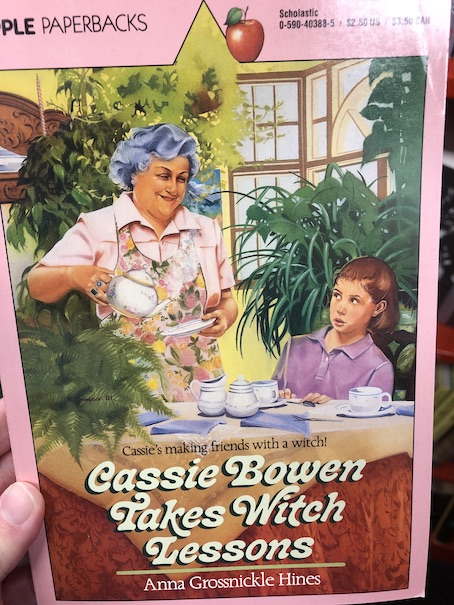
Cassie Bowen Takes Witch Lessons

Cassie Bowen Takes Witch Lessons by Anna Grossnickle Hines, 1985.

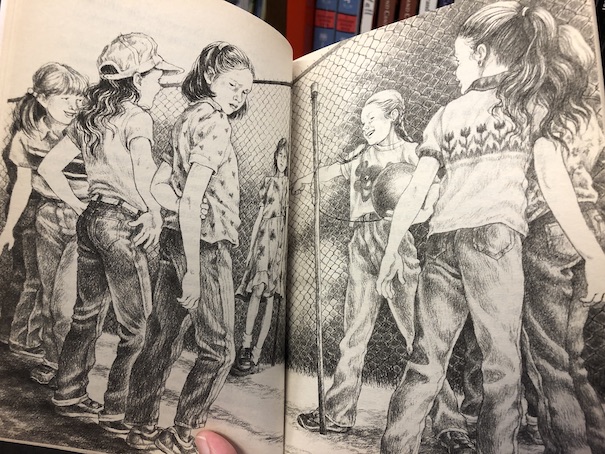
Cassie Bowen and Brenda Bolter have been friends for years, but lately, Brenda has been getting friendlier with Sylvia, another girl in their fourth grade class at school. Sylvia is a mean girl, and the favorite target of her meanness is Agatha Gifford, the new girl at school. Sylvia likes to call her “Saggy Aggy” and “Thrifty Gifford” because Agatha always comes to school wearing dresses that are too loose on her and Sylvia thinks that she probably got them at a thrift store. Most of the girls at school wear brand new jeans, not dresses. Agatha doesn’t bother to fight back when the other girls tease her, and Cassie doesn’t know what to say or do about it, even though the teasing makes her uncomfortable, too.

Even if the other girls are right about Agatha wearing used clothes, Cassie can understand. Cassie wears jeans like most of the other girls, but hers are actually hand-me-downs from an older cousin. (The story of my own youth, too. Thrift stores are the story of my present because I still don’t have much money, and anything I don’t spend on clothes is something I could potentially use to buy books, most of which will also be used because I like older books and because it maximizes my buying power. Life and budgets are about priorities.) Cassie’s mother hasn’t had money to buy new clothes since Cassie’s parents got divorced. The book is vague about what happened in Cassie’s family before the divorce, but Cassie’s father now lives in another state and doesn’t even write or communicate with the family, and he’s certainly not sending money. Cassie’s mother says that he’s got to sort out his life, and Cassie says that her father is kind of a “creep” now, but the book doesn’t go any deeper into it. It’s more important that Cassie’s family is now tight on money, and Cassie has mixed feelings about the divorce. On the one hand, she misses her father and wishes that the divorce had never happened, but on the other, she’s also angry with her father for his part in the divorce and the ways that he changed from the father she knew and loved before. Cassie’s mother says that everyone changes over time, and sometimes, when they change, they grow apart. Cassie will soon come to understand that better through her experiences with Brenda.

Cassie doesn’t like the ways that Brenda is changing, and she resents Brenda sharing the secret hideout they built with Sylvia without even talking it over with her. One day, when the girls are going to their secret fort, they pass the old house where Agatha lives with her grandmother. There are neighborhood rumors that Mrs. Gifford is actually a witch because her old house looks kind of creepy and she often does odd things, like talking to her plants. As the girls pass her house, they hear her talking to her flowers, and suddenly, Sylvia trips up Brenda so that she goes sprawling into the flower bed. As Mrs. Gifford laments about her flowers, Sylvia dramatically exclaims that they must pick some flowers and actually starts yanking more out of the bed until Mrs. Gifford angrily chases them off with a broom.

Cassie is appalled by the entire incident, although she admits that it was funny, watching Mrs. Gifford chase the other girls. Brenda is fascinated with Sylvia because of the daring way she likes to show off and grab attention, and it inspires her to do the same thing, finding ways to make fun of people or cause trouble. It upsets Cassie, who just wants Brenda to be the same Brenda she’s always known. Brenda also tells Cassie that Sylvia has amazing things in her room, like a collection of glass animal figurines. Sylvia even gives her one to keep. Also, Sylvia’s parents supposedly let her stay up as late as she wants, and she can usually get her way with them just by throwing a tantrum. Brenda thinks that all this is cool, which makes her different from the kids I knew growing up. Most self-respecting fourth graders were beyond tantrums and would have been called babies if they had admitted to having one at that age. Having great clothes and a lot of cool stuff in her room would have gone a long way, though.

When the children’s teacher, Mr. Gardner, assigns the kids partners to work on presenting a story to the rest of the class, Cassie hopes that she and Brenda will be partners so that things can be like they were before. However, Brenda and Sylvia end up being partners, and Cassie is assigned to Agatha. Cassie isn’t enthusiastic about it, and Agatha notices, but Cassie decides that she’s going to be as friendly as she can. She asks Agatha about which story she would like to present to the class because she doesn’t like reading that much, and Agatha says that she knows because she’s noticed that Cassie is better at math. Cassie is surprised that Agatha would know that, considering how new she is, and Agatha says that she envies her because she’s been having trouble with fractions. Agatha says that she really likes the story The Nightingale because it reminds her of a beautiful music box that her grandmother owns, and Cassie is fascinated.

One day, when Cassie’s brother is off playing baseball and Brenda and Sylvia are working on their project together, Cassie passes by Agatha’s house and is invited in. Cassie hesitates at first because the house is creepy, but she has to work on the project with Agatha, so she accepts. Agatha’s grandmother serves the girls rose hip tea and cookies. Cassie thinks that rose hip tea sounds weird at first, but it tastes nice. Mrs. Gifford is an eccentric lady, but rather sweet. She introduces Cassie to Roberto, her favorite plant. Part of the reason why she talks to plants is that she lived alone and was lonely before Agatha came to live with her. She is also a member of the same gardening club that Cassie’s mother belongs to. Cassie uses the cookies at tea to explain fractions to Agatha, and Mrs. Gifford shows Cassie her music box, which is beautiful. The music box is special to Mrs. Gifford because it was the last present her father gave her before his death, when she was about the age of the girls now. Cassie understands the feeling because she prizes the teddy bear that her father gave her before he went away.

The more Cassie learns about the Giffords, the less strange they seem, and she no longer believes that Mrs. Gifford is a witch. Agatha tells Cassie that she lives with her grandmother because her parents were killed in a car accident. The only other family she has is an older sister who is away at college, which is why Agatha can’t live with her. Cassie acknowledges that Agatha’s situation is worse than hers because, even though Cassie misses her father, she’s not an orphan. Agatha also explains that the reason why she wears those dresses to school is that her old school was a private church school, where all the girls were required to wear dresses. When Cassie explains to Agatha’s grandmother that there is no requirement about dresses at their school and that most of the girls wear jeans, Agatha’s grandmother is surprised and says that she didn’t realize, so she buys Agatha some new clothes, taking Cassie with them on their shopping trip.

The new clothes fit Agatha better, and Cassie hopes that they will help her fit in better at school, but Sylvia and Brenda won’t let up on the teasing. In fact, Sylvia seems irritated at Agatha dressing more normally and mocks her, saying, “What’s she trying to do? Act like a normal person?” Cassie tries to tell them that Agatha is normal, but they don’t believe her. Soon after, Brenda asks Cassie if she wants to hang out when she’s on her way to see Agatha again about their project. In an effort to get Brenda to ease up on Agatha, Cassie asks Brenda to come with her so that she can see for herself that Agatha and her grandmother are fine.

The Giffords are nice to Brenda, but during the visit, Mrs. Gifford’s special music box disappears. Agatha says that Brenda stole it, and Cassie gets offended by the accusation, saying that Agatha is making it up and telling her that she doesn’t want to be friends anymore out of loyalty to Brenda. Unfortunately … Agatha was right, and Cassie is shocked when she discovers the truth. Cassie retrieves the music box from Brenda, but with Brenda and Sylvia both angry at her for taking the music box back and Agatha and her grandmother probably mad at her for bringing Brenda to their house in the first place and siding with her over the theft, what is Cassie going to do?

I think the ending of the story is very realistic, although it does leave some things unresolved. Agatha does forgive Cassie for not believing her after Cassie returns the music box. Cassie doesn’t tattle on Brenda and Sylvia because they had accused her of being a tattletale earlier, but she does eventually tell her mother everything that has been happening with Sylvia and Brenda. Her mother reassures Cassie that she did the right thing, even if Brenda didn’t. She says that it sounds like Cassie is angry at Brenda for a lot of things besides this, and Cassie agrees that she doesn’t like it that Brenda is so mean sometimes. Cassie mother says that everyone changes, and sometimes, they change for the better and sometimes for the worse. Cassie doesn’t think she and Brenda will ever be friends again, and her mother says that someday Brenda will also get tired of Sylvia’s meanness, but even if she doesn’t, Cassie will find plenty of other friends. Cassie realizes that she and Agatha really do understand each other, and she’s glad when they make up. At school, Sylvia and Brenda both tease Cassie now, saying that she’s taking witch lessons from the Giffords. It hurts Cassie’s feelings to see her old friend turn against her, but she follows Agatha’s advice and ignores them.

Sylvia and Brenda are never punished for the things they’ve done, which is sadly the case for most of the little bullies I knew as a kid. However, it is nice that Cassie and Agatha realize that they are better friends for each other than either Brenda or Sylvia would have been. I noticed that there is also potential for them to be friends with other people in their class besides Brenda and Sylvia. When Cassie got to school at the end of the book, a girl named Stacy asked her if she wanted to play tether ball, which shows that other girls don’t think badly of her for hanging out with Agatha. I also wished that the book would show more of Pam, who had been Sylvia’s best friend at the beginning of the book before Sylvia and Brenda started hanging out. After being abandoned by Sylvia, perhaps she would also be open to making some new friends. Cassie and Agatha might have other options for making new friends.

There is no magic in the story or witchcraft of any kind. In fact, Brenda and Sylvia probably never really believed that Agatha or her grandmother are actually witches. It’s more that, for reasons of their own, Sylvia and Brenda were looking for someone to pick on, and the “witch” accusations were just their excuse. That’s why they were so irritated when Agatha started dressing like the other girls. If their excuse for bullying Agatha disappeared, they didn’t want to lose their ability to bully her. It was never about making Agatha dress or act like the other girls; it was always about Sylvia and Brenda’s need to have someone to victimize. The truth is that even if the Giffords had seemed less strange in the beginning, Sylvia and Brenda probably would either have picked on them anyway or maybe selected some other victim, perhaps going straight to Cassie as their first choice, because they were looking for a victim and would have found one eventually because that was always their goal.

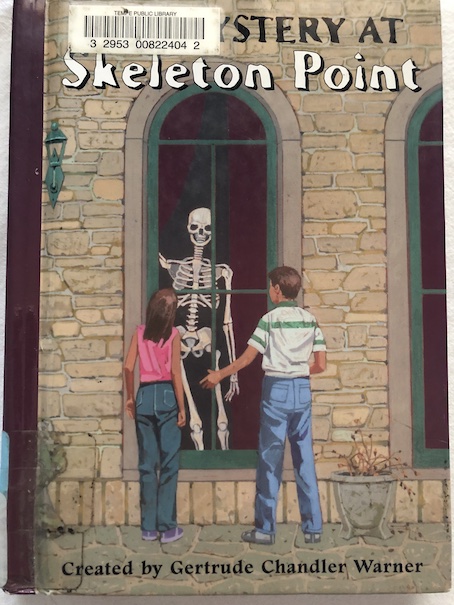
The Mystery at Skeleton Point

The Boxcar Children

Boxcar Children Mystery at Skeleton Point cover

#91 The Mystery at Skeleton Point by Gertrude Chandler Warner, 2002.

Boxcar Children Mystery at Skeleton Point bone collection

Mr. Alden’s cousin Charlotte has recently bought a house and some land at Skeleton Point that is a local landmark.  The doctor who owned the old house collected skeletons.  He was a bone expert and taught aspiring doctors and veterinarians.  It’s a creepy place with a lot of local legends about a skeleton called the Walking Skeleton that came back to life and is trying to turn itself back into a person by stealing pieces from the statuary around the house.  The statues are damaged and missing pieces, although no one really knows why.

Boxcar Children Mystery at Skeleton Point neighbors

The locals have mixed feelings about Charlotte’s desire to donate all the skeletons to a medical school and to clean up the house and renovate it.  Some people don’t like the idea of a local landmark changing.  Greenie, a man who lives nearby, is also an expert on bones who studied with the doctor, and he is upset that the doctor didn’t leave Skeleton Point to him when he died, as he had promised that he would. 

The people Charlotte had hired to carry out the renovations argue with each other about how things should be done and are not happy that Charlotte has asked the Alden children to help out with the cleaning and documenting the statuary around house.  It seems like they’re trying to distract the Aldens and keep them away from the house.

Then, some of the statues around the house disappear.  Who is taking them and why?

The book is available to borrow and read for free online through Internet Archive.

My Reaction

The best part of the story for me was the setting. A house filled with skeletons is a bizarre and creepy idea. But, much of the mystery concerns the statues around the house instead of the skeletons, and honestly, although I had a strong feeling about who was taking the statues, there were times when I suspected other people and different motives for the thefts. The story did a good job of making multiple people look guilty.

The Mystery in the Computer Game

The Boxcar Children

Boxcar Children The Mystery in the Computer Game cover

#78 The Mystery in the Computer Game by Gertrude Chandler Warner, 2000.

Boxcar Children The Mystery in the Computer Game playing

The Alden children love the computer game that they’ve been playing with their cousin, Soo Lee.  The game is called Ring Master, and they have to help the characters in the game to solve puzzles in order to find the magical ring.  Solving puzzles is a specialty of the Aldens.

Then, they get the chance to be play testers for the sequel to Ring Master.  Their grandfather knows the owner of the company that makes the games.  The owner of the company invites the children to come to the company for a tour and even gives them a computer to use to play the test version of the new computer game.

Boxcar Children The Mystery in the Computer Game QuestMaster company

Strangely, some of the people at the company seem upset at the Aldens getting the computer.  Andy, the one of one of the founding members of the company, insists on coming over to the Aldens’ house and working on the computer, giving it some updates.  However, after he leaves, the Aldens realize that some things about the game have suddenly changed.  A new character called Naje suddenly pops up, and she seems to be hanging around places in the game that remind them of places that remind them of real places around town.

Boxcar Children The Mystery in the Computer Game car

The Aldens feel like they’re being given a message through the game, especially when they visit some of the places represented in the game and notice Jane, a member of the computer game company, hanging around these places.  What is Jane up to, and what is the game trying to tell them?

The book is available to borrow and read for free online through Internet Archive.

My Reaction

Boxcar Children The Mystery in the Computer Game posing for a picture

This story deals with corporate spies and the theft of intellectual property, but what makes it really interesting is the sort of treasure hunt-style way the puzzles in the computer game lead them to the culprit. The identity of the mysterious person who is feeding the clues to them is part of the mystery. The fact that the person who is feeding them clues feels like they can’t speak up about their suspicious openly is also a clue to their identity.

Mystery Madness

Mystery Madness by Otto Coontz, 1982.

While Murray’s parents are on vacation, his older sister, Blanche, is in charge of the house. One day, he calls Blanche to get a ride home from the dentist and hears what he thinks is Blanche shooting their housekeeper.

Earlier that morning, he had heard Blanche talking on the phone to someone about a gun. Then, when he calls home, a friend of Blanche’s, Harold, answers, and Murray hears a gun going off in the background and Blanche apologizing to the housekeeper and talking about blood on the carpet. When Murray gets home, his mother’s Persian rug is missing and sees what appears to be a head in a bucket under the sink in the kitchen, further proof that the housekeeper is dead and that her blood stained the carpet.

Murray doesn’t know what to do because he is sure that his sister would never shoot anyone on purpose, and he doesn’t want to see her go to jail. He consults a private detective, Mat Cloak, who he met in a doughnut shop, for help.

The detective agrees to look into the case, and along the way, he realizes that it has connections to a case that he is already investigating. What really happened to the housekeeper? Is Blanche really guilty of murder? Moreover, who is the strange man who is following Murray around?

It’s a very funny story with some twists that readers won’t be able to guess right away. Part of the mystery is pretty obvious because Blanche is a theater student, but the real mystery is one that Murray isn’t even trying to solve and the real villain is someone who Murray thinks is a victim.

The book is available to borrow and read for free online through Internet Archive.

Detective McGruff Sniffs Out a Thief

Detective McGruff Sniffs Out a Thief by Megan Durand, illustrated by John Sullivan, 1983.

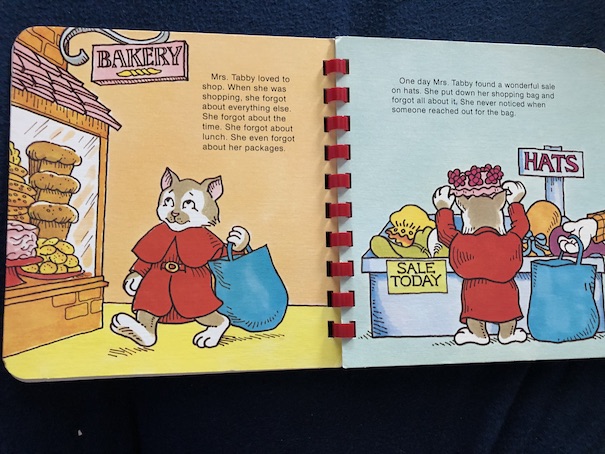
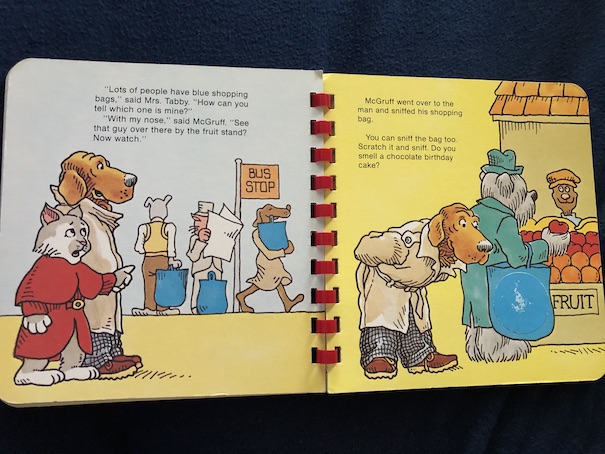
Sniffy books, or scratch-and-sniff books, were popular during my early childhood in the 1980s, and they are still being made today. Scratch-and-sniff books are picture books with special patches that release a scent when they’re scratched. Kids like interactive books, so it can be fun for them to scratch a flower or some food in a picture and then smell it. I know from my old books that these scented patches eventually wear out, although I’m amazed that some of them still have a scent more than 30 years after the books were originally made. I had expected that the ones that my brother and I liked and scratched the most would be the ones that would eventually wear out the fasted, but it also depends on the strength of the original scent. The milder, more subtle scents are often more difficult to smell decades later. Scratching a little harder can sometimes help. This picture book is a mystery story, and I thought that it was clever, using the sniffy patches as part of the mystery story.

Mrs. Tabby loves shopping, but she often forgets to pay attention to her purchases while she’s looking at other things. One day, someone steals her shopping bag while she’s trying on hats at a sale. It’s terrible because the bag contained the chocolate cake for her son’s birthday.

Fortunately, Detective McGruff is nearby when Mrs. Tabby realizes that her bag is missing. Unfortunately, finding it isn’t going to be easy because many people are carrying blue shopping bags that look like hers. Mrs. Tabby isn’t sure what to do, but McGruff decides to use his nose to sniff out the correct bag.

McGruff approaches various shoppers and gives their bags a sniff. All of the bags look alike, but readers can scratch and sniff the special patches on each bag and try to guess what they contain before McGruff reveals the truth.

After sniffing several bags, McGruff eventually locates the one that smells like chocolate and finds the cake. But, curing Mrs. Taffy of being forgetful is another matter.

Detective McGruff, or McGruff the Crime Dog, was created in the early 1980s as a mascot for anti-crime messages from U.S. police and law enforcement agencies through the National Crime Prevention Council, including anti-drug messages and information related to the issue of child abduction. Sometimes, police use McGruff costumes when visiting schoolchildren to talk to them about crime.

Mystery in the Apple Orchard

Mystery in the Apple Orchard cover

Mystery in the Apple Orchard by Helen Fuller Orton, 1954.

Mystery in the Apple Orchard swing

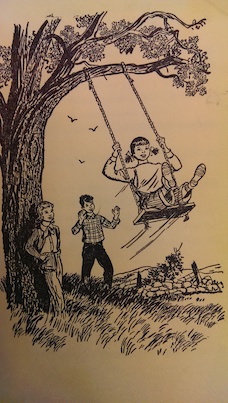
Dee Waters (age nine), her brother Ronnie (age eleven), and the other neighborhood children enjoy playing in the nearby apple orchard. The orchard was planted by Dee and Ronnie’s grandfather, and the trees are all different types of apple. Sometimes, the children take a lunch with them and spend hours climbing trees and playing. They like to watch the animals there, like the squirrels and crows, running around and hiding things in the trees. There is also a swing hung in one of the trees.

The Waters’ housekeeper, Mrs. Brown, lives in the city and commutes to her job in the country. She also has a son, Timmy, and she’s been concerned about him. Timmy is recovering from a broken leg. The bullies in his neighborhood dared him to climb a tall pole, and he fell. Although Timmy’s been out of the hospital, he hasn’t been getting enough fresh air and time outdoors in the city because they don’t live near a park. Dee and Ronnie don’t know Timmy, but hearing that he’s been unwell, they suggest that Mrs. Brown bring him along the next time she comes so that they can show Timmy the apple orchard. The children’s mother thinks that’s a good idea and also urges Mrs. Brown to bring Timmy for a visit.

Timmy is a little younger than Dee and Ronnie, and he can’t play many games with the children yet because he still walks with a crutch and can’t run. Still, he is fascinated by the animals in the orchard and enjoys watching them. He doesn’t see many wild animals in the city.

Most of the other children in the area are nice to Timmy, but Gloria is a little bit of a snob. Ronnie finds Gloria annoying because she is so prissy and extra careful about her clothes, and on Timmy’s first day in the orchard, Gloria shows up with a ring that she says has a real diamond and a family. The other children don’t believe her at first because it would be silly to wear an old, valuable ring to an apple orchard, especially when it looks so loose on her finger. Ronnie warns her that it could get lost, but Gloria tells him to mind his own business. She also tries to cheat when they play hide-and-seek, asking Timmy to tell her where everyone is because he can’t play the game anyway. Timmy refuses to help her cheat, and Gloria leaves in a huff. Because this is a mystery story, you can see where this is probably leading.

Mystery in the Apple Orchard play ticket desk

When Timmy comes the next time, the children decide to pretend that they’re going on trips by airplanes, with the trees in the orchard representing the planes. Timmy is sad that he can’t climb with the others, so they make him the ticket agent in the airport. Gloria shows up again, still with her diamond ring, and the other children again warn her that she could lose it in the orchard. Gloria says that’s impossible because she tied it to her finger, and she shows the the string. (What was it they said about the Titanic being unsinkable?)

Naturally, the ring gets in the way while Gloria is playing with the others, catching on a twig in a tree. They have to untie the string to get her loose. The other children tell Gloria to put the ring somewhere safe while she plays, suggesting that Timmy the ticket agent could watch it. However, Gloria decides to put the ring on a stone near the old well that has been filled in. (Considering that there are small animals in the orchard that happen to like shiny things, this was not the best decision.)

Mystery in the Apple Orchard digging

Sure enough, by the time Gloria comes down from her tree and her imaginary flight to Paris, her ring is gone. Naturally, Gloria is upset and admits that she was wearing the ring without her mother’s permission. (Gloria likes to show off.) She accuses one of the other children of taking the ring. Timmy seems like the most logical suspect, since he was on the ground while the others were in the trees, but he denies it, saying that he closed his eyes so he could imagine a flight, like the others were doing. Dee suggests that an animal could have taken the ring. Earlier, a chipmunk carried off the piece of string. On the other hand, crows also like shiny things. Could the crow have swooped down and carried it away?

Gloria still insists that Timmy took the ring, and she threatens to tell her mother that he stole it. Can the others find the ring before Timmy is labeled as a thief?

It take awhile for the other children to find Gloria’s ring, and because they failed to find it with the animals right away, some readers might wonder whether a human was responsible for taking. However, the mystery itself is very simple and wouldn’t really surprise anyone but young children. In the end, though, the important point is that Timmy is so motivated to find the ring and clear his name that he finds the courage to climb a tree again. He has healed from his broken leg more than even he thought he had. Before coming to the country, the doctor had told him that he could stop using his crutch, but he hesitated to do that because he was so afraid of re-injuring himself. Once he gets the courage to try not using his crutch, he discovers that he can also do many other things, although he does freeze up when trying to come back down the tree and needs the help of a couple of telephone linesmen to get back down. The linesmen tell him that it’s okay and that God has smiled on him for helping him to improve and do what he needed to do. Timmy is reassured by the discovery that he can do more than he thought he could, and his mother and Mrs. Waters decide that the Browns should move to the country permanently so that Mrs. Brown won’t have to commute to work and Timmy can have more fresh air, playing with the other children in the apple orchard.

This book is available to borrow for free online through Internet Archive.