The Little White Horse

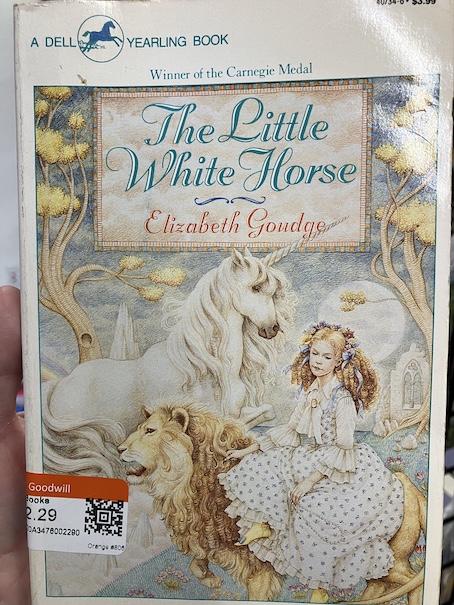
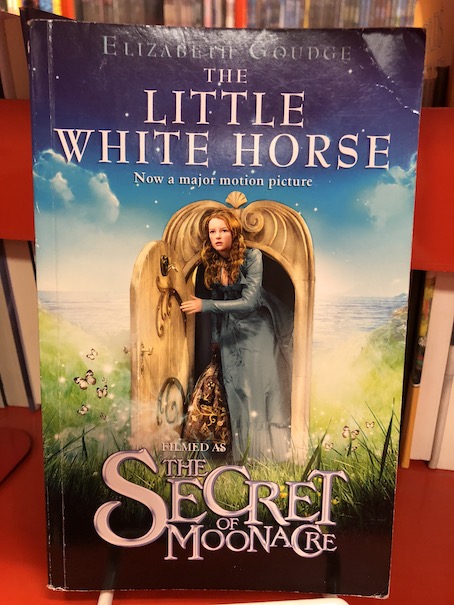
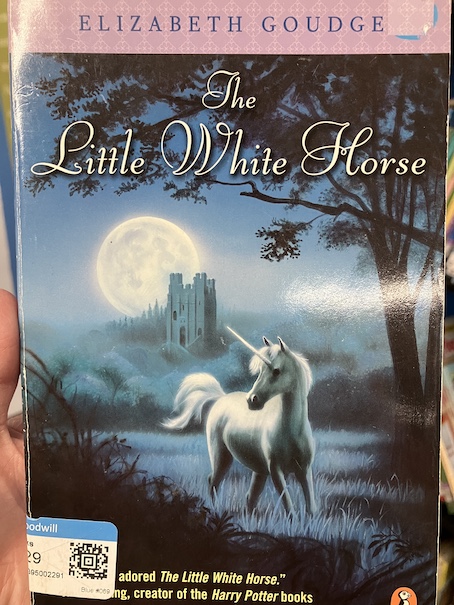
The Little While Horse by Elizabeth Goudge, 1946.

The year is 1842, and Maria Merryweather is on her way to her family’s ancestral home, Moonacre Manor. Thirteen-year-old Maria is an orphan. Her mother died when she was a baby, and now, her father has died. Their house in London had to be sold to pay his debts, and now, Maria is going to live with a distant cousin, Sir Benjamin Merryweather, in the country. She is traveling with her nurse, Miss Heliotrope, who has taken care of her since she was little and is like a mother to her, and her dog, Wiggins. Maria and her father were never really close. Maria isn’t sure that she’s going to like living in the country because she is accustomed to city life and the luxuries that come with it. She fears that life in the country will be rough and full of deprivation.

Maria begins to feel better when she actually sees Moonacre. It’s a lovely, romantic, castle-like manor house. The manor also gives her an odd feeling of home because so many Merryweathers have lived there for so long. Sir Benjamin welcomes her, and she likes him immediately. Oddly, Sir Benjamin refers to has as “one of the silver Merryweathers”, saying that she was born during a full moon. It’s true that Maria has unusual silvery gray eyes. Sir Benjamin says that he’s a “sun Merryweather”, born at midday, but that’s okay because moon Merryweathers and sun Merryweathers get along well. He does have a rather warm, sunny appearance.

Sir Benjamin shows them around the manor and to their rooms. The furnishings are a little shabby, but they’re quite comfortable, and they like their new rooms. Maria is charmed because her room is in a turret, and it has a very small door that’s really only big enough for a small girl like her to get in. Miss Heliotrope is worried that she won’t be able to get into Maria’s room if she is ill and needs her, but Maria is sure that isn’t going to be a problem. She loves the room because it just seems so perfect for her. Wiggins even seems to be getting along with Sir Benjamin’s big, old dog, Wrolf, although Maria has some doubts that Wrolf is actually a dog because he doesn’t look like any dog she’s ever seen before.

At dinner that evening, Sir Benjamin talks about giving Maria riding lessons, saying that he has a little gray pony who would be just right for her. Maria mentions a beautiful white horse that she saw from the carriage as they were approaching the manor, but Miss Heliotrope didn’t see it and thinks she just imagined it. Miss Heliotrope thinks that Maria imagines things all the time, like the little boy named Robin, who had a feather in his cap and was a childhood playmate, but Maria insists that the boy really did exist and so does the little white horse. Thinking about Robin makes her wish that he was here to keep her company at Moonacre, but she hasn’t seen him for a couple of years and doesn’t know where he is.

There are a few odd things that Maria and Miss Heliotrope notice about Moonacre, though. Aside from the odd dog, Wrolf, Sir Benjamin seems oddly evasive about who and where the servants are. They never see them, yet someone has been doing the cooking and cleaning and making fires in the fireplaces. There’s even a fire in Maria’s room, but she can’t figure out how anyone got in to make one since the door is too small for even an adult Miss Heliotrope’s size.

The next day, a riding habit appears in Maria’s room. It’s very nice quality, even though Maria can tell that it’s second-hand because it’s an older style and a little worn and has the initials LM on it. Maria like it, but who used to own it, and who put it in her room? In the parlor attached to her room, Maria also sees an old painting that contains a white horse and an animal that looks something like Wrolf, although she’s still not quite sure what kind of animal it is. (What’s that “brave-looking” animal that has a tawny mane and a tuft on its tail? I’m sure if we think about it, it will come to us.)

Sir Benjamin tells Maria that she shouldn’t wander the countryside alone, but she is free to explore as long as she’s with her pony Periwinkle or Wrolf. The one place he doesn’t want her to go is Merryweather Bay because there are rough fishermen there. He refers to Maria as a “princess” and the area around Moonacre as her “kingdom,” and from the way he says it, it seems that he somehow means that literally. Even the local people seem to have some kind of awe and respect for her.

Maria finds the nearby village of Silverydew charming. The Old Parson introduces her to the children of the village, and they tell her about the mysterious “Black Men” (because they all wear black, not their race) who hang out in the woods and by Merryweather Bay. They set traps for animals and steal livestock from the locals, and everyone is afraid of them.

Maria also discovers that Robin is here in the village of Silverydew, and he rescues her from an encounter with the Black Men. Robin tells her that her ancestor, Sir Wrolf, who founded the Merryweather family, was the one responsible for making the Black Men as evil as they are, and because of that, his soul has been unable to enter Paradise. Locals say that his spirit rides around nearby Paradise Hill, weeping because of what he did, and he will continue to do it until someone finds a way of solving the problem he caused.

Maria asks what exactly Sir Wrolf did, and Old Parson tells her the story of Sir Wrolf and how he acquired the lands around Moonacre. At first, Sir Wrolf just owned the land where the manor house sits, but he wasn’t satisfied with that. Although he was known for being brave and jovial, he was also a greedy and selfish person who thought that he was entitled to take anything he wanted from anyone. First, he kicked the monks out of the monastery on Paradise Hill and used the monastery for a hunting lodge. A fierce lightning storm made him abandon it later because he believed that it was sent by the monks as punishment. Then, he decided that he wanted the woods and bay around Moonacre for hunting and fishing, but they belonged to another nobleman called Black William. He tried various ways to take those lands from Black William, including direct warfare, but he was unsuccessful. Then, it occurred to him that Black William had a lovely daughter, his only child, and if he married her, he would share in her inheritance. Sir Wrolf put on a show of apologizing to Black William and demonstrating that he had mended his ways so he could win the affection of Black William’s daughter. The daughter, who was called the Moon Princess because she was as fair and lovely as the moon, believed that Sir Wrolf was sincere and married him. Sir Wrolf did end up falling in love with his bride, and they had a child together, but the lands he expected to acquire through her were still on his mind. Then, Black William suddenly remarried, and his new wife gave birth to a son, who replaced the Moon Princess as the heir to Black William’s lands. Sir Wrolf was outraged by this reversal of fortune, and while he ranted about it, he let slip how he had married his wife in the hopes of getting her lands. The Moon Princess was shocked and hurt, and although her husband insisted that he had come to love her even though he had married her for selfish reasons, she no longer believed him. She grew to hate him for his deception and even turned against the son they had together. She wanted no part of Sir Wrolf’s life anymore. Then, worse still, word reached them that Black William had mysteriously disappeared and his young son was dead. Although there were no indications of foul play, and it was possible that neither of them had really died at all, the Moon Princess came to believe that her husband was a murderer. One day, she rode away on the little white horse that her husband had given her when they married, and she was also never seen or heard from again. With Black William and his son and daughter gone, Sir Wrolf finally had possession of the lands he had coveted for so long, but he was no longer happy. He genuinely missed his wife and felt guilty for what he had done, and he couldn’t enjoy his prize.

The Old Parson explains that the sins of the past still affect the present and will continue to do so until someone makes them right again. The Black Men who now inhabit the disputed lands are probably the descendants of Black William’s supposedly dead son. The Old Parson believes that the boy’s mother probably feared what Sir Wrolf might do to the boy when his father left them, so she pretended that he was dead already. Every generation of Merryweathers since then have tried to push the Black Men out of the disputed lands, but they’ve never been successful. Also, every generation, a young woman very much like the Moon Princess comes to Moonacre, and she gets along well with the sun-like Merryweathers, but so far, a quarrel has always separated them. Maria worries about that because she likes her cousin Sir Benjamin and doesn’t want to leave Moonacre. Old Parson tells her that part of the legend of Moonacre is that, some day, there will be a Moon Princess who will come and will not leave. The legend states that she will right the wrongs of the past and make peace again, but only if she can get over the prideful nature that all Moon Princesses have and love a poor man who is below her station. The townspeople are in awe of Maria because they hope that she will turn out to be that Moon Princess.
Maria adopts the mission of righting past wrongs, reconciling old quarrels, and bringing peace to the valley once again, but she’ll have to be careful. Not everyone is ready for peace yet, and she has to guard against falling into the same bad habits that others have before her. Before she can complete her destiny, she must speak directly to the Black Men in their castle and when she does, they make a bargain with her. They agreed to end their poaching and thievery if she can prove that Black William wasn’t murdered by Sir Wrolf and if she will restore not only their lands but the pearl necklace that belonged to the original Moon Princess. However, that necklace has been missing since the first Moon Princess disappeared. How can Maria give them something that she doesn’t have and doesn’t know how to find?

The book is available to borrow and read for free online through Internet Archive (multiple copies, including one in Chinese). There is also a movie version of the story called The Secret of Moonacre.

My Reaction and Spoilers
I didn’t read this book as a kid, but it’s one that I’ve been meaning to read for some time. I saw the movie version years ago, and I was curious about what the book was like. The movie and the book set up a somewhat different situation for the quarrel between the two families. In the movie, the quarrel was about the fabulous pearls owned by the first Moon Princess and not about land. Also, Loveday and Robin were members of Black William’s family in the movie, which they weren’t in the book, changing the dynamics of their relationships with Sir Benjamin and Maria.

This story is an enchanting light fantasy. The setting by itself is magical, and Maria’s rooms in the manor are like every little girl’s dream! The story also includes odd, seemingly intelligent animals with unusual capabilities, such as the Zachariah the cat, who takes messages for people and lets them into the manor house or guides them around, and Wrolf, who is clearly a lion, even though everyone calls him a dog. The fact that Wrolf is a lion dawns on Maria toward the end of the book, and Robin confirms that’s true, saying that they all keep calling him a dog because it sounds less scary, and they don’t want to alarm anyone.

Maria’s family history is not something to be proud of, as Old Parson points out. Her ancestors were not the greatest people, in spite of their land-ownership and high status. People are looking to Maria to be better than the others who came before her and to make past wrongs right.

From Robin’s mother, Loveday Minette, who also becomes like a mother to her, Maria learns a little more about what it means to be one of the Merryweather “Moon Princesses.” Gradually, it is revealed that Loveday was the last Moon Princess before Maria. She was in love with Sir Benjamin, and the two of them were going to be married, but like all Moon Princesses and Merryweather men, they had a stupid quarrel and parted. Loveday married someone else and had Robin, but even though she has remained near Moonacre and secretly helps the household, she has been careful not to see Sir Benjamin ever since. Over the years, she has come to realize that she made a terrible mistake with Sir Benjamin and regrets it, but like other Moon Princesses, she has too much pride to admit that she was wrong and apologize. She is more mature now, and she sees that, in some ways, she was aggravating to Sir Benjamin and provoked him, and having provoked him to anger, because Moon Princesses tend to love men with tempers (one of the curses of the Merryweather men), was too proud to make up with him. By the same token, Sir Benjamin was legitimately disrespectful of her and her feelings, and when he attempted an apology, it was a half-hearted effort that attempted to preserve his pride more than demonstrate care for Loveday’s feelings, which is why Loveday didn’t feel like she could accept it.

Members of the Merryweather family and the people they marry have a tendency to attach enormous importance to and emotional investment in small things (geraniums, the color pink, etc. – they either passionately love these things or are violently or oppressively against them), and then they blow up at each other when their partner doesn’t feel exactly the same way about them, taking it as personal insult if someone likes something they don’t like or doesn’t like something they do like. (Like in the Internet meme, “Stop liking what I don’t like!”) They don’t know how to tolerate interests they don’t share, not sweat the small stuff, or live and let live. I would say that a lot of it has to do with poor relationship skills and, ultimately, a lack of respect for other people, even the people they love. They don’t respect each well enough to find out why the other person cares so much about something that seems small and annoying. They are self-absorbed in their own feelings, seeing situations only from their own point of view and putting their own feelings first. They see every conflict as some kind of contest about who’s right, with the drive to win against each other, which puts them both in a position of being on opposite teams instead, where one of them has to get the better of the other in some way, instead of on the same winning team. The result is that neither of them ever really wins, and even if one of them defeats the other in something, they ultimately end up losing their whole relationship, so it’s a net loss for everybody.

This is the cycle that has repeated for generations in this family. Loveday realizes that, for this destructive cycle to end, the Moon Princess has to learn not to provoke the one she loves as well as overcome her sense of pride. Also the Moon Princess’s love (it’s pretty clear to everyone that it’s going to be Robin, in this case) has to learn to control his temper, not respond to things as if they were some kind of personal attack, and consider the well-being of others, especially his princess. Both of them need to learn caring and consideration for others and how to put aside pride and self-interest for the sake of peace, both in their personal relationship with each other and for the sake of the wider community. Loveday emphasizes to both Maria and Robin that they must not quarrel with each other. People are depending on them to put things right in the area, and their own future happiness depends on learning to get along with each other.

The things Loveday and other adults emphasize for the children are personal skills that real people do need to learn in order to have relationships with other people and be mature members of a peaceful, stable community:

  • Don’t aggravate people. You can’t have peace if you’re always teasing or provoking people, and picking fights.
  • Choose your fights carefully, and wherever possible, avoid turning small disagreements into big fights. Remember that any battle comes with a cost, and the costs of petty fighting are higher than the rewards.
  • Be considerate of other people’s feelings and respectful of their property. You don’t have the right to do what you want with other people’s property just because you want it or it bothers you that they have it.
  • Understand that nobody is perfect, including you.
  • It is not your partner’s responsibility to please you in every way or give you everything that you want. It is your responsibility to deal with your own emotions and control your own choices and behavior.
  • Sometimes, you really are in the wrong, and you can’t always have everything you want. Accept both of these facts with maturity and take responsibility for your choices.
  • Being wrong can be embarrassing, but not nearly as embarrassing or destructive as not dealing with situations that need attention or problems that need to be solved.
  • The problems you cause affect more than just you, and problems do not go away when they are ignored.
  • Whatever the circumstances, no matter who or what you’re dealing with, it’s never just about you.
  • The word “responsible” has two meanings. The first is being at fault. (Sir Wrolf was responsible for the situation in the valley and the problems it caused.) The second just means taking charge of a situation and doing what needs to be done, sometimes because you’re the only one who can or is willing to do it. (Maria didn’t cause the problems, but she was responsible because she fixed the problems.) The second type of “responsible” is necessary for successful relationships, no matter who the first type applies to.
  • Love requires understanding and accepting each other and allowing each other to be their own person with their own likes and dislikes.
  • Caring means making each other a priority, working as a team, and doing what’s best for the team, even if it requires some compromise and self-sacrifice.
  • Building a shared life or solving shared problems is team effort, not a competition with each other. There is no “winning” unless it’s a shared victory. Otherwise, everyone loses.

It’s not exactly a spell, but the children’s mission is based around learning to function as a couple and to control their tempers and personal behavior. Magical things do start to happen when they learn to consider others’ feelings and not just their own.

There does seem to be some magic in the story. Robin later explains to Maria that the reason why nobody else could see him playing with her in London when they were younger is because he was always in or around Silverydew or Moonacre. He says that he traveled to London to play with her when he was asleep, so he wasn’t physically there. It’s like a form of astral projection or out-of-body experience. Also, like Sir Benjamin’s “dog” turns out to be a lion, the “little white horse” turns out to be a unicorn.

I couldn’t help but notice that all of the known Moon Princesses since the first one and the men that they seem to love before before they quarrel with them seem to be cousins of each other. Loveday Minette and Sir Benjamin were cousins of each other because their fathers were brothers, and Maria and Robin are more distant cousins of each other because their grandfathers were brothers. The idea of marrying a cousin or even loving them romantically seems odd for modern times, but that did happen in noble families in the past, so it might not seem so odd for the characters and others in the story.

This book also taught me what a mangel-wurzel is. They just mention it in passing, like readers should know what it is. It has such a strange name that I had to look it up. It’s a kind of beet, and apparently, it has also been used to make “punkies” or jack o’lanterns in areas where people didn’t grow turnips, before people adopted pumpkins for the purpose. Just an odd bit of trivia.

The Mystery of the Gingerbread House

Three Cousins Detective Club

#13 The Mystery of the Gingerbread House by Elspeth Campbell Murphy, 1997.

Sarah-Jane lives near a couple whose names are Jack and Jill. They live in an old Victorian gingerbread style house. They have been fixing up the old house, and Sarah-Jane has been acting as a messenger, carrying samples of wallpaper to them from her mother, who is a decorator.

Sarah-Jane brings her cousins to see the house, and Jill shows them an old photograph that she and her husband found of the children who used to live in the house a hundred years ago and a friend of theirs. When the kids first arrived at the house, they startled someone who was working in the parlor. However, Jack and Jill insist that it was not either of them. They look in the parlor and are surprised to see that someone has continued the work they were doing, removing some of the old wallpaper that needs to be replaced. Why would someone sneak into the house to continue their work?

Someone has learned an important secret about the house and something hidden inside, and they are trying to find it before Jack and Jill stumble across it in their renovation work.

The theme of this story is Proverbs 25:13, “A trustworthy messenger refreshes those who send him. He is like the coolness of snow in the summertime.”

The Hidden Message

Adventures in the Northwoods

The Hidden Message by Lois Walfrid Johnson, 1990.

The story, like the others in its series, is set on a farm in Wisconsin during the early 20th century.

One night, Kate McConnell wakes up to hear her mother and stepfather talking. The family needs money for the new planting season, so Papa Nordstrom has decided to take a job in a lumber camp over the winter. It will keep him away from home for a couple of months. He doesn’t really want to leave his family, but there’s a new baby on the way, and they really need the money. His absence on the farm means that the children will have to take on extra chores to help out. Kate also worries because conditions in lumber camps can be dangerous. Her birth father was killed in an accident in a similar camp, and she doesn’t want the same thing to happen to Papa Nordstrom.

Before Papa Nordstrom leaves for the lumber camp, he butchers a pig so his family will have meat while he’s gone. With winter setting in, it’s important to make sure that food supplies are secure. That’s why Kate knows it’s serious when her friend Josie tells her at school that someone stole her family’s steer, the one they were planning to butcher for meat this winter. Her family has no other source of meat, and they might go hungry if they can’t find the steer. Josie asks Kate for help because she and Anders solved a mystery involving a mysterious stranger who took things before.

One of the possible suspects is an older boy who has recently returned to school, who the others call Stretch. Kate has never met Stretch before because he’s been gone from school, doing farm work, since before she arrived in the community. Anders knows him, though, and he tells Kate that Stretch is trouble. Part of the reason they call him “Stretch” is that he has a habit of stretching the truth. Kate finds Stretch handsome at first, but Anders warns her not to get involved with him. Kate thinks Anders is exaggerating about Stretch because other people at school seem to like him. Anders says that if Kate wants to like someone, she should like Erik instead. Kate has a kind of rivalry going with Erik since he dipped her braid in his inkwell, and it permanently stained her dress. Anders says that Erik didn’t really mean to ruin her dress, but Kate is still unhappy about the incident. So, although Kate can tell that Erik is more responsible in other ways and is a bright and dedicated student, and they go to the same church, she has reservations about liking him.

However, Kate soon comes to realize just how dangerous Stretch is. Their teacher warns them all away from the frozen lake because the springs in the lake make the ice unpredictable. While the others play on the playground, Stretch talks Kate into walking by the lake with him. He says that he knows it’s safe because he was out on the lake earlier that morning, although Kate has her doubts about it. Then, Kate spots Anders’s dog out on the ice. Worried about the dog, Kate tries to call to him, but the dog doesn’t come to her like he usually does. Kate steps onto the ice to get the dog, and the ice breaks. Kate nearly drowns in the icy water, but Erik saves her. Kate realizes that, when she was in danger because of Stretch, Stretch actually abandoned her to drown. Later, he won’t even admit that he was the reason why Kate went down to the lake in the first place. When Kate is warmer and able to think better, she also begins to realize that the reason why Anders’s dog wouldn’t come to her when she called was because she was with Stretch, and the dog is afraid of Stretch, indicating that Stretch has been cruel to the dog in the past.

Kate’s brush with death opens her eyes to what Stretch is really like. It also creates a problem because the teacher writes a letter to Kate’s mother about the incident, letting her know that Kate did something very dangerous. Kate doesn’t want her mother to know what happened because it would upset her, especially with Papa Nordstrom being away and the children supposed to be behaving responsibly to help her on the farm. Kate wants to hide the teacher’s letter and not tell her mother, although Anders and Lars try to persuade her to be honest about what’s happened. They argue about it, and Kate accuses them of wanting to tattle on her, threatening to tell on them if they do something wrong. She feels sorry for upsetting them, especially young Lars, but she’s afraid of how her mother might react when she finds out what happened. Anders warns her that her mother might still find out what happened from someone else and that by being dishonest and fighting with Lars, she’s starting something that she’s going to regret. But, Kate can’t even bring herself to confide in anyone that Stretch was the reason she went down to the lake. Even though he almost got her killed and didn’t even try to help her, she can’t bring herself to tattle on him. (That’s dumb, on several levels. I’ll explain why below.)

After the incident with Kate falling through the ice, Stretch avoids going to school for awhile. Then, one day, Kate sees him stealing candy at the general store. Even though Kate knows what she saw, she still can’t bring herself to tell on him, and she even begins making excuses for him in her mind to make him seem less bad. When he offers her a ride home, she’s a little hesitant, but she decides to accept to avoid the long walk home. On the way, she asks him why he didn’t help her when she fell through the ice, but he never answers her. She also notices that his hand is oddly blue, and when she asks about that, he says that he must have just worked that hand too hard when he was cutting wood. However, he doesn’t have wood in the back of his wagon. He’s hauling boxes of something. This time, she decides to tell Anders about Stretch stealing, but she doesn’t mention the boxes in the back of Stretch’s wagon because she still doesn’t know what to think about them.

The secret about the ice incident comes out when Kate’s step-siblings, feeling uncomfortable about her deception, play a prank on her to get her to tell on herself. Knowing how afraid of mice Kate is, they put a dead one in a box with the label, “Pretty on the outside, like this on the inside,” on top. When Kate opens it, she screams, and her mother comes running. Knowing why they played this prank on her, Kate explains the truth to her mother. Her mother gives her a punishment for lying to her before, and Kate sees how upset she is that Kate didn’t tell her the truth earlier.

However, Kate hasn’t quite learned her lesson about lying. She sneaks out when she’s supposed to be grounded in her room by climbing down the tree outside the window. While she’s outside without permission, she spots a loose cow belonging to Josie’s family and guides it back to them. It’s a good deed, but she was still out without permission, and Tina spots her. Kate is angry and accuses Tina of “spying” on her and tries to persuade her not to tell. Kate can tell that Tina is upset and worries about lying to her mother and making her mad. Kate feels badly, but she can’t seem to stop herself from doing these things. She still continues to sneak out during her period of being grounded. When little Tina tries to imitate her by climbing down the tree herself and gets stuck, Kate has to rescue her. Her mother spots them once they’re down on the ground, and Kate confesses everything.

Kate feels like an awful person because Tina could have been badly hurt or even killed by following her example. Her mother says that everyone is awful in the sense that humans are all imperfect, and that’s why they commit sins. That is why God sent His son to redeem human sins. It’s good to be sorry when you’ve done something wrong and ask for forgiveness because forgiveness will be granted, and if you accept Jesus as your Savior, he will take away your sins. (I’ve heard this before, the part about everyone being “awful”, or words to that effect. This is kind of a Protestant way to phrase this. When I’ve heard it before, it usually seems to be from Protestants with a more Evangelical outlook, although that might vary. I don’t disagree with the principles, but Catholics would say it differently, and I may include a little more about it in my reaction.)

Meanwhile, there are still more thefts occurring in the community. Someone robs Erik’s family of all of the vegetables and fruit they’ve canned for the winter. Having food stores stolen at the onset of winter puts the family in a precarious position, and everyone else in the community worries about their foods stores, too.

One day, when Erik is at Windy Hill, Anders starts teasing Kate about her organ playing. He takes it too far, and both Kate and Erik tell him to stop. To Kate’s surprise, Erik hits Anders when he refuses to stop when asked, and the boys start to fight. Kate’s mother comes in, stops the fight, and makes the boys clean the room as punishment, which leads to several revelations. Kate comes to realize that Anders is a major reason why Erik has been teasing her. Anders has been urging Erik to tease her and also using Erik as an excuse for his own teasing. Now, Erik is getting as tired of it as she is. Erik confides in Kate that he knows that Stretch was the reason she went down to the lake when she fell in, and the only reason he hasn’t told anyone else is that he can’t prove that Stretch was there or that he abandoned Kate when she got into trouble.

As the kids move Kate’s organ back into position from the cleaning, Anders almost drops his end, and he accidentally opens a secret hiding place in the organ, knocking a hidden book onto the floor. The book contains church hymns in Swedish, but there’s also a torn part of a note in English. Unfortunately, they don’t have enough of the note to really understand what it means. (This is the “hidden message” of the title, and it doesn’t enter the story until about the final third of the book. I suspected it was a Biblical quotation, but I couldn’t place it from the fragment.) The note fragment contains the word “fear”, which makes the children worry that someone might be in trouble and asking for help. Erik asks them when and where they got the organ, but Kate explains that they bought it a few months ago at a fair in Grantsburg, and she doesn’t even know the name of the man who sold it. Papa Nordstrom might know, but since he’s away, they can’t ask him.

Stretch still seems like the likely suspect for the food thefts. Kate has seen him do some suspicious things, and he’s been telling some obvious lies, but she and Anders have difficulty finding any positive proof to get the authorities to intervene. Then, the thief takes the pig that Papa Nordstrom left for his family and the lid from their stove, rendering the stove useless until it’s replaced. With the stakes that much higher, Kate knows that they have to catch the thief, fast!

Kate also manages to figure out who originally owned the organ and who left the book and the message in the secret hiding place. The original owner is someone Kate already knows who used to play the organ. As I guessed, the message is actually part of a Biblical quotation (Psalm 118, Verse 6). The message is part of the theme of the story, but it doesn’t have anything to do with the theft directly. However, some strange things that the former owner of the organ has observed help to provide Kate and Anders with the proof they need to get back everything that was stolen. The story ends at Christmas.

The book is available to borrow and read for free online through Internet Archive.

Themes and My Reaction

In some ways, I was disappointed in this book. The identity of the thief isn’t really a surprise. Most of the mystery concerns how to prove it. Also, even though the title of the book refers to the hidden message, the mystery doesn’t center around the hidden message, and the hidden message doesn’t contribute directly to the solving of the mystery. Its main contribution to the story is to provide a theme: “The Lord is on my side; I will not fear. What can man do to me?” This quotation does give Kate the courage she needs to confront the thief.

Honesty in Relationships

I don’t blame Kate for having reservations about liking Erik at first. I know that things end up improving between them as the series goes along and even during this book, but he really did do something dumb and started off on the wrong foot with her. He’s not the first to do it, and frankly, it’s become a rather sad cliche. (It’s not unlike Gilbert in Anne of Green Gables and the way he started off wrong with Anne by making those “carrots” comments about her hair.) I’ve heard people say that boys will do mean things like that because they like girls and just don’t know how to say it, but you can’t just let people keep causing problems without some feedback about it because it doesn’t lead to good relationships. You don’t want to give someone the impression that you’re okay with teasing or rough play when you’re not because, if they don’t know it bothers you, they’ll never stop doing it, and it will drive you crazy. We all teach people how to treat us through the feedback we give. If Erik really cares about Kate, he’ll learn to give her the kind of attention she wants instead of the kind she doesn’t.

I started feeling better about Erik when he started standing up to Anders because Anders was going to far and wouldn’t stop even after both Erik and Kate telling him to stop. I appreciated that, while Erik may have initially felt compelled to join Anders in teasing Kate, Erik seems to have developed a sense of when to stop teasing and is willing to draw a hard line when necessary, even standing up to a friend and telling him “no.” Toward the end of the story, Anders finally has an honest talk with Kate, asking her why she didn’t tell him that Stretch was with her at the lake and abandoned her when she got in trouble. The answer is that Anders teases Kate all the time about everything. His constant teasing prevents her from confiding in him about things that they really should discuss. His teasing shuts down conversations before they even start. Anders finally tells Kate that he is her brother and wants to help her when she needs it, and he says that he wouldn’t tease her about anything really important. That attitude sounds promising. Unfortunately, he still insists that he’ll be the judge of what’s important, so I think that relationship still needs some work.

I’ll never understand people who say that teasing helps build relationships. Never. I’ve never seen it work that way in real life, not for building relationships of any depth, at least not unless the relationship has already been established on another basis first. It usually goes the other way, preventing relationships from developing or getting deeper than being shallow because relentless teasing does tend to shut down conversations and prevent people from opening up to each other. Why should someone tell you anything at all if they know that’s the reaction they’re going to get from you and that you don’t care that they don’t like it? The only times when teasing seems tolerable in real life is when the people involved already have built solid relationships with each other based on other qualities, really know each other well, and trust each other. Relationships are frequently based on trust, and you simply can’t trust someone who’s not really listening to what you say so much as trying to figure out how to use any and every little thing you say as a punchline for a dumb and hurtful joke for their own amusement or so they can score a few points off someone else and feel clever about it. I see it more as using other people than building a relationship with them. I just don’t feel endeared to anyone who only seems to be using me to score points to impress some third party onlookers. You can’t build a relationship based on teasing by itself. At least, I know I can’t. It just doesn’t work. What I’m trying to say is that Anders has not built a relationship with Kate and is both oblivious or resistant to feedback. He does not know when to take a hint and shut up even when people tell him plainly and not even when someone physically tackles him to the ground over it. So far, Kate has been doing all the heavy lifting in her relationship with Anders, trying to win him over, and he’s not really giving her much in return, although he’s slowly starting to show some signs of being helpful.

The characters in the story also alternately worry about being thought of as tattle-tales or criticize others for “tattling.” I’ve always thought all that “tattling” stigma was dumb. I know sometimes “tattling” means complaining about really petty things to one-up someone else, which is truly annoying (as I think all forms of one-upmanship are). However, people also use that word to try to shame people for talking about problems that really do need to be discussed. The way I look at it, if you’re going to be either mean or an idiot in a way that hurts other people, you forfeit your rights to complain about those other people talking about your meanness or idiocy. It’s not like the person talking about you made you do what you did, they didn’t ask to hurt by you, and if you did what you did in public, where other people could see it, it already counts as public knowledge anyway.

In 1906, when the story takes place, the Kate’s biggest worry is that her mother will hear about things she’s done from a neighbor at church because that’s their biggest opportunity for seeing and talking to other people. Every kid at school knows that she almost drowned, and since that was the big event of the day, they all no doubt told all of their parents about it. It’s common knowledge, not tattling. In the early 21st century, news of Kate’s brush with death at the lake would be all over social media before the end of the day because an entire classroom of people is aware of what happened and will be excited to talk about it. Even in cases where something happened that wasn’t serious enough for the school to immediately call the parent and tell them directly, any usual incident at school will get around fast. Usually what irritates people about “tattling” is that it can be pointless, petty nitpicking. However, the lake incident in this book was a matter of life and death, so I think complaining about anybody “tattling” is pretty dang petty itself. I think there needs to be a distinction between petty complaining and serious discussion. I think the anti-tattling attitudes people have teach bad morals, including dishonesty, self-delusion, and excuse-making, all issues that Kate has to confront in herself during the course of the story.

By choosing not to “tattle” on Stretch, which actually wouldn’t be “tattling” so much as just giving an honest answer to questions people were directly and specifically asking Kate about how she happened to be out on the frozen lake, Kate has also left Stretch open to doing similar things in the future to other innocent victims. She isn’t helping herself or the next person who could use some honest warnings. She didn’t initially trust Anders’s warnings about Stretch because he wouldn’t answer her questions about Stretch in specific terms (perhaps for fear of being thought a tattler), but Kate is now in a position to describe Stretch’s behavior in very specific terms herself, from first-hand knowledge. Anders was trying to be honest with Kate in his warnings, but he wasn’t fully honest and is already known for being an annoying teaser, which is why he didn’t seem believable. For all Kate knew, it just might have been another of his dumb jokes to embarrass her. (Another problem with too much teasing – no one knows when you’re actually trying to be honest and sincere about something, and few people are prepared to believe it because those are not a teaser’s default modes. If the teaser has already built a relationship based on qualities other than teasing alone, I suppose those close to him might be able to tell the difference, but no one else will, and Anders hasn’t built that kind of relationship with Kate yet.) If Anders had simply said why he didn’t trust Stretch, maybe Kate would have believed him and been more careful in the first place. Kate had to learn the hard way that Anders was telling her the truth about Stretch, and now, she’s going to have to learn the hard way that she also needs to drop her “tattling” hang-ups and be fully honest with herself and other people. Again, we teach others how to treat us, and Stretch could use some fully honest lessons from various people in his life. Don’t worry; he does get some help at the end of the book.

I was interested in what Anders said at the part of the story where he and Kate are talking about whether it’s better for her to like Stretch or Erik. Anders says that Papa Nordstrom has said that liking people is a choice, and people can make good choices or bad choices about who to like, which leads me to a few comments I have about the religious themes in the stories.

Sin and Forgiveness

I’ve explained before that I came from a family of mixed religions, although I was raised Catholic, and my religious education has also been somewhat mixed from childhood, although mainly Catholic. The only reason why I mention it is because, although Catholics and Protestants have similar ideas about the flawed nature of humanity, the causes of sin, and the role of Jesus in redeeming humanity, they have different ways of phrasing these concepts, which can sometimes give people wrong impressions and make it seem like their views are more different from each other than they actually are. When I see it, the differences are partly on where each puts the emphasis and the words they use.

A friend of mine (Mormon) was taking a college religious studies course and she was irritated by the way the teacher talked about original sin and about human beings as being “awful.” I can’t remember the exact phrasing she said that the teacher used, but it was something similar to what the mother says in this book about everyone being “awful.” My friend told me about it because she knows I’m Catholic and don’t mind discussing these things, and she thought her teacher was Catholic. I said that didn’t sound like a Catholic speaking. I looked it up, and it turns out that the teacher was specifically speaking from an Evangelical viewpoint, which is what I expected would be the case because, as I said, I’ve heard this before. I get the concept, but I don’t like that phrasing. It seems like it implies that all humans are inherently “bad” (which is what got on my friends’ nerves), but that’s not really the concept, not in real life or in this book.

The article that I linked in the first paragraph of this section explains it very well, but as a quick overview, the real issue is not that humans are inherently “bad” or “awful.” Not completely. (That’s what some people call the doctrine of “total depravity“, although even some of its adherents say that’s still a misunderstanding of the concept of “total depravity.”) It’s just that human beings are not perfectly good. Humans are inherently imperfect, which is different from just being flat-out “awful.” We’re not completely good or completely bad, just imperfectly between the two. Since we have elements of each in us, neither side can be ignored to get the full picture, and we can make choices about which of our sides we favor and try to maximize. Because we are imperfect as humans, we all sometimes have impulses, desires, and lapses in judgement that lead us to sin. That’s a part of who we are, but at the same time, we also have other desires for relationships with God and our fellow human beings that lead us to self-improvement and a desire to do good for others.

As Papa Nordstrom observed, we all have the ability to make choices. (This is part of the concept of “free will.” Catholics believe strongly in the concept of free will and reject any concept that original sin renders people unable to use their free will to make good decisions and consciously reject flawed impulses. I think that helps make “original sin” seem less of a tragedy because, while there’s always a struggle, knowing that there are still things you can do about it helps. Nobody’s doomed just for being human.) People can make good choices or bad choices. They can choose to give in to their worst impulses or practice mindfulness and self-discipline to resist them and strive for improvement. Understand that there are times when anyone could potentially do the wrong thing or have the impulse to do it. It happens to everyone from time to time, in varying degrees, throughout their lives. But, having the impulse to do something doesn’t mean you have to give in to it every time. Because human beings are imperfect, we often need some help and support to make the right choices when we’re struggling, and that’s the help that Christians look for when they turn to Jesus, accepting Him as their Savior, the example of what to do when they’re not sure how to control their feelings and impulses. People just need to make the choice to seek out that help when they’re struggling with bad habits or a crisis of conscience because there is help available, both spiritual help and help from other human beings. People can choose to say they’re sorry for bad decisions they’ve made and ask for forgiveness and guidance for making better choices, both from God and their fellow humans. (Kate should have been honest with her mother because she’s there to help and guide her and needs to know when something serious happens.) I prefer that description to saying that “we are all awful.” We’re not “awful.” We’re imperfect, and even if we’ll never be perfect in our human state, we can improve. That doesn’t sound as bad, does it?

The part where Kate rescues Tina from the dangerous situation she was in because of Kate’s bad example sort of reminds me of the end of Disney’s Freaky Friday from 1976, when the mother and daughter are talking about what they’ve done and what they’ve learned from being each other for a day:

“I am so much smarter than I thought. And so much dumber.”
“Oh, my darling, aren’t we all?

Other Interesting Topics

I thought the part of the story where Kate was talking to her organ teacher, Mr. Peters, about the difference between playing by ear and learning the notes was interesting. Mr. Peters points out that Kate is in the habit of playing songs by ear but she hasn’t really learned to read music. He tells her that she’ll learn more if she gets in the habit of reading the music for herself instead of depending on someone else playing a song for her to learn it. She later uses her new knowledge of reading music to learn to play one of the songs in the Swedish book of hymns. Musical notes are the same even if the songs are written in other languages.

Sidney’s Ghost

Sidney’s Ghost by Carol Iden, illustrated by Paul Galdone, 1969.

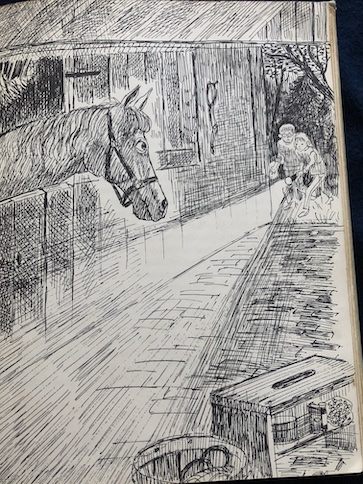
Nine-year-old Sidney Robinson’s best friend is a girl named Megan McKenna. The two of them have many interests in common, including fishing, cars, ghost stories, and horses. Megan’s father owns a stable, and Sidney envies Megan for having her own pony. Because Megan’s father sells horses to other people, the kids are used to seeing horses come and go. When Megan’s father can’t find a buyer for a horse, he’ll try to sell it at public auction. However, if he can’t sell a horse at auction at all, he sometimes sells it to the slaughterhouse, where they use the horse parts for glue and dog food. It’s sad, but the kids accept this as part of life until Megan’s father acquires a retired police horse whose former owner died, and Sidney realizes that he can’t let this beautiful black horse suffer this terrible fate.

The horse, officially named Sergeant O’Hara but called Uncle Charley by Megan’s family is a beautiful animal with a gentle temperament. Sidney wishes that he could persuade his parents to buy the horse for him. He is easy to ride and obeys commands, and he has an excellent history of his time as a police horse.

Megan’s father isn’t completely honest as a horse seller. The book goes into some detail about how he prepares horses for sale, painting on dapples and filing their teeth down to make them seem younger than they really are. Even Sergeant O’Hara gets this treatment, although Sidney worries that it hurts the horse. (I looked it up, and it turns out that it can be beneficial to file the sharp points off of a horse’s teeth, which is called teeth floating. However, this is something that should only be done by someone who has been trained to do it because it can hurt the horse to file the teeth down too much.)

Sidney and Megan love to watch the horse auctions and pretend they’re bidding on the horses, but Sergeant O’Hara is auctioned off as planned. Megan’s brother Michael let him loose in the paddock when he was supposed to be watching him, and he got all dirty, so he isn’t fit to be shown. Then, to Sidney’s shock, Megan tells him that her father is planning to just sell Sergeant O’Hara to the slaughterhouse instead of trying again at the next auction. If Sidney and Megan are going to save poor Sergeant O’Hara’s life, they’ve got to do something, fast!

Megan tells Sidney that she’s thought of a plan to save Sergeant O’Hara. The two kids sneak out and take the horse in the middle of the night and hide him in an old barn. As they go to hide the horse, they see a shadowy figure near the barn. Megan is afraid, and Sergeant O’Hara wants to chase the figure because of his police training, but Sidney stops him.

However, even with the horse safely in the barn where hardly anybody ever goes, there is the very real worry that they’ll be caught. The horse will need exercise, so Sidney will have to go ride him at night or when they’re sure nobody else will be around. Still, they feel like they need to come up with an additional plan in case the horse is spotted. Then, Sidney takes a hint from the way Mr. McKenna painted dapples on a horse earlier and suggests that they could paint Sergeant O’Hara a different color so he won’t be recognized. Megan thinks that’s a great idea, and they decide to paint him white, like the Lone Ranger’s horse, Silver.

They get the painting supplies from Sidney’s father’s hardware store, but Sidney grabs a can of paint labeled “Super Glo – White.” It turns out that it’s not just a really bright white; it’s a glow-in-the-dark white. The kids don’t figure it out until they’ve already painted half of the horse. When Sidney sneaks out to feed and exercise Sergeant O’Hara again, he’s frightened when this big, glowing thing comes out of the darkness at him. Somehow, the horse got out of the barn and scared him by running out in the dark, glowing. Sidney realizes after a moment of panic that’s what happened. Because they only painted half of the horse before they stopped, one side of Sergeant O’Hara is glowing white, and the other is pitch black. When the horse gallops back and forth, he looks like a glowing ghost that vanishes with each turn. It’s a neat effect, but having a ghost horse certainly isn’t inconspicuous.

One night, Sidney accidentally frightens his old teacher, Miss Winthrop, when she’s walking home from visiting a friend. Soon, she spreads the story of her ghost sighting all over town. Most people think that she’s getting a touch of senility in her old age, but Mr. McKenna thinks it over and notices Sidney’s comings and goings in the area. When he goes to the old barn to investigate what Sidney’s been doing. Seeing the horse and the glow-in-the-dark paint, he realizes what happened. He appreciates that Sidney and Megan wanted to save the horse and sees the humor in their unintentional ghost act.

Since the kids feel that strongly about wanting the horse and are taking good care of him, Mr. McKenna decides to let them continue to do so, but there’s still one thing that nobody has answered: Who was that mysterious figure they saw around the barn? The answer comes when this mysterious person sets fire to the McKenna’s stables and Sergeant O’Hara has the opportunity to show his skills as a police horse.

My Reaction

When I first read this book as a kid, I was expecting it to be a mystery. It kind of is, but the mystery isn’t about the horse or about any ghost. There are hints from the very beginning of the story that there is a thief in the area, but the story doesn’t really focus on that until near the end. Sidney and Megan hear people talking about a prowler, and they do see the mysterious prowler around the barn, but they’re too busy with their plans to save the horse to pay too much attention. Fortunately, their horse and his ghostly appearance help them to catch the the thief, and the reward money for catching him straightens out a lot of problems so Sidney can keep Sergeant O’Hara.

The gimmick of the “ghostly” painted horse has stayed in my mind for years since I first read this story, but it’s not the only memorable part of the book. One of the things that I remembered best about this book from when I read it as a kid was the difference in Sidney and Megan’s homes and families. The book puts some emphasis on the difference in their family lives, and it’s shown when each of the kids has dinner at each other’s home. Megan has several siblings, and their house is always noisy and boisterous. Sidney is Sidney is a fussy eater at home, but he just eats what’s put in front of him at the McKennas’, like the other kids do. Megan gets a rap on the knuckles from her father for starting to eat before Grace is said. One line from the book that stuck with me for years was when Megan’s brother, Frank, says Grace with this joking prayer: “We thank the Lord for the next meal – we’re sure of this one.” I still think of this whenever someone says Grace aloud.

By contrast, dinner at the Robinson house is much calmer, quieter, and more formal. Sidney is an only child, and his father owns a hardware store, so the Robinsons can afford nicer things. Megan is impressed at the nice tile in the bathroom, and the table is set with embroidered placemats and matching cloth napkins. Megan accidentally bites into one of the cloves in the ham, and when it burns her mouth, she spits the bite of food into her cloth napkin, feeling terribly guilty about it because the napkin really seems too nice for that sort of thing.

I could identify with the feelings the children have about being in houses where people have different habits. There were times when I was young when I felt a little out of place because they were either more formal than I was accustomed to being or more boisterous than I feel comfortable being. People always feel more comfortable with what they’re used to.

The Silver Spoon Mystery

The Silver Spoon Mystery by Dorothy Sterling, 1958.

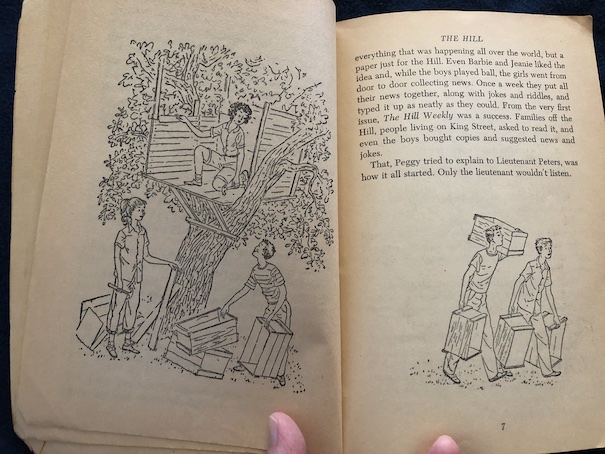
A group of families move into the new suburb built on The Hill overlooking the town of Dwighton. The kids in the new neighborhood become close friends, visiting each other’s houses, playing games, and running around town together. It’s idyllic, but then the boys in the group start playing baseball together, and they begin excluding the girls from the group, even though they’ve all played baseball together before and the girls are good at it. The boys also stop working on the tree house that the kids were all making together, taking some of the tools and materials and building themselves a clubhouse near the baseball field with a sign that says, “NO GIRLS ALLOWED.”

The girls are offended at suddenly being shunned by the boys, so they decide that they need to have some special project, something that will show the boys that girls are just as good as they are and that the girls don’t have to rely on the boys to have some fun. They decide to start a neighborhood newspaper, writing about local events and having fun stuff, like jokes. The newspaper is a success, and adult neighbors buy copies. Then, the boys decide to start a competing newspaper themselves. One of the girls, Peggy, is upset because she’s sure that the boys’ newspaper will be more successful. Some of the boys are older than the girls so they might write better, there are more boys than girls in the group so they have more people to gather news and sell papers, Davey is better at drawing cartoons than the girls are, and worst of all, the boys splurged to buy a hectograph, which uses a gelatin substance for making copies of writing and drawings (as in this video) and will allow the boys to print papers by the hundred (“hecto” means one hundred, and that’s how many copies a hectograph makes at a time). (This is before home computers, so the characters have to rely on manual printing methods. People used hectographs to make copies before modern copy machines, but modern hectographs still exist, and some people use them for artwork or tattoo stencils.)

Peggy’s afraid that the girls won’t be able to compete with the boys’ advantages and thinks that the boys are mean for trying to steal their business. Peggy’s mother tells her that she shouldn’t worry about being better than the boys but focus on being different. She says that the girls should make sure that their paper has different content from the boys’ paper so people will still have a reason to buy theirs even if they’ve already bought the boys’ paper. If the boys’ paper has cartoons, the girls’ paper should have things the boys wouldn’t think to include, like recipes, poems, and fictional stories that could be written and submitted by local people.

Peggy gets an idea from what her mother says, but it’s not a good one. Peggy still wants to show up the boys, and she thinks that the best way to do it is to get a “scoop”, meaning printing an exiting news story that the boys won’t have in their paper. The problem is that the girls don’t know where they’re going to get an exciting news story that the boys don’t know anything about. Nothing that exciting is happening in their town anyway. There haven’t been any shocking events, no murders, no robberies. Peggy tells the other girls that means that they have write about something that hasn’t happened yet. Peggy poses the idea of writing about someone stealing the silver on display at the local library that was made by the silversmith who was the founder of their town. Of course, the problem with that is that the silver hasn’t actually been stolen. One of the girls, Ellen, objects to writing a story about something that hasn’t happened because that’s not actually “news.” However, Peggy talks the other girls into it by saying that they would be writing about it as fiction because people write fictional books all the time, and that’s allowed. Ellen still isn’t convinced, but Peggy goes ahead and writes the story anyway. (Basically, she’s turning the girls’ newspaper into a tabloid, although the kids don’t seem to quite get the difference, even though Ellen can tell that this isn’t right for a newspaper.) The girls all discuss how they would go about stealing the silver spoons from the library, if they were going to do it, and Peggy writes the story from their speculations.

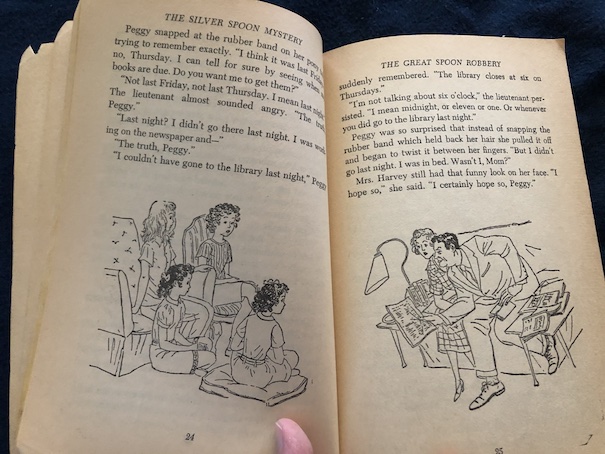
You just know that there’s going to be trouble with Peggy trying to sell a story that everyone knows didn’t happen, but what actually happens is even stranger. After the girls sell their paper with the spoon theft story, Peggy gets home to find a policeman, Lieutenant Peters, waiting for her with her mother. Lieutenant Peters wants to talk to Peggy about the robbery at the library because it turns out that the very night when Peggy was writing her big fictional scoop about silver spoons being stolen from the library, someone was in fact stealing silver spoons from the library, and this thief apparently did it the way Peggy described in her story. Lieutenant Peters wants to know everything that Peggy knows about the theft, and he won’t believe that Peggy wasn’t there to witness it because her description of what happened is so accurate. She even has a description of the thief in her story. Since the theft happened in the middle of the night, Peggy points out that she was asleep in bed, but even Peggy’s mother isn’t sure that Peggy didn’t sneak out. When Peggy’s friends show up at her house, Lieutenant Peters questions them too and comes to the conclusion that Peggy and maybe also her friends stole the spoons themselves to make their story true. Lieutenant Peters says that they’ll be forgiven if they give the spoons back, but the girls can’t do that because they don’t have them.

As Lieutenant Peters and Peggy’s mother continue to question the girls about their story, the girls admit that they made up the whole thing as a fictional story just to attract attention to their paper. Lieutenant Peters catches the boys listening in on their conversation and questions them about what they know about the situation. The boys don’t really know anything about the theft, either, but they were pretty sure that Peggy made up the story she wrote, and they’re fascinated that she might be about to be arrested and taken to “children’s jail.” Peggy’s mother believes her that she just made up the story and it’s all a coincidence that someone happened to steal the silver spoons from the library around the same time, but Lieutenant Peters isn’t convinced.

Word of the spoon theft spreads across town quickly, partly because of Peggy’s story in the neighborhood newspaper and partly because of the story in the regular news. People call Peggy’s house to ask for details, and kids at school look at Peggy and her friends suspiciously, wondering how much they had to do with the theft. Peggy is especially offended when Davey says that his father thinks that it’s an unlikely coincidence that Peggy would write a story about the theft and then the theft would just happen. Before the boys started their “no girls allowed” stuff, Peggy and Davey used to be close friends. However, Davey assures her that he doesn’t think that she’s responsible for the theft. He also tells her that he and the other boys are sorry about pushing the girls by trying to compete with their paper, and they’ve decided to give up theirs and let the girls use the hectograph. The kids discuss trying to investigate the crime themselves because, until the real thief is found, people are going to keep looking at the girls suspiciously.

Most of the neighborhood kids, both boys and girls, join the investigation as the “Hill Detective Club”, except for one of the older girls who is studying for exams and Davey’s older brother, Allen, the only boy who’s mad at the other boys because they don’t want to play baseball now. (Allen is apparently the one who started all the “no girls allowed” stuff because he didn’t make the high school baseball team and he’s been ultra-serious about practicing during the neighborhood games. He’s trying to organize a game between the boys in the neighborhood and their fathers. The book doesn’t explicitly say so, but there might also be an element of embarrassment for him that some of the girls play better than he does. Peggy is described as being the fastest runner in the neighborhood, and Ellen is a good batter.) As they begin their investigation, the kids visit the scene of the crime and study the ways the thief could have gotten into the library, starting to separate the made-up details from Peggy’s fictional story from the real facts and circumstances of the case. Peggy admits that her mind is biased because she still thinks of her story as the way things happened and her fictional suspect as the type of thief they’re looking for, but the truth is that they don’t know for sure how the crime actually happened or what type of person they’re looking for.

When the kids talk to one of the librarians, Miss Bancroft, they learn that the police did find a few sets of fingerprints on the case that held the silver spoons: Miss Lowell, the head librarian; Mrs. Simpson, a descendant of the town’s founding father and part of the local antiquarian society; and Mr. Weatherspoon, who owns a local antique store. Could one of these people be the thief?

The book is available to borrow and read for free online through Internet Archive.

My Reaction

To begin with, this book seems like it’s meant for fairly young elementary students. It tries to teach readers the meaning of some of the words in the story because some of the characters don’t know the meanings of various words the other characters use or words that they encounter in various places, like “descendant” or “optometrist.” The kids in the story are a variety of ages even though they all play together in the neighborhood, and I could understand why some of the younger kids would struggle with bigger words, but there were times when I thought that they were carrying it a little far. Peggy is twelve years old, so it seems like she should have been old enough to know what an optometrist is. Has she never had her eyes checked before? Actually, maybe she never has. If her vision is good or seems good, maybe her family just doesn’t bother. I guess it’s educational for young readers just branching out into chapter books.

I like books that bring up interesting historical topics. The parts about older printing/copying techniques and Mrs. Simpson’s old electric car with the steering stick instead of a steering wheel (possibly a Baker Electric, like the one Jay Leno owns, or something very similar – this video explains the history of the Baker Electric and shows what it’s like to drive it) were interesting, and one of the characters in the story explains more about the history of the town’s famous silver spoons to the kids. Although the town, its founder, and the spoons are all fiction, spoons of this sort did exist in real life. The silver spoons are specifically christening spoons. It used to be traditional to give presents made of silver to new babies and their parents for the child’s christening. One of the most popular presents of this type was small silver baby spoons, especially with special designs or engravings to remember the child’s birth. The character explains why this particular set of spoons is so distinctive, talking about their unique design, how antique dealers would be able to look them up in a reference book and learn their history, and how each of the of the spoons is marked with the maker’s hallmark, the special symbol that the maker would use to identify himself.

Part of the mystery hinges on the coincidence of the theft occurring just when Peggy decides to write a sensational story about an imaginary theft to get attention for her neighborhood newspaper. For readers, the question is whether the timing of the actual theft is really just coincidental or if there’s a direct connection between the story of the theft and the theft itself. I would have been very disappointed in the book if it was just a coincidence, so I immediately approached the story with the idea that the timing of the theft was a clue. I enjoyed considering different possibilities. My first thought, when the theft happened mysteriously immediately after Peggy and her friends invented their theft story, was that someone overheard the girls talking about how they would commit a theft like that and decided to use their imaginary scheme as their own. However, the conversation between Peggy and her friends took place in Peggy’s room, which was pretty private. For someone to overhear them, it would have to be someone in Peggy’s own house, possibly family or a neighborhood friend, or someone listening in from outside, probably one of the neighborhood kids. Those possibilities didn’t seem likely. Then, I remembered the Nero Wolfe murder mystery story Not Quite Dead Enough. What if the theft didn’t occur when the police thought it did (mostly because they believed Peggy’s original story) but actually at the point where the theft was supposedly discovered? The person who claimed to discover the theft was one of the people with the strongest motives to commit it, and this person could have done it after reading the fake news story, seeing an opportunity to make it true and cast suspicion on Peggy’s fictional suspect. The mystery is simple enough to figure out for an adult who likes mystery stories, but probably much more mysterious for kids. Once the kids realize who has the spoons, there is also the additional challenge of proving it and getting the spoons back without getting everyone in trouble.

I thought it was interesting that the story shows some of the problems with sensationalist or tabloid style “news” stories, or “yellow journalism“, as it used to be called. It’s the sort of “news” that relies on flashy and misleading headlines, buzzwords and catch phrases that appeal to its fans and rile them up emotionally, hyperbole and emotionally-charged language, conspiracy theories, pseudoscience, and poorly-qualified or debunked “experts”, to draw readership and advertising money. Basically, they aren’t really “news.” They don’t try to describe things as they actually happened for informative purposes. These are “news” stories that are less about fact than about entertaining their audience or shocking people and stirring up strong emotions to grab people’s attention. That’s basically what Peggy was trying to do with her fake news story, even if she wasn’t quite thinking about it in those terms. Just like tabloid or sensationalist news, Peggy’s story was almost a kind of fan fiction based on the real world. That is, she took real things and situations that she knew existed (the silver display at the library) and wrote an exciting conspiracy story around them that didn’t actually happen (the made-up theft) as a shocking, attention-getting entertainment piece to encourage people to buy the paper she and the other girls were selling. She thought what she was doing was like harmless entertainment, but it wasn’t because it was based on something real, and her made-up story had real consequences. Not only is there a direct connection between the fake story and the real theft, but Peggy’s fake story confuses people, including the local police and insurance investigator, because they have trouble telling how much of Peggy’s story is false, and it biases their minds and the direction of their investigations. Even Peggy herself sometimes gets confused during the investigation, mixing up details from her made-up story with real events. Even though she wrote the fictional story herself, knowing it was fictional, she gets hung up on the way she imagined things would happen when she invented the story and needs to be occasionally reminded to look at the situation as it actually exists, not as she imagined it would be. If the author of the fictional news story can’t even keep her own fiction and the real facts straight in her mind at first, how can the police or anyone else?

Sensationalist journalism can and has led to real problems in real life, setting up dangerous situations by stirring up the emotions of people who may already be unbalanced and suggesting unrealistic events or courses of action that interfere with people’s sense of reality and ability to make informed, reasoned decisions (something else that ties in with the story). In a famous real life case from the early 1900s, the famous newspaper publisher William Randolph Hearst had his own reputation seriously damaged when he published articles written by two of his columnists smearing President McKinley’s reputation and seemingly recommending his assassination. (“If bad institutions and bad men can be got rid of only by killing, then the killing must be done.”) These articles were published only months before President McKinley was actually assassinated. Hearst had used yellow journalism in his papers for years to manipulate public opinion to further his political causes and gain readership. (“War makes for great circulation,” Hearst said after successfully urging public opinion in favor of the Spanish-American War.) After the assassination of the president, people made a connection between the assassination the articles in Hearst’s papers seemed to be advocating (although they called it a “mental exercise” and a joke) and the assassination that actually happened. Whether Hearst actually wanted McKinley to be killed by someone or whether the man who assassinated McKinley was directly inspired by those sensationalist articles is questionable, but the suspicion that was what happened, in a sort of “Will no one rid me of this turbulent priest?” kind of moment, did seriously damage Hearst’s own political ambitions. Hearst did intentionally want to smear McKinley’s reputation, but his lack of consideration for the possible results of his stories, which seemed to be advocating an actual murder that did occur soon after, caused the public to turn against Hearst himself.

We frequently caution people to be careful of what they read because you can’t trust everything, which is sensible advice, but I’d go a little further and say, be careful of why you choose to read what you’re reading and why believe what you read. Was it because the information was presented logically and authoritatively, or is it because you decided ahead of time what you were going to read because of something you already believed or something you already knew you really wanted to do? Picking the right information source is good, but it may be even better to ask yourself what you, as an individual, plan to actually do because of the news sources you’re following. Is it a good thing to do that’s going to help someone or something that’s going to hurt people? Take a look in the mirror once in a while and question your motives as one of your own primary sources of information. You are the one who chooses what news sources you consume. You are the one who decides what you believe because you always have the choice to accept or reject anything you hear from someone else. You are the one who decides what your standards are and where your limits are set. You are the one person who knows exactly what you’re willing to do to accomplish your goals. You are the one who moves your body to the locations you decide to go and makes your mouth say the things it says and your body do the things it does. You are the one who has ability to say “yes” or “no”, not only to other people but yourself when necessary. Anything you may decide to do involves not just a single choice but multiple choices along the way that can only be made by you, so you’re going to have to be your own fact checker at every step, not just about what other people are telling you but what you’re telling yourself and why.

Sensationalist news stories are intentionally emotionally manipulative in order to get people hooked on reading that source, but you’re the only one who gets to decide if you’re hooked and what you’re going to do about it. The next time you read something that makes you really mad at somebody, before you do whatever you’re considering doing about it, pause a moment to ask, not just whether the source you just read might be wrong, but “What if I’m wrong? What if I’m wrong about this situation, and I’m about to do the wrong thing? Am I prepared to face the consequences for my actions if this turns out to be serious?” The reason for asking these questions is, if the consequences of what you’re planning to do are serious, there will be a point where people won’t want to hear about what you believed or thought you believed or what someone else told you earlier. If you’re the one who did the thing, you’re the one who’s going to be facing the consequences for that thing. There’s a point where everyone has to accept the consequences for themselves all by themselves. (To put a finer point on it, riot and people will riot with you, but you’ll be tried as an adult alone.)

Deadline at Spook Cabin

Deadline at Spook Cabin by Eugenia Miller, 1958.

Twelve-year-old Mitch Adams is a newsboy for the summer, but the bicycle that he uses to deliver his newspapers is old and frequently breaks down. He often has to stop and fix it, which means that getting anywhere and delivering his papers takes him longer than it does for the other newsboys. If he doesn’t do something about it soon, his bike might break down completely, and he won’t be able to keep his paper route.

However, the paper he works for is having a contest for the newsboys, and the prize is a new bicycle. If Mitch can win the new bike, his problems will be solved. He’s been saving some money that he could use to get a new bike, but he’s hoping that, if he wins the new bike, he can use the money to buy a special present for his mother – a piano to replace the one they had to sell because they needed money after his father died. It’s an important present because his mother now has a job playing the piano for a dance studio, and she’s been thinking that, if she had a piano of her own again, she could also give piano lessons. In order to win the newspaper contest, Mitch has to be on time with his route, not get any complaints from customers, and sign up more new subscribers this month than any of the other newsboys. Mitch has been working hard at it, and by his count, he’s tied for first place with another boy. If he can keep up the good work to the end of the week, he stands a good chance of winning.

Mitch also has ambitions of becoming a reporter some day. When one of the best reporters for the paper, Jim McCain, says he wants to talk to Mitch about something, Mitch is delighted. Jim invites Mitch to meet him at the newspaper office early the next day so he can show him how the reporters get information from the police and fire department for their stories. Mitch is excited because he’s been asking Jim about that and agrees to meet Jim the next morning.

The next day, Jim actually lets Mitch do some of the calling to the fire department himself after first coaching him about what to say. In particular, he teaches Mitch to base his questions around the “five W’s” – who, what, when, where, and why – that make up a story. Because they live in a small town, there isn’t any particularly startling news from the fire department or the police, but Jim explains that people will want to know what’s happening in the area anyway. Some people may have heard the sounds of a fire engine recently, so they’ll check the newspaper to find out where the fire was, even if it was just a little brush fire.

After Mitch is done with his work for the newspaper, he meets his friend Lyle and Lyle’s younger brother Beanie for a bike ride and a cookout. As they look for a good place to set up a camp fire, they find an abandoned cabin in the woods and decide to take a look inside. There’s not much there, and the boys think that it might be fun to fix it up like it’s their secret hideout and camp there some night. They give the old house the nickname “Spook Cabin” because Beanie thinks it’s kind of creepy. Exploring a little further, they also discover that there’s a tree house in one of the trees surrounding the cabin that’s hard to see from the ground.

Soon, some exciting news comes to Mitch’s paper after all. There was bank robbery in a nearby town. One of the robbers got away, and the police are searching for him. Police officers patrol the town, on the lookout for the fugitive.

Then, a report about a campfire that was left unattended comes from the local fire department. From the description of the campfire, Mitch knows that his friends were the ones who set it because they made it the way they said they would for sending smoke signals. However, they never would have left their fire unattended. Mitch knows that something bad must have happened, and his friends need his help!

The book is available to borrow and read for free online through Internet Archive.

My Reaction

This is a pretty short chapter book, and I thought it was pretty obvious where the missing bank robber was going to end up, but I really liked the story. The part I liked best was all of the information about how a newspaper works, or rather, how it worked in the mid-20th century. The book would have been educational for its time, and it still is, but many of the processes involved in putting together a newspaper would be done electronically now, using computers. The characters in the story are using manual typewriters, printing presses, and teletype machines. There’s a scene where Mitch asks Jim how the teletype machines work, and Jim explains that they’re “a combination telegraph and typewriter.” The machines in the story would be considered antiques or at least somewhat outdated now, but Jim’s tips for asking the right questions to write a story still apply. When I was a kid, though, my teachers usually said it as the “five W’s and an H” – to write a story or essay, you need to know who, what, when, where, why, and sometimes how something happened.

Sammy Keyes and the Sisters of Mercy

Sammy Keyes

Sammy Keyes and the Sisters of Mercy by Wendelin Van Draanen, 1999.

At the end of the previous book in the series, Sammy was given a punishment from her school for causing a disturbance during an assembly that requires her to complete 20 hours of community service. She’s working off her volunteer hours at St. Mary’s Church under the supervision of Father Mayhew. When Sammy lived with her mother, they weren’t religious, and Sammy hadn’t even been baptized. However, her grandmother is much more religious, and she had Sammy baptized by Father Mayhew soon after Sammy moved in with her. Father Mayhew is kind and understanding with Sammy. There are also some nuns at St. Mary’s from an order called the Sisters of Mercy. They’re helping out in the soup kitchen. When elderly Sister Josephine sees that Sammy is painting a wall in Father Mayhew’s office, she complains that he’s always getting the services that the nuns ask for and never get. They’ve been asking to have the house where they live painted for years, and it still hasn’t happened.

Father Mayhew’s gratitude for Sammy’s help fades when a small ivory cross is stolen from his office, and he thinks that Sammy did it because she was in there. Sammy tells him that she didn’t take it, but he doesn’t believe her and sends her to go work in the soup kitchen for awhile. (He didn’t ask her to turn out her pockets before she left his office. I would have because that would settle the matter right there.) In the soup kitchen, Sammy sees another girl about her age who reminds her somewhat of herself, partly because of the high-top shoes she wear. Sammy wonders who the girl is and why she’s eating at the soup kitchen, but she isn’t able to talk to her there.

Later, Sammy discusses the missing cross with Father Mayhew again. This time, he seems less certain that Sammy took it, and Sammy asks him if it was something valuable that might have been sold for money or if someone who is angry with him could have taken it as revenge. The one person who seems angry with Father Mayhew is Sister Josephine, but he can’t picture her taking the cross. However, there are other people who might have a reason to be angry with Father Mayhew. Brother Phil, who works in the soup kitchen, wants to become a full priest, but Father Mayhew doesn’t think that he’s suited to it.

The thefts also continue. A couple of gold chalices are stolen from the church. The nuns who are part of the Sisters of Mercy turn out to be traveling and staying in a trailer, and they’re only staying at St. Mary’s temporarily to hold a fundraiser. They tell Father Mayhew that someone tried to break into their trailer, but they scared the thief off. One of the nuns ask Father Mayhew to keep an heirloom locket in his safe until she can deliver it to her niece.

Meanwhile, at school, Sammy is playing on one of her school’s two softball teams. Her school nemesis, Heather, plays on the other school team, so their feuding and rivalry has transferred to the school’s sports field.

This book is the first book in the series to bring up the subject of Sammy’s father. Sammy’s grandmother gives her a catcher’s mitt that once belonged to her father. Sammy’s mother was going to throw it out, but her grandmother rescued it from the trash, and it’s the only thing Sammy has that was once her father’s. She sees her love of playing catcher at softball as a connection to the father she’s never known. Sammy has never seen a picture of her father and doesn’t know his name, and her mother has admitted that he has no idea that Sammy exists. She has asked her mother about her father in the past, but her mother refuses to tell her who he is or what happened to him. All she has ever told Sammy is that she was young when they met and her relationship with him was a mistake. Sammy can’t help but feel that her mother things of her existence as a mistake as well, maybe even a bigger one than her relationship with her father. The fact that her mother has essentially abandoned her to pursue her dream of being an actress has left her feeling like her mother never really wanted her. Sammy has to stay with her grandmother, even though it means keeping her living arrangements a secret, because staying with her father isn’t even an option.

The next time that Sammy sees the mysterious girl in high-tops at the soup kitchen, she and her friends follow her to see where she lives. It turns out that she’s homeless and living in a cardboard box. This discovery raises some personal questions and concerns for Sammy. On the one hand, she’s unfortunate because her living situation is precarious and depends on not being caught in her grandmother’s apartment, which is meant only for seniors, but on the other, she does have her grandmother to rely on. This other poor girl doesn’t seem to have anyone. At one point, Sammy asks her grandmother about what would have happened to her if she hadn’t been able to take Sammy when her mother left. It’s an uncomfortable question for both of them because it raises the question of whether Sammy’s mother would have just abandoned her completely if she hadn’t had her mother willing to take her. Sammy’s mother doesn’t seems to care how awkward their living arrangement is because they have to keep Sammy’s presence in the apartment a secret. Without Sammy’s father in the picture, there is no one else but her grandmother to take her. There is also the constant question of what would happen to Sammy and her grandmother if someone manages to prove that Sammy is living with her against the rules. Sammy is better off than the homeless girl, not by much, but still better.

Later in the story, after Sammy’s beloved mitt is stolen, Sammy tells Hudson about everything that’s going on. She’s pretty sure that Heather is the mitt thief because she’s the one person who’s always doing awful things to her. Hudson points out that, in a way, Sammy is fortunate to know who she can trust and who she can’t, and she has one definite enemy. Holly has never really had anybody to trust before, and Father Mayhew has no idea who he can trust or not trust in his church. His thief is obviously one of the people who works with him on daily basis, someone who can come and go while seeming above suspicion, and Father Mayhew is only just beginning to realize that there are people around him he can’t trust as much as he thought.

The book is available to borrow and read for free online through Internet Archive (multiple copies).

My Reaction

For awhile, Sammy suspects that the homeless girl who visits the soup kitchen might be the thief who is stealing things from the church, but she’s not. The girl, whose name is Holly, becomes a regular character in the series. She is a runaway foster child who’s had an even tougher life than Sammy. When she and Sammy talk, she explains how she was abused in previous foster homes, which is why she ran away to live on her own. At one point, she is attacked by a man, and Sammy has to help fight him off. The girls realize that Holly can’t keep camping out on her own, and Sammy helps her find a place to stay with people who turn out to be able to provide a much more stable home for her, which is how she remains a character for the rest of the series. Holly begins attending school with Sammy and her friends, with her new foster family making up a story about how she transferred from New Mexico. Her new home seems to be a kind secretive foster home, not unlike Sammy’s living arrangements. Her new foster family doesn’t seem to try to legalize their custody of Holly (not in this book, anyway), possibly out of fear of her being taken away and put in other abusive or dysfunctional foster homes in the flawed system she came from. There is also a standalone book which focuses specifically on Holly called Runaway, which explains more about her personal history. Some of the things that happened to Holly are an indication that this series isn’t meant for young children. I would say that it’s best for tweens and up, probably about around the middle school level.

One of my favorite characters in this series is Hudson Graham, a retired old man who acts like a grandfather to Sammy. She often goes to see him when she needs help and advice. He is knowledgeable on an eclectic range of topics, and he has a massive private library that can answer most of Sammy’s questions. In this book, Sammy thinks about how, even though she and Hudson have talked about many things together, including his wide-ranging hobbies, she doesn’t really know that much about his past, even what he used to do for a living before he retired. Because he has a collection of foreign language dictionaries and recording devices, Sammy thinks that he might have once worked for the CIA or something. When the people who own the dog grooming business down the street lose the key to their safe because a dog ate it, Sammy asks Hudson what they can go, and he tells her some fascinated facts about safes and how to get into them. The fact that he knows about that suggested to me that he probably worked in law enforcement or security at some point. My thought is that he might have once been a private investigator because they do security work and would have some basic law knowledge and use devices that Hudson has, like recording machines and cameras. My next guess would be that he was a journalist, also because of the recording devices and cameras and because journalists can write on a wide range of topics, giving Hudson his eclectic knowledge and the need for his own private research library. Aspects of Sammy’s life and the lives of people she knows add extra mystery to the story. Hudson’s past isn’t explained in this book in the series, and I’m not sure if it ever is.

Sammy Keyes and the Hotel Thief

Sammy Keyes

Sammy Keyes and the Hotel Thief by Wendelin Van Draanen, 1998.

Samantha “Sammy” Keyes lives with her grandmother in her apartment because her mother (who she calls “Lady Lana”) left her with her grandmother a year before, when she left to pursue an acting career. Much of the time, Sammy doesn’t have much to do at her grandmother’s apartment, so she spends her time watching people and nearby buildings with her binoculars. Technically, Sammy isn’t supposed to be living in her grandmother’s apartment because the apartment building is for seniors only, so they have to keep her presence a secret. Sammy only keeps a few belongings that are easily hidden, and she has to hide in a closet when people they don’t know and trust come to the door. She can’t come and go as often as she wants because her grandmother’s nosy neighbor will notice and report her. One day, while looking at a seedy hotel nearby, she witnesses someone with black gloves stealing money from someone’s purse. As she watches, this man looks directly at her and can tell that she’s watching. Sammy has the strange feeling like she’s seen the man somewhere before, but she can’t think where, and she’s nervous that he saw her, too.

A little later, Sammy’s friend, Marissa, comes to the apartment and asks Sammy to help her find her younger brother, who’s missing. Sammy knows that the best place to look for Marissa’s brother is at the pet store, so the two girls hurry off to find him. On her way back to her grandmother’s apartment, Sammy sees that there are police at the hotel, so the theft has been discovered. There are other kids standing around and watching, so Sammy decides to take a look, too. She sees the police interviewing the woman whose money was stolen. As she listens to them talk and mention looking for fingerprints, she can’t help but comment that there won’t be any fingerprints because the thief wore gloves. When the police and victim all hear her say that, they realize that she’s the only witness to the crime. As they question her, she describes what she saw while giving them as little personal information as possible so her secret of living with her grandmother won’t be exposed. When the police take down her name and address, she gives them her real name but Marissa’s address in a wealthy part of town.

The next day, both Sammy and Marissa have their first day of junior high school. Sammy immediately gets the attention of the school mean girl, Heather Acosta (who becomes her school nemesis for the rest of the series). When Heather jabs Sammy in the butt with a sharp pin, Sammy punches her in the nose. Of course, the vice principal shows all kinds of sympathy to poor Heather and punishes Sammy because he claims that nobody saw Heather jab Sammy in the butt with a pin. He makes her sit alone in a tiny closet that the school calls “the Box” to think about what she’s done. Even when Marissa tells the principal what really happened, supporting what Sammy said, the principal just says that there’s never any excuse for punching anybody and that Sammy is suspended. The vice principal expects Sammy to shake hands with her rotten abuser and make peace when she returns to school. (Ooh, I hate that. I’ve got a rant for later.)

After Sammy’s suspension, she and Marissa walk home together, and Sammy tells Marissa about what she witnessed at the hotel. When the two girls stop at the store, they see the woman whose purse was robbed and learn that she’s an astrologer called Madame Nashira (real name Gina). Surprisingly, she admits that she doesn’t really believe in fortune-telling, but she does it anyway because she needs the money. She likes drawing up astrological birth charts for people, though. There’s an interesting scene in the book where she does one for Sammy and explains how it works. (I’ve never been serious about astrology, and I doubt it even more since I took an astronomy class and my teacher showed us how to use a star globe and used it to explain why people’s birth signs aren’t their real birth signs, but it was still kind of fascinating just to think about. I’ve never actually seen a real birth chart before.)

When Sammy gets back to her grandmother’s apartment, Sammy’s grandmother’s nosy neighbor, Mrs. Graybill, tries to find evidence that Sammy is living there against the rules, or Sammy has to pretend like she’s only visiting and leaves to visit a nearby friend, Hudson Graham, an old man who has a lot of books. The two of them talk about other robberies that have happened in the area recently. When Sammy gets back to the apartment, she finds Mrs. Graybill angrily telling her grandmother that Sammy wrote her a threatening note and slipped it under her door. Of course, Sammy didn’t do any such thing. When Sammy sees that the note says, “If you talk, you’ll be sorry,” she knows that the threat is actually from the thief. The thief knew that someone from the apartment building was watching him, but he accidentally delivered the threat to the wrong apartment. With a threatening thief wanting to keep her quiet, Heather and the school principal wanting her butt to suffer at home, the nosy Mrs. Graybill wanting her sent away from her grandmother’s apartment, and the police wanting Sammy at her friend Marissa’s house, Sammy’s witnessing of the theft threatens to expose her own secrets.

The book is available to borrow and read for free online through Internet Archive (multiple copies).

My Reaction

One of the things that stands out to me is that neither Marissa nor Sammy really live in the best homes. Marissa’s family has a lot more money, and they live in a big house, but her parents are busy business people who spend most of their time working and traveling, often leaving Marissa alone with her younger brother, fending for themselves with Pop Tarts and tv dinners. Marissa feels neglected, and she really is. She also doesn’t have many real friends. A lot of the other kids who play up to her, like Heather, are trying to get her to give them money because they’re aware that her parents give her a lot of spending cash, and Marissa has had trouble saying “no” to them in the past. One of the thing Marissa likes about Sammy is that she’s never asked her for money. Sammy likes Marissa for herself.

Sammy is surprised when she finds out that Marissa actually envies her because her grandmother is always there for her in ways her parents aren’t. Sammy doesn’t feel lucky because, even though her grandmother cares about her, she always lives on the edge, having to pretend like she’s not really living with her grandmother, keeping only a few belongings that are easily hidden, and ducking into a closet to avoid being caught. She can never be completely at home in her grandmother’s apartment because she isn’t supposed to be there at all. Sammy’s mother occasionally calls, but Sammy always feels uncomfortable and neglected by her mother’s abandonment of her, which is why she refers to her as “Lady Lana” instead of as her mother.

I thought at first that Sammy’s housing situation might be solved by the end of the book, but it wasn’t. At the end of the story, she’s still secretly living with her grandmother and lying to the police about being Marissa’s foster sister. However, there are hints in this book about another possible place for Sammy and her grandmother to live in the future, so that situation might change. At no point in the story does anyone mention who Sammy’s father is, where he is, or why he didn’t take Sammy when her mother left. The identity of Sammy’s father is actually an over-arching mystery in this series, something that they discuss later.

As for the book’s introduction of “Rear” Admiral Heather the Butt Poker, the book doesn’t use the phrase “rotten abuser”, but that’s my take on it. Get ready for another one of my anti-bullying rants, or skip the rest of this long paragraph and the next two after that. I always find bullying in books stressful, especially when adults take the side of the young bully. It’s not as bad when a bully is punished or at least called out for their bullying, but when adults refuse to believe the victim, it’s awful. I know from long, bitter experience how the worst, most twisted mean kids provoke fights so their victims end up looking like the bad ones when they finally snap. The abusive kids know that the adults like them and will favor them every time. I’ve seen it happen before, and the fact that situations like this end up in books like this shows that it’s a sadly common experience that many people relate to. The abusers’ behavior never changes because they never experience consequences. The adults delude themselves that the abusers are either “normal” kids or will change (somehow, magically) as they get older and gaslight the victims that the situation is their fault and that it’s possible to be friends with the abuser without the abuser changing their behavior and continuing to act the same mean way they always act. I appreciate that the book shows the unfairness of the situation by adults who just want the situation easily resolved and make the kid they don’t like as well take the brunt of it. I know that Sammy’s use of physical retaliation is what put her in trouble, but honestly, I feel more inclined as an adult to think that sometimes physical force is necessary when dealing with a physical abuser. I’ve never heard of anyone who stopped being physically or emotionally abusive because they were asked politely, and when people in authority refuse to do anything, there sadly isn’t much recourse. Heather should not be touching anyone else’s butt, not with a sharp object, not with her hands, and not with anything else. It’s someone else’s butt. Heather should NOT be touching anyone else’s butt for any reason at all, let alone inflicting pain to someone else’s butt by penetrating it with something sharp. At her age, she should be old enough to understand that sort of thing has connotations other than a kid’s prank, and if she isn’t, someone needs to have a long, serious talk with her to explain why. I know that Heather’s meant to be just a thoughtless mean kid and not molester or something, but she’s still young and someone should put a stop to this before it goes any further. Understanding of these things has to come at some point in a person’s life. If there’s any lesson that’s difficult to carry too far, it’s the concept that no one should mess with someone else’s butt and cause pain. If Heather is allowed to mess with people’s butts in this school, understand that there is absolutely nowhere else in this society where she would be allowed to do that without repercussions. There’s no shame in having some weirdo you don’t even know assault your butt, but there’s a whole world of shame for being that weirdo who can’t leave someone else’s butt alone. Also, Heather jabbed Sammy with something sharp that penetrated her skin. Am I the only adult thinking about tetanus and blood poisoning?

Kids who are bullies in school are more likely to engage in aggressive, anti-social, and criminal behavior in adulthood. Shrugging and saying “Kids will be kids” while doing nothing is one of the worst possible things to do. Bullies don’t magically get better when they hit a certain age. If no one intervenes and teaches them that there are some forms of behavior that are never acceptable and really enforce the rules, they will continue their bullying for the whole rest of their lives, seeing the whole rest of the world as being in the wrong for complaining about their behavior, causing workplace stress, family turmoil, and failed relationships. It’s a serious problem. It’s not harmless. It seems like decades past time for the school vice principal to have this explained to him as well. A school can have all kinds of anti-bullying rules, but if they never enforce them for all parties involved, they’re completely useless because it’s like they don’t even exist at all. Kids are pretty good judges of who’s a pushover and what they can get away with, so anyone who’s worked with them should realize that the only rules that matter are the ones that actually get enforced. Unless the vice principal is one of those grown-up bullies himself who never got a clue and can’t stand to realize the reality about himself, which is always a possibility. I just have no sympathy for that.

I wonder if the vice principal considered how his reaction to what Sammy told him about being jabbed in the butt by a sharp object, actively punishing Sammy for what she said and for her physical retaliation to the violation of her body, might be teaching her some terrible lessons about how to respond to a sexual assault, including the one that people in authority will never believe her and will actively punish her because it’s the easiest thing for them to do and that’s all that matters. That happens quite a lot in real life, as the #MeToo movement has shown. This video, which is rather explicit in its descriptions and not for kids, explains about university officials who act like this vice principal and the harm they do when they let sexual violators go unpunished and even rewarded, while their victims are sent jumping through hoops for justice they never plan to give them because they just want them to shut up, go away, and not make trouble for the bullies they really like. At their core, bullying and sexual violence are both about power and control over other people and using people for the perpetrator’s purpose. It’s not really surprising that there is a connection between the two and that young bullies can turn into perpetrators of sexual violence. I wonder if the vice principal’s response would have been different if it had been a boy who jabbed Sammy’s butt instead of a girl. Actually, I don’t really wonder. I’m sure he would never think of that and would spend a lot more time coming up with reasons why this situation is different is different from any form of sexual assault, so harmless, and how he shouldn’t have to think of it if someone asked him. I liked the part where Sammy offered to show him the mark from the pin if he refused to believe her, an offer the vice principal didn’t accept. I know he’s just taking the easy way out here, punishing the person who didn’t lie and deny throwing a punch and maybe sympathizing with Heather because she got noticeably hurt in a place that isn’t covered by pants and underwear, but as an adult who remembers kids like Heather, I have absolutely no respect for this vice principal for his hard-line punish-the-bullied stance. I don’t feel for Heather at all because she got what she provoked, and there was repeated provocation followed up by a physical attack before Sammy finally broke. Every human on Earth has a breaking point, anyone might snap when pushed too far, and nobody is clever for exploiting someone’s human emotions to the point where they break. Learning that is a valuable life lesson. Of course, I know Heather sticks around as a bully for other books, so she’s not learning a thing.

While Sammy is suspended, Heather and her friend Tenille start a scheme at school to get money from other students by milking their sympathy for her “broken nose” (what they call the “Help Heal Heather Fund”). Of course, her nose isn’t really broken. Sammy realizes it because she’s seen someone with a broken nose before, and the bandaging on Heather’s isn’t right. (The book doesn’t mention it, but people with a broken nose also typically get two black eyes or at least dark, obvious bruises under the eyes from the broken blood vessels. I didn’t know that as a kid, but someone told me about that as an adult, so that’s one of the first things I’d look for.) When Sammy realizes that Heather is faking a broken nose and putting bandages on herself, she figures out how to expose her scheme. She calls the office of the doctor Heather mentioned to someone else, pretending to be Heather, and has the doctor’s office call the vice principal to explain that she doesn’t really need to wear bandages, implying that the vice principal is forcing her to wear them against her will out of an abundance of caution. After the vice principal gets the call from the doctor, who chewed him out for forcing a girl to cover her nose in bandages over just a little nose bleed, he marches into the cafeteria and tells Heather to take her bandages off in front of everyone, exposing her fraud. He tells her that they’re going to have a talk in his office about her lies, and Heather tries to hit Sammy, accidentally hitting the vice principal instead. Heather gets suspended for much longer than Sammy was, and the other students are angry with both her and Tenille for taking their money. The vice principal never apologizes to Sammy for his earlier implication that she was lying and for making her sit in that little closet called “the Box” to think about it, but her reputation is restored at school.

The Mansion of Secrets

Kay Tracey

The Mansion of Secrets by Frances K. Judd, 1951, 1980.

Kay’s cousin, Bill, is relieved when he finds a buyer for the old Greeley mansion. The former owner, Manuel Greeley, was an elderly man who passed away without leaving a will. As a lawyer, Bill was put in charge of trying to find the nearest Greeley relative as heir, who turned out to be a distant nephew of Manuel’s. The nephew isn’t interested in keeping the house for himself because he’s an airplane pilot and spends most of his time traveling, so he asked Bill to sell it on his behalf. It’s not a particularly desirable property because it’s a few miles outside of town and rather isolated. There’s also a local rumor that the place is haunted and that there’s a treasure hidden somewhere on the property, earning it the nickname “Mansion of Secrets.” The man who says he wants to buy the mansion, Clarence Cody, is from another state, Wyoming, and he doesn’t care about the isolated nature of the house because he wants to turn the place into a resort and riding school. The mansion would be an idea location because it already has stables and pastures on the property.

Kay is still fascinated by the stories of ghosts and treasure she’s heard about the house and asks Bill if she and some friends could take a look around the place before he completes the sale. She’s always wondered what it was like inside, and she thinks this might be her last chance to find out. Bill decides that the request is harmless enough, lends her the key to the house, and tells Kay that she and her friends can go out to the property and take down the “For Sale” sign for him. He doesn’t expect that Kay and her friends are really going to find any ghosts or treasure.

However, when Kay and her friends go out to the old mansion, they spot a strange woman on the property. This strange woman uses some tools to pry up one of the boards of the stairway and seems to find something hidden under the step, but she becomes frightened and runs away when she realizes that Kay and her friends are there. When the girls try to run after her, she gets away from them.

Then, a man shows up and introduces himself as Peter Greeley, Manuel’s grandnephew. He says that he just came to take some of the pictures from the walls of the house. The girls ask him if the stories about treasure in the house are true, but Peter says he doesn’t think so. He admits that he’s searched the house himself to see if he could find anything, but he never has, so he thinks that it’s just a story.

The girls investigate the steps where the mysterious woman was searching and discover another step with something hidden inside. The papers they find turn out to be blueprints of the house, and there are several spots marked with red ‘X’s and labeled “IMPORTANT.” Two of the ‘X’s represent the step where the woman was searching and the step where the girls found the blueprints, so the girls figure out that the other ‘X’s are also secret hiding places. The girls decide to try checking another one to see what they find, and they discover a hidden panel that holds diamond jewelry! The girls realize that they need to tell Bill and Peter immediately because this treasure and anything else hidden in the house legally belong to Peter, and he should claim it before moving forward with selling the house.

When they show the diamond jewelry to Bill, he takes it to the bank for safe keeping, and he goes out to the house with the girls to check out the other hiding places marked on the blueprints. They split up to search different spots, and Kay’s friends discover some antique Bibles that are valuable collectors’ items. Kay decides to consult the blueprints again, but someone stole them while everyone was looking at the Bible! Realizing that the thief could be hiding somewhere in the house, Bill decides to search, but the thief knocks him down and runs away. They don’t know who it was except that it was a man wearing a mask. Bill decides that the only thing to do is to call Peter Greeley and arrange for someone to guard the house.

They don’t know who either the man or the woman sneaking around the house are, but somehow, both of them seem to know something about what Manuel Greeley was hiding in his house and even where some of it was hidden. With Clarence Cody pressing to finalize the sale of the property, Bill, Kay, and their friends try to find the other stashes of hidden treasures in the house before anyone else can steal them.

The book is available to borrow and read for free online through Internet Archive. That copy is one of the older versions, where Kay’s friend “Wendy” is still called “Wilma”, and her nemesis at school is called “Ethel” instead of “Chris.” Those names changed in later printings of the stories. It also shows the girls with their true hair colors on the cover, something which most other books in the series don’t do. Kay is supposed to have brown hair, Betty is blonde, and Wendy/Wilma has dark hair (I think they usually just say “dark”, implying dark brown or black hair).

My Reaction and Spoilers

Spooky old houses with secret hiding places and hidden rooms are classics in children’s literature, and it’s fun in this book to see them find various kinds of valuable objects hidden in this house by its eccentric former owner. I have to admit that the hidden room of animal trophies was more creepy for me than it was for the characters in the story. I’m an animal lover, and I would not be happy to find myself in a room with deceased animals staring at me reproachfully from the walls. The last thing on my mind at that point would be figuring out how much they were worth. It’s also a bit coincidental that one of Manuel’s “treasures” turns out to be a valuable jar of ambergris, a key ingredient in perfumes, when Kay accidentally broke a jar of the stuff on a class trip to a perfume factory.

Of course, Kay breaking the jar wasn’t actually her fault but that of her school nemesis, who bumped into her on purpose and made her drop it. Kay is one of those characters who seems a little too perfect at everything she does, and even her missteps are often someone else’s fault. I don’t hate Kay, but I have to admit that I’d prefer her being a little more realistic as a human character. Minor klutziness that wasn’t someone else’s fault wouldn’t be a bad characteristic for her to have. There is only one minor flaw that I’ve seen in Kay, which is occasional impatience. Her impatience is only very minor and never enough to seriously interfere with her investigations, but it does appear in this book, toward the end.

Even though they mention rumors of the house being haunted early in the story, there was never a point where the characters really thought that there were ghosts in the house or had to come to the realization that strange things happening were caused by humans instead of ghosts. They knew right from the beginning that there were real humans lurking around the house, looking for hidden treasures. Between the two people initially caught sneaking around the old house, looking for things, the man is more sinister than the woman, and he becomes the repeat visitor. It turns out that the woman used to work for Manuel Greeley and she was searching under one of the steps because Manuel told her to do that if her wages weren’t completely paid by the time he died. When Kay learns the reason why she was searching in the house, her situation is easily resolved.

In many Kay Tracey books, the mystery is less about who the villains are than where they’re hiding and how to catch them. What I mean is that the Kay Tracey mysteries are generally not the kind of mystery book where you have maybe five or six main suspects for committing a crime and the story is about figuring out which of them did it. Instead, the villains and criminals are typically people Kay and her friends have never met or seen before in their lives. In this case, they figure out that they’ve seen the man sneaking around the old mansion before in advertisements because his main career is being a model. It doesn’t take too long to find out his name (at least his professional name) by tracing the advertisements back to an agency, but tracking him down is harder. They eventually catch him when he returns to the mansion but the more mysterious part is how he knew about the mansion’s treasures and the secret hiding places marked on the blueprints. Kay eventually realizes that the man doesn’t have a connection to old Manuel Greeley but to the architect who designed his house. In a rare display of imperfection, Kay almost misses the key clue to the relationship because she gets impatient with the woman who is telling her about the architect and his family.

The Double Disguise

Kay Tracey

The Double Disguise by Frances K. Judd (Stratemeyer Syndicate), 1952 (revised from 1941 edition), 1980.

Kay and her friends, Betty and Wendy, stop to help a woman who was knocked down at the train station. As they help the woman up, a man who claims to be the woman’s son picks up the woman’s suitcase and takes her purse away from Kay. However, the man is not the woman’s son and runs away with her things while Kay and the other girls focus on the woman. The woman, Alice Janey, is very distressed when she finds out that she’s been robbed, and Kay invites her to come stay at her house with her mother and cousin, who is a lawyer, while the police try to find her missing belongings.

The invitation to stay at the Tracey house turns out to be fortuitous because Alice Janey is actually an old friend of Kay’s mother, Kathryn. Kathryn Tracey tells Miss Janey that she’s sure Kay and her friends can help her because they’ve solved mysteries before. (Even though my copy of the book numbers this as the first book in the series, when the series was published for the first time, it was much further along in the series. The order of the books was changed in different reprintings, so the girls have had other adventures before this.) Miss Janey used to live in their town, Brantwood, and she has now returned in order to finish some work that her late father was doing. Her father’s old papers were in the suitcase that was stolen. Miss Janey thinks that the person who stole her suitcase was after those papers.

The next day, Kay takes Miss Janey to the house that she’s purchased on the edge of town, but the house is somewhat lonely and isolated. Miss Janey is a bit nervous about being there alone, so she asks Kay if she’s willing to stay with her until she can get a housekeeper. During the night, Kay wakes up because she hears voices, and she discovers Miss Janey talking to a woman who looks like a witch and seems to be some kind of medium or fortune-teller, telling her where to find her missing suitcase and purse. The next day, Miss Janey claims that she a dream about where to look for the purse and suitcase, not saying anything about the witch woman. Kay knows that Miss Janey is hiding something, but she’s not sure why.

When Miss Janey goes to the empty old house that the witch woman described as the place where she would find her bags, Kay and her friends follow her. The bags are there, but they’re empty. Miss Janey disappears, apparently taken away by a couple of men, and she later turns up at her own house.

As Kay befriends Miss Janey, Miss Janey opens up to her and explains a few things. She admits to Kay that she’s been consulting with the fortune teller, Nanna, for some time. Although Kay is suspicious of Nanna, Miss Janey trusts her. Miss Janey also explains that she used to help her late father in his chemical research and that she now has a laboratory set up in her house. Specifically, she’s trying to finish a formula that her father started working on for a substance that is like glass but which has more uses. She was carrying the formula in her bags when they were stolen, and that’s what the thief must have wanted. This technological development would be very valuable, at least when it’s finished, and the thieves might not have realized that the formula was incomplete.

The situation becomes more complicated when Kay discovers that the men who removed Miss Janey from the old house before are detectives who are investigating her because they suspect her of participating in a fraud that has robbed widows of their money. Kay knows that Miss Janey would never take part in such a thing, but this fraud has a connection to the theft of Miss Janey’s formula.

My Reaction

I found this book rather meandering and disjointed. It started off with a pretty strong premise – a lady has her bags stolen at a train station, and it turns out that she’s carrying an unfinished chemical formula that may be worth a lot of money once it’s finished. The fact that the formula is incomplete adds a complication to the story. Are the people who stole the formula capable of completing it on their own or will they have to trick or force the original owner to finish it for them?

Then, the plot is further complicated by a mysterious fortune teller who turns out to own the house where she told the lady her bags would be found. Is she in the plot to steal the formula? There’s a pretty case for it because it would explain how she seems to know things that she shouldn’t know otherwise, and also it turns out that the thieves have actually been renting her house and using it as a base for their plots without her knowledge, so that plot angle doesn’t really go anywhere in the end.

But, then, the plot is further complicated by a couple of detectives who suspect Miss Janey of being part of a fraud to steal money from widows. A widow’s son is briefly arrested breaking and entering because he entered the mysterious old house for his mother’s money, while various other people have entered and left that same old house with no complaints from anyone. Kay and her friend Ronald see a couple of men at the house who dress as women, and realizing that they must be part of the fraud, try to turn them over to the police only for them to drag Kay with them as a hostage when they go rob a train like bandits from a old western movie, resulting in her being temporarily accused of being their accomplice. Then, a vial marked “POISON” (not any specific poison, mind you, just “POISON” – why a chemist would have something with such a vague label is beyond me) is stolen from Miss Janey’s laboratory and ends up in the hands of the widow’s son. However, they don’t really explain why he had it or what he meant to do with it, he doesn’t use it on anybody, and he tells Kay that the fortune teller make him hand it over to her before Kay even reaches him, so that plot point doesn’t go anywhere, either. All the while, the school mean girl and Kay’s nemesis, Chris Eaton, competes with her to solve the mystery in a vague sort of way and spreads various wild rumors about her at various times that don’t really do anything and also don’t really go anywhere but provide temporary distractions from the plot.

Why would people who steal chemical formulas and have the connections to sell them also perpetrate financial frauds targeting widows and also rob trains? This criminal group is quite diversified. The book also has the criminals speaking a foreign language at times because, with such diversified skills, why wouldn’t they also be from some exotic foreign country? It never even leads anywhere. At first, I thought that they were setting it up for the thieves to also be spies, but that is also never explained and doesn’t go anywhere. The “double disguise” part of the story is that the two thieves are men who also periodically disguise themselves as women, but Kay actually sees them putting on their disguises at one point, so that isn’t a plot twist for very long.

The scene with the sleigh crash happens toward the end of the book, and they get one of the thieves from the wreckage. Kay locates the thieves’ apartment and finds the items they stole there, but she doesn’t get the other thief herself. The other thief gets away from her, and a detective just tells her that they caught him at the hospital, visiting his partner in crime. The end. It ends happily, but it was a confusing ride with a lot of points that didn’t really go anywhere along the way.