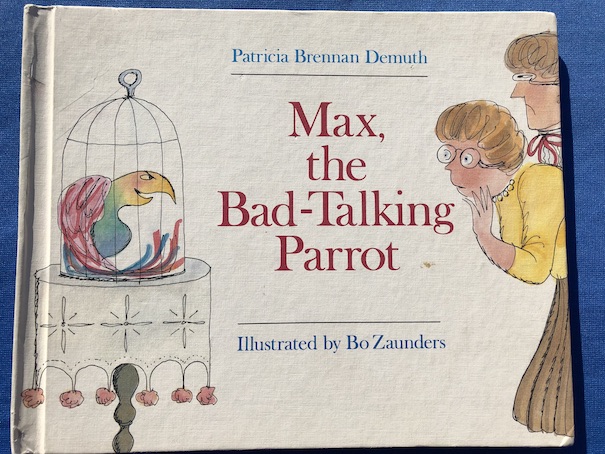
Max, the Bad-Talking Parrot

Max, the Bad-Talking Parrot by Patricia Brennan Demuth, illustrated by Bo Zaunders, 1986.

Don’t worry, Max’s “bad” talk isn’t really that bad.

Max is a parrot who belongs to a woman named Tillie.  They live in a house that has been made into two apartments.  The woman who lives in the apartment above them is Mrs. Goosebump.  Mrs. Goosebump is Tillie’s friend, and Max likes her, too.

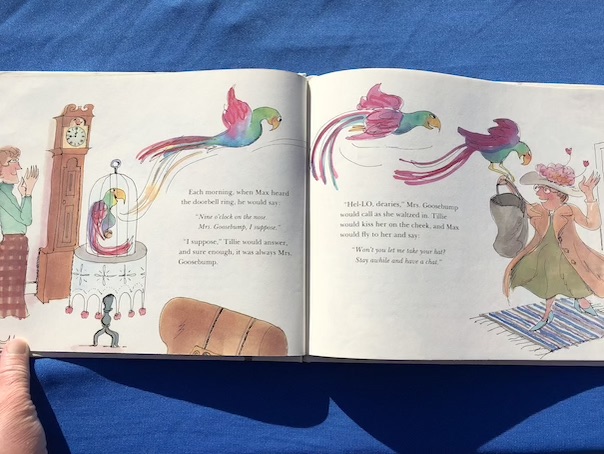
Because Mrs. Goosebump works the night shift in a toll booth, she always comes to see Tillie and Max in the morning, when her shift is over.  Max always greets her with one of his rhymes.  Everything Max says is a rhyme.

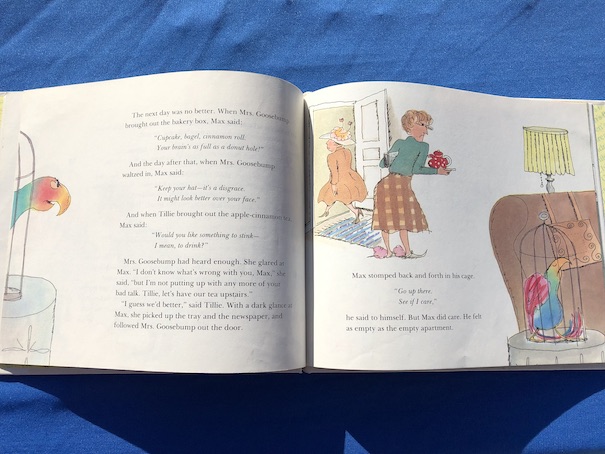
However, one day, as Max is dozing on Mrs. Goosebump’s shoulder during one of her visits, he thinks that he hears her calling him an ugly bird.  Max gets upset and returns to his cage, not ever saying goodbye to Mrs. Goosebump when she leaves.  He feels badly about the insult, and when Mrs. Goosebump visits later, he only gives her insulting rhymes, like, “Cupcake, bagel, cinnamon roll, Your brain’s as full as a donut hole!”

Mrs. Goosebump and Tillie have no idea why he’s so angry. The only thing that they can think to do is ignore him.

Later that night, a burglar breaks into Tillie’s apartment and starts stealing some of her things, including Max!  Max is scared, but by coincidence, the burglar stops to pay at Mrs. Goosebump’s tollbooth.  When Max recites some of his rhymes for her, she recognizes one of his usual rhymes and calls the police.

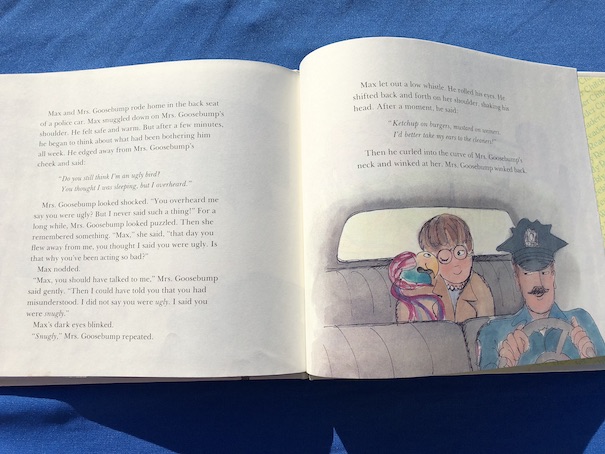
After Max is rescued, he finally tells Mrs. Goosebump why he was so angry, and Mrs. Goosebump explains that she actually said that he was “snugly”, not ugly.  With the misunderstanding cleared up, the two of them become friends again.  Max is also considered a hero for alerting Mrs. Goosebump about the robber.

When I was a kid, I thought that Max’s rhymes were funny, and the scene with the robber at the tollbooth is funny because Max tricks Mrs. Goosebump into believing that the burglar is insulting her before he says the rhyme that Mrs. Goosebump recognizes.  The book is also a good lesson about the importance of talking to people about what you’re feeling in order to clear up misunderstandings.

The Mystery of King Karfu

The Mystery of King Karfu by Doug Cushman, 1996.

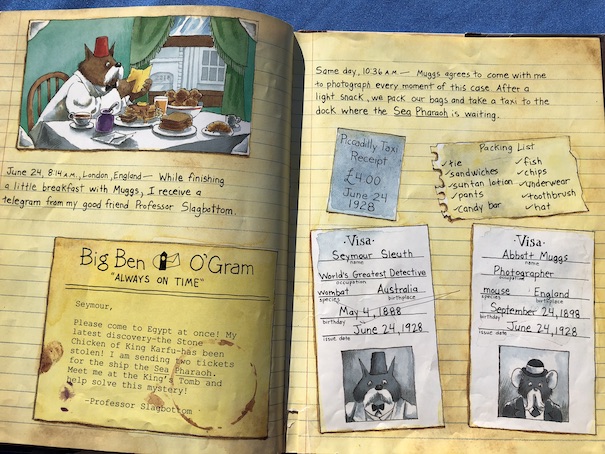
Seymour Sleuth, an Australian wombat living in London, introduces himself as “the greatest detective in the world.”  His friend, Abbott Muggs, a mouse, is a photographer who assists him in his cases and documents them.  When the story begins, Seymour receives a telegram from his friend Professor Slagbottom, who is working on an archaeological site in Egypt.  Someone has stolen one of their finds, the Stone Chicken of King Karfu, and he needs Seymour’s help to find it!  Seymour and Muggs head for Egypt!

King Karfu was a wealthy pharaoh and a wonderful cook, and the Stone Chicken may provide clues about the Lost Treasure of King Karfu, the nature of which is unknown.  When they reach the dig in Egypt, Professor Slagbottom explains that he was researching a message in code on the outside of the Chicken when it was stolen.  The suspects are the other people on the dig, who may be trying to steal King Karfu’s Treasure.

Seymour interviews the suspects one at a time and considers their connection to clues found at the scene of the crime.  As an adult, I figured out who the culprit was pretty quickly, but for the benefit of child readers, Seymour provides notes about the clues and suspects to help them understand the connections. The pictures in the story also provide important clues.  After Professor Slagbottom’s decoder is stolen, Seymour realizes who the thief is.

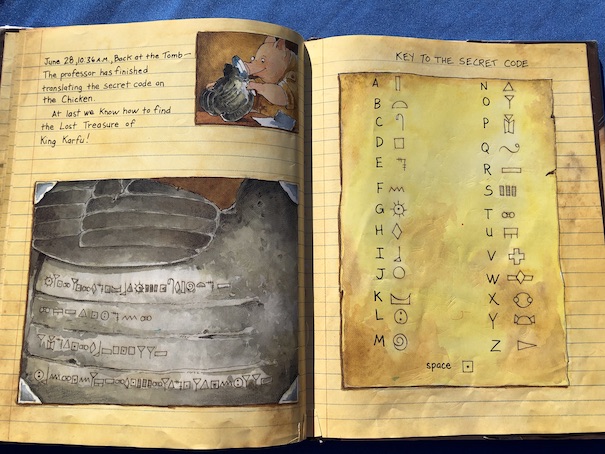
After they get the Stone Chicken back, readers can use the decoder provided to solve the code and learn where the Treasure is.  It turns out that the Treasure is actually a recipe, written in the same substitution code – for peanut butter and jelly sandwiches!

I always like mysteries that involve codes and puzzles, and this cute animal mystery would be fun and challenging for young kids.  With the key provided, it would be a good introduction to substitution codes for kids who have never seen them.  There is one other book with Seymour Sleuth, The Mystery of the Monkey’s Maze.  The author, Doug Cushman, is also the author of the Aunt Eater Mysteries.

The book is currently available online through Internet Archive.

The Snowy Day Mystery

Cam Jansen

CJSnowyDayMystery

The Snowy Day Mystery by David A. Adler, 2004.

One snowy day, Cam Jansen and her friends are on the school bus outside of their school.  Because of the snow, a lot of parents have decided to drive their kids to school, and with all the extra cars, it’s difficult for the bus driver to pull up and let the kids out.  Cam and her friend, Eric, pass the time while they’re waiting with a memory game.

Their game proves useful later, when one of their teachers discovers that someone has stolen three computers from one of the classrooms.  There are footprints in the snow outside the classroom window, but the window was locked from the inside after the theft.  Whoever took the computers must have actually entered the school and passed them to someone outside.  But, computers are big and heavy.  How did they get them away without anyone seeing them?

Cam and Eric begin to investigate, and Danny, a classmate with a habit of telling really bad jokes, tags along.  Part of the solution to the mystery has to do with all of the extra cars in front of the school that morning.  The thieves’ car would have blended in with all of the others, except that they were doing something that none of the other cars were doing, something that Cam realizes that no car would have had a reason to do.  Cam saw the thieves leave herself and is later able to describe the car to the police, but the unusual thing about it doesn’t occur to her until she thinks about where the thieves parked their car.

The book is currently available online through Internet Archive.

Cranberry Halloween

CranberryHalloween

Cranberry Halloween by Wende and Harry Devlin, 1982.

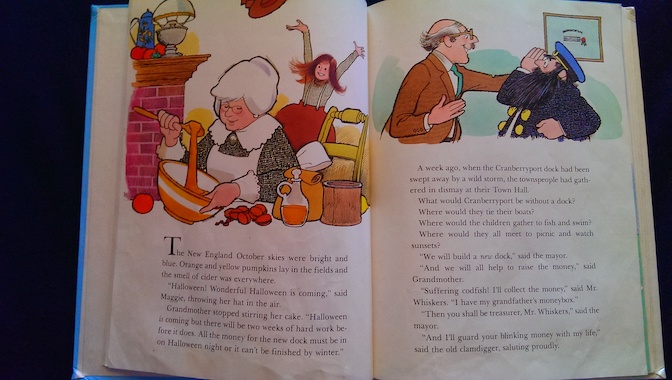
The citizens of Cranberryport need to raise money to build a new dock after theirs was destroyed in a storm. Almost everyone in town volunteers to help, and Mr. Whiskers volunteers to keep the money they raise in his grandfather’s old moneybox.

CranberryHalloweenRaisingMoney

Mr. Grape, a rather cranky old man, not only refuses to donate money to the cause but he insists that it is a mistake to trust Mr. Whiskers with the money because he is a sloppy and careless person. However, Maggie’s grandmother speaks up for Mr. Whiskers, and he gets the job of treasurer for the fund.

CranberryHalloweenSpookyHouse

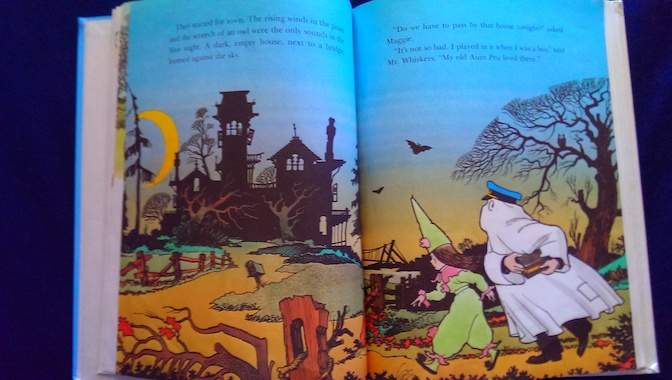
On Halloween night, Mr. Whiskers and young Maggie make their way to the town party, where Mr. Whiskers will present the money for the dock at the town hall.  As they pass by the spooky old house where Mr. Whiskers’s aunt used to live, two men in pirate costumes try to steal the money from them.

CranberryHalloweenPirates

Mr. Whiskers and Maggie hide in the spooky old house, but the pirates are still waiting for them outside. What are they going to do?

CranberryHalloweenTrapped

Mr. Whiskers uses his memories of the old house to find a way out, and it isn’t long before they uncover the villain who put the pirates up to the attempted theft.

The book includes a recipe for Cranberry Dessert in the back.

CranberryHalloweenRecipe

Janie’s Private Eyes

JaniesPrivateEyes

Janie’s Private Eyes by Zilpha Keatley Snyder, 1989.

This is part of the Stanley Family mysteries series.

Janie Stanley has decided to open her own detective agency, The J.V. Stanley Agency, Incorporated, Private Eyes, with the help of her younger siblings and some other friends.  Eight-year-old Janie has had many different aspirations in her young life, from being a Shakespearean actress to being a vampire, so her older brother, David, doesn’t take her detective games too seriously at first.

However, at Mr. and Mrs. Stanley’s New Year’s Eve party, Janie’s “investigations” come to everyone’s attention when she borrows David’s tape recorder to make audio recordings of guests talking and plays them on the stereo that has been hooked up to speakers to play music for the party.  Gossipy Mrs. Dorfman recognizes her own voice, saying uncomplimentary things about her hosts and the other guests, and leaves in a huff of embarrassment.  When Janie’s father confronts her over the incident, Janie says that she was trying to find evidence on a murderer.  When her father and David question her further, she says that old Mr. Rupert, the deceased father of the Mr. Rupert who owns the local grocery store in Steven’s Corners, was murdered.

When old Mr. Rupert died around Thanksgiving, all the kids in the area were sad.  He was always nice to kids when they were in the grocery store and would sometimes give them candy for free.  They called him Grandpa Rupert.  But, Grandpa Rupert’s death was a heart attack, natural causes.  When David asks Janie what makes her think it was murder, she says that she suspects his son and his wife because they inherited the grocery store.  David says that he doesn’t think that Al Rupert would have killed his father.  Janie also says that she heard that there was no autopsy after the death, and she thinks that’s suspicious.  David says that it was well-known that Grandpa Rupert had heart trouble, so a heart attack wasn’t unexpected.  Janie also says that Huy, the younger brother of her friend, Thuy Tran, saw the mailman talking to Grandpa Rupert just before he died, but David doesn’t see why that’s so suspicious.  Eventually, David and her father talk Janie out of her murder investigation idea, but it turns out that the “murder” wasn’t the only investigation that Janie has undertaken.

Dogs in the area have been disappearing, and the Tran family has come under suspicion.  The Trans haven’t been living in the United States for very long.  Originally, they came from Vietnam.  The reason why people are looking at them suspiciously is because dogs started disappearing around the time the Trans moved to the area, and there are rumors that Vietnamese people eat dogs. (Hint: No, the Trans aren’t eating dogs. That’s an old stereotype/rumor that’s been used against various immigrant groups, and no dogs are eaten in this story.)  Janie knows that the Tran family isn’t guilty of dognapping, but proving it is another matter.  After the trouble at the New Year’s Eve party, she asks David and Amanda to help her investigate.  At first, they don’t want to, but David does have to do a journalism project for school with a partner, Pete Garvey.  Pete Garvey is the school bully who also has a crush on Amanda (which is established in a previous book in the series), but he likes the idea of interviewing people about their missing dogs.

However, even though David, Amanda, and Pete Garvey begin talking to people about the missing dogs, Janie and the other members of her detective agency are still on the case!  David has great misgiving about Janie’s involvement.  Then, suddenly, Pete doesn’t want to work on the project anymore and starts behaving suspiciously.  What does he know that no one else does?

The book is available online through Internet Archive.

The Case of the Wandering Weathervanes

McGurk Mysteries

WanderingWeathervanes
WanderingWeathervanesReporter

Brains Bellingham brings a new case to the other members of the McGurk Organization: a weathervane that he was using for his latest science experiment has been stolen!  Although Brains says that the weathervane was extremely valuable because it was a critical part of his experiment, the others don’t think much of it.  However, Brains’ weathervane turns out to be just one of many weathervanes that have disappeared all over town.

At first, everyone is sure that it’s just a prank, probably by some local kids, and it gets reported as an odd tidbit on the local news.  However, the more weather vanes that disappear and the more time that goes by without them being returned, the more disgruntled the local citizens become.  People (like Brains) start claiming that their weathervanes were worth more than they probably were, although there were a couple of legitimate collectors’ items among the stolen weathervanes.  The police fail to see the humor behind the incident and start talking about serious consequences for the one responsible for the weathervanes’ disappearances.  Unfortunately, as often happens in these cases, people begin looking at Wanda’s brother, Ed, as the culprit.

WanderingWeathervanesEd

Ed has a long-standing reputation as a prankster, and so is the first person most people suspect when strange things start happening.  Wanda is sure that he isn’t guilty this time, though.  Her brother wouldn’t be above taking something for a short period of time just as a joke, but he wouldn’t just steal things from people and keep them.  When some of the weathervanes start reappearing, at the wrong houses, it looks like it might have been a prank after all, but Ed still maintains that that he’s innocent.

The members of the McGurk Organization believe that the real culprit might be a friend of Ed’s who admires some of his pranks and might be trying to imitate him with a wild scheme of his own.  However, if Ed’s friend is really guilty, where are the missing weathervanes and why haven’t they been returned?  A professional private investigator has been pressing the kids for what they know about the thefts, and Ed suddenly disappears!  There may be much more to the mysterious disappearing weathervanes than meets the eye.  What started as an odd prank may have uncovered something more serious!

The book is currently available online through Internet Archive.

WanderingWeathervanesSecret

Under Copp’s Hill

UnderCoppsHill

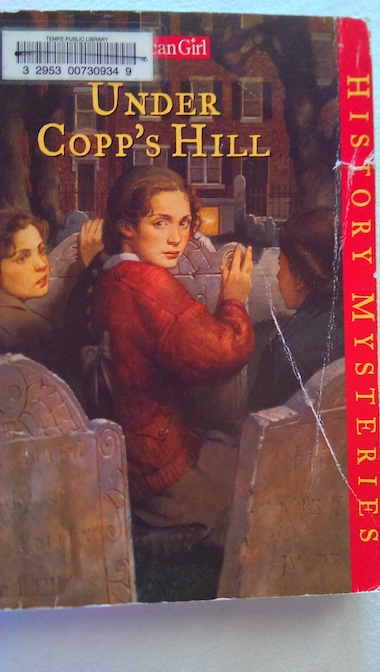
Under Copp’s Hill by Katherine Ayres, 2000.

This book is part of the American Girl History Mysteries series.

The year is 1908, and eleven-year-old Innocenza Moretti lives with her relatives in Boston.  They are immigrants from Italy.  Innie, as her family calls her, is an orphan.  According to the story that her grandmother told her, she was the only one of her parents’ children to survive infancy, her siblings being born prematurely and dying shortly after birth.  Innie’s mother was so grateful that Innie survived that she promised her to the Holy Mother at her baptism.  Then, Innie’s parents died in a fire in their tenement building when she was about two years old.  Innie and her grandmother, Nonna, survived the fire only because little Innie had started crying in the night, and she took her outside to walk her around so that she wouldn’t wake her parents.  Because of that experience, Nonna is deathly afraid of fire and also has become convinced that the Holy Mother must have spared Innie (as well as herself).  She thinks that Innie is destined to become a nun and has continued to promise her to the Holy Mother in prayer, repeating the promise regularly.  Although Nonna thinks that the miracles surrounding Innie’s life are signs of a future life in the Church for Innie, her grandmother’s promises in prayer terrify Innie.

Innie feels trapped by her grandmother’s expectations for her, expectations that the rest of her family don’t even know about.  She doesn’t want to be a nun, but her grandmother is sure that she will be.  Because of her fears that her grandmother may force her to become a nun when she grows up, Innie is never on her best behavior.  She thinks that if she gets a reputation as a trouble-maker, the Church will decide that she is unsuited for a religious life.  Unfortunately, Innie’s long-practiced habit of ignoring rules and her problem child reputation lead her to be suspected of something worse than just minor misbehaving.

Innie’s family owns a boardinghouse where they provide food and lodging for young immigrant men.  Innie and Nonna live on the ground floor, and Innie’s aunt, uncle, and cousins live above them.  Innie spends a lot of time with her cousins, especially Teresa, who is about her age.  Her older cousin, Carmela, persuades both Teresa and Innie to join a library club at a new settlement house with her.  The settlement house helps girls and young women from immigrant families by teaching them work skills and aspects of American culture that they can use as they become American citizens in exchange for some of the work that the girls do on behalf of the settlement house.  Carmela has taken a new job as a pottery painter there and tells her parents that it will be good for Teresa and Innie to go there as well because they will receive help with their schoolwork and they will also have classes to teach them skills like sewing, knitting, and pottery, that they can use to make money later.  However, the real attraction of the club for the girls is that they get to listen to music, have dancing lessons, read books, and socialize with other girls about their age.  The prospect of sewing classes isn’t appealing for Innie, but she loves books and looks forward to borrowing some from the settlement house library.

At the settlement house, Innie meets a variety of girls from other immigrant families, not just Italian ones.  In particular, Innie makes friends with a girl named Matela, who is a Jewish girl from Russia.  As the girls talk about a recent, large fire in town, Matela talks about the czar’s soldiers burning things back in Russia and how she misses her grandfather, who is still there.  Innie understands Matela’s feelings because she knows what it’s like to miss someone.  She doesn’t really remember her parents, but she feels the lack of them in her life.  Teresa also becomes friends with Matela, but the three girls agree to keep their friendship secret because each of their families prefers them to associate with girls from backgrounds similar to their own.  Innie’s uncle wants the girls to spend time with other Italians, and Matela admits that her father prefers her to spend time with other Jewish girls.  The adults don’t really understand the cultural mix at the settlement house.

However, from the very first day that the girls begin going to events at the house, strange things start happening.  Things disappear or are oddly moved about.  Food disappears.  A silver teapot belonging to the ladies who run the settlement house is stolen.  Then, someone steals some pottery and a shawl.

To Innie’s horror, she ends up becoming the prime suspect for the thefts because she was caught snooping in an area of the house where she didn’t belong and because she accidentally broke one of the pieces of pottery that the others girls made and tried to sweep it up without telling anyone.  When she and her friends snoop around and try to find the missing objects, Innie discovers one of the missing pottery pieces.  However, instead of being happy for the clue, the ladies who run the house just think that Innie must have broken more of the pottery and tried to cover it up, like she did before, by hiding the rest of the set.  After all, if she was doing some things she shouldn’t have been doing, it’s plausible that she could be a thief, too.

If Innie is going to remain a member of the library club (and continue to have access to books that she can read), she’s going to have to prove her innocence.  In fact, proving her innocence may also be important for Carmela, who is supposed to have a citizenship hearing soon.  If Innie’s bad reputation causes problems for her at work, she may lose her job and be denied American citizenship!

Matela thinks that the thief could be a ghost from the nearby Copp’s Hill graveyard, but Innie is sure that it must be a human being.  There are secrets at the settlement house that even the ladies who run it are unaware of and someone who desperately needs help and can’t ask for it.

Teresa and Matela continue to help Innie, and in the process, Innie confesses to Matela her fears about becoming a nun.  It is Matela who helps Innie to find the solution to her problem, urging her to step outside of the small community of Italian immigrants that her family clings to and to seek advice from a priest in the Irish area of the city.  As a priest, he has the knowledge that Innie needs to understand her faith, and because he doesn’t know Innie’s family personally, he has the objectivity to help Innie to see her grandmother’s promise in a new light and to understand that her future destiny is still in her own hands.  No one can speak for another person or make important promises on their behalf.  A religious vocation is a serious decision that only a mature adult can make for herself, or not make, as the case may be.  The priest tells her that, as young as she is, Innie should focus on learning to be a good person, and then she will see what direction life leads her.  With that knowledge, of course, Innie realizes that she will have to put more effort into behaving herself, but it’s a relief to her to realize that she doesn’t need to purposely misbehave in order to control her life.

Eventually, Innie’s aunt also learns about the grandmother’s promise and Innie’s worries and reassures her that, although her grandmother can be an intimidating woman with what she wants, Innie’s family loves her and that she shouldn’t be afraid to come to them with her questions and concerns. Innie has thought of herself as parentless, at the mercy of her grandmother’s wishes and expectations, but her aunt says that she loves Innie like she does her own daughters and that Innie is as much a part of their family as they are.  If Innie has problems, her aunt will be there for her, helping her find whatever answers she needs.

There is also a subplot about how girls in immigrant families (at least, in ones like Innie’s family) aren’t as highly-regarded as boys.  When the family is discussing important matters, Innie often tries to comment on what she thinks, but her grandmother keeps telling her to be quiet because it isn’t a girl’s place to comment on business that men should handle and her male cousins sneer at her because they don’t think she knows anything.  However, when Innie’s uncle is worried about the legal papers he has to sign in order to open his new grocery business because his English still isn’t good enough to understand them, Innie points out that Carmela’s English is the best of the family because of all the books she had to read and the paperwork she had to complete when she was applying for citizenship and that she would be the best person to study the paperwork.  At first, her grandmother makes her try to be quiet and her male cousins laugh, but Carmela speaks up and says that she can help her father, if he wants her to, and her father agrees, on the condition that she act as translator and adviser and let him make the final decisions about the business.  Carmela is happy because the arrangement allows her to use her skills without taking her away from the pottery painting that she loves.  The point of this part of the story is about acknowledging the talents that people possess and not disregarding them because they are outside of the usual roles and expectations.  It fits in with the subplot about the grandmother’s expectations for Innie’s future, which are not really in keeping with either her talents or character.  The young people in the story are growing up under different circumstances than their parents, and they will have to learn to find their own way in life, using the abilities they have and the education they can find.

In the back of the book, there is a section with historical information about Boston in 1908.  The fire that happens around the time that the story takes place was a real event.  The settlement house with its library club was also real, and the ladies who run the settlement house, Miss Brown and Miss Guerrier, were also real people.  The book explains more about what life was like for immigrant families like Innie’s and about what the future held for girls like her.  Many of the girls who attended the library clubs later became librarians and teachers themselves, which may be Innie’s eventual destiny when she grows up.  The book also mentions that the area of Boston where Innie’s family lived still has many Italian restaurants and groceries that were started by immigrant families like Innie’s, so we can imagine that the grocery store that Innie’s uncle wants to open will be successful.

The book is currently available online through Internet Archive.
The Mystery of the Midnight Visitor

MorganMidnightVisitor

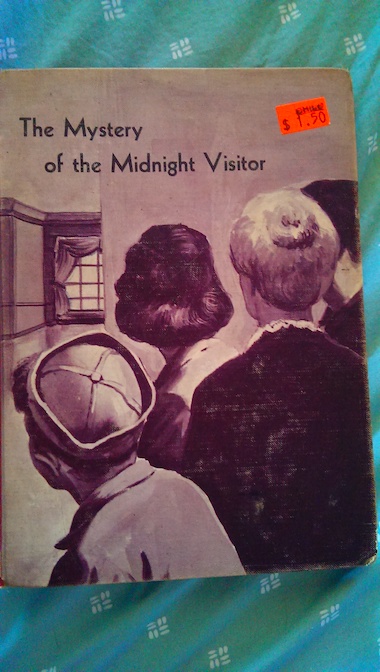
The Mystery of the Midnight Visitor by John and Nancy Rambeau, 1962.

One day, Gabby is going fishing on the beach at Morgan’s Landing. Miss Wellington, a family friend, owns the property along with the old mansion known locally as Morgan Castle. She has given permission to Gabby to fish there, but Gabby is surprised to meet a stranger on the beach as well. This stranger is an old man who says that his name is Admiral Lavendar. When Gabby tells him that he’s on private property, the old man moves on. Then, Gabby spots smoke coming from Morgan Castle!

When Gabby goes to investigate, he finds that someone has shut Miss Wellington in a closet and that there is a fire in the bedroom that had once belonged to Mrs. Morgan, the former lady of the house. He gets Miss Wellington out of the closet, and they call the fire department. The firemen put out the fire and tell Miss Wellington that it was apparently caused by a dropped candle.


Morgan Castle was once owned by the wealthy Morgan family that gave Morgan Bay its name. However, the house has become shabby over the years. Miss Wellington inherited the house after Mrs. Morgan died because there were no other Morgans left. However, she doesn’t actually live in Morgan Castle because she has a house of her own. People have been saying that perhaps the house should be torn down because of its poor condition. Miss Wellington doesn’t have much money and says that she would find it difficult to manage the upkeep of the house.

Gabby and his brother Bill and sister Vinny don’t want to see the old beautiful old mansion destroyed, and there is still the mystery of who dropped the candle and why to consider. A small silver box that Gabby found on the beach turns out to be a jewelry box that once belonged to Mrs. Morgan. Mrs. Morgan wasn’t particularly interested in jewelry, but she did own one particularly fine emerald necklace that was never found after her death. Perhaps the person who dropped the candle was looking for it!

To give Morgan Castle a new purpose and prevent it from being torn down, the kids convince Miss Wellington to let them turn it into a Historical, Boat, and Tennis Club, dedicate to celebrating local history and providing entertainment for local people.

At first, the mysterious Admiral Lavendar looks like a likely suspect for the person sneaking around Morgan Castle, but he turns out to be very helpful to the children and their plans. There is another stranger in town who has the knowledge to seek out Mrs. Morgan’s lost necklace.

MorganMidnightVisitorThief

This book is part of a series that were once used as classroom readers.

Ginnie and the Mystery Doll

GinnieMysteryDoll

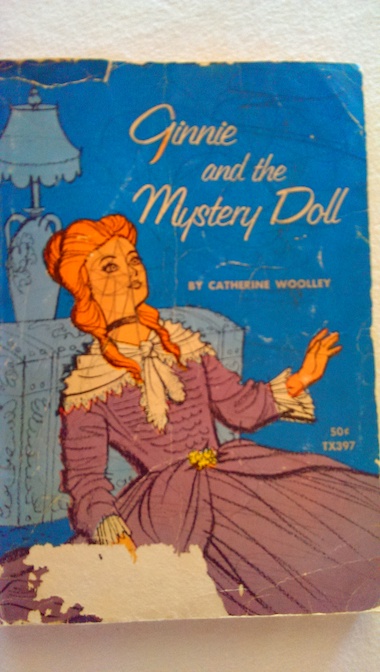
Ginnie and the Mystery Doll by Catherine Woolley, 1960.

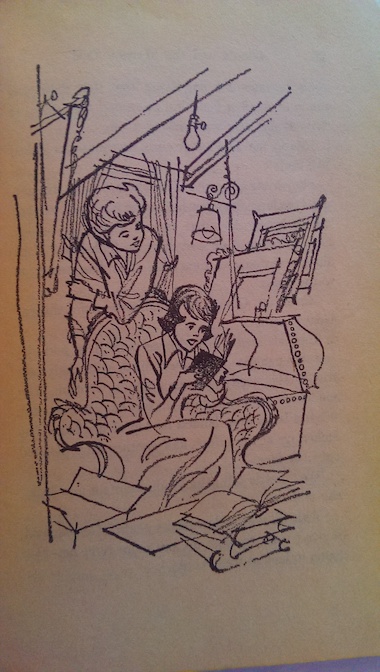
Ginnie and Geneva’s families have rented a house on Cape Cod for the summer, so they’ll be sharing their vacation at the beach. Their next door neighbor at Cape Cod is Miss Wade, a nice older lady. Miss Wade’s house is very old-fashioned, and when the girls make friends with her, she shows it to them, allowing them to see some of the neat old things in her attic on a rainy day. The girls have fun trying on the old clothes in the attic, and then they find an old diary belonging to Miss Wade’s mother when she was a girl. In the diary, the girl talks about the special doll that her uncle gave her, which has a “precious jewel.”

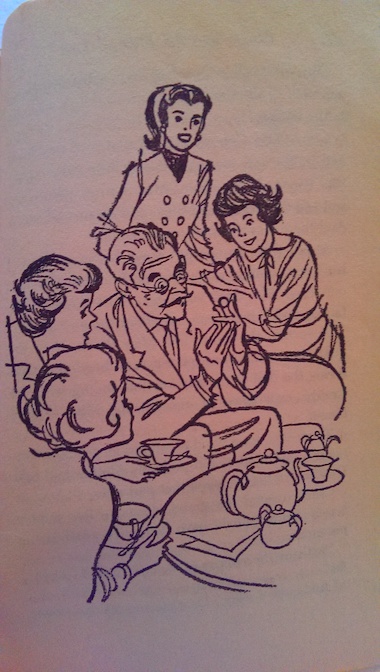
GinnieMysteryDollDiaryAtticThe girls ask Miss Wade about the doll, and she says that she knows the one they mean, but she no longer has it. Her mother’s uncle was the captain of a ship and used to bring her presents from around the world. The doll, called Lady Vanderbilt, was very fancy, and Miss Wade describers her costume to the girls. However, she says that the doll disappeared after she rented her house out to a family one summer while she was traveling. She never found out what happened to the doll, but she assumed that the children of the family probably found her and either took her or broke her. Miss Wade said that she didn’t think that the doll was worth making a fuss about, so she never asked the family about it. The girls note that Miss Wade doesn’t seem to know anything about a precious jewel in the doll, but they decide not to say anything about it since Miss Wade doesn’t have the doll anymore.

The girls decide to concentrate on enjoying their summer vacation, picking beach plums and digging clams with Miss Wade on the beach. Then, when they go to see a local auction, they spot a doll that looks exactly like the Lady Vanderbilt that Miss Wade described! The girls try to bid on the doll at the auction, but someone else buys her instead, and that lady leaves the auction before the girls can talk to her.

GinnieMysteryDollJewelThe girls tell Miss Wade and their mothers about the doll, but when they try to ask the people in charge of the auction where the doll came from and who bought her, they learn that the woman who was in charge of organizing the toys has already left on vacation. The only clue that the girls have is that the woman who bought the doll left the auction in a red Jaguar.

The girls make it their mission to track down the doll and its buyer, asking questions all over town about who might own a red Jaguar. Then, at an art exhibit at the Historical Society, they make a surprising discovery: a painting of the very doll that they’re looking for!

But, just when they figure out who has the doll and where she is, she disappears again when the red Jaguar is stolen with Lady Vanderbilt inside! Was it just an accident that the doll was stolen along with the car, or does someone else know that Lady Vanderbilt might be hiding a valuable secret?

The book is currently available online through Internet Archive.
Emil and the Detectives

Emil

Emil and the Detectives by Erich Kastner, translated by May Massee, 1929, 1930.

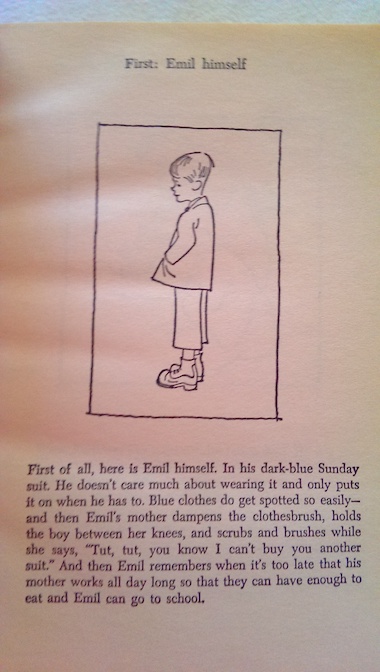
EmilHimselfThis book was originally written in German.  It was written in Germany during the period between the two World Wars.  The date of the story itself is never specified, but it may actually be earlier than when it was written, prior to World War I.  There is a sequel to the book that I haven’t read where Emil’s vacation ends early because he hears that war has broken out, an incident based on the author’s own boyhood experiences at the start of World War I.

The Emil books have an interesting history because of the time period when they were written.  This video explains how the book came to be written, the time period when it was written, and its cultural impact.  By the time the Nazis came to power, Emil and the Detectives had become popular and, as a harmless children’s book, was saved from Nazi book burnings.  The sequel story, Emil and the Three Twins, wasn’t so lucky, which is why it isn’t as well-known as the first Emil book, although it is available today.  The author, Erich Kastner, was known to be a pacifist and opposed to the Nazi government, which was why many of his works were burned during the Nazi regime and publishers were forbidden to publish new books from him.  (This video explains more about the book burnings and Kastner’s burned works.)  Although his political stance interfered with his writing, and he was questioned by the Gestapo several times, he chose to remain in Germany for the duration of the war.  Another of his children’s books, Lisa and Lottie, which was the basis for the Parent Trap movies by Disney, was written after World War II ended.

EmilTrainAt the beginning of this story, it explains that Emil Tischbein’s father died when he was very young and that his mother works hard as a hairdresser to support the two of them. When she can, she saves a little money for Emil’s grandmother as well. When the story begins, Emil is preparing for a train trip to Berlin to visit his relatives. Emil will be traveling by himself and will meet his relatives near the station when he arrives. His mother gives him some money to take to his grandmother and warns him to be careful. Emil pins the money inside his pocket for security.

On the train, Emil talks to the people who share his train compartment. One of them, who calls himself Herr Grundeis, tells him tall tales about what Berlin is like and gives him a piece of chocolate, which is apparently drugged. Emil falls asleep on the train, and when he wakes up, he realizes that he’s been robbed!

EmilGustavDetermined to get the money for his grandmother back, Emil searches for Herr Grundeis and spots him getting off the train. It’s too soon for Emil’s stop, but he follows Grundeis off the train anyway, tracking him to a café.
While Emil is trying to decide how to handle the situation, another boy who carries a horn that he likes to honk, Gustav, spots him watching Grundeis. Gustav asks Emil what he’s doing, and Emil explains the situation. Emil isn’t sure how to get the money back from Grundeis. At first, he’s afraid to tell the police what happened because of a prank he and some friends pulled at home. He worries that perhaps the police have found out about the prank and that they won’t take him seriously. Gustav is sympathetic to Emil and tells him that he can get together some friends to help.

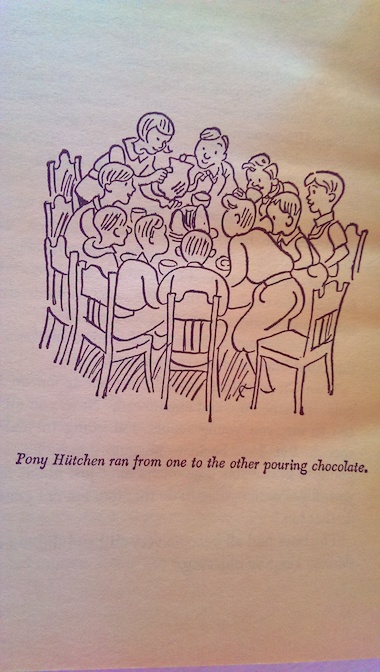
EmilPonyChocolateGustav recruits a bunch of other boys from the neighborhood, and they continue tailing Grundeis through the city to his hotel. The boys call another friend at home, who keeps track of their progress and gives them reports about what others have said.  Emil gets one of the other boys to tell his relatives that he has been delayed on important business, causing his cousin, Pony Hutchen, to come and tell him that everyone is worried and that he’s going to be in big trouble with his relatives if he doesn’t show up soon.  However, they still have the problem of deciding how to confront Grundeis and get him to return the money.  In this case, the detectives don’t need to solve the mystery of who the thief is.  The real problem is how to prove it.

This book is known around the world and has been made into movies several times, including a Disney version in 1964.  The Disney version still takes place in Germany, but for some reason, Emil’s train trip is changed to a bus trip, and the criminal’s plot is much more elaborate.  It’s available on dvd, and you can see the trailer on YouTube.

The book is currently available online through Internet Archive (multiple copies).

My Reaction and Spoilers

Overall, I liked the story, although I found the book difficult to read because the wording sounded strange and awkward in many places.  I think this is probably because of the translation between German and English.  I have the feeling that the translator was trying to be too literal in the translation instead of focusing on translating for meaning and tone.  Unfortunately, I can’t read German, so I can’t say what the original version was like.

EmilReportersThere was a note in the beginning of my copy of the book that says that many of the character names in the book are actually jokes on the part of the author. It’s not as obvious in English because the forms of the names sound reasonable for German names, but anyone who knows German would spot that they aren’t real names. For example, Emil’s last name is Tischbein, which means “table-leg,” and the thief’s alias, Grundeis, means “ground-ice.”

In the end, the boys use their numbers (they have about a hundred child detective recruits by the end of the story) to corner the thief in a bank, and when they confront him in front of the bank personnel, they manage to prove that Emil is the owner of the money using the pin holes in the bills, where Emil had pinned it to his jacket.  The author of the book also appears briefly in the story as a journalist who interviews Emil and his friends for a newspaper story about how they caught the thief. (I think he’s the one standing at the back of the group of reporters in the picture because the man’s hair looks like Kastner’s, combed back.)

Like in another of Kastner’s books, Lisa and Lottie, there is the theme of a child who behaves well because of the family’s poor circumstances.  Emil, like Lottie, is being raised by a single mother who has to work hard to support the two of them. Both Emil and Lottie understand that if they behave badly and get into trouble, it would create more hardships for their mothers.  They basically live hand-to-mouth, and the children understand that their mothers cannot take time away from work to deal with their discipline problems.  Each of them has had to shoulder some of the household burdens from an early age, and it has made them more serious and also a little closer to their mothers than many of the other children from more affluent families. Aside from Emil’s prank at home (which causes him some worry), he is obedient to his mother and also very concerned about her welfare.