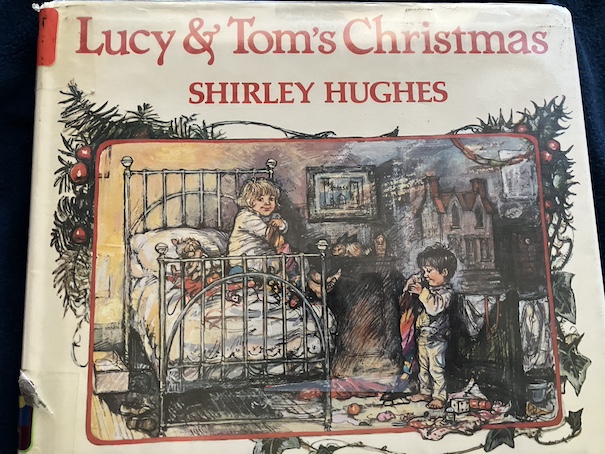
Lucy and Tom’s Christmas

This British children’s picture book shows a young brother and sister enjoying Christmas and celebrating many popular British Christmas traditions.

Before Christmas, Tom and Lucy help their mother make a Christmas pudding, each of them making a wish as they stir it. They see the postman delivering Christmas cards and packages, and they make Christmas cards of their own. They also help their mother to decorate the house.

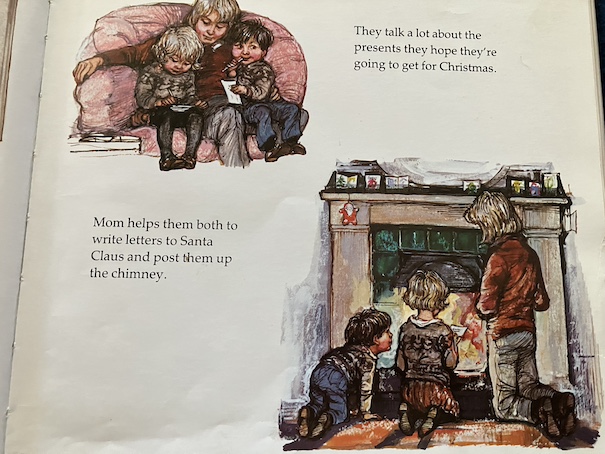
Each of them also has small presents for each other and other people in their family. They also write letters to Father Christmas and “post them up the chimney.” (In Britain, it’s traditional to burn letters to Father Christmas or Santa Claus because he can read their wishes in the smoke.)

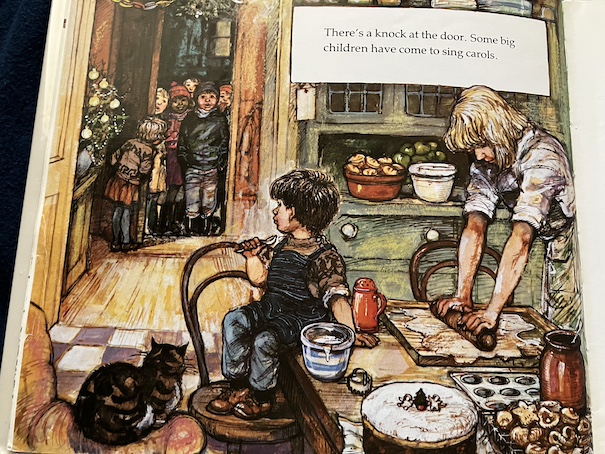
They enjoy listening to carol singers and buying a Christmas tree in the market. On Christmas Eve, they hang their stockings at the foot of their beds for Father Christmas to fill with presents.

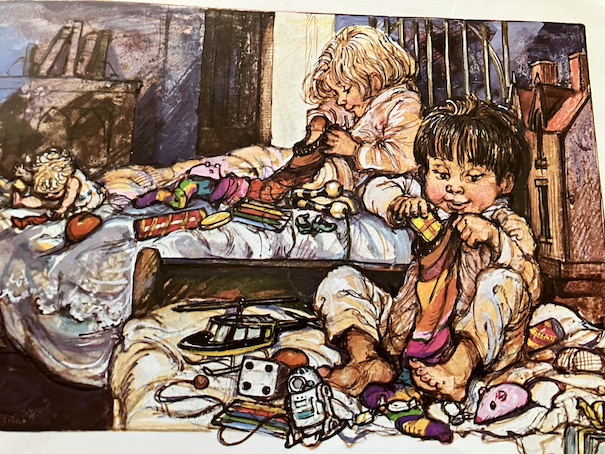
On Christmas morning, the excited children wake up early and play with the presents in their stockings. When their parents wake up, they unwrap their other presents.

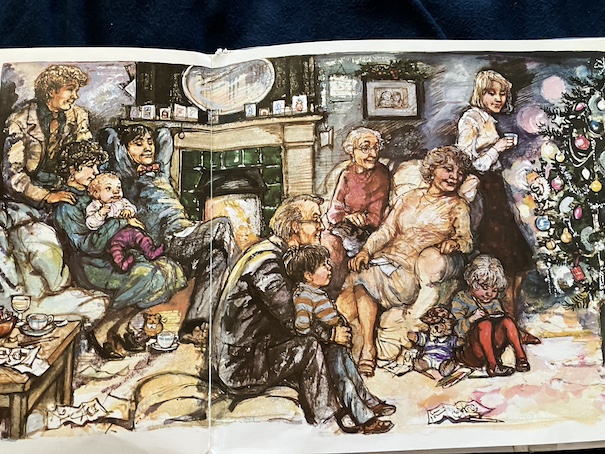
Later, they go to church, and friends and family come to their house for a turkey dinner. After dinner, they open Christmas crackers (party favors that open with a bang and have little prizes and paper hats inside – they aren’t as common in the United States as in Britain, but you can get them here). They give their guests their presents and play party games. It’s a Merry Christmas for everyone!

The book is available to borrow and read for free online through Internet Archive.

I enjoy seeing different types of traditions from around the world, and this picture book reminded me of a YouTube video I saw about British Christmas traditions. Many of the traditions mentioned in the video were also shown in the book, including burning letters to Father Christmas, hanging up stockings on the beds instead of by the fireplace, and opening Christmas crackers.

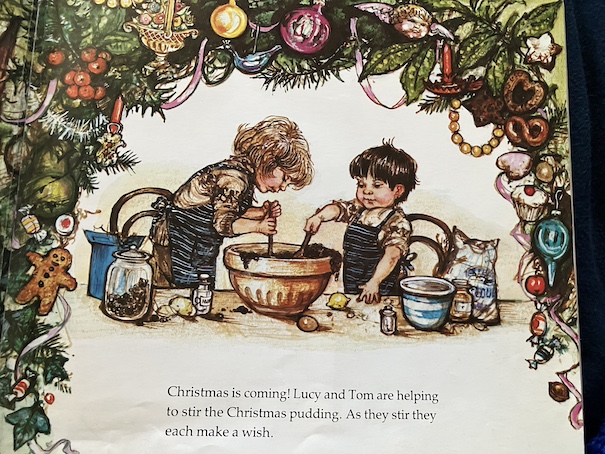
I loved the pictures in the book, showing the children participating in all of the Christmas activities. They are colorful and cheerful, and I enjoyed noticing little details among the children’s Christmas presents. In one picture, it looks like Tom has received a little R2-D2 robot.

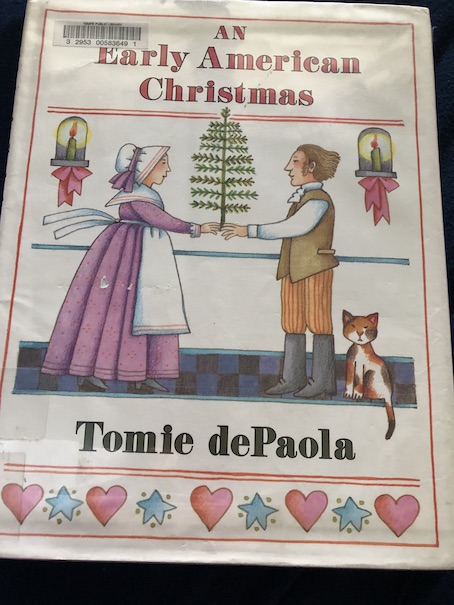
An Early American Christmas

An Early American Christmas by Tomie dePaola, 1987.

A note at the beginning of the book explains the story behind the book, which is based on the history of early Colonial America. Although Christmas is now a popular American holiday with lavish celebrations, many early colonial groups didn’t celebrate Christmas much at all. Even among Christian groups, Christmas was not regarded as a major holiday. In particular, groups like the Puritans, Presbyterians, Quakers, and Baptists tended to avoid celebrating Christmas, seeing it as a frivolous sort of celebration. However, there were other groups, like Catholics, Lutherans, and Episcopalians, who did celebrate the holiday in a festive fashion. The author of this book imagines what it would have been like for a family that celebrates Christmas if they moved to a New England community that didn’t during the early 1800s. In particular, he used New Hampshire as his inspiration.

The beginning of the story describes a New England town that doesn’t celebrate Christmas with decorations or songs. Then, a new family comes to the village. They were originally from Germany, and they had lived in Pennsylvania before coming to the village. (This would make them Pennsylvania Dutch.) They are usual because of their festive Christmas celebrations.

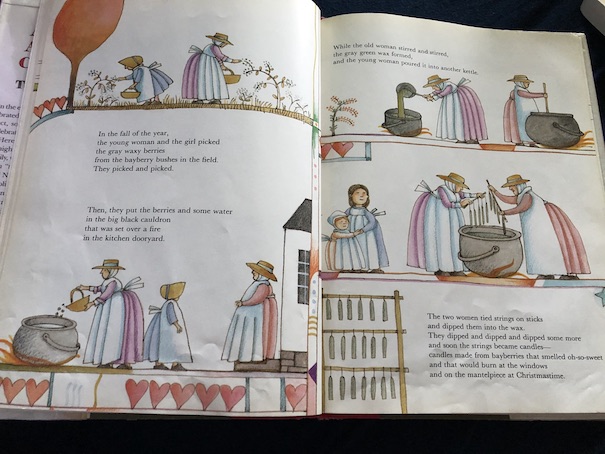
They begin planning for their Christmas celebration in the fall. The women and girls pick bayberries and use them to make candles. They say that bayberry candles bring good luck when they’re burned on Christmas.

The men and boys gather the crops that they will need for their feast. The grandfather of the family carves figures for their manger scene.

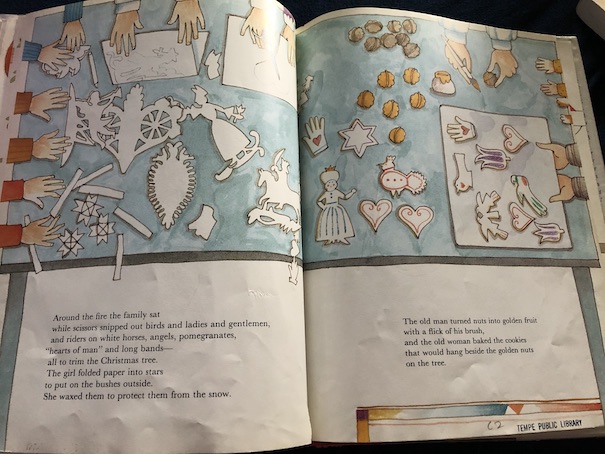
In December, the whole family makes paper decorations and specially-shaped cookies. I liked the variety of baked goods that they show in the pictures. They pick out a tree and make strings of popcorn and dried apples.

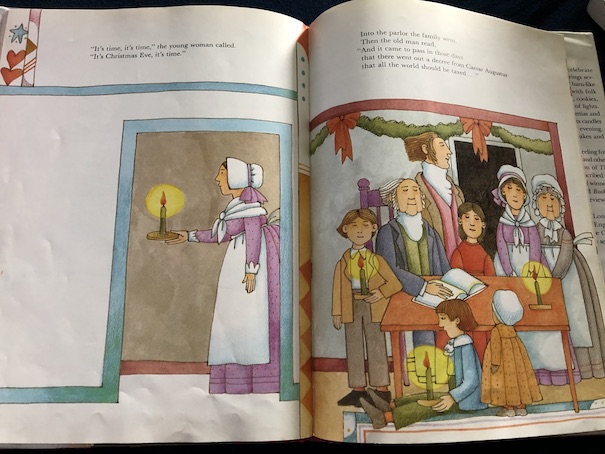
On Christmas Eve, they read the story of Jesus’s birth and decorate their home with all of the decorations they have prepared.

As the years go by and other people in town see what the Christmas Family is doing, they begin to celebrate Christmas, too.

The book is available to borrow and read for free online through Internet Archive.

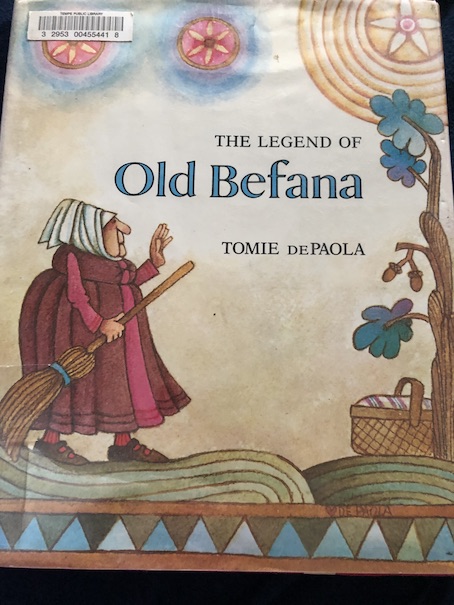
The Legend of Old Befana

The Legend of Old Befana by Tomie dePaola, 1980.

The story is based on a Christmas story from Italian folklore. According to Italian tradition, Old Befana visits the houses of children on January 6th, the Feast of the Three Kings, and leaves treats and gifts. Legend has it that she is on an eternal search for The Christ Child.

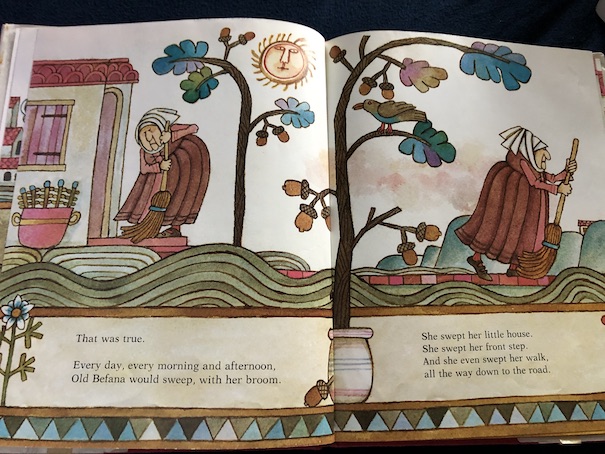
Old Befana is a strange old woman who living in a village in Italy. She is a grumpy woman who spends almost all of her time sweeping. Sometimes, she bakes good things to eat and sings lullabies, although she lives alone, so there’s no one for her to bake for or sing to. People think that she is crazy.

One night, Old Befana wakes up to see a bright light. There is a dazzlingly bright star in the sky, and it makes it difficult for her to sleep.

The next day, as she is doing her usual sweeping, she hears the sound of bells. A strange and beautiful procession comes over the hill. Among the procession are three men in royal robes.

The three kings stop and ask Old Befana if she knows the way to Bethlehem. She says that she has never heard of the place. The kings say that they are looking for “the Child,” but Old Befana doesn’t know what child they mean. They explain to her that this Child is a king and that His appearance was signaled by a bright star in the sky.

Old Befana confirms that she has also seen the star. A boy among the procession tells Old Befana that they are bringing gifts to the Child because He has come to change the world. The boy urges Old Befana to come with them, but old Befana says that she is only a poor woman and continues her sweeping.

After they leave, however, Old Befana continues thinking about what they said, and she starts to think that maybe she should go see the Child. She bakes all kinds of cookies and candies as gifts. She also decides to take her broom so that she can sweep the Child’s room because His mother will be tired. However, she stops to do her usual sweeping before she leaves her home.

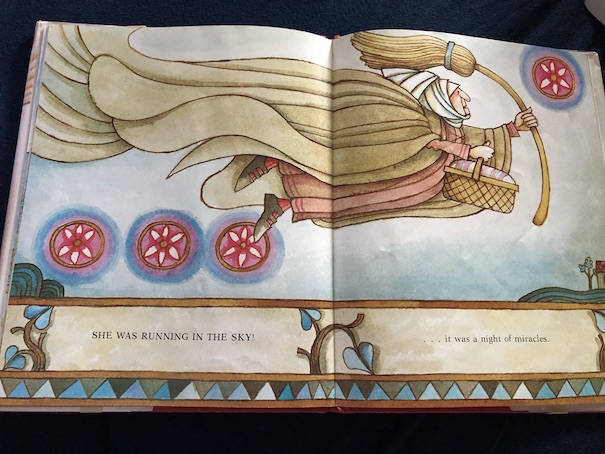
By the time she is finished with her sweeping, the procession is so far ahead that she is unable to catch up to them. Just as Old Befana laments that she cannot catch up to the procession, the angels declare that, “This is the night of miracles.” Suddenly, Old Befana can run fast, even running across the sky.

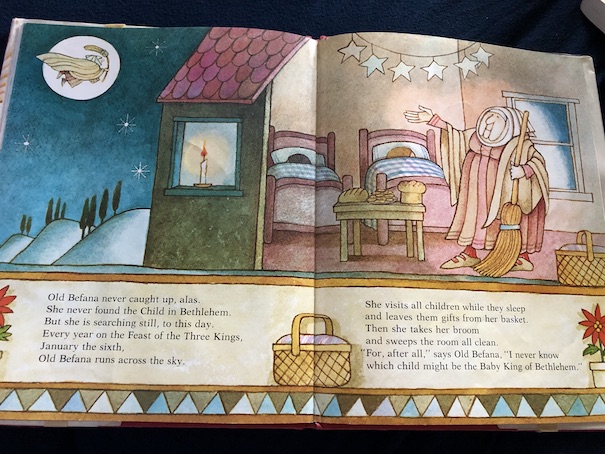
Unfortunately, Old Befana still doesn’t know the way to Bethlehem or who the Child is, so she doesn’t get to see the Christ Child. However, she still continues her search. Every year on January 6, she runs across the sky, carrying her broom and her basket of treats. At every house she finds with a child, she sweeps the room clean and gives the children gifts and treats because she never knows for sure which of them might be the Child she is seeking.

The book is available to borrow and read for free online through Internet Archive.

Clifford's Christmas

Clifford

Clifford’s Christmas by Norman Bridwell, 1984.

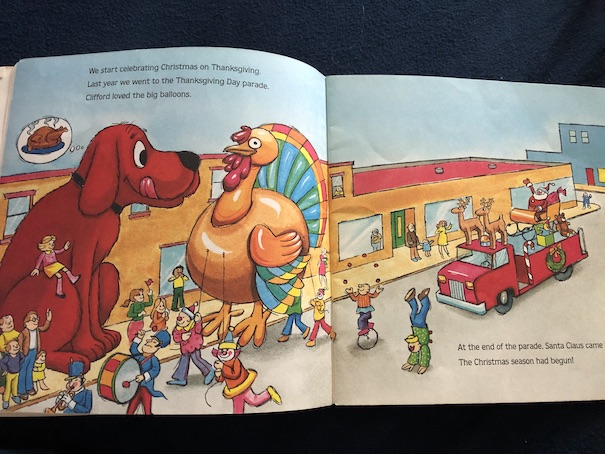
Christmas is coming, and Emily Elizabeth and Clifford are ready to celebrate! Emily Elizabeth talks about how the Christmas season begins with Thanksgiving. (That’s not how everyone regards it, but it is a common way to mark the season in the United States. The day after Thanksgiving, Black Friday, is considered the start of the Christmas shopping season, with people looking for bargains on Christmas presents.)

When it starts to snow, Emily Elizabeth, Clifford, and their friends have fun playing in the snow. They get a Christmas tree, prepare their stockings, and participate in other holiday activities leading up to Christmas. Clifford even gets a kiss under mistletoe!

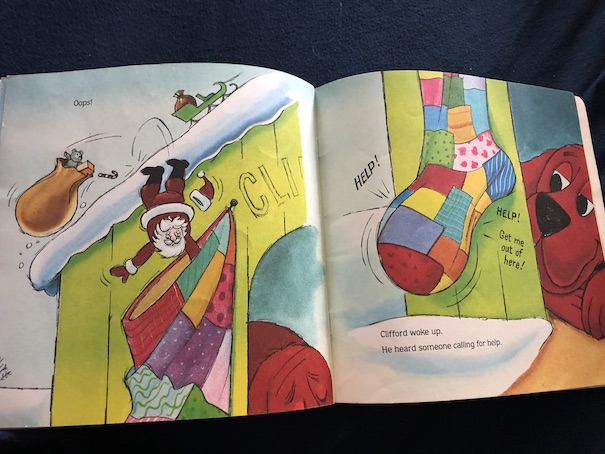
When Santa comes, he lands on the roof of Clifford’s dog house and accidentally falls into Clifford’s stocking, dropping his sack of toys. Clifford has to rescue him.

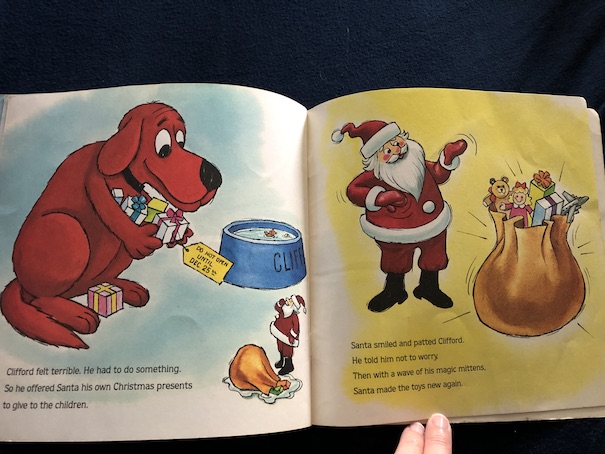
The toys fall into Clifford’s water bowl, but Santa fixes them with his magic. No harm done, and it’s a Merry Christmas after all!

This is just a cute Christmas story with a popular children’s books character. I loved the Clifford books when I was a kid, but I have to admit that they don’t look as good to be now as an adult. The entire plot of Clifford books revolves around Clifford’s enormous size, which is the very idea of the series. However, the plot of this is light, the problem is both caused and immediately solved by Clifford’s large size, and I think I’m just not interested in the usual trope of Famous Character Saves Christmas In Some Way anymore. I think that some Christmas stories with popular characters are still good, but for them to work, they usually have to have deeper, more clever, more interesting plots. This book isn’t bad, but I just didn’t think it was particularly great.

The book is available to borrow for free online through Internet Archive.

Games

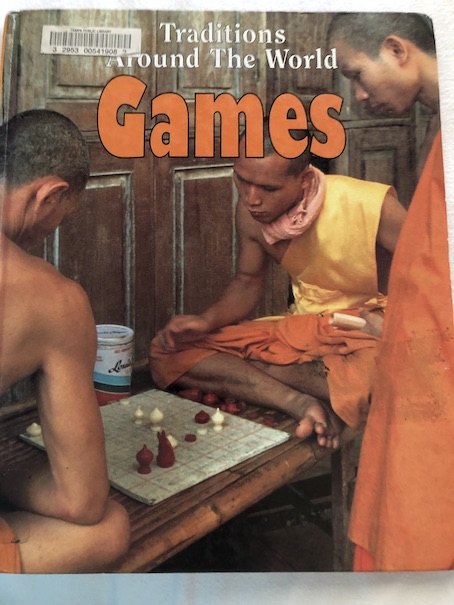
Games by Godfrey Hall, 1995.

This book is part of the Traditions Around the World series, which explains different aspects of culture around the world. Each book in the series focuses on a different cultural topic and then explains traditions regarding that topic in different countries. This one is all about games of various kinds.

The games are organized into sections by continent, and the book covers a variety of board games, party games, and sports. Not all of the games are explained in detail. Many of them have brief descriptions, explaining what types of games they are and when they are usually played, and there are some with complete instructions.

I was originally interested in the histories of the some of the games, but the book doesn’t always explain the history of games or tell how old they are. There is some of that type of information, but some of it is a little vague, just mentioning that these are games are played or have been played in certain countries. Of course, when dealing with such a broad topic in a short book, it can be difficult to go into detail on everything, and when it comes to cultural topics, like games, their origins aren’t always known or obvious. Many games have their origins in many different countries. Sometimes, it’s because they are based on such universal concepts that many different societies naturally come up with their own variations (like games involving tossing a ball or hiding and seeking). Other times, it’s because the games have been played in many different countries over the centuries, and everywhere they’ve been played, rules have been altered or pieces and boards redesigned to take their modern form, like Checkers and Chess. Sometimes, this has happened so many times, it can be difficult to say exactly how the very oldest forms were played like with Backgammon. This book mention that people in China play Backgammon, but it’s actually a game played all over the world, related to ancient board games from Ancient Rome, Egypt, and the Middle East. The book doesn’t really go into its history.

I think that the two strength of this book are the variety of games it covers and the pictures it shows of real people playing different games. The book discusses ancient board games like Go (China and Japan), unusual sports like hurling (from Ireland), and children’s playground games, like How Deep Is the Water? (from Germany) as well as some common games that are played around the world, like jacks (an ancient game that has been played in many variations, called variously knucklebones, jackstones, etc.). Some games and game concepts are universal, but there are some unique gems that are particular to certain areas. Seeing the pictures makes the games come alive and also makes the descriptions easier to understand. That is one of the things that I really like about children’s books, and I wish more adult books would make better use of pictures. They really are worth a thousand words.

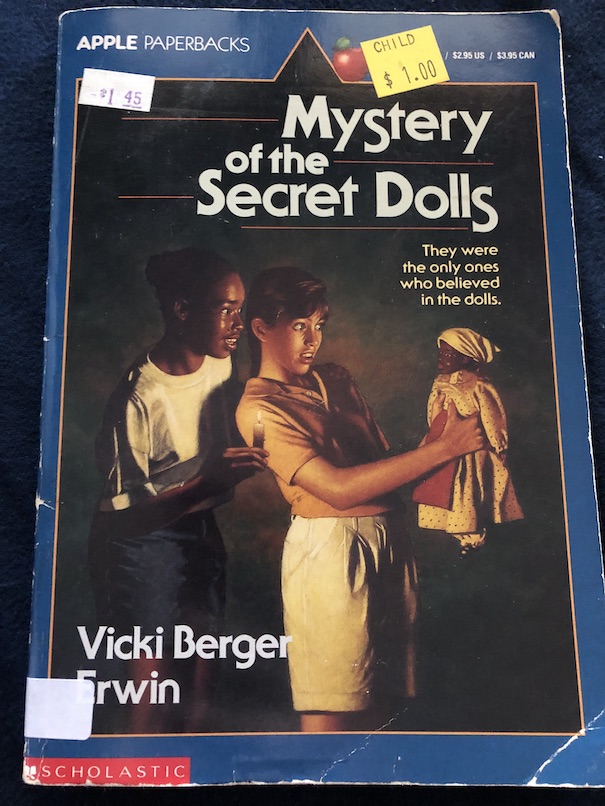
Mystery of the Secret Dolls

Mystery of the Secret Dolls Cover

Mystery of the Secret Dolls by Vicki Berger Erwin, 1993.

Bonnie Scott is visiting her great-aunts, Nell and Mollie, in Callaway County over the summer. Aunt Nell invited her to come and help set up her new doll museum, but Bonnie also wants to take advantage of the trip to work on a project about family history. Aunt Mollie has a restaurant, and Bonnie wants to talk to her about old family recipes that she uses and make a book about them. Unfortunately, when Bonnie arrives in her aunts’ town, she learns that Aunt Mollie has closed her restaurant and is helping Aunt Nell with her doll museum. From Bonnie’s awkward arrival, when no one comes to meet her at the bus stop and Marc, the grandson of the local doctor, Dr. Allen, has to help her find her way to her aunts’ house, she begins to see that things aren’t quite what she thought they were in her family and in her aunts’ town.

The reason why no one came to meet Bonnie is that Aunt Nell accidentally injured herself when she fell off a table she was standing on in order to change a light bulb. She broke her leg and had to go to the doctor. Now that Aunt Nell is in a wheelchair, she says that she will especially need Bonnie’s help, although Aunt Nell and Aunt Mollie also have a young black girl, Lynette Key, staying with them and helping out. Lynette is the daughter of an old family friend, and her family’s history is intertwined with Bonnie’s family. Through her aunts and Lynette, Bonnie comes to understand a little more about her family’s history with dolls and the relationship between Aunt Nell and Aunt Mollie.

Aunt Nell is the older of the two sisters, and she’s been bossing Aunt Mollie around for years, and she’s apparently the one who convinced Mollie to close her restaurant and help her with the doll museum project. The old family home belongs to both of them, although Mollie lived in another house while her husband was still alive. Now that both women are childless widows and Mollie has moved back into the family home, Nell has gone back to her old ways of bossing Mollie around. Bonnie is alarmed when Mollie reveals that there has been a break-in, vandalism, and a fire, apparently deliberate, at the museum, and she thinks that Nell should put off the opening, but Nell is trying to ignore the situation and charge ahead with the project, dragging Mollie and Bonnie with her. The aunts are going to have a security system installed at the museum.

Aunt Nell says their family, the Scotts, have made dolls for about 150 years. She shows Bonnie her doll collection, including the portrait dolls, startlingly realistic dolls made of every member of their family, including Bonnie’s ancestors, like her great-great-great-grandfather who fought for the Confederacy during the Civil War. Aunt Nell apparently strongly identifies with the South and Confederacy because she keeps trying to blame the troubles at the museum on “some Yankee.” Not in a specific sense and not necessarily with any particular person in mind (although there is one person who is also labeled as a Yankee who is a suspect for awhile), it’s more that she just generally associates Yankees with bad stuff, and she says that she hopes that Bonnie hasn’t turned into a Yankee from living in a big city like St. Louis. Although the dolls belong to both of the sisters, Aunt Nell really thinks of the dolls as being hers, and she’s determined to make Bonnie’s family history project about the dolls, whether Bonnie wants it to be or not. Aunt Nell says that Lynette’s grandmother used to work for her, making dolls, and she’s pleased that Lynette shares her interest in dolls, but Lynette privately tells Bonnie that the situation goes deeper than that.

As you might have guessed, Aunt Nell’s mental version of history, including the history of her own family, isn’t entirely accurate. Marc lends Bonnie a history book about the area written by his grandfather, but Lynette tells Bonnie not to let Aunt Nell see it because she and Dr. Allen have very different views about history, and Dr. Allen is a “Yankee.” Bonnie asks her what she means by that, and Lynette says that the Scotts have never gotten over being on the losing side of the Civil War. Dr. Allen, by contrast, believes that the Civil War turned out just fine with the South losing, which makes him a Yankee. It matters because Aunt Nell’s interpretation and attitude toward the past is affecting life in the present.

Although Aunt Nell is mentally on the side of the Confederacy, she doesn’t say anything in support of the idea of slavery and doesn’t seem to have bad feelings about Lynette being black. Nell is actually very fond of Lynette, treating her almost like a young niece, and I suspect that Nell probably mentally replaces the word “slave” with “servant” in her head, as some of the other characters in the book do until Lynette reminds them that there’s a difference and it matters. Nell’s attachment to her family’s grand history (which may not be quite what she makes it out to be) and her feeling that the doll-making business must pass to a blood relative keep her from fully seeing the potential that Lynette has to continue the doll-making traditions that their families both share, something that Lynette really wants to do.

Lynette says that women in her family have worked for the Scott women for generations, making dolls. They were originally slaves belonging to the Scott family, and they even shared the same last name because slaves were sometimes given the surnames of their masters. (In my home town, I’ve met black people with the surname White, which might seem a little odd and contradictory, but this is the probable reason why they have that last name.) Some slaves changed their last names after Emancipation, but not all. Lynette says that even after her ancestors were freed from slavery, one of her ancestors, Rosa, chose to keep the last name Scott because of her connection to the doll-making business.

Lynette points out a section in Dr. Allen’s history book about the Scott dolls having a connection to the Underground Railroad because some of them seemed to have been used as signals for escaping slaves. Margaret Scott, an ancestor of Bonnie’s, used to make black dolls, each with a distinctive little red heart sewn on the chest, and after she made one, a slave would mysteriously disappear. She eventually had to stop doing it because people in the area were getting suspicious of her and put pressure on her to stop. In fact, Lynette says Margaret’s own father, the Confederate colonel, tried forced her to stop, saying that he’d close down her doll-making business if she didn’t, but that Margaret and Rosa actually continued making the black dolls in secret, something that Aunt Nell doesn’t believe. The history book notes that the dolls are rare and valuable collectors’ items. Lynette says that Aunt Nell only has one of these black dolls, and she keeps it locked up for safe-keeping, denying that there even are others, but Lynette is sure that there are more, possibly hidden somewhere. Lynette wants to find these dolls, not only because they are valuable but because they can help prove her family’s connection to the Scott doll-making business. Lynette says that her ancestors never got the credit for the beautiful dolls they made because they were only ever slaves or employees of the Scotts, and the entire doll business was in the Scott family name.

Lynette wants to become a doll maker herself, but Aunt Nell really wants Bonnie to take over the family tradition, even though Bonnie has never really been interested in dolls and would prefer to talk cooking and recipes with Aunt Mollie. The realistic dolls portrait dolls actually kind of give Bonnie the creeps, but Lynette has a sentimental attachment to them because she’s been around them all her life, since her grandmother was a doll maker. Once Bonnie understands the history between her family and Lynette’s and Lynette’s doll-making ambitions, she sees why Lynette seemed a little cold to her at their first meeting, but she isn’t interested in learning the doll business or competing with Lynette to be Aunt Nell’s successor. Even though Aunt Nell is bossy and doesn’t understand Lynette’s deep desire to be a doll maker and continue the Scott doll-making business, Lynette kind of likes her and wants to show her that she is just as attached to the doll-making traditions as she is. Lynette and Bonnie make a deal that Lynette will help Bonnie get the recipes she wants from Aunt Mollie if Bonnie will talk to Aunt Nell about the black dolls and try to get more information about them.

Bonnie thinks that hunting for the long-lost dolls sounds exciting. It occurs to her that the valuable dolls might be the reason why someone broke into the doll museum. The aunts’ old house is spooky, right next to a graveyard, and on Bonnie’s first night there, someone leaves Margaret’s portrait doll (which looks a great deal like Bonnie) in Bonnie’s room with a note that says, “Don’t believe everything you hear.” What does the note mean? Who left the doll, and is it connected to the other strange things happening around the doll museum? Is someone trying to scare Bonnie? Are the missing black dolls still somewhere nearby, and can Bonnie and Lynette find them? What is the real truth about the dolls and what happened in Callaway years ago?

The book is available to borrow and read for free online through Internet Archive.

My Reaction and Spoilers

Although this story doesn’t quite deal with racism in the sense of people hating other people because of race, there is a lot in here about the nature of prejudice, on several levels. Aunt Nell has many preconceived notions about her family and how things in her family ought to be. She assumes from the beginning, when Bonnie contacts her aunts to talk about family history, that Bonnie will do her project about the dolls and the family’s doll-making history and that Bonnie will help her with her doll museum and eventually take over the dolls from her. Aunt Nell started out their relationship with a lot of assumptions, and her assumptions about Bonnie have blinded her to the possibility that Lynette could be the successor to the doll-making business and doll museum that she really wants because they share a common love of dolls and skill in making them. Lynette has already started learning the doll-making business, first from her grandmother and then from Nell, because she loves it, and she is willing to work at developing her skills. She has a similar vision to Nell about the doll business and museum, and the two of them get along well, in spite of Aunt Nell’s bossy personality. It’s only Aunt Nell’s narrow vision of family and sense that the doll-making business should pass to family that keep her from considering the possibility at first. Meanwhile, Bonnie and Mollie are both being forced to go along with Nell’s plans because of what Nell thinks they should do as family, while they both have very different interests and would like the freedom to pursue them. Aunt Nell also has been assuming many things about her sister Mollie for years.

Over 100 years earlier, Margaret Scott also belonged to a family that did not share her interests and her vision of the future. Although she used slave labor in building her doll-making business, she and Rosa found a way to use their craft to help escaping slaves. The Scott family took pride in the doll-making business for generations, but there were sides to Margaret and the dolls that they didn’t understand and appreciate. Before the end of the book, Aunt Nell comes to understand that their family has more variety than she had ever considered and that her goals might not be everyone’s goals.

The ending of the story makes sense and is realistic, but I’ll admit that there were a couple of points that I might have clarified or done differently if I had written the ending. Sometimes, when I’m not entirely satisfied by the ending of a book, I like to say what I would have changed about it, but it’s difficult to do that here without giving too much away. Part that I can say is that I wished that Nell and Mollie had thought of more creative ways to combine their separate interests, like how Bonnie’s final family history project ends up being a combination of both – a cookbook of family recipes, illustrated with pictures of the portrait dolls that represent the people who invented or enjoyed the different recipes. In fact, a cookbook of historical recipes with pictures of historical dolls sounds like a book that many people would actually be interested in buying if they published it professionally and even sold copies through the doll museum, and I found myself wishing that one of the characters would mention that before the end of the book.

The story ends with the impression that Lynette will keep working with Nell and the dolls because, while Bonnie says that she’ll come back and visit, she doesn’t have the interest in doll-making that Lynette does, but I also kind of wished that they would clarify more definitely that Lynette would be continuing the doll-making business. The girls are young yet, so maybe they didn’t feel the need to decide their futures definitely, and it’s enough just to show that’s how things are looking at the end of the book. I had half expected that it would turn out that Lynette and Bonnie are actually related because sometimes slave owners did have children with their slaves, and I suspected that one of the Scott family secrets might have been that Rosa was actually a blood relative and that was part of the reason why she was so close to Margaret and why she kept the Scott family name. The story doesn’t bring up that possibility, focusing on a different secret relationship instead, but I’m still keeping it in mind as a private theory. I like the idea because, if it was true, then it would strengthen Lynette’s ties to the doll-making business she loves, and I think that Nell would appreciate the idea of bringing her more fully into the business as a relative. But, perhaps it’s enough that they just both share the same interest in life
The Day of the Ogre Kachinas

The Day of the Ogre Kachinas by Peggy D. Spence, 1994.

My Dog, Betty

First, I would like to apologize for the cover picture above. This book was in better condition when I first got it. Then, I accidentally left it where my dog could play with it. Oops. She greatly enjoyed this book, which was printed on high-quality and apparently tasty paper, and thought it was a lot of fun, although she found it very difficult to get through. In fact, she did not get past the cover. (Thank goodness.) I enjoyed it much more.

The story is set in a Hopi town in Arizona (my home state!) and features Hopi traditions about kachinas. The introduction to the book explains a little about kachinas, which are spirits that represent concepts in the natural world. In Hopi ceremonies, men dress up as these spirits and dance or act out certain rituals. The ritual in this book is that of the Ogre Kachinas, which is meant to influence children’s behavior, teaching them what their community views as right and wrong and letting them know when they have overstepped the boundaries of their community. (I don’t know if eating the cover of a book counts as overstepping, but I promise that no doggies were harmed or even frightened as part of this book or the reading of it.)

Judson Honyouti, a young Hopi boy, is not a bad kid, but sometimes, like many other kids, he does things that he shouldn’t do. Sometimes, he forgets things or loses his temper and fights with people. His parents and the other adults in his village try to teach him the right things to do, but sometimes, he needs a little extra help to remember.

Judson is nine years old, and he knows that when he sees kachinas in a ceremony, it is only some of the men in his village, wearing costumes. He hopes that when he is old enough, he may become one of the kachina dancers himself, but for that to happen, he must follow his people’s ways and be a good member of his community. To be a good member of his family, Judson helps his father to take care of their cornfield and helps to look after his little sisters, but he still sometimes gets into trouble.

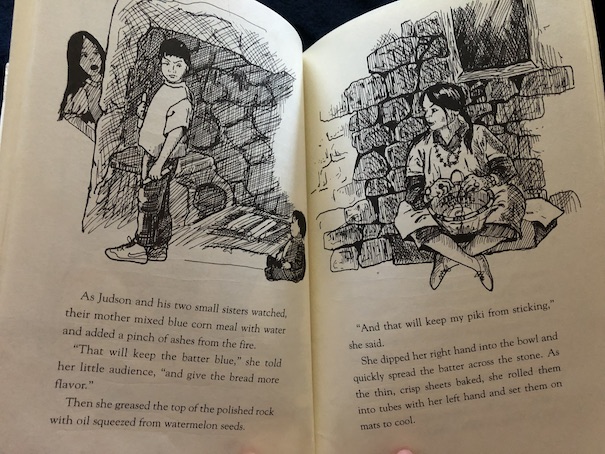
One day, Judson falls asleep while tending his family’s sheep, and most of them wander off. His father has to help him find the sheep again. Then, when his mother asks him to take some stew to his grandfather, Judson drops the bowl because he is playing and not paying attention. To make up for losing the stew, Judson gives his portion to his grandfather. Then, when Judson is supposed to be helping his mother to make piki (or paper bread) so that she can use it to trade in the market, Judson gives into temptation and eats too much. He has to help her make more.

In the market in the plaza, the Ogre Kachinas (really, men dressed up in costume), frighten the children and warn them that they must obey their parents. The Ogre Kachinas like to eat naughty children (but not really), and they say that they will return again soon to see if the children have been good. If they have been bad, the Ogre Kachinas might carry them away!

Even though Judson knows that the Ogre Kachinas are just human beings, their warnings worry him because he knows that he has been doing things wrong and has been getting into trouble. In spite of Judson’s attempts to do better, he still keeps getting into trouble. He fights with his sisters and even hits two other boys when he gets into fights at school. His father warns him that the ogres might come for him if he doesn’t behave, and sure enough, the Ogre Kachinas come one night.

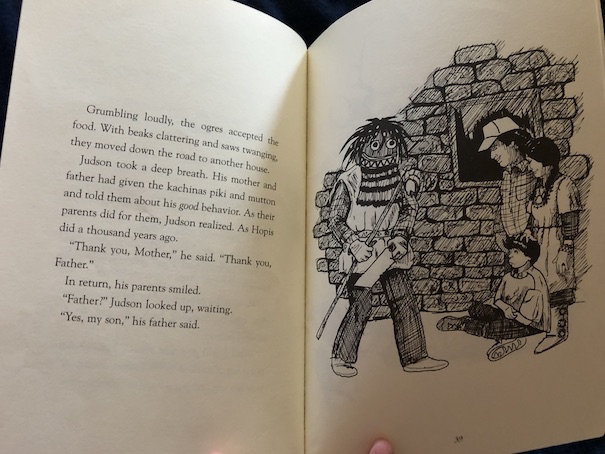
The Ogre Kachinas dance around Judson and his parents and confront Judson with their knowledge of all of the things that Judson has been doing lately. They threaten to take Judson away and eat him because they like to eat bad boys! Even though Judson knows that the kachinas are just ordinary humans in disguise, it’s an alarming performance! However, as part of this tradition, Judson’s parents speak up for him and tell the Ogre Kachinas to leave Judson alone.

It’s true that Judson has done things that he shouldn’t have done, but in many cases, he also did something to try to make up for what he had done wrong, like when he gave his portion of the stew to his grandfather to make up for the portion that he had ruined. He gets into trouble, but he is also polite and helpful in many ways. His parents say that he is actually a good boy and would make the ogres sick if they tried to eat him. Judson is relieved to hear that his parents love him and value the good things he does, even when he isn’t perfect. The Ogre Kachinas not only remind children of what they are not supposed to do but provide an opportunity for the parents to explain that they value their children and what the children do right. As Judson’s parents give the kachinas gifts of food and send them away, Judson realizes that their parents must have done the same for them when they were children and that the same thing has also happened for all Hopi children for generations.

I like books that include a little history and interesting information about cultural practices, but I also like this book for its understanding of human nature. First, I grew up in Arizona (in the American Southwest, for those who live outside of the United States), where this story is set. Although I am not Native American and didn’t grow up on an Indian Reservation, like Judson, I knew about Kachinas and was fascinated by them when I was growing up. I read books about Kachinas, and I loved the display of Barry Goldwater’s Kachina doll collection at the Heard Museum when I was a kid. I used to remember more of the individual names of different kinds of Kachinas and could point out the different ones in the Goldwater collection, but I’ve forgotten some of them as an adult. These things slip away if you don’t reinforce them. The book describes how Kachinas function in Hopi culture. There are different kinds that perform different ceremonial functions, but the main ones in the story are the Ogre Kachinas, which are meant to help frighten children into good behavior.

The need for both positive reinforcement and negative reinforcement is a real part of the human condition. Negative reinforcement has a bad reputation in modern times for making people feel scared or ashamed, and I think that it isn’t enough to have just negative reinforcement (punishment or criticism for things that a person has done wrong) or just positive reinforcement (praise for doing things right) by itself; I think they function best as a pair, the way they do in this story. It isn’t enough to just tell people what not to do (negative reinforcement) because it often leaves them wondering what they should have done instead, and it’s not enough to just give them praise with no criticism because it leaves them with the feeling that they do nothing wrong, and they’re often surprised later when they find out that things they’ve been doing have been seriously getting on everyone’s nerves all along. I think an over-reliance on positive reinforcement alone is part of the modern phenomenon where people don’t realize that they’ve been acting like bullies or saying really inappropriate things for years because, somehow, no one clued them in earlier in life. I’m pretty sure that I know why that is: it’s difficult to be the bearer of bad news or criticism that someone has gone too far with their behavior, to play the role of the disciplinarian, the “rules police” who has to stop the game to tell someone they’re not playing right. In an odd sort of way, the Ogre Kachina costumes probably make it easier for the elders of the community to dish out the criticism and discipline because they’re not quite doing it as themselves; they’re doing it in disguise as the horrible “ogres.”

To help people understand how they’re really supposed to behave in society, they need to know both what they’re not supposed to do and what people really want them to do instead. Judson gets both kinds of feedback in the story during the Ogre Kachina ceremony. First, he is confronted by what he has done wrong, and then he gets to hear his parents explain what he has done right in order to emphasize both what they love about him while helping him to realize what he needs to fix in order to be a better person in their society. Having a child confronted by scary ogres that threaten to eat him for doing things wrong sounds pretty scary, but the book does note that Judson is old enough to know that the Kachinas are just people in costume. Even though he’s kind of scared at being confronted by them, and for a moment, he does feel like they’re really threatening to eat him, he is aware that they are not what they appear to be and realizes that it’s all part of the ceremony. It also means that he is old enough to accept the rebukes as the consequences of their behavior, and he finds his parents’ praise of his good deeds as a motivator to do even better next time, not as an excuse for the things he did wrong.

By the way, Betty the dog was not punished for eating the book cover. I just took the book away from her and gave her a toy she could chew on instead. She is a good doggy, and I should not have left the book where she could get it. Bad Tracy!

The book is available to borrow for free online through Internet Archive.

Ghosts, Witches, and Things Like That

GhostsWitchesThings

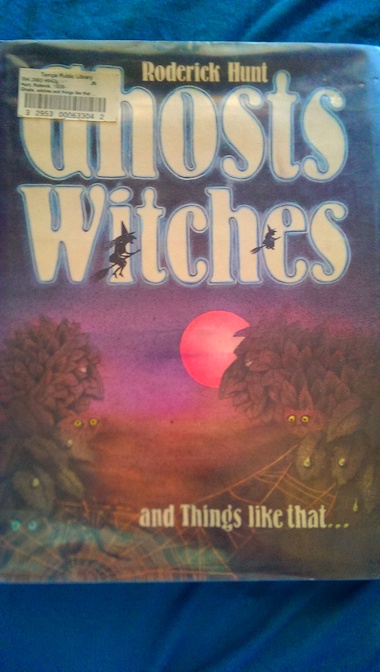
Ghosts, Witches, and Things Like That by Roderick Hunt, 1984.

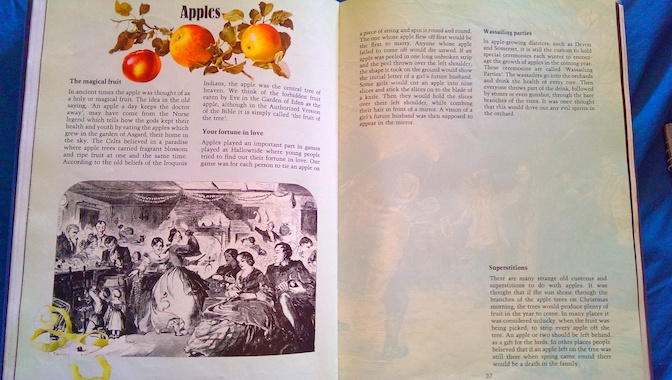
This is a collection of information about the history of Halloween and other things related to Halloween, like folklore, games, recipes, crafts, and poems.  There are sections about specific topics, starting with the section about Halloween itself (spelled Hallowe’en, this is a British book).  The section about Halloween talks about the origins of the holiday and has tips for holding a Halloween party, including how to make costumes and decorations, the rules for games to play (including some old traditional games), and recipes for various Halloween treats.

Other sections of the book focus on various monsters and mythical creatures associated with Halloween, such as witches, ghosts, fairies werewolves, and vampires.  There is a section of ghost stories and some fascinating historical information about spiritualists and how people have faked ghosts in the past, including the Pepper’s Ghost illusion that is still used in the haunted house in Disneyland.  The sections about witches, fairies, and monsters also include a mixture of history and folklore along with some jokes and poems about the various creatures.

GhostsWitchesHistory

This is a fun book to read around Halloween.  It’s a mixture of historical background, folklore, party-planning tips, games, and recipes.  I think that the information about traditional games is still my favorite part.

GhostsWitchesApples

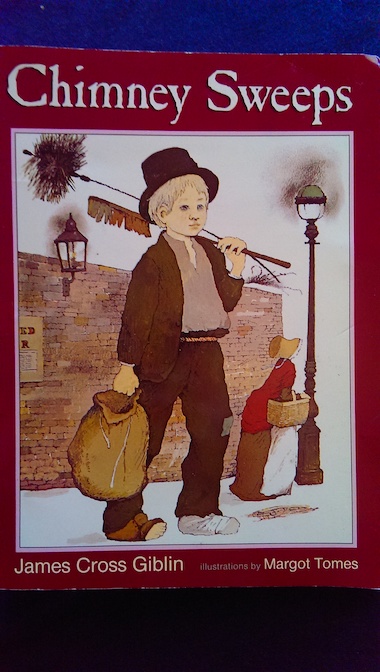
Chimney Sweeps

ChimneySweeps

Chimney Sweeps by James Cross Giblin, 1982.

This book explains about the history and traditions of chimney sweeps. I love books that cover odd topics from history like this!

It starts by explaining the origins of chimneys in the Middle Ages. Before they were invented, people would have to have simple holes in the roofs of their houses to let out smoke from heating and cooking fires, or they would have had to rely on windows or doors to perform the function of venting smoke. Chimneys vent smoke more efficiently, but the more they are used, the more soot collects inside them, and they need to be cleaned out from time to time. If they aren’t cleaned, the build-up inside could either block air from getting to the fire in the fireplace, causing the fire to go out sooner, or it could pose a fire risk because the build-up inside the chimney is still flammable. Sometimes, home owners could clean their own chimneys, if they weren’t very tall, but the taller the chimney is, the more professionals are needed to clean it.

ChimneySweepsAdult

Modern chimney cleaners have vacuums that they can use to clean soot out of a chimney, but originally, people were basically relying on brushes. The book explains the evolution of the profession and variations in the profession between England, Germany, and the United States. Germany is significant to the profession because it was one of the first places where chimney sweep became a recognized profession and there were laws even in the 1400s that all chimneys had to be cleaned twice year. (Remember that chimneys that haven’t been cleaned can be a real fire risk, posing a danger not only to you but your neighbors, especially during a time when most buildings are made of wood and other highly flammable materials.) When chimney sweep became a recognized profession during the Middle Ages, members of the profession formed a guild (as was traditional for different professions in general during the Middle Ages) and established rules and standards for the profession. One of the responsibilities of a guild was to decide on the training and qualifications that the profession requires, and in the case of chimney sweeps, the only way to learn was by serving an apprenticeship. The apprentice would live with a master sweep for three years, learning the trade, and at the end of his training, he would have to prove that he could clean a difficult chimney all by himself with thoroughness and reasonable speed.

There are many traditions and superstitions that came to surround the profession of chimney sweep. One of them that you can still sometimes see even in modern times is the image of the chimney sweep in a top hat. The exact reasons for adopting a top hat and tailcoat as part of their uniform are uncertain, but it began back in the 1500s in Europe. The sweeps often got their top hats and tailcoats as secondhand clothing from undertakers (yes, really). Part of the reason for wearing them might have been as an effort to look professional, but the color black was also suitable for a person who was going to end up covered in soot. According to superstition, the top hat would help to protect the chimney sweep from falling when he was on the roof of a house. Chimney sweeps were often thought to be lucky because their jobs were dangerous, yet they survived.

ChimneySweepsChild

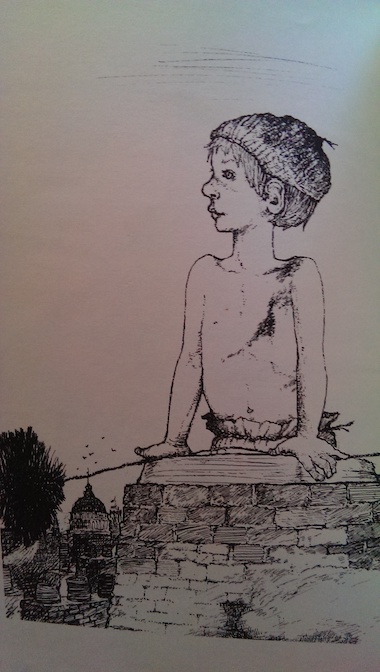
However, chimney sweeps’ lives and work were often hard. In 18th century England, their jobs became more difficult because chimneys were purposely being built in narrow, crooked zigzags. The idea behind the crooked chimneys was that they would keep more heat in, but that made them much harder to clean. Because brushes couldn’t make it around the bends of these chimneys and adults couldn’t get into the narrow flues, sweeps became reliant on young boys to climb up into them and clean them by hand. Although the law required boy apprentices to be no younger than eight years old, many sweeps used boys as young as four or five. Sometimes these boys were official apprentices with the permission of their parents (typically from poor families with many children) or even the sweep’s own children (sometimes, they used their daughters because girls were often smaller than boys). If they couldn’t get children any other way, sometimes sweeps would get children from orphanages or might even resort to kidnapping.  The author of this book includes a short story about what a day in the life of a child chimney sweep was like.
The plight of child chimney sweeps came to light during the early 19th century, when people were starting to become concerned about child labor of all kinds. At first, there was strong opposition to banning child chimney sweeps and using new cleaning devices because the adult chimney sweeps saw it as a threat to their livelihoods and home owners were worried that new methods would be more expensive for them (of the two, I think I’m more offended at the home owners’ attitudes because of the implication that they were more upset about a possible slight increase in expense than the risk to the lives of the children they knowingly endangered).  Many of the child chimney sweeps suffered severe and permanent health problems because they were forced to do this kind of work at an early age, while they were still growing, and because they inhaled and were covered with soot for such long periods.

In the back of the book, there is a poem by William Blake called “The Chimney Sweeper,” which was published in Songs of Innocence in 1789. Knowing the risks to young children, like the little boys in the poem, makes the poem seem pretty disturbing, which may actually be the author’s intention.  Eventually, after long years of struggles in which children were still exploited in chimney sweeping spite of regulations against it, in 1875, Parliament tightened regulations against child labor even further, forcing chimney sweeps to apply for licenses in order to practice their trade, listing each of their apprentices and their ages.

Chimney sweeping in American history was a little different from the way things were done in Europe. The American colonists sometimes tried some strange tactics for cleaning their chimneys. One of the oddest methods was to tie a rope to a goose’s feet and lower it down the chimney. The goose would become frightened and flap its wings, thus knocking the soot loose. When the job was done, the home owner would pull the goose out of the chimney and wash it off. Another tactic was to actually burn the excess soot out of the chimney, although there was a risk of simply setting the house on fire. Later, American cities had official chimney sweeps who were licensed and regulated. On Southern plantations, slaves were used as chimney sweeps, and some of them continued to work as chimney sweeps after they gained their freedom.

Later, when homes began to be heated by other sources than fireplaces, chimney sweeps were in less demand, although there was increased demand in the 1970s, during the energy crisis, because people started using their fireplaces more instead of relying on other heating methods that involved scarce or expensive fuel. Chimney sweeps can also perform other duties beyond simply cleaning chimneys, depending on where they live. For example, in Germany, sweeps perform inspections of factories and homes to make sure that they are using fuels efficiently, looking for sources of needless pollution, which can lead to fines for the owners of the buildings if the problems are not corrected. Some people might also become chimney sweeps as a seasonal part-time job, while they also have another career.

The book is available to borrow and read for free online through Internet Archive.

Happy Holidays

HappyHolidays

Happy Holidays and Other Fun Days Around the Year by E. C. Reichert, illustrated by Suzanne Bruce, 1953.

This book explains a little about the origins of various holidays and how they are commonly celebrated.  It was written during the 1950s, and the illustrations clearly show it in the style of the people’s clothes.  The style of one of the illustrations is one of the charming aspects of the book.

For each holiday in the book, different children talk to their parents or friends about what different holidays mean and how they are planning to celebrate.  Many of the explanations are rather simplistic, and I’ve seen books that explain the history of holidays better, but I have some nostalgia for this book because I read it and liked it when I was a young child.

The Holidays:

New Year’s Day — January 1

Sandra talks to her parents about what they’re going to do on New Year’s Day, and her mother explains the purpose of New Year’s resolutions.

HappyHolidaysNewYear

Valentine’s Day — February 14

Sally and Billy open valentines they’ve received and talk about Saint Valentine and other Valentine’s traditions.

Washington’s Birthday — February 22

Stevie’s father tells him about George Washington and the famous cherry tree story.

St. Patrick’s Day — March 17

Rickey’s friends explain to him why they’re wearing green on St. Patrick’s Day and his mother tells him a little more about the holiday and what shamrocks are.

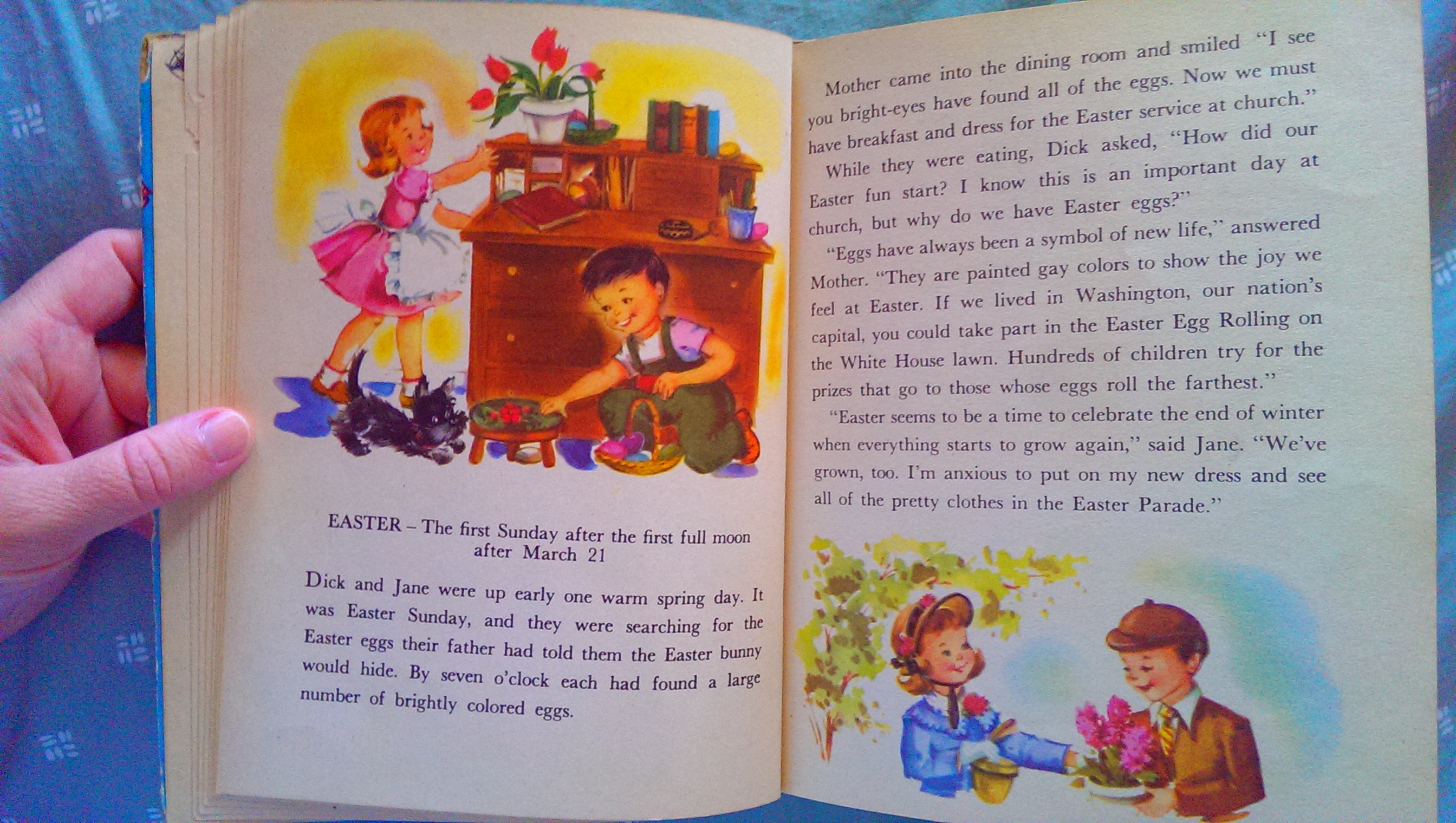
Easter — The first Sunday after the first full moon after March 21

Dick and Jane (not the Dick and Jane from school readers, but yes, those names) hunt for eggs on Easter.  They don’t explain the religious reasons behind the holiday, but they talk about popular Easter traditions, like colored eggs and the Easter Egg Rolling at the White House.  Congratulations to the book for explaining how to calculate the date of Easter!

HappyHolidaysEaster

April Fool’s Day — April 1

When Artie plays a practical joke on Kathy, their father explains the tradition of April Fool’s Day.  (My parents wouldn’t have let my brother give me fake candy because of the choking risk.  Just saying. Actually, I never celebrated April Fool’s Day as a kid because both of my parents hated practical jokes because they both resented jokes their parents played when they were kids, coincidentally around the time this little book was published. My knowledge of April Fool’s Day as a kid came from this book and from things I heard at school.)

Independence Day — July 4

Susie and Johnny go to a parade, have a picnic, and watch fireworks on the Fourth of July.  Their father explains the significance of the holiday.

HappyHolidaysIndependenceDay

Columbus Day — October 12

Miss Nelson’s class at school learns about Christopher Columbus.  (This holiday isn’t celebrated as much today as it was when this book was written. I have to admit, I wasn’t that enthusiastic about it as a kid, either. Columbus Day had no costumes, candy, or presents, and I didn’t get the day off school, and thus, it seemed pretty boring to me when I was young.)

Halloween — October 31

Robin and Judy come back from trick-or-treating, and their mother explains a little about the origins of the holiday.

HappyHolidaysHalloween

Armistice Day — November 11

Terry and Jimmy watch a parade, and their father explains that November 11 was the day that World War I officially ended in 1918.

Thanksgiving Day — The fourth Thursday in November

Ann and Johnny (a different Johnny from the earlier one, I think they either forgot they’d used that name or just couldn’t think of another – they could have called him Jack to be a little different) have dinner with their family at their grandmother’s house.  Johnny talks a little about what he learned in school about the pilgrims and the first Thanksgiving.

Christmas — December 25

Tim and Debbie hang up their stockings, and their mother tells them that it’s Jesus’s birthday and explains the origins of some Christmas traditions.

HappyHolidaysChristmas