American Girls

Happy Birthday, Molly! By Valerie Tripp, 1987.

Molly is excited because she has just learned that an English girl will be coming to stay with her family for a while. The girl, Emily, is one of the child evacuees from London. Really, she’s supposed to be staying with her aunt, who also lives in Molly’s town, but her aunt is in the hospital with pneumonia and won’t be able to take her for another couple of weeks. In the meantime, Molly and her friends are eager to meet her, imagining her to be something like the English princesses, Elizabeth and Margaret Rose.
The girls have a fascination for England after all the things they’ve seen in movies and newsreels. Recently, they saw a newsreel about bomb shelters in England. Inspired by what they’ve seen, the girls make a pretend bomb shelter under an old table and enjoy pretending that they are like the people in the newsreel. Molly’s brother, Ricky, says that it isn’t very realistic, and the girls say that they’ll have to ask Emily when she comes.

However, Emily turns out to be very shy and quiet. She’s pale and skinny and hardly talks at first. When the girls show her their “bomb shelter”, she doesn’t want to play in it. Molly thinks that maybe Emily doesn’t like them, but her mother reminds her that, in World War II England, bomb shelters aren’t places to play. Emily is the same age as Molly, and the war has been going on since she was a little kid. Molly’s mother points out that Emily probably doesn’t remember much about life before the war. Emily is accustomed to bombings and danger all around her, and Molly’s mother compares her to a flower “who’s not sure it’s spring yet. It will take some time for her to realize it’s safe to come out now.”
Emily goes to Molly’s school, and their classmates are fascinated with her. This fascination makes Emily even more shy than she would be otherwise as kids try to imitate her accent and ask her questions about what it’s like to see buildings bombed. To the America kids, the war seems exciting, and they want to know what it’s like to see it up close, but Emily dodges their questions.
Molly finally comes to understand why Emily is so evasive when their town has a blackout drill. When the drill starts, a siren sounds, and everyone has to go down into their basements until they get the signal that it’s all clear. Molly is surprised to see that Emily is actually frightened by the drill, but everyone assures her that it’s just for practice, not because Illinois is actually going to be bombed. In Molly’s family, it’s almost like a game, but Emily has memories of real bombings during the Blitz. As they sit in the basement during the drill, Emily explains it to Molly: the fear, the explosions, destroyed buildings, people getting hurt or killed. Molly and her friends thought it was exciting to hear about the war in newsreels, but living it is an entirely different thing. The drill and everyone’s questions about what bombings are like bring back bad memories for Emily.
As Molly comes to understand Emily’s feelings more, Emily opens up to her. The girls discover that they share a fascination with Princess Elizabeth and her sister Margaret Rose. They start playing a game where they pretend to be the princesses, dressing alike in blue skirts and sweaters. Because the princesses have pet dogs, the girls also pretend that they have dogs, using jump ropes as leashes for their imaginary pets.
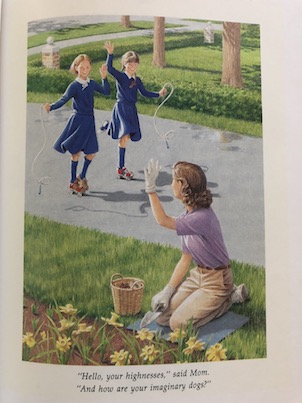
Molly’s birthday is approaching, and she offers to let Emily share in her party and help plan it. She’s curious about what people in England do on their birthdays, and the idea of an English tea party sounds great to her friends. However, Molly doesn’t like the way that Emily describes English birthdays, and the types of sandwiches that the English tea with tea don’t sound very good. Worst of all, Emily says that, at her last birthday before the war rationing started, she had a lemon tart instead of a cake. Molly can’t imagine her birthday without a birthday cake. Mrs. Gilford, the housekeeper, has been saving up rationed goods for her cake this year, and it’s what she’s been looking forward to the most!
Sharing things with Emily becomes more of a trial for Molly, and when the girls argue about their countries’ contributions to the war effort, they get into a fight and Molly starts thinking that she doesn’t even want Emily at her birthday party. However, Molly’s mother points out to the girls that the war effort is a team effort. A couple of special birthday surprises help the girls to make up, including something extra special that helps Emily to heal further from the trauma of the war.
In the Molly, An American Girl movie, Emily plays a larger role than she did in the books. This is the only book in the series where Emily appears. Her story was changed somewhat for the movie, too. In the movie, she says that her mother was killed in a bombing. In the book, her parents are both still alive, and it was her dog who was killed. Molly doesn’t learn that until the end of the book when her family gives the girls a pair of puppies as a present, and Emily tells her about her pet dog who died.
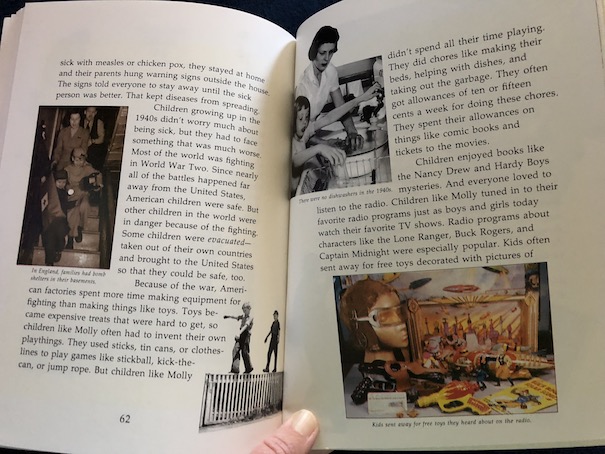
In the back of the book, there’s a section with historical information about what it was like to grow up in the 1940s. It explains how women used to stay in the hospital for about a week after giving birth, and sometimes, they could hire a practical nurse to help them at home as well. Canned baby food was a new invention, and vaccines helped to prevent disease. Back then, people still got smallpox shots because the disease hadn’t been eradicated, but there was still nothing to prevent chicken pox or measles, so children with those diseases had to be kept at home with warning signs out front to tell people to stay away from the quarantined house. (Note: My father was born in 1944, the year that this series takes place, and he said that throughout his early childhood, parents who knew of a child who had chicken pox would deliberately take their children to visit and get the disease. It wasn’t that they really wanted their children to get sick, but since there was no way to prevent the disease at the time, they had to accept that it was inevitable that their child would catch it eventually, and chicken pox is somewhat peculiar in that there is a kind of age window in which the disease isn’t likely to be too bad. If you waited too long, and the child got older or even to adulthood without getting it, it was bound to be much worse when they eventually caught it. So, if your child was about the right age for getting it, in early childhood but no longer a baby, people thought it was best to get it over with so they could benefit from the lifetime immunity afterward. This remained true even up through the 1980s, my early childhood, which is why I have a permanent scar on my face from the disease. Now, there are vaccines to prevent it, although I understand that some people still have chicken pox parties in places where the vaccine isn’t readily available. If you have the option, go for the vaccine. Preventing chicken pox also prevents shingles.)
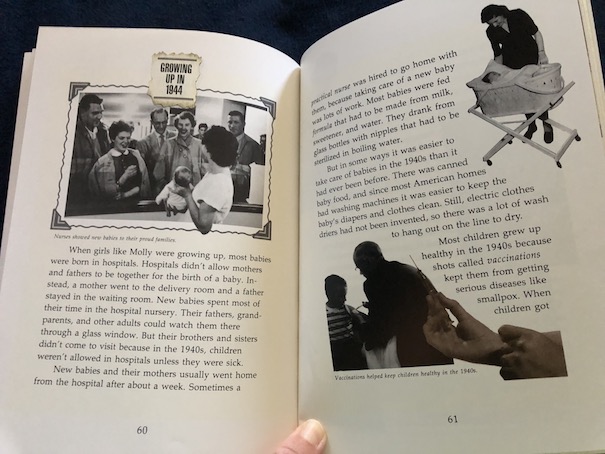
The historical section also talks about child evacuees, like Emily, and what teenagers did during the 1940s. It was around this time that people began looking at the teenage years as being a distinct phase of life, and businesses began specifically catering to teenagers.
The book is currently available online through Internet Archive.




 In 1944, everyone is concerned with finding ways to help the war effort. In Molly’s third grade class at school, her teacher announces that their class is invited to participate in the Lend-a-Hand contest. The class will be divided in half, and each half will compete against the other to find the best way to help the war effort. The class decides to make the contest boys against girls, and Molly immediately starts trying to figure out a spectacular idea that will impress everyone. Unfortunately, one of the other girls says that the girls in class should knit socks for soldiers, and the teacher accepts that as the goal for the girls’ team, before Molly can say anything.
 Molly is appalled at the idea of knitting socks. It’s partly that she had wanted to be the one to come up with the best idea, and it’s also partly because she has tried knitting before, and she knows that socks are difficult, time-consuming projects, especially for beginning knitters. Molly is sure that the other girls are going to find it too difficult and that, in the end, they’ll have nothing to show for their project. Her friend Susan doesn’t think that the project sounds so bad, but Linda also dreads the idea of knitting because she’s not very good at it. Talking it over in their secret hideout in the storage area of Molly’s garage, the three girls decide that they’ll work on a secret project by themselves, something that will save the day when the other girls’ project falls through.
 The other girls are certainly a lot more comfortable, knitting inside. However, as Molly predicted, they are finding their project harder than they thought it would be. None of them has completed an entire sock yet; all they really have are the square shapes at the top of the sock, and they’re getting discouraged. That’s when Molly gets a better idea: why not take the squares they’ve made and turn them into a blanket? Simple squares are much easier to make than socks, they can make a lot of them quickly with everyone helping, and the girls who can’t knit well can sew the squares together. A blanket is still a good war effort project because Molly’s father has told her that the hospital where he works is always in need of blankets for the wounded soldiers. With this new idea, the other girls become much more excited, and they make more progress.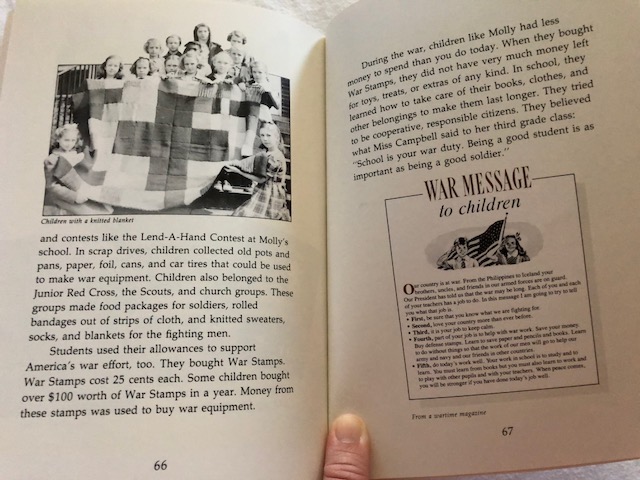

 Molly McIntire misses her father, who is a doctor stationed in England during World War II. Things haven’t been the same in her family since he left. Treats are more rare because of the sugar rationing, and she now has to eat yucky vegetables from her family’s victory garden all the time, under the watchful eyes of the family’s housekeeper. Her mother, while generally understanding, is frequently occupied with her work with the Red Cross. Molly’s older sister, Jill, tries to act grown-up, and Molly thinks that her brothers are pests, especially Ricky, who is fond of teasing. However, when Molly and her friends tease Ricky about his crush on a friend of Jill’s, it touches off a war of practical jokes in their house.
 Halloween is coming, and she wants to come up with great costume ideas for herself and her two best friends, Linda and Susan. Her first thought is that she’d like to be Cinderella, but her friends are understandably reluctant to be the “ugly” stepsisters, and Molly has to admit that she wouldn’t really like that role, either. Also, Molly doesn’t have a fancy dress, and her mother is too busy to make one and also doesn’t think that they should waste rationed cloth on costumes. Instead, she suggests that the girls make grass skirts out of paper and go as hula dancers. The girls like the idea, but Halloween doesn’t go as planned.
 Because he laughed at the girls, saying that he could see their underwear after he sprayed them with water and ruined their skirts, the girls decide to play a trick that will give Ricky his just desserts. The next time that Jill’s friend comes to visit, the girls arrange to have Jill and her friend standing underneath Ricky’s bedroom window when they start throwing all of his underwear out the window, right in front of Ricky. Ricky screams at the girls that “this is war!” just as their mother arrives home.
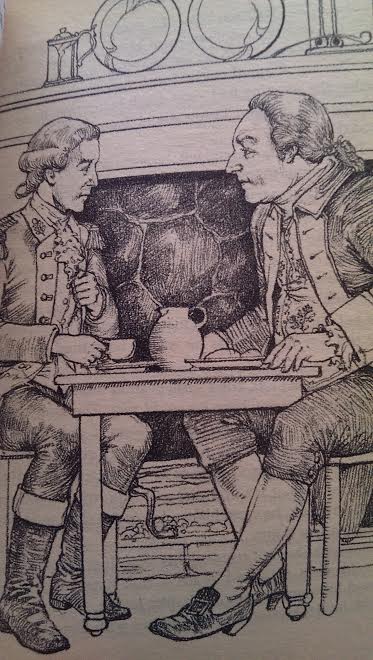 The Gentleman Spy — This is the story of Captain John Andre and General Benedict Arnold during the American Revolution. John Andre was a British officer who was executed for his role in helping Benedict Arnold defect to the British side.
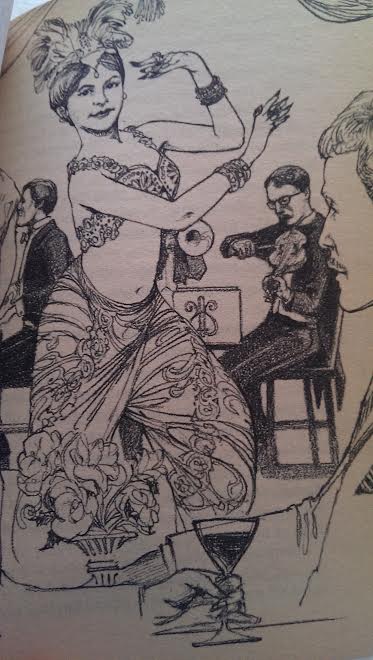 The Phantom of the Desert — Lawrence of Arabia was actually Thomas Edward Lawrence, a British army Captain. He helped the Arabs to fight against the Turks during WWI.
 Silver Days by Sonia Levitin, 1989.
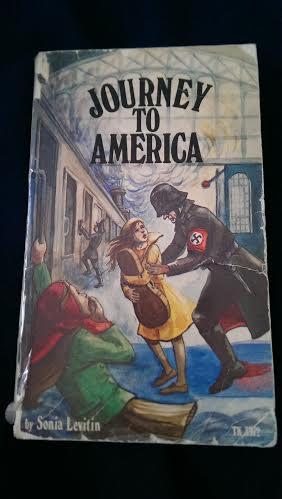 Journey to America by Sonia Levitin, 1970.
 But, getting on the train out of Germany is only the first step of their long journey. Lisa and her mother and sisters live as refugees in Switzerland, waiting for her father to help arrange for their passage to America. Often, they have too little to eat because they don’t have much money. There are some people who help them, and they make some new friends, but the long wait is difficult. Meanwhile, they must face the frightening events taking shape around them, around the people they left behind, and their own uncertain future.
 Number the Stars by Lois Lowry, 1989.
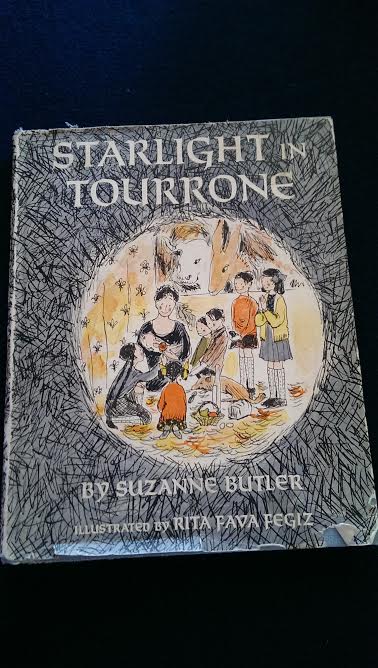 Starlight in Tourrone by Suzanne Butler, 1965.
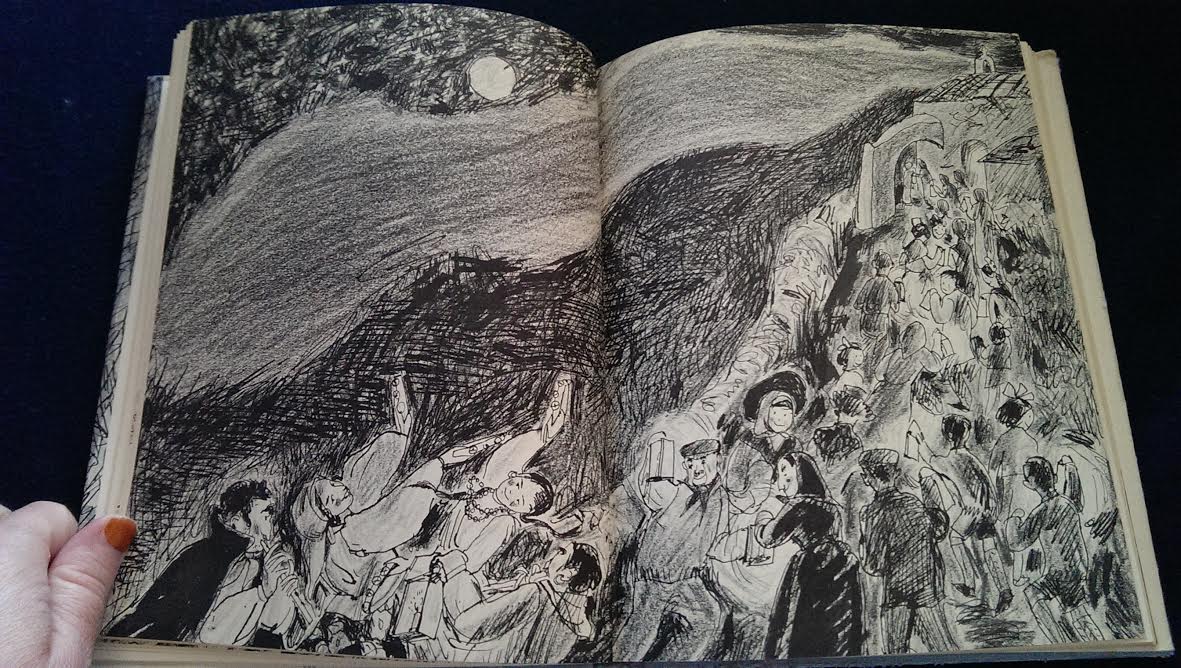 At first, most of the adults in the village are skeptical. Since there are no young couples living there anymore and no babies have been born there for several years, no one knows where the mother and child for the Nativity scene will come from. Many of the adults are too busy with their own problems and worries about the future to help. Still, the children continue to work faithfully on their plans, drawing in the adults in spite of themselves.
 Just as people in the village start to feel hopeful again, something happens that threatens to ruin everything, but there is still one more miracle yet to come, thanks in part to the one person who never doubted it would happen.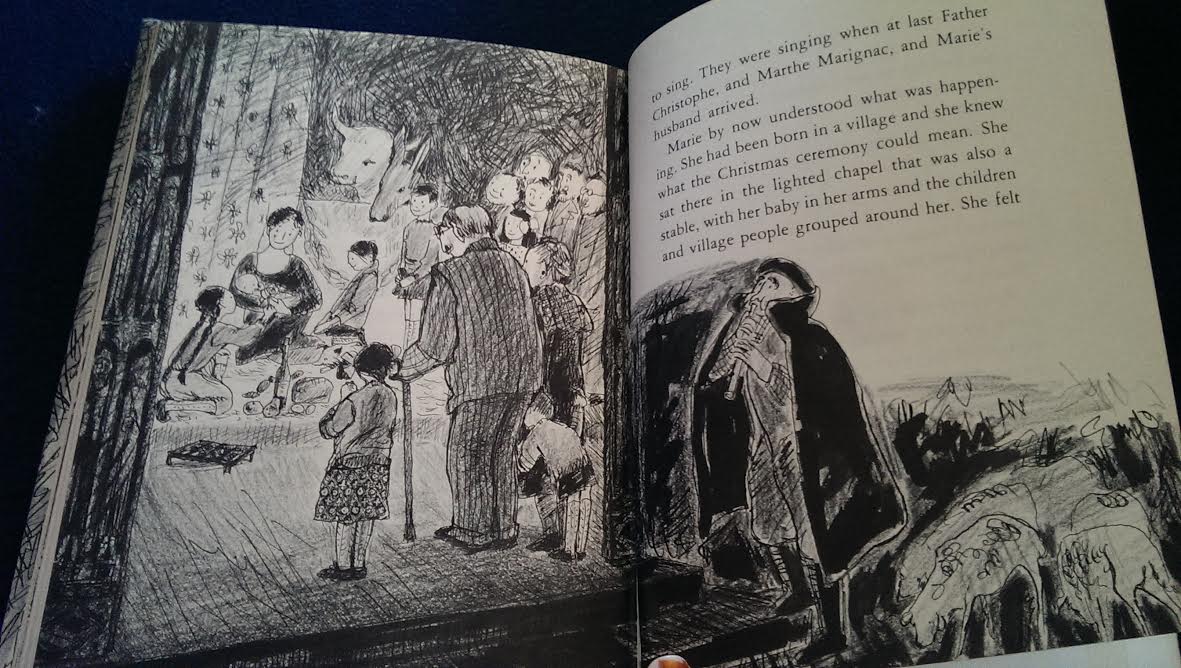

 Jestress's Forgotten Books and Stories