
Tapenum’s Day by Kate Waters, 1996.
This is about a day in the life of a Wampanoag boy living in the area around Plymouth, Massachusetts during the 1620s. His life is reenacted by Issac Hendricks, who was a participant in the Wampanoag Indian Program at the Plimoth Plantation living history museum.
In the beginning, Tapenum introduces himself, explaining a little about his people and the strangers who have only recently come to their land, the English colonists, whom the Wampanoag call wautaconuoag (meaning “coat-men”). Tapenum has just learned that he was not among those young men chosen to train as pniesog, a special kind of warrior among the Wampanoag who also possessed spiritual powers and acted as advisors and diplomats for their chief. It has come as a great disappointment to him that he was not chosen for training. To improve his chances of being chosen later, Tapenum has decided to train himself to improve his strength and hunting abilities.
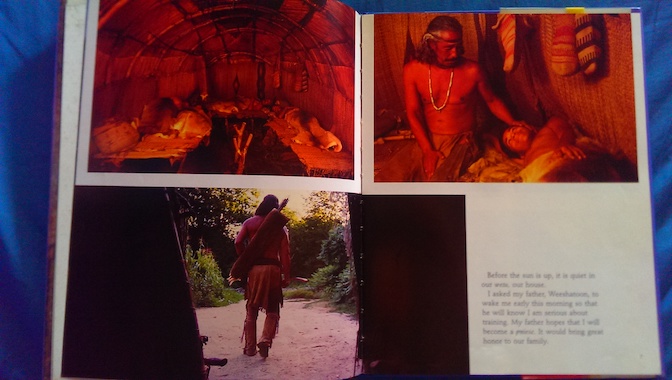
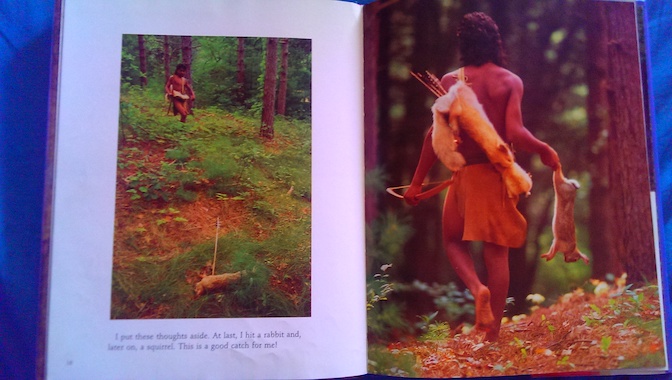
Tapenum goes out hunting early in the morning, while his mother and sister are still asleep. He starts before eating anything because he says that being hungry “makes the hunter more serious.” Eventually, he catches a rabbit and a squirrel. His mother is pleased with his catch, although his father has done even better by bringing home a wild turkey, which is even more difficult.
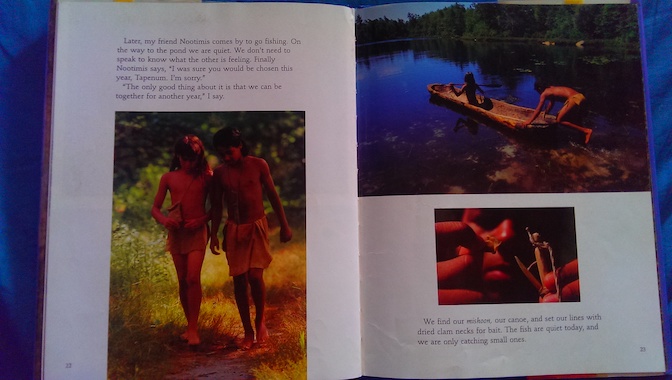
Later, Tapenum meets up with a friend, Nootimis. The two of them go fishing in a canoe. Nootimis knows that Tapenum is disappointed about not being chosen, but Tapenum says that at least he can still spend time with him before (hopefully) going away for training next year.
After fishing, Tapenum goes for a run as part of his training, and he sees smoke. When he investigates, he finds an old wise man named Waban making a canoe. Waban was a pniese himself when he was younger, and Tapenum offers him the fish he caught, hoping that Waban can tell him some things that will help him to be chosen for training.

Tapenum ends up spending the rest of the day with the older man, learning and perfecting his skill at fletching arrows. Waban also explains to him the importance of patience. Tapenum is in too much of a hurry to grow up and begin serious training, but growing up takes time and so does developing the kind of strength and wisdom that he will need as warrior.

There is a section in the back of the book that explains more about the Wampanoag people, the the Wampanoag Indian Program, the Plimoth Plantation living history museum (now called Plimoth Patuxet), and the boy reenacting Tapenum’s life.
This is part of a series of books focusing on the lives of children in Colonial American history. It is available to borrow and read for free online through Internet Archive.
 Jestress's Forgotten Books and Stories