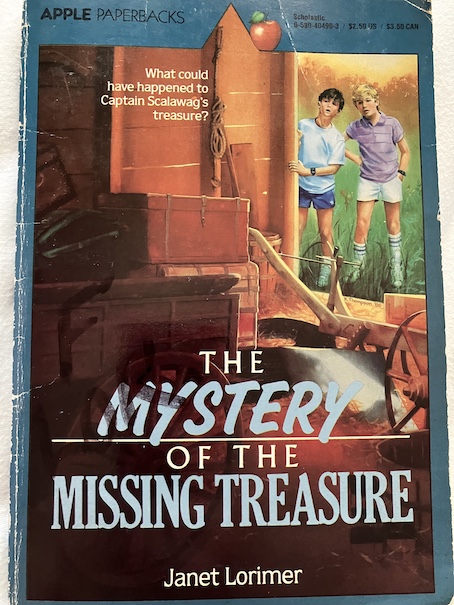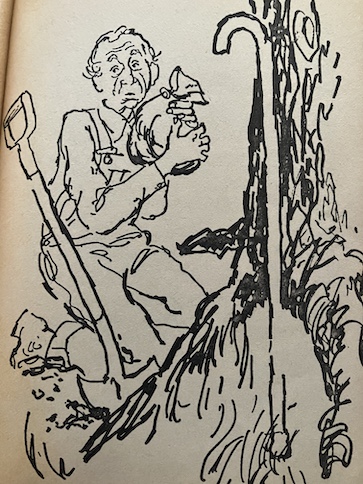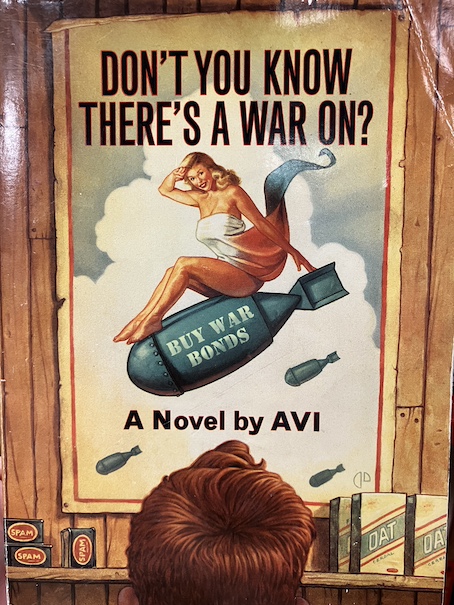
The Mystery of the Missing Treasure by Janet Lorimer, 1987.
Pete’s family has moved from the city to a small town because his father has taken a new job, and the move hasn’t been easy for him. Besides leaving his friends and his school, he’s had to give up roller skating because there’s no roller rink and judo because there’s nowhere to take lessons. So far, there are really only two things that Pete likes about his new town: his new friend Danny and the local legend of Captain Scalawag and his treasure.
When Pete asks Danny for details about Captain Scalawag and his treasure, Danny explains that Captain Scalawag (real name Seth Delaney) had been a captain the Confederate army during the Civil War. He was injured and invalided out of the service, so he became a traveling peddler, although he didn’t have much luck with that. Eventually, he came to their small town in California and took a handyman job with the woman who once owned the house where Pete’s family now lives. Many of the people who had settled the town had come from the South, and Captain Scalawag (as he came to be known later) told them stories about the suffering in the South because of the war. Sympathetic townspeople gave Captain Scalawag their jewelry and raised money for him to take back to the South to set up relief efforts. However, Captain Scalawag was a conman and had no intention of using any of that money for its intended purpose. When the townspeople confronted him about it, he refused to return the money and refused to tell anybody where he hid it. The angry townspeople hanged Captain Scalawag for his theft and deception, but they never figured out what he did with their money and jewelry.
Pete is intrigued by the story and says that he wants to find the treasure, but Danny doesn’t think he has much of a chance. Over the years, many people have searched for the treasure, and they’ve never found anything.
Danny takes Pete swimming in the nearby river with some other boys from the town. Pete gets irritated because one boy, Duffy, teases him about being from the city, and the two of them have a diving contest near some dangerous rocks to prove which of them is the best. They both succeed in making their dives, but although the are declared equals, Pete has the feeling that their problems with each other aren’t over.
After the swim, Danny suggests that they go into town and watch people setting up for the play that they have every Fourth of July, which is a reenactment of the story of Captain Scalawag. Pete is interested, but he feels strange and passes out.
When he wakes up, people are fussing over him, and he seems to be in some kind of old-fashioned general store. A woman in old-fashioned clothing, who calls herself his mother is worried about him, and for some reason she calls him Zeb. Then, Pete wakes up again and finds himself in the local doctor’s office. The doctor said that he had heat exhaustion from being out in the sun too long while swimming. Pete’s father is there, and Pete tries to tell him about his vision of being in the general store in the past. Pete’s father thinks he just had a strange dream, although the doctor says that his office is on the site of the town’s old general store, which burned down years ago.
Pete continues to have trouble fitting in with the local kids. One evening, Duffy and Danny take him on a “snipe hunt“, abandoning him in the woods. (This is an old prank, often played at summer camps, but I think this book was actually the first place I heard of it as a kid.) When Pete realizes that he’s been the victim of a joke, he tries to walk home, but gets lost and falls in the mud. Finally, dirty and disheveled, he makes his way to the road and hitches a ride from Bob, the local deputy his older sister is dating.
When Pete explains to Bob what happened, Bob offends him by laughing. Bob explains that it’s an old prank, and he’s amused that anybody is still doing that. Seeing how angry Pete is, he tries to tell him not to be too angry over the prank and to reassure him that the local boys aren’t so bad, in spite of the prank. He says that the boys are just trying to have fun. It’s almost like a kind of hazing or initiation, and although Bob doesn’t quite explain it this way, he seems to think that if Pete accepts it with good grace, it will put him on a better footing with the other boys. Bob thinks that, given time, Pete will start to see the humor in it, and the next time some other new kid moves to town, Pete might well be the first to suggest taking the newbie on a snipe hunt himself, having become one of the initiated.
In spite of Bob’s apparent indulgence for youthful pranks, he does seriously ask Pete who was involved because, as a responsible adult, he can see that there are more serious issues involved in the prank. It was bad enough that Pete ended up dirty and humiliated, but if he had gotten more seriously lost or had fallen in the river, trying to find his way home after dark, none of it would be funny at all. Bob thinks that he should have a word with the other boys about the the consequences of their actions and give them a warning against pulling pranks where people could get hurt. Pete refuses to say who exactly was involved because he thinks that would just make him a snitch and make everything worse for him socially than it already is. Bob decides to let it go for now, just taking Pete home.
That night, Pete has another dream, where he seems to be seeing things through the eyes of Zeb. He sees the house where he’s living now as it used to be in the past, and he sees the man called Captain Scalawag, persuading the people who live there to contribute to relief efforts in the South due to the war. Then, Pete feels ill and seems to pass out in the dream, waking up in modern times in his own bed. He could just shrug it off as a dream, brought on by the stories he’s been hearing about Captain Scalawag and the old things his parents have discovered around the house and the barn that hind at events in the past. However, when his mother shows him more old photographs she’s found, Pete realizes that the details in his dream were far too accurate for him to have simply imagined them, from the details of the house in the past to the faces of the people he saw talking to Captain Scalawag.
More and more, Pete comes to realize that his dreams are no ordinary dreams. For some reason, he is able to see the past through the eyes of Zeb, a boy who died young around the time that Captain Scalawag conned the local people out of their money and treasures and hid the loot somewhere. Is Zeb himself trying to tell him something or show him something that everyone else has missed?
The book is available to borrow and read for free online through Internet Archive.
My Reaction and Some Spoilers
I remember reading this book as a kid, although I had forgotten many of the details. I remembered Captain Scalawag stealing/scamming people out of valuables and then hiding them, but I had forgotten that the basis of his scheme was convincing people to donate to support the Confederacy during the Civil War. That was surprising because the story is set in California, and the concept of supporting the Confederacy is never appealing to me. I think I forgot that part because, as a kid, the important idea is that Captain Scalawag was a conman with a hidden treasure, and that’s all I cared to remember.
I remember finding it spooky that Pete was seeing things through the eyes of a dying/dead boy. Pete in the story does worry about getting stuck in Zeb’s body in the past, knowing that Zeb doesn’t have much time left to live. However, Zeb is trying to tell Pete something that he realized that indicates what Captain Scalawag did with the treasures he took from the townspeople. Zeb tried to tell people before he died, but because he was severely ill and delirious, nobody understood what he was really trying to say. It turns out that the treasures have been in the barn the entire time, but Captain Scalawag changed their appearance, so the townspeople have overlooked them the entire time. It’s a case of hiding in plain sight.
Pete’s confrontations with the local bully add a subplot to the story. Danny apologizes to Pete about joining in Duffy’s prank against him, and Danny admits that Duffy scares him, too. Eventually, Pete has to fight Duffy physically, but Duffy doesn’t know that Pete took judo lessons in the city, so he’s not as defenseless as Duffy thinks. During the course of their fight, Pete also saves Duffy from being bitten by a snake, so Duffy has to admit that he has some gratitude toward Pete. He’s also impressed by Pete’s fighting techniques. The two of them end up working out a compromise with each other, with Pete agreeing to teach Duffy some judo and Duffy agreeing to teach him some of the knowledge he has from living in the country, like how to kill a snake. (Pete warned Duffy about the snake, but Duffy is the one who killed it.) Because they were fighting out behind the barn, Duffy is also on hand when Pete has his final revelation from Zeb, so he gets to be part of the discovery of the treasure, along with Pete and Danny.
I wasn’t happy when Bob laughed off the kids’ snipe hunt prank against Pete at first. I don’t like pranks, and I think it should be more understandable that some people just don’t want to be part of them, especially when Bob has directly seen the aftermath of the prank. He did redeem himself a little for me when he realizes that the prank could have had much more serious consequences and that, as a responsible adult, he really should point that out to the boys involved. The potentially serious consequences of pranks is part of the reason why I don’t like them. There’s just too much potential with many of them to go horribly wrong. The way Bob seems to be looking at the snipe hunt is like it’s some kind of local initiation stunt for newcomers, although he doesn’t exactly use those words to describe it. However, the idea of it being a kind of initiation doesn’t really redeem it for me. Fraternity initiations and hazing often go wrong, and that’s why universities often crack down on them.
As I recall, this book was the first place I heard about the concept of a snipe hunt. Years later, I was on a church retreat in college, and someone joked about taking someone else on a snipe hunt. I’ll admit that I was briefly gleeful about knowing what that was when the other person didn’t. I almost did go along with it, but I just didn’t have the heart to let someone else in for a prank like that. I would have felt bad if something happened to that person in the woods at night, and I figured they would at least be upset. Since the person did seem worried and asked directly what a snipe hunt is, I told them, so I spoiled the joke before it really happened. I think I made the right decision, though.
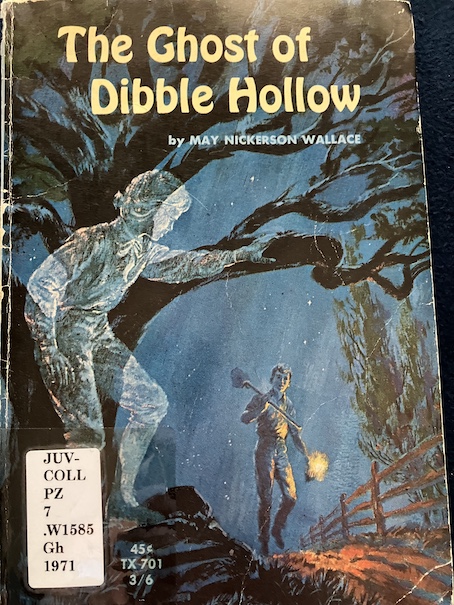
The Ghost of Dibble Hollow by May Nickerson Wallace, 1965.
Elisha Nathanael Dibble Allen, called Pug, is excited to be spending the summer at the old family house called Dibble Hollow that his mother inherited! The summer starts out awkwardly when he gets on the wrong side of old Mr. Smith because his dog, Ricky, chases Mr. Smith’s chickens. When people find out that his family are Dibbles and that they’ll be staying in Dibble Hollow, Pug and his sister Helen learn that the locals in the area are afraid of Dibble Hollow. There are rumors that the house is haunted.
Pug thinks that the house is charming. It was built in 1730, and Pug immediately claims a room for himself with a picture of a boy in old-fashioned clothes who looks a lot like him. It does seem odd, though, that Ricky is afraid to enter that room, no matter how much Pug tries to persuade him.
Then, it seems like the family won’t be able to stay at the house after all because the well is dry, and they can’t get water. Pug is upset about having to leave the house and abandon their summer plans, but things change during the night, when Pug meets the ghost who haunts his room. The ghost is Miles Dibble, the older brother of Nathanael, Pug’s grandfather. Miles died young and still haunts the room that he once shared with Nathanael.
The ghostly Miles explains to Pug that he’s been responsible for the rumors that Dibble Hollow is haunted. He does things to scare strangers away from the house. However, he really wants his relatives to stay at Dibble Hollow, so he explains to Pug that there is actually a second well at Dibble Hollow, and it is connected to the house with pipes, but Pug’s grandfather’s eldest brother, Ezra, turned off the water on purpose to fool people into thinking that there was no water at the house, so he could have the house all to himself. Miles explains to Pug how to find the right pipe in the basement and turn the water back on.
The next morning, Pug follows Miles’s instructions and finds the pipe so the plumber can turn the water back on. His family is amazed how he knew where to look, but Pug is vague about how he knew. He can’t tell them about Miles because Miles tells him that only boys under the age of 15 in the Dibble family can see him, and also one other person who is special to Miles, although Miles doesn’t explain who that is.
Pug is happy that his family will be able to stay at Dibble Hollow for the summer, but he also begins hearing about a feud between the Smith family and the Dibble family. People are unsure exactly how the feud started. The plumber, Mr. Potter, says that there are only a few people who really knew the beginning of it. One of them is Miles, who has been dead for more than 50 years at that point. Another is Eb Smith, who was once Miles’s best friend, and is now the elderly Mr. Smith who was angry that Ricky chased his chickens. Pug is interested in being friends with Eb Smith’s granddaughter, Priscilla, but he thinks that he needs to understand the feud between their families before he can do that.
Since Eb Smith doesn’t want to talk to the Dibbles, Pug and Helen go to see Miss Fanny Woodman, the other person Mr. Potter says would know what happened to start the feud. Miss Woodman explains that the feud started when she was 13 years old, after both the Dibble and Smith families made a lot of money at a fair by winning some prizes and selling livestock. The elder boys in the Dibble and Smith families were supposed to take the money home, but they paid Eb and Miles to do it for them because they wanted to stay longer at the fair. However, Eb thought some suspicious men were following them home, thinking that the younger boys would be easier to rob. To evade the thieves, the two younger boys split up. Eb was supposed to lead the thieves on a wild goose chase while Miles got the money safely home. Eb did manage to lose their followers, but Miles never turned up with the money. The Smiths suspected Miles of running away with the money, but the Dibbles suspected the Smiths of having done something to Miles to get all the money for themselves.
At first, Eb didn’t think the Miles stole the money. He thought maybe Miles was playing some kind of trick on him because the two of them had a rivalry over Miss Woodman. Both boys had a crush on her when they were all kids. Miles was a teaser and a prankster, so it would have been in character for him to pull a trick. However, nobody ever saw the thieves who were supposedly following the boys, and the more Eb thought about it over the years, the more he became convinced that Miles was the one who thought he saw them and was the one who suggested that the two of them split up. Nobody ever found Miles’s body, so there was no proof that he ever died. His family eventually decided that’s what must have happened, so they had a memorial service for him and put a marker for him in the local cemetery, but the Smiths still suspected that Miles just stole the money and ran away.
Eb’s feelings for Miles turned to bitterness when he came to believe that Miles took advantage of their friendship to steal from him and his family, and those feelings only got worse when he suffered a series of misfortunes in his life. Eb’s wife died young, leaving him to raise their son alone. Then, his son and his wife also died, leaving him to care for his granddaughter Priscilla alone. Eb has been struggling for money to help raise Priscilla, and the money that his family lost would have made a difference to him. In fact, it still would make a difference to Eb because he’s in danger of losing his family’s old home because he can’t pay the mortgage. Miss Woodman doesn’t believe that Miles was a thief, but without the town knowing what really happened to Miles, it would be difficult to prove that to Eb Smith.
Pug knows that he has access to a source of information that nobody else does – he’s the only one who can talk to Miles himself about what happened! When Pug sees Miles again, Miles confirms what Miss Woodman said. He says that the thieves followed him instead of Eb that night. Miles tried to get away from them by crossing an old bridge, but he fell into the river and was killed. The thieves were alarmed that he was dead, so after searching him for the money, they pushed his body into the river again and got out of town as fast as they could. Miles says that a man called Mr. Miller later found his body down river and had him buried, but Mr. Miller didn’t know the boy’s identity, so he couldn’t notify his family. Instead, Mr. Miller buried Miles under the name of his own son, who died at sea as a cabin boy and whose body was never recovered. Mr. Miller felt that giving the nameless boy his son’s name and a resting place among his family was a kindness to the drowned boy and a fitting memorial to his own son, who was unable to return to rest with his family. People in the town where the Millers lived and live today know the story about the nameless boy buried with the Millers and Miles’s tombstone recounts it, but so far, nobody has made the connection between that nameless boy and Miles. (Except for one other person, who can’t explain how he knows where Miles is buried for the same reason why Pug can’t tell his family how he knew where the water pipe was.)
Pug asks Miles what happened to the money, and Miles says that he successfully managed to hide it from the thieves before he fell in the river. The problem is that he’s not exactly sure where he hid it. He knows he put it in a tree, but it was night, he was confused and in a hurry, his sense of direction was never good, and then, he died a sudden death. He’s been looking for the tree where he hid the money ever since, but he still can’t find it. He just knows that it’s somewhere around the old Smith place, Twin Maples … where Dibbles aren’t really welcome these days. Miles needs Pug’s help to find that hidden money and repair the relationship between the Smiths and the Dibbles!
The book is available to borrow and read for free online through Internet Archive.
My Reaction and Some Spoilers
Part of the theme of the story is about old grudges. Miss Woodman and Priscilla, among others, tell Eb Smith that the grudge that he’s been holding against Miles and the other Dibbles is only hurting him and that it’s time to let it go, but at the same time, they also understand why he has trouble letting the issue go. The money that Miles was carrying when he disappeared would make a major difference to Eb Smith because he’s been struggling for years to take care of his old family home and his orphaned granddaughter. With the mortgage coming due, the holder of the mortgage, Mr. Pratt, is planning for foreclose and have Eb Smith sent to a retirement home, but that would leave Priscilla without a home. Mr. Pratt says he and his wife would take Priscilla in as a nanny for their four children, but that’s a nightmare job! The Pratts have had trouble keeping a nanny because the children are so badly behaved. Priscilla would be little more than a captive domestic slave to the Pratts. With that much depending on the lost money that would secure the Smiths’ home and future, it’s understandable why Eb Smith has trouble letting the matter go.
Eb doesn’t know that Miles is definitely dead and that he died the night of the fair, when they were chased by thieves. If Miles’s body had been identified and returned to his family shortly after his death, Eb would have accepted years ago that Miles was just the unfortunate victim of the thieves. He would have mourned the loss of his friend and reconciled himself to the loss of the money as something that couldn’t be helped. It was not knowing the truth for years that caused Eb to doubt his old friend and convince himself that Miles was the one responsible for the loss of the money. The restoration of the money is key to helping the Smiths and settling the feud, but knowing the real truth of Miles’s death is also important. As long as Eb doesn’t know the truth, his family’s suspicions, his own suspicions and imagination, and the rumors of the local people are all that Eb has had to fill in the space of what he doesn’t know.
The inability of people to communicate with each other hampers the truth. Pug’s attempts to help the Smiths are hampered because he can’t let Eb Smith know that he’s helping at first. If he did, Eb Smith’s pride and the grudge he holds would probably cause him to refuse the help, even if it hurt him and his granddaughter. Miles refuses to say at first who else besides Pug can see him as a ghost, but Miles later learns that (spoiler) it’s the man who found his body and buried him. Gideon Miller is now a very old man, and he only saw Miles’s ghost once when he was seriously ill, about a year after he buried Miles. That’s the only way that Mr. Miller knows his name and that he is the boy he buried. However, Mr. Miller can’t go to Miles’s family or the Smiths and tell them the truth about Miles because he knows nobody would be likely to believe him. Everyone would just think that he was hallucinating. Mr. Miller and Pug can talk to each other about it because they’ve both experienced Miles and can understand each other’s experiences, but neither of them can convincingly tell anyone else. Pug can’t tell his sister or Priscilla about the things he’s doing to try to help the Smiths, so they think he isn’t really doing much, if anything, although Helen is suspicious that Pug knows things he shouldn’t know and seems to have a hidden source of information. Fortunately, Pug eventually finds a way to show his parents that the unidentified boy buried with the Miller family is Miles.
When Pug has problems with the eldest Pratt boy, Ernie, his father talks to him about grudges and expectations, bringing the story back around to the main theme. People have prejudices against the Dibbles because of what they’ve suspected for years about Miles and the missing money. Pug’s father points out that, while the Pratts definitely have some negative traits, people’s habits of expecting the worst of them just because their family has that reputation, can turn into a self-fulfilling prophecy. If people have the sense that nobody expects anything good about them, they won’t even try to do better. Pug and Ernie do end up getting into a fight, but once they’ve got their feelings out and impressed each other with their fighting ability, they make up and become friends. Ernie helps Pug to understand Mr. Pratt better. Mr. Pratt actually thinks he would be helping Eb Smith by sending him to the county old folks’ home because he genuinely thinks Eb Smith can’t manage his house by himself. It’s not just a ploy to get the property and make a personal profit.
When the truth is revealed and the money found, the adults in the story are mature enough to admit that they were wrong about things, and I thought that was a really good example to present to kids. Eb Smith apologizes to the Dibbles, particularly Pug, about how he treated them when they were only trying to help. He also expresses regret that he came to doubt his best friend, not understanding that something truly tragic happened to him all those years ago. Mr. Pratt, rather than being upset that he won’t get the Smiths’ property after all, is actually relieved that things have worked out well for the Smiths. He tells Mr. Smith that he didn’t mean to make things hard on him, that he really did think that what he was doing was best for him and Priscilla, but Ernie has been talking to him about their situation, and he’s changed his mind.
The time period of the story is dated. Miles’s tombstone and an old diary of his that Pug finds date the year of Miles’s death to 1900. Since he’s been dead for more than 50 years or almost 60 years, the story is set c. 1960, just a few years before the book was published.
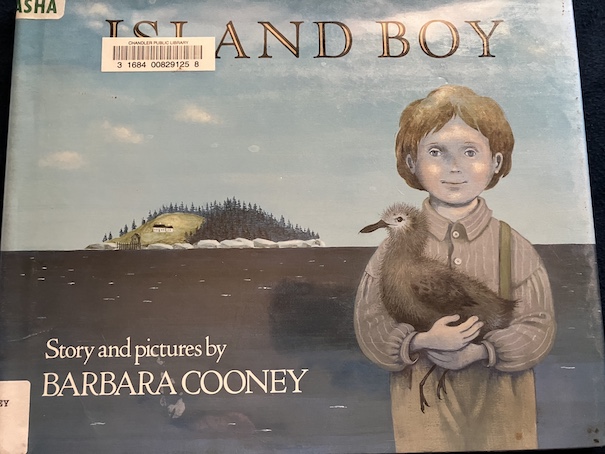
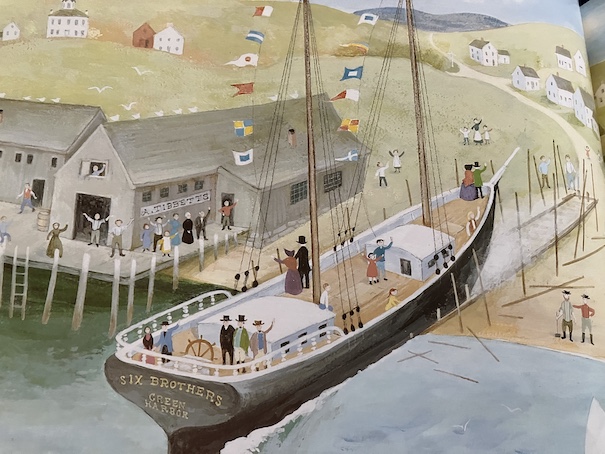
Island Boy story and pictures by Barbara Cooney, 1988.
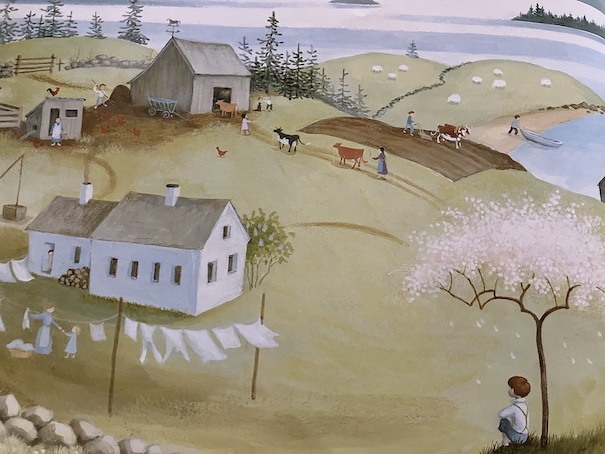
When the Tibbetts family first moves to the island, they build their house and give the island its name, Tibbetts Island. As time passes, there are eventually twelve children in the Tibbetts family, and the youngest of them is little Matthais.
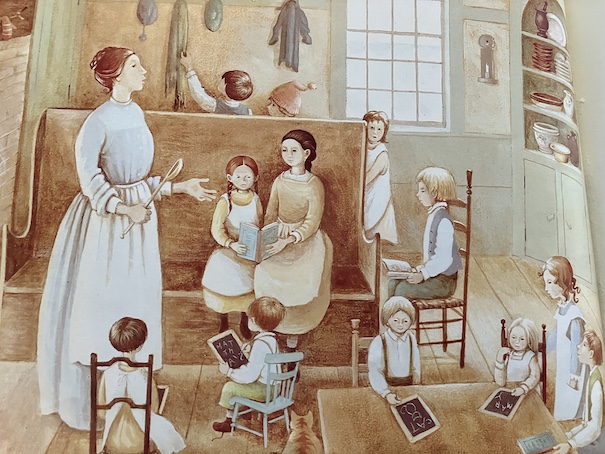
The boys in the family help on their family’s farm and go hunting and fishing. At first, Matthais’s older brothers think he’s too little to help. As he grows up, though, he learns how to be more helpful, and he joins the other children in their lessons in reading and writing.
As time passes, the Tibbetts children grow up and leave the island to get married or get jobs working in their uncle’s shipyard. Eventually, Matthais becomes a cabin boy on one of his uncle’s ships. After years of experience, Matthais become the captain of the ship. He visits many places as a sailor, but he finds himself wanting to return home.
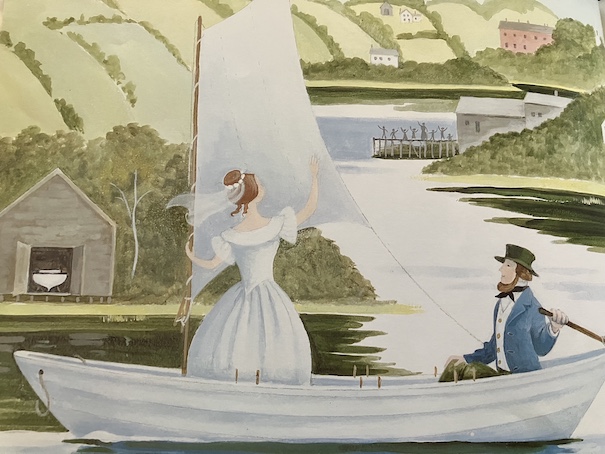
When Matthais marries a young schoolteacher named Hannah, they move into his family’s old home on the island and restart the farm because his aging parents have moved to the mainland. Together, they have three daughters.
Over time, Matthais’s daughters grow up, and he and Hannah grow old. His daughters marry and move away, and Hannah dies. Around this time, new people begin moving to the area, building vacation homes and bringing pleasure boats. Unlike the Tibbetts family, they’re there to enjoy the countryside for fun and not for farming. They’re called “rusticators” because they enjoy the rustic lifestyle. One of Matthais’s daughters points out that he could sell the family’s island to these people, but he can’t bring himself to do it because it’s the family’s old home.
Following the death of her husband, one of Matthais’s daughters moves back to the island with her small son, also named Matthais. The elderly Matthais helps to raise his young grandson and teach him about life on the island. The elderly Matthais eventually dies in a boating accident in rough weather, and many people come to pay their respects and reflect on his long life, but the younger Matthais’s life is still beginning.
The book is available to borrow and read for free online through Internet Archive.
My Reaction
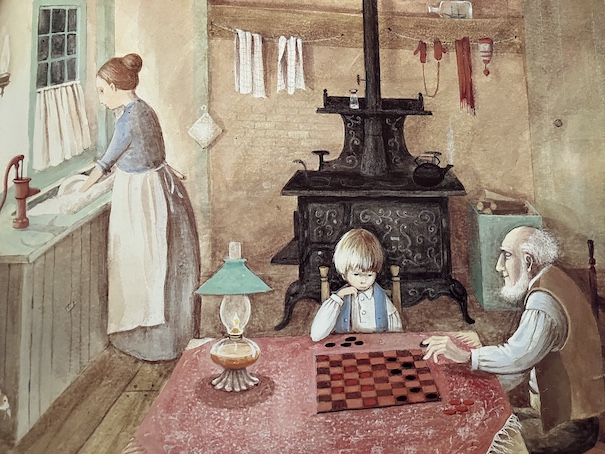
I love the charming, old-fashioned pictures in this book, and it’s a sweet story about a man’s long life and the passing of one generation to the next. As characters comment at the end of the story, Matthais has lived a long and full life. He’s experienced the cozy family life on the island and the beauties of nature, and he’s also traveled and had adventures at sea. He’s raised a family of his own, and he’s set up a home for his daughter and her young son. The end of the story indicates that the cycle of life will continue in this family as the younger Matthais thinks about becoming a sailor like his grandfather and then returning to the island himself.
There’s a sense of stability to the island and its cycles of life and generations. Even when things are changing in the world around them, the nature of the island remains pretty constant, and it’s always a place for members of the family to come home.
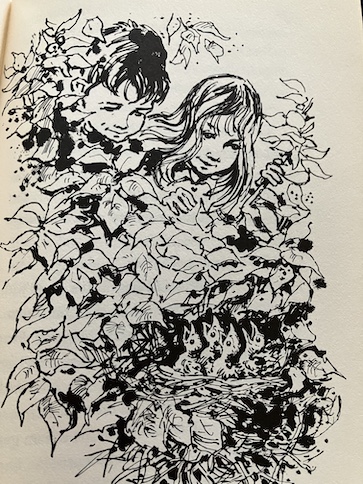
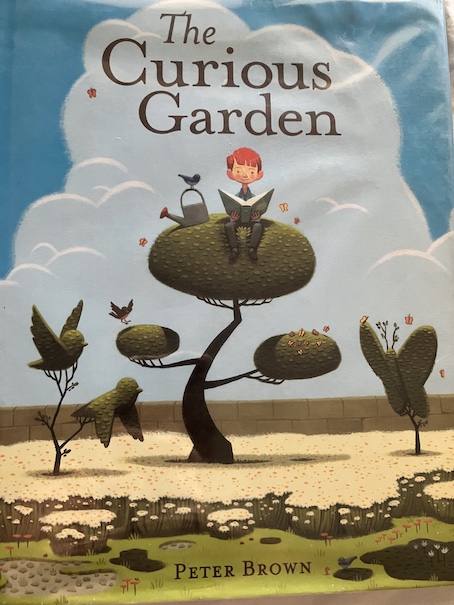
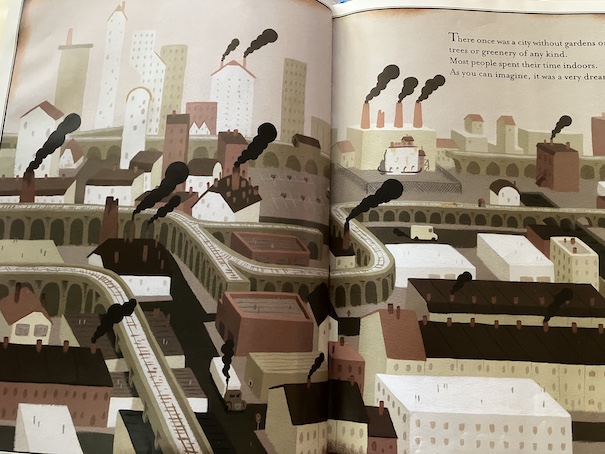
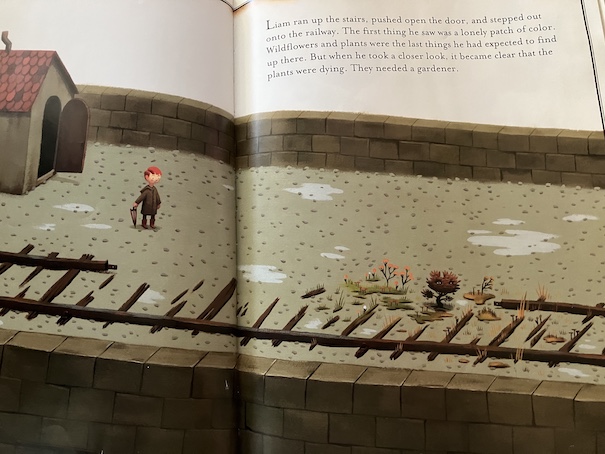
A boy named Liam lives in a dreary city where there aren’t any gardens or green spaces. Most people in the city spend most of their time inside. However, Liam likes to explore outside.
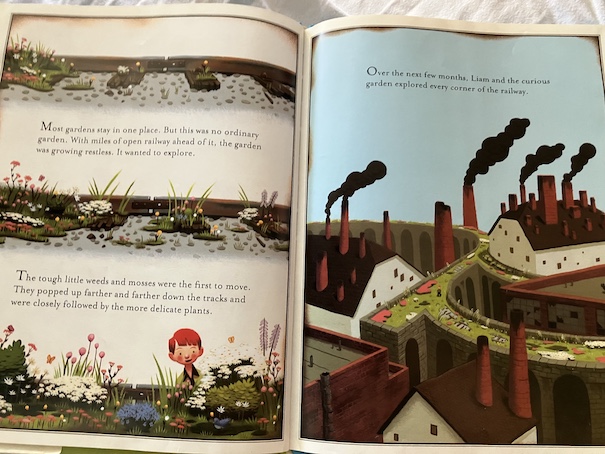
One day, while exploring some disused train tracks, he finds a few plants struggling to survive. Liam doesn’t know much about plants, but he decides to help them by giving them water. Gradually, he begins to learn more about what will help the plants, and they begin to grow and spread into a small garden.
As Liam helps the plants, they begin to spread all along the old railroad tracks. During the winter, the plants are covered in snow, and many of them are killed or have suffered badly from the cold. However, because Liam spent the winter studying about plants and gathering some gardening tools, he is able to restart the garden.
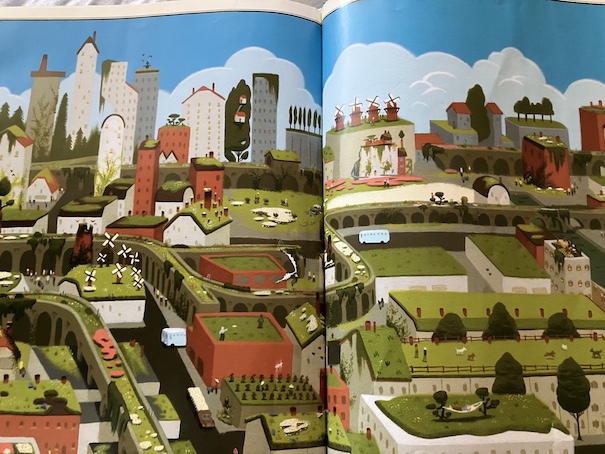
As the garden spreads through the city, other people begin to notice, and they start joining Liam in tending the garden. Greenery begins taking over places and things that are disuses and abandoned, and people encourage the plants to grow where they can enjoy them. Because of their efforts, the city is transformed!
There is an author’s note in the back of the book about the inspiration for the story. There was an elevated train in Manhattan that was shut down in 1980, and plants took over the abandoned tracks. The author, Peter Brown, considered what it would be like if the phenomenon took over an entire city.
My Reaction
The pictures in the book are great, and some pages are full pictures with no text, just showing how the garden grows and spreads through abandoned places in the city. I love how this story was inspired by the way plants take over abandoned places in real life. Plants can grow in some unlikely places, when nothing interferes with them, and in the story, the boy discovers that they can spread further with a little help.
By the end of the story, his entire city is completely transformed into a greener, more eco-friendly place. It’s not just that there are more plants and green spaces in his city, but the factories that we see in early scenes are no longer putting out all that smoke by the end, and we see windmills in the pictures as alternative forms of energy production. We aren’t told exactly why some things are changed about this city, but it seems like the increasing presence of the green spaces has caused people to change aspects of their lives and businesses to accommodate and preserve them. It’s an idyllic solution that doesn’t show a lot of the conflict that occurs in real life, when some people are ready for a change and others just don’t want to change. Still, I like this mage of a hopeful future because it comes as an antidote to the dystopian quality that we see in many forms of modern entertainment.
Six-year-old Emma has to stay home from school during the summer term because she has measles. By the time her quarantine period is over, Emma is feeling better but is bored and restless, eager to get back to school. However, the doctor thinks she should take an extra week off school to recover further.
As Emma continues to sit at home, she knows the other children are back at school, and she can’t help but think about all the things she’s probably missing and wonder if anybody there misses her. Her mother urges her to find something to do so she’ll be happier and the time will pass faster, but Emma is in a disappointed mood and doesn’t feel like trying to make herself happy. She resists all of her mother’s efforts to cheer her up or get her involved in some activity.
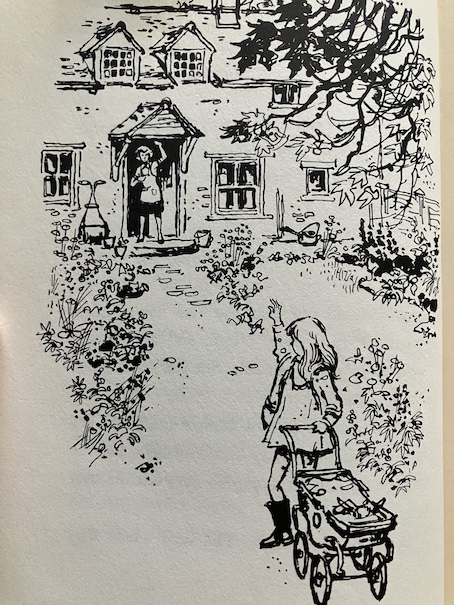
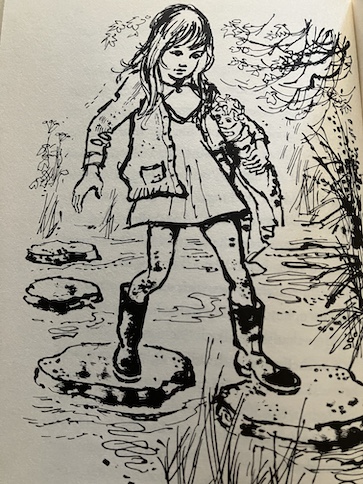
Finally, her mother suggests that she could go to Streamcross, a little area with stepping stones across a stream, where Emma has been with her father before. Emma loves the spot, but she’s never been there alone before. Now, her mother thinks she’s old enough to go alone. Emma takes along her doll, Annabel, and some biscuits (cookies, because this is a British book).
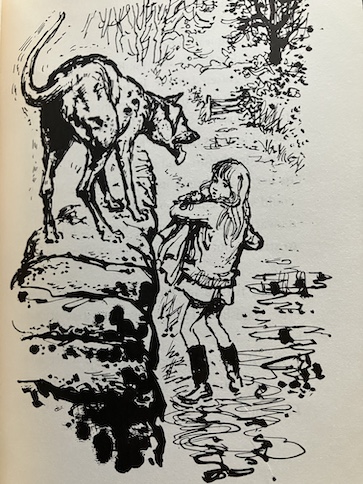
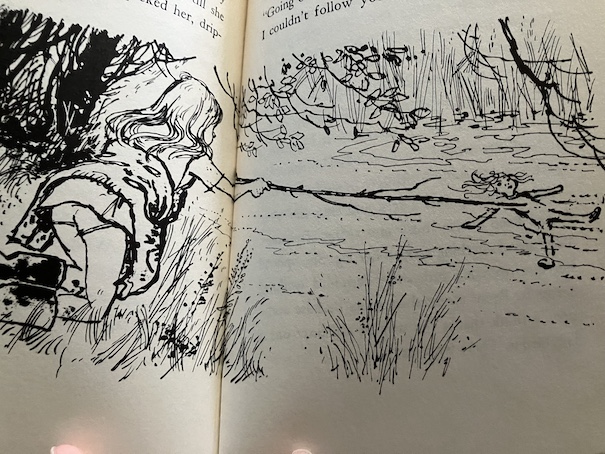
Along the way, Emma has adventures. She has to rescue Annabel from a farm dog. She picks wildflowers. She falls when trying to get a look at a bird’s nest, and she gets stung by nettles. When she tries to clean her doll and the doll’s dress in the stream, she ruins the dress and almost loses Annabel in the stream!
Then, Emma meets up with, Billy, a boy from school. She hides from him because of the state she and Annabel are in, but he spots her because she’s left a few things behind, and Billy plays detective, following the clues. Fortunately, Billy doesn’t laugh at her or her doll. The two of them discover that they share a love for this special spot in the stream, and they trade secrets about it. Emma shows Billy a bird nest she found, and he shows her a hidden spring. Then, he helps Emma to get home, past the farm dog, and stays to tea at Emma’s house.
The book is available to borrow and read for free online through Internet Archive. The American title for this book was Betsy’s Afternoon. The only part of the story that was really changed for the American version was the name of the little girl.
My Reaction
At the end of the story, Emma looks back on the afternoon as being lovely. Not all of it was lovely, like her frightening encounter with the dog or ruining Annabel’s dress and almost losing her completely. During the course of the afternoon, Emma falls down, gets muddy, and is stung by nettles. Still, even when things go wrong, Emma enjoys having an independent adventure, and when she has a friend to share it with her, it gets even better. She also learns that people did miss her at school.
Emma’s adventures are relatively low-key, slice-of-life adventures, but they’re the kind of small adventures that are meaningful, especially to a young child. None of the problems she encounters are very serious, and Emma doesn’t really have any lasting consequences from them, except for ruining her doll’s dress. The dog part was a little scary at first, but Emma isn’t bitten, and Billy later explains that he knows the dog, and it never leaves its farm, so they’re in no danger. Billy is a nice friend, and the two of them appreciate the natural beauties of their favorite spot. In the end, Emma’s adventures and her meeting with a friend who feels the way she does about Streamcross are just what she needs to cheer herself up!
I enjoyed the way the author connected with Emma’s feelings and thought processes. Readers really see through the eyes of a young child – her thoughts, her frustrations, the way she solves problems, and her joy at small discoveries and accomplishments. This is a short chapter book that would be appropriate for children in early elementary school but can still be pleasing to adults.
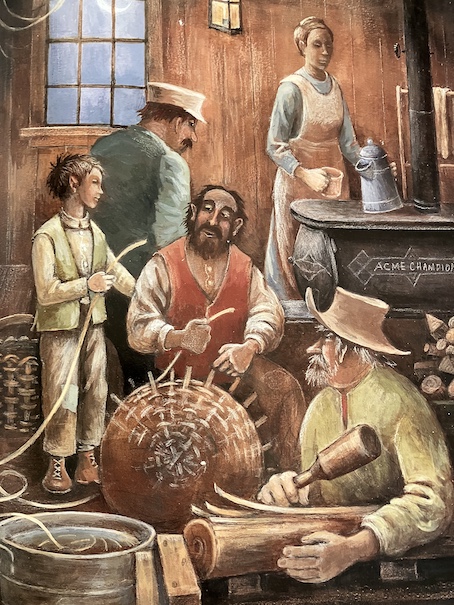
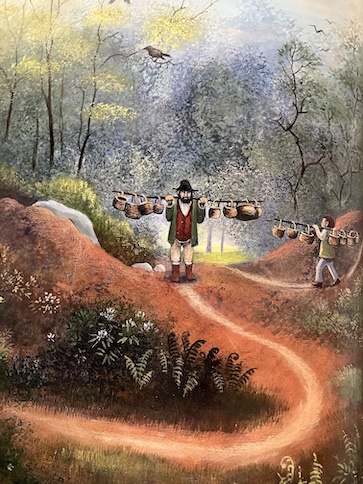
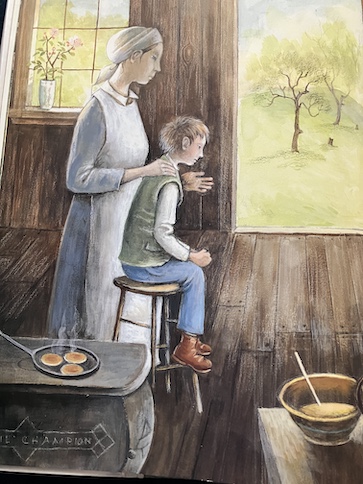
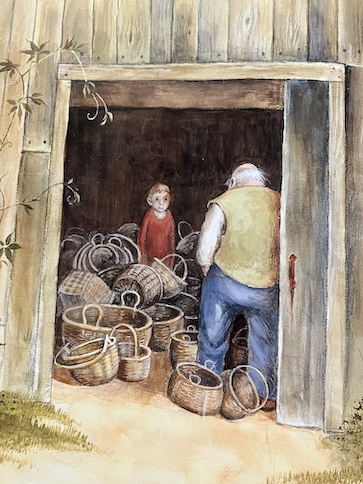
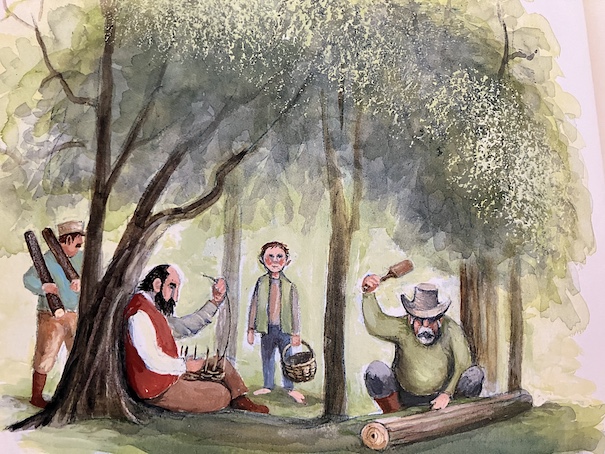
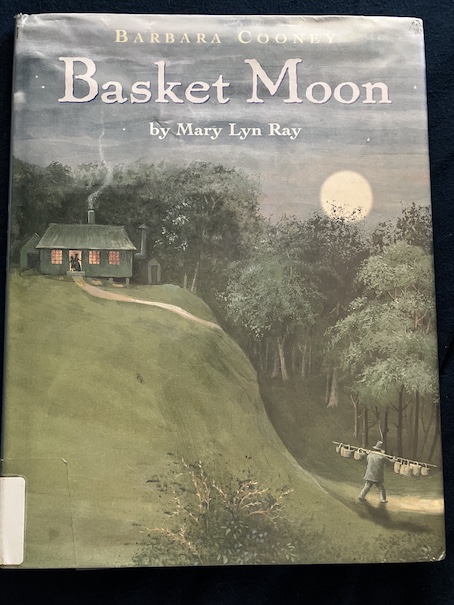
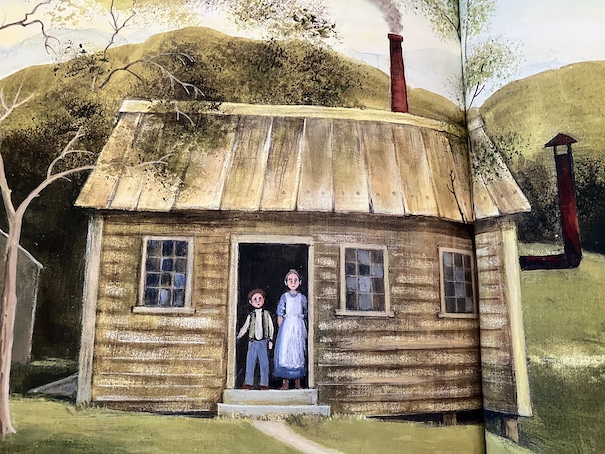
Basket Moon by Mary Lyn Ray, illustrated by Barbara Cooney, 1999.
An eight-year-old boy lives in the countryside with his parents, and his father makes baskets to sell in the town of Hudson in New York. The boy has never been to town before, and he wants to go, but his father always says he’s too young.
His father has taught him which trees are best for wood to make baskets, and he watches his father and the other men who live in the area gathering it. He’s also watched his father weaving baskets, and he starts to weave baskets of his own. When he turns nine years old, his father decides that he’s old enough to go to town with him to sell the baskets.
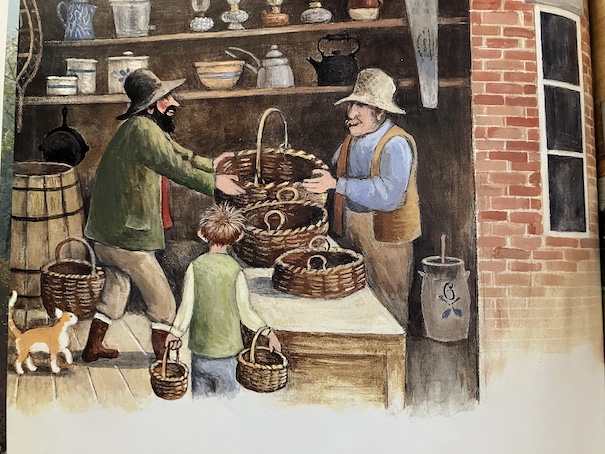
They sell their baskets to a hardware store, and they buy some supplies their family needs. The boy marvels at all the new sights around him. However, as he and his father are heading home, a man teases them about being hillbillies who only know how to make baskets. The boy’s father ignores them, but the boy is bothered by what the man said.
For a time, the boy no longer wants to make baskets, thinking that it’s something that only hillbillies do, like the man in town said. However, when the boy kicks over stacks of his father’s baskets in anger, they don’t break when they fall, and he sees that his father makes strong, high quality baskets. His mother and one of the other men who works with the boy’s father talk to him about how they learned the art of basket making from the trees and the wind. The trees and the wind never seemed to talk to the boy before, but when he really listens, he begins to understand what the men mean.
The book is available to borrow and read for free online through Internet Archive.
My Reaction
I like books about traditional crafts and lesser-known pieces of history. In the back of this book, there’s an author’s note about the history of making baskets among the country people around Hudson, New York. Sometimes, these country people came into town to sell their baskets, but the townspeople were also somewhat leery of them. The wooded countryside around the town was spooky to the townspeople, and there were a lot of stories about frightening things that lurked there. The author points out that this is the area where the stories of Rip Van Winkle and The Legend of Sleepy Hollow were set. The time period of the story is indefinite although it looks like it might be set around the late 1800s or early 1900s. The author’s note says that the art of making baskets in the area started dying out in the mid-20th century because people were using different types of containers, such as paper bags, plastic containers, and cardboard boxes. However, the traditional baskets were made very study, and surviving examples of this functional folk art still exist in collections and museums.
One of the themes of book is being in touch with nature, which is what the adults in the story really mean when they talk about hearing the wind and the trees speak to them. In the end, the boy thinks he literally hears the wind calling to him, but I think it’s supposed to be a metaphor for him getting in touch with nature and with his craft. His family and the others around them are country-dwelling people, and some of the townspeople look down on them for living out in the countryside, away from the society, amenities, and business of the town, but the country-dwelling adults are comfortable with themselves and with their lives. They realize that they know things about nature and about their craft that the townspeople don’t know.
It did occur to me that the townspeople probably wouldn’t know how to make their own baskets if they had to do it themselves. We don’t think that much about baskets today, although we still use them sometimes, frequently as a form of decoration. In those days, though, the baskets were functional home necessities for carrying and storing food and other items. The townspeople in the story buy their baskets from these makers in the countryside because they are the ones who have necessary skills and knowledge to make strong, high-quality baskets that the people in the town need, whether or not the townspeople truly appreciate the work and skill that went into them. Part of what the author’s note points out is that the baskets were of such high quality that some of them have long out-lived their original makers and users. Things of quality last.
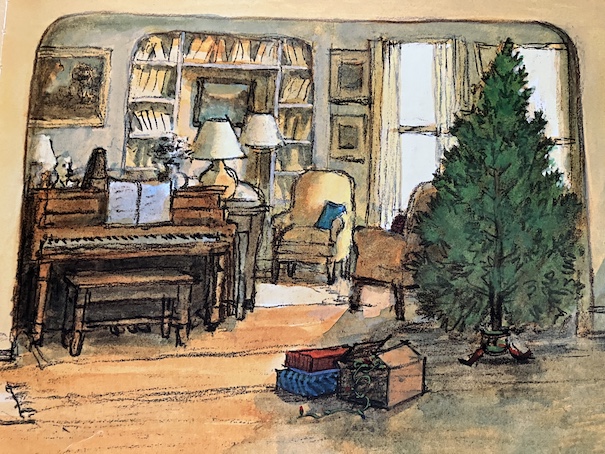
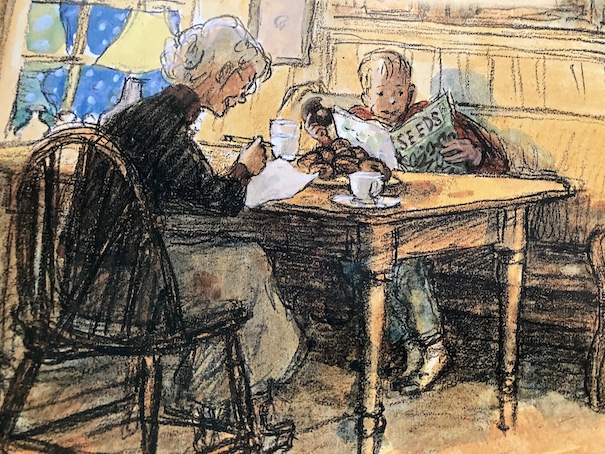
Christmas Farm by Mary Lyn Ray, illustrated by Barry Root, 2008.
Wilma has grown flowers for years, but now, she’s decided that she wants a change. She thinks about what she would like to do with her garden next spring while she’s getting ready for Christmas. Going out to cut a Christmas tree makes her think that maybe she would like to grow Christmas trees instead of flowers.
She starts by ordering 62 dozen small balsam trees (744 trees, for those who are counting), and she gets the boy from next door, Parker, to help her prepare the site for them. They use string to lay out rows for planting the trees.
Wilma knows that it will take longer than a year for the trees to grow big enough to be Christmas trees. As the trees grow, Wilma has to mow around them and take care of them, with young Parker helping her more as he also grows bigger. Wilma loses some trees to pests and weather conditions every year, but by the time the trees are big enough to sell, she has 597 left.
In the months leading up to Christmas that year, people reserve trees, and they also get a buyer who owns a Christmas tree lot in the city. Most of the trees are sold, but there are still some left. They know that the trees that were cut down will sprout again, but they’re also going to order some new ones.
In the back of the book, there is a section that explains more about growing Christmas trees with a chart showing how long it takes the trees to grow.
My Reaction
I thought this book was a sweet and fun look at Christmas tree farms. It takes years to grow trees big enough for Christmas trees, so there is a considerable time investment, and farmers know that they will lose some of their trees to pests or bad weather condition during that time. It’s a project that requires long-term planning and investment.
I always feel a little sorry for the trees when they’re cut down, but I liked how this book explains that, because the stumps of the cut trees are still there with their roots, even cut trees will regrow. The end of this book touches on the cycle of replanting and regrowth, with Wilma and Parker planning for their next phase of planting and cultivating new trees.
I also thought the addition of Parker to the story helps to show the passing of time and the growth of the trees because the boy grows a few years older during the time when they’re letting the trees grow bigger. By the time they’ve sold their first crop of Christmas trees, Parker is getting old enough to take more of an active role in planning the next crop.
The Mysterious Horseman: An Adventure in Prairietown, 1836, by Kate Waters, 1994.
This book is part of a loose series of books by Kate Waters, showing child reenactors at living history museums, having adventures in the roles of the characters they play. While most of the books are set in Colonial times at Plymouth and Colonial Williamsburg, the setting for this story is the Connor Prairie living history museum in Indiana, which shows life in a small town in the 19th century.
The story centers around a boy named Andrew McClure. He is the only one of his siblings left still living with their parents. His older sister is now married, and his baby brother died of an illness during the last year. His family is still grieving for his little brother. Andrew’s best friend is a boy named Thomas Curtis, who lives nearby, and Andrew works part time at a local inn to earn some money.
One day, while Andrew is doing some sweeping at the inn, he overhears some men talking in the taproom. He doesn’t hear their entire conversation, but he hears them talking about a mysterious rider without a head who chased a schoolmaster. Andrew is startled, and he wonders if that has something to do with the new schoolmaster who is supposed to arrive in town.
When Andrew is done with his work, he goes to the schoolhouse, and he finds his friend Thomas and Thomas’s sister, helping the new schoolmaster to clean the schoolhouse and prepare it for lessons to start. Andrew wants to talk to Thomas about what he overheard at the inn, but the schoolmaster only wants to talk to the boys about lessons.
Later, Andrew does have a chance to talk to Thomas, and both of the boys are spooked by the idea of a headless rider. They even think that they hear the rider on the road! The frightened boys go see Thomas’s father, the blacksmith, and tell him about the rider. Fortunately, the blacksmith knows what the men were talking about, and he can settle the boys’ fears.
The book is available to borrow and read for free online through Internet Archive.
My Reaction
I didn’t know about this book until I was looking up Kate Waters’s books for my younger cousins. I was surprised because Kate Waters’s living history museum books are mostly set on the East Coast or focus on the Colonial era. This 19th century book set in Indiana somewhat departs from the theme and has a different feel from the other Kate Waters books, but I enjoyed it. I’ve been to Connor Prairie because I have relatives in the area, and I enjoyed my visit. It’s been years since I’ve been there, so I didn’t immediately recognize the setting. When I read the explanation in the back of the book, I was fascinated to realize that I had visited that location before.
Andrew has a fascination for life on the frontier because he often watches people pass through his town on their way further west, and he daydreams about going west himself. His family is also still coming to terms with the death of his little brother, so the subject of death is still on Andrew’s mind. The deaths of children due to illness were sadly common in the 19th century and on the frontier, and the mourning in Andrew’s family adds to the melancholy and spooky atmosphere of the story.
Most adults and older children will probably recognize what the men at the inn where actually talking about when they were discussing the headless rider who chased the schoolmaster. When the boys talk to Thomas’s father, he immediately recognizes the story as the plot of The Legend of Sleepy Hollow by Washington Irving, originally published in 1820, about 16 years before the story in this book is suppose to take place. The men at the inn were just discussing the plot of the story, not something that they saw on the road themselves.
When Cosmo’s mother and brother mysteriously disappear, Cosmo’s father sends him to live with eccentric cousin Eunice in England, who is a mathematician educated at Cambridge and who now lives in Oxford. Cosmo’s father plans he will join Cosmo in England later, after he’s finished wrapping up the family’s business in Australia.
After Eunice picks up Cosmo at the airport, she tells him that she’s arranged for him to attend a small boarding school. Cosmo has never been to any kind of school before because his family lived too far outside of town. He and his brother always had their lessons together at home. Cosmo isn’t sure he’s going to like living with all these strangers at school, but Eunice says that she arranged for him to be a boarder rather than a day pupil so he would make friends faster. Eunice lives at the old Curtoys mill house, and Cosmo joins her there on weekends.
However, most of the other students at school don’t seem particularly friendly, and one of the teachers seems oddly confrontational about Cosmo’s father. He knows that Cosmo’s father, Richard Curtoys, was once a well-known cancer researcher in London, and he doesn’t know why he gave it all up and moved his family to the middle of nowhere in the Australian Bush. Cosmo doesn’t know what to say because he was very young when his family moved to Australia, and he doesn’t really know why they moved.
On his next weekend with Cousin Eunice, he asks her about it and whether or not the family’s sudden move to England had anything to do with what happened to his mother and brother. Eunice admits that it did. Cosmo’s father hadn’t wanted to explain and had left it up to Eunice to decide how much to tell Cosmo, but Eunice believes that it’s better for people to know everything than not know anything. Eunice reveals to Cosmo that their family has been under a curse for generations.
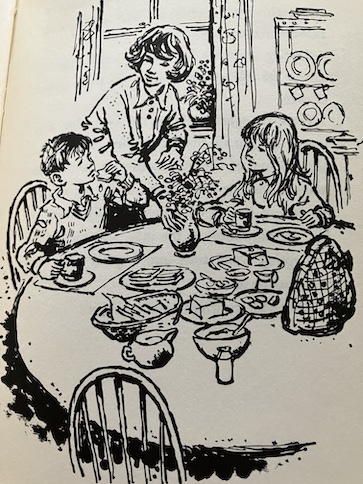
The Curse
The curse apparently started with the Roman invasion of Britain. Their family seems to have Roman roots, and one of their ancestors was apparently a Roman soldier. When the Romans took over Britain, they wanted to convert the inhabitants to the Roman religion, which was still pagan at that time. According to the legend passed down in their family, their ancestor was one of a group of soldiers who were ordered to destroy a pagan British temple. The son of one of the priestesses at the temple tried to resist them, and Cosmo’s ancestor killed him. The boy’s mother then killed herself out of grief. The boy’s grandmother, who was also a priestess, placed a curse on Cosmo’s family: in every generation, the eldest son of the family would die in battle, and his mother would die of grief.
Since then, Eunice says, the curse seems to have come true. She can list generations of their family where the eldest son has died in battle, including Cosmo’s father’s generation. Cosmo’s father was the youngest son of his family, and his elder brother, Frank, died young in battle. After Frank’s death, when Richard was only 10 years old, his mother died of grief, just like in the curse. Richard claimed that the curse was all nonsense when he was an adult, and he refused to tell his wife about it when they got married. However, Eunice had been friends with his wife before she met Richard, and she didn’t think it was fair to keep the secret from her, now that they had two sons of their own. Eunice admits that she told Cosmo’s mother everything, and that the story seriously upset her. It was Cosmo’s mother who insisted on moving to Australia, hoping to get as far away from the curse and any potential war as possible.
When Eunice explains this, some of the things about Cosmo’s family begin to make sense to him. Eunice admits that it seems like the elder brothers of the family resent the younger ones, who are safe from the curse, and Cosmo realizes that he sensed that his brother seemed to be hard on him or resent him, indicating that he probably had some sense that he had an ordeal or possible early death to face that Cosmo would be spared. Yet, younger brothers in the family are not entirely spared from the curse. It’s true that they live to carry on the family line, but each of them is also destined to lose their first son, and shortly afterward, to lose their wife to grief at their son’s death. Cosmo considers that maybe, when he’s grown up, he’ll just adopt a child to get around the problem.
He somewhat compares the family curse to a form of cancer. Some families are more genetically prone to particular types of cancers than others, and the way that members of those families survive is if, somehow, a genetic mutation is introduced to the family line, something that makes those individuals different from the ones before. It’s an indication that, maybe, this curse might not afflict their family forever. If someone, like Cosmo, can figure out how to be different from earlier generations of his family, and not pass on the cursed element to the next generation, there might be an end to the curse. Figuring out how to do that is going to be difficult, though.
Eunice says that his mother tried to evade the curse by running away, but apparently, it didn’t work. Nobody knows exactly what happened to Cosmo’s mother and brother, only that their car was found abandoned, and that they appeared to go off into the Australian desert on foot. Searchers have found no sign of them since, and because it’s such a harsh environment, people don’t think it’s likely that they’re still alive. Nobody knows why they went off into the desert, except maybe either the curse drew them there or they were trying to escape from it. Eunice’s housekeeper, who also knows about the curse, talks about it with Cosmo, and Cosmo asks her whether she thinks it’s possible to break the curse. Like Cosmo, she thinks it might be a case of gradual changes, members of the family doing things differently from earlier generations. Unlike Eunice, she thinks that maybe what Cosmo’s mother and brother did was one such change, and it’s difficult to tell what effect it has had yet.
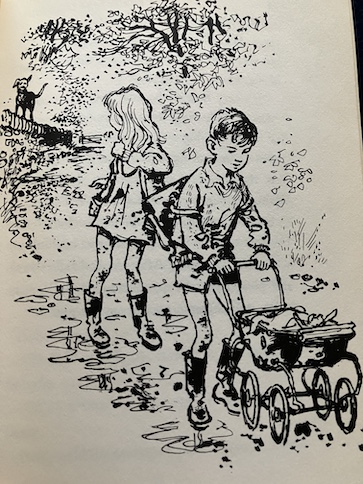
Cosmo remembers a strange old man who visited them once in Australia. He thinks the man was probably a sorcerer or something because he told them things about their futures. He’s not sure what the man said to his mother, except that it seemed to upset her, and she was never the same afterward. Eunice suspects that the man may have told her that it’s impossible to run away from heredity and destiny. The man told his brother something about there being many different types of battles, which might indicate that staying away from wars would not be sufficient to save him from his destiny. The old man didn’t clarify that statement, but it’s true that people also fight internal and emotional battles every day, no matter where they are. Was this the battle Cosmo’s brother lost or could lose, and has it actually claimed his life already?
Cosmo had always thought his brother and mother were braver than he was, but now, he comes to question that. They had tried to run from their apparent destinies, and maybe the running caused them to go missing, and maybe even to die. When Cosmo’s father writes to him about the family curse, he explains that he has come to believe that the curse is a self-fulling prophecy, that it only comes true because people expect it to. Perhaps Cosmo’s mother and brother would have been fine if they hadn’t tried so hard to outrun their curse, putting themselves into a dangerous situation.
Of course, Cosmo realizes that it’s easier for Cosmo and his father to put aside their fear than it was for Cosmo’s mother and brother. Being the direct subject of an existential curse is certainly much more terrifying than just being part of a family that has a curse that may kill people around you. These thoughts cause Cosmo to consider the nature of fear and how people can be afraid of many different things and how the nature of a person’s fears make a difference in how they are affected by them. What one person can face with courage may be the undoing of another.
The Ghosts
Meanwhile, the other kids at school have become deliberately hostile to Cosmo. They accuse him of being stuck up and lying to them about Australia, and they start saying that Cosmo has probably never even been to Australia. Cosmo knows that all of the things that they say about him are untrue and unfair, but there isn’t much he can say to refute it. It seems to be a form of hazing at the school. He thinks about how petty and childish the other kids are and how they have no concept about the serious issues that are hanging over Cosmo. In a way, though, Cosmo discovers that he’s actually more comfortable brooding over the curse than he is thinking about the obnoxious kids at school. There is a kind of comfort in knowing your life fits a pattern, even if it’s a disturbing and unpleasant one. He also thinks about what the old man told him, that one day, he would have three friends. Because of the way kids at school act, Cosmo can’t image having any friends there at all, but that prediction comes true as well.
Cosmo gradually discovers that the mill house where his aunt lives is haunted. Eunice tells him about a phantom coach and horses that are supposed to appear at night, and Cosmo begins seeing a boy who calls himself Con. Con first appears to him as a little boy, about 4 years old, but each time Cosmo sees him, he gets a little older. He also eats Cosmo’s candy bars from his room. Eventually, Con speaks to Cosmo as a young man. He admits that he took the candy because eating someone else’s food forms a relationship between the two of them. Con explains to Cosmo that his father was a free Roman soldier, but his mother is a slave woman, so Con himself is a slave. The only way he can win his freedom is to play in the gladiatorial games, and he needs Cosmo’s help to practice. At night, Cosmo practices Roman style fighting with Con, but it is gradually revealed that Con does not expect to survive his upcoming fight. When Con speaks to Cosmo more about his family, it is revealed that Con is a member of Cosmo’s family from the distant past. He is the eldest son in his generation, and he knows about the family curse. Because of the curse, he expects to die fighting. Cosmo tries to explain to Con that he doesn’t need to believe in the curse.
Whether that helps Con or not isn’t apparent because Cosmo has to spend the next weekend at school and doesn’t see Con again. The next ghost he sees is a boy called Sim. Sim has been living at a monastery in the Middle Ages, getting an education, but his father has pledged him to his uncle to go fight in the Crusades. Sim is worried because he doesn’t know anything about fighting and thinks that he’ll be killed. He asks Cosmo if he can help him learn to fight. Again, Cosmo doesn’t know much about fighting, but he tries his best to help Sim. He doesn’t really see why Sim has to be obligated to go to war if he’s no good at it and doesn’t want to go, but he does notice that Sim’s eyesight is poor, and what he really needs are glasses.
Then, some of the hauntings at the mill house turn frightening. Cosmo is almost killed in multiple, inexplicable accidents. It seems like a poltergeist is out to get him. One of the boys who’s been giving Cosmo a hard time at school is also visiting the mill house and witnesses some of these accidents one weekend because his father works with Eunice. Not only do the boys learn to get along better after getting to know each other, but Cosmo starts realizes that the boy, Moley, actually has some problems of his own. He has an unhappy home life because of his stepmother. Moley also has a weak heart that keeps him from participating in certain school activities. Knowing this makes Cosmo feel more sympathetic toward him. Moley also comes to realize that something mysterious and threatening is happening to Cosmo, and he witnesses a ghost that Cosmo doesn’t see: a stern old woman in black. Moley has the sense that this old woman is responsible for the accidents happening to Cosmo, although he doesn’t seem to recognize that she is a ghost at first. It seems like Cosmo has now become the target of his family’s curse, which shouldn’t happen because he isn’t the eldest son. Has Cosmo become the target of the curse or some other supernatural force that now sees him as a threat?
My Reaction and Spoilers
I enjoyed the story, although I feel a little conflicted about the ending. The story is somewhat open-ended. We know that Cosmo survives his ordeals. Part of me wonders if the curse may have actually saved his life, after a fashion. If his bother was fated to die and Cosmo was fated to survive, then the forces trying to kill Cosmo were destined to fail. But, that’s just conjecture. These questions are never really answered. In the end, Cosmo doesn’t know if anything he’s done has changed the nature of the curse or if it actually can be changed. He still doesn’t know what might be in store for his future wife and children or if he will actually have a future wife and children. The only way to know is to live his life as best he can and deal with whatever comes along the way.
There are two things that I can see that he gains from his ordeals: closure about his mother and brother and a glimpse at what various other relatives have done in the past to change their fate (or if they did anything). I think there are some indications, based on Cosmo’s encounters with family ghosts, that what his father believes about the curse is probably true, but the story leaves that up to the imaginations of the readers. If you like speculative books, you might enjoy this one.
Metaphysics
Although Eunice is a mathematician, she’s also interested in metaphysics. She and Cosmo have discussions about the nature of time and reality and the possibility of other dimensions or other realities, which have a bearing on whether or not we interpret the ghosts that Cosmo sees as ghosts or not. In some ways they seem like ghosts, but in others, they might be people who have not yet died but who have crossed over in time.
This isn’t confirmed, though, and during Cosmo’s ghost experiences, someone from the past is attempting to kill him. (Spoilers) At first, I thought that the old woman attempting to kill Cosmo was the old priestess who originally put the curse on his family and who was trying to stop Cosmo from helping the ghosts who came to him to survive and thwart the curse. That isn’t the case, though. What Cosmo discovers is that various ancestors have tried different ways of thwarting the curse themselves. So far, none of them have been successful (and I’ll have more to say about that), but Cosmo discovers that one ancestress and her son actually became evil sorcerers themselves. The old lady is a sorceress, and she believes a prophecy that her son will die in a fight with Cosmo, so both she and her son are traveling through time and actively trying to kill Cosmo to save the son from the family curse.
During his struggles with this unholy duo, Cosmo is very close to being killed, and he has a near-death experience. He sees a beautiful, peaceful place, with Con and Sim and his mother and brother. He wants to join them all there, but they tell him that it’s not his time, and they will wait for him there until it is. This seems to represent a vision of Heaven and to confirm the supernatural nature of the story and that Cosmo’s mother and brother are also both dead.
Destiny and Curses (Lots of Spoilers)
I already said that, in the end, we don’t know if anything that Cosmo has seen, done, or experienced has broken the curse or changed his future or his family’s future. What we do see through Cosmo’s experiences are two things: that different generations of the family have tried to thwart the curse in different ways and that (although the story doesn’t explicitly spell this out) there may have been reasons other than the curse itself for what happened to the sons who died, including what Cosmo’s father said about belief in the curse itself causing it to come true.
Con tried to practice his fighting skills in an effort to win his battle, but unlike Cosmo, he never seemed to seriously consider that maybe he didn’t need to fight that battle at all. We’re not sure exactly how many generations removed he was from the original curse (maybe one or two, possibly more?), but it seems that enough time has gone by to convince him that the curse is real and that he should believe in it. Did his belief that he was going to his destiny and going to die in the upcoming fight cause him to actually seek out that fight and also to lose it?
When Sim comes to Cosmo, Cosmo tries to talk to him about just choosing not to fight, but Sim explains that isn’t an option for him. His father arranged it with his uncle, and Sim has no power to refuse to go. The choice not to fight isn’t open to Sim, but Cosmo also realizes that, beyond simply not being a skilled fighter, Sim is also at a disadvantage because he has bad eyesight. So, was Sim’s death almost arranged by his family because they had already concluded that it was his fate to die in battle, never teaching him to actually fight and overlooking his eyesight? If they had left Sim in the monastery, where he was studying, maybe nothing bad would have happened to him.
After Cosmo recovers from his near death at the hands of the sorceress and her son, who was an 18th century member of the Hellfire Club, he learns their fate from Eunice. Both the evil mother and her son died at the same time in the river where they nearly drowned Cosmo, indicating that they accidentally got themselves killed in their attempt to kill him. The prophecy that said the son would die while fighting Cosmo was actually a self-fulfilling prophecy. If they simply hadn’t believed it and had ignored Cosmo, he would have never met them at all, living in a completely different time and having no way to magically travel through time on his own. It’s only because they sought him out and actually started the fight that both of them died, which lends credence to what Cosmo’s father says about believing in the curse causes it to happen.
Before the end of the story, Cosmo’s father tells him that searchers have finally found his mother’s and brother’s bodies in the desert, confirming his vision of them in Heaven. We still don’t know exactly why they went off into the desert to die. Were they trying to flee the curse in a panic, so they weren’t thinking about how this decision could lead to their deaths? If they had simply chosen not to believe in the curse and had continued living in London instead of trying to wildly flee, losing the battle with their own emotions, perhaps they would have both lived normal lives and not died early … maybe.
There’s no real way to prove exactly what happened to Cosmo’s mother and brother. We never hear what happened to them from their point of view, and what decisions they made because of it. Both Cosmo’s father and Eunice says that they shouldn’t blame them for how they attempted to deal with something beyond themselves because they did the best they knew how at the time, even if no one else understands. This leads me to consider that maybe the real curse of the family is: bad decisions. Whenever the curse seems to arise again, each generation has to decide how they will handle it: run or fight, believe or not believe, etc. Each time, they’ve made the wrong choice for their circumstances.
In a way, Eunice bears some responsibility for what happened to Cosmo’s mother and brother, although no one blames her for her role in the situation. Cosmo’s father, having concluded that belief in the curse causes it to come true, had decided not to tell his wife or kids about the curse, so they would never have to grapple with whether they believed it or not. But, apparently, he never explained that logic to Eunice because she spoiled it by telling Cosmo’s mother and shocking her into taking a course of action that led to her and her elder son dying. Would the situation have been different if she had said nothing or if she had said something but said it at a different time from the one she actually chose? Eunice says that she thought Cosmo’s father should have explained the situation before he got married. Maybe that would have changed things or maybe it wouldn’t, but if she felt that strongly that this was the right thing to do, she could have brought up the subject earlier. Maybe she should have talked to both of Cosmo’s parents before their marriage to either get everything out in the open or at least understand why she should keep the secret. Either Eunice didn’t do that or she weakened in her resolve to keep the secret, and she inadvertently set the curse cycle in motion again.
The supernatural nature of this story and its ghosts suggests that the curse is probably real on some level and not just a series of bad luck incidents and unfortunate mistakes that the family makes. The hopeful outlook, the one that Eunice’s housekeeper believes, is that, little by little, with each passing generation, the family changes. Each generation is a little different from the last. Cosmo’s brother was apparently the first not to die in a conventional battle or a physical fight. He died trying to avoid fighting. With him, it seems to have been some kind of internal battle. This may be true of later generations, or maybe this is the first step in shattering the pattern of the curse. Possibly, all that Cosmo has seen will grant him the ability to make better choices, teach this children how to break old patterns, or do something drastically different that nobody else has done before. It’s hard to say, but realizing that it’s hard to say what might happen or what could have happened is a major part of the story.
Thinking about the curse and all of the ways the family could break it and all of the ways they’ve failed to break it so far shows the unpredictable nature of the choices people make in life. Each generation apparently did something they thought was for the best, whether they were embracing fate, fighting fate, or running from fate. The story leaves open the possibility that fate (or the curse) will always find them in some form, no matter what they do. If they don’t actively go to war, they may face their battles in another way, like internal or emotional battles. Who’s to say whether a different sort of internal battle might have taken Cosmo’s brother in London, even if the family said nothing about the curse to him or his mother? As a teenager, he might have had a battle with drugs or depression and lost. He might have gotten a disease and lost that battle. Life has a lot of maybes, and none of us can foresee every possible struggle or disaster.
Another maybe is that maybe the important point isn’t whether or not the curse exists or whether or not they can save all the potential victims but what each of them chooses to do with the life they have while they have it. Cosmo and his father will keep on living. His father will return to his important cancer research, and Cosmo will have decisions to make about his own life. He may or may not decide to have kids, he may or may not tell his future wife or fiance about the curse, and he may or may not try to adopt a child rather than have a biological one. In fact, unless the curse guarantees that sons will be born in the family, we don’t know for sure whether Cosmo might have all daughters. Really, anything is possible. What his future children’s struggles might be or what the real risks to them could be are a distant unknown right now in Cosmo’s life. In the end, he will have to trust them to a certain extent to make the right choices or at least the best choices that they know how when their battles come to them, in whatever form they take. We all have battles of our own to face and risks we take, no matter who we are, and nothing in life is guaranteed for any of us.
There is one last thing that did surprise me. In all of the ways it seems people in Cosmo’s family tried to end or thwart the curse, did nobody think of maybe some form of apology or atonement? The curse stems from an ancient offense someone in their family committed. Perhaps, if they found a way to say they were sorry, it would do something to end the vengeance against them, but it seems like nobody even suggests it. Heck, the evil sorceress lady and her son acquired the ability to use magic and travel through time, but because they were evil and stupid, they went after Cosmo, who was probably their greatest ally, instead of looking further back in time for the real source of their problems. Couldn’t they have gone and faced the priestess lady and either stopped her from creating her curse or stopped their ancestor from killing her grandson? There are a lot of maybes to this whole situation, but I’m honestly surprised that they didn’t think of that one.
School Troubles
Some of the school experiences in the story may have been based on the author’s own education. Joan Aiken was home schooled until she was 12 years old, and then, she was sent to the Wychwood School in Oxford, a boarding and day school. It’s possible that she also encountered difficulties adjusting to being at school with other children and the hazing and bullying that can occur in that type of environment. In the story, Eunice sees value in learning how to get along with other people, although Cosmo questions the value of learning to get along with people as awful as the kids at his school.
He gradually begins to learn more about the relationships of kids at school by observing them as an outsider. Some of the awful ways of treating him are considered some kind of hazing or initiation, and he’s expected to undergo it with some degree of grace before they will grant him acceptance. It’s all pretty idiotic and immature. Cosmo realizes it, although he knows he can’t show much reaction, or it will make things much worse. It’s the sort of thing I hated when I was a student myself. I admit that I was shy and socially awkward, and I didn’t get along well with many other kids because I just couldn’t stand this sort of thing.
Over 30 years later, I haven’t really changed my mind about that. I get that being around other people can open your eyes to human nature and how to deal with your fellow flawed human beings, but I see the same problem in this story as I do in real life: allowing this system of hazing encourages the personal entitlement of particular students, and it also is detrimental to the mental health of people who struggle to deal with them. I think schools do better at this now than they did when I was a kid, when it seemed like almost 100% of the personal development, learning, and personal responsibility was put on the shoulders of everyone else who has to deal with this type of person. I think I have much, much less patience for this kind of thing now than I used to due to overexposure early in life, which does call into question whether what I learned from that experience was really beneficial or not. On the whole, I actually do think that I benefited from exposure to other people, in spite of all the stresses and mental health issues along the way. Part of the issue is, when you’re part of a group of people, you have to put up with the worst parts of that group to spend time with the better parts of the group. If you avoid society too much, you don’t meet the better parts. Learning social skills and human understanding also requires time and practice, which is what Cosmo learns in the story.
People who bully and cause problems can be considered in the learning phase of developing social skills themselves. It’s just that there do have to be rules about how much of their bad behavior can be allowed while they learn. They can’t be allowed to sabotage other people’s social development for the sake of their own because that only leads to their personal entitlement at someone else’s expense. If they are spared consequences for their actions, they never learn anything, either, never improving or showing signs of development, just putting more needless stress on other people and never seeming to understand or care why. I’ve seen far too many examples of this in real life.
I actually enjoyed the way the school in the book handled some of these conflicts. The headmaster is a psychologist, and although some of the things he does seem a little unfair, he actually discusses his reasons for doing this with Cosmo. He understands how his students think and feel, and he knows how to give consequences for actions that not only enforce the school’s rules and better treatment for bullied children but also which affect their relationships with each other more positively.
At first, Cosmo is angry when he’s punished along with some of the other kids who have been bullying him for a prank he tried to discourage them from committing. However, the headmaster apologizes to him for that, saying that he knows those other kids have been giving him a hard time, treating him like he thinks he’s better than they are. One of the other teachers says that Cosmo has been targeted because he’s one of the bright students, and some of the members of his family have a more prestigious reputation than Cosmo realizes. By giving Cosmo the same punishment as the other boys, while the other boys are made to acknowledge that it’s unjust and that Cosmo doesn’t deserve it as much as they do, the headmaster is showing the other boys that they don’t have reason to think that Cosmo is being treated better than they are, ending some of their resentment against him. He also knows that the boys can now accept Cosmo as being one of them, united in resentment against the headmaster for being harsh and unfair. The headmaster is willing to take their resentment against him because, as an adult faculty member, he doesn’t need to be one of “them”, as in one of the students or their “friend” or “pal.” He’s apart from them anyway in terms of age and status, and part of his role is guiding their actions and relationships with each other. In a way, Cosmo admires the logic and the tactic, even though it means enduring the punishment, and it does improve the way the the other boys treat him.
This classic children’s book from the mid-19th century is famous as the story that popularized the concept of British children’s boarding school stories, although many people in the 21st century haven’t read it themselves.
Young Tom Brown was brought up in a very close family, although they are often given to quarrels and drama among each other. He is the eldest of his parents’ children and spends his early young life in the vale where he was born, raised by his family and his nursemaid, Charity. Tom’s mother has a talent for training young servants. She is kind and patient with servants in training, treating them almost like older children of the family. Charity is rather clumsy and not too bright, and she has her hands full with young Tom. He is a strong and rebellious little boy. Charity’s relatives have a farm nearby, and she takes him there to pick up supplies for the Brown household. The people on the farm are kind to Tom, and they also help raise him. Because Tom resists training and supervision from women, the Brown family eventually hires an older servant, Benjy, to take care of Tom from about age four. Benjy takes little Tom fishing and tells him stories about the history of the Brown family. Generally, Tom’s early childhood is pleasant and easy.
As Benjy gets older, he is troubled more by arthritis and finds it harder to keep up with young Tom. Tom gets a governess at home, and when Tom begins lessons at the local school, he begins to calm down at home because he spends his energy at school and playing with the local boys in the village. Being friends with other boys his own age is good for Tom because they share the same interests and levels of energy. They play games and wrestle with each other for fun. Then, when Tom is nine years old, his family sends him away to boarding school. There are some sad goodbyes from the local boys in the village, and the other boys give him some little toys as going-away presents. This is the first time that Tom has ever been away from home, and this is where the story of Tom’s education really starts.
First Boarding School Experience
Tom spends about a year at a private school before going on to a public school. The author pauses here to explain the differences between British private schools and public schools. Unlike in the United States, “public” schools are still schools that require school fees, but private and public schools differ in who is accepted as a student and how the students are treated in their time outside of class. In the author’s time and young Tom’s time, students at private schools are more closely supervised in their off hours, with the idea that molding the students into good citizens (which is considered a higher goal in their education than the subjects taught in the classroom) cannot be adequately accomplished in classroom time only and that most of it takes place outside of the classroom. At public schools, the author says, the boys have more freedom and less supervision outside of class.
The boys at the private boarding school Tom attends are supposed to be supervised by school ushers, who monitor their behavior, resolve quarrels, and set a good example for them. Unfortunately, the ushers at Tom’s school aren’t very well educated or good at their job, and they have little interest in doing their job properly. As a consequence, the older students bully the younger ones, students are encouraged to tattle on each other, and physical punishments are used to keep the students in line. In spite of this and some homesickness, Tom actually has a pretty good time at school with his new friends at school. They have some adventures (some of which involves cruelty to animals they find, and the author makes it clear that he doesn’t endorse this and thinks that the bee stings they get are earned) and delight in scaring each other with ghost stories at night. However, this school isn’t really the best treatment or education Tom can get, so it’s just as well that he is sent to a public school after this.
Tom’s change in school comes when there’s an outbreak of disease in the area, and the schoolmaster of the private school is one of the people to become ill. All of the boys are sent home to their families. Since Tom has already told his father that he would rather attend a public school and since school at the private school is canceled for the rest of the term, Tom’s father decides to send him to Rugby. When Tom goes to Rugby, his father talks to him about his school experiences. Tom’s father says that he is going to Rugby at a younger age than he had planned to send him, and if schools are still like they were when he was young, he’s going to see people doing many cruel things and will hear bad talk from other people. He urges Tom, whatever happens at school, to be brave, kind, and truthful and, no matter what other people say, to not say anything he wouldn’t be willing to have his mother or sister hear him say. If he does these things, he won’t have to feel ashamed to see his family when he comes home from school, and they won’t be ashamed of him. This talk and the thoughts of his mother make Tom a little emotional, although he tries not to show it too much.
Tom’s father privately reflects on the reasons why Tom is going away to school. Partly, Tom is going to school because Tom really wants to go and have that experience. The fact is that Tom’s father doesn’t really care too much about Tom learning subjects like Latin, and his mother doesn’t care too much about academics, either. Tom’s parents aren’t too concerned about what kind of scholar Tom is. What Tom’s father really wants for Tom is what he has already told him to be. He wants his son to be brave and truthful, and he wants Tom to be a good and helpful English gentleman and a Christian. Basically, he’s more concerned with his son’s character and life choices than with his son’s grades. He thinks about whether or not he should warn Tom about various temptations he might experience at school, but he decides not to because Tom is still just a boy, and he thinks he wouldn’t understand.
Going to Rugby
Tom takes a stage coach by himself to school, nervous about what the school will be like but excited about the the experiences he is about to have. When Tom arrives at Rugby, a more experienced student, Harry East, helps Tom get settled and acts as a mentor to Tom about school life. East’s aunt is an acquaintance of Tom’s family, and she knew Tom would be coming to Rugby, so she asked East to hemp Tom. He explains the school grounds and uniform pieces to Tom, describes student activities and sports to him, and answers his questions.
Tom loves sports and is eager to play Rugby football, but East tells him that he won’t be able to play until he learns the game. Football is different at Rugby, and it’s a much rougher game than other schools play. East says players often get hurt and break bones. There is a match that day, and Tom finds it exciting to watch, especially since their house wins! After the match, East says that he doesn’t have any allowance money right now, so Tom buys some food they can have for tea, and they share some of it with some of the other boys from their school house. Tom starts making friends with the other boys, and they all talk about the match together.
After tea, East says that it’s time to join their house for singing. Tom is surprised, but East says that group singing among the students is a regular school activity. There are also speeches from other students at the school singing. Today’s speech is about their house’s victory at the football match. One of the students speaking, Brook, praises the players and congratulates them for their victory on behalf of the house, with all the other boys cheering. He says that their house won the match because their house has the best house spirit and team spirit, and they know they can depend on each other. However, he also issues a warning to the students about bullying in the house. Some of the older students have been picking on the younger ones. He doesn’t want to encourage tattling among the students, and he says that learning to deal with bullies is a valuable skill that makes a boy tougher, but at the same time, bullies are cowards, they encourage cowardly behavior among others, and they break up house spirit and bonds of teamwork among the students. He cautions everyone that too much bullying and allowing bullying to continue will destroy the house spirit that helped them win today, so if they want to continue winning and enjoying house victories, they’d better cut it out. Some of the younger students look at the older students have been doing the bullying, especially a boy called Flashman.
Brook also cautions the other students against drinking in the local pubs and talks to them about their new headmaster. Some of the students haven’t been happy with him because he’s changing some of the school customs. Students have been grumbling and would like to see the new headmaster gone, but Brook points out that Brook isn’t going anywhere and that the “customs” he’s been changing have been destructive pranks and other habits that were also causing problems. The new headmaster hasn’t touched some of the customs that really matter to the students, like their sports, and in fact, the headmaster was also watching the match today. There are mixed feelings among the boys at this part of the speech because they like the idea that the headmaster, who they call “the doctor”, was watching the match, but at the same time, the boys don’t really know him or trust him yet.
The author notes that the new headmaster found the school in a state of disorder and mismanagement when he took his position, and the changes he’s been making are about restoring order to the school. The boys, not knowing the difference between a more orderly and well-managed school and the one they got to know when they first arrived, don’t appreciate the doctor’s wisdom of kindness yet. Tom first encounters the doctor when he leads the students in prayers.
Before bed, Tom and the other younger boys meet with some bullying from Flashman and Flashman’s cronies. Some of the other boys are terrified, but Tom and East allow themselves to endure the bullying, being “tossed” by the older boys so the other boys will be spared. The other boys are grateful to them for this, so they start to hold Tom in high regard.
Getting Into Trouble
This eventful first day is a good introduction for Tom about what life at Rugby School will be like for him. Sports, bullying, pranks, fighting, camaraderie among the other students, singing, speeches, and the new headmaster are going to be major themes for him in his education. Like other younger students, Tom has to act as a servant and do chores for older students, part of a tradition called “fagging” (more about that below in my reaction). Tom does well in his classes at school because he has already had a good grounding in his subjects, and he is generally positive about his life at school, in spite of the bullying. He loves participating in the school sports and physical games, like Hare and Hounds.
However, things do get harder for Tom at school. Because he is doing so well at his grade level, he is quickly promoted to the next. When he gets there, with some of his new friends, like East, Tom becomes less studious and more unruly, like the others. Also, the older boys who were trying to set a good example for the others and protect the younger students from the bullies graduate from the school, leaving bullies and less conscientious students as the senior students. The bullying gets worse, and as Brooks had predicted, it breaks the spirit of teamwork in Tom’s house. The students in the house start dividing into factions of bullies and bullied, the younger students against the older.
The younger students get increasingly resentful of the ill treatment and bullying of the older students and start getting rebellious against the system of “fagging” at the school, with Tom and the others declaring that they simply won’t serve the older students anymore. When students like Flashman the bully call for them, they just pretend they don’t hear and refuse to answer them. Flashman and the others try to physically break into Tom and East’s room when they refuse to come, but Tom and East barricade themselves inside. Their success against the older students encourages other students to rebel. Tom considers going to the headmaster about it, but the others discourage the idea. None of the students want to go to the schoolmasters unless absolutely necessary because the students think that the right thing to do is to work out their own problems with each other.
Diggs, one of the older students who is nicer tells the others that, when he and Flashman were younger students, the students in their grade also rebelled against the older students to teach them not to bully them, but Flashman didn’t rebel with the others. Instead, he ingratiated himself to the older students, continuing to serve them and bribing them with treats he got from home. He has evaded discipline and consequences for his behavior by making himself into a useful toady for the students with more authority. Now, Flashman and his cronies increasingly bully the younger students and use physical hurt to subdue them. The younger students retaliate against them with pranks. Tom and East become Flashman’s particular enemies because they live close together in their house and because Tom and East started the rebellion and have been open and accurate in their criticism of his cowardice, refusing to be subdued by the beatings he gives them.
Matters with Flashman come to a head over a lottery, when Flashman pressures other students to turn over their tickets to him. Tom refuses to part with his, and Flashman and his cronies beat him and burn him, hurting him so badly that Diggs intervenes, worrying that they might kill Tom. Diggs shows Flashman to be a coward when he confronts him over the incident and hits Flashman, but Flashman doesn’t fight back because he’s afraid of getting hurt himself. This doesn’t end Flashman’s aggression against the younger boys, and when he starts getting worse again with Tom and East, Diggs urges the two boys to gang up on Flashman. For them to fight him singly wouldn’t be a fair fight because Flashman is several years older than they are and bigger, but Diggs considers it fair for both of them to stand up to Flashman at once. To Flashman’s shock, the two boys do gang up on him. He’s much bigger than they are but not as good at fighting and pretty cowardly about fights where he doesn’t have some obvious, overwhelming advantage. Tom and East win the fight, giving Flashman a cut on his head that bleeds. At first, Tom and East are worried about whether they’ve hurt Flashman badly, but Diggs has a look at the wound and tells Flashman off for being dramatic about how hurt he is. Flashman has only skinned his head a little, and he’s done much worse to the younger boys. Flashman never physically fights the boys again. He eventually leaves the school, being sent away by the headmaster after he becomes disgracefully drunk at a nearby pub one evening. The headmaster was already displeased with Flashman, and this was the last straw. The younger boys are glad to see the bully gone, although some of the older students bear some resentment against the younger ones for their rebellion and their triumph over someone from their level.
Tom and East are emboldened by their victory and for moving up at school, and they become regular rule breakers. They never consider the justice or reasons behind school rules, taking them more as challenges. They get into trouble for trespassing on someone else’s land to go fishing, and the land owner’s gamekeeper brings Tom before the headmaster. Later, Tom and East climb onto the roof of the school and carve their names on the minute hand of the school clock. They are caught because they accidentally change the time on the clock, and when someone investigates why the clock is wrong, finds their names.
Later, they sneak into town against the headmaster’s orders and get caught. They are both taken before the headmaster for this, and they receive floggings for their stunts. The headmaster also gives them a lecture about the dangerous nature of some of their stunts, pointing out that they could have fallen and broken bones from the clock stunt. He points out that they never think about the reasons why rules exist, thinking of them only as whims of the schoolmasters, which isn’t the case. The rules exist for good reasons, and they apply to everyone at the school, including Tom and East. The headmaster says he doesn’t want to keep giving them floggings for their stunts, and if they can’t gain some maturity and reform their behavior, he’ll send them both away from the school. Tom and East are shocked because they never thought that they might have gone far enough to risk their positions at the school. They love their lives at the school and don’t want to be sent home in disgrace. The headmaster tells them to think about their futures at the school seriously when they go home for a term break.
The Headmaster’s Solution
Privately, the headmaster has a word about the boys with one of the other schoolmasters. The headmaster is concerned that, if they continue their irresponsibility and recklessness, they will fail their studies, get into some really serious trouble, and possibly turn into thoughtless bullies of the younger children as they get older. The other schoolmaster acknowledges that they are not the best students and they are a problem, but he thinks that they’re not really bad boys and could still be turned into decent young men. He says to the headmaster that what these boys need is something to give them a sense of responsibility and suggests making each of them responsible for a younger boy at school. Protecting a new boy from the older bullies could settle them and make them more serious and responsible and prevent.
When Tom returns to school for the next term, he expects that he and East will be allowed to share a room and study, which is something that they’ve hoped for. They’ve been making plans for all the ways they can have fun and goof off in their own space. Instead, the school matron introduces Tom to a new boy who will be sharing his room and who will be Tom’s responsibility. George Arthur is a pale, timid, skinny boy, and Tom can see that he’s just the sort of boy who would be picked on by the others. Tom is annoyed at having his plans with East spoiled, but the matron stirs his sense of sympathy by telling him that George Arthur’s father is dead and that he has no brothers. Tom can see that young Arthur will probably be made miserable at school by bullies unless someone stands up for him and teaches him how to handle life at school, so he agrees to take responsibility for him.
The schoolmaster is correct that looking after little George Arthur changes the way that Tom looks at himself, his fellow students, and his education. The change starts when Arthur says his prayers openly at night, getting him a teasing from the other boys, who take any sign of weakness or sentiment as an opportunity for teasing. Tom defends Arthur from them. He also feels a twinge of shame because he remembers, for the first time in a long time, that he had once promised his own mother that he would always say his prayers at night, and he has become neglectful about this, specifically because he wanted to avoid the teasing or bad opinion of the other students. It shames Tom a little to think it, but he realizes that, although Arthur may be physically weaker than he is, he has displayed more moral courage than Tom has simply by saying his prayers, regardless of what the other students think.
Looking after Arthur gives Tom a sense of responsibility, as the schoolmaster hoped, and Tom appreciates feeling like he has a purpose. He enjoys seeing timid Arthur beginning to develop as a student and start to make a new friend on his own. However, Arthur also has things to teach Tom. Tom’s friendship with Arthur helps his own personal development and causes him to consider sides of himself he hasn’t thought about much. As Arthur opens up more to Tom, he explains that he is serious about religion because his late father was a clergyman. When he was alive, his father used to read the Bible with him. Inspired by Arthur’s example, Tom becomes more serious and starts exploring his religious side, although he takes some teasing and criticism from the other students over this budding sentimentality and defense of little Arthur. Tom and East start participating in Bible readings and study with Arthur, considering some of the deeper questions of life and religion that they’ve never considered before. They begin to think even more deeply about life and death when a disease spreads through the school. Arthur becomes ill and another boy dies. Tom is relieved when Arthur recovers, but his near death and the other boy’s death cause Tom to really consider life and death seriously for the first time.
As Tom develops a deeper understanding of life and religion, he finds himself a little at odds with East, who still doesn’t take life seriously. Fortunately, the two of them respect each other enough as friends to talk about their views seriously with each other. Tom doesn’t consider himself as knowledgeable about the subject or as good as explaining it to others as Arthur, but through their conversation, East realizes that he does actually care about the subject and goes to talk to the headmaster about his feelings and about confirmation. The headmaster’s kind understanding and reassurance is an inspiration to the boys, and they come to respect him, although Tom doesn’t fully understand the headmaster and what he’s done for the boys until he is a young man.
At the end of the story, Tom is with some college friends when he hears that the old headmaster has died, and he feel compelled to visit Rugby School again to pay his respects and reflect on his old headmaster.
Although it was not the first book set at an English boarding school, this 19th century book is famous for being the book that popularized the trend of British boarding school stories, which has continued for over 150 years since! There are also references to this specific story in other books, and I have to admit that it gave me a giggle to recognize the scene that Terry Pratchett parodied in his novel Pyramids. The story is semi-autobiographical, based on the experiences the author, Thomas Hughes, had when he attended Rugby School as a boy during the 1830s. There is now a statue of Thomas Hughes outside the Rugby School Library.
The headmaster in the story is only called “the doctor” for most of the story, until the very end, when Tom learns of his death and his last name is given as “Arnold.” Tom’s headmaster is based on Thomas Arnold, who was the real, historical headmaster of Rugby when the author of the book was a student there himself. The real Thomas Arnold did die suddenly of a heart attack at age 46 in 1842, and this book is an homage to his memory as well as the recollections and thoughts of the author on the subject of education. The real life Thomas Arnold did reform the habits and organization of Rugby School, like the headmaster in the story, focusing on the religious and character development of students and creating a system of prefects called “praepostors” as student monitors, something that is referred to in the story. Other British boarding schools copied and built on his ideas and practices. (Added fun fact: Thomas Arnold was the great-grandfather of the author Aldous Huxley, known for Brave New World.)
The book requires some patience for modern because the author spends some time setting the scene and explaining the background of Tom’s family and early childhood before really getting into the story. Part of the reason for that is that the author, Thomas Hughes, based the story on his own childhood and youth, and he spends some time comparing the childhood and conditions of life in young Tom’s time with life at the time he wrote the story.
Hughes admits that he doesn’t like the direction the social situation has been heading in his time, and he feels that his time period is at a changing point. He sees many of the old ways of life falling aside, and he partly blames the new upper classes, who take advantage of the working class, using them to enrich themselves (“buying cheap and selling dear”). He’s describing an increasingly industrialized and urbanized society with a significant wealth gap between the wealthiest members of society and the working class, which was characteristic of Victorian society. Hughes notes that some members of the upper classes profess to be trying to reform the lower classes, but the author says they don’t really understand the working classes at all. There is part of the story, early in the book, after he describes young Tom’s experiences at a local fair, where he delivers a lecture to the younger members of these rising upper classes on the subject. Hughes was a social reformer in the Victorian era, so he has many thoughts about how to improve society and a pretty accurate understanding of social conditions during his lifetime, and he works them into the story of Tom’s education.
A Victorian Boarding School
It’s interesting to see Thomas Hughes’s descriptions of Rugby School and boarding school life and education in the 1830s. I’ve never been to a boarding school before, and neither have most of the other readers who enjoy boarding school stories. It’s getting to see a type of school that most of us will never attend that makes stories of this kind fascinating. Seeing them as they looked in the past is especially fascinating. I’ve read other books and seen documentaries about boarding schools in Britain, and it was interesting to note the aspects of school life that are the same or different from what someone might encounter in a modern school. From what I’ve learned about British boarding schools, extracurricular activities, like sports and singing, are still major features of British boarding schools that have stood the test of time. However, modern schools have cracked down on bullying and abuse from older, higher level students.
A couple of words that appears in the story, “fags” and “fagging” sound like derogatory terms from modern times, but it has nothing to do with homosexuality in this context. “Fagging” was a tradition at British public schools of this time and earlier, where senior students used younger students as servants, giving them menial chores to do. The “fags” described in the story are younger students, who are described as performing various tasks, like fetching things for the older students, cleaning, carrying messages, or arranging furniture for singing. The problem with the tradition of fagging was that it often led to bullying and abuse of younger boys at the hands of the older students, and this is something that’s addressed in the story. The bullying and abuse associated with this tradition is what led to the end of the tradition in modern times.
There are also other student habits which would seem odd by modern standards, including some which would definitely not be allowed for boys of this age. The students at the school are about 11 to 19 at the oldest, but they routinely drink beer, even the younger boys, although I think it’s probably a weak version. The ways the students are treated with regard to money and how they spend their money are also odd by modern standards. Their allowances may be withheld from them as a punishment. There are times in the story when students in need of money auction off some of their own belongings, a subject that appears in A Sweet Girl Graduate, although the boys don’t get in trouble for this as the girls in A Sweet Girl Graduate did. The older boys also impound the allowances of the younger boys for a lottery at one point, using the funds to purchase sweepstakes tickets on a horse race. The younger boys are not consulted about their participation in the gambling, and the only problem that arises from it is when Flashman tries to bully them out of their tickets to get ones he thinks are likely to win.
Education and Manhood
As the author reflects on his time at school, his experiences with friends and classmates, and the inspiration of his old headmaster, he also offers advice to other boys and his thoughts on what it means to be a man and to take charge of ones own development. I don’t think modern parents and teachers would agree on all of his advice, but he makes it clear what experiences from his school days have led him to believe what he does about how boys and men should conduct themselves.
At one point, he says that he has no problem with the idea of boys fighting with each other because he sees fighting and struggling as just part of the role of men in life. He says his only concern is whether or not they’ve chosen the right side to fight on. Flashman serves of an example of how bad people can actually be quite popular, at least among their cultivated cronies, and are often supported by the social system or know how to use the system to their advantage. The author warns other boys not to see another person’s popularity or social position as a sign that they are good people or that they are in the right in a situation because the opposite is very often true. What is good and right is independent of popularity, power, and money and is determined by other factors. He admits, through the character of Tom, that he has developed a soft spot for underdogs and says, even if you think the underdog is wrong in his beliefs, he shouldn’t be scorned but respected for his willingness to fight for what he believes, even knowing that he doesn’t have popular support.
At the end of the story, when the headmaster dies, the character Tom despairs because, although he has moved on from Rugby School, and he realizes that many of the boys who are there now don’t know who he is and wouldn’t recognize him as one of them, the headmaster was a guiding light in his life and spiritual development. He still feels ties to his old school and headmaster because his time there and the headmaster’s influence set him on the course for his life and development. The author reflects that Tom the character was still someone self-centered at this age, and in the first shock of hearing about the headmaster’s sudden death, he thinks of the loss of the headmaster as a personal loss that no one else would understand. However, when he returns to Rugby and thinks about it further, he realizes that he is not the only one whose life was touched by the man, remembering that he left behind a wife and children and that the headmaster cared about all of his students and influenced them all in different ways. Tom the character sheds some of his self-centeredness and realizes that it’s time to move on in his life. The author also says that there is a flaw in looking to mortal men, even the kindest and greatest among them, as the ultimate source of guidance because no mortal man lives forever. Tom the character will tend to his own spiritual development from this point forward and look to God Himself for guidance. In this way, it seems that young Tom the character has developed into the kind of young man his father wanted him to be in the beginning, making his education successful.
Before Tom learns of the headmaster’s death, he discusses his future ambitions with an old schoolmaster, saying that he wants to make a difference in the world as well as earn a good living. The schoolmaster cautions him to be certain of his priorities and know which of those two goals is more important. There are many people who spend their lives making money but do nothing of lasting importance for the world and other people, and there are many people who do good in the world without making much money. If Tom focuses too much on making money, he may sacrifice the goal of doing good in the world, so he needs to remember what he really wants to accomplish in his life and what he wants to prioritize.
Thomas Hughes went to Oxford after his time at Rugby School, like his character, and he became a lawyer, social reformer, and member of Parliament as well as a writer. Among his books are books about religion and the nature of manliness. The themes of Tom Brown’s School Days really were the themes of his life, and he genuinely means the advice that he offers to young men in the story.