
Roxaboxen by Alice McLerran, illustrated by Barbara Cooney, 1991.
This story is based on reminiscences from the author’s family about the games they and their friends played when they were children in Yuma, Arizona. The section in the back about the author and illustrator explains a little about it. The author was born in 1933. Her Aunt Frances (one of the children named in the story) was 80 years old when the creators of the book were writing the story and drawing the pictures, so she was born around 1910. That means that the children in the story probably made up their imaginary town and played in it in during the late 1910s and into the early 1920s. The clothes that the children wear in the pictures appear to be from around that time as well (some of the girls have dresses with dropped waists, and some of the children wear sailor-style outfits).
One of the great things about this book is the power of imagination. Readers are not only taken back in time to someone’s remembered childhood, but to the place that the children invented: a town that both isn’t there but yet always is because of the imaginations of the children who once played there. The pictures in this book are beautiful!

A group of neighborhood friends living in a small town in Arizona play games on the edge of the desert. They make a town of their own from stones and old boxes and other things they find, naming it Roxaboxen. Marian, one of the oldest children, names the town and becomes its mayor.

Using stones, the children outline the streets, houses, and shops of their town. They sell things to each other, using little black stones for money, and decorate their “houses” with old bottles and bits of broken glass in different colors. Using other things they find, the kids pretend that they have cars and horses. There are rules against speeding in their “cars”, so they also appoint a policeman and create a “jail.” Sometimes, they have “wars”, boys against girls.
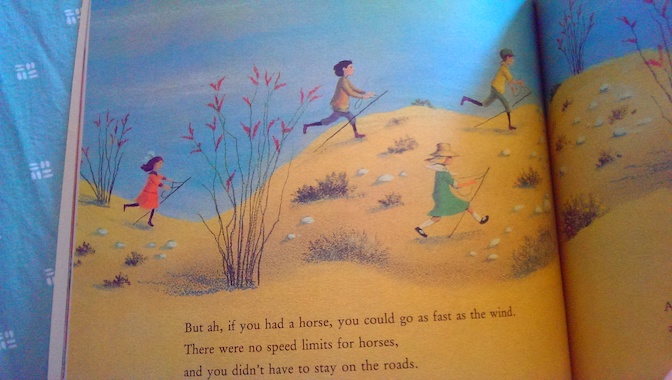
Time passes, but the children continue to play in Roxaboxen year after year, adding to the town and its lore. Even years later, when they’ve grown up and have moved to other places, Roxaboxen still lives in their minds. In a way, they said that their imaginary town always existed, just waiting for those with the imagination to see it, and through the story and illustrations in the book, it now draws in those who read about it but have never seen it themselves.
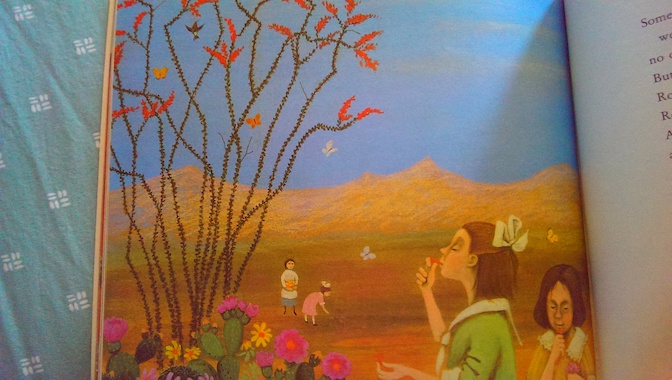
Another great thing about the book is the sense of freedom that the children have. Many modern children wouldn’t be able to go out on the edges of their town and build something for themselves in the same way that the children in the story did. Although, in the freedom of their own minds and their own backyards, maybe some kids are building their own Roxaboxens as we speak.
The book is available to borrow and read for free online through Internet Archive (multiple copies, including one in Spanish and a video reading).

 Jestress's Forgotten Books and Stories
2 thoughts on “Roxaboxen”