American Girls

Meet Addy by Connie Porter, 1993.
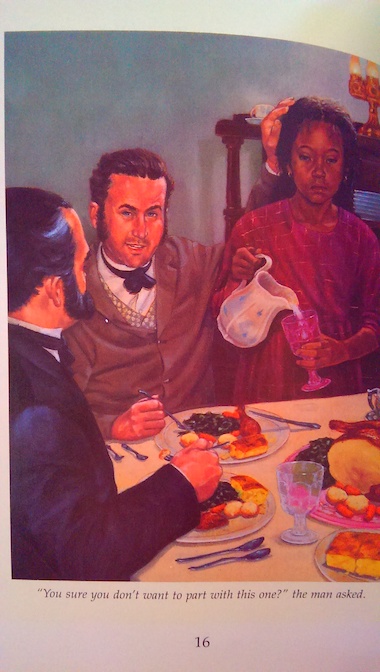 Addy is nine years old, and she has lived her entire life so far as a slave on a plantation in North Carolina. It is the time of the American Civil War, and Addy’s parents are worried about the future of their children.
One night, she hears her father saying to her mother that they ought to take the whole family and run away. Her mother is worried that it’s too dangerous. She hopes that soon the war will end, and they will be freed. However, Addy’s father is worried that the family might be split up before that can happen because there is talk that the plantation owner, Master Stevens, might sell some of his slaves, and families wouldn’t necessarily be sold together.
His fears turn out to be justified because, soon after, while Addy is helping to serve dinner to a guest at the plantation house, she finds out that Master Stevens is planning to sell her father and brother to someone else. She tries to get to them and tell them to run away before they can be taken away, but the overseer stops her. Addy sees her father and brother taken away in chains.
With Addy’s father and brother gone, her mother has a serious talk with Addy about their future. The two of them can follow the plan and run away to the North, establishing a new life for themselves and hopefully arranging for their family to be reunited later. If they don’t take this opportunity to leave, there is the possibility that the family will be fractured further. The man Master Stevens sold Addy’s father and brother to has already said that he might like to buy Addy as well.
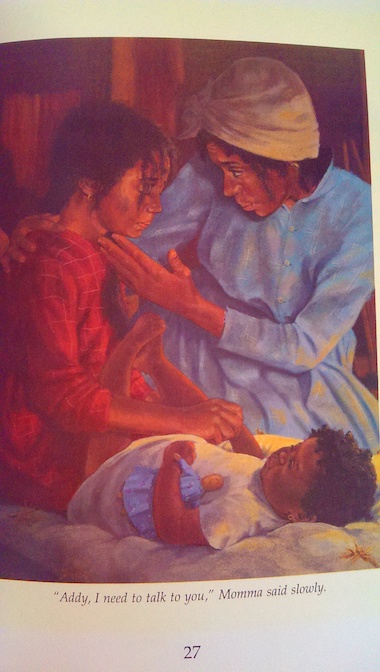 Although Addy and her mother are frightened at the idea of running away, they decide that this is their only chance to escape together. Addy is upset when her mother tells her that they can’t bring her baby sister with them. She is too young for the journey, and if she cries, it might give them away. Instead, they will leave little Esther with their close friends, Auntie Lula and Uncle Solomon Morgan. They plan to find a way to send for them when the war is over.
Addy and her mother have to seek out the woman that Addy’s father had talked about, Miss Caroline. She’s a member of the Underground Railroad and can help them get out of North Carolina and go to Philadelphia, where Addy’s father had planned to take the family.
They leave in the middle of the night and travel by night. The journey is hazardous, and there are times when they are almost caught. At one point, Addy’s mother nearly drowns crossing a river. But, together, they face the dangers, knowing that a better life awaits them at the end of their journey. Even when they reach Miss Caroline, Addy’s story is really just beginning.
In the back, there is a section with historical information about the origins of slavery in North America and what the lives of slaves were like. One thing that I kind of wish they had mentioned was about how widely indentured servitude was used in early American history and how it helped to make the idea of slavery more appealing in early America, which was something one of my old college professors once talked about.


Indentured servitude is when someone works off a debt by working for someone else for free for certain period of time. Often, this was how poor people could pay for passage to America during Colonial times. In exchange for someone paying the price of their passage on a ship, they would work for them for awhile. When that time was over, the indentured servant could move on to new employment or had to be paid for his work. When plantation owners started buying slaves, what they were really saying was that they wanted permanent indentured servants, ones that could never leave them, that wouldn’t have any end to their servitude because it wasn’t based on any debt. It couldn’t be based on any debt because the slaves owed them nothing. The issue for the plantation owners was that they couldn’t build plantations the size they wanted and pay the labor to support them at the same time, so their solution to the problem was free labor — or at least, labor that cost no more than an indentured servant would: one initial outlay for the purchase and then some basic food and clothing to keep the workers going.
The practice of slavery is disgusting, but for me, it’s the attitude behind it that’s the real problem. The plantation owners didn’t have any right to anyone’s free labor, and they knew there was no debt involved. They just didn’t want to pay people, and just not wanting to pay people was a good enough reason for them. In the end, whatever they said about race and their own superiority, it was all really about the money all along. They would have said anything, done anything, to turn more profit for themselves, and because no one stopped them for a long time, that’s exactly what they did. The rest was basically excuses piled upon justifications piled on more self-entitled excuses and more self-centered justifications. They did what they did mainly because they could get away with it, and the fact that they could get away with it made them feel like it was all right. It wasn’t.
 Jestress's Forgotten Books and Stories