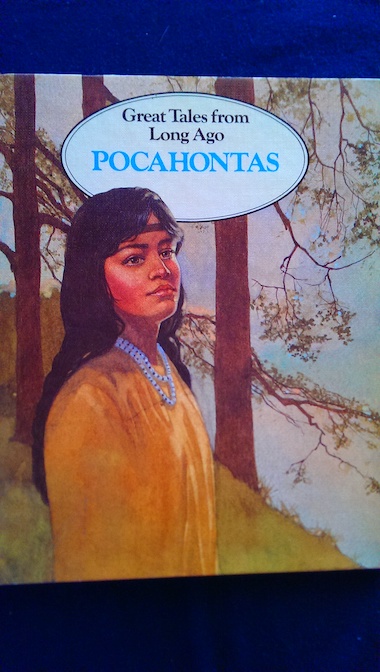
Pocahontas by Jan Gleiter and Kathleen Thompson, 1985.
The story about the life of the young Native American woman known as Pocahontas (“Pocahontas” was really a nickname, which the book mentions, although it doesn’t say that her original name was Matoaka) has been told many times in many forms, but this particular book is somewhat sentimental for me because it was the first one I ever read about her when I was a kid. It’s part of a series about famous and legendary figures in history and myth. Pocahontas was a real, historical person, but aspects of her life have taken on the characteristics of legend (as well as providing material for a Disney movie, although the Disney movie takes liberties with the real life of Matoaka/Pocahontas and the movie was not based on this particular rendition of her story).
When this particular book begins, Pocahontas is a grown, married woman going by the name of Lady Rebecca Rolfe. While living in England, she reflects back on her life and youth, remembering when she first met Europeans.

When she was ten years old, she heard her father, Powhatan (who was the chief of their tribe) and other men talking about the white men. Although Pocahontas hears that the white people had betrayed her people’s trust and even killed some of them, she is curious to get a look at them.

She ends up meeting with a group of boys from Jamestown and playing with them. She begins making friends with people in Jamestown and visiting them from time to time. A man named John Smith becomes curious about the girl and her people and gets Pocahontas to teach him some of her language. (The book is more accurate than the Disney version here, showing that there is a significant age difference between Pocahontas and John Smith, with Pocahontas being a child at their first meeting.)

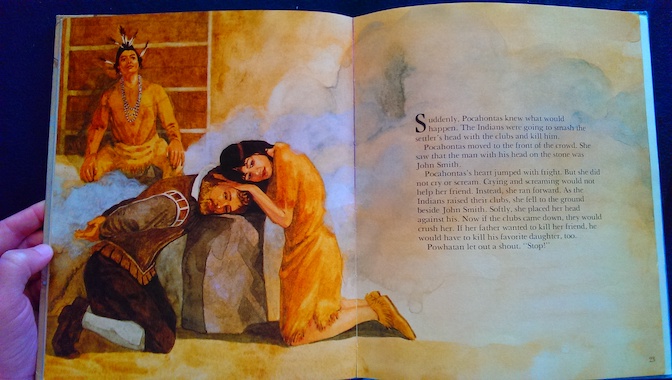
Then, one day, there is a feast in Pocahontas’s village, and some of the men of the tribe bring a white man who was caught trespassing in their territory. Pocahontas recognizes the white man as John Smith and, upon realizing that he is about to be executed, intervenes to save his life. (This is one of the most famous parts of the story of Pocahontas’s life, although the exact circumstances surrounding the real-life incident are a little confusing and may have actually been part of a more complex ritual that John Smith didn’t fully understand at the time, not an actual attempt at execution, if the event actually happened at all. This book offers a simplified version of the incident, supposing that John Smith’s life was in real danger, as he described it in his account of what happened.)
In the end, the settlers at Jamestown kidnap Pocahontas in the hope that Powhatan would end hostilities with them, using her as a bargaining chip. (The book says that her father wasn’t too worried because he knew that the settlers were her friends and would treat her well, but I find this part of the book pretty worrying myself, reading it as an adult. I’m pretty sure that is not how a parent would react to a missing child in real life. I guess that the book is trying to keep the tone light for children, but it just sounds weird.) Pocahontas remains among the settlers, living according to their lifestyle and taking the name Rebecca. Eventually, she meets a man named John Rolfe and marries him. The two of them have a son together. With her new family, she travels to England and tries to help the people there to understand her people. (The book says this in a very optimistic way, calling her visit a “success”, although in real life, this visit was largely a propaganda move on the part of the Virginia Company of London. On the other hand, she was, evidently, very well-received in England, if something of a social curiosity.)

The story in the book ends here, with her still in England, thinking back on her life and her reasons for being there. Part of me wishes that it had explained a little more about Pocahontas’s earlier life and some other facts behind her story. Sadly, part of the reason why they might have been reluctant to tell the rest of the story to children was that the real Pocahontas didn’t live very long after the point where the story ends. As she was preparing to return to Virginia from England, she became very ill and died. Her exact age at the time of her death is unknown, but she was probably about 21 years old. Her son, Thomas Rolfe, was very young at the time she died, but they do still have living descendants today.
Overall, I’d say that this is one of those stories that becomes more interesting when you’re older and realize the full depth of it. This picture book is a very simplified version of the story, meant for kids, but when I was young, it did inspire me to learn more about Pocahontas. There any many missing details of Matoaka/Pocahontas/Rebecca Rolfe’s life because of the limited records of it, but what is known is fascinating. It’s sad because she died so young, but that the story of her life lived on in so many imaginations after her death is profound. Different people, both when she was alive and after her death, tried to use her for their own purposes, but her legend still continues, out-living them all. I’ve never seen the Disney Pocahontas movies, and I don’t really want to. I already know how the story ends.
The book is currently available online through Internet Archive.
 Jestress's Forgotten Books and Stories