American Girls

Happy Birthday, Molly! By Valerie Tripp, 1987.

Molly is excited because she has just learned that an English girl will be coming to stay with her family for a while. The girl, Emily, is one of the child evacuees from London. Really, she’s supposed to be staying with her aunt, who also lives in Molly’s town, but her aunt is in the hospital with pneumonia and won’t be able to take her for another couple of weeks. In the meantime, Molly and her friends are eager to meet her, imagining her to be something like the English princesses, Elizabeth and Margaret Rose.
The girls have a fascination for England after all the things they’ve seen in movies and newsreels. Recently, they saw a newsreel about bomb shelters in England. Inspired by what they’ve seen, the girls make a pretend bomb shelter under an old table and enjoy pretending that they are like the people in the newsreel. Molly’s brother, Ricky, says that it isn’t very realistic, and the girls say that they’ll have to ask Emily when she comes.

However, Emily turns out to be very shy and quiet. She’s pale and skinny and hardly talks at first. When the girls show her their “bomb shelter”, she doesn’t want to play in it. Molly thinks that maybe Emily doesn’t like them, but her mother reminds her that, in World War II England, bomb shelters aren’t places to play. Emily is the same age as Molly, and the war has been going on since she was a little kid. Molly’s mother points out that Emily probably doesn’t remember much about life before the war. Emily is accustomed to bombings and danger all around her, and Molly’s mother compares her to a flower “who’s not sure it’s spring yet. It will take some time for her to realize it’s safe to come out now.”
Emily goes to Molly’s school, and their classmates are fascinated with her. This fascination makes Emily even more shy than she would be otherwise as kids try to imitate her accent and ask her questions about what it’s like to see buildings bombed. To the America kids, the war seems exciting, and they want to know what it’s like to see it up close, but Emily dodges their questions.
Molly finally comes to understand why Emily is so evasive when their town has a blackout drill. When the drill starts, a siren sounds, and everyone has to go down into their basements until they get the signal that it’s all clear. Molly is surprised to see that Emily is actually frightened by the drill, but everyone assures her that it’s just for practice, not because Illinois is actually going to be bombed. In Molly’s family, it’s almost like a game, but Emily has memories of real bombings during the Blitz. As they sit in the basement during the drill, Emily explains it to Molly: the fear, the explosions, destroyed buildings, people getting hurt or killed. Molly and her friends thought it was exciting to hear about the war in newsreels, but living it is an entirely different thing. The drill and everyone’s questions about what bombings are like bring back bad memories for Emily.
As Molly comes to understand Emily’s feelings more, Emily opens up to her. The girls discover that they share a fascination with Princess Elizabeth and her sister Margaret Rose. They start playing a game where they pretend to be the princesses, dressing alike in blue skirts and sweaters. Because the princesses have pet dogs, the girls also pretend that they have dogs, using jump ropes as leashes for their imaginary pets.
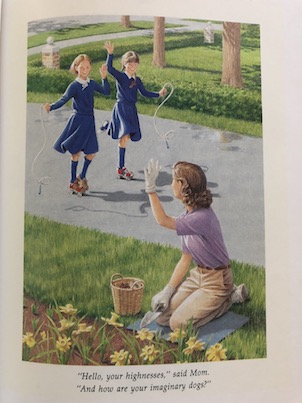
Molly’s birthday is approaching, and she offers to let Emily share in her party and help plan it. She’s curious about what people in England do on their birthdays, and the idea of an English tea party sounds great to her friends. However, Molly doesn’t like the way that Emily describes English birthdays, and the types of sandwiches that the English tea with tea don’t sound very good. Worst of all, Emily says that, at her last birthday before the war rationing started, she had a lemon tart instead of a cake. Molly can’t imagine her birthday without a birthday cake. Mrs. Gilford, the housekeeper, has been saving up rationed goods for her cake this year, and it’s what she’s been looking forward to the most!
Sharing things with Emily becomes more of a trial for Molly, and when the girls argue about their countries’ contributions to the war effort, they get into a fight and Molly starts thinking that she doesn’t even want Emily at her birthday party. However, Molly’s mother points out to the girls that the war effort is a team effort. A couple of special birthday surprises help the girls to make up, including something extra special that helps Emily to heal further from the trauma of the war.
In the Molly, An American Girl movie, Emily plays a larger role than she did in the books. This is the only book in the series where Emily appears. Her story was changed somewhat for the movie, too. In the movie, she says that her mother was killed in a bombing. In the book, her parents are both still alive, and it was her dog who was killed. Molly doesn’t learn that until the end of the book when her family gives the girls a pair of puppies as a present, and Emily tells her about her pet dog who died.
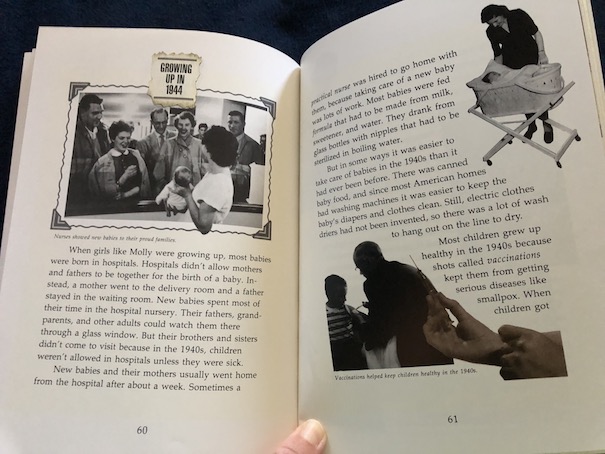
In the back of the book, there’s a section with historical information about what it was like to grow up in the 1940s. It explains how women used to stay in the hospital for about a week after giving birth, and sometimes, they could hire a practical nurse to help them at home as well. Canned baby food was a new invention, and vaccines helped to prevent disease. Back then, people still got smallpox shots because the disease hadn’t been eradicated, but there was still nothing to prevent chicken pox or measles, so children with those diseases had to be kept at home with warning signs out front to tell people to stay away from the quarantined house. (Note: My father was born in 1944, the year that this series takes place, and he said that throughout his early childhood, parents who knew of a child who had chicken pox would deliberately take their children to visit and get the disease. It wasn’t that they really wanted their children to get sick, but since there was no way to prevent the disease at the time, they had to accept that it was inevitable that their child would catch it eventually, and chicken pox is somewhat peculiar in that there is a kind of age window in which the disease isn’t likely to be too bad. If you waited too long, and the child got older or even to adulthood without getting it, it was bound to be much worse when they eventually caught it. So, if your child was about the right age for getting it, in early childhood but no longer a baby, people thought it was best to get it over with so they could benefit from the lifetime immunity afterward. This remained true even up through the 1980s, my early childhood, which is why I have a permanent scar on my face from the disease. Now, there are vaccines to prevent it, although I understand that some people still have chicken pox parties in places where the vaccine isn’t readily available. If you have the option, go for the vaccine. Preventing chicken pox also prevents shingles.)
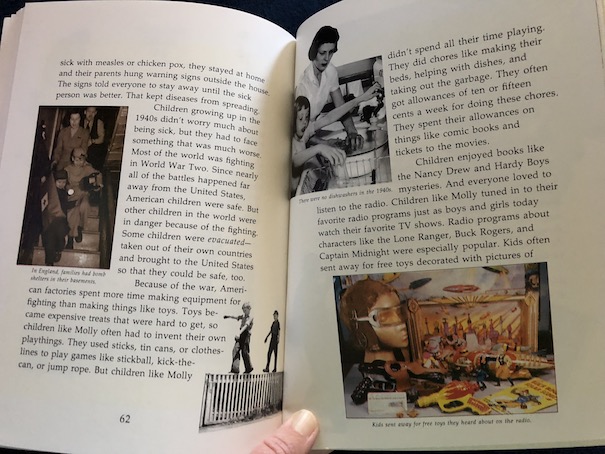
The historical section also talks about child evacuees, like Emily, and what teenagers did during the 1940s. It was around this time that people began looking at the teenage years as being a distinct phase of life, and businesses began specifically catering to teenagers.
The book is currently available online through Internet Archive.
 Jestress's Forgotten Books and Stories