American Girls

Changes for Molly by Valerie Tripp, 1988.
 Molly’s family has wonderful news! Molly’s father is coming home from the war to take charge of a veterans’ hospital right in their home town! Everyone in the McIntire is happy, but Molly has one worry: In her father’s letter, he talked about how much her brothers and sister have grown and changed since he’s been away, but not her. Molly still feels like plain old Molly, and she thinks that her father will look at her like she’s still a dumb little kid. What can she do to show her father that she’s grown in the last two years, like her siblings have?
One thing she can do is get the role of Miss Victory in her dance school’s performance. She’s favored to get the party anyway because she dances it so well. But, with her plain, old, straight braids, Molly thinks that she looks too plain and little-kid like to get the part. What she wants more than anything is to have curls. Miss Victory’s pretty crown would look great on a girl with a head full of curls.
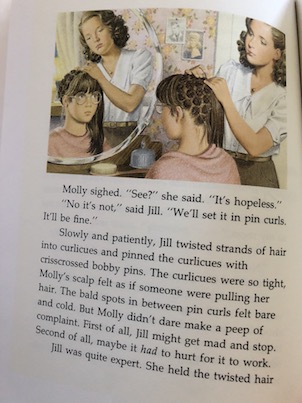 Her friends try to help her by buying a box of hair permanent and offering to help her use it, but it soon becomes obvious that they really don’t know what they’re doing. Fortunately, Molly’s older sister, Jill, catches them before their experiment goes too far and talks them out of it. Molly’s older sister likes to trade hair tips with her friend, Dolores, and she’s more experienced with doing hair. She says that if curls are important to Molly, she’ll help her to set her hair in pin curls until it looks the way she wants.
As Jill helps Molly with her hair, Molly talks to her about how grown up she is and how she still feels like such a kid who hasn’t changed much since their father went away. Jill says that she doesn’t think that it’s true. Jill is five years older than Molly, and she tells her that growing up is something that takes time. A ten-year-old like Molly just isn’t going to be the same as a fifteen-year-old like Jill, and she shouldn’t try to be. Jill says that the war and their father’s absence has made them all grow up a little faster than they would have otherwise. They’ve had to become more mature, more accustomed to making little sacrifices and making do. In a way, Jill envies Molly for having some of her childhood left to spend with their father when he comes home. Jill has already left a lot of hers behind. But, she says that even if Molly doesn’t look very different on the outside, she’s changed somewhat on the inside. She’s developed a more mature outlook on the world. She’s become more aware of some of realities of life and what’s important (at one point in the story, she and her friends talk about the people they know who have returned from the war permanently injured and some, like their teacher’s fiancé, who were killed and will never come back), and she’s starting thinking about other people more (Jill reminds Molly of how understanding and generous she became when Emily was staying with them). Molly just wishes that she would look more mature on the outside, too. More than anything, she hopes that her father will arrive home in time to see her as a beautiful Miss Victory!
Molly gets part of her wish in getting the role of Miss Victory, but it seems like everything is ruined when she comes down with a bad ear infection and won’t be able to be in the performance at all. Her father’s arrival home is also delayed, so Molly is stuck at home alone while everyone else is at the performance. But, just when Molly is feeling horrible and gloomy, what seems like a disappointment turns into something good when she is the first person to welcome her father home, a father who is glad to see her looking just the way he remembered her, braids and all!


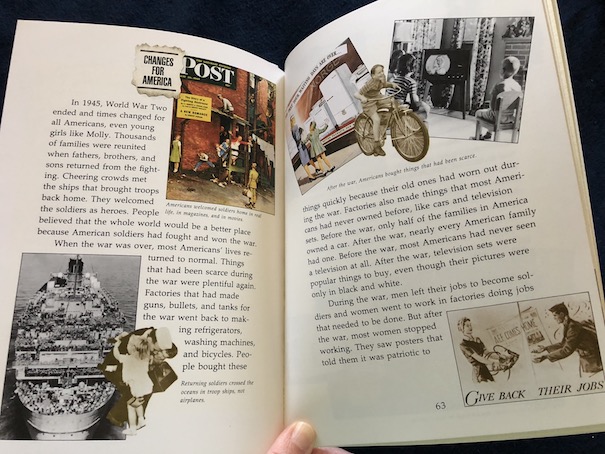
In the back of the book, there is a section of historical information about the end of World War II and what happened when soldiers began returning home.
The book is currently available online through Internet Archive.
 Jestress's Forgotten Books and Stories