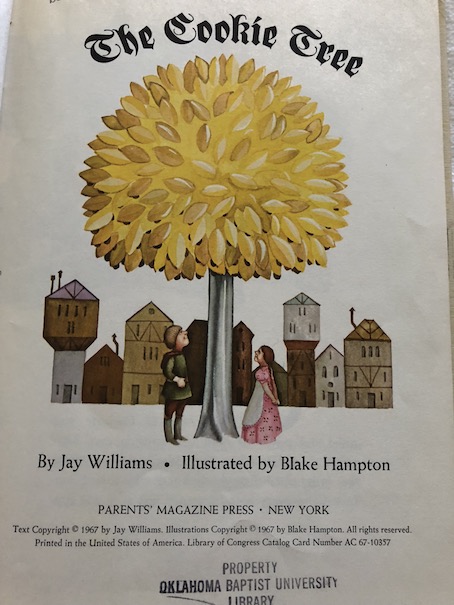
The Cookie Tree by Jay Williams, 1967.
Owlgate is a very orderly little village. Everything has a purpose and a place, and nothing unexpected happens . . . until the day the cookie tree appears in the middle of town. The tree is silver and gold and has chocolate cookies.

A girl named Meg notices it first, but her parents refuse to allow her to pick a cookie from the tree because they’re worried about where it came from. For all they know, the cookies could be poisonous! Meg’s father gets the mayor to come look at the tree.
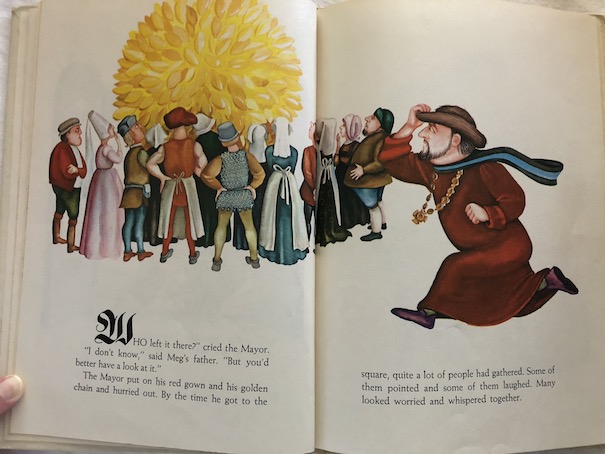
Eventually, everyone in town comes out to see the tree. The miller thinks that the whole thing is probably a big joke, but most of the other adults are worried because it’s weird. Some of them think maybe it’s some kind of bad omen. Little Meg’s theory is that a magician sent it as a present for the village, just to give them cookies. However, the adults reject that explanation, saying that it doesn’t make sense and they don’t any reason see why a magician would send them a cookie tree.
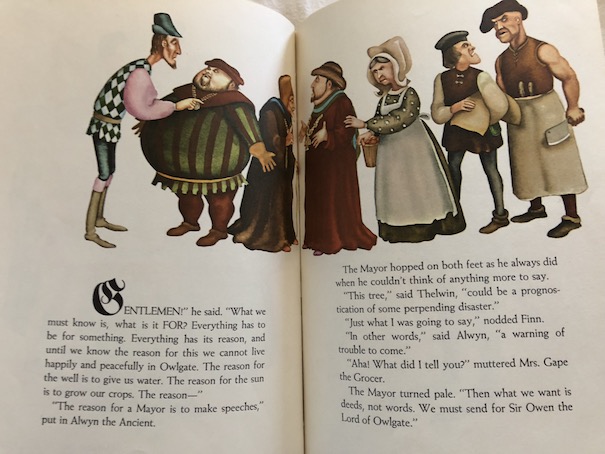
The mayor consults with the Village Councillors, but they don’t accomplish much other than to establish that there are indeed chocolate cookies growing on the tree when one of them samples a cookie. The adults argue back and forth about what to do about the tree, but by the time they come up with a plan, the tree has vanished!
While the adults’ backs were turned, the children of the village ate all the cookies, and once the cookies were gone, the tree disappeared. Apparently, Meg’s theory about the magician sending the tree just to give them cookies was correct.


One of the things that people sometimes praise children for doing is seeing things for what they are. Adults have a tendency to over-analyze things, looking for hidden meanings that may or may not exist. Sometimes, things really are just what they appear to be, and over-analyzing just confuses the issue. It can be like that with children’s books. Adults worry about every little thing in stories and possible messages being sent to children, but when people start over-analyzing stories, they can find themselves making up hidden messages and reading things into stories that aren’t really there. Sometimes, stories and other things are just for fun, and you might as well simply enjoy them for what they are!
The book is currently available online through Internet Archive.
 Jestress's Forgotten Books and Stories