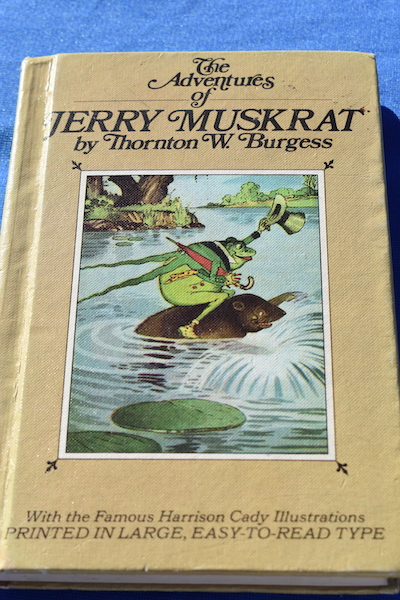
The Adventures of Jerry Muskrat by Thornton W. Burgess, 1914.
This book is part of a series of stories about the adventures of different animals.

Jerry Muskrat lives with his family and friends in the Smiling Pool and Laughing Brook, near the farm owned by Farmer Brown. Jerry’s mother warns him to look out for the traps that Farmer Brown’s son likes to set, but he’s sure that he can take care of himself . . . until he has a very narrow escape!
Jerry’s mother calls a meeting of the other animals to discuss the threat of traps after Jerry’s close call. They decide to ask Great-Grandfather Frog for his advice. He tells them that they must find all of the traps and use a stone or stick to trigger them. Then, when the traps have been sprung, they will bury them. The animals have some close calls while springing the traps, but they manage to set them off successfully.

However, they soon have a new problem: it seems like the water in the Smiling Pool is getting lower each day. When the animals investigate, they discover that someone has dammed the Laughing Brook that feeds the Smiling Pool! If they don’t do something about it, they might all have to go live on the Big River, and they don’t want to leave their home.
It turns out that the dam was made by Paddy the Beaver, Jerry Muskrat’s “big cousin from the North.” Jerry tries to make a hole in the dam so that the water will flow, but Paddy blocks it again, telling them not to mess with his dam. Jerry has to explain to Paddy why the residents of the Smiling Pool need the water. Once Paddy understands, he lets the water flow again.

The animals in the story refer to the place where they live in terms of their pool and brook and the nearby farm. You don’t really know exactly where they live, but there is one animal who has a Southern accent, “Ol’ Mistah Buzzard.” Ol’ Mistah Buzzard talks like the characters in Disney’s Song of the South, regularly dropping phrases like, “Where are yo’alls going?”, “Fo’ the lan’s sake! Fo’ the lan’s sake!”, and referring to other animals as “Brer Mink” and “Brer Turtle.” The book was written before the movie Song of the South was created in 1946, but long after the book that the movie was based on, Uncle Remus by Joel Chandler Harris from 1881. I suspect that the author of this book was inspired by the animal stories in Uncle Remus and that the Buzzard’s dialect is a salute to that. Unfortunately, that kind of dialect is really annoying for modern readers and may make it a difficult thing to read aloud to children. Mercifully, none of the other characters in the book do this. The parade of animals who hurry to find what has stopped the water in the brook is also a take-off from The Tortoise and the Hare story because the turtle, who was left behind by the others in their rush does become the first to find the source of the problem when the others stop to rest.
This book is over 100 years old and in the public domain now. There are multiple places to read this book for free online, but the one that I recommend the most is Lit2Go from the University of South Florida because it offers audio readings of the chapters in the book as well as the text. The book is also available online through Project Gutenberg.
 Jestress's Forgotten Books and Stories