The Boxcar Children
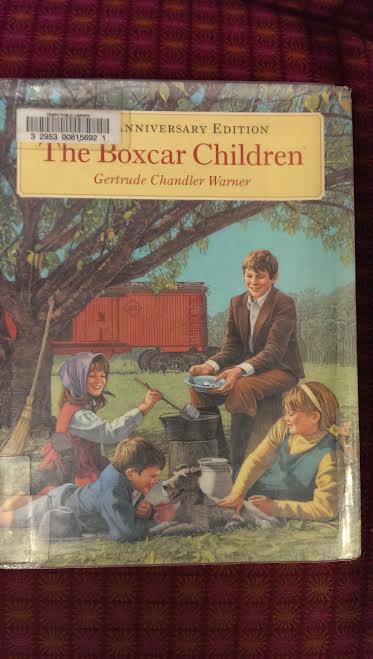 #1 The Boxcar Children by Gertrude Chandler Warner, 1924, 1942.
“One warm night, four children stood in front of a bakery. No one knew them. No one knew where they had come from.”
These are the words that begin not only this story but a series that has been loved by generations and continued well beyond the death of the original author.
The four Alden children are on the run following the deaths of their parents. Their nearest remaining relative is a grandfather they have never met, and although he should have custody of the children now, none of the children want to go live with him. All that they know about him is that he is apparently a mean old man who opposed their parents’ marriage. Henry, the eldest at fourteen, and Jessie, who is twelve, have taken charge of the two younger children, ten-year-old Violet and seven-year-old Benny. They have a little money, and they’re now traveling on foot in search of a new home.
The first place they stop is a bakery in a nearby town where no one knows who they are. They don’t have much money, but they know they are going to need supplies for their journey. The stingy baker and his wife agree to give the children some food and a place to sleep for the night in exchange for some help in their shop. The children are willing to work and accept the offer. However, Henry and Jessie overhear the couple talking about them. They like having the children to help in the shop, but Benny is too young to be of much help. They are considering taking Benny to an orphanage and keeping the others. Not wanting to be separated, Henry and Jessie wake Violet and pick up Benny, moving on. Now, they have a second set of people they’re avoiding, besides their grandfather.
Seeking a place where they can stay while not being noticed by people around them, the children eventually find an old, abandoned boxcar on a disused piece of train track on the edge of some woods. They take shelter there from the rain and decide that they can turn it into their new home. There are blackberries growing nearby that they can eat and a stream where they can keep milk cold. Henry finds odd jobs in a nearby town to earn more money, and the others discover an old dump where they retrieve some old, cracked dishes and other useful items.
It seems like an idyllic life at first. The children are free of adult control, although they do have to work to create a household for themselves and find food. They adopt a stray dog they call Watch (he’s their new watchdog), and Henry makes friends who appreciate what a hard worker he is. However, some of these new friends start to wonder about Henry, where he comes from, and where his parents are.
The children soon realize that someone is spying on them. Is it someone from the town? Could the baker and his wife still be looking for them? Or is it someone sent by their grandfather? When Violet is suddenly taken ill, the others realize that they need help and someone to trust.
Getting help for Violet does mean that the children’s secret is revealed to everyone, although they learn some important things in the process. They discover who was spying on them and why and also discover that their grandfather is a nicer person than they thought and truly cares for them.
Although this series is very popular, most people don’t know that the story they read as children was actually a shortened version of the original story that was written in 1924.
The newer, popular version of the book is available online through Internet Archive. The older version is now public domain and available online through Project Gutenberg.
Comparisons to the Older Version and My Reaction
Along with shortening and simplifying the story from original the 1924 version, the newer version from 1942 changed some of the characters’ names (the children had the same first names, but their family name was originally Cordyce, not Alden) and removed some parts that might be objectionable for young children.
Although the original story doesn’t completely clear up some questions that were left unresolved in the current version, like what the children’s parents were like, precisely how they died, and why they quarreled with the children’s grandfather in the first place, it did supply a few more details in the first chapter. The original story begins when the children move to a new town with their father. No one knew exactly where they came from, and the children pointedly refuse to say. However, they do tell their neighbor, a baker, that their mother is already dead. Their father is drunk, and the baker thinks that he looks like he’s in such bad condition that he isn’t likely to last much longer. That turns out to be true when he dies (apparently from alcohol-related causes) soon after. When they question the children about whether or not they have other relatives, young Benny blurts out that they have a grandfather before the others silence him. The adults press the children for answers, and they reluctantly admit that there is a grandfather, but they say that he did not like their mother and would treat them cruelly if they were sent to him (or so, apparently, their parents had led them to believe). The only one of the children who has even seen the grandfather is Jessie (actually called Jess in this version of the story), and it was only from a distance because her father happened to see him passing by and pointed him out. Later, the children hear the baker and his wife talking, saying that they have no choice but to try to find the grandfather, and the children decide to run away to avoid going to live with him. The questions of how their mother died and why the grandfather didn’t like her in the first place are never answered.
James Cordyce (the children’s grandfather in the original book, their grandmother is also apparently dead) is a wealthy man who owns steel mills, and he is impressed by the children’s ingenuity and resourcefulness at managing their own affairs while living on their own. He tells Henry that he wants him to take over the steel mills one day, and the book says that Henry does so when he grows up and does a wonderful job of managing them. Mr. Cordyce tells the other children that he wants them all to go to college, and then they can do whatever they like when they grow up, which the book says also happens.
Although the books never actually say so, my theory is that Mr. Cordyce/Alden was a hard-headed businessman, particularly when he was younger, driven to succeed and not emotionally demonstrative, and that this attitude caused a rift between him and his son, who may not have shared his father’s business skills and interests. The grandfather may have wanted his son to follow in his footsteps when the son had other ambitions. The son may have seen his father as a cold and ruthless businessman and conveyed that impression to his own children after marrying a woman his father disapproved of (Because her family was poor? Because they were unambitious? Because she had some objectionable personal habit? There’s no telling), but because he may not have told the children the whole reason why he thought that the grandfather was cruel, the children imagined that he was worse than he really was.
We don’t know what the children’s father did for a living after his feud with his father or exactly where they lived (perhaps in Greenfield or close by so that Jessie was able to catch sight of her grandfather one day). Why the father took to drinking is also never explained, but I think it may be implied that he did so out of grief for his dead wife. I think that Henry and Jessie probably had to manage the household for their parents following their mother’s death (and maybe before that if she suffered from ill health), which is part of the reason why the children are so self-sufficient and seem more tied to each other than to any adult. In any case, the original book says that Mr. Cordyce is interested when the doctor who befriends the children says that Henry and Jessie have business management skills, so I think it sounds like he was thrilled to find out that he might have more in common with his grandchildren than he did with his son and hopeful that Henry would make a better successor in the family business. But, that’s just the way I read it.
One other point that the original book covered was Watch’s origins. The later version just has Watch as a stray who the children adopt, but the original story explained that he had just been purchased from a kennel by a wealthy woman when he was lost. The kennel owner tries to reclaim the dog (kennel name Rough No. 3) on behalf of the woman, but the grandfather offers to buy the dog for much more than the original price. The kennel owner says that it’s up to the woman who bought him, and they invite the woman to the house. After hearing how attached the children have become to Watch, the woman allows them to keep him.
 Jestress's Forgotten Books and Stories
5 thoughts on “The Boxcar Children”