The Boxcar Children
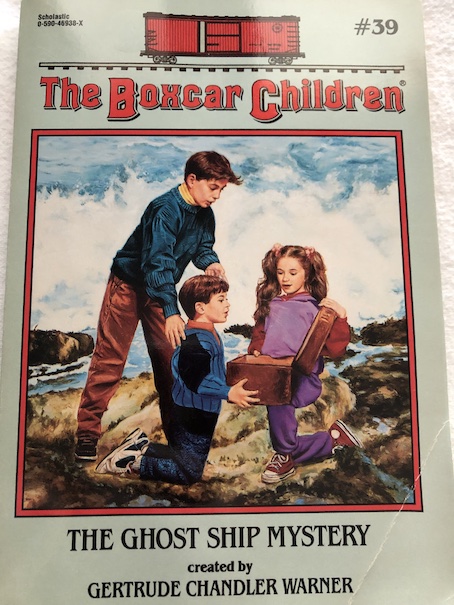
#39 The Ghost Ship Mystery by Gertrude Chandler Warner, 1994.
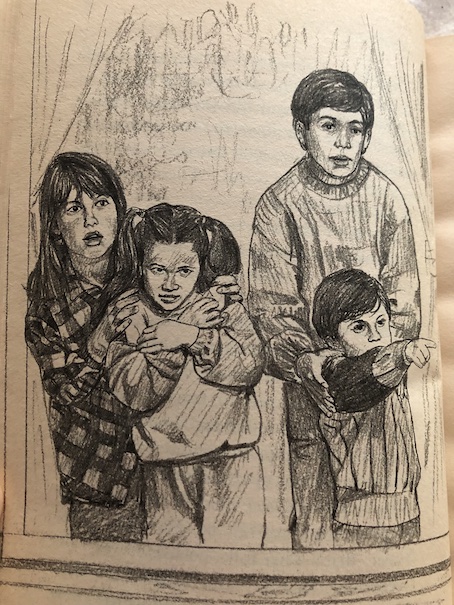
The Alden children are visiting the New England seaside town of Ragged Cove while traveling with their grandfather on a business trip. They enjoy visiting the sea, but on a stormy night at the inn where they are staying, they learn that the town has its own ghost story about a ship called the Flying Cloud that sank off the coast years ago. When storms are coming, people see strange lights that some people think might be the spirits of the people on the Flying Cloud.
As the Aldens soon learn, the events of the Flying Cloud are still affecting people who live in the town. When the ship was wrecked, the only member of the crew who made it to shore was a cabin boy, who died shortly afterward, mumbling about how one of the crew members had taken command of the ship away from the captain in an apparent mutiny. The descendant of the ship’s captain, a woman who manages the small local museum, is bitter toward the descendant of the man who apparently led the mutiny, who now gives whale watch tours.

The Aldens find it strange how events of the distant past can still mean so much to people who are still living, but they find themselves caught up in learning the real secrets of the Flying Cloud when they go on a whale watch tour and their guide, Captain Bob, also takes them scavenging for wreckage after the storm. They make an amazing discovery of a sailors’ post box, a metal box where sailors used to leave messages for each other or objects that they wanted to have delivered home before they would arrive themselves. This particular box has been untouched in a niche in a rock for years, and it has information about the Flying Cloud. At first, Captain Bob is reluctant to part with it, but the Aldens persuade him that it should go to the museum. Captain Bob says that they should take it there on his behalf because the woman who runs the museum won’t want to see him.

The woman who runs the museum is amazed at the find and is eager to explore the contents of the box. However, when the Aldens leave her alone with it for a short time, they notice that a leather book that was in the box suddenly disappears. The woman denies that it was ever there, making the Aldens suspicious. Then, they later hear that someone broke into the museum and stole the entire contents of the box. Who is really responsible for the break-in, and what really happened on the Flying Cloud all those years ago?
The book is available to borrow and read for free online through Internet Archive (multiple copies).
My Reaction and Spoilers:
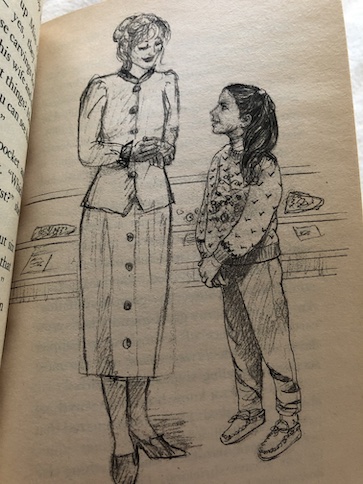
Part of the mystery concerns how people deal with history, especially history that concerns them in a very personal way, when new information is uncovered that changes the story. That the woman who runs the museum is responsible for the book that disappears is obvious because she denies its existence when the Aldens know that they left it with her. The book turns out to be the log book of the Flying Cloud with its final entry, left behind in the post box when the crew began to doubt if they’d make it safely home. The story about the woman’s ancestor, the brave captain who was apparently the victim of a mutiny, isn’t quite what she had always believed, what her family told her, and what she herself had reported in a book that she wrote about the incident. It was partly true, but the final log entry contains new information that puts the whole situation into a different light. The woman struggles not only with the changing story but how that story affected her own behavior, and she worries that what she wrote in her book was a lie. A friend of hers comforts her by saying that it wasn’t a lie, it was the truth as they all understood it for years, just not the complete story, as it turns out. Benny’s proposal that the woman write a new book with the new information makes her feel better.
(Spoiler: It’s not really a mutiny if the captain is incapacitated, and the captain had already died of a severe illness by the time that the ship was wrecked. The person who was blamed for the mutiny wasn’t really at fault.)
The story also explains a little about scrimshaw for an educational element. They describe various objects that sailors could make from scrimshaw. When I first heard of it, it was described as being decorative, but the book talks about useful things, like sewing needles and pie crimpers, that were made with scrimshaw.
 Jestress's Forgotten Books and Stories