Magic Tree House Research Guide
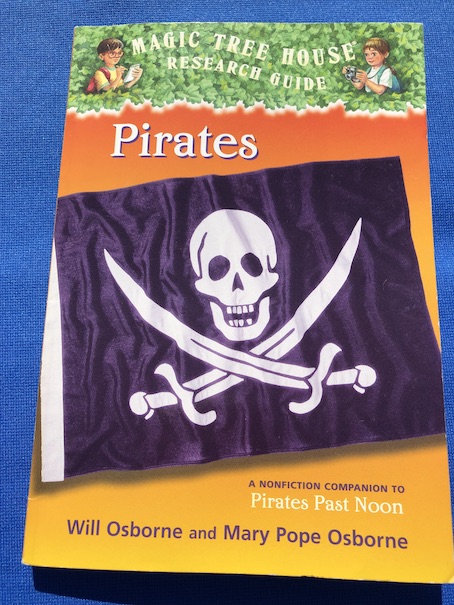
Pirates by Will Osborne and Mary Pope Osborne, 2001.
This book is the nonfiction companion book to Pirates Past Noon, part of the Magic Tree House Series. While the Magic Tree House Series is a fantasy series that involves time travel, there are companion books to some of the novels with nonfiction information related to the stories. The fantasy series is meant to introduce children to different historical periods and encourage an interest in reading, but the companion research guides take children further into certain subjects.
This book focuses on pirates throughout history, explaining how pirates functioned from the time of Ancient Greece and Rome, into the Middle Ages with Vikings, and beyond. It explains that, while legends and adventure stories make the lives of pirates seem fun and exciting, the realities of their lives were more harsh. Throughout the book, Jack and Annie, the characters from the main series, appear in illustrations and side notes to define certain terms or tell the readers fun trivia.

There is a chapter about New World pirates that explains the buccaneers and privateers that preyed on Spanish treasure ships in the Caribbean. The Golden Age of Piracy was in the late 17th and early 18th centuries. It was a period of intense pirating activity as governments recruited privateers to attack the ships of enemy nations. Pirates also attacked ships that traded with American colonies as they increased in size and number. The Golden Age of Piracy ended in the 1720s, when governments began instituting harsher punishments for pirates and sending more warships to confront the pirates. The book includes a Gallery of Pirates where it gives brief biographies of famous pirates, like Henry Morgan, Sir Francis Drake, Blackbeard, and “Calico Jack” Rackham with Anne Bonny and Mary Read.

There are chapters that describe the lives that pirates lived on their ships. One chapter talks about the types of ships that pirates used, how to distinguish between different types, and the trade-offs between size and speed. For example, sloops could move faster, but schooners were larger and could carry more. Although pirates operated outside of the law, they had rules for themselves to establish order and resolve conflicts on their ships, and there were punishments for people who broke the rules. People also had different jobs on pirate ships.

Part of the book also talks about legends of buried treasure and sunken ships. There is some truth to the legends, although mostly, pirates tended to spend their loot shortly after getting it instead of hiding it for later.

At the end of the book, there is a guide for doing further research which suggests research tips, other books to read and documentaries to see, and websites to visit. Of the websites listed in the book, only one still exists as of this writing: Maritime Pirate History. Another one, Treasure Island, pops up thanks to the Wayback Machine. It might be possible to find the others through the Wayback Machine by actually searching the Wayback Machine for them, but with so many other new sites and books that are probably equally as good, it might not be worth the time.
 Jestress's Forgotten Books and Stories