American Girls

Happy Birthday, Samantha by Valerie Tripp, 1987.
This is part of the Samantha, An American Girl series.

Samantha is turning ten years old! She is having a birthday party with some other girls, and Aunt Cornelia’s younger sisters, the twins Agnes and Agatha, are coming to visit. Samantha’s grandmother is very strict, with very precise ideas about the way that things should be done. The twins are accustomed to being raised more permissively. When Samantha complains that her grandmother makes her wear long underwear for most of the year, even when it’s really too hot to wear it. Her grandmother thinks that it will help ward off illness. The twins encourage Samantha to think for herself. Few people wear long underwear anymore or believe that they will get sick by not wearing it, the twins say, and if Samantha doesn’t want to wear it, she should be allowed to make up her own mind about it. Samantha agrees that ten years old should be old enough to decide about simple things, like what kind of underwear to wear.

The twins have a lot of interesting ideas about how to do things differently, and they encourage Samantha to be a little more daring and try new things. When the cook talks about Samantha’s birthday cake and how it will have ten candles on it, the twins suggest that she could make ten smaller cakes, called petite fours, and put one candle on each of them. Samantha thinks that sounds so elegant that she wants to try it, although the cook thinks that it sounds a little strange for birthday cakes. They’re also going to have ice cream at the party, homemade. Samantha and the twins help to make it, although they are annoyed by Eddie, the nosy and bossy boy from next door, who shows up and tries to tell them what to do, hoping for a taste of ice cream himself.

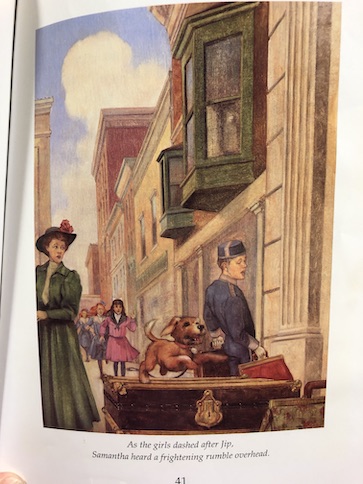
At first, girls the party act a bit self-conscious, trying to be polite and grown-up in their party clothes. After Samantha opens her presents, her Uncle Gard and Aunt Cornelia show up with a special surprise: a puppy named Jip. Jip is a little wild and doesn’t know how to obey commands. He runs off with Samantha’s new teddy bear (a recent invention in Samantha’s time), and the girls have to chase him and get him to drop the toy. Samantha distracts the dog by offering him her shoe, and Eddie, who was watching, picks up the bear. At first, he says that he’ll give it back if they give him some ice cream and let him play with the dog, but Samantha refuses because he was not invited to the party, and she doesn’t like him nosing in. Agatha wrestles the teddy bear away from Eddie before Samantha’s grandmother arrives and tells them that young ladies shouldn’t fight or make spectacles of themselves. Most of the rest of the party is elegant, and the girls are a little more relaxed, now that they look a little less elegant from chasing the dog. However, Eddie gets revenge on the girls by adding salt to the ice cream they made. Even though everything else is fine, including the petite fours, Samantha is still angry at Eddie for ruining the ice cream.
Since Samantha didn’t get to eat the ice cream at her birthday party, the twins and Aunt Cornelia suggest that Samantha return to New York City with them for a visit, and they can all go to a fancy ice cream parlor there. Grandmary agrees and says that she would like to go to New York City herself. On the way to Uncle Gard and Aunt Cornelia’s new house, Grandmary says to Samantha that she hopes that she thinks that the twins get too carried away with some of their ideas. She thinks that they’re too impulsive and don’t think before they act, and while they’ve been raised to be very modern children, she still thinks that some of the old ways are best.
When Grandmary and Samantha see a protest held by women’s suffragists, Grandmary is annoyed at the women, making public spectacles of themselves and inconveniencing passing traffic. She thinks that it’s just another “newfangled notion” that’s a lot of fuss and bother over nothing. She’s never had to vote in her entire life, and she doesn’t see why any other woman would need to. Samantha can tell that this opinion bothers Aunt Cornelia and the twins when Grandmary says it in front of them, but they don’t seem to want to discuss it further.

The twins and Samantha ask to take Jip to the park, and Aunt Cornelia says that’s fine. She has a meeting to attend, but she wants them back home in time to go to the ice cream parlor after her meeting. However, Jip gets away from the girls when they try to put him in Samantha’s doll carriage, and they chase him to the place where the suffragists are meeting. Although Samantha knows that her grandmother doesn’t approve of the suffragists, they have to go after the dog. There, the twins tell Samantha that Cornelia is also a suffragist, and she is speaking at the meeting.
Jip charges right up to the stage where Cornelia is giving her speech, and Cornelia lectures the girls about not thinking about the consequences of their actions and not following her instructions for taking proper care of Jip. Sometimes, they are too impulsive and don’t think ahead. Cornelia explains to the girls about the need to follow agreed-upon rules for safety and how that is different from the changes that her group is advocating. While Grandmary has been saying that the suffragists are also too radical and impulsive and making a fuss about nothing, Cornelia says that much thought, planning, and hard work has gone into their movement to ensure that the changes they’re advocating will be for the better. Grandmary doesn’t appreciate how much thought and preparation the group has done and how long it has taken them to get this far because she hasn’t really thought about the issues at all herself and she has not been to any of previous meetings, where the planning has taken place.
Note: The women’s suffrage movement was already decades old by 1904, when this story takes place, so it’s not really as “newfangled” as Grandmary describes it. It had been building for a long time. However, Grandmary may not have been aware of that because she never needed to be aware. Consider what her life has been like. Remember that Grandmary is a wealthy lady and that marriage and social connections have been the basis of her life. Her husband was wealthy, and she was likely born into a wealthy family. Her life has always been comfortable without her needing to have a job or vote or do anything other than be a wife and mother. Growing up, becoming a well-behaved young lady, and getting married set her for life, and up to this point, she hasn’t had any major problems with money or her lifestyle and hasn’t really needed to think much further than that. She’s used to letting the men in her life handle business and politics and provide her with money, and she now lives on the money that her husband left to her, which is more than ample. Mostly, what Grandmary has needed to manage in her life are the social graces necessary for entertaining her husband’s business associates and their wives and for helping to facilitate her children’s marriages and careers. Grandmary’s daughter was also married to a well-off man before their early deaths. Her son is also a wealthy man, who can provide for his wife, and Cornelia is also from a wealthy family in New York City, a natural extension of their social circle. Grandmary assumes that Samantha, raised in this wealthy social atmosphere, will also naturally meet and marry a wealthy man through the connections of her friends and family, one who will support her and their children in a comfortable fashion. She thinks that, besides caring for her future children, Samantha will likely occupy her time with good works for the less fortunate and that she will give elegant parties for the fashionably-dressed ladies of their social level to solidify their social connections. The elegant affair that her tenth birthday was supposed to be was also practice for her future, as Grandmary envisions it. Grandmary thinks that life will continue to follow this same general course in their family and that there will never be a need for anything different because her own life has been fairly smooth, comfortable, and predictable, largely unshaken, even by the deaths of her husband and Samantha’s parents. But, she’s about to change her mind.

The girls are a little disheveled when they go to meet Grandmary at the ice cream parlor because there is no time to go home and change. As they explain to Grandmary about why the girls look a little disheveled, she tells them that she already knows because she was there, watching the speech. When she saw that Cornelia was the one speaking, she decided to stop and listen, and she was impressed by what she heard. She liked the part where Cornelia talked about the importance of standing up for what is right, and that’s something that Grandmary believes in, too. She is now more open to the suffrage movement than she was before.
The story is partly about growing up and how Samantha realizes that she needs to learn to make her own decisions. She can’t always go by what her grandmother tells her, and sometimes, listening to the twins isn’t always the wisest choice, either. Samantha also begins to see that she has choices to make about the kind of young lady that she will grow up to be. She can be the elegant lady at the party or the public crusader for the causes she believes in or maybe something that combines aspects of both. In the end, Grandmary also begins to see the possibilities of change.
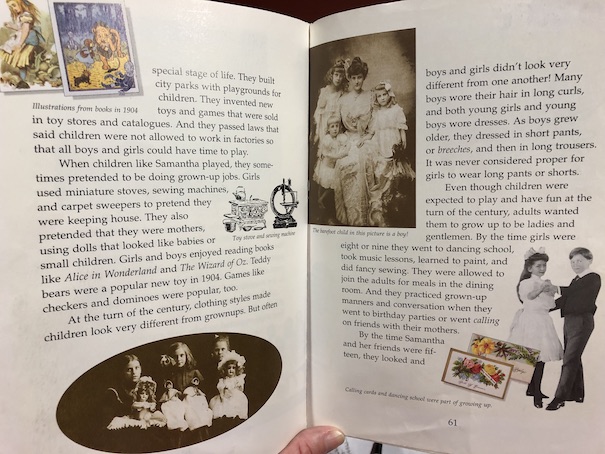
In the back of the book, there is a section about babies and children during the early 1900s. It discusses what children liked to do for fun and how adults would begin training children to be young adults early in life, emphasizing social skills, like dancing, how to behave at the dinner table, and how to engage in polite adult conversation. A girl from a wealthy family, like Samantha, might go to a finishing school instead of college after completing her basic education. At finishing school, she would learn how to manage a household, including how to manage servants (how to hire them, how to tell if they were doing a good job, etc.) and how to throw elegant dinner parties. She might have a coming out or debutante party to introduce her to society as an adult, which meant that she would be ready for introductions and dates with young gentlemen and would probably soon be considering marriage. (This is likely the path that Samantha’s grandmother took in life and the one that she is considering for Samantha.) However, some young ladies did go to college, had careers, or become suffragists, and some did some combination of the above. Samantha’s life is full of possibilities, and her future hasn’t been decided yet. Because Samantha was ten years old in 1904, she would have been eighteen in 1912. For an example of what college life would have been like for an eighteen-year-old girl at a college in the eastern United States in 1912, see the novel Daddy-Long-Legs.
The book is currently available to borrow for free online through Internet Archive.
 Jestress's Forgotten Books and Stories