
Through the Looking Glass by Lewis Carroll, 1871.
The story of Alice in Wonderland is over 150 years old, and the sequel, Through the Looking Glass, is now 150 years old, as of 2021. These books have been reprinted in many different languages and editions. The edition that I’m using for this review is actually a combined edition of the two from 1960 with added notes by Martin Gardner. (Although I used a cover image from a different edition above.) I like editions with added notes because there is quite a lot to explain about both Lewis Carroll and his stories.
I explained a lot of Lewis Carroll’s background and some of the controversies surrounding his life in my review of Alice in Wonderland. One important point about the Alice stories is that they are full of puzzles, riddles, word games, in-jokes, and parodies of poems that were popular in the author’s time. Lewis Carroll (real name Charles Dodgson) was a mathematician and scholar at Oxford, and he liked to play with logic puzzles and word games. Sometimes he would hide people’s names within poems or parts of the story by rearranging the letters of their names or using them as the beginning of lines in a poem, as an acrostic. There is an acrostic poem which is dedicated to Alice Liddell, the real girl who inspired Alice in Wonderland. This poem is printed as part of some editions of Through the Looking Glass, including the one that I’m using. The acrostic poem also references Row, Row, Row Your Boat, which is apparently older although its origins aren’t completely certain. If you read down the beginning letters of the poem, you find out that Alice’s middle name was Pleasance.
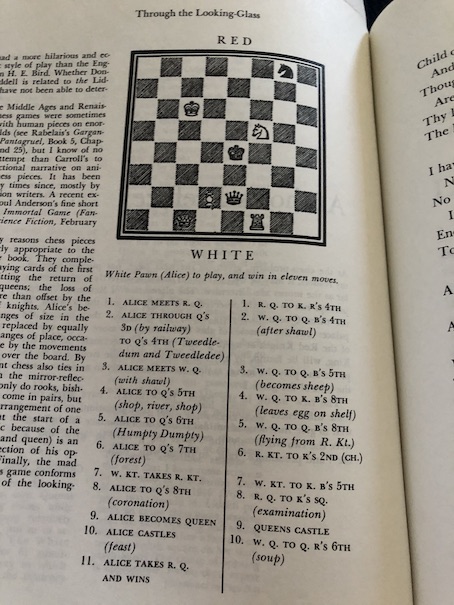
The chess game in Through the Looking Glass is meant to be part of an actual chess game with real moves that can be mapped out on a board. The game and the moves in the story are explained in the preface of my copy of the book. Alice begins as a white pawn in the game, but when she reaches the other side of the board, she becomes a queen, which is part of the rules of chess – pawns that successfully reach the opponent’s side may be exchanged for other pieces. The colors of the chess pieces in Alice’s game are red and white instead of black and white because red and white are old traditional colors. Although black and white are common today, many different color combinations have been used, and the red and white combination dates back to the Middle Ages.
The story begins on the day before Guy Fawkes’ Night. (Alice has been watching the bonfire preparations out the window.) Alice is trying to wind some yarn, and her pet cat Dinah’s little black kitten keeps playing with it. Alice chastises the kitten, and then begins talking to the kitten about the way it was watching her play chess earlier in the day. Alice likes to play games of pretend, and she starts to pretend that the kitten is the red queen from the chess game. The kitten doesn’t cooperate in posing like the chess queen, so Alice holds it up to a looking-glass.
As they look in the mirror, Alice gets the idea of a “Looking-glass House” – a house on the other side of the mirror that can be reached by stepping through it. Alice starts to imagine what it would be like to enter the world on the other side of the mirror. She gets up on the mantle over the fireplace and steps through the mirror into the looking-glass house to see what is there.

Things in the looking-glass house are very strange. The clock and the pictures seem to be alive, and so are the chess pieces. Alice helps the pieces back onto their table after they’ve been knocked off, but they don’t seem to understand what has happened and are alarmed. Alice then picks up a book on the table near the chess board and reads the poem Jabberwocky, which is about the defeat of a horrible monster. The poem is written in backwards writing, and Alice has to hold it up to a mirror to read it. The poem is a nonsense poem that contains many made-up words, which are explained later on in the story.
Alice decides to see what is outside the house. She discovers that the flowers can talk to her, but they are rude and insulting. Then, Alice encounters the Red Queen, who has grown taller than she was in the house. (The flowers say that it’s because of all the fresh air outside.) The Red Queen is both commanding and contradictory, but she gives Alice directions to other “squares”, addressing her as a chess pawn.
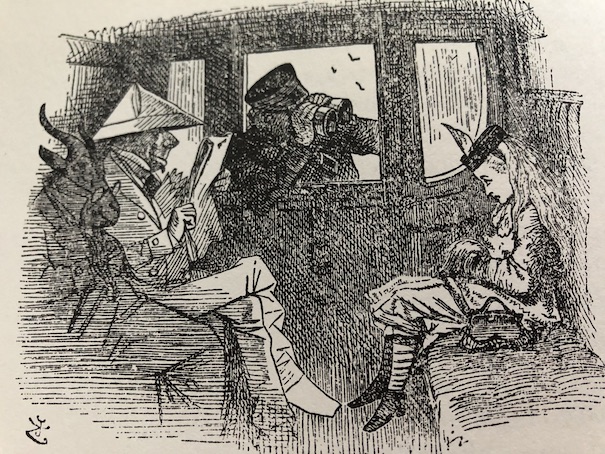
Pawns get to move two squares on their first turn, so Alice gets to go by train. In the train carriage, Alice meets many strange characters, including a gentleman dressed in white, a Goat, a Beetle, and a Gnat, who keeps whispering in her ear and suggesting that she make jokes based on puns. Through the Gnat, Alice meets other strange insects, like the snap-dragon-fly, the rocking-horse-fly, and the bread-and-butterfly. The Gnat tells Alice that the creatures in the woods don’t have names, and when Alice goes through the woods, she temporarily forgets her name, getting it back again on the other side.

Soon after, Alice meets Tweedledum and Tweedledee. (Lewis Carroll didn’t invent these characters. They are nursery rhyme characters.) They ask Alice if she likes poetry, and they tell her the tale of The Walrus and the Carpenter. (This is one of the most-quoted poems in the Alice stories – many people remember the part where they “talk of many things” – “Shoes and ships and sealing wax and cabbages and kings.”) At the end, Alice can’t decide which of the two characters she likes the best because both are sneaky and eat the oysters that trusted them, so she decides that she doesn’t like either of them. (Yeah, I can think of others stories where I’ve felt the same way.) Alice hears a strange sound, and they tell her that it’s the Red King snoring and that the Red King is actually dreaming about her right now. Tweedledum and Tweedledee insist that Alice isn’t a real person, only part of the Red King’s dream, and that she’d disappear if he were to wake up, which upsets Alice. Alice starts to cry, which she thinks is proof that she’s real, but they claim that those aren’t real tears. Finally, Alice decides that they’re just talking nonsense and that there’s no point in crying over it. Tweedledum and Tweedledee want to have a battle (as in their poem), but a large crow interrupts them and frightens them away by producing a great wind.
Alice catches hold of a shawl that was being blown away by the wind and returns it to its owner, the White Queen. The White Queen speaks very strangely, and she says that it’s an effect of living backwards. Because she lives backwards, her memory works both ways, and she can remember things that haven’t happened yet. The White Queen screams with pain before she pricks her finger, so she doesn’t have to do it again after her finger is hurt. Alice cries when she talks about how lonely she is in the woods, and the White Queen distracts her by telling her to consider things because no one can think of two things at once (which is true). The White Queen talks about considering and believing impossible things (sometimes she believes “six impossible things before breakfast” – one of the most famous lines that is often quoted from this story).

As Alice asks the White Queen if her finger is better, she suddenly and inexplicably finds herself in a shop and talking to a sheep, who asks her what she wants to buy. Alice tries to look around, and the Sheep asks her if she’s a child or a teetotum (a kind of spinning top used in old games, sometimes by itself and sometimes as a replacement for dice or a spinner – dreidels are a kind of teetotum) because of the way she’s turning around. The Sheep is knitting and keeps picking up more needles to knit with. For awhile, the shop disappears, and Alice finds herself in a boat with the Sheep, but then the shop returns, and the Sheep asks her again what she wants to buy.

Alice decides to buy an egg, and the egg that she buys turns into Humpty Dumpty when she approaches it. Humpty Dumpty is a bit rude and insults Alice’s name because he doesn’t think it means anything. Alice mistakes Humpty Dumpty’s cravat for a belt because he’s egg-shaped and doesn’t have a true neck for wearing a tie. Humpty Dumpty reveals that the cravat was an un-birthday (a concept that Lewis Carroll invented) present from the White King and Queen. All through the conversation, Humpty Dumpty uses words in unusual yet strangely nit-picky ways, making words mean only what he wants them to mean in the moment. Because he’s so particular about the meanings of words, Alice asks Humpty Dumpty about all the strange words in the Jabberwocky poem, and he explains what the made-up words mean. Humpty Dumpty recites another poem for Alice that doesn’t seem to have a true ending and then abruptly dismisses her.
As Alice leaves, she meets the king with all of his horses and men (from the Humpty Dumpty nursery rhyme) and is introduced to one of his messengers. Alice is amused by the name and description of the messenger and starts playing a game of “I Love My Love” out loud with the messenger’s name. (The two messengers are called Haigha and Hatta and are shown looking like the March Hare and Mad Hatter from Alice in Wonderland in the illustrations.) The messenger informs the king that the lion and the unicorn are fighting for the crown again (another nursery rhyme reference). The king says that it’s all a joke because the crown is his and neither one of them is going to get it no matter which of them wins the fight.

The unicorn is amazed to meet Alice because he never knew that children were real before. As at the end of the rhyme, they are given plum cake, and they hand the dish to Alice for her to cut the cake. However, Alice finds that she can’t cut it, so they ask her to hand the cake around first and then cut it afterward, which surprisingly works.
After the others are drummed out of town, also as part of the rhyme, the Red Knight attempts to capture Alice, but the White Knight shows up to save her. The White Knight tells Alice all about his inventions, none of which make any sense, and sings her a song which apparently has several names and is set to the tune of a song Alice recognizes as “I give thee all, I can no more” (which is another name and the first line of the song which is really titled My Heart and Lute, which is part of the on-going joke about the song’s real name).
Then, Alice reaches the final square of the board and becomes a queen, finding a crown suddenly on her head. The Red Queen and the White Queen appear suddenly, and the Red Queen tells her that she must pass an examination before she can truly become a queen. The queens ask her a series of questions that are supposed to be math questions but are actually a combination of riddles and nonsense. Their general knowledge questions are a combination of nonsense and puns. Eventually, the Red Queen and White Queen both fall asleep to a parody of “Rock-a-bye Baby.”

Alice finds herself in front of a door labelled “Queen Alice,” but the old frog who comes to the door doesn’t seem to want to let her in. Alice enters anyway and sits next to the Red Queen and White Queen. They introduce her to the food being served at the feast, but they don’t actually allow her to have any because it isn’t polite to cut and serve something you’ve been introduced to, and the plum cake verbally protests when Alice tries to serve it anyway.
The White Queen tells Alice a riddle in poem form about fish. The riddle is never answered, but everyone drinks to Alice’s health. The Red Queen tells Alice that she should make a speech, and as she gets up, many strange things begin happening in the room. Alice thinks that the Red Queen is responsible and grabs hold of her, threatening to “shake her into a kitten.” Alice suddenly wakes up, holding her little black kitten.
Like in Alice in Wonderland, everything that Alice experienced was a dream. However, the end of the book poses the question of whether the dream was Alice’s or the Red King’s. The question is never answered; it’s just something to make the readers think. That’s actually what I like most about the Alice stories, that they are partly meant to make the reader think. The stories are somewhat disjointed and constantly changing, kind of like dreams do, but I appreciate all the references and parodies in the stories.
The book is now public domain and is easily available online through Internet Archive and Project Gutenberg.
 Jestress's Forgotten Books and Stories
3 thoughts on “Through the Looking Glass”