Wise Child

Juniper is an unusual woman in the community where she lives. Wise Child knows that she originally came from Cornwall, and now, she lives alone and unmarried. People also know that she practices magic and doesn’t go to church. Yet, although people are a little suspicious about her for that, they still call on her for help when someone is very ill because she is an excellent healer and can frequently help when others can’t.

Wise Child (a nickname given to her by her family) finds herself alone at the age of nine. Her mother, Maeve, had left her with her grandmother years before and her father, Finbar, is a sailor who is often away. While her father is away, Wise Child’s grandmother dies, and the community has to decide where Wise Child will live until her father returns. She wants to live with her aunt, but her aunt and uncle are poor and already have trouble providing food for their children. After church one day, the village priest asks the villagers if anyone else is willing to give Wise Child a home. Few people are willing to take on an extra responsibility and an extra mouth to feed. At first, the only people who are interested in taking Wise Child are people who want to use her as a little servant or extra worker. Wise Child fears going to live with them because she knows they use their own children as hard workers, feeding them little and beating them for discipline. Then, Juniper speaks up and says that she would like to have Wise Child.

The priest is reluctant to let Juniper take Wise Child, knowing that she isn’t a Christian. Juniper suggests letting Wise Child decide where she wants to live, but Wise Child isn’t sure what to answer. She fears the other families and how they would treat her. Juniper has been kind to her in the past, but Wise Child also fears her because of the stories people tell about her. However, Wise Child’s aunt sees that Juniper would take better care of her than the other families, so she lies and says that her father had previously said that, if anything happened to his mother, he would like Juniper to take care of Wise Child. Nobody contradicts this, so Juniper takes custody of Wise Child.

Wise Child is nervous when she goes to live in Juniper’s house, fearing that she will cast spells on her or that she has dead bodies hidden in her cupboards, like her cousins claimed. When Juniper asks her what’s worrying her, Wise Child surprises herself by admitting that she’s heard all of these stories about her and that she’s afraid. To her surprise, Juniper isn’t angry at her or at the people who have told Wise Child these stories. Instead, she says that she thinks Wise Child is brave for coming to her house even while fearing all of these things, and she reassures her that these stories aren’t true. As Wise Child becomes familiar with her house and with her, she will see that she and her house aren’t as scary as the stories say.

Wise Child finds that this is true. Juniper’s cupboards are full of very ordinary things, and the broom that people say Juniper uses for flying is just an ordinary broom. Juniper also doesn’t beat Wise Child, even when she does things wrong. Juniper promises that she will never beat her.

Wise Child finds that she likes living with Juniper. She had always wanted to go to school, like some of the other children, and Juniper teaches her many things. She teaches her some practical household skills, and she also begins teaching her about herbs and medicines. Juniper also promises to teach Wise Child Latin, although girls in their area don’t usually learn Latin because they’re mostly expected to be wives and mothers and to learn to take care of households. However, Juniper says that all truly learned people learn Latin. When her cousin, Coleman, comes to visit to see if she’s all right with Juniper, Wise Child assures him that she’s doing fine.

Juniper does have secrets, though. Wise Child isn’t sure what Juniper keeps in the attic of her house or what she does there. She begins learning Juniper’s secrets when Juniper gets a visit from an older woman called Yuni, who insists that Wise Child undergo a bizarre ritual. Yuni and Juniper smear some kind of smelly ointment on Wise Child’s skin that gives her a vision of flying on Juniper’s broomstick!

The next day, Wise Child questions Juniper about this ritual and whether the things she saw in her vision really happened. Juniper explains that she and Yuni are both magic-users. Some people might call them witches, but they refer to themselves as “Doran”, based on the word for “door” or a way into something. It has to do with people who see into things in ways that other people don’t. Dorans “live in the rhythm” of life, nature, and the changing seasons. Wise Child’s vision means that she has the ability to use magic and become a Doran as well.

As Wise Child begins to understand Juniper’s kind of magic, it awakens memories of her mother in her mind. Wise’s Child’s mother used to beat her and eventually abandoned her, leaving Wise Child with her grandmother while she ran away with another man. Wise Child feels hurt that her mother abandoned her instead of taking her along, wherever she went. However, she also begins to remember things her mother had and things she used to do that seemed strange. Wise Child asks Juniper if her mother was also a Doran, but she says no. Maeve practices magic, but it’s a very different kind of magic.

Wise Child comes to understand what Juniper means when Maeve returns and uses her magic to persuade Wise Child to come live with her for a while. She promises Wise Child a life of ease and luxury with no difficult or boring lessons, but when Wise Child sees what Maeve does and how she takes advantage of other people, she comes to appreciate Juniper’s way of life and lessons more. Maeve has even taken advantage of and hurt Wise Child and her father.

Gradually, Wise Child begins to learn the secrets of her own family’s past, the long rivalry between Juniper and Maeve, and other secrets about the land they live in, the things people who have lived there believed, and the things people have done for power and to control other people or the forces of nature. Wise Child feels conflicted between her beliefs in Christianity and the new knowledge that she’s been gaining about the Dorans. She doesn’t want to have to choose between them, although Juniper says that there’s no need. Juniper says that Christianity and the beliefs of the Dorans don’t really conflict with each other, and she also believes in Jesus. However, she admits that not everybody sees it that way. The village priest in particular is suspicious of Juniper and thinks that Juniper has corrupted Wise Child.

During a particularly bad winter, the priest blames Juniper for bringing on the famine and sickness. He brings in an inquisitor to question Wise Child and Juniper, and Wise Child fears what he and the people of the village will do to them. Will they find a way to escape, and if so, where will they go where they can be safe?

The book is available to borrow and read for free online through Internet Archive. It is the first book in a series about the Dorans, although the second book, Juniper, is a prequel to this one, and it focuses on Juniper’s early life.

I remember reading this book in my early teens, but there were many things about the lore it draws on that I didn’t understand back then. For me, it was just an interesting fantasy book. The story draws on witchcraft lore, but it’s not entirely historically accurate. To begin with, the term “doran” to describe witches or magic users is unique to this book and its series. It’s not an historical term.

The time period of the story is never explicitly defined, although it’s set in a small village in Scotland. I think, when I was younger, I took it to be sort of Medieval, and I think that’s probably what the author intended, but if so, there are various anachronisms for the Middle Ages. For example, Wise Child describes Juniper as giving her a kind of tea, but tea didn’t arrive in the British Isles until the 1600s and didn’t really become popular until the 1700s, so Wise Child shouldn’t have had that concept. Because the story’s time period isn’t really defined, I considered that the story could be as late as the 17th or 18th centuries, except that the village is clearly Catholic, with a priest and a monk serving as the inquisitor at the end of the story. There are no mentions of Protestants, and there should be if the story was set in the 16th or 17th century.

To be fair, Medieval people did make hot tea-like drinks of herbs or grains infused with water, but I don’t think they referred to these drinks as being “tea” because they weren’t familiar with the concept of “tea” then. In modern times, we refer to “tea” to mean a variety of infused drinks, but “tea” itself is a specific plant, the one used for black teas and green teas. Herbal teas don’t contain this plant, so they’re technically tea-like, not actually “tea.” I know it’s a technicality, but it’s the kind of thing I notice now that went past me when I was younger. When Medieval people made infused drinks, they didn’t have the tea plant in them, and they called them “waters”, not “teas”, like barley water or sage water.

Returning to the issue of whether or not this is pre-Reformation times or not, while the story seems to be set in pre-Reformation times, the type of witchcraft trial depicted at the end of the story is more in keeping with Reformation and post-Reformation Scotland than Medieval Scotland. The Witchcraft Act of 1563 made witchcraft illegal and led to a period of witchcraft trials that lasted until 1736. This is really the period of intense persecution of supposed witches, not the Middle Ages. Prior to the Witchcraft Act, it was more common for people to skeptically dismiss “witches” as being merely superstitious, delusional, or frauds rather than staging witch hunts and witch trials.

The type of witchcraft lore that the story uses is also somewhat anachronistic based largely around Wiccan lore and feminist sensibilities that had their basis in the 20th century rather than the type of herbal remedy healing that would have been found in the Middle Ages. (This documentary of the life of Gerald Gardner, the founder of Wicca, is fascinating and explains some of the background lore.) Juniper has a sense that there’s a connection between psychology and emotional health and physical health that’s more modern than Medieval, and her notions of what to teach Wise Child wouldn’t have just been unusual as concepts to teach a girl vs. a boy but also generally unusual for anyone of their time and location, a small village where people primarily make their living in farming.

She is correct that, to be truly considered a learned person in the Middle Ages, Latin would be expected, but this is the reason why truly literate people were considered so rare during that time. It wasn’t that nobody knew how to read during this period, but books were highly uncommon, being expensively and painstakingly produced by hand. More people could read and write in a vernacular way during the Middle Ages (spelling also not standardized during this period) than most people suppose, using basic writing for utilitarian purposes like keeping business accounts or sending occasional personal messages, but only clerical scholars and those who trained with them knew Latin. What I’m saying is that what Juniper teaches Wise Child wouldn’t have been shocking in Medieval Scotland for being inappropriate for girls and ruining them for being wives and mothers, as portrayed in the story, so much as it should have been shocking as a thing that a woman who lives as a simple folk healer in a small farming community shouldn’t have known in the first place to teach anybody. The prequel book, Juniper, explains that there’s far more to Juniper’s past than most of the characters in this book know and that she was far better educated than most people of her time because she came from a royal family.

The part about the psychedelic ointment that produces the illusion of flying is based on witchcraft lore, and there is a scene in the book that involves the sacrifice of a willing deer that is eaten after the ritual is based around concepts of pre-Christian rituals in the British Isles. Most of the details we have of pre-Christians rituals in the British Isles comes from Roman writings, and details are sometimes questioned. I had forgotten about that part of the story since I read the book the first time, and I didn’t like it the second time around. Even if the animal seemed willing to be sacrificed and was eaten afterward, making it a public meal and not just a wasteful sacrifice, it was still a disturbing scene.
The Charmed Children of Rookskill Castle

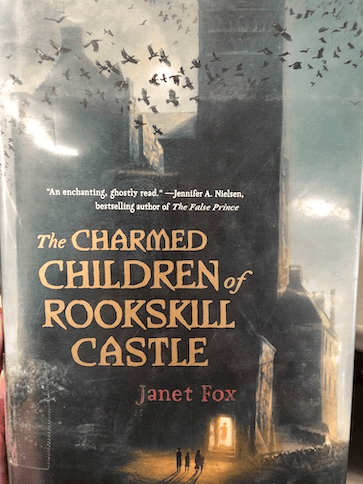
The Charmed Children of Rookskill Castle by Janet Fox, 2016.

In 1940, in London, the coming of the Blitz during World War II means that children must be sent away to escape the bombings. Kat Bateson and her siblings are told that they will be sent to Rookskill Castle.

Rob is excited about going to a castle because it might be haunted and they might learn all kinds of Medieval fighting skills, like fencing and archery. Kat says that the castle is now called Rookskill Castle Children’s Academy, so they’ll probably just be having standard lessons. Rob thinks that she’s being stodgy and boring. Their little sister, Amelie, thinks that ghosts sound exciting, but 12-year-old Kat is sure that there won’t be ghosts. The castle is owned by the children’s distant relatives, and Kat is more worried about practical things, like their father’s war work with MI-6 (he is a spy, although they are not supposed to talk about it), how she will fit in with other children at school, and packing warm clothes for Scotland.

Before the children leave for Scotland, Great Aunt Margaret gives her something for protection – her chatelaine. The chatelaine is a family heirloom that holds a pen, scissors, and thimble attached by chains to a ring. Great Aunt Margaret says that it’s magical, and she warns Kat to be careful with magic because magic always comes at a price. Kat doesn’t really believe in magic, like her younger siblings do. She is practical and enjoys numbers, puzzles, and the clockwork skills that her father has been teaching her. Still, she accepts the chatelaine from her aunt. Her aunt tells her that the pen will write by itself, the scissors will cut anything, and the thimble has the power to capture souls.
Kat and her siblings make the trip to Scotland along with Peter, the American son of people their mother works with. The Bateson children like Peter, and they become friends. However, when they reach Scotland, the station master warns them away from Rookskill Castle, talking about strange stories about the place and other children who have gone there and haven’t been seen since. The children are spooked by what he says, but they have no choice but to go with the man from the castle who comes to pick them up.

When they arrive at Rookskill Castle, they all find the place creepy. The boys find the lady who runs the castle school, Eleanor, to be pretty and charming, but the girls find her creepy. Kat thinks that there is something wrong with her, although she’s not sure what. Eleanor also wears a chatelaine, although Kat doesn’t think hers is as good as the one Aunt Margaret gave her. Aunt Margaret’s chatelaine holds practical items, but Eleanor’s chatelaine holds strange-looking charms with no practical use. Kat doesn’t know what the point of them is, but she prefers Aunt Margaret’s chatelaine.

The children are told that they will share rooms – Peter and Robby together and Kat and Amelie together – and that they must wear school uniforms, which is typical of a boarding school. However, they are also told that they will be locked in their rooms at night, which sounds alarming, and that if they hear any strange noises, they should ignore them because old castles make odd sounds. They are not allowed to wander the grounds and explore.

The children and the other students at the school soon begin to see and hear strange things around the castle. They see other, mysterious children, who are not students but who may be ghosts. The boys hear strange noises coming from a secret room that Kat thinks sound like a radio. Kat thinks that the radio sounds might indicate that there is a German spy at the school, someone who is communicating with someone outside in secret. That would make sense for wartime Britain, but it can’t explain the other, frightening things that are happening at the castle.

There is something wrong with the teachers and the cook at the school. Their memories are sometimes muddled, and they seem to be easily confused about certain things. One of their teachers keeps talking about special artifacts with magical powers that could decide the course of the war, including a magical chatelaine once owned by Vlad the Impaler.

The longer they’re at the school, the more everyone seems to be affected by the place. Kat becomes certain that the students’ cocoa is drugged every night, and Lady Eleanor isn’t what she appears to be. Really none of the adults in the castle is quite what they appear to be, but Lady Eleanor is particularly sinister. In a series of flashbacks, it is revealed that she has led an unnaturally long life because of a magical pact she made centuries ago. In order to gain the power she craves, she needs the souls of children. Logical Kat needs to grasp the idea that there is magic and take possession of her own magical potential to save herself and the others in a terrifying showdown on Halloween night.

My Reaction

I really enjoyed the combination of magic and historical fiction in this story! I’ve read other books that combine the real-life experiences of WWII child evacuees with magic and fantasy. Many people would remember that the children in The Lion, the Witch, and the Wardrobe were child evacuees, but there are other books with similar themes, like Stonestruck by Helen Cresswell. There are several things that make this book different from others of its type, and I love that this book fits well with the Dark Academia aesthetic that’s been popular during the last few years.

One thing that appears in this story that I haven’t seen in similar ones is the use of mathematics and engineering skills alongside magic. Kat’s talent for mathematics and puzzles have practical uses during their adventure, and so does her budding talent for clockwork and machinery. There is both real machinery in the form of code machines and magical machinery in the story, and Amelie comments on the similarity between magic and the incredible results produced by Kat’s mathematics and by machines. I like the juxtaposition of real skills needed for invention and creation alongside the magic.

There is also a double threat in the book – the magical one and the more standard wartime threat of spies. The book’s premise of Nazis being interested in supernatural artifacts also has some basis in history. Movies like Indiana Jones and the Raiders of the Lost Ark are actually correct that there was an element of superstition in Nazism, and Nazis did attempt to use folklore and antiquities to create or build a connection to the past and to powerful figures. (There are many videos and documentaries on YouTube that offer more details about this. I recommend the ones from National Geographic, the Smithsonian Channel, and various universities as being the most authoritative and reliable.) The Nazi concept of history was really more of a fan fiction about their imagined past glories rather than sound and real history, and it was meant to serve as an inspiration for the empire they wanted to create. The book was correct that the darkness of war brings out magic, after a fashion. Even Allied countries, like Britain, saw a rise in spiritualism because of the war as people tried to connect to the spirits of lost loved ones, and this was also the time when Wicca began evolving into a religious movement. In fact, the founders of Wicca in Britain attempted their own magical ritual in the New Forest to ward off the Nazis. (The incident is recounted in this documentary about the life of the founder of Wicca by Professor Ronald Hutton of the University of Bristol.) In times of chaos, people are prepared to try anything and everything they can to protect what’s important, and that can include magic. The real life Wiccan rituals were not like the magic in this book, but I found it interesting that the fantasy of this story built on some real-life wartime attitudes about the supernatural.

I like books that include interesting and unusual historical details. Although this is a fantasy story, the experiences of the child evacuees do resemble the experiences of real-life evacuees. I enjoyed reading about their train journey from London to Scotland and the black-out curtains that even the trains have. Many books about child evacuees have them sent to live in private homes with people they don’t know, but in real life, there were some evacuees who were sent to boarding schools instead.

The use of a magical chatelaine is a charming touch that also shapes the nature of the story. A chaletaine is an unusual piece of jewelry that isn’t commonly worn anymore, which makes it different from stories that make use of charmed necklaces and rings. A chatelaine is a belt hook with items joined to it by chains. The items can be practical items, like the ones on Kat’s chatelaine, or charms, like the ones on Eleanor’s. Each of the items on the chatelaines in the story has a purpose.

There are also themes about power in the story. Eleanor craves power. When she was younger, before she began living this unnatural life, she craved love, but she was abused and neglected. She was powerless and fearful of the people who abused her, and her quest for power is to make herself invulnerable to that type of abuse again. However, in the process, she has sacrificed her humanity and placed herself in the position of being used by someone much more powerful. Readers and the characters can feel sorry for her because of her past life experiences, but she is beyond the point where they could save her from herself, the choices she’s made, the things she’s done to other people, and the evil force that has used her. The book is a little open-ended, with the villain behind the villain still lurking around at the end with a mission of his own to accomplish, and this story has a sequel, The Artifact Hunters.

The Spy Game

Boxcar Children

Mrs. Dawson, a friend of Mrs. McGregor, the Aldens’ housekeeper, stops by one day for a visit. Mrs. Dawson is also a housekeeper, working for Amanda Penner. She has been with the Penner family for years, although her ambition is to own a book store some day. Mrs. Dawson says that Amanda has injured her ankle falling over some loose stones in a walkway at the house she inherited from her grandfather. The Alden children are sympathetic, and they offer to help fix the walkway so nobody else will get hurt. Mrs. Dawson says that she’s sure Amanda would be grateful for the help, although they notice that she’s oddly evasive when Mrs. McGregor asks her if Amanda still likes writing.

When the Aldens go to see Amanda Penner, she tells them more about the house and her family. The house is over 100 years old, and she says that it was built by an ancestor of hers for his young bride, Pandora, who was called Dora. Amanda has many fond memories of the house because, even though she didn’t grow up there, she used to visit her grandfather there every summer.

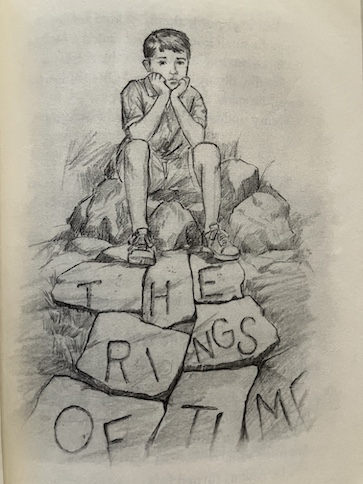
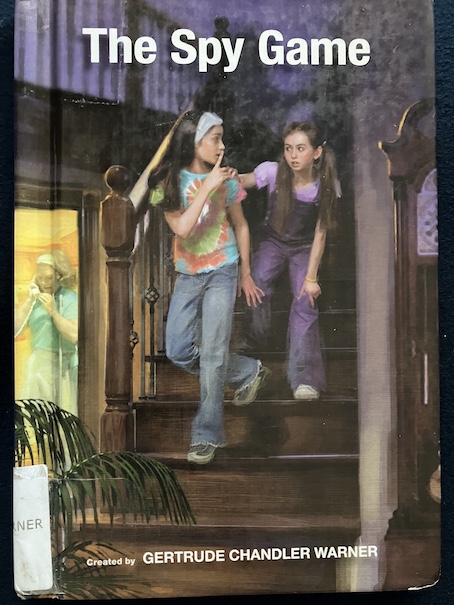
When the children start fixing the stone walkway, they notice that there are letters engraved into the stones. They wonder if the stones are meant to spell something, and when they investigate, they find it leads to a riddle. They show it to Amanda, and she says that it looks like they’ve stumbled on her grandfather’s “Spy Game.” Her grandfather was a big fan of mysteries and used to play a kind of treasure hunt game with her. The game always started with a hint in the form of “I spy with my little eye …”, which is why she started calling it the “Spy Game.” Amanda says that, when her grandfather died, he left her one last “Spy Game” that supposedly leads to something gold, but she hasn’t been able to solve it. Naturally, the Aldens offer to help her find the hidden treasure!

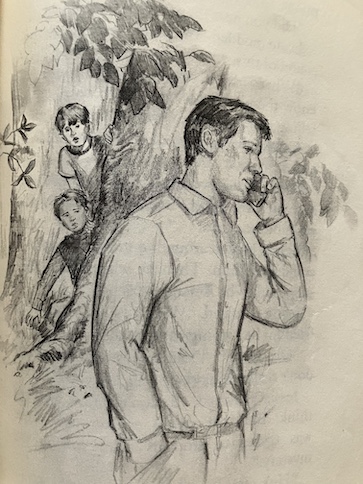
However, they might not be the only ones looking for the hidden treasure. Amanda’s friend, Steve, is renting the room over the garage for the summer, and they overhear him talking on the phone about getting a “treasure.” They also hear Mrs. Dawson talking about opening “Pandora’s Box.” Are Steve and Mrs. Dawson also looking for the gold that Amanda’s grandfather left for her? All is not what it seems in this tale of treasure hunts and riddles!

The book is available to borrow and read for free online through Internet Archive.

There is a fun twist to this story that I don’t want to spoil! It’s hinted at throughout the book that the story behind the treasure hunt doesn’t quite add up, but the true purpose behind the treasure hunt makes a fun surprise! Actually, there’s kind of a double surprise, but I don’t want to spoil either one.

The setting of the story is charming, an old house where a grandfather used to play treasure hunt games with his granddaughter. I always loved treasure hunt stories as a kid, and this is the kind of book I would have loved back then. I liked how the clues in the story could have multiple meanings, like the clue about a tree and a “hollow” could refer to a tree in a place called a “hollow” or to a hollow tree. Readers are given enough information that they can try to figure out the clues along with the Aldens, but I thought that the room for interpretation in the clues made it an interesting challenge.

The Silver Crown

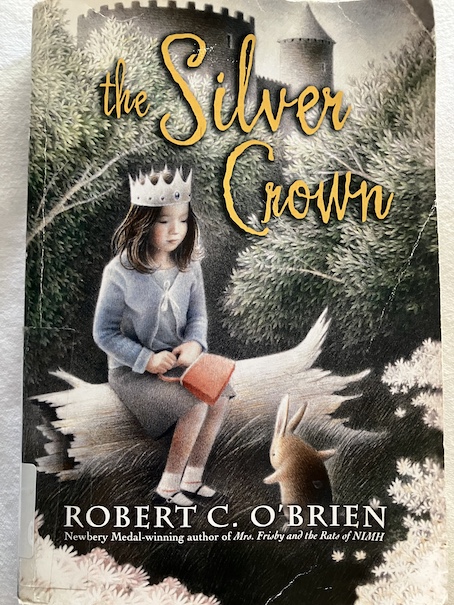
Ellen Carroll has always known, deep down, that she was a queen. Of course, everybody else sees this as a game of pretend, and it kind of is, but on her 10th birthday, her life changes forever, and there may be more behind Ellen’s feeling of being a queen than even she knows.

When Ellen wakes up on her 10th birthday, she finds a letter from her Aunt Sarah and a beautiful silver crown next to her on her pillow. Ellen loves the crown because Aunt Sarah is the only adult who seems to really believe Ellen when she says she’s a queen. Ellen takes the crown and goes for an early walk in the park, daydreaming about being a queen. When Ellen gets back to her house, she gets a real shock. In the brief period that she was gone, the house has completely burned down, and apparently no one else in her family survived!

Ellen, in shock, tries to talk to the firefighters and police about the fire and what happened to her family. She discovers that the fire was surprisingly sudden and fierce, there’s no indication that anyone survived, and they might only find bones when they finish their investigation. Ellen explains that this was her family’s house, but since her family hasn’t lived there very long. Nobody really knew her family, and nobody really knows her, and even the police seem to doubt her identity. However, a policeman says that he will take her to the station.

On the way to the police station, something else shocking happens. Ellen and the police officer witness a murder! A robber shoots a store manager, and when the policeman chases the robber, he is also shot. Alone and forgotten, Ellen watches more police come and investigate the situation, trying to figure out what to do. Ellen realizes that, with her family gone, what she really needs is a guardian or a next of kin. That would be Aunt Sarah. However, Aunt Sarah lives in Kentucky, and that’s hundreds of miles away. Ellen could write to Aunt Sarah, but it would take days for her to get the letter, and in the meantime, Ellen has nowhere else to stay. Then, Ellen decides that the thing to do is to go to Kentucky herself. She writes a letter to her aunt to tell her that she’s coming, and sets out to find a ride.

She accepts a ride from a nice man called Mr. Gates who says he’s a teacher and that he’s going to Kentucky, too. She considers it good luck until, during the ride, she begins to notice that there’s something weird about this man. He seems weirdly happy, all the time, and he sometimes repeats certain stock phrases at inappropriate moments. When Ellen gets a look inside in the glove compartment and sees something disturbing – a gun! Suddenly, something clicks in her mind, and she realizes that Mr. Gates was the man in the green hood who shot the store manager and the policeman! She escapes from Mr. Gates and runs into the woods.

While she hides from him in the dark woods, she hears Mr. Gates searching and calling for her. As she listens to him, he grows more disturbed and more disturbing. First, he tries to tell her that he’s going to take her straight to her Aunt Sarah, and Ellen realizes that she never told him her aunt’s name. Then, he begins raving, trying to command her to come out because “the king” has demanded that he bring her to him, and he will punish them if they don’t come. Ellen doesn’t know what he’s talking about, but in the woods that night, she has a strange vision where a man wearing a black crown that looks like hers seems to be commanding other people.

The next day, Ellen befriends a boy named Otto. Otto lives with his elderly mother in the woods, and they survive partly on things they salvage after trucks wreck on a dangerous section of road nearby. Otto and his mother invite Ellen to stay with them a little while to eat and get some sleep.

Ellen explains everything that’s happened to her to Otto’s mother, Mrs. Fitzpatrick. Mrs. Fitzpatrick is a wise woman, and she and Otto both sense that there’s something odd about Ellen’s crown. They sense that it has a power of some kind, but it’s the kind of power that only particular people can use. Whatever the crown does, Mrs. Fitzpatrick is sure that it will only work for Ellen. She questions Ellen about who gave her the crown, but she admits that she doesn’t really know. All she knows is that it was there when she woke up. Since it was her birthday, she just assumed that it was a birthday present. She talks her Mrs. Fitzpatrick about having this sense that she’s a queen and that her Aunt Sarah thinks so, too. Mrs. Fitzpatrick agrees, but she says the question, is what or where is Ellen the queen of? Ellen will need to figure that out before she can understand what the silver crown really is and what it does.

During the night, Mrs. Fitzpatrick shoots at someone who’s lurking outside their cabin, and they realize that someone is still hunting for Ellen. Ellen can’t stay there, and Mrs. Fitzpatrick points out a road that Ellen can take, and she insists that Otto go with her because he knows how to manage in the woods and can help Ellen. Mrs. Fitzpatrick admits that it’s also best for Otto to leave the area because he’s also in trouble.

At first, she’s vague about what trouble Otto is in, but gradually, Mrs. Fitzpatrick explains that Otto and his past aren’t what he believes or has chosen to believe. Mrs. Fitzpatrick found him as a very small child, abandoned on the nearby highway, and she has no idea who his birth parents are or what happened to them. Mrs. Fitzpatrick says she doesn’t really need the things that Otto has salvaged from the wrecked trucks, but for some reason, Otto believes that she does, so he’s been causing these accidents by using branches to hide the sign warning people of the dangerous curve ahead. It doesn’t seem to affect smaller cars, but bigger trucks can’t make it without warning. Ellen is horrified, but Mrs. Fitzpatrick says that she thinks that Otto needs to leave this place and the dangerous fantasies about himself and his life that he’s build, living alone in the woods.

Mrs. Fitzpatrick lets the children go with a warning to Ellen to keep the crown hidden and not to tell anybody about it. She also warns her to beware of any people or group who use the name Hieronymus. The first Hieronymus was a saint, but others have appropriated the name to study the occult and esoteric knowledge, and not for any holy purpose. Mrs. Fitzpatrick says that she has read about a crown like Ellen’s which is associated with these people, and she thinks this secret society is after Ellen now.

Ellen and Otto set out on a cross-country journey to reach Ellen’s Aunt Sarah, but they eventually find themselves trapped in a disturbing boarding school, run by the secret society they are trying to escape. The students in this school are controlled by the mysterious Hieronymus Machine, and they are being trained as soldiers in the service of “the king” to sow chaos in society. Ellen is close to learning the purpose of her crown, but she and Otto will need their wits to escape and put an end to this secret society’s evil plans!

Robert C. O’Brien is known for Mrs. Frisby and the Rats of NIMH, but The Silver Crown was his first book.

I was intrigued by this story from the very beginning. Strange things start happening very quickly – the appearance of the silver crown on Ellen’s birthday, the destruction of her house, the murder she witnesses, Ellen setting out on her journey to her aunt, and the strange and disturbing Mr. Gates attempting to kidnap her – all of these events, while confusing for Ellen, are related and part of a much larger story.

The parts of the book where Ellen and Otto are traveling cross-country, meeting people who help them escape from the people chasing them and continue their journey, seem almost like part of a fantasy book or fairy tale. This story is both fantasy and science fiction. (Spoiler) The Hieronymus Machine is an invention more than a thousand years old that controls minds by broadcasting feelings like radio waves. The school run by the society uses the Hieronymus Machine to control the minds of the “students”, and the students are all part of a larger experiment to test the powers of the machine and the ability of the black crown to control it. There is a pseudo-scientific explanation of how the machine works, which is the science fiction element, but the black and silver crowns that control the machine and the roles of “king” and “queen” associated with the crowns add the fantasy element. When Ellen meets the king, he explains to her how he discovered the machine and that the people who built it, although they called themselves monks, were actually sorcerers. I enjoy stories that are cross-genre, and I thought that this combination of fantasy and science fiction worked well.

Actually, I was surprised when Ellen and Otto ended up at the boarding school and started learning what the Hieronymus Machine is and what it does because it struck me as very similar to the plot of The Mysterious Benedict Society. This book is 40 years older than The Mysterious Benedict Society, and I wouldn’t be surprised if it inspired that later series. Both of them are based around the concept of mind control machines that work like radio waves and strange boarding schools that are used both for mind control experiments and for training/brain-washing people to serve a dark purpose. Both stories feature children who are orphans and/or separated from their parents and people whose identities are uncertain and whose memories are corrupted by the machine. (Spoiler) It turns out that Ellen’s family is still alive but being held captive by the secret society, but we never learn who Otto’s parents were or if they had any connection to the secret society themselves.

There are some differences between The Mysterious Benedict Society and The Silver Crown. Ellen discovers that the king, although seeming to be in control of everything initially, is also controlled by the machine. The machine controls everyone around it, to some extent. The king somewhat controls the machine through the black crown, but at the same time, he’s also carrying out the goals of the machine. Although he seems in command, he’s really just a tool of the machine itself and needs to be freed from it as badly as everyone else. This is a somewhat different scenario from The Mysterious Benedict Society, where there is one person who is definitely in control. Some people, like Ellen, have a natural resistance to the mind control effects because their minds work differently from other people’s, and that’s how Ellen is able to resist the mind control and use the silver crown. The silver crown is the one that actually controls the machine while the black crown allows the machine to control the wearer while giving him the illusion of control, which is why the king wants to control the silver crown and Ellen. On some level, the machine realizes that it needs Ellen and the silver crown to function. Ellen needs to learn how to use the crown and the knowledge it gives her about what to do to establish control over the machine and ensure that it can’t control anyone else again.

There are actually two different endings to this book, depending on whether you read the British version or the American version, and if you listen to Kent Kently’s reading on Youtube, he reads both of them at the end of the book. In the original British version, Ellen’s Aunt Sarah says that she sent Ellen the crown after finding it in a curio shop in Spain, where the shop owner seemed to think it was an old theatrical prop. This ending isn’t very detailed and leaves some things to the imagination. The American version has far more detail, and in that version, they conclude that the secret society had someone break into Ellen’s house and leave the crown for her because they were actively searching for someone who could use it. If you read other reviews of this story, some of them will differ from each other, depending on which version the reviewer read. Personally, I like the American version with its more detailed explanations better, but Kent Kently prefers the shorter, original version.

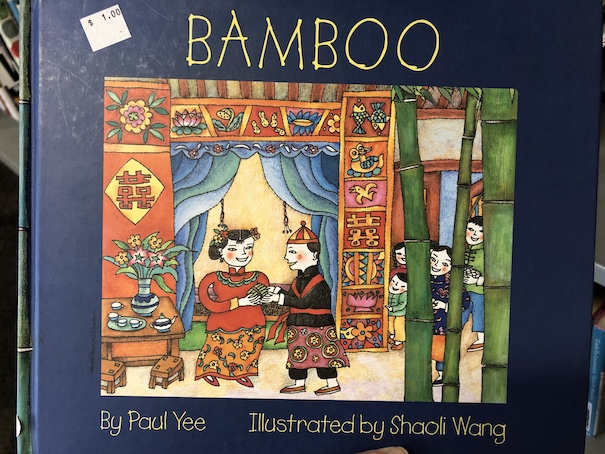
Bamboo

Bamboo is a young farmer. He falls in love with a girl called Ming and marries her. His brother, Banyan, approves of the marriage, but Banyan’s wife, Jin, doesn’t like Ming. When Bamboo and Ming marry, Ming gives Bamboo some bamboo seedlings, and they plant a bamboo grove.

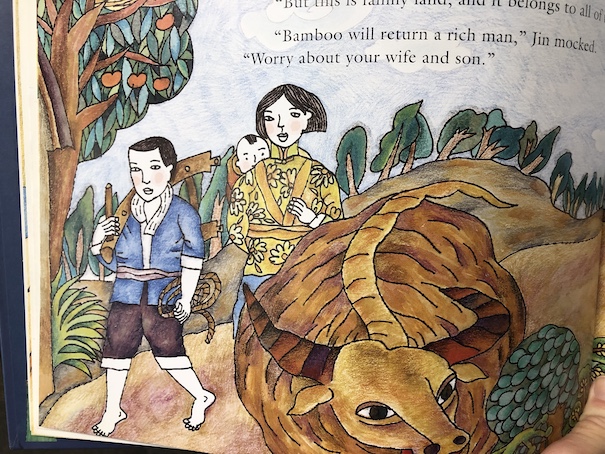
The two couples, Bamboo and his wife and Banyan and his wife, tend the farm together, although Jin complains frequently about the farm work. Then, Jin gives birth to a son, and Bamboo thinks that their growing family can use more land. He decides to go to the New World to earn more money to buy land.

Although the two brother have shared the farmland between them, Jin convinces Banyan to claim the best parts of the farm for them while Bamboo is gone. Her argument is that Bamboo will likely return rich, and Banyan needs to provide for his family. They leave very little for Ming to use to support herself in Bamboo’s absence.

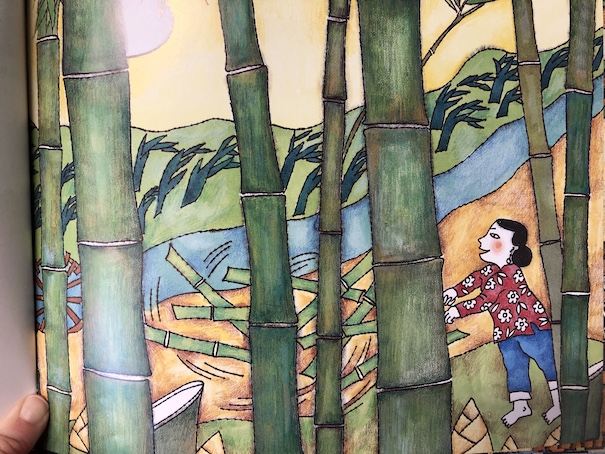
However, the bamboo that Bamboo and Ming planted is magical, and it tills the soil for Ming. When Jin discovers that, she tries to steal the bamboo poles, but they hit her instead. In retaliation, she gets Banyan to throw the poles in the river. Ming cuts a new pole, and it helps her by carrying water. Angrily, Jin gets Banyan to destroy all the bamboo, but Ming’s field still grows rice, and the bamboo grows back.

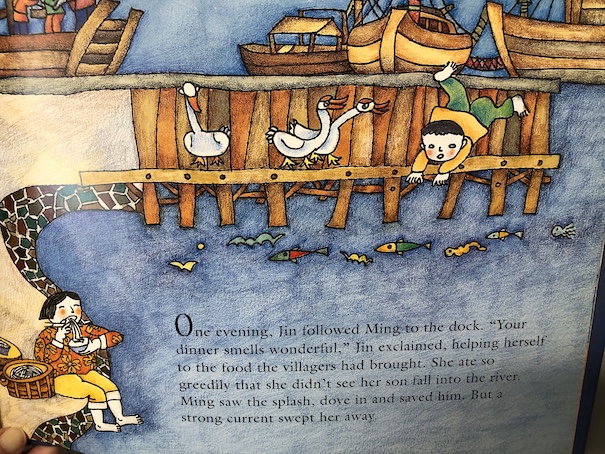
Bamboo writes to Ming that he is returning with gold, but then, she gets word that his ship has sunk. Still holding onto hope that he will return, she keeps going to the dock to wait for him. The kind villagers bring her food while she waits, but Jin eats it. While Jin is eating, her young son falls in the water, and Ming jumps in to help him. She saves the boy, but she is swept away by the current.

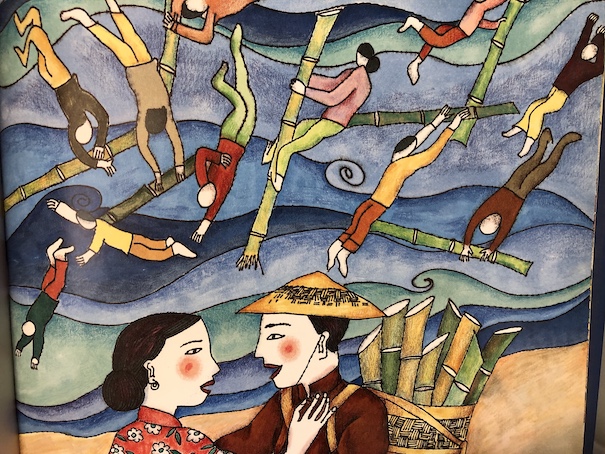
However, Bamboo saves her, and Ming discovers that Bamboo and the others on his ship were rescued by the bamboo poles that Banyan threw in the river.

The book is available to borrow and read for free online through Internet Archive.

This story is written in the style of a folk tale or fairy tale, although I don’t think it is a folk tale. The book didn’t mention that it was based on a folk tale or a retelling of an old story. It does have some similarities to fairy tales, with the cruel, greedy, and jealous relative; the kind and patient woman who is mistreated; and magical objects that help the good woman with her problems.

The trip to the “New World” and finding gold sounds a little more modern than most folk tales and fairy tales, like something that might have happened in the 19th century, but the idea of the husband being away on a long journey sets up the situation for what happens to his wife while he’s away. Like in fairy tales, everything works out for the best in the end. The bamboo poles that Banyan threw in the river save his life when they reach him, and when Ming saves her young nephew’s life, Jin apologizes for the way she’s been treating her. The story’s familiar themes are comforting. Readers can be confident that there will be a happy ending, and I liked it that the very act of throwing the bamboo poles in the river, which was meant to be a punishing act, is what saves the day.

The Korean Cinderella

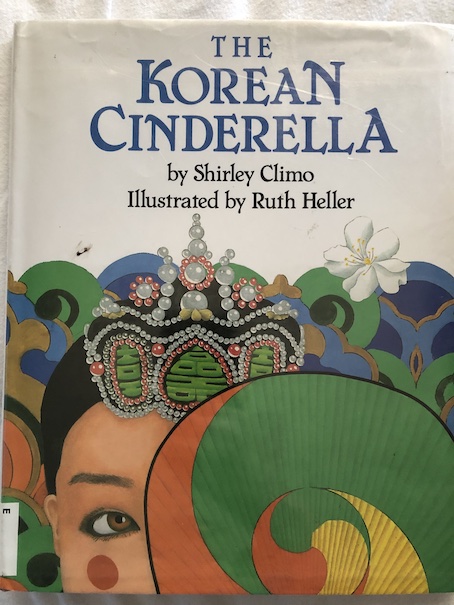
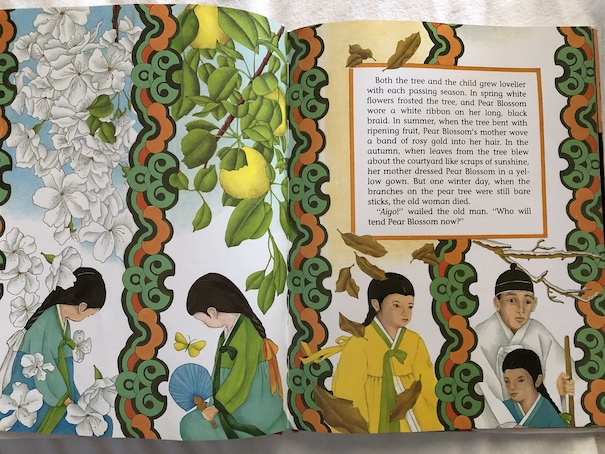
In this Korean version of the classic Cinderella story, a couple who live in a little cottage have a daughter they call Pear Blossom. Pear Blossom is a lovely girl, and when her mother dies, her father thinks that he should remarry, so he will have a wife to help care for his daughter.

The village matchmaker matches him with a widow who also has a daughter, a girl called Peony. However, after the marriage, it becomes clear that Pear Blossom’s new “mother” doesn’t like her, and her new “sister” doesn’t either. Her stepmother and stepsister are jealous of her, so they nitpick everything she does and make her do all the chores. As Pear Blossom’s father’s health worsens, he is less able to interfere with their mistreatment of Pear Blossom, and the stepmother schemes to find a way to get rid of Pear Blossom entirely.

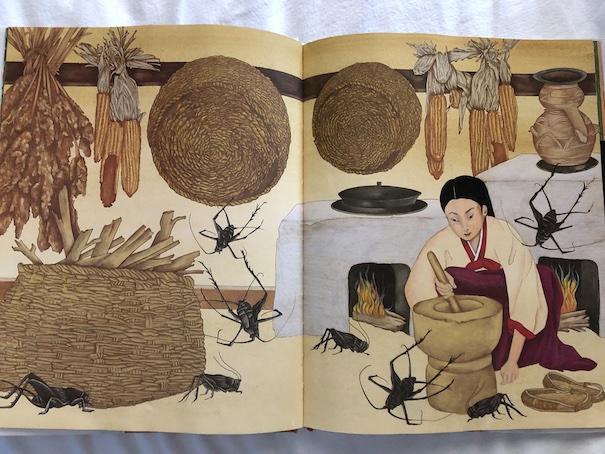
The stepmother keeps assigning Pear Blossom chores that she thinks will be impossible for her to complete, but various animals take pity on her and help her. A frog helps her to fill a jug that has a leak by plugging the leak, and some sparrows help her to hull a massive amount of rice.

One day, Pear Blossom’s stepmother and stepsister go to a festival in the village, leaving Pear Blossom at home. The stepmother says that she can only go to the festival if she weeds the rice paddies first. However, a huge black ox appears out of a whirlwind and takes care of the task for her!

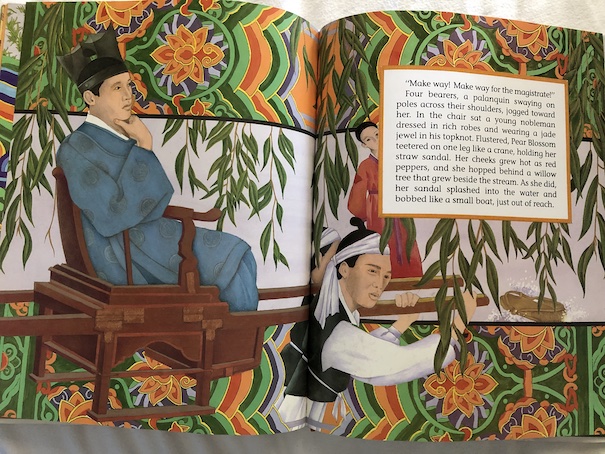
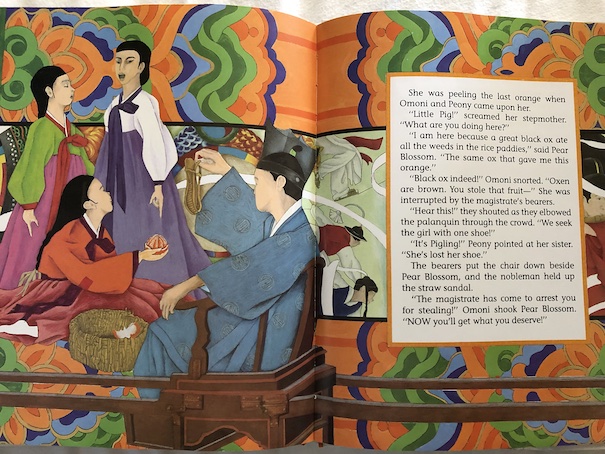
On her way to the festival, Pear Blossom sees the handsome magistrate but accidentally loses one of her sandals as she gets embarrassed and runs away. The lost sandal helps the magistrate to find Pear Blossom at the festival, and he declares that he wants to marry her.

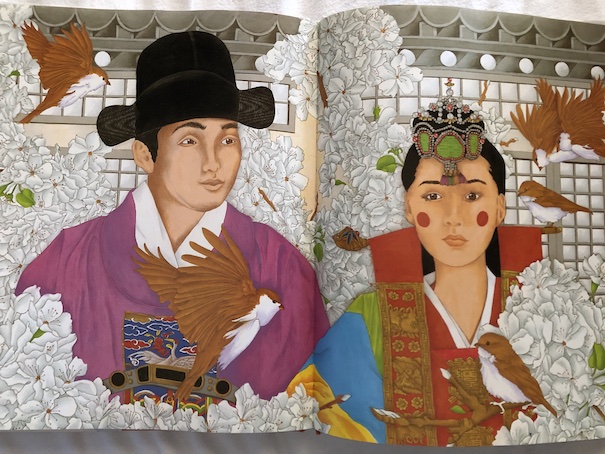
There is an Author’s Note in the back of the book about the background of this fairy tale, and the author notes that there are multiple Korean versions of this story. There’s also an Illustrator’s Note that discusses the style of the illustrations. It explains about how designs that appear in the illustrations are based on designs from Korean temples, and there is also information about the clothing the characters wear.

The book is available to borrow and read for free online through Internet Archive.

Shirley Climo has written multiple picture books about versions of the Cinderella story form around the world, and it’s fascinating to see how a story that so many of us recognize varies from country to country while still maintaining the same basic pattern. An aspect of this particular version of the story that Climo explains in her Author’s Note is that the animals that help Pear Blossom in the story are sent by a kind of “goblin” called a tokgabi or doggabi. The story itself says this, but in folklore, this kind of “goblin” can represent the benevolent spirit of someone who has died. In this story, the spirit might be Pear Blossom’s mother. This explanation makes sense to me because I remember reading something similar about the Chinese version of the Cinderella story. The story of Rhodopis, which Climo retold in The Egyptian Cinderella, may be the oldest form of the Cinderella story, and it doesn’t have that element of the girl’s deceased mother helping her through trials until she finds happiness, but it does put the concept of the Fairy Godmother from European version of the story in a different light.

This is another children’s picture book where I appreciated the notes from the author and illustrator because they add more depth to the story. When I was a kid, I never read notes like that because I was only interested in the story itself, but notes like this make the book more appealing for older readers.

The Persian Cinderella

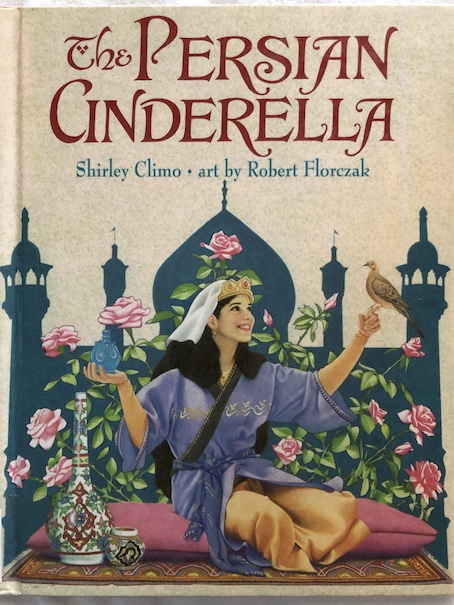
This is a Persian version of the classic Cinderella story.

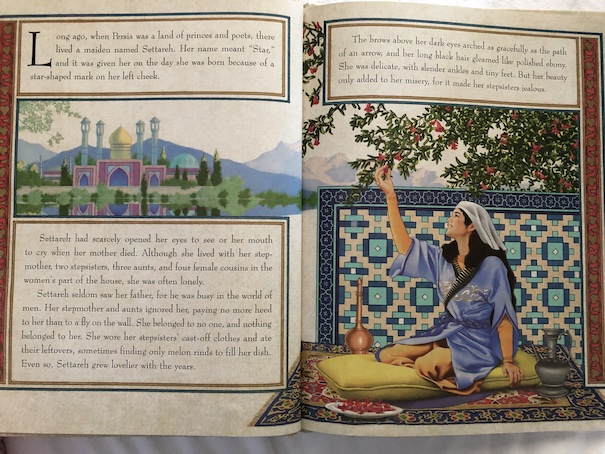
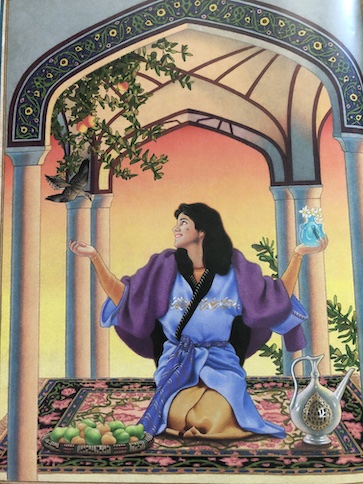
There is a lovely girl named Settareh, a name that means “star” because she has a star-shaped birthmark. Her mother died shortly after she was born, so she has grown up with a stepmother, two stepsisters and some aunts and cousins. Her father leaves her to the women of the family to raise, but she is often ignored and neglected by them. Her stepsisters are jealous that she is pretty and are mean to her.

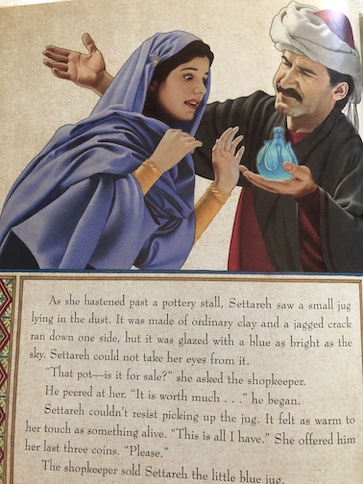
Then, one day, her father visits the women and gives them each some money to buy cloth for new clothes because the princes is inviting everyone to his palace to celebrate the New Year. However, in the market, Settareh spends her money on other things and has none left to buy cloth. She spends part of her money for something to eat because she’s hungry, and then, she gives some to a poor beggar woman as an act of kindness. Finally, she finds herself compelled to buy a strange blue jug. Her stepsisters tell her that she was a fool for buying the jug, which has an obvious crack in it and for wasting the money that she was supposed to spend on cloth, but Settareh still loves the little blue jug.

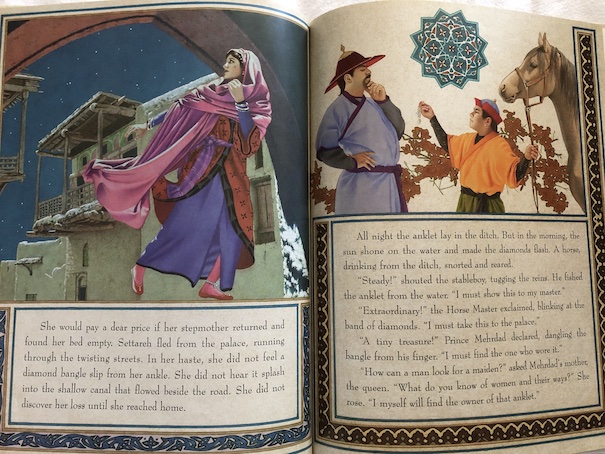
Then, Settareh discovers that the jug has a fairy inside and has the ability to grant wishes! Although her relatives think that Settareh won’t be able to attend the festival at the palace because she doesn’t have anything appropriate to wear, Settareh secretly asks the jug for a special gown and comes to the festival anyway. People at the festival don’t recognize her and think that she’s a visiting princess, and she catches the eye of the prince. However, she leaves the party quickly so she can return home before her family, accidentally losing a diamond anklet as she runs away. One of the prince’s servants finds it and gives it to the prince, who begins to search for the girl who wore it.

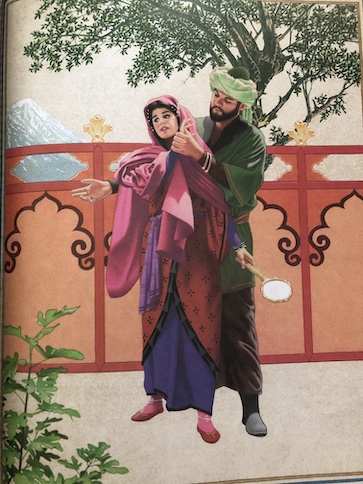
When the prince finds Settareh, he proposes to her, but Settareh’s jealous stepsisters scheme to get rid of her and take the magic jug for themselves! Settareh will need the prince’s help to escape!

There is an Author’s Note in the back, explaining more about this version of the story, which comes from The Arabian Nights, and some background information to the story, including a little about the New Year festival of No Ruz in the story, which is still celebrated in Iran. There is also an Artist’s Note about the style of the artwork.

The book is available to borrow and read for free online through Internet Archive.

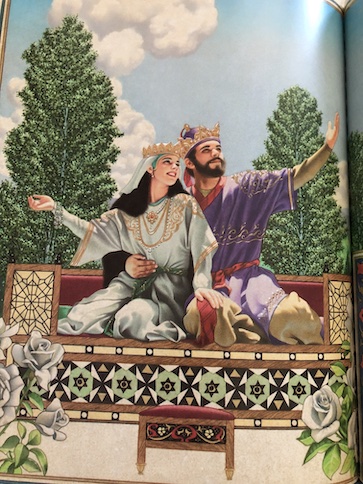
I enjoyed this Persian version of the Cinderella story! I like Shirley Climo’s picture book series showing different versions of Cinderella stories from around the world, including The Egyptian Cinderella and The Korean Cinderella. One of the parts of this story I found the most interesting is that the story doesn’t end when the prince finds the girl who attended his party, as so many other versions of the story do. There is one last obstacle for the couple to overcome, when Settareh’s mean stepsisters use the magic of the jug to turn Settareh into a bird, until she flies to the prince, and he changes her back. I don’t now whether adding one more obstacle to the story enhances it that much, but I appreciated it as an interesting twist. It also resolves the matter of the jug because, while it grants the stepsisters’ evil wish, their wish also destroys the jug, so the wishing is over.

The artwork in the book is beautiful. The artist tried to make the art style as authentically Persian as possible, using models for the characters who were ethnically Persian (Iranian). The artist used a combination of water-based markers, colored pencils, and ink, and pictures are lively and full of color.

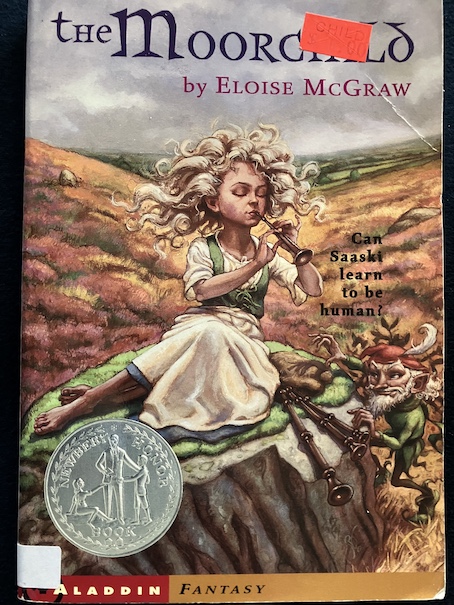
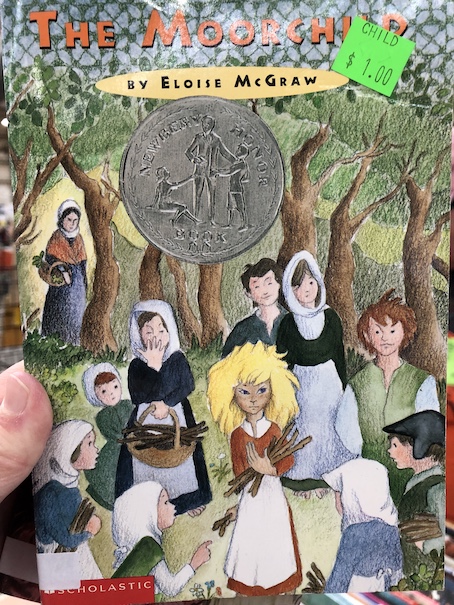
The Moorchild

When Saaski was only a few months old, her grandmother, Old Bess, started to notice that she didn’t look right, compared to the rest of the family or even compared to the way she looked when she was a newer baby. The grandmother tried to brush those thoughts aside, thinking that children change as they grow, and people of the village think that she’s odd herself as a widow who lives alone and knows about herbs. All the same, Saaski seems unusually fussy and throws tantrums, becoming a child who’s difficult to control. It could just be colic, or it could be something stranger.

Old Bess begins to put the pieces together about Saaski’s strange behavior. Saaski seems to hate or fear her own father, and Old Bess realizes that it’s because he is a blacksmith and wears an iron buckle on his belt. Saaski has an aversion to iron. She also has an aversion to salt, and only honey seems to soothe her. Saaski’s eyes change color from time to time, and Old Bess realizes that Saaski not only isn’t her grandchild but that she isn’t even human. Saaski is a changeling, a fairy child switched out for the human child before her christening.

When Old Bess tries to tell her daughter and her husband that Saaski is a changeling, her daughter refuses to believe her. Her husband seems to consider that Old Bess might be right, but he absolutely refuses to do the cruel things to the child that Old Bess tries to tell them will cause the fairy folk to take the changeling back and bring them their real daughter. Old Bess says that Saaski must either be made to tell her true age, which she cannot do because she cannot talk yet, or the parents must do cruel things to her, like beat her, burn her, or throw her down a well. The parents say that they cannot do such things to a baby, no matter what kind of baby it is, and they no longer want to discuss the matter, forbidding Old Bess to tell anyone else of her suspicions.

However, in this case, Old Bess is correct. The child known as Saaski is a changeling, and she knows it herself. Although she is in the form of a human baby, she knows that she is not really a baby. Her fairy name was Moql. She doesn’t know her true age, but she knows that she is a fairy youngling and that she used to live among the other fairies in the fairy mound. She doesn’t like being part of this human family, and she wishes that the fairies would take her back, but she knows that, whatever happens, they never will reclaim her. Even if this family treats her cruelly and the fairies decide to remove her from their house, she knows that they will just place her with a different human family.

The problem is that, unlike other fairies, Moql has no ability to hide from humans. Other fairies can change their shape or color, fade, or just wink out of human vision entirely, but Moql can’t. The fairies discovered it one day when Moql was unable to hide from a human shepherd. She is able to escape from the shepherd, but her blunder isn’t forgiven by the other fairies. Moql’s inability to hide from humans was considered a danger to whole band of fairies. She was taken before the prince of the fairies. When he sees that Moql cannot hide from humans, he remembers that a human man entered the fairy mound some time ago and stayed awhile with a fairy woman. Moql’s mother was a fairy, but her father was that human. As a half-human, Moql will never have the abilities that the other fairy younglings have.

When Moql is considered a danger to the other fairies, they feel little attachment to her or desire to keep her. They don’t consider a half-human likely to work out among the fairies, so they decide to swap her for a human child who might make a good servant to the fairies. They’ve done this before with other younglings like Moql. Moql is frightened because she doesn’t know how to be human. Life in the fairy mound is all that she knows. She is only half human, and if she’s not working out as a half fairy, how can she possibly work out as a human? What if she can’t work out as a human? Will she belong anywhere? What if she belongs nowhere?

The fairies tell her that she will start life all over again as a human baby and that she will forget all about the mound and her past life. The other fairies think nothing of casting her out. None of them really care about her. The fairies don’t feel emotions like humans do, and they don’t feel very much about anybody. Moql’s birth mother doesn’t feel anything for her but a mild curiosity and no concern for her future. Fairy mothers don’t really develop an attachment to their children, who are raised communally in the fairy nursery and school. Most fairies don’t even know who their parents are, and they don’t really develop feelings for their parents any more than parents feel attached to their children. Even fairy couples don’t stay together very long, forgetting about each other when they become bored with the relationship and moving on to others. Fairies don’t really care that much about relationships, like brother and sister, and fairies don’t even have a sense of what being a “friend” means. So far, even Moql hasn’t felt that much for anybody, either. Moql’s first human feelings come with her despair about being torn away from everything and everyone she’s ever known, made worse from realizing that nobody else feels anything for her. In their position, she might not feel anything for the loss of one of them because that’s the fairy way, but the human part of Moql longs for belonging and fears what will happen to her if she can’t find a place or people to belong to.

When Moql wakes the next day, she finds herself as the baby Saaski, but in spite of what the fairies said, she still retains her memories of her fairy life. Everything in this human household is strange. She fears the people who are supposed to be her parents, and most of the things that they offer her to soothe her aren’t soothing to a fairy or half-fairy, which is why she screams and throws tantrums. When she hears Old Bess describe her as a changeling and tries to urge her parents to do things to get rid of her, Moql realizes that she is stuck as a human, no matter what happens. Her only hope is to make herself forget or at least pretend that she doesn’t remember being a fairy and to try her best to be the human baby Saaski. It means pretending that she doesn’t have the ability to do things that a human baby shouldn’t be able to do and that she doesn’t know things that she actually does know. It’s not easy, but Saaski’s memories do fade a bit with time. She has vague memories of her past life, but the longer she lives as a human, the less she remembers of her past.

Time passes, and Saaski grows into a child, but the humans around her have an odd feeling about her. They whisper about her behind her parents’ backs. She doesn’t look like other human children, and odd things seem to happen around her. Saaski doesn’t trust Old Bess because she knows that Old Bess has always suspected she was a changeling. Other children in the village have heard their parents whispering about Saaski, and they start asking her if she really is a changeling. By that point, Saaski isn’t sure anymore what that means.

Old Bess does look for an opportunity at first to get the fairies to take back the changeling, considering shoving her into a pond at one point. However, when she realizes that Saaski has real feelings, she cannot bring herself to do it. She realizes that Saaski is also a victim of the switch when she was exchanged for the real Saaski. She doesn’t really belong among them, Saaski knows it, and Old Bess can tell that it hurts that she’s different and that others don’t accept her. Old Bess isn’t sure how much she understands about herself, her past, or her situation, but it’s been as unfair to her as it has been to the real Saaski and her family. The sense of belonging Saaski craves eludes her.

The only place Saaski really feels at home is out on the moor by herself, although she doesn’t really remember why anymore. That is where she first meets the orphan boy, Tam, who travels with the tinker. Tam knows what other people say about Saaski, but he isn’t afraid of her and likes her anyway. He is the first person who really seems to accept Saaski. For a time, her father forbids her to go on the moor again after she has a distressing encounter with a shepherd, who seems to recognize her as being a fairy.

Surprisingly, Old Bess turns out to be an ally of Saaski’s, urging her parents to let her go to the moor again. She knows how restless Saaski has been, confined to their home. The only thing that has soothed her is the old bagpipes that once belonged to her father’s father. She seems to know how to play them without anyone ever teaching her. Eventually, her parents allow her to return to the moor, partly so she won’t keep playing the bagpipes at home. When she’s able to see Tam again, he is happy to see her, and she shows him how she can play the bagpipes.

There are other things that Saaski seems to know without knowing how she knows. She sometimes sees strange symbols that no one else seems able to see. When Old Bess realizes that she can see these symbols, called runes, the two of them discuss it. Old Bess can’t see them herself, but she knows about them. She learned a lot about such things from an old monk she once cared for and from the books he left behind, which is also where she gained her knowledge of herbs.

Old Bess admits to Saaski that, like her, she is considered strange and that she doesn’t quite belong to the village where they live. She was brought to the village as an infant after she was found abandoned in a basket at a crossroads. They left her at the miller’s house, and she was raised by the miller and her wife. She doesn’t know who her birth parents were, where they came from, or why she was abandoned as an infant, and she was told that the gypsies who found her almost drowned her as a changeling before deciding to leave her in the village.

Saaski also knows that she doesn’t belong in the village, although she can’t think where she does belong. She can’t explain how she is able to see and understand fairy runes or do the other things that she seems able to do, apparently without anyone teaching her. Over time, she gradually discovers or rediscovers the things she could do and knew as a fairy. She discovers that she can see fairies when she spots one stealing Tam’s lunch. Later, a group of fairies try to steal her bagpipes. To Saaski’s surprise, she is able to understand their language, and they seem to recognize her.

Then, after the children in the village bully Saaski again, an illness comes to the village, afflicting all of the children but Saaski. Old Bess says it’s a normal childhood illness she’s seen before, and the children probably got it from the gypsy band who recently passed through town. However, the villagers, who have always been suspicious of Saaski whisper that Saaski is responsible, that she has cursed the other children. Saaski denies is, but the villagers are becoming increasingly hostile. They want her out of the villager, but if Saaski can’t stay there, where can she go?

When Saaski tries to bargain with a fairy for some help to hide from the villagers, the fairy reminds her that she was a fairy herself and that she was never able to disappear. Saaski is stunned at this confirmation of the villager’s suspicions about her being a changeling. When she tells Old Bess about it and about the memories that are now returning to her, Saaski realizes that she really doesn’t belong in this human village, at least not fully. Yet, she remembers that she doesn’t fully belong among the fairies, either. Once again, it leaves her the question of where she does belong. Saaski is going to have to take her fate into her own hands, but before she does, she wants to do something for the family that raised her and has loved her, in spite of everything: find the original Saaski in the fairy mound and return her to her parents.

The book is a Newbery Honor Book.

I enjoyed the story because it is a unique portrayal of the folkloric idea of changelings. Another book I read on the same topic, The Half Child, is told from a real world, historical point of view, without fantasy. In that book, changelings are disabled children or children who aren’t “normal” in some way who are labeled as being something other than human or “real” children because people of the past couldn’t understand why they were different or what was wrong with them.

The Moorchild, however, is fantasy and builds on the folklore concept. In other books with changelings, we see the changelings from the point of view of other people, who wonder about their true nature, but this book includes multiple viewpoints, including that of the changeling herself. In folklore, it isn’t entirely clear why the fairies would want to change their children with human children, leaving them to be raised by other people and possibly never seeing them again. This book builds on that concept, portraying the changeling children as being half human and/or flawed in some way, compared to the other fairies. They do use the human children they gain in the swap as servants, which is a folkloric concept, but this story explains why the fairy child left in exchange for the abducted human child is an acceptable loss to the other fairies.

Fairies in this story don’t have the same types of feelings as humans. In fact, they don’t seem to feel much at all, making most of their lives literally care-free because they just don’t care that much about others or the consequences of their actions. However, they don’t feel much emotional attachment to each other, either. Saaski/Moql’s birth mother doesn’t feel much of anything for her daughter or for the man whose life she changed and worsened through her seduction and rejection. She is completely unconcerned about what has happened to them or what will happen to them because of her. Later, Saaski realizes that the fairies are aware that Saaski is blamed for pranks they played, but they don’t mean it spitefully. They genuinely don’t care whether Saaski or someone else is blamed for things they do as long as they never get caught themselves. When Saaski realizes that the other fairies genuinely don’t care about her or what happens to her, she knows that they will never take her back and that she will never rejoin them.

Saaski feels more emotion than full fairies feel, but she doesn’t always respond in acceptable or predictable ways to the humans she lives with because she doesn’t share all of the emotions they feel. She craves a sense of belonging, but she doesn’t really know how to get it or create it. At times, she feels love and gratitude without being entirely sure what she’s feeling or how to express it. Strangely, she also doesn’t experience hate and resentment in the same way humans do. Tam tries to explain it to her, and Saaski recognizes that the children in the village who bully her feel hatred and resentment to her, but she doesn’t feel those emotions herself. She doesn’t like it when they bully her, and she feels hurt by them, but the emotion of hating and wanting to hurt them back isn’t there. I thought that was an interesting concept, exploring someone with non-conforming emotional reactions. Saaski’s emotions in the story are explained by her fairy heritage, but what made it interesting to me is that neurodivergent humans also have different ways of experiencing and showing emotions that can change the way they are accepted by or interact with other people, which brings the idea of changelings full circle, back to the concept of children who aren’t like other children from birth or a young age.

I thought it was fascinating that we get to see things both from Saaski’s point of view and from the point of view of other people, particularly Old Bess. Old Bess is the first to realize that Saaski is a changeling and not her “real” granddaughter. She understandably wants her real granddaughter back, and she knows the folklore that fairy folk will take back a changeling who has been abused. However, Saaski’s parents, even knowing or suspecting that Saaski might be a changeling, cannot bring themselves to do anything cruel to her, and Old Bess comes around to that point of view herself. By observing Saaski, she sees that Saaski is a child, if not an entirely human child, and an innocent victim of the switch herself, with feelings and a difficult life ahead of her because she doesn’t fit in with this community.

Old Bess also recalls and admits to Saaski that her own past isn’t quite normal and that she also doesn’t quite fit in. I wondered if we would ever get the full story of Old Bess’s past, but unfortunately, we don’t. We know that she was abandoned as an infant, apparently rejected by her birth family or guardian, but we never learn why. I had wondered at first if Old Bess would turn out to be a grown-up changeling. It seems that people once suspected that about her, but apparently, she isn’t because she can’t see the fairies or fairy writing in the way Saaski does. It seems that Old Bess is fully human and not half fairy. In the end, the important point is that, when Old Bess is honest with herself and Saaski about her past, her story has some elements in common with Saaski’s situation. They have both known rejection and abandonment, the difficulties of trying to fit in when they don’t entirely fit in, and the love of people who accepted them and cared for them in spite of it all.

I appreciated that Saaski’s parents do their best to love and care for Saaski even when they know she’s strange and may not be their daughter. They stand up to the people who bully their daughter and pressure them to get rid of her. In fact, in the end, even after Saaski and Tam set out into the world together and they have their birth daughter back, they still think of Saaski and miss her sometimes. Saaski was no replacement for the daughter they lost when they were switched, but at the same time, they realize that their birth daughter doesn’t entirely replace Saaski in their lives and affections. In the end, it’s like they’ve had two daughters, both of them “real”, although one didn’t fit in and eventually left to start a new life elsewhere.

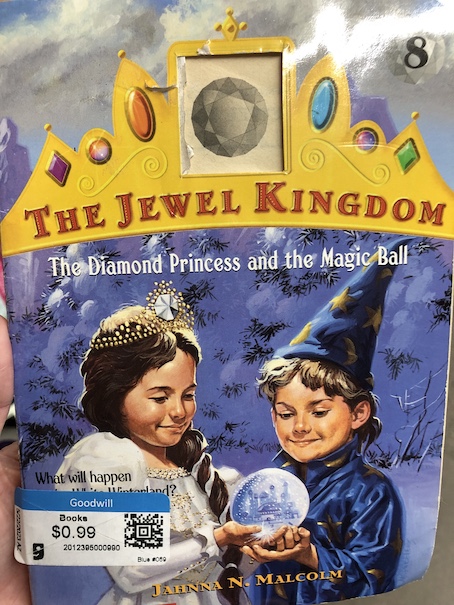
The Diamond Princess and the Magic Ball

The Jewel Kingdom

Demetra is the Diamond Princess, and she lives in the White Winterland. She and each of her sisters has a different castle and region to rule over in their parents’ kingdom, but they still spend time together. After a visit with her parents, Queen Jemma and King Regal, at the Jewel Palace, Demetra finds herself worrying about how she measures up to her sisters. It seems like each of them has done something special for the people in their region, but Demetra can’t think of anything special she’s done. She talks about it with her friend, Finley the fox, but she can’t think of anything really special to do.

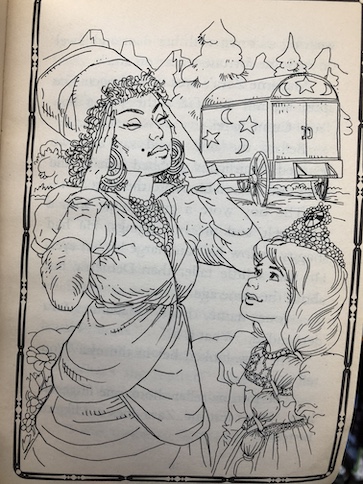
On the way home, they see a wagon with performers giving a show. Princess Demetra wants to stop and watch the show, but Finley warns her that it could be dangerous because they’re near the Mysterious Forest, which is a dangerous region. Demetra insists on stopping anyway, and she meets a fortune teller called Madame Zara. Madame Zara says that she can see that Demetra is a princess, and a boy from the audience says that’s not much for a fortune teller to see because Demetra is obviously wearing her crown.

Madame Zara says that she knows who the boy is, too. His name is Wink, and Madame Zara says that he’s a failed student wizard, rejected by the Wizard Gallivant. Demetra also knows Gallivant because he appointed her as the Diamond Princess. Madame Zara could have figured out Wink’s identity because his wizard robe is peeking out from his pack and has his name on it, but the part that’s harder to figure out is how she knew that the frog hidden in Wink’s shirt is actually his dog. Wink accidentally turned his dog into a frog.

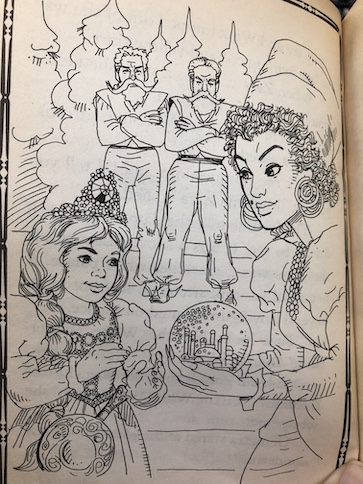
Demetra decides that’s good enough proof that Madame Zara knows things other people don’t, so she asks her to tell her fortune. Madame Zara shows her a beautiful snow globe that looks like it has a scene of the White Winterland inside. Demetra can even hear the voices of people she knows inside it. Madame Zara says that the magic ball tells the future and asks Demetra if she would like to have it. Demetra says she would, although Wink tries to warn her not to trust Madame Zara. However, Demetra lets Madame Zara take a lock of her hair in trade for the magic ball.

As Demetra continues on her way home, she begins to see that the snow that always covers the White Winterland is melting! Something is terribly wrong, and it may have something to do with the magic ball!

The book is available to borrow and read for free online through Internet Archive.

I never actually read any of the Jewel Kingdom books when I was young, but I remember them being sold in stores along with little jeweled charms. It doesn’t take too long to get into the lore and backstory of the series, even though I’ve read the few books I’ve read out of order.

There are recurring villains in this series, especially Lord Bleak and his minions, called Darklings. When the Darklings appears in this story, the book explains who they are and about Lord Bleak’s backstory. Lord Bleak was an evil tyrant who used to rule the Jewel Kingdom, until he was vanquished by Queen Jemma and King Regal. Since then, he’s been trying a series of evil schemes to regain control. The Darklings used to be beautiful, but they were corrupted by evil, and now they’re hideous creatures in dark robes.

Because this story is meant for young children, Demetra makes the mistake of entering into a suspicious trade with a shady character, apparently not having had the “stranger danger” warnings and not heeding her friends’ concerns. Of course, it turns out that the lock of hair she traded for the magic ball was important because it gives the person who holds it power over her and her kingdom. To save her kingdom, she has to get her lock of hair back.

I enjoyed the story, though. It has a colorful setting, and I liked their trip to the Bizarre Bazaar.

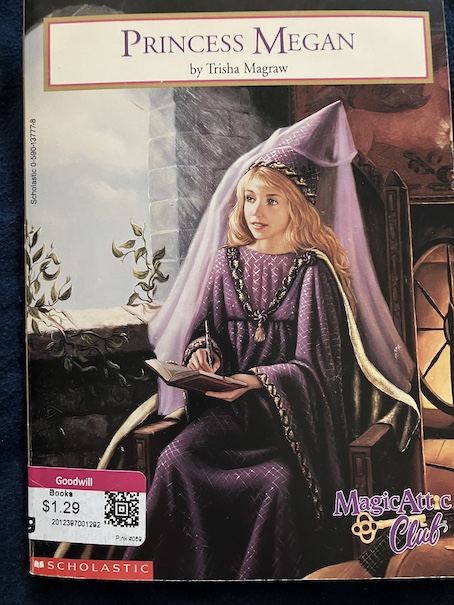
Princess Megan

The Magic Attic Club

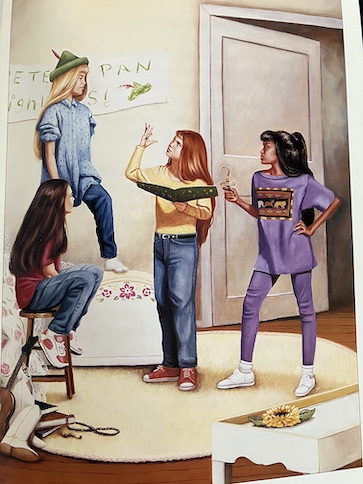
Meg and her friends are planning to perform a short play of Peter Pan at a local nursing home. Her friends chose her to be their director, and Megan is really looking forward to it. Then, her mother does something that threatens to derail the project.

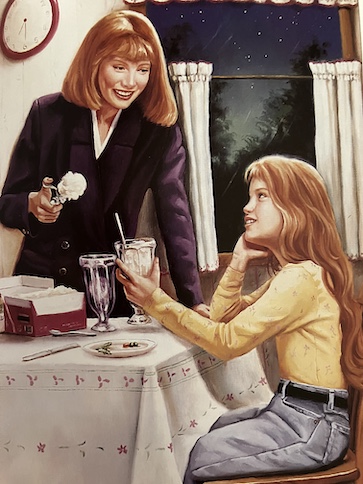
Megan’s mother is a lawyer, and she frequently has to work late. The problem is that, this time, she’s going to have to work on Saturday, interviewing witnesses for a trial. However, that Saturday, Megan’s mother was supposed to be at the high school, receiving donations for a food drive. She asks Megan to take care of the food donations, but the problem is that the play Megan and her friends are supposed to perform is also on Saturday. Helping with the food drive would make it difficult for Megan to get to the play on time. Megan’s mother is tired and in no mood to listen to Megan’s objections that it wouldn’t be fair to derail her project with her friends. Her mother just wants Megan to take care of her obligations for her.

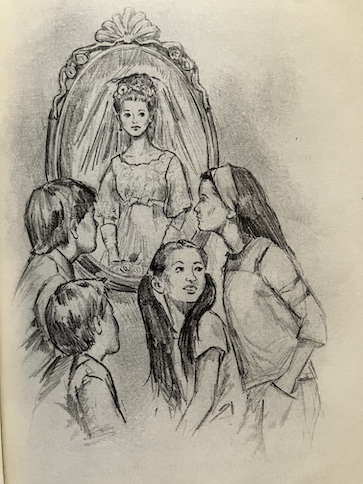
While Megan is fuming about the unfairness of the situation and worrying about what to do, she decides to visit their neighbor, Ellie Goodwin. Megan and her friends have a standing invitation to visit and explore her attic, which has the ability to send them to other places and times when they put on different costumes and look at themselves in the mirror.

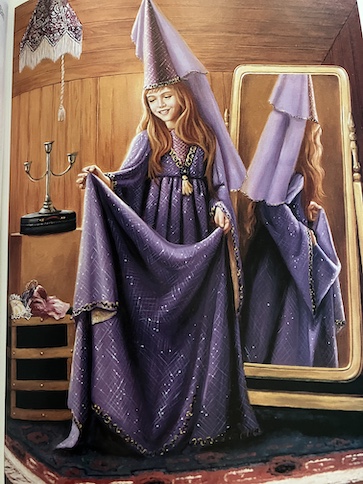
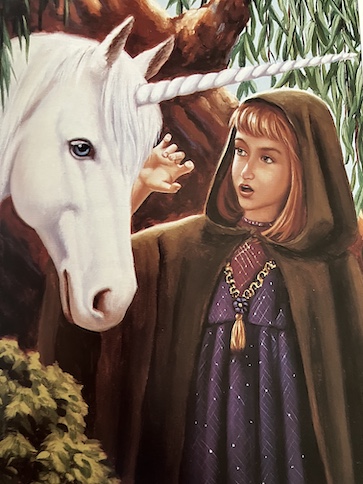
This time, Megan tries on a purple princess dress, and she finds herself in a Medieval village in France, near a castle. She meets a peasant girl named Michelle. Michelle tells her that there’s been trouble over the matter of the unicorn and the feast.

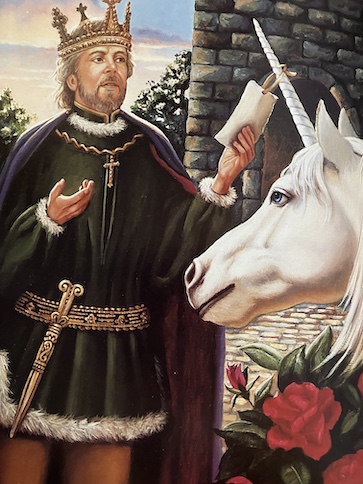
When Megan asks what she means, Michelle explains that Lord Claude and Lady Helene are hosting a feast and joust at their castle and that the king (who is supposedly Megan’s father in this world) has been invited as an important guest. At the end of the feast, they want to give the king a unicorn’s horn as a gift, but the problem with that is that they have to kill the unicorn to do that. Alternatively, it is possible to befriend a unicorn and get filings from its horn that also have magical powers, but Lord Claude and Lady Helene want to give the king the whole horn. Michelle confesses to Megan that her mother, who works in the castle’s kitchen secretly released the unicorn that they’d captured for the purpose. If they knew she was the one who did it, she would be in serious trouble.

Megan wants to help Michelle and her mother, and as someone who supposedly has the rank of princess, she should have some authority. However, she’s not entirely sure what kind of influence she can have because she knows that she’s not a “real” princess. Everyone thinks that she’s the king’s daughter, but Megan knows that she’s not. Can Megan find another way to save the unicorn’s life and Jacqueline from punishment, without revealing herself as an imposter princess?

The book is available to borrow and read for free online through Internet Archive.

Some children’s books that involve time travel have real, historical information for educational value, but this one, and others in the series, are pure fantasy. Megan doesn’t visit real Medieval France. This is a fairy tale version of the Middle Ages with a unicorn and an invisibility cloak. There are a few accurate details for the Middle Ages, like the practice of using straw or other plants on the floors and the fact that intricate tapestries took years of work to complete. However, the focus is definitely on fantasy.

The invisibility cloak is critical to Megan’s plan to save the unicorn and make the king realize the value and beauty of the unicorn before someone can kill it on his behalf. When the king sees the unicorn for himself and reads the note that Megan wrote for him, he accepts the living unicorn and its presence as his gift instead of the horn. The problem with the unicorn is resolved pretty quickly, and so is Megan’s situation with her mother.

At first, I was expecting that the situation that Megan encountered in the fantasy world would have more of a direct parallel to Megan’s situation in her regular life, but it doesn’t really. It mostly serves as its own adventure, although it does highlight that Megan is creative when it comes to problem-solving and can be relied on in difficult circumstances. What Megan really needs to do is to explain to her mother why it would be difficult for her to take over her mother’s project without compromising her own. When Megan finally explains, it turns out that her mother didn’t know about her project with her friends. Handling both of their projects requires some careful scheduling and a little help from a friend, but they manage to work it out.

I really like the pictures in the Magic Attic Club books because they remind me of the ones in the American Girls books. They have a similar quality.