American Girls

Nellie’s Promise by Valerie Tripp, 2004.
This book is a companion book to the Samantha, An American Girl series, focusing on Samantha’s best friend, Nellie. Personally, I don’t like the companion books to the main American Girls books as well as the original books, but this book does follow up on the events to the main series. At the end of Samantha’s series, Samantha’s aunt and uncle took in Nellie and her sisters, Bridget and Jenny, after their parents died. Nellie and her sisters were from a poor family and had to start working from a young age before their parents died. After their parents died, their disreputable uncle abandoned them, and they were sent to an orphanage before Samantha discovered where they were. Samantha’s aunt and uncle are wealthy, and the girls’ lives have improved considerably.
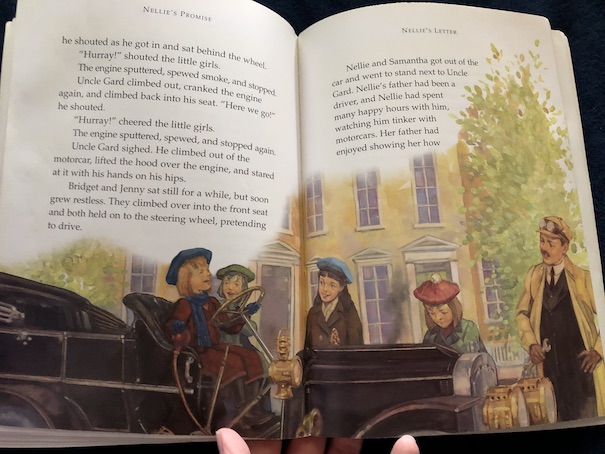
Nellie’s happiness is threatened by the sudden reappearance of her Uncle Mike. Uncle Mike sees Nellie walking down the street in her nice new clothes and wants to know what rich family the girls are living with. Nellie runs away from him, but he threatens to find out where she’s living and to take her and her sisters back, saying that it’s his right as her uncle. He says that he means to put the girls to work earning money for him. Nellie is afraid that he might be able to reclaim them from Uncle Gard and Aunt Cornelia because he is a blood relative.
At first, Nellie is afraid to tell anyone that she’s seen her uncle and that he threatened to take her and her sisters back. Before her parents died, her mother made her promise to look after her younger sisters, so Nellie makes up her mind that’s what she’s going to do.
Nellie worries about the future for her and her sisters. She feels like she doesn’t fit in with the wealthy girls at Samantha’s school, who have had very different lives from hers, and the lessons they learn are the type of lessons for fine young ladies who will marry rich men and spend most of their time raising families, overseeing a house with servants, and entertaining friends and their husbands’ business associates, not preparing for practical professions outside the home. Nellie thinks that it’s important that she have some kind of job skills because the future can be very uncertain, and she wants to know that she can provide for her sisters, no matter what happens.
Samantha senses that Nellie is unhappy, and she asks her if she likes living with Uncle Gard and Aunt Cornelia. Nellie tells her that she does, but she hesitates to explain what’s really worrying her. Instead, she lets Samantha think that she just wants to feel like she’s doing something useful for the family. Before her parents died, Nellie used to get sewing lessons at a settlement house (a place where immigrant families could go to learn English, new job skills, and other skills they would need in their new lives in the United States) run by Miss Brennan. Aunt Cornelia is involved with many good causes, and she wants to visit a settlement house and get an introduction to Miss Brennan. Because Nellie knows Miss Brennan, she can help arrange that. It’s in a rough part of town, but Nellie is more accustomed to navigating rough neighborhoods than Samantha or her aunt. It also occurs to Nellie that she could ask Miss Brennan what to do about Uncle Mike.

Miss Brennan is glad to see Nellie, and she lets her show Aunt Cornelia and Samantha around the settlement house. They have many different types of classes for children as well as adults. Nellie says that she likes the practical classes that she used to have there, and even the types of dances that they do seem more practical than the more purely artistic ones that they do at the school she now attends with Samantha. Aunt Cornelia is pleased with the classes that they offer for women, and because she is interested in women’s education, decides that she wants to help out at the settlement house. However, the visit to the settlement house leaves Samantha irritated for reasons that Nellie doesn’t fully understand.
As Nellie begins spending more time with Aunt Cornelia at the settlement house, Samantha begins spending more time with Bridget and Jenny, and Nellie becomes jealous of how Samantha seems more like their older sister than she is. However, the others still don’t know about Uncle Mike’s reappearance, and Nellie is still fearful of what he might do and what will happen to her and her sisters if Uncle Mike tries to take them away. She feels like her only option is to try to prepare herself for a better job than that of factory worker.
When Nellie finally gets the courage to tell Miss Brennan about her worries, Miss Brennan tells her that she needs to discuss the situation with Uncle Gard. Uncle Gard is a good man, but he’s also a lawyer, and he will know how to legally stop Uncle Mike from trying to take custody of the girls. However, Miss Brennan adds that, whatever else happens, Nellie will still need to make some decisions about her future and what she wants to do with her life and education. The more Nellie thinks about it, the more certain she is about what she wants to do. She wants to become a teacher, like Miss Brennan.
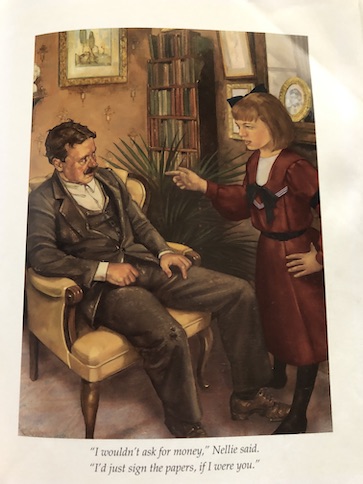
Nellie provokes more drama by applying to the boarding school in Boston where Miss Brennan said that she trained to be a teacher without talking to Aunt Cornelia, Uncle Gard, or Samantha about her decision or about her uncle. However, when the truth comes out about Uncle Mike, everyone understands that she was trying to hide and protect her sisters from him. It turns out that Uncle Gard has actually been looking for Uncle Mike because he already has the documents that he needs to legally adopt Nellie, Bridget, and Jenny, and he just needs Uncle Mike to legally release them into his custody. At first, Uncle Mike tries to extort money from Uncle Gard for the girls, but Nellie gets up the courage to tell him off, promising that if he doesn’t sign the papers and leave, she’ll tell everyone about how he stole all of their money and abandoned them to freeze the last time they were in his custody. The book ends happily, with Aunt Cornelia and Uncle Gard adopting the girls and understanding Nellie’s ambition to be a teacher. They enroll Nellie in a school in New York that teaches the skills she really wants so that she can continue living with them and not go to Boston. It also turns out that Samantha was mostly uncomfortable at the settlement house because she felt so sorry for the young children there and that spending time taking care of Bridget and Jenny was part of her way of trying to help Nellie by leaving her more free to do some of the things that she felt like she had to do. With everything out in the open, Nellie and her sisters are able to more fully become part of the family.
In the back of the book, there is a section with historical information about orphans and adoption in the early 1900s. There were not many laws and regulations governing care of orphans. Usually, orphans would be taken in by relatives, like Samantha was when her parents died. If a child didn’t have any relatives who were willing and able to take them, the child might be sent to an orphanage and possibly sent west on an orphan train as Nellie almost was at the end of the Samantha series. Families didn’t usually adopt children from different levels of society.
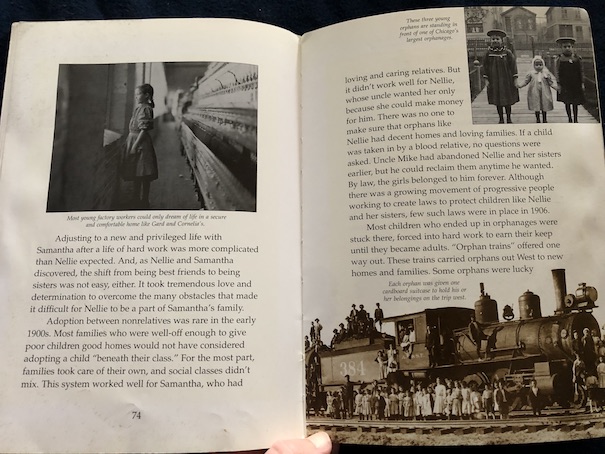
Settlement houses were important resources for poor immigrant families, and the education they received allowed immigrants to enter higher professions than servant or factory worker, which had been the primary source of income for many of them. It was common for settlement houses to help train young women to become teachers. There are still similar institutions and organizations in operation in 21st century America.

The book is available to borrow for free online through Internet Archive.
My Reaction and Further Historical Information
Part of the reason why I don’t like the companion books as much as the original American Girls series is that they tend to get more dramatic than the original books, and sometimes, I feel like the attitudes of the characters are less realistic for their time periods than they were in the original books. I think what made the original books more realistic was the restraint of the stories – they had their share of excitement and sometimes drama, but they never went overboard. The return of Nellie’s disreputable uncle struck me as both unlikely and unnecessary to Nellie’s and Samantha’s larger stories.
The historical details in this book are good. What they say about orphans of the time is basically true, although they note in the historical information section in the back of the book that Nellie’s experience of being adopted by a wealthier family was not typical of the time, and I think that’s part of what bothers me. Adoptions in general during the early 1900s were less formal than they are in modern times, and the idea of Uncle Gard hiring a private detective to find Uncle Mike and get him to sign legal documents doesn’t seem entirely realistic. I think it would have been more realistic to me the way that the last Samantha book ended, with Uncle Mike leaving and the assumption that none of the characters would see him again.
The reason why Nellie and her sisters were sent to the orphanage and why the orphanage was considering sending Nellie west on the orphan train was that no one expected that Uncle Mike would ever want to see the girls again. He’d already taken everything he could from them and left with them with no concern for what would happen to them. In the time that has passed since then, I would have expected that Uncle Mike would already have gotten into trouble that would keep him busy and out of their lives, maybe ended up in prison for being drunk and disorderly or hopping from job to job or begging for money as their little money ran out. Even if Uncle Mike had some thought of finding the girls, I don’t think it’s likely that he would have succeeded or even gotten close on his own because he is not that bright and he is not the kind of person who makes friends in places where he’s been before. I doubt that his former neighbor who took his nieces to the orphanage would have told him much if he had shown up again, looking for them. She knew that he was a drunk who abandoned the girls, and she made it clear that she didn’t like him. The people at the orphanage would have probably sent him away with no information because they would probably view the situation as closed since the girls are already placed out and Mike may not even have any proof of his identity and relationship to the girls. There is no such thing as a driver’s license during this period and many people did not even have birth certificates, so it’s possible that the people at the orphanage could simply choose to disbelieve this disreputable character and send him away. When I was watching a documentary about the orphan trains, former orphan train riders said that the orphanages that sent them west deliberately took notes from them that had their living parents’ addresses and otherwise cut off contact with living parents because they wanted the children to sever their ties to their difficult pasts and devote their attention to their new families, not maintain contact with the parents who were unable to care for them financially, so I wouldn’t expect that anyone at the orphanage in these books would go out of their way to reunite the orphaned girls with a rather shady uncle when they knew that the girls were already placed with a wealthy family and no longer their responsibility. Without help, which would be unlikely to be forthcoming, it doesn’t seem likely that Uncle Mike would be able to stumble on the girls by accident. As mentioned in Changes for Samantha, New York is a big city, people can be difficult to find if you don’t have a hint of where to look, and the wealthier part of the city where Nellie and her sisters live now is not a part of town where a guy like Uncle Mike would be likely to hang out. They could all easily live in New York City for years without meeting each other.
I feel like the situations in the story were a little contrived. By now, I would have thought that Nellie would know that Uncle Gard is a lawyer and would be the best person to ask about the laws. I don’t recall the earlier books saying what Uncle Gard did for a living, but Nellie lives with him now, and I would think that someone would have mentioned Uncle Gard’s profession by now. In the book, it oddly seems like as much of a surprise to Nellie as it is to the readers. I could believe that Nellie would go to the settlement house and do volunteer work there with Aunt Cornelia because it was already established in the previous books that Aunt Cornelia supports good causes, and although women of her level of society didn’t usually work for living, supporting good causes and charitable works would have been acceptable. Nellie’s level of knowledge seems a little odd, considering that she needed extra tutoring in basic subjects, like reading, in Samantha Learns a Lesson. In that book, Nellie never mentioned settlement house lessons, which she would have done if it hadn’t been a sudden decision to insert that this in book. Here, Nellie talks about classes that she had at the settlement house, where I would have expected to have more lessons to improve her reading, and it seems like she learned more there than she seemed to know before, even knowing a few words of foreign languages. In Samantha Learns a Lesson, one of Nellie’s skills was her ability to do math quickly handle money because she used to do the shopping for her mother, and in this book, she mentions that she helped to teach immigrants about American money, which she never mentioned before. These things are necessarily contradictory, but it all just seems a little off because they don’t quite fit into Nellie’s established character and history, and it implies that Nellie has had more education and training than she seemed to have before. It’s not necessarily impossible for a girl of Nellie’s time to know some of these things, but it’s the departure from what was already established about Nellie and her situation in life than kind of grates on me.
I think it could be reasonable for Nellie to develop the ambition to be a teacher. Even Samantha has previously some interest in that direction, having helped to tutor Nellie before. Not all women of this time went on to higher education, but those who did might attend a normal school, which is basically a college that focuses on training teachers. By contrast, the daughters of wealthy, high society families would be more likely attend a finishing school that emphasized social skills and entertaining more than academics. Both Samantha and Nellie are about twelve years old during this story and would be a little young for either of these options, but Samantha’s school seems to be more inclined toward preparing the girls for a finishing school. Given Aunt Cornelia’s interest in education and social causes and Uncle Gard’s support of it, I would expect that Samantha would be more likely to attend a women’s liberal arts college when she gets older, preparing her to marry a well-educated and culturally aware man as well as a wealthy one and probably engage in some form of social work and/or the arts in her spare time, but that’s just a guess. (I discussed some of this already in my review of Happy Birthday, Samantha. See also the book Daddy-Long-Legs for a description of what that might have been like for a girl of Samantha’s and Nellie’s time. The book was written a little later in than the time period of this book, but it’s set at about the right time for Samantha and Nellie to be old enough for college and includes characters of approximately their social backgrounds.) This book doesn’t really go into the subject, but if that’s the case, Samantha’s future might not be as different from Nellie’s as it first seems, and there might be a kind of middle path that both of them could choose. The Finch College in Manhattan, which was a fairly new preparatory school in Samantha’s and Nellie’s time, seems like it would have been a good option for both Samantha and Nellie, catering to upper-class girls while focusing on a more practical liberal arts education than the less academic finishing schools. Its founder, Jessica Finch, was a women’s rights activist and may have moved in similar circles to Aunt Cornelia. Her attempts to balance theoretical and practical knowledge sound like they would have appealed to the characters in the story. I’m not an expert on the Finch College, only having heard a little about it, but I think a school like that would present an intriguing possibility for the girls’ futures.
 Jestress's Forgotten Books and Stories